EP0360382B1 - Objet multicouche pour la génération d'une image latente avec possibilité d'enlèvement sans résidu - Google Patents
Objet multicouche pour la génération d'une image latente avec possibilité d'enlèvement sans résidu Download PDFInfo
- Publication number
- EP0360382B1 EP0360382B1 EP89306764A EP89306764A EP0360382B1 EP 0360382 B1 EP0360382 B1 EP 0360382B1 EP 89306764 A EP89306764 A EP 89306764A EP 89306764 A EP89306764 A EP 89306764A EP 0360382 B1 EP0360382 B1 EP 0360382B1
- Authority
- EP
- European Patent Office
- Prior art keywords
- face sheet
- sheet
- composition
- laminate construction
- face
- Prior art date
- Legal status (The legal status is an assumption and is not a legal conclusion. Google has not performed a legal analysis and makes no representation as to the accuracy of the status listed.)
- Expired - Lifetime
Links
Images

Classifications
-
- B—PERFORMING OPERATIONS; TRANSPORTING
- B41—PRINTING; LINING MACHINES; TYPEWRITERS; STAMPS
- B41M—PRINTING, DUPLICATING, MARKING, OR COPYING PROCESSES; COLOUR PRINTING
- B41M5/00—Duplicating or marking methods; Sheet materials for use therein
- B41M5/124—Duplicating or marking methods; Sheet materials for use therein using pressure to make a masked colour visible, e.g. to make a coloured support visible, to create an opaque or transparent pattern, or to form colour by uniting colour-forming components
- B41M5/165—Duplicating or marking methods; Sheet materials for use therein using pressure to make a masked colour visible, e.g. to make a coloured support visible, to create an opaque or transparent pattern, or to form colour by uniting colour-forming components characterised by the use of microcapsules; Special solvents for incorporating the ingredients
-
- G—PHYSICS
- G09—EDUCATION; CRYPTOGRAPHY; DISPLAY; ADVERTISING; SEALS
- G09F—DISPLAYING; ADVERTISING; SIGNS; LABELS OR NAME-PLATES; SEALS
- G09F3/00—Labels, tag tickets, or similar identification or indication means; Seals; Postage or like stamps
- G09F3/02—Forms or constructions
-
- G—PHYSICS
- G09—EDUCATION; CRYPTOGRAPHY; DISPLAY; ADVERTISING; SEALS
- G09F—DISPLAYING; ADVERTISING; SIGNS; LABELS OR NAME-PLATES; SEALS
- G09F3/00—Labels, tag tickets, or similar identification or indication means; Seals; Postage or like stamps
- G09F3/02—Forms or constructions
- G09F2003/0201—Label sheets intended to be introduced in a printer, e.g. laser printer
-
- G—PHYSICS
- G09—EDUCATION; CRYPTOGRAPHY; DISPLAY; ADVERTISING; SEALS
- G09F—DISPLAYING; ADVERTISING; SIGNS; LABELS OR NAME-PLATES; SEALS
- G09F3/00—Labels, tag tickets, or similar identification or indication means; Seals; Postage or like stamps
- G09F3/02—Forms or constructions
- G09F2003/0214—Stock management
-
- G—PHYSICS
- G09—EDUCATION; CRYPTOGRAPHY; DISPLAY; ADVERTISING; SEALS
- G09F—DISPLAYING; ADVERTISING; SIGNS; LABELS OR NAME-PLATES; SEALS
- G09F3/00—Labels, tag tickets, or similar identification or indication means; Seals; Postage or like stamps
- G09F3/02—Forms or constructions
- G09F2003/0225—Carrier web
- G09F2003/0226—Carrier sheet
-
- G—PHYSICS
- G09—EDUCATION; CRYPTOGRAPHY; DISPLAY; ADVERTISING; SEALS
- G09F—DISPLAYING; ADVERTISING; SIGNS; LABELS OR NAME-PLATES; SEALS
- G09F3/00—Labels, tag tickets, or similar identification or indication means; Seals; Postage or like stamps
- G09F3/02—Forms or constructions
- G09F2003/0276—Safety features, e.g. colour, prominent part, logo
-
- G—PHYSICS
- G09—EDUCATION; CRYPTOGRAPHY; DISPLAY; ADVERTISING; SEALS
- G09F—DISPLAYING; ADVERTISING; SIGNS; LABELS OR NAME-PLATES; SEALS
- G09F3/00—Labels, tag tickets, or similar identification or indication means; Seals; Postage or like stamps
- G09F3/02—Forms or constructions
- G09F2003/0279—Card, e.g. plastic
-
- G—PHYSICS
- G09—EDUCATION; CRYPTOGRAPHY; DISPLAY; ADVERTISING; SEALS
- G09F—DISPLAYING; ADVERTISING; SIGNS; LABELS OR NAME-PLATES; SEALS
- G09F3/00—Labels, tag tickets, or similar identification or indication means; Seals; Postage or like stamps
- G09F3/02—Forms or constructions
- G09F2003/028—Labels containing microcapsules, e.g. ink microcapsules for indicia transfer
-
- Y—GENERAL TAGGING OF NEW TECHNOLOGICAL DEVELOPMENTS; GENERAL TAGGING OF CROSS-SECTIONAL TECHNOLOGIES SPANNING OVER SEVERAL SECTIONS OF THE IPC; TECHNICAL SUBJECTS COVERED BY FORMER USPC CROSS-REFERENCE ART COLLECTIONS [XRACs] AND DIGESTS
- Y10—TECHNICAL SUBJECTS COVERED BY FORMER USPC
- Y10S—TECHNICAL SUBJECTS COVERED BY FORMER USPC CROSS-REFERENCE ART COLLECTIONS [XRACs] AND DIGESTS
- Y10S283/00—Printed matter
- Y10S283/901—Concealed data
-
- Y—GENERAL TAGGING OF NEW TECHNOLOGICAL DEVELOPMENTS; GENERAL TAGGING OF CROSS-SECTIONAL TECHNOLOGIES SPANNING OVER SEVERAL SECTIONS OF THE IPC; TECHNICAL SUBJECTS COVERED BY FORMER USPC CROSS-REFERENCE ART COLLECTIONS [XRACs] AND DIGESTS
- Y10—TECHNICAL SUBJECTS COVERED BY FORMER USPC
- Y10S—TECHNICAL SUBJECTS COVERED BY FORMER USPC CROSS-REFERENCE ART COLLECTIONS [XRACs] AND DIGESTS
- Y10S428/00—Stock material or miscellaneous articles
- Y10S428/914—Transfer or decalcomania
-
- Y—GENERAL TAGGING OF NEW TECHNOLOGICAL DEVELOPMENTS; GENERAL TAGGING OF CROSS-SECTIONAL TECHNOLOGIES SPANNING OVER SEVERAL SECTIONS OF THE IPC; TECHNICAL SUBJECTS COVERED BY FORMER USPC CROSS-REFERENCE ART COLLECTIONS [XRACs] AND DIGESTS
- Y10—TECHNICAL SUBJECTS COVERED BY FORMER USPC
- Y10S—TECHNICAL SUBJECTS COVERED BY FORMER USPC CROSS-REFERENCE ART COLLECTIONS [XRACs] AND DIGESTS
- Y10S428/00—Stock material or miscellaneous articles
- Y10S428/914—Transfer or decalcomania
- Y10S428/915—Fraud or tamper detecting
-
- Y—GENERAL TAGGING OF NEW TECHNOLOGICAL DEVELOPMENTS; GENERAL TAGGING OF CROSS-SECTIONAL TECHNOLOGIES SPANNING OVER SEVERAL SECTIONS OF THE IPC; TECHNICAL SUBJECTS COVERED BY FORMER USPC CROSS-REFERENCE ART COLLECTIONS [XRACs] AND DIGESTS
- Y10—TECHNICAL SUBJECTS COVERED BY FORMER USPC
- Y10S—TECHNICAL SUBJECTS COVERED BY FORMER USPC CROSS-REFERENCE ART COLLECTIONS [XRACs] AND DIGESTS
- Y10S428/00—Stock material or miscellaneous articles
- Y10S428/916—Fraud or tamper detecting
-
- Y—GENERAL TAGGING OF NEW TECHNOLOGICAL DEVELOPMENTS; GENERAL TAGGING OF CROSS-SECTIONAL TECHNOLOGIES SPANNING OVER SEVERAL SECTIONS OF THE IPC; TECHNICAL SUBJECTS COVERED BY FORMER USPC CROSS-REFERENCE ART COLLECTIONS [XRACs] AND DIGESTS
- Y10—TECHNICAL SUBJECTS COVERED BY FORMER USPC
- Y10T—TECHNICAL SUBJECTS COVERED BY FORMER US CLASSIFICATION
- Y10T428/00—Stock material or miscellaneous articles
- Y10T428/14—Layer or component removable to expose adhesive
- Y10T428/1476—Release layer
Definitions
- This invention relates to a clean release laminate construction upon which a latent image may be formed, and in Particular to a construction in which a releasable adhesive secures together two or more sheets upon which latent images may be formed through the use of chemical carbonless techniques.
- manufacturers of quality products desire a procedure for permitting them to inspect samples of products and to determine quickly whether the sample is genuine or not.
- Many consumer goods are counterfeited and distributed with phony labels or tags.
- pressure sensitive adhesives have been utilized to secure the labels to a continuous web during printing.
- labels or the like were attached to a silicone release liner by a pressure sensitive adhesive.
- the label was attached to another surface by means of the tacky adhesive backing on the label.
- Such products are manufactured by the Standard Register Co. and are known as clean release products and are typically used as sew on labels, nameplates, and identification cards.
- releasable or fugitive adhesives Previously, such clean release products have been made through the use of so-called releasable or fugitive adhesives. These releasable adhesives exhibit cohesive (internal) failure instead of the usual adhesive/adherend failure exhibited by typical pressure sensitive adhesives. These releasable adhesives are compositions which form relatively weak bonds, but which adhere well to paper and other surfaces. Failure occurs within the releasable adhesive film itself when a layer of a laminate is subjected to peeling forces. This class of adhesives can be formulated to provide a range of cohesive strengths.
- a thin film of adhesive remains on the back surface of the face sheet, on the face of the backing sheet, or both.
- the film does not exhibit tack and has no adverse effect on the appearance or handling characteristics of the product.
- the surface can be readily printed on.
- US Patent No 4 448 445 teaches a pressure sensitive record system comprising a plurality of sheets in which the top sheet has an autogenous layer on its back surface comprising pressure-rupturable chromogen-containing capsules and a color developer material.
- the top sheet is superimposed over a sheet containing a color-developer layer on its front surface such that when the microcapsules are ruptured by the application of pressure, excess chromogen is transferred to the color developer layer to form a visible image in both the autogenous layer and the colour developer layer.
- Singer US Patent No 3 383 121, teaches a self-adhesive copy label which is affixed to a backer sheet by means of a pressure sensitive adhesive. Singer utilizes a multilayer structure which includes a self-contained carbonless sheet which produces the duplicate copy when the label is subjected to printing impact forces. However, in the Singer structure, care has to be taken to isolate the carbonless reactants from the pressure sensitive adhesive layer. Moreover, the labels of Singer have a tacky surface after delamination.
- Lockhart US Patent No 4 277 089, teaches the use of a removable label product which is adhered to a backer sheet through the use of pressure sensitive adhesive.
- the backer sheet itself comprises a self-contained carbonless product which provides a duplicate copy when the face sheet is subjected to impact printing forces.
- the peelable label of Lockhart has a tacky surface.
- the present invention meets that need by providing a laminate construction in which the face sheet may be imprinted with both legible and/or covert information.
- the covert information may be duplicated on the underside of the face sheet or on one or more intermediate sheets as well as a backing sheet.
- the face sheet can then be readily peeled from the construction and be used as a label, tag, form, or the like.
- the underlying sheets retain the same information as the face sheet.
- the covert or latent information can be developed at a later time to produce a visible image. All elements of the construction have non-tacky surfaces, permitting easy handling and storage.
- the terms releasable adhesive and fugitive adhesive are used interchangeably and refer to that class of adhesives which form weak cohesive bonds between the surfaces they contact so that bond failure occurs either by cohesive failure within the adhesive layer itself or by adhesive failure at the interface between the adhesive layer and one of the surfaces it contacts.
- the releasable adhesives are non-tacky to the touch when dry.
- latent image and covert image are used interchangeably and refer to images which cannot be seen by the naked eye, but which can be made visible at will by application of a material which is co-reactant with the latent image.
- a laminate construction comprising at least three layers, wherein at least one of said layers comprises a face sheet and at least one other of said layers comprises a releasable adhesive securing a first surface of said face sheet to another layer in said laminate construction such that said face sheet is readily separable from said other layer, said laminate construction further including a first composition contained in said releasable adhesive, or on said first surface of said face sheet, or on a surface of said another layer which is in contact with said releasable adhesive, said first composition comprising a reactant which, when combined with a second reactant at a later time, reacts to form a coloured composition which yields a visible image, said first composition, when subjected to an imaging force, forming a latent image.
- the first composition is encapsulated in a plurality of capsules which rupture upon the application of an impact force on the face sheet.
- At least one other of said layers may comprise a backing sheet secured to the first surface of the face sheet by the releasable adhesive.
- the laminate construction may include a layer of pressure sensitive adhesive on the second surface of the backing sheet. Additionally, a release liner may overly the pressure sensitive adhesive layer.
- the laminate construction may also include a second backing sheet underlying the first backing sheet, a first surface of said second backing sheet being secured to a second surface of the first backing sheet by a releasable adhesive, said releasable adhesive containing therein the first composition which, when subjected to an imaging force forms a latent image.
- the first composition comprises a colourless reactant
- the second reactant is a colourless reactant.
- a laminate construction comprises a face sheet having a releasable adhesive securing a first surface thereof to an opaque layer such that said face sheet and opaque layer are readily separable.
- the opaque layer is supported on a release liner and secured thereto by a pressure sensitive adhesive.
- the releasable adhesive contains therein a first composition which, when subjected to an imaging force, forms a latent image on said first surface of said face sheet and on said opaque layer.
- a laminate construction comprises a face sheet having a releasable adhesive securing a first surface thereof to a pressure sensitive adhesive supported on a release liner such that said face sheet is readily separable from said pressure sensitive adhesive.
- the first surface of said face sheet contains a first composition which, when subjected to an imaging force, forms a latent image on said first surface of said face sheet.
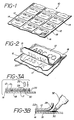
- the laminate construction 10 of the present invention is illustrated in Fig. 1 and includes a face sheet 12 which is typically imprinted with legible indicia 14. As shown, the laminate construction of the present invention may be advantageously formed on a continuous web of backing material 18 so that a multiplicity of individual tags, labels, and the like may be carried on it. The individual face sheets 12 are secured to the backing material 18 by a releasable adhesive 16.
- Both the backing and face material are typically paper or paper-like material.
- either or both of the face or backing material may be of thin, flexible plastic or a thin metallic foil or metal-coated plastic.
- the only requirement is that the face sheet be sufficiently flexible so that when its surface is subjected to an imaging force, the information is transferred to the backing member.
- a suitable releasable adhesive material for use in the invention may be any adhesive which has a low cohesive strength, bonds well to paper or plastic, and is nontacky to the touch when dry.
- the adhesive may be applied to a surface in a fluid state and then converted to a solid by heat, cooling, radiation, or a chemical reaction.
- Suitable classes of releasable adhesives include water based, hot melt, solvent based, and so-called 100% solids adhesives.
- Preferred adhesives are water-based polymer latexes or hot melts such as waxes or polymeric resins.
- Suitable hot melt adhesives are comprised of waxes, resins and plasticizers and may also contain pigments, dispersion aids and soluble polymers.
- Suitable waxes include carnauba, Montan, natural and synthetic paraffins and other common waxes known to the art.
- Suitable resins include hydrocarbon resins and terpine resins.
- Suitable plasticizers include paraffinic and aromatic hydrocarbon oils, phthalate esters and various synthetic viscous liquids known in the art.
- Suitable polymers include polyethylenes, polypropylenes, polybutylenes, polystyrenes, polyesters and various copolymers.
- An especially preferred class of adhesives may be chosen from blends of polyvinyl acetate and polyethylene latexes or emulsions. Such blends are formulated by varying the ratio of these two emulsions. Such adhesives are commercially available. The peel strength of these blends may be varied by varying the ratios of polyvinyl acetate to polyethylene.
- Suitable physical properties for an emulsion type releasable adhesive are: a viscosity of from 3500 to 4500 centipoise at 30 degrees centigrade; a specific gravity of 0.98 to 1.15 grams per cubic centimeter; an oven dry solids content of 43% to 58%; and a pH from 4.5 to 8.5.
- the adhesive is preferably applied at a rate of from about 3.0 to about 22.0 grams per square meter, and most preferably about 3.0 to about 12.0 grams per square meter, based on dry weight.
- the releasable adhesive provides a uniform nonfiber tearing clean release from paper or plastic.
- Preferred release levels may be in the range of from about 100 to about 500 grams per five centimeters of width, although somewhat higher and lower values are operational.
- the release test is conducted at 90 degree peel at 1500 centimeters per minute by delaminating the face material from the backing sheet.
- a releasable adhesive suitable for use in the present invention may generally be identified as one in which cohesive failure occurs as the face sheet is peeled from the backing sheet. Cohesive failure is defined as that which occurs within the layer of adhesive. Adhesive failure is also acceptable. Adhesive failure is defined as failure at the interface between the adhesive and one of the surfaces it contacts.
- the latent or covert imaging capability of the present invention is brought about by the positioning of a colorless reactant which, when combined with a second colorless reactant at a later time, reacts to form a colored composition which yields a visible image, in those areas of the surfaces of the face and backing sheets where a latent image had been formed.
- a colorless reactant which, when combined with a second colorless reactant at a later time, reacts to form a colored composition which yields a visible image, in those areas of the surfaces of the face and backing sheets where a latent image had been formed.
- the colorless reactants utilized in the practice of the present invention are also found in conventional carbonless copy products. It may be desirable to encapsulate the first reactant composition to prevent undesirable migration of the reactant prior to use.
- the colorless latent image material in a non-encapsulated form. This option may be utilized for economic reasons, since encapsulation is a relatively expensive process.
- the colorless reactant is trapped as dispersed liquid droplets within the matrix of a film forming binder. This method for isolating liquid droplets within a coating is well known in the art.
- the first colorless composition Upon the application of an imaging force to the face sheet, the first colorless composition is released in a latent image pattern to the underside of the face sheet as well as to one or more layers beneath the face sheet.
- additional information can be added to the face sheet in the form of further indicia 20 which may, but need not be visible on the upper surface of face sheet 12.
- This further indicia 20 appears as a latent image both on the lower surface 13 of face sheet 12 (in mirror image) as well as on the upper surface 17 of backing sheet 18.
- the indicia may be added to face sheet 12 by hand or mechanically such as by a typewriter or a computer-operated impact printer. If it is not desired that indicia 20 be visible on the upper surface of face sheet 12, then only an imaging force is applied in the absence of ink or other visible printing vehicle.
- the labels in Figs. 1 and 2 are shown to contain information relating to a product serial or other identification number.
- the face sheet may be readily peeled away from the construction and used on, or associated with a product as an indicia of genuineness.
- the backing sheet contains a duplicate copy of the information contained on the face sheet. In some instances, it may be the backing sheet which is secured to the product.
- the laminate construction shown in Fig. 3A may be produced as follows.
- a first color former composition is dissolved in a suitable solvent and the solution is encapsulated as is known in the art, preferably with water as the continuous phase.
- the first color forming composition may be any of the several known color formers such as leuco dyes and the like.
- the capsule slurry may be used as produced with the water phase, or all or a part of the water may be removed.
- the microcapsules containing the first color former composition 22 are blended into the releasable adhesive 16.
- a water-based releasable adhesive such as a blend of emulsions of polyvinyl acetate and polyethylene may be used.
- a hot melt adhesive is utilized, the microcapsules may be separated from the water slurry prior to mixing with the adhesive.
- such a hot melt adhesive may take the form of a blend of waxes, resins, and plasticizers.
- the releasable adhesive and microcapsule blend is coated onto either the lower surface of face sheet 12 or the top surface of backing sheet 18.
- the two sheets are then brought together such as at the nip between two pressure rolls, causing the adhesive to form a bond between the two sheets.
- the laminated web is then heated to dry the adhesive (if a water-based adhesive was used) or cooled (if a hot melt adhesive was used).
- the continuous web of the laminate is then converted into a continuous backing sheet carrying multiple labels or the like at a die cutting station.
- the laminated web is passed through a conventional label press where printed indicia 14 are repetitively printed onto the top of the continuous face sheet.
- the face sheet is then die cut into separate labels, and the matrix portion between labels is removed resulting in a construction as illustrated in Fig. 1.
- the labels may also be imprinted with other information such as product codes, inventory numbers, and prices, etc.
- the imaging force shown schematically as 26, which may produce a visible image or no image at all on the front of the face sheet 12, transfers through that sheet and causes the release of entrapped liquid droplets of composition 22. Some of the color former, or color developer as the case may be, which is released by the imaging force transfers to the upper surface 17 of backing sheet 18 and some transfers to the lower surface 13 of face sheet 12. Some of the released material remains in adhesive layer 16. Latent images 28 and 30 form on the upper surface 17 of backing sheet 18 and lower surface 13 of face sheet 12, respectively.
- the label may now be peeled from the backing sheet 18 as shown in Fig. 3B.
- the use of a releasable adhesive facilitates this removal because of the cohesively weak nature of the adhesive, or because the adhesive bond with either the face or backing sheet is weak.
- the latent image forming material is not encapsulated but is contained as dispersed droplets trapped in the matrix of the adhesive layer, it is preferred that separation occur at the interface between the adhesive and face sheet rather than that the adhesive itself fail.
- the label which is removed is nontacky on its lower surface and can be readily and easily handled. Both the lower surface of the face sheet and the upper surface of the backing sheet contains a duplicate latent copy of the information on the label, and both have nontacky surfaces.
- the latent information may be developed and converted into a visible image by applying a color developer solution, or color former solution as the case may be, to either of the surfaces containing the latent images.
- Suitable color developer compositions known in the art as CF compositions, include acid clay, phenolic resin, and zinc salicylate.
- the composition may be dissolved in an alkylated aromatic solvent such as diisopropyl naphthalene or isobutyl biphenyl, or may be a chlorinated paraffin.
- Suitable color formers are leuco dyes.
- the color developer solution may be applied by any convenient means such as by aerosol spray, a sponge, or a swab such as a felt-tipped pen 32. On application of the color developer solution to the color former composition (whichever is appropriate), a visible image forms.
- FIG. 4A shows a construction similar to that shown in Figs. 3A - 3B with the addition of a layer 34 of pressure sensitive adhesive on the lower surface of backing sheet 18.
- a release liner 36 covers and protects the layer of pressure sensitive until the laminate is applied to a substrate.
- the pressure sensitive adhesive of Fig. 4A may be used to secure the laminate to a product by peeling off release liner 36 and applying the laminate to a product.
- the face sheet 12 may be separated from the remainder of the laminate structure leaving behind a nontacky surface on backing sheet 18. Covert information, formed during manufacture of the laminate or later by the user of the label, is carried on the back of face sheet 12 as well as on the upper surface of backing sheet 18.
- Opaque layer 38 may be formed during manufacture of the laminate by first coating releasable adhesive 16, containing latent image material, onto the back of the face sheet 12, dying this coating, and then overcoating layer 16 with an opacifying layer 38 which will provide a contrasting background for the covert information when it is developed into a visible image.
- the face sheet 12 carrying adhesive layer 16 and opacifying layer 38 is then laminated to a release liner 36 carrying pressure sensitive adhesive coating 34.
- a capsular color former 22 is applied as a separate layer before releasable adhesive layer 16 is applied to the lower surface of face sheet 12.
- capsules in layer 22 will rupture, an a covert image will be formed on the lower surface of face sheet 12.
- No image will be formed on backing sheet 18.
- capsular layer 22 is applied over the upper surface of backing sheet 18, but no capsules are contained within adhesive layer 16.
- Application of an imaging force will rupture the microcapsules an form a covert image on that surface of backing sheet 18. Because of the positioning of releasable adhesive layer 16, no image will be formed on the lower surface of face sheet 12.
- FIG. 4E shows yet another variation.
- separate capsular coating layers 22 are applied to both the lower surface of face sheet 12 as well as the upper surface of backing sheet 18.
- commercially available sheets having a color former already coated thereon may be used for either face sheet 12 or backing sheet 18.
- Such sheets are commercially available from Appleton Paper Company or the Mead Corporation.
- Releasable adhesive layer 16 is then used to laminate the two sheets together.
- Application of an imaging force to face sheet 12 will rupture the microcapsules in each layer and cause the formation of covert images on both the lower surface of face sheet 12 and the upper surface of backing sheet 18.
- the backing sheet of the embodiment of Fig. 4A and the opacifying layer of the embodiment of Fig. 4B have been eliminated to provide a laminate having a face sheet 12 with a capsular layer 22 coated onto the lower surface thereof.
- Releasable adhesive layer 16 secures face sheet 12 to the underlying layers of pressure sensitive adhesive 34 and release liner 36.
- This embodiment of the invention provides a single covert image formed on the lower surface of face sheet 12 when an imaging force is applied.
- both laminates include layers of pressure sensitive adhesive 34 and release liners 36 secured to the lower surface of backing sheets 18.
- both laminates include layers of pressure sensitive adhesive 34 and release liners 36 secured to the lower surface of backing sheets 18.
- a single covert image will be formed on the lower surface of face sheet 12
- a single covert image will be formed on the upper surface of backing sheet 18.
- Fig. 4I adds a pressure sensitive adhesive layer 34 and a release liner 36 to the laminate construction of Fig. 4E.
- the application of an imaging force to face sheet 12 causes the formation of two covert images, one on the lower surface of face sheet 12 and one on the upper surface of backing sheet 18.
- additional covert images may be formed in a laminate construction in accordance with the present invention by providing a second backing sheet 18′ underlying first backing sheet 18.
- Application of an imaging force to the top surface of face sheet 12 will cause the formation of four covert images, on the respective lower surfaces of face sheet 12 and backing sheet 18 and the respective upper surfaces of backing sheets 18 and 18′, in the laminate construction.
- FIG. 4K shows the combination of the printing of both visible and covert images by the application of an imaging force to the laminate.
- face sheet 12 is coated on its lower surface with a releasable adhesive 16 containing microcapsules 22 of a color former or a color developer.
- the upper surface of backing sheet 18 is coated with a layer of the opposite color producing composition, and the laminate secured together by the releasable adhesive.
- Application of an imaging force causes microcapsules 22 containing the one color producing composition to rupture, mixing with the other color producing composition on the upper surface of backing sheet 18 and forming a visible image.
- a covert image is formed on the lower surface of face sheet 12.
- the laminate construction of the present invention is useful in the manufacture of secure, genuine labels for products such as clothing, automotive parts, or any other product which is subject to counterfeiting.
- the laminate produces one or more covert images which can contain information relating to manufacturer's product codes, lot numbers, serial numbers, or other information which will permit an item to be traced to its source.
- the presence of the latent image on a label made in accordance with the present invention makes the information invisible to counterfeiters, but permits the manufacturer to quickly examine the label and determine whether the label, and thus the product, is genuine.
- the laminate construction of the present invention can be used to manufacture other documents which are subject to counterfeiting such as birth certificates, automobile titles and registrations, checks, or any other document which has value or identifies another product having value.
- Other modifications within the scope of the present invention will occur to those skilled in the art.
- the capability of providing duplicate copies of the information can be extended to all of the illustrated embodiments of the invention.
- the capability of providing various combinations of visible and covert images can be provided by the selection and positioning of the layers of the laminate construction.
- all of the laminate constructions are shown with the capsular layers and adhesives coextensive over the entire areas of the laminate, it will be apparent that it may be desirable in some instances to avoid imaging and/or adhesives in certain areas of the construction. For example, if one edge or corner of the face sheet is left unbonded, it is easier to grasp it and peel the face sheet from the laminate construction.
Landscapes
- Physics & Mathematics (AREA)
- General Physics & Mathematics (AREA)
- Engineering & Computer Science (AREA)
- Theoretical Computer Science (AREA)
- Laminated Bodies (AREA)
- Credit Cards Or The Like (AREA)
- Adhesive Tapes (AREA)
- Adhesives Or Adhesive Processes (AREA)
Claims (9)
- Structure stratifiée comprenant au moins trois couches, dans laquelle au moins une desdites couches comprend une feuille du dessus (12) et au moins une autre desdites couches comprend un adhésif de séparation (16) fixant une première surface (13) de ladite feuille du dessus à une autre couche dans ladite structure stratifiée de sorte que ladite feuille du dessus (12) est facilement séparable de ladite autre couche, ladite structure stratifiée comportant de plus une première composition (22) contenue dans ledit adhésif de séparation (16) ou sur ladite première surface (13) de ladite feuille du dessus ou sur une surface de ladite autre couche qui est en contact avec ledit adhésif de séparation, ladite première composition (22) comprenant un agent réactif qui, lorsque combiné avec un second agent réactif à un instant ultérieur, réagit pour former une composition colorée qui produit une image visible, ladite première composition, lorsque soumise à une force de formation d'image, formant une image latente.
- Structure stratifiée selon la revendication 1, dans laquelle ladite première composition est encapsulée dans une pluralité de capsules qui se rompent sur l'application d'une force de choc sur ladite feuille du dessus.
- Structure stratifiée selon la revendication 1 ou 2, dans laquelle au moins une autre desdites couches comprend une feuille de renforcement (18) fixée à ladite première surface (13) de ladite feuille du dessus par ledit adhésif de séparation (16).
- Structure stratifiée selon la revendication 3, comportant une couche d'auto-adhésif (34) sur la seconde surface de ladite feuille de renforcement (18).
- Structure stratifiée selon la revendication 4, comportant une couche de revêtement séparable (36) recouvrant ladite couche d'auto-adhésif.
- Structure stratifiée selon l'une quelconque des revendications 3, 4 et 5, comportant une seconde feuille de renforcement (18′) se trouvant au-dessous de ladite première feuille de renforcement (18), une première surface de ladite seconde feuille de renforcement étant fixée à une seconde surface de ladite première feuille de renforcement par un adhésif de séparation (16′), ledit adhésif de séparation contenant dans celui-ci ladite première composition (22′) qui, lorsque soumise à une force de formation d'image, forme une image latente.
- Structure stratifiée selon l'une quelconque des revendications précédentes, dans laquelle la première composition (22) comprend un agent réactif incolore et le second agent réactif est un agent réactif incolore.
- Structure stratifiée comprenant une feuille du dessus (12) comportant un adhésif de séparation (16) fixant une première surface de celle-ci à une couche opaque (38) de sorte que ladite feuille du dessus et ladite feuille opaque sont facilement séparables, ladite couche opaque étant supportée sur un revêtement de séparation (36) et fixée à celui-ci par un auto-adhésif (34), ledit adhésif de séparation contenant dans celui-ci une première composition (22) qui, lorsque soumis à une force de formation d'image, forme une image latente (28, 30) sur ladite première surface de ladite feuille du dessus et sur ladite couche opaque.
- Structure stratifiée comprenant une feuille du dessus (12) comportant un adhésif de séparation (16) fixant une première surface de celle-ci à un auto-adhésif (34) supporté sur un revêtement de séparation (36) de sorte que ladite feuille du dessus est facilement séparable de l'auto-adhésif, ladite première surface de ladite feuille du dessus contenant sur celle-ci une première composition (22) qui, lorsque soumise à une force de formation d'image, forme une image latente sur ladite première surface de ladite feuille du dessus.
Applications Claiming Priority (2)
| Application Number | Priority Date | Filing Date | Title |
|---|---|---|---|
| US07/224,691 US4940690A (en) | 1988-07-27 | 1988-07-27 | Clean release laminate construction with latent image |
| US224691 | 1988-07-27 |
Publications (3)
| Publication Number | Publication Date |
|---|---|
| EP0360382A2 EP0360382A2 (fr) | 1990-03-28 |
| EP0360382A3 EP0360382A3 (en) | 1990-06-13 |
| EP0360382B1 true EP0360382B1 (fr) | 1994-08-31 |
Family
ID=22841749
Family Applications (1)
| Application Number | Title | Priority Date | Filing Date |
|---|---|---|---|
| EP89306764A Expired - Lifetime EP0360382B1 (fr) | 1988-07-27 | 1989-07-04 | Objet multicouche pour la génération d'une image latente avec possibilité d'enlèvement sans résidu |
Country Status (6)
| Country | Link |
|---|---|
| US (1) | US4940690A (fr) |
| EP (1) | EP0360382B1 (fr) |
| AT (1) | ATE110871T1 (fr) |
| CA (1) | CA1328169C (fr) |
| DE (1) | DE68917838T2 (fr) |
| NZ (1) | NZ229417A (fr) |
Families Citing this family (29)
| Publication number | Priority date | Publication date | Assignee | Title |
|---|---|---|---|---|
| JPH0370965U (fr) * | 1989-11-16 | 1991-07-17 | ||
| ES2036924B1 (es) * | 1991-01-16 | 1994-04-01 | Arysearch Arylan Ag | Precinto transparente anti-falsificacion aplicable a la proteccion de documentos y textos con firma autografa. |
| US5267899A (en) * | 1992-01-23 | 1993-12-07 | Moore Business Forms, Inc. | Defective equipment window stickers |
| US5284689A (en) * | 1992-09-14 | 1994-02-08 | The Standard Register Company | Product label assembly |
| US5855083A (en) * | 1993-04-14 | 1999-01-05 | Re Mark It Holdings Ltd | Erasable sign |
| US5368334A (en) * | 1993-06-10 | 1994-11-29 | Moore Business Forms, Inc. | Variable data clear mark imaging |
| US5431452A (en) * | 1993-08-23 | 1995-07-11 | Wallace Computer Services, Inc. | Hidden entry system and image-developing device therefor |
| IT1270065B (it) * | 1994-07-04 | 1997-04-28 | Barilla Flli G & R | Etichetta per confezioni richiudibili |
| JP3438447B2 (ja) * | 1994-12-28 | 2003-08-18 | セイコーエプソン株式会社 | テープ状記録媒体の印刷装置および印刷方法並びにテープ状記録媒体 |
| JP3353302B2 (ja) * | 1995-08-10 | 2002-12-03 | セイコーエプソン株式会社 | インクジェットプリンタのカートリッジおよびインクジェットプリンタ |
| US5632842A (en) * | 1995-09-11 | 1997-05-27 | Uarco Incorporated | Business form with removable label and method of making same |
| US6053535A (en) * | 1997-01-07 | 2000-04-25 | The Standard Register Company | Business form including a label |
| US6418649B1 (en) * | 1997-06-20 | 2002-07-16 | Judith Bolon | System for the inscription and secure recordation of information |
| US5941572A (en) * | 1997-09-12 | 1999-08-24 | Nocopi Technologies, Inc. | Method for authenticating a textile product and a thread and a woven label usable therewith |
| AU4452400A (en) * | 1999-04-09 | 2000-11-14 | Avery Dennison Corporation | Construction and method for undersurface laser marking |
| US6293592B1 (en) | 1999-09-01 | 2001-09-25 | Avery Dennison Corporation | Greeting card construction and methods of making and using same |
| US6270122B1 (en) | 1999-10-22 | 2001-08-07 | Timer Technologies, Llc | Irreversible thin film display with clearing agent |
| US6318760B1 (en) | 2000-06-06 | 2001-11-20 | Timer Technologies, Llc | Irreversible display with temporary imaging stage |
| US20050175941A1 (en) * | 2004-02-06 | 2005-08-11 | Rohm And Hass Electronic Materials, L.L.C. | Imaging composition and method |
| US20050226975A1 (en) * | 2004-04-13 | 2005-10-13 | Greg Drouillard | Foodstuff marking system |
| EP1839952B1 (fr) * | 2006-03-28 | 2011-10-19 | Autoliv Development AB | Emblème pour composant de véhicule automobile et sa méthode de fabrication. |
| US7748602B2 (en) * | 2006-04-11 | 2010-07-06 | Moore Wallace North America, Inc. | Forms containing removable hang tags and methods of producing the same |
| US20080083286A1 (en) * | 2006-10-05 | 2008-04-10 | Thomas Danowski | Stress indicating materials |
| US7617986B2 (en) * | 2007-01-10 | 2009-11-17 | Datacard Corporation | Laminate security feature |
| US20090246427A1 (en) * | 2008-03-28 | 2009-10-01 | Hincks Daniel A | Product labels having removable portions having adhesive and backing thereon |
| US8663410B2 (en) | 2009-09-14 | 2014-03-04 | Primera Technology, Inc. | System for finishing printed labels using multiple X-Y cutters |
| US8455074B2 (en) | 2010-07-19 | 2013-06-04 | Moore Wallace North America, Inc | Forms containing a removable hang tag |
| ES2398787B1 (es) | 2010-12-16 | 2014-02-18 | BSH Electrodomésticos España S.A. | Procedimiento para fabricar una placa de campo de cocción para un campo de cocción |
| DE102019101335B4 (de) * | 2019-01-18 | 2024-02-08 | Herma Gmbh | Mehrschichthaftkleberaufbau für Klebeetiketten oder Klebebänder und Verwendung |
Family Cites Families (15)
| Publication number | Priority date | Publication date | Assignee | Title |
|---|---|---|---|---|
| US3383121A (en) * | 1965-06-22 | 1968-05-14 | Avery Products Corp | Self-adhesive copy label |
| BE710347A (fr) * | 1967-02-07 | 1968-06-17 | ||
| DE2407822A1 (de) * | 1974-02-19 | 1975-08-28 | Schneider & Soehne Kg G | Selbstklebender aufzeichnungstraeger, z.b. haftetikett |
| US4029341A (en) * | 1976-04-02 | 1977-06-14 | Federal Business Products, Inc. | Printed form having removable label |
| US4109047A (en) * | 1977-07-06 | 1978-08-22 | Moore Business Forms, Inc. | Rub-on security cards |
| US4277089A (en) * | 1977-09-09 | 1981-07-07 | Lockhart James L | Pharmaceutical record and label system |
| US4204706A (en) * | 1978-07-03 | 1980-05-27 | Blum Julian J | Method and multi-layer label having pressure-sensitive mark transfer system |
| US4347274A (en) * | 1979-04-16 | 1982-08-31 | Janssen Alexander P | Visible indexes |
| US4250216A (en) * | 1979-04-16 | 1981-02-10 | Janssen Alexander P | Visible indexes |
| US4448445A (en) * | 1982-02-10 | 1984-05-15 | Wallace Computer Services, Inc. | Pressure-sensitive record system |
| US4479838A (en) * | 1982-06-22 | 1984-10-30 | Mid America Tag & Label Company, Inc. | Coupon structure and method of using the same |
| GB2151205B (en) * | 1983-12-14 | 1987-03-18 | Norcros Investments Ltd | Labels |
| JPS6153786U (fr) * | 1984-09-14 | 1986-04-11 | ||
| US4747619A (en) * | 1987-04-06 | 1988-05-31 | Ncr Corporation | Pressure-sensitive label |
| US4833122A (en) * | 1987-07-01 | 1989-05-23 | The Standard Register Company | Imagable clean release laminate construction |
-
1988
- 1988-07-27 US US07/224,691 patent/US4940690A/en not_active Expired - Fee Related
-
1989
- 1989-06-06 NZ NZ229417A patent/NZ229417A/xx unknown
- 1989-07-04 DE DE68917838T patent/DE68917838T2/de not_active Expired - Fee Related
- 1989-07-04 EP EP89306764A patent/EP0360382B1/fr not_active Expired - Lifetime
- 1989-07-04 AT AT89306764T patent/ATE110871T1/de not_active IP Right Cessation
- 1989-07-11 CA CA000605311A patent/CA1328169C/fr not_active Expired - Fee Related
Also Published As
| Publication number | Publication date |
|---|---|
| DE68917838T2 (de) | 1995-01-12 |
| DE68917838D1 (de) | 1994-10-06 |
| US4940690A (en) | 1990-07-10 |
| CA1328169C (fr) | 1994-04-05 |
| NZ229417A (en) | 1991-02-26 |
| EP0360382A3 (en) | 1990-06-13 |
| ATE110871T1 (de) | 1994-09-15 |
| EP0360382A2 (fr) | 1990-03-28 |
Similar Documents
| Publication | Publication Date | Title |
|---|---|---|
| EP0360382B1 (fr) | Objet multicouche pour la génération d'une image latente avec possibilité d'enlèvement sans résidu | |
| US4833122A (en) | Imagable clean release laminate construction | |
| US5039652A (en) | Clean release postal card or mailer | |
| US5284689A (en) | Product label assembly | |
| CA2122693C (fr) | Document commercial a surface imageable en couleurs | |
| US5752722A (en) | Multipart form and label combination | |
| US5840657A (en) | Imagable linerless pressure sensitive adhesive | |
| US5810397A (en) | Thermally imagable business record and method of desensitizing a thermally imagable surface | |
| JPH09512497A (ja) | 熱ダイトランスファー法のための受像素子 | |
| JPS6311397A (ja) | 改▲ざん▼のわかる証書及びその使用法 | |
| US6991259B2 (en) | Apparatus and method for improved business form with integrated card | |
| WO1999044837A1 (fr) | Support d'enregistrement a transfert intermediaire, procede de formation d'epreuve et epreuve | |
| JP2009109703A (ja) | 開封識別機能付き2層隠蔽ラベル | |
| US4977131A (en) | OCR scannable carbonless copying system and a method of producing OCR scannable images therewith | |
| US6326071B1 (en) | Reverse thermal label | |
| CA2091153C (fr) | Imprime commercial ou publicitaire a substrat de generation d'image | |
| JPH11254844A (ja) | 中間転写記録媒体、これを用いた印画物の形成方法および形成された印画物 | |
| JP2011201180A (ja) | 熱転写シート及びそれを用いた画像形成方法 | |
| CA1267282A (fr) | Materiau d'enregistrement thermosensible a couche active renfermant une teinture fluorescente | |
| JP2007181525A (ja) | 鑑識用粘着シート及びその製造方法 | |
| US5047384A (en) | Carbonless multiple ply credit card transaction form | |
| JP2003220769A (ja) | 中間転写記録媒体 | |
| JP3874472B2 (ja) | 配送伝票 | |
| JP3238583B2 (ja) | 耐熱性耐溶剤性熱転写記録材料 | |
| JP3516480B2 (ja) | 配送伝票 |
Legal Events
| Date | Code | Title | Description |
|---|---|---|---|
| PUAI | Public reference made under article 153(3) epc to a published international application that has entered the european phase |
Free format text: ORIGINAL CODE: 0009012 |
|
| AK | Designated contracting states |
Kind code of ref document: A2 Designated state(s): AT BE CH DE FR LI LU NL |
|
| PUAL | Search report despatched |
Free format text: ORIGINAL CODE: 0009013 |
|
| AK | Designated contracting states |
Kind code of ref document: A3 Designated state(s): AT BE CH DE FR LI LU NL |
|
| 17P | Request for examination filed |
Effective date: 19901017 |
|
| 17Q | First examination report despatched |
Effective date: 19930413 |
|
| GRAA | (expected) grant |
Free format text: ORIGINAL CODE: 0009210 |
|
| AK | Designated contracting states |
Kind code of ref document: B1 Designated state(s): AT BE CH DE FR LI LU NL |
|
| REF | Corresponds to: |
Ref document number: 110871 Country of ref document: AT Date of ref document: 19940915 Kind code of ref document: T |
|
| REF | Corresponds to: |
Ref document number: 68917838 Country of ref document: DE Date of ref document: 19941006 |
|
| ET | Fr: translation filed | ||
| PGFP | Annual fee paid to national office [announced via postgrant information from national office to epo] |
Ref country code: FR Payment date: 19950616 Year of fee payment: 7 Ref country code: CH Payment date: 19950616 Year of fee payment: 7 |
|
| PGFP | Annual fee paid to national office [announced via postgrant information from national office to epo] |
Ref country code: AT Payment date: 19950619 Year of fee payment: 7 |
|
| PGFP | Annual fee paid to national office [announced via postgrant information from national office to epo] |
Ref country code: DE Payment date: 19950623 Year of fee payment: 7 |
|
| PLBE | No opposition filed within time limit |
Free format text: ORIGINAL CODE: 0009261 |
|
| STAA | Information on the status of an ep patent application or granted ep patent |
Free format text: STATUS: NO OPPOSITION FILED WITHIN TIME LIMIT |
|
| PG25 | Lapsed in a contracting state [announced via postgrant information from national office to epo] |
Ref country code: LU Free format text: LAPSE BECAUSE OF NON-PAYMENT OF DUE FEES Effective date: 19950731 Ref country code: BE Effective date: 19950731 |
|
| 26N | No opposition filed | ||
| BERE | Be: lapsed |
Owner name: THE STANDARD REGISTER CY Effective date: 19950731 |
|
| PG25 | Lapsed in a contracting state [announced via postgrant information from national office to epo] |
Ref country code: NL Effective date: 19960201 |
|
| NLV4 | Nl: lapsed or anulled due to non-payment of the annual fee |
Effective date: 19960201 |
|
| PG25 | Lapsed in a contracting state [announced via postgrant information from national office to epo] |
Ref country code: AT Effective date: 19960704 |
|
| PG25 | Lapsed in a contracting state [announced via postgrant information from national office to epo] |
Ref country code: LI Effective date: 19960731 Ref country code: CH Effective date: 19960731 |
|
| REG | Reference to a national code |
Ref country code: CH Ref legal event code: PL |
|
| PG25 | Lapsed in a contracting state [announced via postgrant information from national office to epo] |
Ref country code: FR Effective date: 19970328 |
|
| PG25 | Lapsed in a contracting state [announced via postgrant information from national office to epo] |
Ref country code: DE Effective date: 19970402 |
|
| REG | Reference to a national code |
Ref country code: FR Ref legal event code: ST |