EP0360568B1 - Biokontrolle von mikrobiellen Pathogenen - Google Patents
Biokontrolle von mikrobiellen Pathogenen Download PDFInfo
- Publication number
- EP0360568B1 EP0360568B1 EP89309534A EP89309534A EP0360568B1 EP 0360568 B1 EP0360568 B1 EP 0360568B1 EP 89309534 A EP89309534 A EP 89309534A EP 89309534 A EP89309534 A EP 89309534A EP 0360568 B1 EP0360568 B1 EP 0360568B1
- Authority
- EP
- European Patent Office
- Prior art keywords
- siderophore
- pseudomonas
- iron
- strain
- gene
- Prior art date
- Legal status (The legal status is an assumption and is not a legal conclusion. Google has not performed a legal analysis and makes no representation as to the accuracy of the status listed.)
- Expired - Lifetime
Links
Images


Classifications
-
- C—CHEMISTRY; METALLURGY
- C07—ORGANIC CHEMISTRY
- C07K—PEPTIDES
- C07K14/00—Peptides having more than 20 amino acids; Gastrins; Somatostatins; Melanotropins; Derivatives thereof
- C07K14/195—Peptides having more than 20 amino acids; Gastrins; Somatostatins; Melanotropins; Derivatives thereof from bacteria
- C07K14/21—Peptides having more than 20 amino acids; Gastrins; Somatostatins; Melanotropins; Derivatives thereof from bacteria from Pseudomonadaceae (F)
-
- A—HUMAN NECESSITIES
- A01—AGRICULTURE; FORESTRY; ANIMAL HUSBANDRY; HUNTING; TRAPPING; FISHING
- A01N—PRESERVATION OF BODIES OF HUMANS OR ANIMALS OR PLANTS OR PARTS THEREOF; BIOCIDES, e.g. AS DISINFECTANTS, AS PESTICIDES OR AS HERBICIDES; PEST REPELLANTS OR ATTRACTANTS; PLANT GROWTH REGULATORS
- A01N63/00—Biocides, pest repellants or attractants, or plant growth regulators containing microorganisms, viruses, microbial fungi, animals or substances produced by, or obtained from, microorganisms, viruses, microbial fungi or animals, e.g. enzymes or fermentates
- A01N63/20—Bacteria; Substances produced thereby or obtained therefrom
- A01N63/27—Pseudomonas
-
- A—HUMAN NECESSITIES
- A23—FOODS OR FOODSTUFFS; TREATMENT THEREOF, NOT COVERED BY OTHER CLASSES
- A23K—FODDER
- A23K30/00—Processes specially adapted for preservation of materials in order to produce animal feeding-stuffs
- A23K30/10—Processes specially adapted for preservation of materials in order to produce animal feeding-stuffs of green fodder
- A23K30/15—Processes specially adapted for preservation of materials in order to produce animal feeding-stuffs of green fodder using chemicals or microorganisms for ensilaging
- A23K30/18—Processes specially adapted for preservation of materials in order to produce animal feeding-stuffs of green fodder using chemicals or microorganisms for ensilaging using microorganisms or enzymes
-
- C—CHEMISTRY; METALLURGY
- C12—BIOCHEMISTRY; BEER; SPIRITS; WINE; VINEGAR; MICROBIOLOGY; ENZYMOLOGY; MUTATION OR GENETIC ENGINEERING
- C12N—MICROORGANISMS OR ENZYMES; COMPOSITIONS THEREOF; PROPAGATING, PRESERVING, OR MAINTAINING MICROORGANISMS; MUTATION OR GENETIC ENGINEERING; CULTURE MEDIA
- C12N1/00—Microorganisms; Compositions thereof; Processes of propagating, maintaining or preserving microorganisms or compositions thereof; Processes of preparing or isolating a composition containing a microorganism; Culture media therefor
- C12N1/20—Bacteria; Culture media therefor
- C12N1/205—Bacterial isolates
-
- C—CHEMISTRY; METALLURGY
- C12—BIOCHEMISTRY; BEER; SPIRITS; WINE; VINEGAR; MICROBIOLOGY; ENZYMOLOGY; MUTATION OR GENETIC ENGINEERING
- C12N—MICROORGANISMS OR ENZYMES; COMPOSITIONS THEREOF; PROPAGATING, PRESERVING, OR MAINTAINING MICROORGANISMS; MUTATION OR GENETIC ENGINEERING; CULTURE MEDIA
- C12N15/00—Mutation or genetic engineering; DNA or RNA concerning genetic engineering, vectors, e.g. plasmids, or their isolation, preparation or purification; Use of hosts therefor
- C12N15/09—Recombinant DNA-technology
- C12N15/63—Introduction of foreign genetic material using vectors; Vectors; Use of hosts therefor; Regulation of expression
- C12N15/70—Vectors or expression systems specially adapted for E. coli
- C12N15/71—Expression systems using regulatory sequences derived from the trp-operon
-
- C—CHEMISTRY; METALLURGY
- C12—BIOCHEMISTRY; BEER; SPIRITS; WINE; VINEGAR; MICROBIOLOGY; ENZYMOLOGY; MUTATION OR GENETIC ENGINEERING
- C12N—MICROORGANISMS OR ENZYMES; COMPOSITIONS THEREOF; PROPAGATING, PRESERVING, OR MAINTAINING MICROORGANISMS; MUTATION OR GENETIC ENGINEERING; CULTURE MEDIA
- C12N15/00—Mutation or genetic engineering; DNA or RNA concerning genetic engineering, vectors, e.g. plasmids, or their isolation, preparation or purification; Use of hosts therefor
- C12N15/09—Recombinant DNA-technology
- C12N15/63—Introduction of foreign genetic material using vectors; Vectors; Use of hosts therefor; Regulation of expression
- C12N15/74—Vectors or expression systems specially adapted for prokaryotic hosts other than E. coli, e.g. Lactobacillus, Micromonospora
- C12N15/78—Vectors or expression systems specially adapted for prokaryotic hosts other than E. coli, e.g. Lactobacillus, Micromonospora for Pseudomonas
-
- C—CHEMISTRY; METALLURGY
- C12—BIOCHEMISTRY; BEER; SPIRITS; WINE; VINEGAR; MICROBIOLOGY; ENZYMOLOGY; MUTATION OR GENETIC ENGINEERING
- C12R—INDEXING SCHEME ASSOCIATED WITH SUBCLASSES C12C - C12Q, RELATING TO MICROORGANISMS
- C12R2001/00—Microorganisms ; Processes using microorganisms
- C12R2001/01—Bacteria or Actinomycetales ; using bacteria or Actinomycetales
- C12R2001/38—Pseudomonas
Definitions
- This invention relates to regulation of siderophore production in Pseudomonas microorganisms and to siderophore regulatory genes.
- the invention also relates to biological control of deleterious microorganisms.
- Silage represents a major source of winter feed for dairy cattle and other animals. It is basically a fermented grass or other plant fodder, which because of its high food value promotes good milk production.
- a reduction in pH due to the production of lactic acid by lactic bacteria is the major preservative agent in silage. Ideally, the pH should drop to approximately 3.9-4.2 in the first few days.
- sulphuric or formic acid is often added during silage making. If this occurs, few microbial problems should occur with the silage.
- a number of problems may arise. For example, the prevalence of clostridial spores in silage is a major concern in the agri-food industry.
- Clostridia begin to grow in silage in the early stages, they will prevent the pH from dropping to the desired level by competing for and utilising the lactic acid. Consequently, the reduced preservative nature of the silage may allow other deleterious organisms to grow. Clostridia will also reduce the nutritional value of the silage by catabolising amino acids. The fermentation end-products produced by Clostridia are typically bitter with pungent odours.
- Clostridial spores present more serious problems to the cheese industry if they are present in milk. This is especially true of cheeses like Edam or Gouda, where the pH is not reduced sufficiently during production to inhibit clostridial growth. Consequently, clostridial proliferation results in extensive gas production which destroys the structure of the cheese.
- Aeromonas salmonicida can also be a major problem in fish farming if holding tanks become contaminated.
- the objective of the present invention is to construct a Pseudomonas mutant strain which continues to secrete siderophores when iron is present in the growth environment. It is a further object of the invention to provide a biological means of preventing the growth of deleterious microorganisms.
- the objective of the invention is based on a strategy whereby the regulation imposed by iron on the siderophore producing ability of fluorescent Pseudomonas spp. can be overcome.
- a promoter fusion would be expressed in low iron conditions in Pseudomonas , while no expression should be observed in high iron conditions.
- mutating the Pseudomonas strain such that the promoter fusion is expressed in the presence of exogenous iron, a strain which is deregulated for the production of siderophore can be selected. Having obtained such a mutant, it is then possible to clone the iron regulatory gene (fur) by complementing the mutant with a gene bank of the strain.
- pMSR1 Fe 3+ regulated gene fusion plasmid
- This fusion plasmid expressed the lac genes in Pseudomonas under low iron conditions, but no expression was observed in the presence of 50 ⁇ m Fe 3+ .
- This plasmid was subsequently conjugated into a Tn5 mutant pot of Pseudomonas sp. strain M114 and strain M114FR1 was selected which expressed the lac -fusion in the presence of iron.
- This strain was shown to be deregulated for the production of siderophores. Deregulated is used to mean that siderophore production takes place in both the presence and absence of iron.
- the present invention provides a DNA fragment containing sequences for iron-mediated regulation of siderophore production in Pseudomonas strains and plasmids containing such DNA fragments.
- the present invention provides a DNA fragment for iron-mediated regulation of siderophore production in Pseudomonas strains selected from:-
- the invention also provides a plasmid carrying a DNA fragment containing the fur gene for iron-mediated regulation of siderophore production in Pseudomonas strains, the plasmid being selected from:-
- Bacterial hosts carrying such DNA fragements or plasmids are also provided.
- the invention provides a method of isolating stable siderophore regulatory mutants comprising:-
- the Pseudomonas strain deregulated for siderophore production may be the Pseudomonas sp. strain M114FR1 as defined above.
- the selectable marker may suitably be an antiobiotic resistance gene such that only mutants with an inactive fur gene can grow in the presence of the antibiotic. Mutants produced in this way have the advantage that they can never revert since part of the fur gene has been lost.
- the invention provides a method of controlling the growth of deleterious microorganisms which comprises introducing siderophore into an environment containing one of the said microorganisms and maintaining the siderophore concentration at a level sufficient to inhibit growth of the said microorganism in both the presence and absence of iron in the environment.
- the environment may suitably be a plant growth environment, a fermentation vessel such as a silo or a fish rearing environment such as a fish tank.
- Isolated siderophore complex may be added to the said environment, or siderophore may be introduced into the said environment and the concentration maintained therein by inoculating the said environment with a siderophore-producing strain of Pseudomonas.
- the siderophore-producing Pseudomonas strain may be inoculated together with an iron chelator.
- the iron chelator may suitably be ethylenediamine- di-(o-hydroxyphenyl)acetic acid (EDDA).
- the siderophore may be introduced into the said environment and the concentration maintained by inoculating the said environment with a siderophore-producing strain of Pseudomonas in which the iron-mediated regulation of siderophore production has been overcome i.e. a Fur - mutant,or with a bacterial host containing a DNA fragment containing sequences for iron-mediated regulation of siderophore production in Pseudomonas species or a plasmid carrying such a DNA fragment.
- a siderophore-producing strain of Pseudomonas in which the iron-mediated regulation of siderophore production has been overcome i.e. a Fur - mutant,or with a bacterial host containing a DNA fragment containing sequences for iron-mediated regulation of siderophore production in Pseudomonas species or a plasmid carrying such a DNA fragment.
- the deregulated strains can be used in a method of controlling plant pathogens which comprises inoculating seeds with the above mentioned Pseudomonas strain deregulated for the production of siderophores, or with a bacterial host carrying a plasmid or a DNA fragment as defined above, or with a deregulated siderophore-producing strain of Pseudomonas produced by the method defined above or with a siderophore-regulatory mutant produced by a method as defined above.
- compositions for controlling the growth of deleterious microorganisms comprising a growth-inhibiting amount of isolated siderophore complex.
- isolated siderophore complex is meant purified siderophore complex or a cell-free siderophore-enriched concentrate obtained from the supernatant of cultures of siderophore-producing strains.
- the invention also provides compositions for controlling the growth of deleterious microorganisms comprising a siderophore-producing strain of Pseudomonas .
- Such a composition may also contain an iron chelator, for example EDDA.
- an iron chelator for example EDDA.
- the composition for controlling the growth of deleterious microorganisms preferably comprises a siderophore-producing strain of Pseudomonas in which the iron-mediated regulation of siderophore production has been overcome.
- the compositions may also comprise suitable carriers and/or adjuvants.
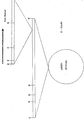
- Fig. 1. Physical map of the iron-regulated lac -gene fusion plasmid pMSR1. It consists of a 21.7 kb DNA fragment containing siderophore biosynthetic genes from strain M114, cloned into the broad host cloning vector pLAFR1. The Tn3- lac transposon (Tn3-HoHol) is inserted into this Pseudomonas DNA fragment such that the expression of the lac genes within the transposon is controlled by an iron-regulated promoter region from the DNA fragment.
- Tn3-HoHol Tn3-HoHol
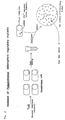
- Fig. 2. Strategy for isolating siderophore regulatory mutants by exploiting the iron-regulated lac -gene fusion plasmid pMSR1. The presence of siderophore regulatory mutants (Fur - ) is indicated by blue colonies on the selection medium.
- SA sucrose Asparagine medium, incorporated with Tetracycline (Tc) to select for plasmid pMSR1 and X-gal to monitor for a Lac + phenotype.
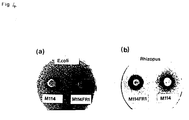
- Fig. 3. Inhibition of E. coli HB101(a) and Rhizophus stolonifer (b) by Pseudomonas sp. strain M114 and the Fur - strain M114FR1. Assays were carried out on a high iron medium such that the wild-type strain M114 produced no siderophore.
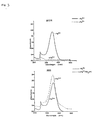
- Fig. 4. Siderophore detection from supernatants of cultures grown in both low and high iron conditions.
- the presence of siderophore in the supernatant is indicated by a yellow/green colour in low iron conditions and by a red/brown colour in the presence of iron.
- the change in colour of the siderophore is due to a colorimetic change which occurs when iron binds the siderophore moiety.
- the presence of siderophore in the supernatants was also quantitatively analysed using a spectrophotometer, where siderophore can be detected at a wavelength of ⁇ 400 nm.
- Fig. 5. Restriction map of the 7.0 kb Bgl II fragment of pSR1. This fragment was subcloned from plasmid pMS639 which contains the fur gene, i.e. the gene which regulates the expression of the siderophore system in the presence of iron.
- Fig. 6. Strategy for isolating stable siderophore regulatory mutants (Fur - ).
- the cloned fur gene is inactivated by substituting a portion of the gene for an antibiotic resistance gene (e.g. kanamycin resistance gene).
- This inactivated fur gene is introduced into a Pseudomonas strain, and by selecting for kanamycin resistance (kn r ), it replaces the active fur gene.
- This mutant can never revert, since there is not a full copy of the gene present in the cell.
- the fluorescent Pseudomonas strain used was Pseudomonas sp. strain M114 (0'Gara et al ., 1986). This strain was isolated from the roots of sugarbeet and was shown to inhibit a wide range of bacterial and fungal pathogens, by a strong siderophore mechanism. It is available in the Culture Collection of University College, Cork, Ireland. It was mutated using a transposon (Tn5) system (Simon et al .5, 1983), and strains which failed to produce the fluorescent siderophore compound (sid - ) were selected. These mutants were characteristically fluorescent negative (Flu - ) on low iron media and consequently had a reduced ability to grow when Fe 3+ was limiting. A pLAFR1 based gene bank of the strain was used to complement the mutants. These complementing clones were capable of restoring the ability of the mutants to produce the fluorescent siderophore compound.
- Tn3 lac transposon (Tn3-HoHo1) (Stachel et al ., 1985) was used.
- This transposon contains the structural genes of the lactose operon ( lac ZYA), but with the promoter region excised. Consequently, for expression of the lac structural genes, transcription must precede at an exogenous promoter. Transposition of the transposon occurs via a transposase gene which is present intrans on a separate plasmid.
- Tn3-HoHo1 insertions are stable, while no transposase gene is present to permit retransposition.
- Tn3-HoHo1 was inserted randomly onto pMS118 and all insertion clones were transferred into Pseudomonas sp. strain M114.
- An insertion clone was selected which expressed the lac genes in low iron conditions but was Lac - in the presence of greater than 20uM Fe 3+ .
- This fusion plasmid (pMSR1) exhibited B-galactosidase activity (the product of the lac -Z gene) of about 120 units in low Fe 3+ conditions but no activity (less than 10 units) in the presence of 50 uM Fe 3+ .
- Pseudomonas sp. strain M114 was mutated using Tn5 and all the Tn5 containing strains were pooled.
- the Fe 3+ regulated fusion plasmid (pMSR1) was then mated into this 'mutant pot' and strains were selected which expressed the lac genes of the plasmid in the presence of iron. The presence of blue colonies in the medium indicated a lac + phenotype.
- Fig. 2 depicts a very simple but powerful selection procedure for the construction of deregulated siderophore-producing strains.
- Pseudomonas sp. strain M114FR1 was isolated using this strategy. This strain was subsequently shown to produce siderophore in the presence of Fe 3+ (Fig. 3).
- Both wild-type Pseudomonas sp. strain M114 and deregulated strain FR1 were grown in low iron and high iron (50 ⁇ M Fe 3+ ) conditions. The presence of siderophore in the culture supernatant in low iron conditions is indicated by a yellow green colour. In high iron conditions the production of siderophore is detected by the appearance of a red/brown colour which was observed for strain FR1.
- the wild-type strain fails to produce siderophore in the presence of Fe 3+ and consequently a clear liquid was obtained.
- Fig. 4 depicts the inhibition of fungal and bacterial test organisms by strain Mll4FR1 and the parent strain M114. It is clear that strain M114FR1 is a far superior strain for fungal and bacterial control under those high iron conditions.
- Pseudomonas sp. strain M114FR1 was deposited at the National Collection of Industrial Bacteria, Aberdeen, Scotland under Accession No. 40046 on 19th September 1988.
- the plasmid pMSR1 can be used in a similar fashion to deregulate siderophore production in any desired Pseudomonas strain.
- Pseudomonas sp. strain M114FR1 which is deregulated for the production of siderophore, was complemented with the gene bank of the wild-type strain.
- the complementing clone pMS639 was capable of restoring the negative regulation imposed by Fe 3+ on to the siderophore producing ability of the strain.
- Plasmid pMS639 which contains a 28 kb DNA insert from Pseudomonas sp. strain M114FR1 was deposited at the National Collection of Industrial Bacteria, Aberdeen, Scotland under Accession No. 40146 on 11th May 1989 ( E. coli LE 392 (pMS639)).
- the 46 kb plasmid pMS639 was subsequently subcloned and a restriction map of a subcloned siderophore regulatory gene is shown in Figure 5 which shows a 7.0 kb Bgl II fragment containing a siderophore regulatory region from Pseudomonas sp. strain M114.
- E. coli kMBL1164 contains a plasmid with a 7 kb DNA insert from Pseudomonas sp. strain M114 (see Fig. 5). This DNA insert contains the gene responsible for iron-mediated regulation of siderophore production in fluorescent Pseudomonas sp. strain M114. This conclusion was based on the complementation of the regulatory mutant described above.
- E. coli kMBL1164 (pSR1) was deposited at The National Collection of Industrial Bacterial, Aberdeen, Scotland under accession No. 40,048 on 19th September, 1988.
- M114 wild-type M114FR1 (Fur - mutant) derived from M114 M114A7R1 " " " M114B5 (siderophore negative mutant) " " "
- This strain was deposited at the National Collection of Industrial and Marine Bacteria, Aberdeen, Scotland under the Asccession No. 40,047 on 19th September 1988.
- the wild-type strain M114 only exhibits lac Z expression from pMSR1 under low iron conditions.
- Mutant strain M114FR1 was selected by its ability to allow lac Z expression from pMSR1 when iron is present in the growth medium.
- the strain M114FR1 was deposited under No. 40,046 on 19th September 1988 at the National Collection of Industrial and Marine Bacteria, Aberdeen, Scotland.
- L. casei 1207 National Collection of Food Bacteria (formerly National Collection of Dairy Organisms), AFRC Institute of Food Research, Reading, Berks., England. Origin of L. casei 1207: University College Cork Culture Collection.
- Table 1 shows the extent of inhibition of strains of Clostridia by the above-mentioned strains of Pseudomonas .
- the Fur - mutants derived from M114, inhibited Clostridium in both the presence and absence of iron, while exerting virtually no influence upon the growth of lactic acid bacteria.
- the siderophore negative mutant failed to inhibit Clostridium or lactic acid bacteria on either high or low iron media, thus confirming that the inhibition of Clostridia was mediated by siderophores.
- M114FR1 proved to be the best inhibitor of Aeromonas both in the absence and presence of Fe 3+ .
- Aeromonas salmonicida is a pathogen which attacks young fish and which is particularly deleterious in fish-rearing processes. Strain M114FRI therefore has potential utility for inhibiting growth of fish pathogenic microorganisms in fish rearing tanks.
- Rhizobacteria of sugar beets effects of seed application and root colonization on yield.
Landscapes
- Life Sciences & Earth Sciences (AREA)
- Health & Medical Sciences (AREA)
- Engineering & Computer Science (AREA)
- Chemical & Material Sciences (AREA)
- Genetics & Genomics (AREA)
- Zoology (AREA)
- Organic Chemistry (AREA)
- Biotechnology (AREA)
- Wood Science & Technology (AREA)
- General Health & Medical Sciences (AREA)
- Microbiology (AREA)
- Bioinformatics & Cheminformatics (AREA)
- General Engineering & Computer Science (AREA)
- Biomedical Technology (AREA)
- Biochemistry (AREA)
- Plant Pathology (AREA)
- Virology (AREA)
- Molecular Biology (AREA)
- Medicinal Chemistry (AREA)
- Biophysics (AREA)
- Physics & Mathematics (AREA)
- Agronomy & Crop Science (AREA)
- Polymers & Plastics (AREA)
- Environmental Sciences (AREA)
- Dentistry (AREA)
- Tropical Medicine & Parasitology (AREA)
- Pest Control & Pesticides (AREA)
- General Chemical & Material Sciences (AREA)
- Proteomics, Peptides & Aminoacids (AREA)
- Gastroenterology & Hepatology (AREA)
- Chemical Kinetics & Catalysis (AREA)
- Animal Husbandry (AREA)
- Food Science & Technology (AREA)
- Micro-Organisms Or Cultivation Processes Thereof (AREA)
- Measuring Or Testing Involving Enzymes Or Micro-Organisms (AREA)
- Medicines Containing Material From Animals Or Micro-Organisms (AREA)
Claims (7)
- DNA-Fragment mit dem fur-Gen für eisenvermittelte Regulation der Siderophorenproduktion in Pseudomonas-Stämmen, ausgewählt aus der folgenden Gruppe:-DNA-Fragment mit dem im unter der Eingangsnummer 40 048 am 19. September 1988 bei der National Collection of Industrial Bacteria, Aberdeen, Schottland, hinterlegten Plasmid pSR1 vorhandenen fur-Gen;DNA-Fragment mit dem in dem unter der Eingangsnummer 40146 am 11. Mai 1989 bei der National Collection of Industrial Bacteria and Marine Bacteria, Aberdeen, Schottland, hinterlegten Plasmid pMS639 vorhandenen fur-Gen,sowie DNA-Fragmente, die den oben genannten im wesentlichen ähnlich sind und auch für die fur-Gene für eisenvermittelte Regulation der Siderophorenproduktion in Pseudomonas-Stämmen codieren.
- Plasmid, enthaltend ein DNA-Fragment mit dem fur-Gen für eisenvermittelte Regulation der Siderophorenproduktion in Pseudomonas-Stämmen, wobei das Plasmid aus der folgenden Gruppe ausgewählt ist:-dem unter der Eingangsnummer 40 048 am 19. September 1988 bei der National Collection of Industrial Bacteria, Aberdeen, Schottland, hinterlegten Plasmid pSR1;dem unter der Eingangsnummer 40146 am 11. Mai 1989 bei der National Collection of Industrial and Marine Bacteria, Aberdeen, Schottland, hinterlegten Plasmid pMS639;und Plasmiden, die den oben genannten im wesentlichen ähnlich sind und auch für das fur-Gen für eisenvermittelte Regulation der Siderophorenproduktion in Pseudomonas-Stämmen codieren.
- Bakterielle Wirte, enthaltend ein DNA-Fragment nach Anspruch 1 oder ein Plasmid nach Anspruch 2.
- Verfahren zur Isolierung von stabilen siderophorenregulierten Mutanten mit den folgenden Schritten:-(a) Klonieren des fur-Gens (eisenvermitteltes Regulatorgen) aus Pseudomonas durch Komplementation eines Pseudomonas-Stammes, der in dem fur-Gen dahingehend mutiert ist, daß der Stamm bezüglich der Siderophorenproduktion entreguliert ist, mit einer Genbibliothek des Wildtypstamms, wobei der entregulierte Stamm aufgrund seiner Wachstumsfähigkeit auf sowohl eisenarmen als auch eisenreichen Nährmedien selektiert werden kann,(b) Inaktivierung des klonierten fur-Gens durch Ersatz eines Genabschnitts mit einem selektierbaren Marker,(c) Einführen des inaktivierten fur-Gens in einen Pseudomonas-Stamm,(d) Ersetzen des aktiven fur-Gens des Pseudomonas-Stamms mit dem klonierten inaktivierten fur-Gen mittels Homogenitierung, sowie(e) Selektieren auf den selektierbaren Marker, um Mutanten mit einem nichtaktiven fur-Gen zu isolieren.
- Verfahren zur Bekämpfung des Wachstums schädlicher Mikroorganismen, dadurch gekennzeichnet, daß man Siderophoren in eine Umwelt mit einem der genannten Mikroorganismen einführt und die Siderophorenkonzentration auf einem zur Inhibierung des Wachstums dieses Mikroorganismus sowohl in der Gegenwart als auch in der Abwesenheit von Eisen in dieser Umwelt ausreichenden Niveau aufrechterhält, wobei man Siderophoren in diese Umwelt einführt und deren Konzentration dadurch aufrechterhält, daß diese Umgebung mit einem siderophorenproduzierenden Pseudomonas-Stamm, der in dem fur-Gen derartig mutiert ist, daß die eisenvermittelte Regulation der Siderophorenproduktion überwunden ist, oder mit einer mit einem Verfahren nach Anspruch 4 hergestellten siderophorenregulierenden Mutante oder mit dem von diesem siderophorenproduzierenden Pseudomonas-Stamm oder dieser siderophorenregulierenden Mutante produzierten isolierten Siderophorenkomplex inokuliert wird.
- Verfahren zur Bekämpfung von Pflanzenschädlingen, dadurch gekennzeichnet, daß man Saatgut mit einem siderophorenproduzierenden Pseudomonas-Stamm, der in dem fur-Gen derartig mutiert ist, daß die eisenvermittelte Regulation der Siderophorenproduktion überwunden ist, oder einer mit einem Verfahren nach Anspruch 4 hergestellten siderophorenregulierenden Mutante inokuliert.
- Zusammensetzung zur Bekämpfung des Wachstums schädlicher Mikroorganismen, ausgewählt aus der folgenden Gruppe: Zusammensetzung, enthaltend eine wachstumsinhibierende Menge an isoliertem Siderophorenkomplex, der von einem siderophorenproduzierenden Pseudomonas-Stamn, der im fur-Gen derartig mutiert ist, daß die eisenvermittelte Regulation der Siderophorenproduktion überwunden ist, produziert wird, oder eine mit einem Verfahren nach Anspruch 4 hergestellte siderophorenregulierende Mutante; und
Zusammensetzung, enthaltend einen siderophorenproduzierenden Pseudomonas-Stamm, der in dem fur-Gen derartig mutiert ist, daß die eisenvermittelte Regulation der Siderophorenproduktion überwunden ist, oder eine mit einem Verfahren nach Anspruch 4 hergestellte siderophorenregulierende Mutante.
Applications Claiming Priority (4)
| Application Number | Priority Date | Filing Date | Title |
|---|---|---|---|
| IE283788 | 1988-09-19 | ||
| IE283788A IE882837L (en) | 1988-09-19 | 1988-09-19 | Regulation of siderophore production |
| IE155289 | 1989-05-12 | ||
| IE155289 | 1989-05-12 |
Publications (3)
| Publication Number | Publication Date |
|---|---|
| EP0360568A2 EP0360568A2 (de) | 1990-03-28 |
| EP0360568A3 EP0360568A3 (de) | 1991-08-07 |
| EP0360568B1 true EP0360568B1 (de) | 1998-01-07 |
Family
ID=26319121
Family Applications (1)
| Application Number | Title | Priority Date | Filing Date |
|---|---|---|---|
| EP89309534A Expired - Lifetime EP0360568B1 (de) | 1988-09-19 | 1989-09-19 | Biokontrolle von mikrobiellen Pathogenen |
Country Status (6)
| Country | Link |
|---|---|
| EP (1) | EP0360568B1 (de) |
| AT (1) | ATE161880T1 (de) |
| AU (1) | AU637057B2 (de) |
| DE (1) | DE68928520D1 (de) |
| ES (1) | ES2113341T3 (de) |
| NZ (1) | NZ230706A (de) |
Cited By (2)
| Publication number | Priority date | Publication date | Assignee | Title |
|---|---|---|---|---|
| CN111269862A (zh) * | 2020-03-17 | 2020-06-12 | 陈建军 | 用于荧光假单胞菌高产铁载体的发酵培养基及其发酵培养方法 |
| WO2023136956A1 (en) * | 2022-01-17 | 2023-07-20 | The Regents Of The University Of California | Metal-binding molecule production and use thereof |
Families Citing this family (3)
| Publication number | Priority date | Publication date | Assignee | Title |
|---|---|---|---|---|
| US5554507A (en) * | 1992-07-30 | 1996-09-10 | American Cyanamid Company | Bacillus subtilis siderophore genes |
| FI974643L (fi) * | 1997-12-30 | 1999-07-01 | Atria Oyj | Biologinen menetelmä salmonellan eliminoimiseksi prosesseista ja rakenteista |
| CL2020001729A1 (es) * | 2020-06-24 | 2020-11-13 | Univ Adolfo Ibanez | Cepa de pseudomonas sp. productora de sideróforos, método de producción de sideróforos, medio de cultivo para cepa pseudomonas sp. |
Family Cites Families (1)
| Publication number | Priority date | Publication date | Assignee | Title |
|---|---|---|---|---|
| US4479936A (en) * | 1982-09-27 | 1984-10-30 | Microlife Technics, Inc. | Method for protecting the growth of plants employing mutant siderophore producing strains of Pseudomonas Putida |
-
1989
- 1989-09-19 AU AU41556/89A patent/AU637057B2/en not_active Ceased
- 1989-09-19 NZ NZ230706A patent/NZ230706A/xx unknown
- 1989-09-19 AT AT89309534T patent/ATE161880T1/de active
- 1989-09-19 ES ES89309534T patent/ES2113341T3/es not_active Expired - Lifetime
- 1989-09-19 DE DE68928520T patent/DE68928520D1/de not_active Expired - Lifetime
- 1989-09-19 EP EP89309534A patent/EP0360568B1/de not_active Expired - Lifetime
Cited By (2)
| Publication number | Priority date | Publication date | Assignee | Title |
|---|---|---|---|---|
| CN111269862A (zh) * | 2020-03-17 | 2020-06-12 | 陈建军 | 用于荧光假单胞菌高产铁载体的发酵培养基及其发酵培养方法 |
| WO2023136956A1 (en) * | 2022-01-17 | 2023-07-20 | The Regents Of The University Of California | Metal-binding molecule production and use thereof |
Also Published As
| Publication number | Publication date |
|---|---|
| AU4155689A (en) | 1990-07-19 |
| ATE161880T1 (de) | 1998-01-15 |
| AU637057B2 (en) | 1993-05-20 |
| DE68928520D1 (de) | 1998-02-12 |
| EP0360568A3 (de) | 1991-08-07 |
| EP0360568A2 (de) | 1990-03-28 |
| ES2113341T3 (es) | 1998-05-01 |
| NZ230706A (en) | 1993-01-27 |
Similar Documents
| Publication | Publication Date | Title |
|---|---|---|
| Loper et al. | A biological sensor for iron available to bacteria in their habitats on plant surfaces | |
| Joshi et al. | Production, purification, stability and efficacy of bacteriocin from isolates of natural lactic acid fermentation of vegetables | |
| Daeschel et al. | Association of a 13.6-megadalton plasmid in Pediococcus pentosaceus with bacteriocin activity | |
| Pierson III et al. | Cloning and heterologous expression of the phenazine biosynthetic | |
| O'sullivan et al. | Traits of fluorescent Pseudomonas spp. involved in suppression of plant root pathogens | |
| Harris et al. | Novel paired starter culture system for sauerkraut, consisting of a nisin-resistant Leuconostoc mesenteroides strain and a nisin-producing Lactococcus lactis strain | |
| Loper | Role of fluorescent siderophore production in biological control of Pythium ultimum by a Pseudomonas fluorescens strain. | |
| US4740593A (en) | Derived nisin producing microorganisms, method of production and use and products obtained thereby | |
| US4716115A (en) | Derived nisin producing microorganisms, method of production and use and products obtained thereby | |
| Höfte et al. | Marking the rhizopseudomonas strain 7NSK2 with a Mu d (lac) element for ecological studies | |
| Fedi et al. | Evidence for signaling between the phytopathogenic fungus Pythium ultimum and Pseudomonas fluorescens F113: P. ultimum represses the expression of genes in P. fluorescens F113, resulting in altered ecological fitness | |
| Ozkan et al. | Characterization of 13 newly isolated strains of anaerobic, cellulolytic, thermophilic bacteria | |
| Hultberg et al. | In vivo and in vitro interactions between Pseudomonas fluorescens and Pythium ultimum in the suppression of damping-off in tomato seedlings | |
| Drici-Cachon et al. | Acid tolerance in Leuconostoc oenos. Isolation and characterization of an acid-resistant mutant | |
| Mundt et al. | Pediococci residing on plants | |
| EP0455364B1 (de) | Selektives Mittel für die Kultur von Propionibacterium | |
| O'Mahony et al. | Characterisation of antimicrobial producing lactic acid bacteria from malted barley | |
| Coderre et al. | Cloning and expression of the pediocin operon in Streptococcus thermophilus and other lactic fermentation bacteria | |
| WO1999026479A1 (en) | Biocontrol agents for control of root diseases | |
| Kitamoto et al. | Selection of killer yeasts (Kluyveromyces lactis) to prevent aerobic deterioration in silage making | |
| EP0137869B1 (de) | Abgeleitete Nisin produzierende Mikroorganismen, Verfahren zur Herstellung und Verwendung und so erhaltene Produkte | |
| AU637057B2 (en) | Biocontrol of microbial pathogens | |
| US5618692A (en) | Zwittermicin resistance gene and biocontrol bacteria with the gene | |
| Lee et al. | Screening for plasmids in the genus Clostridium | |
| EP4166646A1 (de) | Verfahren zur isolierung von milchsäurebakterien aus komplexen proben |
Legal Events
| Date | Code | Title | Description |
|---|---|---|---|
| PUAI | Public reference made under article 153(3) epc to a published international application that has entered the european phase |
Free format text: ORIGINAL CODE: 0009012 |
|
| AK | Designated contracting states |
Kind code of ref document: A2 Designated state(s): AT BE CH DE ES FR GB GR IT LI LU NL SE |
|
| PUAL | Search report despatched |
Free format text: ORIGINAL CODE: 0009013 |
|
| AK | Designated contracting states |
Kind code of ref document: A3 Designated state(s): AT BE CH DE ES FR GB GR IT LI LU NL SE |
|
| 17P | Request for examination filed |
Effective date: 19911204 |
|
| 17Q | First examination report despatched |
Effective date: 19930415 |
|
| GRAG | Despatch of communication of intention to grant |
Free format text: ORIGINAL CODE: EPIDOS AGRA |
|
| GRAH | Despatch of communication of intention to grant a patent |
Free format text: ORIGINAL CODE: EPIDOS IGRA |
|
| GRAH | Despatch of communication of intention to grant a patent |
Free format text: ORIGINAL CODE: EPIDOS IGRA |
|
| GRAA | (expected) grant |
Free format text: ORIGINAL CODE: 0009210 |
|
| AK | Designated contracting states |
Kind code of ref document: B1 Designated state(s): AT BE CH DE ES FR GB GR IT LI LU NL SE |
|
| PG25 | Lapsed in a contracting state [announced via postgrant information from national office to epo] |
Ref country code: LI Free format text: LAPSE BECAUSE OF FAILURE TO SUBMIT A TRANSLATION OF THE DESCRIPTION OR TO PAY THE FEE WITHIN THE PRESCRIBED TIME-LIMIT Effective date: 19980107 Ref country code: GR Free format text: LAPSE BECAUSE OF FAILURE TO SUBMIT A TRANSLATION OF THE DESCRIPTION OR TO PAY THE FEE WITHIN THE PRESCRIBED TIME-LIMIT Effective date: 19980107 Ref country code: CH Free format text: LAPSE BECAUSE OF FAILURE TO SUBMIT A TRANSLATION OF THE DESCRIPTION OR TO PAY THE FEE WITHIN THE PRESCRIBED TIME-LIMIT Effective date: 19980107 Ref country code: BE Free format text: LAPSE BECAUSE OF FAILURE TO SUBMIT A TRANSLATION OF THE DESCRIPTION OR TO PAY THE FEE WITHIN THE PRESCRIBED TIME-LIMIT Effective date: 19980107 Ref country code: AT Free format text: LAPSE BECAUSE OF FAILURE TO SUBMIT A TRANSLATION OF THE DESCRIPTION OR TO PAY THE FEE WITHIN THE PRESCRIBED TIME-LIMIT Effective date: 19980107 |
|
| REF | Corresponds to: |
Ref document number: 161880 Country of ref document: AT Date of ref document: 19980115 Kind code of ref document: T |
|
| REG | Reference to a national code |
Ref country code: CH Ref legal event code: EP |
|
| REF | Corresponds to: |
Ref document number: 68928520 Country of ref document: DE Date of ref document: 19980212 |
|
| ITF | It: translation for a ep patent filed | ||
| PG25 | Lapsed in a contracting state [announced via postgrant information from national office to epo] |
Ref country code: SE Free format text: LAPSE BECAUSE OF FAILURE TO SUBMIT A TRANSLATION OF THE DESCRIPTION OR TO PAY THE FEE WITHIN THE PRESCRIBED TIME-LIMIT Effective date: 19980407 |
|
| PG25 | Lapsed in a contracting state [announced via postgrant information from national office to epo] |
Ref country code: DE Free format text: LAPSE BECAUSE OF FAILURE TO SUBMIT A TRANSLATION OF THE DESCRIPTION OR TO PAY THE FEE WITHIN THE PRESCRIBED TIME-LIMIT Effective date: 19980408 |
|
| ET | Fr: translation filed | ||
| REG | Reference to a national code |
Ref country code: ES Ref legal event code: FG2A Ref document number: 2113341 Country of ref document: ES Kind code of ref document: T3 |
|
| REG | Reference to a national code |
Ref country code: CH Ref legal event code: PL |
|
| PG25 | Lapsed in a contracting state [announced via postgrant information from national office to epo] |
Ref country code: LU Free format text: LAPSE BECAUSE OF NON-PAYMENT OF DUE FEES Effective date: 19980919 |
|
| PLBE | No opposition filed within time limit |
Free format text: ORIGINAL CODE: 0009261 |
|
| STAA | Information on the status of an ep patent application or granted ep patent |
Free format text: STATUS: NO OPPOSITION FILED WITHIN TIME LIMIT |
|
| 26N | No opposition filed | ||
| PGFP | Annual fee paid to national office [announced via postgrant information from national office to epo] |
Ref country code: FR Payment date: 19990928 Year of fee payment: 11 |
|
| PGFP | Annual fee paid to national office [announced via postgrant information from national office to epo] |
Ref country code: ES Payment date: 19990930 Year of fee payment: 11 |
|
| PG25 | Lapsed in a contracting state [announced via postgrant information from national office to epo] |
Ref country code: ES Free format text: LAPSE BECAUSE OF NON-PAYMENT OF DUE FEES Effective date: 20000920 |
|
| PG25 | Lapsed in a contracting state [announced via postgrant information from national office to epo] |
Ref country code: FR Free format text: LAPSE BECAUSE OF NON-PAYMENT OF DUE FEES Effective date: 20010531 |
|
| REG | Reference to a national code |
Ref country code: FR Ref legal event code: ST |
|
| REG | Reference to a national code |
Ref country code: GB Ref legal event code: IF02 |
|
| PGFP | Annual fee paid to national office [announced via postgrant information from national office to epo] |
Ref country code: GB Payment date: 20020917 Year of fee payment: 14 |
|
| PG25 | Lapsed in a contracting state [announced via postgrant information from national office to epo] |
Ref country code: GB Free format text: LAPSE BECAUSE OF NON-PAYMENT OF DUE FEES Effective date: 20030919 |
|
| REG | Reference to a national code |
Ref country code: ES Ref legal event code: FD2A Effective date: 20011011 |
|
| GBPC | Gb: european patent ceased through non-payment of renewal fee |
Effective date: 20030919 |
|
| PGFP | Annual fee paid to national office [announced via postgrant information from national office to epo] |
Ref country code: NL Payment date: 20040930 Year of fee payment: 16 |
|
| PG25 | Lapsed in a contracting state [announced via postgrant information from national office to epo] |
Ref country code: IT Free format text: LAPSE BECAUSE OF NON-PAYMENT OF DUE FEES Effective date: 20050919 |
|
| PG25 | Lapsed in a contracting state [announced via postgrant information from national office to epo] |
Ref country code: NL Free format text: LAPSE BECAUSE OF NON-PAYMENT OF DUE FEES Effective date: 20060401 |
|
| NLV4 | Nl: lapsed or anulled due to non-payment of the annual fee |
Effective date: 20060401 |