EP0360674A2 - Signalverarbeitungssystem und Lernverarbeitungssystem - Google Patents
Signalverarbeitungssystem und Lernverarbeitungssystem Download PDFInfo
- Publication number
- EP0360674A2 EP0360674A2 EP89402544A EP89402544A EP0360674A2 EP 0360674 A2 EP0360674 A2 EP 0360674A2 EP 89402544 A EP89402544 A EP 89402544A EP 89402544 A EP89402544 A EP 89402544A EP 0360674 A2 EP0360674 A2 EP 0360674A2
- Authority
- EP
- European Patent Office
- Prior art keywords
- learning
- signal processing
- layer
- processing section
- units
- Prior art date
- Legal status (The legal status is an assumption and is not a legal conclusion. Google has not performed a legal analysis and makes no representation as to the accuracy of the status listed.)
- Granted
Links
Images




Classifications
-
- G—PHYSICS
- G06—COMPUTING OR CALCULATING; COUNTING
- G06N—COMPUTING ARRANGEMENTS BASED ON SPECIFIC COMPUTATIONAL MODELS
- G06N3/00—Computing arrangements based on biological models
- G06N3/02—Neural networks
- G06N3/08—Learning methods
- G06N3/082—Learning methods modifying the architecture, e.g. adding, deleting or silencing nodes or connections
-
- G—PHYSICS
- G06—COMPUTING OR CALCULATING; COUNTING
- G06N—COMPUTING ARRANGEMENTS BASED ON SPECIFIC COMPUTATIONAL MODELS
- G06N3/00—Computing arrangements based on biological models
- G06N3/02—Neural networks
- G06N3/08—Learning methods
- G06N3/084—Backpropagation, e.g. using gradient descent
Definitions
- This invention relates to a signal processing apparatus or system carrying out signal processing with the use of a so-called neural network made up of a plurality of units each taking charge of signal processing corresponding to that of a neuron, and a learning processing apparatus or system causing a signal processing section by said neural network to undergo a learning processing in accordance with the learning rule of back propagation.
- the learning rule of back propagation which is a learning algorithm of the neural network, has been tentatively applied to signal processing, including high speed image processing or pattern recognition, as disclosed in "parallel Distributed Processing", vol. 1, The MIT Press, 1986 or “Nikkei Electronics, issue of August 10, 1987, No. 427, pp 115 to 124.
- the learning rule of back propagation is also applied, as shown in Fig. 1, to a multistorey neural network having an intermediate layer 2 between an inputlayer 1 and an output layer 3.
- the output value O pj of the unit u j of the output layer 3 may be obtained by sequentially computing the output values of the inputs u j , each corresponding to a neuron, from the input layer 1 towards the output layer 3.
- the output value O pj closest to the value t pj of the teacher signal is output from the unit u j of the output layer 3.
- ⁇ stands for the rate of learning, which is a constant, and which may be empirically determined from the number of the units or layers or from the input or output values.
- ⁇ pj stands for the error proper to the unit u j .
- f′ j (net j ) stands for the differentiation of the output function f j (net j ).
- ⁇ W ji(n+1) ⁇ pj O pi + ⁇ W ji(n) (7) with the use of the results of the preceding learning.
- ⁇ stands for a stabilization factor for reducing the error oscillations and accelerating the convergence thereof.
- the learning constant is empirically determined from the numbers of the layers and the units corresponding to neurons or the input and output values, and the learning is carried out at the constant learning rate using the above formula (7).
- the number of times of repetition n of the learning until the total sum E p between the output value O pj and the teacher signal t pj becomes small enough to terminate the learning may be enormous to render the efficient learning unfeasible.
- the above described signal processing system is constructed as a network consisting only of feedforward couplings between the units corresponding to the neurons, so that, when the features of the input signal pattern are to be extracted by learning the coupling state of the above mentioned network from the input signals and the teacher signal, it is difficult to extract the sequential time series pattern or chronological pattern of the audio signals fluctuating on the time axis.
- the present invention provides a signal processing system in which the learning constant ⁇ is normalized with a learning variable ⁇ indicated by a reciprocal of the square sum of the input value O pj at each unit, added to by 1, to cause the learning rate to be dynamically changed in accordance with the input value O pi to effect learning processing of the coefficient of coupling strength W ji between the units.
- the present invention provides a signal processing system in which signal processing for input signals is performed at the signal processing section in which a recurrent network including loop and feedback circuitry is formed by units of the intermediate and output layers each including delay means, and in which the learning processing section executes learning of the coupling state in the recurrent network formed by the units making up the signal processing section.
- the present invention provides a learning processing system in which the learning processing section executes the learning processing of the coupling strength coefficient as it increases the number of units of the intermediate layer.
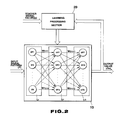
- the signal processing system of the present system includes, as shown schematically in Fig. 2 , a signal processing section 10 for producing an output value O pj from input signal patterns p and a signal processing section 20 for executing learning for producing an output value O pj closest to the desired output value t pj from the input signal patterns p by the signal processing section 10.
- the signal processing section 10 is formed by a neural network including at least an input layer L I , an intermediate layer L H and an output layer L O .
- These layers L I , L H and L O are made up of units u I1 to u Ix , u H1 to u Hy and u O1 to u Oz , each corresponding to a neuron, wherein x, y and z each represent an arbitrary number.
- the learning processing section 20 is fed with a desired output value t pj as a teacher signal for the output value O oj of the output layer L O for the input signal patterns p entered into the signal processing section 10.
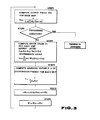
- This learning processing section 20 causes the signal processing section 10 to undergo learning processing of the coupling coefficient w ji , in such a manner that, according to the sequence of steps shown by the flow chart of Fig.
- the coefficient W ji of the coupling strength between the units u I1 to u Ix , u HI to u Hy and u O1 to u Oz is sequentially and repeatedly computed from the output layer L O towards the input layer L I , until the sum of the quadratic errors between the desired output value t pj and the actual output value O oj become sufficiently small, in order that the output value O oj of the output layer L O will be closest to the desired output value t pj supplied as the teacher signal.
- step 1 the learning processing section 20 affords the coupling coefficient w ji to each of the units u H1 to u Hy and u O1 to u Oz to compute the output value O oj of the output layer L O for the input signal patterns p in the signal processing section 10.
- step 2 the section 20 executes decision as to the converging condition for the actual output value O oj , on the basis of the total sum E p of the square errors between the actual output value O oj and the desired output value t pj supplied as the teacher signal.
- the decision step 2 it is decided whether the output value O oj obtained at the output layer L O of the signal processing section 10 is closest to the desired output value t pj . If the result of decision at step 2 is YES, that is, when the total sum E p of the square errors becomes sufficiently small and the output value O oj is closest to the desired output value t pj , the processing of learning is terminated. If the result of decision is NO, the compation operations of steps 3 through 6 are executed sequentially.
- the error ⁇ pj at each of the units u H1 to u Hy and u O1 to u Oz of the signal processing section 10 is computed.
- the learning variant j of the coefficient w ji of the coupling strength from the i'th one to the j'th one of the units u H1 to u Hy and u O1 to u Oz is computed as a reciprocal of the square sum of the totality of the inputs added to by 1 as the threshold value, that is, in accordance with the following formula (12):
- step 1 the output value O oj of the output layer L O for the input patterns p at the signal processing section 10 is computed.
- the learning processing section 20 executes the above steps 1 through 6 repeatedly, until the learning processing is terminated by the decision at step 2 when the total sum E p of the square error between the desired output t pj afforded as the teacher signal and the output value O oj becomes sufficiently small and the output value O oj obtained at the output layer L O of the signal processing section 10 is closest to the desired output value t pj .
- the learning constant ⁇ is normalized by the above learning variable ⁇ represented by the reciprocal of the square sum of the input value O pj at each of the units u H1 to u Hy and u O1 to u Oz added to by 1 as the threshold value.
- This causes the learning rate to be changed dynamically as a function of the input value O pi .
- the learning constant ⁇ is normalized by the learning variable ⁇ represented by the reciprocal of a square sum of the actual input O pi in each unit added to by 1 as a threshold value to cause the learning rate to be changed dynamically in accordance with the input value O Pi to execute the learning processing of the coupling coefficient W ji so that it becomes possible to perform stable and fast learning.
- the signal processing system of the present illustrative embodiment includes a signal processing section 30 for obtaining the output value O pj from the input signal patterns p and a learning processing section 40 for causing the signal processing section 30 to undergo learning to obtain the output value O pj closest to the desired output value t pj from the input signal patterns p.
- the signal processing section 30 is formed, as shown in Fig. 5 , by a neural network of a three-layer structure including at least an input layer L I , an intermediate layer L H and an output layer L O .
- These layers L I , L H and L O are constituted by units u I1 to u ix , u H1 to u Hy and u O1 to u Oz , each corresponding to a neuron, respectively, where x, y and z stand for arbitrary members.
- Each of the units u H1 to n Hy and u O1 to u Oz of the intermediate layer L H and the output layer L O is provided with delay means and forms a recurrent network including a loop LP having its output O j(t) as its own input by way of the delay means and a feedback FB having its output O j(t) as an input to another unit.
- the total sum net j of the inputs to the units u O1 to u Oz of the output layer L O is given by the following formula (19): While each of the units u O1 to u Oz of the output layer L O issues, for the total sum net j of the inputs, an output value O oj(t) represented by the following formula (20): where O j stands for a threshold value and NI, NH and NO stand for the numbers of the delay means provided in the layers L I , L H and L O , respectively.
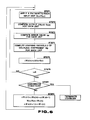
- the learning processing section 40 computes the coefficient W ji of coupling strength between the units u O1 to u Oz , u H1 to u Hy and u I1 to u Ix , from the output layer L O towards the input layer L I , sequentially and repeatedly, according to the sequence shown in the flow chart of Fig. 6, while executing the learning processing of the coupling coefficient W ji so that the total sum of the square errors LMS between the desired output value t pj afforded as the teacher signal and the output value O oj of the output layer L O will be sufficiently small.
- the learning processing section 40 causes the output value O oj of the output layer L O to be closest to the desired output value t zr , afforded as the teacher signal patterns, for an input signal pattern p (xr) supplied to the signal processing section 30.
- This pattern p (xr) represents a information unit as a whole which fluctuates along the time axis and represented by the xr number of data, where r stands for the number of times of sampling of the information unit and x the number data in each sample.
- the section 40 affords at step 1 the input signal patterns p (xr) to each of the units u I1 to u Ix of the input layer L I , and proceeds to computing at step 2 each output value O pj(t) of each of the units u H1 to u Hy and u O1 to u 0z of the intermediate layer L H and the output layer L O .
- the section 40 then proceeds to computing at step 3 the error ⁇ pj of each of the units u O1 to u Oz and u H1 to u Hy , from the output layer L O towards the input layer L I , on the basis of the output values O pj(t) and the desired output value t z r afforded as the teacher signal.
- step 4 the learning variable ⁇ j of the coefficient W ji of coupling strength from the i'th one to the j'th one of the units u I1 to u Ix , u H1 to u Hy and u O1 to u Oz is computed by the following formula (23) in which the learning variable ⁇ j is represented by the recipropcal of the square sum of the input values added to by 1 as a threshold value.
- ⁇ stands for a learning constant.
- step 5 the total sum LMS of the square errors of the units with respect to the teacher signal is computed in accordance with the formula (25)
- step 6 it is decided whether the processing of the steps 1 through 5 has been performed on the R-number of input signal patterns p xr . If the reslt of decision at step 6 is NO, the section 40 reverts to step 1.
- the result of decision at step 6 is YES, that is, when all of the variants ⁇ W ji of the coupling coefficient w ji between the units u O1 to u O2 , u H1 to u y and u I1 to U Ix are computed for the input signal patterns p xr , the section 40 proceeds to step 7 to execute decision of the converging condition for the output value O oj obtained at the output layer L O on the basis of the total sum LMS of square errors between the output value O oj and the desired output value t pj afforded as the teacher signal.
- the decision step 7 it is decided whether the output value O oj obtained at the output layer L O of the signal processing section 30 is closest to the desired output value t pj afforded as the teacher signal.
- the result of decision at step 7 is YES, that is, when the total sum LMS of the square errors is sufficiently small and the output value O oj is closest to the desired output value t pj .
- the learning processing is terminated. If the result of decision at step 7 is NO, the section 40 proceeds to computing at step 8.
- step 8 the section 40 reverts to step 1 to execute the operation of steps 1 to 6.
- the section 40 executes the operations of the steps 1 to 8 repeatedly and, when the total sum LMS of the square errors between the desired output value t pj and the actual output value O oj becomes sufficiently small and the output value O oj obtained at the output value L O of the signal processing section 30 is closest to the desired output value t pj afforded as the teacher signal, terminates the processing of learning by the decision at step 7.
- the learning as to the coupling coefficient W ji between the units u O1 to u Oz , u H1 to u Hy and u I1 to u Ix of the signal processing section 30 constituting the recurrent network inclusive of the above mentioned loop LP and the feedback FB is executed by the learning processing section 40 on the basis of the desired output value t pj afforded as the teacher signal.
- the features of the sequential time-base input signal pattern p xr such as audio signals, fluctuating along the time axis, may also be extracted reliably by the learning processing by the learning processing section 40.
- the time-series input signal pattern p xr can be subjected to desired signal processing by the signal processing section 30.
- the learning constant ⁇ is normalized by the learning constant ⁇ indicated as the reciprocal of the square sum of the input values at the units u H1 to u Hy and u O1 to u Oz , and the learning processing as to the coupling coefficient W ji is performed at the dynamically changing learning rate, as a function of the input value O pi , so that learning can be performed stably and expeditiously with a small number of times of learning.
- signal processing for input signals is performed at the signal processing section 30 in which the recurrent network inclusive of the loop LP and the feedback FB is coustituted by the units u H1 to u Hy and u O1 to u Oz of the intermediate layer L H and the output layer L O each provided with delay means.
- the learning processing section 40 the learning as to the coupling state of the recurrent network by the units u H1 to u Hy and u O1 to u Oz constituting the signal processing section 30 is executed on the basis of the teacher signal.
- the system includes a signal processing section 50 constituted by a neural network of a three-layered structure including at least an input layer L I , an intermediate layer L H and an output layer L O , each made up of plural units performing a signal processing corresponding to one of a neuron, and a learning processing section 60 subjecting the learning processing to the signal processing consisting in sequentially repeatedly computing the coefficient W ji of coupling strength between the above units from the output layer L O towards the input layer L I on the basis of the error data ⁇ pj between the output value of the output layer L O and the desired output value O pj afforded as the teacher signal t pj , for the input signal patterns p entered into the input layer L I of the signal processing section 50, and learning the coupling coefficient W ji in accordance with the back-propagation learning rule.
- a signal processing section 50 constituted by a neural network of a three-layered structure including at least an input layer L I , an intermediate layer L H and an output layer L O , each made up of
- the learning processing section 60 executes the learning processing of the coupling coefficient W ji as it causes the number of the units of the intermediate layer L H of the signal processing section 50 to be increased, and thus the section 60 has the control function of causing the number of units of the intermediate layer L H to be increased in the course of learning processing of the coupling coefficient W ji .
- the learning processing section 60 subjects the signal processing section 50 having the input layer L I , an intermediate layer L H and an output layer L O made up of arbitrary numbers x, y and z of units u I1 to u Ix , u H1 to u Hy and u O1 to u Oz , each corresponding to a neuron, respectively, as shown in Fig. 8A, to learning processing as to the coupling coefficient w ji , while the section 60 causes the number of the unit L H to be increased sequentially from y to (y+m), as shown in Fig. 8B.
- control operation of increasing the number of the units of the intermediate layer L H may be performed periodically in the course of learning processing of the coupling coefficient W ji , or each time the occurrence of the above mentioned local minimum state is sensed.
- the above mentioned learning processing section 60 having the control function of increasing the number of the units of the intermediate layer L H in the course of learning processing of the coupling coefficient W ji , subjects the signal processing section 50 formed by a neural network of a three-layer structure including the input layer L I , intermediate layer L H and the output layer L O to the learning processing of the coupling coefficient W ji , as it causes the number of units of the intermediate layer L H to be increased.
- the section 50 is able to increase the number of the units of the intermediate layer L H to exit from such local minimum state to effect rapid and reliable convergence into the optimum global minimum state.
- Fig. 10 shows, as an example of the above tests, the test results in which learning processing of converging into the optimum minimum state could be achieved by adding the units of the intermediate layer L H at the timing shown by the arrow mark in the figure and by increasing the number of the intermediate layer L H from three to six.
- the ordinate in Fig. 10 stands for the total sum LMS of the quadratic errors and the abscissa stands the number of times of the learning processing operations.
- step 1 the variable K indicating the number of times of the processing for detecting the local minimum state is initialized to "0", while the first variable Lms for deciding the converging condition of the learning processing is also initialized to 10000000000.
- step 2 the variable n indicating the number of times of learning of the overall learning pattern, that is, the 1 -number of the input signal patterns p , is initialized.
- the program then proceeds to step 3 to execute the learning processing of the 1 -number of the input signal patterns p .
- step 6 after the value of the first variable Lms is maintained as the value of the second variable Lms(-1) for deciding the converging condition of the learning processing, the total sum of the square errors between the output signal and the teacher signal in each unit is computed in accordance with the formula (28), this value being then used as the new value for the first variable Lms, such that
- step 7 the first variable Lms for deciding the converging condition of the learning processing is compared with the second variable Lms(-1). If the value of the first variable Lms is lesser than that of the second variable Lms(-1), the program proceeds to step 8 to decide whether or not the variable k indicating the number of times of the processing operations for detecting the local minimum state is equal to 0.
- step 7 If, in step 7, the value of the first variable Lms is larger than that of the second variable Lms(-1), the program proceeds to step 10 to set the value of k indicating the number of times of the processing operations for detecting the local minimum state (k ⁇ k+1). Then, in step 11, it is decided whether or not the value of k is 2.
- the test results have revealed that the learning processing need be repeated an extremely large number of times with considerable time expenditure until the convergence to the optimum minimum state was achieved, and that the local minimum state prevailed for three out of eight learning processing tests without convergence to the optimum global minimum state.
- Fig. 11 shows, by way of an example, the results of the learning processing tests in which the local minimum state was reached.
- the ordinate stands for the total sum LMS of the square errors and the abscissa stands the number of times of the learning processing operations.
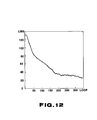
- Fig. 12 the ordinate stands for the total sum LMS of the square errors and the abscissa stands the number of times of the learning processing operations.
- the present invention provides a learning processing system in which the learning processing of the coefficient of coupling strength is performed, while the number of the units of the intermediate layer is increased by the learning processing section, whereby the convergence to the optimum global minimum state is achieved promptly and reliably to achieve the stable learning processing to avoid the local minimum state in the learning processing process conforming to the back-propagation learning rule.
Landscapes
- Engineering & Computer Science (AREA)
- Theoretical Computer Science (AREA)
- Physics & Mathematics (AREA)
- General Health & Medical Sciences (AREA)
- Computing Systems (AREA)
- Biomedical Technology (AREA)
- Biophysics (AREA)
- Computational Linguistics (AREA)
- Data Mining & Analysis (AREA)
- Evolutionary Computation (AREA)
- Life Sciences & Earth Sciences (AREA)
- Molecular Biology (AREA)
- Artificial Intelligence (AREA)
- General Engineering & Computer Science (AREA)
- General Physics & Mathematics (AREA)
- Mathematical Physics (AREA)
- Software Systems (AREA)
- Health & Medical Sciences (AREA)
- Image Analysis (AREA)
- Feedback Control In General (AREA)
Priority Applications (1)
| Application Number | Priority Date | Filing Date | Title |
|---|---|---|---|
| EP94107842A EP0612033B1 (de) | 1988-09-17 | 1989-09-15 | Lernverarbeitungssystem |
Applications Claiming Priority (6)
| Application Number | Priority Date | Filing Date | Title |
|---|---|---|---|
| JP63232846A JP2699447B2 (ja) | 1988-09-17 | 1988-09-17 | 信号処理装置 |
| JP232846/88 | 1988-09-17 | ||
| JP63232845A JP2897220B2 (ja) | 1988-09-17 | 1988-09-17 | 信号処理装置 |
| JP232845/88 | 1988-09-17 | ||
| JP235441/88 | 1988-09-20 | ||
| JP63235441A JP2606317B2 (ja) | 1988-09-20 | 1988-09-20 | 学習処理装置 |
Related Child Applications (2)
| Application Number | Title | Priority Date | Filing Date |
|---|---|---|---|
| EP94107842.0 Division-Into | 1989-09-15 | ||
| EP94107842A Division EP0612033B1 (de) | 1988-09-17 | 1989-09-15 | Lernverarbeitungssystem |
Publications (3)
| Publication Number | Publication Date |
|---|---|
| EP0360674A2 true EP0360674A2 (de) | 1990-03-28 |
| EP0360674A3 EP0360674A3 (en) | 1990-10-31 |
| EP0360674B1 EP0360674B1 (de) | 1995-11-15 |
Family
ID=27331934
Family Applications (2)
| Application Number | Title | Priority Date | Filing Date |
|---|---|---|---|
| EP94107842A Expired - Lifetime EP0612033B1 (de) | 1988-09-17 | 1989-09-15 | Lernverarbeitungssystem |
| EP89402544A Expired - Lifetime EP0360674B1 (de) | 1988-09-17 | 1989-09-15 | Signalverarbeitungssystem und Lernverarbeitungssystem |
Family Applications Before (1)
| Application Number | Title | Priority Date | Filing Date |
|---|---|---|---|
| EP94107842A Expired - Lifetime EP0612033B1 (de) | 1988-09-17 | 1989-09-15 | Lernverarbeitungssystem |
Country Status (3)
| Country | Link |
|---|---|
| US (2) | US5093899A (de) |
| EP (2) | EP0612033B1 (de) |
| DE (2) | DE68924822T2 (de) |
Cited By (10)
| Publication number | Priority date | Publication date | Assignee | Title |
|---|---|---|---|---|
| FR2668625A1 (fr) * | 1990-10-30 | 1992-04-30 | Thomson Csf | Procede d'apprentissage automatique et reseau connexionniste multi-couches pour la mise en óoeuvre de ce procede. |
| EP0491301A1 (de) * | 1990-12-17 | 1992-06-24 | Sony Corporation | Gerät und Verfahren für die Wiedergabe von Signalen |
| EP0540345A1 (de) * | 1991-10-31 | 1993-05-05 | Canon Kabushiki Kaisha | Verfahren und Gerät zur Aufzeichnung und Wiedergabe von Information |
| EP0477733A3 (de) * | 1990-09-28 | 1994-02-09 | Siemens Ag | |
| EP0521729A3 (en) * | 1991-07-03 | 1994-11-02 | Honda Motor Co Ltd | Neural network and learning method therefor |
| EP0583217A3 (de) * | 1992-08-11 | 1995-03-15 | Hitachi Europ Ltd | Optimierung eines Neuralnetzwerks mit Vorwärtskopplung. |
| US6054710A (en) * | 1997-12-18 | 2000-04-25 | Cypress Semiconductor Corp. | Method and apparatus for obtaining two- or three-dimensional information from scanning electron microscopy |
| CN103530690A (zh) * | 2013-10-31 | 2014-01-22 | 中国科学院上海微系统与信息技术研究所 | 一种神经元器件及神经网络 |
| WO2014140541A3 (en) * | 2013-03-15 | 2015-03-19 | Google Inc. | Signal processing systems |
| CN106647271A (zh) * | 2016-12-23 | 2017-05-10 | 重庆大学 | 基于神经网络理论的非线性系统自适应比例积分控制方法 |
Families Citing this family (75)
| Publication number | Priority date | Publication date | Assignee | Title |
|---|---|---|---|---|
| FI894021A7 (fi) * | 1988-08-31 | 1990-03-01 | Fujitsu Ltd | Neuronstruktur. |
| JP2533942B2 (ja) * | 1989-03-13 | 1996-09-11 | 株式会社日立製作所 | 知識抽出方法およびプロセス運転支援システム |
| JPH0692914B2 (ja) * | 1989-04-14 | 1994-11-16 | 株式会社日立製作所 | 機器/設備の状態診断システム |
| EP0416173B1 (de) * | 1989-08-23 | 1997-01-15 | Hitachi, Ltd. | Verfahren zur Richtigstellung von Netzwerkwichtungsfaktoren in einer mehrschichtigen Perceptronvorrichtung und eine solche Vorrichtung mit Mitteln zur Ausführung dieses Verfahrens |
| GB8929146D0 (en) * | 1989-12-22 | 1990-02-28 | British Telecomm | Neural networks |
| US5167006A (en) * | 1989-12-29 | 1992-11-24 | Ricoh Company, Ltd. | Neuron unit, neural network and signal processing method |
| US5581662A (en) * | 1989-12-29 | 1996-12-03 | Ricoh Company, Ltd. | Signal processing apparatus including plural aggregates |
| JPH03250243A (ja) * | 1990-02-27 | 1991-11-08 | Toshiba Corp | 神経回路網演算装置 |
| JP2763182B2 (ja) * | 1990-06-28 | 1998-06-11 | 株式会社東芝 | ニューラル・ネットワークの学習方法 |
| JP2540654B2 (ja) * | 1990-06-28 | 1996-10-09 | シャープ株式会社 | ニュ―ラルネットワ―クの学習装置 |
| GB2246895B (en) * | 1990-07-12 | 1994-03-30 | Mitsubishi Electric Corp | Neural network system |
| US5181171A (en) * | 1990-09-20 | 1993-01-19 | Atlantic Richfield Company | Adaptive network for automated first break picking of seismic refraction events and method of operating the same |
| JP3102918B2 (ja) * | 1990-11-22 | 2000-10-23 | 株式会社リコー | ニューラルネットワーク学習方法およびこの学習方法を用いた信号処理装置 |
| US5259064A (en) * | 1991-01-25 | 1993-11-02 | Ricoh Company, Ltd. | Signal processing apparatus having at least one neural network having pulse density signals as inputs and outputs |
| JP3088171B2 (ja) * | 1991-02-12 | 2000-09-18 | 三菱電機株式会社 | 自己組織型パタ−ン分類システム及び分類方法 |
| JP2520331B2 (ja) * | 1991-03-25 | 1996-07-31 | 株式会社エイ・ティ・アール自動翻訳電話研究所 | ニュ―ラルネットワ―クの学習方法 |
| DE4215179A1 (de) * | 1991-05-08 | 1992-11-12 | Caterpillar Inc | Prozessor und verarbeitendes element zum gebrauch in einem neural- oder nervennetzwerk |
| US5671335A (en) * | 1991-05-23 | 1997-09-23 | Allen-Bradley Company, Inc. | Process optimization using a neural network |
| JPH0683792A (ja) * | 1991-06-12 | 1994-03-25 | Hitachi Ltd | ニューラルネットワークの学習装置およびニューラルネットワークの学習パターン呈示方法 |
| US5479571A (en) * | 1991-06-14 | 1995-12-26 | The Texas A&M University System | Neural node network and model, and method of teaching same |
| JP3323894B2 (ja) * | 1991-06-27 | 2002-09-09 | 株式会社日立製作所 | ニューラルネットワーク学習方法及び装置 |
| WO1993003443A1 (fr) * | 1991-08-05 | 1993-02-18 | Kawasaki Steel Corporation | Processeur de signaux et sa methode d'apprentissage |
| JP2722906B2 (ja) * | 1991-12-27 | 1998-03-09 | ダイキン工業株式会社 | 未知数量推定方法およびその装置 |
| US5787393A (en) * | 1992-03-30 | 1998-07-28 | Seiko Epson Corporation | Speech recognition apparatus using neural network, and learning method therefor |
| US5630019A (en) * | 1992-05-23 | 1997-05-13 | Kabushiki Kaisha Topcon | Waveform evaluating apparatus using neural network |
| US5428710A (en) * | 1992-06-29 | 1995-06-27 | The United States Of America As Represented By The Administrator Of The National Aeronautics And Space Administration | Fast temporal neural learning using teacher forcing |
| US5598509A (en) * | 1992-08-28 | 1997-01-28 | Hitachi, Ltd. | Method of configuring a neural network and a diagnosis/recognition system using the same |
| US5627941A (en) * | 1992-08-28 | 1997-05-06 | Hitachi, Ltd. | Method of configuring a neural network and a diagnosis/control system using the neural network |
| US5288645A (en) * | 1992-09-04 | 1994-02-22 | Mtm Engineering, Inc. | Hydrogen evolution analyzer |
| US5742702A (en) * | 1992-10-01 | 1998-04-21 | Sony Corporation | Neural network for character recognition and verification |
| US5319722A (en) * | 1992-10-01 | 1994-06-07 | Sony Electronics, Inc. | Neural network for character recognition of rotated characters |
| US5930781A (en) * | 1992-10-27 | 1999-07-27 | The United States Of America As Represented By The Administrator Of The National Aeronautics And Space Administration | Neural network training by integration of adjoint systems of equations forward in time |
| JPH06203005A (ja) * | 1992-10-27 | 1994-07-22 | Eastman Kodak Co | 高速区分化ニューラルネットワーク及びその構築方法 |
| EP0602717B1 (de) * | 1992-12-16 | 1997-10-01 | Laboratoires D'electronique Philips S.A.S. | Neuronalanlage und -Bauverfahren |
| US5579439A (en) * | 1993-03-24 | 1996-11-26 | National Semiconductor Corporation | Fuzzy logic design generator using a neural network to generate fuzzy logic rules and membership functions for use in intelligent systems |
| FR2704669B1 (fr) * | 1993-04-29 | 1995-06-30 | France Telecom | Systeme a reseau neuronal pour le traitement de signaux, notamment pour l'analyse et la synthese d'images. |
| US5408424A (en) * | 1993-05-28 | 1995-04-18 | Lo; James T. | Optimal filtering by recurrent neural networks |
| US5448684A (en) * | 1993-11-12 | 1995-09-05 | Motorola, Inc. | Neural network, neuron, and method for recognizing a missing input valve |
| US5737496A (en) * | 1993-11-17 | 1998-04-07 | Lucent Technologies Inc. | Active neural network control of wafer attributes in a plasma etch process |
| JP3633642B2 (ja) * | 1994-02-28 | 2005-03-30 | 富士通株式会社 | 情報の処理装置 |
| US5430830A (en) * | 1994-08-22 | 1995-07-04 | Motorola, Inc. | Adaptive weight adjusting circuit for an neural network |
| US5812992A (en) * | 1995-05-24 | 1998-09-22 | David Sarnoff Research Center Inc. | Method and system for training a neural network with adaptive weight updating and adaptive pruning in principal component space |
| US6151592A (en) * | 1995-06-07 | 2000-11-21 | Seiko Epson Corporation | Recognition apparatus using neural network, and learning method therefor |
| JP3697748B2 (ja) * | 1995-08-21 | 2005-09-21 | セイコーエプソン株式会社 | 端末、音声認識装置 |
| JPH0973440A (ja) * | 1995-09-06 | 1997-03-18 | Fujitsu Ltd | コラム構造の再帰型ニューラルネットワークによる時系列トレンド推定システムおよび方法 |
| US5748847A (en) * | 1995-12-21 | 1998-05-05 | Maryland Technology Corporation | Nonadaptively trained adaptive neural systems |
| US5761626A (en) * | 1995-12-26 | 1998-06-02 | Ford Global Technologies, Inc. | System and method for distinguishing and characterizing motor vehicles for control of automatic drivers |
| KR100442287B1 (ko) * | 1997-02-26 | 2005-01-15 | 주식회사 하이닉스반도체 | 신경망(NeuralNetwork)학습기 |
| US6006186A (en) * | 1997-10-16 | 1999-12-21 | Sony Corporation | Method and apparatus for a parameter sharing speech recognition system |
| US6230122B1 (en) | 1998-09-09 | 2001-05-08 | Sony Corporation | Speech detection with noise suppression based on principal components analysis |
| US6304865B1 (en) | 1998-10-27 | 2001-10-16 | Dell U.S.A., L.P. | Audio diagnostic system and method using frequency spectrum and neural network |
| US6266642B1 (en) | 1999-01-29 | 2001-07-24 | Sony Corporation | Method and portable apparatus for performing spoken language translation |
| US6282507B1 (en) | 1999-01-29 | 2001-08-28 | Sony Corporation | Method and apparatus for interactive source language expression recognition and alternative hypothesis presentation and selection |
| US6223150B1 (en) | 1999-01-29 | 2001-04-24 | Sony Corporation | Method and apparatus for parsing in a spoken language translation system |
| US6442524B1 (en) | 1999-01-29 | 2002-08-27 | Sony Corporation | Analyzing inflectional morphology in a spoken language translation system |
| US6278968B1 (en) | 1999-01-29 | 2001-08-21 | Sony Corporation | Method and apparatus for adaptive speech recognition hypothesis construction and selection in a spoken language translation system |
| US6356865B1 (en) * | 1999-01-29 | 2002-03-12 | Sony Corporation | Method and apparatus for performing spoken language translation |
| US6243669B1 (en) | 1999-01-29 | 2001-06-05 | Sony Corporation | Method and apparatus for providing syntactic analysis and data structure for translation knowledge in example-based language translation |
| US6374224B1 (en) | 1999-03-10 | 2002-04-16 | Sony Corporation | Method and apparatus for style control in natural language generation |
| US6513023B1 (en) | 1999-10-01 | 2003-01-28 | The United States Of America As Represented By The Administrator Of The National Aeronautics And Space Administration | Artificial neural network with hardware training and hardware refresh |
| US6424961B1 (en) * | 1999-12-06 | 2002-07-23 | AYALA FRANCISCO JOSé | Adaptive neural learning system |
| JP2002024795A (ja) * | 2000-07-04 | 2002-01-25 | Sony Corp | 情報処理装置および方法、並びに記録媒体 |
| JP2007504576A (ja) * | 2003-01-17 | 2007-03-01 | アヤラ,フランシスコ,ジェイ | 人工知能を開発するためのシステム及び方法 |
| US7493295B2 (en) * | 2003-01-17 | 2009-02-17 | Francisco J. Ayala | Method, system and computer program for developing cortical algorithms |
| MY138544A (en) | 2003-06-26 | 2009-06-30 | Neuramatix Sdn Bhd | Neural networks with learning and expression capability |
| CN101310294A (zh) * | 2005-11-15 | 2008-11-19 | 伯纳黛特·加纳 | 神经网络的训练方法 |
| US8218904B2 (en) * | 2008-08-27 | 2012-07-10 | Lockheed Martin Corporation | Method and system for circular to horizontal transposition of an image |
| US8775341B1 (en) | 2010-10-26 | 2014-07-08 | Michael Lamport Commons | Intelligent control with hierarchical stacked neural networks |
| US9015093B1 (en) | 2010-10-26 | 2015-04-21 | Michael Lamport Commons | Intelligent control with hierarchical stacked neural networks |
| CN102063640B (zh) * | 2010-11-29 | 2013-01-30 | 北京航空航天大学 | 基于效用差分网络的机器人行为学习模型 |
| KR102413692B1 (ko) | 2015-07-24 | 2022-06-27 | 삼성전자주식회사 | 음성 인식을 위한 음향 점수 계산 장치 및 방법, 음성 인식 장치 및 방법, 전자 장치 |
| KR102192678B1 (ko) | 2015-10-16 | 2020-12-17 | 삼성전자주식회사 | 음향 모델 입력 데이터의 정규화 장치 및 방법과, 음성 인식 장치 |
| CN110352297B (zh) | 2018-02-05 | 2020-09-15 | 丰田自动车株式会社 | 机器学习装置 |
| US10634081B2 (en) | 2018-02-05 | 2020-04-28 | Toyota Jidosha Kabushiki Kaisha | Control device of internal combustion engine |
| US11420325B2 (en) * | 2018-03-05 | 2022-08-23 | Omron Corporation | Method, apparatus and system for controlling a robot, and storage medium |
-
1989
- 1989-09-13 US US07/406,733 patent/US5093899A/en not_active Expired - Lifetime
- 1989-09-15 DE DE68924822T patent/DE68924822T2/de not_active Expired - Fee Related
- 1989-09-15 EP EP94107842A patent/EP0612033B1/de not_active Expired - Lifetime
- 1989-09-15 DE DE68929102T patent/DE68929102T2/de not_active Expired - Fee Related
- 1989-09-15 EP EP89402544A patent/EP0360674B1/de not_active Expired - Lifetime
-
1991
- 1991-07-10 US US07/727,871 patent/US5129039A/en not_active Expired - Lifetime
Non-Patent Citations (4)
| Title |
|---|
| D.E. RUMELHART et al.: "Parallel distributed processing", vol. 1: "Foundations", 1986, pages 318-362, The MIT Press, Cambridge, London, GB * |
| IEEE FIRST INTERNATIONAL CONFERENCE ON NEURAL NETWORKS, San Diego, California, 21st - 24th June 1987, pages II-251/258; F.E. NORROD et al.: "Feedback-induced sequentiality in neural networks" * |
| IEEE INTERNATIONAL CONFERENCE ON NEURAL NETWORKS, San Diego, California, 24th - 27th July 1988, pages 225-230; B. MACUKOW et al.: "Neural network model using a normalized inner product as a measure of similarity" * |
| IEEE INTERNATIONAL CONFERENCE ON NEURAL NETWORKS, San Diego, California, 24th - 27th July 1988, pages II-235-242, IEEE; M.F. TENORIO et al.: "Adaptive networks as a model for human speech development" * |
Cited By (15)
| Publication number | Priority date | Publication date | Assignee | Title |
|---|---|---|---|---|
| EP0477733A3 (de) * | 1990-09-28 | 1994-02-09 | Siemens Ag | |
| FR2668625A1 (fr) * | 1990-10-30 | 1992-04-30 | Thomson Csf | Procede d'apprentissage automatique et reseau connexionniste multi-couches pour la mise en óoeuvre de ce procede. |
| EP0491301A1 (de) * | 1990-12-17 | 1992-06-24 | Sony Corporation | Gerät und Verfahren für die Wiedergabe von Signalen |
| US5295130A (en) * | 1990-12-17 | 1994-03-15 | Sony Corporation | Apparatus and method for signal reproduction |
| EP0521729A3 (en) * | 1991-07-03 | 1994-11-02 | Honda Motor Co Ltd | Neural network and learning method therefor |
| US5522015A (en) * | 1991-07-03 | 1996-05-28 | Honda Giken Kogyo Kabushiki Kaisha | Neural network and learning method for linearly unseparable patterns |
| US5555231A (en) * | 1991-10-31 | 1996-09-10 | Canon Kabushiki Kaisha | Information recording method, method for reproducing recorded information, and apparatus therefor |
| EP0540345A1 (de) * | 1991-10-31 | 1993-05-05 | Canon Kabushiki Kaisha | Verfahren und Gerät zur Aufzeichnung und Wiedergabe von Information |
| EP0583217A3 (de) * | 1992-08-11 | 1995-03-15 | Hitachi Europ Ltd | Optimierung eines Neuralnetzwerks mit Vorwärtskopplung. |
| US6054710A (en) * | 1997-12-18 | 2000-04-25 | Cypress Semiconductor Corp. | Method and apparatus for obtaining two- or three-dimensional information from scanning electron microscopy |
| WO2014140541A3 (en) * | 2013-03-15 | 2015-03-19 | Google Inc. | Signal processing systems |
| US9342781B2 (en) | 2013-03-15 | 2016-05-17 | Google Inc. | Signal processing systems |
| CN103530690A (zh) * | 2013-10-31 | 2014-01-22 | 中国科学院上海微系统与信息技术研究所 | 一种神经元器件及神经网络 |
| CN106647271A (zh) * | 2016-12-23 | 2017-05-10 | 重庆大学 | 基于神经网络理论的非线性系统自适应比例积分控制方法 |
| CN106647271B (zh) * | 2016-12-23 | 2019-07-26 | 重庆大学 | 基于神经网络理论的非线性系统自适应比例积分控制方法 |
Also Published As
| Publication number | Publication date |
|---|---|
| DE68924822T2 (de) | 1996-05-02 |
| EP0360674B1 (de) | 1995-11-15 |
| DE68924822D1 (de) | 1995-12-21 |
| DE68929102D1 (de) | 1999-12-30 |
| EP0360674A3 (en) | 1990-10-31 |
| US5093899A (en) | 1992-03-03 |
| EP0612033B1 (de) | 1999-11-24 |
| EP0612033A3 (de) | 1994-10-12 |
| US5129039A (en) | 1992-07-07 |
| EP0612033A2 (de) | 1994-08-24 |
| DE68929102T2 (de) | 2000-07-06 |
Similar Documents
| Publication | Publication Date | Title |
|---|---|---|
| EP0360674A2 (de) | Signalverarbeitungssystem und Lernverarbeitungssystem | |
| EP0454037A2 (de) | Neuronales Netzwerk zum Verarbeiten einer Vielzahl von Informationen und Lernverfahren | |
| US5095443A (en) | Plural neural network system having a successive approximation learning method | |
| EP0384689B1 (de) | Lernsystem und Lernverfahren für eine Datenverarbeitungsvorrichtung | |
| EP0314170A2 (de) | Mehrschichtiges Neuronalnetzwerk mit dynamischer Programmierung | |
| JP3178884B2 (ja) | ニューラルネットワーク装置 | |
| DE69424372T2 (de) | Hocheffizientes Lernnetzwerk | |
| US5630020A (en) | Learning method and neural network structure | |
| KR102795365B1 (ko) | 인공 신경망에서 학습을 통한 로드 밸런싱 방법 및 시스템 | |
| US5627944A (en) | Parallel data processing system | |
| Zhu et al. | Lagrange neural networks for linear programming | |
| Eremenko et al. | The incremental learning algorithm for compartmental spiking neuron model | |
| JP2606317B2 (ja) | 学習処理装置 | |
| EP0395112B1 (de) | Neuronales Netzwerk | |
| JPH0281160A (ja) | 信号処理装置 | |
| Khotanzad et al. | Non-parametric prediction of AR processes using neural networks | |
| Rashid et al. | A new simple recurrent network with real time recurrent learning process | |
| JP2618504B2 (ja) | 文字認識装置 | |
| Bobrowski | Learning processes in multilayer threshold nets | |
| EP0567983A2 (de) | Lernende Wellenformerkennungseinrichtung | |
| Moreau et al. | Post training in deep learning with last kernel | |
| Chen | A global optimization algorithm for neural network training | |
| Fathy et al. | A parallel design and implementation for backpropagation neural network using MIMD architecture | |
| Burman et al. | Face Recognition using Wavelet Transform and ANN | |
| Moreau et al. | Post-training for Deep Learning |
Legal Events
| Date | Code | Title | Description |
|---|---|---|---|
| PUAI | Public reference made under article 153(3) epc to a published international application that has entered the european phase |
Free format text: ORIGINAL CODE: 0009012 |
|
| AK | Designated contracting states |
Kind code of ref document: A2 Designated state(s): DE FR GB |
|
| PUAL | Search report despatched |
Free format text: ORIGINAL CODE: 0009013 |
|
| AK | Designated contracting states |
Kind code of ref document: A3 Designated state(s): DE FR GB |
|
| 17P | Request for examination filed |
Effective date: 19901228 |
|
| 17Q | First examination report despatched |
Effective date: 19930322 |
|
| GRAA | (expected) grant |
Free format text: ORIGINAL CODE: 0009210 |
|
| AK | Designated contracting states |
Kind code of ref document: B1 Designated state(s): DE FR GB |
|
| XX | Miscellaneous (additional remarks) |
Free format text: TEILANMELDUNG 94107842.0 EINGEREICHT AM 15/09/89. |
|
| REF | Corresponds to: |
Ref document number: 68924822 Country of ref document: DE Date of ref document: 19951221 |
|
| ET | Fr: translation filed | ||
| PLBE | No opposition filed within time limit |
Free format text: ORIGINAL CODE: 0009261 |
|
| STAA | Information on the status of an ep patent application or granted ep patent |
Free format text: STATUS: NO OPPOSITION FILED WITHIN TIME LIMIT |
|
| 26N | No opposition filed | ||
| PGFP | Annual fee paid to national office [announced via postgrant information from national office to epo] |
Ref country code: FR Payment date: 20010911 Year of fee payment: 13 |
|
| PGFP | Annual fee paid to national office [announced via postgrant information from national office to epo] |
Ref country code: GB Payment date: 20010919 Year of fee payment: 13 |
|
| PGFP | Annual fee paid to national office [announced via postgrant information from national office to epo] |
Ref country code: DE Payment date: 20011001 Year of fee payment: 13 |
|
| REG | Reference to a national code |
Ref country code: GB Ref legal event code: IF02 |
|
| PG25 | Lapsed in a contracting state [announced via postgrant information from national office to epo] |
Ref country code: GB Free format text: LAPSE BECAUSE OF NON-PAYMENT OF DUE FEES Effective date: 20020915 |
|
| PG25 | Lapsed in a contracting state [announced via postgrant information from national office to epo] |
Ref country code: DE Free format text: LAPSE BECAUSE OF NON-PAYMENT OF DUE FEES Effective date: 20030401 |
|
| GBPC | Gb: european patent ceased through non-payment of renewal fee |
Effective date: 20020915 |
|
| PG25 | Lapsed in a contracting state [announced via postgrant information from national office to epo] |
Ref country code: FR Free format text: LAPSE BECAUSE OF NON-PAYMENT OF DUE FEES Effective date: 20030603 |
|
| REG | Reference to a national code |
Ref country code: FR Ref legal event code: ST |