EP0361015A2 - Commande bidirectionnelle à grande vitesse pour moteur pas à pas bipolaire pour montre - Google Patents
Commande bidirectionnelle à grande vitesse pour moteur pas à pas bipolaire pour montre Download PDFInfo
- Publication number
- EP0361015A2 EP0361015A2 EP89113738A EP89113738A EP0361015A2 EP 0361015 A2 EP0361015 A2 EP 0361015A2 EP 89113738 A EP89113738 A EP 89113738A EP 89113738 A EP89113738 A EP 89113738A EP 0361015 A2 EP0361015 A2 EP 0361015A2
- Authority
- EP
- European Patent Office
- Prior art keywords
- pulses
- circuit means
- coil
- rotor
- drive
- Prior art date
- Legal status (The legal status is an assumption and is not a legal conclusion. Google has not performed a legal analysis and makes no representation as to the accuracy of the status listed.)
- Withdrawn
Links
Images

Classifications
-
- G—PHYSICS
- G04—HOROLOGY
- G04C—ELECTROMECHANICAL CLOCKS OR WATCHES
- G04C3/00—Electromechanical clocks or watches independent of other time-pieces and in which the movement is maintained by electric means
- G04C3/14—Electromechanical clocks or watches independent of other time-pieces and in which the movement is maintained by electric means incorporating a stepping motor
Definitions
- This invention relates generally to drive circuits for quartz analog wristwatches having a bipole stepping motor. More particularly, the invention relates to a high rate, bidirectional drive circuit for setting quartz analog wristwatches which is particularly suitable for three-hand watches.
- Bipole stepping motors or Lavet stepping motors commonly used in quartz analog wristwatches are normally driven in discrete steps with the motor coming to rest between successive steps.
- the rotor With a bipole stepping motor, the rotor is commonly supplied with a pulse applied to the driving coil, which causes the rotor to rotate 1/2 revolution, and this is transmitted through a gear train to cause the "seconds" hand to step 1/60 revolution.
- the "seconds” hand is also connected to drive the "minutes” hand and the “hours” hand through the gear train. Subsequently, after an interval of one second, the polarity of the driving pulse is reversed and applied to rotate the stepping motor rotor another 1/2 revolution, and so forth. Because the rotor undergoes a damped oscillation after each step, application of the pulses of alternating polarity at a higher frequency for setting the hands is limited to approximately 60 steps a second.
- Patent 4,055,785 issued October 25, 1977 to Nakajima et al., a "burst" of high frequency pulses at a frequency greater than 100 hertz are supplied at a 50 percent duty cycle to reduce coil current and flux intensity for shifting the static equilibrium position of the rotor in order to reverse it.
- the rotor steps forward or reverse in discretion steps, at a normal timekeeping rate, or at a higher rate in discrete steps for the purpose of setting the wristwatch.
- the higher rate is limited due to the need for the rotor stabilize at its equilibrium position after each step. It would be desirable to operate the stepping motor in order to set the watch by electrical means at much higher speeds, particularly in the case of a three-hand wristwatch.
- the only alternative is to employ a manual crown and setting gear mechanism which increases the cost of the watch.
- one object of the present invention is to provide an improved high rate, bidirectional drive circuit for a bipole stepping motor.
- Another object of the invention is to provide a drive circuit with an improved wave form for operating a quartz analog wristwatch during normal timekeeping and for setting, both in forward and reverse directions.
- the invention comprises an improvement to the drive circuit of a quartz analog wristwatch having a stepping motor with a drive coil, a gear train having a plurality of gears driven by the rotor, a plurality of output members with hands rotatably driven by said gears, the rotor, gears, output members and hands together comprising a rotating system
- the improvement comprises a low impedence drive coil, first circuit means arranged to generate periodic pulses of alternating polarity at a normal timekeeping frequency, second circuit means arranged to supply successive drive pulses of alternating polarity to the coil at an intermediate frequency selected to sustain and synchronize the rotating system at a substantially constant angular velocity, and third circuit means arranged to modulate the periodic pulses generated by the first circuit means so as to chop them at a high frequency selected with regard to the low impedence coil, so that energy which would otherwise be consumed by the coil is reduced during normal timekeeping.
- the periodic pulses are provided at one second intervals, the intermediate frequency of successive drive pulses is on the order of 300 to 600 pulses per second, and the timekeeping pulse is chopped at a four kilohertz rate having a 25 to 50 percent duty cycle.
- a braking pulse of 22 to 30 milliseconds in duration may be applied to stop the high speed rotating system at the conclusion of time setting.
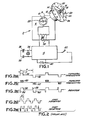
- a simplified schematic view of a quartz analog wristwatch movement is illustrated, the various components being not to scale and drawn to illustrate their function rather than actual shape or size.
- the movement includes a stepping motor 2 supplied with drive pulses by an integrated circuit 4.
- the stepping motor includes a stator 6 and rotor 8 rotatably mounted within the watch frame (not shown).
- Rotor 8 is mechanically coupled via its pinion 10 to a plurality of gears comprising a gear train collectively illustrated at 12.
- Selected gears are associated with coxial rotatable output members 14, 16, 18 which respectively "step” or rotate an "hour” hand 20, "minute” hand 22 and “second” hand 24.
- the hands indicate time by means of a watch dial 26.
- the rotor 8, gears, output members and hands together constitute a rotating system 82 (Fig. 6).
- the stepping motor rotor 8 includes a bipole permanent magnet 28 cooperating with stator 6 in a manner well known to those skilled in the art by means periodically reversing the direction of current through a coil 30 wound around a core 32 of the stator.
- Integrated circuit 4 is disposed on a circuit board (not shown) together with a quartz crystal timebase 34, capacitors 36, 38 and is connectible to an energy cell 40 which is a button-type battery also disposed in the watchcase.
- the integrated circuit 4 is also connected to a manually actuated switch 42 which is operated by a button or crown protruding from the watchcase in a manner well known to those skilled in the art.
- Integrated circuit 4 may either be customized to provide the drive pulses to be described, or it may be a programmable microcomputer chip, which has been mask-programmed to provide the drive pulse wave forms to be described.
- the design and programming of such an integrated circuit is well known to those skilled in the art and the description provided herein is sufficient to design such a circuit without illustration of the logic elements which might be utilized to generate and supply the wave forms to be described.
- the coil 30 is designed to have a significantly lower impedance than prior art coils for stepping motors. This is done by reducing the number of turns and increasing the cross-sectional area of the wire.
- the coil impedance is a complex value which depends upon the varying inductance (dependent upon rotor position in the stator) and upon the wave form and frequency of applied pulses.
- the coil is supplied with periodic alternating square pulses at a rate of 1 pulse per second with amplitude of 1.5 volts and duration of 6.0ms.
- a conventional stepping motor coil designed to operate under these conditions might contain around 10,000 turns and have a resistance of 2500 ohms.
- the low impedance coil for the same motor according to the present invention would have between 4,000 and 8,000 turns and a resistance in the range of 500 ohms to 1500 ohms.
- a satisfactory motor coil would have, as an example, 6,300 turns with a resistance of 1000 ohms.
- a series of wave forms (a) through (e) illustrates typical prior art wave forms.
- Fig. 2(a) is a typical wave form for supplying periodic drive pulses of a duration "P", for example of, 6.0ms at a normal timekeeping frequency over a period "T".
- the pulses alternate in polarity as indicated at 46, 48 and are supplied periodically.
- Periodically is defined herein as including an active pulse followed by a period of time in which a braking pulse or no pulse is applied, in order to allow the rotor to stabilize before applying the next active pulse.
- a pulse of constant amplitude may be modulated or "chopped" at a high frequency to provide a first train 50 of high frequency pulses of one polarity and a second train 52 of high frequency pulses of opposite polarity, such trains of pulses providing a lower current in a conventional stepping motor coil.
- the trains 50, 52 are applied periodically, i.e. with a rest time or braking pulse between trains of pulses.
- Fig. 2(c) illustrates a known rotor reversing wave form discussed, for example, in U.S. Patent 4,205,262, Shida, wherein a short reverse polarity pulse portion 54 is applied to the coil just before a normal forward pulse portion 56, which steps the watch hands in a reverse direction.
- the pattern of the wave form is then reversed to provide a short "reverse" pulse portion 58 to the coil followed by a normal "forward" pulse portion 60, it being understood that the rotor is, again stepped 1/2 revolution in reverse.
- This reverse mode continues at a normal timekeeping frequency with period T, if desired.
- Figs. 2(d) and 2(e) illustrates similar forward and reverse wave forms for supplying "fast forward” and “fast reverse” in accordance with the prior art.
- the wave shapes alternate in polarity as described in connection with those above, except they are applied periodically at a higher frequency with a period T′.
- the rotor advances the gear train step-by-step at the higher frequency, but coming to rest between each step. Due to oscillation of the rotor, this mode of operation is limited to approximately 60 steps per second, where T′ is equal to 1/60 or 16.7 ms.
- setting of the timepiece is accomplished by appropriate actuation of switch 42 by pressing an external pushbutton within a two second time interval.
- the switch 42 is closed for more than two seconds to terminate normal periodic timekeeping pulses by first circuit means an to initiate successive alternating pulses at an intermediate frequency by second circuit means.
- Fig. 3b the switch 42 is closed once, opened and then re-closed within 2 seconds to initiate fast reverse rotation in a manner to be described. Opening switch 42 re-commences normal timekeeping.
- Fig. 3c the switch 42 is closed and reopened twice within 2 seconds and then closed to initiate the stop or braking mode. Reopening switch 42 re-commences normal timekeeping.
- wave forms are illustrated for normal timekeeping 62, fast-forward 63, and braking pulse 64 at the end of the fast-forward sequence.
- the low impedance coil 30 of Fig. 1 is supplied by integrated circuit 4 with a first train 66 of high frequency pulses and after the rotor stabilizes is supplied with a second train 68 of high frequency pulses of opposite polarity.
- Pulse trains 66, 68 are preferably of a duration of approximately 6.0ms and supplied periodically at a normal timekeeping frequency of once per second having a period T of one second.
- the pulse trains 66, 68 are provided by designing integrated circuit 4 to include first circuit means which periodically generate constant amplitude pulses of alternating polarity at normal timekeeping frequency and then modulating or "chopping" the pulses generated by the first circuit means.
- the modulation is provided by third circuit means with a selected high frequency modulating signal preferably on the order of 4 kilohertz and having a 20 to 25 percent duty cycle.
- the modulating frequency selected may vary between 2 kilohertz and 8 kilohertz.
- the modulating frequency, duty cycle and length of pulse trains 66, 68 are selected with regard to the impedance of coil 30 so as to step the rotor 8 once per second in the normal manner without consuming excessive energy during normal timekeeping.
- the integrated circuit is further designed to include second circuit means to generate successive drive pulses of alternating polarity and to supply them to the coil 30.
- Successive drive pulses are defined herein as alternating between one polarity and the opposite polarity without a null or braking pulse i.e., at a 100 percent duty cycle.
- the selection of the intermediate frequency is highly empirical and is preferably determined by experimentation, since it depends upon the mechanical characteristics and design of the stepping motor, gear train, arrangement of the output members and their attached hands, i.e., upon the rotational moment of inertia, friction and overall arrangement of the rotating system.
- the intermediate frequency for the successive drive pulses for a particular three-hand watch of the assignee's manufacture may be on the order of 300 to 600 pulses per second, a pulse being defined as having a period t of between 1.7 and 3.3 ms.
- the pulse width t is selected to coincide with the time required for the stepping motor rotor to complete 1/2 revolution when the rotating system is rotating at high speed, so that each successive pulse will synchronize and sustain the rotating system at a substantially constant angular velocity without deceleration between successive drive pulses.
- the successive drive pulses for high rate time setting are initiated by actuating switch 42 in the manner shown in Fig. 3a, by pushing and holding a button on the time piece to set the watch at a high speed in a forward direction.
- the switch 42 is actuated in the manner shown in Fg. 3c by pushing the button twice in a two second interval.
- the integrated circuit is designed or programmed for providing fourth circuit means to generate a braking pulse, comprising a unipolarity constant pulse shown over time period 64, preferably of 20 to 30 ms in duration. This long braking pulse provides a braking action on the rotor and also assures proper phasing of the rotor for subsequent forward normal timekeeping pulses.
- FIG. 5 illustrates a similar wave form for reversing the watch hands from forward direction at a normal timekeeping frequency illustrated by graph portion 70, to turn in the opposite direction at a high rate reverse drive illustrated by graph portion 72, and to stop the hands with a braking pulse shown in graph portion 74.
- Normal timekeeping consists of alternating polarity pulses applied periodically and modulated at a high frequency as discussed in connection with Fig. 4.
- High rate reverse timesetting is initiated by manually actuated switch 42 in the manner shwon in Fig. 3b by pressing the button, releasing and then pressing and holding within a 2 second interval.
- the first action of the circuit in accordance with the present invention consists of application of a short "forward" pulse 76 which pre-positions the rotor from its rest position by rocking it in a forward direction, followed by a reverse pulse 78 and successive pulses 80, etc., of alternating polarity and duration t′.
- the intermediate frequency which is selected to sustain and synchronize the rotating system at a substantially constant angular velocity in reverse is, again, best selected empirically by experimentation, but typical intermediate frequencies fall within the range of 300 to 600 pulses per second. Since it is quite possible that the mechanical characteristics of the rotating system are different in a reverse direction from those in a forward direction, the intermediate frequency for forward high rate drive may not be the same as the preferred intermediate frequency for reverse high rate drive.
- a braking pulse 74 is applied as before to halt the reverse rotation and position the rotor for receipt of the first normal timekeeping pulse trian 66, as before.
- Fig. 6 of the drawing is a simplified schematic diagram of a rotating system 82 driven by the stepping motor 2, it being understood that the rotating system varies from one type of watch to the next.
- Fig. 6 is simplified and does not show the gear members in the actual positions which they occupy inside the timepiece movement.
- Stepping motor rotor 8 drives a first gear in pinion 84 which drives a second gear and pinion 86 which drives a "seconds" wheel 88 for the seconds hand, "minutes" wheel assembly 90 for the minutes hand and “hours” wheel assembly 92 for the hours hand.
- the output members for the gears 88, 90, 92 would normally be arranged coaxially with one another rather than as shown schematically in Fig. 6.
- the invention permits high speed forward and reverse setting using successive pulses of alternating polarity at an intermediate frequency applied to a low impedance coil which will sustain rotation at a constant angular velocity. Since the low impedance coil would consume excessive energy if supplied with normal constant amplitude periodic drive pulses during normal timekeeping, the high frequency modulation of the periodic pulses permits the use of a low impedance coil without excessive energy consumption.
- the intermediate frequency may be calculated from the circuit equation and the equation of motion which includes the rotating system moment of inertia and other known characteristics of the rotating system 82, it is preferable to determine the intermediate frequency empirically because of the many variables and complexity of such rotating system.
Landscapes
- Physics & Mathematics (AREA)
- General Physics & Mathematics (AREA)
- Control Of Stepping Motors (AREA)
- Electromechanical Clocks (AREA)
Applications Claiming Priority (2)
| Application Number | Priority Date | Filing Date | Title |
|---|---|---|---|
| US07/250,649 US4912692A (en) | 1988-09-29 | 1988-09-29 | High rate, bidirectional drive for a bipole stepping motor watch |
| US250649 | 1988-09-29 |
Publications (2)
| Publication Number | Publication Date |
|---|---|
| EP0361015A2 true EP0361015A2 (fr) | 1990-04-04 |
| EP0361015A3 EP0361015A3 (fr) | 1991-03-20 |
Family
ID=22948601
Family Applications (1)
| Application Number | Title | Priority Date | Filing Date |
|---|---|---|---|
| EP19890113738 Withdrawn EP0361015A3 (fr) | 1988-09-29 | 1989-07-25 | Commande bidirectionnelle à grande vitesse pour moteur pas à pas bipolaire pour montre |
Country Status (3)
| Country | Link |
|---|---|
| US (1) | US4912692A (fr) |
| EP (1) | EP0361015A3 (fr) |
| CA (1) | CA1303121C (fr) |
Cited By (3)
| Publication number | Priority date | Publication date | Assignee | Title |
|---|---|---|---|---|
| EP2466400A1 (fr) * | 2010-12-16 | 2012-06-20 | The Swatch Group Research and Development Ltd. | Mouvement inertiel d'un organe d'affichage mécanique |
| WO2012080020A1 (fr) * | 2010-12-16 | 2012-06-21 | The Swatch Group Research And Development Ltd | Methode et dispositif pour l'obtention d'un mouvement continu d'un moyen d'affichage |
| CN110989327A (zh) * | 2019-12-26 | 2020-04-10 | 中国计量科学研究院 | 分布式高精度时间频率实时综合系统 |
Families Citing this family (11)
| Publication number | Priority date | Publication date | Assignee | Title |
|---|---|---|---|---|
| DE4200551A1 (de) * | 1992-01-11 | 1993-07-15 | Vdo Schindling | Synchronisierverfahren fuer ein anzeigegeraet mit elektrisch angesteuertem schrittmotor |
| US20030063525A1 (en) * | 2001-09-28 | 2003-04-03 | Ken Richardson | Microprocessor controlled quartz analog clock movement |
| US7122026B2 (en) * | 2002-04-22 | 2006-10-17 | Medtronic, Inc. | Implantable infusion device with optimized peristaltic pump motor drive |
| JP2006226927A (ja) * | 2005-02-21 | 2006-08-31 | Seiko Instruments Inc | ステップモータ駆動装置及びアナログ電子時計 |
| US9115527B2 (en) * | 2012-02-15 | 2015-08-25 | Rib Laboratory, Inc. | Control device at opening/closing section of vehicle and method for controlling opening/closing section of vehicle |
| US10103591B2 (en) * | 2012-10-24 | 2018-10-16 | Thane C. Heins | Generator and improved coil therefor having electrodynamic properties |
| JP2015061467A (ja) * | 2013-09-20 | 2015-03-30 | カシオ計算機株式会社 | ステッピングモータ及び時計 |
| CN105678123B (zh) * | 2014-11-18 | 2019-03-08 | 联发科技(新加坡)私人有限公司 | 一种设备解锁方法及装置 |
| CN106997169B (zh) * | 2016-01-25 | 2021-02-19 | 精工电子有限公司 | 模拟电子钟表和模拟电子钟表的控制方法 |
| JP6787734B2 (ja) * | 2016-01-25 | 2020-11-18 | セイコーインスツル株式会社 | アナログ電子時計およびアナログ電子時計の制御方法 |
| JP7011963B2 (ja) * | 2018-03-28 | 2022-02-10 | シチズン時計株式会社 | 電子時計 |
Family Cites Families (12)
| Publication number | Priority date | Publication date | Assignee | Title |
|---|---|---|---|---|
| JPS5280063A (en) * | 1975-12-26 | 1977-07-05 | Citizen Watch Co Ltd | Reversible pulse motor system and watch |
| US4055785A (en) * | 1976-01-12 | 1977-10-25 | Fumio Nakajima | Stepping motor for electronic timepiece |
| US4150536A (en) * | 1976-01-28 | 1979-04-24 | Citizen Watch Company Limited | Electronic timepiece |
| JPS5370876A (en) * | 1976-12-07 | 1978-06-23 | Seiko Instr & Electronics Ltd | Electronic wristwatch |
| GB2064834B (en) * | 1977-09-26 | 1982-12-08 | Citizen Watch Co Ltd | Drive system for stepping motor in a timepiece |
| JPS55113980A (en) * | 1979-02-26 | 1980-09-02 | Seiko Instr & Electronics Ltd | Analog alarm watch |
| DE2941388A1 (de) * | 1979-10-12 | 1981-04-23 | Philips Patentverwaltung Gmbh, 2000 Hamburg | Schaltungsanordnung fuer eine elektronische uhr mit weckeinrichtung |
| JPS56164984A (en) * | 1980-05-23 | 1981-12-18 | Seiko Instr & Electronics Ltd | Electronic watch |
| US4375049A (en) * | 1980-09-24 | 1983-02-22 | Timex Corporation | Stepping motor drive circuit for bi-directional rotation |
| CH648723GA3 (fr) * | 1982-09-10 | 1985-04-15 | ||
| CH654974GA3 (fr) * | 1984-05-04 | 1986-03-27 | ||
| CH660108GA3 (fr) * | 1985-01-23 | 1987-03-31 |
-
1988
- 1988-09-29 US US07/250,649 patent/US4912692A/en not_active Expired - Fee Related
-
1989
- 1989-06-09 CA CA000602296A patent/CA1303121C/fr not_active Expired - Lifetime
- 1989-07-25 EP EP19890113738 patent/EP0361015A3/fr not_active Withdrawn
Cited By (8)
| Publication number | Priority date | Publication date | Assignee | Title |
|---|---|---|---|---|
| EP2466400A1 (fr) * | 2010-12-16 | 2012-06-20 | The Swatch Group Research and Development Ltd. | Mouvement inertiel d'un organe d'affichage mécanique |
| WO2012080020A1 (fr) * | 2010-12-16 | 2012-06-21 | The Swatch Group Research And Development Ltd | Methode et dispositif pour l'obtention d'un mouvement continu d'un moyen d'affichage |
| JP2014503814A (ja) * | 2010-12-16 | 2014-02-13 | ザ・スウォッチ・グループ・リサーチ・アンド・ディベロップメント・リミテッド | 表示手段の連続的な動きを得るための方法および装置 |
| US8737174B2 (en) | 2010-12-16 | 2014-05-27 | The Swatch Group Research And Development Ltd | Inertial motion of a mechanical display member |
| KR101478936B1 (ko) * | 2010-12-16 | 2014-12-31 | 더 스와치 그룹 리서치 앤 디벨롭먼트 엘티디 | 디스플레이 수단들의 연속적인 움직임을 획득하는 방법 및 디바이스 |
| US9541903B2 (en) | 2010-12-16 | 2017-01-10 | The Swatch Group Research And Development Ltd | Method and device for obtaining a continuous movement of a display means |
| CN110989327A (zh) * | 2019-12-26 | 2020-04-10 | 中国计量科学研究院 | 分布式高精度时间频率实时综合系统 |
| CN110989327B (zh) * | 2019-12-26 | 2021-03-30 | 中国计量科学研究院 | 分布式高精度时间频率实时综合系统 |
Also Published As
| Publication number | Publication date |
|---|---|
| US4912692A (en) | 1990-03-27 |
| EP0361015A3 (fr) | 1991-03-20 |
| CA1303121C (fr) | 1992-06-09 |
Similar Documents
| Publication | Publication Date | Title |
|---|---|---|
| US4912692A (en) | High rate, bidirectional drive for a bipole stepping motor watch | |
| EP0338535B1 (fr) | Montre électronique corrigée électroniquement | |
| USRE38197E1 (en) | Multifunction electronic analog timepiece | |
| US4540291A (en) | Horology module comprising an electronic circuit and a calendar device | |
| US6975562B2 (en) | Wearable electronic device with mode operation indicator | |
| JPH07119812B2 (ja) | 機械的エネルギ−の電気的エネルギ−への変換装置 | |
| JP3019324B2 (ja) | アナログ電子時計用ic及びアナログ電子時計 | |
| US4479723A (en) | Analog electronic timepiece drive circuitry for energizing stepping motor drive coil in full and intermediate excitation states, and method therefor | |
| US6314059B1 (en) | Electronically controlled, mechanical timepiece and control method for the same | |
| US5671192A (en) | Radio-controlled clockwork | |
| EP0347251A2 (fr) | Montre électronique analogique multifonctionnelle | |
| GB2138975A (en) | Analog electronic timepiece | |
| US4261048A (en) | Analog quartz timepiece | |
| US4253172A (en) | Electronic timepiece or analog type | |
| JPS6037910B2 (ja) | 電子時計 | |
| US4270198A (en) | Electronic timepiece | |
| GB1592900A (en) | Electronic timepieces having stepping motor-driven analogue time displays | |
| US4173863A (en) | Analog quartz timepiece | |
| JP3047182B2 (ja) | アラーム付電子時計 | |
| US4022013A (en) | Regulating device for electric timepieces | |
| JPH0116119B2 (fr) | ||
| EP0347250B1 (fr) | Montre-réveil électronique | |
| US4272839A (en) | Electric timer | |
| US4303997A (en) | Analog alarm timepiece | |
| JPH0552967A (ja) | 多機能電子時計 |
Legal Events
| Date | Code | Title | Description |
|---|---|---|---|
| PUAI | Public reference made under article 153(3) epc to a published international application that has entered the european phase |
Free format text: ORIGINAL CODE: 0009012 |
|
| AK | Designated contracting states |
Kind code of ref document: A2 Designated state(s): CH DE FR GB LI |
|
| PUAL | Search report despatched |
Free format text: ORIGINAL CODE: 0009013 |
|
| AK | Designated contracting states |
Kind code of ref document: A3 Designated state(s): CH DE FR GB LI |
|
| 17P | Request for examination filed |
Effective date: 19910807 |
|
| 17Q | First examination report despatched |
Effective date: 19920318 |
|
| STAA | Information on the status of an ep patent application or granted ep patent |
Free format text: STATUS: THE APPLICATION IS DEEMED TO BE WITHDRAWN |
|
| 18D | Application deemed to be withdrawn |
Effective date: 19930630 |