EP0361033A2 - Beschichtungsmittel für kollagenhaltige Materialien - Google Patents
Beschichtungsmittel für kollagenhaltige Materialien Download PDFInfo
- Publication number
- EP0361033A2 EP0361033A2 EP89114516A EP89114516A EP0361033A2 EP 0361033 A2 EP0361033 A2 EP 0361033A2 EP 89114516 A EP89114516 A EP 89114516A EP 89114516 A EP89114516 A EP 89114516A EP 0361033 A2 EP0361033 A2 EP 0361033A2
- Authority
- EP
- European Patent Office
- Prior art keywords
- weight
- water
- coating
- acid
- collagen
- Prior art date
- Legal status (The legal status is an assumption and is not a legal conclusion. Google has not performed a legal analysis and makes no representation as to the accuracy of the status listed.)
- Granted
Links
Classifications
-
- C—CHEMISTRY; METALLURGY
- C09—DYES; PAINTS; POLISHES; NATURAL RESINS; ADHESIVES; COMPOSITIONS NOT OTHERWISE PROVIDED FOR; APPLICATIONS OF MATERIALS NOT OTHERWISE PROVIDED FOR
- C09D—COATING COMPOSITIONS, e.g. PAINTS, VARNISHES OR LACQUERS; FILLING PASTES; CHEMICAL PAINT OR INK REMOVERS; INKS; CORRECTING FLUIDS; WOODSTAINS; PASTES OR SOLIDS FOR COLOURING OR PRINTING; USE OF MATERIALS THEREFOR
- C09D4/00—Coating compositions, e.g. paints, varnishes or lacquers, based on organic non-macromolecular compounds having at least one polymerisable carbon-to-carbon unsaturated bond ; Coating compositions, based on monomers of macromolecular compounds of groups C09D183/00 - C09D183/16
-
- A—HUMAN NECESSITIES
- A61—MEDICAL OR VETERINARY SCIENCE; HYGIENE
- A61K—PREPARATIONS FOR MEDICAL, DENTAL OR TOILETRY PURPOSES
- A61K6/00—Preparations for dentistry
- A61K6/30—Compositions for temporarily or permanently fixing teeth or palates, e.g. primers for dental adhesives
Definitions
- the invention relates to preparations which are used as coating material, e.g. can be used as a primer material (primer or liner) or paint to improve the bond between collagen-containing materials and hardening, polymeric materials.
- a primer material primer or liner
- paint to improve the bond between collagen-containing materials and hardening, polymeric materials.
- Materials containing collagen are scaffold protein bodies and main components of human and animal intercellular support substances such as cartilage and bone tissue, skin and dentin (dentin).
- the coating compositions are preferably used for the treatment of dentin in connection with tooth repairs.
- Another method is to etch the dentin and the enamel surfaces with acids, e.g. Phosphoric acid, and then makes the filling.
- acids e.g. Phosphoric acid
- the acids have an irritating effect in the mouth area, they also easily penetrate through the dentin channels into the tooth and damage the nerve (pulpa).
- the connection of the filling to the dentin is low with this method.
- EP-A-141 324 discloses coating compositions for collagen-containing materials which contain an aldehyde, an olefinically unsaturated monomer with active hydrogen, optionally also in a mixture with an unsaturated monomer without active hydrogen, water, solvents such as acetone or ethanol and conventional additives (Page 7, lines 24-29, page 10, lines 1-4, and page 14, lines 20-22).
- Conditioning liquids generally have a pH of 0.1 to 3.5 and may have an acid with a pK a value of less than 5, and optionally a be amphoteric amino compound having a pK value in the range from 9.0 to 10.6 and a pK B value in the range from 11.5 to 12.5.
- the coating agents are intended to create a firm bond between the conditioned dentin surface and the filling material without gap bonding.
- the coating agent according to the invention brings about a firm bond between the conditioned dentin surface and the filling material; This way, tooth repairs are preserved for many years.
- Aldehydes (a) can be aliphatic, aromatic or heterocyclic aldehydes.
- the aldehyde function is bound to a straight-chain or branched aliphatic hydrocarbon radical having 1 to 20, preferably 2 to 10, particularly preferably 2 to 6, carbon atoms.
- aliphatic radicals are methyl, ethyl, propyl, isopropyl, butyl, isobutyl, pentyl, isopentyl, hexyl, isohexyl and hydroxyethyl.
- Aliphatic aldehydes are, for example, formaldehyde, acetaldehyde, butyl aldehyde, glutardialdehyde and glyoxal.
- aromatic aldehydes the aldehyde function is linked to an aromatic radical.
- Aromatic hydrocarbons with 6 to 12 carbon atoms preferably phenyl, naphthyl and biphenyl, may be mentioned as aromatic radicals.
- the aromatic radicals can be substituted, for example, by alkyl (C1 to C6), alkoxy (C1 to C6), hydroxyl or carboxyl.
- Aromatic aldehydes which may be mentioned are, for example: benzaldehyde, salicylaldehyde, vanillin and phthalaldehyde.
- heterocyclic aldehydes the aldehyde function is linked to the heterocycle.
- Furfural can be mentioned as an example.
- the aldehydes for the coating compositions according to the invention can be mono- or dialdehydes.
- Aliphatic mono- and dialdehydes are preferred for the coating compositions according to the invention.
- Water-soluble monomers are to be understood as meaning unsaturated monomers which have a water solubility at 20 ° C. of more than 5% by weight, preferably 10 to 100% by weight, based on the mixture of monomer and water.
- Acrylic acid and methacrylic acid and their derivatives such as the acid amides and hydroxyalkyl esters (C2 to C6) are preferred.
- Examples include (meth) acrylic acid, methacrylic acid amide, hydroxyalkyl (C2 to C5) methacrylates such as hydroxyethyl methacrylate and hydroxypropyl methacrylate, as well as ethylene, diethylene and triethylene glycol monomethacrylate.
- the water-insoluble, unsaturated monomers have a water solubility at 20 ° C. of less than 5% by weight, preferably 0.01 to 3% by weight. They contain two or more polymerizable double bonds in the molecule, methacrylic and acrylic acid esters of 2- to 5-valent alcohols having 2 to 30 carbon atoms being particularly suitable. Alkoxy (meth) acrylates and (meth) acrylates containing urethane groups are particularly preferred.
- Examples include (meth) acrylic acid esters of the formula in the A is an n-valent, straight-chain, branched, cyclic, aliphatic, aromatic or mixed aliphatic-aromatic radical with 2 to 25 carbon atoms, which is interrupted by -O- or NH-bridges and with hydroxy, oxy, carboxy, amino or halogen can be substituted means XH or methyl means and n represents an integer from 2 to 8, preferably 2 to 4, called.
- n is a number from 1 to 4 and m represents a number from 0 to 5.
- Photoinitiators (d) are known per se (Houben-Weyl, Methods of Organic Chemistry, Volume E20, p. 80 ff, Georg Thieme Verlag Stuttgart. 1987). These are preferably carbonyl compounds such as benzoin and its derivatives, in particular benzoin methyl ether, benzil and benzil derivatives, for example 4,4-oxidibenzil and other dicarbonyl compounds such as diacetyl, 2,3-pentanedione and ⁇ -diketo derivatives of norbornane and substituted norbornanes such as Camphorquinone, metal carbonyls such as pentacarbonyl manganese, quinones such as 9,10-phenanthrenequinone and naphthoquinone.
- carbonyl compounds such as benzoin and its derivatives, in particular benzoin methyl ether, benzil and benzil derivatives, for example 4,4-oxidibenzil and other dicarbonyl compounds such as diacetyl, 2,3-p
- the coating materials according to the invention preferably also contain coactivators which, in the presence of photopolymerization initiators, cause the polymerization reaction accelerate tion.
- coactivators are, for example, aromatic amines such as p-toluidine and dimethyl-p-toluidine, trialkylamines such as trihexylamine, polyamines such as N, N, N ', N'-tetraalkylalkylenediamines, barbituric acid and dialkyl barbituric acid.
- the accelerators are generally contained in the coating material in an amount of from 0.01 to about 5% by weight.
- Alkylaminoarylsulfonamides of the formula may also be used as coactivators wherein R1 and R2 are the same or different and are hydrogen, methyl, vinyl or phenyl, R3 is hydrogen, methyl and ethyl, R4 and R5 are the same or different and denote hydrogen, halogen or methyl or ortho-standing R4 and R5 can be part of a fused aromatic six-membered ring, R6 and R7 are the same or different and are hydrogen, methyl, allyl, methallyl, cyclohexyl, phenyl, Are benzyl, hydroxyethyl, hydroxypropyl, acryloyloxyalkyl, methacryloyloxyalkyl, 2,3-epoxypropyl or 1,2-dihydroxypropyl-1- (meth) acrylate and R6 and R7 can be linked to form a morpholine or piperidine residue, called.
- alkylaminoarylsulfonamides are: N, N-dimethyl-p-dimethylaminobenzenesulfonic acid amide and N-hydroxyethyl-p-dimethylaminobenzenesulfonic acid amide.
- Water (s) can be demineralized water, for example.
- Solubilizers in the context of the present invention are volatile solvents (vapor pressure at 25 ° C. above 1000 Pa) from the group of ketones, alcohols and ethers.
- Aliphatic ketones with 3 to 6 carbon atoms, aliphatic alcohols with 1 to 5 carbon atoms, glycol monoalkyl (C1 to C4) ether and cyclic ether (C4 to C6) are preferred. Examples include: acetone, butanone, methanol, ethanol, propanol, isopropanol, butanol, isobutanol, sec-butanol, tert-butanol, ethylene glycol monomethyl ether, tetrahydrofuran and 1,4-dioxane.
- a collagen-containing material Before coating a collagen-containing material with the coating material according to the invention, it is generally treated with a conditioning liquid.
- the composition of the conditioning liquid depends on the type of material to be coated. For enamel, 15-60% aqueous solutions of orthophosphoric acid are particularly suitable.
- As conditioning solutions for dentine (dentin) for example, aqueous solutions of EDTA (for example 0.5 molar, adjusted to pH 7.4 with NaOH) or aqueous solutions which contain 10% citric acid and 3% iron (III) chloride can be used.
- Conditioning liquids for a wide range of applications which are used in particular for tooth enamel and dentin include acids having a pK less than 5, and optionally an amphoteric amino compound having a pK value in the range from 9.0 to 10.6 and a pK B value in the range of 11.5 to 12.5.
- the conditioning fluids may contain the following acids: phosphoric acid, nitric acid, pyruvic acid, citric acid, oxalic acid, ethylenediaminetetraacetic acid, acetic acid, tartaric acid, malic acid, maleic acid.
- Preferred amphoteric amino compounds are compounds of the formula in the R1 represents a carboxyl group
- R2 is hydrogen, optionally through hydroxy, thio, methylthio, carboxy, amino, phenyl, hydroxyphenyl or the groups substituted lower alkyl radical
- R3 is hydrogen or phenyl and wherein the radicals R1 and R3 can be connected by a propyl radical, or in the R1 represents hydrogen
- R2 is the group -A-NH3X, in the A for a divalent alkylene radical with 1 to 6 carbon atoms and X represents halogen, means and R3 means hydrogen, called.
- amphoteric amino compounds may be mentioned: glycine, serine, threonine, cysteine, thyrosine, asparagine, glutamine, alanine, valine, leucine, isoleucine, proline, methionine, phenylalanine, tryptophan, lysine, arginine, histidine, N-phenylglyamin, ethylened hydrochloride, propylene diamine hydrobromide, butylene diamine hydrochloride, butylene diamine hydrobromide, leucine hydrochloride and histidine hydrochloride.
- the conditioning liquid can also contain substances from the group of polyethylene glycols and metal hydroxides.
- the polybasic acids listed above can also be used as partial metal salts as long as free acid functions remain.
- Conditioning liquids which contain at least one of the acids from the group of pyruvic acid, ethylenediaminetetraacetic acid and citric acid and optionally an amphoteric amino compound from the group of glycine, N-phenylglycine and prolin are particularly preferred.
- the coating compositions according to the invention are generally prepared by mixing the components.
- the preparations according to the invention can be used as coating compositions, preferably as primers (primers or liners) or varnishes (varnish), in order to improve the bond between collagen-containing materials and hardening, polymeric materials.
- Materials containing collagen are found in many areas of the human and animal body.
- the application according to the invention naturally relates to living and non-living materials.
- the preparations according to the invention for coating teeth are preferably used to prepare tooth fillings for tooth repairs.
- the curing polymeric materials are essentially determined by the field of application.
- monomers which are physiologically harmless and which can polymerize in the mouth area can be used for the polymerization, for example bis-GMA (bisphenol-A-diglycidyldimethacrylate) may be mentioned.
- the suitability of the coating materials of Examples 1 to 5 is checked by determining the bond strength of a plastic material containing bis-GMA and triethylene glycol dimethacrylate as monomers and camphorquinone as photoinitiator on dentin and enamel, which is treated with a conditioning liquid (60 seconds exposure time, water rinse, Air drying) and the coating material (60 seconds exposure time, air drying) have been pretreated.
- a conditioning liquid 60 seconds exposure time, water rinse, Air drying
- the coating material 60 seconds exposure time, air drying
- Human teeth extracted and stored in a moist state are used for the test.
- the teeth are embedded in epoxy resin by casting.
- a smooth dentin surface is created by wet grinding.
- the final sanding is done with carbon paper 1000.
- a cylindrical, split Teflon mold is clamped onto the dentin surface treated as described above. (Scand. J. Dent. Res. 88 , 348-351 (1980)).
- the photo-hardening plastic filling material is filled in as a filling compound.
- a round drill No. 016 clamped in a hole in a drill holder is attached to the Teflon mold and pressed from above into the material layer still in the hardening process.
- the entire assembly is left undisturbed for 10 minutes at room temperature (23 ⁇ 2 ° C), after which the drill holder and the Teflon mold are removed and the sample is placed under water at a temperature of 23 ⁇ 1 ° C. After 24 hours the sample is mounted with the drill into an Instron tensile test apparatus (Scand. J. Dent. Res. 88 , 348-351 (1980)); at a speed of 1 mm / min. a tensile strength measurement is carried out. The tensile strength is calculated by dividing the load applied when the filling breaks with the cross-sectional area in the fracture surface of the test specimen. In each case 5 measurements were carried out on test specimens.
- K 1 9.1% pyruvic acid 9.1% glycine 81.8% water
- K 2 17% ethylenediaminetetraacetic acid disodium salt dihydrate 1.7% sodium hydroxide 81.3% water
- K 3 35% orthophosphoric acid 65% water.
- a coating material of the following composition was produced: 2.5 g glutardialdehyde 18 g of 2-hydroxyethyl methacrylate 30 g bis-GMA 17.5 g triethylene glycol dimethacrylate 100 mg camphorquinone 7.5 g water 24.5 g acetone.
- Dentin and enamel binding strengths on dentin and enamel were determined using the procedure described in Example 6. Dentine Enamel Conditioning fluid Bond strength [N / mm2] Conditioning fluid Bond strength [N / mm2] K 2 1.0 K 3 7.2
Landscapes
- Health & Medical Sciences (AREA)
- Chemical & Material Sciences (AREA)
- Life Sciences & Earth Sciences (AREA)
- Epidemiology (AREA)
- Wood Science & Technology (AREA)
- Organic Chemistry (AREA)
- Materials Engineering (AREA)
- Oral & Maxillofacial Surgery (AREA)
- Engineering & Computer Science (AREA)
- Animal Behavior & Ethology (AREA)
- General Health & Medical Sciences (AREA)
- Public Health (AREA)
- Veterinary Medicine (AREA)
- Paints Or Removers (AREA)
- Dental Preparations (AREA)
- Materials For Medical Uses (AREA)
Abstract
Description
- Die Erfindung betrifft Zubereitungen, die als Beschichtungsmaterial, z.B. als Grundierungsmaterial (primer oder liner) oder Lack verwendet werden können, um eine Bindung zwischen kollagenhaltigen Materialien und härtenden, polymeren Materialien zu verbessern.
- Kollagenhaltige Materialien sind Gerüsteiweißkörper und Hauptbestandteile der menschlichen und tierischen interzellularen Stützsubstanzen wie Knorpel- und Knochengewebe, Haut und Zahnbein (Dentin). Im Rahmen der vorliegenden Erfindung werden die Beschichtungsmittel bevorzugt zur Behandlung von Dentin im Zusammenhang mit Zahnreparaturen verwendet.
- Besonders im Dentalbereich werden härtende, polymere Materialien als Füllmaterialien bei Zahnreparaturen verwendet. Als härtende, polymere Materialien werden im allgemeinen Füllungen auf Acrylatbasis bevorzugt. Diese polymeren Füllungen haben jedoch den Nachteil, daß sie schlecht am Dentin haften bleiben. Um dieses Problem zu lösen, hat man bisher teilweise Unterschneidungen am Zahnbein vorgenommen; dazu war es erforderlich, über den angegriffenen Bereich hinaus, beachtliche Mengen an frischem Zahnbein zu entfernen.
- Nach einer anderen Methode ätzt man das Zahnbein sowie die Schmelzoberflächen mit Säuren, wie z.B. Phosphorsäure, an und nimmt dann die Füllung vor. Abgesehen davon, daß die Säuren eine Reizwirkung im Mundbereich ausüben, dringen sie auch leicht durch die Dentinkanäle in den Zahn und schädigen den Nerv (pulpa). Außerdem ist bei dieser Methode die Anbindung der Füllung an das Dentin gering.
- Aus der EP-A-141 324 sind Beschichtungsmittel für kollagenhaltige Materialien bekannt, die einen Aldehyd, ein olefinisch ungesättigtes Monomer mit aktivem Wasserstoff, gegebenenfalls auch im Gemisch mit einem ungesättigten Monomer ohne aktiven Wasserstoff, Wasser, Lösungsmittel wie Aceton oder Ethanol und übliche Zusätze enthalten (Seite 7, Zeilen 24-29, Seite 10, Zeilen 1-4, und Seite 14, Zeilen 20-22).
- Es hat sich als günstig herausgestellt, wenn man beispielsweise bei Füllungen von Zahnkavitäten zuerst eine Konditionierung der frischen Dentinoberfläche vornimmt. Konditionierungsflüssigkeiten haben im allgemeinen einen pH-Wert von 0,1 bis 3.5 und können eine Säure mit einem pKs-Wert von kleiner als 5 und gegebenenfalls eine amphotere Aminoverbindung mit einem pKs-Wert im Bereich von 9,0 bis 10,6 und einem pKB-Wert im Bereich von 11,5 bis 12,5 sein.
- Die Beschichtungsmittel sollen zwischen der konditionierten Dentinoberfläche und dem Füllungsmaterial einen festen Verbund ohne Spaltbindung bewirken.
- Es wurde ein Beschichtungsmaterial für kollagenhaltige Materialien gefunden, enthaltend
- a) 1-10 Gew.-% Aldehyd,
- b) 10-40 Gew.-% wasserlösliches Monomer mit aktivem Wasserstoff,
- c) 1-50 Gew.-% wasserunlösliches Monomer mit zwei oder mehreren polymerisierbaren Doppelbindungen,
- d) 0,01-2,5 Gew.-% Photoinitiator,
- e) 15-70 Gew.-% Wasser,
- f) 0,2-10 Gew.-% Löslichkeitsvermittler und/oder Dispergatoren, und
- g) 0-5 Gew.-% an sich bekannte Zusätze,
- Das erfindungsgemäße Beschichtungsmittel bewirkt einen festen Verbund zwischen der konditionierten Dentinoberfläche und dem Füllungsmaterial; die Zahnreparatur bleibt auf diese Weise lange Jahre erhalten.
- Aldehyde (a) können aliphatische, aromatische oder heterocyclische Aldehyde sein.
- Bei aliphatischen Mono- und Dialdehyden ist die Aldehydfunktion an einen geradkettigen oder verzweigten aliphatischen Kohlenwasserstoffrest mit 1 bis 20, bevorzugt 2 bis 10, insbesondere bevorzugt 2 bis 6, Kohlenstoffatomen gebunden. Als aliphatische Reste seien beispielsweise Methyl, Ethyl, Propyl, Isopropyl, Butyl, Isobutyl, Pentyl, Isopentyl, Hexyl, Isohexyl und Hydroxyethyl genannt. Aliphatische Aldehyde sind beispielsweise Formaldehyd, Acetaldehyd, Butylaldehyd, Glutardialdehyd und Glyoxal.
- Bei aromatischen Aldehyden ist die Aldehydfunktion an einen aromatischen Rest gebunden. Als aromatische Reste seien aromatische Kohlenwasserstoffe mit 6 bis 12 Kohlenstoffatomen, vorzugsweise Phenyl, Naphthyl und Biphenyl, genannt. Die aromatischen Reste können beispielsweise substituiert sein durch Alkyl(C₁ bis C₆), Alkoxy (C₁ bis C₆), Hydroxyl oder Carboxyl.
- Als aromatische Aldehyde seien beispielsweise genannt: Benzaldehyd, Salicylaldehyd, Vanillin und Phthalaldehyd.
- Bei heterocyclischen Aldehyden ist die Aldehydfunktion an den Heterocyclus gebunden. Beispielhaft sei Furfurol genannt.
- Die Aldehyde für die erfindungsgemäßen Beschichtungsmittel können Mono- oder Dialdehyde sein.
- Für die erfindungsgemäßen Beschichtungsmittel werden aliphatische Mono- und Dialdehyde bevorzugt.
- Als wasserlösliche Monomere sind ungesättigte Monomere zu verstehen, die eine Wasserlöslichkeit bei 20°C von über 5 Gew.-%, bevorzugt 10 bis 100 Gew.-%, bezogen auf die Mischung aus Monomer und Wasser aufweisen.
- Bevorzugt werden Acrylsäure und Methacrylsäure und deren Derivate, wie die Säureamide und Hydroxyalkylester-(C₂ bis C₆).
- Beispielsweise sei (Meth)acrylsäure, Methacrylsäureamid, Hydroxyalkyl(C₂ bis C₅)methacrylate wie Hydroxyethylmethacrylat und Hydroxypropylmethacrylat, sowie Ethylen-, Diethylen- und Triethylenglykolmonomethacrylat genannt.
- Die wasserunlöslichen, ungesättigten Monomere besitzen eine Wasserlöslichkeit bei 20°C von unter 5 Gew.-%, bevorzugt 0,01 bis 3 Gew.-%. Sie enthalten zwei oder mehrere polymerisierbare Doppelbindungen im Molekül, wobei besonders Methacryl und Acrylsäureester von 2- bis 5-wertigen Alkoholen mit 2 bis 30 Kohlenstoffatomen in Betracht kommen. Besonders bevorzugt sind Alkoxy(meth)acrylate und Urethangruppen enthaltende (Meth)acrylate.
- Beispielsweise seien (Meth)acrylsäureester der Formel

A einen n-wertigen, geradkettigen, verzweigten, cyclischen, aliphatischen, aromatischen oder gemischt aliphatisch-aromatischen Rest mit 2 bis 25 C-Atomen, der durch -O- oder NH-Brücken unterbrochen und mit Hydroxy, Oxy, Carboxy, Amino oder Halogen substituiert sein kann,
bedeutet,
X H oder Methyl bedeutet und
n für eine ganze Zahl von 2 bis 8, vorzugsweise 2 bis 4, steht,
genannt. - Vorzugsweise seien Verbindungen der folgenden Formeln genannt:


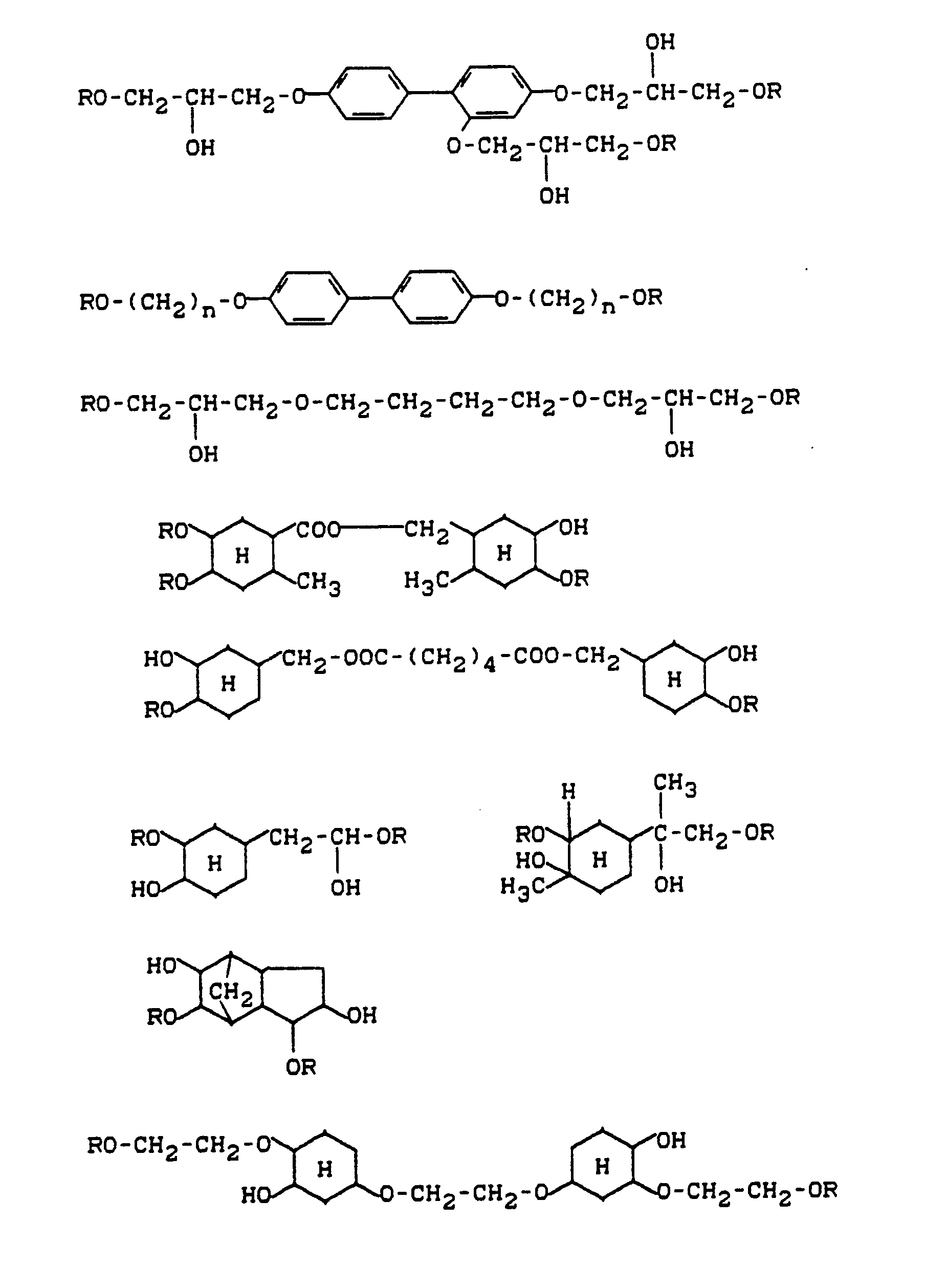


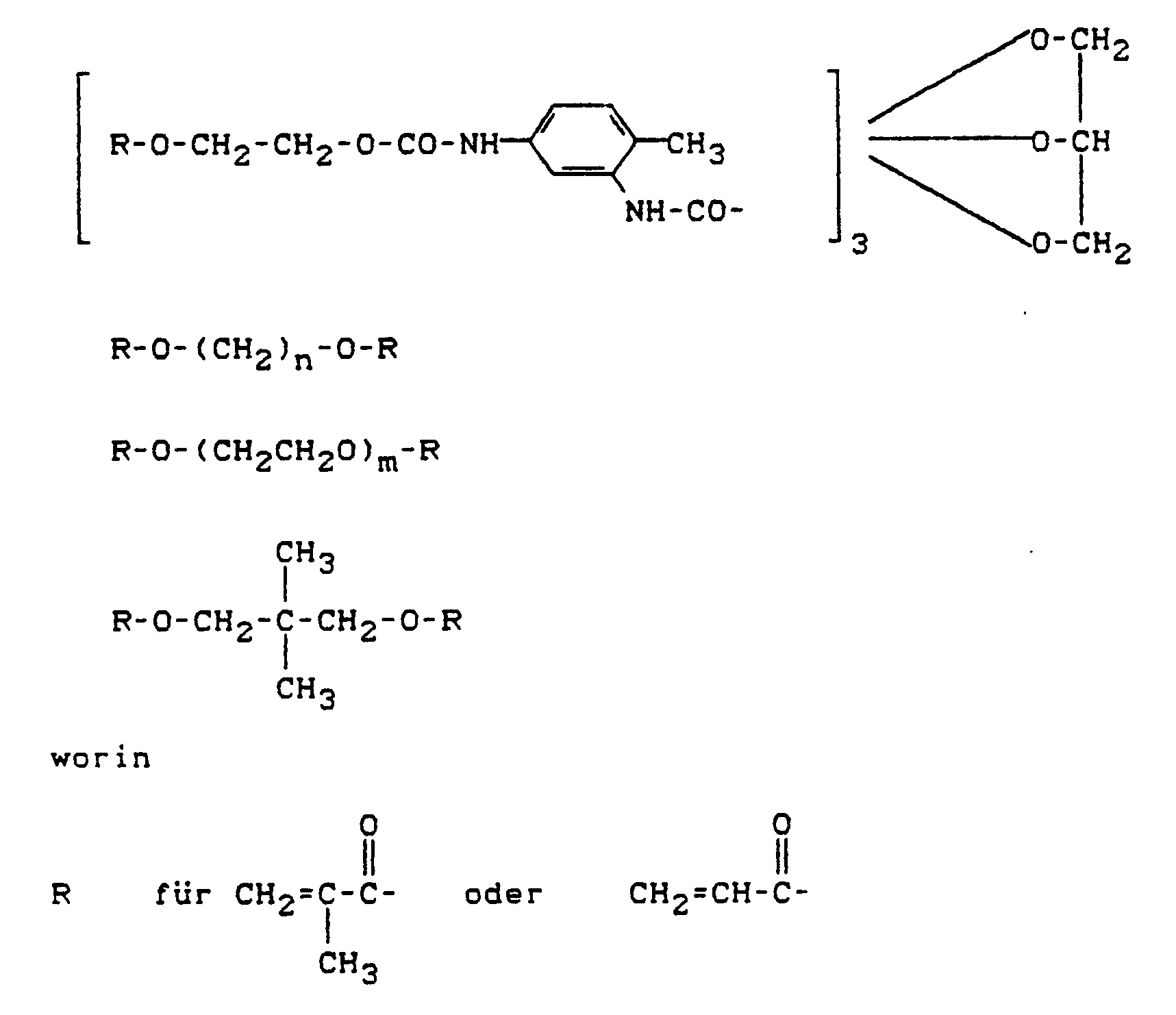
n eine Zahl von 1 bis 4 und
m eine Zahl von 0 bis 5 bedeutet. - Außerdem seien Derivate des Tricyclodecans (EP-A 00 23 686) und Umsetzungsprodukte aus Polyolen, Diisocyanaten und Hydroxyalkylmethacrylaten (DE-A 37 03 120, DE-A 37 03 080 und DE-A 37 03 130) genannt.
- Besonders bevorzugt als Monomer wird das sogenannte Bis-GMA der Formel

- Selbstverständlich ist es möglich, Mischungen der verschiedenen (Meth)acrylsäureester, die Vernetzungen ausbilden können, einzusetzen. Beispielsweise seien Mischungen von 20 bis 70 Gew.-Teilen Bis-GMA und 30 bis 80 Gew.-Teilen Triethylenglykoldimethacrylat genannt.
- Photoinitiatoren (d) sind an sich bekannt (Houben-Weyl, Methoden der organischen Chemie, Band E20, S. 80 ff, Georg Thieme Verlag Stuttgart. 1987). Vorzugsweise handelt es sich dabei um Carbonylverbindungen, wie Benzoin und dessen Derivate, insbesondere Benzoinmethylether, Benzil und Benzilderivate, beispielsweise 4,4-Oxidibenzil und andere Dicarbonylverbindungen wie Diacetyl, 2,3-Pentandion und α-Diketo-Derivate des Norbornans und substituierter Norbornane wie Campherchinon, Metallcarbonyle wie Pentacarbonylmangan, Chinone wie 9,10-Phenanthrenchinon und Naphthochinon.
- Die erfindungsgemäßen Beschichtungsmaterialien enthalten vorzugsweise noch Coaktivatoren, die in Gegenwart von Fotopolymerisationsinitiatoren die Polymerisationsreak tion beschleunigen. Bekannte Beschleuniger sind beispielsweise aromatische Amine wie p-Toluidin und Dimethyl-p-toluidin, Trialkylamine wie Trihexylamin, Polyamine wie N,N,N′,N′-Tetraalkylalkylendiamine, Barbitursäure und Dialkylbarbitursäure.
- Die Beschleuniger sind im allgemeinen in einer Menge von 0,01 bis ca. 5 Gew.-% im Beschichtungsmaterial enthalten.
- Als Coaktivatoren seien auch Alkylaminoarylsulfonamide der Formel
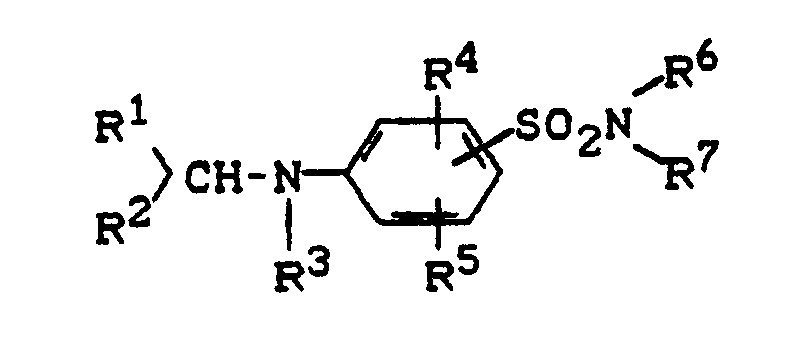
R¹ und R² gleich oder verschieden sind und Wasserstoff, Methyl, Vinyl oder Phenyl bedeuten,
R³ Wasserstoff, Methyl und Ethyl bedeutet,
R⁴ und R⁵ gleich oder verschieden sind und Wasserstoff, Halogen oder Methyl bedeuten oder orthoständiges R⁴ und R⁵ Teile eines anellierten aromatischen Sechsrings sein können,
R⁶ und R⁷ gleich oder verschieden sind und Wasserstoff, Methyl, Allyl, Methallyl, Cyclohexyl, Phenyl, Benzyl, Hydroxyethyl, Hydroxypropyl, Acryloyloxyalkyl, Methacryloyloxyalkyl, 2,3-Epoxypropyl oder 1,2-Dihydroxypropyl-1-(meth)acrylat bedeuten und wobei R⁶ und R⁷ zu einem Morpholin- oder Piperidinrest verbunden sein können,
genannt. - Als Alkylaminoarylsulfonamide seien beispielsweise genannt:
N,N-Dimethyl-p-dimethylaminobenzolsulfonsäureamid und N-Hydroxyethyl-p-dimethylaminobenzolsulfonsäureamid. - Wasser (e) kann beispielsweise demineralisiertes Wasser sein.
- Löslichkeitsvermittler im Rahmen der vorliegenden Erfindung sind flüchtige Lösungsmittel (Dampfdruck bei 25°C über 1000 Pa) aus der Gruppe der Ketone, Alkohole und Ether. Bevorzugt werden aliphatische Ketone mit 3 bis 6 Kohlenstoffatomen, aliphatische Alkohole mit 1 bis 5 Kohlenstoffatomen, Glykolmonoalkyl(C₁ bis C₄ )ether und cyclische Ether(C₄ bis C₆). Beispielhaft seien genannt: Aceton, Butanon, Methanol, Ethanol, Propanol, Isopropanol, Butanol, Isobutanol, sek.-Butanol, tert.-Butanol, Ethylenglykolmonomethylether, Tetrahydrofuran und 1,4-Dioxan.
- Erfindungsgemäß einsetzbare Dispergatoren (f) können ionische und nichtionische Tenside sein.
- a) 2 bis 8 Gew.-% Aldehyd,
- b) 15 bis 40 Gew.-% wasserlösliches Monomer mit aktivem Wasserstoff,
- c) 2 bis 40 Gew.-% wasserunlösliches Monomer mit zwei oder mehreren polymerisierbaren Doppelbindungen,
- d) 0,01 bis 2,5 Gew.-% Photoinitiator,
- e) 25 bis 60 Gew.-% Wasser,
- f) 0,5 bis 10 Gew.-% Löslichkeitsvermittler und/oder Dispergatoren und
- g) 0 bis 5 Gew.-% an sich bekannte Zusätze,
- Vor der Beschichtung eines kollagenhaltigen Materials mit dem erfindungsgemäßen Beschichtungsmaterial wird dieses im allgemeinen mit einer Konditionierflüssigkeit behandelt. Die Zusammensetzung der Konditionierflüssigkeit richtet sich nach der Art des zu beschichtenden Materials. Für Zahnschmelz eignen sich besonders gut 15-60 %ige wäßrige Lösungen von Orthophosphorsäure. Als Konditionierlösungen für Zahnbein (Dentin) können beispielsweise wäßrige Lösungen von EDTA (z.B. 0,5 molar, mit NaOH auf pH 7,4 eingestellt) oder wäßrige Lösungen, die 10 % Zitronensäure und 3 % Eisen(III)chlorid enthalten, eingesetzt werden.
- Konditionierflüssigkeiten für ein breites Einsatzgebiet, die insbesondere für Zahnschmelz und Zahnbein einsetzbar sind, enthalten Säuren mit einem pKs-Wert kleiner als 5 und gegebenenfalls eine amphotere Aminoverbindung mit einem pKs-Wert im Bereich von 9,0 bis 10,6 und einem pKB-Wert im Bereich von 11,5 bis 12,5. Folgende Säuren können in den Konditionierflüssigkeiten enthalten sein: Phosphorsäure, Salpetersäure, Brenztratbensäure, Zitronensäure, Oxalsäure, Ethylendiamintetraessigsäure, Essigsäure, Weinsäure, Äpfelsäure, Maleinsäure.
- Als amphotere Aminoverbindungen seien vorzugsweise Verbindungen der Formel

R¹ für eine Carboxylgruppe steht,
R² Wasserstoff, gegebenenfalls durch Hydroxy, Thio, Methylthio, Carboxy, Amino, Phenyl, Hydroxyphenyl oder die Gruppen
R³ Wasserstoff oder Phenyl bedeutet und
wobei die Reste R¹ und R³ durch einen Propylrest verbunden sein können, oder
in der
R¹ für Wasserstoff steht,
R² die Gruppe -A-NH₃X,
in der
A für einen zweibindigen Alkylenrest mit 1 bis 6 Kohlenstoffatomen und
X für Halogen steht,
bedeutet und
R³ Wasserstoff bedeutet,
genannt. - Beispielsweise seien die folgenden amphoteren Aminoverbindungen genannt: Glycin, Serin, Threonin, Cystein, Thyrosin, Asparagin, Glutamin, Alanin, Valin, Leucin, Isoleucin, Prolin, Methionin, Phenylalanin, Tryptophan, Lysin, Arginin, Histidin, N-Phenylglycin, Ethylendiamin hydrochlorid, Propylendiaminhydrobromid, Butylendiaminhydrochlorid, Butylendiaminhydrobromid, Leucinhydrochlorid und Histidinhydrochlorid.
- Weiterhin kann die Konditionierflüssigkeit Stoffe aus der Gruppe der Polyethylenglykole und Metallhydroxide enthalten. Insbesondere können die oben aufgeführten mehrbasigen Säuren auch als teilweise Metallsalze eingesetzt werden, solange freie Säurefunktionen verbleiben.
- Konditionierflüssigkeiten, die mindestens eine der Säuren aus der Gruppe der Brenztraubensäure, Ethylendiamintetraessigsäure und Zitronensäure sowie gegebenenfalls eine amphotere Aminoverbindung aus der Gruppe des Glycins, N-Phenylglycins und Prolins enthalten, sind besonders bevorzugt.
- Die erfindungsgemäßen Beschichtungsmittel stellt man im allgemeinen durch Mischen der Komponenten her.
- Die erfindungsgemäßen Zubereitungen können als Beschichtungsmittel, vorzugsweise als Grundierungsmittel (primer oder liner) oder Lack (varnish) verwendet werden, um die Bindung zwischen kollagenhaltigen Materialien und härtenden, polymeren Materialien zu verbessern.
- Kollagenhaltige Materialien kommen an vielen Stellen des menschlichen und tierischen Körpers vor. Die erfindungsgemäße Anwendung betrifft selbstverständlich lebende und nicht lebende Materialien. Als kollagenhaltige Materia lien seien Zähne, Knochen, Haut und Leder genannt. Bevorzugt werden die erfindungsgemäßen Zubereitungen zur Beschichtung von Zähnen zur Vorbereitung von Zahnfüllungen bei Zahnreparaturen verwendet.
- Die härtenden polymeren Materialien werden im wesentlichen durch das Anwendungsgebiet bestimmt. So können beispielsweise im Dentalbereich für die Polymerisation nur Monomere eingesetzt werden, die physiologisch unbedenklich sind und die im Mundbereich polymerisieren können, beispielsweise sei Bis-GMA (Bisphenol-A-diglycidyldimethacrylat) genannt.
- Bei der Anwendung, z.B. bei einer Zahnreparatur trägt man nach mechanischer Reinigung des kollagenhaltigen Zahnmaterials zuerst die beschriebene Konditionierflüssigkeit mit etwas Watte auf, läßt sie 60 Sekunden einwirken, spült das Zahnmaterial mit Wasser und trocknet es im Luftstrom. Das erfindungsgemäße Beschichtungsmaterial wird anschließend mit einem kleinen Pinsel in dünner Schicht aufgetragen und überschüssiges Material im Luftstrom verteilt. Auf das Beschichtungsmaterial wird nun die Zahnfüllmasse aufgetragen und mit diesem zusammen ausgehärtet.
- Mit Hilfe eines hochtourigen Rührers (2000 UpM) werden Mischungen mit den unten aufgeführten Zusammensetzungen hergestellt.
- 5 g Glutardialdehyd
33 g 2-Hydroxyethylmethacrylat
2 g Bis-GMA
0,1 g Campherchinon (Fotoinitiator)
55 g Wasser
5 g Aceton - 5 g Glutardialdehyd
33 g 2-Hydroxyethylmethacrylat
2 g Bis-GMA
0,1 g Campherchinon
59,2 g Wasser
0,7 g Poly-N-vinyl-2-pyrrolidon - 3,3 g Glutardialdehyd
23,4 g 2-Hydroxyethylmethacrylat
12,6 g Triethylenglykoldimethacrylat
20,5 g Bis-GMA
67 mg Campherchinon
167 mg N,N-Dimethylaminobenzolsulfonsäurediallylamid (Coaktivator)
38,1 g Wasser
2 g Poly-N-vinyl-2-pyrrolidon
33 mg 2,6-Di-tert.-butyl-4-methylphenol (Stabilisator) - 3,3 g Glutardialdehyd
23,4 g 2-Hydroxyethylmethacrylat
20,8 g Bis-GMA
12,7 g Triethylenglykoldimethacrylat
70 mg Campherchinon
39,3 g Wasser
0,5 g Methyl-tricaprylammoniumchlorid - 2,5 g Glutardialdehyd
18 g 2-Hydroxyethylmethacrylat
30 g Bis-GMA
17,5 g Triethylenglykoldimethacrylat
100 mg Campherchinon
29,5 g Wasser
2,5 g Poly-N-vinyl-2-pyrrolidon - Die Eignung der Beschichtungsmaterialien der Beispiele 1 bis 5 wird geprüft, indem die Bindungsfestigkeit eines Kunststoffmaterials, das Bis-GMA und Triethylenglykoldimethacrylat als Monomere und Campherchinon als Fotoinitiator enthält, auf Dentin und Schmelz bestimmt wird, die mit einer Konditionierflüssigkeit (60 Sekunden Einwirkzeit, Wasserspülung, Lufttrocknung) und dem Beschichtungsmaterial (60 Sekunden Einwirkzeit, Lufttrocknung) vorbehandelt worden sind.
- Für den Test werden herausgezogene und im feuchten Zustand aufbewahrte Menschenzähne benutzt. Die Zähne werden durch Guß in Epoxidharz eingelagert. Für die Messung auf Dentin wird durch Naßschleifen eine glatte Dentinoberfläche erzeugt. Das abschließende Schleifen erfolgt mit Carbonpapier 1000.
- Zur Herstellung eines Probekörpers zum Messen der Bindungsstärke wird eine zylindrische, gespaltete Teflonform auf die wie vorstehend beschrieben behandelte Dentinoberfläche gespannt. (Scand. J. Dent. Res. 88, 348-351 (1980)). Als Füllmasse wird das fotohärtende Kunststoff-Füllungsmaterial eingefüllt. Ein in einem Loch in einer Bohrerhaltung eingespannter Rundbohrer Nr. 016 wird an der Teflonform befestigt und von oben in die noch im Härteprozeß befindliche Materialschicht gepreßt.
- Die gesamte Anordnung wird 10 Min. lang bei Zimmertemperatur (23 ± 2°C) ungestört stehengelassen, wonach die Bohrerhalterung und die Teflonform abgenommen und die Probe unter Wasser mit einer Temperatur von 23 ± 1°C abgesetzt wird. Nach 24 Stdn. wird die Probe mit dem Bohrer in eine Instron-Zugversuchsapparatur (Scand. J. Dent. Res. 88, 348-351 (1980)) montiert; mit einer Geschwindigkeit von 1 mm/Min. wird eine Zugfestigkeitsmessung durchgeführt. Die Zugfestigkeit errechnet sich aus der Division der beim Bruch der Füllung angelegten Belastung mit dem Querschnittsareal in der Bruchfläche des Probekörpers. Es wurden jeweils 5 Messungen an Probekörpern durchgeführt. Als Konditionsflüssigkeiten wurden dabei die folgenden Lösungen verwendet:
K 1: 9,1 % Brenztraubensäure
9,1 % Glycin
81,8 % Wasser
K 2: 17 % Ethylendiamintetraessigsäure-dinatriumsalzdihydrat
1,7 % Natriumhydroxid
81,3 % Wasser
K 3: 35 % Orthophosphorsäure
65 % Wasser. - Die Ergebnisse der Bindungsfestigkeitsmessungen sind in der folgenden Tabelle zusammengefaßt:
Beschichtungsmaterial Dentin Schmelz Konditionierflüssigkeit Bindungsfestigkeit [N/mm²] Konditionierflüssigkeit Bindungsfestigkeit [N/mm²] Beispiel 1 K 1 15 ± 4 K 1 14,8 ± 0,5 Beispiel 2 K 1 19 ± 2 K 1 16,2 ± 3,7 Beispiel 2 K 2 12,3 ± 1 Beispiel 3 K 2 11,8 ± 4 K3 12,6 ± 3,2 Beispiel 4 K 2 13,5 ± 3 K3 17,0 ± 2,1 Beispiel 5 K 2 14,1 ± 3 K3 13,2 ± 3,5 - Es wurde ein Beschichtungsmaterial der folgenden Zusammensetzung hergestellt:
2,5 g Glutardialdehyd
18 g 2-Hydroxyethylmethacrylat
30 g Bis-GMA
17,5 g Triethylenglykoldimethacrylat
100 mg Campherchinon
7,5 g Wasser
24,5 g Aceton. - Nach der in Beispiel 6 beschriebenen Arbeitsweise wurden Bindungsfestigkeiten auf Dentin und Schmelz ermittelt.
Dentin Schmelz Konditionierflüssigkeit Bindungsfestigkeit [N/mm²] Konditionierflüssigkeit Bindungsfestigkeit [N/mm²] K 2 1,0 K 3 7,2
wobei die Summe der Bestandteile 100 Gew.-% ergibt.
Claims (6)
a) 1-10 Gew.-% Aldehyd
b) 10-40 Gew.-% wasserlösliches Monomer mit aktivem Wasserstoff,
c) 1-50 Gew.-% wasserunlösliches Monomer mit zwei oder mehreren polymerisierbaren Doppelbindungen,
d) 0,01-2,5 Gew.-% Photoinitiatoren,
e) 15-70 Gew.-% Wasser,
f) 0,2-10 Gew.-% Löslichkeitsvermittler und/oder Dispergatoren, und gegebenenfalls
g) 0-5 Gew.-% an sich bekannte Zusätze,
wobei die Summe der Bestandteile 100 Gew.-% ergibt.
b) 15 bis 40 Gew.-% eines wasserlöslichen Monomers mit aktivem Wasserstoff,
c) 2 bis 40 Gew.-% wasserunlösliches Monomer mit zwei oder mehreren polymerisierbaren Doppelbindungen,
d) 0,01 bis 2,5 Gew.% Photoinitiator,
e) 25 bis 60 Gew.-% Wasser
f) 0,5 bis 10 Gew.-% Löslichkeitsvermittler und/oder Dispergatoren und gegebenenfalls
g) 0 bis 5 Gew.-% an sich bekannte Zusätze,
wobei die Summe der Bestandteile 100 Gew.-% ergibt.
a) 1-10 Gew.-% Aldehyd,
b) 10-40 Gew.-% wasserlösliches Monomer mit aktivem Wasserstoff,
c) 1-50 Gew.-% wasserunlösliches Monomer mit zwei oder mehreren polymerisierbaren Doppelbindungen,
d) 0,01-2,5 Gew.-% Photoinitiator,
e) 15-70 Gew.-% Wasser,
f) 0,2-10 Gew.-% Löslichkeitsvermittler und/oder Dispergatoren, und gegebenenfalls
g) 0-5 Gew.-% an sich bekannte Zusätze,
unter Rühren mischt.
Priority Applications (1)
| Application Number | Priority Date | Filing Date | Title |
|---|---|---|---|
| AT89114516T ATE82491T1 (de) | 1988-08-19 | 1989-08-05 | Beschichtungsmittel fuer kollagenhaltige materialien. |
Applications Claiming Priority (2)
| Application Number | Priority Date | Filing Date | Title |
|---|---|---|---|
| DE3828170 | 1988-08-19 | ||
| DE3828170A DE3828170A1 (de) | 1988-08-19 | 1988-08-19 | Beschichtungsmittel fuer kollagenhaltige materialien |
Publications (3)
| Publication Number | Publication Date |
|---|---|
| EP0361033A2 true EP0361033A2 (de) | 1990-04-04 |
| EP0361033A3 EP0361033A3 (de) | 1991-01-30 |
| EP0361033B1 EP0361033B1 (de) | 1992-11-19 |
Family
ID=6361179
Family Applications (1)
| Application Number | Title | Priority Date | Filing Date |
|---|---|---|---|
| EP89114516A Expired - Lifetime EP0361033B1 (de) | 1988-08-19 | 1989-08-05 | Beschichtungsmittel für kollagenhaltige Materialien |
Country Status (9)
| Country | Link |
|---|---|
| EP (1) | EP0361033B1 (de) |
| JP (1) | JP2874904B2 (de) |
| AT (1) | ATE82491T1 (de) |
| DE (2) | DE3828170A1 (de) |
| DK (1) | DK173588B1 (de) |
| ES (1) | ES2052840T3 (de) |
| GR (1) | GR3006494T3 (de) |
| IE (1) | IE62648B1 (de) |
| PT (1) | PT91477B (de) |
Cited By (1)
| Publication number | Priority date | Publication date | Assignee | Title |
|---|---|---|---|---|
| EP0599692A1 (de) * | 1992-11-24 | 1994-06-01 | André Salkin | Verwendung von Pyrrolidonderivaten zur Verstärkung der bakteriziden Wirkung von bakteriziden Mitteln |
Families Citing this family (3)
| Publication number | Priority date | Publication date | Assignee | Title |
|---|---|---|---|---|
| FR2692787B1 (fr) * | 1992-06-24 | 1995-07-07 | Salkind Andre | Compositions renfermant des derives amines des derives aldehydiques pouvant etre mis en contact avec des matieres incompatibles sans formation d'agglomerats. |
| DE19544673C2 (de) * | 1995-11-30 | 2001-03-29 | Heraeus Kulzer Gmbh & Co Kg | Dentaladhäsive |
| DE19603577C2 (de) * | 1996-02-01 | 2003-11-13 | Heraeus Kulzer Gmbh & Co Kg | Adhäsive |
Family Cites Families (4)
| Publication number | Priority date | Publication date | Assignee | Title |
|---|---|---|---|---|
| HU187313B (en) * | 1980-10-03 | 1985-12-28 | Andras Sugar | Dental cosmetic prparation |
| DK155079C (da) * | 1983-10-25 | 1989-06-19 | Erik Chr Munksgaard | Adhaesionsfremmende middel for haerdende acrylat- eller methacrylatmaterialer til brug paa collagenholdige materialer, isaer dentin, og midlets anvendelse |
| JPS60149603A (ja) * | 1984-01-17 | 1985-08-07 | Kuraray Co Ltd | 光重合性の組成物 |
| US4814423A (en) * | 1987-11-06 | 1989-03-21 | Dentsply Research & Development Corp. | Dual bonding adhesive composition |
-
1988
- 1988-08-19 DE DE3828170A patent/DE3828170A1/de active Granted
-
1989
- 1989-08-05 AT AT89114516T patent/ATE82491T1/de not_active IP Right Cessation
- 1989-08-05 ES ES89114516T patent/ES2052840T3/es not_active Expired - Lifetime
- 1989-08-05 EP EP89114516A patent/EP0361033B1/de not_active Expired - Lifetime
- 1989-08-05 DE DE8989114516T patent/DE58902765D1/de not_active Expired - Lifetime
- 1989-08-17 PT PT91477A patent/PT91477B/pt not_active IP Right Cessation
- 1989-08-18 DK DK198904072A patent/DK173588B1/da not_active IP Right Cessation
- 1989-08-18 IE IE266689A patent/IE62648B1/en not_active IP Right Cessation
- 1989-08-18 JP JP1211561A patent/JP2874904B2/ja not_active Expired - Fee Related
-
1992
- 1992-12-09 GR GR920402850T patent/GR3006494T3/el unknown
Cited By (1)
| Publication number | Priority date | Publication date | Assignee | Title |
|---|---|---|---|---|
| EP0599692A1 (de) * | 1992-11-24 | 1994-06-01 | André Salkin | Verwendung von Pyrrolidonderivaten zur Verstärkung der bakteriziden Wirkung von bakteriziden Mitteln |
Also Published As
| Publication number | Publication date |
|---|---|
| GR3006494T3 (de) | 1993-06-21 |
| DE58902765D1 (de) | 1992-12-24 |
| EP0361033B1 (de) | 1992-11-19 |
| PT91477B (pt) | 1995-05-04 |
| IE892666L (en) | 1990-02-19 |
| ATE82491T1 (de) | 1992-12-15 |
| DE3828170C2 (de) | 1992-04-09 |
| IE62648B1 (en) | 1995-02-22 |
| JP2874904B2 (ja) | 1999-03-24 |
| DE3828170A1 (de) | 1990-02-22 |
| ES2052840T3 (es) | 1994-07-16 |
| DK407289D0 (da) | 1989-08-18 |
| DK173588B1 (da) | 2001-04-02 |
| PT91477A (pt) | 1990-03-08 |
| DK407289A (da) | 1990-02-20 |
| EP0361033A3 (de) | 1991-01-30 |
| JPH02108611A (ja) | 1990-04-20 |
Similar Documents
| Publication | Publication Date | Title |
|---|---|---|
| DE3750993T3 (de) | Verfahren zum Grundieren von Hartgewebe. | |
| EP0394787B1 (de) | Zubereitungen enthaltend Carbonamidgruppen enthaltende (Meth)acrylsäureester, zur Anwendung als Adhäsivkomponenten zur Behandlung kollagenhaltiger Materialien in der Medizin, sowie Herstellung dieser Zubereitungen | |
| EP0499923B1 (de) | Dentaladhäsive | |
| EP0287927B1 (de) | Konditionierflüssigkeiten von Zahn- oder Knochensubstanz | |
| EP0199057B1 (de) | Beschichtungsmaterial für kollagenhaltige Materialien | |
| EP0531802B1 (de) | Adhäsivkomponente zur Restaurierung der Zahnhartsubstanz | |
| EP0361033B1 (de) | Beschichtungsmittel für kollagenhaltige Materialien | |
| EP0394792A1 (de) | Formylpiperazingruppen enthaltende (Meth)acrylsäurederivate | |
| EP0897297B1 (de) | Dentaladhäsive | |
| EP0418684B1 (de) | Alkandiyl-bis-carbonamide, Adhäsivkomponenten zur Behandlung kollagenhaltiger Materialien zur Anwendung in der Medizin, enthaltend diese Verbindungen | |
| US5277739A (en) | Process for bonding a material to a collagen-containing material | |
| DE19544673A1 (de) | Dentaladhäsive | |
| EP0348718B1 (de) | Flüssigkeit zur Konditionierung von Zahn- oder Knochensubstanz | |
| EP0355562B1 (de) | Adhäsivkomponente zur Behandlung kollagenhaltiger Materialien | |
| DE4039440A1 (de) | N-alkyl-n-(meth)acryloyloxyalkylcarboxamide aromatischer carbonsaeuren und aromatischer carbonsaeureanhydride sowie adhaesive enthaltend diese verbindungen | |
| EP0441187A2 (de) | Carbonsäure-(meth)acryloylaminoalkylester in Adhäsivkomponenten zur Behandlung kollagenhaltiger Materialien | |
| DE19525031A1 (de) | Derivate aromatischer Carbonsäuren, aromatische Carbonsäureanhydride und Hydroxy(meth)acrylaten sowie Adhäsive, enthaltend diese Verbindungen | |
| DE19544670C2 (de) | Verfahren zur Herstellung oligomerer Kondensationsprodukte aromatischer Tricarbonsäuren und Epoxy(meth)acrylaten | |
| US5183832A (en) | Coating agent for collagen-containing materials |
Legal Events
| Date | Code | Title | Description |
|---|---|---|---|
| PUAI | Public reference made under article 153(3) epc to a published international application that has entered the european phase |
Free format text: ORIGINAL CODE: 0009012 |
|
| 17P | Request for examination filed |
Effective date: 19890805 |
|
| AK | Designated contracting states |
Kind code of ref document: A2 Designated state(s): AT BE CH DE ES FR GB GR IT LI LU NL SE |
|
| PUAL | Search report despatched |
Free format text: ORIGINAL CODE: 0009013 |
|
| AK | Designated contracting states |
Kind code of ref document: A3 Designated state(s): AT BE CH DE ES FR GB GR IT LI LU NL SE |
|
| 17Q | First examination report despatched |
Effective date: 19920110 |
|
| GRAA | (expected) grant |
Free format text: ORIGINAL CODE: 0009210 |
|
| AK | Designated contracting states |
Kind code of ref document: B1 Designated state(s): AT BE CH DE ES FR GB GR IT LI LU NL SE |
|
| REF | Corresponds to: |
Ref document number: 82491 Country of ref document: AT Date of ref document: 19921215 Kind code of ref document: T |
|
| ITF | It: translation for a ep patent filed | ||
| GBT | Gb: translation of ep patent filed (gb section 77(6)(a)/1977) | ||
| REF | Corresponds to: |
Ref document number: 58902765 Country of ref document: DE Date of ref document: 19921224 |
|
| ET | Fr: translation filed | ||
| REG | Reference to a national code |
Ref country code: GR Ref legal event code: FG4A Free format text: 3006494 |
|
| PLBE | No opposition filed within time limit |
Free format text: ORIGINAL CODE: 0009261 |
|
| STAA | Information on the status of an ep patent application or granted ep patent |
Free format text: STATUS: NO OPPOSITION FILED WITHIN TIME LIMIT |
|
| 26N | No opposition filed | ||
| EPTA | Lu: last paid annual fee | ||
| REG | Reference to a national code |
Ref country code: ES Ref legal event code: FG2A Ref document number: 2052840 Country of ref document: ES Kind code of ref document: T3 |
|
| EAL | Se: european patent in force in sweden |
Ref document number: 89114516.1 |
|
| NLS | Nl: assignments of ep-patents |
Owner name: HERAEUS KULZER GMBH |
|
| REG | Reference to a national code |
Ref country code: CH Ref legal event code: PUE Owner name: BAYER AKTIENGESELLSCHAFT TRANSFER- HERAEUS KULZER |
|
| REG | Reference to a national code |
Ref country code: FR Ref legal event code: TP |
|
| REG | Reference to a national code |
Ref country code: GB Ref legal event code: 732E |
|
| BECA | Be: change of holder's address |
Free format text: 960626 *HERAEUS KULZER G.M.B.H. & CO. K.G.:D-63450 HANAU |
|
| REG | Reference to a national code |
Ref country code: ES Ref legal event code: PC2A |
|
| REG | Reference to a national code |
Ref country code: GB Ref legal event code: IF02 |
|
| PGFP | Annual fee paid to national office [announced via postgrant information from national office to epo] |
Ref country code: GB Payment date: 20050725 Year of fee payment: 17 |
|
| PGFP | Annual fee paid to national office [announced via postgrant information from national office to epo] |
Ref country code: SE Payment date: 20050811 Year of fee payment: 17 |
|
| PGFP | Annual fee paid to national office [announced via postgrant information from national office to epo] |
Ref country code: FR Payment date: 20050812 Year of fee payment: 17 Ref country code: DE Payment date: 20050812 Year of fee payment: 17 Ref country code: CH Payment date: 20050812 Year of fee payment: 17 |
|
| PGFP | Annual fee paid to national office [announced via postgrant information from national office to epo] |
Ref country code: ES Payment date: 20050816 Year of fee payment: 17 Ref country code: AT Payment date: 20050816 Year of fee payment: 17 |
|
| PGFP | Annual fee paid to national office [announced via postgrant information from national office to epo] |
Ref country code: LU Payment date: 20050822 Year of fee payment: 17 |
|
| PGFP | Annual fee paid to national office [announced via postgrant information from national office to epo] |
Ref country code: GR Payment date: 20050830 Year of fee payment: 17 |
|
| PGFP | Annual fee paid to national office [announced via postgrant information from national office to epo] |
Ref country code: BE Payment date: 20050914 Year of fee payment: 17 |
|
| PG25 | Lapsed in a contracting state [announced via postgrant information from national office to epo] |
Ref country code: AT Free format text: LAPSE BECAUSE OF NON-PAYMENT OF DUE FEES Effective date: 20060805 |
|
| PG25 | Lapsed in a contracting state [announced via postgrant information from national office to epo] |
Ref country code: SE Free format text: LAPSE BECAUSE OF NON-PAYMENT OF DUE FEES Effective date: 20060806 |
|
| PG25 | Lapsed in a contracting state [announced via postgrant information from national office to epo] |
Ref country code: CH Free format text: LAPSE BECAUSE OF NON-PAYMENT OF DUE FEES Effective date: 20060831 Ref country code: BE Free format text: LAPSE BECAUSE OF NON-PAYMENT OF DUE FEES Effective date: 20060831 Ref country code: LI Free format text: LAPSE BECAUSE OF NON-PAYMENT OF DUE FEES Effective date: 20060831 |
|
| PG25 | Lapsed in a contracting state [announced via postgrant information from national office to epo] |
Ref country code: DE Free format text: LAPSE BECAUSE OF NON-PAYMENT OF DUE FEES Effective date: 20070301 |
|
| REG | Reference to a national code |
Ref country code: CH Ref legal event code: PL |
|
| EUG | Se: european patent has lapsed | ||
| GBPC | Gb: european patent ceased through non-payment of renewal fee |
Effective date: 20060805 |
|
| REG | Reference to a national code |
Ref country code: FR Ref legal event code: ST Effective date: 20070430 |
|
| REG | Reference to a national code |
Ref country code: ES Ref legal event code: FD2A Effective date: 20060807 |
|
| PG25 | Lapsed in a contracting state [announced via postgrant information from national office to epo] |
Ref country code: GB Free format text: LAPSE BECAUSE OF NON-PAYMENT OF DUE FEES Effective date: 20060805 |
|
| BERE | Be: lapsed |
Owner name: *HERAEUS KULZER G.M.B.H. & CO. K.G. Effective date: 20060831 |
|
| PG25 | Lapsed in a contracting state [announced via postgrant information from national office to epo] |
Ref country code: ES Free format text: LAPSE BECAUSE OF NON-PAYMENT OF DUE FEES Effective date: 20060807 |
|
| PG25 | Lapsed in a contracting state [announced via postgrant information from national office to epo] |
Ref country code: FR Free format text: LAPSE BECAUSE OF NON-PAYMENT OF DUE FEES Effective date: 20060831 |
|
| PG25 | Lapsed in a contracting state [announced via postgrant information from national office to epo] |
Ref country code: LU Free format text: LAPSE BECAUSE OF NON-PAYMENT OF DUE FEES Effective date: 20060805 |
|
| PG25 | Lapsed in a contracting state [announced via postgrant information from national office to epo] |
Ref country code: GR Free format text: LAPSE BECAUSE OF NON-PAYMENT OF DUE FEES Effective date: 20070302 |
|
| PGFP | Annual fee paid to national office [announced via postgrant information from national office to epo] |
Ref country code: NL Payment date: 20080813 Year of fee payment: 20 |
|
| PGFP | Annual fee paid to national office [announced via postgrant information from national office to epo] |
Ref country code: IT Payment date: 20080826 Year of fee payment: 20 |
|
| NLV7 | Nl: ceased due to reaching the maximum lifetime of a patent |
Effective date: 20090805 |
|
| PG25 | Lapsed in a contracting state [announced via postgrant information from national office to epo] |
Ref country code: NL Free format text: LAPSE BECAUSE OF EXPIRATION OF PROTECTION Effective date: 20090805 |