EP0361063B1 - Photorécepteur électrographique - Google Patents
Photorécepteur électrographique Download PDFInfo
- Publication number
- EP0361063B1 EP0361063B1 EP89115266A EP89115266A EP0361063B1 EP 0361063 B1 EP0361063 B1 EP 0361063B1 EP 89115266 A EP89115266 A EP 89115266A EP 89115266 A EP89115266 A EP 89115266A EP 0361063 B1 EP0361063 B1 EP 0361063B1
- Authority
- EP
- European Patent Office
- Prior art keywords
- group
- resin
- hydrocarbon group
- resins
- electrophotographic photoreceptor
- Prior art date
- Legal status (The legal status is an assumption and is not a legal conclusion. Google has not performed a legal analysis and makes no representation as to the accuracy of the status listed.)
- Expired - Lifetime
Links
Classifications
-
- G—PHYSICS
- G03—PHOTOGRAPHY; CINEMATOGRAPHY; ANALOGOUS TECHNIQUES USING WAVES OTHER THAN OPTICAL WAVES; ELECTROGRAPHY; HOLOGRAPHY
- G03G—ELECTROGRAPHY; ELECTROPHOTOGRAPHY; MAGNETOGRAPHY
- G03G5/00—Recording-members for original recording by exposure, e.g. to light, to heat or to electrons; Manufacture thereof; Selection of materials therefor
- G03G5/02—Charge-receiving layers
- G03G5/04—Photoconductive layers; Charge-generation layers or charge-transporting layers; Additives therefor; Binders therefor
- G03G5/05—Organic bonding materials; Methods for coating a substrate with a photoconductive layer; Inert supplements for use in photoconductive layers
- G03G5/0528—Macromolecular bonding materials
- G03G5/0592—Macromolecular compounds characterised by their structure or by their chemical properties, e.g. block polymers, reticulated polymers, molecular weight, acidity
-
- G—PHYSICS
- G03—PHOTOGRAPHY; CINEMATOGRAPHY; ANALOGOUS TECHNIQUES USING WAVES OTHER THAN OPTICAL WAVES; ELECTROGRAPHY; HOLOGRAPHY
- G03G—ELECTROGRAPHY; ELECTROPHOTOGRAPHY; MAGNETOGRAPHY
- G03G5/00—Recording-members for original recording by exposure, e.g. to light, to heat or to electrons; Manufacture thereof; Selection of materials therefor
- G03G5/02—Charge-receiving layers
- G03G5/04—Photoconductive layers; Charge-generation layers or charge-transporting layers; Additives therefor; Binders therefor
- G03G5/05—Organic bonding materials; Methods for coating a substrate with a photoconductive layer; Inert supplements for use in photoconductive layers
- G03G5/0528—Macromolecular bonding materials
- G03G5/0589—Macromolecular compounds characterised by specific side-chain substituents or end groups
Definitions
- This invention relates to an electrophotographic photoreceptor excellent in electrostatic characteristics and moisture resistance, and especially performance properties as a CPC photoreceptor.
- An electrophotographic photoreceptor may have various structures in agreement with prescribed characteristics or electrophotographic processes applied.
- a photoreceptor comprises a support having provided thereon at least one photoconductive layer and, if necessary, an insulating layer on the surface thereof.
- the photoreceptor composed of a support and at least one photoconductive layer is subjected to ordinary electrophotographic processing for image formation including charging, imagewise exposure, development and, if necessary, transfer.
- Electrophotographic photoreceptors have also been used widely as offset printing plate precursor for direct printing plate making.
- a direct electrophotographic lithographic printing system has recently been acquiring a greater importance as a system providing hundreds to thousands of prints of high image quality.
- Binders to be used in the photoconductive layer should themselves have film-forming properties and capability of dispersing photoconductive particles therein, and, when formulated into a photoconductive layer, binders should exhibit satisfactory adhesion to a support. They are also required to bear various electrostatic characteristics and image-forming properties, such that the photoconductive layer may exhibit excellent electrostatic capacity, small dark decay and large light decay, hardly undergo fatigue before exposure, and stably maintain these characteristics against change of humidity at the time of image formation.
- Binder resins which have been conventionally used include silicone resins (see JP-B-34-6670, the term "JP-B” as used herein means an "examined published Japanese patent application”), styrene-butadiene resins see JP-B-35-1960), alkyd resins, maleic acid resins and polyamides (see Japanese JP-B-35-11219), vinyl acetate resins (see JP-B-41-2425), vinyl acetate copolymer resins (see JP-B-41-2426), acrylic resins (see JP-B-35-11216), acrylic ester copolymer resins (see JP-B-35-11219, JP-B-36-8510, and JP-B-41-13946), etc.
- silicone resins see JP-B-34-6670, the term "JP-B” as used herein means an "examined published Japanese patent application”
- styrene-butadiene resins see JP-
- electrophotographic photosensitive materials using these known resins suffer from any of disadvantages, such as poor affinity for photoconductive particles (poor dispersion of a photoconductive coating composition); low charging properties of the photoconductive layer; poor quality of a reproduced image, particularly dot reproducibility or resolving power; susceptibility of reproduced image quality to influences from the environment at the time of electrophotographic image formation, such as a high temperature and high-humidity condition or a low temperature and low humidity condition; and insufficient film strength or adhesion of the photoconductive layer, which causes, when used as an offset master plate, release of the photoconductive layer from the support during offset printing, failing to obtain a large number of prints.
- disadvantages such as poor affinity for photoconductive particles (poor dispersion of a photoconductive coating composition); low charging properties of the photoconductive layer; poor quality of a reproduced image, particularly dot reproducibility or resolving power; susceptibility of reproduced image quality to influences from the environment at the time of electrophotographic image formation, such as a high temperature and high-
- photosensitive materials containing a large quantity of a sensitizing dye suffer considerable deterioration of whiteness, which means reduced quality as a recording medium, sometimes causing deterioration of dark decay characteristics, resulting in the failure to obtain a satisfactory reproduced image.
- JP-A-60-10254 suggests to control an average molecular weight of a resin to be used as a binder of the photoconductive layer.
- a combined use of an acrylic resin having an acid value of from 4 to 50 whose average molecular weight is distributed within two ranges, i.e., a range of from 1 ⁇ 10 3 to 1 ⁇ 10 4 and a range of from 1 ⁇ 10 4 and 2 ⁇ 10 5 would improve electrostatic characteristics, particularly reproducibility as a PPC photoreceptor on repeated use, moisture resistance and the like.
- binder resins for a photoconductive layer having electrostatic characteristics compatible with printing characteristics.
- binder resins so far reported to be effective for oil-desensitization of a photoconductive layer include a resin having a molecular weight of from 1.8 ⁇ 10 4 to 10 ⁇ 10 4 and a glass transition point of from 10 to 80°C obtained by copolymerizing a (meth)acrylate monomer and a copolymerizable monomer in the presence of fumaric acid in combination with a copolymer of a (meth)acrylate monomer and a copolymerizable monomer other than fumaric acid as disclosed in JP-B-50-31011; a terpolymer containing a (meth)acrylic ester unit having a substituent having a carboxyl group at least 7 atoms distant from the ester linkage as disclosed in JP-A-53-54027; a tetra- or pentapolymer
- binder resins proposed for use in electrophotographic lithographic printing plate precursors were also proved by evaluations to give rise to problems relating to electrostatic characteristics and background staining of prints.
- One object of this invention is to provide an electrophotographic photoreceptor having improved electrostatic characteristics, particularly dark charge retention and photosensitivity, and improved image reproducibility.
- Another object of this invention is to provide an electrophotographic photoreceptor which can form a reproduced image of high quality irrespective of a variation of environmental conditions at the time of reproduction of an image, such as a change to a low-temperature and low-humidity condition or to a high-temperature and high-humidity condition.
- a further object of this invention is to provide a CPC electrophotographic photoreceptor having excellent electrostatic characteristics and small dependence on the environment.
- a still further object of this invention is to provide a lithographic printing plate precursor which provides a lithographic printing plate causing no background stains.
- a yet further object of this invention is to provide an electrophotographic photoreceptor which is hardly influenced by the kind of sensitizing dyes used in combination.
- an electrophotographic photoreceptor comprising a support having provided thereon at least one photoconductive layer containing at least an inorganic photoconductive material and a binder resin, wherein the binder resin comprises at least one resin (A) having a weight average molecular weight of from 1 ⁇ 10 3 to 2 ⁇ 10 4 and containing from 0.1 to 20% by weight of a copolymerizable component containing at least one acidic group selected from -PO 3 H 2 , -COOH, -SO 3 H, wherein R represents a hydrocarbon group or -OR'; and R' represents a hydrocarbon group, and a cyclic acid anhydride-containing group, and at least one copolymer resin (B) having a weight average molecular weight of 2x10 4 or more and comprising a monofunctional macromonomer having a weight average molecular weight of 1 ⁇ 10 3 to 2 ⁇ 10 4 or less, the macromonomer containing at least one polymerizable component
- the binder resin which can be used in the present invention comprises at least (A) a low-molecular weight resin containing from 0.1 to 20% by weight, preferably from 1 to 10% by weight, of a copolymerizable component containing at least one of the above-recited acidic groups and (B) a copolymer resin comprising at least one macromonomer (M) and at least one monomer represented by formula (B-4).
- the proportion of the acidic group-containing copolymerizable component in the resin (A) is from 0.1 to 20% by weight, preferably from 1.0 to 10% by weight.
- the resin (A) has a weight average molecular weight of from 1.0 ⁇ 10 3 to 2.0 ⁇ 10 4 , preferably from 3 ⁇ 10 3 to 1.0 ⁇ 10 4 .
- the resin (A) preferably has a glass transition point of from -10 to 100°C, more preferably from -5 to 85°C.
- the resin (B) is preferably a comb type copolymer resin having a weight average molecular weight of 2 ⁇ 10 4 or more, more preferably from 5 ⁇ 10 4 to 6 ⁇ 10 5 .
- the resin (B) preferably has a glass transition point of from 0 to 120°C, more preferably from 10 to 90°C.
- the acidic group contained in the resin(A) is adsorbed onto stoichiometrical defects of an inorganic photoconductive substance to sufficiently cover the surface thereof, whereby electron traps of the photoconductive substance can be compensated for and humidity resistance can be greatly improved, while assisting the photoconductive particles to be sufficiently dispersed without agglomeration.
- the fact that the resin (A) has a low molecular weight also functions to improve covering power for the surface of the photoconductive particles.
- the resin (B) serves to sufficiently heighten the mechanical strength of a photoconductive layer, which may be insufficient in case of using the resin (A) alone.
- the resulting electrophotographic photoreceptor has too a low initial potential to provide a sufficient image density. If it is more than 20% by weight, dispersing ability of the binder is reduced only to provide an electrophotographic photoreceptor suffering deterioration of film surface smoothness and humidity resistance. When used as an offset master, such a photoreceptor causes considerable background stains.
- a photoreceptor to be used as a lithographic printing plate precursor is prepared from a non-uniform dispersion of photoconductive particles in a binder resin with agglomerates being present, the photoconductive layer would have a rough surface.
- non-image areas cannot be rendered uniformly hydrophilic by oil-desensitization treatment with an oil-desensitizing solution.
- the resulting printing plate induces adhesion of a printing ink to the non-image areas on printing, which phenomenon leads to background stains of the non-image areas of prints.
- the low-molecular weight resin (A) of the present invention is used as a sole binder resin, it is sufficiently adsorbed onto the photoconductive particles to cover the surface of the particles to thereby provide smoothness of the photoconductive layer, satisfactory electrostatic characteristics, and stain-free images. Nevertheless, the resulting photoconductive layer does not exhibit sufficient film strength, failing to give satisfactory results in connection to durability.
- R represents a hydrocarbon group or OR′, wherein R′ represents a hydrocarbon group.
- the hydrocarbon group as represented by R or R′ specifically includes a substituted or unsubstituted alkyl group having from 1 to 12 carbon atoms (e.g., methyl, ethyl, propyl, butyl, hexyl, octyl, decyl, dodecyl, 2-chloroethyl, 2-methoxyethyl, 2-ethoxyethyl, and 3-methoxypropyl), a substituted or unsubstituted aralkyl group having from 7 to 12 carbon atoms (e.g., benzyl, phenethyl, chlorobenzyl, methoxybenzyl, and methylbenzyl), a substituted or unsubstituted alicyclic group having from 5 to 8 carbon atoms (e.g., cyclopentyl and
- any of conventionally known resins can be used as the resin (A) as long as the above-stated requirements of physical properties are satisfied.
- known resins include polyester resins, modified epoxy resins, silicone resins, olefin copolymers, polycarbonate resins, vinyl alkanoate resins, allyl alkanoate resins, modified polyamide resins, phenol resins, fatty acid-modified alkyd resins, and acrylic resins.
- Preferred of the resin (A) is a (meth)acrylic copolymer containing at least one copolymerization component represented by the following formula (A-1) in a total proportion of at least 30% by weight: wherein d represents a hydrogen atom, a halogen atom (e.g., chlorine and bromine), a cyano group or an alkyl group having from 1 to 4 carbon atoms; and R′ represents a substituted or unsubstituted alkyl group having from 1 to 18 carbon atoms (e.g., methyl, ethyl, propyl, butyl, pentyl, hexyl, octyl, decyl, dodecyl, tridecyl, tetradecyl, 2-chloroethyl, 2-bromoethyl, 2-cyanoethyl, 2-hydroxyethyl, 2-methoxyethyl, 2-ethoxyethyl, and 3-hydroxypropy
- the resin (A) is a resin comprising (i) at least one repeating unit represented by formula (A-2) or (A-3) shown below and (ii) at least one repeating unit containing an acidic group.
- X 1 and X 2 each represents a hydrogen atom, a hydrocarbon group having from 1 to 10 carbon atoms, a chlorine atom, a bromine atom, -COY 1 or COOY 2 , wherein Y 1 and Y 2 each represents a hydrocarbon group having from 1 to 10 carbon atoms, provided that both X 1 and X 2 do not simultaneously represent a hydrogen atom; and W 1 and W 2 each represents a mere bond or a linking group containing from 1 to 4 linking atoms which connects -COO- and the benzene ring.
- X 1 and X 2 each preferably represents a hydrogen atom, a chlorine atom, a bromine atom, an alkyl group having from 1 to 4 carbon atoms (e.g., methyl, ethyl, propyl, and butyl), an aralkyl group having from 7 to 9 carbon atoms (e.g., benzyl, phenethyl, 3-phenylpropyl, chlorobenzyl, dichlorobenzyl, bromobenzyl, methylbenzyl, methoxybenzyl, and chloromethylbenzyl), an aryl group (e.g., phenyl, tolyl, xylyl, bromophenyl, methoxyphenyl, chlorophenyl, and dichlorophenyl), or -COY 1 or COOY 2 , wherein Y 1 and Y 2 each preferably represents any of the above-recited hydrocarbon groups, provided that X 1 and Y 2 each preferably
- W 1 is a mere bond or a linking group containing 1 to 4 linking atoms, e.g., ( ⁇ CH 2n ) ⁇ (n: 1, 2 or 3), -CH 2 CH 2 OCO-, ( ⁇ CH 2m ) ⁇ (m: 1 or 2), and -CH 2 CH 2 O-, which connects -COO- and the benzene ring.
- W 2 has the same meaning as W 1 of formula (A-2).
- repeating unit (i) represented by formula (A-2) or (A-3) are shown below for illustrative purposes only but not for limitation.
- the acidic group preferably includes -PO 3 H 2 , -SO 3 H, -COOH, and a cyclic acid anhydride-containing group.
- R represents a hydrocarbon group or OR′, wherein R′ represents a hydrocarbon group.
- the hydrocarbon group as represented by R or R′ preferably includes an aliphatic group having from 1 to 22 carbon atoms (e.g., methyl, ethyl, propyl, butyl, hexyl, octyl, decyl, dodecyl, octadecyl, 2-chloroethyl, 2-methoxyethyl, 2-ethoxypropyl, allyl, crotonyl, butenyl, cyclohexyl, benzyl, phenethyl, 3-phenylpropyl, methylbenzyl, chlorobenzyl, fluorobenzyl, and methoxybenzyl) and a substituted or unsubstituted aryl group (e.g., phenyl, tolyl) and a substituted or unsubstituted aryl group
- the cyclic acid anhydride-containing group is a group containing at least one cyclic acid anhydride.
- the cyclic acid anhydride to be contained includes aliphatic dicarboxylic acid anhydrides and aromatic dicarboxylic acid anhydrides.
- aliphatic dicarboxylic acid anhydrides include succinic anhydride ring, glutaconic anhydride ring, maleic anhydride ring, cyclopentane-1,2-dicarboxylic acid anhydride ring, cyclohexane-1,2-dicarboxylic acid anhydride ring, cyclohexene-1,2-dicarboxylic acid anhydride ring, and 2,3-bicyclo[2,2,2]octanedicarboxylic acid anhydride.
- These rings may be substituted with, for example, a halogen atom (e.g., chlorine and bromine) and an alkyl group (e.g., methyl, ethyl, butyl, and hexyl).
- aromatic dicarboxylic acid anhydrides are phthalic anhydride ring, naphthalene-dicarboxylic acid anhydride ring, pyridine-dicarboxylic acid anhydride ring, and thiophene-dicarboxylic acid anhydride ring.
- These rings may be substituted with, for example, a halogen atom (e.g., chlorine and bromine), an alkyl group (e.g., methyl, ethyl, propyl, and butyl), a hydroxyl group, a cyano group, a nitro group, and an alkoxycarbonyl group (e.g., methoxycarbonyl and ethoxycarbonyl).
- a halogen atom e.g., chlorine and bromine
- an alkyl group e.g., methyl, ethyl, propyl, and butyl
- a hydroxyl group e.g., methyl, ethy
- the copolymerizable component corresponding to the acidic group-containing repeating unit (ii) may be any of acidic group-containing vinyl compounds copolymerizable with a methacrylate monomer corresponding to the repeating unit (i) of formula (A-2) or (A-3). Examples of such vinyl compound are described, e.g., in Kobunshi Gakkai (ed.), Kobunshi Data Handbook (Kosohen) , Baihukan (1986).
- vinyl monomers are acrylic acid, ⁇ - and/or ⁇ -substituted acrylic acids (e.g., ⁇ -acetoxy, ⁇ -acetoxymethyl, ⁇ -(2-amino)methyl, ⁇ -chloro, ⁇ -bromo, ⁇ -fluoro, ⁇ -tributylsilyl, ⁇ -cyano, ⁇ -chloro, ⁇ -bromo, ⁇ -chloro- ⁇ -methoxy, and ⁇ , ⁇ -dichloro compounds), methacrylic acid, itaconic acid, itaconic half esters, itaconic half amides, crotonic acid, 2-alkenylcareboxylic acids (e.g., 2-pentenoic acid, 2-methyl-2-hexenoic acid, 2-octenoic acid, 4-methyl-2-hexenoic acid, and 4-ethyl-2-octenoic acid), maleic acid, maleic half esters, maleic half amides
- acidic group-containing repeating unit (ii) is shown below for illustrative purposes only but not for limitation.
- b 1 :H, CH 3 (hereinafter the same)
- b 2 :H, CH 3 , -CH 2 COOCH 3 (hereinafter the same)
- m integer of 2 to 10
- integer of 2 to 11 m integer of 2 to 10
- R C 1 -C 6 alkyl, benzyl or phenyl
- the acidic group-containing copolymerizable component which can be used in the resin (A) may be any of acidic group-containing vinyl compounds copolymerizable with, for example, a methacrylate monomer of formula (A-1). Examples of such vinyl compounds are described, e.g., in Kobunshi Gakkai (ed.), Kobunshi Data Handbook (Kosohen), Baihukan (1986).
- vinyl monomers are acrylic acid, ⁇ -and/or ⁇ -substituted acrylic acids (e.g., ⁇ -acetoxy, ⁇ -acetoxymethyl, ⁇ -(2-amino)methyl, ⁇ -chloro, ⁇ -bromo, ⁇ -fluoro, ⁇ -tributylsilyl, ⁇ -cyano, ⁇ -chloro, ⁇ -bromo, ⁇ -chloro- ⁇ -methoxy, and ⁇ , ⁇ -dichloro compounds), methacrylic acid, itaconic acid, itaconic half esters, itaconic half amides, crotonic acid, 2-alkenylcarboxylic acids (e.g., 2-pentenoic acid, 2-methyl-2-hexenoic acid, 2-octenoic acid, 4-methyl-2-hexenoic acid, and 4-ethyl2-octenoic acid), maleic acid, maleic half esters, maleic half amides,
- the resin (A) may further comprise other copolymerizable monomers in addition to the monomer of formula (A-1) and the acidic group-containing monomer.
- monomers include ⁇ -olefins, vinyl alkanoates, allyl alkanoates, acrylonitrile, methacrylonitrile, vinyl ethers, acrylamides, methacrylamides, styrenes, and heterocyclic vinyl compounds (e.g., vinylpyrrolidone, vinylpyridine, vinylimidazole, vinylthiophene, vinylimidazoline, vinylpyrazole, vinyldioxane, vinylquinoline, vinylthiazole, and vinyloxazine).
- vinylpyrrolidone vinylpyridine, vinylimidazole, vinylthiophene, vinylimidazoline, vinylpyrazole, vinyldioxane, vinylquinoline, vinylthiazole, and vinyloxazine.
- the resin (B) which can be used in the present invention is a comb type copolymer resin having the above-described physical properties and comprising at least a monofunctional macromonomer (M) and the monomer represented by formula (B-4).
- the resin (B) has a weight average molecular weight of not less than 2 ⁇ 10 4 , more preferably of from 5 ⁇ 10 4 to 6 ⁇ 10 5 .
- the resin (B) preferably has a glass transition point ranging from 0 to 120°C, more preferably from 10 to 90°C.
- the monofunctional macromonomer (M) is a polymer having a weight average molecular weight of 1 ⁇ 10 3 to 2 ⁇ 10 4 which comprises at least one polymerization component represented by formula (B-2) or (B-3), with a polymerizable double bond-containing group represented by formula (B-1) being bonded to only one of the terminals of the main chain thereof.
- hydrocarbon groups as represented by a 1 , a 2 , V, b 1 , b 2 , x 0 , Q 0 , and Q which contain the respectively recited number of carbon atoms when unsubstituted, may have a substituent.
- V represents -COO-, -OCO-, -CH 2 OCO-, -CH 2 COO-, -O-, -SO 2 -, -CO-, or wherein R 1 represents or a hydrocarbon group.
- Preferred hydrocarbon groups as R 1 include a substituted or unsubstituted alkyl group having from 1 to 18 carbon atoms (e.g., methyl, ethyl, propyl, butyl, heptyl, hexyl, octyl, decyl, dodecyl, hexadecyl, octadecyl, 2-chloroethyl, 2-bromoethyl, 2-cyanoethyl, 2-methoxycarbonylethyl, 2-methoxyethyl, and 3-bromopropyl), a substituted or unsubstituted alkenyl group having from 4 to 18 carbon atoms (e.g., 2-methyl-1-propenyl, 2-butenyl, 2-pentenyl, 3-methyl-2-pentenyl, 1-pentenyl, 1-hexenyl, 2-hexenyl, and 4-methyl-2-hexenyl), a
- V represents the benzene ring may have a substituent, such as a halogen atom (e.g., chlorine and bromine), an alkyl group (e.g., methyl, ethyl, propyl, butyl, chloromethyl, and methoxymethyl), and an alkoxy group(e.g., methoxy, ethoxy, propoxy, and butoxy).
- a halogen atom e.g., chlorine and bromine
- an alkyl group e.g., methyl, ethyl, propyl, butyl, chloromethyl, and methoxymethyl
- an alkoxy group e.g., methoxy, ethoxy, propoxy, and butoxy
- a 1 and a 2 which may be the same or different, each preferably represents a hydrogen atom, a halogen atom (e.g., chlorine and fluorine), a cyano group, an alkyl group having from 1 to 4 carbon atoms (e.g., methyl, ethyl, propyl and butyl), or -COO-Z or -COO-Z bonded via a hydrocarbon group, wherein Z represents a hydrogen atom or an alkyl, alkenyl, aralkyl, alicyclic or aryl group having up to 18 carbon atoms, each of which may be substituted. More specifically, the examples of the hydrocarbon groups as enumerated for R 1 are applicable to Z.
- the hydrocarbon group via which -COO-Z is bonded includes a methylene group, an ethylene group, and a propylene group.
- V represents -COO-, -OCO-, -CH 2 OCO-, -CH 2 COO-, -O-, -CONH-, -SO 2 HN- or and a 1 and a 2 , which may be the same or different, each represents a hydrogen atom, a methyl group, -COOZ, or -CH 2 COOZ, wherein Z represents a hydrogen atom or an alkyl group having from 1 to 6 carbon atoms (e.g., methyl, ethyl, propyl, butyl, and hexyl). Most preferably, either one of a 1 and a 2 represents a hydrogen atom.
- x 0 has the same meaning as V in formula (B-1); b 1 and b 2 , which may be the same or different, each has the same meaning as a 1 and a 2 in formula (B-1); and Q 0 represents an aliphatic group having from 1 to 18 carbon atoms or an aromatic group having from 6 to 12 carbon atoms.
- Examples of the aliphatic group for Q 0 include a substituted or unsubstituted alkyl group having from 1 to 18 carbon atoms (e.g., methyl, ethyl, propyl, butyl, heptyl, hexyl, octyl, decyl, dodecyl, tridecyl, hexadecyl, octadecyl, 2-chloroethyl, 2-bromoethyl, 2-hydroxyethyl, 2-methoxyethyl, 2-ethoxyethyl, 2-cyanoethyl, 3-chloropropyl, 2-(trimethoxysilyl)ethyl, 2-tetrahydrofuryl, 2-thienylethyl, 2-N,N-dimethylaminoethyl, and 2-N,N-diethylaminoethyl), a cycloalkyl group having from 5 to 8
- Examples of the aromatic group for Q 0 include a substituted or unsubstituted aryl group having from 6 to 12 carbon atoms (e.g., phenyl, tolyl, xylyl, chlorophenyl, bromophenyl, dichlorophenyl, chloromethylphenyl, methoxyphenyl, methoxycarbonylphenyl, naphthyl, and chloronaphthyl).
- aryl group having from 6 to 12 carbon atoms e.g., phenyl, tolyl, xylyl, chlorophenyl, bromophenyl, dichlorophenyl, chloromethylphenyl, methoxyphenyl, methoxycarbonylphenyl, naphthyl, and chloronaphthyl.
- X 0 preferably represents -COO-, -OCO-, -CH 2 COO-, -CH 2 OCO-, -O-, -CO-, -CONH-, -SO 2 NH-, or Preferred examples of b 1 and b 2 are the same as those described as preferred examples of a 1 and a 2 .
- Q represents -CN, -CONH 2 , or wherein Y represents a hydrogen atom, a halogen atom (e.g., chlorine and bromine), an alkoxy group (e.g., methoxy and ethoxy), or -COOR', wherein R' preferably represents an alkyl group having from 1 to 8 cartoon atoms, an aralkyl group having from 7 to 12 carbon atoms, or an aryl group.
- Y represents a hydrogen atom, a halogen atom (e.g., chlorine and bromine), an alkoxy group (e.g., methoxy and ethoxy), or -COOR', wherein R' preferably represents an alkyl group having from 1 to 8 cartoon atoms, an aralkyl group having from 7 to 12 carbon atoms, or an aryl group.
- the macromonomer (M) may contain two or more polymerization components represented by formula (B-2) or (B-3).
- Q 0 in formula (B-2) is an aliphatic group having from 6 to 12 carbon atoms
- the proportion of such a polymerization component of (B-2) should not exceed 20% by weight based on the total polymerization component in the macromonomer (M).
- X 0 in formula (B-2) is -COO-
- the macromonomer (M) may further contain other repeating units derived from copolymerizable monomers.
- monomers include acrylonitrile, methacrylonitrile, acrylamides, methacrylamides, styrene and its derivatives (e.g., vinyltoluene, chlorostyrene, dichlorostyrene, bromostyrene, hydroxymethylstyrene, and N,N-dimechylaminomethylstyrene), and heterocyclic vinyl compounds (e.g., vinylpyridine, vinylimidazole, vinylpyrrolidone, vinylthiophene, vinylpyrazole, vinyldioxane, and vinyloxazine).
- the macromonomer (M) to be used in the present invention has a structure in which a polymerizable double bond-containing group represented by formula (B-1) is bonded to one of the terminals of a polymer main chain comprising the repeating unit of formula (B-2) and/or the repeating unit of formula (B-3) either directly or via an arbitrary linking group.
- the linking group which may be present between the component of formula (B-1) and the component of (B-2) or (B-3) includes a carbon-carbon double bond (either single bond or double bond), a carbon-hetero atom bond (the hetero atom includes an oxygen atom, a sulfur atom, a nitrogen atom, and a silicon atom), a hetero atom-hetero atom bond, and an arbitrary combination thereof.
- R 2 and R 3 each represents a hydrogen atom, a halogen atom (e.g., flu
- the macromonomer (M) has a weight average molecular weight of at least 1 ⁇ 10 3 .
- the macromonomer (M) can be prepared by known methods, such as an ion polymerization process in which a variety of reagents is reacted on the terminal of a living polymer obtained by anionic polymerization or cationic polymerization to obtain a macromonomer; a radical polymerization process in which a variety of reagents is reacted with an oligomer terminated with a reactive group which is obtained by radical polymerization in the presence of a polymerization initiator and/or a chain transfer agent containing a reactive group (e.g., a carboxyl group, a hydroxyl group, and an amino group) in the molecule thereof thereby to obtain a macromonomer; or a polyaddition or polycondensation process in which a polymerizable double bond-containing group is introduced into an oligomer obtained by polyaddition or polycondensation in the same manner as in the above-described radical polymerization process.
- an ion polymerization process in
- the resin (B) may further contain other copolymerizable monomers as copolymerization components. Included in the copolymerizable monomers are the acidic group-containing vinyl compounds as enumerated with respect to the resin (A) and, in addition, ⁇ -olefins, acrylonitrile, methacrylonitrile, acrylamide, methacrylamide, styrene, vinyl-containing naphthalene compounds (e.g., vinylnaphthalene and 1-isopropenylnaphthalene), and vinyl-containing heterocyclic compounds (e.g., vinylpyridine, vinylpyrrolidone, vinylthiophene, vinyltetrahydrofuran, vinyl-1,3-dioxoran, vinylimidazole, vinylthiazole, and vinyloxazoline).
- the copolymerizable monomers include the acidic group-containing vinyl compounds as enumerated with respect to the resin (A) and, in addition, ⁇ -olef
- a copolymerization ratio of the macromonomer (M) to the monomer of formula (B-4) ranges 1 to 90/99 to 10, preferably 5 to 60/95 to 40, by weight.
- the proportion of such a repeating unit does not exceed 10% by weight of the total copolymer. If it exceeds 10% by weight, the mutual action with inorganic photoconductive particles would become so marked that surface smoothness of the resulting photoreceptor is impaired, which results in deterioration of electrophotographic characteristics, particularly charging properties and dark decay retention.
- resin (B) preferred is a resin (B') in which at least one acidic group selected from -PO 3 H 2 , -SO 3 H, COOH, and -PO 3 R"H (wherein R" represents a hydrocarbon group; more specifically R" has the same meaning as R) is bonded to only one terminal of the main chain of the polymer comprising at least one repeating unit derived from the macromonomer (M) and at least one repeating unit derived from the monomer of formula (B-4).
- R represents a hydrocarbon group; more specifically R" has the same meaning as R
- the polymer main chain does not contain a copolymerization component containing a polar group such as a carboxyl group, a sulfo group, a hydroxyl group, and a phosphono group.
- a polar group such as a carboxyl group, a sulfo group, a hydroxyl group, and a phosphono group.
- the above-described acidic group may be bonded to one of the polymer main chain terminals either directly or via an arbitrary linking group.
- the linking group for connecting the acidic group to the terminal is selected from a carbon-carbon bond (single bond or double bond), a carbon-hetero atom bond (the hetero atom includes an oxygen atom, a sulfur atom, a nitrogen atom, a silicon atom, etc.), a hetero atom-hetero atom bond, and an arbitrary combination thereof.
- Examples of the linking group are [wherein R 5 and R 6 each has the same meaning as R 2 and R 3 ), (wherein R 7 has the same meaning as R 4 ), and an arbitrary combination thereof.
- the content of the acidic group bonded to one terminal of the polymer main chain preferably ranges from 0.1 to 15% by weight, more preferably from 0.5 to 10% by weight, based on the resin (B'). If it is less than 0.1% by weight, the effect of improving film strength would be small. If it exceeds 15% by weight, the photoconductive substance cannot be uniformly dispersed in the binder, forming an agglomerate, which results in the failure of forming a uniform coating film.
- the resin (B') according to the present invention in which the specific acidic group is bonded to only one terminal of the polymer main chain, can easily be prepared by an ionic polymerization process in which a variety of reagents is reacted on the terminal of a living polymer obtained by conventionally known anionic polymerization or cationic polymerization; a radical polymerization process, in which radical polymerization is performed in the presence of a polymerization initiator and/or a chain transfer agent containing a specific acidic group in the molecule thereof; or a process, in which a polymer having a reactive group at the terminal thereof as obtained by the above-described ionic polymerization or radical polymerization is subjected to high polymer reaction to convert the terminal to a specific acidic group.
- the ratio of the resin (A) to the resin (B) [inclusive of the resin (B')] varies depending on the kind, particle size, and surface conditions of the inorganic photoconductive material used. In general, the weight ratio of the resin (A) to the resin (B) is 5 to 80 : 95 to 20, preferably 1 to 80.
- the inorganic photoconductive material which can be used in the present invention includes zinc oxide, titanium oxide, zinc sulfide, cadmium sulfide, cadmium carbonate, zinc selenide, cadmium selenide, tellurium selenide, and lead sulfide.
- the resin binder is used in a total amount of from 10 to 100 parts by weight, preferably from 15 to 50 parts by weight, per 100 parts by weight of the inorganic photoconductive material.
- various dyes can be used as spectral sensitizer in the present invention.
- the spectral sensitizers are carbonium dyes, diphenylmethane dyes, triphenylmethane dyes, xanthene dyes, phthalein dyes, polymethine dyes (e.g., oxonol dyes, merocyanine dyes, cyanine dyes, rhodacyanine dyes, and styryl dyes), phthalocyanine dyes (inclusive of metallized dyes), and the like.
- oxonol dyes e.g., oxonol dyes, merocyanine dyes, cyanine dyes, rhodacyanine dyes, and styryl dyes
- phthalocyanine dyes inclusive of metallized dyes
- carbonium dyes triphenylmethane dyes, xanthene dyes, and phthalein dyes are described in JP-B-51-452, JP-A-50-90334, JP-A-50-114227, JP-A-53-39130, JP-A-53-82353, U.S. Patents 3,052,540 and 4,054,450, and JP-A-57-16456.
- the polymethine dyes such as oxonol dyes, merocyanine dyes, cyanine dyes, and rhodacyanine dyes, include those described in F.M. Harmmer, The Cyanine Dyes and Related Compounds. Specific examples are described in U.S. Patents 3,047,384, 3,110,591, 3,121,008, 3,125,447, 3,128,179, 3,132,942, and 3,622,317, British Patents 1,226,892, 1,309,274 and 1,405,898, JP-B-48-7814 and JP-B-55-18892.
- polymethine dyes capable of spectrally sensitizing in the longer wavelength region of 700 nm or more, i.e., from the near infrared region to the infrared region include those described in JP-A-47-840, JP-A-47-44180, JP-B-51-41061, JP-A-49-5034, JP-A-49-45122, JP-A-57-46245, JP-A-56-35141, JP-A-57-157254, JP-A-61-26044, JP-A-61-27551, U.S. Patents 3,619,154 and 4,175,956, and Research Disclosure, 216, pp. 117 to 118 (1982).
- the photoreceptor of the present invention is particularly excellent in that the performance properties are not liable to variation even when combined with various kinds of sensitizing dyes.
- the photoconductive layer may further contain various additives commonly employed in the electrophotographic photoconductive layer, such as chemical sensitizers.
- additives include electron-accepting compounds (e.g., halogen, benzoquinone, chloranil, acid anhydrides, and organic carboxylic acids) described in the above-cited Imaging , Vol. 1973, No. 8, p. 12; and polyarylalkane compounds, hindered phenol compounds, and p-phenylenediamine compounds described in Hiroshi Komon, et al., Saikin-no Kododen Zairyo to Kankotai no Kaihatsu Jitsuyoka, Chaps. 4 to 6, Nippon Kagaku Joho K.K. (1986).
- the amount of these additives is not particularly critical and usually ranges from 0.0001 to 2.0 parts by weight per 100 parts by weight of the photoconductive substance.
- the photoconductive layer of the photoreceptor suitably has a thickness of from 1 to 100 ⁇ m, particularly from 10 to 50 ⁇ m.
- the thickness of the charge generating layer suitably ranges from 0.01 to 1 ⁇ m, particularly from 0.005 to 0.5 ⁇ m.
- an insulating layer can be provided on the photoreceptor of the present invention.
- the insulating layer is made to serve for the main purposes of protection and improvement of durability and dark decay characteristics, its thickness is relatively small.
- the insulating layer is formed to provide a photoreceptor suitable for application to special electrophotographic processings, its thickness is relatively large, usually ranging from 5 to 70 ⁇ m, particularly from 10 to 50 ⁇ m.
- Charge transport materials in the above-described laminated photoreceptor include polyvinylcarbazole, oxazole dyes, pyrazoline dyes, and triphenylmethane dyes.
- the thickness of the charge transport layer ranges from 5 to 40 ⁇ m, preferably from 10 to 30 ⁇ m.
- Resins to be used in the insulating layer or charge transport layer typically include thermoplastic and thermosetting resins, e.g., polystyrene resins, polyester resins, cellulose resins, polyether resins, vinyl chloride resins, vinyl acetate resins, vinyl chloride-vinyl acetate copolymer resins, polyacrylate resins, polyolefin resins, urethane resins, epoxy resins, melamine resins, and silicone resins.
- thermoplastic and thermosetting resins e.g., polystyrene resins, polyester resins, cellulose resins, polyether resins, vinyl chloride resins, vinyl acetate resins, vinyl chloride-vinyl acetate copolymer resins, polyacrylate resins, polyolefin resins, urethane resins, epoxy resins, melamine resins, and silicone resins.
- the photoconductive layer according to the present invention can be provided on any known support.
- a support for an electrophotographic photosensitive layer is preferably electrically conductive.
- Any of conventionally employed conductive supports may be utilized in this invention.
- Examples of usable conductive supports include a base, e.g., a metal sheet, paper, a plastic sheet, etc., having been rendered electrically conductive by, for example, impregnating with a low resistant substance; the above-described base with the.
- conductive supports and materials for imparting conductivity are described in Yukio Sakamoto, Denshishashin, Vol. 14, No. 1, pp. 2 to 11 (1975), Hiroyuki Moriga, Nyumon Tokushushi no Kagaku, Kobunshi Kankokai (1975), and M.F. Hoover, J. Macromol. Sci. Chem., A-4(6), pp. 1327 to 1417 (1970).
- a mixed solution of 95 g of methyl methacrylate, 5 g of thioglycolic acid, and 200 g of toluene was heated to 75°C in a nitrogen stream while stirring, and 1.0 g of 2,2'-azobis(cyanovaleric acid) (hereinafter abbreviated as ACV) was added thereto to effect polymerization for 8 hours.
- ACV 2,2'-azobis(cyanovaleric acid)
- the resulting polymer [designated as (M-1)] had a number average molecular weight (hereinafter referred to as Mn) of 6500 and a weight average molecular weight (hereinafter referred to as Mw) of 9800.
- a mixed solution of 95 g of methyl methacrylate, 5 g of thioglycolic acid, and 200 g of toluene was heated to 70°C in a nitrogen stream white stirring, and 1.5 g of 2,2'-azobis(isobutyronitrile) (hereinafter abbreviated as AIBN) was added thereto to effect reaction for 8 hours. Then, 7.5 g of glycidyl methacrylate, 1.0 g of N,N-dimethyldodecylamine, and 0.8 g of t-butylhydroquinone were added to the reaction solution, and the mixture was stirred at 100°C for 12 hours. After cooling, the reaction solution was poured into 2 l of methanol to obtain 85 g of a colorless transparent viscous substance.
- the polymer (M-2) had an Mn of 2400 and an Mw of 3000.
- a mixed solution of 95 g of ethyl methacrylate and 200 g of toluene was heated to 70°C in a nitrogen stream, and 5 g of 2,2'-azobis(cyanoheptanol) was added thereto to effect reaction for 8 hours. After cooling, the reaction mixture was cooled to 20°C in a water bath, and 1.0 g of triethylamine and 21 g of methacrylic acid anhydride were added, followed by stirring for 1 hour and then at 60°C for 6 hours.
- the reaction mixture was poured into 2 l of methanol to obtain 75 g of a colorless transparent viscous substance (M-4).
- the polymer (M-4) had an Mn of 6200 and an Mw of 9300.
- a mixture of 93 g of benzyl methacrylate, 7 g of 3-mercaptopropionic acid, 170 g of toluene, and 30 g of isopropanol was heated to 70°C in a nitrogen stream to prepare a uniform solution.
- To the solution was added 2.0 g of AIBN to effect reaction for 8 hours. After cooling, the reaction mixture was poured into 2 l of methanol and heated at 50°C under reduced pressure to remove the solvent.
- the resulting viscous substance was dissolved in 200 g of toluene, and 16 g of glycidyl methacrylate, 1.0 g of N,N-dimethyldodecylmethacrylate, and 1.0 g of t-butylhydroquinone were added to the mixed solution, followed by stirring at 110°C for 10 hours.
- the reaction solution was again poured into 2 l of methanol.
- the resulting pale yellow viscous substance (M-5) had an Mn of 3400 and an Mw of 4400.
- a mixed solution of 95 g of propyl methacrylate, 5 g of thioglycolic acid, and 200 g of toluene was heated to 70°C in a nitrogen stream while stirring, and 1.0 g of AIBN was added thereto to effect reaction for 8 hours. Then, 13 g of glycidyl methacrylate, 1.0 g of N,N-dimethyldodecylamine, and 1.0 g of t-butylhydroquinone were added to the reaction solution, followed by stirring at 110°C for 10 hours. After cooling, the reaction solution was poured into 2 l of methanol to obtain 86 g of a white powder. The resulting polymer (M-6) had an Mn of 3500 and an Mw of 4500.
- a mixture of 40 g of methyl methacrylate, 54 g of ethyl methacrylate, 6 g of 2-mercaptoethylamine, 150g of toluene, and 50 g of tetrahydrofuran was heated to 75°C in a nitrogen stream while stirring, and 2.0 g of AIBN was added thereto to effect reaction for 8 hours.
- the reaction solution was cooled to 20°C in a water bath, and 23 g of methacrylic anhydride was added dropwise thereto taking care not to elevate the temperature above 25°C, followed by stirring for 1 hour.
- a mixed solution of methyl methacrylate, 150 g of toluene, and 150 g of ethanol was heated to 75°C in a nitrogen stream, and 5 g of ACV was added thereto to effect reaction for 8 hours. Then, 15 g of glycidyl acrylate, 1.0 g of N,N-dimethyldodecylamine, and 1.0 g of 2,2'-methylenebis(6-t-butyl-p-cresol) were added to the reaction solution, followed by stirring at 100°C for 15 hours. After cooling, the reaction mixture was poured into 2 l of methanol to obtain 83 g of a transparent viscous substance (M-8). The resulting polymer (M-8) had an Mn of 3600 and an Mw of 4700.
- Macromonomers (M-9) to(M-18) were synthesized in the same manner as in Synthesis Example M-3, except for replacing methacrylic acid chloride with each of the acid halides shown in Table 1.
- the resulting macromonomers (M-9) to (M-18) had an Mn of from 4000 to 5000 and an Mw of from ⁇ 5000 to ⁇ 7200.
- Macromonomers (M-19) to (M-27) were synthesized in the same manner as in Synthesis Example M-2, except for replacing methyl methacrylate with each of the monomers shown in Table 2.
- Macromonomers (M-28) to (M-32) were synthesized in the same manner as in Synthesis Example M-2, except for replacing methyl methacrylate with each of the monomers of Table 3.
- Mn (Mw) 28 M-28 ethyl methacrylate 2800 (3600) 29 M-29 butyl methacrylate 3000 (3900) 30 M-30 benzyl methacrylate 3200 (4200) 31 M-31 cyclohexyl methacrylate 2900 (3800) 32 M-32 phenyl methacrylate 2500 (3100)
- a mixed solution of 95 g of 2,6-dichlorophenyl methacrylate, 5 g of acrylic acid, and 200 g of toluene was heated to 90°C in a nitrogen stream, and 6 g of 2,2'-azobis(2,4-dimethylvaleronitrile) was added to effect reaction for 10 hours.
- the resulting copolymer (A-1) had a weight average molecular weight (hereinafter referred to as Mw) of 7800.
- Resins (A) shown in Table 4 below were synthesized under the same polymerization conditions as in Synthesis Example A-1. These resins had an Mw between 6000 and 8000.
- a mixed solution of 95 g of 2-chloro-6-methylphenyl methacrylate, 5 g of methacrylic acid, 3 g of n-dodecylmercaptan, and 200 g of toluene was heated to 70°C in a nitrogen stream, and 1.5 g of 2,2'-azobis(isobutyronitrile) was added thereto to effect reaction for 4 hours.
- the resulting copolymer (A-25) had an Mw of 8500.
- Resins (A) of Table 5 were synthesized under the same polymerization conditions as in Reference Example A-25. These resins had an Mw between 7000 and 9000.
- a mixed solution of 95 g of ethyl methacrylate, 5 g of acrylic acid, and 200 g of toluene was heated to 90°C in a nitrogen stream, and 7 g of AIBN was added thereto to effect reaction for 8 hours.
- the resulting copolymer (A-31) had an Mw of 7400 and a glass transition point (hereinafter referred to as Tg) of 45°C.
- a mixed solution of 94 g of benzyl methacrylate, 6 g of acrylic acid, 5.0 g of dodecylmercaptan, and 200 g of toluene was heated to 75°C in a nitrogen stream, and 1.0 g of AIBN was added thereto to effect reaction for 8 hours.
- the resulting copolymer had an Mw of 6500 and a Tg of 49°C.
- Resins A were synthesized in the same manner as in Synthesis Example A-31, except for replacing 95 g of ethyl methacrylate with each of the monomers or monomer mixture shown in Table 6. TABLE 6 Synthesis Example No. Resin (A) Monomer(s) (Amount: g) Mw 33 (A-33) methyl methacrylate (95) 6800 34 (A-34) propyl methacrylate (95) 7500 35 (A-35) butyl methacrylate (95) 7800 36 (A-36) butyl methacrylate (25) 7300 ethyl methacrylate (70) 37 (A-37) butyl methacrylate (65) 7200 cyclohexyl methacrylate (30) 38 (A-38) butyl methacrylate (87) 6500 2-hydroxyethyl methacrylate (8) 39 (A-39) ethyl methacrylate (80) 5300 styrene (15) 40 (A-40) benzy
- a mixed solution of 70 g of ethyl methacrylate, 30 g of macromonomer (M-1), and 150 g of toluene was heated to 70°C in a nitrogen stream, and 0.5 g of AIBN was added thereto to effect reaction for 4 hours. Then, 0.3 g of AIBN was further added, followed by reacting for 6 hours.
- the resulting copolymer (B-1) had a composition (weight ratio) shown below, an Mw of 9.8 ⁇ 10 4 and a Tg of 72°C.
- Resins (B) of Table 7 below were synthesized under the same polymerization conditions as in Synthesis Example B-1.
- the resulting resins had an Mw between 8 ⁇ 10 4 and 1.5 ⁇ 10 5 .
- a mixed solution of 70 g of ethyl methacrylate, 30 g of macromonomer (M-2), 150 g of toluene, and 50 g of isopropanol was heated to 70°C in a nitrogen stream, and 0.8 g of 4,4'-azobis(4-cyanovaleric acid) was added thereto to effect reaction for 10 hours.
- the resulting copolymer (B-16) had a composition shown below, an Mw of 9.8x10 4 , and a Tg of 72°C.
- Resins (B) were synthesized in the same manner as in Synthesis Example B-16, except for replacing macromonomer (M-2) with each of the macromonomers shown in Table 8.
- the resulting resins had an Mw of from 9 ⁇ 10 4 to 1.2 ⁇ 10 5 .
- Resins (B) were synthesized in the same manner as in Synthesis Example B-16, except for replacing ACV with each of the azobis compounds shown in Table 9 below.
- a mixed solution of 80 g of butyl methacrylate, 20 g of macromonomer (M-8), 1.0 g of thioglycolic acid, 100 g of toluene, and 50 g of isopropanol was heated to 80°C in a nitrogen stream, and 0.5 g of ACHN was added thereto, followed by stirring for 4 hours. Then, 0.3 g of ACHN was added thereto, followed by stirring for 4 hours.
- the resulting polymer (B-32) had a composition shown below, an Mw of 8.0 ⁇ 10 4 and a Tg of 41°C.
- Resins (B) were synthesized in the same manner as in Synthesis Example B-32, except for replacing thioglycolic acid with each of the compounds shown in Table 10 below.
- Resins (B) of Table 11 were synthesized in the same manner as in Synthesis Example B-26. These resins had an Mw of from 9.5 ⁇ 10 4 to 1.2 ⁇ 10 5 .
- Resins (B) of Table 12 were synthesized under the same polymerization conditions as in Synthesis Example 16-B.
- the resulting resins had an Mw of from 9.5 ⁇ 10 4 to 1.1 ⁇ 10 5 .
- a mixed solution of 68 g of ethyl methacrylate, 30 g of macromonomer (M-1), 2 g of acrylic acid, and 150g of toluene was heated to 70°C in a nitrogen stream, and 0.5 g of AIBN was added thereto to effect reaction for 10 hours.
- the resulting copolymer (B-57) had an Mw of 9.8 ⁇ 10 4 and a Tg of 72°C.
- Resins (B) of Table 13 were synthesized in the same manner as in Synthesis Example 57.
- a mixed solution of 70 g of ethyl methacrylate, 30 g of macromonomer (M-2), 150 g of toluene, and 50 g of isopropanol was heated to 70°C in a nitrogen stream, and 1.0 g of 4,4'-azobis(4-cyanovaleric acid) was added thereto to effect reaction for 10 hours.
- the resulting copolymer (B-69) had a composition shown below, an Mw of 9.8 ⁇ 10 4 , and a Tg of 72°C.
- Resins (B) of Table 14 were synthesized in the same manner as in Synthesis Example 69, except for replacing macromonomer (M-2) with each of the macromonomers shown in Table 14.
- a mixed solution of 80 g of butyl methacrylate, 20 g of macromonomer (M-8), 1.0 g of thioglycolic acid, 100 g of toluene, and 50 g of isopropanol was heated to 80°C in a nitrogen stream, and 0.5 g of 1,1'-azobis-(cyclohexane-1-carbonitrile) (hereinafter abbreviated as ACHN) was added thereto, followed by stirring for 4 hours. Then, 0.3 g of ACHN was further added thereto, followed by stirring for 4 hours.
- the resulting polymer had a composition shown below, an Mw of 8.0 ⁇ 10 4 , and a Tg of 46°C.
- Resins (B) of Table 15 were synthesized in the same manner as in Synthesis Example 78, except for replacing thioglycolic acid with each of the compounds of Table 15.
- Resins (B) of Table 16 were synthesized in the same manner as in Synthesis Example 69, except for replacing ACHN with each of the azobis compounds of Table 16.
- the resulting photoconductive composition was coated on paper having been rendered conductive with a wire bar to a dry thickness of 22 g/m 2 and dried at 110°C for 30 seconds. The coated material was allowed to stand in a dark place at 20°C and 65% RH for 24 hours to obtain an electrophotographic photoreceptor.
- An electrophotographic photoreceptor was prepared in the same manner as in Example 1, except for replacing 34 g of (B-1) with 34 g (solid basis) of (B-16).
- An electrophotographic photoreceptor (designated as Sample A) was prepared in the same manner as in Example 1, except for replacing (A-1) and (B-1) with 40 g (solid basis) of (A-1) alone.
- An electrophotographic photoreceptor (designated as Sample B) was prepared in the same manner as in Example 1, except for replacing (A-1) and (B-1) with 40 g (solid basis) of a copolymer resin shown below (Mw: 6500; Tg: 40°C)) [designated as (R-1)].
- An electrophotographic photoreceptor (designated as Sample C) was prepared in the same manner as in Example 1, except for replacing 6 g of (A-1) with 6 g of (R-1).
- An electrophotographic photoreceptor (designated as Sample D) was prepared in the same manner as in Example 1, except for replacing (A-1) and (B-1) with 40 g of a copolymer resin shown below (Mw: 45000; Tg: 46°C) [designated as (R-2)].
- Each of the photoreceptors obtained in Examples 1 to 2 and Comparative Examples A to D was evaluated for film properties in terms of surface smoothness and mechanical strength; electrostatic characteristics; image forming performance; and stability of image forming performance against variation of environmental conditions in accordance with the following test methods. Further, an offset master plate was produced from each of the photoreceptors, and the oil-desensitivity of the photoconductive layer (in terms of contact angle with water after oil-desensitization) and printing properties (in terms of background stain resistance and printing durability) were evaluated in accordance with the following test methods. The results obtained are shown in Table 17 below.
- the smoothness (sec/cc) was measured by means of a Beck's smoothness tester manufactured by Kumagaya Riko K.K. under an air volume condition of 1 cc.
- the surface of the photoreceptor was rubbed 1000 times with emery paper (#1000) under a load of 50 g/cm 2 by the use of a Heidon 14 Model surface tester (manufactured by Shinto Kagaku K.K.). After dusting, the abrasion loss of the photoconductive layer was measured to obtain a film retention (%).
- the sample was charged to -400 V by corona discharge and then exposed to monochromatic light having a wavelength of 780 nm, and the time required for decay of the surface potential V 10 to one-tenth was measured to obtain an exposure E 1/10 (erg/cm 2 ).
- each sample was charged to -5 kV and exposed to light emitted from a gallium-aluminum-arsenic semi-conductor laser (oscillation wavelength: 750 nm; output: 2.8 mW) at an exposure amount of 64 erg/cm 2 (on the surface of the photoconductive layer) at a pitch of 25 ⁇ m and a scanning speed of 300 m/sec.
- the electrostatic latent image was developed with a liquid developer ("ELP-T" produced by Fuji Photo Film Co., Ltd.), followed by fixing. The reproduced image was visually evaluated for fog and image quality.
- the maximum image density (D m ) of a solid toner image area was measured with a Macbeth reflective densitometer.
- the sample was passed once through an etching processor using an oil-desensitizing solution ("ELP-EX" produced by Fuji Photo Film Co., Ltd.) to render the surface of the photoconductive layer oil-desensitive.
- ELP-EX oil-desensitizing solution
- On the thus oil-desensitized surface was placed a drop of 2 ⁇ l of distilled water, and the contact angle formed between the surface and water was measured by a goniometer.
- the sample was processed in the same manner as described in 4) above, and the surface of the photoconductive layer was subjected to oil-desensitization under the same conditions as in 5) above.
- the resulting lithographic printing plate was mounted on an offset printing machine ("Oliver Model 52", manufactured by Sakurai Seisakusho K.K.), and printing was carried out on fine paper.
- the number of prints obtained until background stains on non-image areas appeared or the quality of image areas was deteriorated was taken as printing durability. The larger the number of the prints, the higher the printing durability.
- Sample A unlike Samples B and C, underwent almost no change of electrostatic characteristics and image forming performance even with the change of environmental condition on processing, while exhibiting superior electrostatic characteristics under a normal temperature and normal humidity condition (20°C, 65% RH) as compared with Sample B.
- a normal temperature and normal humidity condition (20°C, 65% RH)
- the samples according to the present invention proved equal in electrostatic characteristics and image forming performance and superior in film strength.
- oil-desensitization of the offset master plate precursor with an oil-desensitizing solution sufficiently proceeded to render the non-image area sufficiently hydrophilic, as proved by such a small contact angle of 15° or less with water.
- no background stains were observed on the prints.
- Sample A turned out to have poor printing durability due to its insufficient film strength.
- the electrophotographic photoreceptors of the present invention proved satisfactory in all of surface smoothness, film strength, electrostatic characteristics, and printing suitability.
- An electrophotographic photoreceptor was prepared in the same manner as in Example 1, except for replacing 6 g of (A-1) with 6 g each of the resins (A) shown in Table 18, replacing 34 g of (B-1) with 34 g each of the resins (B) shown in Table 18, and replacing 0.018 g of the cyanine dye (A) with 0.018 g of a cyanine dye (B) shown below.
- Each of the resulting photoreceptors was evaluated for film strength, electrostatic characteristics under Condition II, and printing durability in the same manner as in Example 1, and the results obtained are shown in Table 18.
- An electrophotographic photoreceptor was prepared in the same manner as in Example 1, except for replacing 6 g of (A-1) with 6 g each of the resins (A) shown in Table 19, replacing 34 g of (B-1) with 34 g each of the resins (B) shown in Table 19, and replacing 0.018 g of the cyanine dye (A) with 0.018 g of a cyanine dye (C) shown below.
- any of the electrophotographic photoreceptors of Examples 1 to 36 is excellent in charging properties, dark decay retention, and photosensitivity and provides a clear reproduced image free from background fog even when processed under severe conditions of high temperature and high humidity.
- the resulting photoconductive composition was coated on paper having been rendered conductive with a wire bar to a dry thickness of 22 g/m 2 and heated at 110°C for 30 seconds. Then, the resulting coated material was allowed to stand at 20°C and 65% RH for 24 hours to obtain an electrophotographic photoreceptor.
- Example E An electrophotographic photoreceptor (Sample E) was prepared in the same manner as in Example 37, except for replacing (A-31) and (B-1) with 40 g (solid basis) of (A-31) alone.
- Example F An electrophotographic photoreceptor (Sample F) was prepared in the same manner as in Example 37, except for replacing (A-31) and (B-1) with 40 g (solid basis) of (B-1) alone.
- Example G An electrophotographic photoreceptor (Sample G) was prepared in the same manner as in Example 37, except for replacing (A-31) and (B-1) with 40 g of a copolymer resin (R-3) shown below (Mw: 35000; Tg: 46°C). Resin (R-3):
- Example 37 Each of the photoreceptors of Example 37 and Comparative Examples E to G was evaluated in the same manner as in Example 1 with the following exceptions.
- DRR %
- potentials were measured after 10 seconds' standing (V 10 ) and additional 60 seconds' standing (V 70 ), and DRR was calculated from formula (V 70 /V 10 ⁇ 100).
- image forming properties scanning light exposure was conducted by using a gallium-aluminum-arsenic semi-conductor laser having an oscillation wavelength of 780 nm. The results obtained are shown in Table 20.
- each of the electrophotographic photoreceptors of Example 37 and Sample E was proved excellent in surface smoothness and electrostatic characteristics and provided a clear reproduced image free from background fog. This is considered attributed to sufficient adsorption of the binder resin onto the photoconductive particles and sufficient covering over the surface of the photoconductive particles with the binder resin.
- Comparative Example G is an example of using a polymer having a reduced acid component content.
- a high-molecular weight resin having an acid component in the same proportion as in (A-31) was used as a binder, a dispersion of zinc oxide particles formed agglomerates and a uniform dispersion could not be obtained.
- Resins (A) shown in Table 21 were synthesized under the same conditions as for (A-31).
- An electrophotographic photoreceptor was prepared in the same manner as in Example 37, except for using 10 g (solid basis) of each of the resins (A) of Table 21 and 30 g (solid basis) of (B-1) and evaluated for various characteristics in the same manner as in Example 37.
- each of the photoreceptors revealed substantial equality to the same of Example 37 in terms of surface smoothness and film strength.
- any of the photoreceptors according to the present invention is excellent in charging properties, dark decay retention, and photosensitivity and provides a clear reproduced image free from background fog even when processed under severe conditions of high temperature and high humidity (30°C, 80% RH).
- An electrophotographic photoreceptor was prepared in the same manner as in Example 37, except for using (A-31) and each of the resins (B) shown in Table 22 at a weight ratio of 1/4 as a resin binder. Surface smoothness, film strength, and electrostatic characteristics of each of the resulting photoreceptors were evaluated in the same manner as in Example 37. As a result, any of the photoreceptors was proved to be satisfactory in film strength and electrostatic characteristics and to provide a clear reproduced image free from background fog even when processed under a high temperature and high humidity condition (30°C, 80% RH). TABLE 22
- Example No. Resin (B) Example No.
- An electrophotographic photoreceptor was prepared in the same manner as in Example 37, except for using each of the resins (A) shown in Table 23 and each of the resins (B) shown in Table 23 at a weight ratio of 1/5.6 as a binder resin.
- Surface smoothness, film strength, and electrostatic characteristics of the resulting photoreceptors were evaluated in the same manner as in Example 37.
- each of the photoreceptors was proved to be satisfactory in film strength and electrostatic characteristics and to provide a clear reproduced image free from background fog even when processed under a high temperature and high humidity condition (30°C, 80% RH).
- a mixture consisting of 8 g (solid basis) of (A-1), 32 g (solid basis) of (B-57), 200 g of zinc oxide, 0.018 g of the cyanine dye A as used in Example 1, 0.10 g of phthalic anhydride, and 300 g of toluene was dispersed in a ball mill for 2 hours.
- the resulting photoconductive composition was coated on paper having been rendered conductive with a wire bar to a dry thickness of 18 g/cm 2 and dried at 110°C for 30 seconds.
- the coated material was allowed to stand in a dark place at 20°C and 65% RH for 24 hours to obtain an electrophotographic photoreceptor.
- An electrophotographic photoreceptor (designated as Sample H) was prepared in the same manner as in Example 69, except for replacing (A-1) and (B-57) as used in Example 69 with 40 g (solid basis) of (A-1) alone.
- Example I An electrophotographic photoreceptor (Sample I) was prepared in the same manner as in Example 69, except for replacing (A-1) and (B-57) with 40 g (solid basis) of (B-57) alone.
- Example J An electrophotographic photoreceptor (Sample J) was prepared in the same manner as in Example 69, except for replacing (A-1) and (B-57) with 40 g of a copolymer resin (R-4) shown below (Mw: 35000; Tg: 46°C). Resin (R-4):
- Example 69 Each of the photoreceptors obtained in Example 69 and Comparative Examples H to J was evaluated for film properties (surface smoothness), film strength, electrostatic characteristics, image forming performance, contact angle with water, and printing durability in the same manner as in Example 37. The results obtained are shown in Table 24.
- Example 69 and Sample H both had satisfactory surface smoothness and satisfactory electrostatic characteristics and provided a clear reproduced image free from background fog. This is believed attributed to sufficient adsorption of the binder resin onto the photoconductive substance and sufficient covering of the photoconductive particles with the binder resin.
- Comparative Example J is an example of using a polymer having a reduced content of an acidic component.
- a high-molecular weight polymer having an acidic component in the same proportion as in the resin of Example 69 was employed, the dispersion of zinc oxide formed agglomerates, resulting in the failure of preparing a coating composition for a photoconductive layer.
- An electrophotographic photoreceptor was prepared in the same manner as in Example 69, except for using 10 g (solid basis) of each of (A-41) to (A-55) of Table 21 and 30 g (solid basis) of (B-57) as synthesized in Synthesis Example B-57.
- Each of the resulting photoreceptors was evaluated in the same manner as in Example 69 and, as a result, revealed substantial equality to the sample of Example 69 in terms of surface smoothness and film strength.
- Each of the photoreceptors according to the present invention was proved to be excellent in charging properties, dark decay retention and photosensitivity and to provide a clear reproduced image free from background fog even when processed under severe conditions of high temperature and high humidity (30°C, 80% RH).
- An electrophotographic photoreceptor was prepared in the same manner as in Example 69, except for using (A-1) and each of the resins (B) shown in Table 25 at a weight ratio of 1/4 as a binder resin.
- Example 69 Each of the resulting photoreceptors was evaluated for surface smoothness, film strength, and electrostatic characteristics in the same manner as in Example 69.
- any of the photoreceptors according to the present invention was proved to be satisfactory in film strength and electrostatic characteristics and to provide a clear reproduced image free from background fog even when processed under a high temperature and high humidity condition (30°C, 80% RH).
- An electrophotographic photoreceptor was prepared in the same manner as in Example 69, except for replacing 8 g of (A-1) as used in Example 69 with 8 g of each of (A-32) to (A-40) as synthesized in Synthesis Examples A-32 to A-40.
- the results of evaluations of the photoreceptors were similar to those obtained in Example 69.
- Resins (B-58) to (B-83) were synthesized in the same manner as in Synthesis Example 57, except for replacing 30 g of macromonomer (M-1) with 30 g each of the macromonomers (M-2) to (M-27) as obtained in Synthesis Examples M-2 to M-27.
- An electrophotographic photoreceptor was prepared in the same manner as in Example 69, except for replacing 32 g of (B-57) as used in Example 69 with 32 g each of these resins (B). The results of evaluations of the photoreceptors were similar to those obtained in Example 69.
Landscapes
- Physics & Mathematics (AREA)
- Spectroscopy & Molecular Physics (AREA)
- General Physics & Mathematics (AREA)
- Photoreceptors In Electrophotography (AREA)
Claims (7)
- Photorécepteur électrophotographique comprenant un support ayant sur lui une couche photoconductrice contenant au moins un matériau photoconducteur minéral et une résine liante, où ladite résine liante comprend :au moins une résine (A) ayant un poids moléculaire moyen en poids de 1x10³ à 2x10⁴ et contenant de 0,1 à 20% en poids d'un composant copolymérisable comprenant au moins un groupe acide choisi dans le groupe constitué de -PO3H2, -COOH, -SO3H,
 au moins une résine (B) copolymère ayant un poids moléculaire moyen en poids de 2x10⁴ ou plus et comprenant un macromonomère monofonctionnel ayant un poids moléculaire moyen en poids de 1x10³ à 2x10⁴, ledit macromonomère contenant au moins un composant polymérisable représenté par la formule (B-2) ou (B-3) :avec un groupe contenant une double liaison polymérisable représenté par la formule (B-1) :


étant lié à seulement l'une des extrémités de la chaîne principale et un monomère représenté par la formule (B-4) :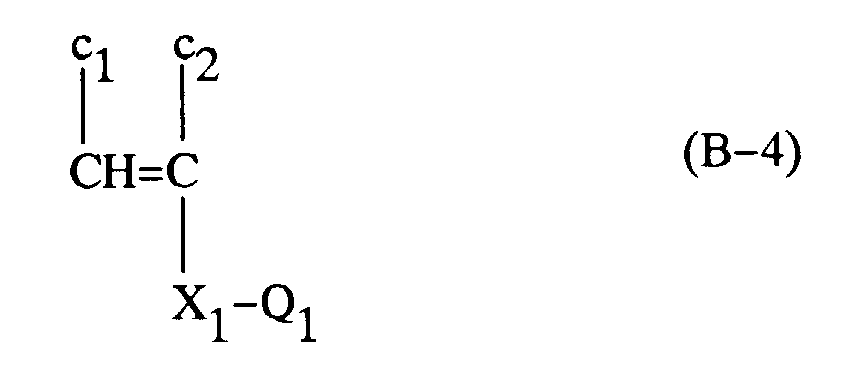
- Photorécepteur électrophotographique selon la revendication 1, où ladite résine (A) est un copolymère (méth)acrylique contenant 30% en poids ou plus d'un monomère représenté par la formule (A-1)

- Photorécepteur électrophotographique selon la revendication 1, où ladite résine (A) est une résine comprenant comme composants copolymérisables (i) au moins une unité répétée représentée par la formule (A-2) ou (A-3) :


- Photorécepteur électrophotographique selon l'une quelconque des revendications 1-3, où ledit composant copolymérisable contenant un groupe acide est présent en une proportion de 1 à 10% en poids.
- Photorécepteur électrophotographique selon l'une quelconque des revendications 1-4, où ladite résine (A) a un poids moléculaire moyen en poids de 3x10³ à 1,0x10⁴.
- Photorécepteur électrophotographique selon l'une quelconque des revendications 1 à 5, où ladite résine (B) a un poids moléculaire moyen en poids de 5x10⁴ à 6x10⁵.
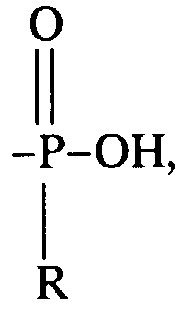
- Photorécepteur électrophotographique selon l'une quelconque des revendications 1-6, où ladite résine (B) est une résine où au moins un groupe acide choisi dans le groupe constitué de -PO3H2, -SO3H, -COOH,
Applications Claiming Priority (6)
| Application Number | Priority Date | Filing Date | Title |
|---|---|---|---|
| JP203933/88 | 1988-08-18 | ||
| JP20393388A JP2584285B2 (ja) | 1988-08-18 | 1988-08-18 | 電子写真感光体 |
| JP20731788A JP2584286B2 (ja) | 1988-08-23 | 1988-08-23 | 電子写真感光体 |
| JP207317/88 | 1988-08-23 | ||
| JP221486/88 | 1988-09-06 | ||
| JP22148688A JP2597161B2 (ja) | 1988-09-06 | 1988-09-06 | 電子写真感光体 |
Publications (3)
| Publication Number | Publication Date |
|---|---|
| EP0361063A2 EP0361063A2 (fr) | 1990-04-04 |
| EP0361063A3 EP0361063A3 (fr) | 1990-12-05 |
| EP0361063B1 true EP0361063B1 (fr) | 1996-12-11 |
Family
ID=27328306
Family Applications (1)
| Application Number | Title | Priority Date | Filing Date |
|---|---|---|---|
| EP89115266A Expired - Lifetime EP0361063B1 (fr) | 1988-08-18 | 1989-08-18 | Photorécepteur électrographique |
Country Status (3)
| Country | Link |
|---|---|
| US (1) | US5030534A (fr) |
| EP (1) | EP0361063B1 (fr) |
| DE (1) | DE68927544T2 (fr) |
Families Citing this family (24)
| Publication number | Priority date | Publication date | Assignee | Title |
|---|---|---|---|---|
| EP0357039B1 (fr) * | 1988-08-31 | 1995-10-25 | Fuji Photo Film Co., Ltd. | Photorécepteur électrophotographique |
| EP0363928B1 (fr) * | 1988-10-12 | 1997-01-02 | Fuji Photo Film Co., Ltd. | Photorécepteur électrophotographique |
| DE69021238T2 (de) * | 1989-03-20 | 1996-03-28 | Fuji Photo Film Co Ltd | Elektrophotographisches lichtempfindliches Material. |
| JP2640141B2 (ja) * | 1989-05-23 | 1997-08-13 | 富士写真フイルム株式会社 | 電子写真感光体 |
| JP2640145B2 (ja) * | 1989-07-21 | 1997-08-13 | 富士写真フイルム株式会社 | 電子写真感光体 |
| US5178982A (en) * | 1989-08-21 | 1993-01-12 | Fuji Photo Film Co., Ltd. | Electrophotographic light-sensitive material |
| JP2655355B2 (ja) * | 1989-09-06 | 1997-09-17 | 富士写真フイルム株式会社 | 電子写真感光体 |
| JPH03100657A (ja) * | 1989-09-14 | 1991-04-25 | Fuji Photo Film Co Ltd | 電子写真感光体 |
| JPH0393734U (fr) * | 1990-01-11 | 1991-09-25 | ||
| EP0439072B1 (fr) * | 1990-01-19 | 1996-04-03 | Fuji Photo Film Co., Ltd. | Matériau photosensible électrophotographique |
| JP2715329B2 (ja) * | 1990-01-31 | 1998-02-18 | 富士写真フイルム株式会社 | 電子写真感光体 |
| US5135831A (en) * | 1990-02-16 | 1992-08-04 | Fuji Photo Film Co., Ltd. | Electrophotographic light-sensitive material |
| US5202208A (en) * | 1990-02-16 | 1993-04-13 | Fuji Photo Film Co., Ltd. | Electrophotographic light-sensitive material |
| JP2681134B2 (ja) * | 1990-02-28 | 1997-11-26 | 富士写真フイルム株式会社 | 電子写真感光体 |
| EP0456486A3 (en) * | 1990-05-11 | 1992-01-08 | Fuji Photo Film Co., Ltd. | An electrophotographic lithographic printing plate precursor |
| JP2622772B2 (ja) * | 1990-05-21 | 1997-06-18 | 富士写真フイルム株式会社 | 電子写真感光体 |
| JP2623153B2 (ja) * | 1990-05-23 | 1997-06-25 | 富士写真フイルム株式会社 | 電子写真感光体 |
| JP2632231B2 (ja) * | 1990-05-25 | 1997-07-23 | 富士写真フイルム株式会社 | 電子写真感光体 |
| EP0485049B1 (fr) * | 1990-07-06 | 1998-09-23 | Fuji Photo Film Co., Ltd. | Précurseur de plaque d'impression lithographique électrophotographique |
| US5342716A (en) * | 1991-02-22 | 1994-08-30 | Fuji Photo Film Co., Ltd. | Electrophotographic lithographic printing plate precursor |
| WO1992018906A1 (fr) * | 1991-04-12 | 1992-10-29 | Fuji Photo Film Co., Ltd. | Plaque d'impression electrophotographique pour lithographie |
| US5368931A (en) * | 1991-07-10 | 1994-11-29 | Fuji Photo Film Co., Ltd. | Lithographic printing plate precursor of direct image type |
| US20040058276A1 (en) * | 2002-09-23 | 2004-03-25 | Dueber Thomas E. | Halo resistent, photoimagable coverlay compositions, having, advantageous application and removal properties, and methods relating thereto |
| US8748548B2 (en) * | 2009-12-28 | 2014-06-10 | Johnson & Johnson Vision Care, Inc. | Macromonomer mixture, terminal-reactive polymer mixture, intermediate for macromonomer and silicone hydrogel |
Family Cites Families (7)
| Publication number | Priority date | Publication date | Assignee | Title |
|---|---|---|---|---|
| US3595647A (en) * | 1967-10-31 | 1971-07-27 | Ricoh Kk | Copying material for use in high-speed electrophotography |
| US3885961A (en) * | 1972-08-01 | 1975-05-27 | Mitsubishi Rayon Co | Polymeric binder material for use in a photoconductive layer employed in electrophotography |
| JPS5631585B2 (fr) * | 1974-08-23 | 1981-07-22 | ||
| US4434218A (en) * | 1979-01-24 | 1984-02-28 | Konishiroku Photo Industry Co., Ltd. | Photosensitive composition for electrophotography |
| JPS57147656A (en) * | 1981-03-09 | 1982-09-11 | Fuji Photo Film Co Ltd | Electrophotographic sensitive printing plate material |
| US4666811A (en) * | 1981-11-10 | 1987-05-19 | James River Graphics, Inc. | Organic photoconductors having improved pre-exposure fatigue resistance and blooming properties |
| JP2549541B2 (ja) * | 1987-03-09 | 1996-10-30 | 富士写真フイルム株式会社 | 電子写真感光体 |
-
1989
- 1989-08-17 US US07/395,008 patent/US5030534A/en not_active Expired - Lifetime
- 1989-08-18 EP EP89115266A patent/EP0361063B1/fr not_active Expired - Lifetime
- 1989-08-18 DE DE68927544T patent/DE68927544T2/de not_active Expired - Fee Related
Also Published As
| Publication number | Publication date |
|---|---|
| US5030534A (en) | 1991-07-09 |
| DE68927544D1 (de) | 1997-01-23 |
| EP0361063A2 (fr) | 1990-04-04 |
| DE68927544T2 (de) | 1997-04-10 |
| EP0361063A3 (fr) | 1990-12-05 |
Similar Documents
| Publication | Publication Date | Title |
|---|---|---|
| EP0361063B1 (fr) | Photorécepteur électrographique | |
| US5021311A (en) | Electrophotographic photoreceptor | |
| EP0362804B1 (fr) | Photorécepteur électrophotographique | |
| EP0361514B1 (fr) | Photorécepteur électrophotographique | |
| EP0363928B1 (fr) | Photorécepteur électrophotographique | |
| EP0357039B1 (fr) | Photorécepteur électrophotographique | |
| US5084367A (en) | Electrophotographic photoreceptor | |
| JP2592314B2 (ja) | 電子写真感光体 | |
| EP0398373B1 (fr) | Matériau photosensible électrophotographique | |
| EP0458298A1 (fr) | Produit photosensible électrophotographique | |
| EP0399469B1 (fr) | Matériau photosensible électrophotographique | |
| EP0410324B1 (fr) | Matériau photosensible électrophotographique | |
| EP0440226B1 (fr) | Matériau photosensible électrophotographique | |
| EP0405499B1 (fr) | Matériau photosensible électrophotographique | |
| JP2584286B2 (ja) | 電子写真感光体 | |
| EP0407936B1 (fr) | Matériau photosensible électrophotographique | |
| EP0416591B1 (fr) | Matériau photosensible électrophotographique | |
| JP2597164B2 (ja) | 電子写真感光体 | |
| JP2632221B2 (ja) | 電子写真感光体 | |
| JP2520711B2 (ja) | 電子写真感光体 | |
| JP2584285B2 (ja) | 電子写真感光体 | |
| JP2597161B2 (ja) | 電子写真感光体 | |
| JP2568906B2 (ja) | 電子写真感光体 | |
| EP0533135B1 (fr) | Matériau photosensible électrophotographique | |
| JP2640140B2 (ja) | 電子写真感光体 |
Legal Events
| Date | Code | Title | Description |
|---|---|---|---|
| PUAI | Public reference made under article 153(3) epc to a published international application that has entered the european phase |
Free format text: ORIGINAL CODE: 0009012 |
|
| AK | Designated contracting states |
Kind code of ref document: A2 Designated state(s): DE GB |
|
| PUAL | Search report despatched |
Free format text: ORIGINAL CODE: 0009013 |
|
| AK | Designated contracting states |
Kind code of ref document: A3 Designated state(s): DE GB |
|
| 17P | Request for examination filed |
Effective date: 19910604 |
|
| 17Q | First examination report despatched |
Effective date: 19940217 |
|
| GRAG | Despatch of communication of intention to grant |
Free format text: ORIGINAL CODE: EPIDOS AGRA |
|
| GRAH | Despatch of communication of intention to grant a patent |
Free format text: ORIGINAL CODE: EPIDOS IGRA |
|
| GRAH | Despatch of communication of intention to grant a patent |
Free format text: ORIGINAL CODE: EPIDOS IGRA |
|
| GRAA | (expected) grant |
Free format text: ORIGINAL CODE: 0009210 |
|
| AK | Designated contracting states |
Kind code of ref document: B1 Designated state(s): DE GB |
|
| REF | Corresponds to: |
Ref document number: 68927544 Country of ref document: DE Date of ref document: 19970123 |
|
| PLBE | No opposition filed within time limit |
Free format text: ORIGINAL CODE: 0009261 |
|
| STAA | Information on the status of an ep patent application or granted ep patent |
Free format text: STATUS: NO OPPOSITION FILED WITHIN TIME LIMIT |
|
| 26N | No opposition filed | ||
| REG | Reference to a national code |
Ref country code: GB Ref legal event code: IF02 |
|
| PGFP | Annual fee paid to national office [announced via postgrant information from national office to epo] |
Ref country code: GB Payment date: 20040818 Year of fee payment: 16 |
|
| PGFP | Annual fee paid to national office [announced via postgrant information from national office to epo] |
Ref country code: DE Payment date: 20040826 Year of fee payment: 16 |
|
| PG25 | Lapsed in a contracting state [announced via postgrant information from national office to epo] |
Ref country code: GB Free format text: LAPSE BECAUSE OF NON-PAYMENT OF DUE FEES Effective date: 20050818 |
|
| PG25 | Lapsed in a contracting state [announced via postgrant information from national office to epo] |
Ref country code: DE Free format text: LAPSE BECAUSE OF NON-PAYMENT OF DUE FEES Effective date: 20060301 |
|
| GBPC | Gb: european patent ceased through non-payment of renewal fee |
Effective date: 20050818 |