EP0361229A2 - Polymer-bonded dyes, process for their preparation and their use - Google Patents
Polymer-bonded dyes, process for their preparation and their use Download PDFInfo
- Publication number
- EP0361229A2 EP0361229A2 EP89117097A EP89117097A EP0361229A2 EP 0361229 A2 EP0361229 A2 EP 0361229A2 EP 89117097 A EP89117097 A EP 89117097A EP 89117097 A EP89117097 A EP 89117097A EP 0361229 A2 EP0361229 A2 EP 0361229A2
- Authority
- EP
- European Patent Office
- Prior art keywords
- polymer
- dye
- dyes
- linked
- meth
- Prior art date
- Legal status (The legal status is an assumption and is not a legal conclusion. Google has not performed a legal analysis and makes no representation as to the accuracy of the status listed.)
- Granted
Links
- 239000000975 dye Substances 0.000 title claims abstract description 126
- 238000000034 method Methods 0.000 title abstract description 15
- 238000002360 preparation method Methods 0.000 title abstract description 6
- 229920000642 polymer Polymers 0.000 claims abstract description 61
- 125000000524 functional group Chemical group 0.000 claims abstract description 13
- 229920001577 copolymer Polymers 0.000 claims description 32
- HRPVXLWXLXDGHG-UHFFFAOYSA-N Acrylamide Chemical compound NC(=O)C=C HRPVXLWXLXDGHG-UHFFFAOYSA-N 0.000 claims description 24
- 239000000178 monomer Substances 0.000 claims description 19
- WHNWPMSKXPGLAX-UHFFFAOYSA-N N-Vinyl-2-pyrrolidone Chemical compound C=CN1CCCC1=O WHNWPMSKXPGLAX-UHFFFAOYSA-N 0.000 claims description 15
- 238000006243 chemical reaction Methods 0.000 claims description 14
- -1 carbostyrils Chemical class 0.000 claims description 13
- 229910052757 nitrogen Inorganic materials 0.000 claims description 11
- PNLUGRYDUHRLOF-UHFFFAOYSA-N n-ethenyl-n-methylacetamide Chemical compound C=CN(C)C(C)=O PNLUGRYDUHRLOF-UHFFFAOYSA-N 0.000 claims description 10
- JWYVGKFDLWWQJX-UHFFFAOYSA-N 1-ethenylazepan-2-one Chemical compound C=CN1CCCCCC1=O JWYVGKFDLWWQJX-UHFFFAOYSA-N 0.000 claims description 8
- PBGPBHYPCGDFEZ-UHFFFAOYSA-N 1-ethenylpiperidin-2-one Chemical compound C=CN1CCCCC1=O PBGPBHYPCGDFEZ-UHFFFAOYSA-N 0.000 claims description 8
- 150000001414 amino alcohols Chemical class 0.000 claims description 8
- PQBYUJWFIDDLNK-UHFFFAOYSA-N ethyl N-ethenoxy-N-methylcarbamate Chemical compound C(=C)ON(C(=O)OCC)C PQBYUJWFIDDLNK-UHFFFAOYSA-N 0.000 claims description 8
- FQPSGWSUVKBHSU-UHFFFAOYSA-N methacrylamide Chemical compound CC(=C)C(N)=O FQPSGWSUVKBHSU-UHFFFAOYSA-N 0.000 claims description 8
- RQAKESSLMFZVMC-UHFFFAOYSA-N n-ethenylacetamide Chemical compound CC(=O)NC=C RQAKESSLMFZVMC-UHFFFAOYSA-N 0.000 claims description 8
- ZQXSMRAEXCEDJD-UHFFFAOYSA-N n-ethenylformamide Chemical compound C=CNC=O ZQXSMRAEXCEDJD-UHFFFAOYSA-N 0.000 claims description 8
- ZYGHJZDHTFUPRJ-UHFFFAOYSA-N benzo-alpha-pyrone Natural products C1=CC=C2OC(=O)C=CC2=C1 ZYGHJZDHTFUPRJ-UHFFFAOYSA-N 0.000 claims description 6
- 235000001671 coumarin Nutrition 0.000 claims description 6
- 150000004775 coumarins Chemical class 0.000 claims description 6
- 239000007850 fluorescent dye Substances 0.000 claims description 6
- VGGSQFUCUMXWEO-UHFFFAOYSA-N Ethene Chemical compound C=C VGGSQFUCUMXWEO-UHFFFAOYSA-N 0.000 claims description 5
- 125000002887 hydroxy group Chemical group [H]O* 0.000 claims description 5
- XJRBAMWJDBPFIM-UHFFFAOYSA-N methyl vinyl ether Chemical compound COC=C XJRBAMWJDBPFIM-UHFFFAOYSA-N 0.000 claims description 5
- 108020004707 nucleic acids Proteins 0.000 claims description 5
- 150000007523 nucleic acids Chemical class 0.000 claims description 5
- 102000039446 nucleic acids Human genes 0.000 claims description 5
- 229920003169 water-soluble polymer Polymers 0.000 claims description 5
- OALHHIHQOFIMEF-UHFFFAOYSA-N 3',6'-dihydroxy-2',4',5',7'-tetraiodo-3h-spiro[2-benzofuran-1,9'-xanthene]-3-one Chemical compound O1C(=O)C2=CC=CC=C2C21C1=CC(I)=C(O)C(I)=C1OC1=C(I)C(O)=C(I)C=C21 OALHHIHQOFIMEF-UHFFFAOYSA-N 0.000 claims description 4
- 125000000751 azo group Chemical group [*]N=N[*] 0.000 claims description 3
- 239000012620 biological material Substances 0.000 claims description 3
- 125000001434 methanylylidene group Chemical group [H]C#[*] 0.000 claims description 3
- PYKYMHQGRFAEBM-UHFFFAOYSA-N anthraquinone Natural products CCC(=O)c1c(O)c2C(=O)C3C(C=CC=C3O)C(=O)c2cc1CC(=O)OC PYKYMHQGRFAEBM-UHFFFAOYSA-N 0.000 claims description 2
- 150000004056 anthraquinones Chemical class 0.000 claims description 2
- XJHABGPPCLHLLV-UHFFFAOYSA-N benzo[de]isoquinoline-1,3-dione Chemical class C1=CC(C(=O)NC2=O)=C3C2=CC=CC3=C1 XJHABGPPCLHLLV-UHFFFAOYSA-N 0.000 claims description 2
- 150000003219 pyrazolines Chemical class 0.000 claims description 2
- 150000003220 pyrenes Chemical class 0.000 claims description 2
- 125000000391 vinyl group Chemical group [H]C([*])=C([H])[H] 0.000 claims description 2
- 229920002554 vinyl polymer Polymers 0.000 claims description 2
- ZBKFYXZXZJPWNQ-UHFFFAOYSA-N isothiocyanate group Chemical group [N-]=C=S ZBKFYXZXZJPWNQ-UHFFFAOYSA-N 0.000 claims 1
- 125000000446 sulfanediyl group Chemical group *S* 0.000 claims 1
- XLYOFNOQVPJJNP-UHFFFAOYSA-N water Substances O XLYOFNOQVPJJNP-UHFFFAOYSA-N 0.000 abstract description 18
- 238000004458 analytical method Methods 0.000 abstract description 7
- 238000002372 labelling Methods 0.000 abstract description 7
- 239000000126 substance Substances 0.000 abstract description 7
- ZHNUHDYFZUAESO-UHFFFAOYSA-N Formamide Chemical compound NC=O ZHNUHDYFZUAESO-UHFFFAOYSA-N 0.000 description 42
- XEKOWRVHYACXOJ-UHFFFAOYSA-N Ethyl acetate Chemical compound CCOC(C)=O XEKOWRVHYACXOJ-UHFFFAOYSA-N 0.000 description 39
- 239000000203 mixture Substances 0.000 description 28
- 239000000243 solution Substances 0.000 description 22
- CSCPPACGZOOCGX-UHFFFAOYSA-N Acetone Chemical compound CC(C)=O CSCPPACGZOOCGX-UHFFFAOYSA-N 0.000 description 17
- FPYJFEHAWHCUMM-UHFFFAOYSA-N maleic anhydride Chemical compound O=C1OC(=O)C=C1 FPYJFEHAWHCUMM-UHFFFAOYSA-N 0.000 description 15
- QGZKDVFQNNGYKY-UHFFFAOYSA-N Ammonia Chemical compound N QGZKDVFQNNGYKY-UHFFFAOYSA-N 0.000 description 14
- XOAAWQZATWQOTB-UHFFFAOYSA-N taurine Chemical compound NCCS(O)(=O)=O XOAAWQZATWQOTB-UHFFFAOYSA-N 0.000 description 14
- 238000012360 testing method Methods 0.000 description 14
- SUTWPJHCRAITLU-UHFFFAOYSA-N 6-aminohexan-1-ol Chemical compound NCCCCCCO SUTWPJHCRAITLU-UHFFFAOYSA-N 0.000 description 12
- 238000002835 absorbance Methods 0.000 description 12
- 238000003756 stirring Methods 0.000 description 12
- 150000003926 acrylamides Chemical class 0.000 description 11
- KFZMGEQAYNKOFK-UHFFFAOYSA-N Isopropanol Chemical compound CC(C)O KFZMGEQAYNKOFK-UHFFFAOYSA-N 0.000 description 10
- JUJWROOIHBZHMG-UHFFFAOYSA-N Pyridine Chemical compound C1=CC=NC=C1 JUJWROOIHBZHMG-UHFFFAOYSA-N 0.000 description 10
- 239000007787 solid Substances 0.000 description 10
- YMWUJEATGCHHMB-UHFFFAOYSA-N Dichloromethane Chemical compound ClCCl YMWUJEATGCHHMB-UHFFFAOYSA-N 0.000 description 9
- 108091034117 Oligonucleotide Proteins 0.000 description 9
- 125000000217 alkyl group Chemical group 0.000 description 9
- 238000006862 quantum yield reaction Methods 0.000 description 9
- IJGRMHOSHXDMSA-UHFFFAOYSA-N Atomic nitrogen Chemical compound N#N IJGRMHOSHXDMSA-UHFFFAOYSA-N 0.000 description 8
- 239000000843 powder Substances 0.000 description 8
- 125000003277 amino group Chemical group 0.000 description 7
- QARBMVPHQWIHKH-UHFFFAOYSA-N methanesulfonyl chloride Chemical compound CS(Cl)(=O)=O QARBMVPHQWIHKH-UHFFFAOYSA-N 0.000 description 7
- IIACRCGMVDHOTQ-UHFFFAOYSA-N sulfamic acid Chemical class NS(O)(=O)=O IIACRCGMVDHOTQ-UHFFFAOYSA-N 0.000 description 7
- 229960003080 taurine Drugs 0.000 description 7
- NIXOWILDQLNWCW-UHFFFAOYSA-M Acrylate Chemical compound [O-]C(=O)C=C NIXOWILDQLNWCW-UHFFFAOYSA-M 0.000 description 6
- KXDHJXZQYSOELW-UHFFFAOYSA-N Carbamic acid Chemical class NC(O)=O KXDHJXZQYSOELW-UHFFFAOYSA-N 0.000 description 6
- CERQOIWHTDAKMF-UHFFFAOYSA-N Methacrylic acid Chemical compound CC(=C)C(O)=O CERQOIWHTDAKMF-UHFFFAOYSA-N 0.000 description 6
- JLCPHMBAVCMARE-UHFFFAOYSA-N [3-[[3-[[3-[[3-[[3-[[3-[[3-[[3-[[3-[[3-[[3-[[5-(2-amino-6-oxo-1H-purin-9-yl)-3-[[3-[[3-[[3-[[3-[[3-[[5-(2-amino-6-oxo-1H-purin-9-yl)-3-[[5-(2-amino-6-oxo-1H-purin-9-yl)-3-hydroxyoxolan-2-yl]methoxy-hydroxyphosphoryl]oxyoxolan-2-yl]methoxy-hydroxyphosphoryl]oxy-5-(5-methyl-2,4-dioxopyrimidin-1-yl)oxolan-2-yl]methoxy-hydroxyphosphoryl]oxy-5-(6-aminopurin-9-yl)oxolan-2-yl]methoxy-hydroxyphosphoryl]oxy-5-(6-aminopurin-9-yl)oxolan-2-yl]methoxy-hydroxyphosphoryl]oxy-5-(6-aminopurin-9-yl)oxolan-2-yl]methoxy-hydroxyphosphoryl]oxy-5-(6-aminopurin-9-yl)oxolan-2-yl]methoxy-hydroxyphosphoryl]oxyoxolan-2-yl]methoxy-hydroxyphosphoryl]oxy-5-(5-methyl-2,4-dioxopyrimidin-1-yl)oxolan-2-yl]methoxy-hydroxyphosphoryl]oxy-5-(4-amino-2-oxopyrimidin-1-yl)oxolan-2-yl]methoxy-hydroxyphosphoryl]oxy-5-(5-methyl-2,4-dioxopyrimidin-1-yl)oxolan-2-yl]methoxy-hydroxyphosphoryl]oxy-5-(5-methyl-2,4-dioxopyrimidin-1-yl)oxolan-2-yl]methoxy-hydroxyphosphoryl]oxy-5-(6-aminopurin-9-yl)oxolan-2-yl]methoxy-hydroxyphosphoryl]oxy-5-(6-aminopurin-9-yl)oxolan-2-yl]methoxy-hydroxyphosphoryl]oxy-5-(4-amino-2-oxopyrimidin-1-yl)oxolan-2-yl]methoxy-hydroxyphosphoryl]oxy-5-(4-amino-2-oxopyrimidin-1-yl)oxolan-2-yl]methoxy-hydroxyphosphoryl]oxy-5-(4-amino-2-oxopyrimidin-1-yl)oxolan-2-yl]methoxy-hydroxyphosphoryl]oxy-5-(6-aminopurin-9-yl)oxolan-2-yl]methoxy-hydroxyphosphoryl]oxy-5-(4-amino-2-oxopyrimidin-1-yl)oxolan-2-yl]methyl [5-(6-aminopurin-9-yl)-2-(hydroxymethyl)oxolan-3-yl] hydrogen phosphate Polymers Cc1cn(C2CC(OP(O)(=O)OCC3OC(CC3OP(O)(=O)OCC3OC(CC3O)n3cnc4c3nc(N)[nH]c4=O)n3cnc4c3nc(N)[nH]c4=O)C(COP(O)(=O)OC3CC(OC3COP(O)(=O)OC3CC(OC3COP(O)(=O)OC3CC(OC3COP(O)(=O)OC3CC(OC3COP(O)(=O)OC3CC(OC3COP(O)(=O)OC3CC(OC3COP(O)(=O)OC3CC(OC3COP(O)(=O)OC3CC(OC3COP(O)(=O)OC3CC(OC3COP(O)(=O)OC3CC(OC3COP(O)(=O)OC3CC(OC3COP(O)(=O)OC3CC(OC3COP(O)(=O)OC3CC(OC3COP(O)(=O)OC3CC(OC3COP(O)(=O)OC3CC(OC3COP(O)(=O)OC3CC(OC3COP(O)(=O)OC3CC(OC3CO)n3cnc4c(N)ncnc34)n3ccc(N)nc3=O)n3cnc4c(N)ncnc34)n3ccc(N)nc3=O)n3ccc(N)nc3=O)n3ccc(N)nc3=O)n3cnc4c(N)ncnc34)n3cnc4c(N)ncnc34)n3cc(C)c(=O)[nH]c3=O)n3cc(C)c(=O)[nH]c3=O)n3ccc(N)nc3=O)n3cc(C)c(=O)[nH]c3=O)n3cnc4c3nc(N)[nH]c4=O)n3cnc4c(N)ncnc34)n3cnc4c(N)ncnc34)n3cnc4c(N)ncnc34)n3cnc4c(N)ncnc34)O2)c(=O)[nH]c1=O JLCPHMBAVCMARE-UHFFFAOYSA-N 0.000 description 6
- 150000001252 acrylic acid derivatives Chemical class 0.000 description 6
- 229910021529 ammonia Inorganic materials 0.000 description 6
- 125000002924 primary amino group Chemical group [H]N([H])* 0.000 description 6
- 108090000623 proteins and genes Proteins 0.000 description 6
- 239000011541 reaction mixture Substances 0.000 description 6
- 230000035945 sensitivity Effects 0.000 description 6
- GZAJOEGTZDUSKS-UHFFFAOYSA-N 5-aminofluorescein Chemical group C12=CC=C(O)C=C2OC2=CC(O)=CC=C2C21OC(=O)C1=CC(N)=CC=C21 GZAJOEGTZDUSKS-UHFFFAOYSA-N 0.000 description 5
- 125000003158 alcohol group Chemical group 0.000 description 5
- 150000008064 anhydrides Chemical group 0.000 description 5
- 239000000427 antigen Substances 0.000 description 5
- 102000036639 antigens Human genes 0.000 description 5
- 108091007433 antigens Proteins 0.000 description 5
- 230000007717 exclusion Effects 0.000 description 5
- 229910052760 oxygen Inorganic materials 0.000 description 5
- UMJSCPRVCHMLSP-UHFFFAOYSA-N pyridine Natural products COC1=CC=CN=C1 UMJSCPRVCHMLSP-UHFFFAOYSA-N 0.000 description 5
- 239000002904 solvent Substances 0.000 description 5
- OZAIFHULBGXAKX-UHFFFAOYSA-N 2-(2-cyanopropan-2-yldiazenyl)-2-methylpropanenitrile Chemical compound N#CC(C)(C)N=NC(C)(C)C#N OZAIFHULBGXAKX-UHFFFAOYSA-N 0.000 description 4
- NIXOWILDQLNWCW-UHFFFAOYSA-N Acrylic acid Chemical compound OC(=O)C=C NIXOWILDQLNWCW-UHFFFAOYSA-N 0.000 description 4
- OFOBLEOULBTSOW-UHFFFAOYSA-N Malonic acid Chemical compound OC(=O)CC(O)=O OFOBLEOULBTSOW-UHFFFAOYSA-N 0.000 description 4
- 238000001816 cooling Methods 0.000 description 4
- 125000004985 dialkyl amino alkyl group Chemical group 0.000 description 4
- 239000000725 suspension Substances 0.000 description 4
- BWEHZEMLYKRDNK-UHFFFAOYSA-N 1-isocyanato-2-prop-1-en-2-ylbenzene Chemical compound CC(=C)C1=CC=CC=C1N=C=O BWEHZEMLYKRDNK-UHFFFAOYSA-N 0.000 description 3
- UMEUMGUZBPZVMV-UHFFFAOYSA-N 2-isocyanatoethenylbenzene Chemical compound O=C=NC=CC1=CC=CC=C1 UMEUMGUZBPZVMV-UHFFFAOYSA-N 0.000 description 3
- XTMYMVIAYRSVIG-UHFFFAOYSA-N 3-(4-aminophenyl)-7-(diethylamino)chromen-2-one Chemical compound O=C1OC2=CC(N(CC)CC)=CC=C2C=C1C1=CC=C(N)C=C1 XTMYMVIAYRSVIG-UHFFFAOYSA-N 0.000 description 3
- VHUUQVKOLVNVRT-UHFFFAOYSA-N Ammonium hydroxide Chemical compound [NH4+].[OH-] VHUUQVKOLVNVRT-UHFFFAOYSA-N 0.000 description 3
- UHOVQNZJYSORNB-UHFFFAOYSA-N Benzene Chemical compound C1=CC=CC=C1 UHOVQNZJYSORNB-UHFFFAOYSA-N 0.000 description 3
- LSNNMFCWUKXFEE-UHFFFAOYSA-M Bisulfite Chemical compound OS([O-])=O LSNNMFCWUKXFEE-UHFFFAOYSA-M 0.000 description 3
- GXBYFVGCMPJVJX-UHFFFAOYSA-N Epoxybutene Chemical compound C=CC1CO1 GXBYFVGCMPJVJX-UHFFFAOYSA-N 0.000 description 3
- 229920002873 Polyethylenimine Polymers 0.000 description 3
- YXFVVABEGXRONW-UHFFFAOYSA-N Toluene Chemical compound CC1=CC=CC=C1 YXFVVABEGXRONW-UHFFFAOYSA-N 0.000 description 3
- 239000002253 acid Substances 0.000 description 3
- 235000011114 ammonium hydroxide Nutrition 0.000 description 3
- 239000007864 aqueous solution Substances 0.000 description 3
- QVGXLLKOCUKJST-UHFFFAOYSA-N atomic oxygen Chemical compound [O] QVGXLLKOCUKJST-UHFFFAOYSA-N 0.000 description 3
- 229920005601 base polymer Polymers 0.000 description 3
- 125000003178 carboxy group Chemical group [H]OC(*)=O 0.000 description 3
- 239000003153 chemical reaction reagent Substances 0.000 description 3
- 150000002148 esters Chemical class 0.000 description 3
- 230000002209 hydrophobic effect Effects 0.000 description 3
- RBQRWNWVPQDTJJ-UHFFFAOYSA-N methacryloyloxyethyl isocyanate Chemical compound CC(=C)C(=O)OCCN=C=O RBQRWNWVPQDTJJ-UHFFFAOYSA-N 0.000 description 3
- 125000004170 methylsulfonyl group Chemical group [H]C([H])([H])S(*)(=O)=O 0.000 description 3
- 239000001301 oxygen Substances 0.000 description 3
- 238000000163 radioactive labelling Methods 0.000 description 3
- 239000000523 sample Substances 0.000 description 3
- YXMISKNUHHOXFT-UHFFFAOYSA-N (2,5-dioxopyrrolidin-1-yl) prop-2-enoate Chemical compound C=CC(=O)ON1C(=O)CCC1=O YXMISKNUHHOXFT-UHFFFAOYSA-N 0.000 description 2
- UFHSKEHEWFGEFH-UHFFFAOYSA-N (2,5-dioxopyrrolidin-3-yl) prop-2-enoate Chemical compound C=CC(=O)OC1CC(=O)NC1=O UFHSKEHEWFGEFH-UHFFFAOYSA-N 0.000 description 2
- RJSLYBIJZJKOST-UHFFFAOYSA-N 1-(2h-benzotriazol-4-yl)prop-2-en-1-one Chemical compound C=CC(=O)C1=CC=CC2=C1N=NN2 RJSLYBIJZJKOST-UHFFFAOYSA-N 0.000 description 2
- ASOKPJOREAFHNY-UHFFFAOYSA-N 1-Hydroxybenzotriazole Chemical compound C1=CC=C2N(O)N=NC2=C1 ASOKPJOREAFHNY-UHFFFAOYSA-N 0.000 description 2
- JKNCOURZONDCGV-UHFFFAOYSA-N 2-(dimethylamino)ethyl 2-methylprop-2-enoate Chemical compound CN(C)CCOC(=O)C(C)=C JKNCOURZONDCGV-UHFFFAOYSA-N 0.000 description 2
- HZAXFHJVJLSVMW-UHFFFAOYSA-N 2-Aminoethan-1-ol Chemical compound NCCO HZAXFHJVJLSVMW-UHFFFAOYSA-N 0.000 description 2
- MXZROAOUCUVNHX-UHFFFAOYSA-N 2-Aminopropanol Chemical compound CCC(N)O MXZROAOUCUVNHX-UHFFFAOYSA-N 0.000 description 2
- XHZPRMZZQOIPDS-UHFFFAOYSA-N 2-Methyl-2-[(1-oxo-2-propenyl)amino]-1-propanesulfonic acid Chemical compound OS(=O)(=O)CC(C)(C)NC(=O)C=C XHZPRMZZQOIPDS-UHFFFAOYSA-N 0.000 description 2
- NGNBDVOYPDDBFK-UHFFFAOYSA-N 2-[2,4-di(pentan-2-yl)phenoxy]acetyl chloride Chemical compound CCCC(C)C1=CC=C(OCC(Cl)=O)C(C(C)CCC)=C1 NGNBDVOYPDDBFK-UHFFFAOYSA-N 0.000 description 2
- AGBXYHCHUYARJY-UHFFFAOYSA-N 2-phenylethenesulfonic acid Chemical compound OS(=O)(=O)C=CC1=CC=CC=C1 AGBXYHCHUYARJY-UHFFFAOYSA-N 0.000 description 2
- AYKYXWQEBUNJCN-UHFFFAOYSA-N 3-methylfuran-2,5-dione Chemical compound CC1=CC(=O)OC1=O AYKYXWQEBUNJCN-UHFFFAOYSA-N 0.000 description 2
- OFNISBHGPNMTMS-UHFFFAOYSA-N 3-methylideneoxolane-2,5-dione Chemical compound C=C1CC(=O)OC1=O OFNISBHGPNMTMS-UHFFFAOYSA-N 0.000 description 2
- ZWAPMFBHEQZLGK-UHFFFAOYSA-N 5-(dimethylamino)-2-methylidenepentanamide Chemical compound CN(C)CCCC(=C)C(N)=O ZWAPMFBHEQZLGK-UHFFFAOYSA-N 0.000 description 2
- NLXLAEXVIDQMFP-UHFFFAOYSA-N Ammonium chloride Substances [NH4+].[Cl-] NLXLAEXVIDQMFP-UHFFFAOYSA-N 0.000 description 2
- 108020003215 DNA Probes Proteins 0.000 description 2
- 239000003298 DNA probe Substances 0.000 description 2
- AFVFQIVMOAPDHO-UHFFFAOYSA-N Methanesulfonic acid Chemical compound CS(O)(=O)=O AFVFQIVMOAPDHO-UHFFFAOYSA-N 0.000 description 2
- NQTADLQHYWFPDB-UHFFFAOYSA-N N-Hydroxysuccinimide Chemical compound ON1C(=O)CCC1=O NQTADLQHYWFPDB-UHFFFAOYSA-N 0.000 description 2
- 229910006069 SO3H Inorganic materials 0.000 description 2
- FAPWRFPIFSIZLT-UHFFFAOYSA-M Sodium chloride Chemical compound [Na+].[Cl-] FAPWRFPIFSIZLT-UHFFFAOYSA-M 0.000 description 2
- 125000002947 alkylene group Chemical group 0.000 description 2
- 229920005603 alternating copolymer Polymers 0.000 description 2
- 230000008033 biological extinction Effects 0.000 description 2
- 230000015572 biosynthetic process Effects 0.000 description 2
- 238000001514 detection method Methods 0.000 description 2
- YWEUIGNSBFLMFL-UHFFFAOYSA-N diphosphonate Chemical compound O=P(=O)OP(=O)=O YWEUIGNSBFLMFL-UHFFFAOYSA-N 0.000 description 2
- MHMNJMPURVTYEJ-UHFFFAOYSA-N fluorescein-5-isothiocyanate Chemical compound O1C(=O)C2=CC(N=C=S)=CC=C2C21C1=CC=C(O)C=C1OC1=CC(O)=CC=C21 MHMNJMPURVTYEJ-UHFFFAOYSA-N 0.000 description 2
- 239000012456 homogeneous solution Substances 0.000 description 2
- 125000002768 hydroxyalkyl group Chemical group 0.000 description 2
- 238000003018 immunoassay Methods 0.000 description 2
- 238000010348 incorporation Methods 0.000 description 2
- VZCYOOQTPOCHFL-UPHRSURJSA-N maleic acid Chemical compound OC(=O)\C=C/C(O)=O VZCYOOQTPOCHFL-UPHRSURJSA-N 0.000 description 2
- 239000011976 maleic acid Substances 0.000 description 2
- 239000002609 medium Substances 0.000 description 2
- DLYUQMMRRRQYAE-UHFFFAOYSA-N phosphorus pentoxide Inorganic materials O1P(O2)(=O)OP3(=O)OP1(=O)OP2(=O)O3 DLYUQMMRRRQYAE-UHFFFAOYSA-N 0.000 description 2
- 239000002244 precipitate Substances 0.000 description 2
- 230000001376 precipitating effect Effects 0.000 description 2
- 239000000047 product Substances 0.000 description 2
- 102000004169 proteins and genes Human genes 0.000 description 2
- 238000000746 purification Methods 0.000 description 2
- 125000006850 spacer group Chemical group 0.000 description 2
- 125000001424 substituent group Chemical group 0.000 description 2
- 239000000758 substrate Substances 0.000 description 2
- 238000003786 synthesis reaction Methods 0.000 description 2
- VZCYOOQTPOCHFL-UHFFFAOYSA-N trans-butenedioic acid Natural products OC(=O)C=CC(O)=O VZCYOOQTPOCHFL-UHFFFAOYSA-N 0.000 description 2
- QAEDZJGFFMLHHQ-UHFFFAOYSA-N trifluoroacetic anhydride Chemical compound FC(F)(F)C(=O)OC(=O)C(F)(F)F QAEDZJGFFMLHHQ-UHFFFAOYSA-N 0.000 description 2
- YCNYLRRRDWVUEF-UHFFFAOYSA-N (4-isothiocyanatophenyl) prop-2-enoate Chemical compound C(C=C)(=O)OC1=CC=C(C=C1)N=C=S YCNYLRRRDWVUEF-UHFFFAOYSA-N 0.000 description 1
- DNIAPMSPPWPWGF-GSVOUGTGSA-N (R)-(-)-Propylene glycol Chemical group C[C@@H](O)CO DNIAPMSPPWPWGF-GSVOUGTGSA-N 0.000 description 1
- JAHNSTQSQJOJLO-UHFFFAOYSA-N 2-(3-fluorophenyl)-1h-imidazole Chemical compound FC1=CC=CC(C=2NC=CN=2)=C1 JAHNSTQSQJOJLO-UHFFFAOYSA-N 0.000 description 1
- RIFCSCMYGXDRNH-UHFFFAOYSA-N 3-(4-aminophenyl)-7-(methylamino)chromen-2-one Chemical compound O=C1OC2=CC(NC)=CC=C2C=C1C1=CC=C(N)C=C1 RIFCSCMYGXDRNH-UHFFFAOYSA-N 0.000 description 1
- YYROPELSRYBVMQ-UHFFFAOYSA-N 4-toluenesulfonyl chloride Chemical compound CC1=CC=C(S(Cl)(=O)=O)C=C1 YYROPELSRYBVMQ-UHFFFAOYSA-N 0.000 description 1
- GAWIXWVDTYZWAW-UHFFFAOYSA-N C[CH]O Chemical group C[CH]O GAWIXWVDTYZWAW-UHFFFAOYSA-N 0.000 description 1
- BVKZGUZCCUSVTD-UHFFFAOYSA-L Carbonate Chemical compound [O-]C([O-])=O BVKZGUZCCUSVTD-UHFFFAOYSA-L 0.000 description 1
- 102000004190 Enzymes Human genes 0.000 description 1
- 108090000790 Enzymes Proteins 0.000 description 1
- 239000005977 Ethylene Substances 0.000 description 1
- YIVJZNGAASQVEM-UHFFFAOYSA-N Lauroyl peroxide Chemical compound CCCCCCCCCCCC(=O)OOC(=O)CCCCCCCCCCC YIVJZNGAASQVEM-UHFFFAOYSA-N 0.000 description 1
- DFPAKSUCGFBDDF-UHFFFAOYSA-N Nicotinamide Chemical group NC(=O)C1=CC=CN=C1 DFPAKSUCGFBDDF-UHFFFAOYSA-N 0.000 description 1
- 229920002292 Nylon 6 Polymers 0.000 description 1
- 239000004952 Polyamide Substances 0.000 description 1
- 108010039918 Polylysine Proteins 0.000 description 1
- WUGQZFFCHPXWKQ-UHFFFAOYSA-N Propanolamine Chemical compound NCCCO WUGQZFFCHPXWKQ-UHFFFAOYSA-N 0.000 description 1
- 241000701093 Suid alphaherpesvirus 1 Species 0.000 description 1
- 238000010521 absorption reaction Methods 0.000 description 1
- 150000008065 acid anhydrides Chemical class 0.000 description 1
- 150000007513 acids Chemical class 0.000 description 1
- 150000001298 alcohols Chemical class 0.000 description 1
- 150000001413 amino acids Chemical class 0.000 description 1
- 125000000129 anionic group Chemical group 0.000 description 1
- 150000001450 anions Chemical class 0.000 description 1
- 239000001000 anthraquinone dye Substances 0.000 description 1
- 239000012736 aqueous medium Substances 0.000 description 1
- 125000003118 aryl group Chemical group 0.000 description 1
- 125000000732 arylene group Chemical group 0.000 description 1
- CSKNSYBAZOQPLR-UHFFFAOYSA-N benzenesulfonyl chloride Chemical compound ClS(=O)(=O)C1=CC=CC=C1 CSKNSYBAZOQPLR-UHFFFAOYSA-N 0.000 description 1
- CDQSJQSWAWPGKG-UHFFFAOYSA-N butane-1,1-diol Chemical compound CCCC(O)O CDQSJQSWAWPGKG-UHFFFAOYSA-N 0.000 description 1
- 230000000711 cancerogenic effect Effects 0.000 description 1
- 150000001718 carbodiimides Chemical class 0.000 description 1
- 150000001732 carboxylic acid derivatives Chemical class 0.000 description 1
- 150000001733 carboxylic acid esters Chemical class 0.000 description 1
- 231100000357 carcinogen Toxicity 0.000 description 1
- 239000003183 carcinogenic agent Substances 0.000 description 1
- 125000002091 cationic group Chemical group 0.000 description 1
- HNEGQIOMVPPMNR-IHWYPQMZSA-N citraconic acid Chemical compound OC(=O)C(/C)=C\C(O)=O HNEGQIOMVPPMNR-IHWYPQMZSA-N 0.000 description 1
- 229940018557 citraconic acid Drugs 0.000 description 1
- 238000004140 cleaning Methods 0.000 description 1
- 150000001875 compounds Chemical class 0.000 description 1
- 238000007334 copolymerization reaction Methods 0.000 description 1
- 125000002993 cycloalkylene group Chemical group 0.000 description 1
- 238000010586 diagram Methods 0.000 description 1
- 238000000502 dialysis Methods 0.000 description 1
- 150000004985 diamines Chemical group 0.000 description 1
- 150000001991 dicarboxylic acids Chemical class 0.000 description 1
- 238000001035 drying Methods 0.000 description 1
- 238000001704 evaporation Methods 0.000 description 1
- 238000011049 filling Methods 0.000 description 1
- 238000001914 filtration Methods 0.000 description 1
- GNBHRKFJIUUOQI-UHFFFAOYSA-N fluorescein Chemical group O1C(=O)C2=CC=CC=C2C21C1=CC=C(O)C=C1OC1=CC(O)=CC=C21 GNBHRKFJIUUOQI-UHFFFAOYSA-N 0.000 description 1
- 239000006081 fluorescent whitening agent Substances 0.000 description 1
- UPBDXRPQPOWRKR-UHFFFAOYSA-N furan-2,5-dione;methoxyethene Chemical compound COC=C.O=C1OC(=O)C=C1 UPBDXRPQPOWRKR-UHFFFAOYSA-N 0.000 description 1
- 238000002523 gelfiltration Methods 0.000 description 1
- 125000001072 heteroaryl group Chemical group 0.000 description 1
- 125000000623 heterocyclic group Chemical group 0.000 description 1
- 230000007062 hydrolysis Effects 0.000 description 1
- 238000006460 hydrolysis reaction Methods 0.000 description 1
- 125000004356 hydroxy functional group Chemical group O* 0.000 description 1
- 125000005462 imide group Chemical group 0.000 description 1
- 230000001900 immune effect Effects 0.000 description 1
- 125000003010 ionic group Chemical group 0.000 description 1
- IQPQWNKOIGAROB-UHFFFAOYSA-N isocyanate group Chemical group [N-]=C=O IQPQWNKOIGAROB-UHFFFAOYSA-N 0.000 description 1
- 238000002955 isolation Methods 0.000 description 1
- 125000000555 isopropenyl group Chemical group [H]\C([H])=C(\*)C([H])([H])[H] 0.000 description 1
- 125000001810 isothiocyanato group Chemical group *N=C=S 0.000 description 1
- 238000011068 loading method Methods 0.000 description 1
- 239000000463 material Substances 0.000 description 1
- LVHBHZANLOWSRM-UHFFFAOYSA-N methylenebutanedioic acid Natural products OC(=O)CC(=C)C(O)=O LVHBHZANLOWSRM-UHFFFAOYSA-N 0.000 description 1
- 239000002773 nucleotide Substances 0.000 description 1
- 125000003729 nucleotide group Chemical group 0.000 description 1
- 150000004893 oxazines Chemical class 0.000 description 1
- 125000001997 phenyl group Chemical group [H]C1=C([H])C([H])=C(*)C([H])=C1[H] 0.000 description 1
- 125000003170 phenylsulfonyl group Chemical group C1(=CC=CC=C1)S(=O)(=O)* 0.000 description 1
- NMHMNPHRMNGLLB-UHFFFAOYSA-N phloretic acid Chemical compound OC(=O)CCC1=CC=C(O)C=C1 NMHMNPHRMNGLLB-UHFFFAOYSA-N 0.000 description 1
- 229920002647 polyamide Polymers 0.000 description 1
- 229920000656 polylysine Polymers 0.000 description 1
- 238000012673 precipitation polymerization Methods 0.000 description 1
- 208000009305 pseudorabies Diseases 0.000 description 1
- 230000005855 radiation Effects 0.000 description 1
- 150000003254 radicals Chemical class 0.000 description 1
- 239000000376 reactant Substances 0.000 description 1
- 238000001226 reprecipitation Methods 0.000 description 1
- 238000011160 research Methods 0.000 description 1
- 238000004007 reversed phase HPLC Methods 0.000 description 1
- 125000000467 secondary amino group Chemical group [H]N([*:1])[*:2] 0.000 description 1
- 238000007086 side reaction Methods 0.000 description 1
- 230000003595 spectral effect Effects 0.000 description 1
- 229920006301 statistical copolymer Polymers 0.000 description 1
- 125000000020 sulfo group Chemical group O=S(=O)([*])O[H] 0.000 description 1
- 125000000542 sulfonic acid group Chemical group 0.000 description 1
- 239000000979 synthetic dye Substances 0.000 description 1
- 125000001302 tertiary amino group Chemical group 0.000 description 1
- 238000010998 test method Methods 0.000 description 1
- 150000004897 thiazines Chemical class 0.000 description 1
- 125000004149 thio group Chemical group *S* 0.000 description 1
- 238000012549 training Methods 0.000 description 1
- 125000004044 trifluoroacetyl group Chemical group FC(C(=O)*)(F)F 0.000 description 1
- GRGCWBWNLSTIEN-UHFFFAOYSA-N trifluoromethanesulfonyl chloride Chemical compound FC(F)(F)S(Cl)(=O)=O GRGCWBWNLSTIEN-UHFFFAOYSA-N 0.000 description 1
- 125000001889 triflyl group Chemical group FC(F)(F)S(*)(=O)=O 0.000 description 1
- 238000000108 ultra-filtration Methods 0.000 description 1
- 238000000870 ultraviolet spectroscopy Methods 0.000 description 1
- 239000002699 waste material Substances 0.000 description 1
Classifications
-
- C—CHEMISTRY; METALLURGY
- C09—DYES; PAINTS; POLISHES; NATURAL RESINS; ADHESIVES; COMPOSITIONS NOT OTHERWISE PROVIDED FOR; APPLICATIONS OF MATERIALS NOT OTHERWISE PROVIDED FOR
- C09B—ORGANIC DYES OR CLOSELY-RELATED COMPOUNDS FOR PRODUCING DYES, e.g. PIGMENTS; MORDANTS; LAKES
- C09B69/00—Dyes not provided for by a single group of this subclass
- C09B69/10—Polymeric dyes; Reaction products of dyes with monomers or with macromolecular compounds
-
- G—PHYSICS
- G01—MEASURING; TESTING
- G01N—INVESTIGATING OR ANALYSING MATERIALS BY DETERMINING THEIR CHEMICAL OR PHYSICAL PROPERTIES
- G01N33/00—Investigating or analysing materials by specific methods not covered by groups G01N1/00 - G01N31/00
- G01N33/48—Biological material, e.g. blood, urine; Haemocytometers
- G01N33/50—Chemical analysis of biological material, e.g. blood, urine; Testing involving biospecific ligand binding methods; Immunological testing
- G01N33/53—Immunoassay; Biospecific binding assay; Materials therefor
- G01N33/531—Production of immunochemical test materials
- G01N33/532—Production of labelled immunochemicals
Definitions
- the present invention relates to polymer-bound dyes, processes for their preparation and their use, for example as labeling substances in analytical processes.
- the polymer-bound dyes also called polymer dyes, contain linkable functional groups and are water-soluble under customary analysis conditions.
- the polymer content is normally responsible for this water solubility.
- the dyes themselves are often water-insoluble.
- the object on which the present invention was based was to develop new marking substances which can be used in biological test systems.
- the labeling substances should have a detection sensitivity comparable to that of the known labeling substances. However, they should not have their disadvantages, such as poor occupational safety and can only be used in special laboratories (radioactivity) or poor stability (enzyme labeling).
- the polymer dyes are soluble in aqueous media to at least 0.1%, preferably at least 1%.
- Usual analysis conditions are understood to be those as used in biological tests, in particular in binding analysis processes such as Immunoassays or gene probe tests occur.
- temperatures of up to approximately 70 ° C., preferably of approximately 10 ° C. to 40 ° C. and pH values of approximately 3 to 11, preferably 5 to 9, may be mentioned deviated from these values.
- the water-solubility of the polymer-bound dyes is essential because this enables the dyes to be used in biological analysis processes.
- the dye polymers have terminal functional groups that are used to link to the protein and a large number of other functional groups that are used to bind the dye molecules.
- Polyethyleneimines, polylysine and polyamides such as nylon 6 and low molecular weight polycarboxylic acids are mentioned as suitable backbone polymers.
- the first example of this application describes the synthesis of a polymer dye from polyethyleneimine and fluorescein isothiocyanate, which contains 70 dye molecules per molecule of polyethyleneimine.
- the quantum yield of a polymeric dye with 80 bound fluorescein units is determined to be only 4%. It follows that this polymer only fluoresces about three times as strongly as monomeric FITC at about 100 times its molecular weight.
- the polymeric dyes according to the invention consist of a water-soluble polymer backbone, to which suitable dyes are covalently bound and which also contains functional groups linked via spacers, which enables the polymeric dye to be covalently linked to biological materials such as, for example, proteins or functionalized oligonucleotides.
- Suitable functional groups are, for example, hydroxyl, amino, carboxyl or also thio groups and isothiocyanato groups, furthermore N-hydroxysuccinimide ester, N-hydroxyphthalimide ester or N-acylbenztriazole groups and, if a linkage is possible under particularly gentle, preferably anhydrous, conditions Acid chloride, acid anhydride and isocyanate groups.
- incorporation of ionic groups is particularly preferred if the polymers contain a high proportion of bound hydrophobic dye molecules.
- unsaturated dicarboxylic acid anhydrides such as acrylamide, methacrylamide, N-C1-C
- acrylamide and vinyl pyrrolidone since they lead to copolymers which are particularly water-soluble;
- B residue of maleic acid, itaconic acid or citraconic acid free of carboxyl groups, particularly preferably maleic acid;
- F residue of a dye containing one or more primary and / or secondary amino groups;
- Y group reactive to antigens or terminally reactive functionalized DNA (gene samples), particularly preferably -O-SO2-CH3 and -O-SO2-CH2-CF3;
- X group which increases the water solubility of the linkable polymeric dye, in particular -SO3H-;
- R C2-C12 alkylene, cycloalkylene or arylene group.
- the following diagram illustrates a process for the preparation of the polymeric dyes according to the invention.
- F represents the dye and a for the average number of dye molecules per polymer chain.
- a is between 3 and 103, preferably between 5 and 500, particularly preferably between 10 and 200.
- a is always at least 1 less than n , the number of maleic anhydride monomers per polymer chain.
- the number c of these molecules can be 0.
- c 0 to 100.
- the reaction with aminosulfonic acids is particularly preferred if the polymeric dyes contain a large number of hydrophobic dye residues per polymer chain, since the water-solubility of the polymeric dyes is improved by the sulfonic acid groups introduced.
- the reactions of the reactive base polymer e.g. the acrylamide-maleic anhydride copolymer
- the dye (F-NH2), the amino alcohol (H2N-R-OH) and optionally the amino acid or ammonia can be carried out in homogeneous solution or in suspension.
- the solvent or suspension medium should be as inert as possible to the reactive groups of the base polymer in order to avoid troublesome side reactions.
- Preferred solvents or suspension media are those which either allow the entire reaction cycle to be carried out in homogeneous solution or which dissolve the base polymer or the polymeric dye.
- the polymeric dye is isolated by methods known per se by evaporating off the solvent, preferably by precipitating the polymeric dye in a suitable organic medium.
- Any excess reagent can be separated off either when the polymeric dye precipitates, by reprecipitation or, in the case of water-soluble reagents, also by dialysis or ultrafiltration.
- the cleaned polymeric dye is then dried.
- the reactions of the copolymers containing acid chloride groups are preferably carried out in the presence of tert-amines as acid scavengers.
- hydroxyalkyl (meth) acrylates can also be copolymerized in these polymers.
- all acylating reactive groups can be reacted with dye molecules and, if appropriate, with compounds which increase water solubility, and the alcohol groups can then be converted into methanesulfonyl, tresyl or other reactive groups.
- linkable water-soluble polymeric dyes Another possibility for the preparation of linkable water-soluble polymeric dyes is the copolymerization of dye monomers which, in addition to the chromophore, contain a (meth) acrylic acid ester or (meth) acrylamide group or another polymerizable vinyl or isopropenyl group with water-solubilizing nonionic Monomer units such as acrylamide, methacrylamide, N-C1-C4-alkyl (meth) acrylamides, N, N-C1-C4-dialkylacrylamides, N-vinylpyrrolidone, N-vinylpiperidone, N-vinylcaprolactam, N-vinylformamide, N-vinylacetamide, N- Vinyl-N-methyl-acetamide or N-vinyl-O-methylurethane, as well as with another monomer, which contains a water-resistant reactive or an activatable group.
- the monomer ratios are chosen so that on average each polymer
- the dyes that can be used are usually those that show absorption in the ultraviolet, infrared or visible spectral range. Suitable dyes which absorb in the visible range are in particular azo, methine and anthraquinone dyes for incorporation into the polymers described. Methine dyes containing heterocycles such as oxazines, thiazines, triphendioxazines or quinophthalones are also very suitable. These dyes can be both water-insoluble and water-soluble through sulfonic acid, carboxylic acid or cationic groups.
- Fluorescent dyes are preferred. Suitable dyes are, for example: Coumarins of the general formula wherein R1 for O-alkyl, N (alkyl) 2, NH-alkyl, NH-SO2-alkyl, NH-SO2-aryl R2 for H, CN, Cl, OH, alkylene, aryl, R3 represents phenyl, hetaryl.
- R1 can also mean where X represents O, N-alkyl or (CH2) n where n can be 0 or 1.
- At least one of the substituents R1, R2 or R3 should be a functional group for linking the dye to the polymer.
- the NH2 group is considered particularly suitable for this.
- Carbostyrils of the general formula are also suitable wherein R1, R2 and R3 can have the meaning given for the coumarins and R4 represents alkyl.
- one of the substituents must have a functional group for attachment to the polymer.
- Naphthalimides of the general formula wherein R11 for alkyl, R12, R13 represents H, Oalkyl, N (alkyl) 2 and either the alkyl group on R11 or that on R12 or R13 carries an NH2 group for linking to the polymer.
- R1 and R2 can also form a ring together with the aromatics such as
- the dyes according to the invention are suitable for labeling in biological analysis processes.
- Antibodies or suitably functionalized oligonucleotides are marked in color, which can then be used in the usual tests (immunoassays or gene probe tests).
- Sensitivity is a decisive factor for the performance of such tests. It is achieved in most of the currently common test methods by using radioactive labeling substances.
- the polymeric dyes according to the invention offer the advantage of increased sensitivity without the use of radioactivity.
- Suitable functionalized oligonucleotides are known from the literature. These are understood to mean, for example, oligonucleotides which contain amino, mercapto or hydroxy functions via an inert spacer.
- trifluoromethanesulfonic acid chloride instead of methanesulfonic acid chloride, trifluoromethanesulfonic acid chloride, benzenesulfonic acid chloride, trifluoroacetic anhydride or p-toluenesulfonic acid chloride can also be used to activate the dye by an analogous process.
- a corresponding acrylamide / 1-acryloxy-benzotriazole copolymer can be marked with 4-aminofluorescein with a similar result.
- CEA monoclonal antibody can also be labeled with dyes according to Examples 5, 6, 7, 9, 14 and 15.
- amino link oligonucleotide labeled in this way is used in the DNA probe test for pseudorabies virus, an improved sensitivity is achieved than when using DNA labeled with corresponding monomeric fluorescent dyes.
- amino link nucleotide can also be labeled with activated polymeric dyes according to Examples 4, 5, 7, 9, 14 and 15 and used in DNA probe tests.
Landscapes
- Health & Medical Sciences (AREA)
- Immunology (AREA)
- Life Sciences & Earth Sciences (AREA)
- Engineering & Computer Science (AREA)
- Chemical & Material Sciences (AREA)
- Hematology (AREA)
- Urology & Nephrology (AREA)
- Biomedical Technology (AREA)
- Molecular Biology (AREA)
- Microbiology (AREA)
- Cell Biology (AREA)
- Biotechnology (AREA)
- Organic Chemistry (AREA)
- Food Science & Technology (AREA)
- Medicinal Chemistry (AREA)
- Physics & Mathematics (AREA)
- Analytical Chemistry (AREA)
- Biochemistry (AREA)
- General Health & Medical Sciences (AREA)
- General Physics & Mathematics (AREA)
- Pathology (AREA)
- Addition Polymer Or Copolymer, Post-Treatments, Or Chemical Modifications (AREA)
Abstract
Description
Die vorliegende Erfindung betrifft Polymer-gebundene-Farbstoffe, Verfahren zu deren Herstellung und deren Verwendung wie zum Beispiel als Markierungssubstanzen in Analysenverfahren. Die Polymer-gebundenen Farbstoffe, auch Polymere Farbstoffe genannt, enthalten verknüpfbare funktionelle Gruppen und sind unter üblichen Analysenbedingungen wasserlöslich. Verantwortlich für diese Wasserlöslichkeit ist normalerweise der Polymeranteil. Die Farbstoffe an sich sind oft wasserunlöslich.The present invention relates to polymer-bound dyes, processes for their preparation and their use, for example as labeling substances in analytical processes. The polymer-bound dyes, also called polymer dyes, contain linkable functional groups and are water-soluble under customary analysis conditions. The polymer content is normally responsible for this water solubility. The dyes themselves are often water-insoluble.
Die Aufgabe die der vorliegenden Erfindung zugrunde lag, war es, neue Markierungssubstanzen zu entwickeln, welche in biologischen Testsystemen einsetzbar sind. Die Markierungssubstanzen sollen eine vergleichbare Nachweisempfindlichkeit aufweisen, wie die bekannten Markierungssubstanzen. Sie sollen aber nicht deren Nachteile haben, wie z.B. schlechte Arbeitssicherheit und nur verwendbar in Speziallabors (Radioaktivität) oder mangelhafte Stabilität (Enzymmarkierung).The object on which the present invention was based was to develop new marking substances which can be used in biological test systems. The labeling substances should have a detection sensitivity comparable to that of the known labeling substances. However, they should not have their disadvantages, such as poor occupational safety and can only be used in special laboratories (radioactivity) or poor stability (enzyme labeling).
Die erfindungsgemäßen polymeren Farbstoffe haben normalerweise mittlere Molekulargewichte in der Größenordnung von etwa
Unter üblichen Analysenbedingungen sind die Polymeren Farbstoffe in wäßrigen Medien zu mindestens 0,1 %, vorzugsweise mindestens zu 1 % löslich.Under normal analysis conditions, the polymer dyes are soluble in aqueous media to at least 0.1%, preferably at least 1%.
Unter üblichen Analysenbedingungen werden solche verstanden wie sie in biologischen Testen insbesondere in Bindungsanalysenverfahren wie z.B. Immunoassays oder Gensonden-Tests vorkommen. Zu nennen wären dabei beispielsweise Temperaturen von bis zu etwa 70° C, bevorzugt von ca. 10° C bis 40° C und pH-Werte von etwa 3 bis 11, bevorzugt von 5 bis 9. Bei besonderen Testen bzw. Analysenverfahren kann durchaus von diesen Werten abgewichen werden. Wesentlich ist die Wasserlöslichkeit der Polymer-gebundenen-Farbstoffe, weil dadurch der Einsatz der Farbstoffe in biologischen Analysenverfahren möglich ist.Usual analysis conditions are understood to be those as used in biological tests, in particular in binding analysis processes such as Immunoassays or gene probe tests occur. For example, temperatures of up to approximately 70 ° C., preferably of approximately 10 ° C. to 40 ° C. and pH values of approximately 3 to 11, preferably 5 to 9, may be mentioned deviated from these values. The water-solubility of the polymer-bound dyes is essential because this enables the dyes to be used in biological analysis processes.
Farbige Polymere und ihre Herstellung durch Umsetzung von Dicarbonsäureanhydridgruppen enthaltenden Polymeren mit vorzugsweise Aminogruppen enthaltenden Farbstoffen sind bekannt. So beschreiben Kalopissis und Viout in US-PS 3 915 635 Haarbehandlungsmittel, welche aus anhydridgruppenhaltigen Polymeren und Azo-, Anthrachinon- oder Benzolfarbstoffen mit Aminogruppen hergestellte polymere Farbstoffe enthalten. Die Polymeren sind jedoch nur in wäßrigen Alkoholen und nicht in Wasser löslich. Außerdem besitzen sie keine zusätzlichen Reaktivgruppen, die eine gezielte Verknüpfung mit z.B. Antikörpern oder DNA ermöglichen.Colored polymers and their preparation by reacting polymers containing dicarboxylic acid anhydride groups with dyes preferably containing amino groups are known. Kalopissis and Viout describe in US Pat. No. 3,915,635 hair treatment compositions which contain polymeric dyes prepared from polymers containing anhydride groups and azo, anthraquinone or benzene dyes having amino groups. The polymers, however, are only soluble in aqueous alcohols and not soluble in water. In addition, they do not have any additional reactive groups that enable specific linkage with, for example, antibodies or DNA.
Hirschfeld beschreibt in US-PS 4 166 105 Reagenzien zum Nachweis spezifischer Reaktanten wie Antigene, die aus einem an einen Antikörper gebundenen Polymeren, welches eine Vielzahl von Farbstoffmolekülen enthält, bestehen.In US Pat. No. 4,166,105, Hirschfeld describes reagents for the detection of specific reactants, such as antigens, which consist of a polymer bound to an antibody which contains a large number of dye molecules.
Die Farbstoffpolymeren besitzen endständige funktionelle Gruppen, die zur Verknüpfung mit dem Protein und eine Vielzahl anderer funktioneller Gruppen, die zur Bindung der Farbstoffmoleküle genutzt werden. Als geeignete Rückgrat-Polymere werden Polyethylenimine, Polylysin und Polyamide wie Nylon 6 und niedermolekulare Polycarbonsäuren genannt.The dye polymers have terminal functional groups that are used to link to the protein and a large number of other functional groups that are used to bind the dye molecules. Polyethyleneimines, polylysine and polyamides such as nylon 6 and low molecular weight polycarboxylic acids are mentioned as suitable backbone polymers.
Im ersten Beispiel dieser Anmeldung wird die Synthese eines Polymeren-Farbstoffes aus Polyethylenimin und Fluoresceinisothiocyanat beschrieben, der 70 Farbstoffmoleküle je Molekül Polyethylenimin enthält. Im Beispiel 7 wird jedoch die Quantenausbeute eines polymeren Farbstoffes mit 80 gebundenen Fluoresceineinheiten zu nur 4 % bestimmt. Daraus folgt, daß dieses Polymer bei etwa hundertfachem Molekulargewicht nur etwa dreimal so stark fluoresziert, wie monomeres FITC.The first example of this application describes the synthesis of a polymer dye from polyethyleneimine and fluorescein isothiocyanate, which contains 70 dye molecules per molecule of polyethyleneimine. In example 7, however, the quantum yield of a polymeric dye with 80 bound fluorescein units is determined to be only 4%. It follows that this polymer only fluoresces about three times as strongly as monomeric FITC at about 100 times its molecular weight.
Im Gegensatz dazu erhält man erfindungsgemäß bei Bindung von 4-Aminofluorescein an Acrylamid-Maleinsäureanhydrid-Copolymere polymere Farbstoffe mit starker Fluoreszenz und Quantenausbeuten über 60 %.In contrast to this, according to the invention, when 4-aminofluorescein is bound to acrylamide-maleic anhydride copolymers, polymeric dyes with strong fluorescence and quantum yields of over 60% are obtained.
Die erfindungsgemäßen polymeren Farbstoffe bestehen aus einem wasserlöslichen Polymer-Rückgrat, an welches geeignete Farbstoffe covalent gebunden sind und welches außerdem noch über Spacer verknüpfte funktionelle Gruppen enthält, die eine covalente Verknüpfung des polymeren Farbstoffes mit biologischen Materialien wie zum Beispiel mit Proteinen oder funktionalisierten Oligonucleotiden ermöglicht.The polymeric dyes according to the invention consist of a water-soluble polymer backbone, to which suitable dyes are covalently bound and which also contains functional groups linked via spacers, which enables the polymeric dye to be covalently linked to biological materials such as, for example, proteins or functionalized oligonucleotides.
Dafür geeignete funktionelle Gruppen sind zum Beispiel Hydroxyl-, Amino-, Carboxyl oder auch Thiogruppen sowie Isothiocyanatogruppen, ferner N-Hydroxysuccinimidester-, N-Hydroxyphthalimidester- bzw. N-Acylbenztriazolgruppen sowie falls eine Verknüpfung unter besonders schonenden, vorzugsweise wasserfreien Bedingungen möglich ist, auch Säurechlorid-, Säureanhydrid- und Isocyanatgruppen.Suitable functional groups are, for example, hydroxyl, amino, carboxyl or also thio groups and isothiocyanato groups, furthermore N-hydroxysuccinimide ester, N-hydroxyphthalimide ester or N-acylbenztriazole groups and, if a linkage is possible under particularly gentle, preferably anhydrous, conditions Acid chloride, acid anhydride and isocyanate groups.
Die Polymeren bestehen aus covalent verknüpften (copolymerisierten) Monomerbausteinen, die dem Polymer die vorteilhaften Eigenschaften verleihen.
- 1. Wasserlöslich machende nicht-ionische Monomerbausteine wie Acrylamid, Methacrylamid, N-C₁-C₄-Alkyl(meth)acrylamide, N,N-C₁-C₄-Dialkylacrylamide, N-Vinylpyrrolidon, N-Vinylpiperidon, N-Vinylcaprolactam, N-Vinylformamid, N-Vinylacetamid, N-Vinyl-N-methyl-acetamid, N-Vinyl-O-methylurethan.
- 2. Über Ester- bzw. Säureimidgruppen oder vorzugsweise Säureamidgruppen covalent gebundende Farbstoffmoleküle.
Die Farbstoffmoleküle können entweder durch Copolymerisation entsprechender Farbstoffmonomere wie (Meth)acrylsäureester oder (Meth)acrylamide geeigneter Farbstoffe oder durch Umsetzung von vorzugsweise Aminogruppen enthaltenden Farbstoffen mit Reaktivgruppen des Rückgratpolymers eingeführt werden.
Reaktivgruppeneinführende Monomere sind beispielsweise Maleinsäureanhydrid, Itaconsäureanhydrid, Citraconsäureanhydrid, (Meth)acrylsäurechlorid, (Meth)acrylsäure-N-hydroxysuccinimidester, (Meth)acrylsäure-N-hydroxyphthalimidester, N-(Meth)acryloylbenztriazol, 3- bzw, 4-Isothiocyanatophenyl(meth)acrylat, 2-Isocyanatoethylmethacrylat, Isocyanatostyrol, Isocyanatoisopropenylbenzol, Vinyloxiran sowie (Meth)acrylsäure in Kombination mit Carbodiimiden. - 3. Reaktive oder aktivierbare Gruppen enthaltende Monomerbausteine, die eine covalente Verknüpfung zum Beispiel mit den Antikörpern, Antigenen, Haptenen oder Nucleinsäuren sowie gegebenenfalls den Farbstoffmolekülen ermöglichen.
Als solche können die obengenannten reaktivgruppeneinführenden Monomeren dienen, wenn sie nicht quantitativ mit Farbstoffmolekülen umgesetzt wurden und die Verknüpfung unter solchen Bedingungen durchgeführt werden kann, daß eine Hydrolyse der Reaktivgruppen zu vernachlässigen ist.
Ferner können zu diesem Zweck vorzugsweise Monomere eingebaut werden, die eine aliphatische Alkoholgruppe enthalten, wie Hydroxialkyl(meth)acrylate wie Hydroxiethyl(meth)acrylat, Hydroxipropyl(meth)acrylat, Butandiolmono(meth)acrylat,
Die Alkoholgruppe kann auch durch Umsetzung der unter 2. genannten Reaktivgruppen des Rückgratpolymeren mit Aminoalkoholen wie Aminoethanol, Aminopropanol oder 6-Amino-1-hexanol eingeführt werden.
Die Alkoholgruppe des Polymeren kann durch Überführung in die Tresyl-(=Trifluormethansulfonyl-) oder Methansulfonylgruppe aktiviert werden. - 4. Falls gewünscht, können ionische, die Wasserlöslichkeit des Polymeren erhöhende Monomerbausteine wie (Meth)acrylsäure, 2-Acryloylamino-2-methyl-propansulfonsäure, Styrolsulfonsäure, Dialkylaminoalkyl-(meth)acrylate bzw. Dialkylaminoalkyl-(meth)acrylamide wie Dimethylaminoethyl-methacrylat oder Dimethylaminopropylacrylamid bzw. die sich von diesen Monomeren ableitenden quaternierten (Meth)acrylate bzw. (Meth)acrylamide mit einpolymerisiert werden.
Zusätzliche Carboxyl-, Sulfonsäure- oder tert.-Aminogruppen können ferner durch Umsetzung eines Teils der Reaktivgruppen des Rückgratpolymers mit Aminocarbonsäuren, Aminosulfonsäuren bzw. primär-tertiären oder sekundär-tertiären Diaminen eingeführt werden.
- 1. Water-solubilizing non-ionic monomer units such as acrylamide, methacrylamide, N-C₁-C₄-alkyl (meth) acrylamides, N, N-C₁-C₄-dialkylacrylamides, N-vinylpyrrolidone, N-vinylpiperidone, N-vinylcaprolactam, N-vinylformamide , N-vinyl acetamide, N-vinyl-N-methyl-acetamide, N-vinyl-O-methyl urethane.
- 2. Dye molecules covalently bound via ester or acid imide groups or preferably acid amide groups.
The dye molecules can be introduced either by copolymerizing corresponding dye monomers such as (meth) acrylic esters or (meth) acrylamides of suitable dyes or by reacting dyes preferably containing amino groups with reactive groups of the backbone polymer.
Monomers introducing reactive groups are, for example, maleic anhydride, itaconic anhydride, citraconic anhydride, (meth) acrylic acid chloride, (meth) acrylic acid-N-hydroxysuccinimide ester, (meth) acrylic acid-N-hydroxyphthalimide ester, N- (meth) acryloylbenztriazole, 3- or, 4-isothiocyanatophenyl acrylate, 2-isocyanatoethyl methacrylate, isocyanatostyrene, isocyanatoisopropenylbenzene, vinyloxirane and (meth) acrylic acid in combination with carbodiimides. - 3. Reactive or activatable groups-containing monomer units which enable covalent linkage, for example, to the antibodies, antigens, haptens or nucleic acids and, if appropriate, the dye molecules.
The above-mentioned reactive group-introducing monomers can serve as such if they have not been reacted quantitatively with dye molecules and the linkage can be carried out under such conditions that hydrolysis of the reactive groups can be neglected.
For this purpose, monomers which contain an aliphatic alcohol group, such as hydroxyalkyl (meth) acrylates such as hydroxyethyl (meth) acrylate, hydroxypropyl (meth) acrylate, butanediol mono (meth) acrylate, can also preferably be incorporated for this purpose.
The alcohol group can also be introduced by reacting the reactive groups of the backbone polymer mentioned under 2 with amino alcohols such as aminoethanol, aminopropanol or 6-amino-1-hexanol.
The alcohol group of the polymer can be activated by conversion into the tresyl (= trifluoromethanesulfonyl) or methanesulfonyl group. - 4. If desired, ionic monomer units which increase the water solubility of the polymer, such as (meth) acrylic acid, 2-acryloylamino-2-methyl-propanesulfonic acid, styrene sulfonic acid, dialkylaminoalkyl (meth) acrylates or dialkylaminoalkyl (meth) acrylamides such as dimethylaminoethyl methacrylate or dimethylaminopropylacrylamide or the quaternized (meth) acrylates or (meth) acrylamides derived from these monomers.
Additional carboxyl, sulfonic acid or tertiary amino groups can also be introduced by reacting some of the reactive groups of the backbone polymer with aminocarboxylic acids, aminosulfonic acids or primary-tertiary or secondary-tertiary diamines.
Der Einbau ionischer Gruppen ist besonders bevorzugt, wenn die Polymere einen hohen Anteil gebundener hydrophober Farbstoffmoleküle enthalten.The incorporation of ionic groups is particularly preferred if the polymers contain a high proportion of bound hydrophobic dye molecules.
Bevorzugte verknüpfbare anionische polymere Farbstoffe entsprechen der allgemeinen Formel

besonders bevorzugt Acrylamid und Vinylpyrrolidon, da sie zu besonders gut wasserlöslichen Copolymeren führen;
B = Carboxylgruppenfreier Rest von Maleinsäure, Itaconsäure oder Citraconsäure,
besonders bevorzugt Maleinsäure;
F = Rest eines eine oder mehrere primäre und/oder sekundäre Aminogruppen enthaltenden Farbstoffes;
Y = gegenüber Antigenen bzw. endständig reaktiv funktionalisierten DNA (Gen-probes) reaktive Gruppe, besonders bevorzugt -O-SO₂-CH₃ und -O-SO₂-CH₂-CF₃;
X = die Wasserlöslichkeit des verknüpfbaren polymeren Farbstoffes erhöhende Gruppe, insbesondere -SO₃H-;
R = C₂-C₁₂-Alkylen, Cycloalkylen- oder Arylengruppe.Preferred linkable anionic polymeric dyes correspond to the general formula
particularly preferred acrylamide and vinyl pyrrolidone, since they lead to copolymers which are particularly water-soluble;
B = residue of maleic acid, itaconic acid or citraconic acid free of carboxyl groups,
particularly preferably maleic acid;
F = residue of a dye containing one or more primary and / or secondary amino groups;
Y = group reactive to antigens or terminally reactive functionalized DNA (gene samples), particularly preferably -O-SO₂-CH₃ and -O-SO₂-CH₂-CF₃;
X = group which increases the water solubility of the linkable polymeric dye, in particular -SO₃H-;
R = C₂-C₁₂ alkylene, cycloalkylene or arylene group.
Eine weitere bevorzugte Gruppe verknüpfbarer polymere Farbstoffe entspricht der Formel

C = Resten von (Meth)acrylamid, N-Vinylpyrrolidon, N-Vinyl-N-methylacetamid, besonders bevorzugt (Meth)acrylamid);
Z = H oder CH₃
D = (Meth)acrylsäure, 2-Acryloylamino-2-methylpropansulfonsäure, Styrolsulfonsäure, Dialkylaminoalkyl(meth)acrylate bzw. Dialkylaminoalkyl(meth)acrylamide bzw. die sich von diesen Monomeren ableitenden quaternierten (Meth)acrylate bzw. (Meth)acrylamide.Another preferred group of linkable polymeric dyes corresponds to the formula
C = residues of (meth) acrylamide, N-vinylpyrrolidone, N-vinyl-N-methylacetamide, particularly preferably (meth) acrylamide);
Z = H or CH₃
D = (meth) acrylic acid, 2-acryloylamino-2-methylpropanesulfonic acid, styrene sulfonic acid, dialkylaminoalkyl (meth) acrylates or dialkylaminoalkyl (meth) acrylamides or the quaternized (meth) acrylates or (meth) acrylamides derived from these monomers.
Das nachstehende Schema verdeutlicht ein Verfahren zur Herstellung der erfindungsgemäßen polymeren Farbstoffe.

Statistische Copolymere aus Acrylamid und Maleinsäureanhydrid können durch radikalische Fällungspolymerisation in gegen Anhydridgruppen inerten Lösungsmitteln wie Aceton, Toluol oder Essigsäureethylester hergestellt werden. Zur Herstellung der erfindungsgemäßen polymeren Farbstoffe sind Copolymere mit
Ⓕ steht stellvertretend für den Farbstoff und
Durch Umsetzung mit einem Aminoalkohol H₂N-R-OH werden Alkoholgruppen in den polymeren Farbstoff eingeführt. Die Zahl dieser Gruppen
Es ist möglich entweder die Umsetzung mit dem aminogruppenhaltigen Farbstoff oder mit dem Aminoalkohol zuerst durchzuführen.It is possible either to carry out the reaction with the dye containing amino groups or with the amino alcohol first.
Falls es erwünscht ist, können anschließend die noch verbliebenen Anhydridgruppen des Polymers mit einer Aminosulfonsäure (-R-X = -R-SO₃H), einer Aminocarbonsäure (-R-X =R-COOH) oder mit Ammoniak (-R-X = -H) umgesetzt werden. Die Anzahl
Die Umsetzungen des reaktiven Basispolymeren (z.B. des Acrylamid-Maleinsäureanhydrid-Copolymeren) mit dem Farbstoff (Ⓕ-NH₂), dem Aminoalkohol (H₂N-R-OH) und gegebenenfalls der Aminosäure oder Ammoniak können in homogener Lösung oder in Suspension durchgeführt werden. Das Lösungsmittel bzw. Suspensionsmedium sollte möglichst inert gegenüber den Reaktivgruppen des Basispolymeren sein um störende Nebenreaktionen zu vermeiden.The reactions of the reactive base polymer (e.g. the acrylamide-maleic anhydride copolymer) with the dye (Ⓕ-NH₂), the amino alcohol (H₂N-R-OH) and optionally the amino acid or ammonia can be carried out in homogeneous solution or in suspension. The solvent or suspension medium should be as inert as possible to the reactive groups of the base polymer in order to avoid troublesome side reactions.
Bevorzugt sind solche Lösungsmittel bzw. Suspensionsmedien, die entweder eine Durchführung des gesamten Reaktionscyclus in homogener Lösung ermöglichen oder das Basispolymere bzw. den polymeren Farbstoff lösen. Nach Durchführung der Reaktionsfolge wird der polymere Farbstoff nach an sich bekannten Methoden isoliert durch Abdampfen des Lösungsmittels, vorzugsweise durch Ausfällen des polymeren Farbstoffes in einem geeigneten organischen Medium.Preferred solvents or suspension media are those which either allow the entire reaction cycle to be carried out in homogeneous solution or which dissolve the base polymer or the polymeric dye. After the reaction sequence has been carried out, the polymeric dye is isolated by methods known per se by evaporating off the solvent, preferably by precipitating the polymeric dye in a suitable organic medium.
Das Verhältnis der gebundenen hydrophoben Farbstoffmoleküle
Die Abtrennung eines eventuellen Überschusses an Reagenzien kann entweder beim Ausfällen des polymeren Farbstoffs, durch erneutes Umfällen oder im Falle wasserlöslicher Reagenzien auch durch Dialyse oder Ultrafiltration erfolgen.Any excess reagent can be separated off either when the polymeric dye precipitates, by reprecipitation or, in the case of water-soluble reagents, also by dialysis or ultrafiltration.
Anschließend wird der gereinigte polymere Farbstoff getrocknet.The cleaned polymeric dye is then dried.
Nach anschließender Überführung der Alkoholgruppen des polymeren Farbstoffes in Methansulfonyl-, Tresyl-, Trifluoracetyl-, Benzolsulfonyl- bzw. p-Toluolsulfonylgruppen, die nach bekannten Verfahren erfolgen kann, erhält man die erfindungsgemäßen verknüpfbaren polymeren Farbstoffe.Subsequent conversion of the alcohol groups of the polymeric dye into methanesulfonyl, tresyl, trifluoroacetyl, benzenesulfonyl or p-toluenesulfonyl groups, which can be carried out by known processes, gives the linkable polymeric dyes according to the invention.
Analog zu den Acrylamid-Maleinsäureanhydrid-Copolymerisaten können auch weitere Dicarbonsäureanhydridgruppen enthaltende Copolymere aus Acrylamid, Methacrylamid, N-C₁-C₄-Alkyl(meth)acrylamiden, N,N-C₁-C₄-Dialkylacrylamiden, N-Vinylpyrrolidon, N-Vinylpiperidon, N-Vinylcaprolactam, N-Vinylformamid, N-Vinylacetamid, N-Vinyl- N-methyl-acetamid, N-Vinyl-O-methylurethan, Ethen oder Methylvinylether und Maleinsäureanhydrid, Itaconsäureanhydrid bzw. Citraconsäureanhydrid mit Aminogruppen enthaltenden Farbstoffen, Aminoalkoholen sowie gegebenenfalls Aminosulfonsäuren, Aminocarbonsäuren oder Ammoniak zu wasserlöslichen polymeren, verknüpfbaren Fabstoffen umgesetzt werden.Analogous to the acrylamide-maleic anhydride copolymers, other copolymers containing dicarboxylic acid anhydride groups can also be made from acrylamide, methacrylamide, N-C₁-C₄-alkyl (meth) acrylamides, N, N-C₁-C₄-dialkylacrylamides, N-vinylpyrrolidone, N-vinylpiperidone, N -Vinylcaprolactam, N-vinylformamide, N-vinylacetamide, N-vinyl- N-methyl-acetamide, N-vinyl-O-methyl urethane, ethene or methyl vinyl ether and maleic anhydride, itaconic anhydride or citraconic anhydride with dyes containing amino groups, amino alcohols and, if appropriate, aminosulfonic acids, amino carboxylic acids or ammonia to form water-soluble polymeric, linkable dyes.
Auch Copolymere aus Acrylamid, Methacrylamid, N-C₁-C₄-Alkyl(meth)acrylamiden, N,N-C₁-C₄-Dialkylacrylamiden, N-Vinylpyrrolidon, N-Vinylpiperidon, N-Vinylcaprolactam, N-Vinylformamid, N-Vinylacetamid, N-Vinyl-N-methylacetamid oder N-Vinyl-O-methylurethan und (Meth)acrylsäurechlorid, Isocyanatoethylmethacrylat, Isocyanatostyrol, Isocyanatoisopropenylbenzol und Vinyloxiran können analog zu den Anhydridgruppen enthaltenden Copolymerisaten zu wasserlöslichen verknüpfbaren polymeren Farbstoffen umgesetzt werden. Dabei werden die Umsetzungen der Säurechloridgruppen enthaltenden Copolymere vorzugsweise in Gegenwart von tert.-Aminen als Säurefänger durchgeführt.Copolymers of acrylamide, methacrylamide, N-C₁-C₄-alkyl (meth) acrylamides, N, N-C₁-C₄-dialkylacrylamides, N-vinylpyrrolidone, N-vinylpiperidone, N-vinylcaprolactam, N-vinylformamide, N-vinylacetamide, N -Vinyl-N-methylacetamide or N-vinyl-O-methylurethane and (meth) acrylic acid chloride, isocyanatoethyl methacrylate, isocyanatostyrene, isocyanatoisopropenylbenzene and vinyloxirane can be converted analogously to the copolymers containing anhydride groups to give water-soluble, linkable polymeric dyes. The reactions of the copolymers containing acid chloride groups are preferably carried out in the presence of tert-amines as acid scavengers.
Copolymerisate aus Acrylamid, Methacrylamid, N-C₁-C₄-Alkyl(meth)acrylamiden, N,N-C₁-C₄-Dialkylacrylamiden, N-Vinylpyrrolidon, N-Vinylpiperidon, N-Vinylcaprolactam, N-Vinylformamid, N-Vinylacetamid, N-Vinyl-N-methyl-acetamid oder N-Vinyl-O-methylurethan und (Meth)acrylsäure-N-hydroxysuccinimidester, (Meth)acrylsäure-N-hydroxyphthalimidester, 1-N-(Meth)acryloylbenztriazol oder Isothiocyanatophenyl-(meth)acrylat können ebenfalls analog zu den Anhydridgruppen enthaltenden Copolymeren mit Aminogruppen enthaltenden Farbstoffen, Aminoalkoholen und gegebenenfalls Aminosulfonsäuren, Aminocarbonsäuren oder Ammoniak umgesetzt werden.Copolymers of acrylamide, methacrylamide, N-C₁-C₄-alkyl (meth) acrylamides, N, N-C₁-C₄-dialkylacrylamides, N-vinylpyrrolidone, N-vinylpiperidone, N-vinylcaprolactam, N-vinylformamide, N-vinylacetamide, N- Vinyl-N-methyl-acetamide or N-vinyl-O-methyl urethane and (meth) acrylic acid-N-hydroxysuccinimide ester, (meth) acrylic acid-N-hydroxyphthalimide ester, 1-N- (meth) acryloylbenzotriazole or isothiocyanatophenyl (meth) acrylate can likewise analogous to the copolymers containing anhydride groups with dyes containing amino groups, amino alcohols and where appropriate, aminosulfonic acids, aminocarboxylic acids or ammonia.
Bei diesen Copolymerisaten besteht jedoch zusätzlich die Möglichkeit, die Reaktivgruppen nur teilweise mit Aminogruppen enthaltenden Farbstoffen sowie gegebenenfalls Aminosulfonsäuren, Aminocarbonsäuren und/oder Ammoniak umzusetzen so daß 1 bis 5 Reaktivgruppen pro polymerem Farbstoffmolekül übrig bleiben. Die Verknüpfung mit den Antikörpern, Antigenen, Haptenen oder Nucleinsäuren erfolgen dann über diese Gruppen.In these copolymers, however, there is also the possibility of reacting the reactive groups only partially with dyes containing amino groups and, if appropriate, aminosulfonic acids, aminocarboxylic acids and / or ammonia, so that 1 to 5 reactive groups remain per polymeric dye molecule. The linkage with the antibodies, antigens, haptens or nucleic acids then takes place via these groups.
Außerdem können bei diesen Polymerisaten zusätzlich Hydroxialkyl(meth)acrylate einpolymerisiert werden. In diesem Falle können alle acylierenden Reaktivgruppen mit Farbstoffmolekülen sowie gegebenenfalls mit die Wasserlöslichkeit erhöhenden Verbindungen umgesetzt und die Alkoholgruppen anschließend in Methansulfonyl-, Tresyl- oder andere Reaktivgruppen überführt werden.In addition, hydroxyalkyl (meth) acrylates can also be copolymerized in these polymers. In this case, all acylating reactive groups can be reacted with dye molecules and, if appropriate, with compounds which increase water solubility, and the alcohol groups can then be converted into methanesulfonyl, tresyl or other reactive groups.
Eine weitere Möglichkeit zur Herstellung verknüpfbarer wasserlöslicher polymerer Farbstoffe besteht in der Copolymerisation von Farbstoffmonomeren, die außer dem Chromophor eine (Meth)acrylsäureester oder (Meth)acrylamid-Gruppe oder eine sonstige polymerisierbare Vinyl- bzw. Isopropenyl-Gruppe enthalten mit wasserlöslich machenden nicht-ionischen Monomerbausteinen wie Acrylamid, Methacrylamid, N-C₁-C₄-Alkyl(meth)acrylamiden, N,N-C₁-C₄-Dialkylacrylamiden, N-Vinylpyrrolidon, N-Vinylpiperidon, N-Vinylcaprolactam, N-Vinylformamid, N-Vinylacetamid, N-Vinyl-N-methyl-acetamid oder N-Vinyl-O-methylurethan, sowie mit einem weiteren Monomeren, welches eine gegen Wasser beständige reaktive oder eine aktivierbare Gruppe enthält. Die Monomerverhältnisse werden dabei so gewählt, daß im Mittel jede Polymerkette 1-5 reaktive bzw. aktivierbare Gruppen enthält und das Polymer wasserlöslich ist.Another possibility for the preparation of linkable water-soluble polymeric dyes is the copolymerization of dye monomers which, in addition to the chromophore, contain a (meth) acrylic acid ester or (meth) acrylamide group or another polymerizable vinyl or isopropenyl group with water-solubilizing nonionic Monomer units such as acrylamide, methacrylamide, N-C₁-C₄-alkyl (meth) acrylamides, N, N-C₁-C₄-dialkylacrylamides, N-vinylpyrrolidone, N-vinylpiperidone, N-vinylcaprolactam, N-vinylformamide, N-vinylacetamide, N- Vinyl-N-methyl-acetamide or N-vinyl-O-methylurethane, as well as with another monomer, which contains a water-resistant reactive or an activatable group. The monomer ratios are chosen so that on average each polymer chain contains 1-5 reactive or activatable groups and the polymer is water-soluble.
Die verwendbaren Farbstoffe, sind normalerweise solche, die im Ultravioletten, Infraroten oder sichtbaren Spektralbereich eine Absorption zeigen. Als Farbstoffe, die im sichtbaren Bereich absorbieren eignen sich insbesondere Azo-, Methin- sowie Anthrachinonfarbstoffe für den Einbau in die beschriebenen Polymeren. Sehr gut geeignet sind auch Heterozyklen enthaltende Methinfarbstoffe wie Oxazine, Thiazine, Triphendioxazine oder Chinophthalone. Diese Farbstoffe können sowohl wasserunlöslich sein als auch durch Sulfonsäure, Carbonsäure- bzw. kationische Gruppen Wasserlöslichkeit erhalten.The dyes that can be used are usually those that show absorption in the ultraviolet, infrared or visible spectral range. Suitable dyes which absorb in the visible range are in particular azo, methine and anthraquinone dyes for incorporation into the polymers described. Methine dyes containing heterocycles such as oxazines, thiazines, triphendioxazines or quinophthalones are also very suitable. These dyes can be both water-insoluble and water-soluble through sulfonic acid, carboxylic acid or cationic groups.
Bevorzugt sind Fluoreszens-Farbstoffe. Geeignete Farbstoffe sind zum Beispiel:
Cumarine der allgemeinen Formel

R₁ für O-Alkyl, N(Alkyl)₂, NH-Alkyl, NH-SO₂-Alkyl, NH-SO₂-Aryl
R₂ für H, CN, Cl, OH, Alkylen, Aryl,
R₃ für Phenyl, Hetaryl steht.Fluorescent dyes are preferred. Suitable dyes are, for example:
Coumarins of the general formula
R₁ for O-alkyl, N (alkyl) ₂, NH-alkyl, NH-SO₂-alkyl, NH-SO₂-aryl
R₂ for H, CN, Cl, OH, alkylene, aryl,
R₃ represents phenyl, hetaryl.
R₁ kann auch noch

X für O, N-Alkyl oder (CH₂)n steht worin n 0 oder 1 sein kann.R₁ can also
X represents O, N-alkyl or (CH₂) n where n can be 0 or 1.
Weiterhin gut geeignet sind Cumarine der Formel

Wenigstens einer der Substituenten R₁, R₂ oder R₃ soll eine funktionelle Gruppe für die Verknüpfung des Farbstoffs mit dem Polymer betragen. Die NH₂-Gruppe wird dafür als besonders geeignet angesehen.At least one of the substituents R₁, R₂ or R₃ should be a functional group for linking the dye to the polymer. The NH₂ group is considered particularly suitable for this.
Ebenfalls geeignet sind Carbostyrile der allgemeinen Formel
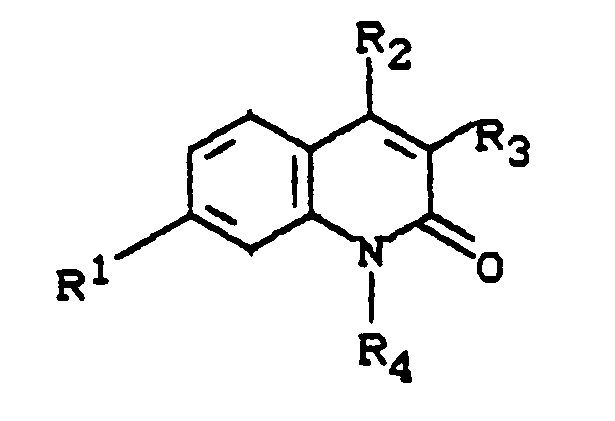
R₁, R₂ und R₃ die bei den Cumarinen angegebenen Bedeutung haben können und
R₄ für Alkyl steht.Carbostyrils of the general formula are also suitable
R₁, R₂ and R₃ can have the meaning given for the coumarins and
R₄ represents alkyl.
Auch hier muß einer der Substituenten ein eine funktionelle Gruppe für Verknüpfung mit dem Polymer tragen.Again, one of the substituents must have a functional group for attachment to the polymer.
Weiterhin geeignet sind
Pyrazoline der allgemeinen Formel

R₅ = für H, oder CH₃,
R₇ und R₈ unabhängig voneinander für H oder Cl und
R₉ für Alkylen,

wobei
R₁₀ = Alkyl bedeutet.Are also suitable
Pyrazolines of the general formula
R₅ = for H, or CH₃,
R₇ and R₈ independently of one another for H or Cl and
R₉ for alkylene,
in which
R₁₀ = alkyl.
Auch gut einsetzbar sind
Naphthalimide der allgemeinen Formel

R₁₁ für Alkyl,
R₁₂, R₁₃ für H, OAlkyl, N(Alkyl)₂ steht und
entweder die Alkylgruppe an R₁₁ oder jene an R₁₂ bzw. R₁₃ eine NH₂-Gruppe zur Verknüpfung mit dem Polymer trägt.Can also be used well
Naphthalimides of the general formula
R₁₁ for alkyl,
R₁₂, R₁₃ represents H, Oalkyl, N (alkyl) ₂ and
either the alkyl group on R₁₁ or that on R₁₂ or R₁₃ carries an NH₂ group for linking to the polymer.
Als ebenfalls geeignet sind zu nennen
Pyrene der allgemeinen Formel

R₁₄ für H oder SO₃H,
R₁₅ und R₁₆ unabhängig voneinander für OAlkyl oder N(Alkyl)₂ und
entweder eine Alkylgruppe an R₁₅ oder an R₁₆ eine NH₂-Gruppe zur Verknüpfung mit dem Polymer trägt.To be mentioned are also suitable
Pyrenes of the general formula
R₁₄ for H or SO₃H,
R₁₅ and R₁₆ independently of one another for Oalkyl or N (alkyl) ₂ and
either an alkyl group on R₁₅ or on R₁₆ carries an NH₂ group for linking to the polymer.
Zu nennen wären noch Fluoresceine der Formel

Auch geeignet sind Rhodanine der allgemeinen Formel

Y⊖ ein farbloses Anion bedeutet und
R₁ und R₂ für Alkyl,

wobei X für O, N-Alkyl oder (CH₂)n mit n = 0 oder 1 steht.Rhodanines of the general formula are also suitable
Y ⊖ is a colorless anion and
R₁ and R₂ for alkyl,
where X is O, N-alkyl or (CH₂) n with n = 0 or 1.
R₁ und R₂ können auch zusammen mit den Aromaten einen Ring bilden wie zum Beispiel

Diese und noch weitere Farbstoffe sind der Literatur wie z.B. "The Chemistry of Synthetic Dyes", Volume V, Akademie Press (1971), oder auch "Fluorescent Whitening Agents", vom Georg Thieme Verlag Stuttgart (1975).These and other dyes are in the literature such as "The Chemistry of Synthetic Dyes", Volume V, Akademie Press (1971), or "Fluorescent Whitening Agents", from Georg Thieme Verlag Stuttgart (1975).
Die erfindungsgemäßen Farbstoffe eignen sich zur Markierung in biologischen Analysenverfahren. So können z.B. Antikörper oder geeignet funktionalisierte Oligonucleotide farbig markiert werden, die dann in die üblichen Tests (Immunoassays bzw. Gensonden-Tests) eingesetzt werden können.The dyes according to the invention are suitable for labeling in biological analysis processes. For example, Antibodies or suitably functionalized oligonucleotides are marked in color, which can then be used in the usual tests (immunoassays or gene probe tests).
Ein für die Leistungsfähigkeit solcher Tests entscheidende Größe ist die Empfindlichkeit. Sie wird bei den meisten derzeit üblichen Testverfahren durch Einsatz radioaktiver Markierungssubstanzen erreicht.Sensitivity is a decisive factor for the performance of such tests. It is achieved in most of the currently common test methods by using radioactive labeling substances.
Diese Methode hat in der praktischen Durchführung aber viele gravierende Nachteile (Strahlengefährdung, Zersetzlichkeit der Substanzen, schwierige Abfallentsorgung, Spezialausrüstung der Labors, spezielle Ausbildung des Personals), die eine Ausdehnung dieser vorteilhaften und leistungsfähigen Tests zu Routineverfahren bisher behindert haben. (s. z.B. WO 88-02784, Pharmacia, 21. 4. 88).In practice, however, this method has many serious disadvantages (radiation hazard, fragility of the substances, difficult waste disposal, special equipment of the laboratories, special training of the personnel), which have hindered the expansion of these advantageous and efficient tests to routine procedures. (see e.g. WO 88-02784, Pharmacia, April 21, 88).
Es sind daher mehrere Versuche unternommen worden, die radioaktive Markierung durch eine problemlose Farbstoffmarkierung zu ersetzen. Damit umgeht man die Nachteile der radioaktiven Markierung, die erzielbare Empfindlichkeit ist aber für viele Tests nicht ausreichend [s. z.B. Nucleic Acids Res. 16, 4957 (1988)].Several attempts have therefore been made to replace radioactive labeling with problem-free dye labeling. This avoids the disadvantages of radioactive labeling, but the sensitivity that can be achieved is not sufficient for many tests [see, for example, Nucleic Acids Res. 16 , 4957 (1988)].
Hier bieten die erfindungsgemäßen polymeren Farbstoffe den Vorteil einer gesteigerten Empfindlichkeit ohne Verwendung von Radioaktivität.Here, the polymeric dyes according to the invention offer the advantage of increased sensitivity without the use of radioactivity.
Zur Verknüpfung der Polymeren Farbstoffe mit biologischen Substraten bieten sich mehrere Verfahren an.
- 1. Das Polymer enthält einpolymerisiert geeignete Gruppierungen, die zur Reaktion mit Antikörpern oder entsprechend funktionalisierten Oligonucleotiden befähigt sind, z.B. können Acrylester von N-Hydroxysuccinimid oder 1-N-Hydroxybenztriazol einpolymerisiert werden.
Die aktiven Polymere werden nach Beladen mit Farbstoffen in wäßriger Lösung mit den zu markierenden biologischen Materialien umgesetzt. Die erhaltenen Mischungen können entweder direkt in Analysen verwendet werden oder nach vorheriger Reinigung. - 2. Das Polymer enthält geeignete funktionelle Gruppen, die durch eine separate chemische Umsetzung so aktiviert werden, daß sie zur Verknüpfung mit Antikörpern und geeigent funktionalisierten Oligonucleotiden befähigt sind.
Solche Gruppierungen können z.B. Hydroxygruppen sein, die sich durch Umsetzung nach literaturbekannten Verfahren in aktivierte Ester, z.B. Sulfonsäure- oder Carbonsäureester, überführen lassen.
Dazu wird das Hydroxylgruppen-haltige Farbstoffpolymer in einem geeigneten Lösungsmittel, beispielsweise mit Methansulfonsäurechlorid, in das Mesylat umgewandelt.
Dieses aktivierte Farbstoffpolymer wird dann in wäßriger Lösung mit dem biologischen Substrat (Antikörper bzw. geeignet funktionalisiertes Oligonucleotid) umgesetzt. Die erhaltene Mischung kann entweder direkt in Tests eingesetzt werden oder auch nach vorheriger Reinigung.
- 1. The polymer contains, in copolymerized form, suitable groups which are capable of reacting with antibodies or correspondingly functionalized oligonucleotides, for example acrylic esters of N-hydroxysuccinimide or 1-N-hydroxybenzotriazole can be polymerized.
After loading with dyes in aqueous solution, the active polymers are reacted with the biological materials to be labeled. The mixtures obtained can either be used directly in analyzes or after prior purification. - 2. The polymer contains suitable functional groups which are activated by a separate chemical reaction in such a way that they are capable of being linked to antibodies and suitably functionalized oligonucleotides.
Such groups can be, for example, hydroxyl groups which can be converted into activated esters, for example sulfonic acid or carboxylic acid esters, by reaction using processes known from the literature.
For this purpose, the hydroxyl group-containing dye polymer is converted into the mesylate in a suitable solvent, for example with methanesulfonic acid chloride.
This activated dye polymer is then reacted in aqueous solution with the biological substrate (antibody or suitably functionalized oligonucleotide). The mixture obtained can either be used directly in tests or after prior cleaning.
Geeignet funktionalisierte Oligonucleotide sind literaturbekannt. Darunter werden z.B. Oligonucleotide verstanden, die über einen inerten Spacer Amino-, Mercapto- oder Hydroxyfunktionen enthalten.Suitable functionalized oligonucleotides are known from the literature. These are understood to mean, for example, oligonucleotides which contain amino, mercapto or hydroxy functions via an inert spacer.
57 g Acrylamid, 20 g Maleinsäureanhydrid und 0,77 g Azobisisobuttersäuredinitril werden in 500 ml trockenem Ethylacetat gelöst und die Lösung fitriert. Der Sauerstoff wird durch dreimaliges Evakuieren und Füllen mit Stickstoff entfernt und die Reaktionsmischung unter Stickstoff 20 Stunden bei 60° C gerührt. Das ausgefallene Copolymerpulver wird abgesaugt, gründlich mit Ethylacetat gewaschen und im Vakuum bei 50° C getrocknet.
Ausbeute: 56,3 g; N = 14,8 % = 25 Gew.-% Maleinsäureanhydrid,
Grenzviskosität [η] = 0,15 (gemessen in 0,9 %iger, wäßriger Kochsalzlösung) dies entspricht einem mittleren Molekulargewicht von etwa 20 000 Dalton.57 g of acrylamide, 20 g of maleic anhydride and 0.77 g of azobisisobutyronitrile are dissolved in 500 ml of dry ethyl acetate and the solution is filtered. The oxygen is removed by evacuation and filling with nitrogen three times and the reaction mixture is stirred under nitrogen at 60 ° C. for 20 hours. The precipitated copolymer powder is filtered off, washed thoroughly with ethyl acetate and dried in vacuo at 50 ° C.
Yield: 56.3 g; N = 14.8% = 25% by weight maleic anhydride,
Intrinsic viscosity [η] = 0.15 (measured in 0.9% aqueous saline solution), this corresponds to an average molecular weight of about 20,000 daltons.
26,6 g N-Vinylpyrrolidon, 23,4 g Maleinsäureanhydrid und 116 g Methylenchlorid werden vorgelegt. Die Lösung wird wie in Beispiel A von Sauerstoff befreit und auf 40° C erwärmt. Innerhalb von 15 Minuten wird eine Lösung von 250 mg Dilauroyl-peroxid in 50 g Methylenchlorid zugetropft und dann 12 Stunden bei 40° C polymerisiert. Das ausgefallene Copolymerisat wird abfiltriert, mit Methylenchlorid gewaschen und im Vakuum bei 50° C getrocknet.
Ausbeute: 20,6 g, N = 6,8 %, entsprechend einem molaren Verhältnis von N-Vinylpyrrolidon zu Maleinsäureanhydrid von etwa 1:1; [η] = 0,11 (gemessen in DMF).26.6 g of N-vinylpyrrolidone, 23.4 g of maleic anhydride and 116 g of methylene chloride are introduced. The solution is freed of oxygen as in Example A and heated to 40 ° C. A solution of 250 mg of dilauroyl peroxide in 50 g of methylene chloride were added dropwise and the mixture was then polymerized at 40 ° C. for 12 hours. The precipitated copolymer is filtered off, washed with methylene chloride and dried in vacuo at 50 ° C.
Yield: 20.6 g, N = 6.8%, corresponding to a molar ratio of N-vinylpyrrolidone to maleic anhydride of about 1: 1; [η] = 0.11 (measured in DMF).
54 g Acrylamid, 6 g Acryloyloxysuccinimid und 0,3 g Azobisisobuttersäurenitril werden in 400 ml trockenem Ethylacetat gelöst. Die Lösung wird wie in Beispiel A von Sauerstoff befreit und unter Stickstoff 20 Stunden bei 60° C gerührt. Das ausgefallene Copolymerpulver wird abgesaugt, gründlich mit Ethylacetat gewaschen und im Vakuum bei 50° C getrocknet.
Ausbeute: 58,4 g
Grenzviskosität [η] = 0,71 (gemessen in 0,8 %iger wäßriger Kochsalzlösung) dies entspricht einem mittleren Molekulargewicht von etwa 115 000 Dalton.54 g of acrylamide, 6 g of acryloyloxysuccinimide and 0.3 g of azobisisobutyronitrile are dissolved in 400 ml of dry ethyl acetate. As in Example A, the solution is freed of oxygen and stirred under nitrogen at 60 ° C. for 20 hours. The precipitated copolymer powder is filtered off, washed thoroughly with ethyl acetate and dried in vacuo at 50 ° C.
Yield: 58.4 g
Intrinsic viscosity [η] = 0.71 (measured in 0.8% aqueous saline solution), this corresponds to an average molecular weight of approximately 115,000 Daltons.
1,5 g des Acrylamid-Maleinsäureanhydrid-Copolymers von Beispiel 1 werden in 30 ml trockenem Formamid bei 50° C gelöst. Nach dem Abkühlen werden bei Raumtemperatur 20 mg 6-Amino-1-hexanol zugegeben und der Ansatz 1 Stunde bei Raumtemperatur gerührt. Nach Zugabe von 600 mg 4-Aminofluorescein wird 24 Stunden bei Raumtemperatur und anschließend 5 Stunden bei 50° C weitergerührt. Der warme Ansatz wird in 1 l Aceton ausgefällt, das Polymer abgesaugt und in 40 ml Formamid bei 50° C gelöst. Nach Zugabe von 1 ml 25 %iger NH₄OH-Lösung wird 30 Minuten bei 50° C gerührt, der Ansatz abgekühlt und in 1 l Aceton erneut ausgefällt. Das Polymer wird abgesaugt, mit Aceton gewaschen und im Hochvakuum bei 25° C getrocknet. Die Fluoreszenz wird in Wasser bei pH 9 gemessen.
Ausbeute: 1,45 g; λmax = 493 nm;
Extinktion bei 493 nm = 0,05 (4,5 mg polymerer Farbstoff in 1 l Wasser); Quantenausbeute = 0,631.5 g of the acrylamide-maleic anhydride copolymer from Example 1 are dissolved in 30 ml of dry formamide at 50 ° C. After cooling, 20 mg of 6-amino-1-hexanol are added at room temperature and the mixture is stirred at room temperature for 1 hour. After adding 600 mg of 4-aminofluorescein, stirring is continued for 24 hours at room temperature and then for 5 hours at 50.degree. The warm batch is precipitated in 1 liter of acetone, the polymer is suctioned off and dissolved in 40 ml of formamide at 50 ° C. After adding 1 ml of 25% NH₄OH solution, the mixture is stirred at 50 ° C. for 30 minutes, the mixture is cooled and again precipitated in 1 l of acetone. The polymer is filtered off, washed with acetone and dried in a high vacuum at 25 ° C. The fluorescence is measured in water at pH 9.
Yield: 1.45 g; λ max = 493 nm;
Absorbance at 493 nm = 0.05 (4.5 mg polymeric dye in 1 l water); Quantum yield = 0.63
1 g des so erhaltenen polymeren Fluoreszenzfarbstoffes werden bei Raumtemperatur in 50 ml trockenem Pyridin vorgelegt, mit 1 g Methansulfonsäurechlorid versetzt und unter Feuchtigkeitsausschluß 4 Stunden bei Raumtemperatur verrührt.1 g of the polymeric fluorescent dye obtained in this way is placed in 50 ml of dry pyridine at room temperature, 1 g of methanesulfonic acid chloride is added and the mixture is stirred at room temperature for 4 hours with the exclusion of moisture.
Anschließend wird abgesaugt und zweimal mit je 30 ml Isopropanol gewaschen.
Ausbeute: 0,9 g schwach gelbes, hygroskopisches Pulver,It is then filtered off and washed twice with 30 ml of isopropanol.
Yield: 0.9 g of pale yellow, hygroscopic powder,
Anstelle von Methansulfonsäurechlorid können zur Aktivierung des Farbstoffes nach analogem Verfahren auch Trifluormethansulfonsäurechlorid, Benzolsulfonsäurechlorid, Trifluoressigsäureanhydrid oder p-Toluolsulfonsäurechlorid verwendet werden.Instead of methanesulfonic acid chloride, trifluoromethanesulfonic acid chloride, benzenesulfonic acid chloride, trifluoroacetic anhydride or p-toluenesulfonic acid chloride can also be used to activate the dye by an analogous process.
3 g des Acrylamid-Maleinsäureanhydrid-Copolymers von Beispiel 1 werden bei 50° C in 30 ml trockenem Formamid gelöst. Eine Suspension von 266 mg 3-(4-Aminophenyl)-7-Methylamino-cumarin in 2,5 ml trockenem DMF wird zugegeben und der Ansatz 3 Stunden bei 50° C gerührt. 30 mg 6-Amino-1-hexanol (fest) werden zugegeben und der Ansatz 1 Stunde bei 50° C weitergerührt. Die Lösung wird dann in 400 ml Ethylacetat eingerührt, wobei das Polymer ausfällt. Das Polymer wird abgesaugt, intensiv mit Ethylacetat gewaschen und im Vakuum über Phosphorpentoxid getrocknet.
Ausbeute: 2,8 g; λmax = 389 nm;
Extinktion bei 389 nm = 0,05 (21 mg polymerer Farbstoff in 1 l Wasser); Quantenausbeute = 0,38.3 g of the acrylamide-maleic anhydride copolymer from Example 1 are dissolved in 30 ml of dry formamide at 50 ° C. A suspension of 266 mg of 3- (4-aminophenyl) -7-methylamino-coumarin in 2.5 ml of dry DMF is added and the mixture is stirred at 50 ° C. for 3 hours. 30 mg of 6-amino-1-hexanol (solid) are added and the mixture is stirred at 50 ° C. for 1 hour. The solution is then stirred into 400 ml of ethyl acetate, the polymer precipitating. The polymer is filtered off with suction, washed intensively with ethyl acetate and dried in vacuo over phosphorus pentoxide.
Yield: 2.8 g; λ max = 389 nm;
Absorbance at 389 nm = 0.05 (21 mg polymeric dye in 1 l water); Quantum yield = 0.38.
1 g des so erhaltenen polymeren Fluoreszenzfarbstoffes werden in 100 ml trockenem Pyridin vorgelegt und mit 1 g Methansulfonsäurechlorid versetzt. Unter Feuchtigkeitsausschluß wird bei Raumtemperatur 4 Stunden gerührt, dann abgesaugt und mit je 30 ml Isopropanol 2 x gewaschen.
Ausbeute: 0,9 g farbloses, hygroskopisches Pulver.1 g of the polymeric fluorescent dye obtained in this way is placed in 100 ml of dry pyridine, and 1 g of methanesulfonic acid chloride is added. With exclusion of moisture, the mixture is stirred at room temperature for 4 hours, then suction filtered and washed twice with 30 ml of isopropanol.
Yield: 0.9 g of colorless, hygroscopic powder.
3 g des Acrylamid-Acryloyloxysuccinimid-Copolymers aus Beispiel 3 werden in 40 ml trockenem Formamid bei 50° C gelöst. Nach dem Abkühlen auf 25° C werden 0,3 g 4-Aminofluorescein zugegeben und der Ansatz 22 Stunden bei 25° C und 4 Stunden bei 50° C gerührt. Das Polymer wird in 500 ml Ethylacetat ausgefällt, nochmals in 30 ml Formamid gelöst und erneut in 500 ml Ethylacetat gefällt und nach der Isolierung im Vakuum über Phosphorpentoxid getrocknet.
Ausbeute: 2,4 g; λmax = 493 nm;
Extinktion bei 493 nm = 0,05 (12 mg polymerer Farbstoff in 1 l Wasser bei pH 10); Quantenausbeute = 0,183 g of the acrylamide-acryloyloxysuccinimide copolymer from Example 3 are dissolved in 40 ml of dry formamide at 50 ° C. After cooling to 25 ° C., 0.3 g of 4-aminofluorescein are added and the mixture is stirred at 25 ° C. for 22 hours and at 50 ° C. for 4 hours. The polymer is precipitated in 500 ml of ethyl acetate, redissolved in 30 ml of formamide and again precipitated in 500 ml of ethyl acetate and, after isolation, dried in vacuo over phosphorus pentoxide.
Yield: 2.4 g; λ max = 493 nm;
Absorbance at 493 nm = 0.05 (12 mg polymeric dye in 1 l water at pH 10); Quantum yield = 0.18
Mit ähnlichem Ergebnis läßt sich ein entsprechendes Acrylamid / 1-Acryloxy-benztriazol Copolymeres mit 4-Aminofluorescein markieren.A corresponding acrylamide / 1-acryloxy-benzotriazole copolymer can be marked with 4-aminofluorescein with a similar result.
2,09 g eines gemäß Beispiel 2 hergestellten Copolymerisats aus Maleinsäureanhydrid und N-Vinylpyrrolidon werden zusammen mit 1,356 g des Farbstoffes

Nach 2-stündigem Rühren bei 50° C addiert man folgende Lösung zum Reaktionsgemisch:
52 mg 6-Amino-1-hexanol
500 mg 2-Aminoethansulfonsäure
5 ml Formamid
5 ml H₂OAfter stirring for 2 hours at 50 ° C., the following solution is added to the reaction mixture:
52 mg of 6-amino-1-hexanol
500 mg of 2-aminoethanesulfonic acid
5 ml formamide
5 ml H₂O
Es wird noch 6 Stunden bei 50° C nachgerührt. Danach kühlt man auf Raumtemperatur ab und fällt den entstandenen polymeren Farbstoff durch Einrühren in einen 15fachen Überschuß an Aceton aus. Der abfiltrierte Farbstoff wird über Nacht im Exsikkator getrocknet.
Ausbeute: 3,56 g, λmax = 510 nm
Extinktion bei 510 nm = 0.43 (40 mg polymerer Farbstoff in 1 l H₂O).The mixture is stirred at 50 ° C for 6 hours. The mixture is then cooled to room temperature and the resulting polymeric dye is precipitated by stirring into a 15-fold excess of acetone. The filtered dye is dried in a desiccator overnight.
Yield: 3.56 g, λ max = 510 nm
Absorbance at 510 nm = 0.43 (40 mg polymeric dye in 1 l H₂O).
1,5 g des Acrylamid-Maleinsäureanhydrid-Copolymers von Beispiel 1 werden in 30 ml trockenem Formamid bei 40-60° C gelöst.1.5 g of the acrylamide-maleic anhydride copolymer from Example 1 are dissolved in 30 ml of dry formamide at 40-60 ° C.
Eine Lösung von 115 mg (3-(4-Aminophenyl)-7-diethylaminocumarin in 1,5 ml DMF wird zugegeben und die Lösung bei 50° C 1 Stunde gerührt. Nach Zugabe von 0,75 ml einer 1 %igen 3-Aminopropanollösung wird 30 Minuten weitergerührt und anschließend werden 0,5 ml konzentrierte wäßrige Ammoniaklösung zugegeben. Es wird 30 Minuten bei 50° C nachgerührt und der Ansatz in 750 ml Ethylacetat eingetropft. Der Polymerfarbstoff fällt feinteilig aus. Er wird abgesaugt, mit Ethylacetat gewaschen und rasch in einen Exiccator überführt, da er hydroskopisch ist. Die Trocknung erfolgt bei < 0,1 mbar.
Ausbeute: 1,42 g; λmax = 412 nm;
Extinktion bei 412 nm = 0,07 (25 mg polymerer Farbstoff in 1 l H₂O); λEmission = 497 nm; Quantenausbeute = 0,21.A solution of 115 mg (3- (4-aminophenyl) -7-diethylaminocoumarin in 1.5 ml DMF is added and the solution is stirred for 1 hour at 50 ° C. After the addition of 0.75 ml of a 1% 3-aminopropanol solution stirring is continued for 30 minutes and then 0.5 ml are concentrated aqueous ammonia solution added. The mixture is stirred at 50 ° C for 30 minutes and the mixture is added dropwise in 750 ml of ethyl acetate. The polymer dye is finely divided. It is suctioned off, washed with ethyl acetate and quickly transferred to a desiccator, since it is hydroscopic. Drying takes place at <0.1 mbar.
Yield: 1.42 g; λ max = 412 nm;
Absorbance at 412 nm = 0.07 (25 mg polymeric dye in 1 l H₂O); λ emission = 497 nm; Quantum yield = 0.21.
1,5 g des Acrylamid-Maleinsäureanhydrid-Copolymers von Beispiel 1 werden in 30 ml trockenem Formamid bei 50° C gelöst. Nach Zugabe einer Lösung vo 115 mg 3-(4-Aminophenyl)-7-diethylaminocumarin in 1,5 ml DMF wird eine Stunde bei 50° C gerührt. 20 mg 6-Amino-1-hexanol (fest) werden zugegeben und der Ansatz 30 Minuten bei 50° C weitergerührt. Nach Zugabe von 300 mg Taurin (fest) wird weitere 60 Minuten bei 50° C gerührt und der Farbstoff anschließend wie in Beispiel 1 gefällt, isoliert und getrocknet.
Ausbeute: 1,85 g; λmax = 414 nm;
Extinktion bei 414 nm = 0,07 (35 mg polymerer Farbstoff in 1l H₂O); λEmission = 501 nm; Quantenausbeute = 0,231.5 g of the acrylamide-maleic anhydride copolymer from Example 1 are dissolved in 30 ml of dry formamide at 50 ° C. After adding a solution of 115 mg of 3- (4-aminophenyl) -7-diethylaminocoumarin in 1.5 ml of DMF, the mixture is stirred at 50 ° C. for one hour. 20 mg of 6-amino-1-hexanol (solid) are added and the mixture is stirred at 50 ° C. for a further 30 minutes. After adding 300 mg of taurine (solid), the mixture is stirred for a further 60 minutes at 50 ° C. and the dye is then precipitated, as in Example 1, isolated and dried.
Yield: 1.85 g; λ max = 414 nm;
Absorbance at 414 nm = 0.07 (35 mg polymeric dye in 1l H₂O); λ emission = 501 nm; Quantum yield = 0.23
1 g des so hergestellten, Hydroxylgruppen enthaltenden polymeren Farbstoffes wird bei Raumtemperatur in 100 ml destilliertem trockenem Pyridin suspendiert. 1 ml Methansulfonsäurechlorid wird zugetropft und der Ansatz bei Raumtemperatur unter Lichtausschluß 4 Stunden gerührt. Anschließend wird rasch abgesaugt, zweimal mit je 30 ml Isopropanol gewaschen und im Ölpumpenvakuum getrocknet.
Ausbeute: 0,95 g schwach gelbes, hygroskopisches Pulver.1 g of the hydroxyl group-containing polymeric dye thus prepared is suspended in 100 ml of distilled dry pyridine at room temperature. 1 ml of methanesulfonic acid chloride is added dropwise and the mixture is stirred at room temperature for 4 hours with the exclusion of light. It is then suctioned off quickly, washed twice with 30 ml of isopropanol and dried in an oil pump vacuum.
Yield: 0.95 g of pale yellow, hygroscopic powder.
1,5 g des Acrylamid-Maleinsäureanhydrid-Copolymers von Beispiel 1 werden in 35 ml trockenem Formamid bei 60° C gelöst. Eine Lösung von 300 mg 4-Aminofluorescein in 3 ml DMF wird zugegeben und der Ansatz 1 Stunde bei 60° C gerührt. Nach Zugabe von 15 mg 6-Amino-1-hexanol (fest) wird 30 Minuten bei 60° C weiter gerührt. 300 mg Taurin (fest) werden zugegeben und 30 Minuten bei 60° C nachgerührt. Anschließend wird der polymere Farbstoff wie in Beispiel 1 beschrieben isoliert und getrocknet.
Ausbeute: 1,75 g; λmax = 476 nm;
Extinktion bei 476 nm = 0,04 (50 mg polymerer Farbstoff in 1l H₂O); λEmission = 518 nm;
Quantenausbeute = 0,22.1.5 g of the acrylamide-maleic anhydride copolymer from Example 1 are dissolved in 35 ml of dry formamide at 60 ° C. A solution of 300 mg of 4-aminofluorescein in 3 ml of DMF is added and the mixture is stirred at 60 ° C. for 1 hour. After adding 15 mg of 6-amino-1-hexanol (solid), stirring is continued at 60 ° C. for 30 minutes. 300 mg of taurine (solid) are added and the mixture is stirred at 60 ° C. for 30 minutes. The polymeric dye is then isolated and dried as described in Example 1.
Yield: 1.75 g; λ max = 476 nm;
Absorbance at 476 nm = 0.04 (50 mg polymeric dye in 1l H₂O); λ emission = 518 nm;
Quantum yield = 0.22.
2,09 g des Copolymerisats aus N-Vinylpyrrolidon und Maleinssäureanhydrid von Beispiel 2 werden zusammen mit 131 mg des Farbstoffs 3-(4-Aminophenyl)-7-diethylaminocumarin in 6,66 g Formamid bei 50° C umgesetzt.2.09 g of the copolymer of N-vinylpyrrolidone and maleic anhydride from Example 2 are reacted together with 131 mg of the dye 3- (4-aminophenyl) -7-diethylaminocoumarin in 6.66 g of formamide at 50 ° C.
Nach 1-stündigem Rühren bei 50° C gibt man folgende Lösung zum Reaktionsgemisch:
19 mg 6-Amino-1-hexanol (fest)
960 mg einer wäßrige Lösung von Na-Taurin (Festgehalt: 43 %)
3,0 g Formamid
3,0 g Wasser.After stirring for 1 hour at 50 ° C., the following solution is added to the reaction mixture:
19 mg 6-amino-1-hexanol (solid)
960 mg of an aqueous solution of Na taurine (solid content: 43%)
3.0 g formamide
3.0 g water.
Es wird noch 5 Stunden bei 50° C nachgerührt. Dann kühlt man auf Raumtemperatur ab und fällt den polymeren Farbstoff durch Einrühren in einen Überschuß von Aceton aus. Das Produkt wird im Exsikkator über Nacht getrocknet.
Ausbeute: 2,40 g, λmax = 411 nm;
Extinktion bei 411 nm = 0,05 (20 mg polymerer Farbstoff in 1 l H₂O); λEmission = 500 nm;
Quantenausbeute = 0,30.The mixture is stirred at 50 ° C for 5 hours. The mixture is then cooled to room temperature and the polymeric dye is precipitated by stirring in an excess of acetone. The product is dried in a desiccator overnight.
Yield: 2.40 g, λ max = 411 nm;
Absorbance at 411 nm = 0.05 (20 mg polymeric dye in 1 l H₂O); λ emission = 500 nm;
Quantum yield = 0.30.
5 g des Acrylamid-Maleinsäureanhydrid-Copolymers von Beispiel 1, 150 ml wasserfreies Formamid und 500 mg des Farbstoffes

Ausbeute: 5,5 g; λmax = 568 nm;
Extinktion bei 568 nm = 0,67 (0,2 mg polymerer Farbstoff in 1 ml Wasser).5 g of the acrylamide-maleic anhydride copolymer of Example 1, 150 ml of anhydrous formamide and 500 mg of the dye
Yield: 5.5 g; λ max = 568 nm;
Absorbance at 568 nm = 0.67 (0.2 mg polymeric dye in 1 ml water).
1,25 g des Acrylamid-Maleinsäureanhydrid-Copolymers von Beispiel 1 werden in 50 ml trockenem Formamid bei 60° C gelöst. 10 mg 6-Amino-1-hexanol (fest) werden zugegeben. Nach 1 Stunde bei 60° C werden 0,75 g des Farbstoffes

Ausbeute: 1,75 g; λmax = 533 nm;
Extinktion bei 533 nm = 0,7 (0,2 mg polymerer Farbstoff in 1 ml Wasser).1.25 g of the acrylamide-maleic anhydride copolymer from Example 1 are in 50 ml of dry formamide at 60 ° C. solved. 10 mg 6-amino-1-hexanol (solid) are added. After 1 hour at 60 ° C 0.75 g of the dye
Yield: 1.75 g; λ max = 533 nm;
Absorbance at 533 nm = 0.7 (0.2 mg polymeric dye in 1 ml water).
1,26 g eines alternierenden Copolymerisates aus Maleinsäureanhydrid und Ethylen mit dem Molekulargewicht 25.000 (EMA®21 der Firma Monsanto) werden in 20 ml Formamid gelöst. Zu dieser Lösung gibt man eine Lösung von 1,695 g eines Farbstoffes mit der Formel

Ausbeute: 3,21 g; λmax = 495 nm;
Extinktion bei λmax = 1,08 (Konzentr.: 40 mg/l; LM : H₂O). Molarer Extinktionskoeffizient: 1,9 · 10⁶.1.26 g of an alternating copolymer of maleic anhydride and ethylene with a molecular weight of 25,000 (EMA®21 from Monsanto) are dissolved in 20 ml of formamide. A solution of 1.695 g of a dye with the formula is added to this solution
Yield: 3.21 g; λ max = 495 nm;
Absorbance at λ max = 1.08 (concentration: 40 mg / l; LM: H₂O). Molar extinction coefficient: 1.9 · 10⁶.
1 g des so hergestellten polymeren Farbstoffes wird bei Raumtemperatur in 50 ml trockenem Pyridin mit 1 g Methansulfonsäurechlorid 4 Stunden unter Feuchtigkeitsausschluß verrührt. Anschließend wird abgesaugt, zweimal mit 30 ml Isopropanol gewaschen und im Ölpumpenvakuum bei Raumtemperatur getrocknet.
Ausbeute: 0,9 g schwarzes, hygroskopisches Pulver.1 g of the polymeric dye prepared in this way is stirred at room temperature in 50 ml of dry pyridine with 1 g of methanesulfonic acid chloride for 4 hours with the exclusion of moisture. It is then suctioned off, washed twice with 30 ml of isopropanol and dried in an oil pump vacuum at room temperature.
Yield: 0.9 g black, hygroscopic powder.
1,56 g eines alternierenden Copolymerisates aus Maleinsäureanhydrid und Methylvinylether mit dem Molekulargewicht 20.000 (Gantrez®AN-119 der Firma GAF) werden in 20 ml Formamid gelöst. Zu dieser Lösung werden 2,034 g einer Lösung des in Beispiel 14 verwendeten Farbstoffes in 30 ml Formamid gegeben. Nach einstündigem Rühren bei Raumtemperatur und zweistündigem Rühren bei 50° C wird folgendes Reaktionsgemisch zugegeben:
235 mg 6-Amino-1-hexanol
250 mg 2-Aminoethansulfonsäure
5 ml Formamid
5 ml H₂O.1.56 g of an alternating copolymer of maleic anhydride and methyl vinyl ether with a molecular weight of 20,000 (Gantrez®AN-119 from GAF) are dissolved in 20 ml of formamide. 2.034 g of a solution of the dye used in Example 14 in 30 ml of formamide are added to this solution. After stirring for one hour at room temperature and stirring for two hours at 50 ° C., the following reaction mixture is added:
235 mg of 6-amino-1-hexanol
250 mg of 2-aminoethanesulfonic acid
5 ml formamide
5 ml H₂O.
Nach sechsstündigem Rühren bei 50° C wird die Lösung auf Raumtemperatur abgekühlt und in ca. 1,2 l Ethylacetat eingerührt. Dabei fällt der polymere Farbstoff als feines Pulver aus, das abfiltriert und im Vakuum bei Raumtemperatur bis zur Gew.-Konstanz getrocknet wird.
Ausbeute: 1,25 g; λmax = 493 nm;
Extinktion bei λmax = 0,788 (Konzentr.: 40 mg/l; LM : H₂O). Molarer Extinktionskoeffizient: 0,97 · 10⁶.After stirring for six hours at 50 ° C., the solution is cooled to room temperature and stirred into about 1.2 l of ethyl acetate. The polymeric dye precipitates as a fine powder, which is filtered off and dried in vacuo at room temperature to constant weight.
Yield: 1.25 g; λ max = 493 nm;
Absorbance at λ max = 0.788 (concentration: 40 mg / l; LM: H₂O). Molar extinction coefficient: 0.97 · 10⁶.
1 g des so hergestellten polymeren Farbstoffes wird bei Raumtemperatur in 70 ml trockenem Pyridin mit 2 g Methansulfonsäurechlorid 4 Stunden unter Feuchtigkeitsausschluß verrührt. Anschließend wird abgesaugt, zweimal mit 30 ml Isopropanol gewaschen und im Ölpumpenvakuum bei Raumtemperatur getrocknet.
Ausbeute: 0,9 g schwarzes, hygroskopisches Pulver.1 g of the polymeric dye prepared in this way is stirred at room temperature in 70 ml of dry pyridine with 2 g of methanesulfonic acid chloride for 4 hours with the exclusion of moisture. It is then suctioned off, washed twice with 30 ml of isopropanol and dried in an oil pump vacuum at room temperature.
Yield: 0.9 g black, hygroscopic powder.
0,5 mg monoklonale Antikörper gegen CEA (Carcinogen Embryonal Antigen) werden in 1 ml H₂O mit 0,86 mg aktiviertem Farbstoff gemäß Beispiel 4 1 Stunde bei Raumtemperatur inkubiert, gegen Wasser dialysiert und lyophilisiert. Der so erhaltene markierte monoklonale Antikörper wurde durch UV-Spektroskopie charakterisiert.0.5 mg of monoclonal antibodies against CEA (carcinogen embryonic antigen) are incubated in 1 ml of H₂O with 0.86 mg of activated dye according to Example 4 for 1 hour at room temperature, dialyzed against water and lyophilized. The labeled monoclonal antibody thus obtained was characterized by UV spectroscopy.
Im immunologischen Test auf CEA erzielt man bei Verwendung dieses markierten Antikörpers eine erhöhte Empfindlichkeit verglichen mit analogen monomeren Farbstoffen.In the immunological test for CEA, an increased sensitivity is achieved when using this labeled antibody compared to similar monomeric dyes.
Mit ähnlichen Resultaten läßt sich der CEA monoklonale Antikörper auch mit Farbstoffen gemäß den Beispielen 5, 6, 7, 9, 14 und 15 markieren.With similar results, the CEA monoclonal antibody can also be labeled with dyes according to Examples 5, 6, 7, 9, 14 and 15.
Es werden 500 µg eines Aminolink-Oligonucleotids, abgeleitet von der Sequenz: GCCGCCTCGG CCTCGCCGAC GCCCGGGACG GGCGCCACCC CCAACGACGT (geeignet als Gensonden-Test für Pseudorabies-Vinus) [Synthese: E.Sonveaux, Bioorganic Chemistry 14, 274 (1986) sowie N. D. Sinha u. R. M. Cook, Nucleic Acids Research 16, 2659 (1988) in 200 µl Carbonat-Puffer (pH = 9) gelöst. Dazu gibt man einen Überschuß eine Lösung des polymeren Fluoreszenz-Farbstoffes gemäß Beispiel 6 in 300 µl Formamid und rührt 36 Stunden bei Raumtemperatur. Die Aufarbeitung erfolgt durch Gelfiltration on BIORAD-Bio-Gel P 4 und anschließende RP-HPLC Reinigung.500 µg of an aminolink oligonucleotide, derived from the sequence: GCCGCCTCGG CCTCGCCGAC GCCCGGGACG GGCGCCACCC CCAACGACGT (suitable as a gene probe test for pseudorabies vinus) [synthesis: E.Sonveaux, Bioorganic Chemistry 14 , 274 (1986) as well as ND Sinha RM Cook, Nucleic Acids Research 16 , 2659 (1988) dissolved in 200 ul carbonate buffer (pH = 9). To this is added an excess of a solution of the polymeric fluorescent dye according to Example 6 in 300 ul formamide and stirred for 36 hours at room temperature. The product is worked up by gel filtration on BIORAD-Bio-Gel P 4 and subsequent RP-HPLC purification.
Bei Verwendung des so markierten Aminolink-Oligonucleotids beim DNA-Probe-Test auf Pseudorabies-Virus wird eine verbesserte Sensitivität erreicht als bei Einsatz von mit entsprechenden monomeren Fluroeszenz-Farbstoffen markierter DNA.When the amino link oligonucleotide labeled in this way is used in the DNA probe test for pseudorabies virus, an improved sensitivity is achieved than when using DNA labeled with corresponding monomeric fluorescent dyes.
Mit ähnlichen Resultaten läßt sich das Aminolinknucleotid auch mit aktivierten polymeren Farbstoffen gemäß den Beispielen 4, 5, 7, 9, 14 und 15 markieren und bei DNA-Probe-Tests einsetzen.With similar results, the amino link nucleotide can also be labeled with activated polymeric dyes according to Examples 4, 5, 7, 9, 14 and 15 and used in DNA probe tests.
Claims (8)
a) einem wasserlöslichen Polymer-Rückgrat,
b) daran covalent gebundenen Farbstoffen sowie
c) funktionellen Gruppen, die eine covalente Verknüpfung der polymeren Farbstoffe, mit biologischen Materialien ermöglichen,
worin das wasserlösliche Polymer Rückgrat ein Copolymer ist welches als nicht-ionische Monomerbausteine Acrylamid, Methacrylamid, N-C₁-C₄-Alkyl(meth)-acrylamide, N,N-C₁-C₄-Dialkylacrylamide, N-Vinylpyrrolidon, N-Vinylpiperidon, N-Vinylcaprolactam, N-Vinylformamid,, N-Vinylacetamid, N-Vinyl-N-methyl-acetamid, N-Vinyl-O-methylurethan, Ethen oder Vinylmethylether enthält.1. Polymer-linked dyestuffs consisting of
a) a water-soluble polymer backbone,
b) dyes covalently bonded to it and
c) functional groups which enable the polymeric dyes to be covalently linked to biological materials,
wherein the water-soluble polymer backbone is a copolymer which, as non-ionic monomer building blocks, acrylamide, methacrylamide, N-C₁-C₄-alkyl (meth) -acrylamides, N, N-C₁-C₄-dialkylacrylamides, N-vinylpyrrolidone, N-vinylpiperidone, N -Vinylcaprolactam, N-vinylformamide, N-vinyl acetamide, N-vinyl-N-methyl-acetamide, N-vinyl-O-methyl urethane, ethene or vinyl methyl ether contains.
Applications Claiming Priority (4)
| Application Number | Priority Date | Filing Date | Title |
|---|---|---|---|
| DE3832830 | 1988-09-28 | ||
| DE3832830 | 1988-09-28 | ||
| DE3921498A DE3921498A1 (en) | 1988-09-28 | 1989-06-30 | POLYMER-TIED DYES, METHOD FOR THE PRODUCTION AND USE THEREOF |
| DE3921498 | 1989-06-30 |
Publications (3)
| Publication Number | Publication Date |
|---|---|
| EP0361229A2 true EP0361229A2 (en) | 1990-04-04 |
| EP0361229A3 EP0361229A3 (en) | 1990-08-08 |
| EP0361229B1 EP0361229B1 (en) | 1994-04-27 |
Family
ID=25872630
Family Applications (1)
| Application Number | Title | Priority Date | Filing Date |
|---|---|---|---|
| EP89117097A Expired - Lifetime EP0361229B1 (en) | 1988-09-28 | 1989-09-15 | Polymer-bonded dyes, process for their preparation and their use |
Country Status (4)
| Country | Link |
|---|---|
| US (1) | US5030697A (en) |
| EP (1) | EP0361229B1 (en) |
| JP (1) | JP2712110B2 (en) |
| DE (2) | DE3921498A1 (en) |
Cited By (14)
| Publication number | Priority date | Publication date | Assignee | Title |
|---|---|---|---|---|
| EP0513560A1 (en) * | 1991-05-03 | 1992-11-19 | Bayer Ag | Polymeric dyes and use thereof |
| WO1992020746A1 (en) * | 1991-05-14 | 1992-11-26 | Hybritech, Incorporated | Polymeric compositions having bound antibodies |
| EP0496473A3 (en) * | 1991-01-25 | 1993-01-13 | Eastman Kodak Company | Method of preparing biologically active reagents from succinimide-containing polymers, analytical element and methods of use |
| EP0583205A1 (en) * | 1992-07-24 | 1994-02-16 | International Business Machines Corporation | Polymeric dyes for antireflective coatings |
| EP0540248A3 (en) * | 1991-11-01 | 1994-03-16 | Hewlett Packard Co | |
| AU655773B2 (en) * | 1990-08-20 | 1995-01-12 | Nalco Chemical Company | Tagged polymers and synthesis thereof by post-polymerization (trans)amidation reaction |
| WO1997028447A1 (en) * | 1996-02-01 | 1997-08-07 | Abbott Laboratories | Polymeric fluorophores enhanced by moieties providing a hydrophobic and conformationally restrictive microenvironment |
| WO2001002452A1 (en) * | 1999-07-02 | 2001-01-11 | Symyx Technologies, Inc. | Polymer brushes for immobilizing molecules to a surface or substrate, where the polymers have water-soluble or water-dispersible segments and probes bonded thereto |
| EP1489144A1 (en) * | 2003-06-18 | 2004-12-22 | DSM IP Assets B.V. | Water-soluble polymeric dye |
| US7205161B2 (en) | 2001-01-10 | 2007-04-17 | Symyx Technologies, Inc. | Polymer brushes for immobilizing molecules to a surface or substrate having improved stability |
| WO2011147857A1 (en) * | 2010-05-25 | 2011-12-01 | Sicpa Holding Sa | Polymer-bonded perylene dyes and compositions containing same |
| US8859688B2 (en) | 2011-05-25 | 2014-10-14 | Sicpa Holding Sa | Polymer-bonded quaterrylene and/or terrylene dyes and compositions containing same |
| US9062207B2 (en) | 2011-11-23 | 2015-06-23 | Sicpa Holding Sa | Polycyclic aromatic hydrocarbon compounds containing an S atom or S(═O)2 group in their basic structure |
| US9249320B2 (en) | 2011-11-10 | 2016-02-02 | Sicpa Holding Sa | Polymer-bonded polycyclic aromatic hydrocarbons having nitrogen containing substituents |
Families Citing this family (36)
| Publication number | Priority date | Publication date | Assignee | Title |
|---|---|---|---|---|
| US5597485A (en) * | 1988-05-13 | 1997-01-28 | Vilmax S.A. | Process for separating proteins |
| US5216086A (en) * | 1990-08-20 | 1993-06-01 | Nalco Chemical Company | Synthesis of tagged polymers by post-polymerization (trans)amidation reaction |
| US5192617A (en) * | 1990-10-24 | 1993-03-09 | Minnesota Mining And Manufacturing Company | Transparent liquid absorbent materials |
| US5134198A (en) * | 1990-10-24 | 1992-07-28 | Minnesota Mining And Manufacturing Company | Transparent liquid absorbent materials |
| US5286803A (en) * | 1990-11-26 | 1994-02-15 | The United States Of America As Represented By The Secretary Of The Navy | Coumarin dyes and side-chain coumarin dye-substituted polymers which exhibit nonlinear optical properties |
| US5151106A (en) * | 1990-12-21 | 1992-09-29 | Allergan, Inc. | Method for tinting a hydrophilic polymer by incorporating a reactive dye into the polymer prior to polymerization |
| US5200462A (en) * | 1991-01-25 | 1993-04-06 | Eastman Kodak Company | Succinimide containing polymers and lattices prepared from same |
| US5266651A (en) * | 1991-05-03 | 1993-11-30 | E. I. Du Pont De Nemours And Company | Crosslinked poled polymers for nonlinear optic applications and method of making them |
| US5176745A (en) * | 1991-12-11 | 1993-01-05 | Milliken Research Corporation | Aqueous ink composition and colorants useful therein |
| DK100592D0 (en) * | 1992-08-10 | 1992-08-10 | Mouritsen & Elsner Aps | METHOD OF CHEMICAL CONNECTION ON SOLID PHASES |
| TW334457B (en) * | 1994-01-21 | 1998-06-21 | Dsm Nv | Coloured polymer composition |
| GB9425138D0 (en) * | 1994-12-12 | 1995-02-08 | Dynal As | Isolation of nucleic acid |
| US5852072A (en) * | 1994-12-16 | 1998-12-22 | Bic Corporation | Erasable ink composition containing a waterborne polyurethane urea |
| US6103006A (en) * | 1998-01-28 | 2000-08-15 | Day-Glo Color Corporation | Fluorescent polymeric pigments |
| US6083310A (en) * | 1998-05-28 | 2000-07-04 | Marconi Data Systems, Inc. | Colored inks comprising polymeric colorants for binary array printing and method of using |
| US6383783B1 (en) | 1999-09-21 | 2002-05-07 | 3M Innovative Properties Company | Nucleic acid isolation by adhering to hydrophobic solid phase and removing with nonionic surfactant |
| ES2545526T3 (en) | 2001-02-01 | 2015-09-11 | Sigma-Aldrich Co. Llc | Enhanced affinity matrices with enhanced visibility for molecular drag and immunoprecipitation applications |
| US6514617B1 (en) | 2001-07-11 | 2003-02-04 | General Electric Company | Tagging materials for polymers, methods, and articles made thereby |
| JP2005538929A (en) | 2002-01-16 | 2005-12-22 | ダイナル バイオテック エイエスエイ | Methods for isolating nucleic acids and proteins from a single sample |
| GB0229287D0 (en) * | 2002-12-16 | 2003-01-22 | Dna Res Innovations Ltd | Polyfunctional reagents |
| US7312257B2 (en) * | 2003-01-23 | 2007-12-25 | General Electric Company | Polymer encapsulation of high aspect ratio materials and methods of making same |
| US20050110978A1 (en) * | 2003-11-26 | 2005-05-26 | Radislav Potyrailo | Method of authenticating articles, authenticatable polymers, and authenticatable articles |
| US20090266991A1 (en) * | 2003-11-26 | 2009-10-29 | Sabic Innovative Plastics Ip B.V. | Method of authenticating tagged polymers |
| US20050112768A1 (en) * | 2003-11-26 | 2005-05-26 | Thomas Evans | Method of authenticating tagged polymers |
| US7169615B2 (en) * | 2003-11-26 | 2007-01-30 | General Electric Company | Method of authenticating polymers, authenticatable polymers, methods of making authenticatable polymers and authenticatable articles, and articles made there from |
| US7094364B2 (en) * | 2003-11-26 | 2006-08-22 | General Electric Company | Method of authenticating polymers, authenticatable polymers, methods of making authenticatable polymers and authenticatable articles, and articles made there from |
| US20050130177A1 (en) | 2003-12-12 | 2005-06-16 | 3M Innovative Properties Company | Variable valve apparatus and methods |
| US7939249B2 (en) | 2003-12-24 | 2011-05-10 | 3M Innovative Properties Company | Methods for nucleic acid isolation and kits using a microfluidic device and concentration step |
| US7727710B2 (en) * | 2003-12-24 | 2010-06-01 | 3M Innovative Properties Company | Materials, methods, and kits for reducing nonspecific binding of molecules to a surface |
| US20050277710A1 (en) * | 2004-06-14 | 2005-12-15 | Joyce Richard P | Tagged resin, method of making a tagged resin, and articles made therefrom |
| US7597961B2 (en) * | 2004-07-13 | 2009-10-06 | Sabic Innovative Plastics Ip B.V. | Authenticatable article and method of authenticating |
| US20060072444A1 (en) * | 2004-09-29 | 2006-04-06 | Engel David B | Marked article and method of making the same |
| EP1717584B1 (en) * | 2005-04-25 | 2013-03-20 | Fujirebio Inc. | Polymeric fluorescent label |
| US7732509B2 (en) * | 2006-08-24 | 2010-06-08 | Eastman Kodak Company | Polymeric colorant-based ink compositions |
| WO2011113677A2 (en) * | 2010-03-19 | 2011-09-22 | Unilever Plc | Composition |
| CN101891968B (en) | 2010-05-25 | 2016-04-13 | 大连理工大学 | Polycarboxylic acid dye with low degree of polymerization |
Family Cites Families (4)
| Publication number | Priority date | Publication date | Assignee | Title |
|---|---|---|---|---|
| US4166105A (en) * | 1973-07-30 | 1979-08-28 | Block Engineering, Inc. | Dye tagged reagent |
| GB1533410A (en) * | 1974-12-20 | 1978-11-22 | Block Engineering | Antigen detecting reagents |
| DE2721267C2 (en) * | 1977-05-11 | 1985-05-02 | Hans A. Dipl.-Chem. Dr. 8000 München Thoma | Antibody gel |
| AR244756A1 (en) * | 1988-05-13 | 1993-11-30 | Vilmax S A | New coloured monomers and polymers, the procedure for preparing these polymers and the procedure for separating biologically active substances through the use of these polymers. |
-
1989
- 1989-06-30 DE DE3921498A patent/DE3921498A1/en not_active Withdrawn
- 1989-09-15 EP EP89117097A patent/EP0361229B1/en not_active Expired - Lifetime
- 1989-09-15 DE DE58907564T patent/DE58907564D1/en not_active Expired - Fee Related
- 1989-09-18 US US07/408,858 patent/US5030697A/en not_active Expired - Fee Related
- 1989-09-26 JP JP1248230A patent/JP2712110B2/en not_active Expired - Lifetime
Cited By (21)
| Publication number | Priority date | Publication date | Assignee | Title |
|---|---|---|---|---|
| AU655773B2 (en) * | 1990-08-20 | 1995-01-12 | Nalco Chemical Company | Tagged polymers and synthesis thereof by post-polymerization (trans)amidation reaction |
| EP0496473A3 (en) * | 1991-01-25 | 1993-01-13 | Eastman Kodak Company | Method of preparing biologically active reagents from succinimide-containing polymers, analytical element and methods of use |
| EP0513560A1 (en) * | 1991-05-03 | 1992-11-19 | Bayer Ag | Polymeric dyes and use thereof |
| US5298583A (en) * | 1991-05-03 | 1994-03-29 | Bayer Aktiengesellschaft | Polymer dyestuffs and preparation and use thereof |
| WO1992020746A1 (en) * | 1991-05-14 | 1992-11-26 | Hybritech, Incorporated | Polymeric compositions having bound antibodies |
| EP0540248A3 (en) * | 1991-11-01 | 1994-03-16 | Hewlett Packard Co | |
| EP0583205A1 (en) * | 1992-07-24 | 1994-02-16 | International Business Machines Corporation | Polymeric dyes for antireflective coatings |
| WO1997028447A1 (en) * | 1996-02-01 | 1997-08-07 | Abbott Laboratories | Polymeric fluorophores enhanced by moieties providing a hydrophobic and conformationally restrictive microenvironment |
| US5994143A (en) * | 1996-02-01 | 1999-11-30 | Abbott Laboratories | Polymeric fluorophores enhanced by moieties providing a hydrophobic and conformationally restrictive microenvironment |
| US6692914B1 (en) | 1999-07-02 | 2004-02-17 | Symyx Technologies, Inc. | Polymer brushes for immobilizing molecules to a surface or substrate, where the polymers have water-soluble or water-dispersible segments and probes bonded thereto |
| WO2001002452A1 (en) * | 1999-07-02 | 2001-01-11 | Symyx Technologies, Inc. | Polymer brushes for immobilizing molecules to a surface or substrate, where the polymers have water-soluble or water-dispersible segments and probes bonded thereto |
| US6833276B2 (en) | 1999-07-02 | 2004-12-21 | Symyx Technologies, Inc. | Polymer brushes for immobilizing molecules to a surface and having water-soluble or water-dispersible segments therein and probes bonded thereto |
| US7205161B2 (en) | 2001-01-10 | 2007-04-17 | Symyx Technologies, Inc. | Polymer brushes for immobilizing molecules to a surface or substrate having improved stability |
| EP1489144A1 (en) * | 2003-06-18 | 2004-12-22 | DSM IP Assets B.V. | Water-soluble polymeric dye |
| WO2011147857A1 (en) * | 2010-05-25 | 2011-12-01 | Sicpa Holding Sa | Polymer-bonded perylene dyes and compositions containing same |
| US9029442B2 (en) | 2010-05-25 | 2015-05-12 | Sicpa Holding Sa | Polymer-bonded perylene dyes and compositions containing same |
| KR101832008B1 (en) | 2010-05-25 | 2018-04-13 | 시크파 홀딩 에스에이 | Polymer-bonded perylene dyes and compositions containing same |
| US8859688B2 (en) | 2011-05-25 | 2014-10-14 | Sicpa Holding Sa | Polymer-bonded quaterrylene and/or terrylene dyes and compositions containing same |
| US9249320B2 (en) | 2011-11-10 | 2016-02-02 | Sicpa Holding Sa | Polymer-bonded polycyclic aromatic hydrocarbons having nitrogen containing substituents |
| US9062207B2 (en) | 2011-11-23 | 2015-06-23 | Sicpa Holding Sa | Polycyclic aromatic hydrocarbon compounds containing an S atom or S(═O)2 group in their basic structure |
| US9505869B2 (en) | 2011-11-23 | 2016-11-29 | Sicpa Holding Sa | Polycyclic aromatic hydrocarbon compounds containing an S atom or S(=O)2 group in their basic structure |
Also Published As
| Publication number | Publication date |
|---|---|
| JPH02123169A (en) | 1990-05-10 |
| DE3921498A1 (en) | 1990-03-29 |
| JP2712110B2 (en) | 1998-02-10 |
| EP0361229B1 (en) | 1994-04-27 |
| US5030697A (en) | 1991-07-09 |
| DE58907564D1 (en) | 1994-06-01 |
| EP0361229A3 (en) | 1990-08-08 |
Similar Documents
| Publication | Publication Date | Title |
|---|---|---|
| EP0361229B1 (en) | Polymer-bonded dyes, process for their preparation and their use | |
| EP0513560B1 (en) | Polymeric dyes and use thereof | |
| DE69620902T2 (en) | FLUORESCENT AND LUMINESCENT MARKING COMPOSITIONS AND METHOD FOR USE THEREOF | |
| DE3912046B4 (en) | Method of labeling a component of an aqueous liquid and luminescent photostable reaction product | |
| DE69617531T2 (en) | Fluorescent labeling complexes with a large Stokes shift, which are assembled by combining cyanines and other resonance energy transfer capable fluorochromes | |
| EP0612772B1 (en) | Luminiscent copolymers | |
| EP0080614B1 (en) | Latex, biologically active latex conjugates and process for their preparation | |
| US5053054A (en) | Methods and reagents for staining intracellular components | |
| EP3461815B1 (en) | Novel poly sulfonated fluorescence dyes | |
| EP0747447B1 (en) | Novel oxazine dyes and their use as fluorescent label | |
| US20120035328A1 (en) | Methods for forming dyed microspheres and populations of dyed microspheres | |
| EP1627025A1 (en) | Fluorescent polymeric materials containing lipid soluble rhodamine dyes | |
| DE3486275T2 (en) | Polymerizable compounds containing integral antibodies and their applications in immunoassays with separation induced by polymerization. | |
| DE10258150A1 (en) | Hydrophilic markers based on benzopyrylo-polymethines | |
| DE2557419C2 (en) | Reagent for analytical purposes labeled with a radiation-emitting marking substance | |
| DE69106805T2 (en) | Copolymers containing polyoxyalkylene side chains. | |
| DE2910414A1 (en) | METHOD FOR MANUFACTURING POLYGLUTARALDEHYDE AND ITS USE | |
| WO2015124690A1 (en) | Composition comprising a fret pair with a defined geometry | |
| EP0553629B1 (en) | Polymerisable emulsifiers and reactiv groups and polymers of emulsifiers and other monomers | |
| DE3943870B4 (en) | Luminescently labeled component of an aqueous liquid | |
| DE102005050834A1 (en) | Use of long chain azo dye as blotter for fluorescent based detection reactions and as dye for optical detection e.g. in qualitative and quantitative determination procedure e.g. immune tests and hybridization procedure | |
| DE102005050833A1 (en) | Use of long chain azo dye as blotter for fluorescent based detection reactions and as dye for optical detection e.g. in qualitative and quantitative determination procedure e.g. immune tests and hybridization procedure | |
| EP1213328A1 (en) | Oxazine derivatives | |
| HK1114115B (en) | Methods for forming dyed microspheres and populations of dyed microspheres |
Legal Events
| Date | Code | Title | Description |
|---|---|---|---|
| PUAI | Public reference made under article 153(3) epc to a published international application that has entered the european phase |
Free format text: ORIGINAL CODE: 0009012 |
|
| 17P | Request for examination filed |
Effective date: 19890915 |
|
| AK | Designated contracting states |
Kind code of ref document: A2 Designated state(s): CH DE FR GB IT LI |
|
| PUAL | Search report despatched |
Free format text: ORIGINAL CODE: 0009013 |
|
| AK | Designated contracting states |
Kind code of ref document: A3 Designated state(s): CH DE FR GB IT LI |
|
| 17Q | First examination report despatched |
Effective date: 19930215 |
|
| GRAA | (expected) grant |
Free format text: ORIGINAL CODE: 0009210 |
|
| AK | Designated contracting states |
Kind code of ref document: B1 Designated state(s): CH DE FR GB IT LI |
|
| PG25 | Lapsed in a contracting state [announced via postgrant information from national office to epo] |
Ref country code: IT Free format text: LAPSE BECAUSE OF FAILURE TO SUBMIT A TRANSLATION OF THE DESCRIPTION OR TO PAY THE FEE WITHIN THE PRE;WARNING: LAPSES OF ITALIAN PATENTS WITH EFFECTIVE DATE BEFORE 2007 MAY HAVE OCCURRED AT ANY TIME BEFORE 2007. THE CORRECT EFFECTIVE DATE MAY BE DIFFERENT FROM THE ONE RECORDED.SCRIBED TIME-LIMIT Effective date: 19940427 |
|
| REF | Corresponds to: |
Ref document number: 58907564 Country of ref document: DE Date of ref document: 19940601 |
|
| GBT | Gb: translation of ep patent filed (gb section 77(6)(a)/1977) |
Effective date: 19940510 |
|
| ET | Fr: translation filed | ||
| PLBE | No opposition filed within time limit |
Free format text: ORIGINAL CODE: 0009261 |
|
| STAA | Information on the status of an ep patent application or granted ep patent |
Free format text: STATUS: NO OPPOSITION FILED WITHIN TIME LIMIT |
|
| 26N | No opposition filed | ||
| PGFP | Annual fee paid to national office [announced via postgrant information from national office to epo] |
Ref country code: GB Payment date: 19960906 Year of fee payment: 8 |
|
| PGFP | Annual fee paid to national office [announced via postgrant information from national office to epo] |
Ref country code: FR Payment date: 19960919 Year of fee payment: 8 |
|
| PG25 | Lapsed in a contracting state [announced via postgrant information from national office to epo] |
Ref country code: GB Free format text: LAPSE BECAUSE OF NON-PAYMENT OF DUE FEES Effective date: 19970915 |
|
| PG25 | Lapsed in a contracting state [announced via postgrant information from national office to epo] |
Ref country code: FR Free format text: THE PATENT HAS BEEN ANNULLED BY A DECISION OF A NATIONAL AUTHORITY Effective date: 19970930 |
|
| GBPC | Gb: european patent ceased through non-payment of renewal fee |
Effective date: 19970915 |
|
| REG | Reference to a national code |
Ref country code: FR Ref legal event code: ST |
|
| PGFP | Annual fee paid to national office [announced via postgrant information from national office to epo] |
Ref country code: DE Payment date: 20010817 Year of fee payment: 13 |
|
| PGFP | Annual fee paid to national office [announced via postgrant information from national office to epo] |
Ref country code: CH Payment date: 20010921 Year of fee payment: 13 |
|
| PG25 | Lapsed in a contracting state [announced via postgrant information from national office to epo] |
Ref country code: LI Free format text: LAPSE BECAUSE OF NON-PAYMENT OF DUE FEES Effective date: 20020930 Ref country code: CH Free format text: LAPSE BECAUSE OF NON-PAYMENT OF DUE FEES Effective date: 20020930 |
|
| PG25 | Lapsed in a contracting state [announced via postgrant information from national office to epo] |
Ref country code: DE Free format text: LAPSE BECAUSE OF NON-PAYMENT OF DUE FEES Effective date: 20030401 |
|
| REG | Reference to a national code |
Ref country code: CH Ref legal event code: PL |