EP0361346A2 - Fluoroalkyl ether, surface modifying composition and method for modifying surface - Google Patents
Fluoroalkyl ether, surface modifying composition and method for modifying surface Download PDFInfo
- Publication number
- EP0361346A2 EP0361346A2 EP89117633A EP89117633A EP0361346A2 EP 0361346 A2 EP0361346 A2 EP 0361346A2 EP 89117633 A EP89117633 A EP 89117633A EP 89117633 A EP89117633 A EP 89117633A EP 0361346 A2 EP0361346 A2 EP 0361346A2
- Authority
- EP
- European Patent Office
- Prior art keywords
- fluoroalkyl ether
- formula
- represented
- molecular structure
- film
- Prior art date
- Legal status (The legal status is an assumption and is not a legal conclusion. Google has not performed a legal analysis and makes no representation as to the accuracy of the status listed.)
- Granted
Links
Images
Classifications
-
- C—CHEMISTRY; METALLURGY
- C08—ORGANIC MACROMOLECULAR COMPOUNDS; THEIR PREPARATION OR CHEMICAL WORKING-UP; COMPOSITIONS BASED THEREON
- C08G—MACROMOLECULAR COMPOUNDS OBTAINED OTHERWISE THAN BY REACTIONS ONLY INVOLVING UNSATURATED CARBON-TO-CARBON BONDS
- C08G65/00—Macromolecular compounds obtained by reactions forming an ether link in the main chain of the macromolecule
- C08G65/02—Macromolecular compounds obtained by reactions forming an ether link in the main chain of the macromolecule from cyclic ethers by opening of the heterocyclic ring
- C08G65/32—Polymers modified by chemical after-treatment
- C08G65/329—Polymers modified by chemical after-treatment with organic compounds
- C08G65/333—Polymers modified by chemical after-treatment with organic compounds containing nitrogen
- C08G65/33303—Polymers modified by chemical after-treatment with organic compounds containing nitrogen containing amino group
- C08G65/3331—Polymers modified by chemical after-treatment with organic compounds containing nitrogen containing amino group cyclic
- C08G65/33313—Polymers modified by chemical after-treatment with organic compounds containing nitrogen containing amino group cyclic aromatic
-
- C—CHEMISTRY; METALLURGY
- C09—DYES; PAINTS; POLISHES; NATURAL RESINS; ADHESIVES; COMPOSITIONS NOT OTHERWISE PROVIDED FOR; APPLICATIONS OF MATERIALS NOT OTHERWISE PROVIDED FOR
- C09D—COATING COMPOSITIONS, e.g. PAINTS, VARNISHES OR LACQUERS; FILLING PASTES; CHEMICAL PAINT OR INK REMOVERS; INKS; CORRECTING FLUIDS; WOODSTAINS; PASTES OR SOLIDS FOR COLOURING OR PRINTING; USE OF MATERIALS THEREFOR
- C09D171/00—Coating compositions based on polyethers obtained by reactions forming an ether link in the main chain; Coating compositions based on derivatives of such polymers
- C09D171/02—Polyalkylene oxides
-
- G—PHYSICS
- G03—PHOTOGRAPHY; CINEMATOGRAPHY; ANALOGOUS TECHNIQUES USING WAVES OTHER THAN OPTICAL WAVES; ELECTROGRAPHY; HOLOGRAPHY
- G03G—ELECTROGRAPHY; ELECTROPHOTOGRAPHY; MAGNETOGRAPHY
- G03G5/00—Recording-members for original recording by exposure, e.g. to light, to heat or to electrons; Manufacture thereof; Selection of materials therefor
- G03G5/14—Inert intermediate or cover layers for charge-receiving layers
- G03G5/147—Cover layers
- G03G5/14708—Cover layers comprising organic material
-
- G—PHYSICS
- G03—PHOTOGRAPHY; CINEMATOGRAPHY; ANALOGOUS TECHNIQUES USING WAVES OTHER THAN OPTICAL WAVES; ELECTROGRAPHY; HOLOGRAPHY
- G03G—ELECTROGRAPHY; ELECTROPHOTOGRAPHY; MAGNETOGRAPHY
- G03G5/00—Recording-members for original recording by exposure, e.g. to light, to heat or to electrons; Manufacture thereof; Selection of materials therefor
- G03G5/14—Inert intermediate or cover layers for charge-receiving layers
- G03G5/147—Cover layers
- G03G5/14708—Cover layers comprising organic material
- G03G5/14713—Macromolecular material
- G03G5/14747—Macromolecular material obtained otherwise than by reactions only involving carbon-to-carbon unsaturated bonds
- G03G5/1476—Other polycondensates comprising oxygen atoms in the main chain; Phenol resins
-
- G—PHYSICS
- G03—PHOTOGRAPHY; CINEMATOGRAPHY; ANALOGOUS TECHNIQUES USING WAVES OTHER THAN OPTICAL WAVES; ELECTROGRAPHY; HOLOGRAPHY
- G03G—ELECTROGRAPHY; ELECTROPHOTOGRAPHY; MAGNETOGRAPHY
- G03G5/00—Recording-members for original recording by exposure, e.g. to light, to heat or to electrons; Manufacture thereof; Selection of materials therefor
- G03G5/14—Inert intermediate or cover layers for charge-receiving layers
- G03G5/147—Cover layers
- G03G5/14708—Cover layers comprising organic material
- G03G5/14713—Macromolecular material
- G03G5/14786—Macromolecular compounds characterised by specific side-chain substituents or end groups
-
- G—PHYSICS
- G11—INFORMATION STORAGE
- G11B—INFORMATION STORAGE BASED ON RELATIVE MOVEMENT BETWEEN RECORD CARRIER AND TRANSDUCER
- G11B5/00—Recording by magnetisation or demagnetisation of a record carrier; Reproducing by magnetic means; Record carriers therefor
- G11B5/62—Record carriers characterised by the selection of the material
- G11B5/72—Protective coatings, e.g. anti-static or antifriction
- G11B5/725—Protective coatings, e.g. anti-static or antifriction containing a lubricant, e.g. organic compounds
- G11B5/7253—Fluorocarbon lubricant
- G11B5/7257—Perfluoropolyether lubricant
Definitions
- the present invention relates to a novel fluoroalkyl ether, a solid surface modifying composition containing said ether, and a method for modifying solid surfaces by using said composition.
- Japanese Patent Publication No. 19670/86 proposes application of a fluorine-containing surface active agent having the following chemical structure; (wherein R f represents a perfluorohexeneyl or perfluorononyl group) on a solid surface to provide it with water and oil repellency. Further, Japanese Patent Publication No.
- 36172/79 discloses a fluorine-containing surface active agent having the structure of (CF 3 -(CF 2 ) n2 -(CH 2 ) m2 -X 2 -COO) 2 -M 2 .
- This surfactant is applied on a solid surface to form a monomolecular layer film thereon, and the film is then irradiated with gamma rays or ultraviolet rays to develop a monomolecular layer polymerized film.
- This film is not only useful as a water and oil repellent film but is also expected as a lubricating film.
- fluorine compounds having various types of reactive terminal functional groups such as silanols and acrylates (U.S. Patent No. 4,120,995; JP Pat. Appln. Kokai Nos. 36171/79, 203239/84, 38730/85, 172159/84 and 39919/86) and fluorine compounds having phosphoric ester type reactive groups (JP Pat. Appln. Kokai Nos. 109028/85, 101717/85, 246020/85, 212809/85 and 427270/86) have been proposed.
- the surface active agent may dissipate into the air when the coated product is left unused for a long time as said surfactant is not fixed firm to the solid surface, and so the coated product cannot be improved sufficiency on durability in water and oil repellency.
- composition useful for modifying solid surfaces which composition is obtained by blending said fluoroalkyl ether with a coating-film-forming material.
- the fluoroalkyl ether according to the invention is a compound in which the perfluoropolyether chain is bonded to a lipophilic organic group in its molecular structure.
- this compound is mixed with a film-forming material and the mixture applied on a solid surface to form a thin hardened film thereon, the perfluoropolyether chain (Rf) separates out on the surface of the hardened film while the organic group stays embedded in the hardened film, and said perfluoropolyether chain (Rf) is fixed in this state.
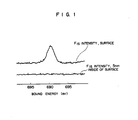
- Fig. 1 of the accompanying drawing is a graph showing a measurement of fluorine intensity in the surface and inside of a hardened coating film formed with a composition of the present invention.
- the fluorine intensity in the surface layer and at a depth of 5 nm from the surface was measured by using an X-ray photoelectron spectroscopy (XPS), and the result shows that fluorine exists in the film surface alone and no fluorine presents at a point of 5 nm depth from the surface. This indicates that the perfluoropolyether chain exists only in the surface of the film.
- XPS X-ray photoelectron spectroscopy
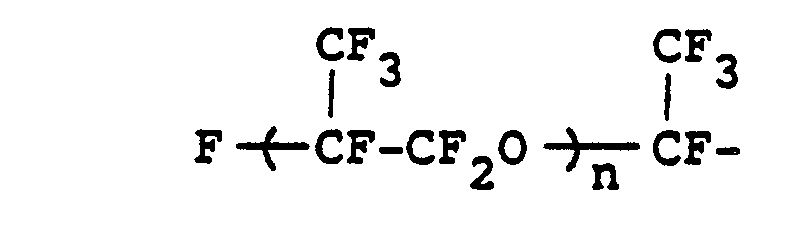
- the perfluoropolyether chain (Rf) in the compound of the present invention is available as a commercial preparation, typical examples thereof being du Pont's KRYTOX 143 and KRYTOX 157 series represented by the formula: (n: an integer of 1 or greater) and Montefluose's FOMBLIN Y and FOMBLIN Z series represented by the formula: (n: an integer of 1 or greater; x and y: 0 or an integer of 1 or greater).
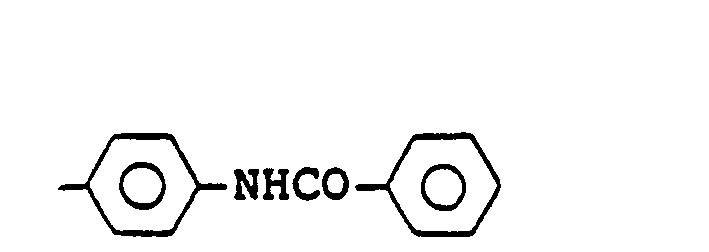
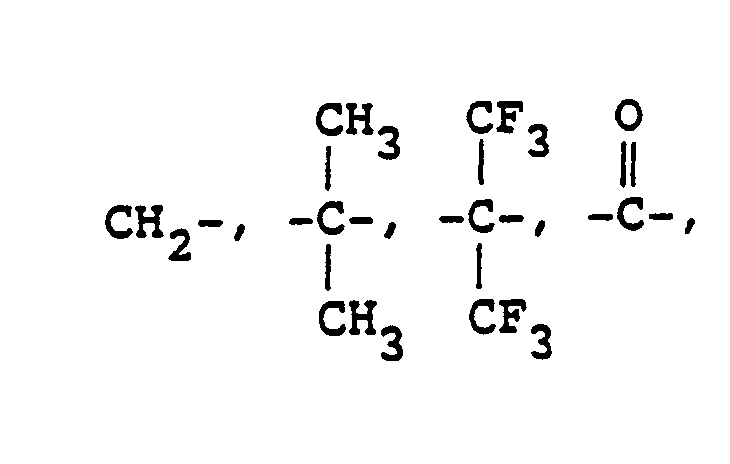
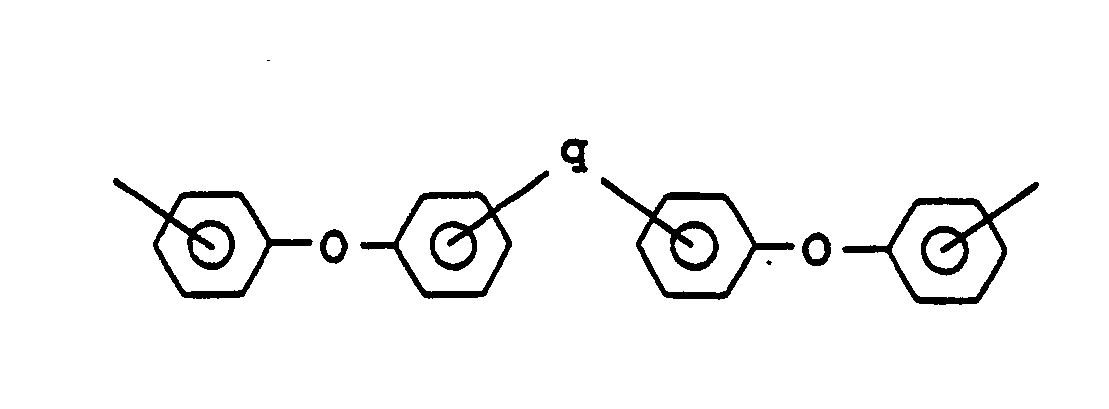
- Examples of the structural unit (CONH-X-NHCO-Y) in the fluoroalkyl ether of the present invention include the following: and
- fluoroalkyl ethers provided according to the present invention include those of the following structural formulae:
- a synthetic resin for coating use having a unit structure similar to (CONH-X-NHCO-Y), which includes polyimide, polyetherimide, polyamideimide, polycarbonate, polyester, polyurethane, melamine resin, phenolic resin, polyhydroxystyrene, epoxy resin, unsaturated imides, and the like.
- a composition for example, containing the fluoroalkyl ether and a film forming resin is made into a solution by using a solvent suitable for paint and the solution is applied on a solid surface to form a thin coating film thereon, and then the coating film is hardened by heating and/or other means.
- the fluoroalkyl ether chain separates out and is oriented toward the film surface while the organic group containing no fluorine atom is embedded and fixed inside of the hardened film.
- the hardened film is provided with durable water and oil repellency; lubricity; lowered surface energy and dielectric constant; and reduced stress.
- the products to which said solid surface modifying method of the invention can be applied effectively are diversified.
- examples of such products are lubricating protective layers for magnetic recording media for which a high degree of lubricity is required; organic protective films for conductive support of photoreceptors; LSI coat films which require strong water repellency; laminates for computers which need strongly reduced dielectric constant; multi-layer wiring circuit boards; icing-preventive films; moistureproof protective films; anticontamination films; and the like.
- a solution containing 24 g (0.0048 mol) of KRYTOX 157 FS-M (MW: 4,800) and 70 g of trifluorotrichloroethane were changed into a 300 ml three-necked flask having a refluxing device. Then 100 ml of SOCl 2 was added and the mixture was caused to react under stirring at 67° C for 3 hours. Three drops of pyridine were also added into the reaction solution.
- reaction product (1) Into a 100 ml three-necked flask having a refluxing device was put 2.55 g (0.0064 mol) of reaction product (1), followed by further supply of 35 ml of acetone dehydrated with anhydrous magnesium sulfate and 0.47 g of triethylamine. Then 6 g (0.005 mol) of the previously prepared acid chloride of the fluorine compound was added dropwise into said three necked flask, and the mixture was stirred sufficiently. After about one-hour reaction, the reaction solution was filtered and the filtrate was diluted with trifluorotrichloroethane and washed with methanol. Then the solvent trifluorotrichloroethane was distilled off to obtain 8.7 g (0.0031 mol) of a fluorine compound having the following structure:
- a solution consisting of 22 g of FOMBLIN Z-DIAC (produced by Montefluose Inc.) represented by the formula HOOC-Rf-COOH (wherein Rf represents ( ⁇ C 2 F 4 O) ⁇ x ( ⁇ CF 2 O) ⁇ y ( ⁇ CF 2 ) ⁇ 2 x : y : z 18: 33 : 1; average molecular weight 2,200) and 100 ml of trifluorotrichloroethane was supplied into a 500 ml flask equipped with a refluxing device. Then 50 ml of thionyl chloride was added and the mixture was reacted under stirring at 67 . C for 3 hours. Three drops of pyridine were also added into the flask.
- compound (A) was produced according to Example 1, and 1 0 g (0.02 mol) of (A') was put into a 200 ml three-necked flask provided with a refluxing device, followed by further supply thereinto of 30 ml of trifluorotrichloroethane, 100 ml of dehydrated acetone and 2 g of triethylamine. Then a trifluorotrichloroethane solution containing 22 g (0.01 mol) of fluorine compound (E) was added dropwise into the three-necked flask, and the mixture in the flask was heated to 60. C and stirred well for conducting a reaction.
- a 1 ⁇ m thick amorphous silicon film was formed on an aluminum alloy substrate, and each sample of solution (II) was applied thereon to form a 50 nm thick coated film.
- This coated film was cured by heating at 200 C for one hour.
- the surface tension of each of the cured films was measured by using water and benzene to determine the water and oil repellency of each film. The results are shown in Table 2.
- Used as a Comparative Example was a 1 nm thick amorphous silicon film formed on an aluminum alloy substrate, with no additional coating film formed thereon.
- any of the coating films according to this invention was larger in the contact angle and higher in the water and oil repellency than the film of Comparative Example.
- a disc having a magnetic layer was prepared by first forming an Ni-P layer and then a Co layer on the surface of a 5.25 inch AI-alloy disc, then depositing on the Co layer a Ni-Co magnetic layer to a thickness of 50 nm, and further formed thereon a 50 nm thick carbon film. Then, each sample of solution (II) was applied on the disc by using a spin coater operated at 2,500 r.p.m. to form a 30 to 50 nm thick coated film. The coated film was preheated at 80°C for 30 minutes and then heated at 230°C for one hour to obtain a disc (1) coated with a cured film.
- Lubricity of each of the thus obtained disc (1) samples was evaluated directly by using a sphere on disc sliding tester.
- the evaluation test by giving a load of 20 g to a sapphire spherical slider, the disc was rotated at a peripheral speed of 40 m/s under the conditions of an ambient atmospheric temperature of 25°C and a relative humidity below 50%, and the disc lubricity was evaluated by the total number of rotations that the disc made until the organic coating film on the disc was ruptured. The results are shown in Table 3.
- the discs embodying the present invention are greater in the total number of rotations of disc until the organic coating layer ruptured in comparison with the comparative disc, indicating excellent lubricity of the discs produced in accordance with the present invention.
- Solution (II) formed in Example 15 was dissolved in N,N'- ⁇ imethylformamide to prepare a 2 wt% solution thereof.
- This solution was uniformly spin coated, at a spinner speed of 3,500 r.p.m., on a polyethylene terephthalate substrate washed sufficiently. Then the coating was dried at 120' C for 15 minutes and N.N'-dimethylformamide was evaporated away to form an orientation controlling film having a thickness of 650 A. This film was rubbed with a felt in a predetermined direction to obtain a substrate having an orientation controlling film.
Landscapes
- Chemical & Material Sciences (AREA)
- Physics & Mathematics (AREA)
- General Physics & Mathematics (AREA)
- Spectroscopy & Molecular Physics (AREA)
- Chemical Kinetics & Catalysis (AREA)
- Organic Chemistry (AREA)
- Wood Science & Technology (AREA)
- General Chemical & Material Sciences (AREA)
- Engineering & Computer Science (AREA)
- Materials Engineering (AREA)
- Polymers & Plastics (AREA)
- Medicinal Chemistry (AREA)
- Health & Medical Sciences (AREA)
- Life Sciences & Earth Sciences (AREA)
- Paints Or Removers (AREA)
- Compositions Of Macromolecular Compounds (AREA)
- Polyethers (AREA)
- Adhesives Or Adhesive Processes (AREA)
- Lubricants (AREA)
- Organic Low-Molecular-Weight Compounds And Preparation Thereof (AREA)
Abstract
Description
- The present invention relates to a novel fluoroalkyl ether, a solid surface modifying composition containing said ether, and a method for modifying solid surfaces by using said composition.
- For preventing contamination of solid surfaces or for providing water and/or oil repellency to solid surfaces, surface modifying methods are popularly used in which a fluorine-containing surface active agent is applied on a solid surface to be treated. For instance, Japanese Patent Publication No. 19670/86 proposes application of a fluorine-containing surface active agent having the following chemical structure;

- For the improvement of lubricity of a solid surface, there are generally known a method in which a fluorine-containing lubricant is applied on a solid surface (U.S. Patent Nos. 3,490,946 and 3,778,308) and a method in which a fluorine-containing surface active agent is applied on a solid surface (Japanese Patent Application Kokai (Laid-Open) Nos. 116931/84, 41431/83, 29147/83, 154619/82 and 44226/82). The "fluorine-containing surface active agent" referred to therein is a compound of the formula; Cn'F2n' + 1-Xa, which is disclosed in Japanese Patent Application Kokai (Laid-Open) No. 29147/83.
- As a surface modifying method for increasing lubricity of a solid surface by fixing a fluorine compound thereon, uses of fluorine compounds having various types of reactive terminal functional groups such as silanols and acrylates (U.S. Patent No. 4,120,995; JP Pat. Appln. Kokai Nos. 36171/79, 203239/84, 38730/85, 172159/84 and 39919/86) and fluorine compounds having phosphoric ester type reactive groups (JP Pat. Appln. Kokai Nos. 109028/85, 101717/85, 246020/85, 212809/85 and 427270/86) have been proposed.
- However, according to the method in which a fluorine-containing surface active agent is applied on a solid surface to obtain water and oil repellency thereof, the surface active agent may dissipate into the air when the coated product is left unused for a long time as said surfactant is not fixed firm to the solid surface, and so the coated product cannot be improved sufficiency on durability in water and oil repellency.
- On the other hand, the method of developing a water and oil repellent polymer film by irradiating a monomolecular layer film with gamma or ultraviolet rays is complicated in the operating procedure and is impractical. The method in which a fluorine compound is fixed on a solid surface by means of a chemical reaction has problems that the reaction involves difficulties in carrying it out and that a homogeneously reacted film is hardly obtainable.
- As described above, it has barely been possible to attain a surface modification with sufficiently high durability through simple operations by the use of hitherto proposed fluorine-containing surface active agents and fluorine compounds.
- Accordingly, it is an object of the present invention to provide a novel fluoroalkyl ether with which the desired modification of solid surfaces with good durability and by a simple process will be achieved.
- It is a further object of the present invention to provide a solid surface modifying composition comprising said fluoroalkyl ether.
- It is a still further object of the present invention to provide a method of modifying solid surface by the use of said composition.
- In accordance with the invention, a novel fluoroalkyl ether having an amide bond in its molecular structure as represented by the following formula [I] is provided;


- According to the invention, there is provided a composition useful for modifying solid surfaces, which composition is obtained by blending said fluoroalkyl ether with a coating-film-forming material.
- It is also envisaged in the invention to provide a method for modifying solid surfaces by applying said composition on a solid surface to be modified.
- The fluoroalkyl ether according to the invention is a compound in which the perfluoropolyether chain is bonded to a lipophilic organic group in its molecular structure. When this compound is mixed with a film-forming material and the mixture applied on a solid surface to form a thin hardened film thereon, the perfluoropolyether chain (Rf) separates out on the surface of the hardened film while the organic group stays embedded in the hardened film, and said perfluoropolyether chain (Rf) is fixed in this state.
- Thus, according to the present invention, it is possible to attain such solid surface modifications as providing durable water and oil repellency and lubricity to a solid surface; lowering surface energy and dielectric constant; affording corrosion resistance; and reducing stress, etc., with simplified operations.
- Fig. 1 of the accompanying drawing is a graph showing a measurement of fluorine intensity in the surface and inside of a hardened coating film formed with a composition of the present invention. The fluorine intensity in the surface layer and at a depth of 5 nm from the surface was measured by using an X-ray photoelectron spectroscopy (XPS), and the result shows that fluorine exists in the film surface alone and no fluorine presents at a point of 5 nm depth from the surface. This indicates that the perfluoropolyether chain exists only in the surface of the film.
- The perfluoropolyether chain (Rf) in the compound of the present invention is available as a commercial preparation, typical examples thereof being du Pont's KRYTOX 143 and KRYTOX 157 series represented by the formula:



- Examples of the structural unit (CONH-X-NHCO-Y) in the fluoroalkyl ether of the present invention include the following:





- The fluoroalkyl ethers provided according to the present invention include those of the following structural formulae:


- As for a film forming material to be blended with the fluoroalkyl ether for obtaining a composition useful for modification of solid surfaces in the present invention, it is preferred to use a synthetic resin for coating use having a unit structure similar to (CONH-X-NHCO-Y), which includes polyimide, polyetherimide, polyamideimide, polycarbonate, polyester, polyurethane, melamine resin, phenolic resin, polyhydroxystyrene, epoxy resin, unsaturated imides, and the like.
- For modifying a solid surface according to the method of the invention, a composition, for example, containing the fluoroalkyl ether and a film forming resin is made into a solution by using a solvent suitable for paint and the solution is applied on a solid surface to form a thin coating film thereon, and then the coating film is hardened by heating and/or other means. In the thus obtained hardened film, the fluoroalkyl ether chain separates out and is oriented toward the film surface while the organic group containing no fluorine atom is embedded and fixed inside of the hardened film. Owing to this structure, the hardened film is provided with durable water and oil repellency; lubricity; lowered surface energy and dielectric constant; and reduced stress.
- The products to which said solid surface modifying method of the invention can be applied effectively are diversified. Examples of such products are lubricating protective layers for magnetic recording media for which a high degree of lubricity is required; organic protective films for conductive support of photoreceptors; LSI coat films which require strong water repellency; laminates for computers which need strongly reduced dielectric constant; multi-layer wiring circuit boards; icing-preventive films; moistureproof protective films; anticontamination films; and the like.
- The present invention will hereinafter be described in further detail by showing the non-limiting examples thereof.
- A solution of 12 g (0.0048 mol) of KRYTOX 157 FS-L (MW: 2,500) and 35 g of trifluorotrichloroethane was changed into a 300 ml three-necked flask provided with a refluxing device, followed by addition of 50 ml of thionyl chloride, and the mixture was allowed to react under stirring at 67* C for 3 hours. Three drops of pyridine were also added to the reaction solution.
- After the reaction, unreacted thionyl chloride, trifluorotrichloroethane and byproduct HCI were removed by vacuum distillation. The process gave a fluorine compound of KRYTOX 157 FS-L terminated with acid chloride in its molecular structure. This compound (A') had the following structure:

- Separated from the above operations, 8 g (0.027 mol) of 1,4-bis(4-aminophenoxy)benzene, 1.9 g (0.0017 mol) of triethylamine and 70 ml of acetone dehydrated sufficiently with anhydrous magnesium sulfate were supplied into a 200 ml three-necked flask equipped with a refluxing device. Then, 2.4 g (0.017 mol) of benzoyl chloride was added dropwise to the solution under stirring at room temperature. After the dropwise addition ended, the reaction was further continued for one hour. The reaction solution was filtered and the filtrate was added with ethanol and again filtered. The resulting filtrate was subjected to column chromatography to obtain 2.55 g (0.0064 mol) of compound (A ) having the following molecular structure:

- The thus obtained 2.55 g of compound (A") was put into a 200 ml three-necked flask equipped with a refluxing device, followed by addition thereto of 30 ml of trifluorotrichloroethane, 35 ml of dehydrated acetone and 0.47 g of triethylamine. To the solution was added dropwise a trifluorotrichloroethane solution containing 12 g (0.005 mol) of the fluorine compound (A') to conduct a reaction at 60. C for about one hour. The reaction solution was filtered and the filtrate was diluted with trifluorotrichloroethane and washed with methanol. Then trifluorotrichloroethane was distilled off to obtain 8.7 g of a brown viscous compound having the following structure:

- A solution containing 24 g (0.0048 mol) of KRYTOX 157 FS-M (MW: 4,800) and 70 g of trifluorotrichloroethane were changed into a 300 ml three-necked flask having a refluxing device. Then 100 ml of SOCl2 was added and the mixture was caused to react under stirring at 67° C for 3 hours. Three drops of pyridine were also added into the reaction solution.
- After the reaction, unreacted SOCl2, trifluorotrichloroethane and byproduct HCl were removed by vacuum distillation. As the result, there was obtained a fluorine compound (B') of KRYTOX 157 FS-M terminated with acid chloride.
- In separate operations, a solution formed by dissolving 10 g of phenoxybenzoic acid


- Separated from the above operations, 8 g (0.027 mol) of 1,3-bis(4-aminophenoxy)benzene, 1.9 g (0.017 mol) of triethylamine and 500 ml of dehydrated acetone were supplied into a 1,000 ml three-necked flask with a refluxing device. To this solution, while stirring it at room temperature, there was added dropwise a solution prepared by adding 100 ml of acetone to 10 g of the acid chloride of phenoxybenzoic acid. The solution reacted under stirring at room temperature for 3 hours. After the reaction, the solution was filtered, and then unreacted SOCI2, acetone and byproduct HCI were removed by vacuum distillation. The residue was column-chromatographed to obtain 16 g (0.032 mol) of compound (B ) having the following structure:

- Then 7 g (0.014 mol) of compound (B") was put into a 200 ml eggplant type flask, followed by addition thereto of 2 g (0.014 mol) of 4-hydroxybenzoic acid, 4.3 g of methylchloropyridine iodide


- Into a 100 ml three-necked flask provided with a refluxing device was put 5 g (0.0082 mol) of compound (B ). Then 1 g of triethylamine and 30 ml of acetone were added into the flask, and the solution was heated to 45' C. Thereafter, a solution of 20 ml of well dehydrated trifluorotrichloroethane and 15 g of fluorine compound (B') was added dropwise, carrying out the reaction over a period of one hour. After the reaction, the solution was filtered and then unreacted SOCI2, acetone, trifluorotrichloroethane and byproduct HCI were removed by vacuum distillation. The distillation residue was dissolved in trifluorotrichloroethane and, after removing of brown crystals, washed with water and ethanol to yield 11.2 g of the objective product having the following structure:


- A solution of 44 g (0.02 mol) of KRYTOX 157 FS-L of the following formula

- Separated from the above operations, 8 g (.0027 mol) of 1,3-bis(4-aminophenoxy)benzene

- Into a 100 ml three-necked flask having a refluxing device was put 2.55 g (0.0064 mol) of reaction product (1), followed by further supply of 35 ml of acetone dehydrated with anhydrous magnesium sulfate and 0.47 g of triethylamine. Then 6 g (0.005 mol) of the previously prepared acid chloride of the fluorine compound was added dropwise into said three necked flask, and the mixture was stirred sufficiently. After about one-hour reaction, the reaction solution was filtered and the filtrate was diluted with trifluorotrichloroethane and washed with methanol. Then the solvent trifluorotrichloroethane was distilled off to obtain 8.7 g (0.0031 mol) of a fluorine compound having the following structure:

- A solution containing 24 g (0.0048 mol) of KRYTOX 157 FS-M of the following formula

- Separated from the above operations, a solution of 10 g of phenoxybenzoic acid


- In another operation, 25 g (0.061 mol) of 2,2-bis(4(4-aminophenoxy)phenyl)propane having the following structure;


- Then 19 g (0.025 mol) of compound (D) was put into a 500 ml three-necked flask having a refluxing device, followed by supply of 25 g of triethylamine and 120 ml of acetone in a sealed state, and the mixture was stirred at 14. C. Then a solution of 55 g of fluorine compound (C) in 60 ml of well-dehydrated trifluorotrichloroethane was added dropwise to the above mixture to carry out a reaction for a period of 4 hours. After the reaction, the solution was filtered and then unreacted thionyl chloride, solvent acetone and byproduct HCI were removed by vacuum distillation. The distillation residue was dissolved in trifluorotrichloroethane and, after removing brown crystals, washed with water and ethanol to obtain 45 g of the objective product having the following structure:


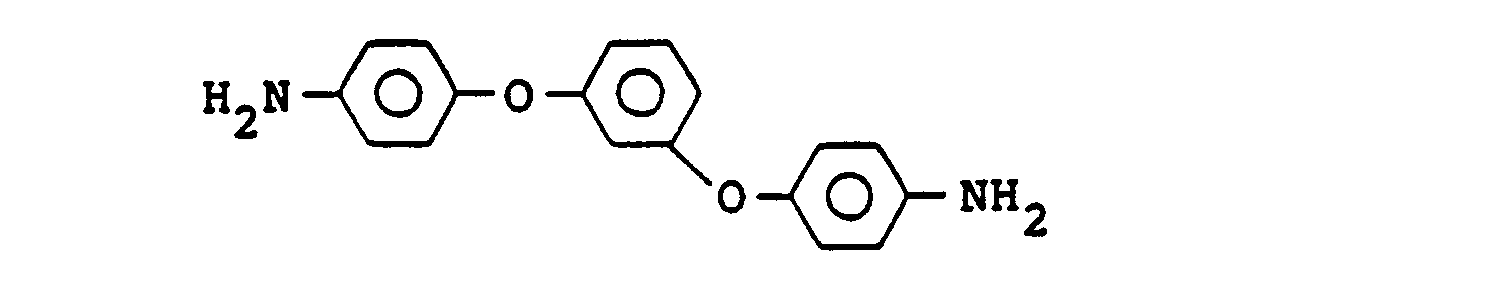
- By following the procedure of Example 1, there was obtained 12 g (0.0048 mol) of a fluorine compound [A] of KRYTOX 157 FS-L terminated with acid chloride. Separated from the above, 0.7 g (0.0023 mol) of 1,3-bis(4-aminophenoxy)benzene of the formula;

- By following the procedure of Example 1, there was obtained 12 g (0.0048 mol) of a fluorine compound (A ) of KRYTOX 157 FS-L terminated with acid chloride. Separated from the above, 0.8 g (0.002 mol) of 2- bis(4-aminophenoxyphenyl)propane of the following structure;


- A solution consisting of 22 g of FOMBLIN Z-DIAC (produced by Montefluose Inc.) represented by the formula HOOC-Rf-COOH (wherein Rf represents (̵C2F4O)̵x (̵CF2O)̵y (̵CF2)̵2 x : y : z = 18: 33 : 1; average molecular weight 2,200) and 100 ml of trifluorotrichloroethane was supplied into a 500 ml flask equipped with a refluxing device. Then 50 ml of thionyl chloride was added and the mixture was reacted under stirring at 67. C for 3 hours. Three drops of pyridine were also added into the flask. Thereafter, unreacted thionyl chloride, solvent trifluorotrichloroethane and reaction product HCI were removed by vacuum distillation. There was resultantly obtained a fluorine compound (E) of FOMBLIN Z-DIAC terminated with acid chloride at both ends of the molecular structure (CIOC-Rf-COCI).
- Separated from the above operations, compound (A) was produced according to Example 1, and 10 g (0.02 mol) of (A') was put into a 200 ml three-necked flask provided with a refluxing device, followed by further supply thereinto of 30 ml of trifluorotrichloroethane, 100 ml of dehydrated acetone and 2 g of triethylamine. Then a trifluorotrichloroethane solution containing 22 g (0.01 mol) of fluorine compound (E) was added dropwise into the three-necked flask, and the mixture in the flask was heated to 60. C and stirred well for conducting a reaction. About one hour thereafter, the reaction mixture was filtered and the filtrate was diluted with trifluorotrichloroethane and washed with methanol, after which the solvent trifluorotrichloroethane was distilled off to yield 15 g of a brown viscous compound having the following structure:


- By using 24 g of KRYTOX 157 FS-M, there was obtained a fluorine compound terminated with acid chloride in its molecular structure (F(C3F6-O)̵n C2F4-COCI) according to the same process as Example 4. There was also obtained 10 g of acid chloride of phenoxybenzoic acid

- Separated from the above operations, 32 g (0.061 mol) of 2,2-bis(4(4-aminophenoxyphenyl)-hexafluoropropane



- Then 16 g (0.025 mol) of compound (F) was put into a 500 ml three-necked flask provided with a refluxing device, followed by further addition of 25 g of triethylamine and 120 ml of acetone, the mixture being stirred at 14'C. Thereafter, a solution consisting of 60 ml of well-dehydrated trifluorotrichloroethane and 25 g of the fluorine compound (F(C3F6-O)̵n C2F4-COCl) was added dropwise into the mixture and continued the reaction over a period of 4 hours. After the reaction ended, the solution was filtered and then unreacted thionyl chloride, solvents acetone and trifluorotrichloroethane and byproduct HCI were removed by vacuum distillation. The distillation residue was dissolved in trifluorotrichloroethane and, after removing brown crystals, washed with water and ethanol to obtain 35 g of the objective refined product having the following structure:


- An organic film-forming material composed of 4.5 g of a bis-phenol A type epoxy resin, 4 g of a resol type phenolic resin and 1.5 g of a polyvinylbutyral resin was dissolved in 2,000 g of cyclohexanone to prepare a solution (1). Then 0.5 g of each of fluoroalkyl ether compounds shown in Table 1, which had been prepared according to Example 1, was dissolved in 15 g of methyl ethyl ketone, and this solution was mixed with solution (1) to prepare a coating solution (II).

- A 1 µm thick amorphous silicon film was formed on an aluminum alloy substrate, and each sample of solution (II) was applied thereon to form a 50 nm thick coated film. This coated film was cured by heating at 200 C for one hour. The surface tension of each of the cured films was measured by using water and benzene to determine the water and oil repellency of each film. The results are shown in Table 2.
- Used as a Comparative Example was a 1 nm thick amorphous silicon film formed on an aluminum alloy substrate, with no additional coating film formed thereon.
- As seen from the results shown in Table 1, any of the coating films according to this invention was larger in the contact angle and higher in the water and oil repellency than the film of Comparative Example.

- Samples of solution (II) containing the fluoroalkyl ether compounds specified in Table 1 were prepared in the same way as in Examples 9 - 14.
- Then, a disc having a magnetic layer was prepared by first forming an Ni-P layer and then a Co layer on the surface of a 5.25 inch AI-alloy disc, then depositing on the Co layer a Ni-Co magnetic layer to a thickness of 50 nm, and further formed thereon a 50 nm thick carbon film. Then, each sample of solution (II) was applied on the disc by using a spin coater operated at 2,500 r.p.m. to form a 30 to 50 nm thick coated film. The coated film was preheated at 80°C for 30 minutes and then heated at 230°C for one hour to obtain a disc (1) coated with a cured film.
- Lubricity of each of the thus obtained disc (1) samples was evaluated directly by using a sphere on disc sliding tester. In the evaluation test, by giving a load of 20 g to a sapphire spherical slider, the disc was rotated at a peripheral speed of 40 m/s under the conditions of an ambient atmospheric temperature of 25°C and a relative humidity below 50%, and the disc lubricity was evaluated by the total number of rotations that the disc made until the organic coating film on the disc was ruptured. The results are shown in Table 3.
- As a Comparative Example, there was used a disc prepared by coating on the above mentioned disc having the magnetic layer with KRYTOX 143 CZ (disclosed in U.S. Patent No. 3,490,946) to a thickness of about 10 nm by using a spin coater, and further heating the coated film at 100* C for 30 minutes.
- As seen from the results of Table 3, the discs embodying the present invention are greater in the total number of rotations of disc until the organic coating layer ruptured in comparison with the comparative disc, indicating excellent lubricity of the discs produced in accordance with the present invention.

- Solution (II) formed in Example 15 was dissolved in N,N'-\imethylformamide to prepare a 2 wt% solution thereof. This solution was uniformly spin coated, at a spinner speed of 3,500 r.p.m., on a polyethylene terephthalate substrate washed sufficiently. Then the coating was dried at 120' C for 15 minutes and N.N'-dimethylformamide was evaporated away to form an orientation controlling film having a thickness of 650 A. This film was rubbed with a felt in a predetermined direction to obtain a substrate having an orientation controlling film.
- Two pieces of thus obtained substrate were placed opposite to each other in such a way that their respective orientation controlling films faced each other, and the two substrates were joined with an adhesive comprising a polyester to make a liquid crystal display element. A phenylcyclohexane type liquid crystal (ZLI-1132, manufactured by Merc Inc.) was placed between the opposing orientation controlling films of the element, and the orienting characteristics of the liquid crystal were examined between a pair of orthogonal polarizing plates. The liquid crystal showed excellent orienting characteristics.
- In toluene, 0.5 g of fluoroalkyl ether obtained in Example 1 and 1.5 g of polyimide precursor PIQ (manufactured by Hitachi Chemical Co., Ltd.) were dissolved to prepare a resin coating solution. This coating solution was spin coated and baked at 250 C for 60 minutes to prepare a wiring insulating film. A semiconductor device having the insulating film was packaged with an epoxy molding resin using a phenolic novolak curing agent, thereby obtaining an LSI product for memory. This product was left in an atmosphere of 85. C and 85% RH under application of a bias voltage. There took place no break or disconnection due to corrosion of AI wiring even after 3,000 hours of test, indicating excellent moistureproof reliability of this LSI product.
Claims (11)








Applications Claiming Priority (2)
| Application Number | Priority Date | Filing Date | Title |
|---|---|---|---|
| JP63238727A JPH0637608B2 (en) | 1988-09-26 | 1988-09-26 | Surface modifying agent and surface modifying method using the same |
| JP238727/88 | 1988-09-26 |
Publications (3)
| Publication Number | Publication Date |
|---|---|
| EP0361346A2 true EP0361346A2 (en) | 1990-04-04 |
| EP0361346A3 EP0361346A3 (en) | 1991-08-14 |
| EP0361346B1 EP0361346B1 (en) | 1996-08-21 |
Family
ID=17034360
Family Applications (1)
| Application Number | Title | Priority Date | Filing Date |
|---|---|---|---|
| EP89117633A Expired - Lifetime EP0361346B1 (en) | 1988-09-26 | 1989-09-25 | Fluoroalkyl ether, surface modifying composition and method for modifying surface |
Country Status (3)
| Country | Link |
|---|---|
| EP (1) | EP0361346B1 (en) |
| JP (1) | JPH0637608B2 (en) |
| DE (1) | DE68926988T2 (en) |
Cited By (10)
| Publication number | Priority date | Publication date | Assignee | Title |
|---|---|---|---|---|
| EP0499281A1 (en) * | 1991-02-15 | 1992-08-19 | AUSIMONT S.p.A. | Dyestuffs for perfluoropolyoxyalkylenes and compositions based on perfluoropolyoxyalkylenes containing such dyestuffs |
| EP0504796A1 (en) * | 1991-03-19 | 1992-09-23 | Hitachi, Ltd. | Method for surface treatment of a body, surface treatment agent, surface treated body, surface treated members, and apparatus being furnished with same |
| US5334477A (en) * | 1992-11-13 | 1994-08-02 | Eastman Kodak Company | Thermally assisted transfer process |
| US5358820A (en) * | 1992-11-13 | 1994-10-25 | Eastman Kodak Company | Thermally assisted transfer process for transferring electrostatographic toner particles to a thermoplastic bearing receiver |
| NL1001728C2 (en) * | 1994-11-24 | 1996-10-15 | Willy Zaremba | Metal cladding. |
| WO1997036210A1 (en) * | 1996-03-28 | 1997-10-02 | Minnesota Mining And Manufacturing Company | Perfluoroether release coatings for organic photoreceptors |
| WO2002020676A1 (en) * | 2000-09-07 | 2002-03-14 | Nederlandse Organisatie Voor Toegepast-Natuurwetenschappelijk Onderzoek Tno | Coating compositions containing perfluoropolyether surfactants |
| EP2818536A1 (en) * | 2008-02-01 | 2014-12-31 | Unimatec Co., Ltd. | Oil additive for fluorinated oils |
| US9498761B2 (en) | 2006-08-07 | 2016-11-22 | Raindance Technologies, Inc. | Fluorocarbon emulsion stabilizing surfactants |
| CN111116895A (en) * | 2019-12-30 | 2020-05-08 | 苏州东杏表面技术有限公司 | Single-end-capping method of double-end perfluoropolyether alcohol |
Families Citing this family (3)
| Publication number | Priority date | Publication date | Assignee | Title |
|---|---|---|---|---|
| JP2697985B2 (en) * | 1991-12-20 | 1998-01-19 | 倉敷化工株式会社 | Automotive glass run |
| JP3253851B2 (en) * | 1996-04-18 | 2002-02-04 | 株式会社日立製作所 | Super water repellent paint and super water repellent coating using the same |
| CN116323746A (en) * | 2020-10-07 | 2023-06-23 | 味之素株式会社 | Ester compound and resin composition |
Family Cites Families (2)
| Publication number | Priority date | Publication date | Assignee | Title |
|---|---|---|---|---|
| US3472894A (en) * | 1967-03-07 | 1969-10-14 | Du Pont | Perfluoroalkyl ether bis(hydroxyalkyl) amides |
| IT1002396B (en) * | 1973-12-28 | 1976-05-20 | Montedison Spa | NN BIS AMINO ALCYL AMIDES OF POLYOXAPERFLUROALCANDIOIC ACIDS, THEIR DERIVATIVES AND PROCEDURE FOR THEIR PREPARATION |
-
1988
- 1988-09-26 JP JP63238727A patent/JPH0637608B2/en not_active Expired - Lifetime
-
1989
- 1989-09-25 DE DE68926988T patent/DE68926988T2/en not_active Expired - Fee Related
- 1989-09-25 EP EP89117633A patent/EP0361346B1/en not_active Expired - Lifetime
Cited By (15)
| Publication number | Priority date | Publication date | Assignee | Title |
|---|---|---|---|---|
| EP0499281A1 (en) * | 1991-02-15 | 1992-08-19 | AUSIMONT S.p.A. | Dyestuffs for perfluoropolyoxyalkylenes and compositions based on perfluoropolyoxyalkylenes containing such dyestuffs |
| US5210188A (en) * | 1991-02-15 | 1993-05-11 | Ausimont S.P.A. | Dyestuffs for perfluoropolyoxyalkylenes and compositions based on perfluoropolyoxyalkylenes containing such dyestuffs |
| EP0504796A1 (en) * | 1991-03-19 | 1992-09-23 | Hitachi, Ltd. | Method for surface treatment of a body, surface treatment agent, surface treated body, surface treated members, and apparatus being furnished with same |
| US5346633A (en) * | 1991-03-19 | 1994-09-13 | Hitachi, Ltd. | Method for surface treatment of a body, surface treatment agent, surface treated body, surface treated members, and apparatus being furnished with same |
| US5334477A (en) * | 1992-11-13 | 1994-08-02 | Eastman Kodak Company | Thermally assisted transfer process |
| US5358820A (en) * | 1992-11-13 | 1994-10-25 | Eastman Kodak Company | Thermally assisted transfer process for transferring electrostatographic toner particles to a thermoplastic bearing receiver |
| NL1001728C2 (en) * | 1994-11-24 | 1996-10-15 | Willy Zaremba | Metal cladding. |
| WO1997036210A1 (en) * | 1996-03-28 | 1997-10-02 | Minnesota Mining And Manufacturing Company | Perfluoroether release coatings for organic photoreceptors |
| US5723242A (en) * | 1996-03-28 | 1998-03-03 | Minnesota Mining And Manufacturing Company | Perfluoroether release coatings for organic photoreceptors |
| WO2002020676A1 (en) * | 2000-09-07 | 2002-03-14 | Nederlandse Organisatie Voor Toegepast-Natuurwetenschappelijk Onderzoek Tno | Coating compositions containing perfluoropolyether surfactants |
| US9498761B2 (en) | 2006-08-07 | 2016-11-22 | Raindance Technologies, Inc. | Fluorocarbon emulsion stabilizing surfactants |
| EP2818536A1 (en) * | 2008-02-01 | 2014-12-31 | Unimatec Co., Ltd. | Oil additive for fluorinated oils |
| EP2236490B1 (en) * | 2008-02-01 | 2016-10-12 | Unimatec Co., Ltd. | Method of synthesis of compound usable as oil additive |
| CN111116895A (en) * | 2019-12-30 | 2020-05-08 | 苏州东杏表面技术有限公司 | Single-end-capping method of double-end perfluoropolyether alcohol |
| CN111116895B (en) * | 2019-12-30 | 2022-05-06 | 苏州东杏表面技术有限公司 | Single-end-capping method of double-end perfluoropolyether alcohol |
Also Published As
| Publication number | Publication date |
|---|---|
| EP0361346B1 (en) | 1996-08-21 |
| JPH0288635A (en) | 1990-03-28 |
| DE68926988T2 (en) | 1997-02-20 |
| JPH0637608B2 (en) | 1994-05-18 |
| DE68926988D1 (en) | 1996-09-26 |
| EP0361346A3 (en) | 1991-08-14 |
Similar Documents
| Publication | Publication Date | Title |
|---|---|---|
| US5157066A (en) | Fluoroalkyl ether, surface modifying composition and method for modifying surface | |
| EP0361346B1 (en) | Fluoroalkyl ether, surface modifying composition and method for modifying surface | |
| KR930002485B1 (en) | Substrate having a perfluoropolyether polymer protective film and a method of manufacturing the same | |
| EP0287974B1 (en) | Synthetic lubricant for lubricating thin film and magnetic recording medium | |
| US8039132B2 (en) | Perfluoropolyether compound, and lubricant and magnetic disk each using the same | |
| KR920001569B1 (en) | Perfluoropolyether composition and preparation method thereof | |
| KR20020010591A (en) | Lubricant for magnetic recording medium and use thereof | |
| CA2020381A1 (en) | Protective layer for magnetic recording media | |
| US20050037932A1 (en) | Ultra-thin lubricant film for advanced tribological performance of magnetic storage media | |
| US5468552A (en) | Magnetic recording medium comprising a magnetic film layer and a coating of purified perfluoropolyether lubricant | |
| US6162521A (en) | Fluoropolyether amide lubricants for an information storage system and a method of making the same | |
| Kasai et al. | Z-dol versus Z-tetraol: bonding and durability in magnetic hard disk application | |
| US5223342A (en) | Magnetic recording medium having a lubricating layer comprising a binder and specified perfluoro polyoxyalkyl lubricant | |
| US5071715A (en) | Magnetic recording medium with a lubricant layer containing a perfluoro polyoxyalkyl compound | |
| JPH11131083A (en) | Polyether compound and magnetic recording medium | |
| US5093211A (en) | Magnetic recording medium comprising a surface treatment layer provided on the magnetic layer of specified fluorocarboxylic acid amine salts | |
| EP0295813B1 (en) | Magnetic recording medium and a method for producing the same | |
| US20060106260A1 (en) | Composition, magnetic recording medium, head slider, and magnetic recording device | |
| US6190749B1 (en) | Hydroxyethyloxymethyl terminated perfluoropolyethers for lubrication of discs in information storage systems | |
| JP2560183B2 (en) | Lubricant and magnetic recording medium using the same | |
| US4978732A (en) | Coated supports with ultra-thin, single-layer or multi-layer coating, process for their production and polyurethanes as intermediates for the coated supports | |
| US5510181A (en) | Lubricant and magnetic recording medium using the same | |
| US5128435A (en) | Magnetic recording medium based on epoxy resins modified by isocyanates with poly(perfluoroether) backbones | |
| EP0232162B1 (en) | Magnetic recording medium and process for producing the same | |
| JP2001011032A (en) | Fluorinated alkylamine and method for producing the same |
Legal Events
| Date | Code | Title | Description |
|---|---|---|---|
| PUAI | Public reference made under article 153(3) epc to a published international application that has entered the european phase |
Free format text: ORIGINAL CODE: 0009012 |
|
| AK | Designated contracting states |
Kind code of ref document: A2 Designated state(s): DE FR GB IT NL |
|
| 17P | Request for examination filed |
Effective date: 19901112 |
|
| PUAL | Search report despatched |
Free format text: ORIGINAL CODE: 0009013 |
|
| AK | Designated contracting states |
Kind code of ref document: A3 Designated state(s): DE FR GB IT NL |
|
| 17Q | First examination report despatched |
Effective date: 19950816 |
|
| GRAH | Despatch of communication of intention to grant a patent |
Free format text: ORIGINAL CODE: EPIDOS IGRA |
|
| GRAH | Despatch of communication of intention to grant a patent |
Free format text: ORIGINAL CODE: EPIDOS IGRA |
|
| GRAH | Despatch of communication of intention to grant a patent |
Free format text: ORIGINAL CODE: EPIDOS IGRA |
|
| GRAA | (expected) grant |
Free format text: ORIGINAL CODE: 0009210 |
|
| AK | Designated contracting states |
Kind code of ref document: B1 Designated state(s): DE FR GB IT NL |
|
| REF | Corresponds to: |
Ref document number: 68926988 Country of ref document: DE Date of ref document: 19960926 |
|
| ET | Fr: translation filed | ||
| ITF | It: translation for a ep patent filed | ||
| PLBE | No opposition filed within time limit |
Free format text: ORIGINAL CODE: 0009261 |
|
| STAA | Information on the status of an ep patent application or granted ep patent |
Free format text: STATUS: NO OPPOSITION FILED WITHIN TIME LIMIT |
|
| 26N | No opposition filed | ||
| PGFP | Annual fee paid to national office [announced via postgrant information from national office to epo] |
Ref country code: FR Payment date: 19990617 Year of fee payment: 11 |
|
| PGFP | Annual fee paid to national office [announced via postgrant information from national office to epo] |
Ref country code: GB Payment date: 19990625 Year of fee payment: 11 |
|
| PGFP | Annual fee paid to national office [announced via postgrant information from national office to epo] |
Ref country code: NL Payment date: 19990630 Year of fee payment: 11 |
|
| PG25 | Lapsed in a contracting state [announced via postgrant information from national office to epo] |
Ref country code: GB Free format text: LAPSE BECAUSE OF NON-PAYMENT OF DUE FEES Effective date: 20000925 |
|
| PG25 | Lapsed in a contracting state [announced via postgrant information from national office to epo] |
Ref country code: NL Free format text: LAPSE BECAUSE OF NON-PAYMENT OF DUE FEES Effective date: 20010401 |
|
| GBPC | Gb: european patent ceased through non-payment of renewal fee |
Effective date: 20000925 |
|
| PG25 | Lapsed in a contracting state [announced via postgrant information from national office to epo] |
Ref country code: FR Free format text: LAPSE BECAUSE OF NON-PAYMENT OF DUE FEES Effective date: 20010531 |
|
| NLV4 | Nl: lapsed or anulled due to non-payment of the annual fee |
Effective date: 20010401 |
|
| REG | Reference to a national code |
Ref country code: FR Ref legal event code: ST |
|
| PG25 | Lapsed in a contracting state [announced via postgrant information from national office to epo] |
Ref country code: IT Free format text: LAPSE BECAUSE OF NON-PAYMENT OF DUE FEES;WARNING: LAPSES OF ITALIAN PATENTS WITH EFFECTIVE DATE BEFORE 2007 MAY HAVE OCCURRED AT ANY TIME BEFORE 2007. THE CORRECT EFFECTIVE DATE MAY BE DIFFERENT FROM THE ONE RECORDED. Effective date: 20050925 |
|
| PGFP | Annual fee paid to national office [announced via postgrant information from national office to epo] |
Ref country code: DE Payment date: 20070907 Year of fee payment: 19 |
|
| PG25 | Lapsed in a contracting state [announced via postgrant information from national office to epo] |
Ref country code: DE Free format text: LAPSE BECAUSE OF NON-PAYMENT OF DUE FEES Effective date: 20090401 |