EP0361463B1 - Thermosensitive recording materials - Google Patents
Thermosensitive recording materials Download PDFInfo
- Publication number
- EP0361463B1 EP0361463B1 EP89117913A EP89117913A EP0361463B1 EP 0361463 B1 EP0361463 B1 EP 0361463B1 EP 89117913 A EP89117913 A EP 89117913A EP 89117913 A EP89117913 A EP 89117913A EP 0361463 B1 EP0361463 B1 EP 0361463B1
- Authority
- EP
- European Patent Office
- Prior art keywords
- compound
- thermosensitive recording
- recording material
- general formula
- bis
- Prior art date
- Legal status (The legal status is an assumption and is not a legal conclusion. Google has not performed a legal analysis and makes no representation as to the accuracy of the status listed.)
- Expired - Lifetime
Links
Classifications
-
- B—PERFORMING OPERATIONS; TRANSPORTING
- B41—PRINTING; LINING MACHINES; TYPEWRITERS; STAMPS
- B41M—PRINTING, DUPLICATING, MARKING, OR COPYING PROCESSES; COLOUR PRINTING
- B41M5/00—Duplicating or marking methods; Sheet materials for use therein
- B41M5/26—Thermography ; Marking by high energetic means, e.g. laser otherwise than by burning, and characterised by the material used
- B41M5/30—Thermography ; Marking by high energetic means, e.g. laser otherwise than by burning, and characterised by the material used using chemical colour formers
- B41M5/337—Additives; Binders
- B41M5/3375—Non-macromolecular compounds
Definitions
- the present invention relates to thermosensitive recording materials and in particular relates to thermosensitive recording materials having excellent thermal response.
- Thermosensitive recording materials are generally composed of a substrate having provided thereon a thermosensitive recording layer containing as major constituents an ordinarily colorless or slightly colored dye precursor and an electron receptive developer. Upon being heated by means of a thermal head, thermal pen or laser beam, the dye precursor instantaneously reacts with the developer to form a recorded-image, as disclosed in Japanese Patent Examined Publication Nos. 43-4160, 45-14039, etc. Because of the advantages of the relatively simple design of devices, ease of maintenance and making no noise, the recording devices employing such thermosensitive recording materials are being used in a wide field including recording instruments for measurements, facsimiles, printers, terminal devices for computers, labels, and automatic vending machines for railroad tickets and the like.
- thermosensitive recording materials For high speed recording, formation of recorded images utilizing as high efficiency as possible small thermal energy liberated from a thermal head in very short time (generally less than 1 m sec) to color-forming reaction are necessary.
- thermosensitive recording materials produced by any one of the above methods are not still fully satisfactory in thermal response or the color-forming property.
- JP-A-63128978 discloses a recording material containing an electron donative colourless dye, an electron acceptance compound as colour developing agent and an aromatic ether having an acetal or ketal group in the molecule.
- the aromatic ether or thioether is a compound of the formula Ar - X - R1 - R2 wherein Ar denotes an aromatic ring, X denotes an oxygen atom or sulfur atom, R1 denotes a divalent group and R2 denotes an acetal or a ketal moiety.
- An object of the present invention is to provide thermosensitive recording materials having a good thermal response and high coloring sensitivity.
- thermo-sensitive recording material comprising a colourless or slightly coloured dye precursor, an electron acceptance compound (developer), colouring said dye precursor by reacting when heated and an acetal or ketal compound, characterized in that said acetal or ketal compound is a compound of the following general formula (I) wherein R1 and R2 each represents hydrogen atom, alkyl, alkenyl or aryl group, and R1 and R2 may be different from each other; R1 and R2 may also be linked together to form cycloalkyl or a cycloether; R3 and R4 each represents a hydrogen atom, an alkyl, alkenyl, alkoxy, aryl group or a halogen atom, and R3 and R4 may be different from each other.
- R1 and R2 each represents hydrogen atom, alkyl, alkenyl or aryl group, and R1 and R2 may be different from each other;
- R1 and R2 may also be linked together to form cycloalkyl or a
- the compound represented by the formula (I) are illustrated as follows: Among illustrated compounds are preferable the compounds of formulae (1), (2), (4) and (5).
- thermosensitive recording materials It is preferable to use compounds having melting point within range of 60 - 160°C for thermosensitive recording materials in practical use.
- the compound of present invention is generally added to the developer in the range within 5 - 400% by weight, but especially adding of 20 - 300% by weight is preferred. If its amount is smaller than 5% by weight, heat responsibility are unsatisfactory. If its amount exceeds 400% by weight, the amount of thermally fusible matter deposited on thermal head, etc. increases, which can make a trouble on the printing process.
- the compounds can be synthesized easily by well known methods and also purified easily. For example, well known synthetic methods of the present ketal or acetal compounds are given in the following reaction schemes (1) - (4). Further, many other known methods are also usable.
- thermosensitive recording materials are prepared by methods described in Japanese Patent Examined Publications Nos. 43-4160, 45-10439, etc.
- thermosensitive recording materials may be generally composed of a substrate having provided thereon a thermosensitive recording layer containing as major constituents an ordinarily colorless or slightly colored dye precursor, an electron receptive compound and a compound according to the present invention.
- the dye precursor Upon being heated by means of a thermal head, thermal pen or laser beam, the dye precursor instantaneously reacts with the electron receptive compound to form a recorded image.
- To the thermosensitive recording layer may also be added a pigment, sensitizer, antioxidant, adhesion preventer according to necessity.
- Dye precursors used in the present invention are not particularly limited as long as they can be generally used for pressure-sensitive recording paper or thermosensitive recording paper. Specific examples include the following dye precursors.
- thermosensitive paper As dye developers used in the present invention, electron receptive compounds generally employed for thermosensitive paper can be used; in particular, phenol derivatives, aromatic carboxylic acid derivatives, N,N′-diarylthiourea derivatives, polymetal salt such as zinc salt, etc. of organic compounds are used. Among them, particularly preferred ones are phenol derivatives.
- Specific examples can be p-phenylphenol, p-hydroxyacetophenone, 4-hydroxy-4′-methyldiphenylsulfone, 4-hydroxy-4′-isopropoxydiphenylsulfone, 4-hydroxy-4′-benzensulfonyloxydiphenylsulfone, 1,1-bis(p-hydroxyphenyl)propane, 1,1-bis(p-hydroxyphenyl)pentane, 1,1-bis(p-hydroxyphenyl)hexane, 1,1-bis(p-hydroxyphenyl)cyclohexane, 2,2-bis(p-hydroxyphenyl)propane, 2,2-bis(p-hydroxyphenyl)hexane, 1,1-bis(p-hydroxyphenyl)-2-ethylhexane, 2,2-bis(3-chloro-4-hydroxyphenyl)propane, 1,1-bis(p-hydroxyphenyl)-1-phenylethane, 1,3-di[2-(p-hydroxyphenyl
- Binders which can be used in the present thermosensitive recording materials include water soluble adhesives such as starches, hydroxyethyl cellulose, methyl cellulose, carboxymethyl cellulose, gelatin, casein, polyvinyl alcohol, modified polyvinyl alcohol, sodium polyacrylate, acrylic amide/acrylate copolymer, acrylamide/acrylate/methacrylate ternary copolymer, alkali salts of styrene/maleic anhydride copolymer, alkali salts of ethylene/maleic anhydride copolymer, etc.; latexes such as polyvinylacetate, polyurethane, polyacrylates, styrene/butadiene copolymer, acrylonitrile/butadiene copolymer, methyl acrylate/butadiene copolymer, ethylene/vinyl acetate copolymer, etc.
- water soluble adhesives such as starches, hydroxyethyl cellulose, methyl cellulose, carb
- additives used in the present invention contain waxes such as N-hydroxymethylstearic amide, stearic amide, palmitic amide, etc.; naphthol derivatives such as 2-benzyloxynaphthalene, etc.; biphenyl derivatives such as p-benzylbiphenyl, 4-allyloxybiphenyl, etc.; polyether compounds such as 1,2-bis(3-methylphenoxy)ethane, 2,2′-bis(4-methoryphenoxy)diethyl ether, bis(4-methoxyphenyl)ether, etc.; a carbonate or oxalate diester derivatives such as diphenyl carbonate, dibenzyl oxalate, di(p-fluorobenzyl)oxalate, etc. for purpose of further improving the sensitivity.
- waxes such as N-hydroxymethylstearic amide, stearic amide, palmitic amide, etc.
- naphthol derivatives such as 2-
- the leuco dye and the electron receptive compound can be illustrated the combination of 3-dibutylamino-6-methyl-7-anilinofluoran and 1,1-bis(p-hydroxyphenyl)propane.
- Pigments used in the present invention include diatomaceous earths, talc, kaolin, calcined kaolin, calcium carbonate, magnesium carbonate, titanium oxide, zinc oxide, silicon oxide, aluminum hydroxide, urea-formalin resin, etc.
- higher fatty acid metal salts such as zinc stearate, calcium stearate, etc.
- waxes such as paraffin, oxidized paraffin, polyethylene, oxidized polyethylene, stearic amide, castor wax, etc.
- dispersing agents such as sodium dioctylsulfosuccinate, etc.
- thermosensitive recording materials such as preparing an overcoat layer for protecting thermosensitive recording layers or preparing an undercoat layer comprised of single or plural layers of pigment or resin between the thermosensitive layer and the substrate.
- a dye dispersion was obtained by milling for 24 hours in a ball mill 30 parts of a dye precursor 3-dibutylamino-6-methyl-7-anilinofluoran with 120 parts of 2.5% aqueous solution of polyvinyl alcohol. Then a dye developer dispersion was obtained by milling for 24 hours in a ball mill 40 parts of 2,2-bis(p-hydroxyphenyl)propane with 160 parts of 2.5% aqueous solution of polyvinyl alcohol. A dispersion of the present compound was obtained by milling for 24 hours in a ball mill, 10 parts of a compound represented by the formula (1) with 30 parts of 2.5% aqueous solution of polyvinyl alcohol.
- thermosensitive coating composition was prepared by mixing the three dispersions above described and mixing sufficiently the resulting mixture and adding the following composition under stirring. 50% calcium carbonate dispersion 60 parts 40% zinc stearate dispersion 25 parts 10% polyvinyl alcohol aqueous solution 40 parts Water 250 parts
- a coating composition mixed of the following composition was coated onto a base paper (substrate) weighing 40g/m2 at 6 g/m2 coverage as solid body and then dried to prepare a coating paper for thermosensitive recording materials.
- Calcined kaolin 100 parts Styrene-butadiene copolymer latex (50% aqueous dispersion) 24 parts 10% polyvinyl alcohol aqueous solution 40 parts Water 68 parts
- thermosensitive coating composition prepared in (1) was coated onto the coating paper for thermosensitive recording materials at 3 g/m2 as solid body and then dried to prepare a thermosensitive recording material.
- thermosensitive recording material was prepared similarly to Example 1 with the exception that the compound represented by the formula (1) was replaced by the compound represented by the formula (2).
- thermosensitive recording material was prepared in a way similar to that of Example 1 with the exceptions that the compound represented by the formula (1) was replaced by the compound represented by the formula (4).
- thermosensitive recording material was prepared in a way similar to that of Example 1 with the exception that the compound represented by the formula (1) was replaced by the compound represented by the formula (5).
- thermosensitive recording material was prepared in a way similar to that of Example 1 with the exception that the compound represented by the formula (1) was removed.
- thermosensitive recording materials obtained by Examples 1 - 4 and Comparative Example 1 were treated by supercalendering so as to have them complied with a Beck's degree of smoothness varied between 400 and 500 seconds. And these materials were printing-tested using TH-PMD facsimile test machine manufactured by Okura Electric Co., Ltd. Printing was performed using a thermal head having a dot density of 8 dots/mm and head resistance of 185 ohm, at a head voltage of 12 V, for a pulse width of 0.6 and 0.8 ms. Recording density was measured with Macbeth RD-918 reflection densitometer.
- thermosensitive recording materials having excellent thermal response and high color developing sensitivity could be obtained by incorporation of the compound of the present invention into thermosensitive recording materials.
Landscapes
- Chemical & Material Sciences (AREA)
- Chemical Kinetics & Catalysis (AREA)
- General Chemical & Material Sciences (AREA)
- Physics & Mathematics (AREA)
- Optics & Photonics (AREA)
- Heat Sensitive Colour Forming Recording (AREA)
Description
- The present invention relates to thermosensitive recording materials and in particular relates to thermosensitive recording materials having excellent thermal response.
- Thermosensitive recording materials are generally composed of a substrate having provided thereon a thermosensitive recording layer containing as major constituents an ordinarily colorless or slightly colored dye precursor and an electron receptive developer. Upon being heated by means of a thermal head, thermal pen or laser beam, the dye precursor instantaneously reacts with the developer to form a recorded-image, as disclosed in Japanese Patent Examined Publication Nos. 43-4160, 45-14039, etc. Because of the advantages of the relatively simple design of devices, ease of maintenance and making no noise, the recording devices employing such thermosensitive recording materials are being used in a wide field including recording instruments for measurements, facsimiles, printers, terminal devices for computers, labels, and automatic vending machines for railroad tickets and the like. Particularly in the field of facsimiles, demand for thermal sensitive devices has been greatly increased and the performance of facsimiles has been raised to high speed and the size of such devices has become very small due to reductions in transmission costs. Facsimiles have been reduced in cost and energy consumption has been lowered. In response to such high speeds and low energy performance required for facsimiles, high sensitivity has been demanded for thermosensitive recording materials. For high speed recording, formation of recorded images utilizing as high efficiency as possible small thermal energy liberated from a thermal head in very short time (generally less than 1 m sec) to color-forming reaction are necessary.
- As a way to achieve the above-mentioned purpose the simultaneous use of a dye precursor and electron receptive compound capable of developing color of said dye precursor with a heat meltable substance having relatively low melting point as a coloring accelerator or a sensitizer has been proposed. It is proposed in Japanese Patent Application KOKAI (Laid-Open) Nos. 57-64573 and 58-87094 to use naphthol derivatives, Nos. 57-64592, 57-185187, 57-191085, 58-110289 and 59-15393 to use naphthoic acid derivatives, Nos. 58-72499 and 58-87088 to use ether or ester derivatives of a phenol compound.
- However, thermosensitive recording materials produced by any one of the above methods are not still fully satisfactory in thermal response or the color-forming property.
- JP-A-63128978 discloses a recording material containing an electron donative colourless dye, an electron acceptance compound as colour developing agent and an aromatic ether having an acetal or ketal group in the molecule. The aromatic ether or thioether is a compound of the formula
Ar - X - R¹ - R²
wherein Ar denotes an aromatic ring,
X denotes an oxygen atom or sulfur atom,
R¹ denotes a divalent group and
R² denotes an acetal or a ketal moiety. - Compounds having the formula (I) as described later according to the present invention are not disclosed in this prior art.
- An object of the present invention is to provide thermosensitive recording materials having a good thermal response and high coloring sensitivity.
- The present invention is directed to a thermo-sensitive recording material comprising a colourless or slightly coloured dye precursor, an electron acceptance compound (developer), colouring said dye precursor by reacting when heated and an acetal or ketal compound, characterized in that said acetal or ketal compound is a compound of the following general formula (I)

wherein R₁ and R₂ each represents hydrogen atom, alkyl, alkenyl or aryl group, and R₁ and R₂ may be different from each other; R₁ and R₂ may also be linked together to form cycloalkyl or a cycloether; R₃ and R₄ each represents a hydrogen atom, an alkyl, alkenyl, alkoxy, aryl group or a halogen atom, and R₃ and R₄ may be different from each other. - As concrete examples of compounds of the present invention, the compound represented by the formula (I) are illustrated as follows:


Among illustrated compounds are preferable the compounds of formulae (1), (2), (4) and (5). - It is preferable to use compounds having melting point within range of 60 - 160°C for thermosensitive recording materials in practical use.
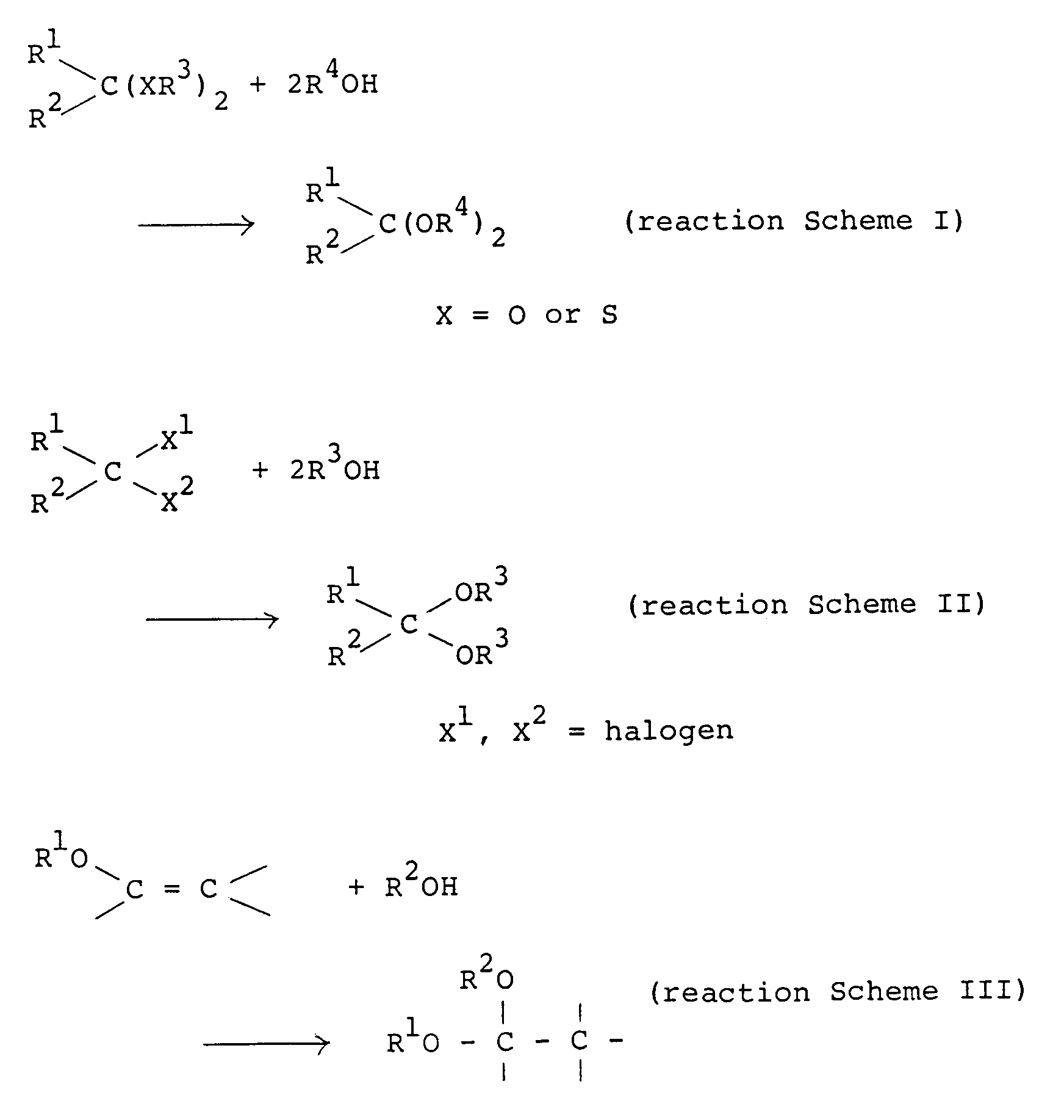
- The compound of present invention is generally added to the developer in the range within 5 - 400% by weight, but especially adding of 20 - 300% by weight is preferred. If its amount is smaller than 5% by weight, heat responsibility are unsatisfactory. If its amount exceeds 400% by weight, the amount of thermally fusible matter deposited on thermal head, etc. increases, which can make a trouble on the printing process. Moreover, the compounds can be synthesized easily by well known methods and also purified easily. For example, well known synthetic methods of the present ketal or acetal compounds are given in the following reaction schemes (1) - (4). Further, many other known methods are also usable.
- (1) The ketal or acetal compounds can be obtained by transacetalization or transketalization which reacts other acetal or ketal compounds with an alcohol, a phenol or a diphenol or derivatives of these by use of an acid catalyst in general. Thioacetal or thioketal compounds can also be transacetalized or transketalized to produce ketal or acetal compounds by use of mercuric oxide as a catalyst (reaction Scheme I).
- (2) The ketal or acetal compounds can be obtained by reaction of a dihalide, e.g. dibromomethane, dibromopropane etc. with an alcohol, a phenol or a diphenol or derivatives thereof in the presence of a base (reaction Scheme II).
- (3) The ketal or acetal compounds can be obtained by addition of an alcohol, a phenol or a diphenol or derivatives thereof to the compound having double bond or triple bond. This reaction is carried out generally using an acid catalyst (reaction Scheme III).
- (4) The ketal or acetal compounds can be obtained by reaction of carbonyl compound such as an aldehyde or a ketone with an alcohol, a phenol or a diphenol or derivatives thereof. This reaction is carried out generally using an acid catalyst and removing water (reaction Scheme IV).
- Thermosensitive recording materials are prepared by methods described in Japanese Patent Examined Publications Nos. 43-4160, 45-10439, etc. Namely, thermosensitive recording materials may be generally composed of a substrate having provided thereon a thermosensitive recording layer containing as major constituents an ordinarily colorless or slightly colored dye precursor, an electron receptive compound and a compound according to the present invention. Upon being heated by means of a thermal head, thermal pen or laser beam, the dye precursor instantaneously reacts with the electron receptive compound to form a recorded image. To the thermosensitive recording layer may also be added a pigment, sensitizer, antioxidant, adhesion preventer according to necessity.
- Dye precursors used in the present invention are not particularly limited as long as they can be generally used for pressure-sensitive recording paper or thermosensitive recording paper. Specific examples include the following dye precursors.
- (1) Triarylmethane compounds:
3,3-bis(p-dimethylaminophenyl)-6-dimethylaminophthalide (Crystal Violet lactone), 3,3-bis(p-dimethylaminophenyl)phthalide, 3-(p-dimethylaminophenyl)-3-(1,2-dimethylindol-3-yl)phthalide, 3-(p-dimethylaminophenyl)-3-(2-methylindol-3-yl)phthalide, 3-(p-dimethylaminophenyl)-3-(2-phenylindol-3-yl)phthalide, 3,3-bis(1,2-dimethylindol-3-yl)-5-dimethylaminophthalide, 3,3-bis(1,2-dimethylindol-3-yl)-6-dimethylaminophthalide, 3,3-bis(9-ethylcarbazol-3-yl)-5-dimethylaminophthalide, 3,3-bis(2-phenylindol-3-yl)-5-dimethylaminophthalide, 3-p-dimethylaminophenyl-3-(1-methylpyrrol-2-yl)-6-dimethylaminophthalide, etc. - (2) Diphenylmethane compounds:
4,4′-bis-dimethylaminophenyl benzhydryl benzyl ether, N-halophenyl leuco Auramine, N-2,4,5-trichlorophenyl leuco Auramine etc. - (3) Xanthene compounds:
Rhodamine B anilinolactam, Rhodamine B p-chloroanilinolactam, 3-diethylamino-7-dibenzylaminofluorane, 3-diethylamino-7-octylaminofluorane, 3-diethylamino-7-phenylfluorane, 3-dimethylamino-7-chlorofluorane, 3-diethylamino-6-chloro-7-methylfluorane, 3-diethylamino-7-octylaminofluorane, 3-diethylamino-7-phenylfluorane, 3-diethylamino-7-chlorofluorane, 3-diethylamino-6-chloro-7-methylfluorane, 3-diethylamino-7-(3,4-dichloroanilino)-fluorane, 3-diethylamino-7-(2-chloroanilino)fluorane, 3-diethylamino-6-methyl-7-anilinofluorane, 3-(N-ethyl-N-tolyl)-amino-6-methyl-7-anilinofluorane, 3-piperidino-6-methyl-7-anilinofluorane, 3-(N-ethyl-N-tolyl)-amino-6-methyl-7-phenethylfluorane, 3-diethylamino-7-(4-nitroanilino)fluorane, 3-dibutylamino-6-methyl-7-anilinofluorane, 3-(N-methyl-N-propyl)amino-6-methyl-7-anilinofluorane, 3-(N-ethyl-N-isoamyl)amino-6-methyl-7-anilinofluorane, 3-(N-methyl-N-cyclohexyl)amino-6-methyl-7-anilinofluorane, 3-(N-ethyl-N-tetrahydrofuryl)amino-6-methyl-7-anilinofluorane, etc. - (4) Thiazine compounds:
Benzoyl leuco methylene blue, p-nitrobenzoyl leuco methylene blue, etc. - (5) Spiro compounds:
3-methyl-spiro-dinaphthopyran, 3-ethyl-spiro-dinaphthopyran, 3,3′-dichloro-spiro-dinaphthopyran, 3-benzyl-spiro-dinaphthopyran, 3-methylnaphtho-(3-methoxybenzo)spiro-pyran, 3-propyl-spiro-benzopyran, etc. These dye precursors can be used singly or as admixtures of two or more. - As dye developers used in the present invention, electron receptive compounds generally employed for thermosensitive paper can be used; in particular, phenol derivatives, aromatic carboxylic acid derivatives, N,N′-diarylthiourea derivatives, polymetal salt such as zinc salt, etc. of organic compounds are used. Among them, particularly preferred ones are phenol derivatives. Specific examples can be p-phenylphenol, p-hydroxyacetophenone, 4-hydroxy-4′-methyldiphenylsulfone, 4-hydroxy-4′-isopropoxydiphenylsulfone, 4-hydroxy-4′-benzensulfonyloxydiphenylsulfone, 1,1-bis(p-hydroxyphenyl)propane, 1,1-bis(p-hydroxyphenyl)pentane, 1,1-bis(p-hydroxyphenyl)hexane, 1,1-bis(p-hydroxyphenyl)cyclohexane, 2,2-bis(p-hydroxyphenyl)propane, 2,2-bis(p-hydroxyphenyl)hexane, 1,1-bis(p-hydroxyphenyl)-2-ethylhexane, 2,2-bis(3-chloro-4-hydroxyphenyl)propane, 1,1-bis(p-hydroxyphenyl)-1-phenylethane, 1,3-di[2-(p-hydroxyphenyl)-2-propyl-benzene, 1,3-di[2-(3,4-dihydroxyphenyl)-2-propyl]benzene, 1,4-di[2-(p-hydroxyphenyl)-2-propyl]benzene, 4,4′-dihydroxydiphenyl ether, 4,4′-dihydroxydiphenylsulfone, 2,2′-bis(p-hydroxyphenylthio)diethyl ether, bis(p-hydroxyphenylthioethyloxy)methane, 3,3′-dichloro-4,4′-dihydroxydiphenylsulfone, 3,3′-diallyl-4,4′-dihydroxydiphenylsulfone, 3,3′-dichloro-4,4′-dihydroxydiphenylsulfide, methyl 2,2-bis(4-hydroxyphenyl)acetate, butyl 2,2-bis(4-hydroxyphenyl)acetate, 4,4′-thiobis(2-5-butyl-5-methylphenol), benzyl p-hydroxybenzoate, chlorobenzyl p-hydroxybenzoate, propyl p-hydroxybenzoate, butyl p-hydroxybenzoate, dimethyl 4-hydroxyphthalate, benzyl gallate, stearyl gallate, salicylanilide, 5-chlorosalicylanilide, etc.
- Binders which can be used in the present thermosensitive recording materials include water soluble adhesives such as starches, hydroxyethyl cellulose, methyl cellulose, carboxymethyl cellulose, gelatin, casein, polyvinyl alcohol, modified polyvinyl alcohol, sodium polyacrylate, acrylic amide/acrylate copolymer, acrylamide/acrylate/methacrylate ternary copolymer, alkali salts of styrene/maleic anhydride copolymer, alkali salts of ethylene/maleic anhydride copolymer, etc.; latexes such as polyvinylacetate, polyurethane, polyacrylates, styrene/butadiene copolymer, acrylonitrile/butadiene copolymer, methyl acrylate/butadiene copolymer, ethylene/vinyl acetate copolymer, etc.
- Further, additives used in the present invention contain waxes such as N-hydroxymethylstearic amide, stearic amide, palmitic amide, etc.; naphthol derivatives such as 2-benzyloxynaphthalene, etc.; biphenyl derivatives such as p-benzylbiphenyl, 4-allyloxybiphenyl, etc.; polyether compounds such as 1,2-bis(3-methylphenoxy)ethane, 2,2′-bis(4-methoryphenoxy)diethyl ether, bis(4-methoxyphenyl)ether, etc.; a carbonate or oxalate diester derivatives such as diphenyl carbonate, dibenzyl oxalate, di(p-fluorobenzyl)oxalate, etc. for purpose of further improving the sensitivity.
- As a preferable combination of the leuco dye and the electron receptive compound can be illustrated the combination of 3-dibutylamino-6-methyl-7-anilinofluoran and 1,1-bis(p-hydroxyphenyl)propane.
- Pigments used in the present invention include diatomaceous earths, talc, kaolin, calcined kaolin, calcium carbonate, magnesium carbonate, titanium oxide, zinc oxide, silicon oxide, aluminum hydroxide, urea-formalin resin, etc.
- In addition, there may be incorporated, for purpose of preventing head abrasion, prevention of sticking, etc., higher fatty acid metal salts such as zinc stearate, calcium stearate, etc.; waxes such as paraffin, oxidized paraffin, polyethylene, oxidized polyethylene, stearic amide, castor wax, etc.; dispersing agents such as sodium dioctylsulfosuccinate, etc.; UV absorbing agents of benzophenone type, benzotriazole type, etc. and further surface active agents, fluorescent dyes, etc., if necessary and desired.
- As the substrate used in the present invention, paper is mainly used. Non-woven cloth, plastic films, synthetic papers, metal foils and the like or composite sheets obtained by combining these may optionally be employed. Various well-known techniques in producing thermosensitive recording materials such as preparing an overcoat layer for protecting thermosensitive recording layers or preparing an undercoat layer comprised of single or plural layers of pigment or resin between the thermosensitive layer and the substrate.
- Next, the present invention will be described in more detail by referring to the examples.
- Parts and % shown below are all by weight.
- A dye dispersion was obtained by milling for 24 hours in a ball mill 30 parts of a dye precursor 3-dibutylamino-6-methyl-7-anilinofluoran with 120 parts of 2.5% aqueous solution of polyvinyl alcohol. Then a dye developer dispersion was obtained by milling for 24 hours in a ball mill 40 parts of 2,2-bis(p-hydroxyphenyl)propane with 160 parts of 2.5% aqueous solution of polyvinyl alcohol. A dispersion of the present compound was obtained by milling for 24 hours in a ball mill, 10 parts of a compound represented by the formula (1) with 30 parts of 2.5% aqueous solution of polyvinyl alcohol.
- A thermosensitive coating composition was prepared by mixing the three dispersions above described and mixing sufficiently the resulting mixture and adding the following composition under stirring.
50% calcium carbonate dispersion 60 parts 40% zinc stearate dispersion 25 parts 10% polyvinyl alcohol aqueous solution 40 parts Water 250 parts - A coating composition mixed of the following composition was coated onto a base paper (substrate) weighing 40g/m² at 6 g/m² coverage as solid body and then dried to prepare a coating paper for thermosensitive recording materials.
Calcined kaolin 100 parts Styrene-butadiene copolymer latex (50% aqueous dispersion) 24 parts 10% polyvinyl alcohol aqueous solution 40 parts Water 68 parts - The thermosensitive coating composition prepared in (1) was coated onto the coating paper for thermosensitive recording materials at 3 g/m² as solid body and then dried to prepare a thermosensitive recording material.
- A thermosensitive recording material was prepared similarly to Example 1 with the exception that the compound represented by the formula (1) was replaced by the compound represented by the formula (2).
- A thermosensitive recording material was prepared in a way similar to that of Example 1 with the exceptions that the compound represented by the formula (1) was replaced by the compound represented by the formula (4).
- A thermosensitive recording material was prepared in a way similar to that of Example 1 with the exception that the compound represented by the formula (1) was replaced by the compound represented by the formula (5).
- A thermosensitive recording material was prepared in a way similar to that of Example 1 with the exception that the compound represented by the formula (1) was removed.
- The thus prepared thermosensitive recording materials obtained by Examples 1 - 4 and Comparative Example 1 were treated by supercalendering so as to have them complied with a Beck's degree of smoothness varied between 400 and 500 seconds. And these materials were printing-tested using TH-PMD facsimile test machine manufactured by Okura Electric Co., Ltd. Printing was performed using a thermal head having a dot density of 8 dots/mm and head resistance of 185 ohm, at a head voltage of 12 V, for a pulse width of 0.6 and 0.8 ms. Recording density was measured with Macbeth RD-918 reflection densitometer.
- These results are shown in Table 1.
Table 1 Optical density of image pulse width (ms) 0.6 0.8 Example 1 1.29 1.45 Example 2 1.14 1.42 Example 3 1.08 1.39 Example 4 0.89 1.38 Comparative Example 1 0.70 1.18 - As is evident from the results of Table 1, thermosensitive recording materials having excellent thermal response and high color developing sensitivity could be obtained by incorporation of the compound of the present invention into thermosensitive recording materials.

Next, a concrete example of a process for preparing thermosensitive recording materials according to the present invention is described.
Claims (7)
- A thermo-sensitive recording material comprising a colourless or slightly coloured dye precursor, an electron acceptance compound (developer), colouring said dye precursor by reacting when heated and an acetal or ketal compound, characterized in that said acetal or ketal compound is a compound of the following general formula (I)

- A thermosensitive recording material of Claim 1, wherein a compound of said general formula (I) is added in an amount of 5 percent by weight to 400 percent by weight to a developer.
- A thermosensitive recording material of Claim 2, wherein a compound of said general formula (I) is added in an amount of 20 percent by weight to 300 percent by weight to a developer.
- A thermosensitive recording material of Claim 1, wherein a compound of said general formula (I) is a compound having a melting point range between 60°C and 160°C.
- A thermosensitive recording material of Claim 1, wherein said leuco dye is 3-dibutylamino-6-methyl-7-anilinofluoran; and said electron receptive compound is 1,1-bis(p-hydroxyphenyl)propane.
- A thermosensitive recording material of Claim 5, wherein one compound selected from

- A thermosensitive recording material of Claim 1, wherein the compound of the general formula (I) is a compound selected from

Applications Claiming Priority (2)
| Application Number | Priority Date | Filing Date | Title |
|---|---|---|---|
| JP246751/88 | 1988-09-29 | ||
| JP63246751A JPH0292580A (en) | 1988-09-29 | 1988-09-29 | heat sensitive recording material |
Publications (3)
| Publication Number | Publication Date |
|---|---|
| EP0361463A2 EP0361463A2 (en) | 1990-04-04 |
| EP0361463A3 EP0361463A3 (en) | 1991-03-27 |
| EP0361463B1 true EP0361463B1 (en) | 1995-05-17 |
Family
ID=17153114
Family Applications (1)
| Application Number | Title | Priority Date | Filing Date |
|---|---|---|---|
| EP89117913A Expired - Lifetime EP0361463B1 (en) | 1988-09-29 | 1989-09-28 | Thermosensitive recording materials |
Country Status (4)
| Country | Link |
|---|---|
| US (1) | US4983568A (en) |
| EP (1) | EP0361463B1 (en) |
| JP (1) | JPH0292580A (en) |
| DE (1) | DE68922681T2 (en) |
Families Citing this family (4)
| Publication number | Priority date | Publication date | Assignee | Title |
|---|---|---|---|---|
| DE4028022A1 (en) * | 1989-09-04 | 1991-03-07 | Mitsubishi Paper Mills Ltd | HEAT-SENSITIVE RECORDING MATERIAL |
| DE19721628A1 (en) | 1997-05-23 | 1998-11-26 | Bayer Ag | Flame-retardant, highly heat-resistant polycarbonate molding compounds with high flow seam strength |
| US20080300298A1 (en) * | 2005-02-23 | 2008-12-04 | Arbiser Jack L | Honokiol Derivates For the Treatment of Proliferative Disorders |
| KR102384224B1 (en) * | 2014-12-30 | 2022-04-08 | 삼성전자주식회사 | Condensed-cyclic compound and organic light emitting device including the same |
Family Cites Families (1)
| Publication number | Priority date | Publication date | Assignee | Title |
|---|---|---|---|---|
| JPH0748092B2 (en) * | 1988-08-09 | 1995-05-24 | 三菱電機株式会社 | Display device |
-
1988
- 1988-09-29 JP JP63246751A patent/JPH0292580A/en active Pending
-
1989
- 1989-09-28 EP EP89117913A patent/EP0361463B1/en not_active Expired - Lifetime
- 1989-09-28 DE DE68922681T patent/DE68922681T2/en not_active Expired - Fee Related
- 1989-09-28 US US07/413,862 patent/US4983568A/en not_active Expired - Fee Related
Non-Patent Citations (1)
| Title |
|---|
| DATABASE WPI, WEEK 8828, DERWENT PUBLICATIONS LTD., LONDON (GB) CLASS E19, AN 88-192923 & JP-A-63128978 (FUJI PHOTO FILM KK) * |
Also Published As
| Publication number | Publication date |
|---|---|
| US4983568A (en) | 1991-01-08 |
| EP0361463A2 (en) | 1990-04-04 |
| EP0361463A3 (en) | 1991-03-27 |
| DE68922681T2 (en) | 1995-10-26 |
| JPH0292580A (en) | 1990-04-03 |
| DE68922681D1 (en) | 1995-06-22 |
Similar Documents
| Publication | Publication Date | Title |
|---|---|---|
| EP0361463B1 (en) | Thermosensitive recording materials | |
| EP0484874B1 (en) | Heat-sensitive recording material | |
| JPH0437583A (en) | Thermal recording material | |
| EP0439148B1 (en) | Heat-sensitive recording material | |
| JPH03114882A (en) | heat sensitive recording material | |
| JP2595349B2 (en) | Thermal recording medium | |
| JPH03293195A (en) | heat sensitive recording material | |
| JPH0427584A (en) | heat sensitive recording material | |
| JPH0365382A (en) | Thermosensitive recording material | |
| JPH0427583A (en) | Thermal recording material | |
| JPH03258586A (en) | heat sensitive recording material | |
| JPH03159782A (en) | Thermal recording material | |
| JPH04310790A (en) | Thermal recording material | |
| JPH0439084A (en) | Thermal recording material | |
| JPH04113884A (en) | Thermal recording material | |
| JPH01178490A (en) | Thermal recording material | |
| JPH0558040A (en) | Heat-sensitive recording material | |
| JPH04122684A (en) | Thermal recording material | |
| JPH04212883A (en) | heat sensitive recording material | |
| JPH03234585A (en) | Thermosensitive recording material | |
| JPH03234580A (en) | Thermal recording material | |
| JPH04113883A (en) | heat sensitive recording material | |
| JPH04310791A (en) | Thermal recording material | |
| JPH0336088A (en) | heat sensitive recording material | |
| JPH0494961A (en) | Thermal recording material |
Legal Events
| Date | Code | Title | Description |
|---|---|---|---|
| PUAI | Public reference made under article 153(3) epc to a published international application that has entered the european phase |
Free format text: ORIGINAL CODE: 0009012 |
|
| AK | Designated contracting states |
Kind code of ref document: A2 Designated state(s): DE FR GB |
|
| PUAL | Search report despatched |
Free format text: ORIGINAL CODE: 0009013 |
|
| AK | Designated contracting states |
Kind code of ref document: A3 Designated state(s): DE FR GB |
|
| 17P | Request for examination filed |
Effective date: 19910607 |
|
| 17Q | First examination report despatched |
Effective date: 19930730 |
|
| GRAA | (expected) grant |
Free format text: ORIGINAL CODE: 0009210 |
|
| AK | Designated contracting states |
Kind code of ref document: B1 Designated state(s): DE FR GB |
|
| REF | Corresponds to: |
Ref document number: 68922681 Country of ref document: DE Date of ref document: 19950622 |
|
| ET | Fr: translation filed | ||
| PLBE | No opposition filed within time limit |
Free format text: ORIGINAL CODE: 0009261 |
|
| STAA | Information on the status of an ep patent application or granted ep patent |
Free format text: STATUS: NO OPPOSITION FILED WITHIN TIME LIMIT |
|
| 26N | No opposition filed | ||
| PGFP | Annual fee paid to national office [announced via postgrant information from national office to epo] |
Ref country code: GB Payment date: 20000927 Year of fee payment: 12 |
|
| PG25 | Lapsed in a contracting state [announced via postgrant information from national office to epo] |
Ref country code: GB Free format text: LAPSE BECAUSE OF NON-PAYMENT OF DUE FEES Effective date: 20010928 |
|
| REG | Reference to a national code |
Ref country code: GB Ref legal event code: IF02 |
|
| GBPC | Gb: european patent ceased through non-payment of renewal fee |
Effective date: 20010928 |
|
| PGFP | Annual fee paid to national office [announced via postgrant information from national office to epo] |
Ref country code: FR Payment date: 20050823 Year of fee payment: 17 |
|
| PGFP | Annual fee paid to national office [announced via postgrant information from national office to epo] |
Ref country code: DE Payment date: 20050922 Year of fee payment: 17 |
|
| PG25 | Lapsed in a contracting state [announced via postgrant information from national office to epo] |
Ref country code: DE Free format text: LAPSE BECAUSE OF NON-PAYMENT OF DUE FEES Effective date: 20070403 |
|
| REG | Reference to a national code |
Ref country code: FR Ref legal event code: ST Effective date: 20070531 |
|
| PG25 | Lapsed in a contracting state [announced via postgrant information from national office to epo] |
Ref country code: FR Free format text: LAPSE BECAUSE OF NON-PAYMENT OF DUE FEES Effective date: 20061002 |