EP0361841A2 - Bicmos logic circuit - Google Patents
Bicmos logic circuit Download PDFInfo
- Publication number
- EP0361841A2 EP0361841A2 EP89309751A EP89309751A EP0361841A2 EP 0361841 A2 EP0361841 A2 EP 0361841A2 EP 89309751 A EP89309751 A EP 89309751A EP 89309751 A EP89309751 A EP 89309751A EP 0361841 A2 EP0361841 A2 EP 0361841A2
- Authority
- EP
- European Patent Office
- Prior art keywords
- transistor
- supply line
- voltage supply
- logic circuit
- mos
- Prior art date
- Legal status (The legal status is an assumption and is not a legal conclusion. Google has not performed a legal analysis and makes no representation as to the accuracy of the status listed.)
- Granted
Links
Images
Classifications
-
- H—ELECTRICITY
- H03—ELECTRONIC CIRCUITRY
- H03K—PULSE TECHNIQUE
- H03K19/00—Logic circuits, i.e. having at least two inputs acting on one output; Inverting circuits
- H03K19/01—Modifications for accelerating switching
- H03K19/017—Modifications for accelerating switching in field-effect transistor circuits
- H03K19/01707—Modifications for accelerating switching in field-effect transistor circuits in asynchronous circuits
- H03K19/01721—Modifications for accelerating switching in field-effect transistor circuits in asynchronous circuits by means of a pull-up or down element
-
- H—ELECTRICITY
- H03—ELECTRONIC CIRCUITRY
- H03K—PULSE TECHNIQUE
- H03K19/00—Logic circuits, i.e. having at least two inputs acting on one output; Inverting circuits
- H03K19/01—Modifications for accelerating switching
- H03K19/013—Modifications for accelerating switching in bipolar transistor circuits
- H03K19/0136—Modifications for accelerating switching in bipolar transistor circuits by means of a pull-up or down element
-
- H—ELECTRICITY
- H03—ELECTRONIC CIRCUITRY
- H03K—PULSE TECHNIQUE
- H03K19/00—Logic circuits, i.e. having at least two inputs acting on one output; Inverting circuits
- H03K19/02—Logic circuits, i.e. having at least two inputs acting on one output; Inverting circuits using specified components
- H03K19/08—Logic circuits, i.e. having at least two inputs acting on one output; Inverting circuits using specified components using semiconductor devices
- H03K19/094—Logic circuits, i.e. having at least two inputs acting on one output; Inverting circuits using specified components using semiconductor devices using field-effect transistors
- H03K19/0944—Logic circuits, i.e. having at least two inputs acting on one output; Inverting circuits using specified components using semiconductor devices using field-effect transistors using MOSFET or insulated gate field-effect transistors, i.e. IGFET
- H03K19/09448—Logic circuits, i.e. having at least two inputs acting on one output; Inverting circuits using specified components using semiconductor devices using field-effect transistors using MOSFET or insulated gate field-effect transistors, i.e. IGFET in combination with bipolar transistors [BIMOS]
Definitions
- the present invention relates to a BiCMOS logic circuit, and more specifically to a BiCMOS logic circuit having a high operation speed.
- BiCMOS logic circuits have been composed of an input MOS logic circuit and an output bipolar circuit.
- a base current for a bipolar transistor for extracting the electric charge on the output of the bipolar circuit is supplied by only a MOS transistor whose gate is connected to a logic input of the input MOS logic circuit and whose drain-source path is connected between a collector and the base of the charge extracting bipolar transistor.
- the BiCMOS logic circuit has a large delay time, and a long signal propagation time.
- Another object of the present invention is to provide a BiCMOS logic circuit has a shortened signal propagation time when an output voltage falls down.
- a BiCMOS logic circuit which includes an input terminal, an output terminal, a MOS logic circuit connected between a first voltage supply line and a second voltage supply line and having an input connected to the input terminal, and an output circuit composed of first and second bipolar transistors connected in series between the first voltage supply line and the second voltage supply line, the first bipolar transistor having a base connected to an output of the MOS logic circuit, a connection node of the first and second bipolar transistors being connected to the output terminal, comprising a base current supplying circuit having first and second MOS transistors connected in series between the first voltage supply line and a base of the second bipolar transistor, the first MOS transistor having a gate connected to the output of the MOS logic circuit, the second MOS transistor having a gate connected to the input terminal.
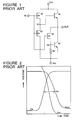
- the shown conventional BiCMOS logic circuit comprises a complementary MOS (CMOS) inverter composed of a PMOS transistor 10 and a NMOS transistor 12 connected in series between a high voltage supply line V CC and a low voltage supply line V EE .
- CMOS complementary MOS
- a source of the PMOS transistor 10 is connected to the high voltage supply line V CC
- a source of the NMOS transistor 12 is connected to the low voltage supply line V EE .
- Gates of these MOS transistors are connected to an input terminal IN. Drains of the PMOS transistor 10 and the NMOS transistor 12 are connected to each other and forms an output node N1 of the CMOS inverter.
- the BiCMOS logic circuit also includes a bipolar output circuit composed of two NPN bipolar transistors 14 and 16 connected in series between the high voltage supply line V CC and the low voltage supply line V EE .
- the bipolar transistor 14 has a collector connected to the high voltage supply line V CC , and an emitter connected to a collector of the bipolar transistor 16, whose emitter is connected to the low voltage supply line V EE .
- a base of the bipolar transistor 14 connected to the output node N1 of the CMOS inverter.
- a NMOS transistor 18 is connected between the collector and a base of the bipolar transistor 16 connected to the low voltage supply line V EE in such a manner that a drain of the NMOS transistor 18 is connected to the collector of the bipolar transistor 16 and a source of the NMOS transistor 18 is connected to the base of the bipolar transistor 16.
- a gate of the NMOS transistor 18 is connected to the input terminal IN.
- the base of the bipolar transistor 16 is connected to the low voltage supply line V EE through a resistor 20.
- the connection node between the two NPN bipolar transistors 14 and 16 is connected to an output terminal OUT of the BiCMOS logic circuit.
- the base of the bipolar transistor 16 is called a node N2 hereinafter.
- BiCMOS logic circuit when a potential on the output terminal OUT is fallen down, an electric charge on the output terminal OUT is extracted through the bipolar transistor 16 connected to the low voltage supply line V EE .
- a base current for bringing the transistor 16 conductive is supplied by the NMOS transistor 18 which is connected between the collector and the base of the bipolar transistor 16 and which receives at the base thereof an input signal on the input terminal IN.
- the collector-base voltage of the transistor 16 is rendered small as a result of the drop of the voltage on the output terminal OUT
- the source-drain voltage of the NMOS transistor 18 is correspondingly rendered small.
- the NMOS transistor 18 will operate in a linear operation region, so that the NMOS transistor 18 can no longer supply a sufficient base current to the bipolar transistor 16. Accordingly, the falling speed of the potential of the ouput terminal OUT becomes low, with the result that the BiCMOS logic circuit has a substantial delay time.
- FIG. 2 shows variations of a voltage V IN on the input terminal IN, a voltage V OUT on the output terminal OUT, and a voltage V N1 on the output node N1 of the CMOS inverter.
- the voltage V N1 quickly falls down in response to a rising of the voltage V IN , the voltage V OUT drops with a delay. Namely, a propagation delay time tpd is large. The reason for this is that a sufficient base current is not supplied to the bipolar transistor 16, and therefore, a collector current of the bipolar transistor 16 is restricted to a low value.
- a gate width and a gate length of the PMOS transistor 10 and the NMOS transistors 12 and 18 are 20 ⁇ m and 1.5 ⁇ m, 5 ⁇ m and 1.3 ⁇ m, and 10 ⁇ m and 1.3 ⁇ m, respectively, and an emitter area of each of the bipolar transistors 14 and 16 are 7.2 ⁇ m2.
- the resister 20 has 20K ⁇ and a supply voltage (between V CC and V EE ) is 4.5V. In this case, the delay time tpd becomes 0.63ns.
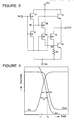
- FIG 3 there is shown a circuit diagram of a first embodiment of the BiCMOS logic circuit in accordance with the present invention.
- elements similar to those shown in Figure 1 are given the same Reference Numerals, and explanation thereof will be omitted for simplification.
- the circuit shown in Figure 3 includes a series circuit composed of NMOS transistors 22 and 24 in addition to the circuit shown in Figure 1.
- the NMOS transistor 22 has a drain connected to the high voltage supply line V CC , and a gate connected to the output node N1 of the CMOS inverter.
- a source of the NMOS transistor 22 is connected to a drain of the NMOS transistor 24, which is connected at a source thereof to the node N2, namely the base of the bipolar transistor 16.
- a gate of the NMOS transistor 24 is connected to the input terminal 10.
- Figure 4 illustrates variations of a voltage V IN on the input terminal IN, a voltage V OUT on the output terminal OUT, and a voltage V N1 on the output node N1 of the CMOS inverter in the circuit shown in Figure 3.
- the voltage V N1 on the output node N1 of the CMOS inverter starts to fall down with a short and determined time delay after the moment the input signal V1 starts to rise up.
- the NMOS transistor 24 is turned on at a moment t1, and thereafter, as a result of the falling of the node voltage V N1 , the NMOS transistor 22 is turned off at a moment t2. Therefore, for a period of time to from the moment t1 to the moment t2, a current is supplied directly to the base of the bipolar transistor 16 through the two series-connected NMOS transistors 22 and 24 from the high voltage supply line V CC , in addition to a conventional base current supply path formed of the transistor 18. Accordingly, the base current of the bipolar transistor 16 is increased, and therefore, the collector current of the bipolar transistor 16 is correspondingly increased. As a result, the speed of extracting the electric charge from the output terminal OUT is increased, and accordingly, the propagation delay time tpd is decreased.
- a gate width and a gate length of the PMOS transistor 10 and the NMOS transistors 12, 18, 22 and 24 are 20 ⁇ m and 1.5 ⁇ m, 5 ⁇ m and 1.3 ⁇ m, 10 ⁇ m and 1.3 ⁇ m, 20 ⁇ m and 1.3 ⁇ m, and 20 ⁇ m and 1.3 ⁇ m, respectively, and an emitter area of each of the bipolar transistors 14 and 16 are 7.2 ⁇ m2.
- the resister 20 has 20K ⁇ and a supply voltage is 4.5V. In this case, the delay time tpd becomes 0.48ns, which has been reduced from that of the circuit shown in Figure 1 by 24%.
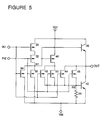
- FIG. 5 there is shown a circuit diagram of a second embodiment of the BiCMOS logic circuit in accordance with the present invention.
- This BiCMOS logic circuit forms a two-input NOR circuit.
- the shown BiCMOS circuit comprises a two-input CMOS NOR circuit, which includes a first PMOS transistor 30 having a gate connected to a first input terminal IN1 and a source connected to a high voltage supply line V CC , and a second PMOS transistor 32 having a gate connected to a second input terminal IN2 and a source connected to a drain of the first PMOS transistor 30.
- the two-input CMOS NOR circuit also includes a first NMOS transistor 34 having a gate connected to the first input terminal IN1, a drain connected to a drain of the second PMOS transistor 32, and a source connected to a low voltage supply line V EE , and a second NMOS transistor 36 having a gate connected to the second input terminal IN2, a drain connected to the drain of the second PMOS transistor 32, and a source connected to the low voltage supply line V EE .
- a connection node N1 between the PMOS transistor 32 and the two NMOS transistors 34 and 36 forms an output node of the CMOS NOR circuit.
- the shown BiCMOS circuit further comprises a bipolar output circuit composed of a first NPN bipolar transistor 38 having a collector connected to the high voltage supply line V CC and a base connected to output node N1 of the CMOS NOR circuit, and a second NPN bipolar transistor 40 having a collector connected to an emitter of the NPN bipolar transistor 38 and an emitter connected to the low voltage supply line V EE .
- a base of the second NPN bipolar transistor 40 is connected through a resister 42 to the low voltage supply line V EE .
- two NMOS transistors 44 and 46 are connected between the collector and the base of the second NPN bipolar transistor 40.
- a gate of the NMOS transistors 44 is connected to the first input terminal IN1, and a gate of the NMOS transistors 46 is connected to the second input terminal IN2.
- the connection node between the bipolar transistors 38 and 40 is connected to an output terminal OUT.
- the shown BiCMOS circuit includes a series circuit composed of a NMOS transistor 46 and a parallel circuit of two NMOS transistors 48 and 50, as shown in Figure 5.
- the series circuit is connected between the high voltage supply line V CC and the base N2 of the bipolar transistor 40.
- a drain of the NMOS transistor 46 is connected to the high voltage supply line V CC and a gate of the NMOS transistor 46 is connected to the node N1 of the CMOS NOR circuit.
- a source of the NMOS transistor 46 is connected commonly to drains of the NMOS transistors 48 and 50, whose sources are commonly connected to the base N2 of the bipolar transistor 40.
- a gate of the NMOS transistor 48 is connected to the first input terminal IN1 and a gate of the NMOS transistor 50 is connected to the second input terminal IN2.
- the NMOS transistor 48 (or 50) is turned on in the course of the rising of the first input signal voltage V IN1 (or the second input signal voltage V IN2 ).
- a current path passing through the NMOS transistor 46 and the NMOS transistor 48 (or 50) is formed to supply an additional base current from the high voltage supply line to the base of the bipolar transistor 40. Namely, the base current of the bipolar transistor 40 is increased. This condition is maintained for a constant period of time until the NMOS transistor 46 is turned off as a result of the voltage falling of the output node N1 of the CMOS NOR circuit. Therefore, a collector current of the bipolar transistor 40 is correspondingly increased, and accordingly, the propagation time tpd is rendered small.
- the BiCMOS logic circuit in accordance with the present invention is characterized by provision of an additional base current supplying circuit connected between a high voltage supply line and a base of a bipolar transistor for extracting electric charges on the output terminal.
- the additional base current supplying circuit has first and second control inputs connected to an input and an output of a MOS logic circuit, respectively, so that the additional base current supplying circuit operates to supply an additional base current to the base of the electric charge extracting bipolar transistor from the high voltage supply line for a constant time after a logical level on said input terminal starts to change, utilizing the fact that the potential of the output of the MOS logic circuit will change with a little but constant delay from a voltage change of the input of the MOS logic circuit.
- a a result the signal propagation time of the BiCMOS logic circuit when the output terminal potential is fallen down can be made small.
Landscapes
- Engineering & Computer Science (AREA)
- Physics & Mathematics (AREA)
- Computer Hardware Design (AREA)
- Computing Systems (AREA)
- General Engineering & Computer Science (AREA)
- Mathematical Physics (AREA)
- Power Engineering (AREA)
- Logic Circuits (AREA)
- Electronic Switches (AREA)
Abstract
Description
- The present invention relates to a BiCMOS logic circuit, and more specifically to a BiCMOS logic circuit having a high operation speed.
- In general, BiCMOS logic circuits have been composed of an input MOS logic circuit and an output bipolar circuit. Conventionally, when electric charges on an output of the bipolar circuit is discharged to pull down an output voltage of the bipolar circuit, a base current for a bipolar transistor for extracting the electric charge on the output of the bipolar circuit is supplied by only a MOS transistor whose gate is connected to a logic input of the input MOS logic circuit and whose drain-source path is connected between a collector and the base of the charge extracting bipolar transistor. In this arrangement, if the collector-base voltage of the charge extracting bipolar transistor becomes lowered as a result of the discharge of the electric charge on the output of the bipolar circuit, the drain-source voltage of the base current supplying MOS transistor is correspondingly decreased, so that the MOS transistor will become to operate in a linear region. As a result, a sufficient base current is not supplied to the charge extracting bipolar transistor, so that the voltage falling down speed of the output of the bipolar circuit becomes small. Thus, the BiCMOS logic circuit has a large delay time, and a long signal propagation time.
- Accordingly, it is an object of the present invention to provide a BiCMOS logic circuit which has overcome the above mentioned defect of the conventional one.
- Another object of the present invention is to provide a BiCMOS logic circuit has a shortened signal propagation time when an output voltage falls down.
- The above and other objects of the present invention are achieved in accordance with the present invention by a BiCMOS logic circuit which includes an input terminal, an output terminal, a MOS logic circuit connected between a first voltage supply line and a second voltage supply line and having an input connected to the input terminal, and an output circuit composed of first and second bipolar transistors connected in series between the first voltage supply line and the second voltage supply line, the first bipolar transistor having a base connected to an output of the MOS logic circuit, a connection node of the first and second bipolar transistors being connected to the output terminal, comprising a base current supplying circuit having first and second MOS transistors connected in series between the first voltage supply line and a base of the second bipolar transistor, the first MOS transistor having a gate connected to the output of the MOS logic circuit, the second MOS transistor having a gate connected to the input terminal.
- The above and other objects, features and advantages of the present invention will be apparent from the following description of preferred embodiments of the invention with reference to the accompanying drawings.
-
- Figure 1 is a circuit diagram illustrating one example of a conventional BiCMOS logic circuit;
- Figure 2 is a waveform diagram showing voltage variations on various points in the circuit shown in Figure 1;
- Figure 3 is a circuit diagram of a first embodiment of the BiCMOS logic circuit in accordance with the present invention;
- Figure 4 is a waveform diagram showing voltage variations on various points in the circuit shown in Figure 3; and
- Figure 5 is a circuit diagram of a second embodiment of the BiCMOS logic circuit in accordance with the present invention;
- Referring to Figure 1, there is shown a circuit diagram illustrating one example of a conventional BiCMOS logic circuit. The shown conventional BiCMOS logic circuit comprises a complementary MOS (CMOS) inverter composed of a
PMOS transistor 10 and aNMOS transistor 12 connected in series between a high voltage supply line VCC and a low voltage supply line VEE. Specifically, a source of thePMOS transistor 10 is connected to the high voltage supply line VCC, and a source of theNMOS transistor 12 is connected to the low voltage supply line VEE. Gates of these MOS transistors are connected to an input terminal IN. Drains of thePMOS transistor 10 and theNMOS transistor 12 are connected to each other and forms an output node N1 of the CMOS inverter. - The BiCMOS logic circuit also includes a bipolar output circuit composed of two NPN
bipolar transistors bipolar transistor 14 has a collector connected to the high voltage supply line VCC, and an emitter connected to a collector of thebipolar transistor 16, whose emitter is connected to the low voltage supply line VEE. A base of thebipolar transistor 14 connected to the output node N1 of the CMOS inverter. In addition, aNMOS transistor 18 is connected between the collector and a base of thebipolar transistor 16 connected to the low voltage supply line VEE in such a manner that a drain of theNMOS transistor 18 is connected to the collector of thebipolar transistor 16 and a source of theNMOS transistor 18 is connected to the base of thebipolar transistor 16. A gate of theNMOS transistor 18 is connected to the input terminal IN. The base of thebipolar transistor 16 is connected to the low voltage supply line VEE through aresistor 20. The connection node between the two NPNbipolar transistors bipolar transistor 16 is called a node N2 hereinafter. - With the above mentioned arrangement of BiCMOS logic circuit, when a potential on the output terminal OUT is fallen down, an electric charge on the output terminal OUT is extracted through the
bipolar transistor 16 connected to the low voltage supply line VEE. In addition, a base current for bringing thetransistor 16 conductive is supplied by theNMOS transistor 18 which is connected between the collector and the base of thebipolar transistor 16 and which receives at the base thereof an input signal on the input terminal IN. - Therefore, when the collector-base voltage of the
transistor 16 is rendered small as a result of the drop of the voltage on the output terminal OUT, the source-drain voltage of theNMOS transistor 18 is correspondingly rendered small. As a result, theNMOS transistor 18 will operate in a linear operation region, so that theNMOS transistor 18 can no longer supply a sufficient base current to thebipolar transistor 16. Accordingly, the falling speed of the potential of the ouput terminal OUT becomes low, with the result that the BiCMOS logic circuit has a substantial delay time. - This phenomenon will be illustrated in Figure 2, which shows variations of a voltage VIN on the input terminal IN, a voltage VOUT on the output terminal OUT, and a voltage VN1 on the output node N1 of the CMOS inverter. Although the voltage VN1 quickly falls down in response to a rising of the voltage VIN, the voltage VOUT drops with a delay. Namely, a propagation delay time tpd is large. The reason for this is that a sufficient base current is not supplied to the
bipolar transistor 16, and therefore, a collector current of thebipolar transistor 16 is restricted to a low value. For example, assume that a gate width and a gate length of thePMOS transistor 10 and theNMOS transistors bipolar transistors resister 20 has 20KΩ and a supply voltage (between VCC and VEE) is 4.5V. In this case, the delay time tpd becomes 0.63ns. - Referring to Figure 3, there is shown a circuit diagram of a first embodiment of the BiCMOS logic circuit in accordance with the present invention. In Figure 3, elements similar to those shown in Figure 1 are given the same Reference Numerals, and explanation thereof will be omitted for simplification.
- As seen from comparison between Figures 1 and 3, the circuit shown in Figure 3 includes a series circuit composed of
NMOS transistors NMOS transistor 22 has a drain connected to the high voltage supply line VCC, and a gate connected to the output node N1 of the CMOS inverter. A source of theNMOS transistor 22 is connected to a drain of theNMOS transistor 24, which is connected at a source thereof to the node N2, namely the base of thebipolar transistor 16. A gate of theNMOS transistor 24 is connected to theinput terminal 10. - Now, an operation of the circuit shown in Figure 3 will be described with reference to Figure 4 which illustrates variations of a voltage VIN on the input terminal IN, a voltage VOUT on the output terminal OUT, and a voltage VN1 on the output node N1 of the CMOS inverter in the circuit shown in Figure 3. As shown in Figure 4, when the input signal voltage VIN on the input terminal IN is brought from a low voltage level to a high voltage level, the voltage VN1 on the output node N1 of the CMOS inverter starts to fall down with a short and determined time delay after the moment the input signal V1 starts to rise up. As a result of the rising of the input signal voltage VIN, the
NMOS transistor 24 is turned on at a moment t₁, and thereafter, as a result of the falling of the node voltage VN1, theNMOS transistor 22 is turned off at a moment t₂. Therefore, for a period of time to from the moment t₁ to the moment t₂, a current is supplied directly to the base of thebipolar transistor 16 through the two series-connectedNMOS transistors transistor 18. Accordingly, the base current of thebipolar transistor 16 is increased, and therefore, the collector current of thebipolar transistor 16 is correspondingly increased. As a result, the speed of extracting the electric charge from the output terminal OUT is increased, and accordingly, the propagation delay time tpd is decreased. - For example, assume that a gate width and a gate length of the
PMOS transistor 10 and theNMOS transistors bipolar transistors resister 20 has 20KΩ and a supply voltage is 4.5V. In this case, the delay time tpd becomes 0.48ns, which has been reduced from that of the circuit shown in Figure 1 by 24%. - Turning to Figure 5, there is shown a circuit diagram of a second embodiment of the BiCMOS logic circuit in accordance with the present invention. This BiCMOS logic circuit forms a two-input NOR circuit.
- The shown BiCMOS circuit comprises a two-input CMOS NOR circuit, which includes a
first PMOS transistor 30 having a gate connected to a first input terminal IN1 and a source connected to a high voltage supply line VCC, and asecond PMOS transistor 32 having a gate connected to a second input terminal IN2 and a source connected to a drain of thefirst PMOS transistor 30. The two-input CMOS NOR circuit also includes afirst NMOS transistor 34 having a gate connected to the first input terminal IN1, a drain connected to a drain of thesecond PMOS transistor 32, and a source connected to a low voltage supply line VEE, and asecond NMOS transistor 36 having a gate connected to the second input terminal IN2, a drain connected to the drain of thesecond PMOS transistor 32, and a source connected to the low voltage supply line VEE. A connection node N1 between thePMOS transistor 32 and the twoNMOS transistors - The shown BiCMOS circuit further comprises a bipolar output circuit composed of a first NPN
bipolar transistor 38 having a collector connected to the high voltage supply line VCC and a base connected to output node N1 of the CMOS NOR circuit, and a second NPNbipolar transistor 40 having a collector connected to an emitter of the NPNbipolar transistor 38 and an emitter connected to the low voltage supply line VEE. A base of the second NPNbipolar transistor 40 is connected through a resister 42 to the low voltage supply line VEE. In addition, twoNMOS transistors bipolar transistor 40. A gate of theNMOS transistors 44 is connected to the first input terminal IN1, and a gate of theNMOS transistors 46 is connected to the second input terminal IN2. The connection node between thebipolar transistors - The above mentioned construction is similar to conventional two-input BiCMOS NOR circuits. In addition to the above mentioned construction, the shown BiCMOS circuit includes a series circuit composed of a
NMOS transistor 46 and a parallel circuit of twoNMOS transistors bipolar transistor 40. Specifically, a drain of theNMOS transistor 46 is connected to the high voltage supply line VCC and a gate of theNMOS transistor 46 is connected to the node N1 of the CMOS NOR circuit. A source of theNMOS transistor 46 is connected commonly to drains of theNMOS transistors bipolar transistor 40. A gate of theNMOS transistor 48 is connected to the first input terminal IN1 and a gate of theNMOS transistor 50 is connected to the second input terminal IN2. - In the above mentioned BiCMOS logic circuit, when the signal voltage VIN1 on the first input terminal IN1 (or the signal voltage VIN2 on the second input terminal IN2) is brought from a low logical level to a high logical level under a condition that the second input signal voltage VIN2 (or the first input signal voltage VIN1) is maintained at the low logical level, the NMOS transistor 48 (or 50) is turned on in the course of the rising of the first input signal voltage VIN1 (or the second input signal voltage VIN2). At this time, since the
NMOS transistor 46 is in an ON condition in response to a high logical level on the output node N1 of the CMOS NOR circuit, a current path passing through theNMOS transistor 46 and the NMOS transistor 48 (or 50) is formed to supply an additional base current from the high voltage supply line to the base of thebipolar transistor 40. Namely, the base current of thebipolar transistor 40 is increased. This condition is maintained for a constant period of time until theNMOS transistor 46 is turned off as a result of the voltage falling of the output node N1 of the CMOS NOR circuit. Therefore, a collector current of thebipolar transistor 40 is correspondingly increased, and accordingly, the propagation time tpd is rendered small. - As seen from the above explanation, the BiCMOS logic circuit in accordance with the present invention is characterized by provision of an additional base current supplying circuit connected between a high voltage supply line and a base of a bipolar transistor for extracting electric charges on the output terminal. The additional base current supplying circuit has first and second control inputs connected to an input and an output of a MOS logic circuit, respectively, so that the additional base current supplying circuit operates to supply an additional base current to the base of the electric charge extracting bipolar transistor from the high voltage supply line for a constant time after a logical level on said input terminal starts to change, utilizing the fact that the potential of the output of the MOS logic circuit will change with a little but constant delay from a voltage change of the input of the MOS logic circuit. A a result, the signal propagation time of the BiCMOS logic circuit when the output terminal potential is fallen down can be made small.
- The above mentioned embodiments has been directed to the inverter and the NOR circuit. However, the circuit in accordance with the present invention can be applied to the other BiCMOS logic circuits including an AND circuit, an OR circuit, an NAND circuit, etc.
- The invention has thus been shown and described with reference to the specific embodiments. However, it should be noted that the present invention is in no way limited to the details of the illustrated structures but changes and modifications may be made within the scope of the appended claims.
Claims (10)
Applications Claiming Priority (2)
| Application Number | Priority Date | Filing Date | Title |
|---|---|---|---|
| JP240176/88 | 1988-09-26 | ||
| JP63240176A JP2696991B2 (en) | 1988-09-26 | 1988-09-26 | BiCMOS logic circuit |
Publications (3)
| Publication Number | Publication Date |
|---|---|
| EP0361841A2 true EP0361841A2 (en) | 1990-04-04 |
| EP0361841A3 EP0361841A3 (en) | 1990-10-31 |
| EP0361841B1 EP0361841B1 (en) | 1996-03-06 |
Family
ID=17055604
Family Applications (1)
| Application Number | Title | Priority Date | Filing Date |
|---|---|---|---|
| EP89309751A Expired - Lifetime EP0361841B1 (en) | 1988-09-26 | 1989-09-26 | Bicmos logic circuit |
Country Status (4)
| Country | Link |
|---|---|
| US (1) | US4985645A (en) |
| EP (1) | EP0361841B1 (en) |
| JP (1) | JP2696991B2 (en) |
| DE (1) | DE68925856T2 (en) |
Cited By (2)
| Publication number | Priority date | Publication date | Assignee | Title |
|---|---|---|---|---|
| EP0547773A1 (en) * | 1991-12-19 | 1993-06-23 | Sun Microsystems, Inc. | Reset gate for a phase detector in a phase-locked loop |
| GB2264832A (en) * | 1992-03-06 | 1993-09-08 | Samsung Electronics Co Ltd | Bicmos driving circuit |
Families Citing this family (12)
| Publication number | Priority date | Publication date | Assignee | Title |
|---|---|---|---|---|
| JPH043619A (en) * | 1990-04-20 | 1992-01-08 | Toshiba Corp | Semiconductor integrated circuit |
| KR930004353B1 (en) * | 1990-04-26 | 1993-05-26 | 한국전기통신공사 | Third state output circuit of BiCMOS |
| JPH0420121A (en) * | 1990-05-15 | 1992-01-23 | Fujitsu Ltd | Bi-cmos circuit |
| US5153464A (en) * | 1990-12-14 | 1992-10-06 | Hewlett-Packard Company | Bicmos tri-state output buffer |
| US5077490A (en) * | 1991-01-30 | 1991-12-31 | Northern Telecom Limited | Schottky-diode emulator for BiCMOS logic circuit |
| US5132567A (en) * | 1991-04-18 | 1992-07-21 | International Business Machines Corporation | Low threshold BiCMOS circuit |
| US5287021A (en) * | 1992-05-06 | 1994-02-15 | Motorola, Inc. | Low noise BICMOS circuit |
| US5355030A (en) * | 1992-12-04 | 1994-10-11 | International Business Machines Corporation | Low voltage BICMOS logic switching circuit |
| US5332933A (en) * | 1993-01-21 | 1994-07-26 | Hewlett-Packard Company | Bipolar-MOS circuits with dimensions scaled to enhance performance |
| US5438270A (en) * | 1994-06-24 | 1995-08-01 | National Semiconductor Corporation | Low battery tester comparing load and no-load battery voltage |
| EP1776970A1 (en) * | 2005-10-12 | 2007-04-25 | Albert Schömig | Implant with multiple coating |
| CN105915211A (en) * | 2016-05-17 | 2016-08-31 | 深圳芯能半导体技术有限公司 | Non-superposing circuit and high-voltage driving circuit |
Family Cites Families (10)
| Publication number | Priority date | Publication date | Assignee | Title |
|---|---|---|---|---|
| JPS60125015A (en) * | 1983-12-12 | 1985-07-04 | Hitachi Ltd | inverter circuit |
| JPH0616585B2 (en) * | 1983-12-16 | 1994-03-02 | 株式会社日立製作所 | Buffer circuit |
| JPH07107973B2 (en) * | 1984-03-26 | 1995-11-15 | 株式会社日立製作所 | Switching circuit |
| US4616146A (en) * | 1984-09-04 | 1986-10-07 | Motorola, Inc. | BI-CMOS driver circuit |
| US4638186A (en) * | 1985-12-02 | 1987-01-20 | Motorola, Inc. | BIMOS logic gate |
| US4649294A (en) * | 1986-01-13 | 1987-03-10 | Motorola, Inc. | BIMOS logic gate |
| JPS6362411A (en) * | 1986-09-02 | 1988-03-18 | Nec Corp | Semiconductor circuit |
| JPS6382122A (en) * | 1986-09-26 | 1988-04-12 | Toshiba Corp | Logic circuit |
| US4839537A (en) * | 1986-11-29 | 1989-06-13 | Kabushiki Kaisha Toshiba | BicMO logic circuit |
| JPS63202126A (en) * | 1987-02-17 | 1988-08-22 | Toshiba Corp | Logic circuit |
-
1988
- 1988-09-26 JP JP63240176A patent/JP2696991B2/en not_active Expired - Lifetime
-
1989
- 1989-09-26 DE DE68925856T patent/DE68925856T2/en not_active Expired - Fee Related
- 1989-09-26 US US07/412,814 patent/US4985645A/en not_active Expired - Fee Related
- 1989-09-26 EP EP89309751A patent/EP0361841B1/en not_active Expired - Lifetime
Cited By (3)
| Publication number | Priority date | Publication date | Assignee | Title |
|---|---|---|---|---|
| EP0547773A1 (en) * | 1991-12-19 | 1993-06-23 | Sun Microsystems, Inc. | Reset gate for a phase detector in a phase-locked loop |
| GB2264832A (en) * | 1992-03-06 | 1993-09-08 | Samsung Electronics Co Ltd | Bicmos driving circuit |
| GB2264832B (en) * | 1992-03-06 | 1995-10-18 | Samsung Electronics Co Ltd | Bicmos driving circuit |
Also Published As
| Publication number | Publication date |
|---|---|
| JPH0287819A (en) | 1990-03-28 |
| DE68925856T2 (en) | 1996-08-01 |
| DE68925856D1 (en) | 1996-04-11 |
| EP0361841B1 (en) | 1996-03-06 |
| EP0361841A3 (en) | 1990-10-31 |
| US4985645A (en) | 1991-01-15 |
| JP2696991B2 (en) | 1998-01-14 |
Similar Documents
| Publication | Publication Date | Title |
|---|---|---|
| US4845386A (en) | Bi-MOS logic circuit having a totem pole type output buffer section | |
| US4449063A (en) | Logic circuit with improved switching | |
| US5047669A (en) | Tristate circuit using bipolar transistor and CMOS transistor | |
| EP0361841B1 (en) | Bicmos logic circuit | |
| US4804869A (en) | BiMOS logical circuit | |
| US4678940A (en) | TTL compatible merged bipolar/CMOS output buffer circuits | |
| EP0279332A1 (en) | A logic circuit used in standard IC of CMOS logic level | |
| US5663659A (en) | Semiconductor integrated circuit device comprising CMOS transistors and differentiator | |
| US5055713A (en) | Output circuit of semiconductor integrated circuit | |
| US4725982A (en) | Tri-state buffer circuit | |
| US4804868A (en) | BiMOS logical circuit | |
| JPH0583004B2 (en) | ||
| KR900000487B1 (en) | Logic gate circuit | |
| US4880998A (en) | Bipolar transistor and CMOS transistor logic circuit having improved discharge capabilities | |
| EP0768762A1 (en) | Output circuit | |
| US5254885A (en) | Bi-CMOS logic circuit with feedback | |
| US5057713A (en) | Bipolar MOS logic circuit and semiconductor integrated circuit | |
| US5138195A (en) | Bi-CMOS logic circuit having full voltage swing and rapid turn-off | |
| US5159214A (en) | Bicmos logic circuit | |
| US5132566A (en) | BiMOS semiconductor integrated circuit having short-circuit protection | |
| EP0426547A2 (en) | Bi-CMOS circuit | |
| US5097150A (en) | Bi-cmos logic circuit | |
| EP0432472A2 (en) | Signal output circuit having bipolar transistor in output stage and arranged in CMOS semiconductor integrated circuit | |
| EP0054408B1 (en) | Logic circuit | |
| US5247214A (en) | Bi-cmos out buffer circuit for cmos logic |
Legal Events
| Date | Code | Title | Description |
|---|---|---|---|
| PUAI | Public reference made under article 153(3) epc to a published international application that has entered the european phase |
Free format text: ORIGINAL CODE: 0009012 |
|
| 17P | Request for examination filed |
Effective date: 19891010 |
|
| AK | Designated contracting states |
Kind code of ref document: A2 Designated state(s): DE FR GB |
|
| PUAL | Search report despatched |
Free format text: ORIGINAL CODE: 0009013 |
|
| AK | Designated contracting states |
Kind code of ref document: A3 Designated state(s): DE FR GB |
|
| 17Q | First examination report despatched |
Effective date: 19930709 |
|
| GRAA | (expected) grant |
Free format text: ORIGINAL CODE: 0009210 |
|
| AK | Designated contracting states |
Kind code of ref document: B1 Designated state(s): DE FR GB |
|
| REF | Corresponds to: |
Ref document number: 68925856 Country of ref document: DE Date of ref document: 19960411 |
|
| ET | Fr: translation filed | ||
| PLBE | No opposition filed within time limit |
Free format text: ORIGINAL CODE: 0009261 |
|
| STAA | Information on the status of an ep patent application or granted ep patent |
Free format text: STATUS: NO OPPOSITION FILED WITHIN TIME LIMIT |
|
| 26N | No opposition filed | ||
| PGFP | Annual fee paid to national office [announced via postgrant information from national office to epo] |
Ref country code: FR Payment date: 20000912 Year of fee payment: 12 |
|
| PGFP | Annual fee paid to national office [announced via postgrant information from national office to epo] |
Ref country code: DE Payment date: 20000918 Year of fee payment: 12 |
|
| PGFP | Annual fee paid to national office [announced via postgrant information from national office to epo] |
Ref country code: GB Payment date: 20000920 Year of fee payment: 12 |
|
| PG25 | Lapsed in a contracting state [announced via postgrant information from national office to epo] |
Ref country code: GB Free format text: LAPSE BECAUSE OF NON-PAYMENT OF DUE FEES Effective date: 20010926 |
|
| REG | Reference to a national code |
Ref country code: GB Ref legal event code: IF02 |
|
| PG25 | Lapsed in a contracting state [announced via postgrant information from national office to epo] |
Ref country code: DE Free format text: LAPSE BECAUSE OF NON-PAYMENT OF DUE FEES Effective date: 20020501 |
|
| GBPC | Gb: european patent ceased through non-payment of renewal fee |
Effective date: 20010926 |
|
| PG25 | Lapsed in a contracting state [announced via postgrant information from national office to epo] |
Ref country code: FR Free format text: LAPSE BECAUSE OF NON-PAYMENT OF DUE FEES Effective date: 20020531 |
|
| REG | Reference to a national code |
Ref country code: FR Ref legal event code: ST |