EP0361886A2 - Gleitkommarechner - Google Patents
Gleitkommarechner Download PDFInfo
- Publication number
- EP0361886A2 EP0361886A2 EP89309826A EP89309826A EP0361886A2 EP 0361886 A2 EP0361886 A2 EP 0361886A2 EP 89309826 A EP89309826 A EP 89309826A EP 89309826 A EP89309826 A EP 89309826A EP 0361886 A2 EP0361886 A2 EP 0361886A2
- Authority
- EP
- European Patent Office
- Prior art keywords
- result
- carry
- subtraction
- propagate
- outputs
- Prior art date
- Legal status (The legal status is an assumption and is not a legal conclusion. Google has not performed a legal analysis and makes no representation as to the accuracy of the status listed.)
- Granted
Links
Images


Classifications
-
- G—PHYSICS
- G06—COMPUTING OR CALCULATING; COUNTING
- G06F—ELECTRIC DIGITAL DATA PROCESSING
- G06F7/00—Methods or arrangements for processing data by operating upon the order or content of the data handled
- G06F7/38—Methods or arrangements for performing computations using exclusively denominational number representation, e.g. using binary, ternary, decimal representation
- G06F7/48—Methods or arrangements for performing computations using exclusively denominational number representation, e.g. using binary, ternary, decimal representation using non-contact-making devices, e.g. tube, solid state device; using unspecified devices
- G06F7/483—Computations with numbers represented by a non-linear combination of denominational numbers, e.g. rational numbers, logarithmic number system or floating-point numbers
- G06F7/485—Adding; Subtracting
-
- G—PHYSICS
- G06—COMPUTING OR CALCULATING; COUNTING
- G06F—ELECTRIC DIGITAL DATA PROCESSING
- G06F5/00—Methods or arrangements for data conversion without changing the order or content of the data handled
- G06F5/01—Methods or arrangements for data conversion without changing the order or content of the data handled for shifting, e.g. justifying, scaling, normalising
- G06F5/012—Methods or arrangements for data conversion without changing the order or content of the data handled for shifting, e.g. justifying, scaling, normalising in floating-point computations
-
- G—PHYSICS
- G06—COMPUTING OR CALCULATING; COUNTING
- G06F—ELECTRIC DIGITAL DATA PROCESSING
- G06F7/00—Methods or arrangements for processing data by operating upon the order or content of the data handled
- G06F7/38—Methods or arrangements for performing computations using exclusively denominational number representation, e.g. using binary, ternary, decimal representation
- G06F7/48—Methods or arrangements for performing computations using exclusively denominational number representation, e.g. using binary, ternary, decimal representation using non-contact-making devices, e.g. tube, solid state device; using unspecified devices
- G06F7/52—Multiplying; Dividing
- G06F7/535—Dividing only
-
- G—PHYSICS
- G06—COMPUTING OR CALCULATING; COUNTING
- G06F—ELECTRIC DIGITAL DATA PROCESSING
- G06F7/00—Methods or arrangements for processing data by operating upon the order or content of the data handled
- G06F7/38—Methods or arrangements for performing computations using exclusively denominational number representation, e.g. using binary, ternary, decimal representation
- G06F7/48—Methods or arrangements for performing computations using exclusively denominational number representation, e.g. using binary, ternary, decimal representation using non-contact-making devices, e.g. tube, solid state device; using unspecified devices
- G06F7/52—Multiplying; Dividing
- G06F7/535—Dividing only
- G06F7/537—Reduction of the number of iteration steps or stages, e.g. using the Sweeny-Robertson-Tocher [SRT] algorithm
- G06F7/5375—Non restoring calculation, where each digit is either negative, zero or positive, e.g. SRT
-
- G—PHYSICS
- G06—COMPUTING OR CALCULATING; COUNTING
- G06F—ELECTRIC DIGITAL DATA PROCESSING
- G06F2207/00—Indexing scheme relating to methods or arrangements for processing data by operating upon the order or content of the data handled
- G06F2207/38—Indexing scheme relating to groups G06F7/38 - G06F7/575
- G06F2207/3804—Details
- G06F2207/3808—Details concerning the type of numbers or the way they are handled
- G06F2207/3832—Less usual number representations
- G06F2207/3844—Hexadecimal
-
- G—PHYSICS
- G06—COMPUTING OR CALCULATING; COUNTING
- G06F—ELECTRIC DIGITAL DATA PROCESSING
- G06F7/00—Methods or arrangements for processing data by operating upon the order or content of the data handled
- G06F7/38—Methods or arrangements for performing computations using exclusively denominational number representation, e.g. using binary, ternary, decimal representation
- G06F7/48—Methods or arrangements for performing computations using exclusively denominational number representation, e.g. using binary, ternary, decimal representation using non-contact-making devices, e.g. tube, solid state device; using unspecified devices
- G06F7/483—Computations with numbers represented by a non-linear combination of denominational numbers, e.g. rational numbers, logarithmic number system or floating-point numbers
- G06F7/487—Multiplying; Dividing
- G06F7/4873—Dividing
Definitions
- This invention relates generally to floating point unit computation techniques performed by data processing systems and, more particularly, to certain techniques for improving the costs and/or speed of operation of floating point computations.
- conventional techniques utilize multi-stage propagate/generate carry techniques for producing a subtraction result, e.g., a subtraction of operands A and B, algebraically represented by (A-B), and then utilize a complete redundant set of propagate/generate carry stages for producing the negative result, i.e., (B-A).
- the highest order carry-out bit of the (A-B) process is then used to determine which result to select in accordance with well-known binary arithmetic techniques.
- the need for a complete redundant set of propagate/generate carry stages undesirably increases the cost of the overall system in performing such operation.
- Other techniques which have been proposed to reduce costs by using fewer components have undesirably increased the overall time needed to perform the operation. It is desirable to perform the operations at as low a cost as possible without increasing the time required for the performance thereof.
- priority encoder circuitry for analyzing the overall exponent computation result in order to determine the number of leading zeroes therein. Once the number of leading zeroes is determined, such number is subtracted from the exponent value and the mantissa value is shifted to the left to eliminate the leading zeroes in accordance with well-known normalization techniques.
- the use of a priority encoder to operate upon the overall result in order to detect the number of leading zeroes has been found to undesirably increase the overall time needed for such operation. It is desirable therefore to determine the number of leading zeroes in a manner which would substantially reduce the conventionally required normalization time without unduly increasing the cost thereof.
- one of the quantities required to be obtained in the divisional algorithm is the value of the quotient (Q) times the remainder (REMR) subtracted from the remainder (REMR) which quantity is normally obtained by prestoring values of Q*REMR and obtaining the desired prestored value for a plurality of values of Q and REMR.
- Q the quotient
- REMR the remainder
- REMR the remainder
- High radix computation techniques are well known to the art. Once the prestored value of Q*REMR is accessed from the memory region where it is pre-stored, it is subtracted from and the division operation is completed. Such a technique requires a relatively large amount of time for the pregeneration of prestored Q*REMR values and a relatively large storage region, therefor.
- the accessing of the desired quantity (REMR - Q*REMR) there from and the subtraction thereof from the remainder using high radix techniques normally takes a relatively long time. It would be desirable to perform such overall operations in a much shorter time and to avoid the need for such a large storage region for such purpose.
- the invention avoids the need for using a completely redundant propagate/generate carry system and makes use of a portion of the same propagate/generate carry stages for both the (A-B) and (B-A) subtraction operations.
- the remaining carry generator stages are used to complete the (A-B) operation to achieve a first result R, while a number of more simplified carry generator stages are used to complete the (B-A) operation to achieve the negative result -R.
- the carry out bit from the (A-B) operation determines which result, i.e., R or -R, is to be used as the desired subtraction result.
- the use of common propagate/generate carry stages in determining both results and the use of simplified stages to complete the inverse subtraction result reduces the overall cost of the subtraction operation as compared with previously used techniques.
- the invention uses a novel technique in which the number of leading zeroes in each slice of a multi-slice exponent result is readily determined.
- Appropriate circuitry is then utilized in parallel with such determination to respond to each multi-slice result and such leading zero determination operation so as to determine which of the slices thereof is the highest order slice containing the first non-zero bit.
- Such slice is selected as the first higher order slice of the normalized result so that the number of zeroes therein, as well as in any higher order slices, is thereby readily determined.
- the number of leading zeroes is then suitably subtracted from the exponent value in such parallel operation and the mantissa result is appropriately left-shifted in order to perform the overall normalization process.
- Such approach has been found to increase the speed of the normalization process in comparison with the use of priority encoder circuitry operating on an entire exponent result.
- the invention utilizes an on-the-fly computation of the quantity (REMR - Q*REMR) by utilizing selected components of the multiplier circuitry of the floating point unit. Because of such on-the-fly operation, the desired final output quotient value is obtained more rapidly and without the need for a large storage region as in conventionally known techniques.
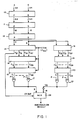
- FIG. 1 shows a block diagram which illustrates a particular embodiment of the technique of the invention in improving the performance of a subtraction operation of a mantissa in a floating point unit.
- the subtraction of two operands e g., (A-B)
- the binary digital addition can be represented by the quantity (A+ B +1), where B is the logical inverse of B, which quantity is in effect the algebraic equivalent of (A-B).
- Such technique is well known and is performed by utilizing a number of propagate/generate carry stages as depicted in FIG. 1.
- such operands are supplied to the first stage of a plurality of successive stages 10-12 of propagate/generate carry logic which produce, respectively, 64-bit, 16-bit and 4-bit propagate (P) and generate (G) outputs in accordance with conventional propagate/generate carry stage operations.
- the P and G outputs of generator stage 12 are supplied to a carry generator stage 13 which has a carry-in bit (CY IN) inserted at bit 63 thereof and is identified as (C63) so as to produce 3 output carry bits at bit positions 15, 31 and 47 (C15, C31 and C47) and a carry-out bit (C O ).
- the process for obtaining -R is greatly simplified by utilizing the P and G outputs from propagate/generate stage 12 for supply to a plurality of simplified carry generator stages 18, 19 and 20 as depicted in FIG. 1.
- no carry in (CY IN) bit is required at such stages and, accordingly, the logic required at each of such stages to produce the required output carry bits from the last stage 20 can be simplified.
- the carry bits from stage 20 are suitably combined with the propagation bits P at exclusive-or gates 21 to produce the - R output as shown.
- the carry bits from each of such stages each use the notation C′ to distinguish them from the carry bits generated at stages 13, 14 and 15.
- the R and -R outputs are supplied to a multiplexer circuit 22 (- R being inverted to produce -R as shown) which selects one or the other result depending on the presence or absence of a carry out (C O ) bit from stage 13 to produce the desired subtraction result, i.e., either (A-B) or (B-A).
- FIG. 2 discloses in block diagram form an embodiment of the invention which provides a unique and useful alternative normalization technique.
- a 64-bit mantissa result is supplied in four hexidecimal slices (from the highest order slice ⁇ to the lowest order slice 3) to each of a plurality of leading zero detection circuits 30, 31, 32 and 33, respectively.
- each slice is represented by four hexidecimal digits and, accordingly, the leading zeroes thereof are represented by one of five conditions.
- the first hexidecimal digit is non-zero; for one leading zero, the first hexidecimal digit is zero; for two leading zeroes, the first two hexidecimal digits are zero; and for three leading zeroes, the first three hexidecimal digits are zero.
- a fifth special condition can occur where all four hexidecimal digits are zero.
- Such conditions can be represented in effect by 3-bits, i.e., a highest order single bit output and two lower order output bits with respect to each 4-digit hexidecimal slice, as shown by the 1-bit and 2-bit outputs, respectively, at each leading zero detection circuit in FIG. 2.
- the first four conditions are represented in each slice by the 3-bits, 000, 001, 010, and 011 while the fifth condition in which all zeroes are present is 1XX.
- the slice containing the first transition from leading zeroes to the first non-zero hexidecimal digit (i.e., the start) of the overall result has not yet been determined.
- each of the subtraction circuits 34-37 also receives the overall exponent result (EXP) and thereupon subtracts from it the number of leading zeroes in the corresponding slice plus, in each case, a number of zeroes equal to the total number of hexidecimal digits in each higher order slice.
- EXP overall exponent result
- each subtraction circuit performs the desired subtraction as if it were the slice in which the transition from leading zeroes to the first (non-zero) bit of the final exponent result has occurred.
- subtraction circuit 34 subtracts from the overall exponent result the number of leading zeroes detected by leading zero detector 30 as if the highest order slice ⁇ were the one in which the leading zero to non-zero bit transition has occurred.
- Subtraction circuit 35 subtracts from the exponent result the number of leading zeroes determined by leading zero detector 31 for the next higher order hexidecimal digits slice 1 plus the total number of digits in the highest order bit slice ⁇ , as if the transition had occurred in the next higher order bit slice 1.
- subtraction circuits 36 and 37 subtract from the exponent result the number of leading zeroes detected for bit slices 3 and 4, respectively, plus a total number of digits in all of the respective higher order bit slices on the assumption in each case that bit slices 2 and 3, respectively, are the bit slices in which the transition has occurred.
- the results of such subtractions are supplied to a multiplexer circuit 38 whereupon the subtraction result for the bit slice in which the actual transition from leading zeroes to the first bit of the exponent value has occurred is selected as the output of multiplexer 38 and represents the exponent value with the correct number of leading zeroes subtracted therefrom.
- the first slice at which the transition occurs is the first higher order slice in which the highest order bit of the 3-bit leading zero output is other than a "1" (if such highest order bit is a "1" then the slice has all zeroes and is not the slice in which such transitions occur).
- Such selection is made by a 2-bit (SEL) input to multiplexer 38 which is determined by a relatively simple priority encoder circuit 39 using the highest order of the output bits from each leading zero detector in accordance with the following table:
- the 1-bit values from each of the LZD's are 10XX and the priority encoder produces the SEL bits (01) to select the output of subtraction circuit 35.
- the mantissa result is then appropriately shifted by the number of leading zeroes which have been detected by appropriate means, i.e., the number of leading zeroes in the selected slice 1 plus the leading zeroes represented by all higher order slices.
- leading zero detectors 30 through 33 and subtraction circuits 34-37 and the selection of the output of multiplexer 38 can be performed in a single floating point operating cycle so that normalization occurs much more rapidly by utilizing such a technique than when utilizing a larger priority encoder which operates on an overall 64-bit mantissa result to determine the number of leading zeroes therein.
- the latter approach often takes more than one cycle and in some cases several cycles.
- Another aspect of a floating point computation unit for improving the operation thereof relates to a novel technique for performing a divide operation in a manner which makes the most effective use of available floating point components, so as to reduce the number of components needed therefor and to perform the divide operation in a shorter time period than using conventional techniques.
- the algorithm requires the multiplication of the divisor by the quotient and the subtraction of such result from the remainder.
- Such functions are normally performed by prestoring divisor/quotient products and then, using the remainder, selecting the correct prestored value for such purpose.
- computing the desired prestored values for storage therein takes some time.
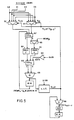
- Fig. 3 shows a flow chart which depicts the steps of an algorithm for performing a high radix algorithm (e.g. one having a radix of 16) for a divide operation for mantissas in a floating point computation process.
- the divisor (DIVR) and the initial remainder (REMR0) are pre-scaled in accordance with conventional procedures, the divisor being greater than the remainder.
- the divisor is bit normalized, i.e. bit shifted to the left, to remove the leading zero bits thereof.
- the initial remainder (REMR0) thereof is also adjusted by being bit shifted to the left by the same number of bits as the divisor.
- the quotient is also initialized to zero.
- An iterative process using "n" iterations is then utilized to determine the final output quotient (Q out-F ) as follows.
- Such value is then used, together with the divisor, to look up the net quotient value (shown as (Q LUT ) in the iteration process using a look-up table, as depicted.
- the output Q LUT from the look-up table is fed back and added to the previous Q n value so as to produce a new accumulated quotient value, Q Acc .
- Such value as well as the previously calculated value of REMR n+1 are used to calculate the next new value of REMR n+1 .
- the process is repeated n times, i.e., for n iterations, the quotient value being up dated to its next accumulated value after each iteration. when n iterations have been performed, the final accumulated value obtained from the look-up table represents the desired output quotient value Q OUT of the overall division operation. If, after the final iteration, the remainder is negative, a "1" is subtracted to produce the desired final quotient output Q out-F .
- circuitry of Fig. 4 for multiplier operations makes use of a well known 2-bit recode technique utilizing carry save adder (CSA) circuits, as described for example in "Computer Systems Architecture" by Jean-Loup Baer, Computer Science Press, 1980, pp.105-106.
- CSA carry save adder
- Using a multiplicand value X and a multiplier value Y each 2-bits of the 8-bit multiplier Y is effectively initially multiplied, using multiplexer circuits 50-53 to which are supplied, respectively, by the values 0, one times the multiplicand, two times the multiplicand and three times the multiplicand, as shown therein and as would be well known to those in the art.
- the outputs of multiplexers 50-53 are respectively supplied as one of the inputs of a plurality of carry-save-adder (CSA) circuits 54-57.
- CSA carry-save-adder
- the output of multiplexer 50 is supplied to CSA a 54, the output of multiplexer 51 to CSA b 55, the output of multiplexer 52 to CSA c 56 and the output of multiplexer 53 to CSA d 57.
- the carry (C) and sum (S) outputs of CSA 54 are supplied as the other two inputs of CSA 55, the C and S outputs of which are supplied to the other two inputs of CSA 56 and, the C and S outputs of which are in turn supplied to CSA 57 via multiplexers 58 and 59 when in the multiply mode.
- the C and S outputs of CSA 57 are supplied to partial product registers PROD C 60 and PROD S 61 (the 5 output of CSA 57 being supplied through a multiplexer 65 during the multiply mode) Such partial products from registers 60 and 61 are fed back into the inputs of CSA 54. The accumulated partial products obtained during each feed back iteration are temporarily stored in registers 60 and 61.
- the final C and S accumulated partial products in PROD C 60 and PROD S 61 are added by adder circuit 63 to supply the final product output, namely, X times Y. If the multiplier Y is negative, a sign correction must occur before adding such final accumulated partial product C and S values and such operation is performed by utilizing a further CSA s 62 between the outputs of the product registers 60 and 61 (supplied to two inputs thereof) and the adder circuit 63. The inverse of the multiplicand X is supplied to the third input of CSA s 62 for such purpose.
- circuitry and operation depicted in Fig. 4 and described above are well known to those in the art for performing a multiply operation.
- multiplexers 58 and 59 provide the necessary inputs to CSA 57, the remaining units 60-65 being utilized during the divide operation for producing the desired multiplied quantity in the divide algorithm.
- the divide operation makes use of multiplexer units 52 and 53, CSA units 57 and 62, as well as adder circuit 63.
- the divisor DIVR
- the quotient Q L.U.T. bits Q0 ⁇ 3 as shown are supplied to mulitplexers 52 and 53 in a similar manner to that when the multiplier bits are supplied in the multiply process.
- the outputs of multiplexers 52 and 53 are supplied as two of the inputs to CSA 57, the C and S outputs therefrom being supplied to registers 60 and 61 as discussed above.
- the initial value of the remainder (REMR0) is initially supplied at the start of the division process in Fig. 5 to the PROD S register 61 via multiplexer 65. Once the initial value of the remainder is supplied for the iterative divide operation involved, multiplexer 65 is placed in a mode which continuously supplies the S output from CSA 57.
- the inverse of the divisor (DIVR) and the C and S accumulated partial product values from registers 60 and 61 are supplied to the sign correcting CSA s 62.
- the final C and S outputs of CSA s 62 are supplied to adder circuit 63 the output of which represents the quantity (REMR n - Q n DIVR)*16.
- Such C and S outputs during the iterative process are supplied as feedback inputs to CSA 57.
- adder circuit 63 representing the final value of the quantity (REMR n - Q n *DIVR)*16 is produced, such quantity is supplied to a look-up table, L.U.T. 64, to which the divisor value is also supplied so as to produce the quotient Q L.U.T. therefrom.
- the quotient from the look-up table 64 is accumulated using adder circuit 66, the output Q Acc thereof being fed back to an input thereof and having added thereto the next Q LUT . After n iterations the output of adder circuit 66 is the final quotient value, Q OUT-F . In each case the outputs of adder circuits 63 and 66 are left-shifted by 4-bits as is required for a radix 16 operation.
- the desired quantity (REMR n - Q n *DlVR)*16 at the output of adder 63 is computed on-the-fly by using available selected components of the multiplier circuit and can then be used to provide the final output quotient in a divide operation as described above.
- Such overall operation provides a faster divide operation than using conventionally known techniques discussed above, as well as reducing considerably the storage requirements required in such conventional divide operation.
Landscapes
- Engineering & Computer Science (AREA)
- Physics & Mathematics (AREA)
- General Physics & Mathematics (AREA)
- Theoretical Computer Science (AREA)
- Computational Mathematics (AREA)
- Mathematical Analysis (AREA)
- Mathematical Optimization (AREA)
- Pure & Applied Mathematics (AREA)
- Computing Systems (AREA)
- General Engineering & Computer Science (AREA)
- Nonlinear Science (AREA)
- Complex Calculations (AREA)
Applications Claiming Priority (2)
| Application Number | Priority Date | Filing Date | Title |
|---|---|---|---|
| US250418 | 1988-09-28 | ||
| US07/250,418 US4979141A (en) | 1988-09-28 | 1988-09-28 | Technique for providing a sign/magnitude subtraction operation in a floating point computation unit |
Publications (3)
| Publication Number | Publication Date |
|---|---|
| EP0361886A2 true EP0361886A2 (de) | 1990-04-04 |
| EP0361886A3 EP0361886A3 (de) | 1992-04-29 |
| EP0361886B1 EP0361886B1 (de) | 1995-11-29 |
Family
ID=22947657
Family Applications (1)
| Application Number | Title | Priority Date | Filing Date |
|---|---|---|---|
| EP89309826A Expired - Lifetime EP0361886B1 (de) | 1988-09-28 | 1989-09-27 | Gleitkommarechner |
Country Status (5)
| Country | Link |
|---|---|
| US (1) | US4979141A (de) |
| EP (1) | EP0361886B1 (de) |
| AU (1) | AU630617B2 (de) |
| CA (1) | CA1321650C (de) |
| DE (1) | DE68924953D1 (de) |
Cited By (2)
| Publication number | Priority date | Publication date | Assignee | Title |
|---|---|---|---|---|
| GB2263001A (en) * | 1992-01-06 | 1993-07-07 | Intel Corp | A multi-stage leading zero detector |
| GB2527125A (en) * | 2014-06-13 | 2015-12-16 | Ibm | Calculation of a number of iterations |
Families Citing this family (7)
| Publication number | Priority date | Publication date | Assignee | Title |
|---|---|---|---|---|
| JPH038018A (ja) * | 1989-06-06 | 1991-01-16 | Toshiba Corp | 符号付き絶対値加減算器 |
| EP0478731A4 (en) * | 1990-04-04 | 1993-09-22 | International Business Machines Corporation | Early scism alu status determination apparatus |
| US5493520A (en) * | 1994-04-15 | 1996-02-20 | International Business Machines Corporation | Two state leading zero/one anticipator (LZA) |
| RU2132566C1 (ru) * | 1998-01-23 | 1999-06-27 | Попов Николай Дмитриевич | Способ полного сложения - вычитания чисел, кодируемых сигналами, и устройство для его осуществления |
| US6567017B2 (en) | 1999-12-30 | 2003-05-20 | Morphics Technology, Inc. | Configurable code generator system for spread spectrum applications |
| US6633896B1 (en) * | 2000-03-30 | 2003-10-14 | Intel Corporation | Method and system for multiplying large numbers |
| US20060179098A1 (en) * | 2005-02-09 | 2006-08-10 | International Business Machines Corporation | System and method for reduction of leading zero detect for decimal floating point numbers |
Family Cites Families (4)
| Publication number | Priority date | Publication date | Assignee | Title |
|---|---|---|---|---|
| US3814925A (en) * | 1972-10-30 | 1974-06-04 | Amdahl Corp | Dual output adder and method of addition for concurrently forming the differences a{31 b and b{31 a |
| US4319335A (en) * | 1979-10-16 | 1982-03-09 | Burroughs Corporation | Arithmetic logic unit controller |
| NL8501698A (nl) * | 1985-06-12 | 1987-01-02 | Docdata Bv | Cassette voorzien van een bandvormige registratiedrager. |
| US4811272A (en) * | 1987-05-15 | 1989-03-07 | Digital Equipment Corporation | Apparatus and method for an extended arithmetic logic unit for expediting selected floating point operations |
-
1988
- 1988-09-28 US US07/250,418 patent/US4979141A/en not_active Expired - Lifetime
-
1989
- 1989-08-25 AU AU40266/89A patent/AU630617B2/en not_active Ceased
- 1989-09-25 CA CA000612948A patent/CA1321650C/en not_active Expired - Fee Related
- 1989-09-27 DE DE68924953T patent/DE68924953D1/de not_active Expired - Lifetime
- 1989-09-27 EP EP89309826A patent/EP0361886B1/de not_active Expired - Lifetime
Cited By (5)
| Publication number | Priority date | Publication date | Assignee | Title |
|---|---|---|---|---|
| GB2263001A (en) * | 1992-01-06 | 1993-07-07 | Intel Corp | A multi-stage leading zero detector |
| GB2263001B (en) * | 1992-01-06 | 1996-03-13 | Intel Corp | A fully decoded multistage leading zero detector and normalization apparatus |
| GB2527125A (en) * | 2014-06-13 | 2015-12-16 | Ibm | Calculation of a number of iterations |
| US10459689B2 (en) | 2014-06-13 | 2019-10-29 | International Business Machines Corporation | Calculation of a number of iterations |
| GB2527125B (en) * | 2014-06-13 | 2021-01-20 | Ibm | Calculation of a number of iterations |
Also Published As
| Publication number | Publication date |
|---|---|
| EP0361886A3 (de) | 1992-04-29 |
| CA1321650C (en) | 1993-08-24 |
| AU4026689A (en) | 1990-04-05 |
| EP0361886B1 (de) | 1995-11-29 |
| DE68924953D1 (de) | 1996-01-11 |
| AU630617B2 (en) | 1992-11-05 |
| US4979141A (en) | 1990-12-18 |
Similar Documents
| Publication | Publication Date | Title |
|---|---|---|
| JP2598507B2 (ja) | 除算または平方根計算装置 | |
| JP3761977B2 (ja) | 遅延整合技術の利用によりクリティカル・パスを減少させた浮動小数点型掛け算器及びその演算方法 | |
| US7395304B2 (en) | Method and apparatus for performing single-cycle addition or subtraction and comparison in redundant form arithmetic | |
| Santoro et al. | Rounding algorithms for IEEE multipliers | |
| US6625633B1 (en) | Divider and method with high radix | |
| US6751644B1 (en) | Method and apparatus for elimination of inherent carries | |
| US4949296A (en) | Method and apparatus for computing square roots of binary numbers | |
| EP0421092A2 (de) | Verfahren und Gerät zur Ausführung mathematischer Funktionen mit Hilfe polynomialer Annäherung und eines Multiplizierers rechteckigen Seitenverhältnisses | |
| JPH0727456B2 (ja) | 浮動小数点演算装置 | |
| EP0394169A2 (de) | Verfahren und Gerät für die Parallelverarbeitung von Postnormalisation und Abrundung | |
| US5751619A (en) | Recurrent adrithmetical computation using carry-save arithmetic | |
| US5184318A (en) | Rectangular array signed digit multiplier | |
| US5132925A (en) | Radix-16 divider using overlapped quotient bit selection and concurrent quotient rounding and correction | |
| US5023827A (en) | Radix-16 divider using overlapped quotient bit selection and concurrent quotient rounding and correction | |
| US7493357B2 (en) | Random carry-in for floating-point operations | |
| US8060551B2 (en) | Method and apparatus for integer division | |
| US5144576A (en) | Signed digit multiplier | |
| US8019805B1 (en) | Apparatus and method for multiple pass extended precision floating point multiplication | |
| US4979141A (en) | Technique for providing a sign/magnitude subtraction operation in a floating point computation unit | |
| US5260889A (en) | Computation of sticky-bit in parallel with partial products in a floating point multiplier unit | |
| EP0063361B1 (de) | Korrekturschaltung für annähernden Quotienten | |
| EP3977259A1 (de) | Gleitkommaaddierer mit mehreren eingaben | |
| USH1222H (en) | Apparatus for determining sticky bit value in arithmetic operations | |
| US5278782A (en) | Square root operation device | |
| US5867413A (en) | Fast method of floating-point multiplication and accumulation |
Legal Events
| Date | Code | Title | Description |
|---|---|---|---|
| PUAI | Public reference made under article 153(3) epc to a published international application that has entered the european phase |
Free format text: ORIGINAL CODE: 0009012 |
|
| AK | Designated contracting states |
Kind code of ref document: A2 Designated state(s): DE FR GB |
|
| PUAL | Search report despatched |
Free format text: ORIGINAL CODE: 0009013 |
|
| AK | Designated contracting states |
Kind code of ref document: A3 Designated state(s): DE FR GB |
|
| 17P | Request for examination filed |
Effective date: 19920702 |
|
| 17Q | First examination report despatched |
Effective date: 19940802 |
|
| GRAA | (expected) grant |
Free format text: ORIGINAL CODE: 0009210 |
|
| AK | Designated contracting states |
Kind code of ref document: B1 Designated state(s): DE FR GB |
|
| PG25 | Lapsed in a contracting state [announced via postgrant information from national office to epo] |
Ref country code: FR Effective date: 19951129 |
|
| REF | Corresponds to: |
Ref document number: 68924953 Country of ref document: DE Date of ref document: 19960111 |
|
| PG25 | Lapsed in a contracting state [announced via postgrant information from national office to epo] |
Ref country code: DE Effective date: 19960301 |
|
| EN | Fr: translation not filed | ||
| PLBE | No opposition filed within time limit |
Free format text: ORIGINAL CODE: 0009261 |
|
| STAA | Information on the status of an ep patent application or granted ep patent |
Free format text: STATUS: NO OPPOSITION FILED WITHIN TIME LIMIT |
|
| 26N | No opposition filed | ||
| PGFP | Annual fee paid to national office [announced via postgrant information from national office to epo] |
Ref country code: GB Payment date: 19990823 Year of fee payment: 11 |
|
| PG25 | Lapsed in a contracting state [announced via postgrant information from national office to epo] |
Ref country code: GB Free format text: LAPSE BECAUSE OF NON-PAYMENT OF DUE FEES Effective date: 20000927 |
|
| GBPC | Gb: european patent ceased through non-payment of renewal fee |
Effective date: 20000927 |