EP0361905A2 - Carbomycin biosynthetic genes, designated carL and carM, for use in streptomyces and other organisms - Google Patents
Carbomycin biosynthetic genes, designated carL and carM, for use in streptomyces and other organisms Download PDFInfo
- Publication number
- EP0361905A2 EP0361905A2 EP89309855A EP89309855A EP0361905A2 EP 0361905 A2 EP0361905 A2 EP 0361905A2 EP 89309855 A EP89309855 A EP 89309855A EP 89309855 A EP89309855 A EP 89309855A EP 0361905 A2 EP0361905 A2 EP 0361905A2
- Authority
- EP
- European Patent Office
- Prior art keywords
- car
- plasmid
- streptomyces
- dna
- organism
- Prior art date
- Legal status (The legal status is an assumption and is not a legal conclusion. Google has not performed a legal analysis and makes no representation as to the accuracy of the status listed.)
- Withdrawn
Links
- 108090000623 proteins and genes Proteins 0.000 title claims abstract description 102
- 241000187747 Streptomyces Species 0.000 title claims abstract description 32
- 229930188120 Carbomycin Natural products 0.000 title description 27
- FQVHOULQCKDUCY-OGHXVOSASA-N [(2s,3s,4r,6s)-6-[(2r,3s,4r,5r,6s)-6-[[(1s,3r,7r,8s,9s,10r,12r,14e,16s)-7-acetyloxy-8-methoxy-3,12-dimethyl-5,13-dioxo-10-(2-oxoethyl)-4,17-dioxabicyclo[14.1.0]heptadec-14-en-9-yl]oxy]-4-(dimethylamino)-5-hydroxy-2-methyloxan-3-yl]oxy-4-hydroxy-2,4-dimeth Chemical compound O([C@@H]1[C@@H](C)O[C@H]([C@@H]([C@H]1N(C)C)O)O[C@H]1[C@@H](CC=O)C[C@@H](C)C(=O)/C=C/[C@@H]2O[C@H]2C[C@@H](C)OC(=O)C[C@H]([C@@H]1OC)OC(C)=O)[C@H]1C[C@@](C)(O)[C@@H](OC(=O)CC(C)C)[C@H](C)O1 FQVHOULQCKDUCY-OGHXVOSASA-N 0.000 title description 27
- 229950005779 carbomycin Drugs 0.000 title description 27
- 230000001851 biosynthetic effect Effects 0.000 title description 24
- 230000003115 biocidal effect Effects 0.000 claims abstract description 51
- 241000187438 Streptomyces fradiae Species 0.000 claims abstract description 44
- 108020004511 Recombinant DNA Proteins 0.000 claims abstract description 21
- 230000015572 biosynthetic process Effects 0.000 claims abstract description 21
- 239000003120 macrolide antibiotic agent Substances 0.000 claims abstract description 13
- 239000013612 plasmid Substances 0.000 claims description 135
- 238000000034 method Methods 0.000 claims description 41
- 239000013598 vector Substances 0.000 claims description 38
- 239000003242 anti bacterial agent Substances 0.000 claims description 18
- 235000000346 sugar Nutrition 0.000 claims description 17
- 230000014509 gene expression Effects 0.000 claims description 16
- 229940088710 antibiotic agent Drugs 0.000 claims description 14
- 102000004190 Enzymes Human genes 0.000 claims description 10
- 108090000790 Enzymes Proteins 0.000 claims description 10
- 230000001131 transforming effect Effects 0.000 claims description 10
- 238000012258 culturing Methods 0.000 claims description 6
- 238000004519 manufacturing process Methods 0.000 claims description 3
- 229930194936 Tylosin Natural products 0.000 abstract description 12
- 239000004182 Tylosin Substances 0.000 abstract description 12
- 229960004059 tylosin Drugs 0.000 abstract description 12
- 235000019375 tylosin Nutrition 0.000 abstract description 12
- WBPYTXDJUQJLPQ-VMXQISHHSA-N tylosin Chemical compound O([C@@H]1[C@@H](C)O[C@H]([C@@H]([C@H]1N(C)C)O)O[C@@H]1[C@@H](C)[C@H](O)CC(=O)O[C@@H]([C@H](/C=C(\C)/C=C/C(=O)[C@H](C)C[C@@H]1CC=O)CO[C@H]1[C@@H]([C@H](OC)[C@H](O)[C@@H](C)O1)OC)CC)[C@H]1C[C@@](C)(O)[C@@H](O)[C@H](C)O1 WBPYTXDJUQJLPQ-VMXQISHHSA-N 0.000 abstract description 12
- 230000000694 effects Effects 0.000 abstract description 10
- 150000001875 compounds Chemical class 0.000 abstract description 3
- 239000013604 expression vector Substances 0.000 abstract description 3
- 230000000295 complement effect Effects 0.000 abstract description 2
- 229940041033 macrolides Drugs 0.000 abstract description 2
- 108020004414 DNA Proteins 0.000 description 55
- 239000012634 fragment Substances 0.000 description 32
- 210000004027 cell Anatomy 0.000 description 30
- 239000000243 solution Substances 0.000 description 27
- 241001646716 Escherichia coli K-12 Species 0.000 description 20
- 229920001817 Agar Polymers 0.000 description 19
- 239000008272 agar Substances 0.000 description 19
- FAPWRFPIFSIZLT-UHFFFAOYSA-M Sodium chloride Chemical compound [Na+].[Cl-] FAPWRFPIFSIZLT-UHFFFAOYSA-M 0.000 description 16
- LFQSCWFLJHTTHZ-UHFFFAOYSA-N Ethanol Chemical compound CCO LFQSCWFLJHTTHZ-UHFFFAOYSA-N 0.000 description 15
- TWRXJAOTZQYOKJ-UHFFFAOYSA-L Magnesium chloride Chemical compound [Mg+2].[Cl-].[Cl-] TWRXJAOTZQYOKJ-UHFFFAOYSA-L 0.000 description 14
- 108091008146 restriction endonucleases Proteins 0.000 description 13
- 238000010276 construction Methods 0.000 description 12
- 230000009466 transformation Effects 0.000 description 12
- XLYOFNOQVPJJNP-UHFFFAOYSA-N water Chemical compound O XLYOFNOQVPJJNP-UHFFFAOYSA-N 0.000 description 12
- 239000008188 pellet Substances 0.000 description 11
- 241001600136 Streptomyces thermotolerans Species 0.000 description 10
- XZNUGFQTQHRASN-XQENGBIVSA-N apramycin Chemical compound O([C@H]1O[C@@H]2[C@H](O)[C@@H]([C@H](O[C@H]2C[C@H]1N)O[C@@H]1[C@@H]([C@@H](O)[C@H](N)[C@@H](CO)O1)O)NC)[C@@H]1[C@@H](N)C[C@@H](N)[C@H](O)[C@H]1O XZNUGFQTQHRASN-XQENGBIVSA-N 0.000 description 10
- 229950006334 apramycin Drugs 0.000 description 10
- 241000588724 Escherichia coli Species 0.000 description 9
- QKNYBSVHEMOAJP-UHFFFAOYSA-N 2-amino-2-(hydroxymethyl)propane-1,3-diol;hydron;chloride Chemical compound Cl.OCC(N)(CO)CO QKNYBSVHEMOAJP-UHFFFAOYSA-N 0.000 description 8
- 108091028043 Nucleic acid sequence Proteins 0.000 description 8
- 239000007984 Tris EDTA buffer Substances 0.000 description 8
- 229940088598 enzyme Drugs 0.000 description 8
- 239000000203 mixture Substances 0.000 description 8
- 239000000047 product Substances 0.000 description 8
- 239000011780 sodium chloride Substances 0.000 description 8
- HEDRZPFGACZZDS-UHFFFAOYSA-N Chloroform Chemical compound ClC(Cl)Cl HEDRZPFGACZZDS-UHFFFAOYSA-N 0.000 description 7
- 239000000872 buffer Substances 0.000 description 7
- 238000010367 cloning Methods 0.000 description 7
- 229910001629 magnesium chloride Inorganic materials 0.000 description 7
- PEDCQBHIVMGVHV-UHFFFAOYSA-N Glycerine Chemical compound OCC(O)CO PEDCQBHIVMGVHV-UHFFFAOYSA-N 0.000 description 6
- 238000003556 assay Methods 0.000 description 6
- AIYUHDOJVYHVIT-UHFFFAOYSA-M caesium chloride Chemical compound [Cl-].[Cs+] AIYUHDOJVYHVIT-UHFFFAOYSA-M 0.000 description 6
- 238000005119 centrifugation Methods 0.000 description 6
- ISWSIDIOOBJBQZ-UHFFFAOYSA-N phenol group Chemical group C1(=CC=CC=C1)O ISWSIDIOOBJBQZ-UHFFFAOYSA-N 0.000 description 6
- 210000001938 protoplast Anatomy 0.000 description 6
- UXVMQQNJUSDDNG-UHFFFAOYSA-L Calcium chloride Chemical compound [Cl-].[Cl-].[Ca+2] UXVMQQNJUSDDNG-UHFFFAOYSA-L 0.000 description 5
- 102000053602 DNA Human genes 0.000 description 5
- 241000191938 Micrococcus luteus Species 0.000 description 5
- VMHLLURERBWHNL-UHFFFAOYSA-M Sodium acetate Chemical compound [Na+].CC([O-])=O VMHLLURERBWHNL-UHFFFAOYSA-M 0.000 description 5
- 238000005273 aeration Methods 0.000 description 5
- 239000001110 calcium chloride Substances 0.000 description 5
- 235000011148 calcium chloride Nutrition 0.000 description 5
- 229910001628 calcium chloride Inorganic materials 0.000 description 5
- 101150014229 carA gene Proteins 0.000 description 5
- 101150070764 carB gene Proteins 0.000 description 5
- 239000013599 cloning vector Substances 0.000 description 5
- 239000004615 ingredient Substances 0.000 description 5
- 229920000570 polyether Polymers 0.000 description 5
- 241000894007 species Species 0.000 description 5
- 235000013619 trace mineral Nutrition 0.000 description 5
- 239000011573 trace mineral Substances 0.000 description 5
- 108091026890 Coding region Proteins 0.000 description 4
- KCXVZYZYPLLWCC-UHFFFAOYSA-N EDTA Chemical compound OC(=O)CN(CC(O)=O)CCN(CC(O)=O)CC(O)=O KCXVZYZYPLLWCC-UHFFFAOYSA-N 0.000 description 4
- DHMQDGOQFOQNFH-UHFFFAOYSA-N Glycine Chemical compound NCC(O)=O DHMQDGOQFOQNFH-UHFFFAOYSA-N 0.000 description 4
- DCXYFEDJOCDNAF-REOHCLBHSA-N L-asparagine Chemical compound OC(=O)[C@@H](N)CC(N)=O DCXYFEDJOCDNAF-REOHCLBHSA-N 0.000 description 4
- 229930006000 Sucrose Natural products 0.000 description 4
- CZMRCDWAGMRECN-UGDNZRGBSA-N Sucrose Chemical compound O[C@H]1[C@H](O)[C@@H](CO)O[C@@]1(CO)O[C@@H]1[C@H](O)[C@@H](O)[C@H](O)[C@@H](CO)O1 CZMRCDWAGMRECN-UGDNZRGBSA-N 0.000 description 4
- 229940041514 candida albicans extract Drugs 0.000 description 4
- 238000006243 chemical reaction Methods 0.000 description 4
- -1 cyclic lactone Chemical class 0.000 description 4
- 230000005764 inhibitory process Effects 0.000 description 4
- 239000002609 medium Substances 0.000 description 4
- 230000008569 process Effects 0.000 description 4
- 239000011541 reaction mixture Substances 0.000 description 4
- 230000010076 replication Effects 0.000 description 4
- 239000001632 sodium acetate Substances 0.000 description 4
- 235000017281 sodium acetate Nutrition 0.000 description 4
- 239000005720 sucrose Substances 0.000 description 4
- 239000012138 yeast extract Substances 0.000 description 4
- OPIFSICVWOWJMJ-AEOCFKNESA-N 5-bromo-4-chloro-3-indolyl beta-D-galactoside Chemical compound O[C@@H]1[C@@H](O)[C@@H](O)[C@@H](CO)O[C@H]1OC1=CNC2=CC=C(Br)C(Cl)=C12 OPIFSICVWOWJMJ-AEOCFKNESA-N 0.000 description 3
- QTBSBXVTEAMEQO-UHFFFAOYSA-N Acetic acid Chemical compound CC(O)=O QTBSBXVTEAMEQO-UHFFFAOYSA-N 0.000 description 3
- XEKOWRVHYACXOJ-UHFFFAOYSA-N Ethyl acetate Chemical compound CCOC(C)=O XEKOWRVHYACXOJ-UHFFFAOYSA-N 0.000 description 3
- 230000005526 G1 to G0 transition Effects 0.000 description 3
- WQZGKKKJIJFFOK-GASJEMHNSA-N Glucose Natural products OC[C@H]1OC(O)[C@H](O)[C@@H](O)[C@@H]1O WQZGKKKJIJFFOK-GASJEMHNSA-N 0.000 description 3
- 102000016943 Muramidase Human genes 0.000 description 3
- 108010014251 Muramidase Proteins 0.000 description 3
- 108010062010 N-Acetylmuramoyl-L-alanine Amidase Proteins 0.000 description 3
- JOCBASBOOFNAJA-UHFFFAOYSA-N N-tris(hydroxymethyl)methyl-2-aminoethanesulfonic acid Chemical compound OCC(CO)(CO)NCCS(O)(=O)=O JOCBASBOOFNAJA-UHFFFAOYSA-N 0.000 description 3
- HEMHJVSKTPXQMS-UHFFFAOYSA-M Sodium hydroxide Chemical compound [OH-].[Na+] HEMHJVSKTPXQMS-UHFFFAOYSA-M 0.000 description 3
- 239000004098 Tetracycline Substances 0.000 description 3
- 102000005936 beta-Galactosidase Human genes 0.000 description 3
- 108010005774 beta-Galactosidase Proteins 0.000 description 3
- 238000012217 deletion Methods 0.000 description 3
- 230000037430 deletion Effects 0.000 description 3
- 238000011161 development Methods 0.000 description 3
- 230000018109 developmental process Effects 0.000 description 3
- 230000029087 digestion Effects 0.000 description 3
- 238000005516 engineering process Methods 0.000 description 3
- 230000002255 enzymatic effect Effects 0.000 description 3
- 238000009585 enzyme analysis Methods 0.000 description 3
- ZMMJGEGLRURXTF-UHFFFAOYSA-N ethidium bromide Chemical compound [Br-].C12=CC(N)=CC=C2C2=CC=C(N)C=C2[N+](CC)=C1C1=CC=CC=C1 ZMMJGEGLRURXTF-UHFFFAOYSA-N 0.000 description 3
- 229960005542 ethidium bromide Drugs 0.000 description 3
- 238000000605 extraction Methods 0.000 description 3
- 239000008103 glucose Substances 0.000 description 3
- 230000012010 growth Effects 0.000 description 3
- 238000002955 isolation Methods 0.000 description 3
- 101150066555 lacZ gene Proteins 0.000 description 3
- 239000004325 lysozyme Substances 0.000 description 3
- 229960000274 lysozyme Drugs 0.000 description 3
- 235000010335 lysozyme Nutrition 0.000 description 3
- 244000005700 microbiome Species 0.000 description 3
- 239000002773 nucleotide Substances 0.000 description 3
- 125000003729 nucleotide group Chemical group 0.000 description 3
- 235000015097 nutrients Nutrition 0.000 description 3
- 239000007858 starting material Substances 0.000 description 3
- 239000000126 substance Substances 0.000 description 3
- 239000006228 supernatant Substances 0.000 description 3
- 235000019364 tetracycline Nutrition 0.000 description 3
- 150000003522 tetracyclines Chemical class 0.000 description 3
- 238000013518 transcription Methods 0.000 description 3
- 230000035897 transcription Effects 0.000 description 3
- 239000006150 trypticase soy agar Substances 0.000 description 3
- 239000012137 tryptone Substances 0.000 description 3
- BKZOUCVNTCLNFF-IGXZVFLKSA-N (2s)-2-[(2r,3r,4s,5r,6s)-2-hydroxy-6-[(1s)-1-[(2s,5r,7s,8r,9s)-2-[(2r,5s)-5-[(2r,3s,4r,5r)-5-[(2s,3s,4s,5r,6s)-6-hydroxy-4-methoxy-3,5,6-trimethyloxan-2-yl]-4-methoxy-3-methyloxolan-2-yl]-5-methyloxolan-2-yl]-7-methoxy-2,8-dimethyl-1,10-dioxaspiro[4.5]dec Chemical compound O([C@@H]1[C@@H]2O[C@H]([C@@H](C)[C@H]2OC)[C@@]2(C)O[C@H](CC2)[C@@]2(C)O[C@]3(O[C@@H]([C@H](C)[C@@H](OC)C3)[C@@H](C)[C@@H]3[C@@H]([C@H](OC)[C@@H](C)[C@](O)([C@H](C)C(O)=O)O3)C)CC2)[C@](C)(O)[C@H](C)[C@@H](OC)[C@@H]1C BKZOUCVNTCLNFF-IGXZVFLKSA-N 0.000 description 2
- AZQWKYJCGOJGHM-UHFFFAOYSA-N 1,4-benzoquinone Chemical compound O=C1C=CC(=O)C=C1 AZQWKYJCGOJGHM-UHFFFAOYSA-N 0.000 description 2
- DIKYHBWGIUNGIW-UHFFFAOYSA-N 2-[2,4-dihydroxy-6-[1-[2-[5-[5-(6-hydroxy-4-methoxy-3,5,6-trimethyloxan-2-yl)oxolan-2-yl]-5-methyloxolan-2-yl]-7-methoxy-2,6-dimethyl-1,10-dioxaspiro[4.5]decan-9-yl]ethyl]-5-(5-methoxy-6-methyloxan-2-yl)oxy-3,5-dimethyloxan-2-yl]propanoic acid Chemical compound O1C(C)C(OC)CCC1OC1(C)C(C(C)C2OC3(OC(C)(CC3)C3OC(C)(CC3)C3OC(CC3)C3C(C(OC)C(C)C(C)(O)O3)C)C(C)C(OC)C2)OC(O)(C(C)C(O)=O)C(C)C1O DIKYHBWGIUNGIW-UHFFFAOYSA-N 0.000 description 2
- STQGQHZAVUOBTE-UHFFFAOYSA-N 7-Cyan-hept-2t-en-4,6-diinsaeure Natural products C1=2C(O)=C3C(=O)C=4C(OC)=CC=CC=4C(=O)C3=C(O)C=2CC(O)(C(C)=O)CC1OC1CC(N)C(O)C(C)O1 STQGQHZAVUOBTE-UHFFFAOYSA-N 0.000 description 2
- 241000187362 Actinomadura Species 0.000 description 2
- IJGRMHOSHXDMSA-UHFFFAOYSA-N Atomic nitrogen Chemical compound N#N IJGRMHOSHXDMSA-UHFFFAOYSA-N 0.000 description 2
- 241000193830 Bacillus <bacterium> Species 0.000 description 2
- 101710134389 Carboxy-terminal domain RNA polymerase II polypeptide A small phosphatase 2 Proteins 0.000 description 2
- WEAHRLBPCANXCN-UHFFFAOYSA-N Daunomycin Natural products CCC1(O)CC(OC2CC(N)C(O)C(C)O2)c3cc4C(=O)c5c(OC)cccc5C(=O)c4c(O)c3C1 WEAHRLBPCANXCN-UHFFFAOYSA-N 0.000 description 2
- AOJJSUZBOXZQNB-TZSSRYMLSA-N Doxorubicin Chemical compound O([C@H]1C[C@@](O)(CC=2C(O)=C3C(=O)C=4C=CC=C(C=4C(=O)C3=C(O)C=21)OC)C(=O)CO)[C@H]1C[C@H](N)[C@H](O)[C@H](C)O1 AOJJSUZBOXZQNB-TZSSRYMLSA-N 0.000 description 2
- ULGZDMOVFRHVEP-RWJQBGPGSA-N Erythromycin Chemical compound O([C@@H]1[C@@H](C)C(=O)O[C@@H]([C@@]([C@H](O)[C@@H](C)C(=O)[C@H](C)C[C@@](C)(O)[C@H](O[C@H]2[C@@H]([C@H](C[C@@H](C)O2)N(C)C)O)[C@H]1C)(C)O)CC)[C@H]1C[C@@](C)(OC)[C@@H](O)[C@H](C)O1 ULGZDMOVFRHVEP-RWJQBGPGSA-N 0.000 description 2
- 239000004471 Glycine Substances 0.000 description 2
- 239000007836 KH2PO4 Substances 0.000 description 2
- KTQFYFLZDLTLAH-UHFFFAOYSA-N Lysocellin Natural products CCC(O)C1(CC)CC(C)C(O)(O1)C2(C)CC(C)C(O2)C(CC)C(=O)C(C)C(O)C(C)C3OC(O)(CC(=O)O)C(C)CC3C KTQFYFLZDLTLAH-UHFFFAOYSA-N 0.000 description 2
- 241000187708 Micromonospora Species 0.000 description 2
- 229930191564 Monensin Natural products 0.000 description 2
- GAOZTHIDHYLHMS-UHFFFAOYSA-N Monensin A Natural products O1C(CC)(C2C(CC(O2)C2C(CC(C)C(O)(CO)O2)C)C)CCC1C(O1)(C)CCC21CC(O)C(C)C(C(C)C(OC)C(C)C(O)=O)O2 GAOZTHIDHYLHMS-UHFFFAOYSA-N 0.000 description 2
- VHKXXVVRRDYCIK-UHFFFAOYSA-N Narasin Natural products CC1CC(C)C(C(CC)C(O)=O)OC1C(C)C(O)C(C)C(=O)C(CC)C1C(C)CC(C)C2(C=CC(O)C3(OC(C)(CC3)C3OC(C)C(O)(CC)CC3)O2)O1 VHKXXVVRRDYCIK-UHFFFAOYSA-N 0.000 description 2
- VHKXXVVRRDYCIK-CWCPJSEDSA-N Narasin Chemical compound C[C@H]1C[C@H](C)[C@H]([C@@H](CC)C(O)=O)O[C@H]1[C@@H](C)[C@H](O)[C@H](C)C(=O)[C@H](CC)[C@@H]1[C@@H](C)C[C@@H](C)[C@@]2(C=C[C@@H](O)[C@@]3(O[C@@](C)(CC3)[C@@H]3O[C@@H](C)[C@@](O)(CC)CC3)O2)O1 VHKXXVVRRDYCIK-CWCPJSEDSA-N 0.000 description 2
- 241000187654 Nocardia Species 0.000 description 2
- 102100021588 Sterol carrier protein 2 Human genes 0.000 description 2
- 241000187398 Streptomyces lividans Species 0.000 description 2
- 239000007994 TES buffer Substances 0.000 description 2
- 229960001230 asparagine Drugs 0.000 description 2
- 238000012474 bioautography Methods 0.000 description 2
- STQGQHZAVUOBTE-VGBVRHCVSA-N daunorubicin Chemical compound O([C@H]1C[C@@](O)(CC=2C(O)=C3C(=O)C=4C=CC=C(C=4C(=O)C3=C(O)C=21)OC)C(C)=O)[C@H]1C[C@H](N)[C@H](O)[C@H](C)O1 STQGQHZAVUOBTE-VGBVRHCVSA-N 0.000 description 2
- 238000009792 diffusion process Methods 0.000 description 2
- VHJLVAABSRFDPM-QWWZWVQMSA-N dithiothreitol Chemical compound SC[C@@H](O)[C@H](O)CS VHJLVAABSRFDPM-QWWZWVQMSA-N 0.000 description 2
- 230000002068 genetic effect Effects 0.000 description 2
- 239000001963 growth medium Substances 0.000 description 2
- XLYOFNOQVPJJNP-ZSJDYOACSA-N heavy water Substances [2H]O[2H] XLYOFNOQVPJJNP-ZSJDYOACSA-N 0.000 description 2
- 238000003780 insertion Methods 0.000 description 2
- 230000037431 insertion Effects 0.000 description 2
- 230000010354 integration Effects 0.000 description 2
- BPHPUYQFMNQIOC-NXRLNHOXSA-N isopropyl beta-D-thiogalactopyranoside Chemical compound CC(C)S[C@@H]1O[C@H](CO)[C@H](O)[C@H](O)[C@H]1O BPHPUYQFMNQIOC-NXRLNHOXSA-N 0.000 description 2
- KTQFYFLZDLTLAH-DESDHLEASA-N lysocellin Chemical compound O1[C@]([C@@H](O)CC)(CC)C[C@@H](C)[C@]1(O)[C@@]1(C)O[C@H]([C@@H](CC)C(=O)[C@@H](C)[C@@H](O)[C@H](C)[C@@H]2[C@H](C[C@@H](C)[C@](O)(CC(O)=O)O2)C)[C@@H](C)C1 KTQFYFLZDLTLAH-DESDHLEASA-N 0.000 description 2
- 238000012423 maintenance Methods 0.000 description 2
- 108700008712 methylenomycin A Proteins 0.000 description 2
- HBECYYFDLZZMPL-UHFFFAOYSA-N methylenomycin A methyl ester Natural products O=C1C(=C)C(C(O)=O)C2(C)C1(C)O2 HBECYYFDLZZMPL-UHFFFAOYSA-N 0.000 description 2
- HBECYYFDLZZMPL-WLGLDCGKSA-N methylenomycin a Chemical compound C[C@]1([C@@H](C(=C)C2=O)C(O)=O)[C@]2(C)O1 HBECYYFDLZZMPL-WLGLDCGKSA-N 0.000 description 2
- 229960005358 monensin Drugs 0.000 description 2
- GAOZTHIDHYLHMS-KEOBGNEYSA-N monensin A Chemical compound C([C@@](O1)(C)[C@H]2CC[C@@](O2)(CC)[C@H]2[C@H](C[C@@H](O2)[C@@H]2[C@H](C[C@@H](C)[C@](O)(CO)O2)C)C)C[C@@]21C[C@H](O)[C@@H](C)[C@@H]([C@@H](C)[C@@H](OC)[C@H](C)C(O)=O)O2 GAOZTHIDHYLHMS-KEOBGNEYSA-N 0.000 description 2
- 229910000402 monopotassium phosphate Inorganic materials 0.000 description 2
- 235000019796 monopotassium phosphate Nutrition 0.000 description 2
- 230000035772 mutation Effects 0.000 description 2
- 229960001851 narasin Drugs 0.000 description 2
- GNSKLFRGEWLPPA-UHFFFAOYSA-M potassium dihydrogen phosphate Chemical compound [K+].OP(O)([O-])=O GNSKLFRGEWLPPA-UHFFFAOYSA-M 0.000 description 2
- OTYBMLCTZGSZBG-UHFFFAOYSA-L potassium sulfate Chemical compound [K+].[K+].[O-]S([O-])(=O)=O OTYBMLCTZGSZBG-UHFFFAOYSA-L 0.000 description 2
- 229910052939 potassium sulfate Inorganic materials 0.000 description 2
- 239000002243 precursor Substances 0.000 description 2
- 229930010796 primary metabolite Natural products 0.000 description 2
- 230000008929 regeneration Effects 0.000 description 2
- 238000011069 regeneration method Methods 0.000 description 2
- 238000011160 research Methods 0.000 description 2
- 150000003839 salts Chemical class 0.000 description 2
- UCSJYZPVAKXKNQ-HZYVHMACSA-N streptomycin Chemical compound CN[C@H]1[C@H](O)[C@@H](O)[C@H](CO)O[C@H]1O[C@@H]1[C@](C=O)(O)[C@H](C)O[C@H]1O[C@@H]1[C@@H](NC(N)=N)[C@H](O)[C@@H](NC(N)=N)[C@H](O)[C@H]1O UCSJYZPVAKXKNQ-HZYVHMACSA-N 0.000 description 2
- 229960002180 tetracycline Drugs 0.000 description 2
- 229930101283 tetracycline Natural products 0.000 description 2
- MHMRAFONCSQAIA-UHFFFAOYSA-N thiolutin Chemical compound S1SC=C2N(C)C(=O)C(NC(=O)C)=C21 MHMRAFONCSQAIA-UHFFFAOYSA-N 0.000 description 2
- 230000014616 translation Effects 0.000 description 2
- YKSVGLFNJPQDJE-YDMQLZBCSA-N (19E,21E,23E,25E,27E,29E,31E)-33-[(2R,3S,4R,5S,6R)-4-amino-3,5-dihydroxy-6-methyloxan-2-yl]oxy-17-[7-(4-aminophenyl)-5-hydroxy-4-methyl-7-oxoheptan-2-yl]-1,3,5,7,37-pentahydroxy-18-methyl-9,13,15-trioxo-16,39-dioxabicyclo[33.3.1]nonatriaconta-19,21,23,25,27,29,31-heptaene-36-carboxylic acid Chemical compound CC(CC(C)C1OC(=O)CC(=O)CCCC(=O)CC(O)CC(O)CC(O)CC2(O)CC(O)C(C(CC(O[C@@H]3O[C@H](C)[C@@H](O)[C@@H](N)[C@@H]3O)\C=C\C=C\C=C\C=C\C=C\C=C\C=C\C1C)O2)C(O)=O)C(O)CC(=O)C1=CC=C(N)C=C1 YKSVGLFNJPQDJE-YDMQLZBCSA-N 0.000 description 1
- ILFPCMXTASDZKM-YFKPBYRVSA-N (1s)-2-methylidene-3-oxocyclopentane-1-carboxylic acid Chemical compound OC(=O)[C@H]1CCC(=O)C1=C ILFPCMXTASDZKM-YFKPBYRVSA-N 0.000 description 1
- ZITSQIZMRMDQLE-SJSJOXFOSA-N (2R)-2-[(2R,3S,6R)-6-[[(2S,4R,5R,6R,7R,9R)-2-[(2R,5S)-5-[(2R,3S,5R)-5-[(2S,3S,5R,6S)-6-hydroxy-3,5,6-trimethyloxan-2-yl]-3-methyloxolan-2-yl]-5-methyloxolan-2-yl]-7-methoxy-2,4,6-trimethyl-1,10-dioxaspiro[4.5]decan-9-yl]methyl]-3-methyloxan-2-yl]propanoic acid Chemical compound CO[C@@H]1C[C@@H](C[C@H]2CC[C@H](C)[C@@H](O2)[C@@H](C)C(O)=O)O[C@]2(O[C@@](C)(C[C@H]2C)[C@H]2CC[C@](C)(O2)[C@@H]2O[C@H](C[C@@H]2C)[C@H]2O[C@](C)(O)[C@H](C)C[C@@H]2C)[C@@H]1C ZITSQIZMRMDQLE-SJSJOXFOSA-N 0.000 description 1
- ZNBNBTIDJSKEAM-NISBWGIBSA-N (2s,3r,4r)-4-[(2s,5r,7s,8r,9s)-7-hydroxy-2-[(2r,5s)-5-[(2r,3s,5r)-5-[(2s,3s,5r,6r)-6-hydroxy-6-(hydroxymethyl)-3,5-dimethyloxan-2-yl]-3-methyloxolan-2-yl]-5-methyloxolan-2-yl]-2,8-dimethyl-1,10-dioxaspiro[4.5]decan-9-yl]-2-methyl-3-propanoyloxypentanoic a Chemical compound C1[C@H](O)[C@@H](C)[C@@H]([C@@H](C)[C@@H](OC(=O)CC)[C@H](C)C(O)=O)O[C@]11O[C@](C)([C@@H]2O[C@@](C)(CC2)[C@H]2[C@H](C[C@@H](O2)[C@@H]2[C@H](C[C@@H](C)[C@](O)(CO)O2)C)C)CC1 ZNBNBTIDJSKEAM-NISBWGIBSA-N 0.000 description 1
- RMVMLZHPWMTQGK-SOUFLCLCSA-N (4s,4as,5as,6s,12ar)-4-(dimethylamino)-1,6,10,11,12a-pentahydroxy-3,12-dioxo-4a,5,5a,6-tetrahydro-4h-tetracene-2-carboxamide Chemical compound C1([C@H]2O)=CC=CC(O)=C1C(O)=C1[C@@H]2C[C@H]2[C@H](N(C)C)C(=O)C(C(N)=O)=C(O)[C@@]2(O)C1=O RMVMLZHPWMTQGK-SOUFLCLCSA-N 0.000 description 1
- GUXHBMASAHGULD-SEYHBJAFSA-N (4s,4as,5as,6s,12ar)-7-chloro-4-(dimethylamino)-1,6,10,11,12a-pentahydroxy-3,12-dioxo-4a,5,5a,6-tetrahydro-4h-tetracene-2-carboxamide Chemical compound C1([C@H]2O)=C(Cl)C=CC(O)=C1C(O)=C1[C@@H]2C[C@H]2[C@H](N(C)C)C(=O)C(C(N)=O)=C(O)[C@@]2(O)C1=O GUXHBMASAHGULD-SEYHBJAFSA-N 0.000 description 1
- FELYAZAWTURXNF-KWJIWYEDSA-N (E,2S,4R,8S)-8-[(2S,5R,7S,8R,9R)-7-hydroxy-2-[(2R,4S,5S,7R,9S,10R)-2-[(2S,3S,5R,6R)-6-hydroxy-6-(hydroxymethyl)-3,5-dimethyloxan-2-yl]-9-[(2S,5S,6R)-5-methoxy-6-methyloxan-2-yl]oxy-4,10-dimethyl-1,6-dioxaspiro[4.5]decan-7-yl]-2,8-dimethyl-1,10-dioxaspiro[4.5]decan-9-yl]-2,4,6-trimethyl-5-oxonon-6-enoic acid Chemical compound O1[C@H](C)[C@@H](OC)CC[C@H]1O[C@@H]1[C@@H](C)[C@]2([C@H](C[C@@H](O2)[C@@H]2[C@H](C[C@@H](C)[C@](O)(CO)O2)C)C)O[C@@H]([C@@]2(C)O[C@]3(O[C@@H]([C@H](C)[C@@H](O)C3)[C@@H](C)\C=C(/C)C(=O)[C@H](C)C[C@H](C)C(O)=O)CC2)C1 FELYAZAWTURXNF-KWJIWYEDSA-N 0.000 description 1
- 229910003208 (NH4)6Mo7O24·4H2O Inorganic materials 0.000 description 1
- PITHJRRCEANNKJ-UHFFFAOYSA-N Aclacinomycin A Natural products C12=C(O)C=3C(=O)C4=CC=CC=C4C(=O)C=3C=C2C(C(=O)OC)C(CC)(O)CC1OC(OC1C)CC(N(C)C)C1OC(OC1C)CC(O)C1OC1CCC(=O)C(C)O1 PITHJRRCEANNKJ-UHFFFAOYSA-N 0.000 description 1
- 241000187844 Actinoplanes Species 0.000 description 1
- VTIKDEXOEJDMJP-UHFFFAOYSA-N Actinorhodine Natural products CC1OC(CC(=O)O)CC2=C1C(=O)c3c(O)c(cc(O)c3C2=O)c4cc(O)c5C(=O)C6=C(C(C)OC(CC(=O)O)C6)C(=O)c5c4O VTIKDEXOEJDMJP-UHFFFAOYSA-N 0.000 description 1
- 102000002260 Alkaline Phosphatase Human genes 0.000 description 1
- 108020004774 Alkaline Phosphatase Proteins 0.000 description 1
- QGZKDVFQNNGYKY-UHFFFAOYSA-O Ammonium Chemical compound [NH4+] QGZKDVFQNNGYKY-UHFFFAOYSA-O 0.000 description 1
- APKFDSVGJQXUKY-KKGHZKTASA-N Amphotericin-B Natural products O[C@H]1[C@@H](N)[C@H](O)[C@@H](C)O[C@H]1O[C@H]1C=CC=CC=CC=CC=CC=CC=C[C@H](C)[C@@H](O)[C@@H](C)[C@H](C)OC(=O)C[C@H](O)C[C@H](O)CC[C@@H](O)[C@H](O)C[C@H](O)C[C@](O)(C[C@H](O)[C@H]2C(O)=O)O[C@H]2C1 APKFDSVGJQXUKY-KKGHZKTASA-N 0.000 description 1
- 241001468213 Amycolatopsis mediterranei Species 0.000 description 1
- 241000894006 Bacteria Species 0.000 description 1
- OYPRJOBELJOOCE-UHFFFAOYSA-N Calcium Chemical compound [Ca] OYPRJOBELJOOCE-UHFFFAOYSA-N 0.000 description 1
- 229930186147 Cephalosporin Natural products 0.000 description 1
- 241001619326 Cephalosporium Species 0.000 description 1
- VEXZGXHMUGYJMC-UHFFFAOYSA-M Chloride anion Chemical compound [Cl-] VEXZGXHMUGYJMC-UHFFFAOYSA-M 0.000 description 1
- 239000004099 Chlortetracycline Substances 0.000 description 1
- 229910021592 Copper(II) chloride Inorganic materials 0.000 description 1
- QNAYBMKLOCPYGJ-UHFFFAOYSA-N D-alpha-Ala Natural products CC([NH3+])C([O-])=O QNAYBMKLOCPYGJ-UHFFFAOYSA-N 0.000 description 1
- 102000012410 DNA Ligases Human genes 0.000 description 1
- 108010061982 DNA Ligases Proteins 0.000 description 1
- 230000008836 DNA modification Effects 0.000 description 1
- 239000003298 DNA probe Substances 0.000 description 1
- 241001495437 Dactylosporangium Species 0.000 description 1
- 239000004375 Dextrin Substances 0.000 description 1
- 229920001353 Dextrin Polymers 0.000 description 1
- 229930184584 Ditrisarubicin Natural products 0.000 description 1
- ZITSQIZMRMDQLE-UHFFFAOYSA-N Grisorixin Natural products O1C2(C(CC(C)(O2)C2OC(C)(CC2)C2C(CC(O2)C2C(CC(C)C(C)(O)O2)C)C)C)C(C)C(OC)CC1CC1CCC(C)C(C(C)C(O)=O)O1 ZITSQIZMRMDQLE-UHFFFAOYSA-N 0.000 description 1
- HTTJABKRGRZYRN-UHFFFAOYSA-N Heparin Chemical compound OC1C(NC(=O)C)C(O)OC(COS(O)(=O)=O)C1OC1C(OS(O)(=O)=O)C(O)C(OC2C(C(OS(O)(=O)=O)C(OC3C(C(O)C(O)C(O3)C(O)=O)OS(O)(=O)=O)C(CO)O2)NS(O)(=O)=O)C(C(O)=O)O1 HTTJABKRGRZYRN-UHFFFAOYSA-N 0.000 description 1
- 101000820585 Homo sapiens SUN domain-containing ossification factor Proteins 0.000 description 1
- 101000673946 Homo sapiens Synaptotagmin-like protein 1 Proteins 0.000 description 1
- DGAQECJNVWCQMB-PUAWFVPOSA-M Ilexoside XXIX Chemical compound C[C@@H]1CC[C@@]2(CC[C@@]3(C(=CC[C@H]4[C@]3(CC[C@@H]5[C@@]4(CC[C@@H](C5(C)C)OS(=O)(=O)[O-])C)C)[C@@H]2[C@]1(C)O)C)C(=O)O[C@H]6[C@@H]([C@H]([C@@H]([C@H](O6)CO)O)O)O.[Na+] DGAQECJNVWCQMB-PUAWFVPOSA-M 0.000 description 1
- 229910021578 Iron(III) chloride Inorganic materials 0.000 description 1
- QNAYBMKLOCPYGJ-UWTATZPHSA-N L-Alanine Natural products C[C@@H](N)C(O)=O QNAYBMKLOCPYGJ-UWTATZPHSA-N 0.000 description 1
- QNAYBMKLOCPYGJ-REOHCLBHSA-N L-alanine Chemical compound C[C@H](N)C(O)=O QNAYBMKLOCPYGJ-REOHCLBHSA-N 0.000 description 1
- ODKSFYDXXFIFQN-BYPYZUCNSA-N L-arginine Chemical compound OC(=O)[C@@H](N)CCCN=C(N)N ODKSFYDXXFIFQN-BYPYZUCNSA-N 0.000 description 1
- 229930064664 L-arginine Natural products 0.000 description 1
- 235000014852 L-arginine Nutrition 0.000 description 1
- RWWSBGHRGAQGJE-UHFFFAOYSA-N Laidlomycin Natural products CC(C(CCC(=O)O)C(C)C(=O)O)C1OC2(CCC(C)(O2)C3CCC(C)(O3)C4OC(CC4C)C5OC(O)(CO)C(C)CC5C)CC(O)C1C RWWSBGHRGAQGJE-UHFFFAOYSA-N 0.000 description 1
- 229930182504 Lasalocid Natural products 0.000 description 1
- 102000003960 Ligases Human genes 0.000 description 1
- 108090000364 Ligases Proteins 0.000 description 1
- BKZOUCVNTCLNFF-UHFFFAOYSA-N Lonomycin Natural products COC1C(C)C(C2(C)OC(CC2)C2(C)OC3(OC(C(C)C(OC)C3)C(C)C3C(C(OC)C(C)C(O)(C(C)C(O)=O)O3)C)CC2)OC1C1OC(C)(O)C(C)C(OC)C1C BKZOUCVNTCLNFF-UHFFFAOYSA-N 0.000 description 1
- 229910021380 Manganese Chloride Inorganic materials 0.000 description 1
- GLFNIEUTAYBVOC-UHFFFAOYSA-L Manganese chloride Chemical compound Cl[Mn]Cl GLFNIEUTAYBVOC-UHFFFAOYSA-L 0.000 description 1
- 229930192392 Mitomycin Natural products 0.000 description 1
- 101100392387 Mucor circinelloides f. lusitanicus carG gene Proteins 0.000 description 1
- LRHPLDYGYMQRHN-UHFFFAOYSA-N N-Butanol Chemical class CCCCO LRHPLDYGYMQRHN-UHFFFAOYSA-N 0.000 description 1
- 238000005481 NMR spectroscopy Methods 0.000 description 1
- 229930193140 Neomycin Natural products 0.000 description 1
- 239000004100 Oxytetracycline Substances 0.000 description 1
- 229910019142 PO4 Inorganic materials 0.000 description 1
- 241000228143 Penicillium Species 0.000 description 1
- 241000364057 Peoria Species 0.000 description 1
- 239000001888 Peptone Substances 0.000 description 1
- 108010080698 Peptones Proteins 0.000 description 1
- 239000004721 Polyphenylene oxide Substances 0.000 description 1
- ZLMJMSJWJFRBEC-UHFFFAOYSA-N Potassium Chemical compound [K] ZLMJMSJWJFRBEC-UHFFFAOYSA-N 0.000 description 1
- 229930189077 Rifamycin Natural products 0.000 description 1
- 102100021651 SUN domain-containing ossification factor Human genes 0.000 description 1
- 239000004189 Salinomycin Substances 0.000 description 1
- KQXDHUJYNAXLNZ-XQSDOZFQSA-N Salinomycin Chemical compound O1[C@@H]([C@@H](CC)C(O)=O)CC[C@H](C)[C@@H]1[C@@H](C)[C@H](O)[C@H](C)C(=O)[C@H](CC)[C@@H]1[C@@H](C)C[C@@H](C)[C@@]2(C=C[C@@H](O)[C@@]3(O[C@@](C)(CC3)[C@@H]3O[C@@H](C)[C@@](O)(CC)CC3)O2)O1 KQXDHUJYNAXLNZ-XQSDOZFQSA-N 0.000 description 1
- VYPSYNLAJGMNEJ-UHFFFAOYSA-N Silicium dioxide Chemical compound O=[Si]=O VYPSYNLAJGMNEJ-UHFFFAOYSA-N 0.000 description 1
- 108020004682 Single-Stranded DNA Proteins 0.000 description 1
- 229920002472 Starch Polymers 0.000 description 1
- 241000187759 Streptomyces albus Species 0.000 description 1
- 241000187758 Streptomyces ambofaciens Species 0.000 description 1
- 241000521327 Streptomyces caespitosus Species 0.000 description 1
- 241000187432 Streptomyces coelicolor Species 0.000 description 1
- 241001446311 Streptomyces coelicolor A3(2) Species 0.000 description 1
- 241000145545 Streptomyces collinus Species 0.000 description 1
- 241000187133 Streptomyces espinosus Species 0.000 description 1
- 241000187122 Streptomyces virginiae Species 0.000 description 1
- 229930184317 Streptovaricin Natural products 0.000 description 1
- QAOWNCQODCNURD-UHFFFAOYSA-L Sulfate Chemical compound [O-]S([O-])(=O)=O QAOWNCQODCNURD-UHFFFAOYSA-L 0.000 description 1
- 229930194911 Sulfurmycin Natural products 0.000 description 1
- NSFFHOGKXHRQEW-UHFFFAOYSA-N Thiostrepton B Natural products N1C(=O)C(C)NC(=O)C(=C)NC(=O)C(C)NC(=O)C(C(C)CC)NC(C(C2=N3)O)C=CC2=C(C(C)O)C=C3C(=O)OC(C)C(C=2SC=C(N=2)C2N=3)NC(=O)C(N=4)=CSC=4C(C(C)(O)C(C)O)NC(=O)C(N=4)CSC=4C(=CC)NC(=O)C(C(C)O)NC(=O)C(N=4)=CSC=4C21CCC=3C1=NC(C(=O)NC(=C)C(=O)NC(=C)C(N)=O)=CS1 NSFFHOGKXHRQEW-UHFFFAOYSA-N 0.000 description 1
- 229930183873 Tolypomycin Natural products 0.000 description 1
- 239000002253 acid Substances 0.000 description 1
- 150000007513 acids Chemical class 0.000 description 1
- USZYSDMBJDPRIF-SVEJIMAYSA-N aclacinomycin A Chemical compound O([C@H]1[C@@H](O)C[C@@H](O[C@H]1C)O[C@H]1[C@H](C[C@@H](O[C@H]1C)O[C@H]1C[C@]([C@@H](C2=CC=3C(=O)C4=CC=CC(O)=C4C(=O)C=3C(O)=C21)C(=O)OC)(O)CC)N(C)C)[C@H]1CCC(=O)[C@H](C)O1 USZYSDMBJDPRIF-SVEJIMAYSA-N 0.000 description 1
- 229960004176 aclarubicin Drugs 0.000 description 1
- VMGZUMXAOXKLLT-PNBNQRKOSA-N actamycin Chemical compound O=C1\C(C)=C/C(C)C(O)C(C)\C=C/C(O)C\C=C(C)/C(=O)CC(O)C(C)\C=C/C=C\C=C/C(=O)NC2=C(O)C3=CC(C)=C(O)C1=C3C(=O)C2=O VMGZUMXAOXKLLT-PNBNQRKOSA-N 0.000 description 1
- ODRXJBTZWPWLEA-RRDJYBMYSA-N actamycin Natural products CC1C=CC=C/C=C/C(=O)NC2=C(O)C(=O)c3c(cc(C)c(O)c3C(=O)C(=CC(C)C(O)C(C)C=CC(O)CC=C(/C)C(=O)CC1O)C)C2=O ODRXJBTZWPWLEA-RRDJYBMYSA-N 0.000 description 1
- 229950002379 actaplanin Drugs 0.000 description 1
- BDNDRNLSLGGULA-UHFFFAOYSA-N actaplanin Chemical compound C=1C2=CC=C(O)C=1C1=C(OC3C(C(O)C(O)C(CO)O3)O)C=C(O)C=C1C(C(=O)OC)NC(=O)C1NC(=O)C2NC(=O)C2NC(=O)C(C=3C=C(C(=C(O)C=3)C)OC=3C(O)=CC=C(C=3)C(N)C(=O)N3)NC(=O)C3CC(C=C3)=CC=C3OC(C=3OC4C(C(O)C(O)C(CO)O4)O)=CC2=CC=3OC(C(=C2)Cl)=CC=C2C1OC1CC(N)C(O)C(C)O1 BDNDRNLSLGGULA-UHFFFAOYSA-N 0.000 description 1
- 108010020588 actaplanin Proteins 0.000 description 1
- VTIKDEXOEJDMJP-WYUUTHIRSA-N actinorhodin Chemical compound C([C@@H](CC(O)=O)O[C@@H]1C)C(C(C2=C(O)C=3)=O)=C1C(=O)C2=C(O)C=3C(C(=C1C2=O)O)=CC(O)=C1C(=O)C1=C2[C@@H](C)O[C@H](CC(O)=O)C1 VTIKDEXOEJDMJP-WYUUTHIRSA-N 0.000 description 1
- 230000009471 action Effects 0.000 description 1
- 229940009456 adriamycin Drugs 0.000 description 1
- 229960003767 alanine Drugs 0.000 description 1
- 229940024606 amino acid Drugs 0.000 description 1
- 235000001014 amino acid Nutrition 0.000 description 1
- 150000001413 amino acids Chemical class 0.000 description 1
- APKFDSVGJQXUKY-INPOYWNPSA-N amphotericin B Chemical compound O[C@H]1[C@@H](N)[C@H](O)[C@@H](C)O[C@H]1O[C@H]1/C=C/C=C/C=C/C=C/C=C/C=C/C=C/[C@H](C)[C@@H](O)[C@@H](C)[C@H](C)OC(=O)C[C@H](O)C[C@H](O)CC[C@@H](O)[C@H](O)C[C@H](O)C[C@](O)(C[C@H](O)[C@H]2C(O)=O)O[C@H]2C1 APKFDSVGJQXUKY-INPOYWNPSA-N 0.000 description 1
- 229960003942 amphotericin b Drugs 0.000 description 1
- 229960000723 ampicillin Drugs 0.000 description 1
- AVKUERGKIZMTKX-NJBDSQKTSA-N ampicillin Chemical compound C1([C@@H](N)C(=O)N[C@H]2[C@H]3SC([C@@H](N3C2=O)C(O)=O)(C)C)=CC=CC=C1 AVKUERGKIZMTKX-NJBDSQKTSA-N 0.000 description 1
- 230000003321 amplification Effects 0.000 description 1
- 238000000137 annealing Methods 0.000 description 1
- 229940045799 anthracyclines and related substance Drugs 0.000 description 1
- MWGPOKWHXRTZII-YNEAEBOCSA-N arugomycin Chemical compound O1[C@@H](C)[C@@H](O)[C@@H](OC)C[C@@H]1O[C@@H]1[C@@]([N+]([O-])=O)(C)C[C@H](O[C@H]2[C@H](C[C@@H](O[C@H]2C)O[C@@H]2[C@@]3(C)C4=C(C=5C(=O)C6=CC=7[C@@H](C(=O)OC)[C@@](C)(O)C[C@@H](C=7C(O)=C6C(=O)C=5C(O)=C4)O[C@@H]4O[C@@H](C)[C@@H](O[C@@H]5O[C@@H](C)[C@@H](O[C@@H]6O[C@@H](C)[C@@H](O[C@@H]7O[C@@H](C)[C@@H](OC(=O)\C=C\C(O)=O)[C@@H](OC)C7)[C@@H](OC)C6)[C@@H](O)C5)[C@@H](OC)C4)O[C@@H](O3)[C@@H](O)[C@@H]2N(C)C)O)O[C@H]1C MWGPOKWHXRTZII-YNEAEBOCSA-N 0.000 description 1
- 230000001174 ascending effect Effects 0.000 description 1
- 229930184293 auramycin Natural products 0.000 description 1
- UGZYFXMSMFMTSM-UHFFFAOYSA-N aureothricin Chemical compound S1SC=C2N(C)C(=O)C(NC(=O)CC)=C21 UGZYFXMSMFMTSM-UHFFFAOYSA-N 0.000 description 1
- WAYBAXDAQZLSTG-UHFFFAOYSA-N aureothricin Natural products CCC(=O)NC1C2SSC=C2NC1=O WAYBAXDAQZLSTG-UHFFFAOYSA-N 0.000 description 1
- 230000001580 bacterial effect Effects 0.000 description 1
- 230000001588 bifunctional effect Effects 0.000 description 1
- 230000003851 biochemical process Effects 0.000 description 1
- 230000006696 biosynthetic metabolic pathway Effects 0.000 description 1
- 239000011575 calcium Substances 0.000 description 1
- 229910052791 calcium Inorganic materials 0.000 description 1
- 229960004348 candicidin Drugs 0.000 description 1
- 150000001720 carbohydrates Chemical class 0.000 description 1
- 235000014633 carbohydrates Nutrition 0.000 description 1
- 229940124587 cephalosporin Drugs 0.000 description 1
- 150000001780 cephalosporins Chemical class 0.000 description 1
- 230000008859 change Effects 0.000 description 1
- JDECNKBYILMOLE-CJQFIEQYSA-N chembl1255887 Chemical class O1COC(=C(C)C2=O)C3=C1\C(C)=C\[C@@](C)(O)[C@H](O)[C@@H](C)[C@@H](O)[C@H](C(=O)OC)[C@H](O)[C@H](C)[C@H](O)[C@H](C)\C=C/C=C(C)/C(=O)NC1=C(C)C(OC(C)=O)=C3C2=C1O JDECNKBYILMOLE-CJQFIEQYSA-N 0.000 description 1
- 239000003153 chemical reaction reagent Substances 0.000 description 1
- 239000003795 chemical substances by application Substances 0.000 description 1
- CYDMQBQPVICBEU-UHFFFAOYSA-N chlorotetracycline Natural products C1=CC(Cl)=C2C(O)(C)C3CC4C(N(C)C)C(O)=C(C(N)=O)C(=O)C4(O)C(O)=C3C(=O)C2=C1O CYDMQBQPVICBEU-UHFFFAOYSA-N 0.000 description 1
- 229960004475 chlortetracycline Drugs 0.000 description 1
- 235000019365 chlortetracycline Nutrition 0.000 description 1
- CYDMQBQPVICBEU-XRNKAMNCSA-N chlortetracycline Chemical compound C1=CC(Cl)=C2[C@](O)(C)[C@H]3C[C@H]4[C@H](N(C)C)C(O)=C(C(N)=O)C(=O)[C@@]4(O)C(O)=C3C(=O)C2=C1O CYDMQBQPVICBEU-XRNKAMNCSA-N 0.000 description 1
- 230000002759 chromosomal effect Effects 0.000 description 1
- 210000000349 chromosome Anatomy 0.000 description 1
- 239000000470 constituent Substances 0.000 description 1
- ORTQZVOHEJQUHG-UHFFFAOYSA-L copper(II) chloride Chemical compound Cl[Cu]Cl ORTQZVOHEJQUHG-UHFFFAOYSA-L 0.000 description 1
- KDWXMIJUXUSUMZ-UHFFFAOYSA-N cyanocycline a Chemical compound O=C1C(OC)=C(C)C(=O)C2=C1C(CO)N1C(C#N)C(N3C)CC4C3C1C2N1CCOC14 KDWXMIJUXUSUMZ-UHFFFAOYSA-N 0.000 description 1
- 125000001511 cyclopentyl group Chemical group [H]C1([H])C([H])([H])C([H])([H])C([H])(*)C1([H])[H] 0.000 description 1
- 229960002398 demeclocycline Drugs 0.000 description 1
- JCSGAUKCDAVARS-UHFFFAOYSA-N demethyltetracycline Natural products CN(C1C(=C(C(C2(C(=C3C(C4=C(C=CC=C4C(C3CC12)O)O)=O)O)O)=O)C(=O)N)O)C JCSGAUKCDAVARS-UHFFFAOYSA-N 0.000 description 1
- 235000019425 dextrin Nutrition 0.000 description 1
- 238000000502 dialysis Methods 0.000 description 1
- HPNMFZURTQLUMO-UHFFFAOYSA-N diethylamine Chemical compound CCNCC HPNMFZURTQLUMO-UHFFFAOYSA-N 0.000 description 1
- AIUDWMLXCFRVDR-UHFFFAOYSA-N dimethyl 2-(3-ethyl-3-methylpentyl)propanedioate Chemical class CCC(C)(CC)CCC(C(=O)OC)C(=O)OC AIUDWMLXCFRVDR-UHFFFAOYSA-N 0.000 description 1
- DANUORFCFTYTSZ-UHFFFAOYSA-N epinigericin Natural products O1C2(C(CC(C)(O2)C2OC(C)(CC2)C2C(CC(O2)C2C(CC(C)C(O)(CO)O2)C)C)C)C(C)C(OC)CC1CC1CCC(C)C(C(C)C(O)=O)O1 DANUORFCFTYTSZ-UHFFFAOYSA-N 0.000 description 1
- 229960003276 erythromycin Drugs 0.000 description 1
- 238000012869 ethanol precipitation Methods 0.000 description 1
- 229940093499 ethyl acetate Drugs 0.000 description 1
- 235000019439 ethyl acetate Nutrition 0.000 description 1
- 210000003527 eukaryotic cell Anatomy 0.000 description 1
- 238000000855 fermentation Methods 0.000 description 1
- 230000004151 fermentation Effects 0.000 description 1
- 235000013312 flour Nutrition 0.000 description 1
- 239000012458 free base Substances 0.000 description 1
- 239000003517 fume Substances 0.000 description 1
- 108091008053 gene clusters Proteins 0.000 description 1
- 235000001727 glucose Nutrition 0.000 description 1
- 235000011187 glycerol Nutrition 0.000 description 1
- 229960002897 heparin Drugs 0.000 description 1
- 229920000669 heparin Polymers 0.000 description 1
- MCAHMSDENAOJFZ-BVXDHVRPSA-N herbimycin Chemical compound N1C(=O)\C(C)=C\C=C/[C@H](OC)[C@@H](OC(N)=O)\C(C)=C\[C@H](C)[C@@H](OC)[C@@H](OC)C[C@H](C)[C@@H](OC)C2=CC(=O)C=C1C2=O MCAHMSDENAOJFZ-BVXDHVRPSA-N 0.000 description 1
- 229930193320 herbimycin Natural products 0.000 description 1
- 238000009396 hybridization Methods 0.000 description 1
- 239000012535 impurity Substances 0.000 description 1
- 238000011534 incubation Methods 0.000 description 1
- 208000015181 infectious disease Diseases 0.000 description 1
- PGHMRUGBZOYCAA-UHFFFAOYSA-N ionomycin Natural products O1C(CC(O)C(C)C(O)C(C)C=CCC(C)CC(C)C(O)=CC(=O)C(C)CC(C)CC(CCC(O)=O)C)CCC1(C)C1OC(C)(C(C)O)CC1 PGHMRUGBZOYCAA-UHFFFAOYSA-N 0.000 description 1
- PGHMRUGBZOYCAA-ADZNBVRBSA-N ionomycin Chemical compound O1[C@H](C[C@H](O)[C@H](C)[C@H](O)[C@H](C)/C=C/C[C@@H](C)C[C@@H](C)C(/O)=C/C(=O)[C@@H](C)C[C@@H](C)C[C@@H](CCC(O)=O)C)CC[C@@]1(C)[C@@H]1O[C@](C)([C@@H](C)O)CC1 PGHMRUGBZOYCAA-ADZNBVRBSA-N 0.000 description 1
- 150000002500 ions Chemical class 0.000 description 1
- RBTARNINKXHZNM-UHFFFAOYSA-K iron trichloride Chemical compound Cl[Fe](Cl)Cl RBTARNINKXHZNM-UHFFFAOYSA-K 0.000 description 1
- 229960004561 laidlomycin Drugs 0.000 description 1
- BBMULGJBVDDDNI-OWKLGTHSSA-N lasalocid Chemical compound C([C@@H]1[C@@]2(CC)O[C@@H]([C@H](C2)C)[C@@H](CC)C(=O)[C@@H](C)[C@@H](O)[C@H](C)CCC=2C(=C(O)C(C)=CC=2)C(O)=O)C[C@](O)(CC)[C@H](C)O1 BBMULGJBVDDDNI-OWKLGTHSSA-N 0.000 description 1
- 229960000320 lasalocid Drugs 0.000 description 1
- 238000004811 liquid chromatography Methods 0.000 description 1
- 239000011565 manganese chloride Substances 0.000 description 1
- 235000002867 manganese chloride Nutrition 0.000 description 1
- 238000004949 mass spectrometry Methods 0.000 description 1
- 230000007246 mechanism Effects 0.000 description 1
- 108020004999 messenger RNA Proteins 0.000 description 1
- OKKJLVBELUTLKV-UHFFFAOYSA-N methanol Substances OC OKKJLVBELUTLKV-UHFFFAOYSA-N 0.000 description 1
- 238000002156 mixing Methods 0.000 description 1
- 238000012986 modification Methods 0.000 description 1
- 230000004048 modification Effects 0.000 description 1
- 235000013379 molasses Nutrition 0.000 description 1
- 238000010369 molecular cloning Methods 0.000 description 1
- 229960004927 neomycin Drugs 0.000 description 1
- DANUORFCFTYTSZ-BIBFWWMMSA-N nigericin Chemical compound C([C@@H]1C[C@H]([C@H]([C@]2([C@@H](C[C@](C)(O2)C2O[C@@](C)(CC2)C2[C@H](CC(O2)[C@@H]2[C@H](C[C@@H](C)[C@](O)(CO)O2)C)C)C)O1)C)OC)[C@H]1CC[C@H](C)C([C@@H](C)C(O)=O)O1 DANUORFCFTYTSZ-BIBFWWMMSA-N 0.000 description 1
- 229910052757 nitrogen Inorganic materials 0.000 description 1
- 238000003199 nucleic acid amplification method Methods 0.000 description 1
- 239000006916 nutrient agar Substances 0.000 description 1
- 229960000988 nystatin Drugs 0.000 description 1
- VQOXZBDYSJBXMA-NQTDYLQESA-N nystatin A1 Chemical compound O[C@H]1[C@@H](N)[C@H](O)[C@@H](C)O[C@H]1O[C@H]1/C=C/C=C/C=C/C=C/CC/C=C/C=C/[C@H](C)[C@@H](O)[C@@H](C)[C@H](C)OC(=O)C[C@H](O)C[C@H](O)C[C@H](O)CC[C@@H](O)[C@H](O)C[C@](O)(C[C@H](O)[C@H]2C(O)=O)O[C@H]2C1 VQOXZBDYSJBXMA-NQTDYLQESA-N 0.000 description 1
- 229960000625 oxytetracycline Drugs 0.000 description 1
- 235000019366 oxytetracycline Nutrition 0.000 description 1
- IWVCMVBTMGNXQD-PXOLEDIWSA-N oxytetracycline Chemical compound C1=CC=C2[C@](O)(C)[C@H]3[C@H](O)[C@H]4[C@H](N(C)C)C(O)=C(C(N)=O)C(=O)[C@@]4(O)C(O)=C3C(=O)C2=C1O IWVCMVBTMGNXQD-PXOLEDIWSA-N 0.000 description 1
- 230000037361 pathway Effects 0.000 description 1
- 235000019319 peptone Nutrition 0.000 description 1
- 229940066779 peptones Drugs 0.000 description 1
- NBIIXXVUZAFLBC-UHFFFAOYSA-K phosphate Chemical compound [O-]P([O-])([O-])=O NBIIXXVUZAFLBC-UHFFFAOYSA-K 0.000 description 1
- 239000010452 phosphate Substances 0.000 description 1
- 150000004291 polyenes Chemical class 0.000 description 1
- 229940113116 polyethylene glycol 1000 Drugs 0.000 description 1
- 239000011591 potassium Substances 0.000 description 1
- 229910052700 potassium Inorganic materials 0.000 description 1
- 238000001556 precipitation Methods 0.000 description 1
- 238000001243 protein synthesis Methods 0.000 description 1
- 230000001105 regulatory effect Effects 0.000 description 1
- 230000003362 replicative effect Effects 0.000 description 1
- 210000003705 ribosome Anatomy 0.000 description 1
- 229960000885 rifabutin Drugs 0.000 description 1
- ATEBXHFBFRCZMA-VXTBVIBXSA-N rifabutin Chemical compound O([C@](C1=O)(C)O/C=C/[C@@H]([C@H]([C@@H](OC(C)=O)[C@H](C)[C@H](O)[C@H](C)[C@@H](O)[C@@H](C)\C=C\C=C(C)/C(=O)NC(=C2N3)C(=O)C=4C(O)=C5C)C)OC)C5=C1C=4C2=NC13CCN(CC(C)C)CC1 ATEBXHFBFRCZMA-VXTBVIBXSA-N 0.000 description 1
- 229960003292 rifamycin Drugs 0.000 description 1
- HJYYPODYNSCCOU-ODRIEIDWSA-N rifamycin SV Chemical compound OC1=C(C(O)=C2C)C3=C(O)C=C1NC(=O)\C(C)=C/C=C/[C@H](C)[C@H](O)[C@@H](C)[C@@H](O)[C@@H](C)[C@H](OC(C)=O)[C@H](C)[C@@H](OC)\C=C\O[C@@]1(C)OC2=C3C1=O HJYYPODYNSCCOU-ODRIEIDWSA-N 0.000 description 1
- 229920002477 rna polymer Polymers 0.000 description 1
- 229960001548 salinomycin Drugs 0.000 description 1
- 235000019378 salinomycin Nutrition 0.000 description 1
- 239000000523 sample Substances 0.000 description 1
- 238000005070 sampling Methods 0.000 description 1
- ILFPCMXTASDZKM-UHFFFAOYSA-N sarkomycin Natural products OC(=O)C1CCC(=O)C1=C ILFPCMXTASDZKM-UHFFFAOYSA-N 0.000 description 1
- 238000012216 screening Methods 0.000 description 1
- 239000013605 shuttle vector Substances 0.000 description 1
- 239000000741 silica gel Substances 0.000 description 1
- 229910002027 silica gel Inorganic materials 0.000 description 1
- 239000011734 sodium Substances 0.000 description 1
- 229910052708 sodium Inorganic materials 0.000 description 1
- 235000010339 sodium tetraborate Nutrition 0.000 description 1
- 238000001228 spectrum Methods 0.000 description 1
- 235000019698 starch Nutrition 0.000 description 1
- 239000008107 starch Substances 0.000 description 1
- VABRZWDEEDQLRD-UHFFFAOYSA-N streptomyces antibiotic uk-63052 Chemical compound CN1C(=O)C(N(C)C(=O)C(C)NC(=O)C(COC(=O)C2(C(C2)C)N(C)C2=O)NC(=O)C=3C(=CC4=CC=CC=C4N=3)O)C(SC(C)CC)SCC2N(C)C(=O)C(C)NC(=O)C(NC(=O)C=2C(=CC3=CC=CC=C3N=2)O)COC(=O)C21CC2C VABRZWDEEDQLRD-UHFFFAOYSA-N 0.000 description 1
- 229960005322 streptomycin Drugs 0.000 description 1
- 230000002311 subsequent effect Effects 0.000 description 1
- IWVCMVBTMGNXQD-UHFFFAOYSA-N terramycin dehydrate Natural products C1=CC=C2C(O)(C)C3C(O)C4C(N(C)C)C(O)=C(C(N)=O)C(=O)C4(O)C(O)=C3C(=O)C2=C1O IWVCMVBTMGNXQD-UHFFFAOYSA-N 0.000 description 1
- 229940040944 tetracyclines Drugs 0.000 description 1
- 238000004809 thin layer chromatography Methods 0.000 description 1
- LJRHSDGQWGPCCR-UHFFFAOYSA-N thiolutin Natural products S1SC=C2NC(=O)C(NC(=O)C)C21 LJRHSDGQWGPCCR-UHFFFAOYSA-N 0.000 description 1
- 229940063214 thiostrepton Drugs 0.000 description 1
- NSFFHOGKXHRQEW-AIHSUZKVSA-N thiostrepton Chemical compound C([C@]12C=3SC=C(N=3)C(=O)N[C@H](C(=O)NC(/C=3SC[C@@H](N=3)C(=O)N[C@H](C=3SC=C(N=3)C(=O)N[C@H](C=3SC=C(N=3)[C@H]1N=1)[C@@H](C)OC(=O)C3=CC(=C4C=C[C@H]([C@@H](C4=N3)O)N[C@H](C(N[C@@H](C)C(=O)NC(=C)C(=O)N[C@@H](C)C(=O)N2)=O)[C@@H](C)CC)[C@H](C)O)[C@](C)(O)[C@@H](C)O)=C\C)[C@@H](C)O)CC=1C1=NC(C(=O)NC(=C)C(=O)NC(=C)C(N)=O)=CS1 NSFFHOGKXHRQEW-AIHSUZKVSA-N 0.000 description 1
- 229930188070 thiostrepton Natural products 0.000 description 1
- NSFFHOGKXHRQEW-OFMUQYBVSA-N thiostrepton A Natural products CC[C@H](C)[C@@H]1N[C@@H]2C=Cc3c(cc(nc3[C@H]2O)C(=O)O[C@H](C)[C@@H]4NC(=O)c5csc(n5)[C@@H](NC(=O)[C@H]6CSC(=N6)C(=CC)NC(=O)[C@@H](NC(=O)c7csc(n7)[C@]8(CCC(=N[C@@H]8c9csc4n9)c%10nc(cs%10)C(=O)NC(=C)C(=O)NC(=C)C(=O)N)NC(=O)[C@H](C)NC(=O)C(=C)NC(=O)[C@H](C)NC1=O)[C@@H](C)O)[C@](C)(O)[C@@H](C)O)[C@H](C)O NSFFHOGKXHRQEW-OFMUQYBVSA-N 0.000 description 1
- 229960000707 tobramycin Drugs 0.000 description 1
- NLVFBUXFDBBNBW-PBSUHMDJSA-N tobramycin Chemical compound N[C@@H]1C[C@H](O)[C@@H](CN)O[C@@H]1O[C@H]1[C@H](O)[C@@H](O[C@@H]2[C@@H]([C@@H](N)[C@H](O)[C@@H](CO)O2)O)[C@H](N)C[C@@H]1N NLVFBUXFDBBNBW-PBSUHMDJSA-N 0.000 description 1
- 238000012546 transfer Methods 0.000 description 1
- 238000013519 translation Methods 0.000 description 1
- 238000005199 ultracentrifugation Methods 0.000 description 1
- 239000011592 zinc chloride Substances 0.000 description 1
- 235000005074 zinc chloride Nutrition 0.000 description 1
- JIAARYAFYJHUJI-UHFFFAOYSA-L zinc dichloride Chemical compound [Cl-].[Cl-].[Zn+2] JIAARYAFYJHUJI-UHFFFAOYSA-L 0.000 description 1
Images


Classifications
-
- C—CHEMISTRY; METALLURGY
- C12—BIOCHEMISTRY; BEER; SPIRITS; WINE; VINEGAR; MICROBIOLOGY; ENZYMOLOGY; MUTATION OR GENETIC ENGINEERING
- C12N—MICROORGANISMS OR ENZYMES; COMPOSITIONS THEREOF; PROPAGATING, PRESERVING, OR MAINTAINING MICROORGANISMS; MUTATION OR GENETIC ENGINEERING; CULTURE MEDIA
- C12N15/00—Mutation or genetic engineering; DNA or RNA concerning genetic engineering, vectors, e.g. plasmids, or their isolation, preparation or purification; Use of hosts therefor
- C12N15/09—Recombinant DNA-technology
- C12N15/11—DNA or RNA fragments; Modified forms thereof; Non-coding nucleic acids having a biological activity
- C12N15/52—Genes encoding for enzymes or proenzymes
-
- C—CHEMISTRY; METALLURGY
- C12—BIOCHEMISTRY; BEER; SPIRITS; WINE; VINEGAR; MICROBIOLOGY; ENZYMOLOGY; MUTATION OR GENETIC ENGINEERING
- C12N—MICROORGANISMS OR ENZYMES; COMPOSITIONS THEREOF; PROPAGATING, PRESERVING, OR MAINTAINING MICROORGANISMS; MUTATION OR GENETIC ENGINEERING; CULTURE MEDIA
- C12N15/00—Mutation or genetic engineering; DNA or RNA concerning genetic engineering, vectors, e.g. plasmids, or their isolation, preparation or purification; Use of hosts therefor
- C12N15/09—Recombinant DNA-technology
- C12N15/63—Introduction of foreign genetic material using vectors; Vectors; Use of hosts therefor; Regulation of expression
- C12N15/74—Vectors or expression systems specially adapted for prokaryotic hosts other than E. coli, e.g. Lactobacillus, Micromonospora
- C12N15/76—Vectors or expression systems specially adapted for prokaryotic hosts other than E. coli, e.g. Lactobacillus, Micromonospora for Actinomyces; for Streptomyces
-
- C—CHEMISTRY; METALLURGY
- C12—BIOCHEMISTRY; BEER; SPIRITS; WINE; VINEGAR; MICROBIOLOGY; ENZYMOLOGY; MUTATION OR GENETIC ENGINEERING
- C12P—FERMENTATION OR ENZYME-USING PROCESSES TO SYNTHESISE A DESIRED CHEMICAL COMPOUND OR COMPOSITION OR TO SEPARATE OPTICAL ISOMERS FROM A RACEMIC MIXTURE
- C12P19/00—Preparation of compounds containing saccharide radicals
- C12P19/44—Preparation of O-glycosides, e.g. glucosides
- C12P19/60—Preparation of O-glycosides, e.g. glucosides having an oxygen of the saccharide radical directly bound to a non-saccharide heterocyclic ring or a condensed ring system containing a non-saccharide heterocyclic ring, e.g. coumermycin, novobiocin
- C12P19/62—Preparation of O-glycosides, e.g. glucosides having an oxygen of the saccharide radical directly bound to a non-saccharide heterocyclic ring or a condensed ring system containing a non-saccharide heterocyclic ring, e.g. coumermycin, novobiocin the hetero ring having eight or more ring members and only oxygen as ring hetero atoms, e.g. erythromycin, spiramycin, nystatin
Definitions
- the present invention comprises novel carbomycin biosynthetic genes, designated car L and car M, methods for using the car L and car M genes, recombinant DNA cloning vectors that comprise the novel genes, and transformants containing the novel vectors.
- Streptomyces thermotolerans (ATCC 11416) produces carbomycin, a macrolide antibiotic consisting of a 16-member cyclic lactone and two sugar residues.
- the antibiotic activity of carbomycin like that of other macrolides, is due to inhibition of protein synthesis by a mechanism that involves the binding of carbomycin to the ribosome.
- the car L and car M genes encode sugar biosynthesis or addition activities required to produce functional antibiotic.
- the present invention provides carbomycin biosynthetic gene expression vectors for use in Streptomyces and other host cells.
- the development and exploitation of recombinant DNA technology in Streptomyces has been driven by the desire to improve the antibiotic-producing ability of this industrially important organism, not only to increase antibiotic yield, but also to produce novel antibiotics.
- This development has been somewhat retarded by the low number of antibiotic biosynthetic genes presently available for use in modifying Streptomyces by recombinant DNA technology.
- the present invention is useful and especially important in that it expands the number of antibiotic biosynthetic genes suitable for such use.
- the vectors of the present invention are particularly useful, because the vectors can be introduced into and selected for in a variety of Streptomyces cells. Streptomyces provided over half of the clinically important antibiotics and thus is a commercially significant group.
- the present invention provides new and useful vectors and methods not only for this industrially important group but also for other antibiotic-producing organisms and allows for increasing the yield of antibiotic in fermentations and also for producing new antibiotics and antibiotic derivatives.
- Antibiotic - a substance produced by a microorganism which, either naturally or with limited modification, will inhibit the growth of or kill another microorganism or eukaryotic cell.
- Antibiotic Biosynthetic Gene a DNA segment that encodes one or more activities that are necessary in the biochemical process of converting primary metabolites into antibiotics.
- Antibiotic Biosynthetic Pathway - the entire set of antibiotic biosynthetic genes necessary for the process of converting primary metabolites into antibiotics.
- Antibiotic-Producing Organism any organism, including, but not limited to, Actinoplanes , Actinomadura , Bacillus , Cephalosporium , Micromonospora , Penicillium , Nocardia , and Streptomyces , which either produces an antibiotic or contains genes which, if expressed, would produce an antibiotic.
- Antibiotic Resistance-Conferring Gene - a DNA segment that encodes an enzymatic or other activity that confers resistance to an antibiotic.
- Ap R the ampicillin resistance-conferring gene.
- Bifunctional Cloning Shuttle Vector a recombinant DNA cloning vector that can replicate and/or integrate into organisms of two different taxa.
- Cloning the process of incorporating a segment of DNA into a recombinant DNA cloning vector and transforming a host cell with the recombinant DNA.
- car A a carbomycin resistance-conferring gene of type A.
- car B a carbomycin resistance-conferring gene of type B.
- car G a DNA sequence that comprises one or more genes that encode the activities required to form the 16-member cyclic lactone of carbomycin.
- car L a DNA sequence that comprises one or more genes that encode the activities required to allow Streptomyces fradiae GS33 to produce antibiotic.
- car M - a DNA sequence that comprises one or more genes that encode the activities required to allow Streptomyces fradiae GS62 to produce antibiotic.
- Constructed DNA any DNA molecule which has been subjected to digestion by a restriction enzyme. cos - the lambda cohesive end sequence.
- Cosmid - a recombinant DNA cloning vector which not only can replicate in a host cell in the same manner as a plasmid but also can be packaged into phage heads.
- Gene A DNA sequence that comprises a promoter and coding sequence positioned so that the promoter drives transcription of the coding sequence.
- Genetic Library - a set of recombinant DNA cloning vectors into which segments of DNA, comprising substantially all of the DNA of a particular organism, have been cloned.
- Hybridization the process of annealing two single-stranded DNA molecules to form a double-stranded DNA molecule, which may or may not be completely base-paired.
- Nm R the neomycin resistance-conferring gene.
- ori a plasmid origin of replication.
- Recombinant DNA Cloning Vector any autonomously replicating or integrating agent, including, but not limited to, plasmids, comprising a DNA molecule to which one or more additional DNA molecules can be or have been added.
- Restriction Fragment any linear DNA molecule generated by the action of one or more restriction enzymes.
- rRNA ribosomal ribonucleic acid.
- Sensitive Host Cell - a host cell that cannot grow in the presence of a given antibiotic without a DNA segment that confers resistance thereto.
- Sugar Biosynthesis Enzyme any enzyme which mediates or directs the biosynthesis of a sugar, or any enzyme which mediates or directs the addition of a sugar to a pre-existing antibiotic or antibiotic-precursor molecule.
- Sugar Biosynthesis Gene any gene or genes which encode or regulate the expression of a sugar biosynthesis enzyme.
- Tc R the tetracycline-resistant phenotype or gene conferring same.
- Transductant - a recipient host cell that has undergone transformation by recombinant phage infection.
- Transformation - the introduction of DNA into a recipient host cell that changes the genotype and results in a change in the recipient cell.
- tsr R the thiostrepton-resistant phenotype or gene conferring same.
- the present invention comprises a novel carbomycin biosynthesis gene, designed car L, as well as a method for increasing the amount of a sugar biosynthesis enzyme in an organism, said method comprising:
- the car L gene can be isolated from plasmid pOJ171 on an ⁇ 20.0 kb Eco RI restriction fragment.
- Plasmid pOJ171 can be isolated from E. coli K12 SF8/pOJ171, a strain deposited on February 6, 1987 and made part of the permanent culture collection of the Agricultural Research Service, Northern Regional Research Center (NRRL), Peoria, IL 61604, under the accession number NRRL B-18169.
- a restriction site and function map of plasmid pOJ171 is presented in Figure 1 of the accompanying drawings. Plasmid pOJ171 can be isolated from E. coli K12 SF8/pOJ171 in substantial accordance with the procedure described in Example 1.
- Plasmid pOJ171 serves as useful starting material for the construction of other vectors that contain the car L carbomycin biosynthetic gene.
- the ⁇ 20.0 kb Eco RI, carbomycin biosynthetic gene-containing restriction fragment of plasmid pOJ171 was isolated and inserted into Eco RI-digested plasmid pOJ160 (NRRL B-18088 deposited July 29, 1986) to yield plasmids pOJ315 and pOJ315A, which differ only with respect to the orientation of the ⁇ 20.0 kb Eco RI, carbomycin biosynthetic-containing restriction fragment.
- the construction protocol for plasmids pOJ315 and pOJ315A is given in Example 2.
- a restriction site and function map of plasmid pOJ315 is presented in Figure 3 of the accompanying drawings.
- the approximately 20 kb Eco RI restriction fragment of the present invention comprises the car L gene of Streptomyces thermotolerans .
- the activity of the car L gene is best understood by defining the mutation which the car L gene complements.
- Certain mutants of Streptomyces fradiae such as S. fradiae GS33 (NRRL 18420 deposited September 23, 1988) do not produce the antibiotic, tylosin.
- Such mutants lack a functional tyl L gene and therefore cannot produce sugar biosynthesis enzymes needed to produce the final antibiotic.
- These mutants can produce antibiotic upon transformation with a vector comprising the car L gene of the present invention.
- the car L gene therefore, is a sugar biosynthesis gene which enables the host to produce the sugar biosynthesis enzymatic activities which allow the S. fradiae GS33 mutant to complete the biosynthesis of antibiotic.
- the car L gene of the present invention is introduced into other strains of macrolide-producing Streptomyces , these transformed organisms produce a variety of hybrid antibiotics.
- the present invention further comprises a novel carbomycin biosynthesis gene, designed car M, as well as a method for increasing the amount of sugar biosynthesis enzyme in an organism, said method comprising:
- the car M gene can be isolated from plasmid pOJ174 on an ⁇ 10Kb Eco RI restriction fragment.
- Plasmid pOJ174 can be isolated from E. coli K12 SF8/pOJ174, a strain deposited on June 4, 1987 and made part of the permanent culture collection of the NRRL under the accession number NRRL B-18221.
- a restriction site and function map of plasmid pOJ174 is presented in Figure 5 of the accompanying drawings.
- the car M gene can also be isolated on the same ⁇ 10Kb Eco RI restriction fragment and on plasmid pOJ220, whi.ch can be isolated from E.
- Plasmid pOJ174 serves as useful starting material for the construction of other vectors that contain the car M carbomycin biosynthetic gene.
- the ⁇ 10Kb Eco RI, carbomycin biosynthetic gene-containing restriction fragment of plasmid pOJ174 was isolated and inserted into Eco RI-digested plasmid pOJ160 to yield plasmids pOJ182 and pOJ182A, which differ only with respect to the orientation of the ⁇ 10Kb Eco RI, carbomycin biosynthetic-containing restriction fragment
- the construction of plasmids pOJ182 and pOJ182A is described in greater detail in Example 5.
- a restriction site and function map of plasmid pOJ182 is presented in Figure 6 of the accompanying drawings.
- Plasmid pOJ182 may itself be used to construct still other useful vectors which comprise the car M carbomycin biosynthetic gene.
- a Pst I digestion and deletion of plasmid pOJ182 yielded plasmid pOJ226, which contains the car M carbomycin biosynthetic gene on an ⁇ 2.0 kb Eco RI- Pst I restriction fragment.
- the construction protocol for plasmid pOJ226 is described in greater detail in Example 6.
- a restriction site and function map of plasmid pOJ226 is presented in Figure 7 of the accompanying drawings.
- the approximately 2.0 kb Eco RI- Pst I restriction fragment of the present invention comprises the car M gene of Streptomyces thermotolerans .
- the car M carbomycin biosynthetic gene of the present invention complements the Streptomyces fradiae mutant, S. fradiae GS62 (NRRL 18421 deposited September 23, 1988), which cannot produce the macrolide antibiotic, tylosin.
- Streptomyces fradiae GS62 is a member of a class of mutants which lack a functional tyl M gene and therefore cannot produce sugar biosynthesis enzymes needed to produce the final antibiotic. Such mutants, however, can produce antibiotic upon transformation with a vector comprising the car M gene.
- the car M gene therefore, is a sugar biosynthesis gene which enables the host to produce the sugar biosynthesis enzymatic activities which allow the S. fradiae GS62 mutant to complete the biosynthesis of antibiotic. Furthermore, when the car M gene of the present invention is introduced into other strains of macrolide-producing Streptomyces , these transformed organisms produce a variety of hybrid antibiotics.
- the car L and car M genes were isolated from a carbomycin-producing strain of Streptomyces thermotolerans (ATCC 11416). Thus, genomic DNA of S. thermotolerans was partially digested with restriction enzyme Mbo I, and the resulting DNA was inserted into Hpa I- Bam HI-digested cosmid pKC462A to yield a number of car L and car M-containing plasmids, including plasmids pOJ171, pOJ220 and pOJ174. Plasmid pKC462A (NRRL B-15973) was deposited at the NRRL on June 3, 1985.
- the vectors of the present invention can be used to transform a variety of organisms to increase the antibiotic-producing ability of the organism or to allow the organisms to complete the biosynthesis of antibiotics or antibiotic precursors.
- the car L and car M genes can be used to transform a variety of antibiotic-producing organisms, particularly macrolide antibiotic-producing organisms, for purposes of making novel antibiotics.
- the car L and car M genes can be reconstructed using recombinant DNA techniques for purposes of producing the car L and car M gene products in non- Streptomyces species.
- the following Tables present a representative sampling of various antibiotic-producing organisms in which the car L and car M genes can be used either to produce a novel antibiotic or to increase antibiotic production.
- Organism Antibiotic Micromonospora various species various ansamycins Nocardia mediterranei rifamycin Streptomyces collinus ansatrienes and napthomycins diastochromogenes ansatrienes and napthomycins galbus subsp.
- griseosporeus napthomycin B hygroscopicus herbimycin hygroscopicus var. geldanus var. nova geldamycin nigellus 21-hydroxy-25-demethyl 25-methylthioprotostreptovaricin rishiriensis mycotrienes sp.
- Organism Antibiotic Streptomyces caespitosus mitomycins A, B, and C coelicolor actinorhodin coeruleorubidicus daunomycin cyaneus ditrisarubicin flavogriseus cyanocycline A galilaeus aclacinomycin A, auramycins, and sulfurmycins lusitanus napthyridinomycin peuceticus daunomycin and adriamycin violochromogenes arugomycin TABLE IV Miscellaneous Antibiotic-Producing Streptomyces Antibiotic Type Streptomyces Species Antibiotic cyclopentane ring-containing coelicolor methylenomycin A erythrochromogen
- asoensis lysocellin chartreusis A23187 cinnamonensis monensin conglobatus ionomycin eurocidicus var. asterocidicus laidlomycin flaveolus CP38936 gallinarius RP 30504 griseus grisorixin hygroscopicus A218, emericid, DE3936, A120A, A28695A and B, etheromycin, and dianemycin lasaliensis lasalocid longwoodensis lysocellin mutabilis S-11743a pactum A80438 ribosidificus lonomycin violaceoniger nigericin Streptoverticillium various species various polyethers
- the car L and car M genes function particularly well in Streptomyces fradiae GS33 and S. fradiae GS62, respectively. Yet even if the original car L and car M genes fail to express in a given organism, such as E. coli , because, for example, the Streptomyces promoter failed to function in that organism, the car L and car M coding sequences of the present invention could be ligated to a DNA containing an appropriate promoter and ribosome-binding site to achieve expression of the car L or car M genes in the host of choice.
- Plasmid pOJ315 contains the car L gene: (1) a promoter that directs transcription of the protein-coding sequence; (2) a sequence that, when transcribed into mRNA, directs translation of the transcript; (3) a protein-coding sequence; and (4) a transcription terminator. Plasmid pOJ182 contains each of these four elements of the car M gene. Each of these elements is independently useful and can, through the techniques of recombinant DNA technology, be used to form recombinant genes of great variety.
- the DNA sequence of the car L and car M genes will reveal the location of the car L and car M coding sequences and thus allow one to position other promoters and translational control sequences, for example, the trp , lpp , and lac promoters and translational control sequences of E. coli , the hybrid tac promoter and translational control sequence, and the veg promoter and translational control sequence of Bacillus , in reading phase with the car L or car M coding sequence.
- promoters of the car L and car M genes are useful in their own right.
- the promoters and other regulatory elements of the car L and car M genes can be linked to the coding sequences of non-carbomycin antibiotic biosynthetic genes to prepare hybrid antibiotic pathway genes that function in other Streptomyces species to yield hybrid antibiotics.
- the individual elements of the gene on the plasmids described herein comprise important components of the present invention.
- Streptomyces replicons can be used in conjunction with the car L and car M genes to construct expression vectors of the present invention.
- Table VI is an illustrative, but not comprehensive, listing of Streptomyces plasmids from which Streptomyces replicons can be obtained. Those skilled in the art recognize that, so long as the replicon function is not disrupted, all or part of the plasmids can be used to construct vectors that contain the car L and car M genes of the present invention.
- the plasmid-containing host and depository accession number are also listed in Table VI.
- Restriction fragments used to construct vectors illustrative of the present invention can be conventionally modified to facilitate ligation.
- molecular linkers can be provided to a particular car L or car M biosynthetic gene-containing restriction fragment or to DNA comprising vector replication or integration functions.
- specific sites for subsequent ligation can be conveniently constructed.
- the various car L or car M biosynthetic gene-containing restriction fragments, origin of replication, or sequences that provide for chromosomal integration of a given vector can be modified by adding, eliminating, or substituting certain nucleotides to alter characteristics and to provide a variety of restriction sites for ligation of DNA.
- Phage ⁇ C31 is a well-known Streptomyces phage that is an excellent source of starting material for constructing integrative carbomycin biosynthetic gene-containing vectors that further exemplify the present invention.
- a derivative of phage 0 ⁇ C31, phasmid pKC331, is especially preferred for constructing such integrating vectors and can be obtained from E. coli K12 BE447/pKC331 deposited August 3, 1984 (NRRL B-15828).
- 0 ⁇ C31-type phages are integrative vectors and can be readily modified to incorporate the car L or car M genes and thus confer car L or car M activity to Streptomyces . Even plasmids that contain a replicon that provides for extrachromosomal maintenance of the plasmid sometimes integrate into the genome of the host cell, usually with concomitant deletion of the replicon sequences.
- the present invention thus is not limited by the type of vector used to introduce the car L and car M genes into the target host cell nor by the location of the car L or car M genes once introduction has occurred.
- the vectors of the present invention comprise a Streptomyces replicon and a car L or car M gene-containing restriction fragment. Because amplification and manipulation of plasmids is done faster and more efficiently in E. coli than in Streptomyces , it is convenient to add DNA sequences that also allow for replication in E. coli . Thus, the addition of functional replicon-containing and antibiotic resistance-conferring restriction fragments from E. coli plasmids such as, for example, pUC8, pUC18, pUC19, pBR322, pACYC184, pBR325, pBR328, and the like is highly advantageous and adds to the general utility of the present illustrative vectors.
- Streptomyces thermotolerans contains two carbomycin resistance-conferring genes, designated car A and car B. These two carbomycin resistance genes may act in concert to cause high-level resistance in Streptomyces thermotolerans .
- the car A gene is disclosed and claimed in, EPP et al ., U.S. Patent Application Serial No. 901,240, attorney docket No. X-6935, filed August 28, 1986, while the car B gene is disclosed and claimed in EPP et al ., U.S. Patent Applicaiton Serial Number 901,334, attorney docket No. X-7135, filed August 28, 1986 (see European Patent Appl. 87307538.6, Pub. Number 0258046).
- the present invention also comprises vectors that contain the car L or car M genes and either or both of the car A and car B genes.
- Plasmid pOJ171 for example, comprises both the car L and car B genes, while plasmid pOJ174 comprises both the car M and car A genes.
- the cloning vectors and transformants of the present invention provide for the cloning of genes to improve yields of various products that are currently produced in Streptomyces and related cells. Examples of such products include, but are not limited to, Carbomycin Streptomycin, Tylosin, Cephalosporins, Actaplanin, Narasin, Monensin, Tobramycin, Erythromycin, and the like.
- the present invention also provides selectable vectors that are useful for cloning, characterizing, and reconstructing a variety of useful DNA sequences.
- Streptomyces can be cultured in a number of ways using any of several different media.
- Preferred carbohydrate sources in a culture medium include, for example, molasses, glucose, dextrin, and glycerol.
- Nitrogen sources include, for example, soy flour, amino acid mixtures, and peptones.
- Nutrient inorganic salts are also incorporated and include the customary salts capable of yielding sodium, potassium, ammonium, calcium, phosphate, chloride, sulfate, and like ions.
- essential trace elements are also added. Such trace elements are commonly supplied as impurities incidental to the addition of other constituents of the medium.
- Streptomyces is grown under aerobic culture conditions over a relatively wide pH range of about 5 to 9 at temperatures ranging from about 15° to 40°C.
- a culture medium For plasmid stability and maintenance, it is desirable to start with a culture medium at a pH of about 7.2 and maintain a culture temperature of about 30°C.
- Plasmid pOJ171 can be obtained from the Northern Regional Research Center in E. coli K12 SF8 under the accession number NRRL B-18169 which was deposited on February 6, 1987.
- the lyophils of E. coli K12 SF8/pOJ171 are plated onto L-agar plates (10 g of Bacto-tryptone, 10 g of NaCl, 5 g of Bacto-Yeast Extract, and 15 g of agar per liter) containing 200 ⁇ g/ml apramycin to obtain a single colony isolate of the strain.
- This colony is used to inoculate about 500 ml of L broth (L agar without agar) containing 200 ⁇ g/ml apramycin, and the resulting culture is incubated at 37°C with aeration until the cells reach stationary phase.
- Plasmid DNA was obtained from the cells to use in construction of plasmid pOJ325 in accordance with the following procedure, which is adapted from Maniatis et al ., 1982, Molecular Cloning (Cold Spring Harbor Laboratory). This same procedure was used, but on a smaller scale and with the ultracentrifugation steps replaced with phenol followed by chloroform extractions, to prepare the plasmid DNA used to identify the E. coli K12 RR1 ⁇ M15/pOJ325 transformants.
- CsCl Eight grams are added to the DNA solution. About 0.8 ml of a 10 mg/ml solution of ethidium bromide in water are added for each 10 ml of CsCl-DNA solution. The final density of the solution is about 0.761 g/ml, and the ethidium bromide concentraton is about 800 ⁇ g/ml.
- the solution is transferred to a Beckman Type 50 centrifuge tube, filled to the top with TE buffer containing 0.761 g of CsCl per ml, sealed, and centrifuged at 45,000 rpm for 24 hours at 20°C. After centrifugation, two bands of DNA are visible in ordinary light and become even more prominent in UV light. The cap is removed from the tube, and the lower DNA band is recovered using a syringe with a #21 hypodermic needle inserted through the side of the centrifuge tube.
- the ethidium bromide is removed from the solution of plasmid DNA by several extractions with water-saturated 1-butanol, and the CsCl is removed by dialysis against TE buffer. After extractions with buffered phenol and then chloroform, the DNA is precipitated, washed with 70% ethanol, and dried. About 0.5 mg of plasmid pOJ171 DNA can be obtained by this procedure.
- a restriction site and function map of plasmid pOJ171 is presented in Figure 1 of the accompanying drawings.
- Plasmid pOJ160 can be obtained from the Northern Regional Research Center in E. coli K12 JM109 under the accession number NRRL B-18088.
- the lyophils of E. coli K12 JM109/pOJ160, which was deposited on July 29, 1986, are plated onto L-agar plates (10 g of Bacto-tryptone, 10 g of NaCl, 5 g of Bacto-Yeast Extract, and 15 g of agar per liter) containing 200 ⁇ g/ml apramycin to obtain a single colony isolate of the strain.
- This colony is used to inoculate about 500 ml of L broth (L agar without agar) containing 200 ⁇ g/ml apramycin, and the resulting culture is incubated at 37°C with aeration until the cells reach stationary phase.
- Plasmid DNA was obtained from the cells to use in construction of plasmid pOJ315 in accordance with the procedure set forth in Example 1, above. About 0.5 mg of plasmid pOJ160 DNA can be obtained by this procedure. A restriction site and function map of plasmid pOJ160 is presented in Figure 2 of the accompanying drawings.
- the Eco RI-digested plasmid pOJ160 DNA was collected by adjusting the sodium acetate (NaOAc) concentration of the reaction mixture to 0.30 M, adding 2.5 volumes of ethanol, chilling the reaction mixture to -70°C, and centrifuging to pellet the precipitated DNA.
- DNA was again precipitated.
- the DNA pellet was dissolved in 50 ⁇ l of TE buffer and contained ⁇ 2.5 ⁇ g of the desired ⁇ 20 kb Eco RI restriction fragment of plasmid pOJ171.
- the ligated DNA contained the desired plasmid pOJ315.
- a restriction site and function map of plasmid pOJ315 is presented in Figure 3 of the accompanying drawings. Because the ⁇ 20 kb, car L gene-containing Eco RI restriction fragment of plasmid pOJ171 could insert into plasmid pOJ160 in either of two orientations, the ligation also produced plasmid pOJ315A, which differs from plasmid pOJ315 only with respect to the orientation of the car L gene-containing restriction fragment.
- the Eco RI site on plasmid pOJ160 resides within a polylinker that itself forms part of the DNA sequence encoding the lac Z ⁇ -fragment.
- Expression of the lac Z ⁇ -fragment in an E. coli ⁇ M15 strain, such as E. coli K12 RR1 ⁇ M15 (NRRL B-15440 deposited May 5, 1983), restores the strain's ability to produce a functional ⁇ -galactosidase enzyme.
- plasmid pOJ160 can restore ⁇ -galactosidase activity to the E. coli K12 RR1 ⁇ M15 strain.
- ⁇ -galactosidase can hydrolyze X-Gal, which is 5-bromo-4-chloro-3-indolyl- ⁇ -D-galactopyranoside, a colorless compound, to an indigo-colored product and thus allows for a convenient screening method for discriminating between transformants containing starting plasmid pOJ160 and those containing a plasmid pOJ160 derivative, such as plasmid pOJ315.
- E. coli K12 RR1 ⁇ M15 cells that are competent for transformation
- the lyophils of E. coli K12 RR1 ⁇ M15 obtained from the NRRL are reconstituted to isolate single colonies.
- One single-colony isolate of RR1 ⁇ M15 was inoculated into 10 ml of L broth (10 g of Bacto-tryptone, 10 g of NaCl, and 5 g of Bacto-Yeast Extract per liter), and the culture was incubated at 37°C overnight with aeration. The overnight culture was used to inoculate 200 ml of L broth to yield a culture with an 0.D.600 of about 0.1.
- the culture was incubated at 37°C with aeration until the O.D.600 was about 0.6.
- the culture was collected by centrifugation at 4000Xg for 10 minutes at 4°C, resuspended in 100 ml of cold 50 mM CaCl2, and incubated on ice for 15 to 30 minutes.
- the cells were again collected by centrifugation and resuspended in 10 ml of cold 50 mM CaCl2 containing 20% glycerol. A 200 ⁇ l aliquot of the cells was added to the ligated DNA prepared above. The cell-DNA mixture was incubated on ice for one hour, centrifuged, and the cell pellet was resuspended into 0.5 ml of L broth in a 1.5 ml tube and incubated with aeration at 37°C for one-half hour.
- Plasmid DNA was obtained from the E. coli K12 RR1 ⁇ M15/pOJ315 transformants in accordance with the procedure for isolating plasmid pOJ160 DNA, described above.
- the plasmid pOJ315 DNA can be used to transform Streptomyces fradiae , as described in Example 3, below.
- Trace element solution ( ⁇ 1 L): Ingredient Amount ZnCl2 40 mg FeCl3 ⁇ 6H2O 200 mg CuCl2 ⁇ 2H2O 10 mg MnCl2 ⁇ 4H2O 10 mg Na2B4O7 ⁇ 10H2O 10 mg (NH4)6Mo7O24 ⁇ 4H2O 10 mg H2O 1 L 3.
- Plasmid pOJ315 was used to transform Streptomyces fradiae GS33 (NRRL 18420 deposited September 23, 1988) in substantial accordance with the procedure set forth below.
- Streptomyces fradiae GS33 contains the tyl L mutant and therefore cannot produce the antibiotic, tylosin.
- a culture of S. fradiae GS33 was started from 1 ml of frozen stock into 10 ml of TSB and incubated at 30°C for about 72 hours.
- TSB is made at 30 g/l and is obtained from Baltimore Biological Laboratories (BBL), P.O. Box 243, Cockeysville, Maryland 21031.
- the culture was incubated in an air-shaker incubator at 30°C for ⁇ 30 hours. This culture was homogenized and sonicated; then, 3 ml of the culture were used to inoculate 17 ml of TSB containing 0.4% glycine.
- the culture was incubated in an air-shaker incubator at 30°C for about ⁇ 24 hours. This culture was again homogenized and sonicated; then, 3 ml of the culture were used to inoculate 17 ml of TSB containing 0.4% glycine. The culture was incubated at 30°C for about 16 hours. The culture was again homogenized and sonicated; then, the mycelial fragments were harvested and washed two times with a 10.3% sucrose solution. The mycelial fragments were resuspended in 20 ml of P media (Example 3A1) containing 1 mg/ml lysozyme, and the resulting solution was incubated at room temperature for about one to one-and-one-half hours.
- P media Example 3A1
- the cells were pipetted up and down to disperse clumps.
- the protoplasts were collected and washed two times with P medium.
- the protoplasts were then suspended in 2 ml of P medium. This process usually generates about 2 to 5 ⁇ 107 protoplasts per 200 ⁇ l of solution.
- heparin Sigma Chemical Co, P.O. Box 14508, St. Louis, Missouri 63178
- the plates were incubated at 30°C overnight ( ⁇ 16 hours) and then overlaid with 3 ml of R2-modified soft agar containing enough apramycin to give a final concentration, after diffusion, of 25 ⁇ g/ml.
- the plates were then incubated for about four days at 30°C, when colonies became visible to the unaided eye.
- the transformation efficiency of this protocol can be increased by first transforming the plasmids into Streptomyces fradiae M1, re-isolating the plasmids and then transforming into the mutant S. fradiae strain. Streptomyces fradiae M1 was first disclosed in Baltz, Journal of General Microbiology, 1978, 107 :93-103.
- Streptomyces fradiae GS33 (NRRL 18420)/pOJ315 transformants were patched from the R2-agar regeneration plates to plates containing AS1 agar (Example 3A5) and 25 ⁇ g/ml apramycin and incubated at 37°C for 2-3 days until the colonies were 5-10 millimeters in diameter.
- the colonies were then plugged and the plugs transferred, using a sterile transfer tube (Spectrum Medical Industrial, Inc., Los Angeles, CA 90054) to trypticase soy agar (TSA) plates, which had been previously overlayed with soft-agar nutrient broth (Difco Laboratories, Detroit, MI 48232) containing Micrococcus luteus X160 (ATCC 9341).
- TSA trypticase soy agar
- the plates were incubated at 37°C for 16-24 hours.
- Micrococcus luteus (ATCC 9341) is sensitive to tylosin and resistant to apramycin. Consequently, this M. luteus strain cannot grow around a plug which contains Streotomyces that are producing tylosin.
- the chromatograms for the plugs prepared from Streptomyces fradiae GS33/pOJ315 transformants produced zones of inhibition resulting from substances on the chromatogram that comigrated with the tylosin standard.
- Plasmid pOJ174 can be obtained from the NRRL in E. coli K12 SF8/pOJ174, deposited June 4, 1987, under the accession number NRRL B-18221. Plasmid pOJ174 can be isolated from E. coli K12 SF8/pOJ174 in substantial accordance with the teaching of Example 1. A restriction site and function map of plasmid pOJ174 is presented in Figure 5 of the accompanying drawings.
- plasmid pOJ182 To prepare plasmid pOJ182, about 1 ⁇ g of plasmid pOJ174 was first digested with restriction enzyme Eco RI, in substantial accordance with the teaching of Example 2. The Eco RI-digested plasmid pOJ174 fragments were then digested with restriction enzyme Aha III in substantial accordance with the teaching of Example 2. After precipitation and resuspension, about 4 ⁇ g of Eco RI and Aha III digested plasmid pOJ174 fragments were ligated into Eco RI-digested, dephosphoxylated plasmid pOJ160, in substantial accordance with the teaching of Example 2. The ligation mixture was transformed into E.
- Eco RI restriction enzyme
- Aha III restriction enzyme
- coli JM109 (Stratagene) in substantial accordance with the teaching of Example 2.
- Subsequent plasmid isolation and restriction enzyme analysis revealed plasmids which comprise an ⁇ 10 kb insert which contains the car M gene.
- These plasmids were designated plasmids pOJ182 and pOJ182A, which differ only in the orientation of the ⁇ 10 kb Eco RI restriction fragment.
- a restriction site and function map of plasmid pOJ182 is presented in Figure 6 of the accompanying drawings.
- the ⁇ 10 kb Eco RI car M-containing restriction fragment used to construct plasmid pOJ182 can be isolated from plasmid pOJ220.
- plasmid pOJ2266 approximately 2 ⁇ g of plasmid pOJ182 were digested with restriction enzyme Pst I in substantial accordance with the teaching of Example 2, except 10X Pst I restriction buffer (100 mM Tris-HCl, pH 7.5; 1 M NaCl; 1 mg/ml BSA and 100 mM MgCl2) and restriction enzyme Pst I were used. This digestion cuts plasmid pOJ182 at two sites; once in the S. thermotolerans insert and once in the polylinker region of plasmid pOJ160. The PstI -digested plasmid pOJ182 was then ligated and transformed into E.
- 10X Pst I restriction buffer 100 mM Tris-HCl, pH 7.5; 1 M NaCl; 1 mg/ml BSA and 100 mM MgCl2
- plasmid pOJ2266 is a Pst I deletion of plasmid pOJ182 comprising the car M gene on an ⁇ 2 kb restriction fragment.
- a restriction site and function map of plasmid pOJ226 is presented in Figure 7 of the accompanying drawings.
- Plasmid pOJ182 and plasmid pOJ226 were individually used to transform Streptomyces fradiae GS62(NRRL 18421 deposited September 23, 1988) in substantial accordance with the teaching of Example 3.
- Example 4A The Plate-Plug assay of Example 4A was used to confirm that S. fradiae GS62/pOJ182 and S. fradiae GS62/pOJ226 were all producing antibiotic.
- Bioautography Assay of Example 4B was also used to confirm that each of the selected transformants produced an antibiotic which co-migrated with the tylosin standard. NMR and Mass Spectroscopy revealed that the antibiotic produced by the transformed strains was tylosin.
Landscapes
- Genetics & Genomics (AREA)
- Health & Medical Sciences (AREA)
- Life Sciences & Earth Sciences (AREA)
- Engineering & Computer Science (AREA)
- Organic Chemistry (AREA)
- Chemical & Material Sciences (AREA)
- Wood Science & Technology (AREA)
- Zoology (AREA)
- Biomedical Technology (AREA)
- Biotechnology (AREA)
- General Engineering & Computer Science (AREA)
- Bioinformatics & Cheminformatics (AREA)
- Molecular Biology (AREA)
- Microbiology (AREA)
- Biochemistry (AREA)
- General Health & Medical Sciences (AREA)
- Plant Pathology (AREA)
- Biophysics (AREA)
- Physics & Mathematics (AREA)
- Chemical Kinetics & Catalysis (AREA)
- General Chemical & Material Sciences (AREA)
- Micro-Organisms Or Cultivation Processes Thereof (AREA)
- Preparation Of Compounds By Using Micro-Organisms (AREA)
Abstract
Description
- The present invention comprises novel carbomycin biosynthetic genes, designated carL and carM, methods for using the carL and carM genes, recombinant DNA cloning vectors that comprise the novel genes, and transformants containing the novel vectors. Streptomyces thermotolerans (ATCC 11416) produces carbomycin, a macrolide antibiotic consisting of a 16-member cyclic lactone and two sugar residues. The antibiotic activity of carbomycin, like that of other macrolides, is due to inhibition of protein synthesis by a mechanism that involves the binding of carbomycin to the ribosome. The carL and carM genes encode sugar biosynthesis or addition activities required to produce functional antibiotic.
- The present invention provides carbomycin biosynthetic gene expression vectors for use in Streptomyces and other host cells. The development and exploitation of recombinant DNA technology in Streptomyces has been driven by the desire to improve the antibiotic-producing ability of this industrially important organism, not only to increase antibiotic yield, but also to produce novel antibiotics. This development has been somewhat retarded by the low number of antibiotic biosynthetic genes presently available for use in modifying Streptomyces by recombinant DNA technology. The present invention is useful and especially important in that it expands the number of antibiotic biosynthetic genes suitable for such use.
- The vectors of the present invention are particularly useful, because the vectors can be introduced into and selected for in a variety of Streptomyces cells. Streptomyces provided over half of the clinically important antibiotics and thus is a commercially significant group. The present invention provides new and useful vectors and methods not only for this industrially important group but also for other antibiotic-producing organisms and allows for increasing the yield of antibiotic in fermentations and also for producing new antibiotics and antibiotic derivatives.
- For purposes of the present invention, as disclosed and claimed herein, the following terms are defined below.
AmR - the apramycin resistance-conferring gene.
Antibiotic - a substance produced by a microorganism which, either naturally or with limited modification, will inhibit the growth of or kill another microorganism or eukaryotic cell.
Antibiotic Biosynthetic Gene - a DNA segment that encodes one or more activities that are necessary in the biochemical process of converting primary metabolites into antibiotics.
Antibiotic Biosynthetic Pathway - the entire set of antibiotic biosynthetic genes necessary for the process of converting primary metabolites into antibiotics.
Antibiotic-Producing Organism - any organism, including, but not limited to, Actinoplanes, Actinomadura, Bacillus, Cephalosporium, Micromonospora, Penicillium, Nocardia, and Streptomyces, which either produces an antibiotic or contains genes which, if expressed, would produce an antibiotic.
Antibiotic Resistance-Conferring Gene - a DNA segment that encodes an enzymatic or other activity that confers resistance to an antibiotic.
ApR - the ampicillin resistance-conferring gene.
Bifunctional Cloning Shuttle Vector - a recombinant DNA cloning vector that can replicate and/or integrate into organisms of two different taxa.
Cloning - the process of incorporating a segment of DNA into a recombinant DNA cloning vector and transforming a host cell with the recombinant DNA.
carA - a carbomycin resistance-conferring gene of type A.
carB - a carbomycin resistance-conferring gene of type B. carG - a DNA sequence that comprises one or more genes that encode the activities required to form the 16-member cyclic lactone of carbomycin.
carL - a DNA sequence that comprises one or more genes that encode the activities required to allow Streptomyces fradiae GS33 to produce antibiotic.
carM - a DNA sequence that comprises one or more genes that encode the activities required to allow Streptomyces fradiae GS62 to produce antibiotic.
Constructed DNA - any DNA molecule which has been subjected to digestion by a restriction enzyme.
cos - the lambda cohesive end sequence.
Cosmid - a recombinant DNA cloning vector which not only can replicate in a host cell in the same manner as a plasmid but also can be packaged into phage heads.
Gene - A DNA sequence that comprises a promoter and coding sequence positioned so that the promoter drives transcription of the coding sequence.
Genetic Library - a set of recombinant DNA cloning vectors into which segments of DNA, comprising substantially all of the DNA of a particular organism, have been cloned.
Hybridization - the process of annealing two single-stranded DNA molecules to form a double-stranded DNA molecule, which may or may not be completely base-paired.
NmR - the neomycin resistance-conferring gene.
ori - a plasmid origin of replication.
Phasmid--a recombinant DNA vector that may act as a phage or as a plasmid.
Recombinant DNA Cloning Vector - any autonomously replicating or integrating agent, including, but not limited to, plasmids, comprising a DNA molecule to which one or more additional DNA molecules can be or have been added.
Restriction Fragment - any linear DNA molecule generated by the action of one or more restriction enzymes.
rRNA - ribosomal ribonucleic acid.
Sensitive Host Cell - a host cell that cannot grow in the presence of a given antibiotic without a DNA segment that confers resistance thereto.
Sugar Biosynthesis Enzyme - any enzyme which mediates or directs the biosynthesis of a sugar, or any enzyme which mediates or directs the addition of a sugar to a pre-existing antibiotic or antibiotic-precursor molecule.
Sugar Biosynthesis Gene - any gene or genes which encode or regulate the expression of a sugar biosynthesis enzyme.
TcR - the tetracycline-resistant phenotype or gene conferring same.
Transductant - a recipient host cell that has undergone transformation by recombinant phage infection.
Transformant - a recipient host cell that has undergone transformation.
Transformation - the introduction of DNA into a recipient host cell that changes the genotype and results in a change in the recipient cell.
tsrR - the thiostrepton-resistant phenotype or gene conferring same. - Figure 1 - the restriction site and function map of plasmid pOJ171. For the purposes of this disclosure, the Figures are not drawn exactly to scale.
- Figure 2 - the restriction site and function map of plasmid pOJ160.
- Figure 3 - the restriction site and function map of plasmid pOJ315.
- Figure 4 - the restriction site and function map of plasmid pOJ220.
- Figure 5 - the restriction site and function map of plasmid pOJ174.
- Figure 6 - the restriction site and function map of plasmid pOJ182.
- Figure 7 - the restriction site and function map of plasmid pOJ226.
- Figure 8 - the function map of the Streptomyces thermotolerans chromosome of the carbomycin biosynthetic gene cluster.
- The present invention comprises a novel carbomycin biosynthesis gene, designed carL, as well as a method for increasing the amount of a sugar biosynthesis enzyme in an organism, said method comprising:
- a) transforming said organism with a recombinant DNA vector that codes for expression of the carL gene product, and
- b) culturing said organism transformed in step (a) under conditions that allow for gene expression.
- The carL gene can be isolated from plasmid pOJ171 on an ∼20.0 kb EcoRI restriction fragment. Plasmid pOJ171 can be isolated from E. coli K12 SF8/pOJ171, a strain deposited on February 6, 1987 and made part of the permanent culture collection of the Agricultural Research Service, Northern Regional Research Center (NRRL), Peoria, IL 61604, under the accession number NRRL B-18169. A restriction site and function map of plasmid pOJ171 is presented in Figure 1 of the accompanying drawings. Plasmid pOJ171 can be isolated from E. coli K12 SF8/pOJ171 in substantial accordance with the procedure described in Example 1.
- Plasmid pOJ171 serves as useful starting material for the construction of other vectors that contain the carL carbomycin biosynthetic gene. For example, the ∼20.0 kb EcoRI, carbomycin biosynthetic gene-containing restriction fragment of plasmid pOJ171 was isolated and inserted into EcoRI-digested plasmid pOJ160 (NRRL B-18088 deposited July 29, 1986) to yield plasmids pOJ315 and pOJ315A, which differ only with respect to the orientation of the ∼20.0 kb EcoRI, carbomycin biosynthetic-containing restriction fragment. The construction protocol for plasmids pOJ315 and pOJ315A is given in Example 2. A restriction site and function map of plasmid pOJ315 is presented in Figure 3 of the accompanying drawings.
- The approximately 20 kb EcoRI restriction fragment of the present invention comprises the carL gene of Streptomyces thermotolerans. The activity of the carL gene is best understood by defining the mutation which the carL gene complements. Certain mutants of Streptomyces fradiae, such as S. fradiae GS33 (NRRL 18420 deposited September 23, 1988) do not produce the antibiotic, tylosin. Such mutants lack a functional tylL gene and therefore cannot produce sugar biosynthesis enzymes needed to produce the final antibiotic. These mutants, however, can produce antibiotic upon transformation with a vector comprising the carL gene of the present invention. The carL gene, therefore, is a sugar biosynthesis gene which enables the host to produce the sugar biosynthesis enzymatic activities which allow the S. fradiae GS33 mutant to complete the biosynthesis of antibiotic. Similarly, when the carL gene of the present invention is introduced into other strains of macrolide-producing Streptomyces, these transformed organisms produce a variety of hybrid antibiotics.
- The present invention further comprises a novel carbomycin biosynthesis gene, designed carM, as well as a method for increasing the amount of sugar biosynthesis enzyme in an organism, said method comprising:
- a) transforming said organism with a recombinant DNA vector that codes for expression of the carM gene product, and
- b) culturing said organism transformed in step (a) under conditions that allow for gene expression.
- The carM gene can be isolated from plasmid pOJ174 on an ∼10Kb EcoRI restriction fragment. Plasmid pOJ174 can be isolated from E. coli K12 SF8/pOJ174, a strain deposited on June 4, 1987 and made part of the permanent culture collection of the NRRL under the accession number NRRL B-18221. A restriction site and function map of plasmid pOJ174 is presented in Figure 5 of the accompanying drawings. The carM gene can also be isolated on the same ∼10Kb EcoRI restriction fragment and on plasmid pOJ220, whi.ch can be isolated from E. coli K12 SF8/pOJ220, a strain deposited on June 4, 1987 and available from the NRRL under the accession number NRRL B-18222. A restriction site and function map of plasmid pOJ220 is presented in Figure 4 of the accompanying drawings.
- Plasmid pOJ174 serves as useful starting material for the construction of other vectors that contain the carM carbomycin biosynthetic gene. For example, the ∼10Kb EcoRI, carbomycin biosynthetic gene-containing restriction fragment of plasmid pOJ174 was isolated and inserted into EcoRI-digested plasmid pOJ160 to yield plasmids pOJ182 and pOJ182A, which differ only with respect to the orientation of the ∼10Kb EcoRI, carbomycin biosynthetic-containing restriction fragment The construction of plasmids pOJ182 and pOJ182A is described in greater detail in Example 5. A restriction site and function map of plasmid pOJ182 is presented in Figure 6 of the accompanying drawings.
- Plasmid pOJ182 may itself be used to construct still other useful vectors which comprise the carM carbomycin biosynthetic gene. A PstI digestion and deletion of plasmid pOJ182 yielded plasmid pOJ226, which contains the carM carbomycin biosynthetic gene on an ∼2.0 kb EcoRI-PstI restriction fragment. The construction protocol for plasmid pOJ226 is described in greater detail in Example 6. A restriction site and function map of plasmid pOJ226 is presented in Figure 7 of the accompanying drawings.
- The approximately 2.0 kb EcoRI-PstI restriction fragment of the present invention comprises the carM gene of Streptomyces thermotolerans. The carM carbomycin biosynthetic gene of the present invention complements the Streptomyces fradiae mutant, S. fradiae GS62 (NRRL 18421 deposited September 23, 1988), which cannot produce the macrolide antibiotic, tylosin. Streptomyces fradiae GS62 is a member of a class of mutants which lack a functional tylM gene and therefore cannot produce sugar biosynthesis enzymes needed to produce the final antibiotic. Such mutants, however, can produce antibiotic upon transformation with a vector comprising the carM gene. The carM gene, therefore, is a sugar biosynthesis gene which enables the host to produce the sugar biosynthesis enzymatic activities which allow the S. fradiae GS62 mutant to complete the biosynthesis of antibiotic. Furthermore, when the carM gene of the present invention is introduced into other strains of macrolide-producing Streptomyces, these transformed organisms produce a variety of hybrid antibiotics.
- The carL and carM genes were isolated from a carbomycin-producing strain of Streptomyces thermotolerans (ATCC 11416). Thus, genomic DNA of S. thermotolerans was partially digested with restriction enzyme MboI, and the resulting DNA was inserted into HpaI-BamHI-digested cosmid pKC462A to yield a number of carL and carM-containing plasmids, including plasmids pOJ171, pOJ220 and pOJ174. Plasmid pKC462A (NRRL B-15973) was deposited at the NRRL on June 3, 1985.
- The vectors of the present invention can be used to transform a variety of organisms to increase the antibiotic-producing ability of the organism or to allow the organisms to complete the biosynthesis of antibiotics or antibiotic precursors. In addition, the carL and carM genes can be used to transform a variety of antibiotic-producing organisms, particularly macrolide antibiotic-producing organisms, for purposes of making novel antibiotics. The carL and carM genes can be reconstructed using recombinant DNA techniques for purposes of producing the carL and carM gene products in non-Streptomyces species. The following Tables present a representative sampling of various antibiotic-producing organisms in which the carL and carM genes can be used either to produce a novel antibiotic or to increase antibiotic production.
TABLE I Ansamycin Antibiotic-Producing Organisms Organism Antibiotic Micromonospora various species various ansamycins Nocardia mediterranei rifamycin Streptomyces collinus ansatrienes and napthomycins diastochromogenes ansatrienes and napthomycins galbus subsp. griseosporeus napthomycin B hygroscopicus herbimycin hygroscopicus var. geldanus var. nova geldamycin nigellus 21-hydroxy-25-demethyl 25-methylthioprotostreptovaricin rishiriensis mycotrienes sp. E/784 actamycin and mycotrienes sp. E88 mycotrienes spectabilis streptovaricins tolypophorous tolypomycin TABLE II Anthracycline and Quinone Antibiotic-Producing Organisms Organism Antibiotic Streptomyces caespitosus mitomycins A, B, and C coelicolor actinorhodin coeruleorubidicus daunomycin cyaneus ditrisarubicin flavogriseus cyanocycline A galilaeus aclacinomycin A, auramycins, and sulfurmycins lusitanus napthyridinomycin peuceticus daunomycin and adriamycin violochromogenes arugomycin 
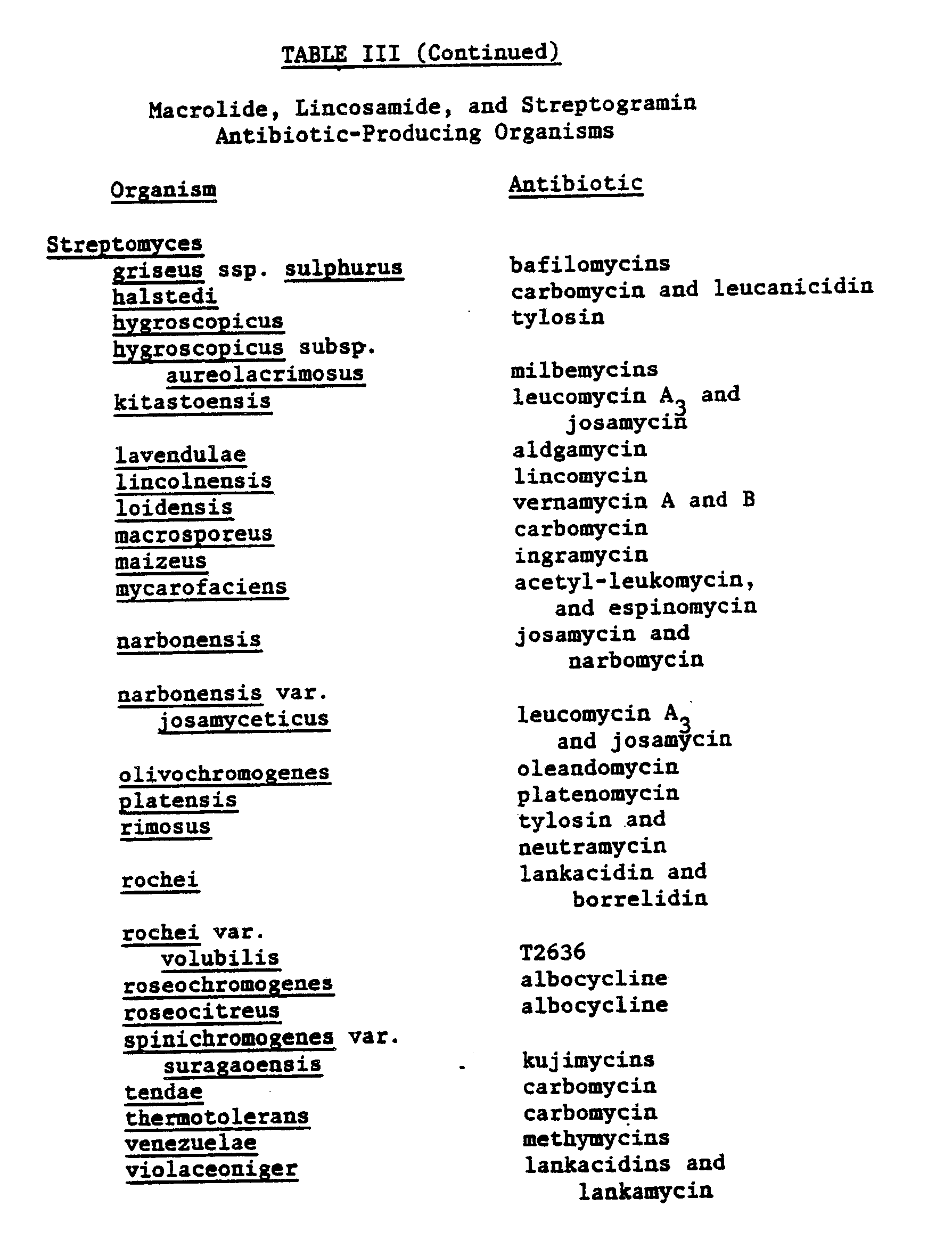
TABLE IV Miscellaneous Antibiotic-Producing Streptomyces Antibiotic Type Streptomyces Species Antibiotic cyclopentane ring-containing coelicolor methylenomycin A erythrochromogenes sarkomycin kasugaensis aureothricin and thiolutin violaceoruber methylenomycin A polyenes griseus candicidin nodosus amphotericin B noursei nystatin tetracyclines aureofaciens tetracycline, chlortetracycline, demethyltetracycline, and demethylchlortetracycline rimosus oxytetracycline TABLE V Polyether Antibiotic-Producing Organism Organism Antibiotic Actinomadura various species various polyethers oligosporus A80190 Dactylosporangium various species various polyethers Nocardia various species various polyethers Streptomyces albus A204, A28695A and B, and salinomycin aureofaciens narasin bobili A80438 cacaoi var. asoensis lysocellin chartreusis A23187 cinnamonensis monensin conglobatus ionomycin eurocidicus var. asterocidicus laidlomycin flaveolus CP38936 gallinarius RP 30504 griseus grisorixin hygroscopicus A218, emericid, DE3936, A120A, A28695A and B, etheromycin, and dianemycin lasaliensis lasalocid longwoodensis lysocellin mutabilis S-11743a pactum A80438 ribosidificus lonomycin violaceoniger nigericin Streptoverticillium various species various polyethers - The carL and carM genes function particularly well in Streptomyces fradiae GS33 and S. fradiae GS62, respectively. Yet even if the original carL and carM genes fail to express in a given organism, such as E. coli, because, for example, the Streptomyces promoter failed to function in that organism, the carL and carM coding sequences of the present invention could be ligated to a DNA containing an appropriate promoter and ribosome-binding site to achieve expression of the carL or carM genes in the host of choice.
- Plasmid pOJ315 contains the carL gene: (1) a promoter that directs transcription of the protein-coding sequence; (2) a sequence that, when transcribed into mRNA, directs translation of the transcript; (3) a protein-coding sequence; and (4) a transcription terminator. Plasmid pOJ182 contains each of these four elements of the carM gene. Each of these elements is independently useful and can, through the techniques of recombinant DNA technology, be used to form recombinant genes of great variety. The DNA sequence of the carL and carM genes will reveal the location of the carL and carM coding sequences and thus allow one to position other promoters and translational control sequences, for example, the trp, lpp, and lac promoters and translational control sequences of E. coli, the hybrid tac promoter and translational control sequence, and the veg promoter and translational control sequence of Bacillus, in reading phase with the carL or carM coding sequence. By choosing the proper promoter and translational control sequence, one can construct vectors that drive expression of the carL or carM gene products in any host cell. The promoters of the carL and carM genes are useful in their own right. The promoters and other regulatory elements of the carL and carM genes can be linked to the coding sequences of non-carbomycin antibiotic biosynthetic genes to prepare hybrid antibiotic pathway genes that function in other Streptomyces species to yield hybrid antibiotics. Thus, the individual elements of the gene on the plasmids described herein comprise important components of the present invention.
- Those skilled in the art will recognize that the carL sequence deposited under accession number NRRL B-18169 and the carM sequence deposited under accession number NRRL B-18221 can be used to prepare DNA probes for use in obtaining other biosynthetic gene-containing DNA segments, especially segments encoding macrolide biosynthetic genes. In addition, due to the diversity of Streptomyces thermotolerans strains both in nature and also in the laboratory, there may be a variety of allelic variants of the carL and carM genes that can be readily isolated given the carL and carM gene-containing compounds of this invention. These allelic variants, which encode gene products that are functionally equivalent to the carL or carM gene disclosed herein also fall within the scope of the present invention.
- A variety of known Streptomyces replicons can be used in conjunction with the carL and carM genes to construct expression vectors of the present invention. Table VI is an illustrative, but not comprehensive, listing of Streptomyces plasmids from which Streptomyces replicons can be obtained. Those skilled in the art recognize that, so long as the replicon function is not disrupted, all or part of the plasmids can be used to construct vectors that contain the carL and carM genes of the present invention. The plasmid-containing host and depository accession number are also listed in Table VI.
Table VI Streptomyces Plasmids Plasmid Host Accession Number SCP2 Streptomyces coelicolor A3(2) NRRL 15042 SCP2* Streptomyces coelicolor M110 NRRL 15041 pEL7 Streptomyces ambofaciens/pEL7 NRRL 12523 pUC6 Streptomyces espinosus NRRL 11439 pUC3 Streptomyces 3022A NRRL 11441 SLP1 Streptomyces lividans NCIB* 11417 pNM100 Streptomyces virginiae NRRL 15156 pEL103 Streptomyces granuloruber A399 12.13/pEL103 NRRL 12549 pIJ702 Streptomyces lividans ATCC** 39155 *National Collection of Industrial Bacteria (NCIB), Torry Research Station, Post Office Box 31, 135 Abbey Road, Aberdeen AB98DG, Scotland, United Kingdom. **American Type Culture Collection, Rockville, MD 20852. - Restriction fragments used to construct vectors illustrative of the present invention can be conventionally modified to facilitate ligation. For example, molecular linkers can be provided to a particular carL or carM biosynthetic gene-containing restriction fragment or to DNA comprising vector replication or integration functions. Thus, specific sites for subsequent ligation can be conveniently constructed. In addition, the various carL or carM biosynthetic gene-containing restriction fragments, origin of replication, or sequences that provide for chromosomal integration of a given vector can be modified by adding, eliminating, or substituting certain nucleotides to alter characteristics and to provide a variety of restriction sites for ligation of DNA. Those skilled in the art understand nucleotide chemistry and the genetic code and thus which nucleotides are interchangeable and which DNA modifications are desirable for a specific purpose. It is also noteworthy that a given carL or carM biosynthetic gene-containing restriction fragment is not limited to a particular position on a cloning vector, as long as critical, vector-controlled functions are not disrupted. Those skilled in the art understand or can readily determine which sites on a vector are advantageous for the ligation or insertion of a particular carL or carM gene-containing restriction fragment.
- Of course, the carL and carM genes can be used to construct vectors other than plasmids. Phage ØC31 is a well-known Streptomyces phage that is an excellent source of starting material for constructing integrative carbomycin biosynthetic gene-containing vectors that further exemplify the present invention. A derivative of phage 0̸C31, phasmid pKC331, is especially preferred for constructing such integrating vectors and can be obtained from E. coli K12 BE447/pKC331 deposited August 3, 1984 (NRRL B-15828). 0̸C31-type phages are integrative vectors and can be readily modified to incorporate the carL or carM genes and thus confer carL or carM activity to Streptomyces. Even plasmids that contain a replicon that provides for extrachromosomal maintenance of the plasmid sometimes integrate into the genome of the host cell, usually with concomitant deletion of the replicon sequences. The present invention thus is not limited by the type of vector used to introduce the carL and carM genes into the target host cell nor by the location of the carL or carM genes once introduction has occurred.
- The vectors of the present invention comprise a Streptomyces replicon and a carL or carM gene-containing restriction fragment. Because amplification and manipulation of plasmids is done faster and more efficiently in E. coli than in Streptomyces, it is convenient to add DNA sequences that also allow for replication in E. coli. Thus, the addition of functional replicon-containing and antibiotic resistance-conferring restriction fragments from E. coli plasmids such as, for example, pUC8, pUC18, pUC19, pBR322, pACYC184, pBR325, pBR328, and the like is highly advantageous and adds to the general utility of the present illustrative vectors.
- Streptomyces thermotolerans contains two carbomycin resistance-conferring genes, designated carA and carB. These two carbomycin resistance genes may act in concert to cause high-level resistance in Streptomyces thermotolerans. The carA gene is disclosed and claimed in, EPP et al., U.S. Patent Application Serial No. 901,240, attorney docket No. X-6935, filed August 28, 1986, while the carB gene is disclosed and claimed in EPP et al., U.S. Patent Applicaiton Serial Number 901,334, attorney docket No. X-7135, filed August 28, 1986 (see European Patent Appl. 87307538.6, Pub. Number 0258046). The present invention also comprises vectors that contain the carL or carM genes and either or both of the carA and carB genes. Plasmid pOJ171, for example, comprises both the carL and carB genes, while plasmid pOJ174 comprises both the carM and carA genes.
- The cloning vectors and transformants of the present invention provide for the cloning of genes to improve yields of various products that are currently produced in Streptomyces and related cells. Examples of such products include, but are not limited to, Carbomycin Streptomycin, Tylosin, Cephalosporins, Actaplanin, Narasin, Monensin, Tobramycin, Erythromycin, and the like. The present invention also provides selectable vectors that are useful for cloning, characterizing, and reconstructing a variety of useful DNA sequences.
- Streptomyces can be cultured in a number of ways using any of several different media. Preferred carbohydrate sources in a culture medium include, for example, molasses, glucose, dextrin, and glycerol. Nitrogen sources include, for example, soy flour, amino acid mixtures, and peptones. Nutrient inorganic salts are also incorporated and include the customary salts capable of yielding sodium, potassium, ammonium, calcium, phosphate, chloride, sulfate, and like ions. As is necessary for the growth and development of other microorganisms, essential trace elements are also added. Such trace elements are commonly supplied as impurities incidental to the addition of other constituents of the medium.
- Streptomyces is grown under aerobic culture conditions over a relatively wide pH range of about 5 to 9 at temperatures ranging from about 15° to 40°C. For plasmid stability and maintenance, it is desirable to start with a culture medium at a pH of about 7.2 and maintain a culture temperature of about 30°C.
- The following examples further illustrate and describe the invention disclosed herein. The invention is not limited in scope by reason of any of the following Examples; sources of reagents or equipment are provided merely for convenience and in no way limit the invention. Both an explanation of and the actual procedures for constructing the invention are described where appropriate.
- Plasmid pOJ171 can be obtained from the Northern Regional Research Center in E. coli K12 SF8 under the accession number NRRL B-18169 which was deposited on February 6, 1987. The lyophils of E. coli K12 SF8/pOJ171 are plated onto L-agar plates (10 g of Bacto-tryptone, 10 g of NaCl, 5 g of Bacto-Yeast Extract, and 15 g of agar per liter) containing 200 µg/ml apramycin to obtain a single colony isolate of the strain. This colony is used to inoculate about 500 ml of L broth (L agar without agar) containing 200 µg/ml apramycin, and the resulting culture is incubated at 37°C with aeration until the cells reach stationary phase.
- Plasmid DNA was obtained from the cells to use in construction of plasmid pOJ325 in accordance with the following procedure, which is adapted from Maniatis et al., 1982, Molecular Cloning (Cold Spring Harbor Laboratory). This same procedure was used, but on a smaller scale and with the ultracentrifugation steps replaced with phenol followed by chloroform extractions, to prepare the plasmid DNA used to identify the E. coli K12 RR1ΔM15/pOJ325 transformants.
- About 500 ml of stationary-phase E. coli/pOJ171 cells are harvested by centrifugation at 4000Xg for 10 minutes at 4°C, and the supernatant is discarded. The cell pellet is washed in 100 ml of ice-cold STE buffer (0.1 M NaCl; 10 mM Tris-HCl, pH 7.8; and 1 mM EDTA). After the cell pellet is washed, the pellet is resuspended in 10 ml of Solution 1 (50 mM glucose; 25 mM Tris-HCl, pH=8.0; and 10 mM EDTA) that contains 1 mg/ml lysozyme and is left at room temperature for 10 minutes. Twenty ml of Solution 2 (0.2 N NaOH and 1% SDS) are then added to the lysozyme-treated cells, and the solution is gently mixed by inversion. The mixture is incubated on ice for 10 minutes.
- Fifteen ml of ice-cold, 3 M sodium acetate, pH=4.8, are added to the lysed-cell mixture, and the solution is mixed by inversion. The solution is incubated on ice for 60 minutes. The. 3 M sodium acetate solution is prepared by mixing equal volumes of 3 M acetic acid and 3 M sodium acetate.
- The lysed cell mixture is centrifuged in a Beckman SW27 rotor (or its equivalent) at 20,000 rpm for 20 minutes at 4°C. About 36 ml of supernatant are recovered, and 2.5 volumes of ethanol are added, mixed, and the resulting solution left on ice for 15 minutes. The plasmid DNA is collected by centrifugation at 12,000Xg for 30 minutes at room temperature. The supernatant is discarded, and the DNA pellet is washed with 70% ethanol at room temperature. The ethanol wash is decanted, and the pellet is dried in a vacuum desiccator. The pellet is then resuspended in 8 ml of TE buffer (10 mM Tris-HCl, pH = 8.0, and 1 mM EDTA).
- Eight grams of CsCl are added to the DNA solution. About 0.8 ml of a 10 mg/ml solution of ethidium bromide in water are added for each 10 ml of CsCl-DNA solution. The final density of the solution is about 0.761 g/ml, and the ethidium bromide concentraton is about 800 µg/ml. The solution is transferred to a Beckman Type 50 centrifuge tube, filled to the top with TE buffer containing 0.761 g of CsCl per ml, sealed, and centrifuged at 45,000 rpm for 24 hours at 20°C. After centrifugation, two bands of DNA are visible in ordinary light and become even more prominent in UV light. The cap is removed from the tube, and the lower DNA band is recovered using a syringe with a #21 hypodermic needle inserted through the side of the centrifuge tube.
- The ethidium bromide is removed from the solution of plasmid DNA by several extractions with water-saturated 1-butanol, and the CsCl is removed by dialysis against TE buffer. After extractions with buffered phenol and then chloroform, the DNA is precipitated, washed with 70% ethanol, and dried. About 0.5 mg of plasmid pOJ171 DNA can be obtained by this procedure. A restriction site and function map of plasmid pOJ171 is presented in Figure 1 of the accompanying drawings.
- Plasmid pOJ160 can be obtained from the Northern Regional Research Center in E. coli K12 JM109 under the accession number NRRL B-18088. The lyophils of E. coli K12 JM109/pOJ160, which was deposited on July 29, 1986, are plated onto L-agar plates (10 g of Bacto-tryptone, 10 g of NaCl, 5 g of Bacto-Yeast Extract, and 15 g of agar per liter) containing 200 µg/ml apramycin to obtain a single colony isolate of the strain. This colony is used to inoculate about 500 ml of L broth (L agar without agar) containing 200 µg/ml apramycin, and the resulting culture is incubated at 37°C with aeration until the cells reach stationary phase.
- Plasmid DNA was obtained from the cells to use in construction of plasmid pOJ315 in accordance with the procedure set forth in Example 1, above. About 0.5 mg of plasmid pOJ160 DNA can be obtained by this procedure. A restriction site and function map of plasmid pOJ160 is presented in Figure 2 of the accompanying drawings.
- About 10 µg (10 µl) of plasmid pOJ160 DNA were added to 2 µl of 10X EcoRI buffer (1 M Tris-HCl, pH=7.5; 500 mM NaCl; 1 mg/ml BSA and 50 mM MgCl₂), 6 µl of H₂O, and 2 µl (∼30 units; unit definitions herein correspond to those of New England Biolabs, 32 Tozer Road, Beverly, MA 01915-9990, unless otherwise indicated) of restriction enzyme EcoRI. The resulting reaction was incubated at 37°C for two hours. The EcoRI-digested plasmid pOJ160 DNA was collected by adjusting the sodium acetate (NaOAc) concentration of the reaction mixture to 0.30 M, adding 2.5 volumes of ethanol, chilling the reaction mixture to -70°C, and centrifuging to pellet the precipitated DNA. The pellet of EcoRI-digested plasmid pOJ160 DNA was resuspended in 400 µl of TE buffer (10 mM Tris-HCl, pH=8.0, and 1 mM EDTA). About 1 µl (0.1 unit) of bacterial alkaline phosphatase (International Biotechnology, Inc., P.O. Box 1565, New Haven, CT 06506) was added to the DNA solution, and the reaction was incubated at 65°C for 1 hour. The reaction mixture was extracted with 400 µl of a 1:1 solution of phenol:chloroform and then extracted with 400 µl of chloroform. The EcoRI-digested, dephosphorylated plasmid pOJ160 DNA was collected by ethanol precipitation and centrifugation as described above, and the DNA pellet was resuspended in 10 µl of TE buffer.
- About 10 µg of plasmid pOJ171 in 100 µl of TE buffer were added to 13 µl of 10X EcoRI buffer 13 µl of H₂O and 4 µl (∼60 units) of restriction enzyme EcoRI. The resulting reaction was incubated at 37°C for 2 hours. The reaction mixture was extracted, and the DNA was collected as described above. The pelleted DNA was then resuspended and digested with restriction enzyme AhaIII in substantial accordance with the above teaching, except 10X AhaIII buffer (100 mM Tris-HCl (pH 8.0), 1 M NaCl and 100 mM MgCl₂) and restriction enzyme AhaIII was used. Following a one hour incubation at 37°C, the DNA was again precipitated. The DNA pellet was dissolved in 50 µl of TE buffer and contained ∼2.5 µg of the desired ∼20 kb EcoRI restriction fragment of plasmid pOJ171. The EcoRI-digested, dephosphorylated plasmid pOJ160 DNA (1 µl) was added to 10 µl ( 0.5 µg) of the EcoRI-AhaIII-digested plasmid pOJ171 DNA, 2 µl of 10X ligase buffer (660 mM Tris-HCl, pH=8; 66 mM MgCl₂; 10 mM dithiothreitol (DTT); and 10 mM ATP), and 6 µl of H₂O. About 1 µl (∼100 units) of T4 DNA ligase was added to the solution of DNA, and the resulting reaction was incubated at 15°C overnight (∼16 hours). The ligated DNA contained the desired plasmid pOJ315. A restriction site and function map of plasmid pOJ315 is presented in Figure 3 of the accompanying drawings. Because the ∼20 kb, carL gene-containing EcoRI restriction fragment of plasmid pOJ171 could insert into plasmid pOJ160 in either of two orientations, the ligation also produced plasmid pOJ315A, which differs from plasmid pOJ315 only with respect to the orientation of the carL gene-containing restriction fragment.
- The EcoRI site on plasmid pOJ160 resides within a polylinker that itself forms part of the DNA sequence encoding the lacZ α-fragment. Expression of the lacZ α-fragment in an E. coli ΔM15 strain, such as E. coli K12 RR1ΔM15 (NRRL B-15440 deposited May 5, 1983), restores the strain's ability to produce a functional β-galactosidase enzyme. Thus, plasmid pOJ160 can restore β-galactosidase activity to the E. coli K12 RR1ΔM15 strain. However, insertion of DNA into a restriction site of the polylinker on plasmid p0J160, as occurs in the construction of plasmid pOJ315, disrupts the lacZ α-fragment coding sequence and concomitantly destroys the ability of the plasmid pOJ160 derivative to complement the ΔM15 mutation. β-galactosidase can hydrolyze X-Gal, which is 5-bromo-4-chloro-3-indolyl-β-D-galactopyranoside, a colorless compound, to an indigo-colored product and thus allows for a convenient screening method for discriminating between transformants containing starting plasmid pOJ160 and those containing a plasmid pOJ160 derivative, such as plasmid pOJ315.
- To prepare E. coli K12 RR1ΔM15 cells that are competent for transformation, the lyophils of E. coli K12 RR1ΔM15 obtained from the NRRL are reconstituted to isolate single colonies. One single-colony isolate of RR1ΔM15 was inoculated into 10 ml of L broth (10 g of Bacto-tryptone, 10 g of NaCl, and 5 g of Bacto-Yeast Extract per liter), and the culture was incubated at 37°C overnight with aeration. The overnight culture was used to inoculate 200 ml of L broth to yield a culture with an 0.D.₆₀₀ of about 0.1. The culture was incubated at 37°C with aeration until the O.D.₆₀₀ was about 0.6. The culture was collected by centrifugation at 4000Xg for 10 minutes at 4°C, resuspended in 100 ml of cold 50 mM CaCl₂, and incubated on ice for 15 to 30 minutes.
- The cells were again collected by centrifugation and resuspended in 10 ml of cold 50 mM CaCl₂ containing 20% glycerol. A 200 µl aliquot of the cells was added to the ligated DNA prepared above. The cell-DNA mixture was incubated on ice for one hour, centrifuged, and the cell pellet was resuspended into 0.5 ml of L broth in a 1.5 ml tube and incubated with aeration at 37°C for one-half hour.
- Aliquots of the transformation mixture were plated on L-agar (L-broth with 15 grams per liter agar) plates containing 200 µg apramycin/ml, 40 µg X-gal/ml, and 40 µg IPTG/ml. IPTG serves to derepress the expression of the α-complementing fragment encoded on plasmid pOJ160. The plates were incubated at 37°C overnight. Colonies that contain a plasmid without an insert, such as E. coli K12 RR1ΔM15/pOJ16O, appear blue on these plates. Colonies that contain a plasmid with an insert, such as E. coli K12 RR1ΔM15/pOJ315, are white. Several apramycin-resistant, white colonies were selected and then screened by restriction enzyme analysis of their plasmid DNA. Plasmid DNA was obtained from the E. coli K12 RR1ΔM15/pOJ315 transformants in accordance with the procedure for isolating plasmid pOJ160 DNA, described above. The plasmid pOJ315 DNA can be used to transform Streptomyces fradiae, as described in Example 3, below.
- The following solutions are referred to throughout the Examples and are presented here for clarity.
1. P Media (∼100 ml): Ingredient Amount Sucrose 10.3 g K₂SO₄ 0.025 g Trace element solution 0.2 ml (see #3) MgCl₂·6H₂O 0.203 g Water 80 ml After autoclaving add: KH₂PO₄ (0.5%) 1 ml CaCl₂·2H₂O (3.68%) 10 ml (N-tris-(hydroxymethyl)methyl-2-aminoethane sulphonic acid), "TES" buffer, 0.25 M, pH=7.2 10 ml 2. Trace element solution (∼1 L): Ingredient Amount ZnCl₂ 40 mg FeCl₃·6H₂O 200 mg CuCl₂·2H₂O 10 mg MnCl₂·4H₂O 10 mg Na₂B₄O₇·10H₂O 10 mg (NH₄)₆Mo₇O₂₄·4H₂O 10 mg H₂O 1 L 3. R2 Regeneration Media (∼ 1 L): Ingredient Amount Sucrose 103 g K₂SO₄ 0.25 g Trace element solution 2 ml MgCl₂·6H₂O 10.12 g glucose 10 g L-asparagine·1H₂O 2.0 g casamino acids 0.1 g Agar 22 g Water to 700 ml The pH is adjusted to pH = 7.2 before autoclaving. After autoclaving, add: KH₂PO₄ (0.05 g/100 ml) 100 ml CaCl₂ (2.22 g/100 ml) 100 ml TES Buffer (5.73 g/100 ml, pH=7.2) 100 ml 4. Soft Nutrient Agar (SNA, ∼1 L): Ingredient Amount Difco Bacto Nutrient Broth 8 g Agar 5 g 5. AS1 Agar (∼1 L): Ingredient Amount Yeast extract 1.0 g L-Alanine 0.2 g L-Arginine Free Base 0.2 g L-Asparagine 0.5 g Soluable Starch 5.0 g NaCl 2.5 g NaSO₄ 10.0 g Meer Agar 20.0 g - Plasmid pOJ315 was used to transform Streptomyces fradiae GS33 (NRRL 18420 deposited September 23, 1988) in substantial accordance with the procedure set forth below.
- Streptomyces fradiae GS33 contains the tylL mutant and therefore cannot produce the antibiotic, tylosin. A culture of S. fradiae GS33 was started from 1 ml of frozen stock into 10 ml of TSB and incubated at 30°C for about 72 hours. TSB is made at 30 g/l and is obtained from Baltimore Biological Laboratories (BBL), P.O. Box 243, Cockeysville, Maryland 21031. The culture was incubated in an air-shaker incubator at 30°C for ∼30 hours. This culture was homogenized and sonicated; then, 3 ml of the culture were used to inoculate 17 ml of TSB containing 0.4% glycine. The culture was incubated in an air-shaker incubator at 30°C for about ∼24 hours. This culture was again homogenized and sonicated; then, 3 ml of the culture were used to inoculate 17 ml of TSB containing 0.4% glycine. The culture was incubated at 30°C for about 16 hours. The culture was again homogenized and sonicated; then, the mycelial fragments were harvested and washed two times with a 10.3% sucrose solution. The mycelial fragments were resuspended in 20 ml of P media (Example 3A1) containing 1 mg/ml lysozyme, and the resulting solution was incubated at room temperature for about one to one-and-one-half hours. During this protoplasting step, the cells were pipetted up and down to disperse clumps. The protoplasts were collected and washed two times with P medium. The protoplasts were then suspended in 2 ml of P medium. This process usually generates about 2 to 5 × 10⁷ protoplasts per 200 µl of solution.
- Approximately 200 µl of the protoplast solution were used per transformation. About 1 µg of the transforming DNA, in 10 µl of either ligation or TE buffer, was added to 50 µl of a 1 mg/ml solution of heparin (Sigma Chemical Co, P.O. Box 14508, St. Louis, Missouri 63178) and mixed. The DNA solution was added to the protoplasts; then, about 0.9 ml of 55% polyethylene glycol 1000 (Sigma) in P media were added to and mixed with the protoplasts. The cell-DNA mixture was vortexed and then plated onto R2 medium (Example 3A3); each plate was inoculated with about 0.1 ml of cells mixed with ∼3 ml of R2-modified soft agar (103 g sucrose, 0.5% agar 10.12 g MgCl₂, 2.22 g CaCl₂, and 5.72 g TES at pH = 7.2 per liter). The plates were incubated at 30°C overnight (∼16 hours) and then overlaid with 3 ml of R2-modified soft agar containing enough apramycin to give a final concentration, after diffusion, of 25 µg/ml. The plates were then incubated for about four days at 30°C, when colonies became visible to the unaided eye.
- The transformation efficiency of this protocol can be increased by first transforming the plasmids into Streptomyces fradiae M1, re-isolating the plasmids and then transforming into the mutant S. fradiae strain. Streptomyces fradiae M1 was first disclosed in Baltz, Journal of General Microbiology, 1978, 107:93-103.
- Streptomyces fradiae GS33 (NRRL 18420)/pOJ315 transformants were patched from the R2-agar regeneration plates to plates containing AS1 agar (Example 3A5) and 25 µg/ml apramycin and incubated at 37°C for 2-3 days until the colonies were 5-10 millimeters in diameter. The colonies were then plugged and the plugs transferred, using a sterile transfer tube (Spectrum Medical Industrial, Inc., Los Angeles, CA 90054) to trypticase soy agar (TSA) plates, which had been previously overlayed with soft-agar nutrient broth (Difco Laboratories, Detroit, MI 48232) containing Micrococcus luteus X160 (ATCC 9341). The plates were incubated at 37°C for 16-24 hours. Micrococcus luteus (ATCC 9341) is sensitive to tylosin and resistant to apramycin. Consequently, this M. luteus strain cannot grow around a plug which contains Streotomyces that are producing tylosin. In the plate-plug assay done with S. fradiae wild-type cells (NRRL 2702)and S. fradiae GS33/pOJ315, there were clear zones of inhibition of M. luteus growth around the plugs. These zones, about 20 to 25 mM in size, of inhibition, which were absent around the S. fradiae GS33 plugs, indicated the transformants were producing tylosin.
- Several plugs were prepared from the plates containing Streptomyces fradiae GS33/pOJ315 used in Example 4A. These plugs were placed onto a thin-layer chromatography plate (Merck, P.O. Box 2000, Rahway, New Jersey 07065, pre-coated silica gel #60 F-254) next to a sample of tylosin standard. The plugs were left on the plate for a time sufficient for diffusion to occur; then, the plate was developed by ascending liquid chromatography in 95:5:5 ethylacetate:diethylamine:methanol. The developed chromatograms were dried thoroughly in a fume hood for at least two hours. The chromatograms were then placed face down on Micrococcus luteus X160-seeded TSA plates for ∼15 minutes. The chromatograms were removed from the plates, and the plates were incubated at 37° for 16-24 hours.
- The chromatograms for the plugs prepared from Streptomyces fradiae GS33/pOJ315 transformants produced zones of inhibition resulting from substances on the chromatogram that comigrated with the tylosin standard.
- Plasmid pOJ174 can be obtained from the NRRL in E. coli K12 SF8/pOJ174, deposited June 4, 1987, under the accession number NRRL B-18221. Plasmid pOJ174 can be isolated from E. coli K12 SF8/pOJ174 in substantial accordance with the teaching of Example 1. A restriction site and function map of plasmid pOJ174 is presented in Figure 5 of the accompanying drawings.
- To prepare plasmid pOJ182, about 1 µg of plasmid pOJ174 was first digested with restriction enzyme EcoRI, in substantial accordance with the teaching of Example 2. The EcoRI-digested plasmid pOJ174 fragments were then digested with restriction enzyme AhaIII in substantial accordance with the teaching of Example 2. After precipitation and resuspension, about 4 µg of EcoRI and AhaIII digested plasmid pOJ174 fragments were ligated into EcoRI-digested, dephosphoxylated plasmid pOJ160, in substantial accordance with the teaching of Example 2. The ligation mixture was transformed into E. coli JM109 (Stratagene) in substantial accordance with the teaching of Example 2. Subsequent plasmid isolation and restriction enzyme analysis revealed plasmids which comprise an ∼10 kb insert which contains the carM gene. These plasmids were designated plasmids pOJ182 and pOJ182A, which differ only in the orientation of the ∼10 kb EcoRI restriction fragment. A restriction site and function map of plasmid pOJ182 is presented in Figure 6 of the accompanying drawings. Alternatively, the ∼10 kb EcoRI carM-containing restriction fragment used to construct plasmid pOJ182 can be isolated from plasmid pOJ220.
- To prepare plasmid pOJ226, approximately 2 µg of plasmid pOJ182 were digested with restriction enzyme PstI in substantial accordance with the teaching of Example 2, except 10X PstI restriction buffer (100 mM Tris-HCl, pH 7.5; 1 M NaCl; 1 mg/ml BSA and 100 mM MgCl₂) and restriction enzyme PstI were used. This digestion cuts plasmid pOJ182 at two sites; once in the S. thermotolerans insert and once in the polylinker region of plasmid pOJ160. The PstI-digested plasmid pOJ182 was then ligated and transformed into E. coli JM109 in substantial accordance with the teaching of Example 2. Restriction enzyme analysis of the plasmids isolated from transformants reveals plasmid pOJ226, which is a PstI deletion of plasmid pOJ182 comprising the carM gene on an ∼2 kb restriction fragment. A restriction site and function map of plasmid pOJ226 is presented in Figure 7 of the accompanying drawings.
- Plasmid pOJ182 and plasmid pOJ226 were individually used to transform Streptomyces fradiae GS62(NRRL 18421 deposited September 23, 1988) in substantial accordance with the teaching of Example 3.
- The Plate-Plug assay of Example 4A was used to confirm that S. fradiae GS62/pOJ182 and S. fradiae GS62/pOJ226 were all producing antibiotic. In addition, the Bioautography Assay of Example 4B was also used to confirm that each of the selected transformants produced an antibiotic which co-migrated with the tylosin standard. NMR and Mass Spectroscopy revealed that the antibiotic produced by the transformed strains was tylosin.
Claims (20)
Applications Claiming Priority (2)
| Application Number | Priority Date | Filing Date | Title |
|---|---|---|---|
| US25115888A | 1988-09-29 | 1988-09-29 | |
| US251158 | 1988-09-29 |
Publications (2)
| Publication Number | Publication Date |
|---|---|
| EP0361905A2 true EP0361905A2 (en) | 1990-04-04 |
| EP0361905A3 EP0361905A3 (en) | 1991-07-10 |
Family
ID=22950733
Family Applications (1)
| Application Number | Title | Priority Date | Filing Date |
|---|---|---|---|
| EP19890309855 Withdrawn EP0361905A3 (en) | 1988-09-29 | 1989-09-27 | Carbomycin biosynthetic genes, designated carl and carm, for use in streptomyces and other organisms |
Country Status (4)
| Country | Link |
|---|---|
| EP (1) | EP0361905A3 (en) |
| JP (1) | JPH03183494A (en) |
| DK (1) | DK478489A (en) |
| IL (1) | IL91797A0 (en) |
Cited By (3)
| Publication number | Priority date | Publication date | Assignee | Title |
|---|---|---|---|---|
| US6265202B1 (en) | 1998-06-26 | 2001-07-24 | Regents Of The University Of Minnesota | DNA encoding methymycin and pikromycin |
| US6495348B1 (en) | 1993-10-07 | 2002-12-17 | Regents Of The University Of Minnesota | Mitomycin biosynthetic gene cluster |
| US6600029B1 (en) | 1995-12-19 | 2003-07-29 | Regents Of The University Of Minnesota | Metabolic engineering of polyhydroxyalkanoate monomer synthases |
Family Cites Families (1)
| Publication number | Priority date | Publication date | Assignee | Title |
|---|---|---|---|---|
| US4952502A (en) * | 1987-02-24 | 1990-08-28 | Eli Lilly And Company | Carbomycin biosynthetic gene, designated carG, for use in streptomyces and other organisms |
-
1989
- 1989-09-27 EP EP19890309855 patent/EP0361905A3/en not_active Withdrawn
- 1989-09-27 IL IL91797A patent/IL91797A0/en unknown
- 1989-09-28 DK DK478489A patent/DK478489A/en not_active Application Discontinuation
- 1989-09-28 JP JP1256889A patent/JPH03183494A/en active Pending
Cited By (3)
| Publication number | Priority date | Publication date | Assignee | Title |
|---|---|---|---|---|
| US6495348B1 (en) | 1993-10-07 | 2002-12-17 | Regents Of The University Of Minnesota | Mitomycin biosynthetic gene cluster |
| US6600029B1 (en) | 1995-12-19 | 2003-07-29 | Regents Of The University Of Minnesota | Metabolic engineering of polyhydroxyalkanoate monomer synthases |
| US6265202B1 (en) | 1998-06-26 | 2001-07-24 | Regents Of The University Of Minnesota | DNA encoding methymycin and pikromycin |
Also Published As
| Publication number | Publication date |
|---|---|
| IL91797A0 (en) | 1990-06-10 |
| DK478489A (en) | 1990-03-30 |
| EP0361905A3 (en) | 1991-07-10 |
| DK478489D0 (en) | 1989-09-28 |
| JPH03183494A (en) | 1991-08-09 |
Similar Documents
| Publication | Publication Date | Title |
|---|---|---|
| US5098837A (en) | Macrolide biosynthetic genes for use in streptomyces and other organisms | |
| AU603088B2 (en) | Improvements in or relating to antibiotic-producing microorganisms | |
| US4935340A (en) | Method of isolating antibiotic biosynthetic genes | |
| US5672497A (en) | Method for increasing the antibiotic-producing ability of antibiotic-producing microorganisms | |
| US5190871A (en) | Use of the site-specific integrating function of phage φC31 | |
| US5149638A (en) | Tylosin biosynthetic genes tylA, tylB and tylI | |
| AU602954B2 (en) | Carbomycin biosynthetic gene, designated carg, for use in streptomyces and other organisms | |
| Mao et al. | Genetic localization and molecular characterization of two key genes (mitAB) required for biosynthesis of the antitumor antibiotic mitomycin C | |
| US5068189A (en) | Recombinant dna vectors encoding a 4"-o-isovaleryl acylase derived from a carbomycin biosynthetic gene, designated care, for use in streptomyces and other organisms | |
| EP0176321B1 (en) | Recombinant dna cosmid shuttle vectors | |
| HU197354B (en) | Process for selecting streptomyces containing recombinant dna | |
| EP0354727A2 (en) | Novel single stranded phasmid vectors and methods for transforming streptomyces and other actinomycetes | |
| US4886757A (en) | Spiramycin resistance-conferring cloning vectors | |
| US5665564A (en) | Isolation and characterisation of genes resistant to anthracycline antibiotics | |
| US4921801A (en) | Novel recombinant DNA cosmid shuttle vectors | |
| US5057425A (en) | Picromycin resistance-conferring gene, designated pica, for use in streptomyces and other organisms | |
| US4904598A (en) | Novel plasmid shuttle vectors conferring spiramycin resistance in streptomyces | |
| US4843002A (en) | Method of selecting recombinant DNA-containing streptomyces | |
| EP0364130B1 (en) | Novel tylosin biosynthetic genes | |
| US4904591A (en) | Carbomycin resistance-conferring gene, designated cara, for use in streptomyces and other organisms | |
| US4914030A (en) | Carbomycin resistance-conferring gene, designated carb, for use in streptomyces and other organisms | |
| JPH03183494A (en) | Calbomycin-biosynthesized gene car l and car m for use in streptomyces genus and other microoganisms | |
| EP0371112B1 (en) | Isolation and characterisation of genes resistant to anthracycline antibiotics | |
| Nakano et al. | Expression of the kanamycin resistance gene in a kanamycin-producing strain of Streptomyces kanamyceticus | |
| NZ232685A (en) | Tylosin biosynthetic pathway and genetically engineered organisms |
Legal Events
| Date | Code | Title | Description |
|---|---|---|---|
| PUAI | Public reference made under article 153(3) epc to a published international application that has entered the european phase |
Free format text: ORIGINAL CODE: 0009012 |
|
| 17P | Request for examination filed |
Effective date: 19891010 |
|
| AK | Designated contracting states |
Kind code of ref document: A2 Designated state(s): AT BE CH DE ES FR GB GR IT LI NL SE |
|
| PUAL | Search report despatched |
Free format text: ORIGINAL CODE: 0009013 |
|
| AK | Designated contracting states |
Kind code of ref document: A3 Designated state(s): AT BE CH DE ES FR GB GR IT LI NL SE |
|
| 17Q | First examination report despatched |
Effective date: 19930505 |
|
| STAA | Information on the status of an ep patent application or granted ep patent |
Free format text: STATUS: THE APPLICATION IS DEEMED TO BE WITHDRAWN |
|
| 18D | Application deemed to be withdrawn |
Effective date: 19940607 |