EP0361923B1 - Dispositif et procédé pour contrôler le positionnement d'éléments de marquage pour une imprimante d'impact en série - Google Patents
Dispositif et procédé pour contrôler le positionnement d'éléments de marquage pour une imprimante d'impact en série Download PDFInfo
- Publication number
- EP0361923B1 EP0361923B1 EP89309893A EP89309893A EP0361923B1 EP 0361923 B1 EP0361923 B1 EP 0361923B1 EP 89309893 A EP89309893 A EP 89309893A EP 89309893 A EP89309893 A EP 89309893A EP 0361923 B1 EP0361923 B1 EP 0361923B1
- Authority
- EP
- European Patent Office
- Prior art keywords
- cam
- platen
- ribbon
- character imprinting
- impact printer
- Prior art date
- Legal status (The legal status is an assumption and is not a legal conclusion. Google has not performed a legal analysis and makes no representation as to the accuracy of the status listed.)
- Expired - Lifetime
Links
- 238000000034 method Methods 0.000 title claims description 8
- 230000033001 locomotion Effects 0.000 claims description 16
- 230000015572 biosynthetic process Effects 0.000 claims description 11
- 230000003116 impacting effect Effects 0.000 claims description 7
- 230000004044 response Effects 0.000 claims description 5
- 238000007639 printing Methods 0.000 description 29
- 230000007246 mechanism Effects 0.000 description 16
- 230000007704 transition Effects 0.000 description 15
- 238000012937 correction Methods 0.000 description 5
- 230000008878 coupling Effects 0.000 description 3
- 238000010168 coupling process Methods 0.000 description 3
- 238000005859 coupling reaction Methods 0.000 description 3
- 230000001965 increasing effect Effects 0.000 description 3
- 230000009467 reduction Effects 0.000 description 3
- 239000013078 crystal Substances 0.000 description 2
- 239000011324 bead Substances 0.000 description 1
- 239000002131 composite material Substances 0.000 description 1
- 238000010276 construction Methods 0.000 description 1
- 230000001186 cumulative effect Effects 0.000 description 1
- 238000013461 design Methods 0.000 description 1
- 238000010586 diagram Methods 0.000 description 1
- 230000003028 elevating effect Effects 0.000 description 1
- 238000005516 engineering process Methods 0.000 description 1
- 231100001261 hazardous Toxicity 0.000 description 1
- 230000036541 health Effects 0.000 description 1
- 230000006872 improvement Effects 0.000 description 1
- 230000001939 inductive effect Effects 0.000 description 1
- 230000000977 initiatory effect Effects 0.000 description 1
- 230000002452 interceptive effect Effects 0.000 description 1
- 238000004519 manufacturing process Methods 0.000 description 1
- 239000000463 material Substances 0.000 description 1
- 238000005259 measurement Methods 0.000 description 1
- 230000004048 modification Effects 0.000 description 1
- 238000012986 modification Methods 0.000 description 1
- 230000007935 neutral effect Effects 0.000 description 1
- 230000002035 prolonged effect Effects 0.000 description 1
- 238000012552 review Methods 0.000 description 1
- 230000011664 signaling Effects 0.000 description 1
- 238000012546 transfer Methods 0.000 description 1
Images




Classifications
-
- B—PERFORMING OPERATIONS; TRANSPORTING
- B41—PRINTING; LINING MACHINES; TYPEWRITERS; STAMPS
- B41J—TYPEWRITERS; SELECTIVE PRINTING MECHANISMS, i.e. MECHANISMS PRINTING OTHERWISE THAN FROM A FORME; CORRECTION OF TYPOGRAPHICAL ERRORS
- B41J25/00—Actions or mechanisms not otherwise provided for
- B41J25/304—Bodily-movable mechanisms for print heads or carriages movable towards or from paper surface
- B41J25/308—Bodily-movable mechanisms for print heads or carriages movable towards or from paper surface with print gap adjustment mechanisms
-
- B—PERFORMING OPERATIONS; TRANSPORTING
- B41—PRINTING; LINING MACHINES; TYPEWRITERS; STAMPS
- B41J—TYPEWRITERS; SELECTIVE PRINTING MECHANISMS, i.e. MECHANISMS PRINTING OTHERWISE THAN FROM A FORME; CORRECTION OF TYPOGRAPHICAL ERRORS
- B41J35/00—Other apparatus or arrangements associated with, or incorporated in, ink-ribbon mechanisms
- B41J35/04—Ink-ribbon guides
- B41J35/10—Vibrator mechanisms; Driving gear therefor
Definitions
- This invention relates to a serial impact printer and, more particularly, to an apparatus and method for controlling the position of marking elements in a serial impact printer.
- the office has, for many years, been a stressful environment due, in part, to the large number of objectionable noise generators, such as typewriters, high speed impact printers, paper shredders, and other office machinery. Where several such devices are placed together in a single room, the cumulative noise pollution may even be hazardous to the health and well being of its occupants. The situation is well recognized and has been addressed by governmental bodies who have set standards for maximum acceptable noise levels in office environments. Attempts have been made by the technical community to reduce the noise pollution. Some of these methods include enclosing impact printers in sound attenuating covers, designing impact printers in which the impact noise is reduced, and designing quieter printers based on non-impact technologies such as ink jet and thermal transfer.
- Noise measurements are often referenced as dBA values.
- the "A" scale by which the sound values have been identified, represents humanly perceived levels of loudness as opposed to absolute values of sound intensity.
- dB or dBA
- impact printers generate impact noise in the range of 65 to just over 80 dBA, which is deemed to be intrusive. When reduced to the high 50s dBA, the noise is construed to be objectionable or annoying. It would be highly desirable to reduce the impact noise to a dBA value in the vicinity of 50 dBA.
- the IBM Selectric ball unit typewriters generate about 78 dBA
- the Xerox Memorywriter typewriters generate about 68 dBA.
- the typewriter of the present invention has been typically measured at slightly less than 52 dBA. This represents a dramatic improvement on the order of about 100 times less noisy than present day offices, a notable achievement toward a less stressful office environment.
- the printing impact produced as the hammer impacts and drives the type character pad against the ribbon, the print sheet and the platen with sufficient force to release the ink from the ribbon, is the major source of noise in the typewriter, other noise sources are present. In the presently available typewriters, the impact noise overshadows the other noises. But, once the impact noise has been substantially reduced, the other noises will no longer be extraneous. Thus, the design of a truly quiet printer requires the designer to address reducing all other noise sources, such as those arising from carriage motion, character selection, ribbon lift and advance, as well as from miscellaneous clutches, solenoids, motors and switches.
- the mean time available between character impacts is about 30 milliseconds.
- the impact noise reduction achieved by the printing mechanism of the present typewriter is made possible by significantly stretching the impact dwell time to a substantially larger fraction of the printing cycle than is typical in conventional printers. For instance, if the dwell time were stretched from 100 microseconds to 6 to 10 milliseconds, this would represent a sixty- to one hundred-fold increase, or stretch, in pulse width relative to the conventional. By extending the deforming of the platen over a longer period of time, an attendant reduction in noise output can be achieved.
- a character impacting member having a high effective mass, is driven with a first force, from a starting position to the rear of a character element and then together with the character imprinting element across a throat gap into incipient contact with the platen/paper combination.
- the character element picks up the marking (or correcting) ribbon and drives it against the platen/paper combination with a second force of a magnitude sufficient to release the marking material and deform the platen.
- the impacting member must have a very low terminal velocity at the instant of contact, it must be rapidly accelerated and decelerated across the throat gap distance. In order to achieve acceptable printing speeds, an extremely short throat distance is preferred.
- the throat gap distance be accurately established and continuously maintained during printing despite thickness variations of the record medium and machine dimensional variations. Of course, it is to be understood that a short throat gap distance in any impact printer will allow faster printing speeds to be achieved.
- the present control mechanism comprises a single cam mechanism for adjusting the throat gap and for raising and lowering the marking and correcting ribbons.
- Control cams for elevating an associated pair of marking and correcting ribbons are disclosed in each of US-A-4,472,073 (Valle et al ), 4,533,267 (Kurachi et al ), 4,589,788 (Lendl), 4,613,248 (Iwase et al ) and 4,637,744 (Valle et al ).
- one or more cam tracks is provided to raise a selected one of a pair of ribbons to a print line or to lower both ribbons to a neutral position for viewing the print line.
- a cam follower arm depending from a pivotable platform upon which the ribbon housings are mounted, extends into the cam track so as to drive the platform and the housings in an arcuate path.
- the throat gap While printing is being conducted, the throat gap is continuously monitored in order that it can be increased to its optimal distance if it becomes too small due to encountering thicker record media or a misalignment of the platen or carriage rails. Modification of the throat gap distance during printing will not affect the print point location of the ribbon.
- This object may be carried out, in one form, by providing a serial impact printer including a platen mounted for rotation about its axis, a scanning carriage mounted for movement along a path parallel to the platen axis and supporting thereon a character imprinting member, a ribbon pack assembly including a marking ribbon and a correcting ribbon disposed one above the other, and a hammer for impacting the character imprinting member.
- Our invention includes a control assembly comprising a unitary cam driven by a drive motor for raising and lowering the ribbon pack assembly and for moving the character imprinting member toward and away from the platen to vary a throat gap distance therebetween.
- a sensor is associated with the character imprinting member for generating a signal when the throat gap distance deviates from a predetermined reference distance, and a microprocessor is provided for receiving the sensor signals for controlling the energization of the drive motor in response thereto.
- the invention accordingly provides a single control member for properly establishing and maintaining the throat gap distance between the character surface and the platen and for raising and lowering of a composite marking/correcting ribbon pack.
- This invention also enables accurate establishment of the home position for the control member in an extremely low cost manner.
- FIG. 1 Salient features of the quiet impact printer, in which the present invention is incorporated, are shown in Figure 1. These include a platen 10 suitably mounted on a frame (not shown) for rotation about its axis 11 to advance and retract a record carrier, comprising a single sheet or a multi-part form, on which characters may be imprinted.
- a carriage support beam 12 fitted with rod stock rails 14 spans the printer from side-to-side beneath and parallel to the platen for rigidly and smoothly supporting a carriage for traversing movement parallel to the axis of the platen.
- a horseshoe-shaped interposer 16 mounted for arcuate movement about pivot axis 18 and carrying a print tip 20 at its apex.
- a rockable bail bar 22 extends substantially parallel to the axis of platen 10 and is constrained to limited angular movement toward and away from the platen about its axis of rotation 24.
- Prime mover 26 in the form of a reciprocating voice coil motor, a rotary motor or any other suitable driver is connected to the bail bar for imparting the rocking movement thereto.
- a bead or rail 28 on the bail bar receives one end of push rod 30, via a pair of capturing rollers 32 and 34, for moving it toward and away from the platen as the bail bar is rocked.
- the non-collapsible push rod illustrated in Figure 1 is a generic form of this element which is preferably collapsible for allowing the print tip 20 to be drawn back away from the platen in order to allow the operator easy access to a printwheel.
- a bearing surface 36 (shown in Figure 2) on the opposite end of the push rod is biased into engagement with a seat on the rear wall of the print tip 20 by means of tension springs 38 extending between pins 40 on the push rod and suitable anchors (not shown) on the interposer 16.
- tension springs 38 extending between pins 40 on the push rod and suitable anchors (not shown) on the interposer 16.
- a pivot frame 42 pivotally mounted upon the carriage is a pivot frame 42, movable toward and away from the platen in an arcuate path about pivot axis 44.
- a printwheel drive motor 46 having a drive shaft 48 terminating in a drive coupling 50, is secured to the pivot frame for movement therewith.
- Printwheel 52 comprises a hub 53 from which radial spokes extend, each terminating in a character imprinting surface. When dropped into place, the hub is urged against the drive coupling by retainer button 54 on the end of retainer spring 56.
- a ribbon pack assembly 58 (shown in phantom lines) overlies the carriage and is mounted thereon by a pair of pivot lugs 60 underlying pivot pins 62 on the carriage.
- the ribbon pack assembly comprises an upper housing 64 containing a supply of marking ribbon and a lower housing 66 containing a supply of correcting ribbon.
- a coupling dagger arm 68 depending from the upper housing terminates in a cam follower pin 70.
- the overall plan profile of the ribbon pack assembly 58 is comparable to standard ribbon housings, in that it includes a body storage portion and a pair of dispensing horns between which the push rod 30 may pass to contact the print tip 20.
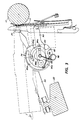
- a throat adjust and ribbon lift control mechanism 72 includes a cam member 74 mounted for rotation upon the carriage about axis pin 76 and a stepper-type drive motor 78 coupled to a gear 80 on cam member 74, also mounted upon the carriage.
- the cam member comprises an entrance slot 82, for receiving cam follower pin 70, communicating with a short, marking cam track 84 and a long, correcting cam track 86, and a cam formation 88 extending axially outwardly from the member and surrounding the pin 76.
- Cam tracks 84 and 86 control ribbon elevation and cam formation 88 controls throat gap distance via throat adjusting link 90.
- One end of link 90 is connected to a pin 92 on the pivot frame 42 while the other end supports cam follower roller 94.
- a torsion spring 96 connected between axis pin 76 and pin 97 on link 90, serves to urge the cam follower roller into intimate contact with the cam formation 88 and to retain the link 90 in position adjacent the cam formation.
- the profile of the cam formation 88 is such that cam follower roller 94 contacts its largest diameter portion 88a when the cam member 74 is in the "home position" orientation illustrated in Figure 2 and the cam follower roller contacts its smallest diameter portion 88b when the cam member is in the orientation illustrated in Figures 3 and 4.
- throat adjusting link 90 moves the pivot frame 42 and printwheel 52 from a rest position ( Figure 2) to a printing position ( Figures 3 and 4).
- the cam follower pin 70 moves along either cam track 84 or cam track 86 (depending on the direction of rotation of the cam member), each of which begins with a rise portion 84a/86a and terminates in a uniform diameter portion 84b/86b.
- the pivot frame is provided with a throat switch 98, mounted upon right side extension 100, which is actuated by a right side throat adjust paddle 102, mounted for arcuate movement about one end of carriage-mounted pivot axle 104.
- a similar throat adjust paddle 106 is located at the left side of pivot axle 104 so that movement of either paddle may actuate the switch.
- a spring 108 biases the paddle assembly against a flexible, spring stock, card guide 110 secured to the carriage at its lower end 112 and lightly biased against the platen 10. Any movement of the card guide away from the platen will move the appropriate throat adjust paddle and, if large enough, will transition the switch (from open to closed, or vice versa), sending a signal to the microprocessor 114 which controls the drive motor 78.
- the microprocessor controls the movements of prime mover 26, stepper drive motor 78, a ribbon advance motor, and other motors.
- an initialization sequence is conducted in order to determine the true "home position" of the cam member 74 (as opposed to the virtual home position where the cam follower pin 70 enters the entrance slot 82) from which rotation of the cam, in either direction, begins to lift one of the ribbons.
- Our invention allows us to achieve a precise step count for the "home position" relative to the true location of the platen, within a single motor step of 0.063 mm, without the need for ultra precise tolerances in the machine parts or precisely located switches, which drive up the manufacturing costs.
- the drive motor 78 is energized to drive the cam member incrementally in one direction, counting the steps until a signal has been received that the throat switch 98 is transitioned.
- the drive motor 78 is reversed to drive the cam member incrementally in the opposite direction, counting the steps until a second switch transition signal is received.
- the count of the total number of stepper motor steps from the first switch transition to the second switch transition represents the total rotary travel of the cam member from the platen, in one direction, back to the platen, in the opposite direction.
- the microprocessor 114 calculates the "home position", which will be a function of the ratio of the lengths of the cam tracks 84 and 86.
- cam profile diagram of Figure 7 it can be seen that since the correction ribbon must be lifted approximately twice the distance (about 9.6 mm) that the marking ribbon must be lifted (about 4.3 mm), and requires an arc of about 220° to the print point for cam track 86 versus an arc of about 140° to the print point for cam track 84.
- the ratio of the cam lengths is about 60:40.
- the microprocessor controls the various mechanisms to drive each to a "home position" where print point visibility is at a maximum.
- the cam member 74 draws back the pivot frame to a throat gap of about 2.54 mm, the cam member lowers the ribbon pack assembly 58 to the Figure 2 position, the printwheel 52 is rotated to a position where a gap is present between character imprinting surfaces, and the bail bar is rocked back to draw the print tip away from the platen.
- the mechanisms advance these elements to their "printing position".
- the throat gap may diminish if the card guide 110 is moved away from the platen by an increase in paper thickness (e.g. six-part form on the right and one-part on the left) or a skewing of the platen or carriage rails. Then the throat adjust paddle 102 will actuate throat switch 98 and cause a switch transition. Upon receiving a transition signal, the microprocessor will incrementally energize the drive motor 78 to draw back the pivot frame until another transition occurs and then take a further two steps back in order to return the throat gap to 1.3 mm. This new print position is sent to the microprocessor so that it may be reestablished when returning from the "home position" after a long pause or cessation of typing. The above-described throat gap correction procedure takes place without affecting ribbon height since the tracks 84 and 86 maintain a constant diameter dwell subsequent to their initial rise.
- the throat gap is programmed to be increased by about 0.63 mm, in case there are tears or folds in the paper, or paper clips, staples or other obstructions which could damage the printing mechanism.
- the pivot frame is returned by the same amount that it was backed out while watching for switch transitions, so that corrections can be made for any changes in clearance.
- Our invention enables our high hammer mass printer to operate at commercially reasonable speeds and to achieve high quality output. These are possible because the throat gap is kept small and because the throat gap is uniformly maintained so that the character impacts at the proper angle, optimizing deflection of the character beam and insuring that the surface of the character is tangential to the platen at impact, virtually at all times.
Landscapes
- Impression-Transfer Materials And Handling Thereof (AREA)
- Common Mechanisms (AREA)
Claims (9)
- Imprimante sérielle à impact comprenant une platine (10) montée pour tourner autour de son axe, un chariot de balayage monté pour se déplacer suivant un trajet parallèle audit axe et supportant un moyen (52) d'impression de caractère, un ensemble à rubans (58) comprenant un ruban de marquage (64) et un ruban de correction (66) disposés l'un au-dessus de l'autre, un moyen de marteau (20) pour frapper ledit moyen d'impression de caractère, ladite imprimante étant caractérisée par un moyen de commande de la position d'un élément de marquage comportant :- une came unitaire (74) pour élever et abaisser ledit ensemble à rubans (58) et pour déplacer ledit moyen d'impression de caractère (52) afin de le rapprocher de ladite platine et de l'en éloigner pour faire varier la distance d'un passage les séparant,- un moyen d'entraînement (78) pour faire tourner ledit moyen de came,- un moyen de capteur (98) pour produire un signal lorsque ladite distance du passage s'écarte d'une distance de référence prédéterminée, et- un moyen de calcul (114) pour recevoir ledit signal et pour commander l'excitation dudit moyen d'entraînement en réponse à celui-ci.
- Imprimante sérielle à impact selon la revendication 1, dans laquelle ladite came unitaire (74) comporte une fente d'admission (82) communiquant avec une paire de pistes de came (84, 86), et un axe (70) de galet de came relié audit ensemble à rubans (58), lesdites pistes de came étant situées par rapport à ladite fente d'admission de façon que la rotation de ladite came dans un sens provoque le mouvement dudit axe du galet de came dans une piste de came et la rotation de ladite came dans la direction opposée provoque le déplacement dudit axe du galet de came dans l'autre piste de came.
- Imprimante sérielle à impact selon la revendication 2, dans laquelle ladite première piste de came (84) comporte une partie de montée basse (84a) et une première partie d'arrêt momentané (84b) pour placer ledit ruban de marquage à un point d'impression sur ladite platine, et ladite autre piste de came (86) comporte une partie de montée haute (86a) et une seconde partie d'arrêt momentané (86b) pour placer ledit ruban de correction audit point d'impression.
- Imprimante sérielle à impact selon la revendication 3, dans laquelle ladite première partie d'arrêt momentané (84b) a un diamètre inférieur à celui de ladite seconde partie d'arrêt momentané (86b).
- Imprimante sérielle à impact selon l'une quelconque des revendications 1 à 4, dans laquelle ladite came unitaire (74) comporte en outre une formation de came centrale, s'étendant axialement (88), pour établir la distance du passage en conjonction avec un moyen de connexion (90) monté entre ledit moyen d'impression de caractère (52) et ladite formation de came.
- Imprimante sérielle à impact selon la revendication 4, dans laquelle ladite came unitaire comporte en outre une formation de came centrale (88), s'étendant axialement, pour établir la distance du passage en conjonction avec un moyen de connexion (90) monté entre ledit moyen d'impression de caractère et ladite formation de came, et lesdites parties de montée de piste de came (84b, 86b) s'étendent radialement à l'extérieur d'une partie d'arrêt momentané de la formation de came alors que lesdites parties d'arrêt momentané des pistes de came s'étendent radialement vers l'extérieur d'une partie de manoeuvre de la formation de came, d'où il résulte que des variations peuvent être effectuées dans ladite distance du passage par de petits mouvements de rotation de ladite came sans avoir d'effet sur la hauteur du ruban.
- Imprimante sérielle à impact selon l'une quelconque des revendications 1 à 4 et 6, comprenant un guide de carte (110) supporté sur ledit chariot et sollicité contre ladite platine, et un moyen (102) d'actionnement de capteur sollicité contre ledit guide de carte de manière à être rapproché de ladite platine et à en être éloigné par ledit guide de carte.
- Procédé pour maintenir un moyen d'impression de caractère (52) à une distance prédéterminée d'un passage par rapport à une platine (10) d'une imprimante sérielle à impact, l'imprimante comprenant une platine (10) qui peut tourner autour de son axe, un chariot de balayage mobile le long d'un trajet parallèle audit axe et supportant un moyen d'impression de caractère (52), un ensemble à rubans (58) comportant un ruban de marquage (64) et un ruban de correction (66) disposés l'un au-dessus de l'autre, et un moyen de marteau (20) mobile pour frapper ledit moyen d'impression de caractère, le procédé étant caractérisé par les étapes consistant à :- élever et abaisser ledit ensemble à rubans au moyen d'une came unitaire et déplacer ledit moyen d'impression de caractère pour le rapprocher de ladite platine et l'en éloigner au moyen de ladite came, afin de faire varier la distance du passage les séparant,- la détection du moment où ladite distance du passage diminue par rapport à ladite distance prédéterminée alors que ledit chariot traverse ladite platine,- produire un signal répondant à l'apparition de ladite diminution, et- mettre sous tension ledit moteur d'entraînement en réponse audit signal pour faire tourner ladite came de façon à déplacer ledit moyen d'impression de caractère pour l'éloigner de ladite platine sans influencer la hauteur du ruban.
- Procédé selon la revendication 8 comprenant les étapes consistant à :- mettre sous tension un moteur d'entraînement pour faire tourner ladite came dans un premier sens de façon que ladite came élève l'un desdits rubans jusqu'à ladite position d'impression et déplace ledit moyen d'impression de caractère dans la direction de ladite platine,- détecter un premier signal représentatif du fait que ledit moyen d'impression de caractère se trouve à une distance prédéterminée de ladite platine,- inverser ledit moteur d'entraînement pour faire tourner ladite came dans le sens opposé, en réponse audit premier signal, de sorte que ledit premier ruban est abaissé et l'autre desdits rubans est alors élevé jusqu'audit point d'impression, alors que simultanément ledit moyen d'impression de caractère est éloigné de ladite platine et est alors déplacé vers ladite platine,- détecter un second signal représentatif du fait que ledit moyen d'impression de caractère se trouve à une distance prédéterminée de ladite platine, et- calculer l'emplacement de ladite position de repos en fonction du rapport de longueurs des trajets angulaires nécessaire pour élever chacun desdits rubans jusqu'audit point d'impression.
Applications Claiming Priority (2)
| Application Number | Priority Date | Filing Date | Title |
|---|---|---|---|
| US07/250,798 US4893950A (en) | 1988-09-28 | 1988-09-28 | Apparatus and method for controlling the positioning of marking elements in a serial impact printer |
| US250798 | 1988-09-28 |
Publications (2)
| Publication Number | Publication Date |
|---|---|
| EP0361923A1 EP0361923A1 (fr) | 1990-04-04 |
| EP0361923B1 true EP0361923B1 (fr) | 1993-03-03 |
Family
ID=22949196
Family Applications (1)
| Application Number | Title | Priority Date | Filing Date |
|---|---|---|---|
| EP89309893A Expired - Lifetime EP0361923B1 (fr) | 1988-09-28 | 1989-09-28 | Dispositif et procédé pour contrôler le positionnement d'éléments de marquage pour une imprimante d'impact en série |
Country Status (4)
| Country | Link |
|---|---|
| US (1) | US4893950A (fr) |
| EP (1) | EP0361923B1 (fr) |
| JP (1) | JPH02169287A (fr) |
| DE (1) | DE68905125T2 (fr) |
Families Citing this family (5)
| Publication number | Priority date | Publication date | Assignee | Title |
|---|---|---|---|---|
| DE8814238U1 (de) * | 1988-11-14 | 1990-03-22 | Siemens Nixdorf Informationssysteme AG, 33106 Paderborn | Druckvorrichtung |
| US5066150A (en) * | 1990-04-18 | 1991-11-19 | Xerox Corporation | Low cost quiet impact printer |
| US5011309A (en) * | 1990-04-18 | 1991-04-30 | Xerox Corporation | Ribbon drive for low cost quiet impact printer |
| JPH07195793A (ja) * | 1993-12-28 | 1995-08-01 | Brother Ind Ltd | 印字装置 |
| GB9606167D0 (en) * | 1996-03-23 | 1996-05-29 | Prestek Ltd | Printing apparatus |
Family Cites Families (19)
| Publication number | Priority date | Publication date | Assignee | Title |
|---|---|---|---|---|
| DE2752061C3 (de) * | 1977-11-22 | 1981-02-12 | Philips Patentverwaltung Gmbh, 2000 Hamburg | Einrichtung zur Einstellung des Abstandes eines Druckkopfes senkrecht zum Druckwiderlager |
| US4268177A (en) * | 1978-11-01 | 1981-05-19 | Plessey Peripheral Systems | Paper thickness adjusting mechanism for impact printer |
| US4227819A (en) * | 1978-11-24 | 1980-10-14 | International Computers Limited | Printer platen |
| DE2919209C2 (de) * | 1979-05-12 | 1982-09-02 | Triumph-Adler Aktiengesellschaft für Büro- und Informationstechnik, 8500 Nürnberg | Steuervorrichtung für Schreibmaschinen |
| IT1119622B (it) * | 1979-12-21 | 1986-03-10 | Olivetti & Co Spa | Macchina per scrivere elettronica |
| DE3008539C2 (de) * | 1980-03-06 | 1982-05-27 | Triumph-Adler Aktiengesellschaft für Büro- und Informationstechnik, 8500 Nürnberg | Verstelleinrichtung des Aufzeichnungsträgeraggregates an Schreib- u.ä. Büromaschinen |
| IT1130115B (it) * | 1980-04-15 | 1986-06-11 | Olivetti & Co Spa | Dispositivo di attuazione per due funzioni di macchine scriventi |
| DE3014823C2 (de) * | 1980-04-15 | 1986-10-09 | Mannesmann AG, 4000 Düsseldorf | Matrixdrucker mit einem zur Druckspalteinstellung anstellbaren Druckkopf |
| US4384794A (en) * | 1981-04-01 | 1983-05-24 | Tokyo Electric Co., Ltd. | Printer |
| JPS5912891A (ja) * | 1982-07-13 | 1984-01-23 | Brother Ind Ltd | タイプライタ−のリボンリフト機構 |
| US4439051A (en) * | 1982-09-24 | 1984-03-27 | Ncr Corporation | Single printing station, multiple record member feeding mechanism |
| JPS6069666U (ja) * | 1983-10-19 | 1985-05-17 | ブラザー工業株式会社 | タイプライタのリボンリフト機構 |
| DE3344595C2 (de) * | 1983-12-09 | 1985-10-31 | Triumph-Adler Aktiengesellschaft für Büro- und Informationstechnik, 8500 Nürnberg | Vorrichtung zum Heben und Transportieren von Farb- und Korrekturbändern in elektronisch gesteuerten Schreib- und ähnlichen Maschinen |
| US4514101A (en) * | 1983-12-14 | 1985-04-30 | Xerox Corporation | Paper thickness adjusting mechanism for impact printer |
| JPS60149482A (ja) * | 1984-01-17 | 1985-08-06 | Silver Seiko Ltd | 印字機のリボンリフト装置 |
| US4575267A (en) * | 1984-04-23 | 1986-03-11 | Ncr Corporation | Record media thickness compensating mechanism |
| US4676675A (en) * | 1984-05-09 | 1987-06-30 | Brother Kogyo Kabushiki Kaisha | Media thickness compensating device for a printer |
| US4652153A (en) * | 1984-07-25 | 1987-03-24 | Oki Electric Industry Co., Ltd. | Wire dot-matrix printer |
| US4810110A (en) * | 1987-09-28 | 1989-03-07 | Micro Peripherals, Inc. | Form thickness compensator with cutter |
-
1988
- 1988-09-28 US US07/250,798 patent/US4893950A/en not_active Expired - Fee Related
-
1989
- 1989-08-25 JP JP1220110A patent/JPH02169287A/ja active Pending
- 1989-09-28 DE DE8989309893T patent/DE68905125T2/de not_active Expired - Fee Related
- 1989-09-28 EP EP89309893A patent/EP0361923B1/fr not_active Expired - Lifetime
Also Published As
| Publication number | Publication date |
|---|---|
| EP0361923A1 (fr) | 1990-04-04 |
| DE68905125T2 (de) | 1993-07-01 |
| JPH02169287A (ja) | 1990-06-29 |
| US4893950A (en) | 1990-01-16 |
| DE68905125D1 (de) | 1993-04-08 |
Similar Documents
| Publication | Publication Date | Title |
|---|---|---|
| KR100385051B1 (ko) | 잉크 젯 프린터의 헤드갭 조정장치 | |
| US4307971A (en) | Sideshift erase apparatus and method for impact printers | |
| EP0983862B1 (fr) | Chariot d'imprimante à jet d'encre ajustable dynamiquement | |
| EP0361923B1 (fr) | Dispositif et procédé pour contrôler le positionnement d'éléments de marquage pour une imprimante d'impact en série | |
| CA1068231A (fr) | Mecanisme de reglage de la frappe d'une machine a ecrire | |
| JP2003276273A (ja) | インクジェットプリンタのヘッドギャップ調整装置 | |
| CA1097582A (fr) | Traduction non-disponible | |
| US4022313A (en) | Ribbon lifting mechanism | |
| EP0347109B1 (fr) | Mécanisme de frappe pour imprimante à percussion | |
| EP0453115B1 (fr) | Imprimantes par impact | |
| US4859096A (en) | Impact mechanism for impact printer | |
| US4359287A (en) | Impression control mechanism for a typewriter | |
| US5017027A (en) | Impact printer | |
| EP0453142B1 (fr) | Dispositif d'avance pour ruban dans une imprimante par impact silencieux et à prix réduit | |
| JPH0576431B2 (fr) | ||
| EP0122774B1 (fr) | Machine à écrire portable électrique | |
| US4319849A (en) | Print hammer for high speed impact printer | |
| US4491069A (en) | Printing hammer driver mechanism | |
| US3996852A (en) | Line printer | |
| US5244289A (en) | Printer having device for adjusting print hammer stroke | |
| JPH0529885Y2 (fr) | ||
| JP3684993B2 (ja) | ドットインパクト型記録装置 | |
| US3860103A (en) | Segment shift arrangement | |
| JPS6131275A (ja) | ワイヤドットプリンタ | |
| JP2516662Y2 (ja) | 印字ヘッドギャップ自動調整機構 |
Legal Events
| Date | Code | Title | Description |
|---|---|---|---|
| PUAI | Public reference made under article 153(3) epc to a published international application that has entered the european phase |
Free format text: ORIGINAL CODE: 0009012 |
|
| AK | Designated contracting states |
Kind code of ref document: A1 Designated state(s): DE FR GB IT |
|
| 17P | Request for examination filed |
Effective date: 19901004 |
|
| 17Q | First examination report despatched |
Effective date: 19920430 |
|
| GRAA | (expected) grant |
Free format text: ORIGINAL CODE: 0009210 |
|
| AK | Designated contracting states |
Kind code of ref document: B1 Designated state(s): DE FR GB IT |
|
| REF | Corresponds to: |
Ref document number: 68905125 Country of ref document: DE Date of ref document: 19930408 |
|
| ET | Fr: translation filed | ||
| ITF | It: translation for a ep patent filed | ||
| PLBE | No opposition filed within time limit |
Free format text: ORIGINAL CODE: 0009261 |
|
| STAA | Information on the status of an ep patent application or granted ep patent |
Free format text: STATUS: NO OPPOSITION FILED WITHIN TIME LIMIT |
|
| 26N | No opposition filed | ||
| PGFP | Annual fee paid to national office [announced via postgrant information from national office to epo] |
Ref country code: FR Payment date: 19960910 Year of fee payment: 8 |
|
| PGFP | Annual fee paid to national office [announced via postgrant information from national office to epo] |
Ref country code: GB Payment date: 19960919 Year of fee payment: 8 |
|
| PGFP | Annual fee paid to national office [announced via postgrant information from national office to epo] |
Ref country code: DE Payment date: 19961004 Year of fee payment: 8 |
|
| PG25 | Lapsed in a contracting state [announced via postgrant information from national office to epo] |
Ref country code: GB Free format text: LAPSE BECAUSE OF NON-PAYMENT OF DUE FEES Effective date: 19970928 |
|
| PG25 | Lapsed in a contracting state [announced via postgrant information from national office to epo] |
Ref country code: FR Free format text: THE PATENT HAS BEEN ANNULLED BY A DECISION OF A NATIONAL AUTHORITY Effective date: 19970930 |
|
| GBPC | Gb: european patent ceased through non-payment of renewal fee |
Effective date: 19970928 |
|
| PG25 | Lapsed in a contracting state [announced via postgrant information from national office to epo] |
Ref country code: DE Free format text: LAPSE BECAUSE OF NON-PAYMENT OF DUE FEES Effective date: 19980603 |
|
| REG | Reference to a national code |
Ref country code: FR Ref legal event code: ST |
|
| PG25 | Lapsed in a contracting state [announced via postgrant information from national office to epo] |
Ref country code: IT Free format text: LAPSE BECAUSE OF NON-PAYMENT OF DUE FEES Effective date: 20050928 |