EP0362231B1 - Systeme de reclusion controlable a distance - Google Patents
Systeme de reclusion controlable a distance Download PDFInfo
- Publication number
- EP0362231B1 EP0362231B1 EP88904140A EP88904140A EP0362231B1 EP 0362231 B1 EP0362231 B1 EP 0362231B1 EP 88904140 A EP88904140 A EP 88904140A EP 88904140 A EP88904140 A EP 88904140A EP 0362231 B1 EP0362231 B1 EP 0362231B1
- Authority
- EP
- European Patent Office
- Prior art keywords
- person
- test
- prisoner
- central office
- information
- Prior art date
- Legal status (The legal status is an assumption and is not a legal conclusion. Google has not performed a legal analysis and makes no representation as to the accuracy of the status listed.)
- Expired - Lifetime
Links
Images
Classifications
-
- G—PHYSICS
- G08—SIGNALLING
- G08B—SIGNALLING SYSTEMS, e.g. PERSONAL CALLING SYSTEMS; ORDER TELEGRAPHS; ALARM SYSTEMS
- G08B21/00—Alarms responsive to a single specified undesired or abnormal condition and not otherwise provided for
- G08B21/18—Status alarms
- G08B21/22—Status alarms responsive to presence or absence of persons
-
- G—PHYSICS
- G07—CHECKING-DEVICES
- G07C—TIME OR ATTENDANCE REGISTERS; REGISTERING OR INDICATING THE WORKING OF MACHINES; GENERATING RANDOM NUMBERS; VOTING OR LOTTERY APPARATUS; ARRANGEMENTS, SYSTEMS OR APPARATUS FOR CHECKING NOT PROVIDED FOR ELSEWHERE
- G07C9/00—Individual registration on entry or exit
- G07C9/20—Individual registration on entry or exit involving the use of a pass
- G07C9/27—Individual registration on entry or exit involving the use of a pass with central registration
-
- H—ELECTRICITY
- H04—ELECTRIC COMMUNICATION TECHNIQUE
- H04M—TELEPHONIC COMMUNICATION
- H04M11/00—Telephonic communication systems specially adapted for combination with other electrical systems
Definitions
- the present invention relates to the alternative confinement and personal surveillance systems for prisoners, probationers and the like, which are often referred to as "home arrest", “home incarceration” or “remote confinement” systems. More particularly, the present invention relates to such systems requiring verification of the prisoner's presence at an unsupervised place of confinement or detention and verification of the prisoner's compliance with additional conditions and behavioral restrictions associated with the confinement.
- Home incarceration and remote confinement refer to confinement to one's home or to another location usually remote from a conventional prison or other correctional facility for service of a criminal sentence or probation.
- the overcrowding of jails and prisons, and the high costs of the construction and operation of prison facilities, have made necessary the search for alternatives to institutional incarceration, particularly for non-violent offenders.
- prior art systems work in two ways. First, they may cause the phone at the prisoner's home to automatically report to a central office whenever the prisoner strays more than a specified distance, usually about 150 feet, from the phone. Second, the system may report the presence or absence of the prisoner upon interrogation by the central office.
- Some devices include an RF transmitter in a neck band, bracelet or anklet which emits a constant or pulsed signal which is received by a transponder connected to the phone line in the prisoner's home; when the signal sensed by the transponder drops below a predetermined level due to the prisoner's excessive distance from the phone, the transponder dials the central office.
- the transponder is activated when contacted by a phone call from the central office and, at that time, verifies the presence of the prisoner as determined by the presence or absence of a signal from the transmitter.
- Other systems require a physical contact or the generation of an electronic signal between the bracelet or anklet and the phone set to be initialized by the prisoner in response to a call from the central office.
- the prisoner For verification of the presence of the prisoner to occur with such a system, it is necessary for the prisoner to be present within some predetermined radius of the telephone location. Absence of the prisoner from this radius will cause a signal to be received by the corrections office informing it of a violation of the home arrest confinement.
- Many of such systems have the disadvantage of being capable of circumvention by the generation of false signals from a device other than that which is attached to the prisoner.
- Alcohol usage is often of great concern to probation officials. This is due not only to the fact that many of the offenders for which home incarceration is well suited are those having a history of alcohol abuse, but it is also because the home incarceration concept itself results in a state of boredom and inactivity which precipitates alcohol abuse.
- Alcohol and drugs are often readily available to the prisoner incarcerated at home. Such being the case, substance abuse is a problem for the entire family as well as the prisoner. The likelihood of domestic violence and erratic behavior is greatly increased by substance abuse. Drinking diminishes the ability of the offender to make rational decisions about complying with judicially imposed conditions so that violence or attempts to flee from the place of confinement as well as other offenses which would not be as likely to occur when the prisoner is sober are liable to be committed when a prisoner is under the influence of alcohol or some other drug.
- a remote confinement system which provides the capability of not only verifying the presence of the prisoner at the home or at any other remote confinement location to which the person is to be confined at any particular time, but which also provides means for remotely determining compliance by the prisoner with behavioral conditions in addition to that of confinement itself. More particularly, it is an objective of the present invention to provide such a remote confinement system with the capability for remote determination of compliance by the prisoner with restrictions on the use of drugs, particularly, alcohol.
- the present invention provides a method for determining from a central office the presence of a specified prisoner at a remote location where the prisoner is in unsupervised confinement, and for ascertaining the prisoner's compliance with a behavioral condition associated with said confinement, said method using electrical transmissions between the remote location and the central office and being characterised in that it comprises the steps of performing on a person at the remote location an unsupervised test for the effects of a violation of the behavioral condition, generating at the remote location a signal carrying information verifying the performance of the test to prescribed criteria and the identity of the tested person, and transmitting the generated signals from the remote location to the central office.
- the present invention also provides a remote confinement system comprising a central station, a remote station for use in a confinement location in which a specified prisoner is assigned for unsupervised confinement, and means for transmitting signals from said remote station to said central station, characterised in that it further comprises means at said remote station for performing an unsupervised test for the effects of a violation of a behavioral condition by a person at the location, means at said remote station for generating a signal carrying information of the performance of said test, and means at said remote station for generating a signal carrying information of the identity of the tested person, said test and identity information signals being transmitted by said means to the central station.
- the system of the present invention accomplishes its objectives by performing a test or sampling procedure intermittently to detect the results or lingering effects of a violation which has previously occurred or has occurred outside of a sphere of surveillance.
- the present invention makes use of the fact that in the case of alcohol consumption, for example, as in cases of other drug use, a number of body fluid tests or other tests taken on or in the vicinity of the prisoner are employable to detect a violation by the prisoner. Blood tests for example are effective to detect most types of substance abuse. Blood alcohol content (BAC) can be reliably and economically determined through breath testing. Urinalysis also is effective for the detection of many abusable substances. Saliva testing has been found to be useful in testing for abuses of some substances also.
- the present invention provides the capability for the testing at the remote confinement location without on-site supervision and provides for the communication of the test data or test results from the remote location to a central location where information from the test can be processed to arrive at a decision as to whether or not there has been a violation of the behavioral conditions by the prisoner.
- the present invention provides for determining from the test information the existence of a violation.
- the preferred arrangement provides for the reduction of the test data to a test result. The data reduction and determination is made either at the incarceration location or at the central office, and either automatically or in part with operator assistance.
- a remote confinement system is provided with the means for assuring that the data from the test is indeed associated with the specific remotely confined prisoner.
- the identity of the person whose breath is being tested must be verified as that of the intended prisoner. Otherwise, either alone or with the cooperation of a friend or family member, the purpose of the test for compliance with behavioral conditions could be defeated.
- the present invention further provides a remote confinement system which is flexible, economical and efficient. It does so in part by allowing for a minimum of central office supervision, monitoring, and manual decision making. As a result, the remote confinement system of the present invention allows for a minimum amount of equipment at the central office facilities and a minimum of central office staff to accommodate a large number of remotely confined prisoners.
- the present invention allows a system to be realised which will accommodate a maximum amount of automated decision making, a minimum amount of manual monitoring, and the ability to adapt to and utilize a wide variety of the technological advances in remote monitoring equipment and in information transmission, analysis and processing, which have been recently perfected, are in the process of development, or which may hereinafter be developed or reduced to a more economical and efficient form so that these advances may be added to or may replace the components of systems which have been deployed.
- the present invention specifically provides a remote confinement system in which a signal is derived at a remote confinement location which contains information for determining the presence and identity of the specified prisoner at the location.
- the invention further provides for deriving information at the remote confinement location from which determination of compliance with the prisoner's conditions of confinement can be made.
- the system of the invention further provides for verifying that the source of the information regarding compliance is information relating to the conduct of the person whose presence and identity were determined.
- the system includes a communications link from the remote confinement location to a central monitoring station such as a parole office, and provides for presenting at the central location the information from which the results of the attendance and behavioral tests can be determined.
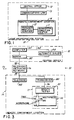
- Fig. 1 is a block diagram of a remote confinement system according to principles of the present invention.
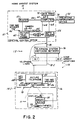
- Fig. 2 is a block diagram of a first preferred embodiment of a remote confinement system as shown in Fig. 1.
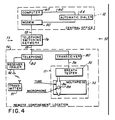
- Fig. 3 is a block diagram of a second preferred embodiment of the present invention showing alternative adaptations of a remote confinement system.
- Fig. 4 is a block diagram of a third preferred embodiment of the present invention showing other alternative adaptations of a remote confinement system according to the present invention.
- Fig. 1 illustrates diagrammatically the general configuration employed by the specific embodiments described below.
- Fig. 1 shows a remote confinement system 10 which is provided with a behavioral condition tester 11 which is capable of detecting the lingering effects of a behavioral condition violation by the remotely confined prisoner and communicating the information to a central office 12.
- a communications link 13 which connects the central office 12 with a remote confinement location 14 at which the prisoner is located communicates the test information to the central office 12.
- the behavioral condition tester 11 is located at the remote confinement location 14 along with means 15 for extracting information for verifying the identity of the person tested by the tester 11 as that of the designated prisoner.
- identity confirming information of a person at the confinement location 14 is transmitted to a central monitoring location 12 through the communications link 13.
- behavioral condition compliance information is extracted from the person at the confinement location 14 by the tester 11 and is also transmitted to the central location 12 through the communications link 13.
- the system 10 of the present invention presents this information at the central office 12 for evaluation and for verification of the presence of the prisoner at the remote confinement location 14 and for determination of the identified prisoner's compliance with the behavioral condition associated with his order of confinement.
- the identity confirming information is information having a high probability of being uniquely associated with the particular prisoner.
- the prior art home arrest systems have employed only an artificial signal source attached to the prisoner in the form of a bracelet or anklet which, on cue or otherwise, is made to transmit an identification signal unique to a particular prisoner.
- Some of the embodiments of the present invention employ as the prisoner identity verifier 15 such identity confirming means in a manner uniquely combined with other features of this invention.
- an identity verifier 15 such as pictorial camera which develops visual image information which may be transmitted over the communications link 13, particularly over voice quality telephone lines, to present a visual image of the prisoner at the central office 12.
- Alternative embodiments employ voice information which may be transmitted to the central office 12 as a characteristic voice print unique to the prisoner.
- Fingerprint information is also an acceptable form of intrinsic information which may be transmitted to the central office as an unique and positive identification characteristic of the prisoner.
- Chemical or biological information from blood or other body fluids or tissue can also provide means for effective identification of specific prisoners. Still, other intrinsic human characteristics such as unique ocular patterns of the fundus of the eye retina are adaptable to the identity verifying means 15.
- inventions of the invention employ a category of identity confirming information which is learned by the prisoner.
- the learned information may be a unique skill or statement taught specifically for the purpose of the home incarceration identification, or may be information from the knowledge, skills and experience previously learned by the prisoner and difficult to duplicate by others.
- Handwriting for example, is a product of an acquired skill and is different for each individual. The differences provide the capability of personal identification by experts and, in addition, by recently developed equipment which can distinguish among sources automatically.
- an identifying comparison is made automatically at the home location in the equipment 15 there provided, and in others information is transmitted to the central office 12 where comparison with information in the central office data files is made, either automatically or with the aid of an operator.
- the test is made in the form of a breath test or other test of body fluid delivered by the prisoner into the tester 11.
- tests particularly those for analyzing body fluids such as blood, urine and saliva, are capable of being performed by automated equipment included in the tester 11. Tests of these fluids for specific substances can be performed without supervision at a remote confinement location 14. Techniques for testing a fluid with a specific reagent, for example, are available for testing for many drugs. Such techniques result in visually perceivable reaction results which can be transmitted by picture from the remote location 14 to the central office 12. Other techniques are capable of producing test results or data in the form of an electrical signal which is readily transmitted from the remote location 14 to the central office 12 where it can be automatically interpreted. These adaptations are contemplated by the present invention.
- Certain embodiments of the present invention include the additional steps or means for verification that the breath test or other test or sampling from the tester 11 that is employed to determine compliance with the behavioral condition is in fact a test or sample related to the prisoner whose identity is confirmed by the identity verifier 15 in the system 10.
- This verification of the source of the test data is achieved by using an interrelated identity confirming and condition sampling method to insure that two bodies of information are derived from the same human source. This is accomplished in some of those embodiments which employ video or pictorial information to verify the prisoner's identity, for example, by reading or recording the visually perceivable readout of the breath test or other condition sampling operation in the same picture used to confirm the prisoner's identity.
- the source verification is accomplished by using a dual purpose sampling device for obtaining breath and voice samples in such a way that the samples are obtained sufficiently close in time or place so that they are assured of being derived from the same human source.
- the same dual testing or sampling device is employed, such as by obtaining from the prisoner's finger substantially contemporaneously, a fingerprint for identification purposes and a blood test for sampling blood chemistry for behavioral condition compliance.
- certain embodiments of the invention further contemplate the utilization of a single prisoner test or sample which contains both identity confirming information and confinement condition compliance information, as for example from a sample of blood.
- a transmission link 13 is provided from a central office to the various confinement locations 14.
- Such a link may utilize any of a number of the various available communications networks.
- the public telephone system is utilized in many of the preferred embodiments described herein.
- the video cable systems as well as air wave links are also contemplated and may be desirable in certain embodiments and adaptations of the invention.
- information may be transmitted from the remote confinement location 14, where it is derived from the prisoner by the particular sampling method, to the central location 12 where it is processed and where a decision is made. In the alternative, the information may be automatically processed by various devices or circuitry at the remote confinement location 14 and the results of the comparison only transmitted to the central office 12.
- the embodiments which employ detection logic and comparison logic at the remote confinement location 14 can make greater use of lower quality transmission means by reducing the information content in the signal being transmitted to the central office 12. This feature is most useful and helpful when voice quality phone lines are used.
- high information content signals as are accommodated by coaxial cable networks are useful for the rapid transmission of a large amount of raw data from the remote confinement locations 14 to the central office 12 for processing centrally in a large computer.
- Implicit in the requirement that the identity of the person at the remote confinement location be confirmed is the need to assure that the test is in fact being performed at the given confinement address. This requires that equipment be located at or otherwise associated with the specific remote location so that the location be uniquely identified. This may be done by installing coded answering devices or other uniquely self-identifiable fixed equipment at each remote location 14, or by utilizing a telephone communications switching network for the link 13. The telephone switching network must be made to reliably establish a communications link to the specified confinement location 14. While location confirmation can be assured with dedicated lines from the central office 12 to the confinement location 14, the embodiments of the present invention which are described herein employ selectable networks such as the standard telephone switching network to address specific locations. The standard telephone switching network is determinative of the level of confidence in confirming the location of the test being performed. It is contemplated that adequate administrative steps are taken to assure the desired level of reliability by preventing the use of call forwarding and other such features.
- Selectability can be achieved with a telephone system by random dialing of programmed phone numbers. Selectability can also be controlled by a computer at the central office 12 to select different locations 14 at different times according to a program, thus accommodating a limited confinement schedule of a prisoner, or accommodating a sentence which allows confinement at more than one location, such as at work and at home at different predetermined times of the day.
- the equipment provided at the confinement location 14 is capable of being geographically fixed and, if provided with equipment identifying coding devices, will furnish a means for location verification where non-selective communication links are employed. Certain embodiments of the present invention may utilize this in connection with the cable or air wave communication from the central office 12 to the confinement location 14, or to verify telephone link communications. With such systems, the equipment of each remote location 14 may be made to respond to a unique calling code.
- a home incarceration or remote confinement system 10 includes a central office 12 and plurality of remote incarceration locations 14.
- the central office 12 is, for example, a communications center at the probation office or correctional facility.
- the remote confinement locations 14 may be residences of persons under home confinement or may be their work places or other locations at which their freedom of movement is to be restricted.
- the confinement locations 14 are illustrated as 14-1 through 14-N in Figure 2.
- Each of the locations 14-I (referred to hereinafter as 14) is selectively connectable to the central office 12 through a conventional telephone system 16 by telephone lines 18 thereby establishing a selective communications link 13 between central office 12 and each of the confinement locations 14. In this embodiment, all communications occur over telephone lines 18 which are of standard voice quality.
- each of the home incarceration locations 14 is provided with a prisoner identity verifier 15 which is made up of a freeze frame picture telephone 20.
- the picture telephone 20 is directly wired to the voice quality telephone line 18 connecting that confinement location 14 to the telephone system exchange 16.
- the picture telephone 20 may be any device capable of transmitting pictorial information from the confinement location 14 over the telephone lines 18. Devices which transmit still pictorial images at a rate of one every few seconds are suitable for this application.
- One such device is commercially available, for example, under the trade name Luma Video Telephone manufactured by Luma Telecom of California, a subsidiary of Mitsubishi Industries.
- This device includes a camera 22 which is capable of collecting pictorial information in the form of one still image every two or three seconds.
- This picture telephone 20 in its commercially available form also has a video display screen 24 which will display the images received over the phone lines 18. However, in this application, the screen 24 of the picture telephone 20 is not necessary at the remote confinement location 14.
- the picture telephone device 20 also includes a two-way audio speaker 26 which functions provide two-way audio communications in the same manner as a telephone handset or a speaker phone.
- the picture telephone 20 also includes a touch tone key set 28 which functions as does the key set of a conventional touch tone telephone; it also includes other push button control functions.
- the remote confinement location 14 is also provided with a behavioral condition tester 11 in the form of a breath tester 30 which is capable of measuring the blood alcohol content ("BAC") of a prisoner or probationer confined to the confinement location 14.
- the breath tester 30 includes either an analog meter or digital display 32 for visually displaying the result of the test in a visually perceivable form which can be read by the camera 22.
- the camera 22 forms a still picture image of the readout of the display 32 for transfer over the phone lines 18 in a form capable of being perceived and interpreted at the central office 12.
- the breath tester 30 in this embodiment is equipped with visual display 32 which is large enough and clear enough to be resolvable in a picture transmitted by the particular picture telephone device 20 which is employed.
- the breath tester 30 is equipped with a mouthpiece 34 adapted to receive a breath sample from the prisoner.
- the breath tester 30 operates such that, when the breath sample is blown by the prisoner into the mouthpiece 34, a BAC reading is produced on the display 32.
- An image of the display 32 is recorded by the camera 22 and transmitted by the picture phone 20 over the phone lines 18 to the central office 12.
- the identity of the person providing the breath sample can then be determined by an attendant at the central office 12.
- an attendant at the central office 12 can further confirm that the breath sample is being given at the same time as the picture is being formed.
- Breath testers suitable for use as the breath testing device 30 are commercially available.
- One such device is, for example, the Alert model J4 manufactured by Alcohol Countermeasures Systems Inc. of Mississauga, Ontario, Canada. This device has long been marketed for use in preliminary roadside screening by law enforcement officers. The Alert J4 is portable and economical.
- This breath testing device is more fully described in the U.S. Patent No. 3,764,270 issued to Collier et al.
- the breath tester 30 may be provided with circuitry capable of transmitting the breath test data or a signal carrying the breath test results directly over the telephone line 18 to the central office 12.
- Such circuitry may include an output line 36 connected to the picture telephone 20.
- An adaption of the breath tester 30 described above but having an output in the form of an electrical signal which can be delivered over the output line 36 is described in the U.S. Patent No. 4,093,945 issued to Collier et al. In this patent, the breath tester output signal is used to enable an automobile ignition system upon the passing of a test of the sobriety of the driver.
- the internal logic circuitry of the tester performs a threshold test and generates an ignition enabling signal when the BAC from a valid sample measures below a predetermined level.
- the output signal may instead carry the breath test data in the form, for example, of an analog signal proportional to the BAC, or may carry the test result in the form, for example, of a simple binary signal indicating that the test has been passed or failed. This direct electrical transmission of the breath test to the central office 12 will be more fully described in connection with the other embodiments discussed below.
- visual transmission of either the data or the test results by way of still pictures is employed in part because it is an efficient method generally suitable for communicating information from almost any test. It is also employed in part because it will transmit information needed to verify the identity of the person on whom the test is being performed and will do so over voice quality phone lines. With pictorial information transmission, blood tests, saliva tests, urine tests, other tests on body fluid, and tests of other sorts for determination of compliance with various behavioral conditions of confinement, may be made at the remote confinement location 14 and transmitted to the central office 12.
- a picture telephone 40 is also provided at the central office 12.
- the picture telephone 40 may be identical to the picture telephone 20 at the remote confinement location 14.
- the telephone 40 would likewise be commercially equipped with a camera 42, a display screen 44, a two-way audio speaker 46, and a digital key set 48 including a touch tone telephone key board and other push button controls.
- the camera 42 is not used and may be omitted at the central office picture telephone set 40, since receipt of pictorial information, not its transmission, is what must be accomplished at the central office 12.
- the central office 12 is provided with a printer 50 to print a hard copy of the pictorial image received by the picture telephone 40, thus, making a permanent record for filing or for later analysis.
- the central office 12 is further provided with an automatic dialer 54 connected through the telephone line 18, to the phone system 16.
- the dialer 54 is capable of being activated under the control of a computer to dial the telephone number of a selected one of a plurality of home arrest locations 14.
- the telephone switching system 16 is used to selectively establish the communications link 13 between the central office 12 and the confinement location 14 at which the selected prisoner is confined.
- the central control office 12 is provided with a computer 60.
- the computer 60 is programmed to operate the automatic dialer 54 to dial the telephone numbers of specific confinement locations in either a predetermined or random manner.
- the computer 60 has an output 62 connected to the automatic dialer 54, and another output 64 connected to the picture telephone 40.
- the output 62 transmits the telephone number signals from the computer 60 to the dialer 54.
- the output 64 is a cable capable of transmitting information from the picture phone 40 for interpretation by the computer 60, and from the computer 60 to the picture phone 40 to control the functions of the phone 40 or to send information out over the phone lines 18.
- the computer 60 is provided with a further output 66 connected to the painter 50 to operate the printer 50 in accordance with the computer program.
- a further connection 68 is provided to connect the computer 60 with a data bank 70.
- This data bank 70 may be a disk, tape drive, or other digitized storage medium containing information relating to specific prisoners who are to be monitored.
- the data bank 70 will contain lists of the behavioral conditions or terms of probation relating to the prisoners involved in the home incarceration program, the phone numbers of the prisoners which are associated with each of the locations of confinement, and other information such as a digitized reference picture of the prisoner.
- the digitized reference picture may be called up from data bank 70 by the computer 60 to be either displayed on a screen at the computer 60 for real time comparison by an operator or a computerized image analysis system, with the image from the confinement location 14 which is displayed on screen 44, or it may be transmitted through the output line 66 to the printer 50 and printed out with the image from the picture phone 40 so that the images may be compared with the reference picture from the data bank 70 at a later time.
- the system operates preferably with initiation of a sequence at the central office 12.
- a prisoner is selected and a signal containing the phone number of the remote confinement location 14 at which the selected prisoner is confined is sent through the output 62 to the automatic dialer 54.
- This causes the dialer 54 to dial the location 14 over the conventional telephone lines 18 and through the telephone switching system 16 establishing a communications link 13 with the confinement location to which the particular selected prisoner is incarcerated.
- the computer 60 is programmed to require an answer at the confinement location 14. If there is no answer after a predetermined number of tries, the fact that a violation has occurred is either recorded or immediately transmitted to a violations office 72 over an additional output 74.
- the violations office 72 is used here symbolically to represent the authority assigned to act upon a report of a violation by a prisoner.
- the camera 22 of the picture phone 20 will take an electronic still picture image of the face of the person answering the call or at an announced time delay after the call is answered to allow the specified prisoner time to come to the phone.
- the picture phone 20 will then transmit the image via the voice quality phone lines 18 to the picture phone 40 at the central office 12.
- This picture may be immediately compared by an operator viewing the screen 44 and comparing the screen image with the information from the file image, in this case an image called up the data bank 70 by the computer 60 as described above. If the image does not match, a manual decision is made by the operator to either signal the violations office 72 or to make a record of a violation of the behavioral condition for later action, as for example, printing out a message at the printer 50. If the confined prisoner is present at the location 14 and his presence is confirmed, the test of the additional confinement condition, in this case the alcohol breath test, is performed.
- the behavioral condition for which the prisoner is being tested is the abstinence from alcoholic consumption.
- the prisoner is thus, upon answering the central office call, instructed by a signal sent over the phone lines 18 from the central office 12, either by the attendant or by a pre-recorded message from the central office 12, or other cue signal to execute a breath test.
- the test is accomplished by the operation of the breath tester 30 at the arrest location 14 to test the alcohol blood content of the confined person.
- the confined person must activate the breath tester 30 by delivering a breath sample into the mouthpiece 34.
- the breath tester 30 is designed to require a sustained air flow of four to five seconds duration in order to deliver a deep lung air sample. Such a sample provides a reliable test for an accurate alcohol blood content reading.
- the delivery of a proper breath sample is determined by a pressure switch and timing circuitry within the breath tester 30.
- the pre-existence of a proper sample is required to either activate the display 32 or to generate a signal to the output line 36 to the picture phone 20 for verification by transmission of a signal, over the phone lines 18 to the central office 12, that the breath sample has been delivered.
- the five second sampling period allows for at least one other still picture of the prisoner to be taken by the picture telephone 20 while the breath sample is being delivered and transmitted to the central office 12.
- picture phones of this type will generate two or three images during the 5 second period. This picture so generated will allow the attendant to verify the identity of the person delivering the breath specimen. This will prevent or at least minimize the likelihood that a person other than the specified prisoner is the source of the breath sample being measured by the breath tester 30.
- the operator will hear the delivery of the breath sample through the two way speakers 26 and 46 as the picture showing the user is being received.
- the LUMA phone described above includes push button controls to select full, medium or small screen images.
- the full screen image may require 5 to 8 seconds for transmission, and its higher resolution picture is suitable for the initial prisoner identifying image.
- the smaller screen images can be transmitted in 2 to 3 seconds with this device and thus they are more suitable for verification of the identity of the tested person.
- the prisoner is required to send a series of closely spaced freeze frame images showing the prisoner delivering the sample. This is accomplished by selecting the small screen mode of the LUMA phone and having the prisoner push its SEND button at intervals corresponding to the most rapid transmission rate (i.e., 2-3 seconds) during the entire course of sample delivery.
- an audible or visual cue such as a tone or light flash signal may be sent from central office 12 or generated at remote location. This will result in receipt at the central office 12 of a chronological series of closely temporally spaced, freeze frame images at the central office showing the prisoner in the act of sample delivery. If any of the images show a person other than the prisoner or if any of the images are spaced in time far enough that the prisoner could reasonably have enlisted the aid of an accomplice to deliver the sample, regardless of whether the image of the accomplice appears in any image, the test will be invalid and a new test required.
- the sample is analyzed automatically by the breath tester 30 and the result in the form of a numerical BAC reading is displayed on the display 32.
- the digital or analog display 32 will be picked up by a further pictorial image taken by camera 22 and transmitted to the central office 12. This information will also be displayed at the central office 12 through the picture telephone 40 on either screen 44 or the printer 50, and will be analyzed manually or automatically either at the time that it is received or subsequently. If the breath test does not show a reading within the acceptable alcohol blood content level, a violation will be communicated to the violations office 72.
- the transmission of information pictorially from the remote confinement location 14 to the central office 12 has the particular advantage of flexibility in the nature of the behavioral condition which may be tested. Any visually readable test result or test data may be transmitted in this way. Changes can be made to existing systems by substituting some other test for the alcohol breath test at any confinement location 14. Thus the same system 10, with the testing devices differing among the various confinement locations 14, may be employed to monitor different confinement conditions for different prisoners at the same time.
- the versatility of pictorial information as a carrier of test data or test results in a remote confinement system 10 is shown by its use with purely chemical tests or other tests which are performed without electrical instrumentation.
- An example of such a test is the Alcoscan Saliva Alcohol Test developed by Lifescan, Inc. of Mountain View, California.
- the test utilizes dry reagent chemistry for the rapid detection of ethanol in saliva. It uses a test strip in which the enzyme alcohol oxidase couples with a dye system to produce an intense color change when in the presence of ethanol.
- the test strip is furnished with a sealed packet costing less than a few dollars each, and which includes instructions and the necessary materials for a complete, self-contained, self-administerable test.
- the Alcoscan Saliva Alcohol Test is performed by the taking of a saliva sample from the mouth of the prisoner onto a clean swab provided with the kit. The sample is then applied to saturate a reagent pad on the test strip. The test strip is then returned to a foil or transparent wrapper for a short reaction period. At the end of the reaction time, a stable color is developed by the test strip which can be visually compared with a color scale printed on the packet. A high BAC in the prisoner produces a very fast reaction.
- the alcohol oxidase enzyme test is highly specific, reacting only with methanol and ethanol.
- the kit described is sensitive at levels as low as .010% BAC. Distinguishable test strip colors result at the BAC levels of .01, .05 and .10 percent.
- a chemical reagent test in the Alcoscan case a specific dry reagent test for alcohol in saliva, will replace the breath tester 30 in the first described embodiment.
- the prisoner will receive instructions or a signal from the central office 12 to perform the reagent test, rather than the breath test, before the camera 22 of the picture phone 20.
- a picture will be transmitted to verify that the specified prisoner who is the one delivering the saliva test.
- a subsequent picture transmitted to the central office 12 will communicate the test results.
- the confinement location 14 may be provided with means for immediately securing the test sample when it is delivered. This can be done by providing a receptacle to receive the test strip while the test is before the camera 20, immediately after the sample is given. The receptacle will be fixed in a position viewable by the camera 22. An automatic follow-up call at the end of the reaction time will transmit a picture of the test results. The test samples so verified can be secured and later physically collected for further analysis.
- Dry reagent tests, and other reagent tests are available for other substances.
- a test for marijuana is available in dry reagent test strip form for use on saliva.
- Tests have been available for determining the presence of other drugs or their degradation products in urine or blood. Some of these tests are specific, some are class sensitive. Most have a very low false detection rate.
- Systems for detecting a wide variety of drugs in urine or blood are marketed by Syva Company of Palo Alto, California under the trade name Emit Drug Detection Systems.
- Equipment is also available for performing automated tests on body fluids such as blood and urine. An example are the Cromotographs manufactured by Varian of Sunnyvale, California. Where body fluids of any type are tested with the system of the first preferred embodiment of the invention, pictorial information of the prisoner during the delivery of the sample verifies the identity of person from whom the sample is taken.
- the breath alcohol test is a very important test and one which is often desired in the context of a remote confinement program. Accordingly, system advantages can be obtained by embodiments of the present invention which are specifically adapted to a specific test such as blood/alcohol breath test developed through the use of a breath tester 30.
- a specific test such as blood/alcohol breath test developed through the use of a breath tester 30.
- One such embodiment which does so in the context of a system which makes greater use of automated analysis and decision making is illustrated and described in the second preferred embodiment.
- FIG. 3 is a diagram of the second preferred embodiment as a present invention. As with the first embodiment, this embodiment is described in the context of the system 10 which employs a central office 12, a remote confinement location 14 which is one of a plurality of such locations, and communications link 13 between the central office 12 and the confinement location 14.
- the link includes a conventional telephone switching station of the commercial public telephone exchange 16.
- the connections between the central office 12, the telephone exchange 16, and the confinement locations 14 are voice quality telephone lines 18.
- pictorial information is not the primary means employed to identify the prisoner and transmit test results, but rather the information is communicated in the form of machine readable electrical signals.
- a breath tester 30 in the form of behavioral condition tester 11 is employed at the confinement location 14 to measure the prisoner's BAC. Instead of generating a visually perceivable readout, however, the breath tester 30 is equipped with circuitry for producing an electrical signal containing information from the results of the breath test. This signal is presented at an output terminal 36 of the breath tester 30 which is connected to telephone line 18 through a modem or other telephone transceiver 80 which is capable of transmitting a signal containing digital or analog encoded information of the results or data from a breath test analysis.
- the transceiver 80 also contains circuitry for detecting and responding to signals from the central office 12, and for implementing an operating sequence.
- Also connected to phone line 18 may be a telephone unit or modem 80 which may be operated in conjunction with transceiver 82 and to facilitate response to a telephone call over the phone line 18.
- the breath tester 30 contains a microphone 84 which is mounted within or in functional proximity to a breath sampling system 86 to which the mouthpiece 34 of breath tester 30 connects to the breath tester 30.
- the microphone 84 is electrically connected so as to impose the audio signal either directly from the microphone onto the phone line 18, or indirectly through a network or other circuitry to the phone line 18.
- the purpose of the microphone 84 is to provide for the taking of a voice sample from the user of the breath testing device 30.
- the purpose of the voice sample is to derive information through which the user may be identified.
- the voice information takes the place of some of the visual information in first embodiment described above. This voice information will carry sufficient data to allow for positive identification of the prisoner and constitutes the prisoner identity verifier 15 of the diagram of Fig. 1.
- the voice sample will also contain information for verifying that the person delivering the breath sample and the identified prisoner are one in the same. That requirement is achieved by the physical placement of the microphone 84 near but preferably within the breath sampling system 86.
- the voice sample is delivered by the user in the form of speech or as a hum as the breath sample is being given. With the provision for circuit logic within the system 10 to synchronize the reading of the breath and voice samples, it can be assured with reasonable certainty that the samples are being taken from one and the same person.
- the microphone 84 and its relation to the mouthpiece 34 described here in connection with this second preferred embodiment may be of the type described from the patent of Joseph P. Hoppesch, U.S. No. 3,809,067.
- the particular device shown in the Hoppesch patent was designed specifically to combine the taking of the breath sample with the taking of a voice sample in the course of using the breath tester 30 in order to require that the two samples be given by the same person at the same time. As such, the likelihood that the breath sample and the voice sample would be from different persons, defeating the purpose of the test, will be minimized.
- the picture phone 40 in Figure 2 at the central office 12 is unnecessary. Instead, at the central office 12, the phone line 18 will connect directly through a modem 90 to the computer 60.
- the automatic dialer 54 is also employed with this system 10 connected in an output line 62 between the computer 60 and either the modem 90 or the telephone line 18 directly.
- the dialer 54 is symbolically illustrated in the figures. It is also common that such a dialer be physically incorporated into the computer 60 or the modem 90.
- Identification of the probationer by voice or by the audio characteristics of the prisoner's hum involves a use of the concept of voice print analysis. This concept is based upon the fact that anatomical differences among individuals result in sound spectra unique to each person, analyses of which will provide for the confirmation of the identity of an unknown speaker when comparison is made of the unknown person's voiceprint with a known voiceprint of the same individual's voice.
- voice print analysis is discussed in an article entitled Voiceprint Identification by L. G. Kersta of Bell Telephone Laboratories, Murray Hill, New Jersey and published in the December 29, 1962 issue of Nature Magazine.
- the use of voiceprint analysis for remote user identification is described in U.S. patent No. 3,525,811 to F. C. Trice et al.
- An example of one such system which will identify a probationer by voice or by a hum is the VoiceScribe 1000 Speech Recognition System marketed by Cherry Electronics Division of Cherry Electrical Products Company, Waukegan, Illinois. It includes a printed circuit board and software for IBM and IBM compatible PCs. It has the capability of accepting a vocabulary of words or speech patterns from a particular person and then recognizing them when repeated. The sensitivity of the system can be adjusted to reduce the likelihood of false acceptance or of false rejection, and it can be set to provide acceptable reliability in a remote confinement system.
- Another speech recognition system is the TI-Speech System by Texas Instruments. It includes a subsystem called the Ti-Speech Vocabulary Manager & Transparent Keyboard which also functions to memorize speech patterns and sounds and to respond with a command when they are duplicated. This system too is adaptable to discriminating among the speech of different persons.
- a further speech recognition system which utilizes concepts capable of adaptation to identification of a prisoner by voice is the Kurzweil Voicesystem from Kurzweil Applied Intelligence, Inc. of Los Angeles, California.
- the hardware and software components for identifying the prisoner by speech or by a hum made during a delivery of the breath sample will be installed at the computer 60 in the central office 12.
- the voice profiles of the prisoners can be retrieved from the data bank 70 and compared with the audio signal received at the central office 12 over the phone lines 18 from the remote confinement location 14.
- the identification is made by conventional methods of correlation of the voice standard with the voice print from the test.
- the limiting factors are those imposed by the quality of the phone lines 18. Communications networks using higher quality lines, fiber optics, coaxial cable or other wide band transmission lines, or air waves will accommodate a higher signal information density and, accordingly, will facilitate more sophisticated and reliable voiceprint analysis at the central office 12.
- voice print identification will be accomplished, in part at least, by installation of equipment at the remote confinement location 14. Such equipment is rapidly becoming more economical.
- circuitry including filter networks or voice print templates or masks encoded on memory devices to be correlated with and to process the signal before transmission over the phone lines 18, the reliability of the identification of the prisoner by voice analysis can be enhanced.
- Devices for making an on site correlation of the voice sample with identification criteria are described in U.S. Patent No. 3,989,896 to H.J.P. Reitbaeck.
- Such devices can be made tunable or programmable to selectively respond to the voiceprint of only the predetermined prisoner assigned to the specific confinement location 14. With this adaption, the identification decision could be made automatically either with the equipment at the remote location 14 or with that at the central office 12. The identification decision so made would be fully automated, and the need for an attendant at the central office 12 would be reduced or eliminated.
- this second preferred embodiment proceeds in a manner similar to that of the first embodiment described above.
- the computer 60 together with the dialer 54, causes the central office 12 to connect over the telephone lines 18 through the central office 16 to the selected remote confinement location 14. If there is no answer, a violation is signaled to the violations office 92. If there is an answer, a recorded message or a recognizable signal of some other sort is caused to appear at the confinement location 14 to instruct the prisoner to perform the breath test or whatever test is indicated. In this case, the prisoner must deliver the five second breath sample at the tester 30 and, at the same time, must provide an identifiable sound by humming into the same mouthpiece 34 so that the hum is picked up by the microphone 84 as the breath sample is being taken.
- a signal carrying the information of the prisoner's BAC and of the voice sample delivered at the time of the breath test are analyzed and transmitted to the central office 12.
- a failure of either the BAC test or the voice print test will be interpreted as a violation and signaled to the violations office 92.
- a device commonly called a "sniffer"
- a device operates to generate an alarm signal when air having a detectable alcohol content comes into contact with the sensor of the device.
- Sniffers usually contain a small fan to direct air through a fuel cell test chamber. Devices of this type are also manufactured by Lion Laboratories Ltd. of Cambridge, U.K. The use of sniffers is practical where their presence is unknown to the prisoner. They may be concealed in the telephone unit in systems such as this second embodiment where voice tests are being performed. Sniffers are less reliable and more easily circumvented than the breath testers described above, so concealment of the devices is preferred.
- the devices inability to quantitatively assess BAC is not a serious shortcoming.
- Such devices can further be used to detect the likelihood of user circumvention of the tester 30 and to signal that further investigation of a prisoner is in order.
- the integrity of the breath test sample is maintained with the use of an interrelated sampling technique.
- This embodiment also produces signals which are reduced to forms which are automatically perceivable by the computer 60 so that violations detection can be made without manual intervention at the central office 12.
- the automatic determination of the result of the confinement condition test and the prisoner identification can be done with devices designed to test for conditions other than BAC with a breath tester 30. Electrical outputs from blood or urine analysis equipment can be communicated to the central office 12 in the same manner as the breath test results.
- a voice print for verifying th identity of the person giving the sample or performing the test may be desirable.
- the voice print method of identification can be effectively used to insure the integrity of samples given by mouth, such as the breath test described here or saliva tests which might be alternatively desired.
- identification by fingerprints has advantages in being easily adaptable to interrelated sampling techniques. This alternative is more fully discussed in connection with alternative subsystems below.
- this second preferred embodiment relies upon data intrinsic to the specific prisoner to identify the prisoner.
- the visual image of the prisoner's face and his voice are sufficiently unique intrinsic properties of an individual to make identification by those characteristics acceptably reliable.
- Other intrinsic characteristics of the prisoner, such as fingerprints, can be employed in alternative embodiments of the invention.
- the identification of the prisoner may also be accomplished by reliance on factors which are not intrinsic to the prisoner, but rather involve the performance of an identify confirming act by the prisoner. Such an act would involve the exercise of skills or knowledge taught to or otherwise learned or acquired by the prisoner. An example of such acts would include a spoken sequence, a series of physical movements, and handwriting samples. Handwriting, for example, is unique for each person; comparisons of handwriting can be made visually or by pen pressure readouts. A system which provides automated personal identification by handwriting sample delivery is described in U.S. Patent No. 3,983,535 to Noel M. Herbst et al. Another example of the use of an identify confirming act is that of the third preferred embodiment described below.
- the third preferred embodiment of the present invention is in all respects identical to that of Fig. 3, except that the breath tester 30 is the device disclosed in U.S. Patent No. 4,738,333, entitled Sobriety Interlock with Unsupervised Confirmation of Operator Identity.
- This embodiment relies for identification of the prisoner on the performance by the prisoner of an identity confirming physical act which cannot be readily learned by most persons without considerable practice.
- This device like that of the second embodiment described with reference to Fig. 3, operates to take two interrelated data samples from the prisoner and to generate electrical signals to report the prisoner's BAC and to confirm the prisoner's identity, and in the process of doing so to verify that the breath sample and the prisoner identifying information are from one and the same person.
- the breath tester 30 of this embodiment is similar to that of the second embodiment described with reference in Fig. 3 above, except that, instead of the microphone 84 of Fig. 3, the breath tester 30 is equipped with pressure or air volume transducers and related circuitry for developing a signal representing a signature of a modulated breath sequence delivered by the prisoner.
- the modulated breath sequence is a predetermined sequence of breath pulses which is difficult for a person to learn. It is taught to the prisoner when first placed in remote confinement. It may be, in part, an arbitrary sequence originated by the prisoner.
- the transducer readout is processed through the remote confinement system, and is recorded on a machine readable medium to be incorporated either into the data bank 70 at the central office 12, or into the circuitry of the breath tester 30 or of the transceiver 80 at the confinement location 14, wherever the comparison is to be made.
- circuitry will be provided in either the test head or an associated control box which will also include means for comparing the modulated breath sequence delivered at the time of the test with the signature stored in the memory device.
- the comparison is made with a microprocessor in the control box of the device.
- a control signal is produced and transmitted to the ignition system of an automobile to enable the car to start if the driver passes the sobriety test.
- This same form of signal can be the test result signal transmitted to the central office 12 as a pass or fail test result which enables the automobile ignition system.
- the identifying modulated breath sequence in this embodiment includes a series of pulses blown into the mouthpiece 34 of the breath tester 30. Timing circuitry within the breath tester 30 requires that the modulated breath sample be given within a very short time after the sample of breath is delivered for the alcohol test. A short time separation of the tests is necessary so that the alcohol sample cannot be given by another person who will then pass the tester to the prisoner to deliver the coded breath sequence. Alternative techniques may be employed to prevent the passage of the breath sampling device from one person to another between delivery of the breath sample and the identity confirming code.
- a picture telephone 20 as utilized in connection with the first preferred embodiment described in Figure 2 can be employed. This allows for visual determination of whether the prisoner has passed the breath tester 30 to another person.
- This third embodiment eliminates the need for the transmission of raw data and analysis of the data at the central office 12. Accordingly the need for transmission of more information than the voice quality lines 18 can handle will not occur. This is because the decision processing with respect to both the breath alcohol test and the identity confirmation test are performed with the equipment at the confinement location 14. According, only one binary bit of the test result information need be transmitted over the voice quality line 18.
- the components at the central office 12 are simpler than with the previous systems. They need contain only a automatic dialer 54 and sufficient circuitry and logic to discriminate between a signal indicating that the test has been passed or one indicating if the test has been failed by the prisoner who is called. Either a failure to answer the automatic call or a failure to return the signal indicating that the breath test and identity test has been passed within a prescribed time, 15 seconds for example, from the answering of the call is sufficient to cause the central office to generate a signal to the violations office 92 to signal a violation.
- Remote confinement systems currently in use provide for a neck, wrist or anklet transmitter which is locked onto the prisoner confined to remote confinement location 14.
- the location 14 is equipped with a device 15 for determining the presence of an identified prisoner, which device is a monitoring device which includes a receiver activated in response to a signal over a telephone line 18.
- the central office 12 is provided with the computer 60, modem 90 and a dialer 54 for dialing the various confinement locations 14 to interrogate the receiver.
- the presence of the prisoner in the vicinity of the receiver will cause the verification signal to returned over the telephone lines 18 to the central office 12.
- the transmitter is a radio frequency transmitter which will transmit a signal of sufficient strength to be detected by the receiver as long as the probationer is in the specified radius of the receiver.
- Such a system may be incorporated into the embodiments described above to provide substitute or backup identity verification 15.
- Systems providing an artificially generated signal transmitter to automatically initiate a call from the remote location 14 to the central office 12 may also be employed in cooperation with systems of the present invention.
- a transmitter 91 attached to the prisoner can operate in cooperation with a transmitter and automatic dialer 92 at the remote location 14 to put through a call whenever the possibility that the prisoner has strayed from the confinement location 14. This would cause the equipment at the central office 12 to proceed with the interrogation and testing sequence as described in connection with the embodiments as described above.
- This adaptation of the system 10 to the use of the transmitter/receiver feature of Fig. 4 can be used in combination with the picture phone 20 of Fig. 2 to detect attempts to generate a false transmitter signal to circumvent the prior art systems employing a transmitter fixed to the prisoner.
- Identity verification by the means 15 may be also accomplished in the embodiments described above by equipping the remote confinement location 14 with fingerprint reading devices. In doing so, the fingerprint images may either be read and the data transmitted to the central office 12 where interrupted and compared with images on file for identity verification or may be analyzed at the confinement location by providing the automated fingerprint analysis equipment there.
- Finger print analysis is also capable of being accomplished by providing equipment at the remote confinement location. This is significantly easier where the fingerprints of the prisoner are to be compared with only one set or a limited number of sets in the file.
- Such equipment has been developed for computer installations requiring high security and for other secured facilities where a means more reliable than the use of keys, cards, or pass words is required to authorize entry to a facility or to permit user access to the computer.
- Self contained portable finger print identification devices such as the Ridge Reader manufactured by FingerMatrix Incorporated of North White Plains, New York, is one such device. This device contains the circuitry and information necessary to verify the identity of a limited number of individuals and to generate and enabling or disabling signal in response to the finger print verification operation. The use of such a device at a remote confinement location will transmit an identity confirming signal over conventional telephone lines. Accordingly, the simplest of equipment at the central office 12 is required to receive the signal.
- unsupervised blood sampling devices at the confinement location are an option.
- Devices for use by diabetics are available for the drawing of blood samples by the patient in the home. These devices contain an opening into which the patient inserts a finger, blood is drawn from the finger automatically, and a test is performed to determine the blood sugar level.
- a blood sample may be drawn to be analyzed for drugs or alcohol.
- the analysis may be done immediately or the sample may be drawn and held for future analysis.
- the time of the taking of the sample and the identity of the person delivering the sample is preserved where future supervised analysis is required.
- the fingerprint identification technique is suitable, since the print can be taken from the same finger in the same operation as the taking of the blood sample, and the identity of the person providing the sample will be reliably determined.
- the systems described above may be provided with devices at the confinement location 14 or performing tests other than a breath test or alcohol on the probationer.
- Blood test, urine test, and saliva test are also capable of being performed remotely and by testing equipment of various types. Such tests will test for conditions of blood alcohol content or anyone of a large number of prohibited substances which the probationer may have consumed.
- Body fluids also contain information of discriminating characteristics which can be used to determine prisoner identity. For instance, modern techniques permit testing a wide variety of parameters beyond the traditional A, B, AB and O antigens and Rh factor. It is now possible to test for a sufficiently large number of other genetically determined blood constituents that the probability of identification error can be reduced to an acceptably small percentage.
- the types of tests which can be performed automatically on various body fluids and as reference or the manner in which such test are performed, the following equipment may be considered.
- Seva Company of California manufactures a series of automated devices for remotely performing tests on blood and urine. Such devices are manufactured under the name Seva Auto Lab Systems, the emit ST Drug Detection System, and the Seva QST System. These devices will perform a number of tests on blood or urine to determine the presence of barbituates, marijuana, cocaine, alcohol, opiates, and a number of other chemical substances. This line of equipment will analyze blood or urine and generate an analog signal with information relating to the results of the tests. Hewlett Packard Company also produces a number of sophisticated analytical instruments for performing general purpose analysis of blood or urine for substance detection. Whether or not it is economically feasible to perform the test needed in a particular case, body fluid samples of all of these types may be taken, the donor verified by the system, and the specimen screened and saved for future analysis or evidentiary purposes.
Landscapes
- Physics & Mathematics (AREA)
- General Physics & Mathematics (AREA)
- Business, Economics & Management (AREA)
- Emergency Management (AREA)
- Engineering & Computer Science (AREA)
- Signal Processing (AREA)
- Investigating Or Analysing Biological Materials (AREA)
- Measuring And Recording Apparatus For Diagnosis (AREA)
- Measurement Of The Respiration, Hearing Ability, Form, And Blood Characteristics Of Living Organisms (AREA)
Abstract
Claims (50)
- Méthode pour déterminer à partir d'un bureau central (12) la présence d'un prisonnier déterminé dans un endroit éloigné (14) où le prisonnier est reclus sans surveillance, et pour s'assurer que le prisonnier se conforme aux règles de comportement impliquées par l'emprisonnement, cette méthode utilisant des transmissions électriques entre les endroits éloignés et le bureau central et étant caractérisée par les étapes suivantes :
accomplissement sur une personne située dans un endroit éloigné (14) d'un test sans surveillance ayant pour but de vérifier s'il y a de la part de cette personne une violation des conditions du comportement;
émission vers cet endroit éloigne d'un signal porteur d'informations permettant de vérifier l'accomplissement du test selon des critères établis et l'identité de la personne soumise au test; et
transmission des signaux émis depuis l'endroit éloigné vers le bureau central (12). - Méthode selon la Revendication 1 dans laquelle la condition du comportement est la conformité à une restriction d'abus d'une substance.
- Méthode selon la Revendication 2 dans laquelle cette phase du test du comportement comprend la phase d'échantillonage d'au moins un fluide corporel de la personne soumise au test et la production d'un résultat au test, et dans laquelle le résultat produit par le test est sensible à la présence d'un composant d'un fluide corporel qui résultera de l'utilisation par la personne testée d'une substance prohibée.
- Méthode selon la Revendication 3 dans laquelle le fluide corporel prélevé à titre d'échantillon comprend un ou plusieurs parmi les fluides suivants :
un prélèvement de l'haleine exhalée par cette personne;
un prélèvement de salive de cette personne;
un prélèvement de l'urine de cette personne;
un prélèvement de sang de cette personne. - Méthode selon la Revendication 3 ou la Revendication 4 dans laquelle un résultat de la phase d'accomplissement de ce test est la réponse à la présence d'alcool dans le fluide.
- Méthode selon l'une quelconque des Revendications 3 à 5 dans laquelle la phase d'accomplissement du test comprend une réaction mettant en contact l'échantillon du fluide corporel avec un réactif.
- Méthode selon l'une quelconque des Revendications 1 à 3 dans laquelle la phase d'accomplissement du test comprend la phase de prélèvement d'un échantillon d'air dans le voisinage de la personne pour détecter la présence d'alcool.
- Méthode selon l'une quelconque des revendications précédentes dans laquelle l'information de l'identité de la personne soumise au test est l'information d'une caractéristique identifiable unique intrinsèque au corps de la personne testée.
- Méthode selon la Revendication 8 dans laquelle l'information de l'identité de la personne testée est une information obtenue à partir d'un échantillon de fluide corporel de la personne testée.
- Méthode selon la Revendication 8 ou 9 dans laquelle une caractéristique identifiable unique est obtenue à partir d'un échantillon de la voix de la personne testée.
- Méthode selon la Revendication 10 lorsqu'elle est rattachée à la Revendication 9 dans laquelle on réalise simultanément au moins la partie des étapes consistant à prendre des échantillons de la voix et de l'haleine.
- Méthode selon la Revendication 10 ou 11, dans laquelle cette phase de test comprend les phases de prélèvement de la salive de la personne testée et la production du résultat du test, et dans laquelle le résultat du test produit est sensible à la présence d'un composant de la salive résultant de la prise par la personne testée d'une substance prohibée.
- Méthode selon la Revendication 8 comprenant en outre une phase de lecture d'empreinte digitale de la personne testée, dans laquelle cette phase d'examen comprend les étapes de prélèvement du sang de la personne testée produisant de ce fait le résultat du test, et dans lesquelles la résultante du test est d'être sensible à la présence dans le sang d'un composant introduit par suite de l'utilisation par la personne d'une substance prohibée.
- Méthode selon l'une quelconque des Revendications précédentes dans laquelle l'information portée par le signal est une information sous forme d'image vidéo.
- Méthode selon la Revendication 14 dans laquelle une information sous forme d'image vidéo comprend l'information d'une caractéristique unique identifiable visuellement de la personne soumise au test.
- Méthode selon les Revendications 14 ou 15 comprenant en outre une phase de production dans cet endroit éloigné d'un résultat visuellement perceptible dudit test, et dans laquelle l'information portée par ce signal comprend une information sous forme d'image vidéo du résultat visuellement perceptible du test.
- Méthode selon l'une quelconque des Revendications 14 à 16 dans laquelle ces étapes génératrices de signaux gênèrent dans un endroit éloigné un signal porteur d'une information sous forme d'image vidéo du prélèvement d'un fluide corporel.
- Méthode selon l'une quelconque des Revendications 14à 17 dans laquelle l'unique caractéristique visuellement identifiable est une image du visage de la personne soumise au test.
- Méthode selon la Revendication 17 ou la Revendication 18 comprenant en outre les étapes consistant a :
retrouver à partir d'une base d'informations l'image vidéo d'une caractéristique visuellement identifiable d'un prisonnier déterminé; et
à comparer les images contenues dans la base d'informations avec l'image générée à partir de l'endroit éloigné pour déterminer au bureau central la présence de ce prisonnier dans cet endroit éloigné et pour vérifier que ce prisonnier est bien la personne sur laquelle on a réalisé le test. - Méthode selon la Revendication 19 dans laquelle l'information de l'image vidéo contenue dans la base d'informations est récupérée à partir de l'endroit éloigné et transmise au bureau central en réponse à un signal émis par ce bureau central.
- Méthode selon l'une quelconque des revendications précédentes comprenant en outre la phase initiale de fixation sur le prisonnier déterminé du dispositif, et comprenant en outre la phase de détection d'absence de proximité de ce dispositif par rapport à l'endroit éloigné.
- Méthode selon l'une quelconque des revendications précédentes comprenant la phase consistant à établir de façon sélective un lien de communications téléphoniques entre le bureau central et un endroit éloigné choisi.
- Méthode selon l'une quelconque des revendications précédentes comprenant en outre les phases consistant à interpréter les signaux reçus au bureau central et en conséquence, à vérifier si la personne soumise au test est bien le prisonnier déterminé et à établir si ce prisonnier se conforme aux restrictions en matière d'abus de certaines substances, et en réponse à cette vérification et détermination, produire un signal de sortie passant par l'installation du bureau central en réponse à la vérification et à l'information du résultat du test reçues par celui-ci.
- Un système de réclusion contrôlable à distance comprenant :
un poste central (12),
un poste éloigné (14) destiné à être utilisé dans un lieu de détention dans lequel un prisonnier déterminé est reclus sans surveillance, et des moyens (13, 80) pour transmettre des signaux à partir de ce poste éloigné vers le poste central, caractérisé en ce qu'il comprend en outre :
des moyens équipant ce poste éloigné (14) permettant d'effectuer à son insu un test à l'effet de détecter une violation des conditions de comportement par une personne située dans cet endroit éloigné,
des moyens (11) équipant ce poste éloigné permettant de produire un signal porteur d'information de la réalisation du test selon des critères prédéfinis, et
des moyens (15) équipant ce poste éloigné permettant de produire un signal porteur d'information de l'identité de la personne soumise au test, ce test et les signaux transmettant l'identité étant transmis par ces moyens au bureau central. - Un système selon la Revendication 24 dans lequel les moyens permettant de réaliser ce test comprennent des moyens (30) de prélèvement de fluide corporel de la personne soumise au test.
- Un système selon la Revendication 24 ou la Revendication 25 dans lequel les moyens permettant de réaliser ce test comprennent des moyens pour déterminer la consommation d'alcool par la personne testée.
- Un système selon l'une quelconque des Revendications 24 à 26 dans lequel les moyens de test comprennent un alcotest (30, 34).
- Un système selon la Revendication 24 ou l'une quelconque des revendications qui y sont rattachées dans lequel les moyens permettant de réaliser ce test dans cet endroit éloigné comprennent des moyens (34) d'analyse d'un échantillon d'haleine exhalée par cette personne à la suite d'une profonde inspiration et des moyens (32) d'affichage du résultat de ce test.
- Un système selon l'une quelconque des Revendications 24 à 28 dans lequel au moins un de ces moyens de production comprend en outre des moyens (20, 22) permettant de produire a partir de l'endroit éloigné un signal porteur d'information sous forme d'image vidéo.
- Un système selon l'une quelconque des Revendications 24 à 29 dans lequel les moyens de production du signal d'identité comprennent des moyens de production d'un signal unique d'une caractéristique identifiable visuellement de la personne dont un échantillon de fluide corporel a été prélevé.
- Un système selon la Revendication 30 dans lequel au moins l'un des moyens de production de ce signal, situé à l'endroit éloigné, comprend une caméra (22).
- Un système selon l'une quelconque des Revendications 24 à 31 comprenant en outre des moyens permettant de produire un résultat au test perceptible visuellement qui comprennent un instrument (32) équipé d'un système de lecture affichant le résultat des tests et dans lequel les moyens de production du signal produisent une information sous forme d'image vidéo du résultat du test.
- 34. Un système selon l'une quelconque des Revendications 24 à 32 dans lequel les moyens de production du signal d'identité comprennent des moyens de lecture d'une empreinte digitale de la personne soumise au test.
- Un système selon l'une quelconque des Revendications 2' à 33 comprenant en outre un dispositif fixé sur un prisonnier déterminé, qui produira un signal en rapport avec la présence de ce prisonnier dans l'endroit éloigné, ou son absence.
- Un système selon l'une quelconque des Revendications 24 à 34 dans lequel les moyens de production d'information de l'identité de la personne soumise au test comprennent des moyens de détection prenant en compte l'intelligence humaine acquise par le prisonnier déterminé et la réalisation d'un acte commis par la personne soumise au test et confirment son identité.
- Un système selon la Revendication 35 dans lequel l'intelligence humaine acquise est une séquence de respiration modulée et dans lequel la réalisation de l'acte de confirmation de l'identité comprend l'émission d'un échantillon d'une séquence de respiration modulée dans un tube (86) situé dans l'endroit éloigné.
- Un système selon l'une quelconque des Revendications 24 à 36 dans lequel les moyens produisant le signal comprennent des moyens (84) pour trouver une caractéristique unique identifiable à partir d'un échantillon de la voix de la personne soumise au test.
- Un système selon la Revendication 37 en tant que rattachée à la Revendication 36 comprenant un microphone dans le tube afin d'obtenir un échantillon de la voix de la personne soumise au test sous forme d'un son émis par la bouche de cette personne dans le tube.
- Un système selon la Revendication 37 ou la Revendication 38, dans lequel les moyens de tester comprennent les moyens pour prélever au travers du tube l'haleine de la personne soumise au test afin de produire le résultat du test.
- Un système selon la Revendication 39 comprenant des moyens pour vérifier que le prélèvement de la voix et de l'haleine ait lieu sans que la personne soumise au test puisse, pendant la prise des deux échantillons, enlever sa bouche qui est en communication avec le tube.
- Un système selon l'une quelconque des Revendications 37 à 40 comprenant des moyens situés à l'endroit éloigné pour comparer l'échantillon de la voix avec l'information permettant d'identifier la voix de la personne soumise au test.
- Un système selon l'une quelconque des Revendications 37 à 40 comprenant en outre des moyens pour réaliser au bureau central l'analyse de l'échantillon de ladite voix.
- Un système selon l'une quelconque des Revendications 24 à 42 comprenant en outre des moyens pour prélever des échantillons de salive de la personne soumise au test et pour fournir le résultat du test, et des moyens pour vérifier que le prélèvement des échantillons de voix et de salive ait lieu sans qu'il y ait rupture du contact de la bouche de la personne avec le tube pendant la prise des deux échantillons.
- Un système selon l'une quelconque des Revendications 2' à 43 comprenant en outre des moyens (16, 80, 90) permettant d'établir de façon sélective un lien de communications téléphoniques entre le bureau central et l'endroit éloigné choisi.
- Un système selon la Revendication 44 comprenant en outre des moyens pour produire un signal de sortie (60) au bureau central en réponse à l'information du résultat du test reçue par ligne téléphonique au bureau central.
- Un système selon l'une quelconque des Revendications 24 a 45 comprenant en outre:
des moyens (40, 54) situés au bureau central permettant de recevoir les signaux transmis depuis ledit endroit éloigné; et
des moyens (60, 70) en réponse auxdits signaux reçus pour vérifier la réalisation dudit test et pour vérifier si la personne soumise au test est bien le prisonnier déterminé. - Un système selon la Revendication 46 comprenant en outre des moyens permettant de produire un signal de sortie au bureau central en réponse à la vérification et au résultat du test.
- Un système selon l'une quelconque des Revendications 24 à 47 comprenant en outre:
des moyens pour rechercher à partir d'un support de mémoire une information sur l'identité du prisonnier déterminé; et
des moyens pour comparer l'information obtenue avec l'information produite depuis l'endroit éloigné pour déterminer au bureau central la présence d'un prisonnier déterminé à l'endroit éloigné et pour vérifier que ce prisonnier est la personne sur laquelle on a réalisé le test. - Un système selon l'une quelconque des Revendications 24 à 48 comprenant en outre des moyens (13) pour établir de façon sélective un lien de communications entre le bureau central et l'endroit éloigné choisi.
- Un système selon l'une quelconque des Revendications 24 à 49 comprenant en outre des moyens pour démarrer les phases de mise en service du système à partir d'un signal émis du bureau central.
Priority Applications (1)
| Application Number | Priority Date | Filing Date | Title |
|---|---|---|---|
| AT88904140T ATE94013T1 (de) | 1987-04-21 | 1988-04-20 | Hausarrestsystem. |
Applications Claiming Priority (2)
| Application Number | Priority Date | Filing Date | Title |
|---|---|---|---|
| US41698 | 1987-04-21 | ||
| US07/041,698 US4843377A (en) | 1987-04-21 | 1987-04-21 | Remote confinement system |
Publications (2)
| Publication Number | Publication Date |
|---|---|
| EP0362231A1 EP0362231A1 (fr) | 1990-04-11 |
| EP0362231B1 true EP0362231B1 (fr) | 1993-09-01 |
Family
ID=21917868
Family Applications (1)
| Application Number | Title | Priority Date | Filing Date |
|---|---|---|---|
| EP88904140A Expired - Lifetime EP0362231B1 (fr) | 1987-04-21 | 1988-04-20 | Systeme de reclusion controlable a distance |
Country Status (7)
| Country | Link |
|---|---|
| US (1) | US4843377A (fr) |
| EP (1) | EP0362231B1 (fr) |
| JP (1) | JPH02503976A (fr) |
| AU (1) | AU605583B2 (fr) |
| CA (1) | CA1284191C (fr) |
| DE (1) | DE3883763T2 (fr) |
| WO (1) | WO1988008655A1 (fr) |
Families Citing this family (171)
| Publication number | Priority date | Publication date | Assignee | Title |
|---|---|---|---|---|
| US4999613A (en) * | 1987-04-21 | 1991-03-12 | Guardian Technologies, Inc. | Remote confinement system |
| US4996161A (en) * | 1987-10-16 | 1991-02-26 | Guardian Technologies, Inc. | Breath alcohol testing system |
| US4916435A (en) * | 1988-05-10 | 1990-04-10 | Guardian Technologies, Inc. | Remote confinement monitoring station and system incorporating same |
| US5023901A (en) * | 1988-08-22 | 1991-06-11 | Vorec Corporation | Surveillance system having a voice verification unit |
| US4952928A (en) * | 1988-08-29 | 1990-08-28 | B. I. Incorporated | Adaptable electronic monitoring and identification system |
| US5204670A (en) * | 1988-08-29 | 1993-04-20 | B. I. Incorporated | Adaptable electric monitoring and identification system |
| US5369699A (en) * | 1988-08-29 | 1994-11-29 | Bi Incorporated | Adaptable personnel supervisory system with automatic fee collection |
| US4980671A (en) * | 1989-04-26 | 1990-12-25 | Guardian Technologies, Inc. | Remote confinement system with timed tamper signal reset |
| US5195145A (en) * | 1989-11-13 | 1993-03-16 | Identity Technologies Incorporated | Apparatus to record epidermal topography |
| WO1991007728A1 (fr) * | 1989-11-13 | 1991-05-30 | Identity Technologies Incorporated | Appareil pour enregistrer une topographie epidermique |
| US5103474A (en) * | 1990-05-08 | 1992-04-07 | Digital Products Corporation | Drive-by personnel monitoring system with radio link |
| US5255306A (en) * | 1991-01-10 | 1993-10-19 | Bi Inc. | Cellular interface unit for use with an electronic house arrest monitoring system |
| GB9101548D0 (en) * | 1991-01-24 | 1991-03-06 | Stc Plc | Surveillance system |
| US5189395A (en) * | 1991-05-10 | 1993-02-23 | Bi, Inc. | Electronic house arrest system having officer safety reporting feature |
| US5220919A (en) * | 1991-08-23 | 1993-06-22 | Safety Technology Partners, Ltd. | Blood alcohol monitor |
| US5170426A (en) * | 1991-09-12 | 1992-12-08 | Bell Atlantic Network Services, Inc. | Method and system for home incarceration |
| US5467403A (en) * | 1991-11-19 | 1995-11-14 | Digital Biometrics, Inc. | Portable fingerprint scanning apparatus for identification verification |
| US5222152A (en) * | 1991-11-19 | 1993-06-22 | Digital Biometrics, Inc. | Portable fingerprint scanning apparatus for identification verification |
| US5525969A (en) * | 1992-05-18 | 1996-06-11 | Ladue; Christoph K. | Monitoring device for location verification |
| US5339351A (en) * | 1992-06-02 | 1994-08-16 | Hoskinson John D | Emergency response system |
| JPH07110831A (ja) * | 1992-08-11 | 1995-04-25 | Rockwell Internatl Corp | 予定厳守システム |
| US5396215A (en) * | 1992-10-28 | 1995-03-07 | Hinkle; Terry A. | Vehicle operation inhibitor control apparatus |
| US5495284A (en) | 1993-03-12 | 1996-02-27 | Katz; Ronald A. | Scheduling and processing system for telephone video communication |
| US7019770B1 (en) | 1993-03-12 | 2006-03-28 | Telebuyer, Llc | Videophone system for scrutiny monitoring with computer control |
| US20030185356A1 (en) | 1993-03-12 | 2003-10-02 | Telebuyer, Llc | Commercial product telephonic routing system with mobile wireless and video vending capability |
| US6323894B1 (en) | 1993-03-12 | 2001-11-27 | Telebuyer, Llc | Commercial product routing system with video vending capability |
| US5412708A (en) * | 1993-03-12 | 1995-05-02 | Katz; Ronald A. | Videophone system for scrutiny monitoring with computer control |
| JPH0715523A (ja) * | 1993-06-23 | 1995-01-17 | Toshiba Corp | 電話装置 |
| US5661458A (en) * | 1993-08-18 | 1997-08-26 | Bi Incorporated | Electronic house arrest monitoring system with automatic fee collection feature |
| US6181253B1 (en) | 1993-12-21 | 2001-01-30 | Trimble Navigation Limited | Flexible monitoring of location and motion |
| US20020120545A1 (en) * | 1994-01-27 | 2002-08-29 | Ronald A. Katz | Commercial product routing system with video vending capability |
| WO1995026013A1 (fr) † | 1994-03-24 | 1995-09-28 | Minnesota Mining And Manufacturing Company | Systeme d'identification biometrique de personnes |
| JP3348960B2 (ja) * | 1994-03-30 | 2002-11-20 | 株式会社東芝 | 証明カード作成装置および証明カード作成方法 |
| US7106843B1 (en) * | 1994-04-19 | 2006-09-12 | T-Netix, Inc. | Computer-based method and apparatus for controlling, monitoring, recording and reporting telephone access |
| US5553119A (en) * | 1994-07-07 | 1996-09-03 | Bell Atlantic Network Services, Inc. | Intelligent recognition of speech signals using caller demographics |
| US5633910A (en) * | 1994-09-13 | 1997-05-27 | Cohen; Kopel H. | Outpatient monitoring system |
| US6014626A (en) * | 1994-09-13 | 2000-01-11 | Cohen; Kopel H. | Patient monitoring system including speech recognition capability |
| US5553609A (en) * | 1995-02-09 | 1996-09-10 | Visiting Nurse Service, Inc. | Intelligent remote visual monitoring system for home health care service |
| DE19512959A1 (de) * | 1995-04-10 | 1996-10-17 | Sel Alcatel Ag | Fernüberwachungsvorrichtung |
| US6034622A (en) | 1995-08-18 | 2000-03-07 | Robert A. Levine | Location monitoring via implanted radio transmitter |
| US5786746A (en) * | 1995-10-03 | 1998-07-28 | Allegro Supercare Centers, Inc. | Child care communication and surveillance system |
| US5776055A (en) * | 1996-07-01 | 1998-07-07 | Hayre; Harb S. | Noninvasive measurement of physiological chemical impairment |
| EP0896712A4 (fr) * | 1997-01-31 | 2000-01-26 | T Netix Inc | Systeme et procede pour detecter une voix enregistree |
| US6148219A (en) * | 1997-02-18 | 2000-11-14 | Itt Manufacturing Enterprises, Inc. | Positioning system for CDMA/PCS communications system |
| US6148195A (en) * | 1997-02-18 | 2000-11-14 | Itt Manufacturing Enterprises, Inc. | Phase agile antenna for use in position determination |
| US6101242A (en) * | 1997-03-28 | 2000-08-08 | Bell Atlantic Network Services, Inc. | Monitoring for key words with SIV to validate home incarceration |
| US6404858B1 (en) | 1997-03-28 | 2002-06-11 | Verizon Services Corp. | Personal dial tone service with personalized call waiting |
| US6018739A (en) * | 1997-05-15 | 2000-01-25 | Raytheon Company | Biometric personnel identification system |
| US6728341B1 (en) * | 1997-06-24 | 2004-04-27 | Royal Thoughts, Llc | Monitoring and communication system for stationary and mobile persons |
| US6029102A (en) * | 1997-07-01 | 2000-02-22 | Elsman; James L. | Driver control display system for a vehicle |
| US6130620A (en) * | 1997-08-11 | 2000-10-10 | Electronic Monitoring Systems, Inc. | Remote monitoring system |
| US6320974B1 (en) | 1997-09-25 | 2001-11-20 | Raytheon Company | Stand-alone biometric identification system |
| US6317544B1 (en) * | 1997-09-25 | 2001-11-13 | Raytheon Company | Distributed mobile biometric identification system with a centralized server and mobile workstations |
| US5968746A (en) * | 1997-11-26 | 1999-10-19 | Schneider; David R. | Method and apparatus for preserving human saliva for testing |
| DE19810792A1 (de) * | 1998-03-12 | 1999-09-16 | Zentrum Fuer Neuroinformatik G | Verfahren zum Verifizieren der Authentizität eines im Rahmen einer Personenerkennung aufgenommenen Bildes |
| US6697103B1 (en) * | 1998-03-19 | 2004-02-24 | Dennis Sunga Fernandez | Integrated network for monitoring remote objects |
| US6054928A (en) * | 1998-06-04 | 2000-04-25 | Lemelson Jerome H. | Prisoner tracking and warning system and corresponding methods |
| WO2000004510A1 (fr) * | 1998-07-20 | 2000-01-27 | Ameritech Corporation | Procede et appareil permettant la verification d'un locuteur et une communication minimale de rapports de surveillance |
| WO2000005869A1 (fr) * | 1998-07-20 | 2000-02-03 | Ameritech Corporation | Procede et appareil permettant de controler et de surveiller electroniquement un locuteur |
| US6667688B1 (en) | 1998-08-28 | 2003-12-23 | Royal Thoughts, L.L.C. | Detection system using personal communication device with response |
| US6608557B1 (en) | 1998-08-29 | 2003-08-19 | Royal Thoughts, Llc | Systems and methods for transmitting signals to a central station |
| WO2000021439A2 (fr) * | 1998-10-12 | 2000-04-20 | Veridicom, Inc. | Enceinte de protection pour dispositifs de detection |
| US6671351B2 (en) | 1998-10-21 | 2003-12-30 | Royal Thoughts, L.L.C. | Assisted personal communication system and method |
| US7088233B2 (en) | 1998-10-23 | 2006-08-08 | Royal Thoughts, Llc | Personal medical device communication system and method |
| US6759956B2 (en) | 1998-10-23 | 2004-07-06 | Royal Thoughts, L.L.C. | Bi-directional wireless detection system |
| US20020169539A1 (en) * | 2001-03-28 | 2002-11-14 | Menard Raymond J. | Method and system for wireless tracking |
| US7138902B2 (en) * | 1998-10-23 | 2006-11-21 | Royal Thoughts, Llc | Personal medical device communication system and method |
| AU7132700A (en) * | 1999-07-01 | 2001-01-22 | T-Netix, Inc. | Off-site detention monitoring system |
| WO2001006429A1 (fr) * | 1999-07-15 | 2001-01-25 | Shea Robert S | Methodes de sequencement des operations de test, de communication et d'evaluation dans le cadre de la gestion de maladies chroniques |
| AU779549B2 (en) * | 1999-09-15 | 2005-01-27 | Gr Intellectual Reserve, Llc | Biometric recognition utilizing unique energy characteristics of an individual organism |
| US8036431B1 (en) * | 1999-10-29 | 2011-10-11 | Identix Incorporated | Portable apparatus for identification verification |
| US7075918B1 (en) | 1999-12-30 | 2006-07-11 | At&T Corp. | BRG with PBX capabilities |
| US6606561B2 (en) * | 2000-05-17 | 2003-08-12 | Omega Patents, L.L.C. | Vehicle tracker including input/output features and related methods |
| US7103344B2 (en) * | 2000-06-08 | 2006-09-05 | Menard Raymond J | Device with passive receiver |
| US20040218732A1 (en) * | 2001-01-22 | 2004-11-04 | Royal Thoughts, L.L.C. | Assisted personal communication system and method |
| US6912399B2 (en) | 2001-01-22 | 2005-06-28 | Royal Thoughts, Llc | Cellular telephone with programmable authorized telephone number |
| US6563910B2 (en) | 2001-02-26 | 2003-05-13 | Royal Thoughts, Llc | Emergency response information distribution |
| US20040066302A1 (en) * | 2001-03-28 | 2004-04-08 | Menard Raymond J. | Interactive motion sensitive sensor |
| US20020177428A1 (en) * | 2001-03-28 | 2002-11-28 | Menard Raymond J. | Remote notification of monitored condition |
| US6663831B2 (en) | 2001-04-04 | 2003-12-16 | Forefront Diagnostics, Inc. | “One-device” system for testing constituents in fluids |
| US20060062437A1 (en) * | 2001-05-16 | 2006-03-23 | Upek, Inc. | Enclosure and biometric data collection for fingerprint sensor device |
| US6995664B1 (en) | 2001-06-20 | 2006-02-07 | Jeffrey Darling | Remote supervision system and method |
| US6735477B2 (en) | 2001-07-09 | 2004-05-11 | Robert A. Levine | Internal monitoring system with detection of food intake |
| US20030013503A1 (en) * | 2001-07-16 | 2003-01-16 | Royal Thoughts, L.L.C. | Intercom module for a wireless system |
| US6894609B2 (en) | 2001-07-17 | 2005-05-17 | Royal Thoughts, Llc | Electrical power control and sensor module for a wireless system |
| US20030210140A1 (en) * | 2001-12-06 | 2003-11-13 | Menard Raymond J. | Wireless management of portable toilet facilities |
| WO2003057521A1 (fr) | 2001-12-21 | 2003-07-17 | Crespo Pierre M | Dispositifs de test de substances a identification photographique |
| US6956484B2 (en) * | 2001-12-21 | 2005-10-18 | Reconnaissance International | Substance testing devices with photo identification |
| US7552030B2 (en) * | 2002-01-22 | 2009-06-23 | Honeywell International Inc. | System and method for learning patterns of behavior and operating a monitoring and response system based thereon |
| US6967562B2 (en) * | 2002-02-22 | 2005-11-22 | Royal Thoughts, Llc | Electronic lock control and sensor module for a wireless system |
| US9020114B2 (en) | 2002-04-29 | 2015-04-28 | Securus Technologies, Inc. | Systems and methods for detecting a call anomaly using biometric identification |
| US20040203563A1 (en) * | 2002-06-07 | 2004-10-14 | Menard Raymond J. | Emergency communication and monitoring system and method |
| US20040087874A1 (en) * | 2002-10-28 | 2004-05-06 | David Schneider | Saliva collection system |
| US6748792B1 (en) | 2003-03-07 | 2004-06-15 | Lifesafer Interlock, Inc. | Impairment detection and interlock system with tester identification |
| US6967581B2 (en) * | 2004-04-07 | 2005-11-22 | Harry Karsten | Breath alcohol detection system with identity verification |
| US7590232B2 (en) * | 2004-07-21 | 2009-09-15 | Carter John A | System and method for tracking individuals |
| US7522060B1 (en) * | 2005-04-25 | 2009-04-21 | Anytransactions, Inc. | Graduated sanction/progressive response system and method for automated monitoring, scheduling and notification |
| US7330122B2 (en) | 2005-08-10 | 2008-02-12 | Remotemdx, Inc. | Remote tracking and communication device |
| US8478596B2 (en) * | 2005-11-28 | 2013-07-02 | Verizon Business Global Llc | Impairment detection using speech |
| US7382268B2 (en) * | 2006-06-13 | 2008-06-03 | Hartman Kevin L | Device and method for tethering a person wirelessly with a cellular telephone |
| US8762172B2 (en) * | 2006-06-29 | 2014-06-24 | The Invention Science Fund I, Llc | Verification technique for patient diagnosis and treatment |
| US20080004903A1 (en) * | 2006-06-29 | 2008-01-03 | Searete Llc, A Limited Liability Corporation Of The State Of Delaware | Enhanced communication link for patient diagnosis and treatment |
| US8468031B2 (en) * | 2006-06-29 | 2013-06-18 | The Invention Science Fund I, Llc | Generating output data based on patient monitoring |
| US20080077447A1 (en) * | 2006-06-29 | 2008-03-27 | Searete Llc, A Limited Liability Corporation Of The State Of Delaware | Enhanced communication link for patient diagnosis and treatment |
| US8135596B2 (en) * | 2006-06-29 | 2012-03-13 | The Invention Science Fund I, Llc | Generating output data based on patient monitoring |
| US8417547B2 (en) * | 2006-06-29 | 2013-04-09 | The Invention Science Fund I, Llc | Verification technique for patient diagnosis and treatment |
| US8719054B2 (en) * | 2006-06-29 | 2014-05-06 | The Invention Science Fund I, Llc | Enhanced communication link for patient diagnosis and treatment |
| US8326645B2 (en) * | 2006-06-29 | 2012-12-04 | The Invention Science Fund I, Llc | Verification technique for patient diagnosis and treatment |
| US20080059246A1 (en) * | 2006-06-29 | 2008-03-06 | Searete Llc, A Limited Liability Corporation Of State Of Delaware | Verification technique for patient diagnosis and treatment |
| US20080208635A1 (en) * | 2006-06-29 | 2008-08-28 | Searete Llc, | Data maintenance via patient monitoring technique |
| US8417546B2 (en) * | 2006-06-29 | 2013-04-09 | The Invention Science Fund I, Llc | Verification technique for patient diagnosis and treatment |
| US20080000995A1 (en) * | 2006-06-29 | 2008-01-03 | Searete Llc, A Limited Liability Corporation Of The State Of Delaware | Enhanced communication link for patient diagnosis and treatment |
| US7991628B2 (en) * | 2006-06-29 | 2011-08-02 | The Invention Science Fund I, Llc | Generating output data based on patient monitoring |
| US8140353B2 (en) * | 2006-06-29 | 2012-03-20 | The Invention Science Fund I, Llc | Compliance data for health-related procedures |
| US8165896B2 (en) * | 2006-06-29 | 2012-04-24 | The Invention Science Fund I, Llc | Compliance data for health-related procedures |
| US8797210B2 (en) | 2006-07-14 | 2014-08-05 | Securealert, Inc. | Remote tracking device and a system and method for two-way voice communication between the device and a monitoring center |
| US7737841B2 (en) | 2006-07-14 | 2010-06-15 | Remotemdx | Alarm and alarm management system for remote tracking devices |
| US7936262B2 (en) | 2006-07-14 | 2011-05-03 | Securealert, Inc. | Remote tracking system with a dedicated monitoring center |
| US7930927B2 (en) * | 2007-03-06 | 2011-04-26 | Bi Incorporated | Transdermal portable alcohol monitor and methods for using such |
| US20080316022A1 (en) * | 2007-03-26 | 2008-12-25 | Bi Incorporated | Beacon Based Tracking Devices and Methods for Using Such |
| US20090062756A1 (en) * | 2007-08-31 | 2009-03-05 | Andrew Mark Long | Signaling Device For Disposable Products |
| JP2009160988A (ja) * | 2007-12-28 | 2009-07-23 | Omron Corp | 検出装置および方法、並びに、プログラム |
| MX2010009680A (es) | 2008-03-07 | 2011-02-23 | Securealert Inc | Un sistema y metodo para monitorear individuos utilizando una baliza y un dispositivo de seguimiento remoto inteligente. |
| WO2009155048A1 (fr) * | 2008-05-28 | 2009-12-23 | Lifesafer Interlock, Inc. | Système de détection de déficience chimique et procédé permettant de réduire les possibilités de contournement |
| US8886663B2 (en) * | 2008-09-20 | 2014-11-11 | Securus Technologies, Inc. | Multi-party conversation analyzer and logger |
| US8493219B2 (en) * | 2008-11-14 | 2013-07-23 | Bi Incorporated | Systems and methods for adaptive monitoring and tracking of a target having a learning period |
| US8657744B2 (en) | 2009-03-23 | 2014-02-25 | Bi Incorporated | Systems and methods for transdermal secretion detection |
| US9228997B2 (en) | 2009-10-02 | 2016-01-05 | Soberlink, Inc. | Sobriety monitoring system |
| US9417232B2 (en) | 2009-10-02 | 2016-08-16 | Bi Mobile Breath, Inc. | Sobriety monitoring system |
| US8707758B2 (en) | 2009-10-02 | 2014-04-29 | Soberlink, Inc. | Sobriety monitoring system |
| US8629776B2 (en) * | 2009-12-03 | 2014-01-14 | Bi Incorporated | Systems and methods for disrupting criminal activity |
| US9355548B2 (en) | 2009-12-03 | 2016-05-31 | Bi Incorporated | Systems and methods for contact avoidance |
| US8576065B2 (en) * | 2009-12-03 | 2013-11-05 | Bi Incorporated | Systems and methods for variable collision avoidance |
| US8514070B2 (en) | 2010-04-07 | 2013-08-20 | Securealert, Inc. | Tracking device incorporating enhanced security mounting strap |
| US8655009B2 (en) * | 2010-09-15 | 2014-02-18 | Stephen L. Chen | Method and apparatus for performing color-based reaction testing of biological materials |
| WO2013006391A1 (fr) * | 2011-07-01 | 2013-01-10 | 3M Innovative Properties Company | Procédé et appareil pour dépister les auteurs d'infraction sous l'emprise de stupéfiant |
| JP2014529467A (ja) | 2011-08-29 | 2014-11-13 | オートモーティブ コアリション フォー トラフィック セーフティ, インコーポレイテッド | 自動車運転者において被分析物を非侵襲的に測定するためのシステムおよび方法 |
| US9524595B2 (en) * | 2012-06-06 | 2016-12-20 | Intelmate Llc | System and method for identity verification in a detention environment |
| US8792687B2 (en) | 2012-06-29 | 2014-07-29 | International Business Machines Corporation | Providing an ID-verified blood test |
| SE536784C2 (sv) * | 2012-08-24 | 2014-08-05 | Automotive Coalition For Traffic Safety Inc | System för utandningsprov |
| SE536782C2 (sv) | 2012-08-24 | 2014-08-05 | Automotive Coalition For Traffic Safety Inc | System för utandningsprov med hög noggrannhet |
| US9707845B1 (en) * | 2013-07-02 | 2017-07-18 | Robert F. Nienhouse 1997 Declaration Of Trust | System and method for locating and determining substance use |
| US10467460B2 (en) | 2013-07-02 | 2019-11-05 | Robert F. Nienhouse 1997 Declaration Of Trust | System and method for locating and determining substance use |
| WO2015030920A1 (fr) | 2013-08-27 | 2015-03-05 | Automotive Coalition For Traffic Safety, Inc. | Systèmes et procédés pour commander un allumage de véhicule à l'aide de données biométriques |
| US9829480B2 (en) | 2013-09-26 | 2017-11-28 | Alcohol Monitoring Systems, Inc. | Remote breath alcohol monitor |
| US10237399B1 (en) | 2014-04-01 | 2019-03-19 | Securus Technologies, Inc. | Identical conversation detection method and apparatus |
| US9621713B1 (en) | 2014-04-01 | 2017-04-11 | Securus Technologies, Inc. | Identical conversation detection method and apparatus |
| ES2964604T3 (es) * | 2014-07-07 | 2024-04-08 | Attenti Electronic Monitoring Ltd | Detección autoadministrada de drogas a prueba de manipulaciones |
| US9922048B1 (en) | 2014-12-01 | 2018-03-20 | Securus Technologies, Inc. | Automated background check via facial recognition |
| WO2016168667A1 (fr) * | 2015-04-16 | 2016-10-20 | Offender Smartphone Monitoring, LLC | Procédé de surveillance |
| US20240430385A1 (en) * | 2015-04-16 | 2024-12-26 | Offender Smartphone Monitoring, LLC | Monitoring process |
| DE102015007344B4 (de) * | 2015-06-12 | 2018-08-16 | Dräger Safety AG & Co. KGaA | Vorrichtung zur Bestimmung des Anteils unerlaubter Substanzen im Atem einer Person |
| US9922508B2 (en) | 2015-10-09 | 2018-03-20 | Soberlink Healthcare, Llc | Bioresistive-fingerprint based sobriety monitoring system |
| US10488398B2 (en) | 2015-12-17 | 2019-11-26 | #1 A Lifesafer, Inc. | Chemical impairment detection system with an integrated, multi-function breath chamber |
| US11104227B2 (en) | 2016-03-24 | 2021-08-31 | Automotive Coalition For Traffic Safety, Inc. | Sensor system for passive in-vehicle breath alcohol estimation |
| US10557844B2 (en) | 2016-04-08 | 2020-02-11 | Soberlink Healthcare, Llc | Bioresistive-fingerprint based sobriety monitoring system |
| US11521736B1 (en) | 2016-06-13 | 2022-12-06 | DynamiCare Health, Inc. | System and method for encouraging therapeutic psychosocial activity |
| US10033965B1 (en) * | 2017-03-23 | 2018-07-24 | Securus Technologies, Inc. | Overt and covert capture of images of controlled-environment facility residents using intelligent controlled-environment facility resident communications and/or media devices |
| US11200304B2 (en) | 2018-04-09 | 2021-12-14 | Robert F. Nienhouse 1997 Declaration Of Trust | System and method for locating and determining substance use |
| US10944803B1 (en) * | 2018-06-21 | 2021-03-09 | Securus Technologies, Llc | Controlled-environment facility interactive session system |
| KR20220020882A (ko) | 2019-06-12 | 2022-02-21 | 오토모티브 코우얼리션 포 트래픽 세이프티, 인크. | 차량 운전자에게서 분석물을 비침습적으로 측정하기 위한 시스템 |
| CA3160797A1 (fr) | 2019-11-13 | 2021-05-20 | Scanwell Health, Inc. | Kits de test de diagnostic pour preparation et analyse d'echantillons |
| SE2050105A1 (en) | 2020-01-31 | 2021-03-30 | Senseair Ab | Method and system for tracer-aided determination and classification of intoxicating substance in breath sample |
| WO2021216996A1 (fr) | 2020-04-24 | 2021-10-28 | Sobr Safe, Inc. | Système de criblage d'alcool transdermique non invasif |
| US11701007B2 (en) | 2020-08-28 | 2023-07-18 | Bi Incorporated | Systems and methods for biometric tamper detection |
| US11665507B2 (en) | 2020-09-15 | 2023-05-30 | Bi Incorporated | Systems and methods for intercept directing in a monitoring system |
| EP4214669A1 (fr) | 2020-09-17 | 2023-07-26 | Scanwell Health, Inc. | Kits de tests de diagnostic et ses procédés d'utilisation |
| USD970033S1 (en) | 2020-10-23 | 2022-11-15 | Becton, Dickinson And Company | Cartridge imaging background device |
| CN116324382B (zh) | 2020-10-23 | 2026-03-10 | 贝克顿·迪金森公司 | 用于测试设备的成像和基于图像的分析的系统和方法 |
| US20240008812A1 (en) | 2020-11-03 | 2024-01-11 | Sobr Safe, Inc. | Wearable data collection device with non-invasive sensing |
| JP6992926B1 (ja) * | 2021-01-28 | 2022-01-13 | 大日本印刷株式会社 | 写真撮影装置、その制御方法、及びプログラム |
Family Cites Families (30)
| Publication number | Priority date | Publication date | Assignee | Title |
|---|---|---|---|---|
| US3478344A (en) * | 1965-06-21 | 1969-11-11 | Ralph K Schwitzgebel | Behavioral supervision system with wrist carried transceiver |
| US3525811A (en) * | 1968-12-26 | 1970-08-25 | Fred C Trice | Remote control voting system |
| US3764270A (en) * | 1971-04-23 | 1973-10-09 | Borg Warner | Breath testing system |
| US3752904A (en) * | 1971-08-09 | 1973-08-14 | Cynthia Cannon | Credit and other security cards and card utilization system therefor |
| US3842345A (en) * | 1971-11-10 | 1974-10-15 | Borg Warner | Method and apparatus for obtaining accurate readout of breath testers |
| US3873771A (en) * | 1972-04-11 | 1975-03-25 | Telescan Communications System | Simultaneous transmission of a video and an audio signal through an ordinary telephone transmission line |
| US3809067A (en) * | 1972-06-07 | 1974-05-07 | Borg Warner | Modulation responsive anti-evasion system for breath testers |
| IT989631B (it) * | 1972-06-13 | 1975-06-10 | Honda Motor Co Ltd | Dispositivo per la identificazione di componenti chimici prestabiliti in gas |
| US3989896A (en) * | 1973-05-08 | 1976-11-02 | Westinghouse Electric Corporation | Method and apparatus for speech identification |
| US3983535A (en) * | 1975-03-04 | 1976-09-28 | International Business Machines Corporation | Signature verification method and apparatus |
| US4285146A (en) * | 1976-07-06 | 1981-08-25 | Precision Dynamics Corporation | Tamper-resistant identification device |
| US4136338A (en) * | 1977-03-08 | 1979-01-23 | James D. Pauls & Associates, Ltd. | Perimeter alarm apparatus |
| DE2818955A1 (de) * | 1977-04-29 | 1978-12-21 | Data Monitoring Serv | Ereignis-monitor |
| AU559709B2 (en) * | 1982-02-22 | 1987-03-19 | Leslie Charles Townsing | Interrogation device |
| IT1198543B (it) * | 1983-03-18 | 1988-12-21 | Gino Grassi | Adattatore telefonico per trasmissione dell'elettrocardiogramma (ecg) a 12 derivazioni |
| US4613845A (en) * | 1983-03-24 | 1986-09-23 | Bois Donald E Du | Apparatus for preventing operation of machinery by one who is intoxicated |
| US4558181A (en) * | 1983-04-27 | 1985-12-10 | Phonetics, Inc. | Portable device for monitoring local area |
| US4598275A (en) * | 1983-05-09 | 1986-07-01 | Marc Industries Incorporated | Movement monitor |
| US4549264A (en) * | 1983-10-04 | 1985-10-22 | B.I. Incorporated | Time and accounting system |
| US4549044A (en) * | 1983-10-06 | 1985-10-22 | Cermetek Microelectronics, Inc. | Remote telemetry unit |
| US4675656A (en) * | 1984-03-16 | 1987-06-23 | Narcisse Bernadine O | Out-of-range personnel monitor and alarm |
| US4593273A (en) * | 1984-03-16 | 1986-06-03 | Narcisse Bernadine O | Out-of-range personnel monitor and alarm |
| FR2565481B1 (fr) * | 1984-06-06 | 1988-11-18 | Oreal | Procede pour apprecier les variations, dans le temps, de caracteristiques d'une zone ou de l'ensemble d'une personne, installation pour la mise en oeuvre de ce procede et applications d'un tel procede |
| US4691340A (en) * | 1984-11-28 | 1987-09-01 | Sony Corporation | Image information accessing user terminal |
| US4665385A (en) * | 1985-02-05 | 1987-05-12 | Henderson Claude L | Hazardous condition monitoring system |
| US4747120A (en) * | 1985-08-13 | 1988-05-24 | Digital Products Corporation | Automatic personnel monitoring system |
| US4706689A (en) * | 1985-10-30 | 1987-11-17 | Daniel Man | Implantable homing device |
| US4715059A (en) * | 1985-11-07 | 1987-12-22 | Luma Telecom, Inc. | Conversational video phone |
| GB8614515D0 (en) * | 1986-06-14 | 1986-07-23 | Lion Lab Ltd | Alcohol detecting devices |
| US4738333A (en) * | 1986-09-16 | 1988-04-19 | Guardian Technologies, Inc. | Sobriety interlock with unsupervised confirmation of operator identity |
-
1987
- 1987-04-21 US US07/041,698 patent/US4843377A/en not_active Expired - Lifetime
-
1988
- 1988-04-20 WO PCT/US1988/001288 patent/WO1988008655A1/fr not_active Ceased
- 1988-04-20 DE DE88904140T patent/DE3883763T2/de not_active Expired - Lifetime
- 1988-04-20 JP JP63503975A patent/JPH02503976A/ja active Pending
- 1988-04-20 EP EP88904140A patent/EP0362231B1/fr not_active Expired - Lifetime
- 1988-04-20 CA CA000564634A patent/CA1284191C/fr not_active Expired - Lifetime
- 1988-04-20 AU AU15944/88A patent/AU605583B2/en not_active Expired
Also Published As
| Publication number | Publication date |
|---|---|
| AU605583B2 (en) | 1991-01-17 |
| EP0362231A1 (fr) | 1990-04-11 |
| HK1007041A1 (en) | 1999-03-26 |
| US4843377A (en) | 1989-06-27 |
| DE3883763T2 (de) | 1994-03-31 |
| WO1988008655A1 (fr) | 1988-11-03 |
| CA1284191C (fr) | 1991-05-14 |
| DE3883763D1 (de) | 1993-10-07 |
| AU1594488A (en) | 1988-12-02 |
| JPH02503976A (ja) | 1990-11-15 |
Similar Documents
| Publication | Publication Date | Title |
|---|---|---|
| EP0362231B1 (fr) | Systeme de reclusion controlable a distance | |
| AU2021201816B2 (en) | Remote breath alcohol monitoring | |
| AU641401B2 (en) | Remote confinement system | |
| US5023901A (en) | Surveillance system having a voice verification unit | |
| CA1336211C (fr) | Alcootest | |
| Penrod et al. | Witness confidence and witness accuracy: Assessing their forensic relation. | |
| HK1007651B (en) | Remote confinement system | |
| US20060028556A1 (en) | Voice, lip-reading, face and emotion stress analysis, fuzzy logic intelligent camera system | |
| EP0873643A1 (fr) | Dispositif de securite | |
| US20250194996A1 (en) | Process and devices for activating a drug measuring device, especially an alcohol measuring device | |
| CN110525456A (zh) | 一种列车安全驾驶监测系统及方法 | |
| EP0147385A1 (fr) | Systeme de surveillance de localites. | |
| CN110549982B (zh) | 一种学生校车安全监控方法及系统 | |
| CN112968775B (zh) | 人员生物特征识别系统 | |
| KR102488741B1 (ko) | 현장 상황 식별성이 향상된 비상벨 시스템 | |
| HK1007041B (en) | Remote confinement system | |
| Witt et al. | Juvenile transfer cases: Risk assessment and risk management | |
| CN118096455A (zh) | 校园异常事件方法、装置、电子设备及可读介质 | |
| Menyechi et al. | Electronic invigilation inclusion in curbing examination malpractices among postgraduate students in selected public tertiary institutions in Rivers State | |
| CN116386179B (zh) | 一种机动车驾驶人自助考试机防作弊监考系统 | |
| CN218782614U (zh) | 可识别身份的检测装置 | |
| Conway | A Basic Introduction to Electronic Monitoring Technologies. | |
| CN118447644A (zh) | 无人消防监控预警系统 | |
| CN115101201A (zh) | 一种基于物联网的体能训练状态监控和评估方法 | |
| WO2021219569A1 (fr) | Système et procédé de test à distance |
Legal Events
| Date | Code | Title | Description |
|---|---|---|---|
| PUAI | Public reference made under article 153(3) epc to a published international application that has entered the european phase |
Free format text: ORIGINAL CODE: 0009012 |
|
| 17P | Request for examination filed |
Effective date: 19891024 |
|
| AK | Designated contracting states |
Kind code of ref document: A1 Designated state(s): AT BE DE FR GB IT LU NL SE |
|
| R17P | Request for examination filed (corrected) |
Effective date: 19891020 |
|
| 17Q | First examination report despatched |
Effective date: 19920107 |
|
| RAP1 | Party data changed (applicant data changed or rights of an application transferred) |
Owner name: BI, INC. |
|
| GRAA | (expected) grant |
Free format text: ORIGINAL CODE: 0009210 |
|
| AK | Designated contracting states |
Kind code of ref document: B1 Designated state(s): AT BE DE FR GB IT LU NL SE |
|
| PG25 | Lapsed in a contracting state [announced via postgrant information from national office to epo] |
Ref country code: AT Effective date: 19930901 |
|
| REF | Corresponds to: |
Ref document number: 94013 Country of ref document: AT Date of ref document: 19930915 Kind code of ref document: T |
|
| ET | Fr: translation filed | ||
| REF | Corresponds to: |
Ref document number: 3883763 Country of ref document: DE Date of ref document: 19931007 |
|
| ITF | It: translation for a ep patent filed | ||
| PG25 | Lapsed in a contracting state [announced via postgrant information from national office to epo] |
Ref country code: LU Free format text: LAPSE BECAUSE OF NON-PAYMENT OF DUE FEES Effective date: 19940430 |
|
| PLBE | No opposition filed within time limit |
Free format text: ORIGINAL CODE: 0009261 |
|
| STAA | Information on the status of an ep patent application or granted ep patent |
Free format text: STATUS: NO OPPOSITION FILED WITHIN TIME LIMIT |
|
| 26N | No opposition filed | ||
| EAL | Se: european patent in force in sweden |
Ref document number: 88904140.6 |
|
| REG | Reference to a national code |
Ref country code: GB Ref legal event code: IF02 |
|
| PGFP | Annual fee paid to national office [announced via postgrant information from national office to epo] |
Ref country code: GB Payment date: 20070313 Year of fee payment: 20 |
|
| PGFP | Annual fee paid to national office [announced via postgrant information from national office to epo] |
Ref country code: NL Payment date: 20070315 Year of fee payment: 20 |
|
| PGFP | Annual fee paid to national office [announced via postgrant information from national office to epo] |
Ref country code: SE Payment date: 20070410 Year of fee payment: 20 |
|
| PGFP | Annual fee paid to national office [announced via postgrant information from national office to epo] |
Ref country code: DE Payment date: 20070430 Year of fee payment: 20 |
|
| PGFP | Annual fee paid to national office [announced via postgrant information from national office to epo] |
Ref country code: IT Payment date: 20070528 Year of fee payment: 20 Ref country code: BE Payment date: 20070430 Year of fee payment: 20 |
|
| BE20 | Be: patent expired |
Owner name: *BI INC. Effective date: 20080420 |
|
| PGFP | Annual fee paid to national office [announced via postgrant information from national office to epo] |
Ref country code: FR Payment date: 20070404 Year of fee payment: 20 |
|
| REG | Reference to a national code |
Ref country code: GB Ref legal event code: PE20 Expiry date: 20080419 |
|
| PG25 | Lapsed in a contracting state [announced via postgrant information from national office to epo] |
Ref country code: NL Free format text: LAPSE BECAUSE OF EXPIRATION OF PROTECTION Effective date: 20080420 |
|
| NLV7 | Nl: ceased due to reaching the maximum lifetime of a patent |
Effective date: 20080420 |
|
| EUG | Se: european patent has lapsed | ||
| PG25 | Lapsed in a contracting state [announced via postgrant information from national office to epo] |
Ref country code: GB Free format text: LAPSE BECAUSE OF EXPIRATION OF PROTECTION Effective date: 20080419 |