EP0362638A2 - Verfahren zur Herstellung von symmetrischen und unsymmetrischen Monoacetalen aromatischer 1,2-Diketone - Google Patents
Verfahren zur Herstellung von symmetrischen und unsymmetrischen Monoacetalen aromatischer 1,2-Diketone Download PDFInfo
- Publication number
- EP0362638A2 EP0362638A2 EP89117506A EP89117506A EP0362638A2 EP 0362638 A2 EP0362638 A2 EP 0362638A2 EP 89117506 A EP89117506 A EP 89117506A EP 89117506 A EP89117506 A EP 89117506A EP 0362638 A2 EP0362638 A2 EP 0362638A2
- Authority
- EP
- European Patent Office
- Prior art keywords
- aromatic
- diketones
- urea
- general formula
- radicals
- Prior art date
- Legal status (The legal status is an assumption and is not a legal conclusion. Google has not performed a legal analysis and makes no representation as to the accuracy of the status listed.)
- Granted
Links
- 238000000034 method Methods 0.000 title claims abstract description 39
- 125000003118 aryl group Chemical group 0.000 title claims abstract description 15
- 239000003054 catalyst Substances 0.000 claims abstract description 17
- 150000003672 ureas Chemical class 0.000 claims abstract description 8
- 238000002360 preparation method Methods 0.000 claims abstract description 6
- 239000002168 alkylating agent Substances 0.000 claims description 15
- 229940100198 alkylating agent Drugs 0.000 claims description 15
- -1 aromatic radicals Chemical class 0.000 claims description 15
- 239000002253 acid Substances 0.000 claims description 8
- 125000004432 carbon atom Chemical group C* 0.000 claims description 8
- 239000000203 mixture Substances 0.000 claims description 7
- AVQQQNCBBIEMEU-UHFFFAOYSA-N 1,1,3,3-tetramethylurea Chemical compound CN(C)C(=O)N(C)C AVQQQNCBBIEMEU-UHFFFAOYSA-N 0.000 claims description 4
- NQPJDJVGBDHCAD-UHFFFAOYSA-N 1,3-diazinan-2-one Chemical compound OC1=NCCCN1 NQPJDJVGBDHCAD-UHFFFAOYSA-N 0.000 claims description 4
- MGJKQDOBUOMPEZ-UHFFFAOYSA-N N,N'-dimethylurea Chemical compound CNC(=O)NC MGJKQDOBUOMPEZ-UHFFFAOYSA-N 0.000 claims description 3
- 125000000217 alkyl group Chemical group 0.000 claims description 3
- 229910052736 halogen Inorganic materials 0.000 claims description 3
- 150000002367 halogens Chemical class 0.000 claims description 3
- YAMHXTCMCPHKLN-UHFFFAOYSA-N imidazolidin-2-one Chemical compound O=C1NCCN1 YAMHXTCMCPHKLN-UHFFFAOYSA-N 0.000 claims description 3
- 239000003495 polar organic solvent Substances 0.000 claims description 3
- 239000000010 aprotic solvent Substances 0.000 claims description 2
- 229910052739 hydrogen Inorganic materials 0.000 claims description 2
- 239000001257 hydrogen Substances 0.000 claims description 2
- 229910052751 metal Inorganic materials 0.000 claims description 2
- 239000002184 metal Substances 0.000 claims description 2
- 230000000737 periodic effect Effects 0.000 claims description 2
- 125000004169 (C1-C6) alkyl group Chemical group 0.000 claims 1
- 125000004435 hydrogen atom Chemical class [H]* 0.000 claims 1
- 239000012454 non-polar solvent Substances 0.000 abstract description 3
- YXFVVABEGXRONW-UHFFFAOYSA-N Toluene Chemical compound CC1=CC=CC=C1 YXFVVABEGXRONW-UHFFFAOYSA-N 0.000 description 27
- OKKJLVBELUTLKV-UHFFFAOYSA-N Methanol Chemical compound OC OKKJLVBELUTLKV-UHFFFAOYSA-N 0.000 description 21
- ZMXDDKWLCZADIW-UHFFFAOYSA-N N,N-Dimethylformamide Chemical compound CN(C)C=O ZMXDDKWLCZADIW-UHFFFAOYSA-N 0.000 description 15
- 239000002904 solvent Substances 0.000 description 14
- 238000006243 chemical reaction Methods 0.000 description 13
- XLYOFNOQVPJJNP-UHFFFAOYSA-N water Substances O XLYOFNOQVPJJNP-UHFFFAOYSA-N 0.000 description 11
- QAOWNCQODCNURD-UHFFFAOYSA-N sulfuric acid Substances OS(O)(=O)=O QAOWNCQODCNURD-UHFFFAOYSA-N 0.000 description 10
- HEMHJVSKTPXQMS-UHFFFAOYSA-M Sodium hydroxide Chemical compound [OH-].[Na+] HEMHJVSKTPXQMS-UHFFFAOYSA-M 0.000 description 9
- 150000001241 acetals Chemical class 0.000 description 9
- WQDUMFSSJAZKTM-UHFFFAOYSA-N Sodium methoxide Chemical compound [Na+].[O-]C WQDUMFSSJAZKTM-UHFFFAOYSA-N 0.000 description 8
- VAYGXNSJCAHWJZ-UHFFFAOYSA-N dimethyl sulfate Chemical compound COS(=O)(=O)OC VAYGXNSJCAHWJZ-UHFFFAOYSA-N 0.000 description 8
- WURBFLDFSFBTLW-UHFFFAOYSA-N benzil Chemical compound C=1C=CC=CC=1C(=O)C(=O)C1=CC=CC=C1 WURBFLDFSFBTLW-UHFFFAOYSA-N 0.000 description 7
- RFFLAFLAYFXFSW-UHFFFAOYSA-N 1,2-dichlorobenzene Chemical compound ClC1=CC=CC=C1Cl RFFLAFLAYFXFSW-UHFFFAOYSA-N 0.000 description 6
- UHOVQNZJYSORNB-UHFFFAOYSA-N Benzene Chemical compound C1=CC=CC=C1 UHOVQNZJYSORNB-UHFFFAOYSA-N 0.000 description 6
- 239000011541 reaction mixture Substances 0.000 description 6
- KWVGIHKZDCUPEU-UHFFFAOYSA-N 2,2-dimethoxy-2-phenylacetophenone Chemical compound C=1C=CC=CC=1C(OC)(OC)C(=O)C1=CC=CC=C1 KWVGIHKZDCUPEU-UHFFFAOYSA-N 0.000 description 5
- XTHFKEDIFFGKHM-UHFFFAOYSA-N Dimethoxyethane Chemical compound COCCOC XTHFKEDIFFGKHM-UHFFFAOYSA-N 0.000 description 5
- LFQSCWFLJHTTHZ-UHFFFAOYSA-N Ethanol Chemical compound CCO LFQSCWFLJHTTHZ-UHFFFAOYSA-N 0.000 description 5
- DHKHKXVYLBGOIT-UHFFFAOYSA-N acetaldehyde Diethyl Acetal Natural products CCOC(C)OCC DHKHKXVYLBGOIT-UHFFFAOYSA-N 0.000 description 5
- 230000015572 biosynthetic process Effects 0.000 description 5
- GUVUOGQBMYCBQP-UHFFFAOYSA-N dmpu Chemical compound CN1CCCN(C)C1=O GUVUOGQBMYCBQP-UHFFFAOYSA-N 0.000 description 5
- KFZMGEQAYNKOFK-UHFFFAOYSA-N Isopropanol Chemical compound CC(C)O KFZMGEQAYNKOFK-UHFFFAOYSA-N 0.000 description 4
- 238000005804 alkylation reaction Methods 0.000 description 4
- 125000005594 diketone group Chemical group 0.000 description 4
- 150000002148 esters Chemical class 0.000 description 4
- 238000004519 manufacturing process Methods 0.000 description 4
- 238000005191 phase separation Methods 0.000 description 4
- 150000003254 radicals Chemical class 0.000 description 4
- FYSNRJHAOHDILO-UHFFFAOYSA-N thionyl chloride Chemical compound ClS(Cl)=O FYSNRJHAOHDILO-UHFFFAOYSA-N 0.000 description 4
- JIAARYAFYJHUJI-UHFFFAOYSA-L zinc dichloride Chemical compound [Cl-].[Cl-].[Zn+2] JIAARYAFYJHUJI-UHFFFAOYSA-L 0.000 description 4
- XEKOWRVHYACXOJ-UHFFFAOYSA-N Ethyl acetate Chemical compound CCOC(C)=O XEKOWRVHYACXOJ-UHFFFAOYSA-N 0.000 description 3
- VEXZGXHMUGYJMC-UHFFFAOYSA-N Hydrochloric acid Chemical compound Cl VEXZGXHMUGYJMC-UHFFFAOYSA-N 0.000 description 3
- DGAQECJNVWCQMB-PUAWFVPOSA-M Ilexoside XXIX Chemical compound C[C@@H]1CC[C@@]2(CC[C@@]3(C(=CC[C@H]4[C@]3(CC[C@@H]5[C@@]4(CC[C@@H](C5(C)C)OS(=O)(=O)[O-])C)C)[C@@H]2[C@]1(C)O)C)C(=O)O[C@H]6[C@@H]([C@H]([C@@H]([C@H](O6)CO)O)O)O.[Na+] DGAQECJNVWCQMB-PUAWFVPOSA-M 0.000 description 3
- CTQNGGLPUBDAKN-UHFFFAOYSA-N O-Xylene Chemical compound CC1=CC=CC=C1C CTQNGGLPUBDAKN-UHFFFAOYSA-N 0.000 description 3
- QAOWNCQODCNURD-UHFFFAOYSA-L Sulfate Chemical compound [O-]S([O-])(=O)=O QAOWNCQODCNURD-UHFFFAOYSA-L 0.000 description 3
- 230000002378 acidificating effect Effects 0.000 description 3
- 238000004821 distillation Methods 0.000 description 3
- 239000007789 gas Substances 0.000 description 3
- VLKZOEOYAKHREP-UHFFFAOYSA-N n-Hexane Chemical compound CCCCCC VLKZOEOYAKHREP-UHFFFAOYSA-N 0.000 description 3
- 239000012071 phase Substances 0.000 description 3
- 230000035484 reaction time Effects 0.000 description 3
- 239000011734 sodium Substances 0.000 description 3
- 229910052708 sodium Inorganic materials 0.000 description 3
- 239000008096 xylene Substances 0.000 description 3
- SNDGLCYYBKJSOT-UHFFFAOYSA-N 1,1,3,3-tetrabutylurea Chemical compound CCCCN(CCCC)C(=O)N(CCCC)CCCC SNDGLCYYBKJSOT-UHFFFAOYSA-N 0.000 description 2
- SPEUIVXLLWOEMJ-UHFFFAOYSA-N 1,1-dimethoxyethane Chemical compound COC(C)OC SPEUIVXLLWOEMJ-UHFFFAOYSA-N 0.000 description 2
- BCWCEHMHCDCJAD-UHFFFAOYSA-N 1,2-bis(4-methylphenyl)ethane-1,2-dione Chemical compound C1=CC(C)=CC=C1C(=O)C(=O)C1=CC=C(C)C=C1 BCWCEHMHCDCJAD-UHFFFAOYSA-N 0.000 description 2
- CYSGHNMQYZDMIA-UHFFFAOYSA-N 1,3-Dimethyl-2-imidazolidinon Chemical compound CN1CCN(C)C1=O CYSGHNMQYZDMIA-UHFFFAOYSA-N 0.000 description 2
- RYHBNJHYFVUHQT-UHFFFAOYSA-N 1,4-Dioxane Chemical compound C1COCCO1 RYHBNJHYFVUHQT-UHFFFAOYSA-N 0.000 description 2
- HZAXFHJVJLSVMW-UHFFFAOYSA-N 2-Aminoethan-1-ol Chemical compound NCCO HZAXFHJVJLSVMW-UHFFFAOYSA-N 0.000 description 2
- YYVYAPXYZVYDHN-UHFFFAOYSA-N 9,10-phenanthroquinone Chemical compound C1=CC=C2C(=O)C(=O)C3=CC=CC=C3C2=C1 YYVYAPXYZVYDHN-UHFFFAOYSA-N 0.000 description 2
- LCGLNKUTAGEVQW-UHFFFAOYSA-N Dimethyl ether Chemical compound COC LCGLNKUTAGEVQW-UHFFFAOYSA-N 0.000 description 2
- NBIIXXVUZAFLBC-UHFFFAOYSA-N Phosphoric acid Chemical compound OP(O)(O)=O NBIIXXVUZAFLBC-UHFFFAOYSA-N 0.000 description 2
- 229920002266 Pluriol® Polymers 0.000 description 2
- 239000002202 Polyethylene glycol Substances 0.000 description 2
- ZLMJMSJWJFRBEC-UHFFFAOYSA-N Potassium Chemical compound [K] ZLMJMSJWJFRBEC-UHFFFAOYSA-N 0.000 description 2
- 244000028419 Styrax benzoin Species 0.000 description 2
- 235000000126 Styrax benzoin Nutrition 0.000 description 2
- 235000008411 Sumatra benzointree Nutrition 0.000 description 2
- AFPRJLBZLPBTPZ-UHFFFAOYSA-N acenaphthoquinone Chemical compound C1=CC(C(C2=O)=O)=C3C2=CC=CC3=C1 AFPRJLBZLPBTPZ-UHFFFAOYSA-N 0.000 description 2
- 239000003513 alkali Substances 0.000 description 2
- 230000029936 alkylation Effects 0.000 description 2
- BHELZAPQIKSEDF-UHFFFAOYSA-N allyl bromide Chemical compound BrCC=C BHELZAPQIKSEDF-UHFFFAOYSA-N 0.000 description 2
- 239000003849 aromatic solvent Substances 0.000 description 2
- 150000005840 aryl radicals Chemical class 0.000 description 2
- QVQLCTNNEUAWMS-UHFFFAOYSA-N barium oxide Chemical compound [Ba]=O QVQLCTNNEUAWMS-UHFFFAOYSA-N 0.000 description 2
- 239000002585 base Substances 0.000 description 2
- 238000009835 boiling Methods 0.000 description 2
- NEHMKBQYUWJMIP-UHFFFAOYSA-N chloromethane Chemical compound ClC NEHMKBQYUWJMIP-UHFFFAOYSA-N 0.000 description 2
- 238000007796 conventional method Methods 0.000 description 2
- 229940028356 diethylene glycol monobutyl ether Drugs 0.000 description 2
- 238000000605 extraction Methods 0.000 description 2
- 235000019382 gum benzoic Nutrition 0.000 description 2
- CZXGXYBOQYQXQD-UHFFFAOYSA-N methyl benzenesulfonate Chemical compound COS(=O)(=O)C1=CC=CC=C1 CZXGXYBOQYQXQD-UHFFFAOYSA-N 0.000 description 2
- AWDNCVJVQYZMTL-UHFFFAOYSA-N n-methylaziridine-1-carboxamide Chemical compound CNC(=O)N1CC1 AWDNCVJVQYZMTL-UHFFFAOYSA-N 0.000 description 2
- 239000003960 organic solvent Substances 0.000 description 2
- JCGNDDUYTRNOFT-UHFFFAOYSA-N oxolane-2,4-dione Chemical compound O=C1COC(=O)C1 JCGNDDUYTRNOFT-UHFFFAOYSA-N 0.000 description 2
- 239000002798 polar solvent Substances 0.000 description 2
- 229920001223 polyethylene glycol Polymers 0.000 description 2
- 239000011591 potassium Substances 0.000 description 2
- 229910052700 potassium Inorganic materials 0.000 description 2
- 239000000376 reactant Substances 0.000 description 2
- 230000009257 reactivity Effects 0.000 description 2
- QDRKDTQENPPHOJ-UHFFFAOYSA-N sodium ethoxide Chemical compound [Na+].CC[O-] QDRKDTQENPPHOJ-UHFFFAOYSA-N 0.000 description 2
- 239000007787 solid Substances 0.000 description 2
- 150000003467 sulfuric acid derivatives Chemical class 0.000 description 2
- 238000003786 synthesis reaction Methods 0.000 description 2
- JOXIMZWYDAKGHI-UHFFFAOYSA-N toluene-4-sulfonic acid Chemical compound CC1=CC=C(S(O)(=O)=O)C=C1 JOXIMZWYDAKGHI-UHFFFAOYSA-N 0.000 description 2
- PYOKUURKVVELLB-UHFFFAOYSA-N trimethyl orthoformate Chemical compound COC(OC)OC PYOKUURKVVELLB-UHFFFAOYSA-N 0.000 description 2
- 239000002351 wastewater Substances 0.000 description 2
- 239000011592 zinc chloride Substances 0.000 description 2
- 235000005074 zinc chloride Nutrition 0.000 description 2
- DNIAPMSPPWPWGF-GSVOUGTGSA-N (R)-(-)-Propylene glycol Chemical compound C[C@@H](O)CO DNIAPMSPPWPWGF-GSVOUGTGSA-N 0.000 description 1
- UWHSPZZUAYSGTB-UHFFFAOYSA-N 1,1,3,3-tetraethylurea Chemical compound CCN(CC)C(=O)N(CC)CC UWHSPZZUAYSGTB-UHFFFAOYSA-N 0.000 description 1
- TUMNHQRORINJKE-UHFFFAOYSA-N 1,1-diethylurea Chemical compound CCN(CC)C(N)=O TUMNHQRORINJKE-UHFFFAOYSA-N 0.000 description 1
- ZKERBBAYDZRNID-UHFFFAOYSA-N 1,2-bis(2,4-dimethylphenyl)ethane-1,2-dione Chemical compound CC1=CC(C)=CC=C1C(=O)C(=O)C1=CC=C(C)C=C1C ZKERBBAYDZRNID-UHFFFAOYSA-N 0.000 description 1
- PYDAJROJMZJKFS-UHFFFAOYSA-N 1,2-bis(2-methoxyphenyl)ethane-1,2-dione Chemical compound COC1=CC=CC=C1C(=O)C(=O)C1=CC=CC=C1OC PYDAJROJMZJKFS-UHFFFAOYSA-N 0.000 description 1
- QGVJJXJRGYQAST-UHFFFAOYSA-N 1,2-bis(2-methylphenyl)ethane-1,2-dione Chemical compound CC1=CC=CC=C1C(=O)C(=O)C1=CC=CC=C1C QGVJJXJRGYQAST-UHFFFAOYSA-N 0.000 description 1
- XDYSRWNBAYVIGW-UHFFFAOYSA-N 1,2-bis(3-bromophenyl)ethane-1,2-dione Chemical compound BrC1=CC=CC(C(=O)C(=O)C=2C=C(Br)C=CC=2)=C1 XDYSRWNBAYVIGW-UHFFFAOYSA-N 0.000 description 1
- XMAWUPHYEABFDR-UHFFFAOYSA-N 1,2-bis(4-chlorophenyl)ethane-1,2-dione Chemical compound C1=CC(Cl)=CC=C1C(=O)C(=O)C1=CC=C(Cl)C=C1 XMAWUPHYEABFDR-UHFFFAOYSA-N 0.000 description 1
- GLGSKPXEIKBTOI-UHFFFAOYSA-N 1,2-bis(4-phenylphenyl)ethane-1,2-dione Chemical compound C=1C=C(C=2C=CC=CC=2)C=CC=1C(=O)C(=O)C(C=C1)=CC=C1C1=CC=CC=C1 GLGSKPXEIKBTOI-UHFFFAOYSA-N 0.000 description 1
- LVSZQGATCLRLCP-UHFFFAOYSA-N 1,2-bis(4-propan-2-ylphenyl)ethane-1,2-dione Chemical compound C1=CC(C(C)C)=CC=C1C(=O)C(=O)C1=CC=C(C(C)C)C=C1 LVSZQGATCLRLCP-UHFFFAOYSA-N 0.000 description 1
- ZBYYVDATVABBCF-UHFFFAOYSA-N 1-(2,4-dichlorophenyl)-2-(4-methylphenyl)ethane-1,2-dione Chemical compound C1=CC(C)=CC=C1C(=O)C(=O)C1=CC=C(Cl)C=C1Cl ZBYYVDATVABBCF-UHFFFAOYSA-N 0.000 description 1
- GLDXCBVHFHZTKV-UHFFFAOYSA-N 1-(3-methoxyphenyl)-2-phenylethane-1,2-dione Chemical compound COC1=CC=CC(C(=O)C(=O)C=2C=CC=CC=2)=C1 GLDXCBVHFHZTKV-UHFFFAOYSA-N 0.000 description 1
- BHVXATXMHZWDFK-UHFFFAOYSA-N 1-(4-chlorophenyl)-2-(4-phenylphenyl)ethane-1,2-dione Chemical compound C1=CC(Cl)=CC=C1C(=O)C(=O)C1=CC=C(C=2C=CC=CC=2)C=C1 BHVXATXMHZWDFK-UHFFFAOYSA-N 0.000 description 1
- QKFICTUTRIMBEX-UHFFFAOYSA-N 1-(4-methylphenyl)-2-phenylethane-1,2-dione Chemical compound C1=CC(C)=CC=C1C(=O)C(=O)C1=CC=CC=C1 QKFICTUTRIMBEX-UHFFFAOYSA-N 0.000 description 1
- IMHIDILLANKTRJ-UHFFFAOYSA-N 1-phenyl-2-(2,4,6-trimethylphenyl)ethane-1,2-dione Chemical compound CC1=CC(C)=CC(C)=C1C(=O)C(=O)C1=CC=CC=C1 IMHIDILLANKTRJ-UHFFFAOYSA-N 0.000 description 1
- SBASXUCJHJRPEV-UHFFFAOYSA-N 2-(2-methoxyethoxy)ethanol Chemical compound COCCOCCO SBASXUCJHJRPEV-UHFFFAOYSA-N 0.000 description 1
- LBLYYCQCTBFVLH-UHFFFAOYSA-M 2-methylbenzenesulfonate Chemical compound CC1=CC=CC=C1S([O-])(=O)=O LBLYYCQCTBFVLH-UHFFFAOYSA-M 0.000 description 1
- QTBSBXVTEAMEQO-UHFFFAOYSA-N Acetic acid Chemical compound CC(O)=O QTBSBXVTEAMEQO-UHFFFAOYSA-N 0.000 description 1
- CSCPPACGZOOCGX-UHFFFAOYSA-N Acetone Chemical compound CC(C)=O CSCPPACGZOOCGX-UHFFFAOYSA-N 0.000 description 1
- VHUUQVKOLVNVRT-UHFFFAOYSA-N Ammonium hydroxide Chemical compound [NH4+].[OH-] VHUUQVKOLVNVRT-UHFFFAOYSA-N 0.000 description 1
- 239000004215 Carbon black (E152) Substances 0.000 description 1
- UFHFLCQGNIYNRP-UHFFFAOYSA-N Hydrogen Chemical compound [H][H] UFHFLCQGNIYNRP-UHFFFAOYSA-N 0.000 description 1
- AFVFQIVMOAPDHO-UHFFFAOYSA-N Methanesulfonic acid Chemical class CS(O)(=O)=O AFVFQIVMOAPDHO-UHFFFAOYSA-N 0.000 description 1
- ZSXGLVDWWRXATF-UHFFFAOYSA-N N,N-dimethylformamide dimethyl acetal Chemical compound COC(OC)N(C)C ZSXGLVDWWRXATF-UHFFFAOYSA-N 0.000 description 1
- OAICVXFJPJFONN-UHFFFAOYSA-N Phosphorus Chemical compound [P] OAICVXFJPJFONN-UHFFFAOYSA-N 0.000 description 1
- NINIDFKCEFEMDL-UHFFFAOYSA-N Sulfur Chemical compound [S] NINIDFKCEFEMDL-UHFFFAOYSA-N 0.000 description 1
- LSNNMFCWUKXFEE-UHFFFAOYSA-N Sulfurous acid Chemical compound OS(O)=O LSNNMFCWUKXFEE-UHFFFAOYSA-N 0.000 description 1
- GHVZOJONCUEWAV-UHFFFAOYSA-N [K].CCO Chemical compound [K].CCO GHVZOJONCUEWAV-UHFFFAOYSA-N 0.000 description 1
- YAIBDWAANBTYIA-UHFFFAOYSA-N aceanthrylene-1,2-dione Chemical class C1=CC=C2C(C(C3=O)=O)=C4C3=CC=CC4=CC2=C1 YAIBDWAANBTYIA-UHFFFAOYSA-N 0.000 description 1
- 150000007513 acids Chemical class 0.000 description 1
- 150000001298 alcohols Chemical class 0.000 description 1
- 125000001931 aliphatic group Chemical group 0.000 description 1
- 125000003545 alkoxy group Chemical group 0.000 description 1
- 150000008051 alkyl sulfates Chemical class 0.000 description 1
- 230000002152 alkylating effect Effects 0.000 description 1
- 229910000147 aluminium phosphate Inorganic materials 0.000 description 1
- 239000000908 ammonium hydroxide Substances 0.000 description 1
- 150000001450 anions Chemical class 0.000 description 1
- 239000008346 aqueous phase Substances 0.000 description 1
- RQPZNWPYLFFXCP-UHFFFAOYSA-L barium dihydroxide Chemical compound [OH-].[OH-].[Ba+2] RQPZNWPYLFFXCP-UHFFFAOYSA-L 0.000 description 1
- 229910001863 barium hydroxide Inorganic materials 0.000 description 1
- SRSXLGNVWSONIS-UHFFFAOYSA-N benzenesulfonic acid Chemical class OS(=O)(=O)C1=CC=CC=C1 SRSXLGNVWSONIS-UHFFFAOYSA-N 0.000 description 1
- AGEZXYOZHKGVCM-UHFFFAOYSA-N benzyl bromide Chemical compound BrCC1=CC=CC=C1 AGEZXYOZHKGVCM-UHFFFAOYSA-N 0.000 description 1
- RGMUCAJQIYCOJM-UHFFFAOYSA-N bis(2-methoxyethyl) sulfate Chemical compound COCCOS(=O)(=O)OCCOC RGMUCAJQIYCOJM-UHFFFAOYSA-N 0.000 description 1
- KCTBVXYMFZQULN-UHFFFAOYSA-N bis(2-methylsulfanylethyl) sulfate Chemical compound CSCCOS(=O)(=O)OCCSC KCTBVXYMFZQULN-UHFFFAOYSA-N 0.000 description 1
- SWEIUQXBWMVBHL-UHFFFAOYSA-N bis(2-phenylethyl) sulfate Chemical compound C=1C=CC=CC=1CCOS(=O)(=O)OCCC1=CC=CC=C1 SWEIUQXBWMVBHL-UHFFFAOYSA-N 0.000 description 1
- IBXWBNFTWJXORA-UHFFFAOYSA-N bis(2-phenylsulfanylethyl) sulfate Chemical compound C=1C=CC=CC=1SCCOS(=O)(=O)OCCSC1=CC=CC=C1 IBXWBNFTWJXORA-UHFFFAOYSA-N 0.000 description 1
- KVVXFPNTQJIKNH-UHFFFAOYSA-N bis(prop-2-enyl) sulfate Chemical compound C=CCOS(=O)(=O)OCC=C KVVXFPNTQJIKNH-UHFFFAOYSA-N 0.000 description 1
- 150000001649 bromium compounds Chemical class 0.000 description 1
- 150000001728 carbonyl compounds Chemical class 0.000 description 1
- 239000007795 chemical reaction product Substances 0.000 description 1
- 239000003153 chemical reaction reagent Substances 0.000 description 1
- 150000001805 chlorine compounds Chemical class 0.000 description 1
- 238000004140 cleaning Methods 0.000 description 1
- 150000001875 compounds Chemical class 0.000 description 1
- 238000002425 crystallisation Methods 0.000 description 1
- 230000008025 crystallization Effects 0.000 description 1
- 125000004122 cyclic group Chemical group 0.000 description 1
- DENRZWYUOJLTMF-UHFFFAOYSA-N diethyl sulfate Chemical compound CCOS(=O)(=O)OCC DENRZWYUOJLTMF-UHFFFAOYSA-N 0.000 description 1
- 229940008406 diethyl sulfate Drugs 0.000 description 1
- XXJWXESWEXIICW-UHFFFAOYSA-N diethylene glycol monoethyl ether Chemical compound CCOCCOCCO XXJWXESWEXIICW-UHFFFAOYSA-N 0.000 description 1
- 229940075557 diethylene glycol monoethyl ether Drugs 0.000 description 1
- QUJIVWINNPEYAS-UHFFFAOYSA-N dihexyl sulfate Chemical compound CCCCCCOS(=O)(=O)OCCCCCC QUJIVWINNPEYAS-UHFFFAOYSA-N 0.000 description 1
- BDUPRNVPXOHWIL-UHFFFAOYSA-N dimethyl sulfite Chemical compound COS(=O)OC BDUPRNVPXOHWIL-UHFFFAOYSA-N 0.000 description 1
- VRZVPALEJCLXPR-UHFFFAOYSA-N ethyl 4-methylbenzenesulfonate Chemical compound CCOS(=O)(=O)C1=CC=C(C)C=C1 VRZVPALEJCLXPR-UHFFFAOYSA-N 0.000 description 1
- 238000004817 gas chromatography Methods 0.000 description 1
- 150000004820 halides Chemical class 0.000 description 1
- 125000005843 halogen group Chemical group 0.000 description 1
- 229930195733 hydrocarbon Natural products 0.000 description 1
- 230000007062 hydrolysis Effects 0.000 description 1
- 238000006460 hydrolysis reaction Methods 0.000 description 1
- 238000011065 in-situ storage Methods 0.000 description 1
- 230000005764 inhibitory process Effects 0.000 description 1
- 150000004694 iodide salts Chemical class 0.000 description 1
- INQOMBQAUSQDDS-UHFFFAOYSA-N iodomethane Chemical compound IC INQOMBQAUSQDDS-UHFFFAOYSA-N 0.000 description 1
- RUTXIHLAWFEWGM-UHFFFAOYSA-H iron(3+) sulfate Chemical compound [Fe+3].[Fe+3].[O-]S([O-])(=O)=O.[O-]S([O-])(=O)=O.[O-]S([O-])(=O)=O RUTXIHLAWFEWGM-UHFFFAOYSA-H 0.000 description 1
- 229910000360 iron(III) sulfate Inorganic materials 0.000 description 1
- 150000002576 ketones Chemical class 0.000 description 1
- 239000000463 material Substances 0.000 description 1
- 239000000155 melt Substances 0.000 description 1
- VUQUOGPMUUJORT-UHFFFAOYSA-N methyl 4-methylbenzenesulfonate Chemical compound COS(=O)(=O)C1=CC=C(C)C=C1 VUQUOGPMUUJORT-UHFFFAOYSA-N 0.000 description 1
- 229940050176 methyl chloride Drugs 0.000 description 1
- 238000002156 mixing Methods 0.000 description 1
- 230000004048 modification Effects 0.000 description 1
- 238000012986 modification Methods 0.000 description 1
- DNIAPMSPPWPWGF-UHFFFAOYSA-N monopropylene glycol Natural products CC(O)CO DNIAPMSPPWPWGF-UHFFFAOYSA-N 0.000 description 1
- FEMOMIGRRWSMCU-UHFFFAOYSA-N ninhydrin Chemical compound C1=CC=C2C(=O)C(O)(O)C(=O)C2=C1 FEMOMIGRRWSMCU-UHFFFAOYSA-N 0.000 description 1
- LYGJENNIWJXYER-UHFFFAOYSA-N nitromethane Chemical compound C[N+]([O-])=O LYGJENNIWJXYER-UHFFFAOYSA-N 0.000 description 1
- 238000010534 nucleophilic substitution reaction Methods 0.000 description 1
- 239000012074 organic phase Substances 0.000 description 1
- 239000003791 organic solvent mixture Substances 0.000 description 1
- 150000002905 orthoesters Chemical class 0.000 description 1
- 230000003647 oxidation Effects 0.000 description 1
- 238000007254 oxidation reaction Methods 0.000 description 1
- 230000000144 pharmacologic effect Effects 0.000 description 1
- 229910052698 phosphorus Inorganic materials 0.000 description 1
- 239000011574 phosphorus Substances 0.000 description 1
- 238000001556 precipitation Methods 0.000 description 1
- 239000000047 product Substances 0.000 description 1
- 235000013772 propylene glycol Nutrition 0.000 description 1
- 239000003586 protic polar solvent Substances 0.000 description 1
- 238000011084 recovery Methods 0.000 description 1
- 238000007086 side reaction Methods 0.000 description 1
- 239000002002 slurry Substances 0.000 description 1
- 230000002269 spontaneous effect Effects 0.000 description 1
- 238000003756 stirring Methods 0.000 description 1
- 125000001424 substituent group Chemical group 0.000 description 1
- 150000003459 sulfonic acid esters Chemical class 0.000 description 1
- 229910052717 sulfur Inorganic materials 0.000 description 1
- 239000011593 sulfur Substances 0.000 description 1
- YBBRCQOCSYXUOC-UHFFFAOYSA-N sulfuryl dichloride Chemical compound ClS(Cl)(=O)=O YBBRCQOCSYXUOC-UHFFFAOYSA-N 0.000 description 1
- 239000000725 suspension Substances 0.000 description 1
- ISIJQEHRDSCQIU-UHFFFAOYSA-N tert-butyl 2,7-diazaspiro[4.5]decane-7-carboxylate Chemical compound C1N(C(=O)OC(C)(C)C)CCCC11CNCC1 ISIJQEHRDSCQIU-UHFFFAOYSA-N 0.000 description 1
- 238000004809 thin layer chromatography Methods 0.000 description 1
- 125000005490 tosylate group Chemical group 0.000 description 1
- ITMCEJHCFYSIIV-UHFFFAOYSA-N triflic acid Chemical compound OS(=O)(=O)C(F)(F)F ITMCEJHCFYSIIV-UHFFFAOYSA-N 0.000 description 1
- LENZDBCJOHFCAS-UHFFFAOYSA-N tris Chemical class OCC(N)(CO)CO LENZDBCJOHFCAS-UHFFFAOYSA-N 0.000 description 1
- 238000005406 washing Methods 0.000 description 1
- 238000010626 work up procedure Methods 0.000 description 1
Classifications
-
- C—CHEMISTRY; METALLURGY
- C07—ORGANIC CHEMISTRY
- C07C—ACYCLIC OR CARBOCYCLIC COMPOUNDS
- C07C49/00—Ketones; Ketenes; Dimeric ketenes; Ketonic chelates
- C07C49/76—Ketones containing a keto group bound to a six-membered aromatic ring
- C07C49/84—Ketones containing a keto group bound to a six-membered aromatic ring containing ether groups, groups, groups, or groups
-
- C—CHEMISTRY; METALLURGY
- C07—ORGANIC CHEMISTRY
- C07C—ACYCLIC OR CARBOCYCLIC COMPOUNDS
- C07C45/00—Preparation of compounds having >C = O groups bound only to carbon or hydrogen atoms; Preparation of chelates of such compounds
- C07C45/61—Preparation of compounds having >C = O groups bound only to carbon or hydrogen atoms; Preparation of chelates of such compounds by reactions not involving the formation of >C = O groups
- C07C45/67—Preparation of compounds having >C = O groups bound only to carbon or hydrogen atoms; Preparation of chelates of such compounds by reactions not involving the formation of >C = O groups by isomerisation; by change of size of the carbon skeleton
- C07C45/68—Preparation of compounds having >C = O groups bound only to carbon or hydrogen atoms; Preparation of chelates of such compounds by reactions not involving the formation of >C = O groups by isomerisation; by change of size of the carbon skeleton by increase in the number of carbon atoms
- C07C45/70—Preparation of compounds having >C = O groups bound only to carbon or hydrogen atoms; Preparation of chelates of such compounds by reactions not involving the formation of >C = O groups by isomerisation; by change of size of the carbon skeleton by increase in the number of carbon atoms by reaction with functional groups containing oxygen only in singly bound form
- C07C45/71—Preparation of compounds having >C = O groups bound only to carbon or hydrogen atoms; Preparation of chelates of such compounds by reactions not involving the formation of >C = O groups by isomerisation; by change of size of the carbon skeleton by increase in the number of carbon atoms by reaction with functional groups containing oxygen only in singly bound form being hydroxy groups
Definitions
- the invention relates to a novel process for the preparation of symmetrical and asymmetrical monoacetals of aromatic 1,2-diketones in a non-polar solvent in the presence of urea derivatives as catalysts.
- the aromatic 1,2-diketone is reacted with a sulfuric acid ester in the presence of an anhydrous acid in a primary monoalcohol as solvent or with sulfuric acid ester generated in situ from thionyl chloride in excess alcohol, as described, for example, in DE-A 23 37 813, DE- A 23 65 497, DE-A 23 65 852, AT 331 237 and ES 508 476.
- trialkyl orthoformate are proposed as alkylating agents.
- benzil is converted to the corresponding dimethyl ketal with trimethyl orthoformate in excess methanol in the presence of sulfuric acid (Chem. Abstr. 96, 34871, JP 56 128-729).
- K.C. Rice Synthesis 1988, 233 better results are obtained in nitromethane with trifluoromethanesulfonic acid and the orthoester.
- Acenaphtenchinon can with p-toluenesulfonic acid, zinc chloride, zinc chloride / conc. Sulfuric acid or iron (III) sulfate / conc. Sulfuric acid in absolute alcohol can be converted into the corresponding ketal (J. Tsunetsugu, J. Chem. Soc. Perkin Trans. I 1986, 1965).
- Aromatic benziles can thus be converted into the 1,1-acetals in high yield in the presence of alkali alcoholates with arylsulfonic acid esters or alkyl sulfates, which is known from DE-A 26 16 382, DE-A 26 16 408 and DE-A 26 16 588 .
- this method also allows the representation of asymmetrical ketals that are not accessible in any other way.
- DE-C 26 16 382 also mentions aromatic solvents such as benzene, toluene, xylene or o-dichlorobenzene as suitable.
- aromatic solvents such as benzene, toluene, xylene or o-dichlorobenzene
- the overall yield in toluene as solvent is less than 50%.
- Benzene, xylene or o-dichlorobenzene behave similarly.
- solubilizers for alkali alcoholates e.g. Ethylene glycol dimethyl ether, diethylene glycol monobutyl ether, polyethylene glycol dimethyl ether or Pluriol® E 1000 (polyethylene glycol from BASF) results in poor BDK yield and the formation of dimethyl ether. This is due to the fact that the alkylation of sodium methylate by dimethyl sulfate is preferred in the presence of the solubilizers mentioned in toluene. When using polar solvents, the reaction proceeds in the desired direction.
- solubilizers for alkali alcoholates e.g. Ethylene glycol dimethyl ether, diethylene glycol monobutyl ether, polyethylene glycol dimethyl ether or Pluriol® E 1000 (polyethylene glycol from BASF) results in poor BDK yield and the formation of dimethyl ether. This is due to the fact that the alkylation of sodium methylate by dimethyl sulfate is preferred in the presence of the solubilizer
- the invention had for its object to find an environmentally friendly process for the preparation of symmetrical monoacetals of aromatic 1,2-diketones in a recoverable non-polar organic solvent, which should also provide high yields.
- the present invention relates to a process for the preparation of symmetrical and asymmetrical 1,1-acetals of aromatic 1,2-diketones of the general formula I.
- A1 and A2 represent the same, different or interconnected, optionally straight-chain or branched alkyl or alkoxy radicals having 1 to 6 carbon atoms, aromatic radicals and halogen or phenyl radicals and R1 and R2 represent the same or different, optionally substituted, straight-chain or branched alkyl radicals having 1 to 10 carbon atoms, from the corresponding aromatic 1,2-diketones of the general formula II characterized in that the 1,2-diketones in an apolar aprotic solvent with an alkylating agent (R1) n X, an alcoholate (R2O) m M, where n and m are integers from 1 to 3, X for the remainder of a one to three-base acid and M represents a metal from the 1st to 3rd main group of the Periodic Table of the Elements,
- aromatic diketones used in this process are known and are prepared, for example, by the process described in DE-A 36 24 146 by oxidation of the corresponding benzoins.
- Suitable aromatic diketones of the general formula II are particularly those in which the aryl radicals which may be bonded to one another independently of one another each represent an unsubstituted or at most trisubstituted by alkyl or alkoxy having 1 to 6 carbon atoms, halogen or by phenyl radicals.
- aromatic 1,2-diketones that can be used for this process are benzil and substituted benzils such as e.g.
- aromatic 1,2-diketones in which the aryl radicals are bonded to one another and which can be used for this process are optionally substituted phenanthrenequinone, acenaphthenequinone or 1,2-aceanthrenequinone.
- o-quinones can be prepared by methods known from the literature and by the method described in J. Chem. Soc., Perkin Trans. I 1986, 1965.
- Suitable alkylating agents for the process have the formula (R 1) n X and are esters of mono- to tri-base acids, in particular of acids containing a sulfur, a phosphorus or a halogen atom. Mention may be made of the esters of sulfuric acid, sulfurous acid, phosphoric acid and phosphorous acid, the esters of hydrohalic acid, such as the chlorides, bromides and iodides, and of the aliphatic ones and aromatic sulfonic acids such as the mesylates, tosylates, brosylates and benzenesulfonates. The sulfates, halides and sulfonic acid esters, of which the sulfates are preferred, are particularly suitable.
- the ester radical R 1 is optionally substituted hydrocarbon radicals having 1 to 10 carbon atoms. Suitable radicals and substituents are described in DE-A-26 16 588.
- alkylating agents examples include dimethyl sulfate, diethyl sulfate, dihexyl sulfate, diallyl sulfate, dicrotyl sulfate, di ( ⁇ -phenylethyl) sulfate, di ( ⁇ -phenylallyl) sulfate, di ( ⁇ -methoxyethyl) sulfate, di (ß -phenoxyethyl) sulfate, di (methylthioethyl) sulfate or di ( ⁇ -phenylthioethyl) sulfate, benzyl bromide, allyl bromide, methyl benzenesulfonate, methyl benzenesulfonate, p-toluenesulfonic acid methyl ester, p-toluenesulfonic acid ethyl ester or the corresponding toluene
- the alcoholates used are optionally those corresponding to the alkylating agent (for symmetrical acetals) or non-corresponding alcoholates (for asymmetrical acetals) with radicals R 2, for example when using dimethyl sulfate an ethylate such as sodium ethylate or potassium ethylate or when using allyl bromide e.g. Sodium methylate. Otherwise, the above information on the radicals R 1 applies mutatis mutandis to the nature of the radicals R 2.
- Preferred are the alcoholates of sodium and potassium, which are preferably in solid crystalline form or as a slurry in the corresponding org. Solvents are used.
- Urea derivatives of the general formula III or IV are used as catalysts. Suitable examples of derivatives of the formula III are dimethyl urea, diethyl urea, tetramethyl urea, tetraethyl urea, tetrabutyl urea or mixtures thereof. Dimethyl urea, tetramethyl urea or tetrabutyl urea are preferred.
- Suitable examples of derivatives of the formula IV are N, N'-propyleneurea, N-methylpropyleneurea, N, N'-dimethylpropyleneurea, N, N'-ethyleneurea, N-methylethyleneurea, N, N'-dimethylethyleneurea and mixtures thereof.
- N-methylpropyleneurea and N, N'-dimethylpropyleneurea are preferred.
- urea derivatives of the formulas III and IV can also be used.
- the urea derivatives are used in amounts of 0.5 to 50% by weight, preferably 5 to 30% by weight, based on the diketone used in each case.
- non-polar solvents are suitable. Examples are given in the Handbook of Chemistry and Physics (62nd Ed.), Page C-700. Of these, the aromatic solvents are preferred, which have a boiling point in the range of 60 to 140 ° C.
- the amount of solvent should expediently be such that the reaction mixture is still readily stirrable after all the reaction components have been combined. This is generally the case when the solvent makes up at least about half of the reaction mixture.
- the 1,2-diketones according to the invention are generally reacted with the alkylating agent and alcoholate at temperatures of from -20 ° C. to 100 ° C., preferably at 20 to 40 ° C.
- the level and compliance with the internal temperature is important for the success of the reaction. It depends on the reactivity of the anion formed from the diketone and the alcoholate. For medium reactivity diketones, e.g. 4,4'-dimethylbenzil should not exceed 35 to 40 ° C.
- temperature-controlled metering is necessary. In general, however, the reaction is complete in a matter of minutes and in most cases is complete when the reactants are brought together. In this point, the present method differs significantly from the method described in DE-A 26 16 382, DE-A 26 16 408 and DE-A 26 16 508 with long subsequent stirring times.
- 1 / n to 10 / n mol or more preferably 1 / n to 4 / n mol of alkylating agent and 1 / m to 10 / m mol or more, preferably 1 / m to 4 / Use m mol of alcoholate.
- the process is carried out in such a way that the alcoholate is introduced into a reaction mixture consisting of the aromatic 1,2-diketone, the alkylating agent, the catalyst and the solvent.
- the alcoholate can be added directly as a solid or in the form of a suspension, for example in toluene, xylene or o-dichlorobenzene.
- the process is most conveniently carried out in such a way that the powdered, crystalline alcoholate is metered in continuously in a temperature-controlled manner.
- water or protic solvents such as e.g. Alcohol interferes with or inhibits alkylation.
- any remaining dimethyl sulfate residues are destroyed by adding bases such as ethanolamine, ammonium hydroxide, aqueous sodium hydroxide solution or by hydrolysis of excess sodium or potassium alcoholate. Care must of course be taken to ensure that the reaction mixture does not reach the acidic pH range, since otherwise the 1,1-acetal can be hydrolysed to the corresponding diketone.
- the reaction mixture can be worked up and the reaction product isolated by conventional methods such as precipitation, extraction or distillation.
- a possible procedure is e.g. in that, after the excess alkylating agent has been destroyed, the toluene is removed, the phases are separated, and the water-immiscible acetal is purified by crystallization or distillation.
- a prerequisite for this procedure is that the solvent used for the reaction is not miscible with water and forms an azeotrope with water.
- the acetal isolated in this way is obtained in analytical form.
- the process offers the advantage that the solvent used in the reaction and the catalyst can largely be recovered from the corresponding phases using conventional methods.
- the crude benzil dimethyl ketal obtained in the phase separation was fractionated at a pressure of 10 mbar on a short packed column. After a small flow of residual water, pure benzil dimethyl ketal passes over as an oil with a boiling point of 165 ° C / 10 mbar, which crystallizes in colorless needles when standing. Yield: 98 g (96%)
- dialkylacetals were synthesized based on the method described in Example 1: Table 2 example Dialkylacetal method catalyst yield 17th Phenanthrenequinone dimethyl acetal A ethyl acetate / hexane N-methyl propylene urea 65 18th 2,2-dimethoxyacenaphthylene-1- (2H) -one A hexane Tetramethyl urea 83 19th 2-ethoxy-2-methoxyacenaphthylene-1- (2H) -one Isopropanol / water N, N'-dimethylpropyleneurea 85
Landscapes
- Chemical & Material Sciences (AREA)
- Organic Chemistry (AREA)
- Chemical Kinetics & Catalysis (AREA)
- Organic Low-Molecular-Weight Compounds And Preparation Thereof (AREA)
- Low-Molecular Organic Synthesis Reactions Using Catalysts (AREA)
- Liquid Crystal Substances (AREA)
- Catalysts (AREA)
Abstract
Description
- Die Erfindung betrifft ein neuartiges Verfahren zur Herstellung von symmetrischen und unsymmetrischen Monoacetalen aromatischer 1,2-Diketone in einem unpolaren Lösungsmittel in Gegenwart von Harnstoffderivaten als Katalysatoren.
- Verbindungen vom Typ der cyclischen und nichtcyclischen, symmetrischen Benzil-1,1-acetale sind bekannte Photoinitiatoren und werden beispielsweise in den DE-A 22 32 365, DE-A 23 37 813 und der EP 85 031 beschrieben. Derivate des 9,9′-Phenanthrenchinondimethylacetals bzw. des Acenaphthenchinons haben pharmakologische Wirksamkeit.
- Zur Herstellung der Monoacetale des Benzils und des Phenanthrenchinons verwenden Kuhn et al. (Chem. Ber. 94, 2258 (1961)) Bariumoxid (Bariumhydroxid) und Methyljodid in Dimethylformamid. Von den gleichen Autoren wird wasserfreies Ninhydrin in Methanol in Gegenwart 5 gew.%iger methanolischer Salzsäure mit Dimethylsulfit in das stabile 1,1-Dimethylacetal überführt. Dieses Syntheseprinzip wurde auf Acetale des Benzils übertragen. Dabei setzt man das aromatische 1,2-Diketon mit einem Schwefeligsäureester in Gegenwart einer wasserfreien Säure in einem primären Monoalkohol als Lösungsmittel oder mit in situ aus Thionylchlorid in überschüssigem Alkohol erzeugtem Schwefligsäureester um, was beispielsweise in den DE-A 23 37 813, DE-A 23 65 497, DE-A 23 65 852, AT 331 237 und ES 508 476 beschrieben ist.
- In anderen Veröffentlichungen werden Orthoameisensäuretrialkylester als Alkylierungsmittel vorgeschlagen. So wird Benzil mit Orthoameisensäuretrimethylester in überschüssigem Methanol in Gegenwart von Schwefelsäure in das entsprechende Dimethylketal überführt (Chem. Abstr. 96, 34871, JP 56 128-729). Nach K.C. Rice (Synthesis 1988, 233) werden in Nitromethan mit Trifluormethansulfonsäure und dem Orthoester bessere Ergebnisse erzielt.
- Acenaphtenchinon kann mit p-Toluolsulfonsäure, Zinkchlorid, Zink-chlorid/konz. Schwefelsäure oder Eisen(III)sulfat/konz. Schwefelsäure in absolutem Alkohol in das entsprechende Ketal überführt werden (J. Tsunetsugu, J. Chem. Soc. Perkin Trans.I 1986, 1965).
- Einen anderen Weg gehen G. LiBassi et al. (EP 85 031): Benzoine werden in Dimethylformamid mit Sulfurylchlorid zum entsprechenden Dichlorid umgesetzt, aus dem mit Natriumalkoholat in Alkohol das symmetrische Acetal gebildet wird.
- Allen bisher genannten Verfahren ist gemeinsam, daß
- 1. ausschließlich symmetrische Acetale
- 2. mit sauren Katalysatoren hergestellt werden.
- Es ist nun literaturbekannt, daß Acetale und Ketale in Gegenwart saurer Katalysatoren in guten bis sehr guten Ausbeuten in die entsprechenden Carbonylverbindungen und Alkohole zurückgespalten werden können (vgl. beispielsweise Houben-Weyl, VII/1, 423; VII/2a, 790; Organic Synth. Coll. Vol. III 217, 731 (1955)). Die Darstellung der Ketale gelingt daher nur in akzeptablen Ausbeuten, wenn das Alkylierungsreagenz im Überschuß vorhanden ist und bei der Aufarbeitung keine Säure freigesetzt wird. Weiterhin sind alle bisher genannten Verfahren mit dem Nachteil behaftet, daß sie bei der Übertragung in einem größeren Maßstab schlecht reproduzierbare Ausbeuten liefern, hohe Temperaturen und lange Reaktionszeiten erfordern.
- Diese Probleme werden umgangen, wenn die Reaktion von vornherein im alkalischen Milieu durchgeführt wird. Aromatische Benzile können so in hoher Ausbeute in Gegenwart von Alkalialkoholaten mit Arylsulfonsäureestern oder Alkylsulfaten in die 1,1-Acetale überführt werden, was aus den DE-A 26 16 382, DE-A 26 16 408 und DE-A 26 16 588 bekannt ist. Dieses Verfahren erlaubt insbesondere auch die Darstellung unsymmetrischer Ketale, die auf anderem Wege nicht zugänglich sind. Bei den bisher beschriebenen Verfahren zur Darstellung von Ketalen aromatischer 1,2-Diketone ist die Eigenschaft des verwendeten Lösungsmittels besonders wichtig; in allen Fällen werden ausschließlich polare Lösungsmittel, wie z.B. Dioxan, Dimethylformamid oder Methanol bevorzugt, weil sie nicht nur für die nucleophile Substitution bzw. die Alkylierungsreaktion optimal sind, sondern auch bei der Aufarbeitung der Reaktionsansätze durch Mischen mit Wasser bequem entfernt werden können. Diese Arbeitsweise ist aber aus der Sicht der Abwasserbelastung unbefriedigend und es müssen sich in der Regel kostenintensive Reinigungsverfahren anschließen, um die Lösungsmittel wieder aus dem Abwasser zu entfernen. Es ist allgemein bekannt, daß ein mit Wasser mischbares organisches Lösungsmittel nur mit aufwendigen Methoden, wie z.B. Destillation oder Extraktion aus der wäßrigen Phase entfernt werden kann. Häufig werden dazu Azeotrope mit Wasser gebildet, die eine vollständige Rückgewinnung unmöglich machen.
- Ein anderer Aspekt der Lösungsmittelproblematik wird am System Thionylchlorid/Methanol offenkundig. Das Alkylierungsmittel wird dabei bei der Reaktion in überschüssigem Methanol erzeugt. Es entstehen die aggressiven sauren Gase SO₂ und HCl; außerdem kann die Bildung von Methylchlorid nicht ausgeschlossen werden.
- Bei dem in den DE-PS 26 16 382, 26 16 408 und 26 16 588 beschriebenen Verfahren ist die Bildung aggressiver Gase ausgeschlossen. Es wird die Verwendung von Dioxan und Dimethylformamid bevorzugt. Das letztere Lösungsmittel reagiert allerdings mit dem Natriummethylat/Dimethylsulfat bei höheren Temperaturen unter Bildung von Dimethylformamid-dimethylacetal. Das Alkylierungsmittel wird somit für diese Reaktion verbraucht.
- In der DE-C 26 16 382 werden auch aromatische Lösungsmittel wie Benzol, Toluol, Xylol oder o-Dichlorbenzol als geeignet genannt. Im Falle des aus dem Benzil zugänglichen Benzildimethylketals beträgt die Gesamtausbeute in Toluol als Lösungsmittel aber weniger als 50 %. Benzol, Xylol oder o-Dichlorbenzol verhalten sich ähnlich.
- Auch der Zusatz von Lösungsvermittlern für Alkalialkoholate, wie z.B. Ethylenglykoldimethylether, Diethylenglykolmonobutylether, Polyethylenglykoldimethylether oder Pluriol® E 1000 (Polyethylenglykol der BASF) ergibt eine schlechte BDK-Ausbeute und die Bildung von Dimethylether. Dies ist darauf zurückzuführen, daß in Gegenwart der genannten Lösungsvermittler in Toluol die Alkylierung von Natriummethylat durch Dimethylsulfat bevorzugt wird. Bei Verwendung von polaren Lösungsmitteln läuft die Reaktion in die gewünschte Richtung.
- Der Erfindung lag die Aufgabe zugrunde, ein umweltfreundliches Verfahren zur Herstellung von symmetrischen Monoacetalen aromatischer 1,2-Diketone in einem rückgewinnbaren unpolaren organischen Lösungsmittel zu finden, das zudem noch hohe Ausbeuten liefern sollte.
- Die Aufgabe wurde durch Mitverwendung von speziellen Harnstoffderivaten als Katalysatoren bei der Alkylierungsreaktion in unpolaren organischen Lösungsmitteln gelöst. Dadurch werden nicht nur die Ausbeuten erhöht, sondern auch die Nebenreaktionen unterdrückt und die Reaktionszeiten verkürzt.
- Gegenstand der vorliegenden Erfindung ist ein Verfahren zur Herstellung von symmetrischen und unsymmetrischen 1,1-Acetalen aromatischer 1,2-Diketone der allgemeinen Formel I

A¹ und A² für gleiche, verschiedene oder miteinander verbundene, gegebenenfalls geradkettige oder verzweigte Alkyl- oder Alkoxy-Reste mit 1 bis 6 C-Atomen, Halogen- oder Phenylreste tragende, aromatische Reste stehen und
R¹ und R² für gleiche oder verschiedene, gegebenenfalls substituierte, geradkettige oder verzweigte Alkylreste mit 1 bis 10 C-Atomen stehen,
aus den entsprechenden aromatischen 1,2-Diketonen der allgemeinen Formel II
(R¹)nX,
einem Alkoholat
(R²O)mM,
wobei n und m für ganze Zahlen von 1 bis 3 stehen,
X für den Rest einer ein- bis dreibasigen Säure und
M für ein Metall der 1. bis 3. Hauptgruppe des Periodensystems der Elemente steht,
in Gegenwart eines Harnstoffderivates der allgemeinen Formel III oder IV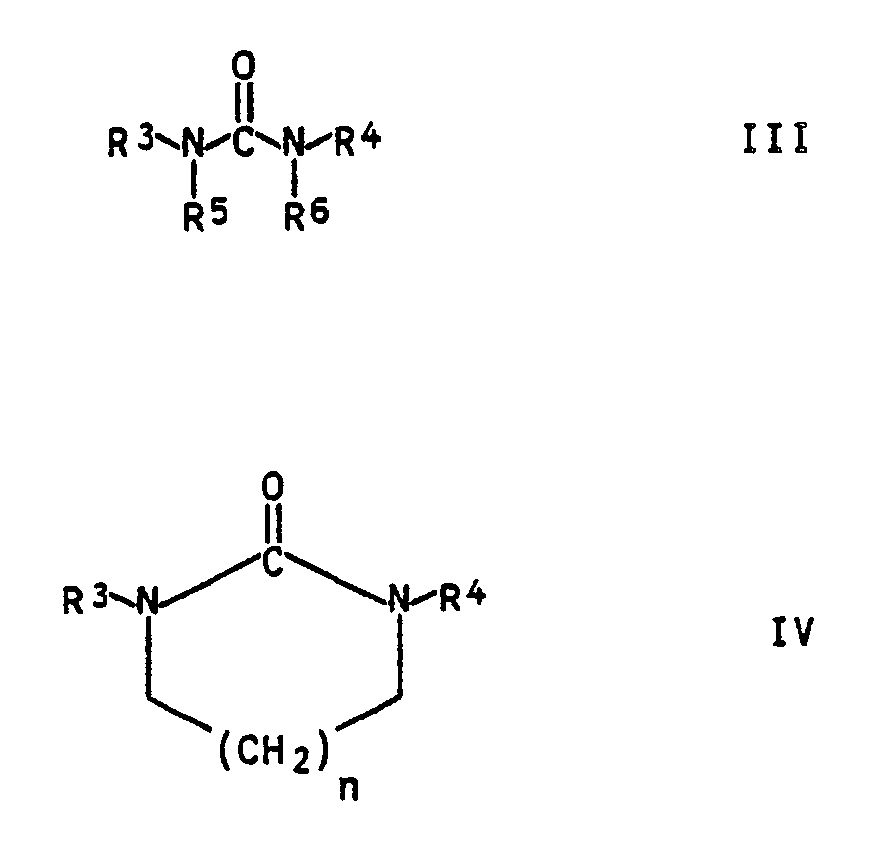
worin
n = 0 bis 3 und
R³, R⁴, R⁵ und R⁶ für gleiche oder verschiedene, geradkettige oder verzweigte Alkylreste mit 1 bis 6 C-Atomen oder Wasserstoff stehen als Katalysator bei Temperaturen von -20 bis +100°C umsetzt. - Zu den Einsatzstoffen ist folgendes auszuführen:
- Die in diesem Verfahren verwendeten aromatischen Diketone sind bekannt und werden beispielsweise nach dem in der DE-A 36 24 146 beschriebenen Verfahren durch Oxidation der entsprechenden Benzoine hergestellt.
- Geeignete aromatische Diketone der allgemeinen Formel II sind besonders solche, in denen die gegebenenfalls miteinander verbundenen Arylreste unabhängig voneinander je einen unsubstituierten oder durch Alkyl- oder Alkoxy mit 1 bis 6 C-Atomen, Halogen oder durch Phenylreste höchstens trisubstituierten Phenylrest bedeuten. Beispiele für aromatische 1,2-Diketone, die für dieses Verfahren verwendet werden können, sind Benzil und substituierte Benzile wie z.B. 4,4′-Dimethylbenzil, 4,4′-Diisopropylbenzil, 4,4′-Diphenylbenzil, 2,2′-Dimethoxybenzil, 4-Methylbenzil, 3-Methoxybenzil, 2,2′-Dimethylbenzil, 4-Chlor-4′-phenylbenzil, 4,4′-Dichlorbenzil, 3,3′-Dibrombenzil, 2,4,2′,4′-Tetramethylbenzil, 2,4,6-Trimethylbenzil, 2,4-Dichlor-4′-methylbenzil. Beispiele für aromatische 1,2-Diketone, bei denen die Arylreste miteinander verbunden sind und die für dieses Verfahren verwendet werden können, sind gegebenenfalls substituiertes Phenanthrenchinon, Acenaphthenchinon oder 1,2-Aceanthrenchinon. Diese o-Chinone sind nach literaturbekannten Verfahren und nach dem in J. Chem. Soc., Perkin Trans.I 1986, 1965 beschriebenen Verfahren darstellbar.
- Für das Verfahren geeignete Alkylierungsmittel haben die genannte Formel (R¹)nX und sind Ester ein bis dreibasiger Säuren, insbesondere von ein Schwefel-, ein Phosphor- oder ein Halogenatom enthaltenden Säuren. Genannt seien die Ester der Schwefelsäure, der schwefligen Säure, der Phosphorsäure und der phosphorigen Säure, die Ester der Halogenwasserstoffsäure, wie die Chloride, Bromide und Jodide sowie der aliphatischen und aromatischen Sulfonsäuren wie die Mesylate, Tosylate, Brosylate und Benzolsulfonate. Besonders geeignet sind die Sulfate, Halogenide und Sulfonsäureester, von denen die Sulfate bevorzugt werden. Der Esterrest R¹ stellt gegebenenfalls Substituenten tragende Kohlenwasserstoffreste mit 1 bis 10 C-Atomen dar. Geeignete Reste und Substituenten sind in der DE-A-26 16 588 beschrieben.
- Beispiele für Alkylierungsmittel, die für dieses Verfahren eingesetzt werden können, sind Dimethylsulfat, Diethylsulfat, Dihexylsulfat, Diallylsulfat, Dicrotylsulfat, Di(ß-phenylethyl)sulfat, Di(ß-phenylallyl)sulfat, Di(ß-methoxyethyl)sulfat, Di(ß-phenoxyethyl)sulfat, Di(methylthioethyl)sulfat oder Di(ß-phenylthioethyl)sulfat, Benzylbromid, Allylbromid, Benzolsulfonsäuremethylester, Benzolsulfonsäureethylester, p-Toluolsulfonsäuremethylester, p-Toluolsulfonsäureethylester oder das o-, p-Gemisch der entsprechenden Toluolsulfonsäureester. Bevorzugt werden beispielsweise die leicht zugänglichen o-,p-Gemische des Toluolsulfonsäuremethylesters oder das Dimethylsulfat.
- Als Alkoholate werden wahlweise dem Alkylierungsmittel entsprechende (für symmetrische Acetale) bzw. nicht entsprechende Alkoholate (für unsymmetrische Acetale) mit Resten R² verwendet, also beispielsweise bei Verwendung von Dimethylsulfat ein Ethylat wie Natriumethylat oder Kaliumethylat oder bei Verwendung von Allylbromid z.B. Natriummethylat. Ansonsten gelten bezüglich der Art der Reste R² die vorstehenden Angaben zu den Resten R¹ sinngemäß. Bevorzugt sind die Alkoholate des Natriums und Kaliums, die vorzugsweise in fester kristalliner Form oder als Aufschlämmung im entsprechenden org. Lösungsmittel eingesetzt werden.
- Als Katalysatoren werden Harnstoffderivate der allgemeinen Formel III oder IV verwendet. Geeignete Beispiele für Derivate der Formel III sind Dimethylharnstoff, Diethylharnstoff, Tetramethylharnstoff, Tetraethylharnstoff, Tetrabutylharnstoff oder deren Gemische. Bevorzugt sind Dimethylharnstoff, Tetramethylharnstoff oder Tetrabutylharnstoff.
- Geeignete Beispiele für Derivate der Formel IV sind N,N′-Propylenharnstoff, N-Methylpropylenharnstoff, N,N′-Dimethylpropylenharnstoff, N,N′-Ethylenharnstoff, N-Methylethylenharnstoff, N,N′-Dimethylethylenharnstoff sowie deren Gemische. Bevorzugt sind N-Methylpropylenharnstoff und N,N′-Dimethylpropylenharnstoff.
- Es können aber auch Gemische der Harnstoffderivate der Formeln III und IV verwendet werden. Die Harnstoffderivate werden in Mengen von 0,5 bis 50 Gew.%, bevorzugt 5 bis 30 Gew.%, bezogen auf das jeweils eingesetzte Diketon verwendet.
- Von den organischen Lösungsmitteln oder Lösungsmittelgemischen kommen ausschließlich unpolare Lösungsmittel in Betracht. Im Handbook of Chemistry and Physics (62nd Ed.), Seite C-700, sind Beispiele aufgeführt. Von diesen werden wiederum die aromatischen Lösungsmittel bevorzugt, die einen Siedepunkt im Bereich von 60 bis 140°C haben. Die Menge an Lösungsmittel sollte zweckmäßigerweise so bemessen sein, daß das Reaktionsgemisch nach Zusammengeben aller Reaktionskomponenten noch gut rührbar ist. Dies ist im allgemeinen dann der Fall, wenn das Lösungsmittel wenigstens etwa die Hälfte des Reaktionsgemisches ausmacht.
- Die erfindungsgemäße Umsetzung der 1,2-Diketone mit dem Alkylierungsmittel und Alkoholat erfolgt im allgemeinen bei Temperaturen von -20°C bis 100°C, bevorzugt bei 20 bis 40°C. Die Höhe und Einhaltung der Innentemperatur ist für den Erfolg der Reaktion wichtig. Sie hängt von der Reaktivität des aus dem Diketon und dem Alkoholat gebildeten Anions ab. Bei Diketonen mittlerer Reaktivität, z.B. dem 4,4′-Dimethylbenzil sollte sie 35 bis 40°C nicht überschreiten. Bei Ketonen, die sehr langsam mit dem Alkoholat/Alkylierungsmittel reagieren, muß temperaturgesteuert zudosiert werden. Im allgemeinen ist die Reaktion jedoch innerhalb weniger Minuten abgeschlossen und in den meisten Fällen ist sie bereits beendet, sobald die Reaktionsteilnehmer zusammengebracht worden sind. In diesem Punkt unterscheidet sich das vorliegende Verfahren deutlich von der in den DE-A 26 16 382, DE-A 26 16 408 und DE-A 26 16 508 beschriebenen Methode mit langen Nachrührzeiten.
- Theoretisch werden 1/n Mol Alkylierungsmittel der vorstehend erläuterten Formel (R¹)nX mit einem Mol 1,2-Diketon und 1/m Mol Alkoholat der ebenfalls vorstehend erläuterten Formel (R²O)mM umgesetzt, wobei n und m der Zahl n bzw. m in der Formel des verwendeten Alkylierungsmittel bzw. Alkoholats entsprechen, um die unsymmetrischen 1,1-Acetale der aromatischen 1,2-Diketone zu erzeugen. Im allgemeinen wird es jedoch vorgezogen, einige Reaktionsteilnehmer in überschüssigen Mengen einzusetzen, um eine vollständige Umsetzung zu erreichen. So kann man pro Mol 1,2-Diketon 1/n bis 10/n Mol oder mehr, vorzugsweise 1/n bis 4/n Mol Alkylierungsmittel und 1/m bis 10/m Mol oder mehr, vorzugsweise 1/m bis 4/m Mol Alkoholat einsetzen.
- Bei einer zweckmäßigen Ausführungsform der Erfindung wird das Verfahren so durchgeführt, daß das Alkoholat in ein Reaktionsgemisch, bestehend aus dem aromatischen 1,2-Diketon, dem Alkylierungsmittel, dem Katalysator und dem Lösungsmittel, eingetragen wird. Dabei kann das Alkoholat direkt als Festsubstanz oder auch in Form einer Suspension, z.B. in Toluol, Xylol oder o-Dichlorbenzol zugegeben werden.
- Das Verfahren wird am zweckmäßigsten so ausgeführt, daß das pulverförmige, kristalline Alkoholat temperaturgesteuert kontinuierlich zudosiert wird. Der Zusatz von Wasser oder protischen Lösungsmitteln, wie z.B. Alkohol stört bzw. inhibiert die Alkylierung.
- Nach Beendigung der Reaktion, was beispielsweise dünnschicht- oder gaschromatographisch sehr leicht feststellbar ist, werden eventuell verbliebene Reste an Dimethylsulfat durch Zusatz von Basen, wie Ethanolamin, Ammoniumhydroxid, wäßriger Natronlauge oder durch Hydrolyse von überschüssigem Natrium- oder Kaliumalkoholat zerstört. Dabei muß selbstverständlich darauf geachtet werden, daß das Reaktionsgemisch nicht in den sauren pH-Bereich gelangt, da sonst eine Hydrolyse des 1,1-Acetals zum entsprechenden Diketon erfolgen kann.
- Die Aufarbeitung des Reaktionsgemisches und Isolierung des Reaktionsproduktes kann nach herkömmlichen Verfahren wie Ausfällen, Extraktion oder Destillation erfolgen. Eine mögliche Vefahrensweise besteht z.B. darin, nach dem Vernichten des überschüssigen Alkylierungsmittels das Toluol auszukreisen, eine Phasentrennung durchzuführen und das mit Wasser nicht mischbare Acetal durch Kristallisation oder Destillation zu reinigen. Voraussetzung für diese Arbeitsweise ist jedoch, daß das zur Umsetzung verwendete Lösungsmittel nicht mit Wasser mischbar ist und ein Azeotrop mit Wasser bildet. Das so isolierte Acetal fällt in analysenreiner Form an. Das Verfahren bietet den Vorteil, daß das in die Reaktion eingesetzte Lösungsmittel und der Katalysator aus den entsprechenden Phasen nach klassischen Methoden wieder weitgehend zurückgewonnen werden kann.
- In 400 ml Toluol wurden bei Raumtemperatur 84 g Benzil, 15 g N,N′-Propylenharnstoff und 65 ml Dimethylsulfat gelöst. Zu der klaren gelben Lösung wurden dann 5 Mal 7,5 g Natriummethylat so zugegeben, daß die Innentemperatur 30°C nicht überschritt. Nach beendeter Zugabe wurden 20 ml 20 gew.%ige Natronlauge zugetropft und das Reaktionsgemisch bei Normaldruck auf 60°C erhitzt. Nach 20 Minuten wurde ein Vakuum von 300 mbar angelegt und zunächst das Azeotrop 20 Gew.% Wasser/80 Gew.% Toluol und anschließend reines Toluol abdestilliert. Nach Zusatz von 400 ml 10 gew.%iger wäßriger Natronlauge wurde das restliche Toluol abdestilliert. Bei 70°C wurde anschließend eine Phasentrennung durchgeführt und die organische Phase aus Isopropanol/Wasser umkristallisiert.
Ausbeute: 96 g (94 %) farblose Nadeln vom Schmp. 63-65°C. - Das bei der Phasentrennung erhaltene rohe Benzildimethylketal wurde bei einem Druck von 10 mbar an einer kurzen Füllkörperkolonne fraktioniert. Nach einem geringen Vorlauf von Restwasser geht reines Benzildimethylketal als Öl mit einem Siedepunkt von 165°C/10 mbar über, das beim Stehen in farblosen Nadeln kristallisiert.
Ausbeute: 98 g (96 %) - Das bei der Phasentrennung erhaltene rohe Benzildimethylketal wurde als Schmelze langsam in ein Gemisch aus 720 ml Wasser und 80 ml Methanol eingerührt, wobei es in Form feiner farbloser Prismen ausfiel. Nach dem Absaugen und Waschen mit Wasser/Methanol = 20:1 wurde im Vakuum getrocknet.
Ausbeute: 95 g (93 %) - In Abänderung von Beispiel 1, Methode A, wurde der Katalysator N,N′-Propylenharnstoff durch die in Tabelle 1 aufgeführten Katalysatoren gemäß Formel III ersetzt. Die folgenden Ausbeuten wurden erhalten:
Tabelle 1 Beispiel Nr. Katalysator Ausbeute an isoliertem BDK [%] 2 - 48 3 Ethylenglykoldimethylether 58 4 Diethylenglykolmonomethylether 4 5 Diethylenglykolmonoethylether 50 6 Diethylenglykolmonobutylether 8 7 1,2-Propandiol 42 8 Pluriol® E 1000 53 9 Dimethylformamid 72 10 N,N′-Dimethylpropylenharnstoff 97 11 N-Methylpropylenharnstoff 92 12 N,N′-Ethylenharnstoff 85 13 N-Methyl-ethylenharnstoff 82 14 N,N′-Dimethylethylenharnstoff 96 15 Tetramethylharnstoff 88 - In den Beispielen 2 bis 8 wurden doppelte Reaktionszeiten gewählt. In den Beispielen 3 bis 6 trat nach einer unterschiedlich langen Inhibierungsphase eine spontane, exotherme Reaktion ein, die bei 8 und 9 mit einer starken Gasentwicklung verbunden war.
- In Analogie zu Beispiel 1, Methode A, wurde Benzil mit Dimethylsulfat und Natriumethylat in Gegenwart von N,N′-Dimethylpropylenharnstoff umgesetzt. Nach der Phasentrennung wurde reines Wertprodukt als gelbliches Öl erhalten, das nach einwöchigem Stehen allmählich kristallisierte. Ausbeute: 79 %, Schmp. 53-54°C.
- In Anlehnung an die in Beispiel 1 beschriebene Methode wurden folgende Dialkylacetale synthetisiert:
Tabelle 2 Beispiel Dialkylacetal Methode Katalysator Ausbeute 17 Phenanthrenchinondimethylacetal A Essigester/Hexan N-Methylpropylenharnstoff 65 18 2,2-Dimethoxyacenaphthylen-1-(2H)-on A Hexan Tetramethylharnstoff 83 19 2-Ethoxy-2-methoxyacenaphthylen-1-(2H)-on Isopropanol/Wasser N,N′-Dimethylpropylenharnstoff 85
Claims (4)

A¹ und A² für gleiche, verschiedene oder miteinander verbundene, gegebenenfalls geradkettige oder verzweigte Alkyl- oder Alkoxy-Reste mit 1 bis 6 C-Atomen, Halogen- oder Phenylreste tragende, aromatische Reste stehen und
R¹ und R² für gleiche oder verschiedene, gegebenenfalls substituierte, geradkettige oder verzweigte Alkylreste mit 1 bis 10 C-Atomen stehen,
aus den entsprechenden aromatischen 1,2-Diketonen der allgemeinen Formel II

(R¹)nX,
einem Alkoholat
(R²O)mM,
wobei n und m für ganze Zahlen von 1 bis 3 stehen,
X für den Rest einer ein- bis dreibasigen Säure und
M für ein Metall der 1. bis 3. Hauptgruppe des Periodensystems der Elemente steht,
in Gegenwart eines Harnstoffderivates der allgemeinen Formel III oder IV

worin
n = 0 bis 3 und
R³, R⁴, R⁵ und R⁶ für gleiche oder verschiedene, geradkettige oder verzweigte Alkylreste mit 1 bis 6 C-Atomen oder Wasserstoff stehen, als Katalysator bei Temperaturen von -20 bis +100°C umsetzt.
Priority Applications (1)
| Application Number | Priority Date | Filing Date | Title |
|---|---|---|---|
| AT89117506T ATE82951T1 (de) | 1988-10-06 | 1989-09-22 | Verfahren zur herstellung von symmetrischen und unsymmetrischen monoacetalen aromatischer 1,2diketone. |
Applications Claiming Priority (2)
| Application Number | Priority Date | Filing Date | Title |
|---|---|---|---|
| DE3834029A DE3834029A1 (de) | 1988-10-06 | 1988-10-06 | Verfahren zur herstellung von symmetrischen und unsymmetrischen monoacetalen aromatischer 1,2-diketone |
| DE3834029 | 1988-10-06 |
Publications (3)
| Publication Number | Publication Date |
|---|---|
| EP0362638A2 true EP0362638A2 (de) | 1990-04-11 |
| EP0362638A3 EP0362638A3 (en) | 1990-09-05 |
| EP0362638B1 EP0362638B1 (de) | 1992-12-02 |
Family
ID=6364526
Family Applications (1)
| Application Number | Title | Priority Date | Filing Date |
|---|---|---|---|
| EP89117506A Expired - Lifetime EP0362638B1 (de) | 1988-10-06 | 1989-09-22 | Verfahren zur Herstellung von symmetrischen und unsymmetrischen Monoacetalen aromatischer 1,2-Diketone |
Country Status (6)
| Country | Link |
|---|---|
| US (1) | US4967010A (de) |
| EP (1) | EP0362638B1 (de) |
| JP (1) | JPH02149538A (de) |
| AT (1) | ATE82951T1 (de) |
| DE (2) | DE3834029A1 (de) |
| ES (1) | ES2045325T3 (de) |
Families Citing this family (3)
| Publication number | Priority date | Publication date | Assignee | Title |
|---|---|---|---|---|
| CN102786404B (zh) * | 2012-08-29 | 2014-07-16 | 天津久日化学股份有限公司 | 安息香双甲醚的制备方法 |
| CN104817443B (zh) * | 2015-03-04 | 2017-01-11 | 绍兴佳英感光材料科技有限公司 | 一种安息香双甲醚的合成工艺 |
| CN113461507A (zh) * | 2021-06-09 | 2021-10-01 | 漯河市新旺化工有限公司 | 安息香双甲醚连续化生产方法及用于该方法的生产装置 |
Family Cites Families (4)
| Publication number | Priority date | Publication date | Assignee | Title |
|---|---|---|---|---|
| FI60194C (fi) * | 1972-07-28 | 1981-12-10 | Ciba Geigy Ag | Foerfarande foer framstaellning av bensil-monoketaler |
| FR2348180A1 (fr) * | 1976-04-14 | 1977-11-10 | Basf Ag | Procede de preparation de monoacetals de 1,2-dicetones aromatiques et utilisation de ces substances comme photo-inducteurs pour des melanges durcissables sous l'action de radiations |
| DE2616408A1 (de) * | 1976-04-14 | 1977-11-03 | Basf Ag | Durch uv-bestrahlung polymerisierbare gemische |
| US4144156A (en) * | 1976-04-14 | 1979-03-13 | Basf Aktiengesellschaft | Manufacture of unsymmetric monoacetals of aromatic 1,2-diketones employable as photoiniatiators |
-
1988
- 1988-10-06 DE DE3834029A patent/DE3834029A1/de not_active Withdrawn
-
1989
- 1989-09-19 US US07/410,042 patent/US4967010A/en not_active Expired - Fee Related
- 1989-09-22 EP EP89117506A patent/EP0362638B1/de not_active Expired - Lifetime
- 1989-09-22 AT AT89117506T patent/ATE82951T1/de not_active IP Right Cessation
- 1989-09-22 DE DE8989117506T patent/DE58902887D1/de not_active Expired - Lifetime
- 1989-09-22 ES ES89117506T patent/ES2045325T3/es not_active Expired - Lifetime
- 1989-10-06 JP JP1260376A patent/JPH02149538A/ja active Pending
Also Published As
| Publication number | Publication date |
|---|---|
| DE3834029A1 (de) | 1990-04-12 |
| JPH02149538A (ja) | 1990-06-08 |
| US4967010A (en) | 1990-10-30 |
| EP0362638B1 (de) | 1992-12-02 |
| ES2045325T3 (es) | 1994-01-16 |
| EP0362638A3 (en) | 1990-09-05 |
| DE58902887D1 (de) | 1993-01-14 |
| ATE82951T1 (de) | 1992-12-15 |
Similar Documents
| Publication | Publication Date | Title |
|---|---|---|
| DE68923250T2 (de) | Chalcon-Derivate und Verfahren zu deren Herstellung. | |
| DE2365852A1 (de) | Verfahren zur herstellung von monoacetalen aromatischer 1,2-diketone | |
| AT397960B (de) | Verfahren zur herstellung des neuen r-(-)-5-(2-((2-(o-äthoxyphenoxy)-äthyl)-amino)- propyl)-2-methoxybenzolsulfonamids | |
| DD139852B1 (de) | Verfahren zur herstellung kristallin-fluessiger substituierter 1,3-dioxane | |
| EP0847976B1 (de) | Verfahren zur Herstellung von Glyoxalmonoacetalen | |
| EP0225433B1 (de) | Hydroxyoxaalkylmelamine, Verfahren zu ihrer Herstellung und deren Verwendung | |
| EP0362638B1 (de) | Verfahren zur Herstellung von symmetrischen und unsymmetrischen Monoacetalen aromatischer 1,2-Diketone | |
| DE3422610A1 (de) | Verfahren zur herstellung von aminen | |
| DE2310141A1 (de) | Verfahren zur herstellung von 1phenyl-2-aminoaethanolderivaten | |
| CH621107A5 (de) | ||
| DE3019069C2 (de) | ||
| DE2834167C2 (de) | Verfahren zur Herstellung von 2-(2-Hydroxyäthoxy)äthyl-N-(α,α,α-trifluor-m-tolyl)anthranilat | |
| DE2513996C3 (de) | Cyc lopentenderivate | |
| DE1287571B (de) | Verfahren zur Herstellung von Enaminen | |
| EP0233337A2 (de) | Verfahren zur Herstellung von Carbonylverbindungen | |
| DE2737299C2 (de) | Verfahren zur Gewinnung von reinem 3-Phenoxybenzaldehyd | |
| DE2732714C2 (de) | Verfahren zur Herstellung von Acyloinen | |
| DE69611551T2 (de) | Herstellung von 6-brom-2-naphtholderivaten | |
| EP0227057B1 (de) | Verfahren zur Herstellung von in 1-Stellung durch aromatische oder heterocyclische Reste substituierten Alkanolen | |
| EP0863884B1 (de) | Verfahren zur herstellung von bis-alkoxy-triazinyl-aminohaltigen stilben-disulfonsäuren oder deren derivate | |
| DE3152459C2 (de) | ||
| AT331237B (de) | Verfahren zur herstellung von monoacetalen aromatischer 1,2-diketone | |
| DE2616382C2 (de) | Verfahren zur Herstellung von nicht-cyclischen, unsymmetrischen 1,1-Acetalen aromatischer 1,2-Diketone, einige nicht-cyclische, unsymmetrische 1,2-Diketone als solche und deren Verwendung als Photoinitiatoren | |
| DE2617967C3 (de) | Verfahren zur Herstellung von 2,4-Diamino-5-benzylpyrimidinen | |
| AT353774B (de) | Verfahren zur herstellung von hydrochinon- dialkylaethern |
Legal Events
| Date | Code | Title | Description |
|---|---|---|---|
| PUAI | Public reference made under article 153(3) epc to a published international application that has entered the european phase |
Free format text: ORIGINAL CODE: 0009012 |
|
| AK | Designated contracting states |
Kind code of ref document: A2 Designated state(s): AT BE CH DE ES FR GB IT LI NL SE |
|
| PUAL | Search report despatched |
Free format text: ORIGINAL CODE: 0009013 |
|
| AK | Designated contracting states |
Kind code of ref document: A3 Designated state(s): AT BE CH DE ES FR GB IT LI NL SE |
|
| 17P | Request for examination filed |
Effective date: 19900724 |
|
| 17Q | First examination report despatched |
Effective date: 19920205 |
|
| GRAA | (expected) grant |
Free format text: ORIGINAL CODE: 0009210 |
|
| AK | Designated contracting states |
Kind code of ref document: B1 Designated state(s): AT BE CH DE ES FR GB IT LI NL SE |
|
| REF | Corresponds to: |
Ref document number: 82951 Country of ref document: AT Date of ref document: 19921215 Kind code of ref document: T |
|
| ITF | It: translation for a ep patent filed | ||
| GBT | Gb: translation of ep patent filed (gb section 77(6)(a)/1977) |
Effective date: 19921207 |
|
| REF | Corresponds to: |
Ref document number: 58902887 Country of ref document: DE Date of ref document: 19930114 |
|
| ET | Fr: translation filed | ||
| PLBE | No opposition filed within time limit |
Free format text: ORIGINAL CODE: 0009261 |
|
| STAA | Information on the status of an ep patent application or granted ep patent |
Free format text: STATUS: NO OPPOSITION FILED WITHIN TIME LIMIT |
|
| 26N | No opposition filed | ||
| REG | Reference to a national code |
Ref country code: ES Ref legal event code: FG2A Ref document number: 2045325 Country of ref document: ES Kind code of ref document: T3 |
|
| EAL | Se: european patent in force in sweden |
Ref document number: 89117506.9 |
|
| PGFP | Annual fee paid to national office [announced via postgrant information from national office to epo] |
Ref country code: FR Payment date: 19960820 Year of fee payment: 8 |
|
| PGFP | Annual fee paid to national office [announced via postgrant information from national office to epo] |
Ref country code: SE Payment date: 19960821 Year of fee payment: 8 |
|
| PGFP | Annual fee paid to national office [announced via postgrant information from national office to epo] |
Ref country code: AT Payment date: 19960829 Year of fee payment: 8 |
|
| PGFP | Annual fee paid to national office [announced via postgrant information from national office to epo] |
Ref country code: NL Payment date: 19960831 Year of fee payment: 8 |
|
| PGFP | Annual fee paid to national office [announced via postgrant information from national office to epo] |
Ref country code: CH Payment date: 19960903 Year of fee payment: 8 |
|
| PGFP | Annual fee paid to national office [announced via postgrant information from national office to epo] |
Ref country code: BE Payment date: 19960910 Year of fee payment: 8 |
|
| PGFP | Annual fee paid to national office [announced via postgrant information from national office to epo] |
Ref country code: GB Payment date: 19960916 Year of fee payment: 8 |
|
| PGFP | Annual fee paid to national office [announced via postgrant information from national office to epo] |
Ref country code: ES Payment date: 19960919 Year of fee payment: 8 |
|
| PGFP | Annual fee paid to national office [announced via postgrant information from national office to epo] |
Ref country code: DE Payment date: 19960923 Year of fee payment: 8 |
|
| PG25 | Lapsed in a contracting state [announced via postgrant information from national office to epo] |
Ref country code: GB Free format text: LAPSE BECAUSE OF NON-PAYMENT OF DUE FEES Effective date: 19970922 Ref country code: AT Free format text: LAPSE BECAUSE OF NON-PAYMENT OF DUE FEES Effective date: 19970922 |
|
| PG25 | Lapsed in a contracting state [announced via postgrant information from national office to epo] |
Ref country code: SE Free format text: LAPSE BECAUSE OF NON-PAYMENT OF DUE FEES Effective date: 19970923 Ref country code: ES Free format text: LAPSE BECAUSE OF THE APPLICANT RENOUNCES Effective date: 19970923 |
|
| PG25 | Lapsed in a contracting state [announced via postgrant information from national office to epo] |
Ref country code: DE Effective date: 19970926 |
|
| PG25 | Lapsed in a contracting state [announced via postgrant information from national office to epo] |
Ref country code: LI Free format text: LAPSE BECAUSE OF NON-PAYMENT OF DUE FEES Effective date: 19970930 Ref country code: FR Free format text: THE PATENT HAS BEEN ANNULLED BY A DECISION OF A NATIONAL AUTHORITY Effective date: 19970930 Ref country code: CH Free format text: LAPSE BECAUSE OF NON-PAYMENT OF DUE FEES Effective date: 19970930 Ref country code: BE Free format text: LAPSE BECAUSE OF NON-PAYMENT OF DUE FEES Effective date: 19970930 |
|
| BERE | Be: lapsed |
Owner name: BASF A.G. Effective date: 19970930 |
|
| PG25 | Lapsed in a contracting state [announced via postgrant information from national office to epo] |
Ref country code: NL Free format text: LAPSE BECAUSE OF NON-PAYMENT OF DUE FEES Effective date: 19980401 |
|
| GBPC | Gb: european patent ceased through non-payment of renewal fee |
Effective date: 19970922 |
|
| REG | Reference to a national code |
Ref country code: CH Ref legal event code: PL |
|
| NLV4 | Nl: lapsed or anulled due to non-payment of the annual fee |
Effective date: 19980401 |
|
| EUG | Se: european patent has lapsed |
Ref document number: 89117506.9 |
|
| REG | Reference to a national code |
Ref country code: FR Ref legal event code: ST |
|
| REG | Reference to a national code |
Ref country code: ES Ref legal event code: FD2A Effective date: 20001009 |
|
| PG25 | Lapsed in a contracting state [announced via postgrant information from national office to epo] |
Ref country code: IT Free format text: LAPSE BECAUSE OF NON-PAYMENT OF DUE FEES;WARNING: LAPSES OF ITALIAN PATENTS WITH EFFECTIVE DATE BEFORE 2007 MAY HAVE OCCURRED AT ANY TIME BEFORE 2007. THE CORRECT EFFECTIVE DATE MAY BE DIFFERENT FROM THE ONE RECORDED. Effective date: 20050922 |