EP0362728B1 - Verfahren zur Gewinnung von Ibuprofen für die Direkttablettierung - Google Patents
Verfahren zur Gewinnung von Ibuprofen für die Direkttablettierung Download PDFInfo
- Publication number
- EP0362728B1 EP0362728B1 EP89118140A EP89118140A EP0362728B1 EP 0362728 B1 EP0362728 B1 EP 0362728B1 EP 89118140 A EP89118140 A EP 89118140A EP 89118140 A EP89118140 A EP 89118140A EP 0362728 B1 EP0362728 B1 EP 0362728B1
- Authority
- EP
- European Patent Office
- Prior art keywords
- ibuprofen
- melt
- roller
- particles
- direct tabletting
- Prior art date
- Legal status (The legal status is an assumption and is not a legal conclusion. Google has not performed a legal analysis and makes no representation as to the accuracy of the status listed.)
- Expired - Lifetime
Links
- HEFNNWSXXWATRW-UHFFFAOYSA-N Ibuprofen Chemical compound CC(C)CC1=CC=C(C(C)C(O)=O)C=C1 HEFNNWSXXWATRW-UHFFFAOYSA-N 0.000 title claims abstract description 39
- 229960001680 ibuprofen Drugs 0.000 title claims abstract description 38
- 238000004519 manufacturing process Methods 0.000 title description 6
- 238000001816 cooling Methods 0.000 claims abstract description 16
- 238000000034 method Methods 0.000 claims description 18
- 239000002245 particle Substances 0.000 claims description 11
- 239000000463 material Substances 0.000 claims description 6
- 238000007711 solidification Methods 0.000 claims description 5
- 230000008023 solidification Effects 0.000 claims description 5
- 239000007787 solid Substances 0.000 claims description 3
- 238000002955 isolation Methods 0.000 claims 1
- 239000000155 melt Substances 0.000 abstract description 13
- 238000003860 storage Methods 0.000 abstract description 5
- 239000002904 solvent Substances 0.000 description 6
- 239000003814 drug Substances 0.000 description 5
- 238000000227 grinding Methods 0.000 description 5
- 239000002054 inoculum Substances 0.000 description 5
- 239000013078 crystal Substances 0.000 description 4
- 239000000203 mixture Substances 0.000 description 4
- OKKJLVBELUTLKV-UHFFFAOYSA-N Methanol Chemical compound OC OKKJLVBELUTLKV-UHFFFAOYSA-N 0.000 description 3
- IMNFDUFMRHMDMM-UHFFFAOYSA-N N-Heptane Chemical compound CCCCCCC IMNFDUFMRHMDMM-UHFFFAOYSA-N 0.000 description 3
- 229940079593 drug Drugs 0.000 description 3
- 239000008187 granular material Substances 0.000 description 3
- 239000000843 powder Substances 0.000 description 3
- 208000001840 Dandruff Diseases 0.000 description 2
- VYPSYNLAJGMNEJ-UHFFFAOYSA-N Silicium dioxide Chemical compound O=[Si]=O VYPSYNLAJGMNEJ-UHFFFAOYSA-N 0.000 description 2
- 239000004480 active ingredient Substances 0.000 description 2
- 239000000654 additive Substances 0.000 description 2
- 238000004090 dissolution Methods 0.000 description 2
- 238000009826 distribution Methods 0.000 description 2
- 238000001035 drying Methods 0.000 description 2
- 238000009472 formulation Methods 0.000 description 2
- 238000011081 inoculation Methods 0.000 description 2
- HQKMJHAJHXVSDF-UHFFFAOYSA-L magnesium stearate Chemical compound [Mg+2].CCCCCCCCCCCCCCCCCC([O-])=O.CCCCCCCCCCCCCCCCCC([O-])=O HQKMJHAJHXVSDF-UHFFFAOYSA-L 0.000 description 2
- VLKZOEOYAKHREP-UHFFFAOYSA-N n-Hexane Chemical compound CCCCCC VLKZOEOYAKHREP-UHFFFAOYSA-N 0.000 description 2
- 238000001953 recrystallisation Methods 0.000 description 2
- 239000000126 substance Substances 0.000 description 2
- 239000000725 suspension Substances 0.000 description 2
- 229920000168 Microcrystalline cellulose Polymers 0.000 description 1
- CZMRCDWAGMRECN-UGDNZRGBSA-N Sucrose Chemical compound O[C@H]1[C@H](O)[C@@H](CO)O[C@@]1(CO)O[C@@H]1[C@H](O)[C@@H](O)[C@H](O)[C@@H](CO)O1 CZMRCDWAGMRECN-UGDNZRGBSA-N 0.000 description 1
- 229930006000 Sucrose Natural products 0.000 description 1
- 238000005299 abrasion Methods 0.000 description 1
- 238000009825 accumulation Methods 0.000 description 1
- 230000000202 analgesic effect Effects 0.000 description 1
- 230000001754 anti-pyretic effect Effects 0.000 description 1
- 230000003356 anti-rheumatic effect Effects 0.000 description 1
- 239000002221 antipyretic Substances 0.000 description 1
- 239000003435 antirheumatic agent Substances 0.000 description 1
- 230000015572 biosynthetic process Effects 0.000 description 1
- 229920003086 cellulose ether Polymers 0.000 description 1
- 238000003889 chemical engineering Methods 0.000 description 1
- 238000002425 crystallisation Methods 0.000 description 1
- 230000008025 crystallization Effects 0.000 description 1
- 230000036758 dandruff formation Effects 0.000 description 1
- 239000002552 dosage form Substances 0.000 description 1
- 239000008298 dragée Substances 0.000 description 1
- 239000000428 dust Substances 0.000 description 1
- 230000002631 hypothermal effect Effects 0.000 description 1
- 238000000338 in vitro Methods 0.000 description 1
- 239000004922 lacquer Substances 0.000 description 1
- 235000019359 magnesium stearate Nutrition 0.000 description 1
- 235000019813 microcrystalline cellulose Nutrition 0.000 description 1
- 239000008108 microcrystalline cellulose Substances 0.000 description 1
- 229940016286 microcrystalline cellulose Drugs 0.000 description 1
- 238000004806 packaging method and process Methods 0.000 description 1
- 239000011088 parchment paper Substances 0.000 description 1
- 239000000825 pharmaceutical preparation Substances 0.000 description 1
- 239000008363 phosphate buffer Substances 0.000 description 1
- 239000000377 silicon dioxide Substances 0.000 description 1
- 235000012239 silicon dioxide Nutrition 0.000 description 1
- 229940079832 sodium starch glycolate Drugs 0.000 description 1
- 229920003109 sodium starch glycolate Polymers 0.000 description 1
- 239000008109 sodium starch glycolate Substances 0.000 description 1
- 238000001228 spectrum Methods 0.000 description 1
- 230000003068 static effect Effects 0.000 description 1
- 239000005720 sucrose Substances 0.000 description 1
- 239000002699 waste material Substances 0.000 description 1
- XLYOFNOQVPJJNP-UHFFFAOYSA-N water Substances O XLYOFNOQVPJJNP-UHFFFAOYSA-N 0.000 description 1
Images

Classifications
-
- C—CHEMISTRY; METALLURGY
- C07—ORGANIC CHEMISTRY
- C07C—ACYCLIC OR CARBOCYCLIC COMPOUNDS
- C07C57/00—Unsaturated compounds having carboxyl groups bound to acyclic carbon atoms
- C07C57/30—Unsaturated compounds having carboxyl groups bound to acyclic carbon atoms containing six-membered aromatic rings
-
- A—HUMAN NECESSITIES
- A61—MEDICAL OR VETERINARY SCIENCE; HYGIENE
- A61K—PREPARATIONS FOR MEDICAL, DENTAL OR TOILETRY PURPOSES
- A61K31/00—Medicinal preparations containing organic active ingredients
- A61K31/185—Acids; Anhydrides, halides or salts thereof, e.g. sulfur acids, imidic, hydrazonic or hydroximic acids
- A61K31/19—Carboxylic acids, e.g. valproic acid
-
- A—HUMAN NECESSITIES
- A61—MEDICAL OR VETERINARY SCIENCE; HYGIENE
- A61K—PREPARATIONS FOR MEDICAL, DENTAL OR TOILETRY PURPOSES
- A61K9/00—Medicinal preparations characterised by special physical form
- A61K9/14—Particulate form, e.g. powders, Processes for size reducing of pure drugs or the resulting products, Pure drug nanoparticles
- A61K9/16—Agglomerates; Granulates; Microbeadlets ; Microspheres; Pellets; Solid products obtained by spray drying, spray freeze drying, spray congealing,(multiple) emulsion solvent evaporation or extraction
- A61K9/1682—Processes
- A61K9/1688—Processes resulting in pure drug agglomerate optionally containing up to 5% of excipient
-
- A—HUMAN NECESSITIES
- A61—MEDICAL OR VETERINARY SCIENCE; HYGIENE
- A61P—SPECIFIC THERAPEUTIC ACTIVITY OF CHEMICAL COMPOUNDS OR MEDICINAL PREPARATIONS
- A61P25/00—Drugs for disorders of the nervous system
- A61P25/04—Centrally acting analgesics, e.g. opioids
-
- A—HUMAN NECESSITIES
- A61—MEDICAL OR VETERINARY SCIENCE; HYGIENE
- A61P—SPECIFIC THERAPEUTIC ACTIVITY OF CHEMICAL COMPOUNDS OR MEDICINAL PREPARATIONS
- A61P29/00—Non-central analgesic, antipyretic or antiinflammatory agents, e.g. antirheumatic agents; Non-steroidal antiinflammatory drugs [NSAID]
-
- C—CHEMISTRY; METALLURGY
- C07—ORGANIC CHEMISTRY
- C07C—ACYCLIC OR CARBOCYCLIC COMPOUNDS
- C07C51/00—Preparation of carboxylic acids or their salts, halides or anhydrides
- C07C51/42—Separation; Purification; Stabilisation; Use of additives
- C07C51/43—Separation; Purification; Stabilisation; Use of additives by change of the physical state, e.g. crystallisation
-
- A—HUMAN NECESSITIES
- A61—MEDICAL OR VETERINARY SCIENCE; HYGIENE
- A61K—PREPARATIONS FOR MEDICAL, DENTAL OR TOILETRY PURPOSES
- A61K9/00—Medicinal preparations characterised by special physical form
- A61K9/20—Pills, tablets, discs, rods
- A61K9/2072—Pills, tablets, discs, rods characterised by shape, structure or size; Tablets with holes, special break lines or identification marks; Partially coated tablets; Disintegrating flat shaped forms
- A61K9/2077—Tablets comprising drug-containing microparticles in a substantial amount of supporting matrix; Multiparticulate tablets
Definitions
- the present invention relates to a method for obtaining free-flowing ibuprofen powder with improved storage and formulation properties for direct tableting.
- the said ibuprofen (2- (4-isobutylphenyl) propionic acid) has a variety of uses, e.g. B. as an analgesic, antipyretic or antirheumatic.
- the drug obtained in the various reaction paths is recrystallized from various solvents before drying and formulation.
- recrystallization processes which can be carried out from a number of solvents, as described in the patent specifications GB 971700, EP-A 170147 or the Bulgarian application 79345, crystals with an acicular habit are always obtained.
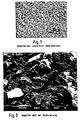
- the so z. B. from water / methanol, n-hexane, or n-heptane acicular dried crystals (see Fig. 1), but have a number of serious disadvantages in handling, storage and in the manufacture of pharmaceutical preparation forms. When drying after recrystallization, the crystals become static, which makes them difficult to handle.
- the needle-shaped ibuprofen causes problems when processed with appropriate additives.
- relatively large amounts of additives have to be used for tableting (approx. 50% based on the active ingredient), which in view of the high dosage of the active ingredient leads to large tablets, which in turn can negatively influence the ability to swallow and thus the "patient compliance" .
- Japanese patent Kokai 81-120616 entitled "Ibuprofen-Containing Granules, Production Method Thereof, and Internal Medicines Containing the Granules" describes the production of ibuprofen granules.
- the melted material is poured onto parchment paper and allowed to cool at room temperature.
- the material solidifies after about 20 minutes. Thereafter, the solid obtained is crushed by means of a roller, hammer mill or sieve mill, so that a powder is obtained.
- the ibuprofen melt under specific conditions on a roller or belt cooling apparatus at a temperature of 0-50 ° C., preferably at a temperature of 0-30 ° C., in a short time It solidifies and uses inoculation material to solidify the ibuprofen melt and crushes the resulting scales, flakes or similar structures under special grinding conditions.
- rounded solid particles with excellent giant, storage and packaging properties are obtained, which are not statically charged, are easy to handle and are suitable for direct tableting.
- the subject matter of the invention is thus a process for obtaining ibuprofen particles by solidifying an ibuprofen melt on a contact cooling apparatus and subsequent comminution, characterized in that that the solidification of the ibuprofen melt is carried out on a roller or belt cooling apparatus at a temperature of 0-50 ° C., preferably at a temperature of 0-30 ° C., using inoculum.
- the melt can be solidified on a roller (see FIG. 3) or belt cooling apparatus (cf., for example, crystallization from melts, G. Matz: CIT 52 (1980) 7.570-575; use and designs of the cooling roller, M. Preger: Aufber.tech. 9 (1970), 551-558).
- the inoculum can be made, for example, by lifting a melt layer that solidifies primarily on the contact cooling apparatus.
- This melt layer should have a thickness of 0.1 to 1.0 mm, preferably up to a maximum of 0.5 mm.
- the inoculum can be placed in particle form on the roller or in the melt be incorporated. If the inoculum is incorporated into the melt, an amount of preferably 10 to 50% by weight, based on the melt, particularly preferably of up to 35% by weight should be selected.
- conventional auxiliaries for the manufacture of pharmaceuticals, as well as ibuprofen particles or mixtures of these substances can be considered as inoculum.
- the temperature of the cooling surface to be used should preferably be between 0 ° and 50 ° C., particularly preferably in the range from 10 to 30 ° C.
- the dwell time of the ibuprofen on the cooling device can be between approx. 25 s and 60 s.
- dwell times of between 5 and 10 s are achieved.
- the dandruff produced is produced with a bulk density of between 200 g / l and 400 g / l for the subsequent comminution.
- the specific output is between 10 kg / m2h and 120 kg / m2h of solidified melt.
- ibuprofen particles with a certain size and the smallest possible size distribution spectrum.
- An average grain size of the ibuprofen particles of between approximately 20 ⁇ m and 200 ⁇ m is preferred.
- Different machines can be used to shred the ibuprofen.
- Particularly suitable for the shredding process is a shredding machine that works with two rollers, ie a so-called roller mill (see FIG. 4, see, for example, floor plan of chemical engineering, Verlag Chemie, Weinheim / Bergstrasse 1968, p.33 J.) with one
- the machine can be adjusted particularly precisely by precisely defining the grinding gap (distance between two rollers), the speed ratio and the roller surface.
- any method can be used for the process according to the invention for producing ibuprofen particles Ibuprofen melts can be used.
- the process is of particular importance for ibuprofen melts which are obtained when the ibuprofen is rectified, for example in accordance with German patent application P 38 02 619.
- the rectified ibuprofen as described last can be subjected directly to solidification on a cooling device, which provides an economical method of presentation for high-quality ibuprofen particles, while avoiding work steps involving solvents with all known disadvantages such as the accumulation of solvent waste, solvent exhaust air, etc.
- the ibuprofen particles produced according to the invention can be further processed in a known manner to form pharmaceuticals in various dosage forms, the further processing being simplified in comparison to the prior art and being able to be carried out with less auxiliary.
- the ibuprofen melt is conveyed from the template 6 (see FIG. 3) at about 80 ° C. to 90 ° C. with the pump 7 to the melt application 3.
- a sump forms between the application roller 2 and the cooling roller 1.
- the application roller such as the cooling roller, for example at 15 ° C., a layer thickness of z. B. 1 mm selected. Since the removal knife 4 in this example leaves a residual layer of 0.5 mm on the roller, a primary layer for inoculating the fresh melt is provided.
- Residence time leads to an area-specific performance of 100 kg / m2h of flaky melt.
- the ibuprofen scales obtained according to Example 1 were comminuted with the aid of a roller mill (cf. FIG. 4) of the following dimensions under the following conditions - roller diameter: 250 mm - roller width: 100 mm - 1st stage grinding gap when using corrugated rollers with 5 corrugations per cm: 0.1 mm - 2nd stage grinding gap with smooth rollers: 0.1 mm - Grist temperature: 25 ° C - Product throughput: 25 kg / h
- Table 1 Grain analysis of ground ibuprofen d ( ⁇ m) % Fraction % Residue > 400 0.40 0.40 400-300 1.90 2.30 300-250 5.00 7.30 250-200 19.20 26.50 200-150 28.30 54.80 150-125 13.50 68.30 125-90 10.40 78.70 90-60 5.80 84.50 60-40 6.00 90.50 ⁇ 40 9.50 100.00
- Ibuprofen tablets or coated tablets of 200 mg composition 1 tablet 1.) Ibuprofen powder, obtained according to Examples 1 and 2: 200 mg 2.) Microcrystalline cellulose: 40.5 mg 3.) Sodium starch glycolate: 2.0 mg 4.) Highly disperse silicon dioxide: 1.5 mg 5.) Magnesium stearate: 1.0 mg
- the substances 1.) - 5.) are mixed in a suitable mixer and pressed into tablets on a rotary tablet machine. If desired, these tablets can in a known manner with film lacquer solutions or suspensions on an aqueous or organic basis, for. B. coated with cellulose ethers as film formers. It is also possible to coat with sucrose-based dragee suspensions.
- the tablets produced in this way had the following properties: - hardness: 70 N - abrasion: 0.5% - disintegration time: ⁇ 1 min.
Landscapes
- Health & Medical Sciences (AREA)
- Chemical & Material Sciences (AREA)
- Organic Chemistry (AREA)
- Engineering & Computer Science (AREA)
- Veterinary Medicine (AREA)
- Animal Behavior & Ethology (AREA)
- Public Health (AREA)
- General Health & Medical Sciences (AREA)
- Life Sciences & Earth Sciences (AREA)
- Pharmacology & Pharmacy (AREA)
- Medicinal Chemistry (AREA)
- Bioinformatics & Cheminformatics (AREA)
- Pain & Pain Management (AREA)
- General Chemical & Material Sciences (AREA)
- Chemical Kinetics & Catalysis (AREA)
- Nuclear Medicine, Radiotherapy & Molecular Imaging (AREA)
- Epidemiology (AREA)
- Neurology (AREA)
- Neurosurgery (AREA)
- Crystallography & Structural Chemistry (AREA)
- Oil, Petroleum & Natural Gas (AREA)
- Rheumatology (AREA)
- Biomedical Technology (AREA)
- Acyclic And Carbocyclic Compounds In Medicinal Compositions (AREA)
- Medicinal Preparation (AREA)
- Organic Low-Molecular-Weight Compounds And Preparation Thereof (AREA)
Description
- Die vorliegende Erfindung betrifft ein Verfahren zur Gewinnung von gut rieselfähigem Ibuprofenpulver mit verbesserten Lager- und Formulierungseigenschaften für die Direkttablettierung. Das genannte Ibuprofen (2-(4-Isobutylphenyl)-propionsäure) findet vielfältige Verwendung, z. B. als Analgeticum, Antipyreticum oder Antirheumaticum.
- Nach dem heutigen Stand der Technik wird das auf den verschiedenen Reaktionswegen gewonnene Arzneimittel vor der Trocknung und Formulierung aus verschiedenen Lösemitteln umkristallisiert. Bei den Umkristallisationsprozessen, die aus einer Reihe von Lösemitteln, wie in den Patentschriften GB 971700, dem EP-A 170147 oder der rumänischen Anmeldung 79345 beschrieben, durchgeführt werden können, werden stets Kristalle mit nadelförmigem Habitus erhalten. Die so z. B. aus Wasser/Methanol, n-Hexan, oder n-Heptan gewonnen nadelförmigen getrockneten Kristalle (siehe Fig. 1), haben jedoch sowohl bei der Handhabung, der Lagerung wie auch bei der Herstellung von pharmazeutischen Zübereitungsformen eine Reihe von gravierenden Nachteilen. Bei der Trocknung nach Umkristallisation laden sich die Kristalle statisch auf, was ihre Handhabung erschwert. Weiterhin haben sie schlechte Fließ-, Riesel- und Lagereigenschaften und erleiden leicht einen Kristallbruch, was zur Staubbildung und zum Zusammenbacken des Produkts führt. Aus diesen Gründen bereitet das nadelförmige Ibuprofen Probleme bei der Verarbeitung mit entsprechenden Zuschlagstoffen (Hilfsstoffen). Zum Beispiel müssen für die Tablettierung relativ große Mengen an Zuschlagstoffen verwendet werden (ca. 50 % bezogen auf den Wirkstoff), was in Anbetracht der hohen Dosierung des Wirkstoffes zu großen Tabletten führt, was wiederum die Schluckbarkeit und damit die "Patientencompliance" negativ beeinflussen kann.
- Man kann diese Nachteile überwinden, wenn man zur Konfektionierung anstelle eines aus Lösemitteln umkristallisierten (nadelförmigen) Produkts von einer Schmelze ausgeht.
- Das japanische Patent Kokai 81-120616 mit dem Titel "Ibuprofen-Containing Granules, Production Method Thereof, and Internal Medicines Containing the Granules" beschreibt die Herstellung von Ibuprofen-Körnchen. Das geschmolzene Material wird auf Pergamentpapier gegossen und man läßt bei Raumtemperatur abkühlen. Eine Verfestigung des Materials tritt nach etwa 20 Minuten ein. Danach wird der erhaltene Feststoff mittels einer Walze, einer Hammermühle oder einer Siebschlagmühle zerkleinert, so daß ein Pulver erhalten wird.
- Die Verfestigung einer Ibuprofen-Schmelze ist außerordentlich problematisch, da die bei etwa 74,8 °C erstarrende Ibuprofenschmelze beim Abkühlen ölig-viskos wird, zur Unterkühlung neigt und nur sehr langsam in den kristallinen Zustand überführt werden kann.
- Es wurde überraschenderweise gefunden, daß man diese Nachteile überwinden kann, wenn die Ibuprofen -Schmelze unter spezifischen Bedingungen auf einem Walzen- oder Bandkühlapparat bei einer Temperatur von 0 - 50 °C, vorzugsweise bei einer Temperatur von 0 - 30 °C in kurzer Zeit zum Erstarren bringt und und bei der Verfestigung der Ibuprofen-Schmelze Impfgut verwendet und die dabei entstandenen Schuppen, Schülpen oder ähnlichen Gebilde unter speziellen Mahlbedingungen zerkleinert. Hierbei werden wie in Fig. 2 gezeigt, rundliche Feststoffpartikeln mit ausgezeichneten Riese-, Lager- und Konfektionier-Eigenschaften gewonnen, die sich nicht statisch aufladen, leicht handhabbar sind und sich für die Direkttablettierung eignen.
- Erfindungsgegenstand ist somit ein Verfahren zur Gewinnung von Ibuprofen-Partikeln durch Verfestigung einer Ibuprofen-Schmelze auf einem Kontaktkühlapparat und nachfolgende Zerkleinerung, dadurch gekennzeichnet, daß die Verfestigung der Ibuprofen-Schmelze auf einem Walzen- oder Bandkühlapparat bei einer Temperatur von 0 - 50° C, vorzugsweise bei einer Temperatur von 0 - 30° C, unter Benutzung von Impfgut erfolgt.
- Die Verfestigung der Schmelze kann wie bereits erwähnt auf einem Walzen-(siehe Fig. 3) oder Bandkühlapparat erfolgen (vgl. z.B. Kristallisation aus Schmelzen, G. Matz: CIT 52 (1980) 7,570-575; Anwendung und Bauformen der Kühlwalze, M. Preger: Aufber. tech. 9 (1970), 551-558).
- Das Impfgut kann beispielsweise durch Aufzug einer primär auf dem Kontaktkühlapparat erstarrenden Schmelzschicht erfolgen. Diese Schmelzschicht sollte eine Stärke von 0,1 bis 1,0 mm, vorzugsweise bis maximal 0,5 mm, aufweisen. Weiterhin kann das Impfgut in Partikelform auf die Walze gebracht werden oder in die Schmelze eingearbeitet werden. Falls das Impfgut in die Schmelze eingearbeitet wird ist eine Menge von vorzugsweise 10 bis 50 Gew.-%, bezogen auf die Schmelze, besonders bevorzugt von bis zu 35 Gew.-% zu wählen. Als Impfgut kommen insbesondere übliche Hilfsstoffe für die Arzneimittelherstellung sowie Ibuprofen-Partikeln oder Mischungen dieser Stoffe in Frage.
Die Temperatur der zur Anwendung kommenden Kühlfläche sollte vorzugsweise zwischen 0° und 50°C, besonders bevorzugt im Bereich von 10 bis 30°C liegen.
Je nach Kühlapparatetyp und Animpfungsmethode kann die Verweilzeit des Ibuprofens auf dem Kühlapparat zwischen ca. 25 s und 60 s liegen. Bei Aufbringen einer primär erstarrenden Schicht auf einer Kühlwalze erreicht man Verweilzeiten zwischen 5 und 10 s. Die dabei erzeugten Schuppen fallen mit einem Schüttgewicht zwischen 200 g/l und 400 g/l für die anschließende Zerkleinerung an. Die spezifische Leistung beträgt zwischen 10 kg/m²h und 120 kg/m²h erstarrter Schmelze.
Beim nachfolgenden Zerkleinerungsprozeß kommt es darauf an, Ibuprofen-Partikeln mit einer bestimmten Größe und einem möglichst engen Größenverteilungsspektrum zu erhalten. Zu bevorzugen ist eine mittlere Korngröße der Ibuprofen-Partikeln zwischen ca. 20µm und 200 µm. Zur Zerkleinerung des Ibuprofens können unterschiedliche Maschinen zur Anwendung kommen. Besonders geeignet ist für den Zerkleinerungsprozeß eine Zerkleinerungsmaschine, die mit zwei Walzen arbeitet, d. h. eine sogenannter Walzenstuhl (siehe Fig. 4, vgl. z.B. Grundriß der chemischen Technik, Verlag Chemie, Weinheim/Bergstraße 1968, S.33 J.) Mit einer derartigen Maschine läßt sich durch die exakte Festlegung der Mahlspaltes (Abstand zwischen zwei Walzen), des Drehzahlverhältnisses und der Walzenoberfläche der Grad der Zerkleinerung besonders präzise einstellen. - Für das erfindungsgemäße Verfahren zur Herstellung von Ibuprofen-Partikeln können prinzipiell beliebige Ibuprofen-Schmelzen verwendet werden. Besondere Bedeutung besitzt das Verfahren allerdings für Ibuprofen-Schmelzen, die bei einer Rektifikation des Ibuprofens z.B. gemäß der deutschen Patentanmeldung P 38 02 619 anfallen. Das wie zuletzt beschrieben rektifizierte Ibuprofen kann unmittelbar der Verfestigung auf einem Kühlapparat unterworfen werden, wodurch eine ökonomische Darstellungsmethode für hochwertige Ibuprofen-Partikeln gegeben ist, unter Meidung von Arbeitsschritten mit Beteiligung von Lösemitteln mit allen bekannten Nachteilen wie das Anfallen von Lösemittelabfällen, Lösemittelabluft etc.. Die erfindungsgemäß hergestellten Ibuprofen-Partikeln können in bekannter Weise zu Arzneimitteln in unterschiedlicher Darreichungsform weiterverarbeitet werden, wobei die Weiterverarbeitung im Vergleich zum Stand der Technik vereinfacht ist und mit weniger Hilfstoff durchgeführt werden kann.
- Durch die nachfolgenden Beispiele, die im einzelnen
- die Erstarrung der Schmelze zu Schuppen,
- den anschließenden Mahlprozeß sowie schließlich
- die Direkttablettierung umfaßt, soll die Erfindung näher erläutert werden.
- Die Ibuprofenschmelze wird aus der Vorlage 6, (vgl. Fig. 3) bei etwa 80 °C bis 90 °C mit der Pumpe 7 zur Schmelzeaufgabe 3 gefördert. Zwischen der Auftragswalze 2 und der Kühlwalze 1 bildet sich ein Sumpf aus. Durch Einstellen der wie die Kühlwalze auf beispielsweise 15 °C temperierten Auftragswalze wird eine Schichtdicke von z. B. 1 mm gewählt. Da das Abnahmemesser 4 in diesem Beispiel eine Restschicht von 0,5 mm auf der Walze zurückläßt, wird eine primäre Schicht zur Animpfung der frischen Schmelze zur Verfügung gestellt. Bei 6 s Verweilzeit führt die erläuterte Betriebsweise zu einer flächenspezifischen Leistung von 100 kg/m²h an geschuppter Schmelze.
- Die nach Beispiel 1 gewonnenen Ibuprofenschuppen wurden mit Hilfe eines Walzenstuhls (vgl. Abb. 4) der folgenden Abmessungen unter den nachstehenden Bedingungen zerkleinert
- Walzendurchmesser: 250 mm - Walzenbreite: 100 mm - Mahlspalt 1. Stufe bei Verwendung von Riffelwalzen mit 5 Riffeln pro cm: 0,1 mm - Mahlspalt 2. Stufe mit Glattwalzen: 0,1 mm - Mahlgut-Temperatur: 25 °C - Produkt-Durchsatz: 25 kg/h - Die Kornverteilung des Mahlguts, das für die Direkt-Tablettierung verwendet wurde, zeigt Tabelle 1.
Tabelle 1 Kornanalyse von gemahlenem Ibuprofen d (µm) % Fraktion % Rueckstand > 400 0,40 0,40 400-300 1,90 2,30 300-250 5,00 7,30 250-200 19,20 26,50 200-150 28,30 54,80 150-125 13,50 68,30 125-90 10,40 78,70 90-60 5,80 84,50 60-40 6,00 90,50 < 40 9,50 100,00 - Ibuprofen-Tabletten bzw. überzogene Tabletten zu 200 mg Zusammensetzung.
1 Tablette 1.) Ibuprofenpulver, gewonnen nach Beispiel 1 und 2: 200 mg 2.) Mikrokristalline Cellulose: 40,5 mg 3.) Natriumstärkeglykolat: 2,0 mg 4.) Hochdisperses Siliciumdioxid: 1,5 mg 5.) Magnesiumstearat: 1,0 mg - Die Substanzen 1.) - 5.) werden in einem geeigneten Mischer gemischt und auf einer Rundläufer-Tabletten-Maschine zu Tabletten verpreßt. Falls erwünscht, können diese Tabletten in bekannter Weise mit Filmlacklösungen oder -suspensionen auf wäßriger bzw. organischer Basis, z. B. mit Celluloseethern als Filmbildnern überzogen werden. Ebenfalls ist ein Überziehen mit Drageesuspensionen auf Saccharosebasis möglich.
- Die auf diese Weise hergestellten Tabletten hatten die folgenden Eigenschaften:
- Härte: 70 N - Abrieb: 0,5 % - Zerfallszeit: < 1 Min. - Die "dissolution rate" von Ibuprofen-Tabletten zu 200 mg wurde gemäß den Anforderungen der USP XXI nach folgender Methode bestimmt:
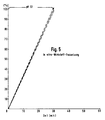
Apparatur 1 (Drehkörbchen-Methode), pH 7,2, Phosphatpuffer, 900 ml, 150 Upm, Prüfdauer 30 Min. Limit nach USP XXI Q = 50 %, Ergebnis 100 % (vgl. Fig. 5)
Claims (5)
- Verfahren zur Gewinnung von Ibuprofen-Partikeln durch Verfestigung einer Ibuprofen-Schmelze auf einem Kontaktkühlapparat und nachfolgende Zerkleinerung, dadurch gekennzeichnet, daß die Verfestigung der Ibuprofen-Schmelze auf einem Walzen- oder Bandkühlapparat bei einer Temperatur von 0 - 50° C, vorzugsweise bei einer Temperatur von 0 - 30° C, unter Benutzung von Impfgut erfolgt.
- Verfahren nach Anspruch 1, dadurch gekennzeichnet, daß als Impfgut Hilfsstoffe verwendet werden.
- Verfahren nach Anspruch 1, dadurch gekennzeichnet, daß als Impfgut Ibuprofen-Partikeln verwendet werden.
- Verfahren nach einem oder mehreren der Ansprüche 1-3, dadurch gekennzeichnet, daß zur Zerkleinerung des Ibuprofens ein Walzenstuhl benutzt wird.
- Verfahren nach einem oder mehreren der Ansprüche 1-4, dadurch gekennzeichnet, daß das Ibuprofen für die Ibuprofen-Schmelze durch eine Rektifikation gereinigt worden ist.
Applications Claiming Priority (2)
| Application Number | Priority Date | Filing Date | Title |
|---|---|---|---|
| DE3833448A DE3833448A1 (de) | 1988-10-01 | 1988-10-01 | Verfahren zur gewinnung von ibuprofen fuer die direkttablettierung |
| DE3833448 | 1988-10-01 |
Publications (3)
| Publication Number | Publication Date |
|---|---|
| EP0362728A2 EP0362728A2 (de) | 1990-04-11 |
| EP0362728A3 EP0362728A3 (de) | 1991-01-02 |
| EP0362728B1 true EP0362728B1 (de) | 1994-11-23 |
Family
ID=6364195
Family Applications (1)
| Application Number | Title | Priority Date | Filing Date |
|---|---|---|---|
| EP89118140A Expired - Lifetime EP0362728B1 (de) | 1988-10-01 | 1989-09-30 | Verfahren zur Gewinnung von Ibuprofen für die Direkttablettierung |
Country Status (4)
| Country | Link |
|---|---|
| EP (1) | EP0362728B1 (de) |
| JP (1) | JPH02223537A (de) |
| AT (1) | ATE114298T1 (de) |
| DE (2) | DE3833448A1 (de) |
Families Citing this family (9)
| Publication number | Priority date | Publication date | Assignee | Title |
|---|---|---|---|---|
| AT401871B (de) * | 1994-01-28 | 1996-12-27 | Gebro Broschek Gmbh | Verfahren zur herstellung von s(+)-ibuprofen- partikeln mit verbesserten fliesseigenschaften und deren verwendung zur arzneimittelherstellung |
| DE4418837A1 (de) | 1994-05-30 | 1995-12-07 | Bayer Ag | Thermisches Granulierverfahren |
| US8124124B2 (en) * | 1999-12-09 | 2012-02-28 | Reckitt Benckiser Healthcare (Uk) Limited | Compressed tablet formulation comprising non-steroidal anti-inflammatory drugs and methods |
| RU2766487C2 (ru) * | 2004-01-20 | 2022-03-15 | Новартис Аг | Композиция и способ прямого прессования |
| GB0423103D0 (en) * | 2004-10-19 | 2004-11-17 | Boots Healthcare Int Ltd | Therapeutic agents |
| DE102005037630A1 (de) | 2005-08-09 | 2007-02-15 | Glatt Gmbh | Verfahren zur Herstellung von Teilchen aus pharmazeutischen Substanzen, Teilchen aus pharmazeutischen Substanzen sowie deren Verwendung |
| GB0519350D0 (en) | 2005-09-22 | 2005-11-02 | Boots Healthcare Int Ltd | Therapeutic agents |
| EP2704696A1 (de) | 2012-03-26 | 2014-03-12 | Glatt AG | Geschmacksmaskierte ibuprofenkörnchen |
| CN113200846B (zh) * | 2021-04-23 | 2022-04-22 | 浙江新和成股份有限公司 | 一种高松密度布洛芬球形晶体的制备方法及其产品 |
Family Cites Families (3)
| Publication number | Priority date | Publication date | Assignee | Title |
|---|---|---|---|---|
| DE2360796B2 (de) * | 1973-12-06 | 1977-06-02 | Edelfettwerke Werner Schlüter, 2000 Hamburg; Glyco Iberica S.A., Gava, Barcelona (Spanien) Vti: Hegel, K.Th., Dr.; Dickel, K., Dipl.-Ing.; Pat.-Anwälte, 2000 Hamburg und 8000 München | Arzneimittel mit verzoegerter abgabe des wirkstoffs im darm |
| GB8606762D0 (en) * | 1986-03-19 | 1986-04-23 | Boots Co Plc | Therapeutic agents |
| DE3802619C1 (de) * | 1988-01-29 | 1989-09-07 | Hoechst Ag, 6230 Frankfurt, De |
-
1988
- 1988-10-01 DE DE3833448A patent/DE3833448A1/de not_active Withdrawn
-
1989
- 1989-09-30 DE DE58908659T patent/DE58908659D1/de not_active Expired - Fee Related
- 1989-09-30 AT AT89118140T patent/ATE114298T1/de not_active IP Right Cessation
- 1989-09-30 EP EP89118140A patent/EP0362728B1/de not_active Expired - Lifetime
- 1989-10-02 JP JP1255365A patent/JPH02223537A/ja active Pending
Also Published As
| Publication number | Publication date |
|---|---|
| ATE114298T1 (de) | 1994-12-15 |
| JPH02223537A (ja) | 1990-09-05 |
| EP0362728A3 (de) | 1991-01-02 |
| EP0362728A2 (de) | 1990-04-11 |
| DE3833448A1 (de) | 1990-04-12 |
| DE58908659D1 (de) | 1995-01-05 |
Similar Documents
| Publication | Publication Date | Title |
|---|---|---|
| DE60004649T2 (de) | Verfahren zur herstellung nicht-hygroscopische l (-) - carnitine salze | |
| DE69407706T2 (de) | Dicalciumphosphat, Verfahren zu seiner Herstellung und ein dieses Phosphat benutzenden Träger | |
| DE69123123T2 (de) | Eine physikalische Form von N-[4-[5-(Cyclopentyloxycarbonylamino)-1-methyl-indol-3-ylmethyl]-3-methoxybenzoyl]-2-methylbenzolsulfonamid, ein Verfahren zu dessen Herstellung und es enthaltende pharmazeutische Zusammensetzungen | |
| DE68916497T2 (de) | Pharmazeutisches Granulat. | |
| EP0181515B1 (de) | Verfahren zur Herstellung einer wässrigen Überzugsmitteldispersion und ihre Verwendung zum Überziehen von Arzneimitteln | |
| EP0119480B1 (de) | Sphärische Einkristalle für pharmazeutische Zwecke | |
| DD218373A5 (de) | Verfahren zur herstellung eines resinates einer substituierten carbonsaeure | |
| DE3687848T2 (de) | Verfahren zum gleitfaehigmachen wasserloeslicher vitaminpulver. | |
| EP0362728B1 (de) | Verfahren zur Gewinnung von Ibuprofen für die Direkttablettierung | |
| DE2813146A1 (de) | Tablettieren von mikrokapseln | |
| AT401871B (de) | Verfahren zur herstellung von s(+)-ibuprofen- partikeln mit verbesserten fliesseigenschaften und deren verwendung zur arzneimittelherstellung | |
| DE60008508T2 (de) | Agglomerate durch kristallisation | |
| DE69907119T3 (de) | Pulverisierte-Sorbitol und ihr Verfahren zur Herstellung | |
| DD208613A5 (de) | Verfahren zur herstellung neuer kristallmodifikationen des (+)-catechinmonohydrats und des (+)-catechinanhydrats | |
| DE10139115A1 (de) | Citalopram enthaltende pharmazeutische Zusammensetzung | |
| DE3789258T2 (de) | Multigranuläre Tablette mit verzögerter Freisetzung. | |
| EP0665830B1 (de) | Tilidin-dihydrogenorthophosphat, verfahren zu dessen herstellung und dieses enthaltende pharmazeutische zubereitungen | |
| DE4027927A1 (de) | Brausekomponente und verfahren zu ihrer herstellung | |
| DD263232A5 (de) | Therapeutische mittel | |
| DE2439538B2 (de) | Verfahren zur Herstellung von oral zu verabreichenden Arzneimitteln mit verzögerter Wirkungsfreigabe | |
| EP0915817B1 (de) | Verfahren zur herstellung von kristallinem d-sorbit | |
| DE3781095T2 (de) | Calciumhypochloritzusammensetzungen und verfahren zu ihrer herstellung. | |
| DE2129646B2 (de) | Verfahren zur herstellung von tabletten einheitlicher form und einheitlicher groesse | |
| EP1038527A1 (de) | Verfahren zur Herstellung von Riboflavin-haltigen Granulaten | |
| DE69623876T2 (de) | Neue feste Lagerungs- und Verkaufsform für Pflanzenschutzmittel und Mittel für ihre Herstellung |
Legal Events
| Date | Code | Title | Description |
|---|---|---|---|
| PUAI | Public reference made under article 153(3) epc to a published international application that has entered the european phase |
Free format text: ORIGINAL CODE: 0009012 |
|
| AK | Designated contracting states |
Kind code of ref document: A2 Designated state(s): AT BE CH DE ES FR GB GR IT LI LU NL SE |
|
| PUAL | Search report despatched |
Free format text: ORIGINAL CODE: 0009013 |
|
| AK | Designated contracting states |
Kind code of ref document: A3 Designated state(s): AT BE CH DE ES FR GB GR IT LI LU NL SE |
|
| 17P | Request for examination filed |
Effective date: 19901221 |
|
| PGFP | Annual fee paid to national office [announced via postgrant information from national office to epo] |
Ref country code: LU Payment date: 19920826 Year of fee payment: 4 |
|
| 17Q | First examination report despatched |
Effective date: 19921026 |
|
| EPTA | Lu: last paid annual fee | ||
| GRAA | (expected) grant |
Free format text: ORIGINAL CODE: 0009210 |
|
| AK | Designated contracting states |
Kind code of ref document: B1 Designated state(s): AT BE CH DE ES FR GB GR IT LI LU NL SE |
|
| PG25 | Lapsed in a contracting state [announced via postgrant information from national office to epo] |
Ref country code: IT Free format text: LAPSE BECAUSE OF FAILURE TO SUBMIT A TRANSLATION OF THE DESCRIPTION OR TO PAY THE FEE WITHIN THE PRESCRIBED TIME-LIMIT;WARNING: LAPSES OF ITALIAN PATENTS WITH EFFECTIVE DATE BEFORE 2007 MAY HAVE OCCURRED AT ANY TIME BEFORE 2007. THE CORRECT EFFECTIVE DATE MAY BE DIFFERENT FROM THE ONE RECORDED. Effective date: 19941123 Ref country code: NL Effective date: 19941123 Ref country code: FR Effective date: 19941123 Ref country code: GB Effective date: 19941123 Ref country code: ES Free format text: THE PATENT HAS BEEN ANNULLED BY A DECISION OF A NATIONAL AUTHORITY Effective date: 19941123 Ref country code: GR Free format text: LAPSE BECAUSE OF FAILURE TO SUBMIT A TRANSLATION OF THE DESCRIPTION OR TO PAY THE FEE WITHIN THE PRESCRIBED TIME-LIMIT Effective date: 19941123 Ref country code: BE Effective date: 19941123 |
|
| REF | Corresponds to: |
Ref document number: 114298 Country of ref document: AT Date of ref document: 19941215 Kind code of ref document: T |
|
| REF | Corresponds to: |
Ref document number: 58908659 Country of ref document: DE Date of ref document: 19950105 |
|
| PG25 | Lapsed in a contracting state [announced via postgrant information from national office to epo] |
Ref country code: SE Effective date: 19950223 |
|
| EN | Fr: translation not filed | ||
| NLV1 | Nl: lapsed or annulled due to failure to fulfill the requirements of art. 29p and 29m of the patents act | ||
| GBV | Gb: ep patent (uk) treated as always having been void in accordance with gb section 77(7)/1977 [no translation filed] |
Effective date: 19941123 |
|
| PLBE | No opposition filed within time limit |
Free format text: ORIGINAL CODE: 0009261 |
|
| STAA | Information on the status of an ep patent application or granted ep patent |
Free format text: STATUS: NO OPPOSITION FILED WITHIN TIME LIMIT |
|
| PG25 | Lapsed in a contracting state [announced via postgrant information from national office to epo] |
Ref country code: LU Free format text: LAPSE BECAUSE OF NON-PAYMENT OF DUE FEES Effective date: 19950930 Ref country code: AT Effective date: 19950930 Ref country code: CH Effective date: 19950930 Ref country code: LI Effective date: 19950930 |
|
| 26N | No opposition filed | ||
| REG | Reference to a national code |
Ref country code: CH Ref legal event code: PL |
|
| PG25 | Lapsed in a contracting state [announced via postgrant information from national office to epo] |
Ref country code: DE Effective date: 19960601 |