EP0362781A2 - Broche à haute fréquence pour l'usinage de pièces - Google Patents
Broche à haute fréquence pour l'usinage de pièces Download PDFInfo
- Publication number
- EP0362781A2 EP0362781A2 EP89118273A EP89118273A EP0362781A2 EP 0362781 A2 EP0362781 A2 EP 0362781A2 EP 89118273 A EP89118273 A EP 89118273A EP 89118273 A EP89118273 A EP 89118273A EP 0362781 A2 EP0362781 A2 EP 0362781A2
- Authority
- EP
- European Patent Office
- Prior art keywords
- spindle
- spindle according
- bearing
- coarse
- sintered
- Prior art date
- Legal status (The legal status is an assumption and is not a legal conclusion. Google has not performed a legal analysis and makes no representation as to the accuracy of the status listed.)
- Ceased
Links
Images





Classifications
-
- H—ELECTRICITY
- H02—GENERATION; CONVERSION OR DISTRIBUTION OF ELECTRIC POWER
- H02K—DYNAMO-ELECTRIC MACHINES
- H02K7/00—Arrangements for handling mechanical energy structurally associated with dynamo-electric machines, e.g. structural association with mechanical driving motors or auxiliary dynamo-electric machines
- H02K7/14—Structural association with mechanical loads, e.g. with hand-held machine tools or fans
- H02K7/16—Structural association with mechanical loads, e.g. with hand-held machine tools or fans for operation above the critical speed of vibration of the rotating parts
-
- B—PERFORMING OPERATIONS; TRANSPORTING
- B23—MACHINE TOOLS; METAL-WORKING NOT OTHERWISE PROVIDED FOR
- B23Q—DETAILS, COMPONENTS, OR ACCESSORIES FOR MACHINE TOOLS, e.g. ARRANGEMENTS FOR COPYING OR CONTROLLING; MACHINE TOOLS IN GENERAL CHARACTERISED BY THE CONSTRUCTION OF PARTICULAR DETAILS OR COMPONENTS; COMBINATIONS OR ASSOCIATIONS OF METAL-WORKING MACHINES, NOT DIRECTED TO A PARTICULAR RESULT
- B23Q1/00—Members which are comprised in the general build-up of a form of machine, particularly relatively large fixed members
- B23Q1/25—Movable or adjustable work or tool supports
- B23Q1/26—Movable or adjustable work or tool supports characterised by constructional features relating to the co-operation of relatively movable members; Means for preventing relative movement of such members
- B23Q1/38—Movable or adjustable work or tool supports characterised by constructional features relating to the co-operation of relatively movable members; Means for preventing relative movement of such members using fluid bearings or fluid cushion supports
-
- B—PERFORMING OPERATIONS; TRANSPORTING
- B23—MACHINE TOOLS; METAL-WORKING NOT OTHERWISE PROVIDED FOR
- B23Q—DETAILS, COMPONENTS, OR ACCESSORIES FOR MACHINE TOOLS, e.g. ARRANGEMENTS FOR COPYING OR CONTROLLING; MACHINE TOOLS IN GENERAL CHARACTERISED BY THE CONSTRUCTION OF PARTICULAR DETAILS OR COMPONENTS; COMBINATIONS OR ASSOCIATIONS OF METAL-WORKING MACHINES, NOT DIRECTED TO A PARTICULAR RESULT
- B23Q1/00—Members which are comprised in the general build-up of a form of machine, particularly relatively large fixed members
- B23Q1/70—Stationary or movable members for carrying working-spindles for attachment of tools or work
-
- B—PERFORMING OPERATIONS; TRANSPORTING
- B23—MACHINE TOOLS; METAL-WORKING NOT OTHERWISE PROVIDED FOR
- B23Q—DETAILS, COMPONENTS, OR ACCESSORIES FOR MACHINE TOOLS, e.g. ARRANGEMENTS FOR COPYING OR CONTROLLING; MACHINE TOOLS IN GENERAL CHARACTERISED BY THE CONSTRUCTION OF PARTICULAR DETAILS OR COMPONENTS; COMBINATIONS OR ASSOCIATIONS OF METAL-WORKING MACHINES, NOT DIRECTED TO A PARTICULAR RESULT
- B23Q17/00—Arrangements for observing, indicating or measuring on machine tools
- B23Q17/10—Arrangements for observing, indicating or measuring on machine tools for indicating or measuring cutting speed or number of revolutions
-
- B—PERFORMING OPERATIONS; TRANSPORTING
- B23—MACHINE TOOLS; METAL-WORKING NOT OTHERWISE PROVIDED FOR
- B23Q—DETAILS, COMPONENTS, OR ACCESSORIES FOR MACHINE TOOLS, e.g. ARRANGEMENTS FOR COPYING OR CONTROLLING; MACHINE TOOLS IN GENERAL CHARACTERISED BY THE CONSTRUCTION OF PARTICULAR DETAILS OR COMPONENTS; COMBINATIONS OR ASSOCIATIONS OF METAL-WORKING MACHINES, NOT DIRECTED TO A PARTICULAR RESULT
- B23Q17/00—Arrangements for observing, indicating or measuring on machine tools
- B23Q17/22—Arrangements for observing, indicating or measuring on machine tools for indicating or measuring existing or desired position of tool or work
-
- F—MECHANICAL ENGINEERING; LIGHTING; HEATING; WEAPONS; BLASTING
- F16—ENGINEERING ELEMENTS AND UNITS; GENERAL MEASURES FOR PRODUCING AND MAINTAINING EFFECTIVE FUNCTIONING OF MACHINES OR INSTALLATIONS; THERMAL INSULATION IN GENERAL
- F16C—SHAFTS; FLEXIBLE SHAFTS; ELEMENTS OR CRANKSHAFT MECHANISMS; ROTARY BODIES OTHER THAN GEARING ELEMENTS; BEARINGS
- F16C32/00—Bearings not otherwise provided for
- F16C32/06—Bearings not otherwise provided for with moving member supported by a fluid cushion formed, at least to a large extent, otherwise than by movement of the shaft, e.g. hydrostatic air-cushion bearings
- F16C32/0603—Bearings not otherwise provided for with moving member supported by a fluid cushion formed, at least to a large extent, otherwise than by movement of the shaft, e.g. hydrostatic air-cushion bearings supported by a gas cushion, e.g. an air cushion
- F16C32/0614—Bearings not otherwise provided for with moving member supported by a fluid cushion formed, at least to a large extent, otherwise than by movement of the shaft, e.g. hydrostatic air-cushion bearings supported by a gas cushion, e.g. an air cushion the gas being supplied under pressure, e.g. aerostatic bearings
-
- F—MECHANICAL ENGINEERING; LIGHTING; HEATING; WEAPONS; BLASTING
- F16—ENGINEERING ELEMENTS AND UNITS; GENERAL MEASURES FOR PRODUCING AND MAINTAINING EFFECTIVE FUNCTIONING OF MACHINES OR INSTALLATIONS; THERMAL INSULATION IN GENERAL
- F16C—SHAFTS; FLEXIBLE SHAFTS; ELEMENTS OR CRANKSHAFT MECHANISMS; ROTARY BODIES OTHER THAN GEARING ELEMENTS; BEARINGS
- F16C32/00—Bearings not otherwise provided for
- F16C32/06—Bearings not otherwise provided for with moving member supported by a fluid cushion formed, at least to a large extent, otherwise than by movement of the shaft, e.g. hydrostatic air-cushion bearings
- F16C32/0603—Bearings not otherwise provided for with moving member supported by a fluid cushion formed, at least to a large extent, otherwise than by movement of the shaft, e.g. hydrostatic air-cushion bearings supported by a gas cushion, e.g. an air cushion
- F16C32/0614—Bearings not otherwise provided for with moving member supported by a fluid cushion formed, at least to a large extent, otherwise than by movement of the shaft, e.g. hydrostatic air-cushion bearings supported by a gas cushion, e.g. an air cushion the gas being supplied under pressure, e.g. aerostatic bearings
- F16C32/0618—Bearings not otherwise provided for with moving member supported by a fluid cushion formed, at least to a large extent, otherwise than by movement of the shaft, e.g. hydrostatic air-cushion bearings supported by a gas cushion, e.g. an air cushion the gas being supplied under pressure, e.g. aerostatic bearings via porous material
-
- H—ELECTRICITY
- H02—GENERATION; CONVERSION OR DISTRIBUTION OF ELECTRIC POWER
- H02K—DYNAMO-ELECTRIC MACHINES
- H02K5/00—Casings; Enclosures; Supports
- H02K5/04—Casings or enclosures characterised by the shape, form or construction thereof
- H02K5/16—Means for supporting bearings, e.g. insulating supports or means for fitting bearings in the bearing-shields
- H02K5/161—Means for supporting bearings, e.g. insulating supports or means for fitting bearings in the bearing-shields radially supporting the rotary shaft at both ends of the rotor
-
- F—MECHANICAL ENGINEERING; LIGHTING; HEATING; WEAPONS; BLASTING
- F16—ENGINEERING ELEMENTS AND UNITS; GENERAL MEASURES FOR PRODUCING AND MAINTAINING EFFECTIVE FUNCTIONING OF MACHINES OR INSTALLATIONS; THERMAL INSULATION IN GENERAL
- F16C—SHAFTS; FLEXIBLE SHAFTS; ELEMENTS OR CRANKSHAFT MECHANISMS; ROTARY BODIES OTHER THAN GEARING ELEMENTS; BEARINGS
- F16C2322/00—Apparatus used in shaping articles
- F16C2322/39—General buildup of machine tools, e.g. spindles, slides, actuators
Definitions
- the invention relates to a high-frequency spindle for workpiece machining, with a radially and axially supported working spindle that is rotatably supported in a spindle housing by means of at least one air bearing.
- High-frequency spindles of this type are known per se; They are designed for speeds up to more than 60,000 / min and are intended to enable quick and precise machining of workpieces using the smallest possible moving masses.
- the high speeds used are necessary to take advantage of the cutting performance of cutting materials such as hard metal, but above all ceramics and polycrystalline diamonds. In addition to high processing speeds, a relatively high feed rate is also required.
- High-frequency spindles are known for use in machine tools and machining centers, which enable axial infeed according to a predetermined program.
- the quick adjustment required for the new high-speed machining with a consistently high setting precision cannot be achieved with these devices. This is at least partly due to the fact that the entire spindle unit is adjusted here.
- the invention has for its object to provide a spindle Dar mentioned type so that it can be delivered more precisely in a short time.
- the moving masses are significantly reduced and are largely limited by the parts belonging directly to the work spindle or the rotor, while the stator and the housing which determines the rigidity of the device remain stationary. For this reason, the acceleration forces are significantly lower at given acceleration times than when the entire spindle unit moves. It is even possible to shorten the positioning times.
- stator and housing facilitates a modular division of the entire device into individual assemblies that can be easily assembled and disassembled, which simplifies inspection procedures, maintenance and repairs.
- the actuator is mounted at one end in a radial bearing and at the opposite end in the adjusting thread of an adjusting spindle.
- the necessary device for the axial adjustment of the work spindle can be used for storage purposes, which in turn reduces the masses to be accelerated and enables an improved utilization of the adjustability.
- the second bearing of the actuating gear is formed by a spindle gear with a threaded nut which is supported on the adjusting spindle.
- the actuator is expediently provided with a recirculating ball nut.
- the radial bearing is formed by a roller bearing.
- the shaft of the actuating gear is formed by the shaft of the adjusting spindle motor.
- the gaseous carrier medium is fed to at least one bearing through a slide ring seal arrangement.
- a further embodiment according to the invention is that the secondary part of at least one drive motor is integrated into the surface of the work spindle in such a way that the latter receives a continuous smooth-surface boundary surface.
- the spindle according to the invention is relatively simple and reliable in that an ejector rod projecting in the spindle axis against a collet is fastened to the housing or the stator and serves to open the collet by retracting the working spindle into a retracted position.
- a buffer is provided which limits the movement path of the work spindle in the housing.
- collet is provided with a centrifugal mechanism for controlling it.
- centrifugal weights are provided which are adjustable radially and axially and are guided between a spring device and at least one inclined surface and are used for axially and radially clamping the tool in the collet.
- centrifugal mechanism is mounted within a cavity of the work spindle, in which a support ring with conical bearing surfaces for axially supporting the centrifugal weights is attached, which are supported on the disc springs with toroidally rounded end faces.
- the centrifugal force mechanism for actuating the collet is separated from its gripping part and is detachably connected to it.
- an axial thrust motor is arranged approximately in the longitudinal center of the spindle housing, as is the rotary motor between lateral radial bearings.
- a non-contact measuring device is provided which is used to continuously determine the instantaneous location of the work spindle along the spindle axis.
- two sensor tips are mounted in the axial path of a part of the work spindle in the spindle housing towards the two ends of a measuring space and are connected to a measuring device and a control device for controlling the longitudinal adjustment of the work spindle.
- the measuring device has an optocoupler and the sensor tips are each provided with a transmitter - such as a light-emitting diode - and a receiver - such as a receiving diode.
- a scanning beam of the optocoupler used to measure and control the rotational speed and / or longitudinal feed of the work spindle is directed along the spindle axis through at least one opening eccentrically arranged to this in a flange of the work spindle.
- the filter is assigned a differential pressure meter, each with a pressure sensor mounted in the flow path of the carrier medium in front of and behind the filter.
- a particularly favorable embodiment according to the invention is that a bearing bush is provided as the air bearing, with at least one bushing part, which has sintered materials of different grain size and / or grain structure.
- the sintered materials of different grain size and / or grain structure provided in at least one bushing part are provided in an irregular distribution or mixture.
- the permeability of the bushing material is better, the greater the proportion of the coarse-grained sintered material that combines with the fine-grained sintered material to form a granular structure of changing uniformity and density with different cavity designs.
- This structure is sufficiently rigid to prevent deformation in the bearing area of the bearing, so that the carrier medium can be supplied in sufficient quantity without risk of malfunction.
- An advantageous further embodiment of the invention has the content that coarse-grained sintered material is embedded in fine-grained sintered material in such a way that it forms continuous flow paths of larger cross-section for the carrier medium of the spindle bearing through the bushing wall.
- Constrictions of such flow paths also have the multiple cross-section of the relatively coarse sintered grain used.
- the flow paths formed by coarse-grained sintered material are distributed over the bushing wall in accordance with a predetermined pattern.
- These flow paths can be arranged in the circumferential direction and / or the axial direction at approximately the same spacing.
- the coarse-grained sintered material forming the flow paths is more concentrated in areas provided with axial spacing than in the other areas of the socket body.
- ring nozzles are practically formed at intermediate intervals, which serve to supply the carrier medium, while the intermediate regions take on the supporting function and stiffen the bearing bush.
- the bearing bush can have a plurality of axially adjoining ring regions which contain different proportions of coarse-grained and fine-grained sintered material.
- Ring areas made of predominantly coarse-grained sintered material can alternate with those made of less coarse-grained material.
- the ring regions made of predominantly coarse-grained material each contain at least one prefabricated sintered body which is sintered together in one piece with other parts of the bearing bush.
- the bearing bush makes it possible for the bearing bush to have star bodies which are arranged in a star shape and are sintered like spokes in at least one transverse plane and have a coarse-grained sintered material.
- the entire compressed gas supply can be accomplished by means of such nozzle bodies, whereby their properties and in particular the compressed gas paths formed there can be better adjusted by the separate production than with an uncontrolled mixture of porous material with different properties.
- At least one cross-sectional area of the bearing bush is formed by a disk sintered between predominantly coarse-grained sintered material between lateral bush parts of a different material.
- the connection can only be made in radial planes, but also via special projections that engage in the neighboring areas.
- At least the coarse-grained sintered discs which are embedded or interposed can, according to the invention, be provided on their inside with recesses which are uniformly distributed in the circumferential direction and which are sector-shaped in cross section and which can assume a toothing function.
- their importance lies essentially in the fact that they separate individual sector-shaped projections from one another, which form the actual load-bearing surfaces and can be cooled better than closed ring surfaces.
- the bearing bush predominantly grain material of high temperature resistance, such as Has tungsten carbide.
- the bearing bush also has a support body made of high-strength and heat-resistant material such as metal, to which one or more sintered bodies are attached by fusing or soldering.
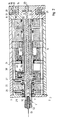
- the high-frequency spindle shown in FIGS. 1 and 2 has, as a rotor, an elongated, transversely divided work spindle 1, which is rotatably mounted in a spindle stator 2 that is modularly divided by transverse subdivision by means of air bearings 26 to 28 and is axially and radially aligned and enclosed by a cylindrical housing 3.
- the housing 3 is divided into a cylindrical cladding tube 6, which is closed at both ends by the housing cover 7, 8.
- the front cover 7 has a central opening 9 with a dynamic ring seal 10 for the passage of the front spindle end, while a central receiving space 11 is formed on the inside in the rear cover 8 for the rear end of the work spindle 1 in the retracted position according to FIG.
- an angular groove 15 is formed on the outside, in which a connection ring 16 is seated, at the connection opening 17 between two annular spaces 18, 19 replaceable ring filter 20 for separating solid and also liquid material particles from the storage air is kept.
- Pressure sensors (not shown), the differential pressure of which indicates the degree of contamination, are connected upstream and downstream of the filter 20.
- the connecting ring 16 is sealed by two ring seals 21.
- the compressed air supplied there or another gaseous pressure medium is supplied to the individual consumption points through longitudinal bores 24, which are guided closely inside the cladding tube 6 parallel to the spindle axis 23 and through the individual stator parts.
- radial bearings 26, 27 and the axial bearing 28 provided on both sides of the front motor unit 25. While the radial bores 29 in the module units of the radial bearings 26, 27 open directly into the longitudinal bores 24, the compressed gas for the axial bearing 28 initially reaches a radial bore 37 in the air distributor 30 into a chamber 32 formed between the latter and a rotor sleeve 31, which is laterally closed by ring seals 33.
- the pressure medium flows through an opening 34 and an annular gap 35 formed between the rotor sleeve 31 and the work spindle to the axial bearing 28.
- the associated inner winding 41 is seated flush in the form of a thin sleeve body in an annular recess on the cylindrical outside of the work spindle 1, so that the Torque can be applied directly between the two parts by motor.
- a bearing disk 43 is drawn in between the axial bearing 28 and the rear motor unit 42 with actuator 39, which is supported on the inside by means of a roller bearing 44 on the outer surface of the rotor sleeve 31, which here forms the shaft of the motor unit and thus of the actuator 39.
- the (rear) servomotor unit 25 drives the rotor sleeve 31, which carries a tubular adjusting spindle 45, in the threaded grooves of which balls of a stator-fixed ball nut 46 engage.
- the work spindle 1 is thus supported in the area of the (rear) servomotor unit 25 and the adjusting spindle 45 on the one hand via a cylindrical surface 47 in the double roller bearing 44 and on the other hand by means of a thread engagement by the ball nut 46.
- the entire work spindle can be operated without any pressure drop with any actuating speed and high precision, regardless of its operating speed, by means of a simple motor drive.
- a tool 51 in the form of a twist drill is held in a collet 52 such that its rear end, when the work spindle moves back into the retracted position, abuts against the centering front end of an ejector rod 54 protruding in an axial cavity 53, which is firmly held in the rear cover 8. With each return movement to the retracted position, the previously used tool can be ejected.
- FIGS. 3 and 4 show, compared to FIGS. 1 and 2, an enlarged part of a central part of the spindle, which does not require any further explanations.
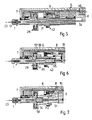
- FIGS. 5 to 9 show comparative representations of different types, FIG. 5 largely corresponding to FIG. 2, while according to FIG. 6 the ejector rod 54 has a piston end 55 which can be moved into an annular receiving space 111 when the work spindle is retracted, and the axial adjusting thread 56 between the inner wall of a stator section 57 and the outer part 58 of the work spindle in the area of the axial bearing 28 is arranged.
- the compressed air supply is moved inwards towards the spindle axis into the piston end 55. In this way, as a comparison with FIG. 5 shows, the spindle length can be significantly reduced.
- roller bearing 441 also being placed on the circumference of the outer part 58 of the axial bearing.
- the adjusting thread 56 is arranged in the same way as in FIG. 6.
- the measuring unit 64 here has an optocoupler, the opposite sensor tips 65 each being provided with a light-emitting diode and a receiving diode and the flange 60 having the same radial distance from the spindle axis 23 as the sensor tips 65 having axial bores 71.
- the inner windings 41, 66 of both motors 25, 42 are also inserted into the cylinder surface 47 of the work spindle 1 without the structure of the outer surface being subject to significant changes.
- the inner winding 41 is longitudinal grooves 69
- the inner winding 66 is circumferential grooves 70, each of which is filled with highly electrically conductive material.
- a collar-shaped sealing plug 76 is inserted into the outer end of a stepped bore 77 formed in the body of the work spindle 1 and firmly connected to the spindle body by means of an annular solder seam 78.
- the sleeve-shaped collet 52 is supported with the outer surface of its conically thickened clamping head 79 on the conical inner surface 80 of the sealing plug 76.
- Longitudinal slots 81, 84 are formed at both ends of the collet, which should enable controlled deformation by pressing and expanding.
- leaf springs 82 are used, which engage in arcuate limited longitudinal grooves 83 of the collet 52.
- a centrifugal force mechanism 85 inserted into the stepped bore 77 serves for actuation, in particular for automatically closing the collet 52.
- Disc springs 86 are supported on the shoulder of the stepped bore 77, which press against the plug 76 via centrifugal weights 87 and a pressure ring 88 and thereby the collet Center 52 in the front end position.
- the flyweights 87 made of hard metal because of the larger weights are soldered to the free ends of the spring tongues 89 which are formed between the longitudinal slots 81 and are sector-shaped in cross section.
- the contact surface 90 between the pressure ring 88 and the centrifugal weights 87 is conical.
- the end faces 91 of the centrifugal weights 87 abutting the plate springs 86 are rounded in a toroidal shape.
- centrifugal weights 87 are thrown outwards by the start of the work spindle 1, they press axially away from the spring pack 86 along the conical contact surface 90, while at the same time the conical pliers head is drawn in on the inner surface 80 and thereby clamped around the shank of the tool 51 becomes. The faster the spindle runs, the tighter the clamping.
- a loading device which detects and holds the worn tool while it is pulled out of the collet by further backward movement of the work spindle and then replaced by a new one.
- the slope along the conical contact surface 90 should not be more than 0.3 mm, at least for drills with a diameter of less than 5 mm. This results in an installation accuracy between the contact surface 90 and the collet with its stop surface of approximately 0.1 mm.
- the centrifugal force mechanism 85 can also be separated from the clamping part of the pliers and fastened to it by means of a threaded connection, which enables an accelerated tool change.
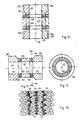
- the bearing bush shown in FIG. 14 is essentially cylindrical with flange projections 102 provided at the ends, between which an annular groove 103 is formed. This externally sealed ring groove is connected to a compressed gas supply during operation.
- the bearing bush shown is formed by four annular bodies joined at the end face and centrally to the axis 110, two outer flange rings 104, a central ring 105 and two interposed nozzle rings 106, which are each connected to one another on the plane surfaces 107 lying perpendicular to the axis 110. If one of the rings to be connected is metallic, a fused connection, for example a soldered connection, must be used. If the rings 104, 105 shown hatched in the drawing also consist of sintered material, then all of the rings 104 to 106 can be sintered together.
- At least the nozzle rings 106 are advantageously prefabricated. Instead of joining all the ring parts laterally after the production, in the case of a bearing bush made entirely of sintered material, it is sufficient to prefabricate the nozzle rings 106, possibly with finished flat surfaces 107. Such rings can then be inserted into a sintered mold according to FIG Provides oversize 211,212, which is then ground away.
- At least the nozzle rings 106 are made of sintered material, preferably with tungsten carbide grain.
- the rings 104, 105 are made of metal or other non-porous material, the grain size for the nozzle rings 106 will be chosen relatively coarsely in order to create flow channels with a fairly wide cross section from the annular groove 103 to the inner surface 113 of the bearing bush.
- the nozzle rings 106 are expediently formed from a mixture of coarse particles 114 and fine particles 115.
- a specific distribution between coarse grain 114 and fine grain 115 can be predetermined. This not only between adjacent ring bodies 104, 105, 106, in which weak and strong permeability alternate, but also in the mixture itself, approximately as indicated by the middle coarse grains 114 in FIG. 16, where coarse grains 114 are provided concentrated along a certain path and therefore expanded flow paths 22 are also installed there.
- radial openings 116 distributed in a star shape, are provided in two radial planes of a one-piece socket body 101 corresponding to the location of the nozzle rings 106, into which nozzle plugs 117 made of sintered material are inserted and sintered together with the socket body or are soldered.
- the latter, the fusion connection applies primarily to a metallic socket body or carrier part, while the sintering together can be carried out after inserting the nozzle plugs 117 into a sintered mold.
- FIGS. 19 and 20 show a modification 161 of the nozzle rings 106 from FIG. 14.
- Four segment grooves 120 are formed in the inner surface 113 and form flat segment backs 121 between them. The same configuration can also be carried out over the remaining part of the socket 101.
- the segment grooves 120 can also be used for the supply of the carrier medium as well as for the discharge thereof. Above all, they serve the Uniformity of the support acting between the shaft and the bearing bush.
Landscapes
- Engineering & Computer Science (AREA)
- Mechanical Engineering (AREA)
- General Engineering & Computer Science (AREA)
- Power Engineering (AREA)
- Chemical & Material Sciences (AREA)
- Dispersion Chemistry (AREA)
- Turning (AREA)
- Magnetic Bearings And Hydrostatic Bearings (AREA)
- Sliding-Contact Bearings (AREA)
Applications Claiming Priority (4)
| Application Number | Priority Date | Filing Date | Title |
|---|---|---|---|
| DE3834140A DE3834140A1 (de) | 1988-10-07 | 1988-10-07 | Hochfrequenzspindel zur werkstueckbearbeitung |
| DE3834140 | 1988-10-07 | ||
| DE3914363 | 1989-04-29 | ||
| DE3914363A DE3914363A1 (de) | 1988-10-07 | 1989-04-29 | Hochfrequenzspindel zur werkstueckbearbeitung |
Publications (2)
| Publication Number | Publication Date |
|---|---|
| EP0362781A2 true EP0362781A2 (fr) | 1990-04-11 |
| EP0362781A3 EP0362781A3 (fr) | 1990-11-14 |
Family
ID=25872964
Family Applications (1)
| Application Number | Title | Priority Date | Filing Date |
|---|---|---|---|
| EP19890118273 Ceased EP0362781A3 (fr) | 1988-10-07 | 1989-10-03 | Broche à haute fréquence pour l'usinage de pièces |
Country Status (2)
| Country | Link |
|---|---|
| EP (1) | EP0362781A3 (fr) |
| DE (1) | DE3914363A1 (fr) |
Cited By (12)
| Publication number | Priority date | Publication date | Assignee | Title |
|---|---|---|---|---|
| FR2677569A1 (fr) * | 1991-06-14 | 1992-12-18 | Corning Inc | Procede et appareil pour former une cavite dans un corps massif en matiere rigide. |
| EP0563862A1 (fr) * | 1992-03-30 | 1993-10-06 | GIFAM S.r.l. | Tête d'usinage pour les machines-outils travaillant par enlèvement de copeaux |
| DE4316170C1 (de) * | 1993-05-14 | 1994-11-17 | Fraunhofer Ges Forschung | Drossel für Gasführungen und Gaslager |
| EP0652074A1 (fr) * | 1993-11-05 | 1995-05-10 | PLURITEC ITALIA S.p.A. | Tête d'usinage pour travailler mécaniquement des plaques, en particulier des plaques à circuit imprimé |
| US5584788A (en) * | 1993-11-05 | 1996-12-17 | Pluritec Italia S.P.A. | Machine for mechanically machining boards, in particular printed circuit boards |
| CN100360277C (zh) * | 2002-03-12 | 2008-01-09 | 普雷塞斯精密轴承有限公司 | 高频主轴 |
| WO2008064736A1 (fr) * | 2006-11-30 | 2008-06-05 | Aerolas Gmbh | Broche à grande vitesse de rotation |
| WO2008081241A1 (fr) * | 2006-12-22 | 2008-07-10 | Machswiss Sa | Mandrin électrique |
| CN102837008A (zh) * | 2012-07-27 | 2012-12-26 | 华中科技大学 | 一种方便拆卸和维护的内置式电主轴 |
| EP2929978A3 (fr) * | 2014-04-08 | 2015-12-30 | Pama S.P.A. | Outil de machine de forage |
| WO2016039912A1 (fr) * | 2014-09-08 | 2016-03-17 | Gunnar Van Der Steur | Ensemble palier à air composite |
| WO2016146798A1 (fr) * | 2015-03-17 | 2016-09-22 | Mauser-Werke Oberndorf Maschinenbau Gmbh | Système à tête d'alésage de précision |
Family Cites Families (6)
| Publication number | Priority date | Publication date | Assignee | Title |
|---|---|---|---|---|
| US3687467A (en) * | 1970-05-01 | 1972-08-29 | Digital Telephone Systems Inc | Collet |
| US3885635A (en) * | 1974-04-19 | 1975-05-27 | Bendix Corp | Two-speed mechanical quill feed and spindle drive mechanism for a machine tool |
| DE2516471A1 (de) * | 1975-04-15 | 1976-10-28 | Blocher Motor Kg | Antriebseinheit |
| DE2659066A1 (de) * | 1976-12-27 | 1978-07-06 | Hanning Elektro Werke | Vorrichtung zum drehenden bearbeiten von werkstuecken |
| DE3439648A1 (de) * | 1984-10-30 | 1986-05-07 | Joachim Prof. Dr.-Ing. 8000 München Heinzl | Aerostatisches lager |
| US4762447A (en) * | 1986-09-23 | 1988-08-09 | Optima Industries, Inc. | Dual-plane high-speed collet |
-
1989
- 1989-04-29 DE DE3914363A patent/DE3914363A1/de not_active Ceased
- 1989-10-03 EP EP19890118273 patent/EP0362781A3/fr not_active Ceased
Cited By (16)
| Publication number | Priority date | Publication date | Assignee | Title |
|---|---|---|---|---|
| FR2677569A1 (fr) * | 1991-06-14 | 1992-12-18 | Corning Inc | Procede et appareil pour former une cavite dans un corps massif en matiere rigide. |
| EP0563862A1 (fr) * | 1992-03-30 | 1993-10-06 | GIFAM S.r.l. | Tête d'usinage pour les machines-outils travaillant par enlèvement de copeaux |
| US5350263A (en) * | 1992-03-30 | 1994-09-27 | Gifam S.R.L. | Toolhead for chip-forming machine tools |
| DE4316170C1 (de) * | 1993-05-14 | 1994-11-17 | Fraunhofer Ges Forschung | Drossel für Gasführungen und Gaslager |
| EP0652074A1 (fr) * | 1993-11-05 | 1995-05-10 | PLURITEC ITALIA S.p.A. | Tête d'usinage pour travailler mécaniquement des plaques, en particulier des plaques à circuit imprimé |
| US5539966A (en) * | 1993-11-05 | 1996-07-30 | Pluritec Italia S.P.A. | Machining head for machining boards |
| US5584788A (en) * | 1993-11-05 | 1996-12-17 | Pluritec Italia S.P.A. | Machine for mechanically machining boards, in particular printed circuit boards |
| CN100360277C (zh) * | 2002-03-12 | 2008-01-09 | 普雷塞斯精密轴承有限公司 | 高频主轴 |
| WO2008064736A1 (fr) * | 2006-11-30 | 2008-06-05 | Aerolas Gmbh | Broche à grande vitesse de rotation |
| WO2008081241A1 (fr) * | 2006-12-22 | 2008-07-10 | Machswiss Sa | Mandrin électrique |
| CN102837008A (zh) * | 2012-07-27 | 2012-12-26 | 华中科技大学 | 一种方便拆卸和维护的内置式电主轴 |
| CN102837008B (zh) * | 2012-07-27 | 2014-09-24 | 华中科技大学 | 一种方便拆卸和维护的内置式电主轴 |
| EP2929978A3 (fr) * | 2014-04-08 | 2015-12-30 | Pama S.P.A. | Outil de machine de forage |
| WO2016039912A1 (fr) * | 2014-09-08 | 2016-03-17 | Gunnar Van Der Steur | Ensemble palier à air composite |
| CN107076213A (zh) * | 2014-09-08 | 2017-08-18 | Efc系统股份有限公司 | 复合空气轴承组件 |
| WO2016146798A1 (fr) * | 2015-03-17 | 2016-09-22 | Mauser-Werke Oberndorf Maschinenbau Gmbh | Système à tête d'alésage de précision |
Also Published As
| Publication number | Publication date |
|---|---|
| EP0362781A3 (fr) | 1990-11-14 |
| DE3914363A1 (de) | 1990-10-31 |
Similar Documents
| Publication | Publication Date | Title |
|---|---|---|
| DE8225992U1 (de) | Bohr- und entgratkopf und darin einspannbares bohr- und entgratwerkzeug | |
| EP3285948A1 (fr) | Outil rotatif à conduit d'agent de refroidissement conique et conduits de sortie d'agent de refroidissement disposés de façon décalée et procédé de fabrication de ceux-ci | |
| EP0590008A1 (fr) | Matrice a extrusion utile pour fabriquer des barres en metal dur ou en ceramique a passages interieurs helicoidaux. | |
| EP0937528A1 (fr) | Alésoir et sa méthode de production | |
| DE10234707A1 (de) | Verfahren und Vorrichtung zum Schleifen eines rotationssymmetrischen Maschinenbauteils | |
| DE7833000U1 (de) | Kombiniertes bohr- und fraeswerkzeug | |
| EP0859679A1 (fr) | Outil de per age avec pointe rempla able | |
| EP2569119B1 (fr) | Procédé d'usinage d'un alésage de cylindre à l'aide de taillants géométriquement déterminés et géométriquement indéterminés | |
| WO2021175639A1 (fr) | Fraise et procédé de fabrication d'une partie de coupe d'une fraise | |
| DE202019004112U1 (de) | Schneidkantenpräparation | |
| EP0259409B1 (fr) | Porte-outil ajustable de fraisage de rainures pour machines-outils | |
| EP0513322B1 (fr) | Outil de forme pour le percage ou le tournage | |
| DE102017121354A1 (de) | Aufrauwerkzeug und Verfahren zu dessen Herstellung | |
| DE3914363A1 (de) | Hochfrequenzspindel zur werkstueckbearbeitung | |
| DE3834140A1 (de) | Hochfrequenzspindel zur werkstueckbearbeitung | |
| DE3720203A1 (de) | Verfahren zur herstellung eines raeumwerkzeugs | |
| DE4008350C2 (de) | Modular aufgebautes Schaftwerkzeug für die Innen- und/oder Außenbearbeitung von Werkstückoberflächen | |
| WO2018029013A1 (fr) | Logement d'outil | |
| DE4418605C2 (de) | Werkzeug zur Bearbeitung von Bohrungswandungen, insbesondere Durchgangsbohrungen mit hoher Oberflächengüte | |
| EP0301185A1 (fr) | Dispositif de serrage pour outils d'usinage comme tarauds, fraises ou semblables, spécialement outils fabriqués entièrement en métal dur | |
| DE4211827C2 (de) | Verfahren und Strangpreßwerkzeug zur kontinuierlichen Herstellung von zylindrischen Stäben mit zumindest einem innenliegenden, wendelförmigen Kanal, und nach diesem Verfahren hergestellter Stab | |
| EP0634959A1 (fr) | Procede et dispositif de fabrication continue de barres cylindriques comportant au moins un canal interieur helicoidal, et ebauche frittee realisee selon ce procede. | |
| DE3446296C2 (fr) | ||
| DE2257653C3 (de) | Bohrkopf | |
| DE2642965A1 (de) | Dreh- und einstechkopf |
Legal Events
| Date | Code | Title | Description |
|---|---|---|---|
| PUAI | Public reference made under article 153(3) epc to a published international application that has entered the european phase |
Free format text: ORIGINAL CODE: 0009012 |
|
| AK | Designated contracting states |
Kind code of ref document: A2 Designated state(s): AT CH DE FR GB LI |
|
| PUAL | Search report despatched |
Free format text: ORIGINAL CODE: 0009013 |
|
| AK | Designated contracting states |
Kind code of ref document: A3 Designated state(s): AT CH DE FR GB LI |
|
| 17P | Request for examination filed |
Effective date: 19910507 |
|
| 17Q | First examination report despatched |
Effective date: 19920731 |
|
| STAA | Information on the status of an ep patent application or granted ep patent |
Free format text: STATUS: THE APPLICATION HAS BEEN REFUSED |
|
| 18R | Application refused |
Effective date: 19940611 |