EP0362785B1 - Dispositif de reconnaissance de la parole continue - Google Patents
Dispositif de reconnaissance de la parole continue Download PDFInfo
- Publication number
- EP0362785B1 EP0362785B1 EP89118306A EP89118306A EP0362785B1 EP 0362785 B1 EP0362785 B1 EP 0362785B1 EP 89118306 A EP89118306 A EP 89118306A EP 89118306 A EP89118306 A EP 89118306A EP 0362785 B1 EP0362785 B1 EP 0362785B1
- Authority
- EP
- European Patent Office
- Prior art keywords
- matching
- cumulative value
- result
- recognition
- likelihood
- Prior art date
- Legal status (The legal status is an assumption and is not a legal conclusion. Google has not performed a legal analysis and makes no representation as to the accuracy of the status listed.)
- Expired - Lifetime
Links
- 230000001186 cumulative effect Effects 0.000 claims description 39
- 230000007704 transition Effects 0.000 claims description 27
- 238000009826 distribution Methods 0.000 claims description 2
- 238000000034 method Methods 0.000 description 26
- 238000004422 calculation algorithm Methods 0.000 description 14
- 238000010586 diagram Methods 0.000 description 6
- 238000004364 calculation method Methods 0.000 description 3
- 238000003909 pattern recognition Methods 0.000 description 2
- 230000000644 propagated effect Effects 0.000 description 2
- 239000013598 vector Substances 0.000 description 2
- 241001522296 Erithacus rubecula Species 0.000 description 1
- 238000007476 Maximum Likelihood Methods 0.000 description 1
- 206010048669 Terminal state Diseases 0.000 description 1
- 230000006870 function Effects 0.000 description 1
- 238000013139 quantization Methods 0.000 description 1
- 230000001755 vocal effect Effects 0.000 description 1
Images


Classifications
-
- G—PHYSICS
- G10—MUSICAL INSTRUMENTS; ACOUSTICS
- G10L—SPEECH ANALYSIS TECHNIQUES OR SPEECH SYNTHESIS; SPEECH RECOGNITION; SPEECH OR VOICE PROCESSING TECHNIQUES; SPEECH OR AUDIO CODING OR DECODING
- G10L15/00—Speech recognition
- G10L15/08—Speech classification or search
- G10L15/14—Speech classification or search using statistical models, e.g. Hidden Markov Models [HMMs]
- G10L15/142—Hidden Markov Models [HMMs]
Definitions
- the present invention relates to the improvement of continuous speech recognition for recognizing continuous speech composed of continuously uttered words.
- HMM Hidden Markov Model
- HMM is formed for each word to be recognized.
- This method for forming HMM is fully described in the above-mentioned "literature 1", page 1633.
- the observation probability for each HMM is computed, and the result of recognition is obtained as a word for the HMM which gives the highest observation probability.
- This observation probability can be also considered as the similarity between speech pattern and each HMM, in which HMM is equivalent to the standard pattern.
- the observation probabilities for HMM can be obtained by the forward algorithm or the Baum algorithm as described in the above-mentioned "reference 1", page 1634.
- the HMM allows continuous speech patterns composed of continuously uttered words to be recognized.
- continuous speech recognition the case where units of recognition are words is explained.
- any recognition such as vocal sound can be similarly treated.
- the continuous speech recognition in the case where units of recognition are words can be achieved by means of the Viterbi algorithm as described in the above-mentioned "reference 1", page 1635.
- the Viterbi algorithm used for continuous speech recognition is an approximation method in which the observation probabilities of words can be obtained from the product of probabilities on a matching pass which is defined as a trace associated with the correspondence between points in time of two patterns. Therefore, the Viterbi algorithm has a disadvantage that the recognizing rate thereof is generally lower compared with the forward algorithm in which the observation probabilities for words can be obtained from probabilities on all possible matching passes.
- the forward algorithm has a disadvantage that the result of recognition cannot be obtained unless computations are performed for all combinations of word sequences in a round robin, in performing continuous speech recognition.
- An object of the present invention is to provide a continuous speech recognition unit wherein the efficient continuous speech recognition can be implemented in small amount of computation so that the matching pass giving the maximum probability can be obtained in a word based on the forward algorithm with the high recognition performance.
- the object of the present invention is achieved by continuous speech recognition unit as set out in Claim 1.
- the cumulative value computing means is a computer which computes the product of the sum of the cumulative values of the similarities obtained for matching passes on the speech pattern of up to a certain point in time or the product of the sum of the cumulative values of the similarities obtained for matching passes stored in the matching pass memory wherein positions of start points of units of recognition obtained from the matching passes are coincident with positions of start points for the matching passes which give the maximum similarities, or the product of the sum of the cumulative values of the similarities obtained for matching passes wherein all or part of recognition results estimated by the result processor means are coincident with the recognition result for the matching passes which give the maximum similarities.
- observation probabilities are computed by obtaining forward likelihood which is the cumulative value of the probabilities by means of the forward algorithm.
- Matching pass is obtained by way of preserving matching pass which gives the maximum forward likelihood at its point in time, by which it becomes possible that observation probabilities are obtained by means of the forward algorithm and matching pass is obtained.
- Observed speech patterns are expressed in ⁇ O t
- position of the start point of the word is traced back together with the result of recognition at the time of the terminal point thereof, and stored.
- the position of start point with respect to the matching pass giving the best probability is propagated according to the following formula: wherein represents i giving the maximum of x(i).
- the result of recognition of word sequence can be obtained by following up in order positions of start points of preserved words. Namely, it can be obtained in the following procedures of:
- Outputted results of recognition which are arranged in reverse order corresponds to the result of recognition of word sequence.
- the forward probability is computed by adding only forward likelihoods for matching pass wherein a start point is coincident with a start point of the matching pass giving the maximum forward probability at its point in time.
- the computation of the forward probability according to the formula (1) is transformed as follows.
- the back pointer l can be computed from the formula (2).
- the forward likelihood is computed by adding forward likelihoods for matching pass which result of recognition matches the result of recognition of the matching pass giving the maximum probability of up to a certain point in time, including forward likelihood for matching pass having different position of start point. Since there is high possibility that matching pass having the forward likelihood close to the maximum likelihood yields the same result of recognition in spite of different position of start point thereof, this method is effective.
- the forward likelihood is computed from the following formula.
- the forward likelihood is obtained by adding forward likelihoods which have same result of recognition, the forward likelihood can be obtained with high precision.
- sequence of words recognized before that point in time is kept as a code c at the result pointer r(j,t).
- code c becomes larger, therefore there is the possibility that processing amount for comparison computation is increased.
- only few recent results of recognition which has been recognized are coded instead of coding all of results of recognition which has been recognized, by which code c can be made to an appropriate volume.
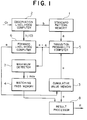
- Fig. 1 is a schematic diagram showing the first embodiment according to the present invention.
- the continuous speech recognition unit of the first embodiment according to the present invention comprises a standard pattern memory 1, an observation likelihood computer 2, a transition probability computer 5, a forward likelihood computer 6, a maximum detector 7, a matching pass memory 4, a cumulative value memory 3 and a result processor 8.
- the standard pattern memory 1 is connected to the observation likelihood computer 2 and the transition probability computer 5.
- the observation likelihood computer is connected to the forward likelihood computer 6.
- the transition probability computer 5 is connected to the forward likelihood computer 6 and the maximum detector 7.
- the forward likelihood computer 6 is connected to the cumulative value memory 3, which are connected to the transition probability computer 5 and the result processor 8.
- the maximum detector 7 is connected to the matching pass memory 4, which is in turn connected to the result processor 8.
- Standard patterns of word unit are kept, as observation likelihood table b j (O) and transition probability a ij which are parameters of HMM as shown in the expression (1), in the standard memory 1. Speech pattern O t is inputted to the observation likelihood computer 2.
- observation likelihood b j (O t ) of the speech pattern Ot is computed by using the observation likelihood table b j (O).
- the observation likelihood is obtained by vector quantization as described in the above-mentioned literature 1, page 1634.
- the transition probability a ij is read out from the standard pattern memory 1, and successively the forward likelihood ⁇ (j,t-1) is read out from the cumulative value memory 3.
- Product ⁇ (i,t-1) ⁇ a ij is computed at the transition probability computer 5.
- Said value is inputted from the transition probability computer 5 to the forward likelihood computer 6 while the observation likelihood b j (O t ) is inputted from said value and the observation likelihood b j (O t ), the forward likelihood ⁇ (j,t) is computed according to the formula (1).
- the obtained forward likelihood ⁇ (j,t) is kept at the cumulative value memory 3.
- the product ⁇ (i,t-1) ⁇ a ij is inputted from the transition probability computer 5 to the maximum detector 7, and i max which is i giving the maximum of obtained forward likelihoods at its point in time is computed according to the formula (3) at the maximum detector 7.
- the back pointer l(j,t) is computed from the i max read out from the maximum detector 7 according to the formula (2) at the matching pass memory 4 and kept therein.
- the forward likelihoods ⁇ (J,t) and the back pointer l(J,t) for a final state are read out from the cumulative value memory 3 and the matching pass memory 4, respectively, and the best result of recognition is defined according to the method described in the above-mentioned literature 1 at the result processor 8 and kept therein.
- the result of recognition of word sequence R can be obtained by following up positions of start points of words which are kept in the above-mentioned method.
- Fig. 2 is a schematic diagram showing the second embodiment according to the present invention.
- the continuous speech recognition unit of the second embodiment according to the present invention comprises a standard pattern memory 21, an observation likelihood computer 22, a transition probability computer 25, a forward likelihood computer 26, a maximum detector 27, a back pointer comparator 29, a matching pass memory 24, a cumulative value memory 23 and a result processor 28.
- the standard pattern memory 21 is connected to the observation likelihood computer 22 and the transition probability computer 25.
- the observation likelihood computer 22 is connected to the forward likelihood computer 26.
- the transition probability computer 25 is connected to the forward likelihood computer 26 and the maximum detector 27.
- the maximum detector 27 is connected to the matching pass memory 24, which are connected to the back pointer comparator 29 and the result processor 28.
- the forward likelihood computer 26 is connected to the cumulative value memory 23, which are connected to the transition probability computer 25 and the result processor 28.
- the forward likelihood ⁇ (j,t) is kept in the cumulative value memory 23.
- ⁇ (1,1) 1.0 while for the other j,t, ⁇ is 0.0.
- the back pointer l(j,t) representing position of start point with respect to a matching pass is kept in the matching pass memory 24.
- the transition probability a ij is read out from the standard pattern memory 21 and successively the forward likelihood ⁇ (j,t-1) is read out from the cumulative value memory 23.
- Product ⁇ (i,t-1) ⁇ a ij is computed at the transition probability computer 25.
- Said value is inputted from the transition probability computer 25 to the maximum detector 27, at which i max which is i giving the maximum of obtained forward likelihood at its point in time is computed according to the formula (3).
- the back pointer l(j,t) is computed from the i max read out from the maximum detector 27 according to the formula (2) at the matching pass memory 24, and kept therein.
- l(i,t-1) for state i successively read out from the matching pass memory 24 is compared with l(i max ,t-1) giving the maximum at the back pointer comparator 29, and state ic in which the former matches the latter is outputted from the back pointer comparator 29 to the forward likelihood computer 26, at which the forward likelihood ⁇ (j,t) is obtained as product of sum of products ⁇ (i,t-1).a ij accumulated with regard to the state ic and the observation likelihood b j (O t ) according to the formula (4), at the forward likelihood computer 26.
- the obtained forward likelihood ⁇ (j,t) is outputted from the forward likelihood computer 26 to the cumulative value memory 23 and kept therein.
- the forward likelihood ⁇ (J,t) and the back pointer l(J,t) for a final state are read out from the cumulative value memory 23 and the matching pass memory 24, respectively, and the best result of recognition is defined at the result processor 28 and kept therein.
- the result of recognition of word sequence R can be obtained by following up positions of start points of words, which are kept in the above-mentioned method.
- Fig. 3 is a schematic diagram showing the third embodiment according to the present invention.
- the continuous speech recognition unit of the third embodiment according to the present invention comprises a standard pattern memory 31, an observation likelihood computer 32, a transition probability computer 35, a forward likelihood computer 36, a maximum detector 37, a result comparator 40, a cumulative value memory 33, a matching pass memory 34, a result memory 39, and a result processor 38.
- the standard pattern memory 31 is connected to the observation likelihood computer 32 and the transition probability computer 35.
- the transition probability computer 35 is connected to the forward likelihood computer 36 and the maximum detector 37.
- the observation likelihood computer 32 is connected to the forward likelihood computer 36.
- the maximum detector 37 is connected to the matching pass memory 34 and the result memory 39.
- the matching pass memory 34 is connected to the result processor 38.
- the result memory 39 is connected to the result comparator 40, which is connected to the forward likelihood computer 36.
- the forward likelihood computer 36 is connected to the cumulative value memory 33, which are conneted to the transition probability computer 35 and. the result processor 38.
- the forward likelihood ⁇ (j,t) is kept in the cumulative value memory 33.
- ⁇ (1,1) 1.0 while for the other j,t, ⁇ is 0.0.
- the back pointer l(j,t) representing position of start point with respect to a matching pass is kept in the matching pass memory 34.
- result pointer r(j,t) is kept in the result memory 39.
- coded result of recognition c is set.
- the transition probability is read out from the standard pattern memory 31 and successively the forward likelihood ⁇ (j,t-1) is read out from the cumulative value memory 33.
- Product ⁇ (i,t-1 ).a ij is computed at the transition probability computer 35. Said value is inputted from the transition probability computer 35 to the forward likelihood computer 36 and the maximum detector 37. imax which is i producing the maximum is computed according to the formula (3), at the maximum detector 37.
- the back pointer l(j,t) is computed from the i max read out from the maximum detector 37 according to the formula (2) at the matching pass memory 34 and kept therein.
- the result pointer r(j,t) is computed according to the formula (7) at the result memory 39 and kept therein.
- r(i,t-1) for state i successively read out from the result memory 39 is compared with the result pointer r(i max ,t-1) giving the maximum read out therefrom at the result comparator 40, and state ic in which the former matches the latter is outputted from the result comparator 40 to the forward likelihood computer 36, at which the forward likelihood ⁇ (j,t) is obtained as product of sum of products ⁇ (i,t-1) ⁇ a ij summed up with regard to the state ic and the observation likelihood b j (O t ) according to the formula (8) at the forward likelihood computer 36.
- the obtained forward likelihood ⁇ (j,t) is outputted from the forward likelihood computer 36 to the cumulative value memory 33 and kept therein.
- the forward likelihood ⁇ (J,t) and the back pointer l(J,t) for a final state are read out from the cumulative value memory 23 and the matching pass memory 24, respectively, and the best result of recognition is defined at the result processor 38 and kept therein.
- the best result of recognition is outputted as result c from the result processor 38 to the result memory 39. It is kept as initial value of the result pointer r(j,t) as shown in the formula at the result memory 39.
- the result of recognition of word sequence R can be obtained by following up positions of start points of words, which are kept in the above-mentioned method.
Landscapes
- Engineering & Computer Science (AREA)
- Physics & Mathematics (AREA)
- Probability & Statistics with Applications (AREA)
- Computational Linguistics (AREA)
- Health & Medical Sciences (AREA)
- Audiology, Speech & Language Pathology (AREA)
- Human Computer Interaction (AREA)
- Acoustics & Sound (AREA)
- Multimedia (AREA)
- Image Analysis (AREA)
- Electric Clocks (AREA)
Claims (5)
- Dispositif de reconnaissance de la parole continue destiné à reconnaítre la parole continue en association avec les modèles standard des dispositifs de reconnaissance donnés comprenant :des moyens de mémoire de modèle standard (1, 21, 31) destinés à stocker des distributions d'observation et des probabilités de transition en tant que modèle standard;des moyens de calcul de similitude (2, 22, 32) destinés à calculer une similitude entre des modèles de parole entrés dans le dispositif de reconnaissance de la parole continue et le modèle standard en correspondance entre points respectifs dans le temps;des moyens de calcul de valeur cumulative (6, 26, 36) destinés à calculer, en tant que valeur cumulative, la somme des produits de valeurs cumulatives respectives et de similitudes obtenus pour la totalité ou une partie de passes d'adaptation sur ledit modèle de parole jusqu'à un certain point dans le temps;des moyens de mémoire de valeur cumulative (3, 23, 33) destinés à stocker lesdites valeurs cumulatives;des moyens de mémoire de passes d'adaptation (4, 24, 34) destinés à stocker la passe d'adaptation qui maximalise la valeur cumulative; etdes moyens de traitement de résultat (8, 28, 38) destinés à définir un résultat de reconnaissance qui correspond à l'état le plus probable à partir de ladite valeur cumulative et de la passe d'adaptation.
- Dispositif de reconnaissance de la parole continue selon la revendication 1, dans lequel lesdits moyens de calcul de valeur cumulative (6, 26, 36) calculent, en tant que valeur cumulative, la somme des produits de valeurs cumulatives et de similitudes obtenues pour des passes d'adaptation sur ledit modèle de parole jusqu'à un certain point dans le temps.
- Dispositif de reconnaissance de la parole continue selon la revendication 1, dans lequel lesdits moyens de calcul de valeur cumulative (6, 26, 36) calculent, en tant que dite valeur cumulative, la somme des produits de valeurs cumulatives respectives et de similitudes obtenues pour des passes d'adaptation stockées dans la mémoire de passe d'adaptation dans laquelle des positions de mise en marche d'unités de reconnaissance obtenues à partir desdites passes d'adaptation coïncident avec des positions de mise en marche pour les passes d'adaptation qui donnent les similitudes maximales.
- Dispositif de reconnaissance de la parole continue selon la revendication 1, dans lequel lesdits moyens de calcul de valeur cumulative (6, 26, 36) calculent, en tant que dite valeur cumulative, la somme des produits de valeurs cumulatives respectives et de similitudes obtenues pour des passes d'adaptation, dans lequel la totalité ou une partie des résultats de reconnaissance estimée par les moyens de traitement de résultat coïncident avec le résultat de reconnaissance des passes d'adaptation qui donnent les similitudes maximales.
- Dispositif de reconnaissance de la parole continue selon l'une quelconque des revendications 1 à 4, dans lequel ladite similitude est une probabilité directe.
Applications Claiming Priority (2)
| Application Number | Priority Date | Filing Date | Title |
|---|---|---|---|
| JP63250555A JPH0296800A (ja) | 1988-10-03 | 1988-10-03 | 連続音声認識装置 |
| JP250555/88 | 1988-10-03 |
Publications (3)
| Publication Number | Publication Date |
|---|---|
| EP0362785A2 EP0362785A2 (fr) | 1990-04-11 |
| EP0362785A3 EP0362785A3 (fr) | 1992-05-13 |
| EP0362785B1 true EP0362785B1 (fr) | 1998-01-07 |
Family
ID=17209653
Family Applications (1)
| Application Number | Title | Priority Date | Filing Date |
|---|---|---|---|
| EP89118306A Expired - Lifetime EP0362785B1 (fr) | 1988-10-03 | 1989-10-03 | Dispositif de reconnaissance de la parole continue |
Country Status (5)
| Country | Link |
|---|---|
| US (1) | US5029212A (fr) |
| EP (1) | EP0362785B1 (fr) |
| JP (1) | JPH0296800A (fr) |
| CA (1) | CA2000033C (fr) |
| DE (1) | DE68928522T2 (fr) |
Families Citing this family (11)
| Publication number | Priority date | Publication date | Assignee | Title |
|---|---|---|---|---|
| JPH0776878B2 (ja) * | 1991-10-31 | 1995-08-16 | インターナショナル・ビジネス・マシーンズ・コーポレイション | 音声認識方法および装置 |
| JPH05257492A (ja) * | 1992-03-13 | 1993-10-08 | Toshiba Corp | 音声認識方式 |
| JPH0772840B2 (ja) * | 1992-09-29 | 1995-08-02 | 日本アイ・ビー・エム株式会社 | 音声モデルの構成方法、音声認識方法、音声認識装置及び音声モデルの訓練方法 |
| US5627939A (en) * | 1993-09-03 | 1997-05-06 | Microsoft Corporation | Speech recognition system and method employing data compression |
| GB2285700B (en) * | 1994-01-12 | 1998-06-24 | Drallim Ind | Monitoring apparatus and method |
| US5615286A (en) * | 1995-05-05 | 1997-03-25 | Bell Communications Research, Inc. | Method for determining a most likely sequence of states |
| JP3453456B2 (ja) * | 1995-06-19 | 2003-10-06 | キヤノン株式会社 | 状態共有モデルの設計方法及び装置ならびにその状態共有モデルを用いた音声認識方法および装置 |
| JP3885523B2 (ja) * | 2001-06-20 | 2007-02-21 | 日本電気株式会社 | サーバ・クライアント型音声認識装置及び方法 |
| US7260530B2 (en) * | 2002-02-15 | 2007-08-21 | Bevocal, Inc. | Enhanced go-back feature system and method for use in a voice portal |
| JP4194433B2 (ja) * | 2003-07-07 | 2008-12-10 | キヤノン株式会社 | 尤度算出装置および方法 |
| JP6596309B2 (ja) * | 2015-11-11 | 2019-10-23 | 株式会社東芝 | 分析装置および分析方法 |
Family Cites Families (5)
| Publication number | Priority date | Publication date | Assignee | Title |
|---|---|---|---|---|
| US4783804A (en) * | 1985-03-21 | 1988-11-08 | American Telephone And Telegraph Company, At&T Bell Laboratories | Hidden Markov model speech recognition arrangement |
| US4748670A (en) * | 1985-05-29 | 1988-05-31 | International Business Machines Corporation | Apparatus and method for determining a likely word sequence from labels generated by an acoustic processor |
| JPH06105394B2 (ja) * | 1986-03-19 | 1994-12-21 | 株式会社東芝 | 音声認識方式 |
| US4831550A (en) * | 1986-03-27 | 1989-05-16 | International Business Machines Corporation | Apparatus and method for estimating, from sparse data, the probability that a particular one of a set of events is the next event in a string of events |
| US4852180A (en) * | 1987-04-03 | 1989-07-25 | American Telephone And Telegraph Company, At&T Bell Laboratories | Speech recognition by acoustic/phonetic system and technique |
-
1988
- 1988-10-03 JP JP63250555A patent/JPH0296800A/ja active Pending
-
1989
- 1989-10-02 CA CA002000033A patent/CA2000033C/fr not_active Expired - Fee Related
- 1989-10-03 EP EP89118306A patent/EP0362785B1/fr not_active Expired - Lifetime
- 1989-10-03 US US07/416,560 patent/US5029212A/en not_active Expired - Lifetime
- 1989-10-03 DE DE68928522T patent/DE68928522T2/de not_active Expired - Fee Related
Non-Patent Citations (3)
| Title |
|---|
| EP-A- 0 237 934 * |
| FR-A- 2 579 357 * |
| March 1983, NEW YORK pages 179 - 190; BAHL ET AL.: 'A MAXIMUM LIKELIHOOD APPROACH TO CONTINUOUS SPEECH RECOGNITION' * |
Also Published As
| Publication number | Publication date |
|---|---|
| JPH0296800A (ja) | 1990-04-09 |
| EP0362785A2 (fr) | 1990-04-11 |
| DE68928522T2 (de) | 1998-08-27 |
| US5029212A (en) | 1991-07-02 |
| CA2000033A1 (fr) | 1990-04-03 |
| EP0362785A3 (fr) | 1992-05-13 |
| DE68928522D1 (de) | 1998-02-12 |
| CA2000033C (fr) | 1994-06-14 |
Similar Documents
| Publication | Publication Date | Title |
|---|---|---|
| US4827521A (en) | Training of markov models used in a speech recognition system | |
| EP0960417B1 (fr) | Procede de determination de facteurs specifiques selon le modele pour la reconnaissance des formes, en particulier de formes sonores | |
| US6009390A (en) | Technique for selective use of Gaussian kernels and mixture component weights of tied-mixture hidden Markov models for speech recognition | |
| Juang et al. | Mixture autoregressive hidden Markov models for speech signals | |
| US5072452A (en) | Automatic determination of labels and Markov word models in a speech recognition system | |
| EP0303022B1 (fr) | Adaptation rapide d'un dispositif de reconnaissance de la parole à un nouveau locuteur à partir des données correspondant à un locuteur de référence | |
| US6260013B1 (en) | Speech recognition system employing discriminatively trained models | |
| EP0314908B1 (fr) | Détermination automatique d'étiquettes et de représentations de mots par des modèles de Markov dans un système pour la reconnaissance de la parole | |
| JP4531166B2 (ja) | 信頼性尺度の評価を用いる音声認識方法 | |
| EP0362785B1 (fr) | Dispositif de reconnaissance de la parole continue | |
| EP0617827B1 (fr) | Systeme expert composite | |
| US5617509A (en) | Method, apparatus, and radio optimizing Hidden Markov Model speech recognition | |
| US5963906A (en) | Speech recognition training | |
| Shinoda et al. | Speaker adaptation with autonomous model complexity control by MDL principle | |
| US5970450A (en) | Speech recognition system using modifiable recognition threshold to reduce the size of the pruning tree | |
| CA2247747A1 (fr) | Methode de recherche et de reevaluation pour systeme de reconnaissance vocale | |
| McDermott et al. | String-level MCE for continuous phoneme recognition. | |
| US5737488A (en) | Speech recognizer | |
| US5974381A (en) | Method and system for efficiently avoiding partial matching in voice recognition | |
| US5220609A (en) | Method of speech recognition | |
| JP2531227B2 (ja) | 音声認識装置 | |
| Smith et al. | A hidden Markov model with optimized inter-frame dependence | |
| US6195639B1 (en) | Matching algorithm for isolated speech recognition | |
| Juang et al. | Mixture autoregressive hidden Markov models for speaker independent isolated word recognition | |
| Matton et al. | Maximum mutual information training of distance measures for template based speech recognition |
Legal Events
| Date | Code | Title | Description |
|---|---|---|---|
| PUAI | Public reference made under article 153(3) epc to a published international application that has entered the european phase |
Free format text: ORIGINAL CODE: 0009012 |
|
| 17P | Request for examination filed |
Effective date: 19891026 |
|
| AK | Designated contracting states |
Kind code of ref document: A2 Designated state(s): DE FR GB |
|
| PUAL | Search report despatched |
Free format text: ORIGINAL CODE: 0009013 |
|
| AK | Designated contracting states |
Kind code of ref document: A3 Designated state(s): DE FR GB |
|
| 17Q | First examination report despatched |
Effective date: 19940419 |
|
| GRAG | Despatch of communication of intention to grant |
Free format text: ORIGINAL CODE: EPIDOS AGRA |
|
| GRAG | Despatch of communication of intention to grant |
Free format text: ORIGINAL CODE: EPIDOS AGRA |
|
| GRAH | Despatch of communication of intention to grant a patent |
Free format text: ORIGINAL CODE: EPIDOS IGRA |
|
| GRAH | Despatch of communication of intention to grant a patent |
Free format text: ORIGINAL CODE: EPIDOS IGRA |
|
| GRAA | (expected) grant |
Free format text: ORIGINAL CODE: 0009210 |
|
| AK | Designated contracting states |
Kind code of ref document: B1 Designated state(s): DE FR GB |
|
| REF | Corresponds to: |
Ref document number: 68928522 Country of ref document: DE Date of ref document: 19980212 |
|
| ET | Fr: translation filed | ||
| PLBE | No opposition filed within time limit |
Free format text: ORIGINAL CODE: 0009261 |
|
| STAA | Information on the status of an ep patent application or granted ep patent |
Free format text: STATUS: NO OPPOSITION FILED WITHIN TIME LIMIT |
|
| 26N | No opposition filed | ||
| REG | Reference to a national code |
Ref country code: GB Ref legal event code: IF02 |
|
| PGFP | Annual fee paid to national office [announced via postgrant information from national office to epo] |
Ref country code: GB Payment date: 20021002 Year of fee payment: 14 |
|
| PGFP | Annual fee paid to national office [announced via postgrant information from national office to epo] |
Ref country code: FR Payment date: 20021008 Year of fee payment: 14 |
|
| PGFP | Annual fee paid to national office [announced via postgrant information from national office to epo] |
Ref country code: DE Payment date: 20021011 Year of fee payment: 14 |
|
| PG25 | Lapsed in a contracting state [announced via postgrant information from national office to epo] |
Ref country code: GB Free format text: LAPSE BECAUSE OF NON-PAYMENT OF DUE FEES Effective date: 20031003 |
|
| PG25 | Lapsed in a contracting state [announced via postgrant information from national office to epo] |
Ref country code: DE Free format text: LAPSE BECAUSE OF NON-PAYMENT OF DUE FEES Effective date: 20040501 |
|
| GBPC | Gb: european patent ceased through non-payment of renewal fee |
Effective date: 20031003 |
|
| PG25 | Lapsed in a contracting state [announced via postgrant information from national office to epo] |
Ref country code: FR Free format text: LAPSE BECAUSE OF NON-PAYMENT OF DUE FEES Effective date: 20040630 |
|
| REG | Reference to a national code |
Ref country code: FR Ref legal event code: ST |