EP0362805B1 - Aimant permanent et procédé de fabrication - Google Patents
Aimant permanent et procédé de fabrication Download PDFInfo
- Publication number
- EP0362805B1 EP0362805B1 EP89118356A EP89118356A EP0362805B1 EP 0362805 B1 EP0362805 B1 EP 0362805B1 EP 89118356 A EP89118356 A EP 89118356A EP 89118356 A EP89118356 A EP 89118356A EP 0362805 B1 EP0362805 B1 EP 0362805B1
- Authority
- EP
- European Patent Office
- Prior art keywords
- coercive force
- magnet
- koe
- proviso
- compound
- Prior art date
- Legal status (The legal status is an assumption and is not a legal conclusion. Google has not performed a legal analysis and makes no representation as to the accuracy of the status listed.)
- Expired - Lifetime
Links
Images


Classifications
-
- H—ELECTRICITY
- H01—ELECTRIC ELEMENTS
- H01F—MAGNETS; INDUCTANCES; TRANSFORMERS; SELECTION OF MATERIALS FOR THEIR MAGNETIC PROPERTIES
- H01F1/00—Magnets or magnetic bodies characterised by the magnetic materials therefor; Selection of materials for their magnetic properties
- H01F1/01—Magnets or magnetic bodies characterised by the magnetic materials therefor; Selection of materials for their magnetic properties of inorganic materials
- H01F1/03—Magnets or magnetic bodies characterised by the magnetic materials therefor; Selection of materials for their magnetic properties of inorganic materials characterised by their coercivity
- H01F1/032—Magnets or magnetic bodies characterised by the magnetic materials therefor; Selection of materials for their magnetic properties of inorganic materials characterised by their coercivity of hard-magnetic materials
- H01F1/04—Magnets or magnetic bodies characterised by the magnetic materials therefor; Selection of materials for their magnetic properties of inorganic materials characterised by their coercivity of hard-magnetic materials metals or alloys
- H01F1/047—Alloys characterised by their composition
- H01F1/053—Alloys characterised by their composition containing rare earth metals
- H01F1/055—Alloys characterised by their composition containing rare earth metals and magnetic transition metals, e.g. SmCo5
- H01F1/057—Alloys characterised by their composition containing rare earth metals and magnetic transition metals, e.g. SmCo5 and IIIa elements, e.g. Nd2Fe14B
- H01F1/0571—Alloys characterised by their composition containing rare earth metals and magnetic transition metals, e.g. SmCo5 and IIIa elements, e.g. Nd2Fe14B in the form of particles, e.g. rapid quenched powders or ribbon flakes
- H01F1/0575—Alloys characterised by their composition containing rare earth metals and magnetic transition metals, e.g. SmCo5 and IIIa elements, e.g. Nd2Fe14B in the form of particles, e.g. rapid quenched powders or ribbon flakes pressed, sintered or bonded together
- H01F1/0577—Alloys characterised by their composition containing rare earth metals and magnetic transition metals, e.g. SmCo5 and IIIa elements, e.g. Nd2Fe14B in the form of particles, e.g. rapid quenched powders or ribbon flakes pressed, sintered or bonded together sintered
Definitions
- the present invention relates to a permanent magnet, more particularly an Nd-Fe-B sintered magnet, and to a method for producing the same.
- melt-quenched magnets In the Nd-Fe-B magnets there are melt-quenched magnets and sintered magnets. Essentially, the melt-quenched magnet is magnetically isotropic. There is a method under proposal for rendering the melt-quenched magnet anisotropic, which resides in crushing a strip obtained by melt-quenching to produce a powder, hot-pressing and then die-upsetting the powder. This method, however, has not yet been carried out industrially, since the production steps are complicated.
- Nd-Fe-B sintered magnet has been developed by the present inventor et al. It has outstanding characteristics in that it exhibits excellent magnetic property in terms of 50 MGOe * of maximum energy product (BH)max in a laboratory scale and 40 MGOe even in a mass production scale; and, the cost of raw materials is remarkably cheaper than those of the rare-earth cobalt magnet, since the main components are Fe and B, and Nd (neodymium) and Pr (praseodymium), all inexpensive elements, which are relatively abundant in the rare-earth elements.
- Representative patents of the Nd-Fe-B sintered magnet are Japanese Unexamined Patent Publication No. 59-89401, Japanese Unexamined Patent Publication No.
- JP-A-62-165 305 discloses a permanent magnet material with a coercivity of 15 kOe and above with a specific composition including Dy and Cu and/or V and or other elements.
- the present inventor researched and discovered the following. That is, in a V-added Nd-Fe-B magnet having a specified composition, the NdFe 4 B 4 phase (B rich phase) is suppressed to the minimum amount, and a compound phase other than the NdFe 4 B 4 phase, i.e., a V-Fe-B compound phase, whose presence is heretofore unknown, is formed and replaces the NdFe 4 B 4 phase, i.e., B rich phase.
- An absolute value of the coercive force (iHc) is exceedingly enhanced and the stability at high temperature is improved due to the functions of both V-Fe-B compound phase and the particular composition.
- the corrosion resistance of the Nd-Fe-B sintered magnet is greatly improved by the formation of the V-Fe-B compound phase and disappearance or decrease of the NdFe 4 B 4 phase.
- Nd-Fe-B sintered magnet which may hereinafter be referred to as the Nd-Fe-B magnet, according to the present invention is first described.
- V-T-B compound (phase) may be hereinafter referred to as V-Fe-B compound (phase).
- the V-Fe-B compound phase is formed in the constitutional structure of a sintered body, as long as Nd, Pr, (Dy), B, Fe and V are within the above described ranges.
- V-Fe-B compound phase in the sample of No.1 in Table 1 described below turned out to have a composition of 29.5 at% of V, 24.5 at% of Fe, 46 at% of B, and a trace of Nd.
- An electron diffraction-photograph used for analysis of the crystal structure of V-Fe-B compound is shown in Figs. 3(A) and (B). For identification of the crystal structure, it is now compared with those of already known compounds.
- V 3 B 2 is the most probable. Presumably, a part of V of this compound is replaced with Fe. Elements other than the above mentioned can be dissolved in a solid solution of that compound. Depending upon the composition, additive elements, and impurities of sintered bodies, V of that compound can be replaced with various elements having properties similar to V. It is, however, up to the present, neither known exactly which kind of elements substitute V in the V-Fe-B compound, nor in what amount these elements substitute V. Since NbaV 2 , which is similar to V 3 B 2 , is present, Nb seems to substitute V in a great amount. Other transition elements also seem to be able to substitute a part of V.
- the amount of substitution of the element(s) based on the total amount of V + Fe seems to be up to 40% Nb and up to 20% of Ti, Zr, Hf, Ta, Cr, Mo, W, Mu, Co and Ni.B of the V-Fe-B compound can be replaced with C which has properties similar to B. Even in these cases, an improved coercive force (iHc) is obtained, as long as the sintered magnet includes a binary V-B compound, the part of which is replaced with Fe (possibly, (V 1-x ,Fe x ,) 3 B2 phase) and is occasionally additionally replaced with Co and the M elements described hereinbelow.
- the B rich phase which is contained in most of the conventional Nd-Fe-B magnets, is gradually lessened and finally becomes zero with the increase in the amount formed of the V-Fe-B compound, in which virtually no, or very little Nd is dissolved as a solid solution, the remainder of Nd constitutes the Nd rich phase, which is essential for the liquid-phase sintering, with the result that Nd is effectively used for improving the magnetic properties.
- the Nd-Fe-B magnet according to the present invention which is essentially free of the B rich phase, exhibits a higher coercive force (iHc) than the conventional Nd-Fe-B magnet having the same composition as the former magnet and containing more B than the stoichiometric composition of R 2 Fe 14 B.
- the excess boron is therefore 2.2 at% in the case of, for example Nd-Fe-B magnet containing 8 at% of B.
- the properties of the Nd-Fe-B magnet are better in the case where the V-Fe-B compound phase is dispersed mainly in the grain boundaries, than in the case where the V-Fe-B compound phase is dispersed mainly within the grains. Ideally, almost all of the crystal grains of the R 2 Fe 14 B compound-phase are in contact at their boundaries with a few or more of the particles of the V-Fe-B compound phase.
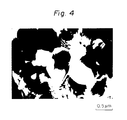
- FIGs. 2, 3 and 4 relate to the structure of V-added Nd-Fe-B magnet which is free from Cu, the above descriptions with reference to these drawings are also applied to the V-added Nd-Fe-B magnet containing Cu.
- the coercive force (iHc) of the Nd-Fe-B magnet according to claim 1 is 15 kOe or more. Since the coercive force (iHc) is enhanced by 3 kOe by addition of 1 at% of Dy at room temperature, the coercive force (iHc) at room temperature is 15 + 3x (kOe) (x is Dy content by atomic %) in an Nd-Fe-B magnet, in which Dy is added. However, since the applied maximum magnetic field of an electromagnet used in experiments for measuring the demagnetizing curves until the completion of the present invention was 21 kOe, actual values could not be measured when the coercive force (iHc) exceeded 21 kOe. Therefore, when
- the temperature-coefficient of the coercive force (iHc) is, for example, 0.6 %/°C
- the coercive force (iHc) at room temperature must be 17.8 kOe or more.
- This value of coercive force (iHc) is fulfilled by a compositional range according to claim 1 except in the vicinities of the upper and lower limits, provided that to the composition of claim 1, aluminum is added.
- the temperature coefficient of the coercive force (iHc) is 0.7 %/ ° C or more, 5 kOe or more of the coercive force (iHc) is obtained at 140 ° C by a composition with a Dy addition.
- a coercive force (iHc) at 200 ° C amounting to 5 kOe or more is obtained by a composition containing 3 - approximately 5.5 at% of V, 13 at% or more of R, more than 1 at% of Dy and an aluminum addition.
- the coercive force (iHc) in proximity of the peak value is obtained by heat treating in a very narrow temperature range of heat treatment, as given in Table 1, followed by water cooling.
- the range of heat treatment indicates the temperature range, in which a coercive force (iHc) lower than the maximum coercive force (iHc) by 1 kOe is obtained. If not specified, aluminum is contained as an impurity.
- the holding time at the heat treating temperature is 1 hour (also in Table 2).
- the range of heat treatment is 10 ° C or less and hence very narrow.
- a powder of the raw materials must be carefully and uniformly mixed in the production process of sintered magnets, in which two or more kinds of fine particles are mixed with one another. Also in the production process, in which one kind of ingot is crushed to obtain a powder of desired composition, the phases must be uniformly and finely distributed in an ingot.
- a uniform mixing step using a jet mill is necessary, so as to thoroughly and uniformly mix the powder which has previously been separated to the respective phases by another jet mill. Necessary length of time for uniformly mixing the powder is 30 minutes or more by using a rocking mixer.
- the coercive force (iHc) is further enhanced. This is presumably because a small amount of AI promotes fine, dispersion of the V-T-B compound phase.
- Nd and Pr are mainly used for the rare-earth elements (R), because both Nd 2 Fe 14 B and Pr 2 Fe 14 B have higher saturation magnetization together with higher uniaxial magnetic anisotropy than those of the R 2 Fe 14 Bcompound-phase of the other rare-earth elements.
- Nd+Pr/R is 80 at%, because high saturation magnetization and high coercive force (iHc) are obtained by setting high contents of Nd and Pr, except for Dy.
- Dy enhances the coercive force (iHc) at 140 ° C and 200 ° C by approximately 2 kOe/% and 1 kOe/%, respectively.
- the content of Dy is 4 at% or less, because Dy is a rare resource and further, the residual magnetization is considerably lowered at more than 4 at%.
- rare-earth elements not only highly refined rare-earth elements but also mixed raw-materials, such as dydimium, in which Nd and Pr remain unseparated, and Ce-dydimium, in which Ce remains unseparated, can be used as the raw material for rare-earth elements.
- Co which may partly replace Fe, enhances the Curie point and improves the temperature-coefficient of residual magnetization. If, however, Co amounts to 25 at% or more of the total of Co and Fe, the coercive force (iHc) is lessened due to the minority phase described hereinafter. The amount of Co must therefore be 25 at% or less of the total of Co and Fe.
- Nd2 Fe14 B compound and V-Fe-B compound are changed to R 2 (FeCo) 14 B compound and V-(FeCo)-B compound, respectively.
- (Co. Fe)-Nd phase generates as a new minority phase, which lowers the coercive force (iHc).
- the present inventor added various elements to the above described Nd-Fe-B magnet and investigated influences of the additive elements on the coercive force (iHc). As a result, it turned out that the coercive force (iHc) is only slightly improved or is virtually unimproved, but does not incur any decrease.
- M 1 enhances the coercive force (iHc), but not as outstandingly as V does.
- M 2 and M 3 have a slight effect of enhancing the coercive force (iHc).
- M 2 and M 3 may be incorporated in the refining process of rare-earth elements and Fe. It is advantageous therefore from the point of view of the cost of raw materials when the addition of Mi, M 2 and M 3 is permitted.
- Transition elements among the above elements replace a part of T of V-T-B compound.
- the additional amount of Mi, M 2 and M 3 exceeds the upper limits, the Curie point and residual magnetization are lowered.
- ferroboron which is frequently used as the raw material of boron, contains aluminum.
- Aluminum also dissolves from a crucible. Aluminum is therefore contained in 0.4 wt% (0.8 at%) at the maximum in the Nd-Fe-B magnet, even if aluminum is not added as an alloy element.
- Nd-Fe-B magnet there are other elements which are reported to add to Nd-Fe-B magnet.
- Ga is alleged to enhance the coercive force (iHc), when it is added together with cobalt. Ga can also be added in the Nd-Fe-B magnet of the present invention.
- Cu in an amount less than 0.01 % is also an impurity. Oxygen is incorporated in the Nd-Fe-B sintered magnet during the alloy-pulverizing step, the post-pulverizing, pressing step, and the sintering step.
- a large amount of Ca is incorporated in the Nd-Fe-B magnet as the residue of the leaching step (rinsing step for separating CaO) of the co-reducing method for directly obtaining the alloy powder of Nd-Fe-B alloy by reduction with the use of Ca.
- Oxygen is incorporated in the Nd-Fe-B magnet in an amount of 10000 ppm (weight ratio) at the maximum. Such oxygen improves neither magnetic properties nor the other properties.
- Nd-Fe-B magnet Into the Nd-Fe-B magnet are incorporated carbon from the raw materials of rare-earth and Fe-B, as well as carbon, phosphorus and sulfur from the lubricant used in the pressing step. Under the present technique, carbon is incorporated in the Nd-Fe-B magnet in an amount of 5000 ppm (weight ratio) at the maximum. Also, this carbon improves neither the magnetic properties nor the other properties.
- the coercive force (iHc) is 15 kOe or more. This value is higher than 12 kOe of the coercive force (iHc) of the heat-treated standard composition by 3 kOe.
- Such enhancement of coercive force due to the V-T-B compound phase takes place presumably because the particles of such a phase suppress the grain growth during sintering and modify the grain boundaries such that nuclei of magnetization inversion generate in the grain boundaries with difficulty.
- heat treatment characteristics of the V-added Nd-Fe-B sintered magnet are illustrated with reference to an example of Nd 16 Fe bail B 8 V 4 Al 0.5 .
- the peak value of the coercive force (iHc) is obtained in an extremely narrow temperature range of the heat treatment.
- the peak temperature when Cu is added, significant reduction of the coercive force (iHc) from the peak value does not take place when the heat treatment temperature slightly deviates from the temperature where the peak value of the coercive force (iHc) is obtained.
- This temperature is hereinafter referred to as the peak temperature. Accordingly, a high coercive force (iHc) is obtained while tolerating a broad range of the holding temperature.
- the maximum energy product of the inventive Nd-Fe-B sintered magnet is at least 20MGOe, since this is the minimum value required for high-performance magnets, and, further a rare-earth magnet having lower value cannot compete with other magnets.
- Alloys were melted in a high-frequency induction furnace and cast in an iron mold.
- the starting materials the following (materials) were used: for Fe, an electrolytic iron having purity of 99.9 wt%; for B, a ferro-boron alloy and boron having purity of 99 wt%; Pr having purity of 99 wt%; Dy having purity of 99 wt%; for V, a ferrovanadium containing 50 wt% of V; and, AI having purity of 99.9 wt%.
- Melt was stirred thoroughly during melting and casting so as to distribute V uniformly throughout the melt. The thickness of the ingots was made to 10 mm or less.
- This thickness is so thin as to carry out rapid cooling and to finely disperse the V-Fe-B compound phase in the ingots.
- the resultant ingots were pulverized by a stamp mill to 35 mesh (0.42 mm). A fine pulverizing was then carried out by a jet mill with the use of nitrogen gas. As a result, a powder having a grain diameter of 2.5 - 3.5 ⁇ m was obtained. This powder was shaped under a pressure of 1.5 tlcm 2* and in the magnetic field of 10 kOe.
- the powder was thoroughly stirred so as to uniformly and finely disperse the V-Fe-B compound in the sintered body.
- the green compact obtained by pressing under the magnetic field was then sintered at 1050 to 1120 ° C for 1 to 5 hours in an argon atmosphere.
- compositions were prepared by the above procedure.
- the temperature of the heat treatment was varied and the coercive force (iHc) was measured.
- the results are shown in Fig.1.
- the following facts are apparent from Fig. 1.
- the maximum coercive force (iHc) of Nd 16 FebalB 8 V 4 free of Cu exhibits a sharp peak.
- Temperature sensitivity of the coercive force (iHc) is considerably improved in the case of Nd 16 Fe bal B 8 V 4 Cu 0.05 with the addition of an appropriate amount of Cu.
- the coercive force (iHc) is generally reduced.
- Sheets 10x10x1 mm in size having the compositions as given in Table 3, were prepared by the same method as Example 1. These sheets were heated to 80 ° C in air having 90 % of RH, up to 120 hours, and the weight increase by oxidation was measured. The results are shown in Table 3. It is apparent from Table 3 that the corrosion resistance is considerably improved by the addition of V.
- the astersiked sample is comparative.
Landscapes
- Chemical & Material Sciences (AREA)
- Crystallography & Structural Chemistry (AREA)
- Inorganic Chemistry (AREA)
- Engineering & Computer Science (AREA)
- Power Engineering (AREA)
- Hard Magnetic Materials (AREA)
- Manufacturing Cores, Coils, And Magnets (AREA)
- Ultra Sonic Daignosis Equipment (AREA)
- Diaphragms For Electromechanical Transducers (AREA)
- Adhesives Or Adhesive Processes (AREA)
Claims (9)
caractérisé en ce qu'il contient, en outre, V, en une quantité allant de 2 à 6 at% et Cu en une quantité allant de 0,01 à 1 at% ; et une phase minoritaire de composé V-T-B finement dispersée, où T est Fe, et dans le cas où l'aimant contient du Co, T est Fe et Co, et l'aimant offre un produit d'énergie maximum (BH)max de 20 MGOe* ou plus et une force coercitive (iHc) de 15 kOe** ou plus, ainsi que des caractéristiques de traitement thermique améliorées.
caractérisé en ce qu'il contient, en outre, V, en une quantité allant de 2 à 6 at% et Cu en une quantité allant de 0,01 à 1 at% ; et une phase minoritaire de composé V-T-B finement dispersée, où T est Fe, et dans le cas où l'aimant contient du Co, T est Fe et Co, et l'aimant offre un produit d'énergie maximum (BH)max de 20 MGOe*ou plus et une force coercitive supérieure ou égale à 15 + 3x kOe**, x est la teneur en Dy (at%), à la condition que lorsque 15 + 3x (kOe**) est égal à 21 kOe** ou plus, la force coercitive est égale à 21 kOe** ou plus, l'aimant offrant en outre des caractéristiques de traitement thermique améliorées.



caractérisé en ce que la composition de l'aimant Nd-Fe-B est la suivante : R = 11-18 at%, R étant un ou plusieurs éléments de terres rares, à l'exception de Dy, à la condition que 80 at% (Nd + Pr)/R < 100 at%, B = 6-12 at%, V = 2-6 at%, Cu = de 0,01 à 1 at%, le complément étant apporté par Fe et Co, à la condition que Co soit de 25 at% ou moins par rapport au total de Co et Fe, y compris 0 % de Co, et des impuretés.
caractérisé en ce que la composition de l'aimant Nd-Fe-B est la suivante : R = 11-18 at%, R représentant des éléments de terres rares, R1 = Nd + Pr, R2 = Dy, à la condition que 80 at% ≦(R1 + R2)/R 100 at%, R2 ≦ 4 at%, B = 6-12 at%, V = 2-6 at%, Cu = de 0,01 à 1 at%, le complément étant apporté par Fe et Co, à la condition que Co soit de 25 at% ou moins par rapport au total de Co et Fe, y compris 0 % de Co, et des impuretés.

Priority Applications (1)
| Application Number | Priority Date | Filing Date | Title |
|---|---|---|---|
| AT89118356T ATE103412T1 (de) | 1988-10-06 | 1989-10-03 | Dauermagnet und herstellungsverfahren. |
Applications Claiming Priority (2)
| Application Number | Priority Date | Filing Date | Title |
|---|---|---|---|
| JP63250851A JP2787580B2 (ja) | 1988-10-06 | 1988-10-06 | 熱処理性がすぐれたNd−Fe−B系焼結磁石 |
| JP250851/88 | 1988-10-06 |
Publications (3)
| Publication Number | Publication Date |
|---|---|
| EP0362805A2 EP0362805A2 (fr) | 1990-04-11 |
| EP0362805A3 EP0362805A3 (fr) | 1991-07-24 |
| EP0362805B1 true EP0362805B1 (fr) | 1994-03-23 |
Family
ID=17213949
Family Applications (1)
| Application Number | Title | Priority Date | Filing Date |
|---|---|---|---|
| EP89118356A Expired - Lifetime EP0362805B1 (fr) | 1988-10-06 | 1989-10-03 | Aimant permanent et procédé de fabrication |
Country Status (8)
| Country | Link |
|---|---|
| US (1) | US4995905A (fr) |
| EP (1) | EP0362805B1 (fr) |
| JP (1) | JP2787580B2 (fr) |
| AT (1) | ATE103412T1 (fr) |
| DE (1) | DE68914078T2 (fr) |
| ES (1) | ES2050750T3 (fr) |
| FI (1) | FI103223B (fr) |
| IE (1) | IE891829L (fr) |
Families Citing this family (10)
| Publication number | Priority date | Publication date | Assignee | Title |
|---|---|---|---|---|
| US5167914A (en) * | 1986-08-04 | 1992-12-01 | Sumitomo Special Metals Co., Ltd. | Rare earth magnet having excellent corrosion resistance |
| US5201963A (en) * | 1989-10-26 | 1993-04-13 | Nippon Steel Corporation | Rare earth magnets and method of producing same |
| US5200001A (en) * | 1989-12-01 | 1993-04-06 | Sumitomo Special Metals Co., Ltd. | Permanent magnet |
| US5093076A (en) * | 1991-05-15 | 1992-03-03 | General Motors Corporation | Hot pressed magnets in open air presses |
| FR2707421B1 (fr) * | 1993-07-07 | 1995-08-11 | Ugimag Sa | Poudre additive pour la fabrication d'aimants frittés type Fe-Nd-B, méthode de fabrication et aimants correspondants. |
| US5482575A (en) * | 1992-12-08 | 1996-01-09 | Ugimag Sa | Fe-Re-B type magnetic powder, sintered magnets and preparation method thereof |
| US6277211B1 (en) * | 1999-09-30 | 2001-08-21 | Magnequench Inc. | Cu additions to Nd-Fe-B alloys to reduce oxygen content in the ingot and rapidly solidified ribbon |
| CN1182548C (zh) | 2000-07-10 | 2004-12-29 | 株式会社新王磁材 | 稀土磁铁及其制造方法 |
| EP1603142B1 (fr) * | 2003-02-27 | 2014-12-31 | Hitachi Metals, Ltd. | Aimant permanent destine a un accelerateur de faisceaux de particules et generateur de champs magnetiques |
| WO2007010860A1 (fr) | 2005-07-15 | 2007-01-25 | Neomax Co., Ltd. | Aimant fritté de terre rare et son procédé de production |
Family Cites Families (12)
| Publication number | Priority date | Publication date | Assignee | Title |
|---|---|---|---|---|
| JPS59163804A (ja) * | 1983-03-08 | 1984-09-14 | Sumitomo Special Metals Co Ltd | 永久磁石用合金 |
| CA1316375C (fr) * | 1982-08-21 | 1993-04-20 | Masato Sagawa | Materiaux magnetiques et aimants permanents |
| US4684406A (en) * | 1983-05-21 | 1987-08-04 | Sumitomo Special Metals Co., Ltd. | Permanent magnet materials |
| JPS59218704A (ja) * | 1983-05-27 | 1984-12-10 | Sumitomo Special Metals Co Ltd | 永久磁石材料の製造方法 |
| JPS6032306A (ja) * | 1983-08-02 | 1985-02-19 | Sumitomo Special Metals Co Ltd | 永久磁石 |
| JPS60218457A (ja) * | 1984-04-12 | 1985-11-01 | Seiko Epson Corp | 永久磁石合金 |
| US4767450A (en) * | 1984-11-27 | 1988-08-30 | Sumitomo Special Metals Co., Ltd. | Process for producing the rare earth alloy powders |
| JPS62120003A (ja) * | 1985-11-20 | 1987-06-01 | Sumitomo Special Metals Co Ltd | 耐食性のすぐれた永久磁石及びその製造方法 |
| US4765848A (en) * | 1984-12-31 | 1988-08-23 | Kaneo Mohri | Permanent magnent and method for producing same |
| JPS636808A (ja) * | 1986-06-26 | 1988-01-12 | Shin Etsu Chem Co Ltd | 希土類永久磁石 |
| JPS6328844A (ja) * | 1986-07-23 | 1988-02-06 | Toshiba Corp | 永久磁石材料 |
| EP0261579B1 (fr) * | 1986-09-16 | 1993-01-07 | Tokin Corporation | Méthode pour la fabrication d'un aimant permanent terre métal rare-fer-bore utilisant une poudre en alliage refroidi brusquement |
-
1988
- 1988-10-06 JP JP63250851A patent/JP2787580B2/ja not_active Expired - Fee Related
-
1989
- 1989-05-23 US US07/355,759 patent/US4995905A/en not_active Expired - Lifetime
- 1989-06-12 IE IE891829A patent/IE891829L/xx unknown
- 1989-07-27 FI FI893600A patent/FI103223B/fi not_active IP Right Cessation
- 1989-10-03 DE DE68914078T patent/DE68914078T2/de not_active Expired - Fee Related
- 1989-10-03 AT AT89118356T patent/ATE103412T1/de not_active IP Right Cessation
- 1989-10-03 ES ES89118356T patent/ES2050750T3/es not_active Expired - Lifetime
- 1989-10-03 EP EP89118356A patent/EP0362805B1/fr not_active Expired - Lifetime
Also Published As
| Publication number | Publication date |
|---|---|
| FI103223B1 (fi) | 1999-05-14 |
| DE68914078T2 (de) | 1994-06-30 |
| JPH02101146A (ja) | 1990-04-12 |
| ATE103412T1 (de) | 1994-04-15 |
| JP2787580B2 (ja) | 1998-08-20 |
| IE891829L (en) | 1990-04-06 |
| ES2050750T3 (es) | 1994-06-01 |
| FI893600A0 (fi) | 1989-07-27 |
| FI103223B (fi) | 1999-05-14 |
| DE68914078D1 (de) | 1994-04-28 |
| EP0362805A2 (fr) | 1990-04-11 |
| FI893600A7 (fi) | 1990-04-07 |
| US4995905A (en) | 1991-02-26 |
| EP0362805A3 (fr) | 1991-07-24 |
Similar Documents
| Publication | Publication Date | Title |
|---|---|---|
| EP0261579B1 (fr) | Méthode pour la fabrication d'un aimant permanent terre métal rare-fer-bore utilisant une poudre en alliage refroidi brusquement | |
| EP1420418B1 (fr) | Aimant fritté à base de R-Fe-B | |
| US7618497B2 (en) | R-T-B based rare earth permanent magnet and method for production thereof | |
| US6296720B1 (en) | Rare earth/iron/boron-based permanent magnet alloy composition | |
| EP0344542B1 (fr) | Aimant fritté de Nd-Fe-B et son procédé de fabrication | |
| JP2751109B2 (ja) | 熱安定性の良好な焼結型永久磁石 | |
| JPH0521218A (ja) | 希土類永久磁石の製造方法 | |
| EP0237416B1 (fr) | Aimant permanent à base de terres rares | |
| US4859254A (en) | Permanent magnet | |
| KR960008185B1 (ko) | 희토류-철계 영구자석 및 이의 제조방법 | |
| US4995905A (en) | Permanent magnet having improved heat-treatment characteristics and method for producing the same | |
| JPH0696928A (ja) | 希土類焼結磁石及びその製造方法 | |
| JP2794496B2 (ja) | 不可逆減磁の小さい熱安定性に優れたR−Fe−Co−B−C系永久磁石合金 | |
| JP2853838B2 (ja) | 希土類永久磁石の製造方法 | |
| EP0386286B1 (fr) | Aimant permanent à base de métal de terre rare et de fer | |
| JPH10289813A (ja) | 希土類磁石 | |
| JPH11251125A (ja) | 希土類元素・鉄・ボロン系焼結磁石およびその製造方法 | |
| JP2739525B2 (ja) | 不可逆減磁の小さい熱安定性に優れたR−Fe−B−C系永久磁石合金 | |
| EP0288637B1 (fr) | Aimant permanent et son procédé de fabrication | |
| JP3151265B2 (ja) | 希土類永久磁石の製造方法 | |
| JP2720039B2 (ja) | 耐食性のすぐれた希土類磁石材料 | |
| JP2794494B2 (ja) | 不可逆減磁の小さい熱安定性に優れたR−Fe−Co−B−C系永久磁石合金 | |
| JP3529551B2 (ja) | 希土類焼結磁石の製造方法 | |
| JP3053344B2 (ja) | 希土類磁石の製造方法 | |
| JP2794497B2 (ja) | 不可逆減磁の小さい熱安定性に優れたR−Fe−B−C系永久磁石合金 |
Legal Events
| Date | Code | Title | Description |
|---|---|---|---|
| PUAI | Public reference made under article 153(3) epc to a published international application that has entered the european phase |
Free format text: ORIGINAL CODE: 0009012 |
|
| AK | Designated contracting states |
Kind code of ref document: A2 Designated state(s): AT CH DE ES FR GB IT LI NL SE |
|
| PUAL | Search report despatched |
Free format text: ORIGINAL CODE: 0009013 |
|
| AK | Designated contracting states |
Kind code of ref document: A3 Designated state(s): AT CH DE ES FR GB IT LI NL SE |
|
| 17P | Request for examination filed |
Effective date: 19920122 |
|
| 17Q | First examination report despatched |
Effective date: 19930517 |
|
| GRAA | (expected) grant |
Free format text: ORIGINAL CODE: 0009210 |
|
| ITF | It: translation for a ep patent filed | ||
| AK | Designated contracting states |
Kind code of ref document: B1 Designated state(s): AT CH DE ES FR GB IT LI NL SE |
|
| REF | Corresponds to: |
Ref document number: 103412 Country of ref document: AT Date of ref document: 19940415 Kind code of ref document: T |
|
| REF | Corresponds to: |
Ref document number: 68914078 Country of ref document: DE Date of ref document: 19940428 |
|
| ET | Fr: translation filed | ||
| REG | Reference to a national code |
Ref country code: ES Ref legal event code: FG2A Ref document number: 2050750 Country of ref document: ES Kind code of ref document: T3 |
|
| PG25 | Lapsed in a contracting state [announced via postgrant information from national office to epo] |
Ref country code: AT Effective date: 19941003 |
|
| PG25 | Lapsed in a contracting state [announced via postgrant information from national office to epo] |
Ref country code: ES Free format text: LAPSE BECAUSE OF NON-PAYMENT OF DUE FEES Effective date: 19941004 |
|
| PGFP | Annual fee paid to national office [announced via postgrant information from national office to epo] |
Ref country code: SE Payment date: 19941014 Year of fee payment: 6 |
|
| PLBE | No opposition filed within time limit |
Free format text: ORIGINAL CODE: 0009261 |
|
| STAA | Information on the status of an ep patent application or granted ep patent |
Free format text: STATUS: NO OPPOSITION FILED WITHIN TIME LIMIT |
|
| EAL | Se: european patent in force in sweden |
Ref document number: 89118356.8 |
|
| 26N | No opposition filed | ||
| PG25 | Lapsed in a contracting state [announced via postgrant information from national office to epo] |
Ref country code: NL Effective date: 19950501 |
|
| NLV4 | Nl: lapsed or anulled due to non-payment of the annual fee | ||
| PG25 | Lapsed in a contracting state [announced via postgrant information from national office to epo] |
Ref country code: SE Effective date: 19951004 |
|
| EUG | Se: european patent has lapsed |
Ref document number: 89118356.8 |
|
| PGFP | Annual fee paid to national office [announced via postgrant information from national office to epo] |
Ref country code: FR Payment date: 19991027 Year of fee payment: 11 |
|
| PGFP | Annual fee paid to national office [announced via postgrant information from national office to epo] |
Ref country code: DE Payment date: 19991028 Year of fee payment: 11 |
|
| PGFP | Annual fee paid to national office [announced via postgrant information from national office to epo] |
Ref country code: CH Payment date: 19991222 Year of fee payment: 11 |
|
| PGFP | Annual fee paid to national office [announced via postgrant information from national office to epo] |
Ref country code: GB Payment date: 20000927 Year of fee payment: 12 |
|
| PG25 | Lapsed in a contracting state [announced via postgrant information from national office to epo] |
Ref country code: LI Free format text: LAPSE BECAUSE OF NON-PAYMENT OF DUE FEES Effective date: 20001031 Ref country code: CH Free format text: LAPSE BECAUSE OF NON-PAYMENT OF DUE FEES Effective date: 20001031 |
|
| REG | Reference to a national code |
Ref country code: CH Ref legal event code: PL |
|
| PG25 | Lapsed in a contracting state [announced via postgrant information from national office to epo] |
Ref country code: FR Free format text: LAPSE BECAUSE OF NON-PAYMENT OF DUE FEES Effective date: 20010629 |
|
| PG25 | Lapsed in a contracting state [announced via postgrant information from national office to epo] |
Ref country code: DE Free format text: LAPSE BECAUSE OF NON-PAYMENT OF DUE FEES Effective date: 20010703 |
|
| REG | Reference to a national code |
Ref country code: FR Ref legal event code: ST |
|
| PG25 | Lapsed in a contracting state [announced via postgrant information from national office to epo] |
Ref country code: GB Free format text: LAPSE BECAUSE OF NON-PAYMENT OF DUE FEES Effective date: 20011003 |
|
| REG | Reference to a national code |
Ref country code: GB Ref legal event code: IF02 |
|
| GBPC | Gb: european patent ceased through non-payment of renewal fee |
Effective date: 20011003 |
|
| REG | Reference to a national code |
Ref country code: ES Ref legal event code: FD2A Effective date: 19951113 |
|
| PG25 | Lapsed in a contracting state [announced via postgrant information from national office to epo] |
Ref country code: IT Free format text: LAPSE BECAUSE OF NON-PAYMENT OF DUE FEES;WARNING: LAPSES OF ITALIAN PATENTS WITH EFFECTIVE DATE BEFORE 2007 MAY HAVE OCCURRED AT ANY TIME BEFORE 2007. THE CORRECT EFFECTIVE DATE MAY BE DIFFERENT FROM THE ONE RECORDED. Effective date: 20051003 |