EP0362900A2 - Optischer Wellenlängenmultiplexer für vier Kanäle - Google Patents
Optischer Wellenlängenmultiplexer für vier Kanäle Download PDFInfo
- Publication number
- EP0362900A2 EP0362900A2 EP19890120129 EP89120129A EP0362900A2 EP 0362900 A2 EP0362900 A2 EP 0362900A2 EP 19890120129 EP19890120129 EP 19890120129 EP 89120129 A EP89120129 A EP 89120129A EP 0362900 A2 EP0362900 A2 EP 0362900A2
- Authority
- EP
- European Patent Office
- Prior art keywords
- wavelength
- wavelengths
- optical
- polarization
- signals
- Prior art date
- Legal status (The legal status is an assumption and is not a legal conclusion. Google has not performed a legal analysis and makes no representation as to the accuracy of the status listed.)
- Withdrawn
Links
- 230000003287 optical effect Effects 0.000 title claims abstract description 41
- 230000010287 polarization Effects 0.000 claims description 36
- 239000013078 crystal Substances 0.000 abstract description 5
- 239000010453 quartz Substances 0.000 abstract description 2
- VYPSYNLAJGMNEJ-UHFFFAOYSA-N silicon dioxide Inorganic materials O=[Si]=O VYPSYNLAJGMNEJ-UHFFFAOYSA-N 0.000 abstract description 2
- 239000000835 fiber Substances 0.000 description 13
- 238000000034 method Methods 0.000 description 10
- 239000000463 material Substances 0.000 description 7
- 238000010586 diagram Methods 0.000 description 6
- 230000009466 transformation Effects 0.000 description 6
- 230000005540 biological transmission Effects 0.000 description 5
- 238000000926 separation method Methods 0.000 description 4
- 230000002457 bidirectional effect Effects 0.000 description 3
- 230000008859 change Effects 0.000 description 3
- 238000000576 coating method Methods 0.000 description 3
- 238000004891 communication Methods 0.000 description 3
- 230000008901 benefit Effects 0.000 description 2
- 239000011521 glass Substances 0.000 description 2
- 238000004519 manufacturing process Methods 0.000 description 2
- 230000001902 propagating effect Effects 0.000 description 2
- XLYOFNOQVPJJNP-UHFFFAOYSA-N water Substances O XLYOFNOQVPJJNP-UHFFFAOYSA-N 0.000 description 2
- 229910021532 Calcite Inorganic materials 0.000 description 1
- 239000000969 carrier Substances 0.000 description 1
- 230000008867 communication pathway Effects 0.000 description 1
- 238000010276 construction Methods 0.000 description 1
- 239000006185 dispersion Substances 0.000 description 1
- 230000005684 electric field Effects 0.000 description 1
- 238000005562 fading Methods 0.000 description 1
- 239000003365 glass fiber Substances 0.000 description 1
- 238000001093 holography Methods 0.000 description 1
- 238000005305 interferometry Methods 0.000 description 1
- 239000013307 optical fiber Substances 0.000 description 1
- 230000000737 periodic effect Effects 0.000 description 1
- 230000008569 process Effects 0.000 description 1
- 230000003595 spectral effect Effects 0.000 description 1
Images
Classifications
-
- G—PHYSICS
- G02—OPTICS
- G02B—OPTICAL ELEMENTS, SYSTEMS OR APPARATUS
- G02B6/00—Light guides; Structural details of arrangements comprising light guides and other optical elements, e.g. couplings
- G02B6/24—Coupling light guides
- G02B6/26—Optical coupling means
- G02B6/28—Optical coupling means having data bus means, i.e. plural waveguides interconnected and providing an inherently bidirectional system by mixing and splitting signals
- G02B6/293—Optical coupling means having data bus means, i.e. plural waveguides interconnected and providing an inherently bidirectional system by mixing and splitting signals with wavelength selective means
- G02B6/29302—Optical coupling means having data bus means, i.e. plural waveguides interconnected and providing an inherently bidirectional system by mixing and splitting signals with wavelength selective means based on birefringence or polarisation, e.g. wavelength dependent birefringence, polarisation interferometers
-
- G—PHYSICS
- G02—OPTICS
- G02B—OPTICAL ELEMENTS, SYSTEMS OR APPARATUS
- G02B27/00—Optical systems or apparatus not provided for by any of the groups G02B1/00 - G02B26/00, G02B30/00
- G02B27/28—Optical systems or apparatus not provided for by any of the groups G02B1/00 - G02B26/00, G02B30/00 for polarising
- G02B27/288—Filters employing polarising elements, e.g. Lyot or Solc filters
-
- G—PHYSICS
- G02—OPTICS
- G02B—OPTICAL ELEMENTS, SYSTEMS OR APPARATUS
- G02B6/00—Light guides; Structural details of arrangements comprising light guides and other optical elements, e.g. couplings
- G02B6/10—Light guides; Structural details of arrangements comprising light guides and other optical elements, e.g. couplings of the optical waveguide type
- G02B6/105—Light guides; Structural details of arrangements comprising light guides and other optical elements, e.g. couplings of the optical waveguide type having optical polarisation effects
-
- G—PHYSICS
- G02—OPTICS
- G02B—OPTICAL ELEMENTS, SYSTEMS OR APPARATUS
- G02B6/00—Light guides; Structural details of arrangements comprising light guides and other optical elements, e.g. couplings
- G02B6/24—Coupling light guides
- G02B6/26—Optical coupling means
- G02B6/27—Optical coupling means with polarisation selective and adjusting means
- G02B6/2706—Optical coupling means with polarisation selective and adjusting means as bulk elements, i.e. free space arrangements external to a light guide, e.g. polarising beam splitters
- G02B6/2713—Optical coupling means with polarisation selective and adjusting means as bulk elements, i.e. free space arrangements external to a light guide, e.g. polarising beam splitters cascade of polarisation selective or adjusting operations
- G02B6/272—Optical coupling means with polarisation selective and adjusting means as bulk elements, i.e. free space arrangements external to a light guide, e.g. polarising beam splitters cascade of polarisation selective or adjusting operations comprising polarisation means for beam splitting and combining
-
- G—PHYSICS
- G02—OPTICS
- G02B—OPTICAL ELEMENTS, SYSTEMS OR APPARATUS
- G02B6/00—Light guides; Structural details of arrangements comprising light guides and other optical elements, e.g. couplings
- G02B6/24—Coupling light guides
- G02B6/26—Optical coupling means
- G02B6/27—Optical coupling means with polarisation selective and adjusting means
- G02B6/2753—Optical coupling means with polarisation selective and adjusting means characterised by their function or use, i.e. of the complete device
- G02B6/2766—Manipulating the plane of polarisation from one input polarisation to another output polarisation, e.g. polarisation rotators, linear to circular polarisation converters
-
- G—PHYSICS
- G02—OPTICS
- G02B—OPTICAL ELEMENTS, SYSTEMS OR APPARATUS
- G02B6/00—Light guides; Structural details of arrangements comprising light guides and other optical elements, e.g. couplings
- G02B6/24—Coupling light guides
- G02B6/26—Optical coupling means
- G02B6/27—Optical coupling means with polarisation selective and adjusting means
- G02B6/2753—Optical coupling means with polarisation selective and adjusting means characterised by their function or use, i.e. of the complete device
- G02B6/2773—Polarisation splitting or combining
Definitions
- This invention relates to a four channel optical wavelength multiplexer. Accordingly, it is a general object of this invention to provide new and improved devices of such character.
- Optical wavelength division multiplexing is a technique for combining two or more light beams with different wavelengths along a single optical path.
- Optical wavelength division demultiplexing involves the separation of these signals from one another at the other end of that path.
- Optical multiplexers and demultiplexers are often interchangeable with each other.
- Optical wavelength division multiplexing and demultiplexing can be used in optical communications systems to multiply the effective information capacity (or signal bandwidth) of a single optical communication pathway.
- the medium may be optical fiber, free space (or air), water, etc. Individual channels can be transmitted along the path on different optical wavelength carriers, each of which propagates independently of the others.
- the multiplexers and demultiplexers described herein provide for an arbitrarily small separation between channel wavelengths so that a required number of channels can be located within an acceptable wavelength range therefor.
- This feature is especially desirable in dense media, such as glass fibers or water, since such media generally have a very limited wavelength range over which the chromatic optical dispersion is near zero and the total losses are small.
- dense media such as glass fibers or water
- the wavelength range might be approximately 60 nanometers, depending upon the glass. (Contemporary single-mode fibers used at about 1.3 ⁇ m have a wavelength range thereabout.) Outside of this narrow range, additional channels are of little value.
- the channel spacing of the multiplexed signals can be as small as desired, as will be made more apparent hereinafter.
- the size of the spacing is limited primarily by the stability and spectral width of the optical sources that are utilized, such as lasers.
- the locations of and spacings between the channel wavelengths can be determined by the thicknesses of prisms in the multiplexers, and these are the only fabrication parameters which generally need be changed to customize the units for a specific application.
- the devices can be continually tuned by varying the effective thicknesses of the prisms.
- a multiplexer and a demultiplexer can be independently tuned to exactly match the wavelengths of two lasers in the system, so that the laser wavelengths do not have to be precisely specified.
- the invention is primarily applicable to a fiber optical system, it is to be understood that its precepts can be applied to free-space and other optical communications applications, as would be apparent to those skilled in the art.
- two light signals impinge upon a beam-splitter that is designed to transmit one wavelength and to reflect the other.
- one wavelength passes through the beamsplitter, and the other wavelength is incident at such an angle that it is reflected by the beamsplitter along the same optical path as the first. Both beams are then coupled by the same optics into a system fiber.
- one wavelength passes through a beamsplitter, while the other wavelength is reflected from the beamsplitter.
- the individual beams thus separated can then be individually processed.
- more than one device can, in principle, be used in a tree or series configuration.
- a grating is utilized to diffract different wavelengths of light at different angles such that multiple wavelengths are separated from one another in different directions of propagation or combined to form a single beam when incident from multiple angles.
- Diffraction gratings have the potential advantage that a single device is able to handle more than two wavelengths, while all other previously known types can only handle two sets of wavelengths per stage.
- diffraction gratings are inherently polarization sensitive.
- the continual polarization variations in the fiber result in significant fading problems in the receiver.
- any change of laser wavelength causes the focused spot of light to wander from the optimal position at the end of the fiber.
- this can be somewhat accommodated by utilizing output fibers with much larger diameters than that of the system fiber, or by using detector cells themselves to collect the light.
- the fabrication of such a device is extremely difficult.
- the fibers must be bunched very closely together, at specific directions with respect to one another. This usually requires individual adjustments with micromanipulators, or precision fiber-aligning grooves which cannot be adjusted.
- Holographic devices are essentially diffraction gratings that are made by the optical technique of holography. Often, the hologram is designed to perform lens type operations as well as diffraction, so some external optics can be eliminated.
- holographic gratings usually have higher throughput losses, especially when combined with focusing functions.
- Another object of this invention is to provide for a new and improved optical multiplexer and demultiplexer, utilizing neither dichroic filters nor diffraction to achieve wavelength selectivity.
- Still another object of this invention is to provide for a new and improved optical multiplexer and demultiplexer utilizing the optical technique of birefringent interferometry.
- Yet another object of this invention is to provide for a new and improved optical multiplexer and demultiplexer utilizing no highly wavelength sensitive optical coatings, and in which wide bandwidth antireflection coatings and polarization beamsplitter coatings can be used that do not need to be respecified for each system application.
- Still yet another object of this invention is to provide for a new and improved optical multiplexer and demultiplexer in which the channel wavelengths and spacings are determined by the thickness of a single crystal in each unit and in which, otherwise, all units can be identical.
- Yet still another object of this invention is to provide for a new and improved birefringent optical wavelength multiplexer/demultiplexer in which, unlike any other previous known multiplexing technique, an individual unit can be independently tuned so that the spacing and location of its wavelength passband can be selected and, in the case of two channels, any two lasers can be selected and the multiplexer/demultiplexer later can be precisely tuned to those wavelengths.
- Still yet another object of this invention is to provide for a new and improved optical wavelength multiplexer/demultiplexer in which a standard configuration thereof is insensitive to polarization changes.
- Yet still another object of this invention is to provide for a new and improved optical wavelength multiplexer/demultiplexer, which, when multiple units are utilized to multiplex (or demultiplex) more than two channels only one unit, the one closest to the system link, processes channels which are closest together.
- An apparatus which multiplexes or demultiplexes any number, n, of wavelength-separated channels using a tree configuration of n-1 birefringent interferometer units. All units in the tree configuration can be identically constructed, although some units may have different lengths of birefringent crystal elements than others.
- a birefringent interferometer unit acts as a bidirectional optical comb filter, which transmits alternate wavelength channels along different paths, that is, each of the two transmission paths of the comb filter has a periodic power-vs-wavelength transfer characteristic, each essentially one-half of a period out of phase with the other.
- every other wavelength propagates along one of the two possible optical paths through the comb filter, and the wavelengths between them travel along the other path.
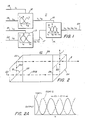
- FIG. 1 there is shown a block diagram of a typical birefringent multiplexer/demultiplexer 11.
- the birefringent multiplexer/demultiplexer 11 uses a tree structure of comb filter units 12, 13, 14.
- Each comb filter unit 12, 13, 14, as shown in Fig. 1 contains a graph of the transfer functions for the two transmission paths through it.
- a four-channel device, as depicted in Fig. 1, is shown for simplicity.
- the lines 16, 17 between the units represent interconnecting fibers or, alternatively, can represent freely propagating collimated light beams.
- Each of the two comb filters 12, 13 has a basic channel spacing of 2 ⁇ .
- the channels have this wavelength separation and travel separately along two transmission paths of the comb filter unit.
- Each unit 12, 13 has the same channel spacing, but tuned ⁇ away from each other.
- the two comb filters 12, 13 guide the channels along different paths, separated on the left and combined on the right.
- the entire configuration is bidirectional for each wavelength path.
- the overall system heretofore described can be used to multiplex four channels onto a single fiber, for example.
- a similar unit can be used at the receiving end of the system, in reverse manner, to demultiplex the four channels from one another.
- both ends of the system include both transmitters and receivers, so that the devices at either end can act as multiple wavelength duplexers.
- any one or more wavelength channels can propagate from left to right, while others propagate from right to left.
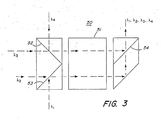
- the comb filter unit 20 includes two polarization beam splitters 21, 22, two reflecting surfaces 23, 24, and a birefringent element 26 having parallel opposite sides 27, 28.
- the birefringent element 26 can be crystalline, such as quartz or calcite, but can be, alternatively, any other birefringent material such as stressed plastic, electro-optical material, etc.
- the optical axis of the birefringent element 26 is nominally parallel to its two parallel surfaces 27, 28.
- the optical axis is oriented half way between the axes of polarization of the two beams incident upon it (i.e., 45° from each other).
- the parallel surfaces 27, 28 are oriented perpendicular to the common direction of propagation of the two beams.
- a light beam is provided at the input port 25, at the left of Fig. 2.
- Output ports 1, 2 are provided at the right, and top right, of the figure, as shown.
- a pair of light beams can be provided at the right, and top right, for combined output at the left port 25.
- a collimated beam of light (whose polarization state is immaterial) enters the input port 25 and is directed onto the first polarization beam splitter 21.
- the beam splitter 21 splits the beam into two linearly polarized beams 29A, 29B whose directions of propagation can be perpendicular to one another as shown, or at any other angle.
- the reflecting surface 23 reflects beam 29A parallel to the other 29B, and both beams 29A, 29B enter the birefringent element 26.
- both beams 29A, 29B undergo essentially the same transformation.
- the component of the optical electrical field vector which is parallel to the extraordinary axis of the material propagates faster or slower, depending upon the material, than the component parallel to the ordinary axis.
- these two components are out of phase by an amount proportional to the thickness of the birefringent material, and inversely proportional to the optical wavelength.
- polarization state which, depending on the phase, is one of the following: (1) linearly polarized parallel to the input beam polarization, (2) linearly polarized perpendicular to the input beam polarization, or (3) elliptically or circularly polarized.
- the beam component 29B that entered the input port 25 and was not reflected by the polarization splitter 21 is reflected by the second reflecting surface 24 towards the second polarization beam splitter 22.
- the other beam 29A that was reflected by the first polarization beam splitter 21 and the first reflecting surface 23 is also directed to the second polarization beam splitter 22.
- the light beam has both 0° and 90° components in both beams 29A, 29B, and thus, components of each are transmitted through the two ports 1, 2.
- a comb filter 20 To tune a comb filter 20 to a desired wavelength, it is only necessary to replace the birefringent prism 26 with one having a different thickness. Alternatively, or supplementary, a material can be used with a different ⁇ n. Further, any technique which changes the overall retardation through the crystal path can be used to tune the wavelength passband.
- FIG. 5 there is shown a block diagram of a four-channel multiplexer 50 that can be constructed with a single birefringent stage 51, in lieu of three as described hereinabove.
- using polarized signals reduces the number of birefringent comb filters units 50 from n-1 to (n/2)-1, where n is a power of 2.
Landscapes
- Physics & Mathematics (AREA)
- General Physics & Mathematics (AREA)
- Optics & Photonics (AREA)
Priority Applications (1)
| Application Number | Priority Date | Filing Date | Title |
|---|---|---|---|
| EP19890120129 EP0362900A2 (de) | 1984-09-13 | 1985-09-13 | Optischer Wellenlängenmultiplexer für vier Kanäle |
Applications Claiming Priority (3)
| Application Number | Priority Date | Filing Date | Title |
|---|---|---|---|
| US650012 | 1984-09-13 | ||
| US06/650,012 US4566761A (en) | 1984-09-13 | 1984-09-13 | Birefringent optical wavelength multiplexer/demultiplexer |
| EP19890120129 EP0362900A2 (de) | 1984-09-13 | 1985-09-13 | Optischer Wellenlängenmultiplexer für vier Kanäle |
Related Parent Applications (2)
| Application Number | Title | Priority Date | Filing Date |
|---|---|---|---|
| EP85111612.9 Division | 1985-09-13 | ||
| EP85111612A Division EP0177800A3 (de) | 1984-09-13 | 1985-09-13 | Optischer doppelbrechender Wellenlängen-Multiplexer/Demultiplexer |
Publications (1)
| Publication Number | Publication Date |
|---|---|
| EP0362900A2 true EP0362900A2 (de) | 1990-04-11 |
Family
ID=26120707
Family Applications (1)
| Application Number | Title | Priority Date | Filing Date |
|---|---|---|---|
| EP19890120129 Withdrawn EP0362900A2 (de) | 1984-09-13 | 1985-09-13 | Optischer Wellenlängenmultiplexer für vier Kanäle |
Country Status (1)
| Country | Link |
|---|---|
| EP (1) | EP0362900A2 (de) |
Cited By (4)
| Publication number | Priority date | Publication date | Assignee | Title |
|---|---|---|---|---|
| WO2002035261A3 (en) * | 2000-10-23 | 2002-11-21 | Adc Telecommunications Inc | Method and apparatus for thermally compensating a birefringent optical element |
| WO2003021836A1 (en) * | 2000-12-04 | 2003-03-13 | Chorum Technologies Lp | Compact wavelength filter using optical birefringence and reflective elements |
| US6704143B1 (en) | 2000-10-23 | 2004-03-09 | Adc Telecommunications, Inc. | Method and apparatus for adjusting an optical element to achieve a precise length |
| US7257287B2 (en) | 1998-08-21 | 2007-08-14 | Avanex Corporation | Optical interleaver |
-
1985
- 1985-09-13 EP EP19890120129 patent/EP0362900A2/de not_active Withdrawn
Cited By (5)
| Publication number | Priority date | Publication date | Assignee | Title |
|---|---|---|---|---|
| US6847786B2 (en) | 1996-10-29 | 2005-01-25 | Ec-Optics Technology, Inc. | Compact wavelength filter using optical birefringence and reflective elements |
| US7257287B2 (en) | 1998-08-21 | 2007-08-14 | Avanex Corporation | Optical interleaver |
| WO2002035261A3 (en) * | 2000-10-23 | 2002-11-21 | Adc Telecommunications Inc | Method and apparatus for thermally compensating a birefringent optical element |
| US6704143B1 (en) | 2000-10-23 | 2004-03-09 | Adc Telecommunications, Inc. | Method and apparatus for adjusting an optical element to achieve a precise length |
| WO2003021836A1 (en) * | 2000-12-04 | 2003-03-13 | Chorum Technologies Lp | Compact wavelength filter using optical birefringence and reflective elements |
Similar Documents
| Publication | Publication Date | Title |
|---|---|---|
| US4566761A (en) | Birefringent optical wavelength multiplexer/demultiplexer | |
| US4685773A (en) | Birefringent optical multiplexer with flattened bandpass | |
| JP2545047B2 (ja) | 光通信ネットワ―クにおける光搬送波抽出,再挿入機器 | |
| US6847786B2 (en) | Compact wavelength filter using optical birefringence and reflective elements | |
| US6243200B1 (en) | Optical wavelength router based on polarization interferometer | |
| US6097861A (en) | Multi-wavelength channel transmission filter | |
| EP1400047A2 (de) | Wellenlängenmultiplexeinrichtung | |
| US6370286B1 (en) | Tunable periodic filter | |
| WO2002091045A2 (en) | Compact tunable optical wavelength interleaver | |
| JP2003114402A (ja) | 光合分波器およびその調整方法 | |
| EP1203248B1 (de) | Dichter wellenlängenmultiplexer hoher isolation mit polarisationsstrahlteiler, nichtlinearem interferometer und doppelbrechenden platten | |
| US6748142B2 (en) | Integrated optical dual dispersion compensator for compensating both chromatic and polarization mode dispersion | |
| JPH0816739B2 (ja) | 波長分岐挿入素子 | |
| US6400508B1 (en) | Compact wavelength interleaver | |
| US6441961B1 (en) | Folded optical interleaver with optional routing capability | |
| US6608719B1 (en) | Comb wavelength division multiplexer | |
| US20080219668A1 (en) | Liquid crystal optical device with arrayed waveguide grating | |
| US6490377B1 (en) | Optical interleaver | |
| US20250286644A1 (en) | Optical channel monitor assisted by a switching engine | |
| US6927913B2 (en) | Optical signal processing apparatus | |
| JP2833255B2 (ja) | 光ディマルチプレクサ | |
| JP2002072008A (ja) | 光分波器および光合波器 | |
| JPH0690366B2 (ja) | 回折格子型光分波器 | |
| CN117991454A (zh) | 一种光器件以及光通信设备 | |
| US20010055158A1 (en) | Apparatus for channel interleaving in communications |
Legal Events
| Date | Code | Title | Description |
|---|---|---|---|
| PUAI | Public reference made under article 153(3) epc to a published international application that has entered the european phase |
Free format text: ORIGINAL CODE: 0009012 |
|
| 17P | Request for examination filed |
Effective date: 19891030 |
|
| AC | Divisional application: reference to earlier application |
Ref document number: 177800 Country of ref document: EP |
|
| AK | Designated contracting states |
Kind code of ref document: A2 Designated state(s): BE DE IT |
|
| STAA | Information on the status of an ep patent application or granted ep patent |
Free format text: STATUS: THE APPLICATION IS DEEMED TO BE WITHDRAWN |
|
| 18D | Application deemed to be withdrawn |
Effective date: 19901002 |