EP0363075A1 - Rohrpostempfangsstation - Google Patents
Rohrpostempfangsstation Download PDFInfo
- Publication number
- EP0363075A1 EP0363075A1 EP89309885A EP89309885A EP0363075A1 EP 0363075 A1 EP0363075 A1 EP 0363075A1 EP 89309885 A EP89309885 A EP 89309885A EP 89309885 A EP89309885 A EP 89309885A EP 0363075 A1 EP0363075 A1 EP 0363075A1
- Authority
- EP
- European Patent Office
- Prior art keywords
- tube
- conveyor
- receiver
- article
- receiving station
- Prior art date
- Legal status (The legal status is an assumption and is not a legal conclusion. Google has not performed a legal analysis and makes no representation as to the accuracy of the status listed.)
- Withdrawn
Links
- 230000005484 gravity Effects 0.000 claims description 3
- 230000003116 impacting effect Effects 0.000 claims description 2
- 239000000463 material Substances 0.000 description 4
- 229920003002 synthetic resin Polymers 0.000 description 3
- 239000000057 synthetic resin Substances 0.000 description 3
- 230000001419 dependent effect Effects 0.000 description 2
- 230000004048 modification Effects 0.000 description 2
- 238000012986 modification Methods 0.000 description 2
- 238000002485 combustion reaction Methods 0.000 description 1
- 238000001514 detection method Methods 0.000 description 1
- 230000000694 effects Effects 0.000 description 1
- 230000003287 optical effect Effects 0.000 description 1
- 238000013022 venting Methods 0.000 description 1
Images

Classifications
-
- B—PERFORMING OPERATIONS; TRANSPORTING
- B65—CONVEYING; PACKING; STORING; HANDLING THIN OR FILAMENTARY MATERIAL
- B65G—TRANSPORT OR STORAGE DEVICES, e.g. CONVEYORS FOR LOADING OR TIPPING, SHOP CONVEYOR SYSTEMS OR PNEUMATIC TUBE CONVEYORS
- B65G51/00—Conveying articles through pipes or tubes by fluid flow or pressure; Conveying articles over a flat surface, e.g. the base of a trough, by jets located in the surface
- B65G51/04—Conveying the articles in carriers having a cross-section approximating that of the pipe or tube; Tube mail systems
- B65G51/26—Stations
- B65G51/30—Stations for delivery
Definitions
- This invention relates to a receiving station for a pneumatic conveyor.
- a pneumatic conveyor includes an elongate tube along which articles being conveyed travel by virtue of an air flow. It is known to provide such a conveyor with a receiving station in the form of a tube section from which the air flow can escape thus permitting articles to decelerate along a predetermined length of the tube until they reach a stationary condition whereupon they may be lifted from the tube through an aperture therein. Although such a receiving station is adequate for many applications it has, in relation to certain applications, two disadvantages which the present invention seeks to obviate. Firstly where the articles being conveyed are of a high density material, and are travelling at speed, then their momentum is large and a considerable length of tube must be provided at the receiving station within which the articles can decelerate to rest. Secondly, in many instances it is required that articles conveyed to the receiving station are transferred automatically to a further conveyor, for example a belt type conveyor, or into the input mechanism of some further apparatus.
- a further conveyor for example a belt type conveyor
- a pneumatic conveyor receiving station comprising a receiver into which an article conveyed along the tube of the pneumatic conveyor passes, there being within the receiver, arrestor means for arresting an article entering the receiver from the conveyor tube, and, said receiver being movable, at least in part, between a first position which it occupies during arrival therein of a article from the tube of the conveyor, and a second position in which the article received by the receiver is discharged therefrom.
- said arrestor means comprises a buffer for absorbing the kinetic energy of a conveyed article impacting thereagainst.
- the receiver includes a length of tube housing said arrestor means, and movable, at least in part, between a first position in which the tube receives articles conveyed along the conveyor tube, and a second position in which articles received within the tube are discharged therefrom under gravity.
- the receiver is perforated to vent the conveyor air flow.
- the tube of the receiver is pivotted about a substantially horizontal axis passing through a region of the tube remote from the conveyor tube.
- the invention further resides in a pneumatic conveyor incorporating a receiving station as specified above.
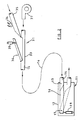
- Figure 1 is a diagrammatic perspective view of a pneumatic conveyor receiving station in accordance with one example of the present invention
- Figure 2 is a diagrammatic representation of a pneumatic conveyor utilizing a receiving station of the kind shown in Figure 1.
- the receiving station 11 includes a housing 12 supporting a short length 13 of synthetic resin tube.
- the tube 13 is, in use, coupled through a convenient union (not shown) to the discharge end of the tube 14 of the pneumatic conveyor, the tube 13 being coextensive with the tube 14 and conveniently being of the same material, and the same diameter.
- the tube 13 extends generally horizontally in use, and over the upper part of its periphery are distributed a plurality of apertures 15 through which air, or other motive gas for the pneumatic conveyor system can escape.
- a further length of identical tube 16 mounted for pivotal movement relative to the housing 11 and the tube 13 by a substantially horizontally extending pivot pin 17.
- the tube 16 is pivotable relative to the housing 11 and the tube 13 between a first position shown in full lines in the drawing, and a second position shown in dotted lines. In the first position of the tube 16 the tubes 16 and 13 are continuous, the abutting ends of the tubes having been cut obliquely with respect to their longitudinal axis.
- the axis of pivotal movement of the tube 16 is adjacent the end of the tube 16 remote from the abutting surfaces of the tubes 13 and 16 and thus the tube 16 can be pivotted to said second position in which the abutting end of the tube 16 is displaced below the corresponding end of the tube 13.
- a pad 18 conveniently formed from a high density, foamed, closed cell, synthetic resin material which acts as a buffer to arrest articles entering the tube 16 in use.
- a double acting pneumatic ram 19 the free end of the piston rod 21 of which is pivotally connected to the tube 16.
- the cylinder of the ram is pivotally mounted on the wall of the housing 11, and operation of the ram 19 moves the tube 16 between its first and second positions relative to the tube 13.
- the housing 12 includes an abutment 22 which defines the second position of the tube 16 and as can be seen from the drawing the housing 11 also supports a discharge tube 23 which is generally coextensive with the tube 16 in the second position of the tube 16.
- the ram 19 In operation, when an article being conveyed along the tube 14 by an air flow therein, is expected at the receiver station the ram 19 will be operated to move the tube 16 to its first position. In the first position the tubes 14, 13, and 16 are coextensive and an article arriving at the receiving station along the tube 14 passes through the tube 13 and into the tube 16. The apertures 15 in the tube 13, and similar apertures in the tube 16 permit deceleration of the article by venting the air flow behind the article to atmosphere. If the article does not decelerate sufficiently rapidly to come to rest when it enters the tube 16 then it will impact against the pad 18 and the material of the pad 18 is chosen such that it will absorb the kinetic energy of the article, thus arresting the article substantially without rebound.
- the ram 19 is operated to pivot the tube 16 to its second position wherein the tube 16 is inclined at a relatively steep angle to the horizontal, and the article within the tube 16 can slide therefrom, under gravity, and into the discharge tube 23.
- the discharge tube 23 conducts the discharged article to any desired location. For example discharge may take place onto a further conveyor, or into a storage area. As a further alternative discharge may take place into the inlet of a machine for performing further operations on the article.
- the receiver of the receiving station is a tube such as the tube 16. It would, if desired, be possible for certain applications to substitute a shallow trough for the tube 16 provided of course that the articles entering the trough 16 are not such as to bounce out of the trough when striking the buffer pad 18. Moreover, although it is convenient to have the whole of the receiver, whether it be a tube or a trough, pivoting between the first and second positions, it would of course be possible to pivot only a lower a section of the receiver upon which the received article rests. Thus in the case of the tube 16 an upper section thereof could be stationary, and only a lower section need pivot under the action of the ram or an equivalent actuator to discharge the article through the discharge tube 23.
- the manner in which the ram 19 is controlled may vary depending upon the application. For example, in some applications it may not be possible to predict accurately when a conveyed article will reach the receiver station, and thus the tube 14 adjacent the receiving station may be fitted with some form of sensor, for example an optical sensor which provides an output signal when an article is passing along the tube 14 and is closely approaching the receiving station.
- the signal from the sensor can be used to operate a timing mechanism which immediately actuates the ram 19 to ensure that the tube 16 is in its first position to receive the conveyed article.
- the time taken for the article to pass from the sensor to the tube 16 can of course be determined accurately, and the timing mechanism can thus be arranged to cause the ram 19 to move the tube 16 to its second position at a predetermined length of time after movement to the first position.
- Naturally discharge of a received article may be dependent upon readiness of a conveyor, or other apparatus, to receive the article, and thus operation of the ram 19 to move the ram to its second position may be initiated by receipt, in a control mechanism, of a signal from the destination of the article.
- the ram 19 would be operated to maintain the tube 16 in its first position and when the sensor 34 sends a signal causing the cover 36 of the input station 31 to open then the same signal would cause the ram 19 to move the tube 16 to its second position.
- the timing of movement of the tube 16 in relation to movement of the cover of the input station may need to be varied dependent upon the length of the tube 14 and the speed of movement of the articles being conveyed.
- a time delay mechanism may be incorporated so that although operation of the ram 19 is controlled by the sensor controlling movement of the cover of the input station, the timing of the actuation is varied to accommodate the time taken for articles to travel from the input station to the receiving station.
- Also disclosed in our copending application 8818612.7 is a variation intended to accommodate articles of relatively high mass (high density) such as metallic inlet and outlet valves for internal combustion engines.
- articles of relatively high mass high density
- the cover When conveying such articles, particularly when the distance through which the articles are to be conveyed is relatively small, it has been found convenient to operate the input station such that the cover is normally open, and is closed at a predetermined intervals after an article in the supply line, for entry into the input station, has been detected.
- the cover is normally open, the approach of an article is detected, the article enters the input station and a predetermined time after detection the cover is closed, and remains closed for a predetermined length of time sufficient for the article to be accelerated by the air flow to a velocity such that the articles momentum will permit it to reach the destination.
- the cover is opened so greatly reducing the air flow and leaving the article to continue substantially without further propulsion from the air flow.
- the ram 19 can be operated by the signal which causes closure of the cover of the input station, to move the tube 16 to its first position, and the signal which causes opening of the cover of the input station also causes operation of the ram 19 to move the tube 16 to its second position. Again timing variations may need to be incorporated in order to accommodate the time taken for the article to pass from the input station to the receiving station.
- the perforations 15 are omitted so that the air flow to the receiving station can escape only when the tube 16 is in its open, second position.
- articles may be accelerated along the main conveying tube by ensuring that the tube 16 is in its second position, the air flow being subsequently reduced by moving the tube 16 to its first, closed position so restricting or preventing the flow of air along the main conveying tube in the region of the receiving station.
- Timer or other control arrangements can be used to effect operation of the ram 19 at appropriate points in the passage of articles along the system.
- the receiving station disclosed above is used in conjunction with an input station comprising an open end of the main conveying tube through which air is drawn into the system.
- a pusher or other mechanical device can be utilized to introduce articles to be conveyed, singly into the tube.
- the air flow in the tube can be generated by a blower arrangement connected in parallel with the tube or by a blower positioned downstream of the receiving station and drawing air through the main conveying tube, the tube 13, and the tube 16.
- the pad 18 is arranged to permit the air flow while still acting as an abutment for conveyed articles. Opening of the tube 13 to its second position will break the air flow path therethrough so that an article in the tube can slide therefrom into the discharge tube 23 or other discharge arrangement.
- the conveyor may be provided with a control system incorporating interlocks to ensure that articles cannot be input at an input station until the receiving station has successfully discharged a previously conveyed article and so can be readied, or is actually ready, to receive a further article.
- the interlocks may extend to the destination of articles discharged from the receiving station so that articles cannot be input at an input station until previous articles have been successfully discharged from the receiving station and successfully received at their destination.
Landscapes
- Physics & Mathematics (AREA)
- Engineering & Computer Science (AREA)
- Fluid Mechanics (AREA)
- Mechanical Engineering (AREA)
- Attitude Control For Articles On Conveyors (AREA)
Applications Claiming Priority (2)
| Application Number | Priority Date | Filing Date | Title |
|---|---|---|---|
| GB888823171A GB8823171D0 (en) | 1988-10-03 | 1988-10-03 | Receiving station |
| GB8823171 | 1988-10-03 |
Publications (1)
| Publication Number | Publication Date |
|---|---|
| EP0363075A1 true EP0363075A1 (de) | 1990-04-11 |
Family
ID=10644624
Family Applications (1)
| Application Number | Title | Priority Date | Filing Date |
|---|---|---|---|
| EP89309885A Withdrawn EP0363075A1 (de) | 1988-10-03 | 1989-09-28 | Rohrpostempfangsstation |
Country Status (5)
| Country | Link |
|---|---|
| EP (1) | EP0363075A1 (de) |
| JP (1) | JPH02231311A (de) |
| AU (1) | AU4249989A (de) |
| GB (1) | GB8823171D0 (de) |
| ZA (1) | ZA897512B (de) |
Cited By (1)
| Publication number | Priority date | Publication date | Assignee | Title |
|---|---|---|---|---|
| CN111591766A (zh) * | 2019-02-20 | 2020-08-28 | 江苏雷镈智能科技有限公司 | 缓冲装置及其应用 |
Citations (7)
| Publication number | Priority date | Publication date | Assignee | Title |
|---|---|---|---|---|
| DE115718C (de) * | ||||
| DE112958C (de) * | ||||
| DE1203687B (de) * | 1962-06-26 | 1965-10-21 | Standard Elektrik Lorenz Ag | Rohrpoststation zum wahlweisen Absenden, Empfangen und Passierenlassen von Rohrpostbuechsen |
| DE1286462B (de) * | 1967-02-10 | 1969-01-02 | Deutsche Bundespost | Empfangsstation fuer Rohrpostanlagen |
| GB1231730A (de) * | 1969-10-08 | 1971-05-12 | ||
| US4003530A (en) * | 1975-08-13 | 1977-01-18 | Davis Orin H | Pneumatic courier discharge unit |
| US4315704A (en) * | 1979-05-11 | 1982-02-16 | Charles K. Kelley And Sons Inc. | Single line pneumatic tube system |
-
1988
- 1988-10-03 GB GB888823171A patent/GB8823171D0/en active Pending
-
1989
- 1989-09-28 EP EP89309885A patent/EP0363075A1/de not_active Withdrawn
- 1989-10-03 ZA ZA897512A patent/ZA897512B/xx unknown
- 1989-10-03 JP JP1258635A patent/JPH02231311A/ja active Pending
- 1989-10-03 AU AU42499/89A patent/AU4249989A/en not_active Abandoned
Patent Citations (7)
| Publication number | Priority date | Publication date | Assignee | Title |
|---|---|---|---|---|
| DE115718C (de) * | ||||
| DE112958C (de) * | ||||
| DE1203687B (de) * | 1962-06-26 | 1965-10-21 | Standard Elektrik Lorenz Ag | Rohrpoststation zum wahlweisen Absenden, Empfangen und Passierenlassen von Rohrpostbuechsen |
| DE1286462B (de) * | 1967-02-10 | 1969-01-02 | Deutsche Bundespost | Empfangsstation fuer Rohrpostanlagen |
| GB1231730A (de) * | 1969-10-08 | 1971-05-12 | ||
| US4003530A (en) * | 1975-08-13 | 1977-01-18 | Davis Orin H | Pneumatic courier discharge unit |
| US4315704A (en) * | 1979-05-11 | 1982-02-16 | Charles K. Kelley And Sons Inc. | Single line pneumatic tube system |
Cited By (1)
| Publication number | Priority date | Publication date | Assignee | Title |
|---|---|---|---|---|
| CN111591766A (zh) * | 2019-02-20 | 2020-08-28 | 江苏雷镈智能科技有限公司 | 缓冲装置及其应用 |
Also Published As
| Publication number | Publication date |
|---|---|
| ZA897512B (en) | 1990-06-27 |
| AU4249989A (en) | 1990-04-05 |
| GB8823171D0 (en) | 1988-11-09 |
| JPH02231311A (ja) | 1990-09-13 |
Similar Documents
| Publication | Publication Date | Title |
|---|---|---|
| US5813196A (en) | Automatic sequential bagging machine with constant feed and method of operation | |
| US4195737A (en) | Method and apparatus for handling elongated articles, such as pieces of timber | |
| US6322295B1 (en) | Pneumatic apparatus and method for transporting irregularly-shaped objects | |
| JPS62171819A (ja) | 第1搬送装置から第2搬送装置へ物品を側方に偏向させる装置 | |
| MXPA01000673A (es) | Transportador de aire para transportar articulos suspendidos y proceso para liberar, disminuir la velocidad o inmovilizar articulos o impartir un ritmo a los mismos. | |
| DK1015363T3 (da) | Fremgangsmåde til omledning af en artikel fra en transportør ved hjælp af en udstøder og en anordning dertil | |
| EP0033211B1 (de) | Ausscheidesystem für eine automatische Sortiermaschine | |
| RU2731801C1 (ru) | Отводящее устройство со стабилизирующим устройством, создающим эффект коанда | |
| EP0742165A1 (de) | Vorrichtung zum Sortieren von Produkten | |
| EP0363075A1 (de) | Rohrpostempfangsstation | |
| US9592967B2 (en) | Preform conveying apparatus and method | |
| US3008563A (en) | Charge-arresting device for article accumulators | |
| US5127773A (en) | Carrier delivery terminal for a pneumatic transport system | |
| EP0165473B1 (de) | Transportbahn für Werkstücke | |
| US6401904B1 (en) | Method and apparatus for separating objects | |
| US7140828B2 (en) | Non-contact aerodynamic diverter/stacker insertion system | |
| JP2006061767A (ja) | 振り分け装置 | |
| US5249794A (en) | Feed device for a sorting machine for sorting flat objects such as postal items | |
| EA000143B1 (ru) | Устройство для отвода отдельной или нескольких емкостей в виде тела вращения из транспортируемого под действием скоростного напора потока емкостей в виде тела вращения и цилиндр с управляемо-выдвигаемым поршнем | |
| EP0376382B1 (de) | Sortieranlage, welche mit sich bewegenden Hängeklauen ausgestattet ist, welche von zwei Seiten betätigbar sind | |
| GB2222131A (en) | Pneumatic transport station | |
| CN210159973U (zh) | 重力驱动式货物分拣装置及系统 | |
| US3310142A (en) | Autoamtic cap ejector | |
| US5682973A (en) | Mail decelerating device | |
| EP0353964A2 (de) | Pneumatischer Förderer |
Legal Events
| Date | Code | Title | Description |
|---|---|---|---|
| PUAI | Public reference made under article 153(3) epc to a published international application that has entered the european phase |
Free format text: ORIGINAL CODE: 0009012 |
|
| AK | Designated contracting states |
Kind code of ref document: A1 Designated state(s): AT BE CH DE ES FR GB GR IT LI LU NL SE |
|
| STAA | Information on the status of an ep patent application or granted ep patent |
Free format text: STATUS: THE APPLICATION IS DEEMED TO BE WITHDRAWN |
|
| 18D | Application deemed to be withdrawn |
Effective date: 19901012 |