EP0363085A2 - Novel compounds - Google Patents
Novel compounds Download PDFInfo
- Publication number
- EP0363085A2 EP0363085A2 EP89309920A EP89309920A EP0363085A2 EP 0363085 A2 EP0363085 A2 EP 0363085A2 EP 89309920 A EP89309920 A EP 89309920A EP 89309920 A EP89309920 A EP 89309920A EP 0363085 A2 EP0363085 A2 EP 0363085A2
- Authority
- EP
- European Patent Office
- Prior art keywords
- methyl
- group
- azabicyclo
- oxadiazol
- compound
- Prior art date
- Legal status (The legal status is an assumption and is not a legal conclusion. Google has not performed a legal analysis and makes no representation as to the accuracy of the status listed.)
- Withdrawn
Links
- 150000001875 compounds Chemical class 0.000 title claims abstract description 147
- -1 C2−4alkenyl Chemical group 0.000 claims abstract description 88
- IJGRMHOSHXDMSA-UHFFFAOYSA-N Atomic nitrogen Chemical group N#N IJGRMHOSHXDMSA-UHFFFAOYSA-N 0.000 claims abstract description 77
- 229910052757 nitrogen Inorganic materials 0.000 claims abstract description 43
- 239000001257 hydrogen Substances 0.000 claims abstract description 42
- 229910052739 hydrogen Inorganic materials 0.000 claims abstract description 42
- 150000003839 salts Chemical class 0.000 claims abstract description 21
- UFHFLCQGNIYNRP-UHFFFAOYSA-N Hydrogen Chemical compound [H][H] UFHFLCQGNIYNRP-UHFFFAOYSA-N 0.000 claims abstract description 17
- 125000004435 hydrogen atom Chemical group [H]* 0.000 claims abstract description 16
- NINIDFKCEFEMDL-UHFFFAOYSA-N Sulfur Chemical group [S] NINIDFKCEFEMDL-UHFFFAOYSA-N 0.000 claims abstract description 14
- 239000005864 Sulphur Chemical group 0.000 claims abstract description 13
- 125000000217 alkyl group Chemical group 0.000 claims abstract description 11
- 150000002431 hydrogen Chemical class 0.000 claims abstract description 11
- QVGXLLKOCUKJST-UHFFFAOYSA-N atomic oxygen Chemical group [O] QVGXLLKOCUKJST-UHFFFAOYSA-N 0.000 claims abstract description 10
- 229910052760 oxygen Inorganic materials 0.000 claims abstract description 10
- 239000001301 oxygen Substances 0.000 claims abstract description 10
- 229910052799 carbon Inorganic materials 0.000 claims abstract description 9
- 125000003118 aryl group Chemical group 0.000 claims abstract description 8
- 125000001559 cyclopropyl group Chemical group [H]C1([H])C([H])([H])C1([H])* 0.000 claims abstract description 8
- OAKJQQAXSVQMHS-UHFFFAOYSA-N Hydrazine Chemical compound NN OAKJQQAXSVQMHS-UHFFFAOYSA-N 0.000 claims abstract description 7
- 229910052736 halogen Inorganic materials 0.000 claims abstract description 6
- 125000005843 halogen group Chemical group 0.000 claims abstract description 6
- 150000002367 halogens Chemical class 0.000 claims abstract description 6
- 125000004433 nitrogen atom Chemical group N* 0.000 claims abstract description 6
- 150000001721 carbon Chemical group 0.000 claims abstract description 5
- 125000006650 (C2-C4) alkynyl group Chemical group 0.000 claims abstract description 3
- 125000001494 2-propynyl group Chemical group [H]C#CC([H])([H])* 0.000 claims abstract description 3
- 101100294115 Caenorhabditis elegans nhr-4 gene Proteins 0.000 claims abstract description 3
- 101100295741 Gallus gallus COR4 gene Proteins 0.000 claims abstract description 3
- 101100134922 Gallus gallus COR5 gene Proteins 0.000 claims abstract description 3
- 125000005842 heteroatom Chemical group 0.000 claims abstract description 3
- 125000000717 hydrazino group Chemical group [H]N([*])N([H])[H] 0.000 claims abstract description 3
- QJGQUHMNIGDVPM-UHFFFAOYSA-N nitrogen group Chemical group [N] QJGQUHMNIGDVPM-UHFFFAOYSA-N 0.000 claims abstract description 3
- 238000011282 treatment Methods 0.000 claims description 35
- 238000000034 method Methods 0.000 claims description 32
- 125000002496 methyl group Chemical group [H]C([H])([H])* 0.000 claims description 30
- 125000006575 electron-withdrawing group Chemical group 0.000 claims description 10
- 125000002941 2-furyl group Chemical group O1C([*])=C([H])C([H])=C1[H] 0.000 claims description 9
- CDNFGQCWGGTNRR-UHFFFAOYSA-N 5-(1-azabicyclo[2.2.1]heptan-3-ylmethyl)-1,2,4-oxadiazol-3-amine Chemical compound NC1=NOC(CC2C3CCN(C3)C2)=N1 CDNFGQCWGGTNRR-UHFFFAOYSA-N 0.000 claims description 8
- 238000002360 preparation method Methods 0.000 claims description 8
- 206010012289 Dementia Diseases 0.000 claims description 6
- 238000011321 prophylaxis Methods 0.000 claims description 6
- 125000001359 1,2,3-triazol-4-yl group Chemical group [H]N1N=NC([*])=C1[H] 0.000 claims description 4
- KBBLOOLKEXZMNG-UHFFFAOYSA-N 5-(1-azabicyclo[2.2.1]heptan-4-ylmethyl)-1,2,4-oxadiazol-3-amine Chemical compound NC1=NOC(CC23CCN(CC2)C3)=N1 KBBLOOLKEXZMNG-UHFFFAOYSA-N 0.000 claims description 4
- 125000003682 3-furyl group Chemical group O1C([H])=C([*])C([H])=C1[H] 0.000 claims description 3
- NOCSRXKUXLTKMN-UHFFFAOYSA-N 5-(1-azabicyclo[3.2.1]octan-5-ylmethyl)-1,2,4-oxadiazol-3-amine Chemical compound NC1=NOC(CC23CN(CC2)CCC3)=N1 NOCSRXKUXLTKMN-UHFFFAOYSA-N 0.000 claims description 3
- 150000001450 anions Chemical class 0.000 claims description 3
- 239000003814 drug Substances 0.000 claims description 3
- 125000006592 (C2-C3) alkenyl group Chemical group 0.000 claims description 2
- 125000006593 (C2-C3) alkynyl group Chemical group 0.000 claims description 2
- 125000006656 (C2-C4) alkenyl group Chemical group 0.000 claims description 2
- 125000004505 1,2,4-oxadiazol-5-yl group Chemical group O1N=CN=C1* 0.000 claims description 2
- 125000004516 1,2,4-thiadiazol-5-yl group Chemical group S1N=CN=C1* 0.000 claims description 2
- 125000004509 1,3,4-oxadiazol-2-yl group Chemical group O1C(=NN=C1)* 0.000 claims description 2
- 125000004521 1,3,4-thiadiazol-2-yl group Chemical group S1C(=NN=C1)* 0.000 claims description 2
- 230000000911 decarboxylating effect Effects 0.000 claims description 2
- 239000003937 drug carrier Substances 0.000 claims description 2
- 125000001153 fluoro group Chemical group F* 0.000 claims description 2
- 230000003301 hydrolyzing effect Effects 0.000 claims description 2
- 239000008194 pharmaceutical composition Substances 0.000 claims description 2
- 229910052700 potassium Inorganic materials 0.000 claims description 2
- 125000006239 protecting group Chemical group 0.000 claims description 2
- YWIUWODLXMFUED-UHFFFAOYSA-N 3-(1-azabicyclo[2.2.1]heptan-3-ylmethyl)-5-methyl-1,2,4-oxadiazole Chemical compound O1C(C)=NC(CC2C3CCN(C3)C2)=N1 YWIUWODLXMFUED-UHFFFAOYSA-N 0.000 claims 2
- 238000004519 manufacturing process Methods 0.000 claims 2
- LJXCQIKEWHQDPR-UHFFFAOYSA-N 2-(1-azabicyclo[2.2.1]heptan-3-ylmethyl)-1,3-oxazole Chemical compound C1N(C2)CCC2C1CC1=NC=CO1 LJXCQIKEWHQDPR-UHFFFAOYSA-N 0.000 claims 1
- UQVPTTVEGRFDOB-UHFFFAOYSA-N 2-(1-azabicyclo[2.2.1]heptan-4-ylmethyl)-1,3-oxazole Chemical compound C1CN(C2)CCC12CC1=NC=CO1 UQVPTTVEGRFDOB-UHFFFAOYSA-N 0.000 claims 1
- FTXVLRDLSMMLJU-UHFFFAOYSA-N 2-(1-azabicyclo[2.2.2]octan-3-ylmethyl)-1,3-oxazole Chemical compound C1N(CC2)CCC2C1CC1=NC=CO1 FTXVLRDLSMMLJU-UHFFFAOYSA-N 0.000 claims 1
- BEBRDMZDCXOXHT-UHFFFAOYSA-N 2-(1-azabicyclo[2.2.2]octan-3-ylmethyl)-1,3-thiazole Chemical compound C1N(CC2)CCC2C1CC1=NC=CS1 BEBRDMZDCXOXHT-UHFFFAOYSA-N 0.000 claims 1
- NOERKWOSGQEOBF-UHFFFAOYSA-N 3-[(2-methyltetrazol-5-yl)methyl]-1-azabicyclo[2.2.1]heptane Chemical compound CN1N=NC(CC2C3CCN(C3)C2)=N1 NOERKWOSGQEOBF-UHFFFAOYSA-N 0.000 claims 1
- SLRDKPFTLHDDMV-UHFFFAOYSA-N 5-(1-azabicyclo[2.2.1]heptan-3-ylmethyl)-1,3-oxazole Chemical compound C1N(C2)CCC2C1CC1=CN=CO1 SLRDKPFTLHDDMV-UHFFFAOYSA-N 0.000 claims 1
- PRDVUGJQWYTJTK-UHFFFAOYSA-N 5-(1-azabicyclo[2.2.1]heptan-3-ylmethyl)-3-methyl-1,2,4-oxadiazole Chemical compound CC1=NOC(CC2C3CCN(C3)C2)=N1 PRDVUGJQWYTJTK-UHFFFAOYSA-N 0.000 claims 1
- QSYRKYFBYRTVFI-UHFFFAOYSA-N 5-(1-azabicyclo[2.2.2]octan-3-ylmethyl)-3-methyl-1,2,4-oxadiazole Chemical compound CC1=NOC(CC2C3CCN(CC3)C2)=N1 QSYRKYFBYRTVFI-UHFFFAOYSA-N 0.000 claims 1
- OKKJLVBELUTLKV-UHFFFAOYSA-N Methanol Chemical compound OC OKKJLVBELUTLKV-UHFFFAOYSA-N 0.000 description 168
- HEDRZPFGACZZDS-UHFFFAOYSA-N Chloroform Chemical compound ClC(Cl)Cl HEDRZPFGACZZDS-UHFFFAOYSA-N 0.000 description 124
- RTZKZFJDLAIYFH-UHFFFAOYSA-N Diethyl ether Chemical compound CCOCC RTZKZFJDLAIYFH-UHFFFAOYSA-N 0.000 description 98
- YXFVVABEGXRONW-UHFFFAOYSA-N Toluene Chemical compound CC1=CC=CC=C1 YXFVVABEGXRONW-UHFFFAOYSA-N 0.000 description 96
- LFQSCWFLJHTTHZ-UHFFFAOYSA-N Ethanol Chemical compound CCO LFQSCWFLJHTTHZ-UHFFFAOYSA-N 0.000 description 90
- HEDRZPFGACZZDS-MICDWDOJSA-N Trichloro(2H)methane Chemical compound [2H]C(Cl)(Cl)Cl HEDRZPFGACZZDS-MICDWDOJSA-N 0.000 description 80
- 238000006243 chemical reaction Methods 0.000 description 79
- 239000000243 solution Substances 0.000 description 73
- 239000003921 oil Substances 0.000 description 69
- 235000019198 oils Nutrition 0.000 description 69
- BWHMMNNQKKPAPP-UHFFFAOYSA-L potassium carbonate Chemical compound [K+].[K+].[O-]C([O-])=O BWHMMNNQKKPAPP-UHFFFAOYSA-L 0.000 description 64
- 239000000203 mixture Substances 0.000 description 55
- PMZURENOXWZQFD-UHFFFAOYSA-L Sodium Sulfate Chemical compound [Na+].[Na+].[O-]S([O-])(=O)=O PMZURENOXWZQFD-UHFFFAOYSA-L 0.000 description 53
- VEXZGXHMUGYJMC-UHFFFAOYSA-N Hydrochloric acid Chemical compound Cl VEXZGXHMUGYJMC-UHFFFAOYSA-N 0.000 description 49
- YMWUJEATGCHHMB-UHFFFAOYSA-N Dichloromethane Chemical compound ClCCl YMWUJEATGCHHMB-UHFFFAOYSA-N 0.000 description 48
- 238000010992 reflux Methods 0.000 description 48
- FYSNRJHAOHDILO-UHFFFAOYSA-N thionyl chloride Chemical compound ClS(Cl)=O FYSNRJHAOHDILO-UHFFFAOYSA-N 0.000 description 46
- 238000005160 1H NMR spectroscopy Methods 0.000 description 44
- 229920006395 saturated elastomer Polymers 0.000 description 44
- 229910052938 sodium sulfate Inorganic materials 0.000 description 44
- 235000011152 sodium sulphate Nutrition 0.000 description 44
- QTBSBXVTEAMEQO-UHFFFAOYSA-N Acetic acid Chemical compound CC(O)=O QTBSBXVTEAMEQO-UHFFFAOYSA-N 0.000 description 35
- 239000007832 Na2SO4 Substances 0.000 description 35
- XEKOWRVHYACXOJ-UHFFFAOYSA-N Ethyl acetate Natural products CCOC(C)=O XEKOWRVHYACXOJ-UHFFFAOYSA-N 0.000 description 34
- 229910000027 potassium carbonate Inorganic materials 0.000 description 32
- 239000007787 solid Substances 0.000 description 32
- XLYOFNOQVPJJNP-UHFFFAOYSA-N water Substances O XLYOFNOQVPJJNP-UHFFFAOYSA-N 0.000 description 32
- 235000019441 ethanol Nutrition 0.000 description 31
- 235000011181 potassium carbonates Nutrition 0.000 description 31
- 239000012074 organic phase Substances 0.000 description 30
- ZMXDDKWLCZADIW-UHFFFAOYSA-N N,N-Dimethylformamide Chemical compound CN(C)C=O ZMXDDKWLCZADIW-UHFFFAOYSA-N 0.000 description 28
- WYURNTSHIVDZCO-UHFFFAOYSA-N Tetrahydrofuran Chemical compound C1CCOC1 WYURNTSHIVDZCO-UHFFFAOYSA-N 0.000 description 28
- 239000002253 acid Substances 0.000 description 26
- TYJJADVDDVDEDZ-UHFFFAOYSA-M potassium hydrogencarbonate Chemical compound [K+].OC([O-])=O TYJJADVDDVDEDZ-UHFFFAOYSA-M 0.000 description 26
- IAZDPXIOMUYVGZ-UHFFFAOYSA-N Dimethylsulphoxide Chemical compound CS(C)=O IAZDPXIOMUYVGZ-UHFFFAOYSA-N 0.000 description 24
- VYPSYNLAJGMNEJ-UHFFFAOYSA-N Silicium dioxide Chemical compound O=[Si]=O VYPSYNLAJGMNEJ-UHFFFAOYSA-N 0.000 description 24
- 239000011541 reaction mixture Substances 0.000 description 24
- 239000002904 solvent Substances 0.000 description 24
- CSCPPACGZOOCGX-UHFFFAOYSA-N Acetone Chemical compound CC(C)=O CSCPPACGZOOCGX-UHFFFAOYSA-N 0.000 description 21
- 238000001644 13C nuclear magnetic resonance spectroscopy Methods 0.000 description 20
- 239000012298 atmosphere Substances 0.000 description 19
- OKKJLVBELUTLKV-MZCSYVLQSA-N Deuterated methanol Chemical compound [2H]OC([2H])([2H])[2H] OKKJLVBELUTLKV-MZCSYVLQSA-N 0.000 description 18
- YLQBMQCUIZJEEH-UHFFFAOYSA-N Furan Chemical compound C=1C=COC=1 YLQBMQCUIZJEEH-UHFFFAOYSA-N 0.000 description 17
- 125000004453 alkoxycarbonyl group Chemical group 0.000 description 17
- 150000001408 amides Chemical class 0.000 description 16
- 125000002485 formyl group Chemical group [H]C(*)=O 0.000 description 16
- JUJWROOIHBZHMG-UHFFFAOYSA-N Pyridine Chemical compound C1=CC=NC=C1 JUJWROOIHBZHMG-UHFFFAOYSA-N 0.000 description 15
- 239000000284 extract Substances 0.000 description 15
- QGZKDVFQNNGYKY-UHFFFAOYSA-N Ammonia Chemical compound N QGZKDVFQNNGYKY-UHFFFAOYSA-N 0.000 description 14
- MZRVEZGGRBJDDB-UHFFFAOYSA-N N-Butyllithium Chemical compound [Li]CCCC MZRVEZGGRBJDDB-UHFFFAOYSA-N 0.000 description 14
- MUBZPKHOEPUJKR-UHFFFAOYSA-N Oxalic acid Chemical compound OC(=O)C(O)=O MUBZPKHOEPUJKR-UHFFFAOYSA-N 0.000 description 14
- KDLHZDBZIXYQEI-UHFFFAOYSA-N Palladium Chemical compound [Pd] KDLHZDBZIXYQEI-UHFFFAOYSA-N 0.000 description 14
- 238000003756 stirring Methods 0.000 description 14
- 229960000583 acetic acid Drugs 0.000 description 13
- 150000002148 esters Chemical class 0.000 description 13
- WEVYAHXRMPXWCK-UHFFFAOYSA-N Acetonitrile Chemical compound CC#N WEVYAHXRMPXWCK-UHFFFAOYSA-N 0.000 description 12
- 125000003178 carboxy group Chemical group [H]OC(*)=O 0.000 description 12
- 239000003054 catalyst Substances 0.000 description 12
- 125000004093 cyano group Chemical group *C#N 0.000 description 12
- IPCUHOZQKJVNNS-UHFFFAOYSA-N ethyl 2-(1-azabicyclo[2.2.1]heptan-3-yl)acetate Chemical compound C1CC2C(CC(=O)OCC)CN1C2 IPCUHOZQKJVNNS-UHFFFAOYSA-N 0.000 description 11
- 150000003891 oxalate salts Chemical class 0.000 description 11
- 229920000137 polyphosphoric acid Polymers 0.000 description 11
- XTHFKEDIFFGKHM-UHFFFAOYSA-N Dimethoxyethane Chemical compound COCCOC XTHFKEDIFFGKHM-UHFFFAOYSA-N 0.000 description 10
- 238000004821 distillation Methods 0.000 description 10
- 239000012442 inert solvent Substances 0.000 description 10
- ZCSHNCUQKCANBX-UHFFFAOYSA-N lithium diisopropylamide Chemical compound [Li+].CC(C)[N-]C(C)C ZCSHNCUQKCANBX-UHFFFAOYSA-N 0.000 description 10
- 239000000047 product Substances 0.000 description 10
- 238000010828 elution Methods 0.000 description 9
- 239000000543 intermediate Substances 0.000 description 9
- CENHCJCHLRDIEE-UHFFFAOYSA-N methyl 2-(1-azabicyclo[2.2.1]heptan-3-yl)acetate Chemical compound C1CC2C(CC(=O)OC)CN1C2 CENHCJCHLRDIEE-UHFFFAOYSA-N 0.000 description 9
- VLKZOEOYAKHREP-UHFFFAOYSA-N n-Hexane Chemical compound CCCCCC VLKZOEOYAKHREP-UHFFFAOYSA-N 0.000 description 9
- 239000000725 suspension Substances 0.000 description 9
- CPELXLSAUQHCOX-UHFFFAOYSA-N Hydrogen bromide Chemical compound Br CPELXLSAUQHCOX-UHFFFAOYSA-N 0.000 description 8
- 125000003917 carbamoyl group Chemical group [H]N([H])C(*)=O 0.000 description 8
- IXCSERBJSXMMFS-UHFFFAOYSA-N hydrogen chloride Substances Cl.Cl IXCSERBJSXMMFS-UHFFFAOYSA-N 0.000 description 8
- 229910000041 hydrogen chloride Inorganic materials 0.000 description 8
- OSZWLWIIRBIOOH-UHFFFAOYSA-N 2-(1-azabicyclo[2.2.1]heptan-3-yl)acetonitrile Chemical compound C1CC2C(CC#N)CN1C2 OSZWLWIIRBIOOH-UHFFFAOYSA-N 0.000 description 7
- MSIHYZBPKIMRGA-UHFFFAOYSA-N 2-(1-azabicyclo[2.2.1]heptan-4-yl)acetonitrile Chemical compound C1CN2CCC1(CC#N)C2 MSIHYZBPKIMRGA-UHFFFAOYSA-N 0.000 description 7
- WSFSSNUMVMOOMR-UHFFFAOYSA-N Formaldehyde Chemical compound O=C WSFSSNUMVMOOMR-UHFFFAOYSA-N 0.000 description 7
- PNEYBMLMFCGWSK-UHFFFAOYSA-N aluminium oxide Inorganic materials [O-2].[O-2].[O-2].[Al+3].[Al+3] PNEYBMLMFCGWSK-UHFFFAOYSA-N 0.000 description 7
- 229910021529 ammonia Inorganic materials 0.000 description 7
- 239000002585 base Substances 0.000 description 7
- 125000002915 carbonyl group Chemical group [*:2]C([*:1])=O 0.000 description 7
- 239000007788 liquid Substances 0.000 description 7
- 239000012044 organic layer Substances 0.000 description 7
- LPNYRYFBWFDTMA-UHFFFAOYSA-N potassium tert-butoxide Chemical compound [K+].CC(C)(C)[O-] LPNYRYFBWFDTMA-UHFFFAOYSA-N 0.000 description 7
- UMJSCPRVCHMLSP-UHFFFAOYSA-N pyridine Natural products COC1=CC=CN=C1 UMJSCPRVCHMLSP-UHFFFAOYSA-N 0.000 description 7
- LPUPMJJQOVTXRZ-UHFFFAOYSA-N 3-(1-azabicyclo[2.2.1]heptan-3-ylmethyl)-5-methyl-1,2,4-oxadiazole;hydrochloride Chemical compound Cl.O1C(C)=NC(CC2C3CCN(C3)C2)=N1 LPUPMJJQOVTXRZ-UHFFFAOYSA-N 0.000 description 6
- YXHKONLOYHBTNS-UHFFFAOYSA-N Diazomethane Chemical compound C=[N+]=[N-] YXHKONLOYHBTNS-UHFFFAOYSA-N 0.000 description 6
- WTDHULULXKLSOZ-UHFFFAOYSA-N Hydroxylamine hydrochloride Chemical compound Cl.ON WTDHULULXKLSOZ-UHFFFAOYSA-N 0.000 description 6
- DGAQECJNVWCQMB-PUAWFVPOSA-M Ilexoside XXIX Chemical compound C[C@@H]1CC[C@@]2(CC[C@@]3(C(=CC[C@H]4[C@]3(CC[C@@H]5[C@@]4(CC[C@@H](C5(C)C)OS(=O)(=O)[O-])C)C)[C@@H]2[C@]1(C)O)C)C(=O)O[C@H]6[C@@H]([C@H]([C@@H]([C@H](O6)CO)O)O)O.[Na+] DGAQECJNVWCQMB-PUAWFVPOSA-M 0.000 description 6
- CTQNGGLPUBDAKN-UHFFFAOYSA-N O-Xylene Chemical compound CC1=CC=CC=C1C CTQNGGLPUBDAKN-UHFFFAOYSA-N 0.000 description 6
- KWYUFKZDYYNOTN-UHFFFAOYSA-M Potassium hydroxide Chemical compound [OH-].[K+] KWYUFKZDYYNOTN-UHFFFAOYSA-M 0.000 description 6
- ZMANZCXQSJIPKH-UHFFFAOYSA-N Triethylamine Chemical compound CCN(CC)CC ZMANZCXQSJIPKH-UHFFFAOYSA-N 0.000 description 6
- GSLDEZOOOSBFGP-UHFFFAOYSA-N alpha-methylene gamma-butyrolactone Chemical compound C=C1CCOC1=O GSLDEZOOOSBFGP-UHFFFAOYSA-N 0.000 description 6
- 125000001797 benzyl group Chemical group [H]C1=C([H])C([H])=C(C([H])=C1[H])C([H])([H])* 0.000 description 6
- WGQKYBSKWIADBV-UHFFFAOYSA-N benzylamine Chemical compound NCC1=CC=CC=C1 WGQKYBSKWIADBV-UHFFFAOYSA-N 0.000 description 6
- 125000001309 chloro group Chemical group Cl* 0.000 description 6
- 238000004440 column chromatography Methods 0.000 description 6
- SIPUZPBQZHNSDW-UHFFFAOYSA-N diisobutylaluminium hydride Substances CC(C)C[Al]CC(C)C SIPUZPBQZHNSDW-UHFFFAOYSA-N 0.000 description 6
- YDKODYWXEYGFFH-UHFFFAOYSA-N ethyl 2-(1-azabicyclo[2.2.1]heptan-3-ylidene)acetate;oxalic acid Chemical compound OC(=O)C(O)=O.C1CC2C(=CC(=O)OCC)CN1C2 YDKODYWXEYGFFH-UHFFFAOYSA-N 0.000 description 6
- 239000000706 filtrate Substances 0.000 description 6
- 125000000623 heterocyclic group Chemical group 0.000 description 6
- 125000002887 hydroxy group Chemical group [H]O* 0.000 description 6
- 239000000377 silicon dioxide Substances 0.000 description 6
- NDVLTYZPCACLMA-UHFFFAOYSA-N silver oxide Chemical compound [O-2].[Ag+].[Ag+] NDVLTYZPCACLMA-UHFFFAOYSA-N 0.000 description 6
- 239000011734 sodium Substances 0.000 description 6
- 229910052708 sodium Inorganic materials 0.000 description 6
- AQRLNPVMDITEJU-UHFFFAOYSA-N triethylsilane Chemical compound CC[SiH](CC)CC AQRLNPVMDITEJU-UHFFFAOYSA-N 0.000 description 6
- 239000003981 vehicle Substances 0.000 description 6
- 239000008096 xylene Substances 0.000 description 6
- VAYTZRYEBVHVLE-UHFFFAOYSA-N 1,3-dioxol-2-one Chemical compound O=C1OC=CO1 VAYTZRYEBVHVLE-UHFFFAOYSA-N 0.000 description 5
- KRXFNXMCMSUEOM-UHFFFAOYSA-N 1-azabicyclo[2.2.1]heptane-4-carbaldehyde Chemical compound C1CN2CCC1(C=O)C2 KRXFNXMCMSUEOM-UHFFFAOYSA-N 0.000 description 5
- SMQXUAKDPBAMJX-UHFFFAOYSA-N 1-azabicyclo[2.2.2]octan-3-yl(1,3-thiazol-2-yl)methanol Chemical compound C1N(CC2)CCC2C1C(O)C1=NC=CS1 SMQXUAKDPBAMJX-UHFFFAOYSA-N 0.000 description 5
- HMLQKWGSQOBMRL-UHFFFAOYSA-N 1-azabicyclo[2.2.2]octane-3-carbaldehyde Chemical compound C1CC2C(C=O)CN1CC2 HMLQKWGSQOBMRL-UHFFFAOYSA-N 0.000 description 5
- KBQUXTPOUAODLK-UHFFFAOYSA-N 2-(1-azabicyclo[2.2.1]heptan-3-yl)acetamide Chemical compound C1CC2C(CC(=O)N)CN1C2 KBQUXTPOUAODLK-UHFFFAOYSA-N 0.000 description 5
- BHFYZYCBCKVMGW-UHFFFAOYSA-N 2-(1-azabicyclo[2.2.1]heptan-3-ylmethyl)-1,3-oxazole;oxalic acid Chemical compound OC(=O)C(O)=O.C1N(C2)CCC2C1CC1=NC=CO1 BHFYZYCBCKVMGW-UHFFFAOYSA-N 0.000 description 5
- ZTWHTYIKQQQGIT-UHFFFAOYSA-N 2-(1-azabicyclo[2.2.1]heptan-4-yl)acetamide Chemical compound C1CN2CCC1(CC(=O)N)C2 ZTWHTYIKQQQGIT-UHFFFAOYSA-N 0.000 description 5
- NGNBDVOYPDDBFK-UHFFFAOYSA-N 2-[2,4-di(pentan-2-yl)phenoxy]acetyl chloride Chemical compound CCCC(C)C1=CC=C(OCC(Cl)=O)C(C(C)CCC)=C1 NGNBDVOYPDDBFK-UHFFFAOYSA-N 0.000 description 5
- QCQCHGYLTSGIGX-GHXANHINSA-N 4-[[(3ar,5ar,5br,7ar,9s,11ar,11br,13as)-5a,5b,8,8,11a-pentamethyl-3a-[(5-methylpyridine-3-carbonyl)amino]-2-oxo-1-propan-2-yl-4,5,6,7,7a,9,10,11,11b,12,13,13a-dodecahydro-3h-cyclopenta[a]chrysen-9-yl]oxy]-2,2-dimethyl-4-oxobutanoic acid Chemical compound N([C@@]12CC[C@@]3(C)[C@]4(C)CC[C@H]5C(C)(C)[C@@H](OC(=O)CC(C)(C)C(O)=O)CC[C@]5(C)[C@H]4CC[C@@H]3C1=C(C(C2)=O)C(C)C)C(=O)C1=CN=CC(C)=C1 QCQCHGYLTSGIGX-GHXANHINSA-N 0.000 description 5
- NLXLAEXVIDQMFP-UHFFFAOYSA-N Ammonia chloride Chemical compound [NH4+].[Cl-] NLXLAEXVIDQMFP-UHFFFAOYSA-N 0.000 description 5
- 0 C(CC1CC1)CC1*2C1*CCC2 Chemical compound C(CC1CC1)CC1*2C1*CCC2 0.000 description 5
- ZCQWOFVYLHDMMC-UHFFFAOYSA-N Oxazole Chemical compound C1=COC=N1 ZCQWOFVYLHDMMC-UHFFFAOYSA-N 0.000 description 5
- XBDQKXXYIPTUBI-UHFFFAOYSA-M Propionate Chemical compound CCC([O-])=O XBDQKXXYIPTUBI-UHFFFAOYSA-M 0.000 description 5
- KEAYESYHFKHZAL-UHFFFAOYSA-N Sodium Chemical compound [Na] KEAYESYHFKHZAL-UHFFFAOYSA-N 0.000 description 5
- QAOWNCQODCNURD-UHFFFAOYSA-N Sulfuric acid Chemical compound OS(O)(=O)=O QAOWNCQODCNURD-UHFFFAOYSA-N 0.000 description 5
- 150000001732 carboxylic acid derivatives Chemical class 0.000 description 5
- 125000004185 ester group Chemical group 0.000 description 5
- BQNAHLRWSVMSEA-UHFFFAOYSA-N ethyl 1-azabicyclo[2.2.1]heptane-3-carboxylate Chemical compound C1CC2C(C(=O)OCC)CN1C2 BQNAHLRWSVMSEA-UHFFFAOYSA-N 0.000 description 5
- VOSFCWXPVNUZFC-UHFFFAOYSA-N ethyl 1-azabicyclo[2.2.1]heptane-4-carboxylate;hydrobromide Chemical compound Br.C1CN2CCC1(C(=O)OCC)C2 VOSFCWXPVNUZFC-UHFFFAOYSA-N 0.000 description 5
- ZNYZKXCVJJQSEU-UHFFFAOYSA-N ethyl 1-azabicyclo[2.2.2]octane-3-carboxylate Chemical compound C1CC2C(C(=O)OCC)CN1CC2 ZNYZKXCVJJQSEU-UHFFFAOYSA-N 0.000 description 5
- CCXWBNJQAPTNDD-UHFFFAOYSA-N ethyl 2-(1-azabicyclo[2.2.1]heptan-4-yl)acetate Chemical compound C1CN2CCC1(CC(=O)OCC)C2 CCXWBNJQAPTNDD-UHFFFAOYSA-N 0.000 description 5
- HMZXUJJVSGXQJP-UHFFFAOYSA-N ethyl 2-(1-azabicyclo[3.2.1]octan-3-ylidene)acetate Chemical compound C1C(=CC(=O)OCC)CC2CCN1C2 HMZXUJJVSGXQJP-UHFFFAOYSA-N 0.000 description 5
- 125000001495 ethyl group Chemical group [H]C([H])([H])C([H])([H])* 0.000 description 5
- 239000007789 gas Substances 0.000 description 5
- 238000005984 hydrogenation reaction Methods 0.000 description 5
- 239000010410 layer Substances 0.000 description 5
- 239000000463 material Substances 0.000 description 5
- KGCBGVXKSIJIEB-UHFFFAOYSA-N n-methoxy-n-methyl-1-azabicyclo[2.2.1]heptane-4-carboxamide Chemical compound C1CN2CCC1(C(=O)N(C)OC)C2 KGCBGVXKSIJIEB-UHFFFAOYSA-N 0.000 description 5
- XUVHGNJTQLATHM-UHFFFAOYSA-N n-methoxy-n-methyl-1-azabicyclo[3.2.1]octane-5-carboxamide Chemical compound C1N2CCC1(C(=O)N(C)OC)CCC2 XUVHGNJTQLATHM-UHFFFAOYSA-N 0.000 description 5
- CYQAYERJWZKYML-UHFFFAOYSA-N phosphorus pentasulfide Chemical compound S1P(S2)(=S)SP3(=S)SP1(=S)SP2(=S)S3 CYQAYERJWZKYML-UHFFFAOYSA-N 0.000 description 5
- 239000002798 polar solvent Substances 0.000 description 5
- 239000002002 slurry Substances 0.000 description 5
- 239000001117 sulphuric acid Substances 0.000 description 5
- 235000011149 sulphuric acid Nutrition 0.000 description 5
- 125000004169 (C1-C6) alkyl group Chemical group 0.000 description 4
- WMIBTAUTANHWES-UHFFFAOYSA-N 1-azabicyclo[3.2.1]octan-5-yl(furan-2-yl)methanol Chemical compound C1CN(CCC2)CC12C(O)C1=CC=CO1 WMIBTAUTANHWES-UHFFFAOYSA-N 0.000 description 4
- WECLUYCAWLJMKM-UHFFFAOYSA-N 1-phenyl-n-(trimethylsilylmethyl)methanamine Chemical compound C[Si](C)(C)CNCC1=CC=CC=C1 WECLUYCAWLJMKM-UHFFFAOYSA-N 0.000 description 4
- AKHGUDHZTRISAF-UHFFFAOYSA-N 2-(1-azabicyclo[3.2.1]octan-5-yl)acetonitrile Chemical compound C1N2CCC1(CC#N)CCC2 AKHGUDHZTRISAF-UHFFFAOYSA-N 0.000 description 4
- PPTKUMPBDIZBBZ-UHFFFAOYSA-N 3-[(2-methyltetrazol-5-yl)methyl]-1-azabicyclo[2.2.1]heptane;oxalic acid Chemical compound OC(=O)C(O)=O.CN1N=NC(CC2C3CCN(C3)C2)=N1 PPTKUMPBDIZBBZ-UHFFFAOYSA-N 0.000 description 4
- YEJRWHAVMIAJKC-UHFFFAOYSA-N 4-Butyrolactone Chemical compound O=C1CCCO1 YEJRWHAVMIAJKC-UHFFFAOYSA-N 0.000 description 4
- QPZOFKOCEPRLRF-UHFFFAOYSA-N 7-benzyl-2-oxa-7-azaspiro[4.4]nonan-1-one Chemical compound O=C1OCCC11CN(CC=2C=CC=CC=2)CC1 QPZOFKOCEPRLRF-UHFFFAOYSA-N 0.000 description 4
- OKTJSMMVPCPJKN-UHFFFAOYSA-N Carbon Chemical group [C] OKTJSMMVPCPJKN-UHFFFAOYSA-N 0.000 description 4
- PCLIMKBDDGJMGD-UHFFFAOYSA-N N-bromosuccinimide Chemical compound BrN1C(=O)CCC1=O PCLIMKBDDGJMGD-UHFFFAOYSA-N 0.000 description 4
- 238000005481 NMR spectroscopy Methods 0.000 description 4
- FAPWRFPIFSIZLT-UHFFFAOYSA-M Sodium chloride Chemical compound [Na+].[Cl-] FAPWRFPIFSIZLT-UHFFFAOYSA-M 0.000 description 4
- DTQVDTLACAAQTR-UHFFFAOYSA-N Trifluoroacetic acid Chemical compound OC(=O)C(F)(F)F DTQVDTLACAAQTR-UHFFFAOYSA-N 0.000 description 4
- DHKHKXVYLBGOIT-UHFFFAOYSA-N acetaldehyde Diethyl Acetal Natural products CCOC(C)OCC DHKHKXVYLBGOIT-UHFFFAOYSA-N 0.000 description 4
- 150000001336 alkenes Chemical class 0.000 description 4
- 230000027455 binding Effects 0.000 description 4
- 239000003795 chemical substances by application Substances 0.000 description 4
- 239000010779 crude oil Substances 0.000 description 4
- 238000002425 crystallisation Methods 0.000 description 4
- 239000012024 dehydrating agents Substances 0.000 description 4
- 230000000994 depressogenic effect Effects 0.000 description 4
- 229960004132 diethyl ether Drugs 0.000 description 4
- 238000005886 esterification reaction Methods 0.000 description 4
- QDEHVMNJNSPHLW-UHFFFAOYSA-M ethyl 1-benzyl-1-azoniabicyclo[2.2.1]heptane-4-carboxylate;bromide Chemical compound [Br-].C1CC(C(=O)OCC)(C2)CC[N+]21CC1=CC=CC=C1 QDEHVMNJNSPHLW-UHFFFAOYSA-M 0.000 description 4
- WBJINCZRORDGAQ-UHFFFAOYSA-N formic acid ethyl ester Natural products CCOC=O WBJINCZRORDGAQ-UHFFFAOYSA-N 0.000 description 4
- 239000012362 glacial acetic acid Substances 0.000 description 4
- HJOYENDIAIZUDR-UHFFFAOYSA-N methyl 2-(1-azabicyclo[3.2.1]octan-5-yl)acetate Chemical compound C1N2CCC1(CC(=O)OC)CCC2 HJOYENDIAIZUDR-UHFFFAOYSA-N 0.000 description 4
- TZIHFWKZFHZASV-UHFFFAOYSA-N methyl formate Chemical compound COC=O TZIHFWKZFHZASV-UHFFFAOYSA-N 0.000 description 4
- JRZJOMJEPLMPRA-UHFFFAOYSA-N olefin Natural products CCCCCCCC=C JRZJOMJEPLMPRA-UHFFFAOYSA-N 0.000 description 4
- WCPAKWJPBJAGKN-UHFFFAOYSA-N oxadiazole Chemical compound C1=CON=N1 WCPAKWJPBJAGKN-UHFFFAOYSA-N 0.000 description 4
- BASFCYQUMIYNBI-UHFFFAOYSA-N platinum Chemical compound [Pt] BASFCYQUMIYNBI-UHFFFAOYSA-N 0.000 description 4
- 239000012312 sodium hydride Substances 0.000 description 4
- 229910000104 sodium hydride Inorganic materials 0.000 description 4
- 239000012258 stirred mixture Substances 0.000 description 4
- 238000012360 testing method Methods 0.000 description 4
- CFOAUYCPAUGDFF-UHFFFAOYSA-N tosmic Chemical compound CC1=CC=C(S(=O)(=O)C[N+]#[C-])C=C1 CFOAUYCPAUGDFF-UHFFFAOYSA-N 0.000 description 4
- QAEDZJGFFMLHHQ-UHFFFAOYSA-N trifluoroacetic anhydride Chemical compound FC(F)(F)C(=O)OC(=O)C(F)(F)F QAEDZJGFFMLHHQ-UHFFFAOYSA-N 0.000 description 4
- ZXOFAHRGRROAQR-UHFFFAOYSA-N 1-(isocyanomethylsulfonyl)-2-methylbenzene Chemical compound CC1=CC=CC=C1S(=O)(=O)C[N+]#[C-] ZXOFAHRGRROAQR-UHFFFAOYSA-N 0.000 description 3
- KMAOIYSVADZEAA-UHFFFAOYSA-N 2-(1-azabicyclo[2.2.1]heptan-4-ylmethyl)-1,3-oxazole;oxalic acid Chemical compound OC(=O)C(O)=O.C1CN(C2)CCC12CC1=NC=CO1 KMAOIYSVADZEAA-UHFFFAOYSA-N 0.000 description 3
- OADRWXRIRKUPOX-UHFFFAOYSA-N 2-(1-azabicyclo[2.2.2]octan-3-yl)acetamide Chemical compound C1CC2C(CC(=O)N)CN1CC2 OADRWXRIRKUPOX-UHFFFAOYSA-N 0.000 description 3
- MZUBQAQZMWUMNM-UHFFFAOYSA-N 2-(1-azabicyclo[2.2.2]octan-3-ylmethyl)-1,3-thiazole;oxalic acid Chemical compound OC(=O)C(O)=O.C1N(CC2)CCC2C1CC1=NC=CS1 MZUBQAQZMWUMNM-UHFFFAOYSA-N 0.000 description 3
- DPYIICMLVVOTIM-UHFFFAOYSA-N 2-oxooxolane-3-carbaldehyde;sodium Chemical compound [Na].O=CC1CCOC1=O DPYIICMLVVOTIM-UHFFFAOYSA-N 0.000 description 3
- DZGTWJYORSSHNL-UHFFFAOYSA-N 5-(1-azabicyclo[3.2.1]octan-3-ylmethyl)-1,2,4-oxadiazol-3-amine Chemical compound NC1=NOC(CC2CN3CCC(C3)C2)=N1 DZGTWJYORSSHNL-UHFFFAOYSA-N 0.000 description 3
- KNAGOJUEPWYMBP-UHFFFAOYSA-N 5-(furan-2-ylmethyl)-1-azabicyclo[3.2.1]octane;oxalic acid Chemical compound OC(=O)C(O)=O.C1CN(CCC2)CC12CC1=CC=CO1 KNAGOJUEPWYMBP-UHFFFAOYSA-N 0.000 description 3
- VHUUQVKOLVNVRT-UHFFFAOYSA-N Ammonium hydroxide Chemical compound [NH4+].[OH-] VHUUQVKOLVNVRT-UHFFFAOYSA-N 0.000 description 3
- FBPFZTCFMRRESA-FSIIMWSLSA-N D-Glucitol Natural products OC[C@H](O)[C@H](O)[C@@H](O)[C@H](O)CO FBPFZTCFMRRESA-FSIIMWSLSA-N 0.000 description 3
- WMFOQBRAJBCJND-UHFFFAOYSA-M Lithium hydroxide Chemical compound [Li+].[OH-] WMFOQBRAJBCJND-UHFFFAOYSA-M 0.000 description 3
- FYYHWMGAXLPEAU-UHFFFAOYSA-N Magnesium Chemical compound [Mg] FYYHWMGAXLPEAU-UHFFFAOYSA-N 0.000 description 3
- DNIAPMSPPWPWGF-UHFFFAOYSA-N Propylene glycol Chemical compound CC(O)CO DNIAPMSPPWPWGF-UHFFFAOYSA-N 0.000 description 3
- HEMHJVSKTPXQMS-UHFFFAOYSA-M Sodium hydroxide Chemical compound [OH-].[Na+] HEMHJVSKTPXQMS-UHFFFAOYSA-M 0.000 description 3
- 229910021627 Tin(IV) chloride Inorganic materials 0.000 description 3
- 238000005903 acid hydrolysis reaction Methods 0.000 description 3
- 125000004682 aminothiocarbonyl group Chemical group NC(=S)* 0.000 description 3
- 235000011114 ammonium hydroxide Nutrition 0.000 description 3
- 239000000872 buffer Substances 0.000 description 3
- 230000003197 catalytic effect Effects 0.000 description 3
- 239000003153 chemical reaction reagent Substances 0.000 description 3
- 239000003638 chemical reducing agent Substances 0.000 description 3
- 238000010511 deprotection reaction Methods 0.000 description 3
- UAOMVDZJSHZZME-UHFFFAOYSA-N diisopropylamine Chemical compound CC(C)NC(C)C UAOMVDZJSHZZME-UHFFFAOYSA-N 0.000 description 3
- 230000000694 effects Effects 0.000 description 3
- 238000011049 filling Methods 0.000 description 3
- 238000001914 filtration Methods 0.000 description 3
- 229910000042 hydrogen bromide Inorganic materials 0.000 description 3
- 230000007062 hydrolysis Effects 0.000 description 3
- 238000006460 hydrolysis reaction Methods 0.000 description 3
- USZLCYNVCCDPLQ-UHFFFAOYSA-N hydron;n-methoxymethanamine;chloride Chemical compound Cl.CNOC USZLCYNVCCDPLQ-UHFFFAOYSA-N 0.000 description 3
- BDAGIHXWWSANSR-UHFFFAOYSA-N methanoic acid Natural products OC=O BDAGIHXWWSANSR-UHFFFAOYSA-N 0.000 description 3
- AEXITZJSLGALNH-UHFFFAOYSA-N n'-hydroxyethanimidamide Chemical compound CC(N)=NO AEXITZJSLGALNH-UHFFFAOYSA-N 0.000 description 3
- RPZAAFUKDPKTKP-UHFFFAOYSA-N n-(methoxymethyl)-1-phenyl-n-(trimethylsilylmethyl)methanamine Chemical compound COCN(C[Si](C)(C)C)CC1=CC=CC=C1 RPZAAFUKDPKTKP-UHFFFAOYSA-N 0.000 description 3
- VBPHBVDLBOYECU-UHFFFAOYSA-N n-methoxy-n-methyl-1-azabicyclo[2.2.2]octane-3-carboxamide Chemical compound C1CC2C(C(=O)N(C)OC)CN1CC2 VBPHBVDLBOYECU-UHFFFAOYSA-N 0.000 description 3
- 230000007935 neutral effect Effects 0.000 description 3
- 238000000746 purification Methods 0.000 description 3
- 239000012047 saturated solution Substances 0.000 description 3
- 150000003333 secondary alcohols Chemical class 0.000 description 3
- 229910001923 silver oxide Inorganic materials 0.000 description 3
- 239000000600 sorbitol Substances 0.000 description 3
- 235000010356 sorbitol Nutrition 0.000 description 3
- HADHZJGGNKXUCP-RJRFIUFISA-N sulfo (ne,1z)-n-[amino-(hydroxyamino)methylidene]methanehydrazonate Chemical compound O\N=C(/N)N\N=C/OS(O)(=O)=O HADHZJGGNKXUCP-RJRFIUFISA-N 0.000 description 3
- 239000006188 syrup Substances 0.000 description 3
- 235000020357 syrup Nutrition 0.000 description 3
- 239000003826 tablet Substances 0.000 description 3
- HPGGPRDJHPYFRM-UHFFFAOYSA-J tin(iv) chloride Chemical compound Cl[Sn](Cl)(Cl)Cl HPGGPRDJHPYFRM-UHFFFAOYSA-J 0.000 description 3
- SEDZOYHHAIAQIW-UHFFFAOYSA-N trimethylsilyl azide Chemical compound C[Si](C)(C)N=[N+]=[N-] SEDZOYHHAIAQIW-UHFFFAOYSA-N 0.000 description 3
- SAUUYUMFHVJERW-UHFFFAOYSA-N 2-(1-azabicyclo[2.2.1]heptan-3-yl)-n-methoxy-n-methylacetamide Chemical compound C1CC2C(CC(=O)N(C)OC)CN1C2 SAUUYUMFHVJERW-UHFFFAOYSA-N 0.000 description 2
- OPPMQNQAINSEQW-UHFFFAOYSA-N 2-(1-azabicyclo[2.2.2]octan-3-ylmethyl)-1,3-oxazole;oxalic acid Chemical compound OC(=O)C(O)=O.C1N(CC2)CCC2C1CC1=NC=CO1 OPPMQNQAINSEQW-UHFFFAOYSA-N 0.000 description 2
- YYROPELSRYBVMQ-UHFFFAOYSA-N 4-toluenesulfonyl chloride Chemical compound CC1=CC=C(S(Cl)(=O)=O)C=C1 YYROPELSRYBVMQ-UHFFFAOYSA-N 0.000 description 2
- SUNBBUVQFUBJLY-UHFFFAOYSA-N 5-(1-azabicyclo[2.2.1]heptan-3-ylmethyl)-1,3-oxazole;hydrochloride Chemical compound Cl.C1N(C2)CCC2C1CC1=CN=CO1 SUNBBUVQFUBJLY-UHFFFAOYSA-N 0.000 description 2
- SHDLBQTYOXSADA-UHFFFAOYSA-N 5-(1-azabicyclo[2.2.1]heptan-3-ylmethyl)-3-methyl-1,2,4-oxadiazole;oxalic acid Chemical compound OC(=O)C(O)=O.CC1=NOC(CC2C3CCN(C3)C2)=N1 SHDLBQTYOXSADA-UHFFFAOYSA-N 0.000 description 2
- 241000220479 Acacia Species 0.000 description 2
- DLFVBJFMPXGRIB-UHFFFAOYSA-N Acetamide Chemical compound CC(N)=O DLFVBJFMPXGRIB-UHFFFAOYSA-N 0.000 description 2
- KZMGYPLQYOPHEL-UHFFFAOYSA-N Boron trifluoride etherate Chemical compound FB(F)F.CCOCC KZMGYPLQYOPHEL-UHFFFAOYSA-N 0.000 description 2
- WKBOTKDWSSQWDR-UHFFFAOYSA-N Bromine atom Chemical compound [Br] WKBOTKDWSSQWDR-UHFFFAOYSA-N 0.000 description 2
- ROSDSFDQCJNGOL-UHFFFAOYSA-N Dimethylamine Chemical compound CNC ROSDSFDQCJNGOL-UHFFFAOYSA-N 0.000 description 2
- IAYPIBMASNFSPL-UHFFFAOYSA-N Ethylene oxide Chemical compound C1CO1 IAYPIBMASNFSPL-UHFFFAOYSA-N 0.000 description 2
- ZHNUHDYFZUAESO-UHFFFAOYSA-N Formamide Chemical compound NC=O ZHNUHDYFZUAESO-UHFFFAOYSA-N 0.000 description 2
- 108010010803 Gelatin Proteins 0.000 description 2
- PEDCQBHIVMGVHV-UHFFFAOYSA-N Glycerine Chemical compound OCC(O)CO PEDCQBHIVMGVHV-UHFFFAOYSA-N 0.000 description 2
- AVXURJPOCDRRFD-UHFFFAOYSA-N Hydroxylamine Chemical compound ON AVXURJPOCDRRFD-UHFFFAOYSA-N 0.000 description 2
- 235000010643 Leucaena leucocephala Nutrition 0.000 description 2
- 239000002841 Lewis acid Substances 0.000 description 2
- TWRXJAOTZQYOKJ-UHFFFAOYSA-L Magnesium chloride Chemical compound [Mg+2].[Cl-].[Cl-] TWRXJAOTZQYOKJ-UHFFFAOYSA-L 0.000 description 2
- 241000124008 Mammalia Species 0.000 description 2
- 102000014415 Muscarinic acetylcholine receptor Human genes 0.000 description 2
- 108050003473 Muscarinic acetylcholine receptor Proteins 0.000 description 2
- OAICVXFJPJFONN-UHFFFAOYSA-N Phosphorus Chemical compound [P] OAICVXFJPJFONN-UHFFFAOYSA-N 0.000 description 2
- PXIPVTKHYLBLMZ-UHFFFAOYSA-N Sodium azide Chemical compound [Na+].[N-]=[N+]=[N-] PXIPVTKHYLBLMZ-UHFFFAOYSA-N 0.000 description 2
- 150000001241 acetals Chemical class 0.000 description 2
- OIPILFWXSMYKGL-UHFFFAOYSA-N acetylcholine Chemical group CC(=O)OCC[N+](C)(C)C OIPILFWXSMYKGL-UHFFFAOYSA-N 0.000 description 2
- 150000007513 acids Chemical class 0.000 description 2
- 125000004442 acylamino group Chemical group 0.000 description 2
- 239000000556 agonist Substances 0.000 description 2
- 125000000320 amidine group Chemical group 0.000 description 2
- 150000001412 amines Chemical class 0.000 description 2
- 125000004202 aminomethyl group Chemical group [H]N([H])C([H])([H])* 0.000 description 2
- MDFFNEOEWAXZRQ-UHFFFAOYSA-N aminyl Chemical compound [NH2] MDFFNEOEWAXZRQ-UHFFFAOYSA-N 0.000 description 2
- 238000004458 analytical method Methods 0.000 description 2
- 150000008064 anhydrides Chemical class 0.000 description 2
- 125000001584 benzyloxycarbonyl group Chemical group C(=O)(OCC1=CC=CC=C1)* 0.000 description 2
- 230000015572 biosynthetic process Effects 0.000 description 2
- AZWXAPCAJCYGIA-UHFFFAOYSA-N bis(2-methylpropyl)alumane Chemical compound CC(C)C[AlH]CC(C)C AZWXAPCAJCYGIA-UHFFFAOYSA-N 0.000 description 2
- GDTBXPJZTBHREO-UHFFFAOYSA-N bromine Substances BrBr GDTBXPJZTBHREO-UHFFFAOYSA-N 0.000 description 2
- 229910052794 bromium Inorganic materials 0.000 description 2
- 125000001246 bromo group Chemical group Br* 0.000 description 2
- 244000309464 bull Species 0.000 description 2
- 239000002775 capsule Substances 0.000 description 2
- 210000003169 central nervous system Anatomy 0.000 description 2
- 239000003610 charcoal Substances 0.000 description 2
- OOCUOKHIVGWCTJ-UHFFFAOYSA-N chloromethyl(trimethyl)silane Chemical compound C[Si](C)(C)CCl OOCUOKHIVGWCTJ-UHFFFAOYSA-N 0.000 description 2
- 238000010549 co-Evaporation Methods 0.000 description 2
- 238000009833 condensation Methods 0.000 description 2
- 230000005494 condensation Effects 0.000 description 2
- 238000001816 cooling Methods 0.000 description 2
- 230000003226 decolorizating effect Effects 0.000 description 2
- XXTZHYXQVWRADW-UHFFFAOYSA-N diazomethanone Chemical compound [N]N=C=O XXTZHYXQVWRADW-UHFFFAOYSA-N 0.000 description 2
- 208000037265 diseases, disorders, signs and symptoms Diseases 0.000 description 2
- 230000032050 esterification Effects 0.000 description 2
- PSXUTDAPCUAJER-UHFFFAOYSA-N ethyl 2-(1-azabicyclo[2.2.2]octan-3-yl)acetate Chemical compound C1CC2C(CC(=O)OCC)CN1CC2 PSXUTDAPCUAJER-UHFFFAOYSA-N 0.000 description 2
- 238000002474 experimental method Methods 0.000 description 2
- 238000000605 extraction Methods 0.000 description 2
- 239000000945 filler Substances 0.000 description 2
- 239000008273 gelatin Substances 0.000 description 2
- 229920000159 gelatin Polymers 0.000 description 2
- 235000019322 gelatine Nutrition 0.000 description 2
- 235000011852 gelatine desserts Nutrition 0.000 description 2
- 125000004997 halocarbonyl group Chemical group 0.000 description 2
- 230000026030 halogenation Effects 0.000 description 2
- 238000005658 halogenation reaction Methods 0.000 description 2
- 238000010438 heat treatment Methods 0.000 description 2
- VKYKSIONXSXAKP-UHFFFAOYSA-N hexamethylenetetramine Chemical compound C1N(C2)CN3CN1CN2C3 VKYKSIONXSXAKP-UHFFFAOYSA-N 0.000 description 2
- BHEPBYXIRTUNPN-UHFFFAOYSA-N hydridophosphorus(.) (triplet) Chemical compound [PH] BHEPBYXIRTUNPN-UHFFFAOYSA-N 0.000 description 2
- 238000011065 in-situ storage Methods 0.000 description 2
- 238000011534 incubation Methods 0.000 description 2
- 150000002576 ketones Chemical class 0.000 description 2
- CFHGBZLNZZVTAY-UHFFFAOYSA-N lawesson's reagent Chemical compound C1=CC(OC)=CC=C1P1(=S)SP(=S)(C=2C=CC(OC)=CC=2)S1 CFHGBZLNZZVTAY-UHFFFAOYSA-N 0.000 description 2
- 150000007517 lewis acids Chemical class 0.000 description 2
- 239000011777 magnesium Substances 0.000 description 2
- 229910052749 magnesium Inorganic materials 0.000 description 2
- HQKMJHAJHXVSDF-UHFFFAOYSA-L magnesium stearate Chemical compound [Mg+2].CCCCCCCCCCCCCCCCCC([O-])=O.CCCCCCCCCCCCCCCCCC([O-])=O HQKMJHAJHXVSDF-UHFFFAOYSA-L 0.000 description 2
- 239000012528 membrane Substances 0.000 description 2
- 125000005905 mesyloxy group Chemical group 0.000 description 2
- VNWKTOKETHGBQD-UHFFFAOYSA-N methane Natural products C VNWKTOKETHGBQD-UHFFFAOYSA-N 0.000 description 2
- 125000000956 methoxy group Chemical group [H]C([H])([H])O* 0.000 description 2
- DVSDBMFJEQPWNO-UHFFFAOYSA-N methyllithium Chemical compound C[Li] DVSDBMFJEQPWNO-UHFFFAOYSA-N 0.000 description 2
- 238000002156 mixing Methods 0.000 description 2
- 239000002808 molecular sieve Substances 0.000 description 2
- HWWVAHCWJLGKLW-UHFFFAOYSA-N n,n-dimethylhydroxylamine;hydron;chloride Chemical class Cl.CN(C)O HWWVAHCWJLGKLW-UHFFFAOYSA-N 0.000 description 2
- 230000009871 nonspecific binding Effects 0.000 description 2
- 150000002905 orthoesters Chemical class 0.000 description 2
- 235000006408 oxalic acid Nutrition 0.000 description 2
- 239000008188 pellet Substances 0.000 description 2
- UYWQUFXKFGHYNT-UHFFFAOYSA-N phenylmethyl ester of formic acid Natural products O=COCC1=CC=CC=C1 UYWQUFXKFGHYNT-UHFFFAOYSA-N 0.000 description 2
- 229910052698 phosphorus Inorganic materials 0.000 description 2
- 239000011574 phosphorus Substances 0.000 description 2
- UHZYTMXLRWXGPK-UHFFFAOYSA-N phosphorus pentachloride Chemical compound ClP(Cl)(Cl)(Cl)Cl UHZYTMXLRWXGPK-UHFFFAOYSA-N 0.000 description 2
- XHXFXVLFKHQFAL-UHFFFAOYSA-N phosphoryl trichloride Chemical compound ClP(Cl)(Cl)=O XHXFXVLFKHQFAL-UHFFFAOYSA-N 0.000 description 2
- 235000013855 polyvinylpyrrolidone Nutrition 0.000 description 2
- 239000001267 polyvinylpyrrolidone Substances 0.000 description 2
- 229920000036 polyvinylpyrrolidone Polymers 0.000 description 2
- 239000000843 powder Substances 0.000 description 2
- 239000002244 precipitate Substances 0.000 description 2
- 239000003755 preservative agent Substances 0.000 description 2
- 238000001953 recrystallisation Methods 0.000 description 2
- SQGYOTSLMSWVJD-UHFFFAOYSA-N silver(1+) nitrate Chemical compound [Ag+].[O-]N(=O)=O SQGYOTSLMSWVJD-UHFFFAOYSA-N 0.000 description 2
- URGAHOPLAPQHLN-UHFFFAOYSA-N sodium aluminosilicate Chemical compound [Na+].[Al+3].[O-][Si]([O-])=O.[O-][Si]([O-])=O URGAHOPLAPQHLN-UHFFFAOYSA-N 0.000 description 2
- 239000011780 sodium chloride Substances 0.000 description 2
- 239000000126 substance Substances 0.000 description 2
- 238000006467 substitution reaction Methods 0.000 description 2
- 238000003786 synthesis reaction Methods 0.000 description 2
- HJUGFYREWKUQJT-UHFFFAOYSA-N tetrabromomethane Chemical compound BrC(Br)(Br)Br HJUGFYREWKUQJT-UHFFFAOYSA-N 0.000 description 2
- VEPTXBCIDSFGBF-UHFFFAOYSA-M tetrabutylazanium;fluoride;trihydrate Chemical compound O.O.O.[F-].CCCC[N+](CCCC)(CCCC)CCCC VEPTXBCIDSFGBF-UHFFFAOYSA-M 0.000 description 2
- 150000003852 triazoles Chemical class 0.000 description 2
- VJCHUDDPWPQOLH-UHFFFAOYSA-N trimethyl(1,3-thiazol-2-yl)silane Chemical compound C[Si](C)(C)C1=NC=CS1 VJCHUDDPWPQOLH-UHFFFAOYSA-N 0.000 description 2
- RIOQSEWOXXDEQQ-UHFFFAOYSA-N triphenylphosphine Chemical compound C1=CC=CC=C1P(C=1C=CC=CC=1)C1=CC=CC=C1 RIOQSEWOXXDEQQ-UHFFFAOYSA-N 0.000 description 2
- 239000000080 wetting agent Substances 0.000 description 2
- 125000004178 (C1-C4) alkyl group Chemical group 0.000 description 1
- 125000000229 (C1-C4)alkoxy group Chemical group 0.000 description 1
- NDQXKKFRNOPRDW-UHFFFAOYSA-N 1,1,1-triethoxyethane Chemical compound CCOC(C)(OCC)OCC NDQXKKFRNOPRDW-UHFFFAOYSA-N 0.000 description 1
- ZORQXIQZAOLNGE-UHFFFAOYSA-N 1,1-difluorocyclohexane Chemical compound FC1(F)CCCCC1 ZORQXIQZAOLNGE-UHFFFAOYSA-N 0.000 description 1
- 125000001766 1,2,4-oxadiazol-3-yl group Chemical group [H]C1=NC(*)=NO1 0.000 description 1
- BBVIDBNAYOIXOE-UHFFFAOYSA-N 1,2,4-oxadiazole Chemical group C=1N=CON=1 BBVIDBNAYOIXOE-UHFFFAOYSA-N 0.000 description 1
- ICSMHHPNBLZOLB-UHFFFAOYSA-N 1-azabicyclo[2.2.2]octane-3-carbonitrile Chemical compound C1CC2C(C#N)CN1CC2 ICSMHHPNBLZOLB-UHFFFAOYSA-N 0.000 description 1
- KNHZVHKPTBBLRA-UHFFFAOYSA-N 1-azabicyclo[3.2.1]octan-3-one Chemical compound C1C(=O)CC2CCN1C2 KNHZVHKPTBBLRA-UHFFFAOYSA-N 0.000 description 1
- IIZPXYDJLKNOIY-JXPKJXOSSA-N 1-palmitoyl-2-arachidonoyl-sn-glycero-3-phosphocholine Chemical compound CCCCCCCCCCCCCCCC(=O)OC[C@H](COP([O-])(=O)OCC[N+](C)(C)C)OC(=O)CCC\C=C/C\C=C/C\C=C/C\C=C/CCCCC IIZPXYDJLKNOIY-JXPKJXOSSA-N 0.000 description 1
- LYUPJHVGLFETDG-UHFFFAOYSA-N 1-phenylbutan-2-ol Chemical compound CCC(O)CC1=CC=CC=C1 LYUPJHVGLFETDG-UHFFFAOYSA-N 0.000 description 1
- GGZQLTVZPOGLCC-UHFFFAOYSA-N 2-(2-bromoethyl)-1,3-dioxolane Chemical compound BrCCC1OCCO1 GGZQLTVZPOGLCC-UHFFFAOYSA-N 0.000 description 1
- ISTBVJOFZNQWJF-UHFFFAOYSA-N 2-(hydroxyamino)-3,7-dihydropurin-6-one Chemical compound O=C1NC(NO)=NC2=C1NC=N2 ISTBVJOFZNQWJF-UHFFFAOYSA-N 0.000 description 1
- GOJUJUVQIVIZAV-UHFFFAOYSA-N 2-amino-4,6-dichloropyrimidine-5-carbaldehyde Chemical group NC1=NC(Cl)=C(C=O)C(Cl)=N1 GOJUJUVQIVIZAV-UHFFFAOYSA-N 0.000 description 1
- XKUSEYNIYRUHNC-UHFFFAOYSA-N 3-(cyclohexylamino)-2h-1,2,4-triazin-5-one Chemical compound O=C1C=NNC(NC2CCCCC2)=N1 XKUSEYNIYRUHNC-UHFFFAOYSA-N 0.000 description 1
- LXWLEQZDXOQZGW-UHFFFAOYSA-N 3-bromofuran Chemical compound BrC=1C=COC=1 LXWLEQZDXOQZGW-UHFFFAOYSA-N 0.000 description 1
- OSWFIVFLDKOXQC-UHFFFAOYSA-N 4-(3-methoxyphenyl)aniline Chemical compound COC1=CC=CC(C=2C=CC(N)=CC=2)=C1 OSWFIVFLDKOXQC-UHFFFAOYSA-N 0.000 description 1
- XBQMCFHZZFIXIC-UHFFFAOYSA-N 4-methoxy-4,5-dihydro-1,3-oxazole Chemical compound COC1COC=N1 XBQMCFHZZFIXIC-UHFFFAOYSA-N 0.000 description 1
- XVMSFILGAMDHEY-UHFFFAOYSA-N 6-(4-aminophenyl)sulfonylpyridin-3-amine Chemical compound C1=CC(N)=CC=C1S(=O)(=O)C1=CC=C(N)C=N1 XVMSFILGAMDHEY-UHFFFAOYSA-N 0.000 description 1
- ZCYVEMRRCGMTRW-UHFFFAOYSA-N 7553-56-2 Chemical compound [I] ZCYVEMRRCGMTRW-UHFFFAOYSA-N 0.000 description 1
- HBAQYPYDRFILMT-UHFFFAOYSA-N 8-[3-(1-cyclopropylpyrazol-4-yl)-1H-pyrazolo[4,3-d]pyrimidin-5-yl]-3-methyl-3,8-diazabicyclo[3.2.1]octan-2-one Chemical class C1(CC1)N1N=CC(=C1)C1=NNC2=C1N=C(N=C2)N1C2C(N(CC1CC2)C)=O HBAQYPYDRFILMT-UHFFFAOYSA-N 0.000 description 1
- QTBSBXVTEAMEQO-UHFFFAOYSA-M Acetate Chemical compound CC([O-])=O QTBSBXVTEAMEQO-UHFFFAOYSA-M 0.000 description 1
- 235000019489 Almond oil Nutrition 0.000 description 1
- 238000006218 Arndt-Eistert homologation reaction Methods 0.000 description 1
- 241000416162 Astragalus gummifer Species 0.000 description 1
- 229930003347 Atropine Natural products 0.000 description 1
- 229920002134 Carboxymethyl cellulose Polymers 0.000 description 1
- VEXZGXHMUGYJMC-UHFFFAOYSA-M Chloride anion Chemical compound [Cl-] VEXZGXHMUGYJMC-UHFFFAOYSA-M 0.000 description 1
- ZAMOUSCENKQFHK-UHFFFAOYSA-N Chlorine atom Chemical compound [Cl] ZAMOUSCENKQFHK-UHFFFAOYSA-N 0.000 description 1
- 229920002261 Corn starch Polymers 0.000 description 1
- XFXPMWWXUTWYJX-UHFFFAOYSA-N Cyanide Chemical compound N#[C-] XFXPMWWXUTWYJX-UHFFFAOYSA-N 0.000 description 1
- FBPFZTCFMRRESA-JGWLITMVSA-N D-glucitol Chemical compound OC[C@H](O)[C@@H](O)[C@H](O)[C@H](O)CO FBPFZTCFMRRESA-JGWLITMVSA-N 0.000 description 1
- QOSSAOTZNIDXMA-UHFFFAOYSA-N Dicylcohexylcarbodiimide Chemical compound C1CCCCC1N=C=NC1CCCCC1 QOSSAOTZNIDXMA-UHFFFAOYSA-N 0.000 description 1
- 238000006228 Dieckmann condensation reaction Methods 0.000 description 1
- 239000004150 EU approved colour Substances 0.000 description 1
- VGGSQFUCUMXWEO-UHFFFAOYSA-N Ethene Chemical compound C=C VGGSQFUCUMXWEO-UHFFFAOYSA-N 0.000 description 1
- 239000005977 Ethylene Substances 0.000 description 1
- 241000400611 Eucalyptus deanei Species 0.000 description 1
- PXGOKWXKJXAPGV-UHFFFAOYSA-N Fluorine Chemical compound FF PXGOKWXKJXAPGV-UHFFFAOYSA-N 0.000 description 1
- DHMQDGOQFOQNFH-UHFFFAOYSA-N Glycine Chemical compound NCC(O)=O DHMQDGOQFOQNFH-UHFFFAOYSA-N 0.000 description 1
- 238000006736 Huisgen cycloaddition reaction Methods 0.000 description 1
- 239000004354 Hydroxyethyl cellulose Substances 0.000 description 1
- 229920000663 Hydroxyethyl cellulose Polymers 0.000 description 1
- RKUNBYITZUJHSG-UHFFFAOYSA-N Hyosciamin-hydrochlorid Natural products CN1C(C2)CCC1CC2OC(=O)C(CO)C1=CC=CC=C1 RKUNBYITZUJHSG-UHFFFAOYSA-N 0.000 description 1
- GUBGYTABKSRVRQ-QKKXKWKRSA-N Lactose Natural products OC[C@H]1O[C@@H](O[C@H]2[C@H](O)[C@@H](O)C(O)O[C@@H]2CO)[C@H](O)[C@@H](O)[C@H]1O GUBGYTABKSRVRQ-QKKXKWKRSA-N 0.000 description 1
- 235000019759 Maize starch Nutrition 0.000 description 1
- 239000012359 Methanesulfonyl chloride Substances 0.000 description 1
- 229920000168 Microcrystalline cellulose Polymers 0.000 description 1
- 229940121948 Muscarinic receptor antagonist Drugs 0.000 description 1
- FXHOOIRPVKKKFG-UHFFFAOYSA-N N,N-Dimethylacetamide Chemical compound CN(C)C(C)=O FXHOOIRPVKKKFG-UHFFFAOYSA-N 0.000 description 1
- WFBHRSAKANVBKH-UHFFFAOYSA-N N-hydroxyguanidine Chemical class NC(=N)NO WFBHRSAKANVBKH-UHFFFAOYSA-N 0.000 description 1
- 235000019502 Orange oil Nutrition 0.000 description 1
- RSDOPYMFZBJHRL-UHFFFAOYSA-N Oxotremorine Chemical compound O=C1CCCN1CC#CCN1CCCC1 RSDOPYMFZBJHRL-UHFFFAOYSA-N 0.000 description 1
- 229930040373 Paraformaldehyde Natural products 0.000 description 1
- YGYAWVDWMABLBF-UHFFFAOYSA-N Phosgene Chemical compound ClC(Cl)=O YGYAWVDWMABLBF-UHFFFAOYSA-N 0.000 description 1
- 229920002873 Polyethylenimine Polymers 0.000 description 1
- RWRDLPDLKQPQOW-UHFFFAOYSA-N Pyrrolidine Chemical group C1CCNC1 RWRDLPDLKQPQOW-UHFFFAOYSA-N 0.000 description 1
- 239000007868 Raney catalyst Substances 0.000 description 1
- 229910000564 Raney nickel Inorganic materials 0.000 description 1
- NPXOKRUENSOPAO-UHFFFAOYSA-N Raney nickel Chemical compound [Al].[Ni] NPXOKRUENSOPAO-UHFFFAOYSA-N 0.000 description 1
- 241000700159 Rattus Species 0.000 description 1
- DMEOQRSZGNVAIH-UHFFFAOYSA-N S(=O)(=O)(O)O.ONC=1NC(C=2NC=NC2N1)=O Chemical compound S(=O)(=O)(O)O.ONC=1NC(C=2NC=NC2N1)=O DMEOQRSZGNVAIH-UHFFFAOYSA-N 0.000 description 1
- UIIMBOGNXHQVGW-UHFFFAOYSA-M Sodium bicarbonate Chemical class [Na+].OC([O-])=O UIIMBOGNXHQVGW-UHFFFAOYSA-M 0.000 description 1
- DBMJMQXJHONAFJ-UHFFFAOYSA-M Sodium laurylsulphate Chemical compound [Na+].CCCCCCCCCCCCOS([O-])(=O)=O DBMJMQXJHONAFJ-UHFFFAOYSA-M 0.000 description 1
- 239000004141 Sodium laurylsulphate Substances 0.000 description 1
- 229920002472 Starch Polymers 0.000 description 1
- QAOWNCQODCNURD-UHFFFAOYSA-L Sulfate Chemical compound [O-]S([O-])(=O)=O QAOWNCQODCNURD-UHFFFAOYSA-L 0.000 description 1
- 229920001615 Tragacanth Polymers 0.000 description 1
- 239000007983 Tris buffer Substances 0.000 description 1
- 238000007239 Wittig reaction Methods 0.000 description 1
- HCHKCACWOHOZIP-UHFFFAOYSA-N Zinc Chemical compound [Zn] HCHKCACWOHOZIP-UHFFFAOYSA-N 0.000 description 1
- JPKKQJKQTPNWTR-KQAYXBCTSA-N [(1r,5s)-8-methyl-8-azabicyclo[3.2.1]octan-3-yl] (2r)-3-hydroxy-2-phenylpropanoate;sulfuric acid;hydrate Chemical compound O.OS(O)(=O)=O.C1([C@H](CO)C(=O)OC2C[C@H]3CC[C@@H](C2)N3C)=CC=CC=C1.C1([C@H](CO)C(=O)OC2C[C@H]3CC[C@@H](C2)N3C)=CC=CC=C1 JPKKQJKQTPNWTR-KQAYXBCTSA-N 0.000 description 1
- WETWJCDKMRHUPV-UHFFFAOYSA-N acetyl chloride Chemical compound CC(Cl)=O WETWJCDKMRHUPV-UHFFFAOYSA-N 0.000 description 1
- 239000012346 acetyl chloride Substances 0.000 description 1
- 125000002777 acetyl group Chemical group [H]C([H])([H])C(*)=O 0.000 description 1
- 239000011149 active material Substances 0.000 description 1
- 239000013543 active substance Substances 0.000 description 1
- 125000002252 acyl group Chemical group 0.000 description 1
- 150000001266 acyl halides Chemical class 0.000 description 1
- 239000000654 additive Substances 0.000 description 1
- 239000002671 adjuvant Substances 0.000 description 1
- 230000001476 alcoholic effect Effects 0.000 description 1
- 239000008168 almond oil Substances 0.000 description 1
- CEGOLXSVJUTHNZ-UHFFFAOYSA-K aluminium tristearate Chemical compound [Al+3].CCCCCCCCCCCCCCCCCC([O-])=O.CCCCCCCCCCCCCCCCCC([O-])=O.CCCCCCCCCCCCCCCCCC([O-])=O CEGOLXSVJUTHNZ-UHFFFAOYSA-K 0.000 description 1
- 238000005576 amination reaction Methods 0.000 description 1
- 125000003277 amino group Chemical group 0.000 description 1
- DQPBABKTKYNPMH-UHFFFAOYSA-N amino hydrogen sulfate Chemical compound NOS(O)(=O)=O DQPBABKTKYNPMH-UHFFFAOYSA-N 0.000 description 1
- 235000019270 ammonium chloride Nutrition 0.000 description 1
- 239000003708 ampul Substances 0.000 description 1
- 230000003444 anaesthetic effect Effects 0.000 description 1
- 239000005557 antagonist Substances 0.000 description 1
- 239000011260 aqueous acid Substances 0.000 description 1
- 238000010936 aqueous wash Methods 0.000 description 1
- 125000003710 aryl alkyl group Chemical group 0.000 description 1
- 238000011914 asymmetric synthesis Methods 0.000 description 1
- 125000004429 atom Chemical group 0.000 description 1
- RKUNBYITZUJHSG-SPUOUPEWSA-N atropine Chemical compound O([C@H]1C[C@H]2CC[C@@H](C1)N2C)C(=O)C(CO)C1=CC=CC=C1 RKUNBYITZUJHSG-SPUOUPEWSA-N 0.000 description 1
- 229960000396 atropine Drugs 0.000 description 1
- AGEZXYOZHKGVCM-UHFFFAOYSA-N benzyl bromide Chemical compound BrCC1=CC=CC=C1 AGEZXYOZHKGVCM-UHFFFAOYSA-N 0.000 description 1
- 238000005574 benzylation reaction Methods 0.000 description 1
- 239000011230 binding agent Substances 0.000 description 1
- 230000004071 biological effect Effects 0.000 description 1
- 238000009835 boiling Methods 0.000 description 1
- 239000012267 brine Substances 0.000 description 1
- 239000006172 buffering agent Substances 0.000 description 1
- 239000001506 calcium phosphate Substances 0.000 description 1
- 229910000389 calcium phosphate Inorganic materials 0.000 description 1
- 235000011010 calcium phosphates Nutrition 0.000 description 1
- 239000001768 carboxy methyl cellulose Substances 0.000 description 1
- 235000010948 carboxy methyl cellulose Nutrition 0.000 description 1
- 239000008112 carboxymethyl-cellulose Substances 0.000 description 1
- 238000009903 catalytic hydrogenation reaction Methods 0.000 description 1
- 238000005119 centrifugation Methods 0.000 description 1
- 210000003710 cerebral cortex Anatomy 0.000 description 1
- 239000000460 chlorine Substances 0.000 description 1
- 229910052801 chlorine Inorganic materials 0.000 description 1
- 239000002026 chloroform extract Substances 0.000 description 1
- IJOOHPMOJXWVHK-UHFFFAOYSA-N chlorotrimethylsilane Chemical compound C[Si](C)(C)Cl IJOOHPMOJXWVHK-UHFFFAOYSA-N 0.000 description 1
- 239000003240 coconut oil Substances 0.000 description 1
- 235000019864 coconut oil Nutrition 0.000 description 1
- 238000007796 conventional method Methods 0.000 description 1
- 229910052593 corundum Inorganic materials 0.000 description 1
- 239000013058 crude material Substances 0.000 description 1
- 239000012043 crude product Substances 0.000 description 1
- 239000013078 crystal Substances 0.000 description 1
- 230000008025 crystallization Effects 0.000 description 1
- WZHCOOQXZCIUNC-UHFFFAOYSA-N cyclandelate Chemical compound C1C(C)(C)CC(C)CC1OC(=O)C(O)C1=CC=CC=C1 WZHCOOQXZCIUNC-UHFFFAOYSA-N 0.000 description 1
- 238000007257 deesterification reaction Methods 0.000 description 1
- 230000005595 deprotonation Effects 0.000 description 1
- 238000010537 deprotonation reaction Methods 0.000 description 1
- 239000012954 diazonium Substances 0.000 description 1
- IJGRMHOSHXDMSA-UHFFFAOYSA-O diazynium Chemical compound [NH+]#N IJGRMHOSHXDMSA-UHFFFAOYSA-O 0.000 description 1
- SBZXBUIDTXKZTM-UHFFFAOYSA-N diglyme Chemical compound COCCOCCOC SBZXBUIDTXKZTM-UHFFFAOYSA-N 0.000 description 1
- 229940043279 diisopropylamine Drugs 0.000 description 1
- 125000000118 dimethyl group Chemical group [H]C([H])([H])* 0.000 description 1
- 125000002147 dimethylamino group Chemical group [H]C([H])([H])N(*)C([H])([H])[H] 0.000 description 1
- YWEUIGNSBFLMFL-UHFFFAOYSA-N diphosphonate Chemical compound O=P(=O)OP(=O)=O YWEUIGNSBFLMFL-UHFFFAOYSA-N 0.000 description 1
- 239000007884 disintegrant Substances 0.000 description 1
- 238000006073 displacement reaction Methods 0.000 description 1
- 239000002552 dosage form Substances 0.000 description 1
- 239000008157 edible vegetable oil Substances 0.000 description 1
- 239000003995 emulsifying agent Substances 0.000 description 1
- 239000000839 emulsion Substances 0.000 description 1
- 150000002084 enol ethers Chemical class 0.000 description 1
- 239000002702 enteric coating Substances 0.000 description 1
- 238000009505 enteric coating Methods 0.000 description 1
- CCGKOQOJPYTBIH-UHFFFAOYSA-N ethenone Chemical compound C=C=O CCGKOQOJPYTBIH-UHFFFAOYSA-N 0.000 description 1
- BEFDCLMNVWHSGT-UHFFFAOYSA-N ethenylcyclopentane Chemical compound C=CC1CCCC1 BEFDCLMNVWHSGT-UHFFFAOYSA-N 0.000 description 1
- 125000001301 ethoxy group Chemical group [H]C([H])([H])C([H])([H])O* 0.000 description 1
- 125000003754 ethoxycarbonyl group Chemical group C(=O)(OCC)* 0.000 description 1
- MDKXBBPLEGPIRI-UHFFFAOYSA-N ethoxyethane;methanol Chemical compound OC.CCOCC MDKXBBPLEGPIRI-UHFFFAOYSA-N 0.000 description 1
- GGMVZFHWAZRGSF-UHFFFAOYSA-N ethyl 1-azabicyclo[3.2.1]octane-5-carboxylate Chemical compound C1N2CCC1(C(=O)OCC)CCC2 GGMVZFHWAZRGSF-UHFFFAOYSA-N 0.000 description 1
- MVCUJICWUODJGF-UHFFFAOYSA-M ethyl 1-benzyl-1-azoniabicyclo[2.2.1]heptane-3-carboxylate;bromide Chemical compound [Br-].C1CC(C2)C(C(=O)OCC)C[N+]21CC1=CC=CC=C1 MVCUJICWUODJGF-UHFFFAOYSA-M 0.000 description 1
- PXCVERMVMRYYCV-UHFFFAOYSA-N ethyl 2-methyl-1-azabicyclo[2.2.1]heptane-3-carboxylate Chemical compound C(C)OC(=O)C1C(N2CCC1C2)C PXCVERMVMRYYCV-UHFFFAOYSA-N 0.000 description 1
- UREBWPXBXRYXRJ-UHFFFAOYSA-N ethyl acetate;methanol Chemical compound OC.CCOC(C)=O UREBWPXBXRYXRJ-UHFFFAOYSA-N 0.000 description 1
- RIFGWPKJUGCATF-UHFFFAOYSA-N ethyl chloroformate Chemical compound CCOC(Cl)=O RIFGWPKJUGCATF-UHFFFAOYSA-N 0.000 description 1
- 125000002534 ethynyl group Chemical group [H]C#C* 0.000 description 1
- 238000001704 evaporation Methods 0.000 description 1
- 230000008020 evaporation Effects 0.000 description 1
- 239000003925 fat Substances 0.000 description 1
- 235000019197 fats Nutrition 0.000 description 1
- 239000000796 flavoring agent Substances 0.000 description 1
- 239000012530 fluid Substances 0.000 description 1
- 229910052731 fluorine Inorganic materials 0.000 description 1
- 239000011737 fluorine Substances 0.000 description 1
- VUWZPRWSIVNGKG-UHFFFAOYSA-N fluoromethane Chemical compound F[CH2] VUWZPRWSIVNGKG-UHFFFAOYSA-N 0.000 description 1
- 239000008098 formaldehyde solution Substances 0.000 description 1
- 235000019253 formic acid Nutrition 0.000 description 1
- 125000004005 formimidoyl group Chemical group [H]\N=C(/[H])* 0.000 description 1
- 239000012458 free base Substances 0.000 description 1
- UTVVREMVDJTZAC-UHFFFAOYSA-N furan-2-amine Chemical class NC1=CC=CO1 UTVVREMVDJTZAC-UHFFFAOYSA-N 0.000 description 1
- 150000002240 furans Chemical class 0.000 description 1
- 239000000499 gel Substances 0.000 description 1
- 235000011187 glycerol Nutrition 0.000 description 1
- 239000008187 granular material Substances 0.000 description 1
- 239000004312 hexamethylene tetramine Substances 0.000 description 1
- 235000010299 hexamethylene tetramine Nutrition 0.000 description 1
- 239000012456 homogeneous solution Substances 0.000 description 1
- 150000004678 hydrides Chemical class 0.000 description 1
- JUINSXZKUKVTMD-UHFFFAOYSA-N hydrogen azide Chemical compound N=[N+]=[N-] JUINSXZKUKVTMD-UHFFFAOYSA-N 0.000 description 1
- 235000019447 hydroxyethyl cellulose Nutrition 0.000 description 1
- 230000000977 initiatory effect Effects 0.000 description 1
- 229910052740 iodine Inorganic materials 0.000 description 1
- 239000011630 iodine Substances 0.000 description 1
- 239000008101 lactose Substances 0.000 description 1
- 235000010445 lecithin Nutrition 0.000 description 1
- 239000000787 lecithin Substances 0.000 description 1
- 229940067606 lecithin Drugs 0.000 description 1
- 239000003446 ligand Substances 0.000 description 1
- 239000012280 lithium aluminium hydride Substances 0.000 description 1
- 229910003002 lithium salt Inorganic materials 0.000 description 1
- 159000000002 lithium salts Chemical class 0.000 description 1
- 239000007937 lozenge Substances 0.000 description 1
- 229910001629 magnesium chloride Inorganic materials 0.000 description 1
- 235000019359 magnesium stearate Nutrition 0.000 description 1
- 238000002844 melting Methods 0.000 description 1
- 230000008018 melting Effects 0.000 description 1
- 229910000372 mercury(II) sulfate Inorganic materials 0.000 description 1
- QARBMVPHQWIHKH-UHFFFAOYSA-N methanesulfonyl chloride Chemical compound CS(Cl)(=O)=O QARBMVPHQWIHKH-UHFFFAOYSA-N 0.000 description 1
- OKKJLVBELUTLKV-VMNATFBRSA-N methanol-d1 Chemical compound [2H]OC OKKJLVBELUTLKV-VMNATFBRSA-N 0.000 description 1
- 229960004011 methenamine Drugs 0.000 description 1
- NBTOZLQBSIZIKS-UHFFFAOYSA-N methoxide Chemical compound [O-]C NBTOZLQBSIZIKS-UHFFFAOYSA-N 0.000 description 1
- SJFNDMHZXCUXSA-UHFFFAOYSA-M methoxymethyl(triphenyl)phosphanium;chloride Chemical compound [Cl-].C=1C=CC=CC=1[P+](C=1C=CC=CC=1)(COC)C1=CC=CC=C1 SJFNDMHZXCUXSA-UHFFFAOYSA-M 0.000 description 1
- 229920000609 methyl cellulose Polymers 0.000 description 1
- 239000004292 methyl p-hydroxybenzoate Substances 0.000 description 1
- 235000010270 methyl p-hydroxybenzoate Nutrition 0.000 description 1
- 125000004674 methylcarbonyl group Chemical group CC(=O)* 0.000 description 1
- 239000001923 methylcellulose Substances 0.000 description 1
- 235000010981 methylcellulose Nutrition 0.000 description 1
- 229940016286 microcrystalline cellulose Drugs 0.000 description 1
- 235000019813 microcrystalline cellulose Nutrition 0.000 description 1
- 239000008108 microcrystalline cellulose Substances 0.000 description 1
- 239000000472 muscarinic agonist Substances 0.000 description 1
- 239000003149 muscarinic antagonist Substances 0.000 description 1
- 230000003551 muscarinic effect Effects 0.000 description 1
- KRKPYFLIYNGWTE-UHFFFAOYSA-N n,o-dimethylhydroxylamine Chemical compound CNOC KRKPYFLIYNGWTE-UHFFFAOYSA-N 0.000 description 1
- 150000002825 nitriles Chemical class 0.000 description 1
- 239000012299 nitrogen atmosphere Substances 0.000 description 1
- 229910000510 noble metal Inorganic materials 0.000 description 1
- 239000002687 nonaqueous vehicle Substances 0.000 description 1
- 239000012038 nucleophile Substances 0.000 description 1
- 238000010534 nucleophilic substitution reaction Methods 0.000 description 1
- TVMXDCGIABBOFY-UHFFFAOYSA-N octane Chemical compound CCCCCCCC TVMXDCGIABBOFY-UHFFFAOYSA-N 0.000 description 1
- 239000004533 oil dispersion Substances 0.000 description 1
- 229940006093 opthalmologic coloring agent diagnostic Drugs 0.000 description 1
- 239000010502 orange oil Substances 0.000 description 1
- 125000002971 oxazolyl group Chemical group 0.000 description 1
- KJIFKLIQANRMOU-UHFFFAOYSA-N oxidanium;4-methylbenzenesulfonate Chemical compound O.CC1=CC=C(S(O)(=O)=O)C=C1 KJIFKLIQANRMOU-UHFFFAOYSA-N 0.000 description 1
- 239000007800 oxidant agent Substances 0.000 description 1
- 125000004043 oxo group Chemical group O=* 0.000 description 1
- 229910052763 palladium Inorganic materials 0.000 description 1
- 229920002866 paraformaldehyde Polymers 0.000 description 1
- 238000007911 parenteral administration Methods 0.000 description 1
- 239000003182 parenteral nutrition solution Substances 0.000 description 1
- 239000000546 pharmaceutical excipient Substances 0.000 description 1
- DLYUQMMRRRQYAE-UHFFFAOYSA-N phosphorus pentoxide Inorganic materials O1P(O2)(=O)OP3(=O)OP1(=O)OP2(=O)O3 DLYUQMMRRRQYAE-UHFFFAOYSA-N 0.000 description 1
- 229910052697 platinum Inorganic materials 0.000 description 1
- CHKVPAROMQMJNQ-UHFFFAOYSA-M potassium bisulfate Chemical compound [K+].OS([O-])(=O)=O CHKVPAROMQMJNQ-UHFFFAOYSA-M 0.000 description 1
- 235000015320 potassium carbonate Nutrition 0.000 description 1
- 239000001120 potassium sulphate Substances 0.000 description 1
- CUQOHAYJWVTKDE-UHFFFAOYSA-N potassium;butan-1-olate Chemical compound [K+].CCCC[O-] CUQOHAYJWVTKDE-UHFFFAOYSA-N 0.000 description 1
- 230000002335 preservative effect Effects 0.000 description 1
- 150000003141 primary amines Chemical class 0.000 description 1
- TVDSBUOJIPERQY-UHFFFAOYSA-N prop-2-yn-1-ol Chemical compound OCC#C TVDSBUOJIPERQY-UHFFFAOYSA-N 0.000 description 1
- BDERNNFJNOPAEC-UHFFFAOYSA-N propan-1-ol Chemical class CCCO BDERNNFJNOPAEC-UHFFFAOYSA-N 0.000 description 1
- FKRCODPIKNYEAC-UHFFFAOYSA-N propionic acid ethyl ester Natural products CCOC(=O)CC FKRCODPIKNYEAC-UHFFFAOYSA-N 0.000 description 1
- 239000004405 propyl p-hydroxybenzoate Substances 0.000 description 1
- 235000010232 propyl p-hydroxybenzoate Nutrition 0.000 description 1
- 235000013772 propylene glycol Nutrition 0.000 description 1
- QELSKZZBTMNZEB-UHFFFAOYSA-N propylparaben Chemical compound CCCOC(=O)C1=CC=C(O)C=C1 QELSKZZBTMNZEB-UHFFFAOYSA-N 0.000 description 1
- 238000000197 pyrolysis Methods 0.000 description 1
- 239000002287 radioligand Substances 0.000 description 1
- 230000008707 rearrangement Effects 0.000 description 1
- 238000006462 rearrangement reaction Methods 0.000 description 1
- 230000001105 regulatory effect Effects 0.000 description 1
- 238000007142 ring opening reaction Methods 0.000 description 1
- 230000000630 rising effect Effects 0.000 description 1
- 229910052701 rubidium Inorganic materials 0.000 description 1
- 238000007789 sealing Methods 0.000 description 1
- 239000000741 silica gel Substances 0.000 description 1
- 229910002027 silica gel Inorganic materials 0.000 description 1
- 229910001961 silver nitrate Inorganic materials 0.000 description 1
- 239000012279 sodium borohydride Substances 0.000 description 1
- 229910000033 sodium borohydride Inorganic materials 0.000 description 1
- 235000019333 sodium laurylsulphate Nutrition 0.000 description 1
- 159000000000 sodium salts Chemical class 0.000 description 1
- 229940080313 sodium starch Drugs 0.000 description 1
- KFZUDNZQQCWGKF-UHFFFAOYSA-M sodium;4-methylbenzenesulfinate Chemical compound [Na+].CC1=CC=C(S([O-])=O)C=C1 KFZUDNZQQCWGKF-UHFFFAOYSA-M 0.000 description 1
- HPALAKNZSZLMCH-UHFFFAOYSA-M sodium;chloride;hydrate Chemical compound O.[Na+].[Cl-] HPALAKNZSZLMCH-UHFFFAOYSA-M 0.000 description 1
- 239000004334 sorbic acid Substances 0.000 description 1
- 235000010199 sorbic acid Nutrition 0.000 description 1
- 229940075582 sorbic acid Drugs 0.000 description 1
- 239000001593 sorbitan monooleate Substances 0.000 description 1
- 235000011069 sorbitan monooleate Nutrition 0.000 description 1
- 229940035049 sorbitan monooleate Drugs 0.000 description 1
- 238000010561 standard procedure Methods 0.000 description 1
- 239000008107 starch Substances 0.000 description 1
- 229940032147 starch Drugs 0.000 description 1
- 235000019698 starch Nutrition 0.000 description 1
- 239000007858 starting material Substances 0.000 description 1
- 230000000707 stereoselective effect Effects 0.000 description 1
- 230000001954 sterilising effect Effects 0.000 description 1
- 238000004659 sterilization and disinfection Methods 0.000 description 1
- 235000000346 sugar Nutrition 0.000 description 1
- YBBRCQOCSYXUOC-UHFFFAOYSA-N sulfuryl dichloride Chemical compound ClS(Cl)(=O)=O YBBRCQOCSYXUOC-UHFFFAOYSA-N 0.000 description 1
- 229910021653 sulphate ion Inorganic materials 0.000 description 1
- 239000000829 suppository Substances 0.000 description 1
- 239000004094 surface-active agent Substances 0.000 description 1
- 239000000375 suspending agent Substances 0.000 description 1
- 239000002278 tabletting lubricant Substances 0.000 description 1
- UGNWTBMOAKPKBL-UHFFFAOYSA-N tetrachloro-1,4-benzoquinone Chemical compound ClC1=C(Cl)C(=O)C(Cl)=C(Cl)C1=O UGNWTBMOAKPKBL-UHFFFAOYSA-N 0.000 description 1
- 150000003536 tetrazoles Chemical group 0.000 description 1
- 230000001225 therapeutic effect Effects 0.000 description 1
- 238000002560 therapeutic procedure Methods 0.000 description 1
- VLLMWSRANPNYQX-UHFFFAOYSA-N thiadiazole Chemical compound C1=CSN=N1.C1=CSN=N1 VLLMWSRANPNYQX-UHFFFAOYSA-N 0.000 description 1
- 125000003441 thioacyl group Chemical group 0.000 description 1
- JOXIMZWYDAKGHI-UHFFFAOYSA-N toluene-4-sulfonic acid Chemical compound CC1=CC=C(S(O)(=O)=O)C=C1 JOXIMZWYDAKGHI-UHFFFAOYSA-N 0.000 description 1
- 125000005424 tosyloxy group Chemical group S(=O)(=O)(C1=CC=C(C)C=C1)O* 0.000 description 1
- 230000002110 toxicologic effect Effects 0.000 description 1
- 231100000759 toxicological effect Toxicity 0.000 description 1
- 239000000196 tragacanth Substances 0.000 description 1
- 235000010487 tragacanth Nutrition 0.000 description 1
- 229940116362 tragacanth Drugs 0.000 description 1
- QORWJWZARLRLPR-UHFFFAOYSA-H tricalcium bis(phosphate) Chemical compound [Ca+2].[Ca+2].[Ca+2].[O-]P([O-])([O-])=O.[O-]P([O-])([O-])=O QORWJWZARLRLPR-UHFFFAOYSA-H 0.000 description 1
- GGUBFICZYGKNTD-UHFFFAOYSA-N triethyl phosphonoacetate Chemical compound CCOC(=O)CP(=O)(OCC)OCC GGUBFICZYGKNTD-UHFFFAOYSA-N 0.000 description 1
- LENZDBCJOHFCAS-UHFFFAOYSA-N tris Chemical compound OCC(N)(CO)CO LENZDBCJOHFCAS-UHFFFAOYSA-N 0.000 description 1
- 238000007514 turning Methods 0.000 description 1
- 238000009827 uniform distribution Methods 0.000 description 1
- 238000005406 washing Methods 0.000 description 1
- 239000008215 water for injection Substances 0.000 description 1
- 229910001845 yogo sapphire Inorganic materials 0.000 description 1
- 229910052725 zinc Inorganic materials 0.000 description 1
- 239000011701 zinc Substances 0.000 description 1
Classifications
-
- C—CHEMISTRY; METALLURGY
- C07—ORGANIC CHEMISTRY
- C07D—HETEROCYCLIC COMPOUNDS
- C07D487/00—Heterocyclic compounds containing nitrogen atoms as the only ring hetero atoms in the condensed system, not provided for by groups C07D451/00 - C07D477/00
- C07D487/12—Heterocyclic compounds containing nitrogen atoms as the only ring hetero atoms in the condensed system, not provided for by groups C07D451/00 - C07D477/00 in which the condensed system contains three hetero rings
- C07D487/14—Ortho-condensed systems
-
- C—CHEMISTRY; METALLURGY
- C07—ORGANIC CHEMISTRY
- C07D—HETEROCYCLIC COMPOUNDS
- C07D471/00—Heterocyclic compounds containing nitrogen atoms as the only ring hetero atoms in the condensed system, at least one ring being a six-membered ring with one nitrogen atom, not provided for by groups C07D451/00 - C07D463/00
- C07D471/02—Heterocyclic compounds containing nitrogen atoms as the only ring hetero atoms in the condensed system, at least one ring being a six-membered ring with one nitrogen atom, not provided for by groups C07D451/00 - C07D463/00 in which the condensed system contains two hetero rings
- C07D471/08—Bridged systems
-
- A—HUMAN NECESSITIES
- A61—MEDICAL OR VETERINARY SCIENCE; HYGIENE
- A61P—SPECIFIC THERAPEUTIC ACTIVITY OF CHEMICAL COMPOUNDS OR MEDICINAL PREPARATIONS
- A61P25/00—Drugs for disorders of the nervous system
- A61P25/28—Drugs for disorders of the nervous system for treating neurodegenerative disorders of the central nervous system, e.g. nootropic agents, cognition enhancers, drugs for treating Alzheimer's disease or other forms of dementia
-
- C—CHEMISTRY; METALLURGY
- C07—ORGANIC CHEMISTRY
- C07D—HETEROCYCLIC COMPOUNDS
- C07D453/00—Heterocyclic compounds containing quinuclidine or iso-quinuclidine ring systems, e.g. quinine alkaloids
- C07D453/02—Heterocyclic compounds containing quinuclidine or iso-quinuclidine ring systems, e.g. quinine alkaloids containing not further condensed quinuclidine ring systems
-
- C—CHEMISTRY; METALLURGY
- C07—ORGANIC CHEMISTRY
- C07D—HETEROCYCLIC COMPOUNDS
- C07D487/00—Heterocyclic compounds containing nitrogen atoms as the only ring hetero atoms in the condensed system, not provided for by groups C07D451/00 - C07D477/00
- C07D487/02—Heterocyclic compounds containing nitrogen atoms as the only ring hetero atoms in the condensed system, not provided for by groups C07D451/00 - C07D477/00 in which the condensed system contains two hetero rings
- C07D487/08—Bridged systems
Definitions
- This invention relates to compounds having pharmaceutical activity, to a process for their preparation and their use as pharmaceuticals.
- a novel group of compounds has now been discovered which enhance acetylcholine function via an action at muscarinic receptors within the central nervous system and are therefore of potential use in the treatment and/or prophylaxis of dementia in mammals.
- a compound of formula (I) or a pharmaceutically acceptable salt thereof in which one of X and Y represents hydrogen and the other represents -CH2-Z where Z is a group in which Q represents a 3-membered divalent residue completing a 5-membered aromatic ring and comprises one or two heteroatoms selected from oxygen, nitrogen and sulphur, or three nitrogen atoms, any amino nitrogen being optionally substituted by a C1 ⁇ 2 alkyl, cyclopropyl or propargyl group, and any ring carbon atom being optionally substituted by a group R1; or a group in which A1, A2 and A3 complete a 5-membered aromatic ring and A1 is oxygen or sulphur, one of A2 and A3 is CR2 and the other is nitrogen or CR3, or A2 is oxygen or sulphur, one of A1 and A3 is CR2 and the other is CR3; and R1, R2 and R3 are independently selected from hydrogen, halogen,
- Certain compounds of formula (I) are capable of existing in a number of stereoisomeric forms including enantiomers.
- the invention extends to each of these stereoisomeric forms, and to mixtures thereof (including racemates).
- the different stereoisomeric forms may be separated one from the other by the usual methods, or any given isomer may be obtained by stereospecific or asymmetric synthesis.
- the compounds of formula (I) can form acid addition salts with acids, such as the conventional pharmaceutically acceptable acids, for example hydrochloric, hydrobromic, phosphoric, acetic, fumaric, salicylic, citric, lactic, mandelic, tartaric, oxalic and methanesulphonic.
- acids such as the conventional pharmaceutically acceptable acids, for example hydrochloric, hydrobromic, phosphoric, acetic, fumaric, salicylic, citric, lactic, mandelic, tartaric, oxalic and methanesulphonic.
- Preferred combinations of (r, s, t) include (2,2,0), (3,1,0), (2,1,0), (2,1,1) and (3,1,1), most preferably (2,1,0).
- Examples of combinations of (r, s, t) include (2,1,0), (3,1,0), (2,1,1) and (2,2,0).
- X is preferably hydrogen.
- 5-Membered aromatic heterocycles within the definition of variable Z include oxadiazole such as 1,2,4-oxadiazol-5-yl, 1,2,4-oxadiazol-3-yl and 1,3,4-oxadiazol-2-yl, oxazole such as 1,3-oxazol-2-yl, 1,3-oxazol-4-yl 1,3-oxazol-5-yl, 1,2-oxazol-3-yl and 1,2-oxazol-5-yl, thiadiazole such as 1,2,4-thiadiazol-5-yl and 1,3,4-thiadiazol-2-yl, thiazolo such as 1,3-thiazol-2-yl, 1,3-thiazol-5-yl and 1,2-thiazol-5-yl and furan such as furan-2-yl and furan-3-yl, triazole such as 1,2,3-triazol-4-yl and 2H-tetrazol-5-yl.
- oxadiazole such as
- variables R1, R2 and R3 are independently selected from hydrogen, halogen, N(R41)2, C2 ⁇ 3 alkenyl, C2 ⁇ 3 alkynyl, cyclopropyl or C1 ⁇ 2 alkyl optionally substituted with one, two or three fluorine atoms, in which R41 is hydrogen or methyl.
- R1, R2 and R3 include hydrogen, methyl, ethyl, NH2 and CH2F, preferably hydrogen, methyl and NH2, most preferably hydrogen and methyl.
- R1, R2 and R3 will be limited by the preparative constraints and/or stability of the group Z.
- a 1,3-oxazole ring will tolerate a 2-amino substituent whereas 2-amino furans are unstable.
- 2-halo-furans are stable whereas 2-halo-1,3-oxazoles are very labile compounds.
- Z is a tri- or tetrazole group, the amino nitrogen must be substituted; preferably ⁇ to the position of the methyl-azabicyclic moiety.
- Z examples include 3-amino-1,2,4-oxadiazol-5-yl, 3-methyl-1,2,4-oxadiazol-5-yl, 1,3-oxazol-2-yl, 1,3-oxazol-5-yl, 2-methyl-2H-tetrazol-5-yl, 2-furyl, 5-methyl-1,2,4-oxadiazol-3-yl and 1,3-thiazol-2-yl.
- the invention also provides a process for the preparation of a compound of formula (I), or a pharmaceutically acceptable salt thereof, which process comprises:
- the deprotection, conversion and interconversion steps may be carried out in any appropriate order.
- examples of the leaving groups L1 and L2 include halo such as bromo, tosyloxy and mesyloxy.
- R5 when an N-protecting group examples include benzyl and substituted benzyl.
- a and A′ examples include alkoxycarbonyl, benzyloxycarbonyl and cyano.
- the cyclisation reaction is a nucleophilic substitution which may be carried out under conventional conditions appropriate to the groups A and B.
- B is (CH2) j Br and A is C1 ⁇ 4 alkoxycarbonyl
- the cyclisation is carried out in an inert solvent such as toluene or ether at elevated temperature.
- B is (CH2) j Otos or (CH2) j O-Mes
- it is preferably obtained by treatment of a (CH2) j OH group with a suitable reagent such as tosylchloride or mesyl chloride, in a base such as pyridine, whereupon the cyclisation may proceed at ambient temperature, or at elevated temperature in an inert solvent such as toluene.
- the cyclisation may be carried out in a lower alkanol such as ethanol in the presence of acid such as hydrogen bromide.
- a lower alkanol such as ethanol
- acid such as hydrogen bromide.
- A′ will be an alkoxycarbonyl group corresponding to the lower alkanol used for the cyclisation.
- R5 is an N-protecting group such as benzyl
- this may be removed by conventional hydrogenation, preferably catalytically over a suitable catalyst such as Pd/C.
- A′ or K is benzyloxycarbonyl, deesterification and deprotection may be effected simultaneously by conventional hydrogenation.
- K and A when an electron withdrawing group includes C1 ⁇ 4 alkoxycarbonyl and cyano.
- A is an electron withdrawing group such as C1 ⁇ 4 alkoxycarbonyl
- B is hydrogen and R5 is -(CH2) j L2 where L2 is, for example, chloro
- the cyclisation may be effected by treatment of the compound of formula (II) with lithium diisopropylamide.
- examples of leaving groups L3 include halo such as chloro and hydroxy.
- groups convertible to -(CH2) t -CH(CH2Z)CH2- include -(CH2) t COCH2- and -(CH2) t CHA′CH2-.
- examples of A′ include hydroxy, C1 ⁇ 4 alkoxycarbonyl, cyano and formyl.
- examples of L4 include those given for L3 or C1 ⁇ 4 alkoxy such as ethoxy.
- Examples of electron withdrawing groups K include C1 ⁇ 4 alkoxycarbonyl and cyano.
- E is -(CH2) t -CO-CH2-
- the cyclisation may be carried out under basic conditions where R5 is benzyl (F.I. Carrol, A.M. Ferguson, and J.B. Lewis, J. Org. Chem. 31 , 2957, 1966).
- the cyclisation is a rearrangement reaction which can be carried out under acid conditions in a polar solvent, such as hydrogen bromide in ethanol, at ambient temperature, to yield a compound where A′ is a carboxy ester group. It is preferred to protect the nitrogen atom with an R5 N-protecting group such as benzyl, which may be subsequently removed by hydrogenation over a suitable catalyst such as Pd/C.
- the resulting ⁇ -keto ester is hydrolysed and decarboxylated under conventional conditions such as heating at reflux in dilute hydrochloric acid.
- the cyclisation may be carried out as described in EP-0094742 under basic conditions such as sodium hydride and potassium t-butoxide, in an inert polar solvent such as dimethylformamide.
- Conversions of groups A′ and K and of the carbonyl group from process variants (b) and (c), and interconversions of Z, may be carried out conventionally, see for example standard text books on heterocyclic chemistry such as 'Comprehensive Heterocyclic Chemistry', A.R. Katritzky and C.W. Rees, Pergamon, 1984.
- the groups A′ and K are first converted to a group CH2Z′ where Z′ is Z or a group convertible thereto.
- a carbonyl group may be reacted with tosylmethyl isocyanide to yield a compound where A′ is cyano, or with methoxymethyl triphenyl phosphonium chloride and potassium t-butoxide in dimethyl formamide followed by aqueous acid hydrolysis of the enol ether to yield a compound where A′ is formyl.
- the carbonyl group may be reduced to an A′ hydroxy group with a suitable reducing agent such as sodium borohydride in ethanol at ambient temperature, or sodium in ethanol at elevated temperature, such as the boiling point of the solvent, under an inert atmosphere such as nitrogen, depending on the stereochemistry required.
- a suitable reducing agent such as sodium borohydride in ethanol at ambient temperature, or sodium in ethanol at elevated temperature, such as the boiling point of the solvent, under an inert atmosphere such as nitrogen, depending on the stereochemistry required.
- An A′ hydroxy group may be converted to cyano by first converting it to a good leaving group such as mesyloxy or tosyloxy and then displacing it with cyanide ion.
- An A′ formyl group may be obtained by conventional reduction of an A′ or K alkoxycarbonyl group with a reducing agent such as diisobutylaluminium hydride in an inert solvent such as toluene at low temperature, or, more preferably hydrolysis with acid, followed by conversion to the acid chloride by treatment with thionyl chloride and reaction with O-N-methylated dimethyl hydroxylamine hydrochloride in the presence of pyridine in a suitable solvent such as dichloromethane to give the O-N-dimethyl amide. Reduction with diisobutyl aluminium hydride under similar conditions as above yields the required formyl group.
- An A′ formyl group may be converted to CH2 CN by treatment with p-toluenesulphonylmethyl isocyanide under basic conditions at depressed temperature.
- a Z 2-furyl or 1,3-thiazol-2-yl group may be obtained by treatment of an A′ formyl group with the anion of the heterocycle.
- the lithium salt of furan is generated by treatment of furan with lithium diisopropylamide or butyl lithium, followed by treatment of the resulting secondary alcohol with a Lewis acid such as tin (IV) chloride to afford the carbonium ion which is reduced with a hydride donor such as triethyl silane.
- a Lewis acid such as tin (IV) chloride
- a hydride donor such as triethyl silane.
- 1,3-thiazol-2-yl 2-trimethylsilyl-1,3-thiazole is used and the secondary alcohol is dehydrated and the resulting olefin is catalytically hydrogenated.
- the process comprises:
- the halocarbonyl group in the compound of formula (V) may be obtained by conversion of an A′ alkoxycarbonyl group by conventional de-esterification followed by halogenation with a suitable reagent such as thionyl chloride, or by conversion of an A′ cyano group by conventional acid hydrolysis to the carboxylic acid followed by halogenation as aforesaid.
- a compound of formula (VI) with a phosphorus ylide of formula (VII) or (VIII) which is equivalent to the conversion of a ketone to an olefin is known as a Wittig Reaction and may be carried out under conditions generally used for such reactions.
- a compound of formula (VI) is reacted with a compound of formula (VIII) in which Ra and Rb are each C1 ⁇ 6 alkyl, for example ethyl, and Z1 is an ester function, for example ethoxycarbonyl.
- the resulting olefin may be reduced under standard conditions, for example by catalytic hydrogenation in an alcoholic solvent such as ethanol in the presence of a noble metal catalyst such as palladium or by treatment with magnesium and methanol, according to the stereochemistry required.
- Z1 in the compound of formula (IX) is an amide derivative
- Conversion of Z′ to a heterocyclic group Z, as defined for formula (I), may be carried out using procedures as described in, for example standard text books on heterocyclic chemistry such as 'Comprehensive Heterocyclic Chemistry', A.R. Katritzky and C.W. Rees, Pergamon, 1984.
- the Z′ group is first converted, as necessary, to a suitable starting group Z′ for the chosen conversion reaction to give the required group Z.
- a Z′ alkoxycarbonyl group may be obtained by conventional acid hydrolysis of a Z′ cyano group followed by esterification.
- a Z′ carboxy group may be obtained by conventional de-esterification of a Z′ alkoxycarbonyl group.
- a Z′ chlorocarbonyl group may be obtained by treatment of a Z′ carboxy group with thionyl chloride at elevated temperature.
- a Z′ aminocarbonyl group may be obtained by treatment of a Z′ chlorocarbonyl group with ammonia.
- a Z′ cyano group may be obtained by treatment of a Z′ aminocarbonyl group with a dehydrating agent such as phosphorus pentoxide in toluene, or pyridine and trifluoroacetic anhydride.
- a dehydrating agent such as phosphorus pentoxide in toluene, or pyridine and trifluoroacetic anhydride.
- a Z′ CH3-CO- group may be obtained by treatment of a LiOOC group with methyl lithium, the LiOOC group being obtained by hydrolysis of a Z′ alkoxycarbonyl group with lithium hydroxide in water.
- a Z′ CH2CO- group may be obtained by reaction of a Z′ chlorocarbonyl group with N,O-dimethylhydroxylamine and treatment with methyl lithium.
- a Z′ bromomethylcarbonyl group may be obtained by treatment of a Z′ COCH3 group either with bromine in a suitable solvent such as methanol, the nitrogen of the azabicycle being protected as the hydrochloride or hydrobromide salt, or with lithium diisopropylamide and trimethylsilyl chloride at low temperature followed by N-bromosuccinimide in tetrahydrofuran at low temperature.
- a Z′ -COCl group may be converted to a -COCH2Br group by treatment with diazomethane in ether at low temperature followed by hydrogen bromide in acetic acid at ambient temperature.
- a Z′ CH2N ⁇ C group may be obtained from a formamidomethyl group by treatment with phosgene and triethylamine.
- the formamidomethyl group may in turn be obtained from the aminomethyl group by reaction with an ester of formic acid such as ethyl formate.
- the aminomethyl group may be obtained by reduction of the aminocarbonyl group with lithium aluminium hydride.
- a Z′ formyl group may be obtained from a Z′ alkoxycarbonyl group as described above for the corresponding conversion of an A′ alkoxycarbonyl group.
- a Z′ formyl group may be treated with triphenyl phosphine, carbon tetrabromide and zinc in an inert solvent such as dichloromethane at ambient temperature to provide a 2,2-dibromoethenyl group which may be eliminated with n-butyl lithium in hexane to give an ethynyl group.
- Treatment of the latter with azidotrimethyl silane in an inert solvent such as tetrahydrofuran at elevated temperature yields the unsubstituted 1,2,3-triazol-4-yl group which is alkylated as required.
- a 2-methyl group may be introduced by treatment with diazomethane in ether at ambient temperature.
- a Z′ cyano group may be treated with azidotrimethyl silane in an inert solvent such as tetrahydrofuran at elevated temperature to yield a 2-trimethylsilyl-2H-tetrazol-5- yl group.
- Treatment of the latter with methanol effects deprotection of the amino nitrogen which may then by alkylated as described above.
- a Z′ chlorocarbonyl or Z′ carboxy ester group may be reacted with an appropriate amide oxime, at elevated temperature in an inert, polar solvent such as chloroform, and the resulting substitution product cyclised at elevated temperature in a suitable solvent such as toluene or xylene.
- a Z′ chlorocarbonyl group may be reacted with acetamide oxime, at elevated temperature in an inert, polar solvent such as chloroform, and the resulting substitution product cyclised at elevated temperature in a suitable solvent such as toluene or xylene.
- the reaction may be carried out at ambient temperature, the N-hydroxy acyl amidine intermediate isolated and then cyclised at elevated temperature, or alternatively in a single step at elevated temperature.
- Z represents 3-amino-1,2,4-oxadiazol-5-yl
- a Z′ chlorocarbonyl or Z′ carboxy ester group may be reacted with a hydroxy guanidine derivative under basic conditions.
- a Z′ aminocarbonyl group may be converted into an aminothiocarbonyl group using phosphorus pentasulphide or Lawesson's reagent (S. Scheibye, B.S. Pederson and J.O. Lawesson, Bull. Soc. Chim. Belg., 1978, 87 (3), 229).
- the aminothiocarbonyl may be converted into a thioacyl amidine group and cyclised as described above for the 1,2,4-oxadiazole group.
- a Z′ cyano group may be reacted with hydroxylamine, in a polar solvent such as methanol, to yield the corresponding amide oxime.
- the amide oxime may be cyclised using a suitable derivative of a C2 ⁇ 3 alkanoic such as the anhydride or a trialkylorthoacetate such as triethyl orthoacetate, the acid derivative acting as the solvent, at elevated temperature.
- a Z′ carboxy or carboxy ester group may be converted to the acid hydrazide by conventional procedures.
- the acid may be converted to a C1 ⁇ 6 alkyl ester e.g. methyl, with the appropriate C1 ⁇ 6 alkanol e.g. methanol under conventional esterification conditions, and the resulting ester reacted with hydrazine at elevated temperature to give the acid hydrazide.
- the acid hydrazide may then be cyclised by condensation with a suitable derivative of the appropriate C1 ⁇ 3 alkanoic acid RCO2H, e.g. a trialkyl ortho-ester, such as the triethyl ortho-ester, the acid derivative acting as the solvent, at elevated temperature.
- a Z′ acid hydrazide may be reacted with a suitable acylating agent such as methyl formate or an acetyl or propionyl halide to give a diacyl hydrazide group, -CONHNHCOR which can be cyclised using phosphorus pentasulphide.
- a suitable acylating agent such as methyl formate or an acetyl or propionyl halide
- the cyclisation is preferably carried out in the absence of solvent with the nitrogen of the azabicycle protected as the hydrochloride salt.
- the conversion may be effected by reaction of a Z′ aminocarbonyl group with vinylene carbonate at elevated temperature in the presence of a strong acid such as polyphosphoric acid, which may also function as the solvent.
- a Z′ carboxy group may first be converted to the carboxylic acid chloride and then reacted with a compound of formula NH2CH2CR(OR′)2, or the Z′ carboxy group may be reacted directly with the compound of formula NH2CH2CR(OR′)2 in the presence of a condensing agent such as dicyclohexylcarbodiimide or a chloroformate ester such as ethyl chloroformate, to give a group CONHCH2C(OR′)2R; which may be cyclised using a suitable dehydrating agent such as polyphosphoric acid, phosphorus oxychloride, phosphorus pentachloride, sulphuric acid or sulphuryl chloride preferably polyphosphoric acid.
- a suitable dehydrating agent such as polyphosphoric acid, phosphorus oxychloride, phosphorus pentachloride, sulphuric acid or sulphuryl chloride preferably polyphosphoric acid.
- a Z 5-(H or C1 ⁇ 2alkyl)-1,3-thiazol-2-yl group may be obtained by cyclisation of a Z′ -CONHCH2C(OR′)2R group using phosphorus pentasulphide.
- the reaction is preferably carried out in the absence of solvent with the nitrogen of the azabicycle protected as the hydrochloride salt.
- 1,3-Oxazol-2-yl groups 4-methyl-substituted may be provided by the cyclisation of a Z′ aminocarbonyl group with propargyl alcohol or acetate ester thereof, in the presence of a dehydrating agent such as polyphosphoric acid,using a catalyst such as HgSO4, at elevated temperature.
- R is hydrogen the aldehyde is preferably protected as an acetal.
- the nitrogen atom of the azabicyclic moiety may require protection.
- a Z′ aminothiocarbonyl group may be reacted with the appropriate ⁇ -halo acyl compound such as BrCH2COCH3 as indicated for the corresponding 1,3-oxazole.
- 1,3-Oxazol-4-yl groups optionally 2-substituted may be provided by reacting a bromomethylcarbonyl group with an appropriate C1 ⁇ 3 alkanoic acid amide.
- the reaction with acetamide is carried out at elevated temperature and the reaction with formamide is carried out in sulphuric acid.
- An unsubstituted 1,3-oxazol-4-yl group may alternatively be obtained by treatment of a Z′ -CH2N ⁇ C group with a formate ester such as methyl formate after deprotonation with a strong base such as n-butyl lithium or potassium t-butoxide.
- a formate ester such as methyl formate
- a strong base such as n-butyl lithium or potassium t-butoxide.
- the reaction of a Z′ CH3CO group may be carried out at depressed temperature with ethyl formate, acetate or propionate in a suitable solvent such as toluene, under basic conditions such as sodium hydride and catalytic ethanol, followed by reflux, to yield the sodium salt of the resulting dicarbonyl compound.
- the dicarbonyl compound sodium salt may be treated prior to the cyclisation step with dimethylamine in ethanol in the presence of glacial acetic acid at ambient temperature to give the vinylogous amide which may be cyclised as described above.
- W is halo such as chloro, OCOCH3 or OSi(CH3)3.
- a Z′ -COCH2Br group may be converted to -COCH2NH2 by treatment with NaN3 in acetone or N,N-dimethylformamide followed by hydrogenation over a Pd/C catalyst in ethanolic HCl, or by treatment with hexamethylene tetramine followed by hydrolysis in methanolic HCl.
- the -COCH2NH2 group may then be acylated with the appropriate derivative of formic acid such as acetic-formic anhydride or acetic acid such as the anhydride or chloride to yield an acyl amino ketone which can be cyclised using a suitable dehydrating agent such as polyphosphoric acid, sulphuric acid or phosphorous pentachloride at elevated temperature.
- formic acid such as acetic-formic anhydride or acetic acid such as the anhydride or chloride
- acetic acid such as the anhydride or chloride
- a Z′ -CHO group may be treated with p-toluene sulphonylmethyl isocyanide and anhydrous potassium carbonate in methanol under reflux followed by heating the 4-methoxyoxazoline product with polyphosphoric acid to afford a Z 1,3-oxazol-5-yl group.
- a Z ⁇ CHO group may be treated with a reactive derivative of propanol such as the 3-tosyl derivative and in which the carbonyl group is preferably protected as a cyclic acetal (X): prepared by reaction of sodium 4-methylphenylsulphinate with 2-(2-bromoethyl)-1,3-dioxolane in dimethyl formamide at ambient temperature.
- X cyclic acetal
- Alkyl-substituted 2-furyl groups may be obtained analogously using the appropriately substituted analogue of the compound of formula (X) prepared from the corresponding ketone or aldehyde.
- an A′ formyl group may be treated with a furan derivative lithiated at the 2- or 3-position, prepared by reaction of a 2- for 3-bromofuran with n-butyllithium in an inert solvent such as diethyl ether at reduced temperature, followed by reduction of the resulting secondary alcohol using triethylsilane in acetonitrile in the presence of a Lewis acid such as stannic chloride or boron trifluoride etherate.
- a Lewis acid such as stannic chloride or boron trifluoride etherate.
- a Z 1,3-thiazol-5-yl group may be obtained by dehydrating and cyclising the corresponding acyl amino ketone using phosphorous pentasulphide at elevated temperature.
- 3-substituted 1,2-thiazol-5-yl groups may be prepared from the corresponding 1,2-oxazolyl group by ring opening effected by treatment with a reducing agent such as Raney nickel and hydrogen in a suitable solvent such as methanol or ethanol to yield a vinylogous amide which may be cyclised using phosphorous pentasulphide in the presence of a suitable oxidising agent such as sulphur or chloranil in a solvent such as toluene at elevated temperature.
- a suitable solvent such as methanol or ethanol
- a sulphur-containing group Z′ is obtained by treatment of a carbonyl-containing group Z′ with either phosphorus pentasulphide or with Lawesson's reagent (S.Scheibye, B.S. Pederson and S.O. Lawesson, Bull. Soc. Chim. Belg., 1978, 87(3), 229).
- the resulting sulphur-containing group Z′ may then be converted to the required sulphur containing group Z analogously to the conversion of carbonyl-containing groups.
- the thiolating agent is phosphorus pentasulphide, this may also effect cyclisation.
- Interconversion of carbon substituents R1, R2 and R3 within a group Z may be carried out conventionally. This an amino group may be converted to chloro, or -NHNH2, via a diazonium intermediate. Similarly a chloro substituent may be converted by reaction with a nucleophile such as methoxide; and alkoxycarbonyl groups may be converted, via carboxy, to an amino substituent.
- an endo isomer may be obtained by epimerisation of a corresponding exo isomer, the epimerisation reaction being effected by standard procedures at any convenient stage in the process but preferably before the introduction of the group Y.
- R represents H, methyl or ethyl as appropriate and R′ represents C1 ⁇ 6 alkyl such as methyl or ethyl or two R′ groups together represent C2 ⁇ 6 polymethylene such as ethylene.
- the compound of formula (II) may be prepared by treating a compound of formula (XII): where R6 is C1 ⁇ 4 alkyl and the remaining variables are as previously defined, with lithium diisopropylamide, prepared in situ from diisopropylamine and n-butyllithium followed by reaction with a compound L5(CH2) j L1 where L5 is a leaving group, in an inert solvent such as ether at depressed to elevated temperature. Both L1 and L5 are suitably bromo.
- the compound of formula (II) may be prepared by reacting the compound of formula (XII), treated with lithium diisopropylamide as before, with ethylene oxide in an inert solvent such as ether at depressed to elevated temperature.
- the compound of formula (II) where A and L1 together represent -COO, j is 2, k is 2 and l is 1 may be prepared by a 1,3-dipolarcyclo addition reaction which involves reacting a compound of formula (XIII): with a compound of formula (XIV): in which R7 is an N-protecting group, in the presence of a catalytic amount of trifluoroacetic acid.
- A is an electron withdrawing group such as C1 ⁇ 4 alkoxycarbonyl
- B is hydrogen and R5 is (CH2) j L2
- the compound of formula (II) may be prepared by reacting the compound of formula (XII) where R5 is hydrogen with a compound L5(CH2) j L2 where L5 is as previously defined, in a solvent such as acetone in the presence of a base such as potassium carbonate.
- the leaving group L5 is preferably bromo and L2 is preferably chloro.
- Compounds of formulae (XII) are known compounds or may be prepared by analogous methods to those for preparing known compounds.
- the compound of formula (XII) where k is 2, l is 1 and R5 is benzyl may be prepared by the cyclisation of di-C1 ⁇ 4 alkyl itaconate in the appropriate alkanol with benzylamine at elevated temperature, followed by reduction of the resulting oxo group at the 2-position of the pyrrolidine ring with BH3 in tetrahydrofuran, at ambient to elevated temperature.
- a compound of formula (XIII) may be obtained by the reaction of ⁇ -butyrolactone with ethyl formate in the presence of base such as sodium hydride followed by reaction of the resulting formyl derivative (as the enol salt) with formaldehyde.
- a compound of formula (XIV) may be obtained by the reaction of the primary amine R7NH2 successively with chloromethyltrimethylsilane and formaldehyde followed by methanol and anhydrous potassium carbonate.
- compositions of formula (I) may be formed conventionally by reaction with the appropriate acid such as described above under formula (I).
- the compounds of the present invention enhance acetylcholine function via an action at muscarinic receptors within the central nervous system and are therefore of potential use in the treatment and/or prophylaxis of dementia.
- the present invention also provides a pharmaceutical composition, which comprises a compound of formula (I) or pharmaceutically acceptable salt thereof, and a pharmaceutically acceptable carrier.
- compositions may be in the form of tablets, capsules, powders, granules, lozenges, suppositories, reconstitutable powders, or liquid preparations such as oral or sterile parenteral solutions or suspensions.
- composition of the invention is in the form of a unit dose.
- Unit dose presentation forms for oral administration may be tablets and capsules and may contain conventional excipients such as binding agents, for example syrup, acacia, gelatin, sorbitol, tragacanth, or polyvinylpyrrolidone; fillers, for example lactose, sugar, maize-starch, calcium phosphate, sorbitol or glycine; tabletting lubricants, for example magnesium stearate; disintegrants, for example starch, polyvinylpyrrolidone, sodium starch glycollate or microcrystalline cellulose; or pharmaceutically acceptable wetting agents such as sodium lauryl sulphate.
- binding agents for example syrup, acacia, gelatin, sorbitol, tragacanth, or polyvinylpyrrolidone
- fillers for example lactose, sugar, maize-starch, calcium phosphate, sorbitol or glycine
- tabletting lubricants for example magnesium stearate
- disintegrants for example star
- the solid oral compositions may be prepared by conventional methods of blending, filling, tabletting or the like. Repeated blending operations may be used to distribute the active agent throughout those compositions employing large quantities of fillers. Such operations are of course conventional in the art.
- the tablets may be coated according to methods well known in normal pharmaceutical practice, in particular with an enteric coating.
- Oral liquid preparations may be in the form of, for example, emulsions, syrups, or elixirs, or may be presented as a dry product for reconstitution with water or other suitable vehicle before use.
- Such liquid preparations may contain conventional additives such as suspending agents, for example sorbitol, syrup, methyl cellulose, gelatin, hydroxyethylcellulose, carboxymethylcellulose, aluminium stearate gel, hydrogenated edible fats; emulsifying agents, for example lecithin, sorbitan monooleate, or acacia; non-aqueous vehicles (which may include edible oils), for example almond oil, fractionated coconut oil, oily esters such as esters of glycerine, propylene glycol, or ethyl alcohol; preservatives, for example methyl or propyl p-hydroxybenzoate or sorbic acid; and if desired conventional flavouring or colouring agents.
- suspending agents for example sorbitol, syrup, methyl cellulose,
- fluid unit dosage forms are prepared utilizing the compound and a sterile vehicle, and, depending on the concentration used, can be either suspended or dissolved in the vehicle.
- the compound can be dissolved in water for injection and filter sterilized before filling into a suitable vial or ampoule and sealing.
- adjuvants such as a local anaesthetic, a preservative and buffering agents can be dissolved in the vehicle.
- the composition can be frozen after filling into the vial and the water removed under vacuum.
- Parenteral suspensions are prepared in substantially the same manner, except that the compound is suspended in the vehicle instead of being dissolved, and sterilization cannot be accomplished by filtration.
- the compound can be sterilized by exposure to ethylene oxide before suspending in the sterile vehicle.
- a surfactant or wetting agent is included in the composition to facilitate uniform distribution of the compound.
- compositions may contain from 0.1% to 99% by weight, preferably from 10-60% by weight, of the active material, depending on the method of administration.
- the invention also provides a method of treatment and/or prophylaxis of dementia in mammals including humans, which comprises administering to the sufferer an effective amount of a compound of formula (I) or a pharmaceutically acceptable salt thereof.
- suitable unit doses maybe 0.05 to 100 mg. for example 0.2 to 50mg; and such unit doses may be administered more than once a day, for example two or three times a day, so that the total daily dosage is in the range of about 0.01 to 5 mg/kg; and such therapy may extend for a number of weeks or months.
- the invention provides a compound of formula (I) or a pharmaceutically acceptable salt thereof for use as an active therapeutic substance.
- the invention further provides a compound of formula (I) or a pharmaceutically acceptable salt thereof, for use in the treatment and/or prophylaxis of dementia.
- the invention provides the use of a compound of formula (I) or a pharmaceutically acceptable salt thereof for the preparation of a medicament for the treatment and/or prophylaxis of dementia.
- E,Z -3-Carboethoxymethylene-1-azabicyclo[2.2.2]octane (3.0g, 0.0154mol) was stirred with concentrated ammonia solution (125ml) in a sealed flask for 5 days, after which a further portion of concentrated ammonia solution (70ml) was added and the mixture stirred at room temperature for a further three weeks. The ammonia solution was then saturated with solid potassium carbonate and extracted with CHCl3 (3 x 500ml).
- the organic extracts were dried (Na2SO4), filtered and evaporated to dryness under reduced pressure to yield a white solid (2.53g, 99%).
- the unsaturated amide (2.53g, 0.0152mol) was dissolved in EtOH (20ml), and glacial acetic acid (5ml) and 5% Pt-C catalyst (440mg) added under nitrogen.
- the mixture was hydrogenated overnight at 150 psi and 40 o C with rocking.
- the suspension was then filtered under nitrogen through celite and the filtrate evaporated to dryness under reduced pressure.
- the residue was dissolved in saturated aqueous potassium carbonate solution, extracted with CHCl3 (3 x 250ml) and the organic extracts dried (Na2SO4).
- Triethylphosphono acetic (2.69g, 0.012 mole) in dry DMF (10ml) was treated with potassium butoxide (1.59g, 0.013 mole) at 0 o C with continuous stirring under an atmosphere of nitrogen.
- 1-azabicyclo[2.2.1]heptane-3-one1 (1.11g, 0.01 mole) in DMF (10ml) was added at 0 o C and the stirred solution allowed to warm to room temperature over a period of 30 min. After standing at room temperature for 1h the reaction was neutralised with acetic acid and concentrated in vacuo to a gum. The gum was then partitioned between aqueous potassium carbonate and chloroform.
- the reaction was concentrated in vacuo to a gum and azeotroped with toluene to remove the last traces of water.
- the residue was treated with thionyl chloride (50ml) and heated under reflux for 15 min when a homogenous solution was obtained.
- the solution was then concentrated in vacuo to a gum which was azeotroped three times with toluene to remove the last traces of thionyl chloride.
- the residue was dissolved in dry dichloromethane (200ml) and the solution cooled to -50 o C under an atmosphere of nitrogen. A saturated solution of ammonia in dichloromethane (500ml) was added slowly so as to keep the temperature below -40 o C.
- Triethylphosphonoacetate (7.17g, 0.032 mole) in dry dimethylformamide (20ml) was treated with potassium tertiary butoxide (3.9g, 0.035 mole) under an atmosphere of nitrogen for 30 min at 0 o C.
- potassium tertiary butoxide 3.g, 0.035 mole
- Ethyl 1-azabicyclo[2.2.1]hept-4-yl carboxylate hydrobromide salt (D22) (10g, 0.04 moles) was dissolved in concentrated hydrochloric acid (55ml) and water (22ml) and heated under reflux for 16h. The reaction was then concentrated in vacuo and azeotroped once with toluene to afford a colourless solid. This product was suspended in thionyl chloride (80ml) and heated under reflux for 4h when the solution was homogenous. The reaction was then concentrated in vacuo and the residue azeotroped with dry toluene until a crystalline residue was obtained.
- a solution of 4-formyl-1-azabicyclo[2.2.1]heptane (D24) (2.625g, 0.021 mole) in dimethoxyethane (30ml) was added at -50 o C and stirred at this temperature for 1.5h. The solution was then allowed to warm to room temperature and stirred at 25 o C for 1h.
- Acetamide oxime (0.580g, 7.8mmol) was added and the mixture heated at reflux for 4h. The mixture was allowed to cool, diluted with water and saturated with solid anhydrous potassium carbonate. The chloroform layer was separated and the aqueous layer re-extracted with chloroform (100ml). The combined organic extracts were then washed with saturated aqueous potassium carbonate solution (100ml) and the organic extracts were then dried (Na2SO4), filtered and evaporated to dryness under reduced pressure to yield a brown oil (0.88g). This was heated at reflux in xylene (120ml) for 2h using a Dean and Stark head.
- the acid chloride was dissolved in ethanol free chloroform (30ml) and treated with acetamide oxime (0.74g, 0.01 moles) under an atmosphere of nitrogen; the reaction mixture was heated under reflux for 2 hours and then left to stand for 48h.
- the reaction was basified with saturated aqueous potassium carbonate solution and the organic phase separated, dried (Na2SO4) and concentrated to yield a brown oil.
- the brown oil was heated under reflux in xylene (100ml) for 1.75h. Xylene was removed in vacuo to afford a dark brown oil.
- the crude oil was chromatographed on silica in a gradient of 5 to 10% methanol in chloroform to afford the title compound as a colourless oil (400mg, 33%).
- Oxalate salt crystallised from ether as cubes which contained 10% of the exo isomer by NMR. m.p. 104-107 o C.
- Oxalate salt 1H NMR (CD3OD) ⁇ : 2.74-3.01 (2H, m), 3.28 (3H, s, CH3), 3.47-3.51 (1H, m), 3.75-3.89 (3H, m), 3.95-4.60 (6H, m).
- the amide (0.79g, 0.005moles) was treated with polyphosphoric acid (34g) and vinylene carbonate (0.59g, 0.005moles) and the well stirred mixture heated at 120 o C for 11 ⁇ 2h.
- the resulting black liquid was allowed to cool slightly and poured into saturated aqueous potassium carbonate (50ml) and ice with vigorous stirring.
- the black solution was extracted with ether, the organic phase was separated, dried (Na2SO4) and concentrated in vacuo to yield a pale yellow oil.
- the oxalate salt was recrystallised from methanol/ether to afford the title compound as a white solid (210mg, 12%). m.p.
- the crude amide was treated with polyphosphoric acid (20g) and vinylene carbonate (0.15g, 1eq) and heated at 120 o C for 1h.
- the black liquid was allowed to cool slightly and was then cautiously poured into a vigorously stirred mixture of saturated aqueous potassium carbonate and ice. Solid potassium carbonate was added until all of the gummy material had dissolved.
- the mixture was partitioned with ether, the organic phase was separated, dried (Na2SO4) and concentrated in vacuo to afford an oil.
- the oil was chromatographed on silica in a gradient of 10% to 40% methanol in chloroform.
- the extract was concentrated in vacuo and the residue partitioned between ethyl acetate and dilute hydrochloric acid.
- the acid layer was separated, basified with potassium carbonate solution and extracted with ethyl acetate.
- the extract was dried (Na2SO4) and concentrated in vacuo to leave a yellow oil, which was distilled in a Kugelrschreib apparatus (bp 170 o C at 0.2mmHg) to give a colourless oil. This was converted into its oxalate salt, which was recrystallised from acetone/ether to give the title compound (E12) as a white solid (50mg, 6%) m.pt. 129-133 o C.
- Oxalate salt - 1H NMR (d6 DMSO) ⁇ : 1.45-1.55 (2H, m), 1.65-2.05 (4H, m), 2.80 (2H, s), 3.00-3.25 (4H, m), 3.25-3.50 (2H, m), 6.18-6.22 (1H, m), 6.38-6.42 (1H, m), 7.57-7.60 (1H, m).
- Cerebral cortex from Hooded Lister rats (Olac, UK) is homogenised in 2.5 vols ice-cold 50mM tris buffer pH 7.7 (at 25 o C). After centrifugation at 25,000 x g at 4 o C for 15 min the pellet is resuspended in 2.5 vols buffer and the wash repeated 3 times more. The final resuspension is in 2.5 volumes and the homogenates are stored in 1ml aliquots at -20 o C.
- Incubations are prepared using the above buffer with the addition of 2mM magnesium chloride in the 3H-Oxotremorine-M (3H-OXO-M) experiments.
- 3H-Quinuclidinyl Benzilate 3H-QNB
- 1ml of stored membranes is diluted to 30ml and 0.1ml mixed with test compound and 0.27nM (c. 25,000 cpm) 3H-QNB (Amersham International).
- 3H-OXO-M 1ml of membranes is diluted to 6ml and 0.1ml mixed with test compound and 2nM (c. 250,000 cpm) 3H-OXO-M (New England Nuclear).
- Non-specific binding of 3H-QNB is defined using 1 ⁇ m Atropine sulphate (2 ⁇ m Atropine) and of 3H-OXO-M using 10 ⁇ M Oxotremorine. Non-specific binding values typically are 5% and 25% of total binding, respectively. Incubations are carried out at 37 o C for 30 min and the samples filtered using Whatman GF/B filters. (In the 3H-OXO-M experiments the filters are presoaked for 30 min in 0.05% polyethylenimine in water). Filters are washed with 3 x 4ml ice-cold buffer. Radioactivity is assessed using a Packard BPLD scintillation counter, 3ml Pico-Fluor 30 (Packard) as scintillant.
- Packard Packard BPLD scintillation counter
- 3ml Pico-Fluor 30 Packard
- This test provides an indication of the muscarinic binding activity of the test compound.
- the results are obtained as IC50 values (i.e. the concentration which inhibits binding of the ligand by 50%) for the displacement of the muscarinic agonist 3H-OXO-M and the muscarinic antagonist 3H-QNB.
- IC50(3H-QNB)/IC50(3H-OXO-M) gives an indication of the agonist character of the compound. Agonists typically exhibit a large ratio; antagonists typically exhibit a ratio near to unity.
Landscapes
- Chemical & Material Sciences (AREA)
- Organic Chemistry (AREA)
- Health & Medical Sciences (AREA)
- Engineering & Computer Science (AREA)
- Bioinformatics & Cheminformatics (AREA)
- Biomedical Technology (AREA)
- Neurology (AREA)
- Neurosurgery (AREA)
- Nuclear Medicine, Radiotherapy & Molecular Imaging (AREA)
- Life Sciences & Earth Sciences (AREA)
- General Chemical & Material Sciences (AREA)
- Medicinal Chemistry (AREA)
- Psychiatry (AREA)
- Hospice & Palliative Care (AREA)
- Pharmacology & Pharmacy (AREA)
- Chemical Kinetics & Catalysis (AREA)
- Animal Behavior & Ethology (AREA)
- General Health & Medical Sciences (AREA)
- Public Health (AREA)
- Veterinary Medicine (AREA)
- Pharmaceuticals Containing Other Organic And Inorganic Compounds (AREA)
- Nitrogen Condensed Heterocyclic Rings (AREA)
- Heterocyclic Carbon Compounds Containing A Hetero Ring Having Nitrogen And Oxygen As The Only Ring Hetero Atoms (AREA)
- Plural Heterocyclic Compounds (AREA)
Abstract

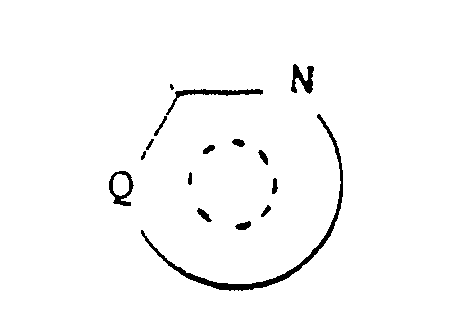
Description
- This invention relates to compounds having pharmaceutical activity, to a process for their preparation and their use as pharmaceuticals.
- A novel group of compounds has now been discovered which enhance acetylcholine function via an action at muscarinic receptors within the central nervous system and are therefore of potential use in the treatment and/or prophylaxis of dementia in mammals.
- According to the present invention, there is provided a compound of formula (I) or a pharmaceutically acceptable salt thereof:


- Certain compounds of formula (I) are capable of existing in a number of stereoisomeric forms including enantiomers. The invention extends to each of these stereoisomeric forms, and to mixtures thereof (including racemates). The different stereoisomeric forms may be separated one from the other by the usual methods, or any given isomer may be obtained by stereospecific or asymmetric synthesis.
- In compounds of formula (I) having two asymmetric centres where Y is other than hydrogen, the stereo-chemical configuration in which the group Y and the (CH₂)s bridge are on the same side of the plane of the molecule which contains both bridgehead atoms and the ring carbon atom bonded to the group Y will herein be referred to as the exo configuration. Similarly, the configuration of compounds in which the group Y and the bridge (CH₂)s are on opposite sides of the above-mentioned plane of the molecule will herein be referred to as the endo configuration.
- The compounds of formula (I) can form acid addition salts with acids, such as the conventional pharmaceutically acceptable acids, for example hydrochloric, hydrobromic, phosphoric, acetic, fumaric, salicylic, citric, lactic, mandelic, tartaric, oxalic and methanesulphonic.
- Preferred combinations of (r, s, t) include (2,2,0), (3,1,0), (2,1,0), (2,1,1) and (3,1,1), most preferably (2,1,0).
- Examples of combinations of (r, s, t) include (2,1,0), (3,1,0), (2,1,1) and (2,2,0).
- X is preferably hydrogen.
- 5-Membered aromatic heterocycles within the definition of variable Z include oxadiazole such as 1,2,4-oxadiazol-5-yl, 1,2,4-oxadiazol-3-yl and 1,3,4-oxadiazol-2-yl, oxazole such as 1,3-oxazol-2-yl, 1,3-oxazol-4-yl 1,3-oxazol-5-yl, 1,2-oxazol-3-yl and 1,2-oxazol-5-yl, thiadiazole such as 1,2,4-thiadiazol-5-yl and 1,3,4-thiadiazol-2-yl, thiazolo such as 1,3-thiazol-2-yl, 1,3-thiazol-5-yl and 1,2-thiazol-5-yl and furan such as furan-2-yl and furan-3-yl, triazole such as 1,2,3-triazol-4-yl and 2H-tetrazol-5-yl.
- In a preferred aspect, variables R₁, R₂ and R₃ are independently selected from hydrogen, halogen, N(R₄¹)₂, C₂₋₃ alkenyl, C₂₋₃ alkynyl, cyclopropyl or C₁₋₂ alkyl optionally substituted with one, two or three fluorine atoms, in which R₄¹ is hydrogen or methyl.
- Values for R₁, R₂ and R₃ include hydrogen, methyl, ethyl, NH₂ and CH₂F, preferably hydrogen, methyl and NH₂, most preferably hydrogen and methyl.
- It will be appreciated that the range of values of R₁, R₂ and R₃ will be limited by the preparative constraints and/or stability of the group Z. For example, a 1,3-oxazole ring will tolerate a 2-amino substituent whereas 2-amino furans are unstable. Conversely, 2-halo-furans are stable whereas 2-halo-1,3-oxazoles are very labile compounds. Where Z is a tri- or tetrazole group, the amino nitrogen must be substituted; preferably γ to the position of the methyl-azabicyclic moiety.
- Examples of Z include 3-amino-1,2,4-oxadiazol-5-yl, 3-methyl-1,2,4-oxadiazol-5-yl, 1,3-oxazol-2-yl, 1,3-oxazol-5-yl, 2-methyl-2H-tetrazol-5-yl, 2-furyl, 5-methyl-1,2,4-oxadiazol-3-yl and 1,3-thiazol-2-yl.
- The invention also provides a process for the preparation of a compound of formula (I), or a pharmaceutically acceptable salt thereof, which process comprises:
- (a) cyclising a compound of formula (II):

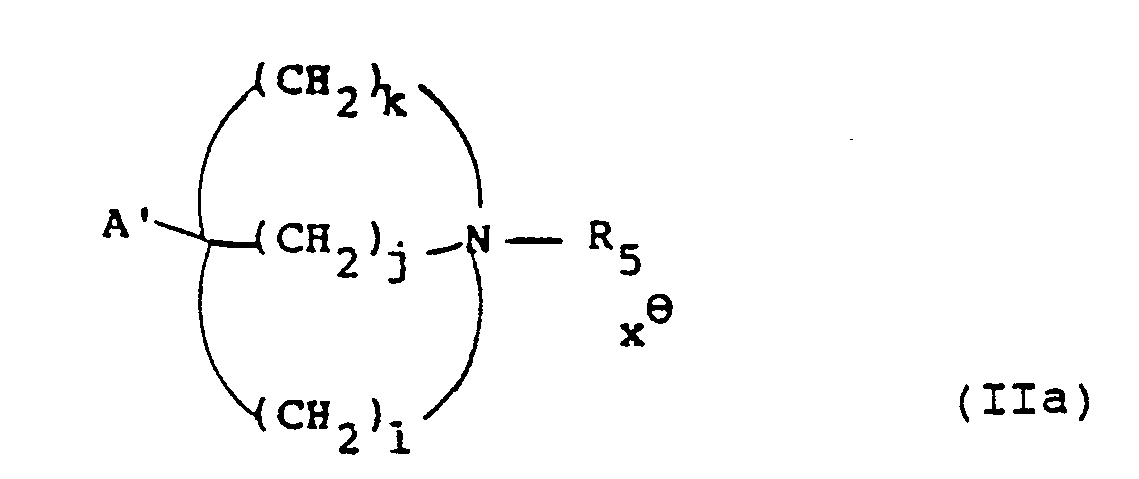
or (ii) A represents an electron withdrawing group, B represents hydrogen and R₅ represents -(CH₂)j L₂ where L₂ is a leaving group; one of k and l is 1 and the other and j independently represent an integer of 2 or 3; to give a compound of formula (IIb):
and thereafter, optionally or as necessary, removing any R₅ N-protecting group, converting K to A′, converting A′ to CH₂Z, interconverting Z and/or forming a pharmaceutically acceptable salt; - (b) cyclising a compound of formula (III):
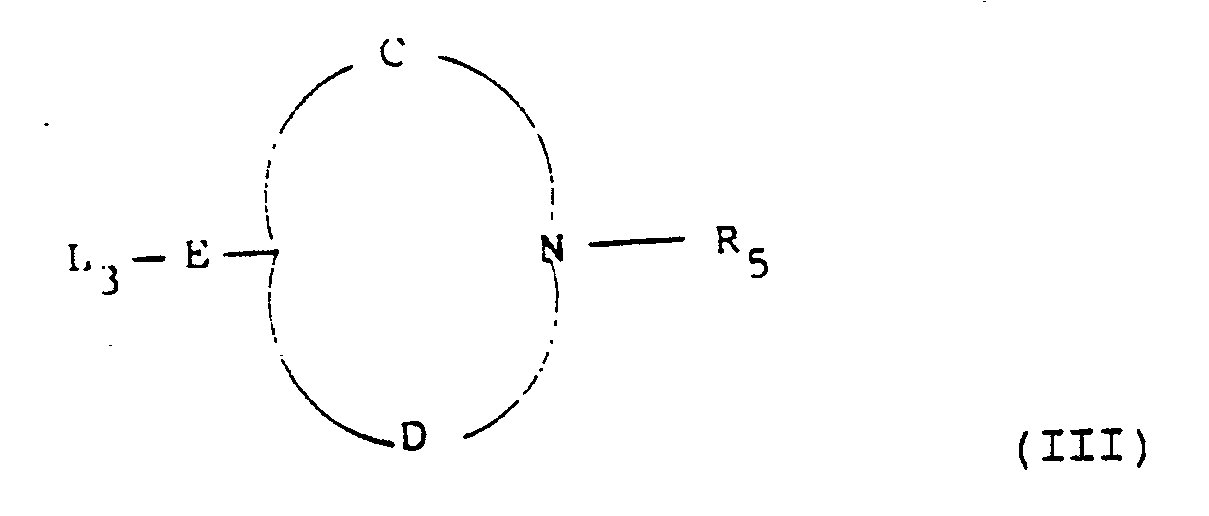
- (c) cyclising a compound of formula (IV):

- The deprotection, conversion and interconversion steps may be carried out in any appropriate order.
- In process variant (a), examples of the leaving groups L₁ and L₂ include halo such as bromo, tosyloxy and mesyloxy.
- Examples of R₅ when an N-protecting group include benzyl and substituted benzyl.
- Examples of A and A′ include alkoxycarbonyl, benzyloxycarbonyl and cyano.
- The cyclisation reaction is a nucleophilic substitution which may be carried out under conventional conditions appropriate to the groups A and B. Thus, when B is (CH₂)jBr and A is C₁₋₄ alkoxycarbonyl, the cyclisation is carried out in an inert solvent such as toluene or ether at elevated temperature. When B is (CH₂)jOtos or (CH₂)jO-Mes , it is preferably obtained by treatment of a (CH₂)jOH group with a suitable reagent such as tosylchloride or mesyl chloride, in a base such as pyridine, whereupon the cyclisation may proceed at ambient temperature, or at elevated temperature in an inert solvent such as toluene. When A and L₁ together represent -COO-, the cyclisation may be carried out in a lower alkanol such as ethanol in the presence of acid such as hydrogen bromide. In the resulting compound of formula (IIa), A′ will be an alkoxycarbonyl group corresponding to the lower alkanol used for the cyclisation.
- Where R₅ is an N-protecting group such as benzyl, this may be removed by conventional hydrogenation, preferably catalytically over a suitable catalyst such as Pd/C. Where A′ or K is benzyloxycarbonyl, deesterification and deprotection may be effected simultaneously by conventional hydrogenation.
- Examples of K and A when an electron withdrawing group includes C₁₋₄ alkoxycarbonyl and cyano.
- When A is an electron withdrawing group such as C₁₋₄ alkoxycarbonyl, B is hydrogen and R₅ is -(CH₂)jL₂ where L₂ is, for example, chloro, the cyclisation may be effected by treatment of the compound of formula (II) with lithium diisopropylamide.
- In process variant (b), examples of leaving groups L₃ include halo such as chloro and hydroxy. Examples of groups convertible to -(CH₂)t-CH(CH₂Z)CH₂- include -(CH₂)tCOCH₂- and -(CH₂)tCHA′CH₂-. In the group -(CH₂)t-CHA′-CH₂-, examples of A′ include hydroxy, C₁₋₄ alkoxycarbonyl, cyano and formyl. In process variant (c), examples of L₄ include those given for L₃ or C₁₋₄ alkoxy such as ethoxy. Examples of electron withdrawing groups K include C₁₋₄ alkoxycarbonyl and cyano.
- In process variant (b), where L₃ is hydroxy and D is -(CH₂)t-CHOH-CH₂-, the cyclisation of compounds of formula (III) may be carried out by pyrolysis, by the method of D.O. Spry and H.S., Aaron, J. Org. Chem., 1969, 34, 3674, to yield a compound where A′ is hydroxy.
- Where E is -(CH₂)t-CO-CH₂-, the cyclisation may be carried out under basic conditions where R₅ is benzyl (F.I. Carrol, A.M. Ferguson, and J.B. Lewis, J. Org. Chem. 31, 2957, 1966).
- Where L₃ and A′ together represent -COO-, the cyclisation is a rearrangement reaction which can be carried out under acid conditions in a polar solvent, such as hydrogen bromide in ethanol, at ambient temperature, to yield a compound where A′ is a carboxy ester group. It is preferred to protect the nitrogen atom with an R₅ N-protecting group such as benzyl, which may be subsequently removed by hydrogenation over a suitable catalyst such as Pd/C.
- In process variant (c), where Y³ and Y⁴ both contain carboxy ester groups the cyclisation of compounds of formulas (IV) is a Dieckmann reaction which is catalysed by a base such as potassium t-butoxide at elevated temperature in a solvent such as toluene.
- The resulting β-keto ester is hydrolysed and decarboxylated under conventional conditions such as heating at reflux in dilute hydrochloric acid.
- Where y is 0, the cyclisation may be carried out as described in EP-0094742 under basic conditions such as sodium hydride and potassium t-butoxide, in an inert polar solvent such as dimethylformamide.
- Conversions of groups A′ and K and of the carbonyl group from process variants (b) and (c), and interconversions of Z, may be carried out conventionally, see for example standard text books on heterocyclic chemistry such as 'Comprehensive Heterocyclic Chemistry', A.R. Katritzky and C.W. Rees, Pergamon, 1984.
- The groups A′ and K are first converted to a group CH₂Z′ where Z′ is Z or a group convertible thereto. The carbonyl group from process variants (b) and (c) is converted to a group C=CH-Z′ or CH-CH₂-Z′ where Z′ is as aforesaid.
- A carbonyl group may be reacted with tosylmethyl isocyanide to yield a compound where A′ is cyano, or with methoxymethyl triphenyl phosphonium chloride and potassium t-butoxide in dimethyl formamide followed by aqueous acid hydrolysis of the enol ether to yield a compound where A′ is formyl.
- Alternatively the carbonyl group may be reduced to an A′ hydroxy group with a suitable reducing agent such as sodium borohydride in ethanol at ambient temperature, or sodium in ethanol at elevated temperature, such as the boiling point of the solvent, under an inert atmosphere such as nitrogen, depending on the stereochemistry required.
- An A′ hydroxy group may be converted to cyano by first converting it to a good leaving group such as mesyloxy or tosyloxy and then displacing it with cyanide ion.
- An A′ formyl group may be obtained by conventional reduction of an A′ or K alkoxycarbonyl group with a reducing agent such as diisobutylaluminium hydride in an inert solvent such as toluene at low temperature, or, more preferably hydrolysis with acid, followed by conversion to the acid chloride by treatment with thionyl chloride and reaction with O-N-methylated dimethyl hydroxylamine hydrochloride in the presence of pyridine in a suitable solvent such as dichloromethane to give the O-N-dimethyl amide. Reduction with diisobutyl aluminium hydride under similar conditions as above yields the required formyl group.
- An A′ formyl group may be converted to CH₂ CN by treatment with p-toluenesulphonylmethyl isocyanide under basic conditions at depressed temperature.
- A Z 2-furyl or 1,3-thiazol-2-yl group may be obtained by treatment of an A′ formyl group with the anion of the heterocycle. In the case of 2-furyl, the lithium salt of furan is generated by treatment of furan with lithium diisopropylamide or butyl lithium, followed by treatment of the resulting secondary alcohol with a Lewis acid such as tin (IV) chloride to afford the carbonium ion which is reduced with a hydride donor such as triethyl silane. In the case of 1,3-thiazol-2-yl, 2-trimethylsilyl-1,3-thiazole is used and the secondary alcohol is dehydrated and the resulting olefin is catalytically hydrogenated.
- In one preferred aspect, the process comprises:
- (d) the reaction of a compound of formula (V):

- (e) the reaction of a compound of formula (VI):
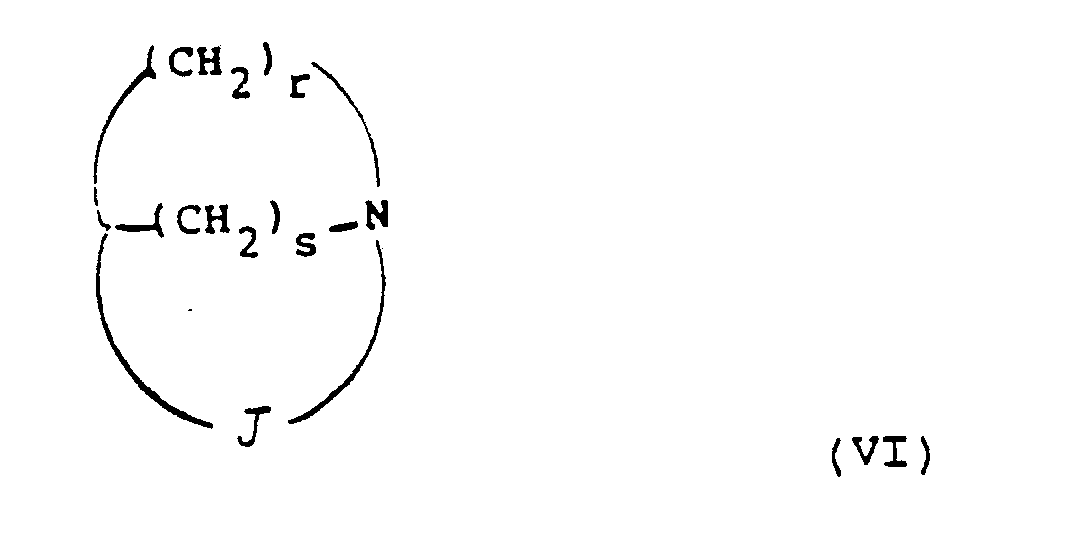


- The halocarbonyl group in the compound of formula (V) may be obtained by conversion of an A′ alkoxycarbonyl group by conventional de-esterification followed by halogenation with a suitable reagent such as thionyl chloride, or by conversion of an A′ cyano group by conventional acid hydrolysis to the carboxylic acid followed by halogenation as aforesaid.
- Conversion of a compound of formula (V) to a compound of formula (IX) which is equivalent to the conversion of an acyl halide to a carboxylic acid or derivative thereof having one additional carbon atom is known as the Arndt-Eistert Synthesis and may be carried out under conditons commonly used for that synthesis. The synthesis proceeds via a diazoketone intermediate which rearranges in the presence of a catalyst, for example silver oxide to a ketene which reacts with water to form a carboxylic acid, or alternatively with an alcohol, for example ethyl alcohol, to form an ester derivative or with an amine, for example ammonia, to form an amide derivative.
- The reaction of a compound of formula (VI) with a phosphorus ylide of formula (VII) or (VIII) which is equivalent to the conversion of a ketone to an olefin is known as a Wittig Reaction and may be carried out under conditions generally used for such reactions. Preferably a compound of formula (VI) is reacted with a compound of formula (VIII) in which Ra and Rb are each C₁₋₆ alkyl, for example ethyl, and Z¹ is an ester function, for example ethoxycarbonyl. The resulting olefin may be reduced under standard conditions, for example by catalytic hydrogenation in an alcoholic solvent such as ethanol in the presence of a noble metal catalyst such as palladium or by treatment with magnesium and methanol, according to the stereochemistry required.
- Where it is required that Z¹ in the compound of formula (IX) is an amide derivative, it may be convenient to use a compound of formula (VII) or (VIII) in which Z¹ is an amide derivative or alternatively to convert a Z¹ ester to a Z¹ amide by treatment with ammonia prior to reduction of the α,β-unsaturated intermediate.
- While it is preferred to reduce the α,β-unsaturated acid, or ester or amide derivative thereof, it will be appreciated that conversation of Z¹ to Z may take place prior to the reduction of the double bond.
- Conversion of Z′ to a heterocyclic group Z, as defined for formula (I), may be carried out using procedures as described in, for example standard text books on heterocyclic chemistry such as 'Comprehensive Heterocyclic Chemistry', A.R. Katritzky and C.W. Rees, Pergamon, 1984.
- The Z′ group is first converted, as necessary, to a suitable starting group Z′ for the chosen conversion reaction to give the required group Z.
- A Z′ alkoxycarbonyl group may be obtained by conventional acid hydrolysis of a Z′ cyano group followed by esterification.
- A Z′ carboxy group may be obtained by conventional de-esterification of a Z′ alkoxycarbonyl group.
- A Z′ chlorocarbonyl group may be obtained by treatment of a Z′ carboxy group with thionyl chloride at elevated temperature.
- A Z′ aminocarbonyl group may be obtained by treatment of a Z′ chlorocarbonyl group with ammonia.
- A Z′ cyano group may be obtained by treatment of a Z′ aminocarbonyl group with a dehydrating agent such as phosphorus pentoxide in toluene, or pyridine and trifluoroacetic anhydride.
- A Z′ CH₃-CO- group may be obtained by treatment of a LiOOC group with methyl lithium, the LiOOC group being obtained by hydrolysis of a Z′ alkoxycarbonyl group with lithium hydroxide in water. Alternatively, a Z′ CH₂CO- group may be obtained by reaction of a Z′ chlorocarbonyl group with N,O-dimethylhydroxylamine and treatment with methyl lithium.
- A Z′ bromomethylcarbonyl group may be obtained by treatment of a Z′ COCH₃ group either with bromine in a suitable solvent such as methanol, the nitrogen of the azabicycle being protected as the hydrochloride or hydrobromide salt, or with lithium diisopropylamide and trimethylsilyl chloride at low temperature followed by N-bromosuccinimide in tetrahydrofuran at low temperature. Alternatively, a Z′ -COCl group may be converted to a -COCH₂Br group by treatment with diazomethane in ether at low temperature followed by hydrogen bromide in acetic acid at ambient temperature.
- A Z′ CH₂N≡C group may be obtained from a formamidomethyl group by treatment with phosgene and triethylamine. The formamidomethyl group may in turn be obtained from the aminomethyl group by reaction with an ester of formic acid such as ethyl formate. The aminomethyl group may be obtained by reduction of the aminocarbonyl group with lithium aluminium hydride.
- A Z′ formyl group may be obtained from a Z′ alkoxycarbonyl group as described above for the corresponding conversion of an A′ alkoxycarbonyl group.
- When Z represents a 1,2,3-triazol-4-yl group, a Z′ formyl group may be treated with triphenyl phosphine, carbon tetrabromide and zinc in an inert solvent such as dichloromethane at ambient temperature to provide a 2,2-dibromoethenyl group which may be eliminated with n-butyl lithium in hexane to give an ethynyl group. Treatment of the latter with azidotrimethyl silane in an inert solvent such as tetrahydrofuran at elevated temperature yields the unsubstituted 1,2,3-triazol-4-yl group which is alkylated as required. A 2-methyl group may be introduced by treatment with diazomethane in ether at ambient temperature.
- When Z represents a 2H-tetrazol-5-yl group, a Z′ cyano group may be treated with azidotrimethyl silane in an inert solvent such as tetrahydrofuran at elevated temperature to yield a 2-trimethylsilyl-2H-tetrazol-5- yl group. Treatment of the latter with methanol effects deprotection of the amino nitrogen which may then by alkylated as described above.
- When Z represents 3-substituted-1,2,4-oxadiazol-5-yl, a Z′ chlorocarbonyl or Z′ carboxy ester group may be reacted with an appropriate amide oxime, at elevated temperature in an inert, polar solvent such as chloroform, and the resulting substitution product cyclised at elevated temperature in a suitable solvent such as toluene or xylene.
- For example, when Z represents 3-methyl-1,2,4-oxadiazol-5-yl, a Z′ chlorocarbonyl group may be reacted with acetamide oxime, at elevated temperature in an inert, polar solvent such as chloroform, and the resulting substitution product cyclised at elevated temperature in a suitable solvent such as toluene or xylene. Alternatively, reaction of a Z′ aminocarbonyl group with an acetal of N,N-dimethylacetamide such as the dimethyl or diethyl acetal at elevated temperature yields an acyl amidine group -CON=C(CH₃)N(CH₃)₂ which may then be cyclised with hydroxylamine, in the presence of acid, such as acetic acid, which may also function as the solvent. The reaction may be carried out at ambient temperature, the N-hydroxy acyl amidine intermediate isolated and then cyclised at elevated temperature, or alternatively in a single step at elevated temperature. When Z represents 3-amino-1,2,4-oxadiazol-5-yl, a Z′ chlorocarbonyl or Z′ carboxy ester group may be reacted with a hydroxy guanidine derivative under basic conditions.
- When Z represents 3-(H or methyl)-1,2,4-thiadiazol-5-yl, a Z′ aminocarbonyl group may be converted into an aminothiocarbonyl group using phosphorus pentasulphide or Lawesson's reagent (S. Scheibye, B.S. Pederson and J.O. Lawesson, Bull. Soc. Chim. Belg., 1978, 87 (3), 229). The aminothiocarbonyl may be converted into a thioacyl amidine group and cyclised as described above for the 1,2,4-oxadiazole group.
- When Z represents 5-(C₁₋₂alkyl)-1,2,4- oxadiazol-3-yl, a Z′ cyano group may be reacted with hydroxylamine, in a polar solvent such as methanol, to yield the corresponding amide oxime. The amide oxime may be cyclised using a suitable derivative of a C₂₋₃ alkanoic such as the anhydride or a trialkylorthoacetate such as triethyl orthoacetate, the acid derivative acting as the solvent, at elevated temperature.
- When Z represents 5-(H or C₁₋₂alkyl)-1,3,4-oxadiazol-2-yl, a Z′ carboxy or carboxy ester group may be converted to the acid hydrazide by conventional procedures. For example, the acid may be converted to a C₁₋₆ alkyl ester e.g. methyl, with the appropriate C₁₋₆ alkanol e.g. methanol under conventional esterification conditions, and the resulting ester reacted with hydrazine at elevated temperature to give the acid hydrazide. The acid hydrazide may then be cyclised by condensation with a suitable derivative of the appropriate C₁₋₃ alkanoic acid RCO₂H, e.g. a trialkyl ortho-ester, such as the triethyl ortho-ester, the acid derivative acting as the solvent, at elevated temperature.
- When Z represents 5-(H or C₁₋₂alkyl)-1,3,4-thiadiazol-2-yl a Z′ acid hydrazide may be reacted with a suitable acylating agent such as methyl formate or an acetyl or propionyl halide to give a diacyl hydrazide group, -CONHNHCOR which can be cyclised using phosphorus pentasulphide. The cyclisation is preferably carried out in the absence of solvent with the nitrogen of the azabicycle protected as the hydrochloride salt.
- When Z represents 1,3-oxazol-2-yl, the conversion may be effected by reaction of a Z′ aminocarbonyl group with vinylene carbonate at elevated temperature in the presence of a strong acid such as polyphosphoric acid, which may also function as the solvent.
- When Z represents 5-(H or C₁₋₂alkyl)-1,3-oxazol-2-yl, a Z′ carboxy group may first be converted to the carboxylic acid chloride and then reacted with a compound of formula NH₂CH₂CR(OR′)₂, or the Z′ carboxy group may be reacted directly with the compound of formula NH₂CH₂CR(OR′)₂ in the presence of a condensing agent such as dicyclohexylcarbodiimide or a chloroformate ester such as ethyl chloroformate, to give a group CONHCH₂C(OR′)₂R; which may be cyclised using a suitable dehydrating agent such as polyphosphoric acid, phosphorus oxychloride, phosphorus pentachloride, sulphuric acid or sulphuryl chloride preferably polyphosphoric acid.
- A Z 5-(H or C₁₋₂alkyl)-1,3-thiazol-2-yl group may be obtained by cyclisation of a Z′ -CONHCH₂C(OR′)₂R group using phosphorus pentasulphide. The reaction is preferably carried out in the absence of solvent with the nitrogen of the azabicycle protected as the hydrochloride salt.
- 1,3-Oxazol-2-yl groups 4-methyl-substituted may be provided by the cyclisation of a Z′ aminocarbonyl group with propargyl alcohol or acetate ester thereof, in the presence of a dehydrating agent such as polyphosphoric acid,using a catalyst such as HgSO₄, at elevated temperature.
- Alternative routes to optionally 4-substituted 1,3-oxazol-2-yl groups include:
- i) the condensation of a Z′ aminocarbonyl group with the appropriate compound BrCH₂COR at elevated temperature; or
- ii) the reaction of a Z′ carboxy group under basic conditions with the appropriate compound BrCH₂COR to give a group -COOCH₂COR which may be cyclised with ammonium chloride.
- Where R is hydrogen the aldehyde is preferably protected as an acetal.
- During the reaction (i) above, the nitrogen atom of the azabicyclic moiety may require protection.
- When Z is 4-(H or C₁₋₂alkyl)-1,3-thiazol-2-yl a Z′ aminothiocarbonyl group may be reacted with the appropriate α-halo acyl compound such as BrCH₂COCH₃ as indicated for the corresponding 1,3-oxazole.
- 1,3-Oxazol-4-yl groups optionally 2-substituted may be provided by reacting a bromomethylcarbonyl group with an appropriate C₁₋₃ alkanoic acid amide. Preferably, the reaction with acetamide is carried out at elevated temperature and the reaction with formamide is carried out in sulphuric acid.
- An unsubstituted 1,3-oxazol-4-yl group may alternatively be obtained by treatment of a Z′ -CH₂N≡C group with a formate ester such as methyl formate after deprotonation with a strong base such as n-butyl lithium or potassium t-butoxide.
- When Z represents 3-(H or C₁₋₂alkyl)-1,2-oxazol-5-yl, the reaction of a Z′ CH₃CO group may be carried out at depressed temperature with ethyl formate, acetate or propionate in a suitable solvent such as toluene, under basic conditions such as sodium hydride and catalytic ethanol, followed by reflux, to yield the sodium salt of the resulting dicarbonyl compound. Cyclisation at ambient temperature with an aminating agent such as hydroxylamine-O-sulphonic acid in a dry solvent such as methanol, ethanol or diglyme, preferably in the presence of an acid such as sulphuric acid, p-toluene sulphonic acid or potassium hydrogen sulphate to minimise amination of the azabicycle, yields a compound of formula (I).
- Alternatively, the dicarbonyl compound sodium salt may be treated prior to the cyclisation step with dimethylamine in ethanol in the presence of glacial acetic acid at ambient temperature to give the vinylogous amide which may be cyclised as described above.
- When Z represents an optionally 5-substituted 1,2-oxazol-3-yl group, a Z′ -C≡N⁺-O⁻ nitrile oxide group may be reacted with an olefin of the structure R-C(W)=CH₂, where W is halo such as chloro, OCOCH₃ or OSi(CH₃)₃. The highly reactive nitrile oxide may conveniently be generated in situ from an appropriate Z′ halo oxime -C(Br)=NOH by treatment with a base such as triethylamine in a solvent such as N,N-dimethylformamide. The halo oxime is prepared by treatment of a Z′ -CH=NOH oxime group with N-bromosuccinimide in N,N-dimethylformamide at ambient temperature, the azabicyclic being in the form of the hydrochloride salt. The Z˝ -CH=NOH oxime group may be prepared from a Z′ -CHO group by reaction with hydroxylamine hydrochloride in a solvent such as methanol.
- When Z represents a 2-(H or methyl)-1,3-oxazol-5-yl group, a Z′ -COCH₂Br group may be converted to -COCH₂NH₂ by treatment with NaN₃ in acetone or N,N-dimethylformamide followed by hydrogenation over a Pd/C catalyst in ethanolic HCl, or by treatment with hexamethylene tetramine followed by hydrolysis in methanolic HCl.
- The -COCH₂NH₂ group may then be acylated with the appropriate derivative of formic acid such as acetic-formic anhydride or acetic acid such as the anhydride or chloride to yield an acyl amino ketone which can be cyclised using a suitable dehydrating agent such as polyphosphoric acid, sulphuric acid or phosphorous pentachloride at elevated temperature.
- Alternatively, a Z′ -CHO group may be treated with p-toluene sulphonylmethyl isocyanide and anhydrous potassium carbonate in methanol under reflux followed by heating the 4-methoxyoxazoline product with polyphosphoric acid to afford a Z 1,3-oxazol-5-yl group.
- When Z represents 2-furyl, a Z˝ CHO group may be treated with a reactive derivative of propanol such as the 3-tosyl derivative and in which the carbonyl group is preferably protected as a cyclic acetal (X):


- Alkyl-substituted 2-furyl groups may be obtained analogously using the appropriately substituted analogue of the compound of formula (X) prepared from the corresponding ketone or aldehyde.
- In an alternative procedure to compounds of formula (I) where Z represents a 2- or 3-furyl group, an A′ formyl group may be treated with a furan derivative lithiated at the 2- or 3-position, prepared by reaction of a 2- for 3-bromofuran with n-butyllithium in an inert solvent such as diethyl ether at reduced temperature, followed by reduction of the resulting secondary alcohol using triethylsilane in acetonitrile in the presence of a Lewis acid such as stannic chloride or boron trifluoride etherate.
- A Z 1,3-thiazol-5-yl group may be obtained by dehydrating and cyclising the corresponding acyl amino ketone using phosphorous pentasulphide at elevated temperature.
- Optionally 3-substituted 1,2-thiazol-5-yl groups may be prepared from the corresponding 1,2-oxazolyl group by ring opening effected by treatment with a reducing agent such as Raney nickel and hydrogen in a suitable solvent such as methanol or ethanol to yield a vinylogous amide which may be cyclised using phosphorous pentasulphide in the presence of a suitable oxidising agent such as sulphur or chloranil in a solvent such as toluene at elevated temperature.
- Compound of formula (I) in which Q contains a sulphur atom in place of oxygen may be prepared analogously. A sulphur-containing group Z′ is obtained by treatment of a carbonyl-containing group Z′ with either phosphorus pentasulphide or with Lawesson's reagent (S.Scheibye, B.S. Pederson and S.O. Lawesson, Bull. Soc. Chim. Belg., 1978, 87(3), 229). The resulting sulphur-containing group Z′ may then be converted to the required sulphur containing group Z analogously to the conversion of carbonyl-containing groups. Where the thiolating agent is phosphorus pentasulphide, this may also effect cyclisation.
- Interconversion of carbon substituents R₁, R₂ and R₃ within a group Z may be carried out conventionally. This an amino group may be converted to chloro, or -NHNH₂, via a diazonium intermediate. Similarly a chloro substituent may be converted by reaction with a nucleophile such as methoxide; and alkoxycarbonyl groups may be converted, via carboxy, to an amino substituent.
- Where applicable, an endo isomer may be obtained by epimerisation of a corresponding exo isomer, the epimerisation reaction being effected by standard procedures at any convenient stage in the process but preferably before the introduction of the group Y.
- In the above description, R represents H, methyl or ethyl as appropriate and R′ represents C₁₋₆ alkyl such as methyl or ethyl or two R′ groups together represent C₂₋₆ polymethylene such as ethylene.
- Compounds of formula (II) may be prepared conventionally.
- Where A is C₁₋₄ alkoxycarbonyl, B is (CH₂)jL₁ and R₅ is hydrogen or an N-protecting group, the compound of formula (II) may be prepared by treating a compound of formula (XII):

- Where A and L₁ together represent -COO- and j is 2, the compound of formula (II) may be prepared by reacting the compound of formula (XII), treated with lithium diisopropylamide as before, with ethylene oxide in an inert solvent such as ether at depressed to elevated temperature.
- Alternatively, the compound of formula (II) where A and L₁ together represent -COO, j is 2, k is 2 and l is 1 may be prepared by a 1,3-dipolarcyclo addition reaction which involves reacting a compound of formula (XIII):


- Where A is an electron withdrawing group such as C₁₋₄ alkoxycarbonyl, B is hydrogen and R₅ is (CH₂)jL₂, the compound of formula (II) may be prepared by reacting the compound of formula (XII) where R₅ is hydrogen with a compound L₅(CH₂)jL₂ where L₅ is as previously defined, in a solvent such as acetone in the presence of a base such as potassium carbonate. The leaving group L₅ is preferably bromo and L₂ is preferably chloro.
- Compounds of formulae (XII) are known compounds or may be prepared by analogous methods to those for preparing known compounds. The compound of formula (XII) where k is 2, l is 1 and R₅ is benzyl may be prepared by the cyclisation of di-C₁₋₄ alkyl itaconate in the appropriate alkanol with benzylamine at elevated temperature, followed by reduction of the resulting oxo group at the 2-position of the pyrrolidine ring with BH₃ in tetrahydrofuran, at ambient to elevated temperature.
- Intermediates of formulae (III) and (IV) are known compounds (e.g. as described in EP-A-0094742 or EP-A-0261763) or may be prepared analogously.
- Intermediates of formula (III) where A′ and L₃ together represent -COO- are described in, for example, Kuthan et al., Coll. Czechoslov. Chem. Comm., 1977, 42, 283 or may be prepared therefrom by conventional hydrogenation of the pyridine ring over 5% Pt/C, and benzylation of the nitrogen atom by treatment with benzyl bromide and potassium carbonate in dry acetone.
- Intermediates of formula (II) where L₃ is a leaving group are described in, for example, Spry et al., J. Org. Chem., 1969, 34, 3674 and Hasse et al., Chem. Ber., 1960, 93, 1686.
- Intermediates of formula (IV) are described in, for example, Martell et al., J. Pharm. Sci., 1963, 52(4), 331, Sternbach et al., J.A.C.S., 1952, 74, 2215, Thill et al., J. Org. Chem., 1968, 33, 4376 and EP-0 094 742.
- Compounds of formulae (XIII) and (XIV) may be prepared conventionally. Thus, a compound of formula (XIII) may be obtained by the reaction of γ-butyrolactone with ethyl formate in the presence of base such as sodium hydride followed by reaction of the resulting formyl derivative (as the enol salt) with formaldehyde. A compound of formula (XIV) may be obtained by the reaction of the primary amine R₇NH₂ successively with chloromethyltrimethylsilane and formaldehyde followed by methanol and anhydrous potassium carbonate.
- Pharmaceutically acceptable salts of the compounds of formula (I) may be formed conventionally by reaction with the appropriate acid such as described above under formula (I).
- The compounds of the present invention enhance acetylcholine function via an action at muscarinic receptors within the central nervous system and are therefore of potential use in the treatment and/or prophylaxis of dementia.
- The present invention also provides a pharmaceutical composition, which comprises a compound of formula (I) or pharmaceutically acceptable salt thereof, and a pharmaceutically acceptable carrier.
- The compositions may be in the form of tablets, capsules, powders, granules, lozenges, suppositories, reconstitutable powders, or liquid preparations such as oral or sterile parenteral solutions or suspensions.
- In order to obtain consistency of administration it is preferred that a composition of the invention is in the form of a unit dose.
- Unit dose presentation forms for oral administration may be tablets and capsules and may contain conventional excipients such as binding agents, for example syrup, acacia, gelatin, sorbitol, tragacanth, or polyvinylpyrrolidone; fillers, for example lactose, sugar, maize-starch, calcium phosphate, sorbitol or glycine; tabletting lubricants, for example magnesium stearate; disintegrants, for example starch, polyvinylpyrrolidone, sodium starch glycollate or microcrystalline cellulose; or pharmaceutically acceptable wetting agents such as sodium lauryl sulphate.
- The solid oral compositions may be prepared by conventional methods of blending, filling, tabletting or the like. Repeated blending operations may be used to distribute the active agent throughout those compositions employing large quantities of fillers. Such operations are of course conventional in the art. The tablets may be coated according to methods well known in normal pharmaceutical practice, in particular with an enteric coating.
- Oral liquid preparations may be in the form of, for example, emulsions, syrups, or elixirs, or may be presented as a dry product for reconstitution with water or other suitable vehicle before use. Such liquid preparations may contain conventional additives such as suspending agents, for example sorbitol, syrup, methyl cellulose, gelatin, hydroxyethylcellulose, carboxymethylcellulose, aluminium stearate gel, hydrogenated edible fats; emulsifying agents, for example lecithin, sorbitan monooleate, or acacia; non-aqueous vehicles (which may include edible oils), for example almond oil, fractionated coconut oil, oily esters such as esters of glycerine, propylene glycol, or ethyl alcohol; preservatives, for example methyl or propyl p-hydroxybenzoate or sorbic acid; and if desired conventional flavouring or colouring agents.
- For parenteral administration, fluid unit dosage forms are prepared utilizing the compound and a sterile vehicle, and, depending on the concentration used, can be either suspended or dissolved in the vehicle. In preparing solutions the compound can be dissolved in water for injection and filter sterilized before filling into a suitable vial or ampoule and sealing. Advantageously, adjuvants such as a local anaesthetic, a preservative and buffering agents can be dissolved in the vehicle. To enhance the stability, the composition can be frozen after filling into the vial and the water removed under vacuum. Parenteral suspensions are prepared in substantially the same manner, except that the compound is suspended in the vehicle instead of being dissolved, and sterilization cannot be accomplished by filtration. The compound can be sterilized by exposure to ethylene oxide before suspending in the sterile vehicle. Advantageously, a surfactant or wetting agent is included in the composition to facilitate uniform distribution of the compound.
- The compositions may contain from 0.1% to 99% by weight, preferably from 10-60% by weight, of the active material, depending on the method of administration.
- The invention also provides a method of treatment and/or prophylaxis of dementia in mammals including humans, which comprises administering to the sufferer an effective amount of a compound of formula (I) or a pharmaceutically acceptable salt thereof.
- The dose of the compound used in the treatment of such disorders will vary in the usual way with the seriousness of the disorders, the weight of the sufferer, and the relative efficacy of the compound. However, as a general guide suitable unit doses maybe 0.05 to 100 mg. for example 0.2 to 50mg; and such unit doses may be administered more than once a day, for example two or three times a day, so that the total daily dosage is in the range of about 0.01 to 5 mg/kg; and such therapy may extend for a number of weeks or months.
- Within the above indicated dosage ranges no toxicological effects are indicated for the compounds of the invention.
- In a further aspect the invention provides a compound of formula (I) or a pharmaceutically acceptable salt thereof for use as an active therapeutic substance.
- The invention further provides a compound of formula (I) or a pharmaceutically acceptable salt thereof, for use in the treatment and/or prophylaxis of dementia.
- In another aspect the invention provides the use of a compound of formula (I) or a pharmaceutically acceptable salt thereof for the preparation of a medicament for the treatment and/or prophylaxis of dementia.
- The following examples illustrate the invention and the following descriptions illustrate the preparation of intermediates thereto.
-

- (±) exo Ethyl 1-benzyl-1-azoniabicyclo[2.2.1]hept-3-ylcarboxylate bromide (EP A 0257741 Description 9) (54 g, 0.16 mole) was dissolved in ethanol (400 ml) and hydrogenated over 10% Pd-C (8.5 g) at atmospheric pressure and 25oC. After 2 h the solution was filtered and concentrated in vacuo to leave a gum. This was partitioned between chloroform and saturated aqueous potassium carbonate solution and the organic phase separated, dried (Na₂SO₄) and concentrated in vacuo to leave a gum. This gum was distilled to give the title compound (D1) as a colourless oil (23 g, 85%) b.p. 150oC at 0.5 mmHg.
¹H Nmr (CDCl₃) δ:
1.10-1.20 (1H,m), 1.25 (3H,t,J=7Hz), 1.54-1.67 (1H,m), 2.15-2.25 (1H,m), 2.28-2.35 (1H,m), 2.38-2.50 (1H,m), 2.60-2.67 (1H,m), 2.70-2.90 (3H,m), 2.93-3.03 (1H,m), 4.13 (2H,q,J=7Hz). -

- (±) exo 3-Ethoxycarbonyl-1-azabicyclo[2.2.1]heptane (D1) 2g, 12mmol) was heated under reflux in 5N hydrochloric acid (100ml) for 1.5h. The reaction mixture was then concentrated in vacuo to a gum which was dissolved in thionyl chloride (50ml) and heated under reflux for 0.5h. The reaction mixture was then concentrated to a gum, dry toluene (20ml) added and the mixture re-evaporated to remove the last traces of thionyl chloride. The residue on evaporation was dissolved in dry dichloromethane (50ml) and added under dry nitrogen to a solution of diazomethane in dry ether (100mmol in 150ml) at 0oC with continuous stirring over a period of 15 mins (the ether solution of diazomethane had been pre-dried by stirring with crushed potassium hydroxide pellets for 1h at 0oC). When the addition was complete the solvents were removed in vacuo at approx. 10oC and the residue partitioned between chloroform and saturated aqueous potassium carbonate solution. The organic phase was separated and concentrated in vacuo to a gum. The gum was dissolved in methanol (20ml) and treated with freshly prepared silver oxide. (Silver nitrate (1g) in water (10ml) was added to a slight excess of aqueous potassium hydroxide. The precipitate was collected by filtration and washed successively with methanol and ether). The methanol slurry of silver oxide was heated to reflux for 0.5h. The reaction mixture was then filtered through celite and concentrated in vacuo to a gum. The residue was then chromatographed on silica in a gradient of 10-20% methanol in chloroform. Elution with 20% methanol in chloroform afforded a colourless oil which was distilled on a Kugelrohr to afford the title compound (110mg) b.p. 150oC at 0.1mmHg
¹H NMR (CDCl₃), δ:
1.15 (1H, m, 5H); 1.6 (1H, m, 5H); 1.8 (1H, m, 3H); 2.1 and 2.25 (2H, m, 8H); 2.25 (1H, m, 4H); 2.3 and 2.8 (2H, m, 2H); 2.45 and 2.8 (2H, m, 6H); 3.62 (1H, s, OMe);
¹³C NMR (CDCl₃) δ:
30 CH₂; 39 CH₃; 39 CH₂; 41 CH; 51 CH; 53 CH₂; 57 CH₂, 62 CH₂, 173 C. -

- (±) E(3-Ethoxycarbonylmethylene)-1-azabicyclo-[2.2.1]heptane oxalate salt (D5) (2g, 0.007 mol) in methanol (50ml, Ar grade) was added to magnesium metal turnings (4g) under an atmosphere of nitrogen. A crystal of iodine was added and the mixture was warmed to 40oC until reaction began. After initiation the highly exothermic reaction was placed in a bath of iced water and left to reflux under its own heat of reaction until all the magnesium had been consumed. The reaction was quenched with acetic acid and concentrated in vacuo to leave a solid residue. The residue was basified with saturated aqueous potassium carbonate and partitioned with chloroform. The mixture was filtered through celite and the organic layer was separated, dried (Na₂SO₄) and concentrated in vacuo to afford a pale brown oil comprising a crude 4:1 mixture of endo:exo isomers of the title compound in stoichiometric yield. The crude product was chromatographed on alumina in a gradient of 4 to 10% methanol in ethyl acetate. Elution with 6% methanol in ethyl acetate afforded the title compound (D2) as a colourless oil (150mg, 0.89 mmol, 12%).
¹³C NMR CDCl₃ δ:
30.5, 38.9 (two carbons superimposed), 41.6, 51.3, 53.5, 57.2, 61.9, 173. - Elution with 10% methanol in ethyl acetate afforded the endo isomer (830mg, 0.0049 mol) as a colourless oil.
-

- A solution of E,Z-3-carboethoxylene-1-azabicyclo[2.2.2]octane* (6.0g, 0.031mol) was hydrogenated in ethanol (250ml) over 10% Pd/C catalyst (770mg) at 150 psi and 45oC with rocking for 24 h. The catalyst was filtered off under nitrogen using celite and the organic filtrate was evaporated to dryness under reduced pressure. The resulting pale yellow oil was purified by Kugelröhr distillation (120oC at 0.1mmHg) to yield the title compound as a clear oil (6.01g, 98%).
¹H NMR (270MHz, CDCl₃) δ:
1.26 (3H, t, Et-CH₃); 1.47 (1H, m); 1.69 (4H, bm); 2.17 (1H, m); 2.41 (3H, m); 2.86 (4H, bm); 3.20 (1H, dd, 3-H); 4.14 (2H, q, Et-CH₂).
IR (NaCl plate) 1715cm⁻¹
MS C₁₁H₁₉NO₂, M⁺ found 197.1415, required 197.1411. - (*L.N. Yakhontov, L.I. Mastafanova and M.V. Rubstov, Zh. Obshch. Khim., 1963, 33, (10), 3211-14; (C.A. 1964, 60, 4109e).)
-

- E,Z-3-Carboethoxymethylene-1-azabicyclo[2.2.2]octane (3.0g, 0.0154mol) was stirred with concentrated ammonia solution (125ml) in a sealed flask for 5 days, after which a further portion of concentrated ammonia solution (70ml) was added and the mixture stirred at room temperature for a further three weeks. The ammonia solution was then saturated with solid potassium carbonate and extracted with CHCl₃ (3 x 500ml).
- The organic extracts were dried (Na₂SO₄), filtered and evaporated to dryness under reduced pressure to yield a white solid (2.53g, 99%). The unsaturated amide (2.53g, 0.0152mol) was dissolved in EtOH (20ml), and glacial acetic acid (5ml) and 5% Pt-C catalyst (440mg) added under nitrogen. The mixture was hydrogenated overnight at 150 psi and 40oC with rocking. The suspension was then filtered under nitrogen through celite and the filtrate evaporated to dryness under reduced pressure. The residue was dissolved in saturated aqueous potassium carbonate solution, extracted with CHCl₃ (3 x 250ml) and the organic extracts dried (Na₂SO₄). The organic solution was filtered and evaporated to dryness under reduced pressure to yield a yellow oil which was purified by column chromatography (neutral Al₂O₃ eluting with 2-10% MeOH/CHCl₃) to yield the title compound (1.57g, 61%) as a pale yellow oil.
¹H NMR (270MHz, CDCl₃) δ:
1.47 (1H, m); 1.66 (4H, m); 2.18 (1H, m); 2.41 (3H, bm); 2.83 (4H, bm); 3.18 (1H, dd, 3-H); 5.68 (bs, NH₂). -

- Triethylphosphono acetic (2.69g, 0.012 mole) in dry DMF (10ml) was treated with potassium butoxide (1.59g, 0.013 mole) at 0oC with continuous stirring under an atmosphere of nitrogen. After 30 minutes 1-azabicyclo[2.2.1]heptane-3-one¹ (1.11g, 0.01 mole) in DMF (10ml) was added at 0oC and the stirred solution allowed to warm to room temperature over a period of 30 min. After standing at room temperature for 1h the reaction was neutralised with acetic acid and concentrated in vacuo to a gum. The gum was then partitioned between aqueous potassium carbonate and chloroform. The chloroform solution was separated and concentrated in vacuo to a gum. Kugelröhr distillation in vacuo afforded a colourless oil b.pt 200oC at 0.5mm. The oil was dissolved in ether (20ml) and treated with oxalic acid (900mg) in methanol (2ml). The title compound oxalate salt (D5) slowly crystallised out. Recrystallisation from methanol ether afforded the pure title compound free from the Z isomer as needles (D5) (2.13g; 78%). m.p. 140-150oC.
¹Douglas O. Spry and Herbert S. Araron, J.O.C. 34, 3674 (1969)
¹H NMR DMSO δ:
1.30 (3H, t, J=9Hz, CH₃), 1.65-1.75 and 2.25-2.4 (each 1H, m, 5-CH₂); 3.25-3.7 (5H, m, 4-CH, 6-CH₂, 7-CH₂); 4.15-4.25 (2H, q, J=9Hz, CH₂CH₃); 4.35 (2H, m, 2-CH₂); 6.12 (1H, s, CH=C). -

- (±) E(3-Ethoxycarbonylmethylene)-1-azabicyclo[2.2.1]heptane oxalate salt (350mg, 0.00125 moles) D5) was dissolved in ethanol (25ml) and treated with 10% palladium on charcoal (500mg) and stirred under an atmosphere of hydrogen until TLC 20% methanol ethyl acetate indicated complete reduction (24h). The reaction was then filtered through celite and concentrated in vacuo to a gum. The gum was partitioned between chloroform and saturated aqueous potassium carbonate solution. The organic phase was separated and concentrated in vacuo to a gum which was distilled in vacuo to afford (±) endo 3-ethoxycarbonylmethyl-1-azabicyclo[2.2.1]heptane (D6) (140mg, 0.000076 moles, 60%) Bpt 160oC at 0.1mm containing 10% of the exo isomer.
¹H NMR (CDCl₃) δ:
1.27 (3H, t, J=8Hz), 1.4-1.55 (2H, m), 1.87-1.96 (1H, m), 2.27-2.58 (7H, m), 2.7-2.9 (1H, m), 3.0-3.15 (1H, m), 4.07-4.2 (2H, q, J=8Hz).
¹³C NMR (CDCl₃) (endo isomer) δ:
14.4, CH₃; 23.6, CH₂; 36.2, CH₂; 37.4, CH; 41.16, CH; 55.0, CH₂; 60.7 CH₂; 60.75, CH₂; 61.5, CH₂; 173.4, C. -

- (±) endo 3-(Ethoxycarbonylmethyl)-1-azabicyclo[2.2.1]heptane (D6) (1.15g, 0.0065 moles) was dissolved in concentrated hydrochloric acid (15ml) and water (6 ml) and the mixture was heated under reflux for 2h. The reaction was concentrated in vacuo to leave a brown gum which was azeotroped twice with dry toluene to remove last traces of water. The dry gum was treated with thionyl chloride (11ml) and heated under reflux for 5 mins. Thionyl chloride was removed in vacuo and the residual oil azeotroped three times with dry toluene to afford the acid chloride. To the dry acid chloride in ethanol free chloroform (40ml) was added N,O,dimethyl hydroxylamine hydrochloride (0.644g, 0.0071 moles) under an atmosphere of nitrogen. The mixture was cooled to -60oC and pyridine (5ml) added dropwise to the stirred solution which was then allowed to warm to room temperature over 2 hours. The reaction mixture was evaporated in vacuo to yield a viscous brown oil which was partitioned between saturated aqueous potassium carbonate and chloroform. The organic phase was separated, dried (Na₂SO₄) and concentrated in vacuo to afford a brown oil which was distilled on a Kugelröhr to yield the title compound as a colourless oil (0.92g, 0.0046 moles, 71%) b.p. 175oC at 0.7mmHg. Containing 10% of the exo isomer by Nmr.
¹H NMR (CDCl₃) δ:
1.37-1.66 (2H, m), 1.8-1.98 (1H, m), 2.21-2.7 (7H, m), 2.7-2.9 (1H, m), 3.15 (1H, m), 3.19 (3H, s), 3.68 (3H, s). -

- (±) Ethyl 1-azabicyclo[3.2.1]oct-5-ylcarboxylate (Example 7 of EP 0287356, 5g, 0.027mole) in hydrochloric acid (5N, 150ml) was heated under reflux for 1.5h. The reaction was then concentrated in vacuo to a hygroscopic solid which was dissolved in thionyl chloride (100ml) and heated under reflux for 0.5h. The mixture was then concentrated in vacuo to a gum, which was freed from excess thionyl chloride by co-evaporation with toluene. The residue was dissolved in absolute chloroform (100ml) and treated with N,O-dimethylhydroxylamine hydrochloride (2.92g, 0.030 mole). After cooling to 0oC pyridine (10.9ml, 0.135 mole) was added dropwise. The reaction was allowed to warm to room temperature and stirred for 1h. The reaction mixture was poured into saturated aqueous potassium carbonate solution (100ml) and the mixture was extracted with chloroform (4 x 100ml). The combined organic extracts were dried (Na₂SO₄) and evaporated to give an oil which was distilled in vacuo to afford the title compound (D8) (3.77g, 69%) b.p. 160oC at 0.5 mmHg.
¹H-Nmr (CDCl₃) δ:
1.47 (1H, m), 1.68-2.13 (7H, m), 2.78-3.15 (6H, m), 3.17 (3H, s), 3.67 (3H, s). -

- (±) 1-Azabicyclo[3.2.1]oct-5-yl-N-methoxy-N-methyl carboxamide (D8) (10g, 0.05 mole) in dry THF (250ml) was treated with diisobutyl aluminium hydride (43ml of a 1.5M solution in toluene 0.065 mole) at -60oC. The reaction mixture was allowed to warm to -20oC over a period of 1.5h. The reaction mixture was cooled to -60oC and poured into 5N hydrochloric acid at -20oC. The reaction mixture was concentrated in vacuo to remove excess tetrahydrofuran and then partitioned between saturated aqueous potassium carbonate and chloroform. The organic phase was separated and concentrated in vacuo to a gum. Kugelröhr distillation afforded the title compound b.p. 140-150 at 0.5mm (D9) (5.5g, 0.0395 mole, 80%).
¹H NMR δ:
1.5-2.2 (6H, m), 2.7-3.2 (6H, m), 9.55 (1H, s). -

- A solution of p-Toluenesulphonylmethyl isocyanide (4.12g, 0.023 mole) in dry 1,2-dimethoxyethane was added slowly to a stirred suspension of potassium t-butoxide (5.15g, 0.042 mole) in 1,2- dimethoxyethane (30ml) kept at -60oC under an atmosphere of nitrogen. (±) 1-Azabicyclo[3.2.1]oct-5-yl carboxaldehyde (D9) (2.99g, 0.0215 mole) in 1,2-dimethoxyethane (30ml) was added dropwise to the mixture at -60oC. The reaction was stirred at -60oC for 1.5h and then for a further 1h at room temperature. Methanol (50ml) was added and the reaction was then heated under reflux for 15 min. Solvent was removed in vacuo and the residue was partitioned between saturated aqueous potassium carbonate and chloroform. The organic phase was separated, dried (Na₂SO₄) and concentrated in vacuo. The crude material was distilled on a Kugelröhr to afford the title compound (D10) (2.16g, 0.014 mole, 67%).
¹H NMR (CDCl₃) δ:
1.5-1.87 (6H, m, together 3-CH₂, 4-CH₂, 8-CH₂), 2.35 (2H, s, 9-CH₂), 2.5-2.9 (5H, m) and 2.95-3.07 (1H, m) together (2-CH₂, 6-CH₂, 7-CH₂).
¹³C NMR (CDCl₃) δ:
2.0 (CH₂), 26 (CH₂), 35.8 (2 x CH₂ superimposed), 40.09 (tertiary C, C-5), 52 (CH₂), 54.4 (CH₂), 64.3 (CH₂), 117.8 (C-10). -

- (±) 5-Cyanomethyl-1-azabicyclo[3.2.1]octane (D10, 2.16g, 0.0144 mole) was dissolved in concentrated hydrochloric acid (55ml) and heated under reflux for 2h. The reaction mixture was evaporated to dryness and the residue dissolved in methanol saturated with hydrogen chloride gas. After 2 hours at 20oC, the reaction mixture was concentrated in vacuo to a gum which was partitioned between saturated aqueous potassium carbonate and chloroform. The organic phase was separated, dried (Na₂SO₄) and concentrated in vacuo to yield a crude oil. The oil was distilled on a Kugelröhr to afford the title compound (D11) as a colourless oil (1.74g, 0.0095 mole, 66%).
¹H NMR, δ:
1.37-1.88 (6H, m), 2.38 (2H, s, 9-CH₂), 2.52-3.08 (6H, m), 3.67 (3H, s, CH₃).
¹³C NMR δ:
20, 35.5, 36, 41.2, 42.9, 51.2, 51.9, 54.5, 65, 172.1. -

- (±) E(3-Ethoxycarbonylmethylene)-1-azabicyclo[2.2.1]heptane oxalate salt (D5) (10.83g, 0.04 mole) in ethanol (200ml) was stirred with 10% palladium on charcoal (1.5g) at 40oC under an atmosphere of hydrogen for 4h. The solution was then filtered through celite and concentrated in vacuo to a gum which was partitioned between chloroform and saturated aqueous potassium carbonate solution, the organic phase was separated, dried over sodium sulphate and concentrated in vacuo to a gum (6.74g). This material was dissolved in concentrated hydrochloric acid (50ml) and water (20ml) and heated under reflux for 7h. The reaction was concentrated in vacuo to a gum and azeotroped with toluene to remove the last traces of water. The residue was treated with thionyl chloride (50ml) and heated under reflux for 15 min when a homogenous solution was obtained. The solution was then concentrated in vacuo to a gum which was azeotroped three times with toluene to remove the last traces of thionyl chloride. The residue was dissolved in dry dichloromethane (200ml) and the solution cooled to -50oC under an atmosphere of nitrogen. A saturated solution of ammonia in dichloromethane (500ml) was added slowly so as to keep the temperature below -40oC. The reaction was allowed to warm to 20oC over a period of 4h with stirring. Saturated aqueous potassium carbonate solution was added and the organic phase separated, dried over sodium sulphate and concentrated in vacuo to a gum. The gum was recrystallised from THF/ether to afford the title compound (D12) (4,36g, 0.028 mole, 70%). M.pt = 60-65oC containing 10% of the exo isomer.
-

- (±) endo 3-Aminocarbonylmethyl-1-azabicyclo[2.2.1]heptane (D12) (4.36g, 0.028 moles) was suspended in dry THF (150ml) and treated with pyridine (5ml, 0.056 moles) and trifluoroacetic anhydride (4.67ml, 0.0308 moles) at room temperature with continuous stirring at such a rate that the temperature did not rise above 30oC. After 1.5h at 25oC the reaction was treated with water (3ml) and concentrated in vacuo to low volume (40ml). The reaction was then partitioned between chloroform and saturated aqueous potassium carbonate solution. The organic phase was separated, dried over sodium sulphate and concentrated to a brown oil. Kugelröhr distillation afforded the title compound (D13) as a colourless oil. B-pt. 150oC at 0.1mmHg.
¹H NMR (CDCl₃) δ:
1.4-1.6 (2H, m), 1.9-2.0 (1H, m), 2.2-2.7 (7H, m), 2.8-2.95 (1H, m), 3.0-3.2 (1H, m) -

- A stirred solution of furan (510mg, 0.0075 mole) in dry ether (30ml) at -40oC under nitrogen was treated with 1.6M n-butyllithium in hexane (4.2ml, 0.0067 mole) and then allowed to warm to room temperature over 2h. The solution was cooled to -60oC and treated with a solution of (±) 1-azabicyclo[3.2.1]oct-5-yl-carboxaldehyde (D9, 850mg, 0.0061 mole) in ether (10ml). A white precipitate immediately formed. The mixture was allowed to warm to room temperature over 1h, then treated with saturated potassium carbonate solution (15ml) and extracted with ethyl acetate (2 x (40ml). The combined extracts were dried (Na₂SO₄) and concentrated in vacuo to leave an orange oil, which was passed through a short basic alumina column eluting with ethyl acetate to give the title compound (D14) as a pale yellow oil (750mg, 59%).
¹H NMR (CDCl₃) δ:
1.25-2.10 (6H, m), 2.40-3.00 (6H, m), 4.43 (1H, s), 5.55 (1H, br.s, OH), 6.07-6.37 (2H, m), 7.23-7.33 (1H, m). -

- Triethylphosphonoacetate (7.17g, 0.032 mole) in dry dimethylformamide (20ml) was treated with potassium tertiary butoxide (3.9g, 0.035 mole) under an atmosphere of nitrogen for 30 min at 0oC. To this solution was added 1-azabicyclo[3.2.1]octan-3-one*
- (*D.P. Thill and H.S. Aaron, J. Org. Chem., 1968, 33, 4376.) (1.93g, 0.016 mole) in dry dimethylformamide (30ml) and the reaction allowed to warm to room temperature over 4h. The reaction was quenched with acetic acid (5ml), evaporated to dryness in vacuo and the residue partitioned between saturated aqueous potassium carbonate and chloroform. The organic phase was separated, dried (Na₂SO₄) and concentrated in vacuo to a yellow oil. The oil was chromatographed on silica in a gradient of 20-40% methanol in chloroform. Elution with 30% methanol in chloroform afforded the title compound (D15) (1.05g, 34%) as a viscous oil containing a 3:1 mixture of E/Z isomers. ¹H NMR (CDCl₃) δ:
1.29 (3H, t), 1.57-1.9 (2H, m), 2.2-2.72 (2H, m), 2.72-3.16 (4H, m), 3.2-3.74 (3H, m), 4.15 (2H, q), 5.73 (1H, s).
¹³C NMR (CDCl₃) (major isomer) δ:
31.3 (CH₃), 47.4 (C-6), 52.2 (C-5), 53.1, 69.2, 77.0, 77.1, 80.5, 135.2, 173.9, 182.9 (C=O) -

- A mixture of chloromethyltrimethylsilane (325g, 370ml, 2.65 mole) and benzylamine (835g, 850ml, 7.78 mole) was heated at 120oC (oil bath temperature) for 2h. A white solid began appearing after only 10 minutes and a viscous mixture eventually resulted. The reaction mixture was allowed to cool, then basified with potassium carbonate solution and extracted twice with ether. The combined extracts were dried (Na₂SO₄) and concentrated in vacuo to leave a yellow oil, which was purified by distillation. The excess benzylamine was removed in the first fractions (b.p. 47-62oC at 2mmHg). The title compound (D16) was obtained as a colourless oil (380g, 74%) b.p. 75-80oC at 2mmHg.
¹H NMR (CDCl₃) δ:
0.10 (9H, s), 1.40 (1H, br.s, NH), 2.10 (2H, s), 3.85 (2H, s), 7.27-7.43 (5H, m) -

- A stirred 37% aqueous formaldehyde solution (230g, 215ml, 2.8 mole) was cooled to -5oC and treated dropwise over 20 minutes with N-benzyl-N-[(trimethylsilyl)methyl]amine (D16, 380g, 1.96 mole), whilst keeping the temperature between -5 and 0oC. After completing the addition, the mixture was treated with methanol (230ml), saturated with potassium carbonate and stirred at room temperature for 2h. The mixture was treated with ether (500ml) and the organic phase separated, dried (K₂CO₃) and concentrated in vacuo to give a colourless oil (480g), which was about 75% title compound (D17). This material was used in the next stage without purification.
¹H NMR (CDCl₃) δ:
0.10 (9H, s), 2.23 (2H, s), 3.30 (3H, s), 3.82 (2H, s), 4.05 (2H, s), 7.25-7.40 (5H, m) -

- A stirred suspension of sodium hydride (300g of 80% oil dispersion, 10 moles) in dry ether (8l) under nitrogen was treated slowly with absolute ethanol (60ml, 1.1 mole), followed immediately by a mixture of ethyl formate (808 ml, 10 moles) and γ-butyrolactone (770ml, 10 moles) over about 1.25h. The rate of addition of the reagents was regulated to give a steady reflux and evolution of hydrogen (about 220l). After completing the addition, the mixture was stirred for a further 0.5h and the solid then filtered off, washed with ether and dried in vacuo to give the title compound (D18) as a white solid (1.32kg, 97%).
-

- A stirred suspension of paraformaldehyde (270g, 9.0 mole) in THF (3.5L) at room temperature in a 20L flask under nitrogen was treated with α-formyl-γ-butyrolactone sodium salt (D18, 270g, 2.0 mole). The mixture was then immediately heated to reflux temperature for 1h. Evolution of a small quantity of gas was observed. The mixture was cooled to around 10oC, treated with saturated aqueous potassium carbonate solution (500ml) and ether (1.5L), and the organic layer separated, dried (Na₂SO₄) and concentrated in vacuo to leave a pale yellow oil. This material was distilled to give the title compound (D19) as a colourless oil (125g, 64%) b.p. 76-80oC at 8mmHg.
¹H NMR (CDCl₃) δ:
2.95-3.03 (2H, m), 4.40 (2H, t, J=7Hz), 5.69 (1H, t, J=3Hz), 6.25 (1H, t, J=3Hz) -

- A stirred solution of N-benzyl-N-(methoxymethyl)-N-[(trimethylsilyl)methyl]amine (D17, 160g of 75% purity, assume 0.51 mole) and α-methylene-γ-butyrolactone (D19, 50g, 0.51 mole) in dichloromethane (1l) under nitrogen was cooled to 0oC and then treated with a 1M solution of trifluoroacetic acid in dichloromethane (50ml, 0.05 mole), keeping the temperature below 5oC. The reaction mixture was allowed to warm to room temperature over 2h, then washed with saturated sodium bicarbonate solution. The aqueous wash was extracted with dichloromethane and the organic solutions then combined, washed with brine, dried (Na₂SO₄) and concentrated in vacuo to leave a pale yellow oil. This was distilled in vacuo to give the title compound (D20) as a colourless oil (96g, 81%) b.p. 160-170oC at 1mmHg.
¹H NMR (CDCl₃) δ:
1.77-1.92 (1H, m), 2.15-2.40 (3H, m), 2.48-2.78 (3H, m), 2.85-2.98 (1H, m), 3.55-3.70 (2H, m), 4.10-4.30 (2H, m), 7.15-7.35 (5H, m) -

- A stirred solution of 7-benzyl-7-aza-2-oxaspiro[4.4]nonan-1-one (D20, 96g, 0.42 mole) in ethanol (150ml) was saturated with hydrogen bromide gas and then left to stand for 18h. The solution was concentrated in vacuo and the residue basified with saturated potassium carbonate solution and extracted with chloroform. The organic extract was dried (Na₂SO₄) and concentrated in vacuo to leave a pale brown oil. This was treated with ether and the resulting solid filtered off, washed with ether and dried to give the title compound (D21) as a white solid (130g, 91%).
-
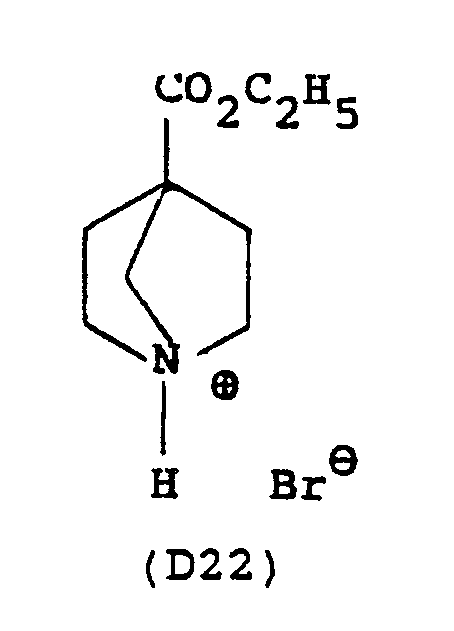
- A suspension of ethyl 1-benzyl-1-azoniabicyclo[2.2.1]hept-4-ylcarboxylate bromide (D21, 130g, 0.38 mole) in ethanol (500ml) was hydrogenated over 10% palladium on charcoal catalyst (8g) at atmospheric temperature and pressure for 18h. The catalyst was removed by filtering through celite, washing several times with hot ethanol, and the filtrate concentrated in vacuo to give the title compound (D22) as a crystalline white solid (80.1g, 84%).
¹H NMR (CD₃OD) δ:
1.3 (3H, t, J=7Hz), 2.0-2.18 (2H, m), 2.3-2.5 (2H, m), 3.35-3.5 (2H, m), 3.45 (2H, s), 3.5-3.7 (2H, m), 4.25 (2H, q, J=7Hz) -

- Ethyl 1-azabicyclo[2.2.1]hept-4-yl carboxylate hydrobromide salt (D22) (10g, 0.04 moles) was dissolved in concentrated hydrochloric acid (55ml) and water (22ml) and heated under reflux for 16h. The reaction was then concentrated in vacuo and azeotroped once with toluene to afford a colourless solid. This product was suspended in thionyl chloride (80ml) and heated under reflux for 4h when the solution was homogenous. The reaction was then concentrated in vacuo and the residue azeotroped with dry toluene until a crystalline residue was obtained. This material was suspended in dry acetonitrile (150ml) and N,O-dimethyl hydroxylamine hydrochloride (4.4g, 0.045 moles) added. The stirred solution was cooled to -30oC and pyridine (16ml) added at such a rate that the temperature did not rise above -20oC. The solution was then allowed to warm to room temperature overnight when a homogenous solution was obtained. The solution was then concentrated in vacuo to a gum which was partitioned between chloroform and saturated aqueous potassium carbonate. The organic phase was separated, dried over Na₂SO₄ and concentrated in vacuo to a gum. Kugelröhr distillation afforded the title compound (D23) (6.48g, 0.035 moles, 88%). B.pt. 150-160 at 2mmHg as a white solid. M.pt. 108-110oC.
¹H NMR (CDCl₃) δ:
1.6-1.75 (2H, m, 3H, 5H), 1.85-1.95 (2H, m, 3H, 5H), 2.57-2.7 (2H, m, 2H, 6H), 2.75 (2H, s, 7-CH₂), 2.95-3.1 (2H, m, 2H, 6H), 3.25 (3H, s, NMe), 3.7 (3H, s, OMe).
¹³C NMR (CDCl₃) δ:
33.0, 33.9, 55.5, 55.6, 61.4, 63.0, 175.6 -

- 4-(N-Methyl-N-methoxyaminocarbonyl)-1-azabicyclo[2.2.1]heptane (D23) (6.48g, 0.035 mole) in dry tetrahydrofuran (100ml) was cooled to -70oC under an atmosphere of nitrogen (a fine suspension of the amide formed on cooling). To this was added diisobutyl aluminium hydride in hexane (30ml of 1.5M solution, 0.045 mole) and the solution stirred at -70oC for 1h and then allowed to warm to room temperature over 2h. The reaction was then cooled to -60oC and poured on to a well stirred slurry of ice and 5N HCl (40ml). The solution was then basified with excess potassium carbonate and the product recovered by exhaustive extraction with chloroform. The chloroform extract was dried over Na₂SO₄ sulphate and concentrated in vacuo to a gum. The gum was purified by Kugelröhr distillation to afford the title compound (D24) (4.05g, 0.0324 mole, 93%) B.pt 75-85oC at 0.4mmHg as a colourless oil.
¹H NMR (CDCl₃) δ:
1.3-1.43 (2H, m, 3H, 5H), 2.0-2.17 (2H, m, 3H, 5H), 2.6-2.75 (2H, m, 2H, 6H), 2.65 (2H, s, 7-CH₂), 3.0-3.14 (2H, m, 2H, 6H), 9.95 (1H, s, CHO).
¹³C NMR (CDCl₃) δ:
31.8, 55.2, 55.5, 62.7, 202.5 -

- Toluene sulphonyl methyl isocyanide (4.29g, 0.022 mole) in dry 1,2 dimethoxyethane (25ml) was added to a stirred suspension of potassium t-butoxide (5.13g, 0.042 mole) in dimethoxyethane (30ml) at -50oC under an atmosphere of nitrogen. A solution of 4-formyl-1-azabicyclo[2.2.1]heptane (D24) (2.625g, 0.021 mole) in dimethoxyethane (30ml) was added at -50oC and stirred at this temperature for 1.5h. The solution was then allowed to warm to room temperature and stirred at 25oC for 1h. Methanol (50ml) was then added and the solution heated under reflux for 15 min. The solution was then concentrated in vacuo to a gum and the residue partitioned between saturated aqueous potassium carbonate and chloroform. The organic phase was separated dried over sodium sulphate and concentrated in vacuo to a gum. Kugelröhr distillation afforded the title compound (D25) (1.8g, 0.0132 mole, 63%) as a colourless oil. B.pt 140oC at 0.5mmHg.
¹H NMR (CDCl₃) δ:
1.33-1.5 (2H, m, 3H, 5H), 1.6-1.75 (2H, m, 3H, 5H), 2.4 (2H, s, 7-CH₂), 2.6-2.75 (2H, m, 2H, 6H), 2.75 (2H, s, 8-CH₂), 2.95-3.1 (2H, m, 2H, 6H) -

- 4-(Cyanomethyl)-1-azabicyclo[2.2.1]heptane (D25) (0.9g, 0.0062 moles), was dissolved in 5N hydrochloric acid, (25ml) and heated under reflux for 12h. The reaction was then concentrated in vacuo to a gum and dissolved in ethanol (20ml), to which was added concentrated sulphuric acid (1ml) and the solution heated under reflux for 15 min. The solution was then concentrated in vacuo to a gum. Kugelröhr distillation afforded the title compound (D26) (0.85g, 0.00464 mole, 70%) as an oil. B.pt 150oC at 0.5mmHg.
¹H NMR (CDCl₃) δ:
1.28 (3H, t, J=7Hz, CH₃), 1.33-1.48 (2H, m, 3H, 5H), 1.5-1.75 (2H, m, 3H, 5H), 2.40 (2H, s, 7-CH₂), 2.5-2.7 (2H, m, 2H, 6H), 2.68 (2H, s, 8-CH₂), 2.88-3.1 (2H, m, 2H, 6H), 4.15 (2H, q, J=7Hz, OCH₂). -

- 4-(Cyanomethyl)-1-azabicyclo[2.2.1]heptane (D25) (0.9g, 0.0066 mole) was heated under reflux with 5N hydrochloric acid (30ml) for 4h and then concentrated in vacuo to a gum. This was azeotroped with toluene to afford the anhydrous acid hydrochloride which was treated with thionyl chloride (20ml) which was heated under reflux for 2h when a homogeneous solution was obtained. The excess thionyl chloride was removed in vacuo and the residue azeotroped with toluene to remove the last traces of thionyl chloride. The residue was dissolved in dichloromethane (50ml) and cooled to -50oC with stirring. To this was added dichloromethane (100ml) saturated with ammonia at -50oC and the stirred reaction allowed to warm to 20oC over 2h. Excess saturated aqueous potassium carbonate solution was added and the organic phase separated, dried over sodium sulphate and concentrated in vacuo to a gum. Crystallisation from methanol/ether afforded the title compound (D27) (400mg, 0.026 mole, 39%) as needles. M.p. 143-145oC.
¹H NMR ((CD₃)₂SO) δ:
1.1-1.3 (2H, m, 3H, 5H), 1.4-1.58 (2H, m, 3H, 5H), 2.2 (2H, s, 7-CH₂), 2.38 (2H, s, 8-CH₂), 2.35-2.5 (2H, m, 2H, 6H), 2.65-2.8 (2H, m, 2H, 6H), 3.5 (Br s, H₂O), 6.75 (1H, s, NH), 7.3 (1H, s, NH) -

- Hydroxylamine hydrochloride (1.67g, 0.0236 mole) was added to a solution of sodium (0.552g, 23.6 mole) in methanol (40ml) under nitrogen and the reaction heated under reflux for 15 min whereupon the hydroxylamine hydrochloride had completely dissolved and the resulting sodium chloride had precipitated out. (±) endo 3-(Cyanomethyl)-1-azabicyclo[2.2.1]heptane (D13) (0.8g, 0.0059 mole) in methanol (30ml) was added and the mixture heated under reflux for 48h. The reaction was then concentrated in vacuo to a gum and the residue partitioned between saturated aqueous potassium carbonate (5ml) and water. The organic phase was separated and repeatedly extracted with chloroform. The combined organic extracts were dried over sodium sulphate and concentrated in vacuo to give the title compound as a 10:1 mixture of endo:exo isomers (D28) (0.9g, 0.0053 mole, 90%).
Ir ν C=N 1660cm⁻¹
¹H NMR (CDCl₃) δ:
1.35-1.70 (2H, m), 1.9-2.05 (1H, m), 2.12-2.6 (8H, m), 2.74-2.91 (1H, m), 3.0-3.18 (1H, m), 4.4-4.55 (2H, m). -

- (±) 3-[(N-hydroxy)-carboximidamidemethyl]-1-azabicyclo[2.2.1]heptane (D28) (0.37g, 0.0022 mole) in absolute chloroform was cooled to 0oC and treated with acetyl chloride (0.2g, 0.0026 mole) under nitrogen. The reaction was allowed to warm to room temperature over 1h. The solution was then cooled to 0oC and treated with saturated aqueous potassium carbonate solution (10ml). The organic layer was separated, the aqueous layer repeatedly extracted with chloroform and the combined organic extracts dried over sodium sulphate and concentrated in vacuo to afford the title compound (as a 10:1 mixture of exo:endo isomers) (D29) (0.42g, 0.002 mole, 91%).
-

- Hydrogen chloride gas was bubbled through a solution of (±) 3-cyano-1-azabicyclo[2.2.2]octane (D1 of EP-0261763) (48.5g, 0.357 moles) in ethanol (300ml) causing the solution to reflux. The mixture was maintained at reflux while hydrogen chloride gas was bubbled through for 3h. The mixture was allowed to cool and then concentrated in vacuo. The residue was partitioned between saturated potassium carbonate solution and chloroform. The organic layer was dried (Na₂SO₄) and evaporated to dryness. The residue was distilled to give the title compound (D30) as a colorless liquid (42.5g, 65%) b.p. 100oC at 1.0mmHg.
¹H NMR (CDCl₃) δ:
1.25 (3H, t), 1.33-1.50 (1H, m), 1.55-1.72 (3H, m), 2.15-2.21 (1H, m), 2.50-3.10 (6H, m), 3.25-3.38 (1H, m), 4.17 (2H, q). -
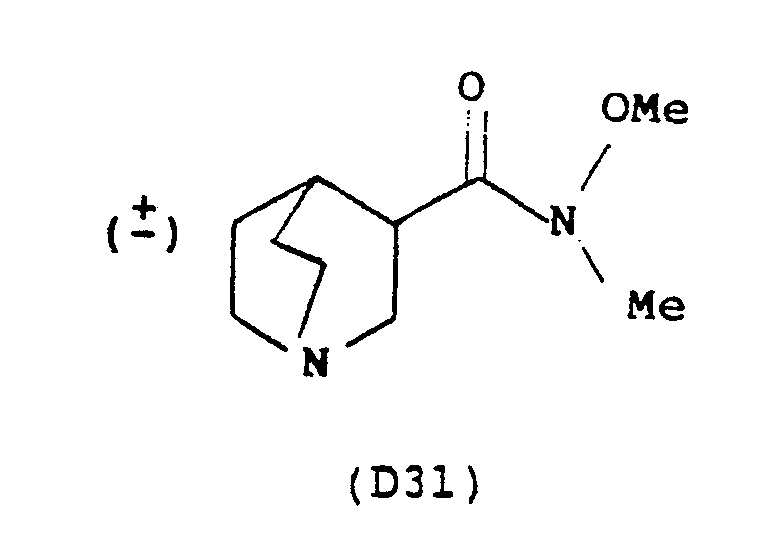
- (±) Ethyl 1-azabicyclo[2,2,2]oct-3-yl carboxylate (D30) (42.5 g, 0.232 moles) in concentrated hydrochloric acid (300ml) and water (100ml) was heated under reflux for 2h. The mixture was allowed to cool and concentrated in vacuo to give a white solid which was dissolved in thionyl chloride (150ml) and heated under reflux for 1.5h. The mixture was evaporated to dryness, and freed from residual thionylchloride by co-evaporation with toluene. The residue was dissolved in dry acetonitrile (1200ml) and treated with N,O-dimethylhydroxylamine hydrochloride (24g, 0.246 moles) and pyridine (58ml, 0.717 moles) at 0oC. The mixture was allowed to warm to room temperature and stirred for 3h. The mixture was concentrated in vacuo and the residue partitioned between saturated potassium carbonate solution and chloroform. The organic layer was dried (Na₂SO₄) and evaporated to dryness. The residue was distilled to give the title compound (D31) as a pale yellow oil which solidified on standing (37g, 80%) b.p. 120oC at 1.0mmHg.
-

- (±) 3-(N-Methyl-N-methoxyaminocarbonyl)-1-azabicyclo[2.2.2]octane (D31) (6.0g, 0.03 moles) was dissolved in dry toluene (250ml) and cooled to -70oC under a nitrogen atmosphere. Diisobutylaluminium hydride (1.5M solution in toluene (45ml, 0.068 moles) was added dropwise. The reaction was then allowed to warm to room temperature over a period of 2h. Hydrochloric acid (2N, 300ml) was added rapidly with vigorous stirring. The aqueous layer was saturated with potassium carbonate and the mixture extracted with chloroform (3 x 250ml). The combined extracts were dried (Na₂SO₄) and evaporated to dryness. The residue was distilled in a Kugelröhr to yield the title compound (D32) as a colourless oil (3.6g, 85%) b.p. 100oC at 1.0mmHg.
¹H NMR (CDCl₃) δ:
1.39-1.58 (2H, m), 1.62-1.75 (2H, m), 2.29-2.35 (1H, m), 2.50-2.60 (1H, m), 2.72-2.98 (5H, m), 3.30-3.43 (1H, m), 9.80 (1H, s). -

- A mixture of (±) 3-formyl-1-azabicyclo[2.2.2]octane (D32) (2.5g, 0.018 moles) and 2-trimethylsilyl-1,3-thiazole (2.7g, 0.017 moles) was stirred together without solvent at room temperature for 3h. The mixture was diluted with tetrahydrofuran (100ml) and then treated with tetrabutylammonium fluoride trihydrate (5.4g, 0.017 moles). After 1h the mixure was concentrated in vacuo and the residue partitioned between saturated potassium carbonate solution and chloroform. The organic layer was dired (Na₂SO₄) and evaporated to dryness. The residue was subjected to column chromatography on TLC alumina eluting with 0.5% methanol/chloroform. This gave an oil which was triturated with diethylether/methanol to yield the title compound (D33) as a buff solid (0.5g, 13%).
¹H NMR (CDCl₃) δ:
1.40-1.72 (3H, m), 1.75-1.92 (1H, m), 2.00-2.20 (2H, m), 2.42-2.53 (1H, m), 2.63-2.89 (5H, m), 4.80 (1H, d), 7.29 (1H, d), 7.69 (1H, d). -

- A mixure of (±) 3-((1,3-thiazol-2-yl)hydroxymethyl)-1-azabicyclo[2.2.2]octane (D33) (0.49g, 0.0022 moles) and toluene-4-sulphonic acid monohydrate (1.2g, 0.0063 moles) was heated under reflux in xylene (60ml) for 24h. A 'Dean and Stark' apparatus was used to trap the eliminated water. The mixture was allowed to cool and then concentrated in vacuo. The residue was partitioned between saturated potassium carbonate solution and chloroform. The organic layer was dried (Na₂SO₄) and evaporated to dryness. The residue was subjected to column chromatography on silica gel eluting with 0-5% methanol/chloroform. This yielded the title compound (D34) (0.23g, 51%) as a white solid plus a smaller amount of the E isomer.
¹H NMR (CDCl₃) δ:
1.70-1.92 (4H, m), 2.03-2.11 (1H, m), 2.82-3.09 (4H, m), 3.87 (2H, s), 6.55-6.62 (1H, m), 7.27 (1H, d), 7.79 (1H, d). -

- Sodium (95mg, 4mmol) was dissolved in ethanol (50ml) and to this was added hydroxy guanidine sulphate hemihydrate (314mg, 1.18mmol) and powdered 4A molecular sieve (1g) under nitrogen at room temperature. To this solution was added (±) exo 3-methoxycarbonylmethyl-1-azabicyclo[2.2.1]heptane (D2) (100mg; 0.59mmol) and the stirred solution heated under reflux for 1.5h. Acetic acid (1ml) was added and the reaction concentrated in vacuo to a gum. The gum was partitioned between chloroform and saturated aqueous potassium carbonate solution. The organic phase was separated, dried (Na₂SO₄) and concentrated in vacuo to a solid. A solution in chloroform/ether 1:1 was treated with decolourising charcoal (1g), filtered and concentrated to a gum. The gum was allowed to crystallise from ether to afford the title compound (E1) (26mg, 23%) as needles, m.p. 114-115oC
¹H NMR (CDCl₃) δ:
1.18 (1H, m, 5H); 1.60 (1H, m, 5H); 1.90 (1H, m, 3H); 2.3-2.9 (9H); 4.35 (2H, bs, NH₂)
¹³C NMR (CDCl₃) δ:
30.9, 31.7, 40.6, 41.8, 53.9, 57.6, 62.0, 168, 178. -

- (±) 3-Ethoxycarbonylmethyl-1-azabicyclo[2.2.1]octane (D3) (1.10g, 5.6mmol) was dissolved in concentrated hydrochloric acid (25ml) and heated at reflux with stirring for 2h. The solution was evaporated to dryness under reduced pressure and dried in a vacuum desiccator overnight to yield the acid hydrochloride (1.10g, 96%). The acid hydrochloride (1.10g, 5.35mmol) was suspended in thionyl chloride (20ml) and stirred at room temperature under nitrogen for 60h. The yellow solution was evaporated to dryness under reduced pressure, dried azeotropically with toluene and the resulting orange solid suspended in ethanol-free chloroform. Acetamide oxime (0.580g, 7.8mmol) was added and the mixture heated at reflux for 4h. The mixture was allowed to cool, diluted with water and saturated with solid anhydrous potassium carbonate. The chloroform layer was separated and the aqueous layer re-extracted with chloroform (100ml). The combined organic extracts were then washed with saturated aqueous potassium carbonate solution (100ml) and the organic extracts were then dried (Na₂SO₄), filtered and evaporated to dryness under reduced pressure to yield a brown oil (0.88g). This was heated at reflux in xylene (120ml) for 2h using a Dean and Stark head. The reaction mixture was evaporated to dryness under reduced pressure and purified by column chromatography (silica eluting with 5-7% methanol/chloroform, to afford the oxadiazole (E2) (0.26g, 22% from ester) which was purified as the hydrochloride salt (200mg).
¹H NMR (270MHz, d₆DMSO) δ:
1.86 (5H, bm); 2.32 (3H, s, CH₃); 2.90 (1H, dd, 3-H); 3.17 (6H, m); 3.34 (1H, s); 3.43 (1H, m).
¹³C NMR (67MHz, d₆DMSO) δ:
11.0 (CH); 18.7 (CH₂); 23.4 (CH₃); 23.5 (CH₂); 28.5 (CH₂); 30.7 (CH); 44.7 (CH₂); 45.2 (CH₂); 50.8 (CH₂); 166.8 (quaternary C) and 177.7 (quaternary C).
MS C₁₁H₁₇N₃O requires M⁺ 207.1366, M⁺ found 207.1373. -

- (±) 3-Aminocarbonylmethyl-1-azabicyclo[2.2.2]octane (D4, 1.6g, 0.0095mol) was mixed with vinylene carbonate (1.25g, 0.0145mol) and polyphosphoric acid (34g), and the mixture heated at 110-130oC for 90 minutes. The solution was cooled, ice (50ml) added and the slurry stirred at room temperature for 1h. The ice-cooled reaction mixture was then basified to pH 9 with 20% aqueous NaOH solution. The ice-cooled solution was then saturated with solid potassium carbonate and extracted with diethyl ether (2 x 500ml). The organic extracts were dried (Na₂SO₄), filtered and evaporated to dryness under reduced pressure to yield a yellow oil. This was purified by column chromatography (neutral alumina eluting with 1% MeOH/CHCl₃) to afford a clear oil (280mg, 16%) which was crystallised as the oxalate salt to afford the title compound.
¹H NMR (270MHz, d₆DMSO) δ:
1.86 (5H, bm); 2.96 (4H, m); 3.22 (4H, bm); 3.48 (1H, dt); 7.15 (1H, s, oxazole-H); 8.06 (1H, s, oxazole-H).
¹³C NMR (67MHz, d₆DMSO) δ:
17.6, 23.4, 23.7, 30.1, 31.2, 45.0, 45.7, 51.2, 126.9, (CH-oxazole), 139.4 (CH-oxazole), 162.2 (C-oxazole), 164.0 (C oxalate).
MS C₁₁H₁₆N₂O requires M⁺ 192.1262; M⁺ found 192.1263. -

- To a solution of sodium (1.0g, 0.04 mole) in ethanol (60ml) under an atmosphere of nitrogen was added crushed molecular sieve (5g) and hydroxyguanidine sulphate hemihydrate (5.75g, 0.04 mole). The resulting slurry was stirred for 15 min then (±) 5-(methoxycarbonylmethyl)-1-azabicyclo[3.2.1]octane (D11, 0.5g, 0.0027 mole) was added. The mixture was heated under reflux for 6h then left to stand overnight. The reaction was neutralized with acetic acid, filtered and concentrated in vacuo to a gum. The gum was partitioned between saturated aqueous potassium carbonate and chloroform. The organic phase was separated, dried (Na₂SO₄) and evaporated to afford a gummy solid. Recrystallised from methanol/ether to afford the title compound (E4, 0.13g, 0.006 mole, 23%).
¹H NMR (CDCl₃) δ:
1.4-1.85 (6H, m), 2.61-3.13 (6H, m), 2.92 (2H, s, 9-CH₂), 4.43 (broad singlet).
¹³C NMR (CDCl₃) δ:
20 (CH₂), 35.3 (CH₂), 35.5 (CH₂), 36 (CH₂), 42.5 (tertiary C C-5), 52 (CH₂), 54.8 (CH₂), 65 (CH₂), 167.9, 177.5 together (oxadiazole carbons). -

- Sodium (420mg 0.018 moles) was dissolved in ethanol (50ml) under an atmosphere of nitrogen and the resulting solution cooled to 20oC and treated with hydroxy guanine hemihydrate (1.4g, 0.005 moles) and powdered 3A molecular sieve (5g). To this well stirred slurry was added (±) endo 3-ethoxycarbonylmethyl-1-azabicyclo[2.2.1]heptane (D6) and the reaction heated under reflux for 2h. The reaction was then neutralised by the addition of glacial acetic acid, filtered through celite and the filtrate concentrated in vacuo to a gum. This gum was partitioned between chloroform and saturated aqueous potassium carbonate solution and the organic phase separated and concentrated in vacuo to a gum. Crystallisation from acetone/methanol afforded the title compound (E5) as needles mpt 140-145oC (185mg, 36%).
¹H NMR (270Mhz, CH₃OD)
1.46-1.75 (2H, m), 2.05-2.18 (1H, m), 2.4-2.64 (5H, m), 2.75-2.85 (1H, m), 2.85 (2H, d, J=7Hz), 3.0-3.13 (1H, m), 4.9 (2H, s).
¹³C NMR CD₃OD δ:
23.7, 28.4, 39.3, 42.0, 54.9, 60.4, 61.5, 170.5, 179.5
Analysis C₉H₁₄N₄O, requires C, 55.6; H, 7.3; N, 28.8%
Found C, 55.6; H, 7.3; N, 28.7%. -

- (±) endo 3-(Ethoxycarbonylmethyl)-1-azabicyclo[2.2.1]heptane (D6) (1.15g, 0.006moles) was heated under reflux in concentrated hydrochloric acid (15ml) and water (7ml) for 2h. The reaction mixture was evaporated to constant volume, dry toluene (20ml) added and the mixture re-evaporated to remove last traces of water. The dry residue was dissolved in thionyl chloride (15ml) and heated under reflux for 2 minutes. The solution was then concentration in vacuo and azeotroped twice with dry toluene to afford the thionyl chloride free acid chloride. The acid chloride was dissolved in ethanol free chloroform (30ml) and treated with acetamide oxime (0.74g, 0.01 moles) under an atmosphere of nitrogen; the reaction mixture was heated under reflux for 2 hours and then left to stand for 48h. The reaction was basified with saturated aqueous potassium carbonate solution and the organic phase separated, dried (Na₂SO₄) and concentrated to yield a brown oil. The brown oil was heated under reflux in xylene (100ml) for 1.75h. Xylene was removed in vacuo to afford a dark brown oil. The crude oil was chromatographed on silica in a gradient of 5 to 10% methanol in chloroform to afford the title compound as a colourless oil (400mg, 33%). The oxalate salt crystallised from ether as cubes which contained 10% of the exo isomer by NMR. m.p. 104-107oC. Oxalate salt ¹H NMR (CD₃OD) δ:
2.74-3.01 (2H, m), 3.28 (3H, s, CH₃), 3.47-3.51 (1H, m), 3.75-3.89 (3H, m), 3.95-4.60 (6H, m).
Oxalate salt ¹³C NMR (CD₃OD) (Major isomer), δ:
12.7, 22.7, 27.7, 36.8, 40.8, 53.4, 57.7, 60.8, 166.3 (oxalate), 168.31, 179.7. -

- Crude (±) endo 3-ethoxycarbonylmethyl-1-azabicyclo[2.2.1]heptane (D6) (1.21g, 0.0066 mols) was dissolved in concentrated hydrochloric acid (15ml) and water (6ml) and heated under reflux for 2h. Water and excess hydrochloric acid were removed in vacuo, dry toluene (30ml) was added to the residue and the mixture re-evaporated to remove last traces of water. The dry residue was treated with thionyl chloride (11ml) and dichloromethane (30ml) and heated under reflux for 1h when a homogenous solution was attained. The reaction mixture was evaporated to afford a pale brown oil which was azeotroped three times with toluene. A solution of the dry oil in dichloromethane (30ml) was cooled to -40oC and treated dropwise with a saturated solution of ammonia in dichloromethane (40ml) under an atmosphere of nitrogen. The reaction mixture was allowed to warm to room temperature with stirring. The mixture was basified with saturated aqueous potassium carbonate, the organic phase separated, dried (Na₂SO₄) and concentrated in vacuo to afford a gummy solid. Crystallization from acetone/ether gave the amide as a buff coloured solid (0.83g, 0.005mols) which was used without further purification in the next step. The amide (0.79g, 0.005moles) was treated with polyphosphoric acid (34g) and vinylene carbonate (0.59g, 0.005moles) and the well stirred mixture heated at 120oC for 1½h. The resulting black liquid was allowed to cool slightly and poured into saturated aqueous potassium carbonate (50ml) and ice with vigorous stirring. The black solution was extracted with ether, the organic phase was separated, dried (Na₂SO₄) and concentrated in vacuo to yield a pale yellow oil. The oxalate salt was recrystallised from methanol/ether to afford the title compound as a white solid (210mg, 12%).
m.p. 136-143oC, containing 10% of the exo isomer by NMR.
Oxalate salt ¹H NMR (DMSO) δ:
1.64-2.13 (2H, m), 2.74-3.7 (10H, m), 7.2 (1H, s, 4′-CH), 8.12 (1H, s, 5′-CH).
Oxalate salt ¹³C (DMSO) (major isomer) δ:
21, 27.5, 36, 52, 56.6, 59, 127, 139.5, 163, 165 (oxalate), plus one carbon under DMSO signal. -

- A solution of (±) endo 3-N-methyl-N-methoxy aminocarboxymethyl-1-azabicyclo[2.2.1]heptane (D7) (1.36g, 0.007 moles) in THF (40ml) was cooled to -70oC under an atmosphere of nitrogen and DIBAL (5.1ml of a 1.5M solution in toluene, 0.008 moles) added slowly. The solution was stirred at -70oC for 45 mins and then at room temperature for a further 2½h. The reaction mixture was re-cooled to -70oC and then poured into a vigorously stirred mixture of 5N hydrochloride acid (7ml) and ice. The reaction mixture was evaporated in vacuo to afford an oil which was basified with saturated aqueous potassium carbonate and partitioned with chloroform. The organic phase was separated dried (Na₂SO₄) and concentrated to give a pale brown oil. The crude oil was distilled on a Kugelröhr to yield the aldehyde as a colourless oil (0.81g, 0.06 moles) b.p. 115oC at 0.5mmHg. Without further purification the aldehyde (0.81g, 0.006 moles) in methanol (20ml) was treated with para toluenesulphonylmethylisocyanide (TOSMIC) (1.2g, 1.1eq) and solid potassium carbonate (0.93g, 1.1eq) under nitrogen. The solution was heated under reflux for 1.5h, then concentrated in vacuo and the residual oil partitioned between saturated aqueous potassium carbonate and chloroform. The organic phase was separated, dried (Na₂SO₄) and evaporated to yield a pale brown oil. The crude oil was dissolved in ether which was added to polyphosphoric acid (18g) and the ether was evaporated in vacuo. The reaction mixture was then heated at 170oC for 10 mins with vigorous stirring. The resulting hot, brown liquid was immediately poured into a vigorously stirred mixture of chloroform (50ml) and saturated aqueous potassium carbonate (50ml). The organic phase was separated, dried (Na₂SO₄) and evaporated to yield a crude brown oil which was distilled on a Kugelrohr to give the title compound (E11) as yellow oil (260mg, 20%) b.p. 200 at 0.5mmHg. The oil was crystallised as the hydrochloride salt - a low melting, colourless solid (300mg, 20%) containing 10% of the exo isomer by NMR.
Hydrochloride ¹H NMR (DMSO) δ:
1.85-2.10, (2H, m), 2.66-3.62 (10H, m), 7.03 (1H, s, oxazole CH), 8.36 (1H, s, oxazole CH)
Hydrochloride ¹³C NMR (DMSO) major isomer, δ:
21, 25, 36.5, 52, 56, 59, 122.5, 150.5, 151.5 plus one carbon under DMSO signal. -

- (±) E/Z 3-Ethoxycarbonylmethylene-1-azabicyclo[3.2.1]octane (D15) (1.05g, 0.0054 moles) was dissolved in ethanol (50ml) and treated with 10% palladium on charcoal (120mg) and stirring under an atmosphere of hydrogen for 6h. The reaction was then filtered through celite and concentrated in vacuo to a gum. Kugelröhr distillation afforded the saturated ester (0.73g, 0.0038 moles) as a 10:1 mixture of endo:exo isomers which was used directly in the next step. Sodium metal (0.37g, 0.016 moles) was dissolved in dry ethanol (30ml) under nitrogen and crushed 3A molecular sieve (3g) added. Hydroxyguanidine sulphate hemihydrate (2.13g, 0.008 moles) and the saturated ester (0.4g, 0.002 moles) were added, the reaction mixture stirred at 25oC for 15 mins and then heated under reflux for 3h. The reaction was then cooled, quenched by the addition of acetic acid and concentrated in vacuo to a gum which was partitioned between saturated aqueous potassium carbonate and chloroform. The organic phase was separated, dried (Na₂SO₄) and concentrated in vacuo to a gum. Crystallisation from ether afforded the title compound (E9) (0.081g, 0.00039 mole, 19%) as needles. M.pt. 151-153oC.
¹H NMR (CDCl₃) δ:
1.4-1.54 (1H), 1.78-1.90 (2H), 2.03-2.32 (3H), 2.45-2.6 (1H), 2.72-3.1 (6H), 3.24-3.38 (1H), 4.37-4.7 (2H).
¹³CC NMR CDCl₃ δ:
27.7, 31.3, 33.0, 34.3, 34.9, 52.3, 58.3, 58.8, 167.8, 178.4 -

- (±) exo 3-Methoxycarbonylmethyl-1-azabicyclo[2.2.1] heptane (D2) (0.250g, 0.0015 mole) was dissolved in concentrated hydrochloric acid (7ml) and water (3ml) and heated under reflux for 2h. The reaction was evaporated to dryness and azeotroped with dry toluene. The dry residue was treated with thionyl chloride (6ml) and dichloromethane (14ml) and heated under reflux for 1h. The reaction was concentrated in vacuo and azeotroped three times with dry toluene to remove last traces of thionyl chloride and afford a pale brown oil. A solution of the oil in dichloromethane (20ml) under an atmosphere of nitrogen was cooled to -40oC. The cold solution was treated, dropwise, with a saturated solution of ammonia in dichloromethane (10ml). The reaction was allowed to warm to room temperature and stir for 1h. The reaction mixture was partitioned with saturated aqueous potassium carbonate, the organic phase was separated, dried (Na₂SO₄) and concentrated in vacuo to afford a viscous oil. The oil was worked with ether to give the crude amide as a gummy buff-coloured solid.
- The crude amide was treated with polyphosphoric acid (20g) and vinylene carbonate (0.15g, 1eq) and heated at 120oC for 1h. The black liquid was allowed to cool slightly and was then cautiously poured into a vigorously stirred mixture of saturated aqueous potassium carbonate and ice. Solid potassium carbonate was added until all of the gummy material had dissolved. The mixture was partitioned with ether, the organic phase was separated, dried (Na₂SO₄) and concentrated in vacuo to afford an oil. The oil was chromatographed on silica in a gradient of 10% to 40% methanol in chloroform. Elution with 30% methanol in chloroform gave the title compound (E10) (15mg, 6%) which crystallised as the oxalate salt.
m.p. 109oC
Oxalate ¹H NMR (CD₃OD) δ:
1.9-2.03 (1H, m), 2.22-2.37 (1H, m), 2.62-2.78 (1H), 2.94-3.74 (9H, m), 7.26 (1H, s) and 8.3 (1H, s) together oxazole protons. -

- (±) endo 3-(Cyanomethyl)-1-azabicyclo[2.2.1]heptane endo:exo 10:1 (D13) (0.74g, 0.005 moles) in tetrahydrofuran (2ml, 0.0015 mole) was heated with azidotrimethylsilane in an autoclave at 110oC for 24h. The reaction mixture was dissolved in methanol and then concentrated to remove any unreacted hydrazoic acid. The residue was then taken up in methanol and treated with an excess of diazomethane in ether at 10oC for 1h when the yellow colour persisted. The reaction was then concentrated in vacuo to a gum. The gum was extracted with ethyl acetate and the extract columned on neutral alumina in a gradient of 0-20% methanol a mixture of unreacted endo and exo starting materials D13 (40mg). Elution with 2% methanol in ethyl acetate afforded the 2 methyl isomer (163mg) 10:1 mixture of endo:exo isomers as a colourless oil. The oxalate salt crystallized from acetone/ether to afford the title compound (E11) (138mg, 0.00049 mole, 10%) as needles. M. pt. 121-124oC. Elution with 10% methanol in ethyl acetate afforded a 10:1 mixture of endo and exo [(1-methyltetrazol-5-yl)methyl-1-azabicyclo[2.2.1]heptane (60mg).
¹H NMR (CD₃OD) (exo isomer) δ:
2.15-2.30 and 2.30-2.45 each (1H, m, 5-H), 3.03-3.72 (9H, m), 3.8-3.95 (1H, m), 4.5 (3H, s, CH₃).
¹³C NMR CD₃OD (exo isomer) δ:
22.2 and 26.5 (C-5 and C-8), 38.4, 39.77 and 40.73 (C-3, C-4, CH₃), 53.9, 58.6, 61.0 (C-2, C-6, C-7), 166, oxalate (C-5).
Analysis % Found: C, 46.5; H, 6.0; N, 24.6
C₁₁H₁₇N₅O₄ requires: C, 46.6; H, 6.1; N, 24.7% -

- A stirred solution of 5-[(fur-2-yl)hydroxymethyl]-1-azabicyclo[3.2.1]octane (D14, 600mg, 0.0029 mole) and triethylsilane (1.85ml, 0.012 mole) in dry acetonitrile (60ml) at 0oC under nitrogen was treated with tin (IV) chloride (0.75ml, 0.0064 mole). The resulting brown solution was allowed to warm to room temperature over 20 minutes, then heated at 40oC for 30 minutes. The solution became almost colourless. The solution was cooled in an ice bath and treated with excess concentrated potassium carbonate solution, then extracted with ethyl acetate. The extract was concentrated in vacuo and the residue partitioned between ethyl acetate and dilute hydrochloric acid. The acid layer was separated, basified with potassium carbonate solution and extracted with ethyl acetate. The extract was dried (Na₂SO₄) and concentrated in vacuo to leave a yellow oil, which was distilled in a Kugelröhr apparatus (bp 170oC at 0.2mmHg) to give a colourless oil. This was converted into its oxalate salt, which was recrystallised from acetone/ether to give the title compound (E12) as a white solid (50mg, 6%) m.pt. 129-133oC.
Oxalate salt:- ¹H NMR (d₆ DMSO) δ:
1.45-1.55 (2H, m), 1.65-2.05 (4H, m), 2.80 (2H, s), 3.00-3.25 (4H, m), 3.25-3.50 (2H, m), 6.18-6.22 (1H, m), 6.38-6.42 (1H, m), 7.57-7.60 (1H, m). -

- Sodium (850mg, 37mM) was dissolved in ethanol (50ml) under an atmosphere of nitrogen. The solution was then treated with hydroxyguanine sulphate hemihydrate (2.55g, 0.0192 mole), powdered 3A molecular size (10g) and 4-(ethoxycarbonylmethyl)-1-azabicyclo[2.2.1]heptane (D26) (0.85g, 0.0046 mole) and heated under reflux for 1.5h. Acetic acid (3ml) was added, the solution filtered through celite and the filtrate concentrated in vacuo to a gum. The gum was then partitioned between chloroform and saturated aqueous potassium carbonate solution. The organic phase was separated, dried over sodium sulphate and concentrated in vacuo to a gum. The gum was crystallised from ether to afford the title compound (E13) (310mg, 0.0016 mole, 34%) as needles. M.pt 144-145oC
¹H NMR (CDCl₃) δ:
1.28-1.43 (2H, m, 3H, 5H), 1.53-1.67 (2H, m, 3H, 5H), 2.4 (2H, s, 7-CH₂), 2.55-2.7 (2H, m, 2H, 6H), 2.9-3.05 (2H, m, 2H, 6H), 3.15 (2H, s, 8-CH₂), 4.47 (2H, s, NH₂).
¹³C NMR (CDCl₃) δ:
29.6 (C-8), 35.5 (C-3, C-5), 47.7 (C-6), 55.4 (C-2, C-2), 63.9 (C-7), 167-9 and 177.7 (C-3′, C-5′). -

- 4-(Aminocarbonylmethyl)-1-azabicyclo[2.2.1]heptane (D27) (350mg, 0.00227 mole) in polyphosphoric acid (15g) was treated with vinylene carbonate (292mg, 0.0034 mole) with continuous stirring and the solution heated on an oil bath at 120oC for 1.5h. The reaction was then allowed to cool and poured into aqueous saturated potassium carbonate solution. The product was recovered by extraction into chloroform. The organic phase was separated, dried over sodium sulphate and concentrated in vacuo to a gum (48mg). The gum was dissolved in ether, filtered through a short column of decolourising charcoal and treated with oxalic acid (25mg) in methanol. The solution was allowed to crystallise to afford the title compound (E14) (45mg, 0.00017 moles, 7%) as needles. M.pt. 140-143oC.
¹H NMR (CD₃OD) δ:
1.82-1.95 (2H, m, 3H, 5H), 2.0-2.15 (2H, m, 3H, 5H), 3.28 (2H, s, 7-CH₂), 3.32 (2H, s, 8-CH₂), 3.35 (2H, m, 2H, 6H), 3.5-3.65 (2H, m, 2H, 6H), 7.18 (1H, s, 4′H), 7.92 (1H, s, 5′H).
¹³C NMR (CD₃OD) δ:
30.2 (C-8), 32.8 (C3, C5), 48.2 (C-4), 54.5 (C2, C6), 62.5 (C-7), 127.8 (C-4′), 141.1 (C-5′), 163.3 (oxalate), 166.5 (C-2′). -

- (±) 3=[(N-Acetoxy)-carboximidamide methyl]-1-azabicyclo[2.2.1]heptane (D29) (0.42g, 0.002 mole in toluene, 50ml) was heated under relux using a Dean and Stark apparatus for 12h. The solution was then concentrated in vacuo to a gum and the residue columned on silica in a gradient of 5-8% methanol in chloroform. Elution with 5% methanol in chloroform afforded a colourless oil which was dissolved in ether and treated with hydrogen chloride in ether. The resulting solid was recrystallized from methanol/ether to afford the title compound (E16) (42mg, 0.00018 mole) as needles. M.p. 165-167oC.
¹H NMR ((CD₃)₂SO) δ:
1.70-1.82 (1H, m), 2.03-2.2 (1H, m), 2.42-2.55 (1H, m), 2.75 (3H, s), 2.8-3.6 (9H, m).
¹³C NMR ((CD₃)₂SO) δ:
11.9 (CH₃), 27.3, 28.8 (C-5 and C-8), 37.7, 39.2 (C-3 and C-4), 50.8, 55.7, 57.4, (C-2, C-6, C-7), 168.5, 176.9 (C-3′ and C-5′). - Elution with 8% methanol in chloroform afforded a colourless oil which was dissolved in ether and treated with hydrogen chloride in ether to afford a gummy solid. Recrystallisation from methanol/ether afforded the title compound (E15) (0.151g, 0.00066 mole) as needles. M.p. 193-195oC.
¹H NMR ((CD₃)₂SO) δ:
1.79-1.99 (2H, m), 2.55 (3H, s, CH₃), 2.68-3.55 (10H, m).
¹³C NMR ((CD₃)₂SO) δ:
11.8 (CH₃), 20.9 and 25.6 (C-5, C-8), 35.5 and 39.2 (C-3, C-4), 51.7, 56.2 and 59.0 (C-2, C-6, C-7), 168.8 and 176.9 (C-3′, C-5′). -

- (±) Z 3((1,3-Thiazol-2-yl)methylene)-1-azabicyclo [2.2.2]octane (D34) (0.15 g, 0.00073 moles) was hydrogenated in methanol (20ml) over a 5% platinum on sulphided carbon catalyst (0.6g) at 200 psi and 100oC for 48h. The mixture was filtered through Kieselguhr and the filter pad washed with methanol (2 x 50ml). The combined filtrates were concentrated in vacuo and the residue subjected to column chromatography on TLC alumina eluting with 0.5% methanol/chloroform. This gave a white solid which was treated with anhydrous oxalic acid in ethanol/diethylether to give the title compound (E17) (0.03g, 14%) m.p. 126-130oC.
Free base ¹H NMR (CDCl₃) δ:
1.40-1.87 (5H, m), 2.12-2.25 (1H, m), 2.44-2.53 (1H, m), 2.71-2.93 (5H, m), 3.10 (2H, d), 7.19 (1H, d), 7.69 (1H, d). - Cerebral cortex from Hooded Lister rats (Olac, UK) is homogenised in 2.5 vols ice-cold 50mM tris buffer pH 7.7 (at 25oC). After centrifugation at 25,000 x g at 4oC for 15 min the pellet is resuspended in 2.5 vols buffer and the wash repeated 3 times more. The final resuspension is in 2.5 volumes and the homogenates are stored in 1ml aliquots at -20oC.
- Incubations (total volume 2ml) are prepared using the above buffer with the addition of 2mM magnesium chloride in the 3H-Oxotremorine-M (3H-OXO-M) experiments. For 3H-Quinuclidinyl Benzilate (3H-QNB), 1ml of stored membranes is diluted to 30ml and 0.1ml mixed with test compound and 0.27nM (c. 25,000 cpm) 3H-QNB (Amersham International). For 3H-OXO-M, 1ml of membranes is diluted to 6ml and 0.1ml mixed with test compound and 2nM (c. 250,000 cpm) 3H-OXO-M (New England Nuclear).
- Non-specific binding of 3H-QNB is defined using 1µm Atropine sulphate (2µm Atropine) and of 3H-OXO-M using 10µM Oxotremorine. Non-specific binding values typically are 5% and 25% of total binding, respectively. Incubations are carried out at 37oC for 30 min and the samples filtered using Whatman GF/B filters. (In the 3H-OXO-M experiments the filters are presoaked for 30 min in 0.05% polyethylenimine in water). Filters are washed with 3 x 4ml ice-cold buffer. Radioactivity is assessed using a Packard BPLD scintillation counter, 3ml Pico-Fluor 30 (Packard) as scintillant.
- This test provides an indication of the muscarinic binding activity of the test compound. The results are obtained as IC₅₀ values (i.e. the concentration which inhibits binding of the ligand by 50%) for the displacement of the muscarinic agonist 3H-OXO-M and the muscarinic antagonist 3H-QNB. The ratio IC₅₀(3H-QNB)/IC₅₀(3H-OXO-M) gives an indication of the agonist character of the compound. Agonists typically exhibit a large ratio; antagonists typically exhibit a ratio near to unity.
- The results are shown in Table 1.
Table 1 Example [³H-OXO-M IC₅₀ (nM) ³H-QNB IC₅₀ (nM) E1 36.5 7,500 E2 1,050 13,000 E3 755 7,000 E4 580 6,700 E5 32 21,000 E6 150 10,200 E7 42 8,000 E8 625 38,000 E9 925 4,600 E10 38 5,600 E11 340 8,000 E12 660 4,000 E13 118 85,000 E14 410 74,000 E15 950 30,500 E16 1000 - E17 875 -
Claims (13)


or (ii) A represents an electron withdrawing group, B represents hydrogen and R₅ represents -(CH₂)j L₂ where L₂ is a leaving group; one of k and l is 1 and the other and j independently represent an integer of 2 or 3; to give a compound of formula (IIb):

and thereafter, optionally or as necessary, removing any R₅ N-protecting group, converting K to A′, converting A′ to CH₂Z, interconverting Z and/or forming a pharmaceutically acceptable salt;


(±) exo 3-[(3-Amino-1,2,4-oxadiazol-5-yl)methyl]-1-azabicyclo[2.2.1]heptane,
(±) 3-[(3-methyl-1,2,4-oxadiazol-5-yl)methyl]-1-azabicyclo[2.2.2]octane,
(±) 3-[(1,3-oxazol-2-yl)methyl]-1-azabicyclo[2.2.2]octane,
(±) 5-[(3-amino-1,2,4-oxadiazol-5-yl)methyl]-1-azabicyclo[3.2.1]octane,
(±) endo 3-[(3-amino-1,2,4-oxadiazol-5-yl)methyl]-1-azabicyclo[2.2.1]heptane,
(±) endo 3-[(3-methyl-1,2,4-oxadiazol-5-yl)methyl]-1-azabicyclo[2.2.1]heptane,
(±) endo 3-[(1,3-oxazol-2-yl)methyl]-1-azabicyclo[2.2.1]heptane,
(±) endo 3-[(1,3-oxazol-5-yl)methyl]-1-azabicyclo[2.2.1]heptane,
(±) endo 3-[(3-amino-1,2,4-oxadiazol-5-yl)methyl-1-azabicyclo[3.2.1]octane,
(±) exo 3-[(1,3-oxazol-2-yl)methyl-1-azabicyclo[2.2.1]heptane,
(±) endo 3-[(2-methyltetrazol-5-yl)methyl]-1-azabicyclo[2.2.1]heptane,
(±) 5-[(fur-2-yl)methyl-1-azabicyclo[3.2.1]octane,
4-[(3-amino-1,2,4-oxadiazol-5-yl)methyl]-1-azabicyclo[2.2.1]heptane,
4-[(1,3-oxazol-2-yl)methyl]-1-azabicyclo[2.2.1]heptane,
(±) endo 3-[(5-methyl-1,2,4-oxadiazol-3-yl)methyl]-1-azabicyclo[2.2.1]heptane,
(±) exo 3-[(5-methyl-1,2,4-oxadiazol-3-yl)methyl]-1-azabicyclo[2.2.1]heptane,
(±) 3-[(1,3-Thiazol-2-yl)methyl]-1-azabicyclo[2.2.2]octane, or a pharmaceutically acceptable salt of any of the foregoing compounds.
Applications Claiming Priority (4)
| Application Number | Priority Date | Filing Date | Title |
|---|---|---|---|
| GB888823142A GB8823142D0 (en) | 1988-10-03 | 1988-10-03 | Novel compounds |
| GB8823142 | 1988-10-03 | ||
| GB898920073A GB8920073D0 (en) | 1989-09-07 | 1989-09-07 | Novel compounds |
| GB8920073 | 1989-09-07 |
Publications (2)
| Publication Number | Publication Date |
|---|---|
| EP0363085A2 true EP0363085A2 (en) | 1990-04-11 |
| EP0363085A3 EP0363085A3 (en) | 1991-03-27 |
Family
ID=26294467
Family Applications (1)
| Application Number | Title | Priority Date | Filing Date |
|---|---|---|---|
| EP19890309920 Withdrawn EP0363085A3 (en) | 1988-10-03 | 1989-09-28 | Novel compounds |
Country Status (8)
| Country | Link |
|---|---|
| US (1) | US5091397A (en) |
| EP (1) | EP0363085A3 (en) |
| JP (1) | JP2934742B2 (en) |
| KR (1) | KR900006339A (en) |
| AU (1) | AU4242689A (en) |
| CA (1) | CA2000042A1 (en) |
| DK (1) | DK484589A (en) |
| PT (1) | PT91872B (en) |
Cited By (11)
| Publication number | Priority date | Publication date | Assignee | Title |
|---|---|---|---|---|
| EP0414394A3 (en) * | 1989-08-05 | 1991-05-08 | Beecham Group P.L.C. | Novel compounds |
| EP0402056A3 (en) * | 1989-06-06 | 1991-09-04 | Beecham Group p.l.c. | Azabicyclic compounds, process for their preparation and pharmaceutical compositions containing them |
| WO1993013083A1 (en) * | 1991-12-31 | 1993-07-08 | Fujisawa Pharmaceutical Co., Ltd. | Oxadiazole derivatives having acetylcholinesterase-inhibitory and muscarinic agonist activity |
| US5318978A (en) * | 1991-10-15 | 1994-06-07 | Warner-Lambert Company | Azabicyclo oxime and amine cholinergic agents and methods of treatment |
| WO1996025160A1 (en) * | 1995-02-17 | 1996-08-22 | Novo Nordisk A/S | The use of heterocyclic compounds |
| WO1997001558A1 (en) * | 1995-06-29 | 1997-01-16 | Novo Nordisk A/S | Novel substituted azabicyclic compounds |
| US5599937A (en) * | 1992-05-11 | 1997-02-04 | Pharmacia Ab | Heteroaromatic quinuclidinenes, their use and preparation |
| WO1997036906A1 (en) * | 1996-04-02 | 1997-10-09 | Novo Nordisk A/S | Heterocyclic compounds and their preparation and use |
| US5733912A (en) * | 1997-02-19 | 1998-03-31 | Abbott Laboratories | 7A-heterocycle substituted hexahydro-1H-pyrrolizine compounds useful in controlling chemical synaptic transmission |
| US5981545A (en) * | 1989-10-07 | 1999-11-09 | Beecham Group P.L.C. | N-linked azabicyclic heterocycles useful for treating dementia |
| EP1082959A1 (en) * | 1991-09-20 | 2001-03-14 | Glaxo Group Limited | NK1 Antagonists for the treatment of depression |
Families Citing this family (8)
| Publication number | Priority date | Publication date | Assignee | Title |
|---|---|---|---|---|
| GB8717446D0 (en) * | 1987-07-23 | 1987-08-26 | Merck Sharp & Dohme | Chemical compounds |
| US5190953A (en) * | 1992-03-26 | 1993-03-02 | A. H. Robins Company, Incorporated | Heterocyclic carboxylic acid amides and esters of azabicyclic compounds as gastric prokinetic, antiemetic, anxiolytic and antiarrhythmic agents |
| US5244907A (en) * | 1992-03-26 | 1993-09-14 | A. H. Robins Company, Incorporated | Carbocyclic carboxylic acid amides and esters of azabicyclic compounds as gastric prokinetic, antiemetic, anxiolytic and antiarrhythmic agents |
| US5312785A (en) * | 1993-05-18 | 1994-05-17 | The Dow Chemical Company | Sintered self-reinforced silicon nitride |
| AU2003250322B2 (en) * | 2002-08-14 | 2010-01-21 | Neurosearch A/S | Novel quinuclidine derivatives and their use |
| WO2007022351A2 (en) * | 2005-08-18 | 2007-02-22 | Glaxo Group Limited | Muscarinic acetylcholine receptor antagonists |
| US7968484B2 (en) * | 2007-09-07 | 2011-06-28 | Ut-Battelle, Llc | Use of additives to improve microstructures and fracture resistance of silicon nitride ceramics |
| KR101427092B1 (en) * | 2012-01-13 | 2014-08-07 | 제일모직주식회사 | Method for preparing α-methylenelactone |
Citations (4)
| Publication number | Priority date | Publication date | Assignee | Title |
|---|---|---|---|---|
| EP0094742A2 (en) | 1982-04-14 | 1983-11-23 | Beecham Group Plc | Substituted azabicyclo compounds, process for their preparation and pharmaceutical compositions containing them |
| EP0257741A2 (en) | 1986-06-27 | 1988-03-02 | Beecham Group Plc | Azabicyclic compounds, process and intermediates for their preparation and pharmaceutical compositions containing them |
| EP0261763A1 (en) | 1986-06-27 | 1988-03-30 | Beecham Group Plc | Novel bridged bicyclic N-heterocycles |
| EP0287356A2 (en) | 1987-04-15 | 1988-10-19 | Beecham Group Plc | Bridgehead substituted azabicyclic derivatives |
Family Cites Families (3)
| Publication number | Priority date | Publication date | Assignee | Title |
|---|---|---|---|---|
| NZ219646A (en) * | 1986-03-27 | 1990-10-26 | Merck Sharp & Dohme | Oxadiazole derivatives of azacyclics for treating cns disorders |
| GB8717446D0 (en) * | 1987-07-23 | 1987-08-26 | Merck Sharp & Dohme | Chemical compounds |
| EP0322182A3 (en) * | 1987-12-22 | 1992-01-02 | Beecham Group Plc | Azabicyclic compounds, process for their preparation and pharmaceutical compositions containing them |
-
1989
- 1989-09-28 EP EP19890309920 patent/EP0363085A3/en not_active Withdrawn
- 1989-09-29 US US07/415,123 patent/US5091397A/en not_active Expired - Fee Related
- 1989-10-02 CA CA002000042A patent/CA2000042A1/en not_active Abandoned
- 1989-10-02 DK DK484589A patent/DK484589A/en not_active Application Discontinuation
- 1989-10-02 PT PT91872A patent/PT91872B/en not_active IP Right Cessation
- 1989-10-02 KR KR1019890014260A patent/KR900006339A/en not_active Withdrawn
- 1989-10-02 AU AU42426/89A patent/AU4242689A/en not_active Abandoned
- 1989-10-03 JP JP1258652A patent/JP2934742B2/en not_active Expired - Lifetime
Patent Citations (4)
| Publication number | Priority date | Publication date | Assignee | Title |
|---|---|---|---|---|
| EP0094742A2 (en) | 1982-04-14 | 1983-11-23 | Beecham Group Plc | Substituted azabicyclo compounds, process for their preparation and pharmaceutical compositions containing them |
| EP0257741A2 (en) | 1986-06-27 | 1988-03-02 | Beecham Group Plc | Azabicyclic compounds, process and intermediates for their preparation and pharmaceutical compositions containing them |
| EP0261763A1 (en) | 1986-06-27 | 1988-03-30 | Beecham Group Plc | Novel bridged bicyclic N-heterocycles |
| EP0287356A2 (en) | 1987-04-15 | 1988-10-19 | Beecham Group Plc | Bridgehead substituted azabicyclic derivatives |
Non-Patent Citations (12)
| Title |
|---|
| A.R. KATRITZKY; C.W. REES: "Comprehensive Heterocyclic Chemistry", 1984, PERGAMON |
| B.S. PEDERSON; S.O. LAWESSON, BULL. SOC. CHIM. BELG., vol. 87, no. 3, 1978, pages 229 |
| C.A., vol. 60, 1964, pages 4109E |
| DOUGLAS 0. SPRY; HERBERT S. ARARON, J.O.C., vol. 34, 1969, pages 3674 |
| HASSE ET AL., CHEM. BER., vol. 93, 1960, pages 1686 |
| KUTHAN ET AL., COLL. CZECHOSLOV. CHEM. COMM., vol. 42, 1977, pages 283 |
| L.N. YAKHONTOV; L.I. MASTAFANOVA; M.V. RUBSTOV, ZH. OBSHCH. KHIM., vol. 33, no. 10, 1963, pages 3211 - 14 |
| MARTELL ET AL., J. PHARM. SCI., vol. 52, no. 4, 1963, pages 331 |
| S. SCHEIBYE; B.S. PEDERSON; J.O. LAWESSON, BULL. SOC. CHIM. BELG., vol. 87, no. 3, 1978, pages 229 |
| SPRY ET AL., J. ORG. CHEM., vol. 34, 1969, pages 3674 |
| STERNBACH ET AL., J.A.C.S., vol. 74, 1952, pages 2215 |
| THILL ET AL., J. ORG. CHEM., vol. 33, 1968, pages 4376 |
Cited By (15)
| Publication number | Priority date | Publication date | Assignee | Title |
|---|---|---|---|---|
| EP0402056A3 (en) * | 1989-06-06 | 1991-09-04 | Beecham Group p.l.c. | Azabicyclic compounds, process for their preparation and pharmaceutical compositions containing them |
| US5217975A (en) * | 1989-06-06 | 1993-06-08 | Beecham Group P.L.C. | Azabicyclic compounds for treating dementia |
| EP0414394A3 (en) * | 1989-08-05 | 1991-05-08 | Beecham Group P.L.C. | Novel compounds |
| US5981545A (en) * | 1989-10-07 | 1999-11-09 | Beecham Group P.L.C. | N-linked azabicyclic heterocycles useful for treating dementia |
| EP1082959A1 (en) * | 1991-09-20 | 2001-03-14 | Glaxo Group Limited | NK1 Antagonists for the treatment of depression |
| US5318978A (en) * | 1991-10-15 | 1994-06-07 | Warner-Lambert Company | Azabicyclo oxime and amine cholinergic agents and methods of treatment |
| US5464842A (en) * | 1991-10-15 | 1995-11-07 | Warner-Lambert Company | Azabicyclo oxime and amine cholinergic agents and methods of treatment |
| WO1993013083A1 (en) * | 1991-12-31 | 1993-07-08 | Fujisawa Pharmaceutical Co., Ltd. | Oxadiazole derivatives having acetylcholinesterase-inhibitory and muscarinic agonist activity |
| US5599937A (en) * | 1992-05-11 | 1997-02-04 | Pharmacia Ab | Heteroaromatic quinuclidinenes, their use and preparation |
| WO1996025160A1 (en) * | 1995-02-17 | 1996-08-22 | Novo Nordisk A/S | The use of heterocyclic compounds |
| US5859004A (en) * | 1995-02-17 | 1999-01-12 | Novo Nordisk A/S | Use of heterocyclic compounds for the treatment of conditions caused by malfunctioning of the nicotinic cholinergic system |
| WO1997001558A1 (en) * | 1995-06-29 | 1997-01-16 | Novo Nordisk A/S | Novel substituted azabicyclic compounds |
| US5914338A (en) * | 1996-04-02 | 1999-06-22 | Novo Nordisk | Heterocyclic compounds and their preparation and use |
| WO1997036906A1 (en) * | 1996-04-02 | 1997-10-09 | Novo Nordisk A/S | Heterocyclic compounds and their preparation and use |
| US5733912A (en) * | 1997-02-19 | 1998-03-31 | Abbott Laboratories | 7A-heterocycle substituted hexahydro-1H-pyrrolizine compounds useful in controlling chemical synaptic transmission |
Also Published As
| Publication number | Publication date |
|---|---|
| EP0363085A3 (en) | 1991-03-27 |
| AU4242689A (en) | 1990-04-26 |
| DK484589A (en) | 1990-04-04 |
| JP2934742B2 (en) | 1999-08-16 |
| KR900006339A (en) | 1990-05-08 |
| PT91872B (en) | 1995-05-31 |
| CA2000042A1 (en) | 1990-04-03 |
| JPH02129186A (en) | 1990-05-17 |
| DK484589D0 (en) | 1989-10-02 |
| PT91872A (en) | 1990-04-30 |
| US5091397A (en) | 1992-02-25 |
Similar Documents
| Publication | Publication Date | Title |
|---|---|---|
| US5091397A (en) | 1-aza-bicyclico(2.2.1)heptanes | |
| EP0261763B1 (en) | Novel bridged bicyclic N-heterocycles | |
| EP0287356B1 (en) | Bridgehead substituted azabicyclic derivatives | |
| EP0392803B1 (en) | Novel compounds | |
| EP0239309B1 (en) | Oxadiazoles useful in the treatment of senile dementia | |
| US5541194A (en) | Certain 1-azabicyclo[2.2.1]heptanes and 1-azabicyclo[2.2.2]octanes | |
| JP2936280B2 (en) | Novel compound, production method thereof and pharmaceutical composition containing the same | |
| US5166357A (en) | Compounds | |
| EP0307140B1 (en) | Oxadiazolyl-azabicycloheptanes for the treatment of senile dementia | |
| EP0414394B1 (en) | Azabicyclic Derivatives having muscarinic receptor affinity | |
| US4988706A (en) | Certain pharmaceutically useful oxadiazoles | |
| US5043343A (en) | Certain 5-substituted-1-aza-bicyclo[3.3.3]heptanes and their pharmaceutical compositions and methods | |
| US5157160A (en) | Certain 5-substituted-1-azabicyclo[3.1.1]heptanes and their pharmaceutical use | |
| HK1012365B (en) | Novel compounds | |
| IE84087B1 (en) | Novel compounds |
Legal Events
| Date | Code | Title | Description |
|---|---|---|---|
| PUAI | Public reference made under article 153(3) epc to a published international application that has entered the european phase |
Free format text: ORIGINAL CODE: 0009012 |
|
| AK | Designated contracting states |
Kind code of ref document: A2 Designated state(s): AT BE CH DE ES FR GB GR IT LI LU NL SE |
|
| PUAL | Search report despatched |
Free format text: ORIGINAL CODE: 0009013 |
|
| AK | Designated contracting states |
Kind code of ref document: A3 Designated state(s): AT BE CH DE ES FR GB GR IT LI LU NL SE |
|
| 17P | Request for examination filed |
Effective date: 19910504 |
|
| 17Q | First examination report despatched |
Effective date: 19930408 |
|
| GRAG | Despatch of communication of intention to grant |
Free format text: ORIGINAL CODE: EPIDOS AGRA |
|
| GRAG | Despatch of communication of intention to grant |
Free format text: ORIGINAL CODE: EPIDOS AGRA |
|
| GRAG | Despatch of communication of intention to grant |
Free format text: ORIGINAL CODE: EPIDOS AGRA |
|
| GRAH | Despatch of communication of intention to grant a patent |
Free format text: ORIGINAL CODE: EPIDOS IGRA |
|
| RIN1 | Information on inventor provided before grant (corrected) |
Inventor name: WADSWORTH, HARRY JOHN SMITHKLINE BEECHAM PHARMACEU Inventor name: WYMAN, PAUL ADRIAN SMITHKLINE BEECHAM PHARMACEUTI Inventor name: HADLEY, MICHAEL STEWART SMITHKLINE BEECHAM PHARMA Inventor name: JENKINS, SARAH MARGARET SMITHKLINE BEECHAM PHARMA |
|
| RAP1 | Party data changed (applicant data changed or rights of an application transferred) |
Owner name: BEECHAM GROUP PLC |
|
| GRAG | Despatch of communication of intention to grant |
Free format text: ORIGINAL CODE: EPIDOS AGRA |
|
| GRAH | Despatch of communication of intention to grant a patent |
Free format text: ORIGINAL CODE: EPIDOS IGRA |
|
| GRAG | Despatch of communication of intention to grant |
Free format text: ORIGINAL CODE: EPIDOS AGRA |
|
| GRAH | Despatch of communication of intention to grant a patent |
Free format text: ORIGINAL CODE: EPIDOS IGRA |
|
| STAA | Information on the status of an ep patent application or granted ep patent |
Free format text: STATUS: THE APPLICATION IS DEEMED TO BE WITHDRAWN |
|
| 18D | Application deemed to be withdrawn |
Effective date: 20000916 |