EP0363580A1 - Effet de flux de soudage par évaporation micro-explosive - Google Patents
Effet de flux de soudage par évaporation micro-explosive Download PDFInfo
- Publication number
- EP0363580A1 EP0363580A1 EP89113457A EP89113457A EP0363580A1 EP 0363580 A1 EP0363580 A1 EP 0363580A1 EP 89113457 A EP89113457 A EP 89113457A EP 89113457 A EP89113457 A EP 89113457A EP 0363580 A1 EP0363580 A1 EP 0363580A1
- Authority
- EP
- European Patent Office
- Prior art keywords
- medium
- process according
- solder
- joint
- joining
- Prior art date
- Legal status (The legal status is an assumption and is not a legal conclusion. Google has not performed a legal analysis and makes no representation as to the accuracy of the status listed.)
- Withdrawn
Links
Images

Classifications
-
- B—PERFORMING OPERATIONS; TRANSPORTING
- B23—MACHINE TOOLS; METAL-WORKING NOT OTHERWISE PROVIDED FOR
- B23K—SOLDERING OR UNSOLDERING; WELDING; CLADDING OR PLATING BY SOLDERING OR WELDING; CUTTING BY APPLYING HEAT LOCALLY, e.g. FLAME CUTTING; WORKING BY LASER BEAM
- B23K35/00—Rods, electrodes, materials, or media, for use in soldering, welding, or cutting
- B23K35/22—Rods, electrodes, materials, or media, for use in soldering, welding, or cutting characterised by the composition or nature of the material
- B23K35/36—Selection of non-metallic compositions, e.g. coatings or fluxes; Selection of soldering or welding materials, conjoint with selection of non-metallic compositions, both selections being of interest
- B23K35/3612—Selection of non-metallic compositions, e.g. coatings or fluxes; Selection of soldering or welding materials, conjoint with selection of non-metallic compositions, both selections being of interest with organic compounds as principal constituents
-
- B—PERFORMING OPERATIONS; TRANSPORTING
- B23—MACHINE TOOLS; METAL-WORKING NOT OTHERWISE PROVIDED FOR
- B23K—SOLDERING OR UNSOLDERING; WELDING; CLADDING OR PLATING BY SOLDERING OR WELDING; CUTTING BY APPLYING HEAT LOCALLY, e.g. FLAME CUTTING; WORKING BY LASER BEAM
- B23K35/00—Rods, electrodes, materials, or media, for use in soldering, welding, or cutting
- B23K35/22—Rods, electrodes, materials, or media, for use in soldering, welding, or cutting characterised by the composition or nature of the material
- B23K35/38—Selection of media, e.g. special atmospheres for surrounding the working area
Definitions
- the present invention relates in general to the joining of members using heat in a soldering, brazing or welding operation, and in particular to a new and useful process which utilizes a medium that undergoes evaporation by microexplosions at or below the joining temperature for cleaning, protecting and reducing surface tension at the surfaces of members to be joined to each other.
- Heat can be used to join members to each other whether they are of metallic or non-metallic materials.
- the process of soldering includes a third material which has a lower melting temperature than that of either of the members to be connected to each other.
- the solder creates an intermetallic alloy with the base materials to mechanically connect them to each other. Without the formation of these alloys, the solder simply lies on the surface between the members.
- Soldering is generally divided into soft soldering which takes place at up to 300°C and usually involves solders made of tin and lead. Hard soldering which is also known as brazing uses temperatures above 400°C. Solders for brasing are usually alloys of copper, silver or gold.
- Welding is a joining operation which does not use a third solder material but which relies on the fusing of the members at their surfaces for connecting the members together.
- Flux is commonly used for all types of thermal joining. Fluxes commonly have a solid base such as resin which is in a liquid solvent so that the flux can be sprayed or brushed onto the surfaces to be joined. The solvent evaporates at the beginning of the soldering cycle leaving only the solid flux at the joint surfaces. The flux usually fuses before reaching the joining or soldering temperatures and is at this point active for cleaning and protecting the surfaces to be joined.
- the flux thus satisfies two important requirements for an effective joining.
- the first of these is that the surfaces to be joined are free of any contaminants such as grease, dirt or oxide.
- the second is that once cleaned, the surfaces must remain clean throughout the joining operation.
- Flux is thus needed for most thermal joining operations.
- the flux tends to stay at the surfaces of the solder and the members to be joined. Some of the flux may invade the body of the solder, however. Some enclosure are even present after the end of the solder process. Any flux which remains around the joint must be removed either by mechanical or chemical means to avoid any subsequent solder activity even at ambient temperatures. The cleaning process is critical and expensive. Despite this, however, flux may remain within the cavities in the joint which results in the creation of unwanted holes as channels. These reduce mechanical strength. In addition, since fluxes are chemically agressive, these may act as a sight for corrosion and water absorption.
- the object of the present invention is to produce a flux effect during a thermal joining process which leaves no solid residues but which is still effective in cleaning and maintaining clean conditions in the joint area.
- the present invention is applicable not only for connecting metallic member to each other either directly by welding or with an intermediate solder, but also for joining non-metal members together such as plastic to plastic or for joining metal to non-metal members.
- non-metal members such as plastic to plastic or for joining metal to non-metal members.
- plastic to metal joints such as conductive plastic to metal oxide connections and even gall-solder connections.
- the present invention utilizes a mechanical rather than a chemical technique for reducing surface tension at the surfaces to be joined.
- the thermal joining process is envisioned to include a first phase whereby contaminants are reduced at the surfaces of the materials to be joined, and a second stage whereby the surfaces are maintained in a cleaned condition despite the thermal process.
- the object of the first and second phase is to increase wetability and reduce surface tension at the surfaces to be connected.
- the inventor has found that quite surprisingly and unexpectedly, if a medium is used at the joint which evaporates below or near the joining temperature, mechanical microexplosions are created which drastically reduce surface tension and produce an effective weld or solder joint. It appears that the microexplosions produced by sudden evaporation of the medium mechanically disperses contaminants and may mechanically force the solder or fused surface portion of the members to flow, producing sufficient wetting for creating the joint.
- Glycerin is an inexpensive, widely available substance which leaves no residue after evaporation. Since glycerin is relatively viscous, the inventor has found it useful to add a wetting agent to the glycerin. Household detergents such as liquid dishwashing detergent work well as a wetting agent and additive to the glycerin. Since glycerin is already used for skin treatment, it results in an absolutely clean environment for the thermal joining process. The use of detergent is also advantageous in that selected fragrances can be included in the medium for even further improving environmental conditions. This is in stark contrast to the noxious fumes generated by conventional flux during thermal joining operations.
- a selected amount of medium is used so that by the end of the joining process, all of the medium has evaporated. This eliminates any subsequent cleaning step. Even where excess medium is present, it is easily driven off by further heating even at reduced temperatures. Simply storing the complete joints at ambient or slightly elevated temperatures will eventually remove all of the medium.
- the medium will also be removed from any tiny holes or cracks in the joint.
- the medium of the present invention both replaces conventional flux and eliminates many of the problems associates with the use of conventional flux.
- microexplosion mechanism While the microexplosion mechanism is not fully understood, it is believed that this evaporation by microexplosion of the medium produces craters in the solid and liquid surfaces at the joint which mechanically, and perhaps chemically, breaks up the surfaces and breaks up the oxides to increase flow and wetability and decrease surface tension.
- the invention thus appears to operate as a mechanical rather than a chemical flux.
- the flux-like medium of the present invention should have an evaporation temperature which is slightly below or near the joining temperature. While medium having lower evaporation temperatures, such as simple water, can be used, a problem occurs in that as the medium evaporates, it draws excessive heat from the joining area thereby adversely effecting the joining operation. Lower evaporating mediums can be used, however, if efforts are made to maintain the joining temperature, for example, by directing heated gas at the joint.
- Another advantage to using a medium which has an evaporation temperature near the joining temperature is that some of the medium will remain at the joining temperature to protect the surface during the phase two portion of the process (that is the phase when new oxides or other contaminants may be created).
- the flux-like medium of the present invention may be solid or liquid at ambient temperatures with an evaporation temperature as noted above.
- gas stream in the present invention can also be effective in channeling the solder, fused metal and medium as desired.
- inert gas such as helium is used to avoid oxidation.
- gases having a reducing effect can be utilized.
- the process of the invention can also be used for removing solder from surfaces for cleaning purposes. It has been found, for example, that by emersing the solder tip of a soldering iron having solder thereon, into a quantity of medium, the tip is cleaned of solder.
- Fig. 1 is a microphotograph taken from above of a solder ball made of 60/40 solder and having a 1 mm diameter.
- This ball was placed on a sheet of copper foil having a thickness of 0.2 mm.
- the foil was heated to 250°C. Heating was conducted in a standard air environment. The heating was constant during the heating stage and no medium was utilized in accordance with the present invention. After 60 seconds of heating the heat was removed and the copper foil and solder ball were allowed to cool. Based on natural thermal expansion and shrinking during the thermal cycle, the ball changed shape slightly from an ideal sphere. Because of extreme high surface tension and the present of heavy oxides, shrinking was not uniform. No wetting took place between the solder and the copper. No joint was created. The oxidized surface had heavy surface tension and wrinkling. In addition, dark spots were observed which represent additional oxide areas.
- Fig. 3 shows a peripheral area of the adhered solder ball of Fig. 2, at greatly increased magnification.
- Fig. 3 illustrates the excellent wetting capacity between the solder and the copper with an almost zero radius at the solder-copper interface. Because all of the medium evaporated during the thermal process and before the sample was cooled, the solder surface, after it had flowed to its position shown in Figs. 2 and 3, showed slight oxidation. This had no adverse effect on the joint, however, since oxidation apparently took effect after the flowing and wetting of the solder on the copper.
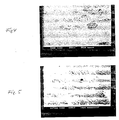
- Fig. 4 is an enlarged microphotograph showing the surface of a lead on a typical intergrated circuit.
- the lead is made of Alloy 42 which is predominently iron.
- the lead had been electroplated with 90/10 solder to a thickness of about 4 micrometers.
- the lead had been stored for five years. During that storage, some iron migrated through pores of the solder plating and covered the outer surface thereof. Absolutely no solder was in fact visible on the surface. "Solderability" according to conventional standards had thus been entirely lost. Note the small crystal needles of pure iron on the surface of the lead.
- the lead was heated to 250°C and the glycerin plus detergent medium of the present invention was dropped on the surface.
- Fig. 5 shows the results of the microexplosive evaporation which resulted. Apparently, the surface tension of the solder was reduced sufficiently to allow the remaining solder under the upper iron coating to fuse and float to the surface creating a typical fine solder ball pattern without any oxides at its surface. Excess medium was used so that some of the medium remained unevaporated after the heating cycle. This effectively prevented further oxidation from taking place. The part was cleaned and washed before the photograph of Fig. 5 was taken.
- any medium which may be liquid or solid at ambient room temperature and which evaporates at below the joining temperature can be used for the present invention. It is particularly advantageous to utilize medium which leaves no residue after evaporation to avoid having to clean the solder or weld joint.
- Inert or reducing gases are also useful when applied by nozzles in a stream directed toward the joint area for directing the medium and fused solder and for producing an improved environment for the thermal treatment.
- the gas may be heated to maintain the joint at the joining temperature particularly where mediums having low evaporation temperatures (e.g. water) are to be used.
- the guided gas can also be used to remove surplus material or solder during or after the joining cycle by means of relocation or evaporation. After such process, a typical cleaning cycle can be utilized which can be combined with a cooling cycle.
- the reduced need for cleaning increases through-put time for the creation of soldered joints. If excess medium is used, the flow of gas can be effective in blowing off or evaporating excess medium.
- a pulsed heating method can also be used to practice the invention.
- the microexplosive evaporation is still effective during pulse heating to clean and protect the surface for producing an effective weld or solder connection.
- Another feature of the present invention is the use of a closed environment for the joining process.
- the evaporated medium is collected, condensed and then used for subsequent joining cycles. Since the medium is non-corrosive and environmentally safe, there is little environmental danger and little danger of corrosion to the hardware for recycling the medium.
- the medium can also be deposited in the desired shape for the joint. With the solder and medium both deposited in that shape, a reduced flowing of the solder and medium is needed to establish the joint during the thermal treatment.
- the liquid medium in this environment also acts as a thermal conductor for conducting heat from the members to be joined, to the solder. This is particularly useful if the members have an irregular shape and do not initially conform to the shape of the solder. In this way, non-flat surfaces can be soldered through the help of the liquid medium acting as a thermal conductor. As soon as this solder melts, the solder itself acts as a thermal conductor and the medium can evaporate through microexplosion to produce the flux effect.
- the present invention is not limited to soldered joints but may also be used to plate a surface with solder or to remove solder from that surface.
- the flux effect of the present invention can also be used for metallic and non-metallic welding operations.
- the technique of the invention can also be used for cleaning the solder itself.
- the surface of the solder is cleansed and is rendered free of any extraneous contaminants.
- the solder can then be stored in a closed environment to avoid subsequent contamination.
Landscapes
- Engineering & Computer Science (AREA)
- Mechanical Engineering (AREA)
- Electric Connection Of Electric Components To Printed Circuits (AREA)
Applications Claiming Priority (2)
| Application Number | Priority Date | Filing Date | Title |
|---|---|---|---|
| DE3824861 | 1988-07-21 | ||
| DE3824861A DE3824861A1 (de) | 1988-07-21 | 1988-07-21 | Verfahren zur herstellung von loetverbindungen |
Publications (1)
| Publication Number | Publication Date |
|---|---|
| EP0363580A1 true EP0363580A1 (fr) | 1990-04-18 |
Family
ID=6359271
Family Applications (1)
| Application Number | Title | Priority Date | Filing Date |
|---|---|---|---|
| EP89113457A Withdrawn EP0363580A1 (fr) | 1988-07-21 | 1989-07-21 | Effet de flux de soudage par évaporation micro-explosive |
Country Status (3)
| Country | Link |
|---|---|
| US (1) | US4986463A (fr) |
| EP (1) | EP0363580A1 (fr) |
| DE (1) | DE3824861A1 (fr) |
Cited By (1)
| Publication number | Priority date | Publication date | Assignee | Title |
|---|---|---|---|---|
| WO2005028152A1 (fr) * | 2003-09-11 | 2005-03-31 | Behr Gmbh & Co. Kg | Piece a braser, procede de brasage et echangeur de chaleur |
Families Citing this family (6)
| Publication number | Priority date | Publication date | Assignee | Title |
|---|---|---|---|---|
| DE4002348A1 (de) * | 1990-01-30 | 1991-08-01 | Productech Gmbh | Verfahren zur herstellung von loetverbindungen |
| DE4041270A1 (de) * | 1990-12-21 | 1992-06-25 | Grasmann Karl Heinz Wls | Verfahren und vorrichtung zur verarbeitung von elektronischen flachbaugruppen, insbesondere mit bauelementen bestueckten leiterplatten |
| DE4133645A1 (de) * | 1991-10-11 | 1993-04-15 | Ernst Hohnerlein | Verfahren zum loeten und loetkolben zur durchfuehrung dieses verfahrens |
| US5919317A (en) * | 1994-12-07 | 1999-07-06 | Nippondenso Co., Ltd. | Soldering flux, soldering paste and soldering method using the same |
| US6120848A (en) * | 1998-11-17 | 2000-09-19 | Ford Motor Company | Method of making a braze sheet |
| US20040149084A1 (en) * | 2002-09-05 | 2004-08-05 | Massachusetts Institute Of Technology | Apparatus and process for manufacturing solder balls |
Citations (5)
| Publication number | Priority date | Publication date | Assignee | Title |
|---|---|---|---|---|
| DE1627461A1 (de) * | 1966-03-14 | 1971-07-22 | Borg Warner | Verfahren zum Loeten von Aluminium |
| DE2238874A1 (de) * | 1972-08-07 | 1974-02-21 | Licentia Gmbh | Verfahren zum loeten und flussmittel zur durchfuehrung dieses verfahrens |
| DE2611832A1 (de) * | 1976-03-19 | 1977-09-22 | Linde Ag | Verfahren und vorrichtung zum flussmittellosen loeten |
| DD134331A1 (de) * | 1977-11-23 | 1979-02-21 | Wolfgang Grobe | Verfahren zur montage von halbleiterbauelementen mittels weichloetung |
| US4496098A (en) * | 1982-03-25 | 1985-01-29 | Ichiro Kawakatsu | Process for producing a tin/lead alloy solder joint with less wetting agent residue |
Family Cites Families (11)
| Publication number | Priority date | Publication date | Assignee | Title |
|---|---|---|---|---|
| GB599805A (en) * | 1944-11-17 | 1948-03-22 | H J Enthoven & Sons Ltd | Improvements relating to soldering |
| US2291399A (en) * | 1939-12-29 | 1942-07-28 | Aluminum Co Of America | Solder flux |
| GB680588A (en) * | 1950-08-16 | 1952-10-08 | Metro Cutanit Ltd | Improvements relating to the brazing of metals |
| DE1041770B (de) * | 1953-07-31 | 1958-10-23 | Metallgesellschaft Ag | Loetmittel |
| DE1223668B (de) * | 1957-01-05 | 1966-08-25 | Castolin Schweissmaterial A G | Borsaeurehaltiges, insbesondere pastenfoermiges Flussmittel zum Hartloeten |
| DE1187109B (de) * | 1962-05-04 | 1965-02-11 | Kueppers Metallwerk G M B H | Flussmittel mit rueckstandslos verfluechtigendem Flussmitteltraeger fuer Weichlot-Drahtfuellungen in fester, kristalliner Form mit nichthygroskopischen Eigenschaften |
| SU433000A1 (ru) * | 1972-05-30 | 1974-06-25 | Флюс для пайки | |
| US4244506A (en) * | 1979-11-26 | 1981-01-13 | Aluminum Company Of America | Recovery of flux residues from rinse water in dip brazing |
| JPS5779173A (en) * | 1980-11-05 | 1982-05-18 | Konishiroku Photo Ind Co Ltd | Etching method for chromium film and chromium oxide film |
| US4632295A (en) * | 1985-08-12 | 1986-12-30 | International Business Machines Corporation | Reduction atmosphere workpiece joining |
| US4738732A (en) * | 1987-02-04 | 1988-04-19 | Hughes Aircraft Co. | Self cleaning liquid solder flux |
-
1988
- 1988-07-21 DE DE3824861A patent/DE3824861A1/de not_active Ceased
-
1989
- 1989-07-20 US US07/382,849 patent/US4986463A/en not_active Expired - Fee Related
- 1989-07-21 EP EP89113457A patent/EP0363580A1/fr not_active Withdrawn
Patent Citations (5)
| Publication number | Priority date | Publication date | Assignee | Title |
|---|---|---|---|---|
| DE1627461A1 (de) * | 1966-03-14 | 1971-07-22 | Borg Warner | Verfahren zum Loeten von Aluminium |
| DE2238874A1 (de) * | 1972-08-07 | 1974-02-21 | Licentia Gmbh | Verfahren zum loeten und flussmittel zur durchfuehrung dieses verfahrens |
| DE2611832A1 (de) * | 1976-03-19 | 1977-09-22 | Linde Ag | Verfahren und vorrichtung zum flussmittellosen loeten |
| DD134331A1 (de) * | 1977-11-23 | 1979-02-21 | Wolfgang Grobe | Verfahren zur montage von halbleiterbauelementen mittels weichloetung |
| US4496098A (en) * | 1982-03-25 | 1985-01-29 | Ichiro Kawakatsu | Process for producing a tin/lead alloy solder joint with less wetting agent residue |
Cited By (3)
| Publication number | Priority date | Publication date | Assignee | Title |
|---|---|---|---|---|
| WO2005028152A1 (fr) * | 2003-09-11 | 2005-03-31 | Behr Gmbh & Co. Kg | Piece a braser, procede de brasage et echangeur de chaleur |
| US7891540B2 (en) | 2003-09-11 | 2011-02-22 | Behr Gmbh & Co. Kg | Soldering work piece, soldering method and heat exchanger |
| US8136716B2 (en) | 2003-09-11 | 2012-03-20 | Behr Gmbh & Co. Kg | Soldering work piece, soldering method and heat exchanger |
Also Published As
| Publication number | Publication date |
|---|---|
| US4986463A (en) | 1991-01-22 |
| DE3824861A1 (de) | 1990-01-25 |
Similar Documents
| Publication | Publication Date | Title |
|---|---|---|
| AU634441B2 (en) | A fluxless soldering process | |
| JP3330609B2 (ja) | ろう付方法 | |
| US6659329B1 (en) | Soldering alloy | |
| JPH05185216A (ja) | ニッケルーチタン合金の接合方法 | |
| US7156284B2 (en) | Low temperature methods of bonding components and related structures | |
| EP0199589B1 (fr) | Dépôt de poudres métalliques sur un substrat au moyen d'un faisceau laser | |
| EP0001921B1 (fr) | Tresse en cuivre étamé pour enlever l'étain de soudure et sa méthode de fabrication | |
| EP0330867B1 (fr) | Application, sans utilisation de flux, d'une couche comprenant du métal | |
| US3675310A (en) | Soldering method | |
| US4986463A (en) | Flux effect by microexplosive evaporation | |
| US2768271A (en) | Titanium heliarc brazing process | |
| US2937438A (en) | Method for joining aluminum to stainless steel | |
| Chung et al. | Influence of flux on wetting behavior of lead-free solder balls during the infrared-reflow process | |
| Thwaites | Soldering technology—decade of developments | |
| US20040245228A1 (en) | Attach aligned optics and microelectronics with laser soldering methods | |
| JP2000317629A (ja) | 半田ごて用こて先 | |
| Thwaites | The attainment of reliability in modern soldering techniques for electronic assemblies | |
| CN111390422B (zh) | 一种熔点差异大的异种金属复合的装配结构及连接方法 | |
| JPH03216277A (ja) | 材料の接合方法 | |
| JP3090386B2 (ja) | 回路基板へのリード端子接合方法及びリード端子付き回路基板 | |
| Schwartz | Fundamentals of soldering | |
| Kim et al. | The effect of reduction capability of resin material on the solder wettability for electrically conductive adhesives (ECAs) assembly | |
| KR100356413B1 (ko) | 부분용융 상태에서의 리플로우 솔더링 방법 | |
| JPH11221668A (ja) | 洗浄を必要としない半田付け方法 | |
| JP2006043709A (ja) | 鉛フリーはんだ合金 |
Legal Events
| Date | Code | Title | Description |
|---|---|---|---|
| PUAI | Public reference made under article 153(3) epc to a published international application that has entered the european phase |
Free format text: ORIGINAL CODE: 0009012 |
|
| AK | Designated contracting states |
Kind code of ref document: A1 Designated state(s): CH DE FR GB IT LI NL SE |
|
| 17P | Request for examination filed |
Effective date: 19901129 |
|
| 17Q | First examination report despatched |
Effective date: 19910624 |
|
| STAA | Information on the status of an ep patent application or granted ep patent |
Free format text: STATUS: THE APPLICATION IS DEEMED TO BE WITHDRAWN |
|
| 18D | Application deemed to be withdrawn |
Effective date: 19930209 |