EP0363592B1 - Procédé et dispositif de fabrication de pièces ou objets moulés par une technique d'extrusion-formage - Google Patents
Procédé et dispositif de fabrication de pièces ou objets moulés par une technique d'extrusion-formage Download PDFInfo
- Publication number
- EP0363592B1 EP0363592B1 EP89114546A EP89114546A EP0363592B1 EP 0363592 B1 EP0363592 B1 EP 0363592B1 EP 89114546 A EP89114546 A EP 89114546A EP 89114546 A EP89114546 A EP 89114546A EP 0363592 B1 EP0363592 B1 EP 0363592B1
- Authority
- EP
- European Patent Office
- Prior art keywords
- mould
- negative
- melt
- extrudate
- extruder
- Prior art date
- Legal status (The legal status is an assumption and is not a legal conclusion. Google has not performed a legal analysis and makes no representation as to the accuracy of the status listed.)
- Expired - Lifetime
Links
- 238000000034 method Methods 0.000 title claims abstract description 34
- 238000005266 casting Methods 0.000 title claims abstract description 17
- 238000001125 extrusion Methods 0.000 title claims abstract description 9
- 229920003023 plastic Polymers 0.000 claims abstract description 46
- 239000004033 plastic Substances 0.000 claims abstract description 46
- 239000000155 melt Substances 0.000 claims description 19
- 238000002844 melting Methods 0.000 claims description 16
- 230000008018 melting Effects 0.000 claims description 16
- 229920001169 thermoplastic Polymers 0.000 claims description 15
- 239000004416 thermosoftening plastic Substances 0.000 claims description 14
- 238000001816 cooling Methods 0.000 claims description 6
- 238000004519 manufacturing process Methods 0.000 claims description 5
- 239000000463 material Substances 0.000 claims description 5
- 238000003856 thermoforming Methods 0.000 claims 14
- 238000005034 decoration Methods 0.000 claims 1
- 238000005304 joining Methods 0.000 claims 1
- 238000007493 shaping process Methods 0.000 claims 1
- 239000010410 layer Substances 0.000 description 42
- 229920000578 graft copolymer Polymers 0.000 description 10
- 229920001577 copolymer Polymers 0.000 description 9
- 239000000203 mixture Substances 0.000 description 8
- 239000002245 particle Substances 0.000 description 8
- 229910052751 metal Inorganic materials 0.000 description 7
- 239000002184 metal Substances 0.000 description 7
- 229920001897 terpolymer Polymers 0.000 description 7
- 239000000956 alloy Substances 0.000 description 6
- 229910045601 alloy Inorganic materials 0.000 description 6
- 239000000919 ceramic Substances 0.000 description 6
- 239000006260 foam Substances 0.000 description 6
- 239000000843 powder Substances 0.000 description 6
- 229920002725 thermoplastic elastomer Polymers 0.000 description 6
- 244000043261 Hevea brasiliensis Species 0.000 description 4
- 229920000459 Nitrile rubber Polymers 0.000 description 4
- 150000001336 alkenes Chemical class 0.000 description 4
- 239000000945 filler Substances 0.000 description 4
- 238000010438 heat treatment Methods 0.000 description 4
- 229920003052 natural elastomer Polymers 0.000 description 4
- 229920001194 natural rubber Polymers 0.000 description 4
- 239000002985 plastic film Substances 0.000 description 4
- 239000002356 single layer Substances 0.000 description 4
- 239000002344 surface layer Substances 0.000 description 4
- 239000004721 Polyphenylene oxide Substances 0.000 description 3
- 238000009825 accumulation Methods 0.000 description 3
- 230000035508 accumulation Effects 0.000 description 3
- 239000003795 chemical substances by application Substances 0.000 description 3
- 150000002148 esters Chemical class 0.000 description 3
- -1 ethylene butylene Chemical group 0.000 description 3
- 229910001092 metal group alloy Inorganic materials 0.000 description 3
- 238000000465 moulding Methods 0.000 description 3
- 229920006255 plastic film Polymers 0.000 description 3
- 229920000570 polyether Polymers 0.000 description 3
- 229920002635 polyurethane Polymers 0.000 description 3
- 239000004814 polyurethane Substances 0.000 description 3
- 239000000126 substance Substances 0.000 description 3
- KAKZBPTYRLMSJV-UHFFFAOYSA-N Butadiene Chemical compound C=CC=C KAKZBPTYRLMSJV-UHFFFAOYSA-N 0.000 description 2
- 239000004952 Polyamide Substances 0.000 description 2
- PPBRXRYQALVLMV-UHFFFAOYSA-N Styrene Chemical compound C=CC1=CC=CC=C1 PPBRXRYQALVLMV-UHFFFAOYSA-N 0.000 description 2
- 229920000122 acrylonitrile butadiene styrene Polymers 0.000 description 2
- 239000004676 acrylonitrile butadiene styrene Substances 0.000 description 2
- XECAHXYUAAWDEL-UHFFFAOYSA-N acrylonitrile butadiene styrene Chemical compound C=CC=C.C=CC#N.C=CC1=CC=CC=C1 XECAHXYUAAWDEL-UHFFFAOYSA-N 0.000 description 2
- 125000005250 alkyl acrylate group Chemical group 0.000 description 2
- 239000002923 metal particle Substances 0.000 description 2
- CERQOIWHTDAKMF-UHFFFAOYSA-M methacrylate group Chemical group C(C(=C)C)(=O)[O-] CERQOIWHTDAKMF-UHFFFAOYSA-M 0.000 description 2
- 229920002285 poly(styrene-co-acrylonitrile) Polymers 0.000 description 2
- 229920002647 polyamide Polymers 0.000 description 2
- 229920000642 polymer Polymers 0.000 description 2
- 229920000098 polyolefin Polymers 0.000 description 2
- QQONPFPTGQHPMA-UHFFFAOYSA-N propylene Natural products CC=C QQONPFPTGQHPMA-UHFFFAOYSA-N 0.000 description 2
- 125000004805 propylene group Chemical group [H]C([H])([H])C([H])([*:1])C([H])([H])[*:2] 0.000 description 2
- 239000011541 reaction mixture Substances 0.000 description 2
- 238000007789 sealing Methods 0.000 description 2
- NIXOWILDQLNWCW-UHFFFAOYSA-M Acrylate Chemical compound [O-]C(=O)C=C NIXOWILDQLNWCW-UHFFFAOYSA-M 0.000 description 1
- NLHHRLWOUZZQLW-UHFFFAOYSA-N Acrylonitrile Chemical compound C=CC#N NLHHRLWOUZZQLW-UHFFFAOYSA-N 0.000 description 1
- 239000004793 Polystyrene Substances 0.000 description 1
- 239000004433 Thermoplastic polyurethane Substances 0.000 description 1
- JNLZXUJUHWEXGC-UHFFFAOYSA-L [C+2]=O.C(C(=C)C)(=O)[O-].C(C(=C)C)(=O)[O-] Chemical compound [C+2]=O.C(C(=C)C)(=O)[O-].C(C(=C)C)(=O)[O-] JNLZXUJUHWEXGC-UHFFFAOYSA-L 0.000 description 1
- 125000005396 acrylic acid ester group Chemical group 0.000 description 1
- 239000012790 adhesive layer Substances 0.000 description 1
- 125000000217 alkyl group Chemical group 0.000 description 1
- 239000011230 binding agent Substances 0.000 description 1
- QYMGIIIPAFAFRX-UHFFFAOYSA-N butyl prop-2-enoate;ethene Chemical compound C=C.CCCCOC(=O)C=C QYMGIIIPAFAFRX-UHFFFAOYSA-N 0.000 description 1
- GDMLVHQYGPXZLA-UHFFFAOYSA-N carbon monoxide;ethenyl acetate Chemical compound [O+]#[C-].CC(=O)OC=C GDMLVHQYGPXZLA-UHFFFAOYSA-N 0.000 description 1
- 150000001875 compounds Chemical class 0.000 description 1
- 238000010924 continuous production Methods 0.000 description 1
- 239000000110 cooling liquid Substances 0.000 description 1
- 150000001993 dienes Chemical class 0.000 description 1
- 238000009826 distribution Methods 0.000 description 1
- 229920001971 elastomer Polymers 0.000 description 1
- 239000000806 elastomer Substances 0.000 description 1
- 229920001038 ethylene copolymer Polymers 0.000 description 1
- 239000005038 ethylene vinyl acetate Substances 0.000 description 1
- 229920006245 ethylene-butyl acrylate Polymers 0.000 description 1
- 239000000835 fiber Substances 0.000 description 1
- 239000010419 fine particle Substances 0.000 description 1
- 239000011888 foil Substances 0.000 description 1
- 239000003365 glass fiber Substances 0.000 description 1
- 229920001903 high density polyethylene Polymers 0.000 description 1
- 239000004700 high-density polyethylene Substances 0.000 description 1
- 239000007788 liquid Substances 0.000 description 1
- 239000002991 molded plastic Substances 0.000 description 1
- 230000002093 peripheral effect Effects 0.000 description 1
- 239000004014 plasticizer Substances 0.000 description 1
- 229920001200 poly(ethylene-vinyl acetate) Polymers 0.000 description 1
- 238000003825 pressing Methods 0.000 description 1
- 238000005096 rolling process Methods 0.000 description 1
- 230000035939 shock Effects 0.000 description 1
- 239000007787 solid Substances 0.000 description 1
- 229920000638 styrene acrylonitrile Polymers 0.000 description 1
- 229920002803 thermoplastic polyurethane Polymers 0.000 description 1
- 238000009827 uniform distribution Methods 0.000 description 1
Images
Classifications
-
- B—PERFORMING OPERATIONS; TRANSPORTING
- B29—WORKING OF PLASTICS; WORKING OF SUBSTANCES IN A PLASTIC STATE IN GENERAL
- B29C—SHAPING OR JOINING OF PLASTICS; SHAPING OF MATERIAL IN A PLASTIC STATE, NOT OTHERWISE PROVIDED FOR; AFTER-TREATMENT OF THE SHAPED PRODUCTS, e.g. REPAIRING
- B29C51/00—Shaping by thermoforming, i.e. shaping sheets or sheet like preforms after heating, e.g. shaping sheets in matched moulds or by deep-drawing; Apparatus therefor
- B29C51/26—Component parts, details or accessories; Auxiliary operations
- B29C51/42—Heating or cooling
-
- B—PERFORMING OPERATIONS; TRANSPORTING
- B29—WORKING OF PLASTICS; WORKING OF SUBSTANCES IN A PLASTIC STATE IN GENERAL
- B29C—SHAPING OR JOINING OF PLASTICS; SHAPING OF MATERIAL IN A PLASTIC STATE, NOT OTHERWISE PROVIDED FOR; AFTER-TREATMENT OF THE SHAPED PRODUCTS, e.g. REPAIRING
- B29C51/00—Shaping by thermoforming, i.e. shaping sheets or sheet like preforms after heating, e.g. shaping sheets in matched moulds or by deep-drawing; Apparatus therefor
- B29C51/02—Combined thermoforming and manufacture of the preform
-
- B—PERFORMING OPERATIONS; TRANSPORTING
- B29—WORKING OF PLASTICS; WORKING OF SUBSTANCES IN A PLASTIC STATE IN GENERAL
- B29C—SHAPING OR JOINING OF PLASTICS; SHAPING OF MATERIAL IN A PLASTIC STATE, NOT OTHERWISE PROVIDED FOR; AFTER-TREATMENT OF THE SHAPED PRODUCTS, e.g. REPAIRING
- B29C33/00—Moulds or cores; Details thereof or accessories therefor
- B29C33/02—Moulds or cores; Details thereof or accessories therefor with incorporated heating or cooling means
- B29C33/04—Moulds or cores; Details thereof or accessories therefor with incorporated heating or cooling means using liquids, gas or steam
-
- B—PERFORMING OPERATIONS; TRANSPORTING
- B29—WORKING OF PLASTICS; WORKING OF SUBSTANCES IN A PLASTIC STATE IN GENERAL
- B29C—SHAPING OR JOINING OF PLASTICS; SHAPING OF MATERIAL IN A PLASTIC STATE, NOT OTHERWISE PROVIDED FOR; AFTER-TREATMENT OF THE SHAPED PRODUCTS, e.g. REPAIRING
- B29C51/00—Shaping by thermoforming, i.e. shaping sheets or sheet like preforms after heating, e.g. shaping sheets in matched moulds or by deep-drawing; Apparatus therefor
- B29C51/10—Forming by pressure difference, e.g. vacuum
-
- B—PERFORMING OPERATIONS; TRANSPORTING
- B29—WORKING OF PLASTICS; WORKING OF SUBSTANCES IN A PLASTIC STATE IN GENERAL
- B29C—SHAPING OR JOINING OF PLASTICS; SHAPING OF MATERIAL IN A PLASTIC STATE, NOT OTHERWISE PROVIDED FOR; AFTER-TREATMENT OF THE SHAPED PRODUCTS, e.g. REPAIRING
- B29C51/00—Shaping by thermoforming, i.e. shaping sheets or sheet like preforms after heating, e.g. shaping sheets in matched moulds or by deep-drawing; Apparatus therefor
- B29C51/14—Shaping by thermoforming, i.e. shaping sheets or sheet like preforms after heating, e.g. shaping sheets in matched moulds or by deep-drawing; Apparatus therefor using multilayered preforms or sheets
Definitions
- the present invention relates to a method and a device for the production of molded parts or articles using an extrusion casting process, wherein the melt-shaped single or multi-layer plastic extrudate emerging from a slot extruder is introduced into a mold which is constantly under vacuum during the casting, the mold presented or Mold surface assumes, the slot extruder and / or the mold are moved in at least one direction and the average thickness of the extrudate in the negative or negative deep-drawing mold is set below 7000 »m.
- a slot extruder which operates discontinuously or intermittently with regard to the amount of plastic extrudate ejected, and by controlling the amount of plastic extrudate ejected and observing certain process features, undercuts or other irregularly shaped objects or molded parts can be coated approximately evenly or material accumulations to avoid at predetermined locations.
- thermoplastic is melted in a melting unit, extruder or rolling mill, the extruded strands are inserted without pressure into a mold and subsequently that The mold filling is pounded by hand.
- This process cannot be used on an industrial scale and is not suitable for the production of thin-walled profiles.
- a negative deep-drawing process in which solid foils, plates or sheets are used, which are heated or preheated, brought to a certain temperature and pre-shaped by a stamp or similar device, the stamp already has the shape or molding area of the negative deep-drawing mold.
- nozzles or syringes for injecting cooling liquid onto the back of the deformed film are arranged in the negative deep-drawing mold.
- the molded articles produced according to utility model DE-U-8706204.6 are also used for automotive interior trim.
- the liquid plastic mass emerging from the extruder is brought into wheel-like molds which are moved at a uniform speed, the casting process taking place uniformly.
- the aim and object of the present invention was to find an improved extrusion casting method and an improved extrusion casting device.
- undercuts or other irregularly shaped objects or molded parts should be able to be coated approximately uniformly.
- a process for the production of molded parts or articles using an extrusion casting process is suitable for these tasks, the melt-shaped single-layer or multi-layer plastic extrudate emerging from a slot extruder being introduced into a mold which is constantly under vacuum during the pouring in, thereby the presented one Takes shape or surface, the Slot extruders and / or the mold are moved in at least one direction and the average thickness of the extrudate in the negative or negative deep-drawing mold is set below 7000 »m.
- a slot extruder which operates discontinuously or intermittently with regard to the amount of plastic extrudate discharged, the amount of plastic extrudate being discharged being set to zero or a smaller amount of discharge during the time of the deep-drawing process.
- a nozzle of the slot extruder is used which has a device which can be adjusted and controlled during the application of the melt to adjust the distance of the nozzle lips, as a result of which undercuts or other irregularly shaped objects or molded parts are coated approximately uniformly or material accumulations are avoided at predetermined locations.
- the plastic extrudate is applied in the form of a sheet-like melt to an all-round porous, air-permeable frame or edge of the negative or negative deep-drawing mold, and the negative mold or negative deep-drawing mold is set to a temperature below 373 K before pouring.
- the extrudate takes on the perous, air-permeable, grained, structured, shaped and / or surface decorated form of the negative mold or negative deep-drawing mold and is immediately cooled by more than 80 K or shock-cooled.
- a different thickness distribution of the extrudate is thus achieved by controlling the distance of the die lips and / or by controlling the screw speed of the extruder and / or by changing the movement speed during the movement process of the slot extruder and / or the negative mold or the negative deep-drawing mold the negative mold or negative deep drawing mold and / or the extruder.
- this enables undercuts or other irregularly shaped objects or molded parts to be approximated to coat evenly or to avoid material accumulation at predetermined locations.
- the extruders or slot extruders and / or the negative mold, preferably the negative deep-drawing mold are moved in at least one direction in order to produce three-dimensionally shaped plastic molded parts or objects, so that an approximately uniform distribution of the thickness of the extrudate on the negative mold or negative deep-drawing mold takes place.
- the extruder preferably slot extruder, operates discontinuously or intermittently with regard to the amount of plastic extrudate that is ejected, the amount of plastic extrudate ejected being set to zero or to a lower amount of ejection, preferably during the time of the deep-drawing process.
- a carrier preferably a positively shaped carrier
- a Pressure preferably a uniform pressure
- the melt-shaped, single-layer or multilayer plastic extrudate emerging from the extruder is located immediately before and / or during the deformation in the negative mold or negative deep-drawing mold in or above the flow temperature or flow temperature range, crystallite melting temperature or melting temperature, the deformation temperature 2 to 80 K, preferably 5 to 40 K, is lower than the extrusion temperature.
- the melt-like sheet or plastic extrudate emerging from the extruder contains a partially crystalline component in the thermoplastic, the temperature being set immediately before the deformation in the negative deep-drawing tool, in or above the crystallite melting range, preferably in the thermoplastic range.
- the melt-shaped sheet or plastic extrudate emerging from the extruder contains an amorphous component, the temperature being set immediately before the deformation in the negative deep-drawing tool, preferably in or above the flow temperature range or in the thermoplastic range.
- the negative mold or negative deep-drawing mold is set to a temperature below 333 K before pouring, the plastic extrudate in the form of a web-shaped melt during and / or when the frame or edge and / or peripheral edge of the porous mold surface of the negative mold is touched on all sides or negative deep-drawing mold is also sucked in from the all-round edge and shock cooling is carried out by more than 140 K.
- the carrier has a heat-activatable adhesive layer on its surface facing the melting path.
- the invention further relates to a device for producing molded parts or objects by the casting process, consisting of at least one casting mold and at least one slot extruder, the slot extruder and / or the mold being arranged to be movable in at least one direction and the mold being porous and permeable to air.
- the porous or microporous negative mold or negative deep-drawing mold also has a porous, all-round edge or frame, Air-permeable or microporous, air-permeable surface and the die of the slot extruder has a device which can be adjusted and controlled during the application of the melt to adjust the distance between the die lips and / or the negative mold or negative deep-drawing die and / or the extruder are equipped with a controllable device for adjusting the Provide movement speeds.
- the porous or microporous negative mold or negative deep-drawing mold is thus provided on the edge or frame and / or all-round edge of the mold surface with a porous, air-permeable, preferably micro-porous, air-permeable surface for applying a vacuum to seal the melt web and / or overpressure for generating blown air for demolding or built up.
- the porous or microporous negative mold or negative deep-drawing mold is provided near its mold surface with a cooling device or a cooling system.
- At least one device for applying a vacuum and / or overpressure or for generating blown air for demolding is arranged on the negative mold or negative deep-drawing mold.
- the die of the slot extruder has a device which can be adjusted and controlled during the application of the melt to adjust the distance between the die lips.
- the negative mold or negative deep-drawing mold and / or the extruder are provided with a controllable device for adjusting the speed of movement.
- the extruder is equipped with a device for controlling the screw speed.
- the negative deep-drawing mold used according to the invention is preferably provided with a sealing device for the plastic film, plastic-containing sheet or plastic plate, the negative deep-drawing mold being equipped with at least one supply line and / or device for exerting a pressure difference, preferably vacuum and / or negative pressure.
- the negative deep-drawing mold has a porous, air-permeable, preferably microporous air-permeable, mold surface which has a layer or surface with an average particle thickness of less than 150 »m and contains metal, metal alloy, micrometallic particles, ceramic metal and / or ceramic micrometallic and / or very fine fillers the negative deep-drawing mold is in combination with a feed device and / or take-off device for the plastic film, sheet or plate or transport device for the molded part or article produced.
- a stamp or similar device is assigned to the negative deep-drawing mold as a counter tool.
- the stamp has the shape or shaped part areas of the negative deep-drawing mold (in positive form).
- the negative deep-drawing mold contains at least one surface layer as the mold surface, which consists of a binder, a non-heat-conducting or poorly heat-conducting inorganic-chemical filler, preferably ceramic powder, with an average particle size of less than 80 »m, preferably less than 50» m, and a finely divided metal, metal alloy, micro metal particles, ceramic metal particles and / or heat-resistant, fine-particle powder or powdery mixture with an average particle thickness below 80 »m, preferably below 60» m.
- a binder a non-heat-conducting or poorly heat-conducting inorganic-chemical filler, preferably ceramic powder, with an average particle size of less than 80 »m, preferably less than 50» m
- a finely divided metal, metal alloy, micro metal particles, ceramic metal particles and / or heat-resistant, fine-particle powder or powdery mixture with an average particle thickness below 80 »m, preferably below 60» m.
- the weight ratio of the non-heat-conducting or poorly heat-conducting inorganic-chemical filler to the very finely divided metal powder, metal alloy powder, ceramic metal or Powder containing micrometallic particles is 12: 1 to 1:12, preferably 5: 1 to 1: 5 (in the deformation surface layer of the negative deep-drawing mold).
- the surface layer additionally contains fibers made of inorganic chemical material, preferably glass fibers.
- the average particle size (based on the mold surface layer) of the inorganic-chemically finely divided filler to the finely divided metal powder is in the ratio of 3: 1 to 1:10, preferably 1: 1 to 1: 3.
- the metal or ceramic particles are completely or partially replaced by other refractory or temperature-resistant particles.
- the negative deep-drawing mold and the stamp are arranged in a molding chamber which can be fogged with underpressure or with overpressure.
- a plurality of negative deep-drawing molds are arranged one behind the other, next to one another or in a carousel-like manner.
- the plastics known per se and / or mixtures thereof, elastomers and the like can be used as plastics.
- the extrudate according to the invention has one or more layers (extrudate or coextrudate).
- a single-layer plastic extrudate or a two-layer plastic coextrudate in the form of a web-shaped melt which is preferably applied to an edge or frame of the porous negative deep-drawing mold and / or the pressure or vacuum chambers without additional heating, utilizing the thermal capacity of the melt web, in which the negative deep-drawing mold is arranged, applied and with uniform or almost uniform movement of the slot extruder and / or the negative deep-drawing mold guided in at least one direction, the extrudate covering at least one negative deep-drawing mold on its molding surface up to and including the edge or frame.
- the extruded or coextruded sheet is preferably sealed and held at the edge or frame and deformed using a pressure difference, preferably using a negative pressure created from the negative deep-drawing mold, in the negative deep-drawing process, the amount of plastic co-extrudate preferably set to zero during the deep-drawing process or is reduced to a lower output.
- a single-layer, preferably an at least two-layer plastic extrudate in the form of a sheet-like melt is used, which is preferably without additional heating, utilizing the heat capacity of the melt track and a transport device, preferably a transport chain, a transport chamber, a conveyor belt and / or a gripping device and is guided from the extruder over the negative deep-drawing mold at a speed depending on the output quantity and the melt thickness so that the melt web at least on the edges of the negative deep-drawing mold and / or the edges or stenter of a pressure or vacuum chamber, in which the negative deep-drawing mold is arranged, rests and is arranged on the negative deep-drawing mold surface and is optionally sealed with at least one sealing frame or upper part of the clamping frame rd, as well as using a pressure difference, preferably using a negative pressure created from the negative deep-drawing mold, in the negative deep-drawing process, the amount of plastic extrudate expelled during the deep
- the coextrudate used has an upper layer to be shaped, decorated or shaped by the negative deep-drawing mold, its flow temperature or Flow temperature range, crystallite melting temperature or melting range is 3 to 50 K lower than the lower layer and / or at which the melt index of the lower layer or lower film (measured according to DIN 53735) MFI 170 ° C / 209 N / 10 min. 1/50 to 3/5 of the melt index MFI 170 ° C / 209 N / 10 min. the upper class is.
- the extrudate consists of a coextrudate in which the flow temperature or the flow temperature range, crystallite melting temperature or melting range of the upper layer is 8 to 40 K lower than that of the lower layer and / or the melt index (measured according to DIN 53735 ) MFI 170 ° C / 209 N / 10 min. the bottom layer or bottom film 1/20 to 1/2 of the melt index MFI 170 ° C / 209 N / 10 min. the top layer or top film.
- both the top layer and the bottom layer or bottom film consist of a plastic mixture or a plastic alloy which contain the same plastics, but in different weight concentrations, based on the individual layers or films.
- the plastic mixture or alloy of the top layer and bottom layer contain a polyolefin, preferably a propylene homo, co, block or graft polymer or a high density polyethylene (hard phase) and at least one further thermoplastic or a thermoplastic elastomer with a low flow temperature or lower flow temperature range, crystallite melting temperature or crystallite melting temperature range or a higher melt index (soft phase) or consist thereof, wherein the thermoplastic or the thermoplastic elastomer as at least one component is an alloy, a co, graft, block or terpolymer of or with an acrylonitrile, diene, butadiene, ethylene butylene and / or styrene, preferably ethylene-butylene-styrene triblock polymer (SEBS) and / or other stryrene block polymers, ethylene-propylene-diene graft or copolymer (EPDM), cross-linked or partially cross-linked natural rubber (NR), cross
- thermoplastics or thermoplastic elastomers in the bottom layer by more than 3% by weight , preferably by more than 7% by weight, is lower than in the upper layer.
- the plastic mixture or alloy of the top layer or top film and bottom layer or bottom film contain a polystyrene (PS), polyamide (PA), styrene-acrylonitrile-co or graft polymer (SAN), acrylonitrile-butadiene-styrene-co- or graft polymer (ABS) and / or acrylic acid ester styrene-acrylonitrile co or graft polymer (ASA) (hard phase) and at least one further thermoplastic or a thermoplastic elastomer with a lower flow temperature or lower flow temperature range, crystallite melting temperature or crystallite melting temperature range or a higher melt index (Soft phase) or consist thereof, the thermoplastic or thermoplastic elastomer as at least one component an alloy, a co-, graft, block or terpolymer of at least one of the following compounds: alkene or alkenyl (C1 - C4) - alkyl (C1 - C8) -Acry
- the plastic mixture or alloy of the top layer or top film and bottom layer or bottom film contains or consists of a polyurethane and / or polyether ester, the polyurethane and / or the polyether ester of the top film or top layer having a Shore Has a D hardness of 25 to 50 or is adjusted to it by modifying agents and the polyurethane and / or the polyether ester of the lower film or lower layer has a Shore D hardness of 35 to 70 and by at least 5, preferably 10, Shore D Hardness levels are higher than the Shore D hardness of the D hardness levels is higher than the Shore D hardness of the top film or top layer or by a modifying agent or modifying agent mixture thereon.
- both the top layer and the bottom layer of the extrudate consist of at least one, preferably at least two different plastics and have qualitatively and quantitatively different compositions.
- the invention further relates to the use of the molded parts or objects produced by the negative deep-drawing process, preferably the molded plastic molded parts or objects provided with a foam layer on the lower layer or lower film and / or a support, for motor vehicle interior trims and motor vehicle parts, preferably for control panels, consoles, side walls, Door jambs and / or pillar trims.
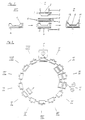
- FIG. 1 schematically shows an exemplary embodiment of the method and the device according to the invention.
- the negative deep-drawing mold (1) in the holding device (2) and in a connecting device for applying pressure or negative pressure are shown schematically in FIG.
- the sheet-like plastic extrudate enters from the slot extruder 4 into the negative mold or negative deep-drawing mold, which is constantly under vacuum or vacuum during the casting.
- the negative deep-drawing mold and / or the extruder are moved in at least one direction.
- the negative deep-drawing mold was subjected to a movement process.
- the sheet-like melt is applied to the edge or frame of the porous negative mold or negative deep-drawing mold (working stage Ia).
- the negative deep-drawing mold continues to move, the surface of the negative deep-drawing mold being covered by the extrudate in steps (Ib) and (Ic).
- the movement process is completed when the other side edge of the negative deep-drawing mold and / or the vacuum chamber is reached.
- the one- or two-layer melt web 5 emerging from an extruder 4 is applied to the edge of the negative drawing mold without additional heating device, utilizing the heat capacity of the melt web (IA).
- the negative deep-drawing mold is kept under vacuum or negative pressure during the pouring process.
- the melt web is brought over and into the negative mold (IB).
- the movement of the negative form is now complete (IC).
- the cast and / or cast-in melt web is sealed over the all-round porous, air-permeable frame or edge of the negative deep-drawing mold and at the same time deformed in the negative deep-drawing mold (II).
- FIG. 3 shows a continuous process in the form of a chain or carousel-like arrangement.
- Working stage I shows the extrudate (5) emerging from an extruder (4), which is applied to the edge of the negative deep-drawing mold (1) without an additional heating device using the heat capacity of the extrudate or the melt web.
- the melt web is brought into the negative deep-drawing mold and, if necessary, sealed by means of a frame.
- a negative pressure is then applied to the negative deep-drawing mold and negative-deep drawn.
- a carrier is introduced and provided in work stage IV with a foam reaction mixture and the foam mold lid attached to the mold is subsequently closed.
- the operations V and VI serve to foam or react the foam reaction mixture.
- working stage VII the foam lid is opened.
- the back-foamed plastic film web is punched out at its edges at work stage VIII and the back-foamed molded part is removed (work stage IX).
Landscapes
- Engineering & Computer Science (AREA)
- Mechanical Engineering (AREA)
- Manufacturing & Machinery (AREA)
- Extrusion Moulding Of Plastics Or The Like (AREA)
- Blow-Moulding Or Thermoforming Of Plastics Or The Like (AREA)
- Moulds For Moulding Plastics Or The Like (AREA)
Claims (9)
- Procédé pour la fabrication d'éléments de moulage ou d'objets en utilisant un procédé de moulage par extrusion dans lequel l'extrudat de matière synthétique à une ou plusieurs couches, sous forme d'une masse fondue s'échappant d'une extrudeuse à fente large, est introduit dans un moule maintenu constamment sous vide au cours du versage, en l'occurrence, épouse la forme préétablie du moule ou de la surface de moulage, dans lequel l'extrudeuse à fente large et/ou le moule se déplacent dans au moins une direction et l'épaisseur moyenne du produit d'extrusion dans le moule négatif ou dans le moule d'emboutissage négatif est réglée à moins de 7000 »m, caractérisé en ce qu'on utilise une extrudeuse à fente large qui travaille en discontinu ou par intermittence en ce qui concerne la quantité éjectée du produit d'extrusion en matière synthétique, dans lequel la quantité de l'extrudat de matière synthétique éjectée pendant le laps de temps que dure le processus d'emboutissage est réglée à zéro ou à une quantité d'éjection réduite, dans lequel on utilise une filière de l'extrudeuse à fente large présentant un dispositif qui peut être réglé et commandé lors de l'application de la masse fondue, pour régler la distance séparant les lèvres de la filière, de façon à appliquer un revêtement de manière approximativement uniforme sur des contre-dépouilles ou encore sur d'autres objets ou éléments de moulage moulés de manière non uniforme, ou à éviter des accumulations de matière à des endroits prédéterminés; en ce que l'extrudat de matière synthétique est appliqué sous la forme d'une masse fondue en forme de bande sur un cadre ou sur un bord du moule négatif ou du moule d'emboutissage négatif, poreux, perméable à l'air et qui s'étend sur tous les côtés; en ce que le moule négatif ou le moule d'emboutissage négatif est réglé avant le versage à une température inférieure à 373 K et en ce que l'extrudat épouse la forme de la surface de moulage poreuse, perméable à l'air, grainée, texturée, façonnée et/ou munie de décorations superficielles du moule négatif ou du moule d'emboutissage négatif, et est immédiatement refroidi ou refroidi par choc de plus de 80 K.
- Procédé selon la revendication 1, caractérisé en ce que le moule négatif ou le moule d'emboutissage négatif est réglé avant le versage à une température inférieure à 333 K, en ce que l'extrudat de matière synthétique sous forme d'une masse fondue en forme de bande, pendant et/ou lors de sa mise en contact avec le cadre ou le bord et/ou le bord s'étendant sur tous les côtés de la surface de moulage poreuse du moule négatif ou du moule d'emboutissage négatif, est également aspiré par le bord s'étendant sur tous les côtés, et en ce qu'on procède à un refroidissement par choc de plus de 140 K.
- Procédé selon les revendications 1 et 2, caractérisé en ce que l'extrudat de matière synthétique à une ou plusieurs couches, sous forme d'une masse fondue s'échappant de l'extrudeuse à fente large, immédiatement avant et/ou pendant la déformation dans le moule négatif ou dans le moule d'emboutissage négatif, se situe à la température de fluage ou dans la plage de température de fluage, à la température de fusion du cristallite ou encore à la température de fusion, ou bien au-dessus de ces dernières, sa température de formage se situant de 2 à 80 K, de préférence de 5 à 40 K en dessous de la température d'extrusion.
- Procédé selon une ou plusieurs des revendications 1 à 3, caractérisé en ce que l'extrudat de matière synthétique ou la bande en forme de masse fondue s'échappant de l'extrudeuse à fente large contiennent une fraction partiellement cristalline de matières thermoplastiques, et dans lequel le réglage de la température a lieu immédiatement avant la déformation dans l'outil d'emboutissage négatif, dans ou au-dessus du domaine de fusion du cristallite, de préférence dans la plage thermoplastique.
- Procédé selon une ou plusieurs des revendications 1 à 3, caractérisé en ce que l'extrudat de matière synthétique ou la bande en forme de masse fondue s'échappant de l'extrudeuse, de préférence de l'extrudeuse à fente large, contient une fraction amorphe, et dans lequel le réglage de la température a lieu immédiatement avant la déformation dans l'outil d'emboutissage négatif, de préférence dans ou au-dessus de la plage de température de fluage ou encore dans la plage thermoplastique.
- Procédé selon une ou plusieurs des revendications 1 à 5, caractérisé en ce que, après le versage de l'extrudat dans le moule négatif ou dans le moule d'emboutissage négatif, on applique un support, de préférence un support positif, sur la masse fondue versée encore chaude à partir du côté envers qui ne doit pas être décoré ou qui ne doit pas être embouti et/ou en utilisant de la pression, de préférence une pression uniforme, on procède, sur le côté envers du support, à une déformation du côté envers de la bande en masse fondue en liaison avec le support.
- Dispositif pour la fabrication d'éléments moulés ou d'objets conformément au procédé de coulée, constitué par au moins un moule de coulée et par au moins une extrudeuse à fente large, dans lequel l'extrudeuse à fente large et/ou le moule sont disposés de manière mobiles dans au moins une direction, et le moule est poreux et perméable à l'air, caractérisé en ce que le moule négatif ou le moule d'emboutissage négatif poreux ou microporeux possède également, contre le bord ou contre le cadre s'étendant sur tous les côtés, une surface poreuse perméable à l'air ou microporeuse perméable à l'air, et la filière de l'extrudeuse à fente large présente un dispositif qui peut être réglé et commandé au cours de l'application de la masse fondue pour régler la distance séparant les lèvres de la filière et/ou en ce que le moule négatif ou le moule d'emboutissage négatif et/ou l'extrudeuse sont munis d'un dispositif apte à être commandé pour le réglage des vitesses de déplacement.
- Dispositif selon la revendication 7, caractérisé en ce que l'extrudeuse est équipée d'un dispositif pour la commande de la vitesse de rotation de la vis.
- Dispositif selon les revendications 7 et 8, caractérisé en ce que le moule négatif ou le moule d'emboutissage négatif est muni, à proximité de sa surface de moulage, d'un dispositif de refroidissement ou d'un système de refroidissement.
Applications Claiming Priority (2)
| Application Number | Priority Date | Filing Date | Title |
|---|---|---|---|
| DE3834637A DE3834637A1 (de) | 1988-10-11 | 1988-10-11 | Verfahren und vorrichtung zur herstellung von formteilen oder gegenstaenden unter verwendung eines extrusions-giessverfahrens |
| DE3834637 | 1988-10-11 |
Publications (3)
| Publication Number | Publication Date |
|---|---|
| EP0363592A2 EP0363592A2 (fr) | 1990-04-18 |
| EP0363592A3 EP0363592A3 (fr) | 1991-11-06 |
| EP0363592B1 true EP0363592B1 (fr) | 1995-06-14 |
Family
ID=6364897
Family Applications (1)
| Application Number | Title | Priority Date | Filing Date |
|---|---|---|---|
| EP89114546A Expired - Lifetime EP0363592B1 (fr) | 1988-10-11 | 1989-08-07 | Procédé et dispositif de fabrication de pièces ou objets moulés par une technique d'extrusion-formage |
Country Status (4)
| Country | Link |
|---|---|
| EP (1) | EP0363592B1 (fr) |
| AT (1) | ATE123689T1 (fr) |
| DE (3) | DE3844976C2 (fr) |
| ES (1) | ES2074458T3 (fr) |
Families Citing this family (3)
| Publication number | Priority date | Publication date | Assignee | Title |
|---|---|---|---|---|
| DE4211415C2 (de) * | 1992-04-04 | 1996-05-23 | Benecke Ag J H | Folie oder Formkörper aus einem mehrphasigen Kunststoff |
| DE19616643C1 (de) * | 1996-04-26 | 1997-04-03 | Siempelkamp Handling Sys Gmbh | Verfahren zum Betrieb einer Anlage für die Herstellung einer Schaumstoffplatte |
| DE102020127015A1 (de) | 2020-10-14 | 2022-04-14 | Valeo Schalter Und Sensoren Gmbh | Eingabevorrichtung für ein Kraftfahrzeug, Verfahren und Werkzeug zum Herstellen eines Kunststoffteils für eine Eingabevorrichtung eines Kraftfahrzeugs |
Family Cites Families (10)
| Publication number | Priority date | Publication date | Assignee | Title |
|---|---|---|---|---|
| GB1254267A (en) * | 1969-04-17 | 1971-11-17 | American Cyanamid Co | Polymerization process |
| DE2022465A1 (de) * | 1970-05-08 | 1971-11-25 | Leifeld & Co | Verfahren zum Extrudieren und Blasverformen bzw.Tiefziehen von Thermoplasten |
| US3793402A (en) * | 1971-11-05 | 1974-02-19 | F Owens | Low haze impact resistant compositions containing a multi-stage,sequentially produced polymer |
| CA1022356A (en) * | 1973-02-28 | 1977-12-13 | Du Pont Of Canada Limited | Process for the continuous melt thermoforming of polymers |
| JPS5385855A (en) * | 1976-12-31 | 1978-07-28 | Asano Kenkyusho Kk | Sheet molding apparatus equipped extruder |
| US4421712A (en) * | 1980-08-13 | 1983-12-20 | Maryland Cup Corporation | Continuously rotary thermo-forming systems and apparatus of the pressure assist, plug assist and match mold type |
| WO1985002142A1 (fr) * | 1983-11-11 | 1985-05-23 | A.A.R.C. (Management) Pty. Limited | Procede et dispositif d'alimentation en bande thermoplastique en fusion |
| DE8706204U1 (de) * | 1987-04-30 | 1988-09-01 | Alkor GmbH Kunststoffe, 81479 München | Vorrichtung zur Herstellung von Formteilen oder Gegenständen aus thermoverformbaren Kunststoffbahnen |
| EP0288728B2 (fr) * | 1987-04-30 | 1995-11-02 | Alkor Gmbh Kunststoffe | Procédé et dispositif de fabrication de pièces ou d'articles en des feuilles plastiques thermoformables |
| EP0288733B1 (fr) * | 1987-04-30 | 1992-11-25 | Alkor Gmbh Kunststoffe | Procédé et dispositif pour la fabrication d'articles à partir de films ou plaques thermoformables en matière plastique ou de feuilles thermoformables contenant de la matière plastique |
-
1988
- 1988-10-11 DE DE3844976A patent/DE3844976C2/de not_active Expired - Fee Related
- 1988-10-11 DE DE3834637A patent/DE3834637A1/de not_active Withdrawn
-
1989
- 1989-08-07 ES ES89114546T patent/ES2074458T3/es not_active Expired - Lifetime
- 1989-08-07 EP EP89114546A patent/EP0363592B1/fr not_active Expired - Lifetime
- 1989-08-07 DE DE58909290T patent/DE58909290D1/de not_active Expired - Fee Related
- 1989-08-07 AT AT89114546T patent/ATE123689T1/de active
Also Published As
| Publication number | Publication date |
|---|---|
| ES2074458T3 (es) | 1995-09-16 |
| DE58909290D1 (de) | 1995-07-20 |
| DE3844976C2 (de) | 2001-01-25 |
| ATE123689T1 (de) | 1995-06-15 |
| DE3834637A1 (de) | 1990-04-12 |
| EP0363592A2 (fr) | 1990-04-18 |
| EP0363592A3 (fr) | 1991-11-06 |
Similar Documents
| Publication | Publication Date | Title |
|---|---|---|
| EP1363772B1 (fr) | Materiau composite avec une couche superieure en polypropylene et une feuille en mousse en polypropylene | |
| DE68913773T2 (de) | Mehrschichtiger Formkörper und Verfahren zu seiner Herstellung. | |
| EP0480153B1 (fr) | Procédé et appareil pour la fabrication d'un objet moulé en matière plastique | |
| EP0477476B1 (fr) | Méthode et dispositif pour la production d'objets moulés | |
| EP0299168B1 (fr) | Procédé et dispositif de fabrication de pièces ou d'autres articles montés | |
| EP0546130B1 (fr) | Procede de fabrication de corps moules a couches multiples | |
| DE4030478A1 (de) | Verfahren und vorrichtung zur herstellung von kraftfahrzeugteilen, kraftfahrzeuginnenverkleidungen sowie flugzeuginnenverkleidungen | |
| DE2551038A1 (de) | Verfahren zur herstellung von geschaeumten polyolefin-formkoerpern | |
| EP0288728B2 (fr) | Procédé et dispositif de fabrication de pièces ou d'articles en des feuilles plastiques thermoformables | |
| DE69226613T2 (de) | Verfahren und Vorrichtung zum Herstellen von Kunststoffgegenständen mit ausgeschäumten Kernen | |
| EP0363594B2 (fr) | Procédé et dispositif de fabrication de pièces ou objets moulés en matières plastiques thermoformables avec procédé d'étirage | |
| EP0669195A1 (fr) | Objets moulés en matière composite et procédé de production | |
| EP0363592B1 (fr) | Procédé et dispositif de fabrication de pièces ou objets moulés par une technique d'extrusion-formage | |
| EP0288733B1 (fr) | Procédé et dispositif pour la fabrication d'articles à partir de films ou plaques thermoformables en matière plastique ou de feuilles thermoformables contenant de la matière plastique | |
| DE4030477C2 (de) | Verfahren und Vorrichtung zur Herstellung von Formteilen oder Gegenständen | |
| EP0363595B1 (fr) | Procédé, dispositif et feuille en matière plastique pour la fabrication de pièces ou objets moulés | |
| EP0363597B1 (fr) | Procédé de fabrication de pièces ou objets moulés par étirage à partir de feuilles, pellicules ou plaques en matière plastique thermoformable | |
| EP0363593B1 (fr) | Procédé et dispositif de fabrication de pièces ou objets moulés pour véhicules | |
| EP0363596B1 (fr) | Procédé de fabrication de pièces ou objets moulés pour véhicules ou pour la garniture intérieure de véhicules | |
| DE8706204U1 (de) | Vorrichtung zur Herstellung von Formteilen oder Gegenständen aus thermoverformbaren Kunststoffbahnen | |
| DE3714365A1 (de) | Verfahren und vorrichtung zur herstellung von formteilen oder gegenstaenden aus thermoverformbaren kunststoffolien | |
| DE3714366A1 (de) | Verfahren zur herstellung von formteilen oder gegenstaenden aus thermoverformbaren kunststoffolien, thermoverformbaren kunststoffhaltigen bahnen oder kunststoffplatten | |
| DE3714367A1 (de) | Verfahren und vorrichtung zur herstellung von formteilen oder gegenstaenden aus thermoverformbaren kunststoffbahnen | |
| DE8709582U1 (de) | Vorrichtung zur Herstellung von Formteilen oder Gegenständen | |
| JPS60157828A (ja) | 熱成形性材シ−トの成形体の製造方法 |
Legal Events
| Date | Code | Title | Description |
|---|---|---|---|
| PUAI | Public reference made under article 153(3) epc to a published international application that has entered the european phase |
Free format text: ORIGINAL CODE: 0009012 |
|
| 17P | Request for examination filed |
Effective date: 19890811 |
|
| AK | Designated contracting states |
Kind code of ref document: A2 Designated state(s): AT BE CH DE ES FR GB GR IT LI LU NL SE |
|
| PUAL | Search report despatched |
Free format text: ORIGINAL CODE: 0009013 |
|
| AK | Designated contracting states |
Kind code of ref document: A3 Designated state(s): AT BE CH DE ES FR GB GR IT LI LU NL SE |
|
| 17Q | First examination report despatched |
Effective date: 19930426 |
|
| GRAA | (expected) grant |
Free format text: ORIGINAL CODE: 0009210 |
|
| AK | Designated contracting states |
Kind code of ref document: B1 Designated state(s): AT BE CH DE ES FR GB GR IT LI LU NL SE |
|
| PG25 | Lapsed in a contracting state [announced via postgrant information from national office to epo] |
Ref country code: NL Free format text: LAPSE BECAUSE OF FAILURE TO SUBMIT A TRANSLATION OF THE DESCRIPTION OR TO PAY THE FEE WITHIN THE PRESCRIBED TIME-LIMIT Effective date: 19950614 Ref country code: GR Free format text: LAPSE BECAUSE OF FAILURE TO SUBMIT A TRANSLATION OF THE DESCRIPTION OR TO PAY THE FEE WITHIN THE PRESCRIBED TIME-LIMIT Effective date: 19950614 |
|
| REF | Corresponds to: |
Ref document number: 123689 Country of ref document: AT Date of ref document: 19950615 Kind code of ref document: T |
|
| REF | Corresponds to: |
Ref document number: 58909290 Country of ref document: DE Date of ref document: 19950720 |
|
| PG25 | Lapsed in a contracting state [announced via postgrant information from national office to epo] |
Ref country code: LU Free format text: LAPSE BECAUSE OF NON-PAYMENT OF DUE FEES Effective date: 19950831 Ref country code: LI Effective date: 19950831 Ref country code: CH Effective date: 19950831 |
|
| ITF | It: translation for a ep patent filed | ||
| REG | Reference to a national code |
Ref country code: ES Ref legal event code: FG2A Ref document number: 2074458 Country of ref document: ES Kind code of ref document: T3 |
|
| ET | Fr: translation filed | ||
| GBT | Gb: translation of ep patent filed (gb section 77(6)(a)/1977) |
Effective date: 19950929 |
|
| NLV1 | Nl: lapsed or annulled due to failure to fulfill the requirements of art. 29p and 29m of the patents act | ||
| REG | Reference to a national code |
Ref country code: GB Ref legal event code: 727A |
|
| REG | Reference to a national code |
Ref country code: CH Ref legal event code: PL |
|
| PLBE | No opposition filed within time limit |
Free format text: ORIGINAL CODE: 0009261 |
|
| STAA | Information on the status of an ep patent application or granted ep patent |
Free format text: STATUS: NO OPPOSITION FILED WITHIN TIME LIMIT |
|
| 26N | No opposition filed | ||
| REG | Reference to a national code |
Ref country code: GB Ref legal event code: 727B |
|
| PGFP | Annual fee paid to national office [announced via postgrant information from national office to epo] |
Ref country code: DE Payment date: 19990706 Year of fee payment: 11 |
|
| PGFP | Annual fee paid to national office [announced via postgrant information from national office to epo] |
Ref country code: FR Payment date: 19990716 Year of fee payment: 11 |
|
| PGFP | Annual fee paid to national office [announced via postgrant information from national office to epo] |
Ref country code: BE Payment date: 19990719 Year of fee payment: 11 |
|
| PGFP | Annual fee paid to national office [announced via postgrant information from national office to epo] |
Ref country code: ES Payment date: 19990803 Year of fee payment: 11 |
|
| PGFP | Annual fee paid to national office [announced via postgrant information from national office to epo] |
Ref country code: GB Payment date: 19990804 Year of fee payment: 11 |
|
| PGFP | Annual fee paid to national office [announced via postgrant information from national office to epo] |
Ref country code: AT Payment date: 19990810 Year of fee payment: 11 |
|
| PGFP | Annual fee paid to national office [announced via postgrant information from national office to epo] |
Ref country code: SE Payment date: 19990816 Year of fee payment: 11 |
|
| PG25 | Lapsed in a contracting state [announced via postgrant information from national office to epo] |
Ref country code: GB Free format text: LAPSE BECAUSE OF NON-PAYMENT OF DUE FEES Effective date: 20000807 Ref country code: AT Free format text: LAPSE BECAUSE OF NON-PAYMENT OF DUE FEES Effective date: 20000807 |
|
| PG25 | Lapsed in a contracting state [announced via postgrant information from national office to epo] |
Ref country code: SE Free format text: LAPSE BECAUSE OF NON-PAYMENT OF DUE FEES Effective date: 20000808 Ref country code: ES Free format text: LAPSE BECAUSE OF NON-PAYMENT OF DUE FEES Effective date: 20000808 |
|
| PG25 | Lapsed in a contracting state [announced via postgrant information from national office to epo] |
Ref country code: BE Free format text: LAPSE BECAUSE OF NON-PAYMENT OF DUE FEES Effective date: 20000831 |
|
| BERE | Be: lapsed |
Owner name: ALKOR G.M.B.H. KUNSTSTOFFE Effective date: 20000831 |
|
| GBPC | Gb: european patent ceased through non-payment of renewal fee |
Effective date: 20000807 |
|
| EUG | Se: european patent has lapsed |
Ref document number: 89114546.8 |
|
| PG25 | Lapsed in a contracting state [announced via postgrant information from national office to epo] |
Ref country code: FR Free format text: LAPSE BECAUSE OF NON-PAYMENT OF DUE FEES Effective date: 20010430 |
|
| PG25 | Lapsed in a contracting state [announced via postgrant information from national office to epo] |
Ref country code: DE Free format text: LAPSE BECAUSE OF NON-PAYMENT OF DUE FEES Effective date: 20010501 |
|
| REG | Reference to a national code |
Ref country code: FR Ref legal event code: ST |
|
| REG | Reference to a national code |
Ref country code: ES Ref legal event code: FD2A Effective date: 20010911 |
|
| PG25 | Lapsed in a contracting state [announced via postgrant information from national office to epo] |
Ref country code: IT Free format text: LAPSE BECAUSE OF NON-PAYMENT OF DUE FEES;WARNING: LAPSES OF ITALIAN PATENTS WITH EFFECTIVE DATE BEFORE 2007 MAY HAVE OCCURRED AT ANY TIME BEFORE 2007. THE CORRECT EFFECTIVE DATE MAY BE DIFFERENT FROM THE ONE RECORDED. Effective date: 20050807 |