EP0363622A1 - Polypeptide mit Plasminogenaktivität, ihre Herstellung und Verwendung - Google Patents
Polypeptide mit Plasminogenaktivität, ihre Herstellung und Verwendung Download PDFInfo
- Publication number
- EP0363622A1 EP0363622A1 EP89116075A EP89116075A EP0363622A1 EP 0363622 A1 EP0363622 A1 EP 0363622A1 EP 89116075 A EP89116075 A EP 89116075A EP 89116075 A EP89116075 A EP 89116075A EP 0363622 A1 EP0363622 A1 EP 0363622A1
- Authority
- EP
- European Patent Office
- Prior art keywords
- tpa
- tpa55
- dna
- polypeptides
- plasminogen activator
- Prior art date
- Legal status (The legal status is an assumption and is not a legal conclusion. Google has not performed a legal analysis and makes no representation as to the accuracy of the status listed.)
- Withdrawn
Links
- 108090000765 processed proteins & peptides Proteins 0.000 title claims abstract description 19
- 229920001184 polypeptide Polymers 0.000 title claims abstract description 18
- 102000004196 processed proteins & peptides Human genes 0.000 title claims abstract description 18
- 102000001938 Plasminogen Activators Human genes 0.000 title description 2
- 108010001014 Plasminogen Activators Proteins 0.000 title description 2
- 230000000694 effects Effects 0.000 title description 2
- 238000004519 manufacturing process Methods 0.000 title description 2
- 229940127126 plasminogen activator Drugs 0.000 title description 2
- 238000002360 preparation method Methods 0.000 claims abstract description 4
- 108090000373 Tissue Plasminogen Activator Proteins 0.000 claims description 34
- 102000003978 Tissue Plasminogen Activator Human genes 0.000 claims description 32
- 229960000187 tissue plasminogen activator Drugs 0.000 claims description 32
- 108090000623 proteins and genes Proteins 0.000 claims description 18
- 150000001413 amino acids Chemical class 0.000 claims description 12
- 238000000034 method Methods 0.000 claims description 9
- 238000010353 genetic engineering Methods 0.000 claims description 2
- 230000008569 process Effects 0.000 claims description 2
- 125000003275 alpha amino acid group Chemical group 0.000 claims 1
- 201000010099 disease Diseases 0.000 abstract description 2
- 208000037265 diseases, disorders, signs and symptoms Diseases 0.000 abstract description 2
- 210000004027 cell Anatomy 0.000 description 27
- 108020004414 DNA Proteins 0.000 description 20
- FAPWRFPIFSIZLT-UHFFFAOYSA-M Sodium chloride Chemical compound [Na+].[Cl-] FAPWRFPIFSIZLT-UHFFFAOYSA-M 0.000 description 16
- 239000012634 fragment Substances 0.000 description 14
- 239000013612 plasmid Substances 0.000 description 14
- 239000013598 vector Substances 0.000 description 10
- PEDCQBHIVMGVHV-UHFFFAOYSA-N Glycerine Chemical compound OCC(O)CO PEDCQBHIVMGVHV-UHFFFAOYSA-N 0.000 description 9
- 239000002299 complementary DNA Substances 0.000 description 9
- 239000000243 solution Substances 0.000 description 9
- 229910019142 PO4 Inorganic materials 0.000 description 8
- 235000010482 polyoxyethylene sorbitan monooleate Nutrition 0.000 description 8
- 229920000053 polysorbate 80 Polymers 0.000 description 8
- 102000004169 proteins and genes Human genes 0.000 description 8
- 239000011780 sodium chloride Substances 0.000 description 8
- 108091003079 Bovine Serum Albumin Proteins 0.000 description 7
- 108091028043 Nucleic acid sequence Proteins 0.000 description 7
- 239000012894 fetal calf serum Substances 0.000 description 7
- 235000018102 proteins Nutrition 0.000 description 7
- 108091008146 restriction endonucleases Proteins 0.000 description 7
- HEMHJVSKTPXQMS-UHFFFAOYSA-M Sodium hydroxide Chemical compound [OH-].[Na+] HEMHJVSKTPXQMS-UHFFFAOYSA-M 0.000 description 6
- WQZGKKKJIJFFOK-PHYPRBDBSA-N alpha-D-galactose Chemical group OC[C@H]1O[C@H](O)[C@H](O)[C@@H](O)[C@H]1O WQZGKKKJIJFFOK-PHYPRBDBSA-N 0.000 description 6
- AIYUHDOJVYHVIT-UHFFFAOYSA-M caesium chloride Chemical compound [Cl-].[Cs+] AIYUHDOJVYHVIT-UHFFFAOYSA-M 0.000 description 6
- 229920000936 Agarose Polymers 0.000 description 5
- 238000013459 approach Methods 0.000 description 5
- 239000000463 material Substances 0.000 description 5
- 239000002609 medium Substances 0.000 description 5
- 239000000047 product Substances 0.000 description 5
- 229920001817 Agar Polymers 0.000 description 4
- 241000894006 Bacteria Species 0.000 description 4
- HEDRZPFGACZZDS-UHFFFAOYSA-N Chloroform Chemical compound ClC(Cl)Cl HEDRZPFGACZZDS-UHFFFAOYSA-N 0.000 description 4
- 108091026890 Coding region Proteins 0.000 description 4
- 102000009123 Fibrin Human genes 0.000 description 4
- 108010073385 Fibrin Proteins 0.000 description 4
- BWGVNKXGVNDBDI-UHFFFAOYSA-N Fibrin monomer Chemical compound CNC(=O)CNC(=O)CN BWGVNKXGVNDBDI-UHFFFAOYSA-N 0.000 description 4
- 239000000020 Nitrocellulose Substances 0.000 description 4
- ISWSIDIOOBJBQZ-UHFFFAOYSA-N Phenol Chemical compound OC1=CC=CC=C1 ISWSIDIOOBJBQZ-UHFFFAOYSA-N 0.000 description 4
- 102000013566 Plasminogen Human genes 0.000 description 4
- 108010051456 Plasminogen Proteins 0.000 description 4
- 229920002684 Sepharose Polymers 0.000 description 4
- 239000008272 agar Substances 0.000 description 4
- 239000000872 buffer Substances 0.000 description 4
- 238000006243 chemical reaction Methods 0.000 description 4
- 238000010367 cloning Methods 0.000 description 4
- 238000012217 deletion Methods 0.000 description 4
- 230000037430 deletion Effects 0.000 description 4
- 229950003499 fibrin Drugs 0.000 description 4
- 229920001220 nitrocellulos Polymers 0.000 description 4
- XLYOFNOQVPJJNP-UHFFFAOYSA-N water Substances O XLYOFNOQVPJJNP-UHFFFAOYSA-N 0.000 description 4
- 239000004475 Arginine Substances 0.000 description 3
- 102000004594 DNA Polymerase I Human genes 0.000 description 3
- 108010017826 DNA Polymerase I Proteins 0.000 description 3
- 102000004190 Enzymes Human genes 0.000 description 3
- 108090000790 Enzymes Proteins 0.000 description 3
- 241000588724 Escherichia coli Species 0.000 description 3
- LFQSCWFLJHTTHZ-UHFFFAOYSA-N Ethanol Chemical compound CCO LFQSCWFLJHTTHZ-UHFFFAOYSA-N 0.000 description 3
- 102000003960 Ligases Human genes 0.000 description 3
- 108090000364 Ligases Proteins 0.000 description 3
- 239000007983 Tris buffer Substances 0.000 description 3
- 238000001042 affinity chromatography Methods 0.000 description 3
- ODKSFYDXXFIFQN-UHFFFAOYSA-N arginine Natural products OC(=O)C(N)CCCNC(N)=N ODKSFYDXXFIFQN-UHFFFAOYSA-N 0.000 description 3
- 230000001580 bacterial effect Effects 0.000 description 3
- 239000002585 base Substances 0.000 description 3
- 239000005018 casein Substances 0.000 description 3
- BECPQYXYKAMYBN-UHFFFAOYSA-N casein, tech. Chemical compound NCCCCC(C(O)=O)N=C(O)C(CC(O)=O)N=C(O)C(CCC(O)=N)N=C(O)C(CC(C)C)N=C(O)C(CCC(O)=O)N=C(O)C(CC(O)=O)N=C(O)C(CCC(O)=O)N=C(O)C(C(C)O)N=C(O)C(CCC(O)=N)N=C(O)C(CCC(O)=N)N=C(O)C(CCC(O)=N)N=C(O)C(CCC(O)=O)N=C(O)C(CCC(O)=O)N=C(O)C(COP(O)(O)=O)N=C(O)C(CCC(O)=N)N=C(O)C(N)CC1=CC=CC=C1 BECPQYXYKAMYBN-UHFFFAOYSA-N 0.000 description 3
- 235000021240 caseins Nutrition 0.000 description 3
- 238000010276 construction Methods 0.000 description 3
- 229940088598 enzyme Drugs 0.000 description 3
- 210000003527 eukaryotic cell Anatomy 0.000 description 3
- 239000000499 gel Substances 0.000 description 3
- 238000001502 gel electrophoresis Methods 0.000 description 3
- 239000012528 membrane Substances 0.000 description 3
- 239000010452 phosphate Substances 0.000 description 3
- 238000012216 screening Methods 0.000 description 3
- 101150010939 tpa gene Proteins 0.000 description 3
- 238000001890 transfection Methods 0.000 description 3
- 230000009466 transformation Effects 0.000 description 3
- LENZDBCJOHFCAS-UHFFFAOYSA-N tris Chemical compound OCC(N)(CO)CO LENZDBCJOHFCAS-UHFFFAOYSA-N 0.000 description 3
- 108091032973 (ribonucleotides)n+m Proteins 0.000 description 2
- DHMQDGOQFOQNFH-UHFFFAOYSA-N Glycine Chemical compound NCC(O)=O DHMQDGOQFOQNFH-UHFFFAOYSA-N 0.000 description 2
- 101000740205 Homo sapiens Sal-like protein 1 Proteins 0.000 description 2
- FFEARJCKVFRZRR-BYPYZUCNSA-N L-methionine Chemical compound CSCC[C@H](N)C(O)=O FFEARJCKVFRZRR-BYPYZUCNSA-N 0.000 description 2
- 108020005187 Oligonucleotide Probes Proteins 0.000 description 2
- 102000035195 Peptidases Human genes 0.000 description 2
- 108091005804 Peptidases Proteins 0.000 description 2
- 239000004365 Protease Substances 0.000 description 2
- 102100037204 Sal-like protein 1 Human genes 0.000 description 2
- 239000011543 agarose gel Substances 0.000 description 2
- 238000004113 cell culture Methods 0.000 description 2
- 238000005119 centrifugation Methods 0.000 description 2
- 238000003776 cleavage reaction Methods 0.000 description 2
- 239000012228 culture supernatant Substances 0.000 description 2
- 230000009089 cytolysis Effects 0.000 description 2
- 239000003814 drug Substances 0.000 description 2
- 238000000605 extraction Methods 0.000 description 2
- 230000003480 fibrinolytic effect Effects 0.000 description 2
- 210000002950 fibroblast Anatomy 0.000 description 2
- 229930182830 galactose Natural products 0.000 description 2
- 125000003563 glycoside group Chemical group 0.000 description 2
- 238000011534 incubation Methods 0.000 description 2
- 238000002955 isolation Methods 0.000 description 2
- 210000004962 mammalian cell Anatomy 0.000 description 2
- 229930182817 methionine Natural products 0.000 description 2
- 238000010369 molecular cloning Methods 0.000 description 2
- 239000002773 nucleotide Substances 0.000 description 2
- 125000003729 nucleotide group Chemical group 0.000 description 2
- 239000002751 oligonucleotide probe Substances 0.000 description 2
- 150000002482 oligosaccharides Chemical class 0.000 description 2
- NBIIXXVUZAFLBC-UHFFFAOYSA-K phosphate Chemical compound [O-]P([O-])([O-])=O NBIIXXVUZAFLBC-UHFFFAOYSA-K 0.000 description 2
- 229940012957 plasmin Drugs 0.000 description 2
- 239000002244 precipitate Substances 0.000 description 2
- 238000001556 precipitation Methods 0.000 description 2
- 239000012460 protein solution Substances 0.000 description 2
- 230000007017 scission Effects 0.000 description 2
- 238000012360 testing method Methods 0.000 description 2
- DGVVWUTYPXICAM-UHFFFAOYSA-N β‐Mercaptoethanol Chemical compound OCCS DGVVWUTYPXICAM-UHFFFAOYSA-N 0.000 description 2
- JKMHFZQWWAIEOD-UHFFFAOYSA-N 2-[4-(2-hydroxyethyl)piperazin-1-yl]ethanesulfonic acid Chemical compound OCC[NH+]1CCN(CCS([O-])(=O)=O)CC1 JKMHFZQWWAIEOD-UHFFFAOYSA-N 0.000 description 1
- LVSPDZAGCBEQAV-UHFFFAOYSA-N 4-chloronaphthalen-1-ol Chemical compound C1=CC=C2C(O)=CC=C(Cl)C2=C1 LVSPDZAGCBEQAV-UHFFFAOYSA-N 0.000 description 1
- 102000002260 Alkaline Phosphatase Human genes 0.000 description 1
- 108020004774 Alkaline Phosphatase Proteins 0.000 description 1
- 108700028369 Alleles Proteins 0.000 description 1
- 241000701822 Bovine papillomavirus Species 0.000 description 1
- 0 CCC[C@](*=CCCC(*)(C(C*)*I)C=C)[N-][N+](C)* Chemical compound CCC[C@](*=CCCC(*)(C(C*)*I)C=C)[N-][N+](C)* 0.000 description 1
- UXVMQQNJUSDDNG-UHFFFAOYSA-L Calcium chloride Chemical compound [Cl-].[Cl-].[Ca+2] UXVMQQNJUSDDNG-UHFFFAOYSA-L 0.000 description 1
- 241000282693 Cercopithecidae Species 0.000 description 1
- 102000012410 DNA Ligases Human genes 0.000 description 1
- 108010061982 DNA Ligases Proteins 0.000 description 1
- KCXVZYZYPLLWCC-UHFFFAOYSA-N EDTA Chemical compound OC(=O)CN(CC(O)=O)CCN(CC(O)=O)CC(O)=O KCXVZYZYPLLWCC-UHFFFAOYSA-N 0.000 description 1
- 102100031780 Endonuclease Human genes 0.000 description 1
- 108010043984 Erythrina caffra trypsin inhibitor Proteins 0.000 description 1
- 241001131785 Escherichia coli HB101 Species 0.000 description 1
- 102000016359 Fibronectins Human genes 0.000 description 1
- 108010067306 Fibronectins Proteins 0.000 description 1
- 229920001917 Ficoll Polymers 0.000 description 1
- 239000004471 Glycine Substances 0.000 description 1
- 241000219726 Griffonia simplicifolia Species 0.000 description 1
- 241000238631 Hexapoda Species 0.000 description 1
- 108091026898 Leader sequence (mRNA) Proteins 0.000 description 1
- 108090001090 Lectins Proteins 0.000 description 1
- 102000004856 Lectins Human genes 0.000 description 1
- 239000004472 Lysine Substances 0.000 description 1
- KDXKERNSBIXSRK-UHFFFAOYSA-N Lysine Natural products NCCCCC(N)C(O)=O KDXKERNSBIXSRK-UHFFFAOYSA-N 0.000 description 1
- 108010086093 Mung Bean Nuclease Proteins 0.000 description 1
- 102000016943 Muramidase Human genes 0.000 description 1
- 108010014251 Muramidase Proteins 0.000 description 1
- 108010062010 N-Acetylmuramoyl-L-alanine Amidase Proteins 0.000 description 1
- 108091034117 Oligonucleotide Proteins 0.000 description 1
- 102000003992 Peroxidases Human genes 0.000 description 1
- 102000004160 Phosphoric Monoester Hydrolases Human genes 0.000 description 1
- 108090000608 Phosphoric Monoester Hydrolases Proteins 0.000 description 1
- 102000010752 Plasminogen Inactivators Human genes 0.000 description 1
- 108010077971 Plasminogen Inactivators Proteins 0.000 description 1
- 229920001213 Polysorbate 20 Polymers 0.000 description 1
- 108010076504 Protein Sorting Signals Proteins 0.000 description 1
- 108010092799 RNA-directed DNA polymerase Proteins 0.000 description 1
- 240000004808 Saccharomyces cerevisiae Species 0.000 description 1
- 102000012479 Serine Proteases Human genes 0.000 description 1
- 108010022999 Serine Proteases Proteins 0.000 description 1
- 108091081024 Start codon Proteins 0.000 description 1
- 108010023197 Streptokinase Proteins 0.000 description 1
- 102000019197 Superoxide Dismutase Human genes 0.000 description 1
- 108010012715 Superoxide dismutase Proteins 0.000 description 1
- 108091036066 Three prime untranslated region Proteins 0.000 description 1
- 208000007536 Thrombosis Diseases 0.000 description 1
- 108090000435 Urokinase-type plasminogen activator Proteins 0.000 description 1
- 102000003990 Urokinase-type plasminogen activator Human genes 0.000 description 1
- 241000700605 Viruses Species 0.000 description 1
- JLCPHMBAVCMARE-UHFFFAOYSA-N [3-[[3-[[3-[[3-[[3-[[3-[[3-[[3-[[3-[[3-[[3-[[5-(2-amino-6-oxo-1H-purin-9-yl)-3-[[3-[[3-[[3-[[3-[[3-[[5-(2-amino-6-oxo-1H-purin-9-yl)-3-[[5-(2-amino-6-oxo-1H-purin-9-yl)-3-hydroxyoxolan-2-yl]methoxy-hydroxyphosphoryl]oxyoxolan-2-yl]methoxy-hydroxyphosphoryl]oxy-5-(5-methyl-2,4-dioxopyrimidin-1-yl)oxolan-2-yl]methoxy-hydroxyphosphoryl]oxy-5-(6-aminopurin-9-yl)oxolan-2-yl]methoxy-hydroxyphosphoryl]oxy-5-(6-aminopurin-9-yl)oxolan-2-yl]methoxy-hydroxyphosphoryl]oxy-5-(6-aminopurin-9-yl)oxolan-2-yl]methoxy-hydroxyphosphoryl]oxy-5-(6-aminopurin-9-yl)oxolan-2-yl]methoxy-hydroxyphosphoryl]oxyoxolan-2-yl]methoxy-hydroxyphosphoryl]oxy-5-(5-methyl-2,4-dioxopyrimidin-1-yl)oxolan-2-yl]methoxy-hydroxyphosphoryl]oxy-5-(4-amino-2-oxopyrimidin-1-yl)oxolan-2-yl]methoxy-hydroxyphosphoryl]oxy-5-(5-methyl-2,4-dioxopyrimidin-1-yl)oxolan-2-yl]methoxy-hydroxyphosphoryl]oxy-5-(5-methyl-2,4-dioxopyrimidin-1-yl)oxolan-2-yl]methoxy-hydroxyphosphoryl]oxy-5-(6-aminopurin-9-yl)oxolan-2-yl]methoxy-hydroxyphosphoryl]oxy-5-(6-aminopurin-9-yl)oxolan-2-yl]methoxy-hydroxyphosphoryl]oxy-5-(4-amino-2-oxopyrimidin-1-yl)oxolan-2-yl]methoxy-hydroxyphosphoryl]oxy-5-(4-amino-2-oxopyrimidin-1-yl)oxolan-2-yl]methoxy-hydroxyphosphoryl]oxy-5-(4-amino-2-oxopyrimidin-1-yl)oxolan-2-yl]methoxy-hydroxyphosphoryl]oxy-5-(6-aminopurin-9-yl)oxolan-2-yl]methoxy-hydroxyphosphoryl]oxy-5-(4-amino-2-oxopyrimidin-1-yl)oxolan-2-yl]methyl [5-(6-aminopurin-9-yl)-2-(hydroxymethyl)oxolan-3-yl] hydrogen phosphate Polymers Cc1cn(C2CC(OP(O)(=O)OCC3OC(CC3OP(O)(=O)OCC3OC(CC3O)n3cnc4c3nc(N)[nH]c4=O)n3cnc4c3nc(N)[nH]c4=O)C(COP(O)(=O)OC3CC(OC3COP(O)(=O)OC3CC(OC3COP(O)(=O)OC3CC(OC3COP(O)(=O)OC3CC(OC3COP(O)(=O)OC3CC(OC3COP(O)(=O)OC3CC(OC3COP(O)(=O)OC3CC(OC3COP(O)(=O)OC3CC(OC3COP(O)(=O)OC3CC(OC3COP(O)(=O)OC3CC(OC3COP(O)(=O)OC3CC(OC3COP(O)(=O)OC3CC(OC3COP(O)(=O)OC3CC(OC3COP(O)(=O)OC3CC(OC3COP(O)(=O)OC3CC(OC3COP(O)(=O)OC3CC(OC3COP(O)(=O)OC3CC(OC3CO)n3cnc4c(N)ncnc34)n3ccc(N)nc3=O)n3cnc4c(N)ncnc34)n3ccc(N)nc3=O)n3ccc(N)nc3=O)n3ccc(N)nc3=O)n3cnc4c(N)ncnc34)n3cnc4c(N)ncnc34)n3cc(C)c(=O)[nH]c3=O)n3cc(C)c(=O)[nH]c3=O)n3ccc(N)nc3=O)n3cc(C)c(=O)[nH]c3=O)n3cnc4c3nc(N)[nH]c4=O)n3cnc4c(N)ncnc34)n3cnc4c(N)ncnc34)n3cnc4c(N)ncnc34)n3cnc4c(N)ncnc34)O2)c(=O)[nH]c1=O JLCPHMBAVCMARE-UHFFFAOYSA-N 0.000 description 1
- 239000003513 alkali Substances 0.000 description 1
- AVKUERGKIZMTKX-NJBDSQKTSA-N ampicillin Chemical compound C1([C@@H](N)C(=O)N[C@H]2[C@H]3SC([C@@H](N3C2=O)C(O)=O)(C)C)=CC=CC=C1 AVKUERGKIZMTKX-NJBDSQKTSA-N 0.000 description 1
- 229960000723 ampicillin Drugs 0.000 description 1
- 230000008901 benefit Effects 0.000 description 1
- SQVRNKJHWKZAKO-UHFFFAOYSA-N beta-N-Acetyl-D-neuraminic acid Natural products CC(=O)NC1C(O)CC(O)(C(O)=O)OC1C(O)C(O)CO SQVRNKJHWKZAKO-UHFFFAOYSA-N 0.000 description 1
- 239000011230 binding agent Substances 0.000 description 1
- 230000003115 biocidal effect Effects 0.000 description 1
- 239000001110 calcium chloride Substances 0.000 description 1
- 235000011148 calcium chloride Nutrition 0.000 description 1
- 229910001628 calcium chloride Inorganic materials 0.000 description 1
- 239000001506 calcium phosphate Substances 0.000 description 1
- 229910000389 calcium phosphate Inorganic materials 0.000 description 1
- 235000011010 calcium phosphates Nutrition 0.000 description 1
- 239000001913 cellulose Substances 0.000 description 1
- 229920002678 cellulose Polymers 0.000 description 1
- 238000012512 characterization method Methods 0.000 description 1
- 239000013599 cloning vector Substances 0.000 description 1
- 238000000975 co-precipitation Methods 0.000 description 1
- ATDGTVJJHBUTRL-UHFFFAOYSA-N cyanogen bromide Chemical compound BrC#N ATDGTVJJHBUTRL-UHFFFAOYSA-N 0.000 description 1
- SUYVUBYJARFZHO-RRKCRQDMSA-N dATP Chemical compound C1=NC=2C(N)=NC=NC=2N1[C@H]1C[C@H](O)[C@@H](COP(O)(=O)OP(O)(=O)OP(O)(O)=O)O1 SUYVUBYJARFZHO-RRKCRQDMSA-N 0.000 description 1
- SUYVUBYJARFZHO-UHFFFAOYSA-N dATP Natural products C1=NC=2C(N)=NC=NC=2N1C1CC(O)C(COP(O)(=O)OP(O)(=O)OP(O)(O)=O)O1 SUYVUBYJARFZHO-UHFFFAOYSA-N 0.000 description 1
- RGWHQCVHVJXOKC-SHYZEUOFSA-J dCTP(4-) Chemical compound O=C1N=C(N)C=CN1[C@@H]1O[C@H](COP([O-])(=O)OP([O-])(=O)OP([O-])([O-])=O)[C@@H](O)C1 RGWHQCVHVJXOKC-SHYZEUOFSA-J 0.000 description 1
- HAAZLUGHYHWQIW-KVQBGUIXSA-N dGTP Chemical compound C1=NC=2C(=O)NC(N)=NC=2N1[C@H]1C[C@H](O)[C@@H](COP(O)(=O)OP(O)(=O)OP(O)(O)=O)O1 HAAZLUGHYHWQIW-KVQBGUIXSA-N 0.000 description 1
- NHVNXKFIZYSCEB-XLPZGREQSA-N dTTP Chemical compound O=C1NC(=O)C(C)=CN1[C@@H]1O[C@H](COP(O)(=O)OP(O)(=O)OP(O)(O)=O)[C@@H](O)C1 NHVNXKFIZYSCEB-XLPZGREQSA-N 0.000 description 1
- 230000001419 dependent effect Effects 0.000 description 1
- 229960000633 dextran sulfate Drugs 0.000 description 1
- 230000029087 digestion Effects 0.000 description 1
- 229940079593 drug Drugs 0.000 description 1
- 239000003937 drug carrier Substances 0.000 description 1
- 238000002635 electroconvulsive therapy Methods 0.000 description 1
- 238000010828 elution Methods 0.000 description 1
- DEFVIWRASFVYLL-UHFFFAOYSA-N ethylene glycol bis(2-aminoethyl)tetraacetic acid Chemical compound OC(=O)CN(CC(O)=O)CCOCCOCCN(CC(O)=O)CC(O)=O DEFVIWRASFVYLL-UHFFFAOYSA-N 0.000 description 1
- 108010092809 exonuclease Bal 31 Proteins 0.000 description 1
- 239000013613 expression plasmid Substances 0.000 description 1
- 239000013604 expression vector Substances 0.000 description 1
- 239000003527 fibrinolytic agent Substances 0.000 description 1
- 230000002068 genetic effect Effects 0.000 description 1
- 239000003102 growth factor Substances 0.000 description 1
- 239000001963 growth medium Substances 0.000 description 1
- ZJYYHGLJYGJLLN-UHFFFAOYSA-N guanidinium thiocyanate Chemical compound SC#N.NC(N)=N ZJYYHGLJYGJLLN-UHFFFAOYSA-N 0.000 description 1
- 210000004408 hybridoma Anatomy 0.000 description 1
- 210000003000 inclusion body Anatomy 0.000 description 1
- 238000010348 incorporation Methods 0.000 description 1
- 239000003112 inhibitor Substances 0.000 description 1
- 239000003999 initiator Substances 0.000 description 1
- 230000010354 integration Effects 0.000 description 1
- 238000004255 ion exchange chromatography Methods 0.000 description 1
- 239000002523 lectin Substances 0.000 description 1
- 210000004185 liver Anatomy 0.000 description 1
- 229960000274 lysozyme Drugs 0.000 description 1
- 239000004325 lysozyme Substances 0.000 description 1
- 235000010335 lysozyme Nutrition 0.000 description 1
- 239000011159 matrix material Substances 0.000 description 1
- 238000002844 melting Methods 0.000 description 1
- 108020004999 messenger RNA Proteins 0.000 description 1
- 238000002156 mixing Methods 0.000 description 1
- 208000010125 myocardial infarction Diseases 0.000 description 1
- 229920001542 oligosaccharide Polymers 0.000 description 1
- 108040007629 peroxidase activity proteins Proteins 0.000 description 1
- 230000033885 plasminogen activation Effects 0.000 description 1
- 239000002797 plasminogen activator inhibitor Substances 0.000 description 1
- 239000000256 polyoxyethylene sorbitan monolaurate Substances 0.000 description 1
- 235000010486 polyoxyethylene sorbitan monolaurate Nutrition 0.000 description 1
- 239000001267 polyvinylpyrrolidone Substances 0.000 description 1
- 235000013855 polyvinylpyrrolidone Nutrition 0.000 description 1
- 229920000036 polyvinylpyrrolidone Polymers 0.000 description 1
- 230000000644 propagated effect Effects 0.000 description 1
- 230000002797 proteolythic effect Effects 0.000 description 1
- 230000002285 radioactive effect Effects 0.000 description 1
- 230000010076 replication Effects 0.000 description 1
- 230000004044 response Effects 0.000 description 1
- 239000000523 sample Substances 0.000 description 1
- 108010073863 saruplase Proteins 0.000 description 1
- 230000028327 secretion Effects 0.000 description 1
- 239000012679 serum free medium Substances 0.000 description 1
- 125000005629 sialic acid group Chemical group 0.000 description 1
- 235000020183 skimmed milk Nutrition 0.000 description 1
- 239000011734 sodium Substances 0.000 description 1
- 239000001509 sodium citrate Substances 0.000 description 1
- NLJMYIDDQXHKNR-UHFFFAOYSA-K sodium citrate Chemical compound O.O.[Na+].[Na+].[Na+].[O-]C(=O)CC(O)(CC([O-])=O)C([O-])=O NLJMYIDDQXHKNR-UHFFFAOYSA-K 0.000 description 1
- 238000010561 standard procedure Methods 0.000 description 1
- 239000007858 starting material Substances 0.000 description 1
- 238000011146 sterile filtration Methods 0.000 description 1
- 229960005202 streptokinase Drugs 0.000 description 1
- 239000006228 supernatant Substances 0.000 description 1
- 238000002560 therapeutic procedure Methods 0.000 description 1
- 230000002537 thrombolytic effect Effects 0.000 description 1
- 238000013518 transcription Methods 0.000 description 1
- 230000035897 transcription Effects 0.000 description 1
- QORWJWZARLRLPR-UHFFFAOYSA-H tricalcium bis(phosphate) Chemical compound [Ca+2].[Ca+2].[Ca+2].[O-]P([O-])([O-])=O.[O-]P([O-])([O-])=O QORWJWZARLRLPR-UHFFFAOYSA-H 0.000 description 1
- 239000001226 triphosphate Substances 0.000 description 1
- 235000011178 triphosphate Nutrition 0.000 description 1
- 125000002264 triphosphate group Chemical class [H]OP(=O)(O[H])OP(=O)(O[H])OP(=O)(O[H])O* 0.000 description 1
- 229960005356 urokinase Drugs 0.000 description 1
- 230000002792 vascular Effects 0.000 description 1
- 230000003612 virological effect Effects 0.000 description 1
Images



Classifications
-
- C—CHEMISTRY; METALLURGY
- C12—BIOCHEMISTRY; BEER; SPIRITS; WINE; VINEGAR; MICROBIOLOGY; ENZYMOLOGY; MUTATION OR GENETIC ENGINEERING
- C12N—MICROORGANISMS OR ENZYMES; COMPOSITIONS THEREOF; PROPAGATING, PRESERVING, OR MAINTAINING MICROORGANISMS; MUTATION OR GENETIC ENGINEERING; CULTURE MEDIA
- C12N9/00—Enzymes; Proenzymes; Compositions thereof; Processes for preparing, activating, inhibiting, separating or purifying enzymes
- C12N9/14—Hydrolases (3)
- C12N9/48—Hydrolases (3) acting on peptide bonds (3.4)
- C12N9/50—Proteinases, e.g. Endopeptidases (3.4.21-3.4.25)
- C12N9/64—Proteinases, e.g. Endopeptidases (3.4.21-3.4.25) derived from animal tissue
- C12N9/6421—Proteinases, e.g. Endopeptidases (3.4.21-3.4.25) derived from animal tissue from mammals
- C12N9/6424—Serine endopeptidases (3.4.21)
- C12N9/6456—Plasminogen activators
- C12N9/6459—Plasminogen activators t-plasminogen activator (3.4.21.68), i.e. tPA
-
- A—HUMAN NECESSITIES
- A61—MEDICAL OR VETERINARY SCIENCE; HYGIENE
- A61P—SPECIFIC THERAPEUTIC ACTIVITY OF CHEMICAL COMPOUNDS OR MEDICINAL PREPARATIONS
- A61P7/00—Drugs for disorders of the blood or the extracellular fluid
- A61P7/02—Antithrombotic agents; Anticoagulants; Platelet aggregation inhibitors
-
- C—CHEMISTRY; METALLURGY
- C12—BIOCHEMISTRY; BEER; SPIRITS; WINE; VINEGAR; MICROBIOLOGY; ENZYMOLOGY; MUTATION OR GENETIC ENGINEERING
- C12Y—ENZYMES
- C12Y304/00—Hydrolases acting on peptide bonds, i.e. peptidases (3.4)
- C12Y304/21—Serine endopeptidases (3.4.21)
- C12Y304/21069—Protein C activated (3.4.21.69)
-
- A—HUMAN NECESSITIES
- A61—MEDICAL OR VETERINARY SCIENCE; HYGIENE
- A61K—PREPARATIONS FOR MEDICAL, DENTAL OR TOILETRY PURPOSES
- A61K38/00—Medicinal preparations containing peptides
Definitions
- the present invention relates to new polypeptides with plasminogen activator activity, processes for their preparation and their use in combating diseases.
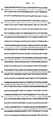
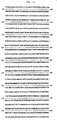
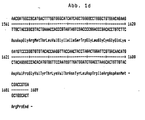
- the human, mature tissue plasminogen activator is a polypeptide of 527 amino acids and a molecular weight of about 68 kD (Pennica et al. 1983, Nature 301, 214-221 and Ny et al. 1984, Proc. Natl. Acad. Sci USA 81, 5355-5359) (see Fig. 1a-1c).
- the molecule contains several distinct regions, so-called domains, to which various functions are assigned.
- the N-terminus is formed by a finger region that is homologous to the fibronectin. This is followed by a region that is similar to several growth factors. This is followed by two Kringel domains.
- the protease domain follows after a cleavage site at which the single-chain molecule can be cleaved into two chains; this contains the active center and has homology to other serine proteases.
- tissue plasminogen activator has a strong affinity for fibrin, the plasminogen activation is dependent on fibrin; as a protease, tPA cleaves plasminogen to plasmin, which in turn breaks down fibrin into cleavage products. tPA can be inhibited by plasminogen activator inhibitors. Furthermore, tPA has a relatively short half-life; the molecule breaks down rapidly in the liver.
- tPA can therefore be used in fibrinolytic therapy, e.g. B. after a heart attack.
- polypeptides of the formula tPA1 ⁇ 54-X-tPA172 ⁇ 527 wherein tPA1 ⁇ 54 and tPA172 ⁇ 527 the amino acids 1-54 and 172-527 of the human, mature tissue plasminogen activator and X one of the amino acid sequences - Ser-tPA111 ⁇ 171, - tPA55 ⁇ 105, - tPA55 ⁇ 130-Arg-tPA140 ⁇ 171 or - tPA55 ⁇ 125-tPA139 ⁇ 171 mean, where tPA111111, tPA55 ⁇ 105, tPA55 ⁇ 130, tPA140 ⁇ 171, tPA55 ⁇ 125 and tPA139 ⁇ 171 the amino acids 111-171, 55-105, 55-130, 140-171, 55-125 and 139- 171 of the human, mature tissue plasminogen activator, and their allele variants or derivatives with sequences shortened or extended by one to six amino acids at the N and / or C terminus have improved properties.
- the new polypeptides are thus changed between amino acids 54 and 172 of the tPA.
- the invention further relates to DNA sequences which code for the mutated polypeptides and to vectors which contain these DNA sequences.
- the new polypeptides can be produced genetically using known methods.
- the starting point for the constructions described here is a cDNA clone, hereinafter called pCUtpa, which contains the coding sequence of tPA and 5'- and 3'- untranslated regions. After a "leader” and pro sequence, the mature protein begins with Ser (1) and ends after Pro (527).
- pUCtPA is isolated as follows: mRNA is isolated from human uterine tissue and rewritten into double-stranded cDNA. After inserting this cDNA into the commercially available cloning vector pUC9, a cDNA library is created. The methods used can be found, for example, in Maniatis et al., Molecular Cloning, CSH-press. The "screening" of such gene banks with radioactively labeled oligonucleotide probes has also become a widely used and described method. A cDNA clone containing the coding region and adjacent regions can be isolated by this method.
- Parts of the DNA sequence of PUC9tPA are easily accessible with the help of restriction enzymes. These fragments, optionally in conjunction with chemically synthesized oligonucleotides, adapters or gene fragments, can be used to clone the DNA sequences which code for the new polypeptides.
- the incorporation of the gene fragments or synthetic DNA sequences into cloning vectors for example the commercially available plasmids pBR322, pUC8 or 9, pCU18 or 19, M13mp18 or M13mp19 takes place in a known manner.
- the genes or gene fragments can also be provided with suitable chemically synthesized control regions or regions isolated from bacteria, phages, eukaryotic cells or their viruses, which enable expression of the proteins.
- hybrid plasmids obtained in this way into suitable host organisms are also known and has been described in detail.
- the hybrid plasmids can also be provided with appropriate signal sequences which allow the polypeptides to be secreted into the medium.
- vectors For expression in mammalian cells, vectors can be used which place the gene to be expressed, in this case the mutated tPA cDNA, under the control of the mouse methallothionein or the SV40 viral promoter. The presence of the methionine start codon and the leader / prosequence of the tPA gene is necessary for the expression. Clones are then isolated which have copies of these vectors as episomes or integrated into the genome. Z are particularly advantageous. B. the integration and expression of the foreign gene based on the bovine papilloma virus. In connection with prokaryotic sequences that code for replication in bacterial cells and antibiotic resistance, the construction of so-called "shuttle" vectors is possible.
- the plasmid is first constructed and propagated in bacterial cells; the conversion into the eukaryotic cells then takes place, e.g. into the mouse fibroblast cell line C127.
- bacterial cells e.g. Yeast, insect cells and other mammalian cells such as e.g. CHO, L and 293 cells for which expression can be used.
- the tissue plasminogen activator when expressed in eukaryotic cells, the tissue plasminogen activator also receives glycoside side chains at amino acids 117, 184 and 448 (Asn). Bacteria are unable to synthesize glycoside side chains. Most eukaryonitic proteins expressed in bacteria, as well as tPA and the polypeptides derived from it according to the invention, occur in the cell as denatured inclusion bodies and have to be renatured using protein chemistry. Furthermore, bacteria are often unable to split off the initiator amino acid methionine from the finished protein. These difficulties can be avoided by using secretion systems.
- the new polypeptides are purified by separating them from the culture medium by affinity and ion exchange chromatography using known methods.
- polypeptides obtained according to the invention have an increased clot specificity, longer half-life, reduced inhibitor binding and / or greater proteolytic activity and can therefore be used for thrombolysis. They show improved properties compared to human tissue plasminogen activator.
- the invention therefore also relates to medicaments which contain at least one of the new polypeptides, optionally in a pharmaceutically acceptable carrier or binder.
- the drugs can also combinations of the new proteins with other fibrinolytics, such as prourokinase, urokinase or streptokinase or their derivatives, as well as with other pharmaceutical proteins, e.g. B. contain superoxide dismutase. Further embodiments of the invention are described in more detail in the following examples.
- the polyA+-RNA was rewritten into single-stranded cDNA.
- the second strand was synthesized using E. coli DNA polymerase I.
- SalI linkers were attached to the double-stranded cDNA using the enzyme T4 DNA ligase.
- the commercially available plasmid pUC9 was linearized with the restriction enzyme SalI. Both DNAs were linked together ligated and transformed with the hybrid CaCl2-treated competent cells of the E. coli strain HB101 thus obtained. The cells were plated on LB plates with 100 ⁇ g / ml ampicillin and incubated overnight at 37 ° C.
- the colonies were transferred to nitrocellulose filters, replica plated, lysed with 0.5 N NaOH / 1.5 M NaCl and the denatured DNA was firmly bound to the filter by baking at 80 ° C. for 2 hours.
- oligonucleotide probes each comprising 17 bases of the tPA-DNA. They consist of the following sequences: 5 ′ TGCAGATCACTTGGTAA 3 ′ 5 ′ CCAGGCCCAGTGCCTGG 3 ′ 5 ′ TCCAGTCCGGCAGCTGC 3 ′
- probes were labeled with ⁇ -32 P-ATP at the 5 'end. They were then incubated with the prehybridized filters in a solution containing 6 x SET, 0.1% SDS, 5 x Denhardt's and 10% dextran sulfate overnight at 42 ° C with gentle shaking. The filters are then washed several times in 6 x SET / 0.1% SDS at 42 ° C, dried and exposed to an X-ray film. Clones that gave a radioactive response during "screening" were isolated and grown up. A clone, hereinafter referred to as pUCtPA, contains an approximately 2.1 kb insert which contains the coding region and 5′- and 3′-non-coding regions (FIG. 2). Plasmid DNA from pUCtPA was prepared by lysozyme digestion and SDS-alkali treatment of the bacterial culture and subsequent CsCl gradient centrifugation.
- the starting product was the plasmid pUC tPA (Fig. 2). This was cut preparatively with the restriction endonuclease BstX1.
- the DNA was treated with exonuclease Bal31 in various batches between 0 and 10 min (Fig. 3). The reactions were stopped with EGTA. The DNAs were precipitated with alcohol and washed and then treated with mung bean nuclease (blunt ends). After phenol / chloroform extraction and repeated alcohol precipitation, the DNAs were re-ligated with T4 ligase and transformed into E.coli CMK603.
- Plasmids were isolated from the transformants and cut with EcoR1. In this way, tPA genes of different sizes could be identified. Several tPA genes with different sized deletions were sequenced to determine the reading frame (amino acid sequence). Continuous reading frame deletion mutants were cloned into plasmid pCL28Xho BPV (see Example 4), expressed in mouse fibroblasts and tested.
- the two fragments were then treated with Klenow polymerase and the 5 'overhanging ends filled in to blunt ends. This ensured that the truncated tPA gene remained in the reading frame.
- the two fragments were ligated together with T4 ligase and transformed into E.coli CMK 603. Plasmids from some transformants were prepared and analyzed with restriction enzymes (e.g. Ava1). The DNA of a truncated tPA gene was sequenced as a control and then cloned into the plasmid pCL28Xho BPV (see Example 4), expressed in mouse fibra loads and tested.
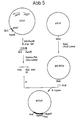
- DNA of the monkey virus SV40 was cut with the restriction enzymes BamHI and BclI and the 0.24 kb fragment was prepared by gel electrophoresis (Fig. 5). The ends were filled in with the Klenow fragment of DNA polymerase I in the presence of the four deoxynucleotide triphosphates dATP, dCTP, dGTP and dTTP. XhoI linkers were then ligated.
- the eukaryotic expression vector CL28XhoBPV created by ligation of CL28X and pB2-2 (according to Reddy et al. 1987, DNA 6, 461-72), was partially cut with the restriction enzyme XbaI, ie incubation was carried out for a limited time so that molecules arose that were only split at one of the two XbaI recognition sequences, i.e. linearized (Fig. 6). The approach was then implemented with Klenow polymerase and dNTPs as described. The linear molecules were then isolated by gel electrophoresis.
- the linear pCL28XhoBPV fragments were then ligated with the pretreated 0.24 kb fragment from SV40. After transformation and screening of minilysates, a clone was isolated which carried the SV40 fragment in the former XbaI site located approximately 0.15 kB 3 ′ to the XhoI site; this DNA (“pCL28XhoBPV-SVpolyA") carried the SV40 transcription stop signals of the "early" genes.
- Plasmid DNA from pCL28XhoBPV-SVpolyA was linearized with the restriction enzyme XhoI and treated with alkaline phosphatase.
- pUCtPA-CTX, -CTN, -CTT, -CTFg, CTaF, -CTV was cleaved with the enzyme SalI and the approx. 2.1 kb insert was prepared (Fig. 7). Both fragments were linked together using T4 ligase.
- a clone was isolated which contained the mutated tPA DNA simply and in the correct orientation: pCL28BPV-tPA-CTX, -CTN, -CTT, -CTFg, -CTaF, -CTV.
- C127I cells (J. Virol. 26 (1978) 292; ATCC catalog of cell lines and hybridomas 5th edition, 1985, p142) were transfected with BPV expression plasmids using the calcium phosphate coprecipitation method (Virology 52 (1973) / 456, DNA cloning; volume II; ed. DMGlover IRL Press, pages 143ff and 213 (1985)).
- 5 x 10⁵ C127I cells were seeded in DMEM (Dulbecco's Modified Eagles Medium) + 10% FCS (fetal calf serum) in 60 mm petri dishes. The next day the medium was changed to MEM (Modified Eagles Medium) with 25mM Hepes + 10% FCS.
- a plasmid DNA was purified with 10 ⁇ g of CsCl Ca-phosphate co-precipitate formed, which was carefully applied to the C127I cells.
- the cells were kept at 37 ° C for 4 h; Incubated 7% CO2.
- Subsequent glycerol shock treatment significantly increased the efficiency of the transfection.
- the medium was withdrawn from the cells 4 h after application of the precipitate.
- the cells were 3 min. incubated with 2 ml 15% glycerol / HBS (DNA cloning Vol. II, page 152) per 60 mm petri dish at room temperature.
- the glycerol / HBS solution was drawn off, the cell lawn was washed with 3 ml of DMEM + 10% FCS.
- the cells were washed with DMEM + 10% FCS at 37 ° C; Incubated 7% CO2.
- the DMEM + 10% FCS was withdrawn three times a week and replaced with fresh one.
- transfected cells containing the BPV genome were recognizable as collections of transformed cells, so-called foci.
- Foci expressing the tPA muteins described above were identified by a casein agar overlay (see below).
- 7% CO2 was visible in the cloudy casein agar lysis areas at the locations where tPA-expressing cells are located.
- the cells located at these sites were isolated by the "cloning-cylinder" method (DNA cloning Vol.
- the cell lines obtained were then grown using standard methods in DMEM + 10% FCS. For production, the cell lines were kept in serum-free DMEM after reaching confluence.
- the tPA mutein from the serum-free cell culture supernatant obtained in this way can now be characterized and purified.
- the cells are washed twice in 60 mm petri dishes with serum-free medium. Then 2 ml "overlay agarose" are carefully pipetted into the Petri dishes. The petri dishes are left to cool and solidify the agarose at room temperature. It is then incubated for 2-3 hours in an incubator at 37 ° C. with the addition of 7% CO2 and the size and number of lysis yards are determined.
- the tPA mutein was isolated from the serum-free cell culture supernatant obtained according to Example 5 by affinity chromatography on Erythrina trypsin inhibitor Sepharose (ETI-Sepharose, 1 cm x 3 cm). To produce the affinity matrix, 5 mg of ETI was coupled to 1 ml of CNBr-activated Sepharose 4B. The gel material was equilibrated with 20 mM Na phosphate, 0.15 M NaCl, 0.01% ®Tween 80, pH 7.0 before application of the cell supernatant. After application, the gel material was treated with the same buffer to remove non-specifically bound material.
- ETI-Sepharose Erythrina trypsin inhibitor Sepharose
- the specifically bound mutein was then desorbed by elution with 0.1 M glycine, 0.1 M arginine / HCl, 0.01% ®Tween 80, pH 3.0.
- the eluate was combined and adjusted to pH 5.0 with 0.1 N sodium hydroxide solution.
- the eluate was diluted with 3 times the volume of 20 mM Na-PO4, 250 mM NaCl 0.01% ®Tween 80 and a pH of 7 was set.
- the protein solution was then applied to a lysine ®Sepharose column (1 cm ⁇ 7 cm) equilibrated with 20 mM Na-PO4, 250 mM NaCl, 0.01% ®Tween 80, pH 7.0 . In order to remove non-specifically bound material, it was rinsed with 20 mM Na-PO4, 0.01% ®Tween 80, pH 6.5. The specifically bound mutein was then desorbed with 20 mM Na-PO4, 0.4 M arginine, 0.01% ®Tween 80, pH 6.5. Finally, the protein solution was still against 20 mM Na-PO4; 0.1 M arginine, 0.01% ®Tween 80, pH 5.0 dialyzed and finally stored at -20 ° C until further use.
- the nitrocellulose was 5 - 10 min in 50 mM Tris, 150 mM NaCl, 0.02% H2O2 and 0.5 mg / ml 4-chloro-1-naphthol incubated. Positive reactions became visible within 5 min by the blue banding of the protein band. The reaction was then stopped by transferring the nitrocellulose membrane into water.
- the oligosaccharide residues contain ⁇ -linked galactose residues which, according to Fig. 8, are linked with ⁇ -linked subterminal galactose residues.
- the ⁇ -galactose residues are preferably localized at galactose 6 ′ (numbering of the sugar residues see Fig. 8).
- the other subterminal galactose residues are either substituted by sialic acid or other ⁇ -linked galactose.
Landscapes
- Health & Medical Sciences (AREA)
- Chemical & Material Sciences (AREA)
- Organic Chemistry (AREA)
- Engineering & Computer Science (AREA)
- Life Sciences & Earth Sciences (AREA)
- Bioinformatics & Cheminformatics (AREA)
- General Health & Medical Sciences (AREA)
- Genetics & Genomics (AREA)
- Wood Science & Technology (AREA)
- Zoology (AREA)
- Biochemistry (AREA)
- General Engineering & Computer Science (AREA)
- Biomedical Technology (AREA)
- Medicinal Chemistry (AREA)
- Chemical Kinetics & Catalysis (AREA)
- Veterinary Medicine (AREA)
- Hematology (AREA)
- Nuclear Medicine, Radiotherapy & Molecular Imaging (AREA)
- Pharmacology & Pharmacy (AREA)
- Animal Behavior & Ethology (AREA)
- Public Health (AREA)
- General Chemical & Material Sciences (AREA)
- Diabetes (AREA)
- Molecular Biology (AREA)
- Biotechnology (AREA)
- Microbiology (AREA)
- Medicines That Contain Protein Lipid Enzymes And Other Medicines (AREA)
- Enzymes And Modification Thereof (AREA)
- Peptides Or Proteins (AREA)
Abstract
Es werden Polypeptide der Formel tPA1-54-X-tPA172-527 , worin tPA1-54 und tPA172-527 die in der Beschreibung angegebene Bedeutung besitzen, und deren Herstellung beschrieben. Die neuen Polypeptide eignen sich zu Bekämpfung von Krankheiten.
Description
- Die vorliegende Erfindung betrifft neue Polypeptide mit Plasminogenaktivatoraktivität, Verfahren zu deren Herstellung und deren Verwendung bei der Bekämpfung von Krankheiten.
- Der humane, gereifte Gewebe-Plasminogenaktivator (tPA) ist ein Polypeptid aus 527 Aminosäuren und einem Molekulargewicht von etwa 68 kD (Pennica et al. 1983, Nature 301, 214 - 221 und Ny et al. 1984, Proc. Natl. Acad. Sci. USA 81, 5355-5359) (vgl. Abb. 1a-1c). Das Molekül enthält mehrere distinkte Regionen, sog. Domänen, denen verschiedene Funktionen zugeordnet werden. Der N-Terminus wird durch eine Finger-Region gebildet, die dem Fibronektin homolog ist. Anschließend folgt eine Region, die Ähnlichkeit mit mehreren Wachstumsfaktoren besitzt. Im Anschluß daran folgen zwei Kringel-Domänen. Nach einer Spaltstelle, an der das einkettige Molekül in zwei Ketten gespalten werden kann, schließt sich die Protease-Domäne an; diese enthält das aktive Zentrum und besitzt Homologie zu anderen Serin-Proteasen.
- Mehrere Eigenschaften machen den Gewebe-Plasminogenaktivator zu einem interessanten Molekül: tPA besitzt eine starke Affinität zu Fibrin, die Plasminogen-Aktivierung ist Fibrin-abhängig; als Protease spaltet tPA Plasminogen zu Plasmin, das wiederum Fibrin zu Spaltprodukten abbaut. tPA ist durch Plasminogenaktivator-Inhibitoren hemmbar. Ferner hat tPA eine relativ kurze Halbwertzeit; das Molekül wird in der Leber rasch abgebaut.
- Diese Faktoren bewirken, daß tPA in vivo spezifisch an Blutgerinnseln Plasminogen zu Plasmin aktiviert und durch Abbau des Fibrins die Wiederherstellung des Gefäßstromes bewirkt. tPA kann deshalb in der fibrinolytischen Therapie, z. B. nach einem Herzinfarkt, eingesetzt werden.
- Es wurde nun gefunden, daß Polypeptide der Formel
tPA₁₋₅₄-X-tPA₁₇₂₋₅₂₇ ,
worin
tPA₁₋₅₄ und tPA₁₇₂₋₅₂₇ die Aminosäuren 1-54 und 172-527 des humanen, gereiften Gewebe-Plasminogenaktivators und
X eine der Aminosäuresequenzen
- Ser-tPA₁₁₁₋₁₇₁,
- tPA₅₅₋₁₀₅,
- tPA₅₅₋₁₃₀-Arg-tPA₁₄₀₋₁₇₁ oder
- tPA₅₅₋₁₂₅-tPA₁₃₉₋₁₇₁
bedeuten, wobei tPA₁₁₁₋₁₇₁, tPA₅₅₋₁₀₅, tPA₅₅₋₁₃0, tPA₁₄₀₋₁₇₁, tPA₅₅₋₁₂₅ und tPA₁₃₉₋₁₇₁ die Aminosäuren 111-171, 55-105, 55-130, 140-171, 55-125 und 139-171 des humanen, gereiften Gewebeplasminogenaktivators sind, sowie deren Allelvarianten oder Derivaten mit am N- und/oder C-Terminus um ein bis sechs Aminosäuren verkürzten oder verlängerten Sequenzen verbesserte Eigenschaften besitzen. - Die neuen Polypeptide sind also zwischen den Aminosäuren 54 und 172 des tPA verändert.
- Die Erfindung betrifft weiter DNA-Sequenzen, die für die mutierten Polypeptide codieren, sowie Vektoren, die diese DNA-Sequenzen enthalten.
- Die neuen Polypeptide lassen sich gentechnisch nach bekannten Verfahren herstellen. Ausgangspunkt für die hier beschriebenen Konstruktionen ist ein cDNA-Klon, im folgenden pCUtpa genannt, der die codierende Sequenz von tPA und noch 5′- und 3′- nicht translatierte Bereiche enthält. Nach einer "leader"- und Prosequenz beginnt das reife Protein mit Ser(1) und endet nach Pro(527).
- pUCtPA wird die folgt isoliert: Aus menschlichem Uterus-Gewebe wird mRNA isoliert und in doppelsträngige cDNA umgeschrieben wird. Nach Einsetzen dieser cDNA in den kommerziell erhältlichen Klonierungsvektor pUC9 wird eine cDNA-Bibliothek angelegt. Die dabei verwendeten Methoden sind beispielsweise in Maniatis et al., Molecular Cloning, CSH-press, nachzulesen. Auch das "screening" solcher Genbanken mit radioaktiv markierten Oligonukleotidsonden ist inzwischen ein vielfach verwendete und beschriebene Methode. Nach diesem Verfahren kann ein cDNA-Klon, der die kodierende Region und angrenzende Bereiche enthält, isoliert werden.
- Teile der DNA-Sequenz von PUC9tPA sind mit Hilfe von Restriktionsenzymen leicht zugänglich. Diese Fragmente, ggf. in Verbindung mit chemisch synthetisierten Oligonukleotiden, Adaptoren oder Genfragmenten können benutzt werden, um die DNA-Sequenzen, die für die neuen Polypeptide codieren, zu klonieren. Der Einbau der Genfragmente bzw. synthetischen DNA-Sequenzen in Klonierungsvektoren, z.B. die handelsüblichen Plasmide pBR322, pUC8 oder 9, pCU18 oder 19, M13mp18 oder M13mp19 erfolgt in bekannter Weise. Auch können die Gene oder Genfragmente mit geeigneten chemisch synthetisierten oder aus Bakterien, Phagen, Eukaryontenzellen oder deren Viren isolierten Kontrollregionen versehen werden, die die Expression der Proteine ermöglichen. Die Transformation bzw. Transfektion der so erhaltenen Hybridplasmide in geeignete Wirtsorganismen ist ebenfalls bekannt und eingehend beschrieben. Auch können die Hybridplasmide mit entsprechenden Signalsequenzen versehen werden, die die Sekretion der Polypeptide ins Medium erlauben.
- Bei der Expression in Säugerzellen kann man Vektoren verwenden, die das zu exprimierende Gen, in diesem Fall die mutierte tPA-cDNA, unter die Kontrolle des Maus-Methallothionein- oder des viralen SV40-Promoters setzt. Notwendig für die Expression ist das Vorliegen des Methionin-Startcodons und der Leader-/Prosequenz des tPA-Gens. Man isoliert dann Klone, die Kopien dieser Vektoren als Episome oder ins Genom integriert besitzen. Besonders vorteilhaft sind z. B. die Integration und Expression des Fremdgens auf der Basis des Rinderpapillom-Virus. In Verbindung mit prokaryontischen Sequenzen, die für die Replikation in Bakterienzellen und eine Antibiotika-Resistenz codieren, ist der Aufbau sog. "shuttle"-Vektoren möglich. Konstruktion und Vermehrung des Plasmids erfolgen zunächst in Bakterienzellen; anschließend erfolgt die Umsetzung in die Eukaryontenzellen, z.B. in die Maus-Fibroblastenzellinie C127. Es ist selbstverständlich, daß auch andere Zellsysteme, z.B. Hefe, Insektenzellen und andere Säugerzellen, wie z.B. CHO-, L- und 293-Zellen, für die Expression verwendet werden können.
- Diese eukaryontischen Expressionssysteme besitzen den Vorteil, daß sie in der Lage sind, ihre Produkte effektiv und meist in nativer Form zu sezernieren. Ferner besitzen sie die Fähigkeit, ihre Produkte posttranslational zu modifizieren.
- So erhält der Gewebe-Plasminogenaktivator bei der Expression in Eukaryontenzellen noch Glykosidseitenketten an den Aminosäuren 117, 184 und 448 (Asn). Bakterien sind nicht in der Lage, Glycosidseitenketten zu synthetisieren. Die meisten in Bakterien exprimierten eukaryonitischen Proteine, wie auch tPA und die von ihr erfindungsgemäß abgeleiteten Polypeptide, fallen in der Zelle als denaturierte Einschlußkörper an und müssen proteinchemisch renaturiert werden. Ferner sind Bakterien oft nicht in der Lage, die Initiatoraminosäure Methionin vom fertigen Protein abzuspalten. Durch die Verwendung von Sekretionssystemen können diese Schwierigkeiten umgangen werden.
- Aufgrund der Degeneration des genetischen Codes ist es aber auch möglich, andere DNA-Sequenzen, z.B. chemisch synthetisierte Gene mit unterschiedlicher DNA-Sequenz für die Expression der neuen Polypeptide zu benutzen.
- Die Reinigung der neuen Polypeptide erfolgt durch deren Abtrennung aus dem Kulturmedium durch Affinitäts- und Ionenaustausch-Chromatographie nach bekannten Verfahren.
- Die erfindungsgemäß erhaltenen Polypeptide besitzen eine erhöhte Gerinnselspezifität, längere Halbwertzeit, verringerte Inhibitorbindung und/oder größere proteolytisch Aktivität und können daher zur Thrombolyse eingesetzt werden. Sie zeigen dabei verbesserte Eigenschaften gegenüber humanem Gewebe-Plasminogenaktivator.
- Gegenstand der Erfindung sind daher auch Arzneimittel, die mindestens eines der neuen Polypeptide enthalten, ggf. in einem pharmazeutisch verträglichen Träger oder Bindmittel. Die Arzneimittel können auch Kombinationen der neuen Proteine mit anderen Fibrinolytika, wie Prourokinase, Urokinase oder Streptokinase oder deren Derivate, sowie mit anderen Pharmaproteinen, z. B. Superoxiddismutase enthalten. Weitere Ausgestaltungen der Erfindung sind in den folgenden Beispielen näher beschrieben.
- Für gentechnische Methoden sei dazu z. B. auf das Handbuch von Maniatis et al., Molecular Cloning, Cold Spring Harbor Laboratory, 1982, verwiesen.
- 30 g tPA-produzierendes menschliches Uterus-Gewebe wurde in 6 M Guanidiniumthiocyanat, 5 mM Natriumcitrat (pH 7,0), 0,1 M 2-Mercaptoethanol, 0,5 % Sarcosyl im Ultra-Turax® aufgeschlossen. Grobe Zelltrümmer wurden bei 3000 rpm abzentrifugiert. Die RNA wurde durch Zentrifugation durch eine 5,7 M CsCl-Kissen über Nacht bei 45.000 rpm abgetrennt. Anschließend wurde die polyA⁺-enthaltende RNA-Fraktion durch Affinitätschromatographie an oligo(dT)-Cellulose abgetrennt.
- Mit Hilfe des Enzyms AMV-Reverse Transcriptase und oligo(dT)12-18 als Starter wurde die polyA⁺-RNA in einsträngige cDNA umgeschrieben. Die Synthese des zweiten Stranges erfolgte mit E. coli-DNA-Polymerase I. An die doppelsträngige cDNA wurden mit Hilfe des Enzyms T4-DNA-Ligase SalI-Linker angesetzt. Das kommerziell erhältliche Plasmid pUC9 wurde mit dem Restriktionsenzym SalI linearisiert. Beide DNAs wurden miteinander ligiert und mit dem so erhaltenen Hybrid CaCl₂-behandelte, kompetente Zellen des E. coli-Stammes HB101 transformiert.
Die Zellen wurden auf LB-Platten mit 100 µg/ml Ampicillin plattiert und über Nacht bei 37°C inkubiert.
Die Kolonien wurden auf Nitrocellulose-Filter übertragen, Replikaplattiert, mit 0,5 N NaOH/1,5 M NaCl lysiert und die denaturierte DNA durch 2-stündiges Backen bei 80°C fest an den Filter gebunden.
Die Filter wurden in 6 x SET-Puffer (1 x SET = 0,15 M NaCl, 15mM Tris/HCL pH 7,4, 1 mM EDTA), 0,1 % SDS und 5 x Denhardt's Lösung (100 x Denhardt = 1 g Ficoll, 1 g Polyvinylpyrrolidon, 1 g BSA pro 50 ml) für 4 h, bei 68°C vorhybridisiert. Mit Hilfe eines DNA-Synthesizers wurden drei Oligonukleotid-Sonden, die jeweils 17 Basen der tPA-DNA umfassen, hergestellt. Sie bestehen aus folgenden Sequenzen:
5′ TGCAGATCACTTGGTAA 3′
5′ CCAGGCCCAGTGCCTGG 3′
5′ TCCAGTCCGGCAGCTGC 3′ - Diese Sonden wurden am 5′-Ende mit γ-³²P-ATP markiert. Sie wurden dann mit den vorhybridisierten Filtern in einer Lösung, die 6 x SET, 0,1 % SDS, 5 x Denhardt's und 10 % Dextransulfat enthält, über Nacht bei 42°C unter leichtem Schütteln inkubiert. Die Filter werden danach mehrfach in 6 x SET/0,1 % SDS bei 42°C gewaschen, angetrocknet und einem Röntgenfilm exponiert. Klone, die beim "Screening" eine radioaktive Antwort gaben, wurden isoliert und weitergezüchtet. Ein Klon, im folgenden pUCtPA genannt, enthält ein etwa 2,1 kb großes Insert, das die codierende Region, sowie 5′- und 3′-nicht-codierende Bereiche enthält (Abb. 2). Plasmid-DNA von pUCtPA wurde durch Lysozym-Aufschluß und SDS-Alkali-Behandlung der Bakterienkultur sowie anschließende CsCl-Gradientenzentrifugation präpariert.
- Ausgangsprodukt war das Plasmid pUC tPA (Abb. 2). Dieses wurde präparativ mit der Restriktionsendonuklease BstX1 geschnitten. Mit der Exonuklease Bal31 wurde die DNA in verschiedenen Ansätzen zwischen 0 und 10 min behandelt (Abb. 3). Die Reaktionen wurden jeweils mit EGTA abgestoppt. Die DNAs wurden mit Alkohol gefällt und gewaschen und danach mit Mung Bean Nuklease behandelt (glatte Enden). Nach einer Phenol/Chloroform-Extraktion und nochmaliger Alkoholfällung wurden die DNAs mit T4-Ligase rückligiert und in E.coli CMK603 transformiert.
- Aus den Transformanten wurden Plasmide isoliert und mit EcoR1 geschnitten. Es konnten so tPA-Gene unterschiedlicher Größe identifiziert werden. Mehrere tPA-Gene mit unterschiedlich großen Deletionen wurden sequenziert, um das Leseraster (Aminosäuresequenz) zu bestimmen. Deletionsmutanten mit durchgehendem Leseraster wurden in das Plasmid pCL28Xho BPV (siehe Beispiel 4) umkloniert, in Mausfibroblasten exprimiert und getestet.
- Ausgangsprodukt war das Plasmid pUC tPA (Abb. 2). Dieses wurde in einem Ansatz präparativ mit NarI geschnitten. In einem zweiten Ansatz wurde des präparativ mit NarI und StyI doppelt geschnitten (Abb. 4). Vom ersten Ansatz wurde die größere Bande (ungefähr 4150 Basenpaare = Vektorbande +3′-Ende tPA) aus einem Agarosegel isoliert.
- Vom zweiten Ansatz wurde die 457-Basenpaare große Bande aus einem Agarosegel isoliert (=NarI/Sal1-Fragment vom Vektor und 5′-Ende vom tPA).
- Die beiden Fragmente wurden anschließend mit Klenow-Polymerase behandelt und die 5′-überhängenden Enden zu glatten Enden aufgefüllt. Dadurch wurde sichergestellt, daß das verkürzte tPA-Gen im Leseraster blieb. Nach einer Phenol/Chloroform-Extraktion und anschließender Alkoholfällung wurden die beiden Fragmente mit T4-Ligase zusammenligiert und in E.coli CMK 603 transformiert. Von einigen Transformanten wurden Plasmide präpariert und mit Restriktionsenzymen (z.B. Ava1) analysiert. Die DNA eines verkürzten tPA-Gens wurde zur Kontrolle sequenziert und dann in das Plasmid pCL28Xho BPV (siehe Beispiel 4) umkloniert, in Mausfibrablasten exprimiert und getestet.
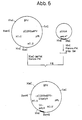
- DNA des Affenvirus SV40 wurde mit den Restriktionsenzymen BamHI und BclI geschnitten und das 0,24 kb-Fragment gelelektrophoretisch präpariert (Abb. 5). Die Enden wurden in Gegenwart der vier Desoxynukleotidtriphosphate dATP, dCTP, dGTP und dTTP mit dem Klenow-Fragment der DNA-PolymeraseI aufgefüllt. Anschließend wurden XhoI-Linker anligiert.
- Parallel wurde der kommerziell erhältliche Vektor pUC18 mit dem Enzym SmaI linearisiert. Dann wurden ebenfalls XhoI-Linker angesetzt. DNA dieses Vektors ("pUC18Xho") wurde mit XhoI linearisiert, mit alkalischer Phosphatase behandelt und mit dem 0,24 kb XhoI-SV40-Fragment (s. o.) ligiert. Es entstand pSVpA.
pSVpA-DNA wurde präparativ mit XhoI gespalten und wie oben mit Klenow-Polymerase in Gegenwart der vier dNTPs inkubiert. Das 0,24 kb-Fragment wurde Gel-isoliert.
Gleichzeitig wurde der Eukaryonten-Expressionsvektor CL28XhoBPV, entstanden durch Ligation von CL28X und pB2-2 (nach Reddy et al. 1987, DNA 6, 461-72), partiell mit dem Restriktionsenzym XbaI geschnitten, d. h. es wurde zeitlich derart limitiert inkubiert, daß Moleküle entstanden, die nur an einer der beiden XbaI-Erkennungssequenzen gespalten, also linearisiert sind (Abb. 6). Der Ansatz wurde dann wie beschrieben mit Klenow-Polymerase und dNTPs umgesetzt. Die linearen Moleküle wurden anschließend durch Gelelektrophorese isoliert. - Es erfolgte dann die Ligation der linearen pCL28XhoBPV-Fragmente mit dem vorbehandelten 0,24 kb-Fragment aus SV40. Nach Transformation und Screening von Minilysaten wurde ein Klon isoliert, der das SV40-Fragment in der etwa 0,15 kB 3′-wärts der XhoI-Stelle gelegenen vormaligen XbaI-Stelle trug; diese DNA ("pCL28XhoBPV-SVpolyA") trug die SV40-Transkriptionsstopsignale der "frühen" Gene.
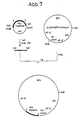
- Plasmid-DNA von pCL28XhoBPV-SVpolyA wurde mit dem Restriktionsenzym XhoI linearisiert und mit alkalischer Phosphatase behandelt. Gleichzeitig wurde pUCtPA-CTX, -CTN, -CTT, -CTFg, CTaF, -CTV (aus den Beispielen 2 und 3) mit dem Enzym SalI gespalten und das ca. 2,1 kb große Insert präpariert (Abb. 7). Beide Fragmente wurden mittels T4-Ligase miteinander verbunden. Nach Transformation und Minilysaten wurde ein Klon isoliert, der die mutierte tPA-DNA einfach und in der korrekten Orientierung enthielt: pCL28BPV-tPA-CTX, -CTN, -CTT, -CTFg, -CTaF, -CTV.
- C127I Zellen (J. Virol. 26 (1978) 292; ATCC catalogue of cell lines and hybridomas 5th edition, 1985, p142) wurden mit BPV-Expressionsplasmiden transfiziert mit der Calciumphosphat-Copräzipitationsmethode (Virology 52 (1973)/ 456, DNA cloning; volume II; ed. D.M.Glover IRL Press, Seiten 143ff und 213 (1985)).
5 x 10⁵ C127I-Zellen wurden in DMEM (Dulbecco's Modified Eagles Medium) + 10 % FCS (Foetales Kalbsserum) in 60 mm Petrischalen eingesät. Am nächsten Tag wurde das Medium gewechselt auf MEM (Modified Eagles Medium) mit 25mM Hepes + 10 % FCS. Mit 10 µg CsCl-gereinigter Plasmid DNA wurde ein Ca-Phosphat-Corpräzipitat gebildet, welches vorsichtig auf die C127I-Zellen aufgebracht wurde. Die Zellen wurden 4 h bei 37°C; 7 % CO₂ inkubiert. Durch eine anschließende Glycerin-Schock-Behandlung wurde die Effizienz der Transfektion erheblich gesteigert. Hierzu wurde 4 h nach Aufbringen des Präzipitates das Medium von den Zellen abgezogen. Die Zellen wurden 3 min. mit je 2 ml 15 % Glycerin/HBS (DNA cloning Vol. II, Seite 152) pro 60 mm Petrischale bei Raumtemperatur inkubiert. Die Glycerin/HBS-Lösung wurde abgezogen, der Zellrasen mit 3 ml DMEM + 10 % FCS gewaschen. Die Zellen wurden mit DMEM + 10 % FCS bei 37°C; 7 % CO₂ inkubiert. Dreimal in der Woche wurde das DMEM + 10 % FCS abgezogen und durch frisches ersetzt. Nach 2-3 Wochen waren transfizierte Zellen, die das BPV-Genom enthalten, als Ansammlungen transformierte Zellen, sogenannte Foci, zu erkennen.
Foci, die die oben beschriebenen tPA-Muteine exprimieren, wurden durch einen Casein-Agar-Overlay (siehe unten) identifiziert. Nach 2-3 h Inkubation bei 37°C; 7 % CO₂ waren im trüben Casein-Agar Lysehöfe an den Stellen zu erkennen, an denen sich tPA-exprimierende Zellen befinden. Nach Entfernen des Casein-Agar wurden die sich an diesen Stellen befindenden Zellen nach der "cloning-cylinder"-Methode isoliert (DNA cloning Vol. II, S. 220). Die erhaltenen Zellinien wurden anschließend mit Standardmethoden in DMEM + 10 % FCS hochgezüchtet.
Zur Produktion wurden die Zellinien nach Erreichen der Konfluenz in serumfreiem DMEM gehalten. Das tPA-Mutein aus dem so erhaltenen serumfreien Zellkulturüberstand kann nun charakterisiert und aufgereinigt werden. - Für den oben erwähnten Agar Overlay Test werden folgende Lösungen benötigt:
-
- 1) 8 % Magermilchlösung in H₂O werden 30 min bei 100°C gekocht und anschließend im 37°C Wasserbad abgekühlt.
- 2) Eine 2 %ige Lösung von Low-melting Agarose in PBS wird nach Autoklavieren im 37°C Wasserbad abgekühlt. Anschließend wird im Verhältnis 1:1 doppelt konzentriertes DMEM zugegeben.
- 3) 0,64 mg Plasminogen wird in 1 ml H₂O gelöst. Durch Zusammenpipettieren von 16 ml Lösung 2, 4 ml Lösung 1 und 0,4 ml Plasminogen wird die Overlay Agarose hergestellt. Diese wird nach Mischen im 37°C Wasserbad gehalten.
- Zur Durchführung des Tests werden die Zellen in 60 mm Petrischalen zweimal mit serumfreiem Medium gewaschen. Anschließend werden je 2 ml "Overlay-Agarose" vorsichtig in die Petrischalen pipettiert. Die Petrischalen werden zum Abkühlen und Erstarren der Agarose bei Raumtemperatur stehen gelassen. Anschließend wird 2-3 h im Brutschrank bei 37°C unter Zugabe von 7 % CO₂ inkubiert und die Größe und Anzahl der Lysehöfe bestimmt.
- Aus dem gemäß Beispiel 5 erhaltenen serumfreien Zellkulturüberstand wurde das tPA-Mutein nach Sterilfiltration und Zugabe von 0,01 % ®Tween 80 durch eine Affinitätschromatographie an Erythrina-Trypsin-Inhibitor-Sepharose (ETI-Sepharose, 1 cm x 3 cm) isoliert. Zur Herstellung der Affinitätsmatrix wurden 5 mg ETI an 1 ml CNBr-aktivierte Sepharose 4B gekoppelt. Das Gelmaterial wurde vor dem Auftragen des Zellüberstands mit 20 mM Na-phosphat, 0,15 M NaCl, 0,01 % ®Tween 80, pH 7,0 äquilibriert. Nach dem Auftragen wurde das Gelmaterial mit demselben Puffer behandelt, um unspezifisch gebundenes Material zu entfernen. Die Desorption des spezifisch gebundenen Muteins erfolgte anschließend durch Elution mit 0,1 M Glycin, 0,1 M Arginin/HCl, 0,01 % ®Tween 80, pH 3,0. Das Eluat wurde vereinigt und mit 0,1 N Natronlauge auf pH 5,0 eingestellt. Alternativ wurde das Eluat mit dem 3fachen Volumen an 20 mM Na-PO₄, 250 mM NaCl 0,01 % ®Tween 80 verdünnt und ein pH-Wert von 7 eingestellt. Zur weiteren Reinigung des isolierten Muteins wurde die Proteinlösung dann auf eine mit 20 mM Na-PO₄, 250 mM NaCl, 0,01 % ®Tween 80, pH 7,0 äquilibrierte Lysin-®Sepharose-Säule (1 cm x 7 cm) aufgetragen. Um unspezifisch gebundenes Material zu entfernen wurde mit 20 mM Na-PO₄, 0,01 % ®Tween 80, pH 6,5 gespült. Die Desorption des spezifisch gebundenen Muteins erfolgte dann mit 20 mM Na-PO₄, 0,4 M Arginin, 0,01 % ®Tween 80, pH 6,5. Abschließend wurde die Proteinlösung noch gegen 20 mM Na-PO₄; 0,1 M Arginin, 0,01 % ®Tween 80, pH 5,0 dialysiert und schließlich bei -20°C bis zur weiteren Verwendung aufbewahrt.
- 5 - 10 µg des gemäß Beispiel 6 erhaltenen Muteins wurden durch SDS-Gelelektrophorese aufgetrennt und anschließend auf Nitrozellulose-Membranen transferiert. Nach dem Absättigen mit PBS-Puffer (2 mM Phosphat, 150 mM NaCl, pH 7,4), der 0,1 % ®Tween 20, pH 7,4 enthielt, wurde die Membran 2 h mit an Peroxidase gekoppeltem Lektin von Griffonia Simplicifolia inkubiert. Nach dem Entfernen ungebundenen Materials mit Hilfe von TBS-Puffer (10 mM Tris, 150 mM NaCl, pH 7,4) wurde die Nitrozellulose 5 - 10 min in 50 mM Tris, 150 mM NaCl, 0,02 % H₂O₂ und 0,5 mg/ml 4-Chlor-1-naphthol inkubiert. Positive Reaktionen wurden durch Blaufärbung der Proteinbande innerhalb von 5 min sichtbar. Die Reaktion wurde dann durch Transferieren der Nitrozellulose-Membran in Wasser gestoppt.
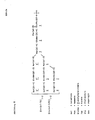
- Die Oligosaccharid-Reste enthalten α-gebundene Galaktose-Reste, die gemäß Abb. 8 mit β-gebundenen subterminalen Galaktose-Resten verknüpft sind. Dabei sind die α-Galaktose-Reste bevorzugt an der Galaktose 6′ (Numerierung der Zuckerreste siehe Abb. 8) lokalisiert. Die anderen subterminalen Galaktose-Reste sind entweder durch Sialinsäure oder weitere α-gebundene Galaktose substituiert.
Claims (5)
- Gentechnologisches Verfahren zur Herstellung von Polypeptiden der Formel
tPA₁₋₅₄-X-tPA₁₇₂₋₅₂₇ ,
worin
tPA₁₋₅₄ und tPA₁₇₂₋₅₂₇ die Aminosäuren 1-54 und 172-527 des humanen, gereiften Gewebe-Plasminogenaktivators und
X eine der Aminosäuresequenzen
- Ser-tPA₁₁₁₋₁₇₁
- tPA₅₅₋₁₀₅
- tPA₅₅₋₁₃₀-Arg-tPA₁₄₀₋₁₇₁ oder
- tPA₅₅₋₁₂₅-tPA₁₃₉₋₁₇₁
bedeuten, wobei tPA₁₁₁₋₁₇₁, tPA₅₅₋₁₀₅, tPA₅₅₋₁₃0, tPA₁₄₀₋₁₇₁, tPA₅₅₋₁₂₅ und tPA₁₃₉₋₁₇₁ die Aminosäuren 111-171, 55-105, 55-130, 140-171, 55-125 und 139-171 des humanen, gereiften Gewebeplasminogenaktivators sind, sowie deren Allelvarianten oder Derivaten mit am N- und/oder C-Terminus um ein bis sechs Aminosäuren verkürzten oder verlängerten Sequenzen, dadurch gekennzeichnet, daß man in einem Wirtsorganismus ein Gen zur Expression bringt, das für die Peptidsequenzen nach Anspruch 1 kodiert.
Applications Claiming Priority (2)
| Application Number | Priority Date | Filing Date | Title |
|---|---|---|---|
| DE3830734A DE3830734A1 (de) | 1988-09-09 | 1988-09-09 | Neue polypeptide, ihre herstellung und verwendung |
| DE3830734 | 1988-09-09 |
Publications (1)
| Publication Number | Publication Date |
|---|---|
| EP0363622A1 true EP0363622A1 (de) | 1990-04-18 |
Family
ID=6362650
Family Applications (1)
| Application Number | Title | Priority Date | Filing Date |
|---|---|---|---|
| EP89116075A Withdrawn EP0363622A1 (de) | 1988-09-09 | 1989-08-31 | Polypeptide mit Plasminogenaktivität, ihre Herstellung und Verwendung |
Country Status (3)
| Country | Link |
|---|---|
| EP (1) | EP0363622A1 (de) |
| JP (1) | JPH02211870A (de) |
| DE (1) | DE3830734A1 (de) |
Citations (2)
| Publication number | Priority date | Publication date | Assignee | Title |
|---|---|---|---|---|
| EP0241208A1 (de) * | 1986-04-02 | 1987-10-14 | Beecham Group Plc | Modifiziertes fibrinolytisches Enzym |
| EP0242836A1 (de) * | 1986-04-21 | 1987-10-28 | Roche Diagnostics GmbH | Gewebs-Plasminogen-Aktivator (tPA) - Derivat und seine Herstellung |
-
1988
- 1988-09-09 DE DE3830734A patent/DE3830734A1/de not_active Withdrawn
-
1989
- 1989-08-31 EP EP89116075A patent/EP0363622A1/de not_active Withdrawn
- 1989-09-08 JP JP1231807A patent/JPH02211870A/ja active Pending
Patent Citations (2)
| Publication number | Priority date | Publication date | Assignee | Title |
|---|---|---|---|---|
| EP0241208A1 (de) * | 1986-04-02 | 1987-10-14 | Beecham Group Plc | Modifiziertes fibrinolytisches Enzym |
| EP0242836A1 (de) * | 1986-04-21 | 1987-10-28 | Roche Diagnostics GmbH | Gewebs-Plasminogen-Aktivator (tPA) - Derivat und seine Herstellung |
Non-Patent Citations (1)
| Title |
|---|
| THE EMBO JOURNAL, Band 7, Nr. 9, Seite 2731-2740, 25. Aug 1988, M.J. GETHING et al.: "Variants of human tissue-type plasminogen activator that lack specific structural domains of the heavy chain" * |
Also Published As
| Publication number | Publication date |
|---|---|
| JPH02211870A (ja) | 1990-08-23 |
| DE3830734A1 (de) | 1990-03-22 |
Similar Documents
| Publication | Publication Date | Title |
|---|---|---|
| DE3688760T2 (de) | Expression von Faktor-VII-Aktivität in Säugetierzellen. | |
| DE68923741T2 (de) | Fledermausspeichel-Plasminogenaktivatoren. | |
| DE3687651T2 (de) | Analoge des gewebespezifischen plasminogenaktivators. | |
| DE69434332T2 (de) | Thrombin mutanten | |
| DE3588149T2 (de) | Rekombinante DNS-Verfahren und dadurch hergestellte Produkte | |
| DE69101634T4 (de) | Rekombinant hergestellte blutfaktoren, verfahren zur exprimierung besagter blutfaktoren sowie in besagtem prozess verwendeter rekombinanter vaccina-virus. | |
| DE69024382T2 (de) | Fledermausspeichel-Plasminogenaktivator vPA-alpha 1 | |
| DE3537176A1 (de) | Expression eines plasminogenaktivators in hefe | |
| DE3786317T2 (de) | Proteinanaloge des gewebs-plasminogenaktivators. | |
| DE3689977T2 (de) | Dns-sequenzen, rekombinante dns-moleküle und verfahren zur herstellung menschlicher lipocortinähnlicher polypeptide. | |
| DE69101486T2 (de) | Verfahren zur reinigung rekombinanter polypeptide. | |
| EP0408945B1 (de) | Plasmide, deren Herstellung und deren Verwendung bei der Gewinnung eines Plasminogenaktivators | |
| DE3831714A1 (de) | Tpa-aehnliche polypeptide, ihre herstellung und verwendung | |
| DE3687721T2 (de) | Verfahren zur herstellung eines plasminogenaktivators fuer gewebe. | |
| EP0496327B1 (de) | Verfahren zur Herstellung von Polypeptiden mit Prourokinase-Aktivität | |
| EP0340573A2 (de) | Neue Proteine, ihre Herstellung und Verwendung | |
| EP0363622A1 (de) | Polypeptide mit Plasminogenaktivität, ihre Herstellung und Verwendung | |
| EP0447468B1 (de) | Ancrod-proteine, ihre herstellung und verwendung | |
| DE3823805A1 (de) | Neue polypeptide, ihre herstellung und verwendung | |
| DE69321134T2 (de) | Plasminogen-derivate die durch thrombin aktivierbar sind | |
| DE4423574A1 (de) | Nicht-glykosylierte Plasminogenaktivator-Derivate und ihre Verwendung bei erhöhtem Blutungsrisiko | |
| DE3821757A1 (de) | Neue polypeptide, ihre herstellung und verwendung | |
| DE3815886A1 (de) | Neue polypeptide, ihre herstellung und verwendung | |
| DE3930099A1 (de) | Neue polypeptide, ihre herstellung und verwendung | |
| EP0540560B1 (de) | Ancrod ähnliche proteine, ihre herstellung und verwendung |
Legal Events
| Date | Code | Title | Description |
|---|---|---|---|
| PUAI | Public reference made under article 153(3) epc to a published international application that has entered the european phase |
Free format text: ORIGINAL CODE: 0009012 |
|
| AK | Designated contracting states |
Kind code of ref document: A1 Designated state(s): AT BE CH DE ES FR GB IT LI NL SE |
|
| 17P | Request for examination filed |
Effective date: 19900316 |
|
| STAA | Information on the status of an ep patent application or granted ep patent |
Free format text: STATUS: THE APPLICATION HAS BEEN WITHDRAWN |
|
| 18W | Application withdrawn |
Withdrawal date: 19910204 |