EP0363647A2 - Fire resistant hydraulic fluids - Google Patents
Fire resistant hydraulic fluids Download PDFInfo
- Publication number
- EP0363647A2 EP0363647A2 EP89116540A EP89116540A EP0363647A2 EP 0363647 A2 EP0363647 A2 EP 0363647A2 EP 89116540 A EP89116540 A EP 89116540A EP 89116540 A EP89116540 A EP 89116540A EP 0363647 A2 EP0363647 A2 EP 0363647A2
- Authority
- EP
- European Patent Office
- Prior art keywords
- alkyl
- esters
- substituted
- polyhaloaromatic
- formula
- Prior art date
- Legal status (The legal status is an assumption and is not a legal conclusion. Google has not performed a legal analysis and makes no representation as to the accuracy of the status listed.)
- Granted
Links
- 239000012530 fluid Substances 0.000 title claims abstract description 53
- 230000009970 fire resistant effect Effects 0.000 title claims abstract description 32
- 150000002148 esters Chemical class 0.000 claims abstract description 58
- 239000000203 mixture Substances 0.000 claims abstract description 55
- -1 polyol esters Chemical class 0.000 claims abstract description 47
- 238000000034 method Methods 0.000 claims abstract description 40
- 239000002253 acid Substances 0.000 claims abstract description 17
- 150000007513 acids Chemical class 0.000 claims abstract description 14
- 229920005862 polyol Polymers 0.000 claims abstract description 11
- 150000003014 phosphoric acid esters Chemical class 0.000 claims abstract description 9
- 239000002480 mineral oil Substances 0.000 claims abstract description 8
- 229920001296 polysiloxane Polymers 0.000 claims abstract description 8
- 150000004760 silicates Chemical class 0.000 claims abstract description 8
- 229920000151 polyglycol Polymers 0.000 claims abstract description 7
- 239000010695 polyglycol Substances 0.000 claims abstract description 7
- 125000000217 alkyl group Chemical group 0.000 claims description 56
- 150000001875 compounds Chemical class 0.000 claims description 46
- 125000003118 aryl group Chemical group 0.000 claims description 8
- 229910052736 halogen Inorganic materials 0.000 claims description 8
- 125000003107 substituted aryl group Chemical group 0.000 claims description 7
- 229910052801 chlorine Inorganic materials 0.000 claims description 6
- 229930195733 hydrocarbon Natural products 0.000 claims description 6
- 150000002430 hydrocarbons Chemical class 0.000 claims description 6
- 150000008282 halocarbons Chemical class 0.000 claims description 5
- 125000002887 hydroxy group Chemical group [H]O* 0.000 claims description 5
- 125000000484 butyl group Chemical group [H]C([*])([H])C([H])([H])C([H])([H])C([H])([H])[H] 0.000 claims description 4
- 229910052731 fluorine Inorganic materials 0.000 claims description 4
- 150000002762 monocarboxylic acid derivatives Chemical class 0.000 claims description 4
- 150000003077 polyols Chemical class 0.000 claims description 4
- 229920006395 saturated elastomer Polymers 0.000 claims description 4
- 150000001338 aliphatic hydrocarbons Chemical class 0.000 claims description 3
- 125000002947 alkylene group Chemical group 0.000 claims description 3
- 125000000753 cycloalkyl group Chemical group 0.000 claims description 3
- 150000002009 diols Chemical class 0.000 claims description 3
- 125000005843 halogen group Chemical group 0.000 claims description 3
- 229920000728 polyester Polymers 0.000 claims description 2
- 239000004215 Carbon black (E152) Substances 0.000 claims 4
- 229920001522 polyglycol ester Polymers 0.000 claims 1
- 235000010446 mineral oil Nutrition 0.000 abstract 1
- 229910052794 bromium Inorganic materials 0.000 description 71
- YXFVVABEGXRONW-UHFFFAOYSA-N Toluene Chemical compound CC1=CC=CC=C1 YXFVVABEGXRONW-UHFFFAOYSA-N 0.000 description 54
- 239000000047 product Substances 0.000 description 41
- 239000007788 liquid Substances 0.000 description 30
- 229920001223 polyethylene glycol Polymers 0.000 description 30
- XLYOFNOQVPJJNP-UHFFFAOYSA-N water Substances O XLYOFNOQVPJJNP-UHFFFAOYSA-N 0.000 description 29
- OKKJLVBELUTLKV-UHFFFAOYSA-N Methanol Chemical compound OC OKKJLVBELUTLKV-UHFFFAOYSA-N 0.000 description 27
- IJGRMHOSHXDMSA-UHFFFAOYSA-N Atomic nitrogen Chemical compound N#N IJGRMHOSHXDMSA-UHFFFAOYSA-N 0.000 description 26
- QHWKHLYUUZGSCW-UHFFFAOYSA-N Tetrabromophthalic anhydride Chemical compound BrC1=C(Br)C(Br)=C2C(=O)OC(=O)C2=C1Br QHWKHLYUUZGSCW-UHFFFAOYSA-N 0.000 description 24
- YIWUKEYIRIRTPP-UHFFFAOYSA-N 2-ethylhexan-1-ol Chemical compound CCCCC(CC)CO YIWUKEYIRIRTPP-UHFFFAOYSA-N 0.000 description 23
- NMRPBPVERJPACX-UHFFFAOYSA-N (3S)-octan-3-ol Natural products CCCCCC(O)CC NMRPBPVERJPACX-UHFFFAOYSA-N 0.000 description 20
- WOFPPJOZXUTRAU-UHFFFAOYSA-N 2-Ethyl-1-hexanol Natural products CCCCC(O)CCC WOFPPJOZXUTRAU-UHFFFAOYSA-N 0.000 description 20
- GOOHAUXETOMSMM-UHFFFAOYSA-N Propylene oxide Chemical compound CC1CO1 GOOHAUXETOMSMM-UHFFFAOYSA-N 0.000 description 16
- SCVFZCLFOSHCOH-UHFFFAOYSA-M potassium acetate Chemical compound [K+].CC([O-])=O SCVFZCLFOSHCOH-UHFFFAOYSA-M 0.000 description 15
- 238000010992 reflux Methods 0.000 description 15
- 229910052757 nitrogen Inorganic materials 0.000 description 13
- LRHPLDYGYMQRHN-UHFFFAOYSA-N N-Butanol Chemical compound CCCCO LRHPLDYGYMQRHN-UHFFFAOYSA-N 0.000 description 12
- 239000003921 oil Substances 0.000 description 12
- 0 O=CC(CCC(C1)*=O)(C1C(O[Na])=O)C1CCCCCC1 Chemical compound O=CC(CCC(C1)*=O)(C1C(O[Na])=O)C1CCCCCC1 0.000 description 11
- 125000000956 methoxy group Chemical group [H]C([H])([H])O* 0.000 description 11
- 239000012071 phase Substances 0.000 description 11
- OQBLGYCUQGDOOR-UHFFFAOYSA-L 1,3,2$l^{2}-dioxastannolane-4,5-dione Chemical compound O=C1O[Sn]OC1=O OQBLGYCUQGDOOR-UHFFFAOYSA-L 0.000 description 10
- ZSIAUFGUXNUGDI-UHFFFAOYSA-N hexan-1-ol Chemical compound CCCCCCO ZSIAUFGUXNUGDI-UHFFFAOYSA-N 0.000 description 10
- 239000011541 reaction mixture Substances 0.000 description 10
- AUHHYELHRWCWEZ-UHFFFAOYSA-N tetrachlorophthalic anhydride Chemical compound ClC1=C(Cl)C(Cl)=C2C(=O)OC(=O)C2=C1Cl AUHHYELHRWCWEZ-UHFFFAOYSA-N 0.000 description 10
- IAYPIBMASNFSPL-UHFFFAOYSA-N Ethylene oxide Chemical compound C1CO1 IAYPIBMASNFSPL-UHFFFAOYSA-N 0.000 description 9
- 239000002904 solvent Substances 0.000 description 9
- KBPLFHHGFOOTCA-UHFFFAOYSA-N 1-Octanol Chemical compound CCCCCCCCO KBPLFHHGFOOTCA-UHFFFAOYSA-N 0.000 description 8
- VMHLLURERBWHNL-UHFFFAOYSA-M Sodium acetate Chemical compound [Na+].CC([O-])=O VMHLLURERBWHNL-UHFFFAOYSA-M 0.000 description 8
- 238000001816 cooling Methods 0.000 description 8
- 150000002367 halogens Chemical group 0.000 description 8
- 239000001632 sodium acetate Substances 0.000 description 8
- 235000017281 sodium acetate Nutrition 0.000 description 8
- CXWXQJXEFPUFDZ-UHFFFAOYSA-N tetralin Chemical compound C1=CC=C2CCCCC2=C1 CXWXQJXEFPUFDZ-UHFFFAOYSA-N 0.000 description 8
- SBASXUCJHJRPEV-UHFFFAOYSA-N 2-(2-methoxyethoxy)ethanol Chemical compound COCCOCCO SBASXUCJHJRPEV-UHFFFAOYSA-N 0.000 description 7
- 235000011056 potassium acetate Nutrition 0.000 description 7
- WKBOTKDWSSQWDR-UHFFFAOYSA-N Bromine atom Chemical compound [Br] WKBOTKDWSSQWDR-UHFFFAOYSA-N 0.000 description 6
- CSNNHWWHGAXBCP-UHFFFAOYSA-L Magnesium sulfate Chemical compound [Mg+2].[O-][S+2]([O-])([O-])[O-] CSNNHWWHGAXBCP-UHFFFAOYSA-L 0.000 description 6
- ZMANZCXQSJIPKH-UHFFFAOYSA-N Triethylamine Chemical compound CCN(CC)CC ZMANZCXQSJIPKH-UHFFFAOYSA-N 0.000 description 6
- 150000008064 anhydrides Chemical class 0.000 description 6
- GDTBXPJZTBHREO-UHFFFAOYSA-N bromine Substances BrBr GDTBXPJZTBHREO-UHFFFAOYSA-N 0.000 description 6
- 238000004821 distillation Methods 0.000 description 6
- GLDOVTGHNKAZLK-UHFFFAOYSA-N octadecan-1-ol Chemical compound CCCCCCCCCCCCCCCCCCO GLDOVTGHNKAZLK-UHFFFAOYSA-N 0.000 description 6
- NOPFSRXAKWQILS-UHFFFAOYSA-N docosan-1-ol Chemical compound CCCCCCCCCCCCCCCCCCCCCCO NOPFSRXAKWQILS-UHFFFAOYSA-N 0.000 description 5
- 230000001050 lubricating effect Effects 0.000 description 5
- XDTMQSROBMDMFD-UHFFFAOYSA-N C1CCCCC1 Chemical compound C1CCCCC1 XDTMQSROBMDMFD-UHFFFAOYSA-N 0.000 description 4
- RTZKZFJDLAIYFH-UHFFFAOYSA-N Diethyl ether Chemical compound CCOCC RTZKZFJDLAIYFH-UHFFFAOYSA-N 0.000 description 4
- BRLQWZUYTZBJKN-UHFFFAOYSA-N Epichlorohydrin Chemical compound ClCC1CO1 BRLQWZUYTZBJKN-UHFFFAOYSA-N 0.000 description 4
- LFQSCWFLJHTTHZ-UHFFFAOYSA-N Ethanol Chemical compound CCO LFQSCWFLJHTTHZ-UHFFFAOYSA-N 0.000 description 4
- FAPWRFPIFSIZLT-UHFFFAOYSA-M Sodium chloride Chemical compound [Na+].[Cl-] FAPWRFPIFSIZLT-UHFFFAOYSA-M 0.000 description 4
- 238000006243 chemical reaction Methods 0.000 description 4
- 239000000460 chlorine Substances 0.000 description 4
- 238000004128 high performance liquid chromatography Methods 0.000 description 4
- 239000000463 material Substances 0.000 description 4
- TZYRSLHNPKPEFV-UHFFFAOYSA-N 2-ethyl-1-butanol Chemical compound CCC(CC)CO TZYRSLHNPKPEFV-UHFFFAOYSA-N 0.000 description 3
- QTBSBXVTEAMEQO-UHFFFAOYSA-N Acetic acid Chemical compound CC(O)=O QTBSBXVTEAMEQO-UHFFFAOYSA-N 0.000 description 3
- WFDIJRYMOXRFFG-UHFFFAOYSA-N Acetic anhydride Chemical compound CC(=O)OC(C)=O WFDIJRYMOXRFFG-UHFFFAOYSA-N 0.000 description 3
- HEMHJVSKTPXQMS-UHFFFAOYSA-M Sodium hydroxide Chemical compound [OH-].[Na+] HEMHJVSKTPXQMS-UHFFFAOYSA-M 0.000 description 3
- 239000006227 byproduct Substances 0.000 description 3
- 239000003054 catalyst Substances 0.000 description 3
- 229960000735 docosanol Drugs 0.000 description 3
- 239000000706 filtrate Substances 0.000 description 3
- 238000001914 filtration Methods 0.000 description 3
- 239000003112 inhibitor Substances 0.000 description 3
- 239000012299 nitrogen atmosphere Substances 0.000 description 3
- NLKNQRATVPKPDG-UHFFFAOYSA-M potassium iodide Chemical compound [K+].[I-] NLKNQRATVPKPDG-UHFFFAOYSA-M 0.000 description 3
- 239000000126 substance Substances 0.000 description 3
- RBACIKXCRWGCBB-UHFFFAOYSA-N 1,2-Epoxybutane Chemical compound CCC1CO1 RBACIKXCRWGCBB-UHFFFAOYSA-N 0.000 description 2
- ZAMOUSCENKQFHK-UHFFFAOYSA-N Chlorine atom Chemical compound [Cl] ZAMOUSCENKQFHK-UHFFFAOYSA-N 0.000 description 2
- YXHKONLOYHBTNS-UHFFFAOYSA-N Diazomethane Chemical compound C=[N+]=[N-] YXHKONLOYHBTNS-UHFFFAOYSA-N 0.000 description 2
- LYCAIKOWRPUZTN-UHFFFAOYSA-N Ethylene glycol Chemical compound OCCO LYCAIKOWRPUZTN-UHFFFAOYSA-N 0.000 description 2
- PXGOKWXKJXAPGV-UHFFFAOYSA-N Fluorine Chemical compound FF PXGOKWXKJXAPGV-UHFFFAOYSA-N 0.000 description 2
- CTQNGGLPUBDAKN-UHFFFAOYSA-N O-Xylene Chemical compound CC1=CC=CC=C1C CTQNGGLPUBDAKN-UHFFFAOYSA-N 0.000 description 2
- WQDUMFSSJAZKTM-UHFFFAOYSA-N Sodium methoxide Chemical compound [Na+].[O-]C WQDUMFSSJAZKTM-UHFFFAOYSA-N 0.000 description 2
- 239000000654 additive Substances 0.000 description 2
- QVGXLLKOCUKJST-UHFFFAOYSA-N atomic oxygen Chemical group [O] QVGXLLKOCUKJST-UHFFFAOYSA-N 0.000 description 2
- WIHMDCQAEONXND-UHFFFAOYSA-M butyl-hydroxy-oxotin Chemical compound CCCC[Sn](O)=O WIHMDCQAEONXND-UHFFFAOYSA-M 0.000 description 2
- 238000005260 corrosion Methods 0.000 description 2
- 230000007797 corrosion Effects 0.000 description 2
- HPXRVTGHNJAIIH-UHFFFAOYSA-N cyclohexanol Chemical compound OC1CCCCC1 HPXRVTGHNJAIIH-UHFFFAOYSA-N 0.000 description 2
- MWKFXSUHUHTGQN-UHFFFAOYSA-N decan-1-ol Chemical compound CCCCCCCCCCO MWKFXSUHUHTGQN-UHFFFAOYSA-N 0.000 description 2
- 238000006114 decarboxylation reaction Methods 0.000 description 2
- 238000004512 die casting Methods 0.000 description 2
- LQZZUXJYWNFBMV-UHFFFAOYSA-N dodecan-1-ol Chemical compound CCCCCCCCCCCCO LQZZUXJYWNFBMV-UHFFFAOYSA-N 0.000 description 2
- GHLKSLMMWAKNBM-UHFFFAOYSA-N dodecane-1,12-diol Chemical compound OCCCCCCCCCCCCO GHLKSLMMWAKNBM-UHFFFAOYSA-N 0.000 description 2
- 239000003063 flame retardant Substances 0.000 description 2
- 239000011737 fluorine Substances 0.000 description 2
- 238000010438 heat treatment Methods 0.000 description 2
- 239000001257 hydrogen Substances 0.000 description 2
- 229910052739 hydrogen Inorganic materials 0.000 description 2
- 239000004615 ingredient Substances 0.000 description 2
- 229910052943 magnesium sulfate Inorganic materials 0.000 description 2
- 235000019341 magnesium sulphate Nutrition 0.000 description 2
- 238000006386 neutralization reaction Methods 0.000 description 2
- 239000012074 organic phase Substances 0.000 description 2
- 230000003647 oxidation Effects 0.000 description 2
- 238000007254 oxidation reaction Methods 0.000 description 2
- 239000001301 oxygen Substances 0.000 description 2
- 229910052760 oxygen Inorganic materials 0.000 description 2
- 229920000642 polymer Polymers 0.000 description 2
- BWHMMNNQKKPAPP-UHFFFAOYSA-L potassium carbonate Chemical compound [K+].[K+].[O-]C([O-])=O BWHMMNNQKKPAPP-UHFFFAOYSA-L 0.000 description 2
- TYJJADVDDVDEDZ-UHFFFAOYSA-M potassium hydrogencarbonate Chemical compound [K+].OC([O-])=O TYJJADVDDVDEDZ-UHFFFAOYSA-M 0.000 description 2
- 239000011780 sodium chloride Substances 0.000 description 2
- 125000000547 substituted alkyl group Chemical group 0.000 description 2
- 239000008096 xylene Substances 0.000 description 2
- BNHGVULTSGNVIX-UHFFFAOYSA-N 1-(2-ethoxyethoxy)ethanol Chemical compound CCOCCOC(C)O BNHGVULTSGNVIX-UHFFFAOYSA-N 0.000 description 1
- 239000005968 1-Decanol Substances 0.000 description 1
- MTNNKIABIWFELY-UHFFFAOYSA-N 13,14,15,16-tetrabromo-5-hydroxy-3,9,10-trioxabicyclo[10.4.0]hexadeca-1(12),13,15-triene-2,11-dione Chemical compound O=C1OCC(O)CCCOOC(=O)C2=C(Br)C(Br)=C(Br)C(Br)=C21 MTNNKIABIWFELY-UHFFFAOYSA-N 0.000 description 1
- RNFJDJUURJAICM-UHFFFAOYSA-N 2,2,4,4,6,6-hexaphenoxy-1,3,5-triaza-2$l^{5},4$l^{5},6$l^{5}-triphosphacyclohexa-1,3,5-triene Chemical compound N=1P(OC=2C=CC=CC=2)(OC=2C=CC=CC=2)=NP(OC=2C=CC=CC=2)(OC=2C=CC=CC=2)=NP=1(OC=1C=CC=CC=1)OC1=CC=CC=C1 RNFJDJUURJAICM-UHFFFAOYSA-N 0.000 description 1
- IBWTYTFTIGKXBJ-UHFFFAOYSA-N 2,4,5,6-tetrabromobenzene-1,3-dicarboxylic acid Chemical compound OC(=O)C1=C(Br)C(Br)=C(Br)C(C(O)=O)=C1Br IBWTYTFTIGKXBJ-UHFFFAOYSA-N 0.000 description 1
- XNWFRZJHXBZDAG-UHFFFAOYSA-N 2-METHOXYETHANOL Chemical compound COCCO XNWFRZJHXBZDAG-UHFFFAOYSA-N 0.000 description 1
- PQOSNJHBSNZITJ-UHFFFAOYSA-N 3-methyl-3-heptanol Chemical compound CCCCC(C)(O)CC PQOSNJHBSNZITJ-UHFFFAOYSA-N 0.000 description 1
- KUSJVBWDLIVLIG-UHFFFAOYSA-N 4,5,6-tribromo-2-benzofuran-1,3-dione Chemical compound BrC1=C(Br)C(Br)=CC2=C1C(=O)OC2=O KUSJVBWDLIVLIG-UHFFFAOYSA-N 0.000 description 1
- QDTDKYHPHANITQ-UHFFFAOYSA-N 7-methyloctan-1-ol Chemical compound CC(C)CCCCCCO QDTDKYHPHANITQ-UHFFFAOYSA-N 0.000 description 1
- PLLBRTOLHQQAQQ-UHFFFAOYSA-N 8-methylnonan-1-ol Chemical compound CC(C)CCCCCCCO PLLBRTOLHQQAQQ-UHFFFAOYSA-N 0.000 description 1
- UAEPNZWRGJTJPN-UHFFFAOYSA-N CC1CCCCC1 Chemical compound CC1CCCCC1 UAEPNZWRGJTJPN-UHFFFAOYSA-N 0.000 description 1
- 239000005069 Extreme pressure additive Substances 0.000 description 1
- UFHFLCQGNIYNRP-UHFFFAOYSA-N Hydrogen Chemical compound [H][H] UFHFLCQGNIYNRP-UHFFFAOYSA-N 0.000 description 1
- 239000004440 Isodecyl alcohol Substances 0.000 description 1
- 239000004439 Isononyl alcohol Substances 0.000 description 1
- FFKZOUIEAHOBHW-UHFFFAOYSA-N N,4-dimethyl-N-nitrosobenzenesulfonamide Chemical group O=NN(C)S(=O)(=O)C1=CC=C(C)C=C1 FFKZOUIEAHOBHW-UHFFFAOYSA-N 0.000 description 1
- 229910000831 Steel Inorganic materials 0.000 description 1
- YSMRWXYRXBRSND-UHFFFAOYSA-N TOTP Chemical compound CC1=CC=CC=C1OP(=O)(OC=1C(=CC=CC=1)C)OC1=CC=CC=C1C YSMRWXYRXBRSND-UHFFFAOYSA-N 0.000 description 1
- ZJCCRDAZUWHFQH-UHFFFAOYSA-N Trimethylolpropane Chemical compound CCC(CO)(CO)CO ZJCCRDAZUWHFQH-UHFFFAOYSA-N 0.000 description 1
- PQYJRMFWJJONBO-UHFFFAOYSA-N Tris(2,3-dibromopropyl) phosphate Chemical compound BrCC(Br)COP(=O)(OCC(Br)CBr)OCC(Br)CBr PQYJRMFWJJONBO-UHFFFAOYSA-N 0.000 description 1
- UKLDJPRMSDWDSL-UHFFFAOYSA-L [dibutyl(dodecanoyloxy)stannyl] dodecanoate Chemical compound CCCCCCCCCCCC(=O)O[Sn](CCCC)(CCCC)OC(=O)CCCCCCCCCCC UKLDJPRMSDWDSL-UHFFFAOYSA-L 0.000 description 1
- 238000010521 absorption reaction Methods 0.000 description 1
- WETWJCDKMRHUPV-UHFFFAOYSA-N acetyl chloride Chemical compound CC(Cl)=O WETWJCDKMRHUPV-UHFFFAOYSA-N 0.000 description 1
- 239000012346 acetyl chloride Substances 0.000 description 1
- 150000001298 alcohols Chemical class 0.000 description 1
- 150000001336 alkenes Chemical class 0.000 description 1
- 125000003368 amide group Chemical group 0.000 description 1
- UUEDINPOVKWVAZ-UHFFFAOYSA-N bis(2-ethylhexyl) 3,4,5,6-tetrabromobenzene-1,2-dicarboxylate Chemical compound CCCCC(CC)COC(=O)C1=C(Br)C(Br)=C(Br)C(Br)=C1C(=O)OCC(CC)CCCC UUEDINPOVKWVAZ-UHFFFAOYSA-N 0.000 description 1
- YHWCPXVTRSHPNY-UHFFFAOYSA-N butan-1-olate;titanium(4+) Chemical compound [Ti+4].CCCC[O-].CCCC[O-].CCCC[O-].CCCC[O-] YHWCPXVTRSHPNY-UHFFFAOYSA-N 0.000 description 1
- 125000004432 carbon atom Chemical group C* 0.000 description 1
- 239000003610 charcoal Substances 0.000 description 1
- 239000003795 chemical substances by application Substances 0.000 description 1
- 238000010276 construction Methods 0.000 description 1
- 239000012043 crude product Substances 0.000 description 1
- 125000004093 cyano group Chemical group *C#N 0.000 description 1
- 125000000113 cyclohexyl group Chemical group [H]C1([H])C([H])([H])C([H])([H])C([H])(*)C([H])([H])C1([H])[H] 0.000 description 1
- 238000000354 decomposition reaction Methods 0.000 description 1
- 239000012975 dibutyltin dilaurate Substances 0.000 description 1
- XXJWXESWEXIICW-UHFFFAOYSA-N diethylene glycol monoethyl ether Chemical compound CCOCCOCCO XXJWXESWEXIICW-UHFFFAOYSA-N 0.000 description 1
- 239000004205 dimethyl polysiloxane Substances 0.000 description 1
- 235000013870 dimethyl polysiloxane Nutrition 0.000 description 1
- QRBLPTJJQNRVAJ-UHFFFAOYSA-N dioctyl 3,4,5,6-tetrabromobenzene-1,2-dicarboxylate Chemical compound CCCCCCCCOC(=O)C1=C(Br)C(Br)=C(Br)C(Br)=C1C(=O)OCCCCCCCC QRBLPTJJQNRVAJ-UHFFFAOYSA-N 0.000 description 1
- 230000008034 disappearance Effects 0.000 description 1
- 239000002270 dispersing agent Substances 0.000 description 1
- 229920001971 elastomer Polymers 0.000 description 1
- 239000000806 elastomer Substances 0.000 description 1
- 238000005516 engineering process Methods 0.000 description 1
- 238000004880 explosion Methods 0.000 description 1
- 150000002334 glycols Chemical class 0.000 description 1
- 150000002366 halogen compounds Chemical class 0.000 description 1
- 125000004435 hydrogen atom Chemical group [H]* 0.000 description 1
- WGCNASOHLSPBMP-UHFFFAOYSA-N hydroxyacetaldehyde Natural products OCC=O WGCNASOHLSPBMP-UHFFFAOYSA-N 0.000 description 1
- 238000002329 infrared spectrum Methods 0.000 description 1
- INQOMBQAUSQDDS-UHFFFAOYSA-N iodomethane Chemical compound IC INQOMBQAUSQDDS-UHFFFAOYSA-N 0.000 description 1
- JEIPFZHSYJVQDO-UHFFFAOYSA-N iron(III) oxide Inorganic materials O=[Fe]O[Fe]=O JEIPFZHSYJVQDO-UHFFFAOYSA-N 0.000 description 1
- 239000012263 liquid product Substances 0.000 description 1
- 229910052751 metal Inorganic materials 0.000 description 1
- 239000002184 metal Substances 0.000 description 1
- 150000002739 metals Chemical class 0.000 description 1
- 238000005555 metalworking Methods 0.000 description 1
- 238000005065 mining Methods 0.000 description 1
- 238000002156 mixing Methods 0.000 description 1
- 238000010137 moulding (plastic) Methods 0.000 description 1
- GOQYKNQRPGWPLP-UHFFFAOYSA-N n-heptadecyl alcohol Natural products CCCCCCCCCCCCCCCCCO GOQYKNQRPGWPLP-UHFFFAOYSA-N 0.000 description 1
- JRZJOMJEPLMPRA-UHFFFAOYSA-N olefin Natural products CCCCCCCC=C JRZJOMJEPLMPRA-UHFFFAOYSA-N 0.000 description 1
- WXZMFSXDPGVJKK-UHFFFAOYSA-N pentaerythritol Chemical compound OCC(CO)(CO)CO WXZMFSXDPGVJKK-UHFFFAOYSA-N 0.000 description 1
- 125000001997 phenyl group Chemical group [H]C1=C([H])C([H])=C(*)C([H])=C1[H] 0.000 description 1
- 229920000435 poly(dimethylsiloxane) Polymers 0.000 description 1
- 229920001521 polyalkylene glycol ether Polymers 0.000 description 1
- 229920013639 polyalphaolefin Polymers 0.000 description 1
- 235000015497 potassium bicarbonate Nutrition 0.000 description 1
- 239000011736 potassium bicarbonate Substances 0.000 description 1
- 229910000028 potassium bicarbonate Inorganic materials 0.000 description 1
- 229910000027 potassium carbonate Inorganic materials 0.000 description 1
- 235000011181 potassium carbonates Nutrition 0.000 description 1
- 238000002360 preparation method Methods 0.000 description 1
- 125000002924 primary amino group Chemical group [H]N([H])* 0.000 description 1
- 239000000376 reactant Substances 0.000 description 1
- 229920005989 resin Polymers 0.000 description 1
- 239000011347 resin Substances 0.000 description 1
- 238000005096 rolling process Methods 0.000 description 1
- 230000003595 spectral effect Effects 0.000 description 1
- 238000005507 spraying Methods 0.000 description 1
- 229910001220 stainless steel Inorganic materials 0.000 description 1
- 239000010935 stainless steel Substances 0.000 description 1
- 239000010959 steel Substances 0.000 description 1
- 238000003756 stirring Methods 0.000 description 1
- 125000001424 substituent group Chemical group 0.000 description 1
- SZIMYNVBPPNTMU-UHFFFAOYSA-N tert-butyl phenyl hydrogen phosphate Chemical compound CC(C)(C)OP(O)(=O)OC1=CC=CC=C1 SZIMYNVBPPNTMU-UHFFFAOYSA-N 0.000 description 1
- 238000009988 textile finishing Methods 0.000 description 1
- VXUYXOFXAQZZMF-UHFFFAOYSA-N titanium(IV) isopropoxide Chemical compound CC(C)O[Ti](OC(C)C)(OC(C)C)OC(C)C VXUYXOFXAQZZMF-UHFFFAOYSA-N 0.000 description 1
- 125000002889 tridecyl group Chemical group [H]C([*])([H])C([H])([H])C([H])([H])C([H])([H])C([H])([H])C([H])([H])C([H])([H])C([H])([H])C([H])([H])C([H])([H])C([H])([H])C([H])([H])C([H])([H])[H] 0.000 description 1
- SRPWOOOHEPICQU-UHFFFAOYSA-N trimellitic anhydride Chemical compound OC(=O)C1=CC=C2C(=O)OC(=O)C2=C1 SRPWOOOHEPICQU-UHFFFAOYSA-N 0.000 description 1
- 238000005292 vacuum distillation Methods 0.000 description 1
- 239000004034 viscosity adjusting agent Substances 0.000 description 1
- 238000003466 welding Methods 0.000 description 1
Classifications
-
- C—CHEMISTRY; METALLURGY
- C08—ORGANIC MACROMOLECULAR COMPOUNDS; THEIR PREPARATION OR CHEMICAL WORKING-UP; COMPOSITIONS BASED THEREON
- C08K—Use of inorganic or non-macromolecular organic substances as compounding ingredients
- C08K5/00—Use of organic ingredients
- C08K5/04—Oxygen-containing compounds
- C08K5/10—Esters; Ether-esters
- C08K5/12—Esters; Ether-esters of cyclic polycarboxylic acids
-
- C—CHEMISTRY; METALLURGY
- C09—DYES; PAINTS; POLISHES; NATURAL RESINS; ADHESIVES; COMPOSITIONS NOT OTHERWISE PROVIDED FOR; APPLICATIONS OF MATERIALS NOT OTHERWISE PROVIDED FOR
- C09K—MATERIALS FOR MISCELLANEOUS APPLICATIONS, NOT PROVIDED FOR ELSEWHERE
- C09K5/00—Heat-transfer, heat-exchange or heat-storage materials, e.g. refrigerants; Materials for the production of heat or cold by chemical reactions other than by combustion
-
- C—CHEMISTRY; METALLURGY
- C10—PETROLEUM, GAS OR COKE INDUSTRIES; TECHNICAL GASES CONTAINING CARBON MONOXIDE; FUELS; LUBRICANTS; PEAT
- C10M—LUBRICATING COMPOSITIONS; USE OF CHEMICAL SUBSTANCES EITHER ALONE OR AS LUBRICATING INGREDIENTS IN A LUBRICATING COMPOSITION
- C10M105/00—Lubricating compositions characterised by the base-material being a non-macromolecular organic compound
- C10M105/50—Lubricating compositions characterised by the base-material being a non-macromolecular organic compound containing halogen
- C10M105/54—Lubricating compositions characterised by the base-material being a non-macromolecular organic compound containing halogen containing carbon, hydrogen, halogen and oxygen
-
- C—CHEMISTRY; METALLURGY
- C10—PETROLEUM, GAS OR COKE INDUSTRIES; TECHNICAL GASES CONTAINING CARBON MONOXIDE; FUELS; LUBRICANTS; PEAT
- C10M—LUBRICATING COMPOSITIONS; USE OF CHEMICAL SUBSTANCES EITHER ALONE OR AS LUBRICATING INGREDIENTS IN A LUBRICATING COMPOSITION
- C10M111/00—Lubrication compositions characterised by the base-material being a mixture of two or more compounds covered by more than one of the main groups C10M101/00 - C10M109/00, each of these compounds being essential
-
- C—CHEMISTRY; METALLURGY
- C10—PETROLEUM, GAS OR COKE INDUSTRIES; TECHNICAL GASES CONTAINING CARBON MONOXIDE; FUELS; LUBRICANTS; PEAT
- C10M—LUBRICATING COMPOSITIONS; USE OF CHEMICAL SUBSTANCES EITHER ALONE OR AS LUBRICATING INGREDIENTS IN A LUBRICATING COMPOSITION
- C10M131/00—Lubricating compositions characterised by the additive being an organic non-macromolecular compound containing halogen
- C10M131/08—Lubricating compositions characterised by the additive being an organic non-macromolecular compound containing halogen containing carbon, hydrogen, halogen and oxygen
- C10M131/12—Acids; Salts or esters thereof
-
- C—CHEMISTRY; METALLURGY
- C10—PETROLEUM, GAS OR COKE INDUSTRIES; TECHNICAL GASES CONTAINING CARBON MONOXIDE; FUELS; LUBRICANTS; PEAT
- C10M—LUBRICATING COMPOSITIONS; USE OF CHEMICAL SUBSTANCES EITHER ALONE OR AS LUBRICATING INGREDIENTS IN A LUBRICATING COMPOSITION
- C10M169/00—Lubricating compositions characterised by containing as components a mixture of at least two types of ingredient selected from base-materials, thickeners or additives, covered by the preceding groups, each of these compounds being essential
- C10M169/04—Mixtures of base-materials and additives
-
- C—CHEMISTRY; METALLURGY
- C10—PETROLEUM, GAS OR COKE INDUSTRIES; TECHNICAL GASES CONTAINING CARBON MONOXIDE; FUELS; LUBRICANTS; PEAT
- C10M—LUBRICATING COMPOSITIONS; USE OF CHEMICAL SUBSTANCES EITHER ALONE OR AS LUBRICATING INGREDIENTS IN A LUBRICATING COMPOSITION
- C10M2203/00—Organic non-macromolecular hydrocarbon compounds and hydrocarbon fractions as ingredients in lubricant compositions
- C10M2203/02—Well-defined aliphatic compounds
-
- C—CHEMISTRY; METALLURGY
- C10—PETROLEUM, GAS OR COKE INDUSTRIES; TECHNICAL GASES CONTAINING CARBON MONOXIDE; FUELS; LUBRICANTS; PEAT
- C10M—LUBRICATING COMPOSITIONS; USE OF CHEMICAL SUBSTANCES EITHER ALONE OR AS LUBRICATING INGREDIENTS IN A LUBRICATING COMPOSITION
- C10M2203/00—Organic non-macromolecular hydrocarbon compounds and hydrocarbon fractions as ingredients in lubricant compositions
- C10M2203/02—Well-defined aliphatic compounds
- C10M2203/022—Well-defined aliphatic compounds saturated
-
- C—CHEMISTRY; METALLURGY
- C10—PETROLEUM, GAS OR COKE INDUSTRIES; TECHNICAL GASES CONTAINING CARBON MONOXIDE; FUELS; LUBRICANTS; PEAT
- C10M—LUBRICATING COMPOSITIONS; USE OF CHEMICAL SUBSTANCES EITHER ALONE OR AS LUBRICATING INGREDIENTS IN A LUBRICATING COMPOSITION
- C10M2203/00—Organic non-macromolecular hydrocarbon compounds and hydrocarbon fractions as ingredients in lubricant compositions
- C10M2203/02—Well-defined aliphatic compounds
- C10M2203/024—Well-defined aliphatic compounds unsaturated
-
- C—CHEMISTRY; METALLURGY
- C10—PETROLEUM, GAS OR COKE INDUSTRIES; TECHNICAL GASES CONTAINING CARBON MONOXIDE; FUELS; LUBRICANTS; PEAT
- C10M—LUBRICATING COMPOSITIONS; USE OF CHEMICAL SUBSTANCES EITHER ALONE OR AS LUBRICATING INGREDIENTS IN A LUBRICATING COMPOSITION
- C10M2203/00—Organic non-macromolecular hydrocarbon compounds and hydrocarbon fractions as ingredients in lubricant compositions
- C10M2203/04—Well-defined cycloaliphatic compounds
-
- C—CHEMISTRY; METALLURGY
- C10—PETROLEUM, GAS OR COKE INDUSTRIES; TECHNICAL GASES CONTAINING CARBON MONOXIDE; FUELS; LUBRICANTS; PEAT
- C10M—LUBRICATING COMPOSITIONS; USE OF CHEMICAL SUBSTANCES EITHER ALONE OR AS LUBRICATING INGREDIENTS IN A LUBRICATING COMPOSITION
- C10M2203/00—Organic non-macromolecular hydrocarbon compounds and hydrocarbon fractions as ingredients in lubricant compositions
- C10M2203/06—Well-defined aromatic compounds
-
- C—CHEMISTRY; METALLURGY
- C10—PETROLEUM, GAS OR COKE INDUSTRIES; TECHNICAL GASES CONTAINING CARBON MONOXIDE; FUELS; LUBRICANTS; PEAT
- C10M—LUBRICATING COMPOSITIONS; USE OF CHEMICAL SUBSTANCES EITHER ALONE OR AS LUBRICATING INGREDIENTS IN A LUBRICATING COMPOSITION
- C10M2207/00—Organic non-macromolecular hydrocarbon compounds containing hydrogen, carbon and oxygen as ingredients in lubricant compositions
- C10M2207/28—Esters
- C10M2207/281—Esters of (cyclo)aliphatic monocarboxylic acids
-
- C—CHEMISTRY; METALLURGY
- C10—PETROLEUM, GAS OR COKE INDUSTRIES; TECHNICAL GASES CONTAINING CARBON MONOXIDE; FUELS; LUBRICANTS; PEAT
- C10M—LUBRICATING COMPOSITIONS; USE OF CHEMICAL SUBSTANCES EITHER ALONE OR AS LUBRICATING INGREDIENTS IN A LUBRICATING COMPOSITION
- C10M2207/00—Organic non-macromolecular hydrocarbon compounds containing hydrogen, carbon and oxygen as ingredients in lubricant compositions
- C10M2207/28—Esters
- C10M2207/282—Esters of (cyclo)aliphatic oolycarboxylic acids
-
- C—CHEMISTRY; METALLURGY
- C10—PETROLEUM, GAS OR COKE INDUSTRIES; TECHNICAL GASES CONTAINING CARBON MONOXIDE; FUELS; LUBRICANTS; PEAT
- C10M—LUBRICATING COMPOSITIONS; USE OF CHEMICAL SUBSTANCES EITHER ALONE OR AS LUBRICATING INGREDIENTS IN A LUBRICATING COMPOSITION
- C10M2207/00—Organic non-macromolecular hydrocarbon compounds containing hydrogen, carbon and oxygen as ingredients in lubricant compositions
- C10M2207/28—Esters
- C10M2207/283—Esters of polyhydroxy compounds
-
- C—CHEMISTRY; METALLURGY
- C10—PETROLEUM, GAS OR COKE INDUSTRIES; TECHNICAL GASES CONTAINING CARBON MONOXIDE; FUELS; LUBRICANTS; PEAT
- C10M—LUBRICATING COMPOSITIONS; USE OF CHEMICAL SUBSTANCES EITHER ALONE OR AS LUBRICATING INGREDIENTS IN A LUBRICATING COMPOSITION
- C10M2207/00—Organic non-macromolecular hydrocarbon compounds containing hydrogen, carbon and oxygen as ingredients in lubricant compositions
- C10M2207/28—Esters
- C10M2207/286—Esters of polymerised unsaturated acids
-
- C—CHEMISTRY; METALLURGY
- C10—PETROLEUM, GAS OR COKE INDUSTRIES; TECHNICAL GASES CONTAINING CARBON MONOXIDE; FUELS; LUBRICANTS; PEAT
- C10M—LUBRICATING COMPOSITIONS; USE OF CHEMICAL SUBSTANCES EITHER ALONE OR AS LUBRICATING INGREDIENTS IN A LUBRICATING COMPOSITION
- C10M2207/00—Organic non-macromolecular hydrocarbon compounds containing hydrogen, carbon and oxygen as ingredients in lubricant compositions
- C10M2207/28—Esters
- C10M2207/34—Esters having a hydrocarbon substituent of thirty or more carbon atoms, e.g. substituted succinic acid derivatives
-
- C—CHEMISTRY; METALLURGY
- C10—PETROLEUM, GAS OR COKE INDUSTRIES; TECHNICAL GASES CONTAINING CARBON MONOXIDE; FUELS; LUBRICANTS; PEAT
- C10M—LUBRICATING COMPOSITIONS; USE OF CHEMICAL SUBSTANCES EITHER ALONE OR AS LUBRICATING INGREDIENTS IN A LUBRICATING COMPOSITION
- C10M2209/00—Organic macromolecular compounds containing oxygen as ingredients in lubricant compositions
- C10M2209/10—Macromolecular compoundss obtained otherwise than by reactions only involving carbon-to-carbon unsaturated bonds
- C10M2209/103—Polyethers, i.e. containing di- or higher polyoxyalkylene groups
-
- C—CHEMISTRY; METALLURGY
- C10—PETROLEUM, GAS OR COKE INDUSTRIES; TECHNICAL GASES CONTAINING CARBON MONOXIDE; FUELS; LUBRICANTS; PEAT
- C10M—LUBRICATING COMPOSITIONS; USE OF CHEMICAL SUBSTANCES EITHER ALONE OR AS LUBRICATING INGREDIENTS IN A LUBRICATING COMPOSITION
- C10M2211/00—Organic non-macromolecular compounds containing halogen as ingredients in lubricant compositions
- C10M2211/04—Organic non-macromolecular compounds containing halogen as ingredients in lubricant compositions containing carbon, hydrogen, halogen, and oxygen
- C10M2211/0406—Organic non-macromolecular compounds containing halogen as ingredients in lubricant compositions containing carbon, hydrogen, halogen, and oxygen used as base material
-
- C—CHEMISTRY; METALLURGY
- C10—PETROLEUM, GAS OR COKE INDUSTRIES; TECHNICAL GASES CONTAINING CARBON MONOXIDE; FUELS; LUBRICANTS; PEAT
- C10M—LUBRICATING COMPOSITIONS; USE OF CHEMICAL SUBSTANCES EITHER ALONE OR AS LUBRICATING INGREDIENTS IN A LUBRICATING COMPOSITION
- C10M2211/00—Organic non-macromolecular compounds containing halogen as ingredients in lubricant compositions
- C10M2211/04—Organic non-macromolecular compounds containing halogen as ingredients in lubricant compositions containing carbon, hydrogen, halogen, and oxygen
- C10M2211/042—Alcohols; Ethers; Aldehydes; Ketones
- C10M2211/0425—Alcohols; Ethers; Aldehydes; Ketones used as base material
-
- C—CHEMISTRY; METALLURGY
- C10—PETROLEUM, GAS OR COKE INDUSTRIES; TECHNICAL GASES CONTAINING CARBON MONOXIDE; FUELS; LUBRICANTS; PEAT
- C10M—LUBRICATING COMPOSITIONS; USE OF CHEMICAL SUBSTANCES EITHER ALONE OR AS LUBRICATING INGREDIENTS IN A LUBRICATING COMPOSITION
- C10M2211/00—Organic non-macromolecular compounds containing halogen as ingredients in lubricant compositions
- C10M2211/04—Organic non-macromolecular compounds containing halogen as ingredients in lubricant compositions containing carbon, hydrogen, halogen, and oxygen
- C10M2211/044—Acids; Salts or esters thereof
-
- C—CHEMISTRY; METALLURGY
- C10—PETROLEUM, GAS OR COKE INDUSTRIES; TECHNICAL GASES CONTAINING CARBON MONOXIDE; FUELS; LUBRICANTS; PEAT
- C10M—LUBRICATING COMPOSITIONS; USE OF CHEMICAL SUBSTANCES EITHER ALONE OR AS LUBRICATING INGREDIENTS IN A LUBRICATING COMPOSITION
- C10M2211/00—Organic non-macromolecular compounds containing halogen as ingredients in lubricant compositions
- C10M2211/04—Organic non-macromolecular compounds containing halogen as ingredients in lubricant compositions containing carbon, hydrogen, halogen, and oxygen
- C10M2211/044—Acids; Salts or esters thereof
- C10M2211/0445—Acids; Salts or esters thereof used as base material
-
- C—CHEMISTRY; METALLURGY
- C10—PETROLEUM, GAS OR COKE INDUSTRIES; TECHNICAL GASES CONTAINING CARBON MONOXIDE; FUELS; LUBRICANTS; PEAT
- C10M—LUBRICATING COMPOSITIONS; USE OF CHEMICAL SUBSTANCES EITHER ALONE OR AS LUBRICATING INGREDIENTS IN A LUBRICATING COMPOSITION
- C10M2211/00—Organic non-macromolecular compounds containing halogen as ingredients in lubricant compositions
- C10M2211/06—Perfluorinated compounds
-
- C—CHEMISTRY; METALLURGY
- C10—PETROLEUM, GAS OR COKE INDUSTRIES; TECHNICAL GASES CONTAINING CARBON MONOXIDE; FUELS; LUBRICANTS; PEAT
- C10M—LUBRICATING COMPOSITIONS; USE OF CHEMICAL SUBSTANCES EITHER ALONE OR AS LUBRICATING INGREDIENTS IN A LUBRICATING COMPOSITION
- C10M2223/00—Organic non-macromolecular compounds containing phosphorus as ingredients in lubricant compositions
- C10M2223/02—Organic non-macromolecular compounds containing phosphorus as ingredients in lubricant compositions having no phosphorus-to-carbon bonds
- C10M2223/04—Phosphate esters
-
- C—CHEMISTRY; METALLURGY
- C10—PETROLEUM, GAS OR COKE INDUSTRIES; TECHNICAL GASES CONTAINING CARBON MONOXIDE; FUELS; LUBRICANTS; PEAT
- C10M—LUBRICATING COMPOSITIONS; USE OF CHEMICAL SUBSTANCES EITHER ALONE OR AS LUBRICATING INGREDIENTS IN A LUBRICATING COMPOSITION
- C10M2223/00—Organic non-macromolecular compounds containing phosphorus as ingredients in lubricant compositions
- C10M2223/02—Organic non-macromolecular compounds containing phosphorus as ingredients in lubricant compositions having no phosphorus-to-carbon bonds
- C10M2223/04—Phosphate esters
- C10M2223/041—Triaryl phosphates
-
- C—CHEMISTRY; METALLURGY
- C10—PETROLEUM, GAS OR COKE INDUSTRIES; TECHNICAL GASES CONTAINING CARBON MONOXIDE; FUELS; LUBRICANTS; PEAT
- C10M—LUBRICATING COMPOSITIONS; USE OF CHEMICAL SUBSTANCES EITHER ALONE OR AS LUBRICATING INGREDIENTS IN A LUBRICATING COMPOSITION
- C10M2223/00—Organic non-macromolecular compounds containing phosphorus as ingredients in lubricant compositions
- C10M2223/02—Organic non-macromolecular compounds containing phosphorus as ingredients in lubricant compositions having no phosphorus-to-carbon bonds
- C10M2223/04—Phosphate esters
- C10M2223/042—Metal salts thereof
-
- C—CHEMISTRY; METALLURGY
- C10—PETROLEUM, GAS OR COKE INDUSTRIES; TECHNICAL GASES CONTAINING CARBON MONOXIDE; FUELS; LUBRICANTS; PEAT
- C10M—LUBRICATING COMPOSITIONS; USE OF CHEMICAL SUBSTANCES EITHER ALONE OR AS LUBRICATING INGREDIENTS IN A LUBRICATING COMPOSITION
- C10M2227/00—Organic non-macromolecular compounds containing atoms of elements not provided for in groups C10M2203/00, C10M2207/00, C10M2211/00, C10M2215/00, C10M2219/00 or C10M2223/00 as ingredients in lubricant compositions
- C10M2227/02—Esters of silicic acids
-
- C—CHEMISTRY; METALLURGY
- C10—PETROLEUM, GAS OR COKE INDUSTRIES; TECHNICAL GASES CONTAINING CARBON MONOXIDE; FUELS; LUBRICANTS; PEAT
- C10M—LUBRICATING COMPOSITIONS; USE OF CHEMICAL SUBSTANCES EITHER ALONE OR AS LUBRICATING INGREDIENTS IN A LUBRICATING COMPOSITION
- C10M2229/00—Organic macromolecular compounds containing atoms of elements not provided for in groups C10M2205/00, C10M2209/00, C10M2213/00, C10M2217/00, C10M2221/00 or C10M2225/00 as ingredients in lubricant compositions
- C10M2229/02—Unspecified siloxanes; Silicones
-
- C—CHEMISTRY; METALLURGY
- C10—PETROLEUM, GAS OR COKE INDUSTRIES; TECHNICAL GASES CONTAINING CARBON MONOXIDE; FUELS; LUBRICANTS; PEAT
- C10M—LUBRICATING COMPOSITIONS; USE OF CHEMICAL SUBSTANCES EITHER ALONE OR AS LUBRICATING INGREDIENTS IN A LUBRICATING COMPOSITION
- C10M2229/00—Organic macromolecular compounds containing atoms of elements not provided for in groups C10M2205/00, C10M2209/00, C10M2213/00, C10M2217/00, C10M2221/00 or C10M2225/00 as ingredients in lubricant compositions
- C10M2229/04—Siloxanes with specific structure
- C10M2229/041—Siloxanes with specific structure containing aliphatic substituents
-
- C—CHEMISTRY; METALLURGY
- C10—PETROLEUM, GAS OR COKE INDUSTRIES; TECHNICAL GASES CONTAINING CARBON MONOXIDE; FUELS; LUBRICANTS; PEAT
- C10M—LUBRICATING COMPOSITIONS; USE OF CHEMICAL SUBSTANCES EITHER ALONE OR AS LUBRICATING INGREDIENTS IN A LUBRICATING COMPOSITION
- C10M2229/00—Organic macromolecular compounds containing atoms of elements not provided for in groups C10M2205/00, C10M2209/00, C10M2213/00, C10M2217/00, C10M2221/00 or C10M2225/00 as ingredients in lubricant compositions
- C10M2229/04—Siloxanes with specific structure
- C10M2229/05—Siloxanes with specific structure containing atoms other than silicon, hydrogen, oxygen or carbon
-
- C—CHEMISTRY; METALLURGY
- C10—PETROLEUM, GAS OR COKE INDUSTRIES; TECHNICAL GASES CONTAINING CARBON MONOXIDE; FUELS; LUBRICANTS; PEAT
- C10N—INDEXING SCHEME ASSOCIATED WITH SUBCLASS C10M RELATING TO LUBRICATING COMPOSITIONS
- C10N2040/00—Specified use or application for which the lubricating composition is intended
- C10N2040/06—Instruments or other precision apparatus, e.g. damping fluids
-
- C—CHEMISTRY; METALLURGY
- C10—PETROLEUM, GAS OR COKE INDUSTRIES; TECHNICAL GASES CONTAINING CARBON MONOXIDE; FUELS; LUBRICANTS; PEAT
- C10N—INDEXING SCHEME ASSOCIATED WITH SUBCLASS C10M RELATING TO LUBRICATING COMPOSITIONS
- C10N2040/00—Specified use or application for which the lubricating composition is intended
- C10N2040/08—Hydraulic fluids, e.g. brake-fluids
Definitions
- This invention relates to flame (fire) resistant hydraulic fluid compositions that comprise at least one polyhaloaromatic ester.
- the esters of this invention may be used alone or in combination with one or more of the following fluids: (A) mineral oils, (B) poly-a-olefins, (C) cycloaliphatics, (D) alkylated aromatics, (E) esters of dibasic acids, (F) silicones, (G) silicate esters, (H) polyol esters, (I) polyglycols, (J) phosphate esters, or (K) organohalide compounds other than the inventive esters.
- This invention also comprises a method for improving the flame resistance of those materials which either are flammable or have marginal flame resistance, particularly including the above fluids.
- Hydraulic fluids find use wherever there is a need to transfer pressure from one point to another in a system. Some of the many commercial applications where hydraulic fluids are utilized are in aircraft, braking systems, compressors, machine tools, presses, draw benches, jacks, elevators, die-castings, plastic moldings, welding, coal-mining, tube reducing machines, paper-machine press rolls, calendar stacks, metal working operations, fork lifts, automobiles, etc.
- fire resistant hydraulic fluids are well known in industry. They are needed in those applications where it is necessary to reduce or minimize fire and explosion hazards that may result from leaking, misting or spraying hydraulic fluids onto a hot surface. Examples of applications where fire resistant hydraulic fluids are used are in aircraft and in steel rolling mills as well as high pressure systems such as in die casting machines, hydroelectric turbines, hydraulic presses, compressors, and the like.
- a widely used class of fire resistant hydraulic fluids is the phosphate esters or blends containing such, exemplified by many U.S. patents including 2,862,886; 4,370,281; and 4,645,615.
- Halogenated fluids have also found use as fire resistant hydraulic fluids. These include chlorinated, brominated, as well as fluorinated types and also are exemplified by many U.S. patents including, among others, 2,528,347; 4,577,044; and 4,596,664.
- esters of polyhaloaromatic acids useful in this invention have been used as flame-proofing materials for unrelated materials.
- U.S. 4,098,708 describes the use of haloester compounds as flame retardant textile finishing agents.
- U.S. 4,298,517 and 4,397,977 disclose using haloester compounds as flame retardants for halogenated resins.
- Fire resistant hydraulic fluid compositions comprise of one or more esters of a polyhaloaromatic acid as described herein, preferably one or more polyhalophthalate esters, or a mixture of one or more such esters with with one or more known hydraulic fluids.
- Useful hydraulic fluids known in the art include: (A) mineral oils; (B) poly-a-olefins; (C) cycloaliphatics; (D) alkylated aromatics; (E) esters of dibasic acids; (F) polyol esters; (G) polyglycols; (H) silicones; (I) silicate esters; (J) phosphate esters; and (K) fluorinated, chlorinated, and brominated halogen compounds other than the described esters.
- this invention also comprises mixtures of the inventive esters with all substances which are useful as hydraulic fluids, provided that the substances and esters are not deleteriously affected by the combination.
- the inventive compounds and compositions provide fire resistant hydraulic fluids having high autoignition temperatures, low volatility, and low flame propagation rates.
- inventive polyhaloaromatic esters When the inventive polyhaloaromatic esters are combined with hydraulic fluids, they should comprise at least 1 wt. %, preferably at least 10 wt. %, most preferably at least 20 wt. % of the weight of the combination.
- the fire resistant properties of known hydraulic fluid compositions can be improved by the addition of the inventive esters of polyhaloaromatic acid per se, or the addition of the inventive combination compositions.
- the halogen substituents on the aromatic esters of this invention are preferably chlorine or bromine, bromine being particularly preferred. Moreover, it is desirable that the halogen substituents comprise a large percentage of the ester, preferably at least 25 weight percent, more preferably at least 35 weight percent. In the case of the preferred bromine-substituted esters described below, the bromine may comprise in excess of 40 or 45 weight percent of the ester.
- the maximum halogen content achievable varies with the ester, and may be as high as 80 weight percent. The high weight percent of halogen is important since the halogen is believed to be largely responsible for the flame resistant properties.
- Preferred esters of polyhaloaromatic acids useful as fire resistant hydraulic fluids per se or in the compositions of the present invention have one of the following formulas: wherein:
- substituted in the above moiety definitions refers to the inclusion of at least one ether, hydroxyl, ester, halo, amino, amido, or cyano moiety on the alkyl chain.
- esters described above may be used as the only components of the fire resistant hydraulic fluids or may be blended with one or more of the following known hydraulic fluids.
- hydraulic fluids (A) to (K), inclusive may be found in Kirk-Othmer "Encyclopedia of Chemical Technology", Third Edition, (pub.) Vol. 12, pp. 712-733 (1980).
- compositions of this invention may be prepared in any convenient manner such as uniformly blending under ambient conditions.
- Additives known in the art to improve other hydraulic fluid properties may be added if desired.
- Such additives may include but are not limited to viscosity modifiers, rust and oxidation inhibitors, defoamers, pour point depressants, dispersants, wear inhibitors, corrosion inhibitors, friction-reducing compounds, extreme pressure additives, and the like.
- R is C 1_12 alkyl or substituted alkyl, A is Br, X is oxygen, p is 0 to 20, and q is 1 to 6. More preferably R is:
- R 11 is hydrogen or C 1_22 alkyl or substituted alkyl;
- R 3 and R 4 are independently hydrogen, -CH 3 , -CH 2 CI, -C 2 Hs, -C 4 H 9 or -C 8 H 17 ;
- A is Br;
- X is oxygen;
- p is 0 to 20;
- q is 1 to 6;
- r is 0.10 to 5; and
- u is 2 to 4.
- R 3 and R 4 are independently H, -CH 3 , or -CH 2 Cl; q is 1, r is 0.25 to 2; and u is 4.
- inventive esters may be made by any known methods as exemplified in Examples 1-68.
- the substituent moiety A is a halogen and is preferably bromine or fluorine, most preferably bromine.
- the preferred compounds are:
- Example 2 To the compound of Example 1 were added 348.0 g (6.0 mols) of propylene oxide and 2.0 liters of toluene. The mixture was heated at 60 -100° C. The solvent and residual propylene oxide were removed to give the product in almost quantitative yield.
- the analytical data were consistent with the assigned structure:
- Example 5 To 634.0 g (1.0 mol) of the composition of Example 5 can be added 116 g (2.0 mols) of propylene oxide in 200 ml of toluene. The reaction mixture is heated to from 60°-100°C for 3-5 hours, and then concentrated to give a product with the assigned structure:
- Example 7 To 484.0 g (1.0 mol) of the product of Example 7 can be added 116.0 g (2.0 mol) of propylene oxide in 200 ml of toluene. The reaction mixture is then warmed at 60° -100° C for 3-5 hours, and concentrated to give a product with the assigned structure:
- the mixture was cooled to about 100°C; tetrabromophthalic anhydride, 614.5 g (1.35 mols) and sodium acetate, 1.62 g were added; and the mixture was reheated to reflux and held for 25 hours.
- propylene oxide, (156.4 g, 2.69 mols, 100% excess) was added and the mixture heated to and held at 100° C for 2.5 hours.
- This compound was prepared by the procedure described in Example 9 except that poly(ethylene glycol)600 was used in place of poly(ethylene glycol)300.
- the product was a viscous liquid. Calcd. % Br, 39.5. Found % Br, 39.3. Analytical data was consistent with the assigned structure.
- This compound was prepared by the procedure described in Example 9 except that poly(ethylene glycol)400 was used in place of poly(ethylene glycol)300.
- Product is a viscous liquid. Calcd. % Br, 44.2. Found % Br, 44.0. Analytical data is consistent with the assigned structure.
- Methoxy "Carbowax” 350 and toluene were refluxed for 1 hour in order to distill out a small amount of water.
- Tetrabromophthalic anhydride (1:1 mole ratio with Methoxy "Carbowax” 350) and sodium acetate were added and the mixture refluxed for 17 hours.
- an excess of diazomethane (prepared from the decomposition of N-methyl-N-nitroso-p-toluene sulfonamide by sodium hydroxide) in ethyl ether was added and the mixture allowed to stand overnight. The excess diazomethane was decomposed by adding acetic acid and the solvent removed by distillation. Product was a viscous liquid. Calcd. % Br, 39.2. Found % Br, 37.4. Analytical data was consistent with the assigned structure:
- Poly(ethylene glycol)600, 885.4 g ( 1.40 mols), tetrabromophthalic anhydride, 1298.4 g (2.80 mols), potassium acetate, 1.35 g, and toluene (1000 g) were charged into a one-gallon glass-lined reactor and heated to 120" C. After 4 hours at this temperature, ethylene oxide, 246.68 g (5.60 mols) was pumped into the reactor in 3/4 hour while maintaining the temperature at 120°C. After one more hour of heating, the mixture was cooled to room temperature, the excess ethylene oxide was then vented, and the product collected. After stripping off the toluene, 2250 g of the product was isolated in 99% yield as a viscous liquid. Calcd. % Br, 39.2. Found % Br, 38.8. Analytical data was consistent with the assigned structure.
- Tetrabromophthalic anhydride 231.9 g (0.50 mol), 2-ethylhexanol, 130.2 g (1.0 mol), and potassium acetate, 0.24 g were heated to and kept at 120°C for 4 hours.
- the mixture was cooled to 60 °C and potassium carbonate, 35.9 g (0.26 mol), was added.
- the mixture was reheated to 80 °C and kept at this temperature for 2 hours, then cooled to 60 * C and triethylamine, 14.2 g (0.14 mol) was added. Then the mixture was reheated to 70°C and methyl iodide, 113.6 g (0.8 mol) was added over 20 minutes.
- Tetrabromophthalic anhydride 231.9 gm (0.5 mol), 2-(2-methoxyethoxy)-ethanol, 360.5 gm (3.0 mols), stannous oxalate, 2.32 gm, 0.2 gm KOAc and xylene, 100 ml were mixed and refluxed (temp. 171 °C) for 73 hours, during which time of reaction water was collected. Then 150 ml of toluene were added to the reaction mixture, which was then washed with a 15% NaCl solution. The organic phase was dried with anhydrous magnesium sulfate overnight.
- This compound may be prepared by the procedure outlined in Example 26 except using 2-(2- ethoxyethoxy)-ethanol in place of 2-(2-methoxyethoxy)-ethanol.
- This compound was prepared by the procedure outlined in Example 23 except that docosyl alcohol (behenyl alcohol) was used in place of poly(ethylene glycol) 600 and propylene oxide in place of ethylene oxide.
- the product was a viscous liquid. Calcd. % Br, 37.7. Found % Br, 36.5. Analytical data was consistent with the assigned structure:
- This compound may be prepared by the procedure outlined in Example 23 except that tricontyl alcohol can be used in place of poly(ethylene glycol) 600 and propylene oxide in place of ethylene oxide.
- the product would be a viscous liquid.
- This compound may be prepared by the procedure outlined in Example 26 except using methoxy "Carbowax" 550 in place of 2 -[ 2-methoxyethoxy]-ethanol.
- This compound may be prepared following the procedure outlined in Example 31 except using 1-dodecanol instead of 2-ethyl-1-hexanol.
- This compound may be prepared following the procedure in Example 31 except using isononyl alcohol instead of 2-ethyl-l-hexanol.
- This compound may be prepared by the procedure outlined in Example 26 except using isodecyl alcohol in place of 2-(2-methoxyethoxy)-ethanol.
- This compound may be prepared following the procedure outlined in Example 31 except using n-butyl alcohol instead of 2-ethyl-1-hexanol and using butyl stannoic acid as catalyst instead of stannous oxalate.
- This compound may be prepared following the procedure outlined in Example 31 except using 1-octadecanol instead of 2-ethyl-1-hexanol.
- This compound may be prepared following the procedure outlined in Example 31 except using cyclohexanol instead of 2-ethyl-1-hexanol.
- This compound may be prepared following the procedure outlined in Example 31 except using tribromophthalic anhydride instead of tetrabromophthalic anhydride.
- This compound may be prepared following the procedure outlined in Example 31 except using 1,12-dodecanediol instead of 2-ethyl-1-hexanol and dibutyltin dilaurate instead of stannous oxalate.
- This compound may be prepared following the procedure outlined in Example 31 except using 2,4,5,6-tetrabromoisophthalic acid instead of tetrabromophthalic anhydride.
- This compound may be prepared following the procedure outlined in Example 31 except replacing three-fourths of the 2-ethyl-1-hexanol by an equimolar quantity of 1-butanol and refluxing the 2-ethyl-1-hexanol for 2-3 hours prior to the addition of the remaining alcohol.
- This compound may be prepared following the procedure outlined in Example 45 except using 1-hexanol instead of 2-ethyl-1-hexanol and 2-ethoxyethoxyethanol instead of 1-butanol.
- This compound may be prepared following the procedure outlined in Example 45 except using cyclohexanol instead of 1-butanol.
- This compound may be prepared following the procedure outlined in Example 44 except using 1- decanol instead of 2-ethyl-1-hexanol, tetrachlorophthalic anhydride in place of tetrabromophthalic anhydride, and butylstannoic acid as the catalyst instead of stannous oxalate.
- This compound may be prepared following the procedure outlined in Example 31 except using 2,3,5,6,- tetrabromoterephthalic acid instead of tetrabromophthalic anhydride.
- DOTBP Dioctyl Tetrabromophthalate (an inventive ester)
- TCP Tricresyl Phosphate ["Durad" 124, a trademark of FMC Corp.]
- TBPP tert-Butyl Phenyl Phosphate ["Durad" 220B, a trademark of FMC Corp.]
- compositions of this invention show the fire resistant characteristic of the compositions of this invention as evidenced by the high autoignition temperatures, fire points, and flash points of compositions 70, 71, and 72. Further, the flash and fire points of these compositions are at least comparable to the known commercial fire resistant hydraulic fluid (Example 69) and in several instances higher. Additionally, the flame resistant nature of the compositions of this invention (example 71 and 72) is shown by the wick ignition test in which a wick is saturated with a liquid and then passed through a flame in windshield wiper fashion for a number of cycles. As shown by the data, the wicks saturated with the compositions 71 and 72 did not ignite even after 100 cycles through a flame, the limit of the test. Compositions 70, 71, and 72 of this invention also show comparable lubricating properties to the commercial hydraulic fluid (example 69) as shown by an at least comparable and in one case lower coefficient of friction.
Landscapes
- Chemical & Material Sciences (AREA)
- Chemical Kinetics & Catalysis (AREA)
- Organic Chemistry (AREA)
- General Chemical & Material Sciences (AREA)
- Oil, Petroleum & Natural Gas (AREA)
- Health & Medical Sciences (AREA)
- Engineering & Computer Science (AREA)
- Polymers & Plastics (AREA)
- Medicinal Chemistry (AREA)
- Physics & Mathematics (AREA)
- Emergency Medicine (AREA)
- Combustion & Propulsion (AREA)
- Thermal Sciences (AREA)
- Materials Engineering (AREA)
- Lubricants (AREA)
- Organic Low-Molecular-Weight Compounds And Preparation Thereof (AREA)
- Fireproofing Substances (AREA)
Abstract
Description
- This invention relates to flame (fire) resistant hydraulic fluid compositions that comprise at least one polyhaloaromatic ester. The esters of this invention may be used alone or in combination with one or more of the following fluids: (A) mineral oils, (B) poly-a-olefins, (C) cycloaliphatics, (D) alkylated aromatics, (E) esters of dibasic acids, (F) silicones, (G) silicate esters, (H) polyol esters, (I) polyglycols, (J) phosphate esters, or (K) organohalide compounds other than the inventive esters. This invention also comprises a method for improving the flame resistance of those materials which either are flammable or have marginal flame resistance, particularly including the above fluids.
- Hydraulic fluids find use wherever there is a need to transfer pressure from one point to another in a system. Some of the many commercial applications where hydraulic fluids are utilized are in aircraft, braking systems, compressors, machine tools, presses, draw benches, jacks, elevators, die-castings, plastic moldings, welding, coal-mining, tube reducing machines, paper-machine press rolls, calendar stacks, metal working operations, fork lifts, automobiles, etc.
- The use of fire resistant hydraulic fluids is well known in industry. They are needed in those applications where it is necessary to reduce or minimize fire and explosion hazards that may result from leaking, misting or spraying hydraulic fluids onto a hot surface. Examples of applications where fire resistant hydraulic fluids are used are in aircraft and in steel rolling mills as well as high pressure systems such as in die casting machines, hydroelectric turbines, hydraulic presses, compressors, and the like.
- A widely used class of fire resistant hydraulic fluids is the phosphate esters or blends containing such, exemplified by many U.S. patents including 2,862,886; 4,370,281; and 4,645,615.
- Halogenated fluids have also found use as fire resistant hydraulic fluids. These include chlorinated, brominated, as well as fluorinated types and also are exemplified by many U.S. patents including, among others, 2,528,347; 4,577,044; and 4,596,664.
- The esters of polyhaloaromatic acids useful in this invention have been used as flame-proofing materials for unrelated materials. For example, U.S. 4,098,708 describes the use of haloester compounds as flame retardant textile finishing agents. U.S. 4,298,517 and 4,397,977 disclose using haloester compounds as flame retardants for halogenated resins. There are no known references disclosing the use of esters of polyhaloaromatic acids as fire resistant hydraulic fluids per se, or as components of fire resistant hydraulic fluid compositions.
- Fire resistant hydraulic fluid compositions are provided which comprise of one or more esters of a polyhaloaromatic acid as described herein, preferably one or more polyhalophthalate esters, or a mixture of one or more such esters with with one or more known hydraulic fluids. Useful hydraulic fluids known in the art include: (A) mineral oils; (B) poly-a-olefins; (C) cycloaliphatics; (D) alkylated aromatics; (E) esters of dibasic acids; (F) polyol esters; (G) polyglycols; (H) silicones; (I) silicate esters; (J) phosphate esters; and (K) fluorinated, chlorinated, and brominated halogen compounds other than the described esters. However, this invention also comprises mixtures of the inventive esters with all substances which are useful as hydraulic fluids, provided that the substances and esters are not deleteriously affected by the combination. The inventive compounds and compositions provide fire resistant hydraulic fluids having high autoignition temperatures, low volatility, and low flame propagation rates.
- When the inventive polyhaloaromatic esters are combined with hydraulic fluids, they should comprise at least 1 wt. %, preferably at least 10 wt. %, most preferably at least 20 wt. % of the weight of the combination.
- An important consideration for a fire-resistant hydraulic fluid is that its autogenous ignition (autoignition) temperature should be above about 750 F (400 C). [See U.S. Patent 3,730,889] This and other important properties such as appropriate lubricating viscosity under high and low temperature conditions, stability at high temperatures, lubricating ability, oxidation stability, compatibility with materials of construction (e.g., metals, elastomers), antiwear properties, corrosion resistance, etc. may be achieved by the compositions of this invention by utilizing the proper combination of components.
- In another embodiment, the fire resistant properties of known hydraulic fluid compositions can be improved by the addition of the inventive esters of polyhaloaromatic acid per se, or the addition of the inventive combination compositions.
- Other than in the operating examples, or where otherwise indicated, all numbers expressing quantities of ingredients or reaction conditions used herein are to be understood as modified in all instances by the term "about".
- The halogen substituents on the aromatic esters of this invention are preferably chlorine or bromine, bromine being particularly preferred. Moreover, it is desirable that the halogen substituents comprise a large percentage of the ester, preferably at least 25 weight percent, more preferably at least 35 weight percent. In the case of the preferred bromine-substituted esters described below, the bromine may comprise in excess of 40 or 45 weight percent of the ester. The maximum halogen content achievable varies with the ester, and may be as high as 80 weight percent. The high weight percent of halogen is important since the halogen is believed to be largely responsible for the flame resistant properties.
- Preferred esters of polyhaloaromatic acids useful as fire resistant hydraulic fluids per se or in the compositions of the present invention have one of the following formulas:
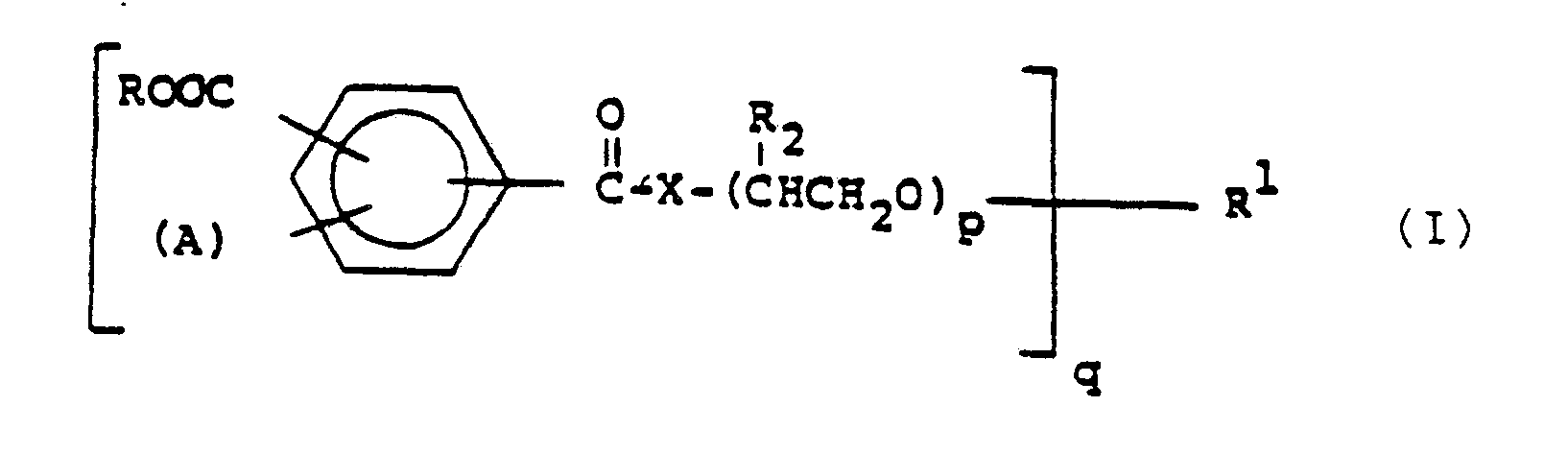

- (a) the rings can have all possible isomeric arrangements;
- (b) R is substituted or unsubstituted C1_30 alkyl, hydroxy Cs 20 alkyl, polyhydroxy C3_10-alkyl, or

- (c) R1 is H, branched, or linear substituted or unsubstituted saturated C1_30 alkyl or unsaturated C2 22 alkyl, or - -R and R7 is as defined below,
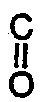
- (d) R2, independently, is H or CH3;
- (e) R3 and R4 are, independently, H, C1_18 alkyl, halogen substituted C1_18 alkyl, ORS, or -O C RS;
- (f) R5 is C1_22 alkyl;
- (g) R6 is H or C1_22 alkyl;
- (h) R7 is C1_18 alkyl, polyhydroxy C3_12 alkyl,

- (i) R8 is branched or linear substituted or unsubstituted C1_18 alkyl;
- (j) R9 is H or C1_22 alkyl;
- (k) R10 is H, -CR5, or

- (I) R" is H, branched or linear substituted or unsubstituted C1_30 alkyl, polyhydroxy -C3_12-alkyl,


- (m) R12 is H or C1_22 alkyl;
- (n) R13 is H or C1_22 alkyl;
- (o) A is CI or Br;
- (p) B is halogen, OR5, or

- (q) G is

- (r) X is 0 or NH;
- (s) j is 0 to 1;
- (t) k is 0 to 1; with the proviso that when j is 0 then k is 1 and when k is 0 then j is 1;
- (u) m is 1 to 5;
- (v) p is 0 or an integer of 1 to 50;
- (w) q is an integer of 1 to 6;
- (x) r is from more than 1 to 50; and
- (y) u is 1 to 4.
- The term "substituted" in the above moiety definitions refers to the inclusion of at least one ether, hydroxyl, ester, halo, amino, amido, or cyano moiety on the alkyl chain.
- The esters described above may be used as the only components of the fire resistant hydraulic fluids or may be blended with one or more of the following known hydraulic fluids.
-
- (A) Mineral Oils of varying lubricating viscosities.
- (B) Poly-α-olefins (olefin oligimers) having the general formula:

- (C) Cycloaliphatics in which an aliphatic hydrocarbon is substituted by at least one cycloalkyl (e.g., cyclohexyl). A typical example would be 2,3-dicyclohexyl-2-3-dimethylhexane; i.e.

- (D) Alkylated Aromatics in which one or more (preferably two or more) C alkyl moieties are substituted on the benzene ring. Preferred, compounds are

- (E) Esters of Dibasic Acids which are prepared by the reaction of a dibasic acid with a monohydroxy alcohol and have the general formula:
- R15 R14
 OR15
OR15
- wherein R,4 is C4_8 alkylene and each R15 independently is C8_13 alkyl. Typical examples of dibasic acids are adipic, azeleic, sebacic and of alcohols are 2-ethyhexyl, 3,5,5-trimethylhexyl, isodecyl, and tridecyl.
- R15
- (F) Silicones, which are fluids having a polymer structure. A typical example of a silicone fluid is dimethylpolysiloxane.

- (G) Silicate esters having the general formula: (R16O)4Si wherein R16 is C1_30 alkyl or C6_14 aryl, or substituted aryl.
- (H) Polyol ester fluids formed by reacting a diol or polyol with a monocarboxylic acid. Two commonly used polyols are trimethylolpropane and pentaerythritol. The monocarboxylic acid should contain 5 to 30 (preferably 5 to 10) carbon atoms. Many other polyesters are suitable as a component of the compositions of this invention.
- (I) Polyglycol fluids (polyalkylene glycol ethers) of the formula

- (J) Phosphate Esters are one of the larger volume classes of synthetic lubricating fluids and comprise the largest segment of the water-free fire resistant hydraulic fluids market. They have the general formula: O=P-(OR18)3 where R18 is independently C1_30 alkyl, C6_22 aryl or substituted aryl. The most common class is when R18 is an aryl or substituted aryl
- (K) Organohalides other than polyhaloaromatic esters are hydrocarbons or substituted hydrocarbons which contain chlorine, bromine, or fluorine, or combinations thereof. This class of compounds is considered fire resistant.
- A more complete description of hydraulic fluids (A) to (K), inclusive, may be found in Kirk-Othmer "Encyclopedia of Chemical Technology", Third Edition, (pub.) Vol. 12, pp. 712-733 (1980).
- The compositions of this invention may be prepared in any convenient manner such as uniformly blending under ambient conditions. Additives known in the art to improve other hydraulic fluid properties may be added if desired. Such additives may include but are not limited to viscosity modifiers, rust and oxidation inhibitors, defoamers, pour point depressants, dispersants, wear inhibitors, corrosion inhibitors, friction-reducing compounds, extreme pressure additives, and the like.
- It is a preferred embodiment that in combination in the inventive ester of formula (I), R is C1_12 alkyl or substituted alkyl, A is Br, X is oxygen, p is 0 to 20, and q is 1 to 6. More preferably R is:



- It is also a preferred embodiment that in combination in the inventive ester of formula (II), R11 is hydrogen or C1_22 alkyl or substituted alkyl; R3 and R4 are independently hydrogen, -CH3, -CH2CI, -C2Hs, -C4H9 or -C8H17; A is Br; X is oxygen; p is 0 to 20; q is 1 to 6; r is 0.10 to 5; and u is 2 to 4. More preferably R3 and R4 are independently H, -CH3, or -CH2Cl; q is 1, r is 0.25 to 2; and u is 4.
- The inventive esters may be made by any known methods as exemplified in Examples 1-68.
- The following formulas are for representative polyhaloaromatic esters which may be used in practicing this invention. The substituent moiety A is a halogen and is preferably bromine or fluorine, most preferably bromine.


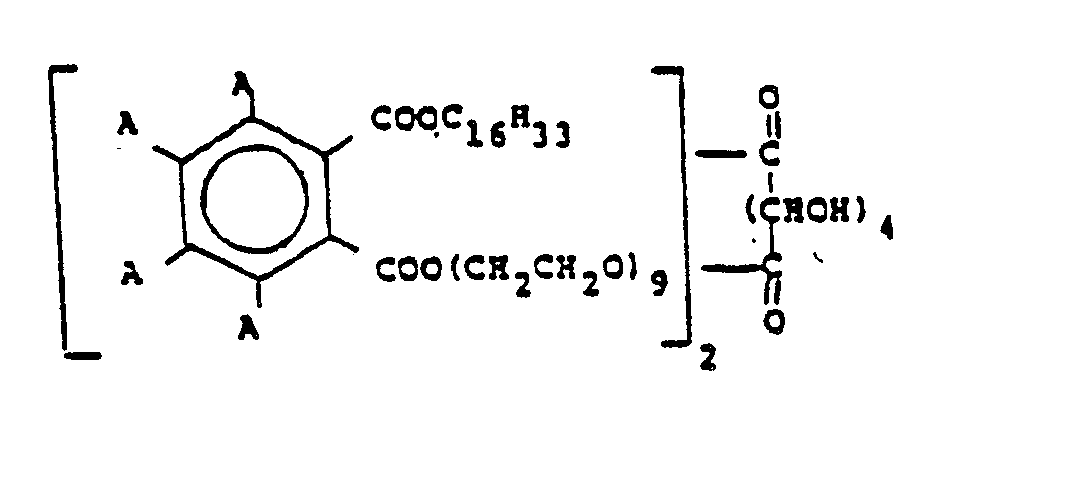


- The preferred compounds are:
- The preferred compounds are:


- To 1,392 g (3.0 mols) of tetrabromophthalic anhydride were added 1,050 g (3.0 mols) of Methoxy "Carbowax" 350 in the presence of 22.0 g of sodium acetate. The mixture was heated at 90. C for 8 hours in a nitrogen atmosphere. The reaction mixture was filtered hot to remove the sodium acetate. The analytical data were consistent with the assigned structure. ["Carbowax" is a trademark of Union Carbide Corp. for polyethylene glycols and methoxypolyethylene glycols, the number following being the approximate polymer molecular weight.]

- To the compound of Example 1 were added 348.0 g (6.0 mols) of propylene oxide and 2.0 liters of toluene. The mixture was heated at 60 -100° C. The solvent and residual propylene oxide were removed to give the product in almost quantitative yield. The analytical data were consistent with the assigned structure:

- To 92.8 g (0.2 mol) of tetrabromophthalic anhydride was added all at once 80 g (0.2 mol) of "Carbowax" 400 and the mixture heated to 120 -130° C for 2.5 hours. The desired product was isolated in essentially quantitative yield as a clear yellow viscous liquid. Calcd. Mol. Wt., 864; found 865. Calcd. % Br, 371; found, 38.5. The analytical data were consistent with the assigned structure:

- To 240 g (0.24 mol) of the compound of Example 3 was added 45.3 g (0.24 mol) of trimellitic anhydride and the mixture heated at 155°C under nitrogen for about 7 hours. The infrared spectrum indicated the completion of the reaction by the substantial disappearance of the anhydride absorption band at 5.65. The product was isolated in essentially quantitative yield. Analy. Calcd.; % Br, 30.3%; Mol. Wt., 1056; neutralization equivalent, 352; Found: % Br, 29.4; Mol. Wt., 1014; neutralization equivalent, 351. The spectral data was consistent with the structure:

- To 284.0 g (1.0 mol) of tetrachlorophthalic anhydride can be added 350.0 g (1.0 mol) of methoxy "Carbowax" 350 in the presence of 7.0 g of sodium acetate. The mixture is then heated at 90° C for 8 hours in a nitrogen atmosphere, after which it is filtered hot to remove sodium acetate, to give an expected product with the assigned structure:

- To 634.0 g (1.0 mol) of the composition of Example 5 can be added 116 g (2.0 mols) of propylene oxide in 200 ml of toluene. The reaction mixture is heated to from 60°-100°C for 3-5 hours, and then concentrated to give a product with the assigned structure:

- To 284.0 g (1.0 mol) of tetrachlorophthalic anhydride can be added 200.0 g (1.0 mol) of "Carbowax" 200 in the presence of 7.0 g of sodium acetate. The mixture is then heated at 90 C for 8 hours in a nitrogen atmosphere, and is filtered hot to remove sodium acetate, to generate an expected product with the assigned structure:

- To 484.0 g (1.0 mol) of the product of Example 7 can be added 116.0 g (2.0 mol) of propylene oxide in 200 ml of toluene. The reaction mixture is then warmed at 60° -100° C for 3-5 hours, and concentrated to give a product with the assigned structure:

- Poly(ethylene glycol) 300, 204.5 g (0.67 mol) was refluxed (T = 117°C) with 600 ml of toluene for 1.5 hours in order to remove a small amount of water present in the glycol. The mixture was cooled to about 100°C; tetrabromophthalic anhydride, 614.5 g (1.35 mols) and sodium acetate, 1.62 g were added; and the mixture was reheated to reflux and held for 25 hours. After the mixture was cooled to 50 ° C, propylene oxide, (156.4 g, 2.69 mols, 100% excess) was added and the mixture heated to and held at 100° C for 2.5 hours. When the solution cooled to about 50 C it was filtered through a bed of diatomaceus earth and decolorizing charcoal. The filtrate was distilled to remove the solvent to give 904.1 g of product as a viscous liquid. Calcd. % Br, 47.4. Found % Br, 46.5. Analytical data is consistent with the assigned structure:

- This compound was prepared by the procedure described in Example 9 except that poly(ethylene glycol)200 was used in place of poly(ethylene glycol)300. The product was a viscous liquid. Calcd. % Br, 51.0. Found % Br, 49.3. Analytical data was consistent with the assigned structure:

- This compound was prepared by the procedure described in Example 9 except that poly(ethylene glycol)600 was used in place of poly(ethylene glycol)300. The product was a viscous liquid. Calcd. % Br, 39.5. Found % Br, 39.3. Analytical data was consistent with the assigned structure.
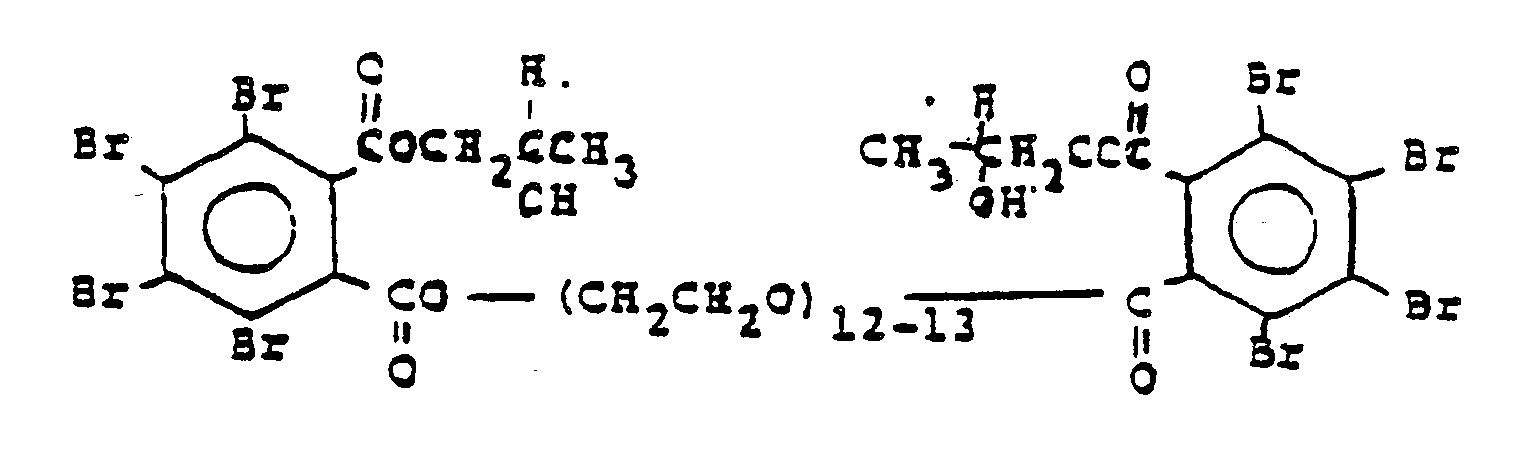
- This compound was prepared by the procedure described in Example 9 except that poly(ethylene glycol)400 was used in place of poly(ethylene glycol)300. Product is a viscous liquid. Calcd. % Br, 44.2. Found % Br, 44.0. Analytical data is consistent with the assigned structure.

- Methanol (54.1 g, 1.5 mol), tetrabromophthalic anhydride (695.6 g, 1.6 mols), and potassium acetate, 2.73 g were refluxed for 4 hours with 500 ml of toluene. After cooling the reaction mixture to room temperature, propylene oxide (87.12 g, 1.5 moles) added and the mixture reacted at 80 * C for 2.5 hours. Product was obtained as a viscous liquid after distilling out the toluene. Calcd. % Br, 57.7. Found % Br, 57.2. Analytical data is consistent with assigned structure.

- This compound was prepared by the procedure similar to that described in Example 13 except that methoxy "Carbowax" 350 was used in place of methanol and ethylene oxide in place of propylene oxide. Calcd. % Br, 37.8. Found % Br, 37.2. Analytical data was consistent with assigned structure:

- This compound was prepared by the procedure in Example 13 except that 2-methoxyethanol was used in place of methanol. Product was a viscous liquid. Calcd. % Br, 53.6. Found % Br, 52.0. Analytical data was consistent with the assigned structure:

- This compound was prepared by the procedure outlined in Example 13 except that methoxy "Carbowax" 350 was used in place of methanol and epoxybutane in place of propylene oxide. Product was a viscous liquid. Calcd. % Br, 36.5. Found % Br, 37.2. Analytical data was consistent with the assigned structure:

- This compound was prepared by the procedure outlined in Example 13 except that 2-ethylhexanol-1 was used in place of methanol. Product was a viscous liquid. Calcd. % Br, 50.0. Found % 52.7. Analytical data was consistent with the assigned structure:
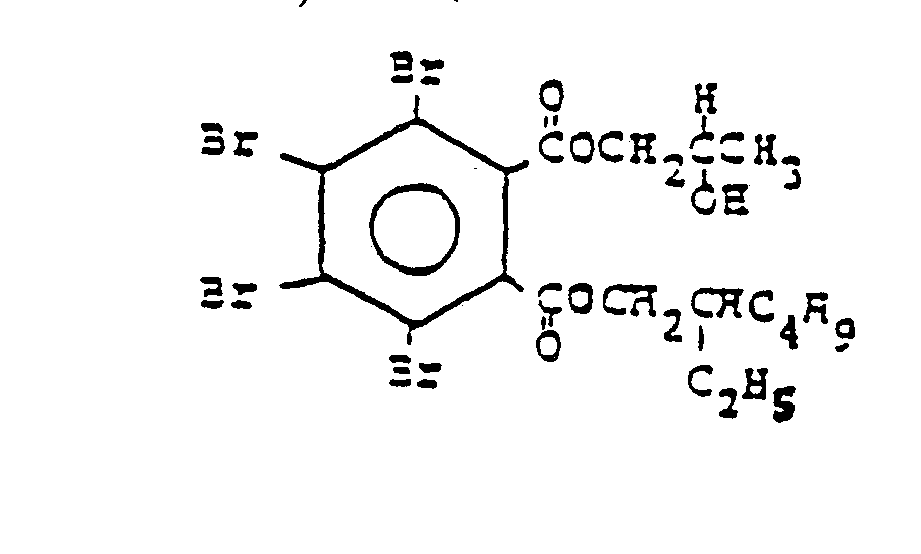
- This compound was prepared by the procedure described in Example 13 except that stearyl alcohol was used in place of methanol. Product was a viscous liquid. Calcd. % Br, 41.0. Found % Br, 43.0. Analytical. data was consistent with the assigned structure:

- This compound was prepared by the procedure described in Example 13 except that 2,3-dibromopropanol-1 was used in place of methanol. Product was a viscous liquid. Calcd. % Br, 64.8. Found % Br, 61.9. Analytical data was consistent with the assigned structure:

- This compound was prepared by the procedure outlined in Example 16 except that epichlorohydrin was used in place of epoxybutane. Calcd. % Br, 35.7. Found % 35.4. Analytical data was consistent with the assigned structure:

- To a solution of methoxy "Carbowax" 350 (300.0 g, 0.89 mol) in dry toluene (184 ml) was added sodium methoxide (48.0 g, 0.90 mol) in methanol. The methanol was then distilled off at ambient pressure. Tetrabromophthalic anhydride was then added (442.2 g, 0.89 mol) along with an additional 50 ml of toluene. The reaction mixture was refluxed for 2 hours and after cooling to room temperature, epichlorohydrin (106.94 g, 1.16 mols) was added. The mixture was refluxed for 20 hours. After the solvent and excess epichlorohydrin were distilled, a viscous dark produce was obtained. Calcd. % Br, 37.2. Found % Br, 40.4. Analytical data was consistent with assigned structure:

- Methoxy "Carbowax" 350 and toluene were refluxed for 1 hour in order to distill out a small amount of water. Tetrabromophthalic anhydride (1:1 mole ratio with Methoxy "Carbowax" 350) and sodium acetate were added and the mixture refluxed for 17 hours. After cooling to room temperature, an excess of diazomethane (prepared from the decomposition of N-methyl-N-nitroso-p-toluene sulfonamide by sodium hydroxide) in ethyl ether was added and the mixture allowed to stand overnight. The excess diazomethane was decomposed by adding acetic acid and the solvent removed by distillation. Product was a viscous liquid. Calcd. % Br, 39.2. Found % Br, 37.4. Analytical data was consistent with the assigned structure:

- Poly(ethylene glycol)600, 885.4 g ( 1.40 mols), tetrabromophthalic anhydride, 1298.4 g (2.80 mols), potassium acetate, 1.35 g, and toluene (1000 g) were charged into a one-gallon glass-lined reactor and heated to 120" C. After 4 hours at this temperature, ethylene oxide, 246.68 g (5.60 mols) was pumped into the reactor in 3/4 hour while maintaining the temperature at 120°C. After one more hour of heating, the mixture was cooled to room temperature, the excess ethylene oxide was then vented, and the product collected. After stripping off the toluene, 2250 g of the product was isolated in 99% yield as a viscous liquid. Calcd. % Br, 39.2. Found % Br, 38.8. Analytical data was consistent with the assigned structure.

- To the product of Example 11, 453.8 g (0.27 mol), acetic anhydride, 83.4 g (0.82 mol), potassium acetate, 1.0 g, and toluene, 400 ml, were added and the mixture refluxed for 8 hours. After cooling to room temperature, the reaction mixture was transferred to a separatory funnel and extracted first with 100 ml of a 16% potassium bicarbonate solution and then with 100 ml of water. After distilling off the solvent, 335.0 g (64% yield) of product was obtained as a viscous liquid. Calcd. % Br, 39.2. Found % Br, 38.8. Analytical data was consistent with the assigned structure:

- Tetrabromophthalic anhydride, 231.9 g (0.50 mol), 2-ethylhexanol, 130.2 g (1.0 mol), and potassium acetate, 0.24 g were heated to and kept at 120°C for 4 hours. The mixture was cooled to 60 °C and potassium carbonate, 35.9 g (0.26 mol), was added. The mixture was reheated to 80 °C and kept at this temperature for 2 hours, then cooled to 60* C and triethylamine, 14.2 g (0.14 mol) was added. Then the mixture was reheated to 70°C and methyl iodide, 113.6 g (0.8 mol) was added over 20 minutes. The mixture was heated to 70-75 C and kept at this temperature for 2g hours, then cooled to room temperature and filtered in order to remove by-product potassium iodide. The filtrate was distilled to remove toluene and 290 g of crude product was collected as a pale yellow liquid. This product was extracted 3 times with 100 ml each of a 6.5% potassium carbonate solution followed by 2 times with 100 ml each of water and once with a 30% sodium chloride solution. The organic phase was dried over anhydrous magnesium sulfate overnight. The magnesium sulfate was filtered off and after removing the solvent from filtrate by distillation, 204 g of product was obtained in 67% yield as a pale yellow liquid. Calcd. % Br, 52.6. Found % Br, 52.2. Analytical data was consistent with the assigned structure:

- Tetrabromophthalic anhydride, 231.9 gm (0.5 mol), 2-(2-methoxyethoxy)-ethanol, 360.5 gm (3.0 mols), stannous oxalate, 2.32 gm, 0.2 gm KOAc and xylene, 100 ml were mixed and refluxed (temp. 171 °C) for 73 hours, during which time of reaction water was collected. Then 150 ml of toluene were added to the reaction mixture, which was then washed with a 15% NaCl solution. The organic phase was dried with anhydrous magnesium sulfate overnight. After removing the magnesium sulfate by filtration, toluene and xylene were removed by distillation to give 246.6 gm of yellow liquid product in 72% yield. Calcd. % Br, 46.6. Found % Br, 46.9. Analytical data was consistent with the assigned structure:

- This compound may be prepared by the procedure outlined in Example 26 except using 2-(2- ethoxyethoxy)-ethanol in place of 2-(2-methoxyethoxy)-ethanol.

- This compound was prepared by the procedure outlined in Example 23 except that docosyl alcohol (behenyl alcohol) was used in place of poly(ethylene glycol) 600 and propylene oxide in place of ethylene oxide. The product was a viscous liquid. Calcd. % Br, 37.7. Found % Br, 36.5. Analytical data was consistent with the assigned structure:

- This compound may be prepared by the procedure outlined in Example 23 except that tricontyl alcohol can be used in place of poly(ethylene glycol) 600 and propylene oxide in place of ethylene oxide. The product would be a viscous liquid.

- This compound may be prepared by the procedure outlined in Example 26 except using methoxy "Carbowax" 550 in place of 2-[2-methoxyethoxy]-ethanol.

- Into a one liter three-necked flask, equipped with an overhead mechanical stirrer, a Dean Stark trap, a water condenser with a nitrogen inlet and a thermometer were charged 231.86 gm (0.50 mol) of tetrabromophthalic anhydride, 390.7 gm (3.0 mols) of 2-ethyl-1-hexanol, and 2.32 gm of stannous oxalate. The flask and contents were stirred and heated to reflux (195. C) and 9 ml of water (100% of theory) were obtained in 22 hours. The contents were cooled to room temperature, filtered to remove the catalyst, and the excess of alcohol was removed by vacuum distillation to give 350 gm of a light yellow oil. The yield was 97%. Calcd. % Br 45.3, Found % Br, 44.9. Analytical data was consistent with the assigned structure. High pressure liquid chromatography (HPLC) of the product showed it to be 96.2% pure with only a minor amount of by-product (3.3%) due to decarboxylation of the intermediate half-ester. This contrasts with the results obtained by Spatz, et al., [I & EC Products Res. and Dev., 8: 391 (1969), at p. 2, last paragraph].

- Following the procedure outlined in Example 31 using 6955.8 gm (15.0 mols) of tetrabromophthalic anhydride, 11.72 kg (90.15 mols) 2-ethyl-1-hexanol, and 69.55 gm of stannous oxalate, resulted in 10.5 kg (99% yield) of di-2-ethylhexyl tetrabromophthalate. Calcd. % Br 45.3, Found % Br 43.5. Analytical data was consistent with the assigned structure. High pressure liquid chromatography (HPLC) of the product showed it to be 97.1% pure with only a minor amount of by-product (2.8%) due to decarboxylation of the intermediate half-ester.

- This compound may be prepared following the procedure outlined in Example 31 except using 1-dodecanol instead of 2-ethyl-1-hexanol.

- Into a two liter three-necked flask, equipped with an overhead mechanical stirrer, Dean Stark trap, a water condenser with a nitrogen inlet tube and a thermometer, were charged 463.7 gm (1.0 mol) of tetrabromophthalic anhydride, 442.7 gm (3.4 mols) of 1-octanol and 4.6 gm of stannous oxalate. The flask and contents were heated to reflux (210° C) and 22.5 gm of a water phase were collected in 7 hours. The excess 1-octanol was removed on a rotary evaporator to give 696 gm of a dark oil. The yield was 98.6%.

- This compound may be prepared following the procedure in Example 31 except using isononyl alcohol instead of 2-ethyl-l-hexanol.

- This compound may be prepared by the procedure outlined in Example 26 except using isodecyl alcohol in place of 2-(2-methoxyethoxy)-ethanol.

- This compound may be prepared following the procedure outlined in Example 31 except using n-butyl alcohol instead of 2-ethyl-1-hexanol and using butyl stannoic acid as catalyst instead of stannous oxalate.

- This compound may be prepared following the procedure outlined in Example 31 except using 1-octadecanol instead of 2-ethyl-1-hexanol.

- Into a one liter three-necked .flask, equipped with an overhead mechanical stirrer, Dean Stark trap, a water condenser with a nitrogen inlet tube and a thermometer, were charged 285.9 gm (1.0 mol) of tetrachlorophthalic anhydride, 442.7 gm (3.4 mol) of 2-ethyl-1-hexanol and 6.5 gm of titanium tetrakisisopropoxide. The flask and contents were heated to reflux (200 C) and 23 gm of a water phase were collected in 2 hours. The excess 2-ethyl-2-hexanol was removed on a rotary evaporator to give 528 gm of an oil. The yield was quantitative.

- This compound may be prepared following the procedure outlined in Example 31 except using cyclohexanol instead of 2-ethyl-1-hexanol.

- This compound may be prepared following the procedure outlined in Example 31 except using tribromophthalic anhydride instead of tetrabromophthalic anhydride.

- This compound may be prepared following the procedure outlined in Example 31 except using 1,12-dodecanediol instead of 2-ethyl-1-hexanol and dibutyltin dilaurate instead of stannous oxalate.

- Into a two liter three-necked flask, equipped with an overhead mechanical stirrer, Dean Stark trap, a water condenser with a nitrogen inlet tube and a thermometer, were charged 927.5 gm (2 mols) of tetrabromophthalic anhydride, 780 gm (6 mols) of 2-ethyl-1-hexanol and 9.27 gm of titanium tetrabutoxide. The flask and contents were heated to reflux 185°C at 560mm pressure and 73 gm of a water phase were collected in 10 hours. The excess 2-ethyl-1-hexanol was removed on a rotary evaporator to give 1350 gm of oil. The yield is 96%. Analytical data was consistent with the assigned structure.
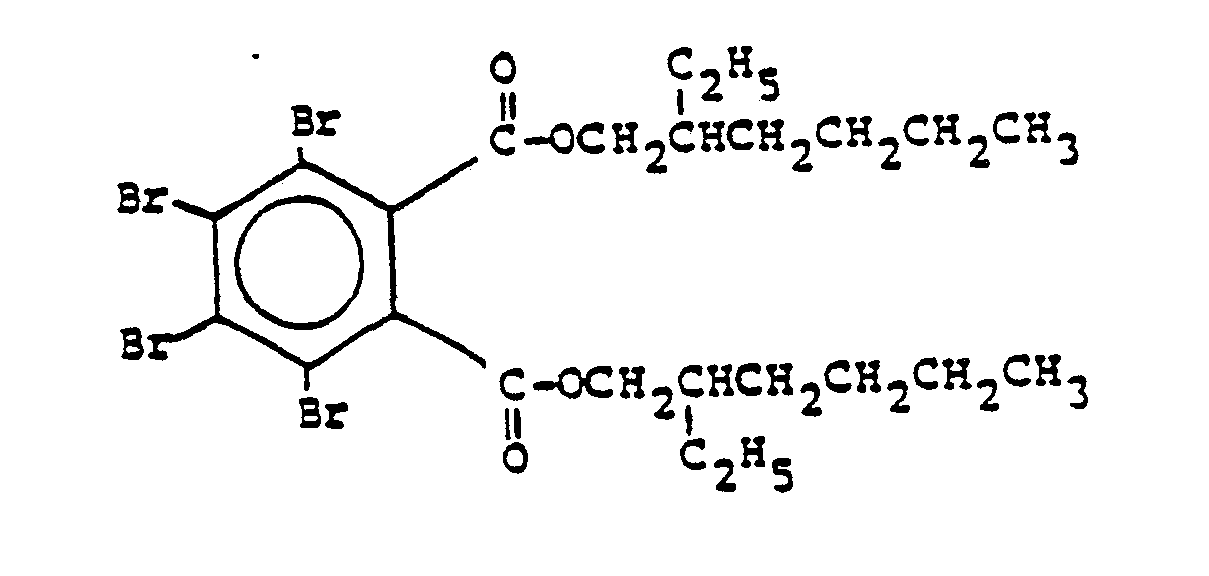
- This compound may be prepared following the procedure outlined in Example 31 except using 2,4,5,6-tetrabromoisophthalic acid instead of tetrabromophthalic anhydride.

- This compound may be prepared following the procedure outlined in Example 31 except replacing three-fourths of the 2-ethyl-1-hexanol by an equimolar quantity of 1-butanol and refluxing the 2-ethyl-1-hexanol for 2-3 hours prior to the addition of the remaining alcohol.

- This compound may be prepared following the procedure outlined in Example 45 except using 1-hexanol instead of 2-ethyl-1-hexanol and 2-ethoxyethoxyethanol instead of 1-butanol.

- This compound may be prepared following the procedure outlined in Example 45 except using cyclohexanol instead of 1-butanol.
- This compound may be prepared following the procedure outlined in Example 44 except using 1- decanol instead of 2-ethyl-1-hexanol, tetrachlorophthalic anhydride in place of tetrabromophthalic anhydride, and butylstannoic acid as the catalyst instead of stannous oxalate.

- Into a one liter three-necked flask, equipped with an overhead mechanical stirrer, Dean Stark trap, a water condenser with a nitrogen inlet tube and a thermometer, were charged 285.9 gm (1.0 mol) of tetrachlorophthalic anhydride, 442.7 gm (3.4 mols) of 1-octanol and 3.0 gm of butylstannoic anhydride. The flask and contents were heated to reflux (216 C) and 18.8 gm of a water phase were collected in 2 hours. The excess 1-octanol was removed on a rotary evaporator to give 522 gm of an oil. The yield was 99%.

- Into a one liter three-necked flask, equipped with an overhead mechanical stirrer, Dean Stark trap, a water condenser with a nitrogen inlet tube and a thermometer, were charged 285.9 gm (1.0 mol) of tetrachlorophthalic anhydride, 442.7 gm (3.4 mols) of 2-ethyl-1-hexanol and 3.3 gm of stannous oxalate. The flask and contents were heated to reflux (200 C) and 19.8 gm of a water phase were collected in 3 hours. The excess 2-ethyl-1-hexanol was removed on a rotary evaporator to give 508 gm of a light colored oil. The yield was 96.2%.


- Into a one liter three-necked flask, equipped with an overhead mechanical stirrer, Dean Stark trap, a water condenser with a nitrogen inlet tube and a thermometer, were charged 285.9 gm (1.0 mol) of tetrachlorophthalic anhydride, 442.7 gm (3.4 mols) of 2-ethyl-1-hexanol and 3.3 gm butylstannoic anhydride. The flask and contents were heated to reflux (200*C) and 20 gm of a water phase were collected in 2 hours. The excess 2-ethyl-1-hexanol was removed on a rotary evaporator to give 527 gm of a light colored oil. The yield was quantitative.

- Into a two liter three-necked flask, equipped with an overhead mechanical stirrer, Dean Stark trap, a water condenser with a nitrogen inlet tube and a thermometer, were charged 572 gm (2.0 mols) of tetrachlorophthalic anhydride, 885 gm (6.8 mols) of 2-ethyl-1-hexanol and 6.6 gm of stannous oxalate. The flask and contents were heated to reflux (196°C) and 40.0 gm of a water phase were collected in 6 hours. The excess 2-ethyl-1-hexanol was removed on a rotary evaporator to give 952 gm of a light colored oil. The yield was 90%.

- Into a two liter three-necked flask, equipped with an overhead mechanical stirrer, Dean Stark trap, a water con denser with a nitrogen inlet tube and a thermometer, were charged 285.9 gm (1.0 mol) of tetrachlorophthalic anhydride, 347.5 gm of tetrahydronaphthalene and 3.3 gm of stannous oxalate. The flask and contents were heated to reflux (178°C) and 19.0 gm of water phase were collected in 10 hours. The excess 2-ethyl-1-butanol and tetrahydronaphthalene were removed on a rotary evaporator to give 474 gm of an oil. The yield was quantitative.

- Into a two liter three-necked flask, equipped with an overhead mechanical stirrer, Dean Stark trap, a water condenser with a nitrogen inlet tube and a thermometer, were charged 463.7 gm (1.0 mol) of tetrabromophthalic anhydride, 408 gm (4.0 mol) of 2-ethyl-1-butanol, 450 gm of tetrahydronaphthalene and 4.64 gm of butyl stannoic anhydride. The flask and contents were heated to reflux (170 C) and 20 gm of a water phase were collected in 9 hours. The excess 2-ethyl-1-butanol and tetrahydronaphthalene were removed on a rotary evaporator to give 624 gm of a light yellow oil. The yield was 96%.

- Into a two liter three-necked flask, equipped with an overhead mechanical stirrer, Dean Stark trap, a water condenser with a nitrogen inlet tube and a thermometer, were charged 285.9 gm (1.0 mol) of tetrachlorophthalic anhydride, 347.5 gm (3.4 mol) of 1-hexanol; 300 gm of tetrahydronaphthalene and 3.0 of butylstannoic anhydride. The flask and contents were heated to reflux (180`C) and 18.0 gm of a water phase were collected in 4 hours. The excess 1-hexanol and tetrahydronaphthalene were removed on a rotary evaporator to give 466 gm of an oil. The yield was 99%.

- Into a two liter three-necked flask, equipped with an overhead mechanical stirrer, Dean Stark trap, a water condenser nitrogen inlet tube and a thermometer, were charged 463.7 gm (1.0 mol) of tetrabromophthalic anhydride, 347.5 gm (3.4 mol) of 1-hexanol, 300 gm of tetrahydronaphthalene and 6.6 gm of butyl stannoic anhydride. The flask and contents were heated to reflux (180°C) and 21.6 gm of a water phase were collected in 6.5 hours. The excess 1-hexanol and tetrahydronaphthalene were removed on a rotary evaporator to give 623 gm of an oil. The yield was 96%.

- This compound may be prepared following the procedure outlined in Example 31 except using 2,3,5,6,- tetrabromoterephthalic acid instead of tetrabromophthalic anhydride.

- A mixture of 75.3 g of omega-methylhepta (oxyethylene)-2-hydroxypropyl tetrabromophthalate containing 2.2% hydroxyl, 45.16 g (0.10 mol) tetrabromophthalic anhydride, and 50 mg potassium acetate, was heated at 125°C for 5.5 hours. After cooling to room temperature, 11.27 g (0.18 mol) of propylene oxide was added, and the mixture was reheated to 85 °C and kept at this temperature for 3 hours. The excess propylene oxide was removed by distillation to give a colorless, opalescent, viscous liquid in essentially quantitative yield. Calcd. % Br, 46.1. Found % Br, 46.7. Analytical data was consistent with the following assigned structure:

- A mixture of 129.25 g (0.25 mol) Methoxy "Carbowax" 550 (M.W. 550), 231.86 g (0.50 mol) tetrabromophthalic anhydride, 0.24 g potassium acetate and 250 ml toluene were refluxed for 6 hours. After cooling to 50-60 C, 70.58 g (1.2 mols) of propylene oxide was added in 15 minutes. The mixture was heated to 85°C and kept at this temperature for 6 hours. After filtration, the solvent and excess of propylene oxide were removed by distillation to give the product as an opalescent, viscous liquid in essentially quantitative yield. Calcd. % Br, 41.0. Found % Br, 40.9. Analytical data was consistent with the following assigned structure:

- The compound below was prepared by the procedure outlined in Example 59 except that Methoxy "Carbowax" 750 (M.W. 750) was used in place of Methoxy "Carbowax" 550. The product was a slightly yellow, viscous liquid. Calcd. % Br, 36.7. Found % Br, 36.5. Analytical data was consistent with the following assigned structure:

- The compound below was prepared by the procedure outlined in Example 59 except that epichlorohydrin was used in place of propylene oxide. The product was a slightly yellow, opalescent, viscous liquid. Calcd. % Br, 39.2; % Cl, 4.35. Found % Br, 39.1; % Cl, 4.40. Analytical data was consistent with the following assigned structure:

- Into a 1-gallon, stainless steel, stirred autoclave, were charged: 855.4 g (1.40 mols) of poly(ethylene glycol 600); 1623.0 g (3.51 mols) of tetrabromophthalic anhydride; 1.7 g (3.5 mols) of potassium acetate, and 1000 ml of toluene. The mixture was heated to and kept at 120° C for 6 hours. 328.3 g (7 mols) of ethylene oxide was pumped into the mixture in 45 minutes. Heating continued for 2 hours. After cooling to room temperature, the reaction mixture was collected, and the solvent was removed by distillation to give the product in essentially quantitative yield. The product was a light yellow, viscous liquid. Calcd. % Br, 42.5. Found % Br, 43.0. Analytical data was consistent with the following assigned structure:


- The compound below was prepared by the procedure outlined in Example 62 except that 3 mols of tetrabromophthalic anhydride and 6 mols of ethylene oxide were used per mol of poly(ethylene glycol)600. The product was a light yellow, viscous liquid. Calcd. % Br, 44.9. Found % Br, 44.6. Analytical data was consistent with the following assigned structure:


- The compound below was prepared by the procedure outlined in Example 62 except that 4 mols of tetrabromophthalic anhydride and 8 mols of ethylene oxide were used per mol of poly(ethylene glycol)600. The product was a yellow, highly viscous liquid. Calcd. % Br, 48.4. Found % Br, 49.9. Analytical data was consistent with the following assigned structure:


- The compound below was prepared by the procedure outlined in Example 64 except that propylene oxide was used in place of ethylene oxide. The product was a yellow, highly viscous liquid. Calcd. % Br, 47.4. Found % Br, 46.3. Analytical data was consistent with the following assigned structure:


- The compound below was prepared by the procedure outlined in Example 64 except that octadecyl alcohol was used in place of poly(ethylene glycol)600. The product was a yellow, highly viscous liquid. Calcd. % Br, 48.6. Found % Br, 46.5. Analytical data was consistent with the following assigned structure:

- A mixture of 251.7 g (containing 1.52% hydroxy groups) of the product of Example 64 and 250 ml of toluene was warmed to 50 °C until the reactant dissolved. After cooling to room temperature, 18.55 g (0.2 mol) of acetyl chloride was added in one portion, and then 25.1 g (0.25 mol) of triethylamine was added in 10 minutes. During this period the temperature of the reaction mixture rose from 23 °C to 62 C. The mixture was heated to reflux and kept there for four hours. After filtering the reaction mixture, the solvent was removed to give a dark red-yellow, viscous liquid in 92% yield. Calcd. % Br, 46.9. Found % Br, 47.1. Analytical data was consistent with the following assigned structure:

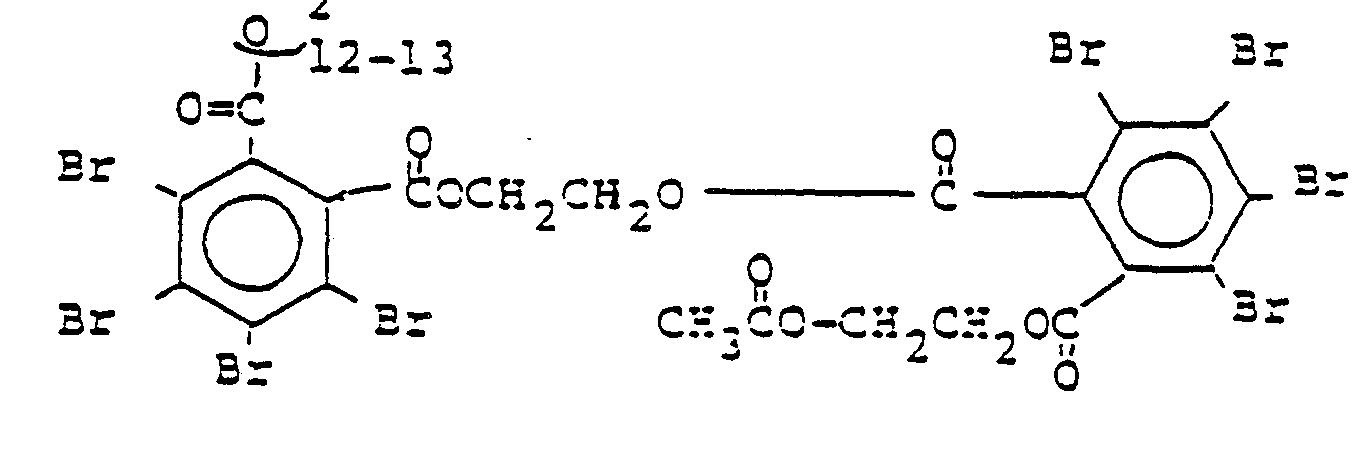
- The compound below was prepared by the procedure outlined in Example 65 except that behenyl alcohol was used in place of poly(ethylene glycol)600. The product was a highly viscous liquid. Calcd. % Br, 46.6. Found % Br, 45.9. Analytical data was consistent with the following assigned structure:

- In the following examples, the fire resistant characteristics of the hydraulic fluid compositions of this invention are demonstrated. Those compositions of Examples 71 and 72 which contain more than one component were prepared by simply stirring the ingredients together. All percentages are by weight. DOTBP = Dioctyl Tetrabromophthalate (an inventive ester) TCP = Tricresyl Phosphate ["Durad" 124, a trademark of FMC Corp.] TBPP = tert-Butyl Phenyl Phosphate ["Durad" 220B, a trademark of FMC Corp.]


- The above results clearly demonstrate the fire resistant characteristic of the compositions of this invention as evidenced by the high autoignition temperatures, fire points, and flash points of compositions 70, 71, and 72. Further, the flash and fire points of these compositions are at least comparable to the known commercial fire resistant hydraulic fluid (Example 69) and in several instances higher. Additionally, the flame resistant nature of the compositions of this invention (example 71 and 72) is shown by the wick ignition test in which a wick is saturated with a liquid and then passed through a flame in windshield wiper fashion for a number of cycles. As shown by the data, the wicks saturated with the compositions 71 and 72 did not ignite even after 100 cycles through a flame, the limit of the test. Compositions 70, 71, and 72 of this invention also show comparable lubricating properties to the commercial hydraulic fluid (example 69) as shown by an at least comparable and in one case lower coefficient of friction.


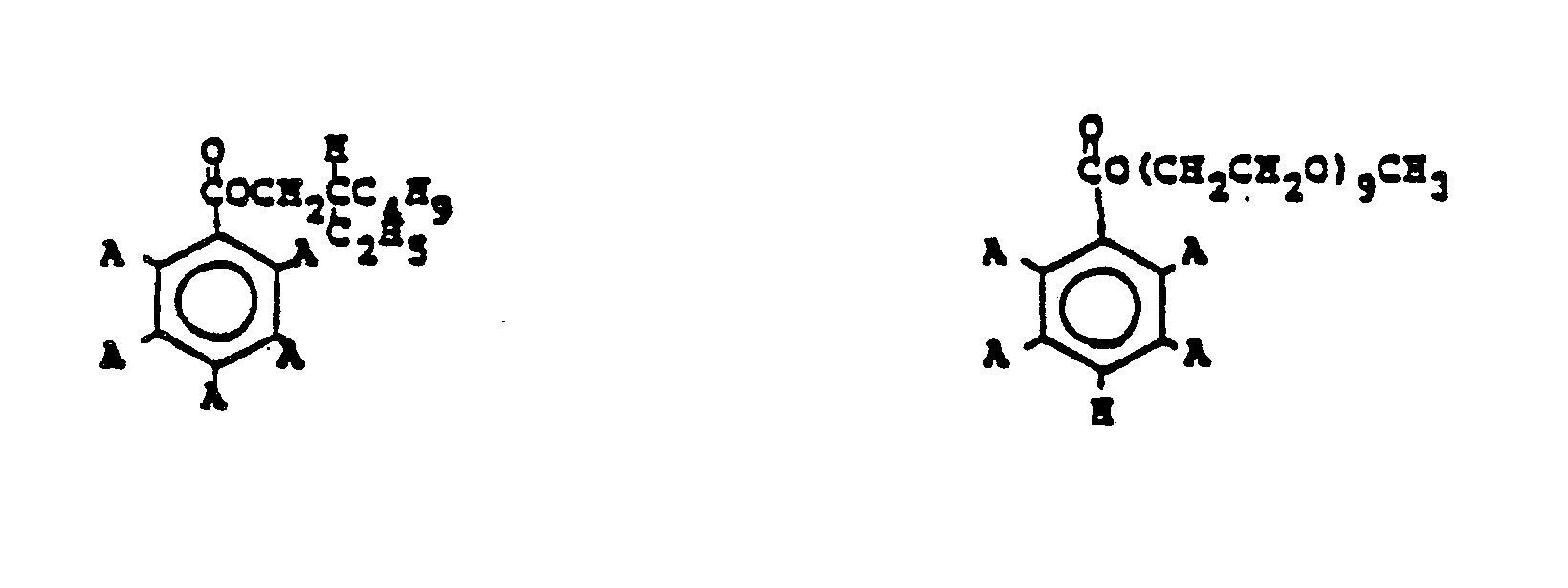


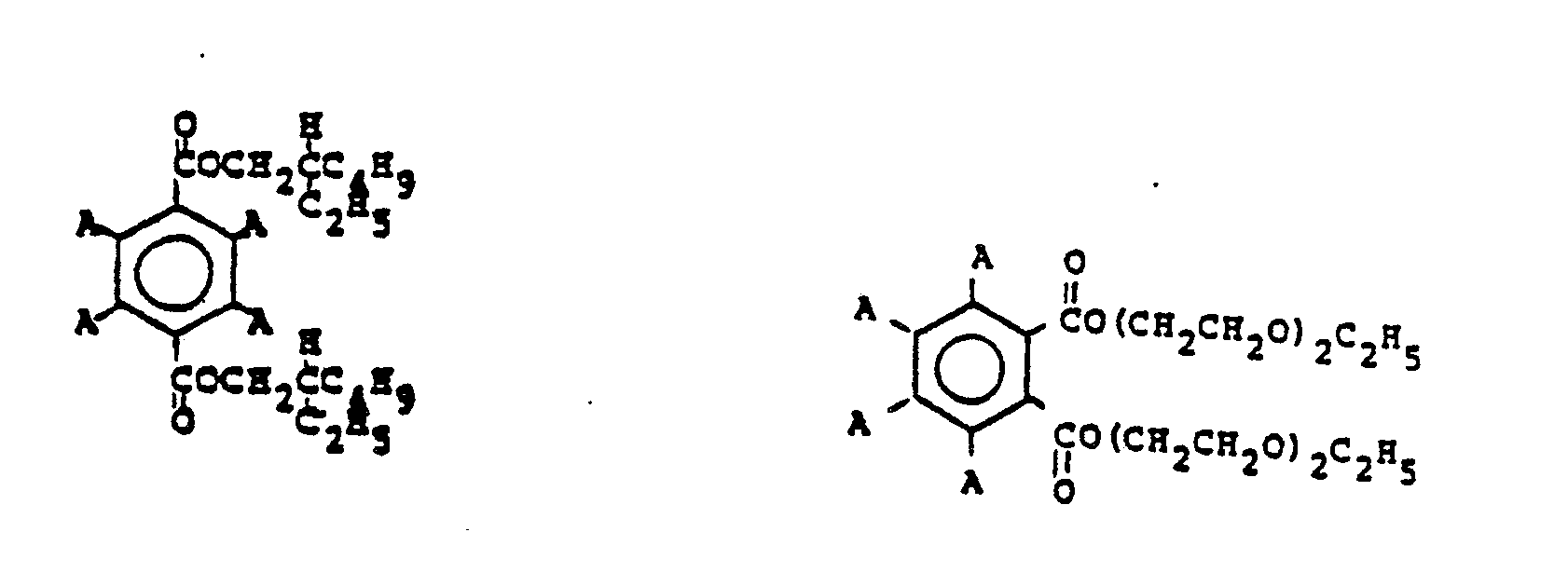

Claims (19)


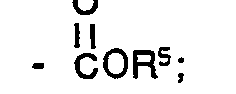


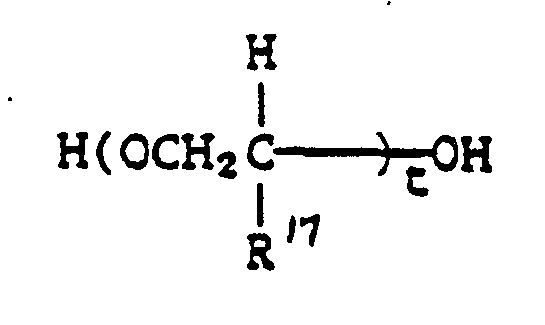


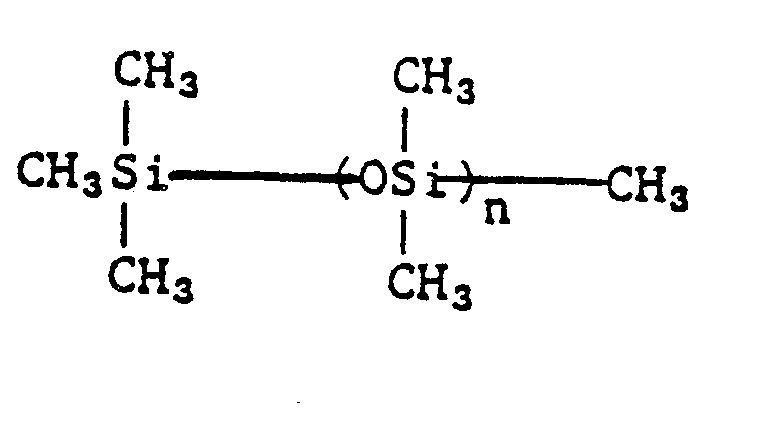




Applications Claiming Priority (2)
| Application Number | Priority Date | Filing Date | Title |
|---|---|---|---|
| US25826788A | 1988-10-14 | 1988-10-14 | |
| US258267 | 1988-10-14 |
Publications (3)
| Publication Number | Publication Date |
|---|---|
| EP0363647A2 true EP0363647A2 (en) | 1990-04-18 |
| EP0363647A3 EP0363647A3 (en) | 1990-07-25 |
| EP0363647B1 EP0363647B1 (en) | 1993-12-15 |
Family
ID=22979825
Family Applications (1)
| Application Number | Title | Priority Date | Filing Date |
|---|---|---|---|
| EP89116540A Expired - Lifetime EP0363647B1 (en) | 1988-10-14 | 1989-09-07 | Fire resistant hydraulic fluids |
Country Status (10)
| Country | Link |
|---|---|
| EP (1) | EP0363647B1 (en) |
| JP (1) | JPH02209996A (en) |
| KR (1) | KR900006478A (en) |
| AU (1) | AU4141589A (en) |
| BR (1) | BR8905219A (en) |
| CA (1) | CA1337191C (en) |
| DE (1) | DE68911460T2 (en) |
| DK (1) | DK508989A (en) |
| IL (1) | IL91622A0 (en) |
| MX (1) | MX173531B (en) |
Cited By (2)
| Publication number | Priority date | Publication date | Assignee | Title |
|---|---|---|---|---|
| EP0477360A4 (en) * | 1990-04-12 | 1992-10-07 | Atochem North America, Inc. | Fire resistant hydraulic fluids |
| US5760161A (en) * | 1997-02-10 | 1998-06-02 | Albemarle Corporation | Process for making unsaturated, thermosetting, brominated phthalic anhydride/polyol polyester resins |
Families Citing this family (1)
| Publication number | Priority date | Publication date | Assignee | Title |
|---|---|---|---|---|
| US9309366B2 (en) * | 2011-03-16 | 2016-04-12 | Chemtura Corporation | Reactive flame retardants blends for flexible polyurethane foams |
Family Cites Families (3)
| Publication number | Priority date | Publication date | Assignee | Title |
|---|---|---|---|---|
| US2837482A (en) * | 1950-03-23 | 1958-06-03 | Gen Electric | Organopolysiloxane lubricants |
| US4138349A (en) * | 1977-01-10 | 1979-02-06 | General Electric Company | Silicone lubricant compositions containing trischloroethyl-phosphite and/or bis-chloroethyl chloroethyl phosphonate |
| US5049697A (en) * | 1987-09-21 | 1991-09-17 | Atochem North America, Inc. | High yield method for preparation of dialkyl esters of polyhaloaromatic acids |
-
1989
- 1989-09-07 EP EP89116540A patent/EP0363647B1/en not_active Expired - Lifetime
- 1989-09-07 DE DE89116540T patent/DE68911460T2/en not_active Expired - Fee Related
- 1989-09-12 CA CA000611070A patent/CA1337191C/en not_active Expired - Fee Related
- 1989-09-13 IL IL91622A patent/IL91622A0/en unknown
- 1989-09-14 AU AU41415/89A patent/AU4141589A/en not_active Abandoned
- 1989-10-12 JP JP1264072A patent/JPH02209996A/en active Pending
- 1989-10-13 DK DK508989A patent/DK508989A/en not_active Application Discontinuation
- 1989-10-13 MX MX017951A patent/MX173531B/en unknown
- 1989-10-13 BR BR898905219A patent/BR8905219A/en not_active Application Discontinuation
- 1989-10-14 KR KR1019890014736A patent/KR900006478A/en not_active Withdrawn
Cited By (2)
| Publication number | Priority date | Publication date | Assignee | Title |
|---|---|---|---|---|
| EP0477360A4 (en) * | 1990-04-12 | 1992-10-07 | Atochem North America, Inc. | Fire resistant hydraulic fluids |
| US5760161A (en) * | 1997-02-10 | 1998-06-02 | Albemarle Corporation | Process for making unsaturated, thermosetting, brominated phthalic anhydride/polyol polyester resins |
Also Published As
| Publication number | Publication date |
|---|---|
| EP0363647B1 (en) | 1993-12-15 |
| EP0363647A3 (en) | 1990-07-25 |
| IL91622A0 (en) | 1990-04-29 |
| MX173531B (en) | 1994-03-14 |
| DE68911460T2 (en) | 1994-05-11 |
| KR900006478A (en) | 1990-05-08 |
| DK508989D0 (en) | 1989-10-13 |
| CA1337191C (en) | 1995-10-03 |
| DE68911460D1 (en) | 1994-01-27 |
| JPH02209996A (en) | 1990-08-21 |
| DK508989A (en) | 1990-04-17 |
| BR8905219A (en) | 1990-05-15 |
| AU4141589A (en) | 1990-04-26 |
Similar Documents
| Publication | Publication Date | Title |
|---|---|---|
| US3931023A (en) | Triaryl phosphate ester functional fluids | |
| US3282971A (en) | Fatty acid esters of polyhydric alcohols | |
| US6255262B1 (en) | High hydroxyl content glycerol di-esters | |
| US4153565A (en) | Benzotriazole adduct and lubricant compositions containing said adduct | |
| US5328627A (en) | Fire resistant hydraulic fluids | |
| US20030104956A1 (en) | Synthetic lubricant base stock formed from high content branched chain acid mixtures | |
| US6395689B1 (en) | Terpene ethers and their use | |
| FR2467186A1 (en) | ALKYL ETHERS OF POLYOLS, THEIR PREPARATION AND THEIR JOBS | |
| EP0363647A2 (en) | Fire resistant hydraulic fluids | |
| EP0157583A2 (en) | Oil based lubricant compostions | |
| US4036773A (en) | Lubricant compositions containing carboxylic acid esters of hindered hydroquinones | |
| CA1047480A (en) | Hydraulic fluids based on borate esters | |
| US4828740A (en) | Mixed hydroquinone-hydroxyester borates as antioxidants | |
| US3260672A (en) | Synthetic ester lubricating oil containing certain haloalkyl carboxylic acid esters | |
| JPH0662553B2 (en) | Multifunctional additives for functional fluids and lubricants | |
| JP3001680B2 (en) | Lubricant or heat transfer fluid containing ester compound | |
| JPH027358B2 (en) | ||
| US4162225A (en) | Lubricant compositions of enhanced antioxidant properties | |
| EP0523122A1 (en) | Esters and fluids containing them. | |
| US5006270A (en) | Mixed resorcinol-hydroxyester borates as antioxidants | |
| JPS6366293A (en) | Metal lubricating base oil | |
| US4141848A (en) | Organic compositions containing esters of aryl aminoaryloxyalkanols | |
| JPH0256398B2 (en) | ||
| US4282108A (en) | Oil-soluble spiro-[cycloalkane-oxazolidines], their preparation and use as additives and chelating agents for functional fluids | |
| US4031018A (en) | Auxiliary antioxidants |
Legal Events
| Date | Code | Title | Description |
|---|---|---|---|
| PUAI | Public reference made under article 153(3) epc to a published international application that has entered the european phase |
Free format text: ORIGINAL CODE: 0009012 |
|
| AK | Designated contracting states |
Kind code of ref document: A2 Designated state(s): BE DE ES FR GB IT NL SE |
|
| PUAL | Search report despatched |
Free format text: ORIGINAL CODE: 0009013 |
|
| AK | Designated contracting states |
Kind code of ref document: A3 Designated state(s): BE DE ES FR GB IT NL SE |
|
| RAP1 | Party data changed (applicant data changed or rights of an application transferred) |
Owner name: ATOCHEM NORTH AMERICA, INC. (A PENNSYLVANIA CORP.) |
|
| 17P | Request for examination filed |
Effective date: 19910124 |
|
| 17Q | First examination report despatched |
Effective date: 19920120 |
|
| GRAA | (expected) grant |
Free format text: ORIGINAL CODE: 0009210 |
|
| ITF | It: translation for a ep patent filed | ||
| AK | Designated contracting states |
Kind code of ref document: B1 Designated state(s): BE DE ES FR GB IT NL SE |
|
| PG25 | Lapsed in a contracting state [announced via postgrant information from national office to epo] |
Ref country code: SE Effective date: 19931215 Ref country code: ES Free format text: THE PATENT HAS BEEN ANNULLED BY A DECISION OF A NATIONAL AUTHORITY Effective date: 19931215 |
|
| REF | Corresponds to: |
Ref document number: 68911460 Country of ref document: DE Date of ref document: 19940127 |
|
| ET | Fr: translation filed | ||
| PLBE | No opposition filed within time limit |
Free format text: ORIGINAL CODE: 0009261 |
|
| STAA | Information on the status of an ep patent application or granted ep patent |
Free format text: STATUS: NO OPPOSITION FILED WITHIN TIME LIMIT |
|
| 26N | No opposition filed | ||
| PGFP | Annual fee paid to national office [announced via postgrant information from national office to epo] |
Ref country code: FR Payment date: 19950803 Year of fee payment: 7 |
|
| PGFP | Annual fee paid to national office [announced via postgrant information from national office to epo] |
Ref country code: GB Payment date: 19950815 Year of fee payment: 7 |
|
| PGFP | Annual fee paid to national office [announced via postgrant information from national office to epo] |
Ref country code: NL Payment date: 19950817 Year of fee payment: 7 |
|
| PGFP | Annual fee paid to national office [announced via postgrant information from national office to epo] |
Ref country code: DE Payment date: 19950823 Year of fee payment: 7 |
|
| PGFP | Annual fee paid to national office [announced via postgrant information from national office to epo] |
Ref country code: BE Payment date: 19950824 Year of fee payment: 7 |
|
| PG25 | Lapsed in a contracting state [announced via postgrant information from national office to epo] |
Ref country code: GB Effective date: 19960907 |
|
| PG25 | Lapsed in a contracting state [announced via postgrant information from national office to epo] |
Ref country code: FR Effective date: 19960930 Ref country code: BE Effective date: 19960930 |
|
| BERE | Be: lapsed |
Owner name: ATOCHEM NORTH AMERICA INC. (A PENNSYLVANIA CORP.) Effective date: 19960930 |
|
| PG25 | Lapsed in a contracting state [announced via postgrant information from national office to epo] |
Ref country code: NL Effective date: 19970401 |
|
| GBPC | Gb: european patent ceased through non-payment of renewal fee |
Effective date: 19960907 |
|
| NLV4 | Nl: lapsed or anulled due to non-payment of the annual fee |
Effective date: 19970401 |
|
| PG25 | Lapsed in a contracting state [announced via postgrant information from national office to epo] |
Ref country code: DE Effective date: 19970603 |
|
| REG | Reference to a national code |
Ref country code: FR Ref legal event code: ST |
|
| REG | Reference to a national code |
Ref country code: FR Ref legal event code: ST |
|
| PG25 | Lapsed in a contracting state [announced via postgrant information from national office to epo] |
Ref country code: IT Free format text: LAPSE BECAUSE OF NON-PAYMENT OF DUE FEES;WARNING: LAPSES OF ITALIAN PATENTS WITH EFFECTIVE DATE BEFORE 2007 MAY HAVE OCCURRED AT ANY TIME BEFORE 2007. THE CORRECT EFFECTIVE DATE MAY BE DIFFERENT FROM THE ONE RECORDED. Effective date: 20050907 |