EP0363664A2 - Verfahren zur Entschwefelung von Koksofengas - Google Patents
Verfahren zur Entschwefelung von Koksofengas Download PDFInfo
- Publication number
- EP0363664A2 EP0363664A2 EP89116932A EP89116932A EP0363664A2 EP 0363664 A2 EP0363664 A2 EP 0363664A2 EP 89116932 A EP89116932 A EP 89116932A EP 89116932 A EP89116932 A EP 89116932A EP 0363664 A2 EP0363664 A2 EP 0363664A2
- Authority
- EP
- European Patent Office
- Prior art keywords
- gas
- potash
- stretford
- washing
- coke oven
- Prior art date
- Legal status (The legal status is an assumption and is not a legal conclusion. Google has not performed a legal analysis and makes no representation as to the accuracy of the status listed.)
- Granted
Links
- 238000000034 method Methods 0.000 title claims abstract description 45
- 239000000571 coke Substances 0.000 title claims abstract description 21
- QAOWNCQODCNURD-UHFFFAOYSA-N Sulfuric acid Chemical compound OS(O)(=O)=O QAOWNCQODCNURD-UHFFFAOYSA-N 0.000 claims abstract description 36
- NINIDFKCEFEMDL-UHFFFAOYSA-N Sulfur Chemical compound [S] NINIDFKCEFEMDL-UHFFFAOYSA-N 0.000 claims abstract description 35
- BWHMMNNQKKPAPP-UHFFFAOYSA-L potassium carbonate Substances [K+].[K+].[O-]C([O-])=O BWHMMNNQKKPAPP-UHFFFAOYSA-L 0.000 claims abstract description 34
- KWYUFKZDYYNOTN-UHFFFAOYSA-M Potassium hydroxide Chemical compound [OH-].[K+] KWYUFKZDYYNOTN-UHFFFAOYSA-M 0.000 claims abstract description 32
- 229940072033 potash Drugs 0.000 claims abstract description 32
- 235000015320 potassium carbonate Nutrition 0.000 claims abstract description 32
- 238000005406 washing Methods 0.000 claims abstract description 31
- RWSOTUBLDIXVET-UHFFFAOYSA-N Dihydrogen sulfide Chemical compound S RWSOTUBLDIXVET-UHFFFAOYSA-N 0.000 claims abstract description 20
- 239000007789 gas Substances 0.000 claims description 72
- 238000009833 condensation Methods 0.000 claims description 10
- 230000005494 condensation Effects 0.000 claims description 10
- UHOVQNZJYSORNB-UHFFFAOYSA-N Benzene Chemical compound C1=CC=CC=C1 UHOVQNZJYSORNB-UHFFFAOYSA-N 0.000 claims description 9
- 238000006477 desulfuration reaction Methods 0.000 claims description 9
- 230000023556 desulfurization Effects 0.000 claims description 9
- 238000002485 combustion reaction Methods 0.000 claims description 8
- QGZKDVFQNNGYKY-UHFFFAOYSA-N Ammonia Chemical compound N QGZKDVFQNNGYKY-UHFFFAOYSA-N 0.000 claims description 6
- UFWIBTONFRDIAS-UHFFFAOYSA-N Naphthalene Chemical compound C1=CC=CC2=CC=CC=C21 UFWIBTONFRDIAS-UHFFFAOYSA-N 0.000 claims description 6
- 230000008929 regeneration Effects 0.000 claims description 6
- 238000011069 regeneration method Methods 0.000 claims description 6
- 239000002918 waste heat Substances 0.000 claims description 5
- 238000011144 upstream manufacturing Methods 0.000 claims description 4
- 229910021529 ammonia Inorganic materials 0.000 claims description 3
- 239000003245 coal Substances 0.000 claims description 3
- 239000000126 substance Substances 0.000 claims description 2
- 229910052717 sulfur Inorganic materials 0.000 description 19
- 239000011593 sulfur Substances 0.000 description 19
- 229910000037 hydrogen sulfide Inorganic materials 0.000 description 11
- LELOWRISYMNNSU-UHFFFAOYSA-N hydrogen cyanide Chemical compound N#C LELOWRISYMNNSU-UHFFFAOYSA-N 0.000 description 9
- 238000006243 chemical reaction Methods 0.000 description 8
- 239000002253 acid Substances 0.000 description 6
- CDBYLPFSWZWCQE-UHFFFAOYSA-L Sodium Carbonate Chemical compound [Na+].[Na+].[O-]C([O-])=O CDBYLPFSWZWCQE-UHFFFAOYSA-L 0.000 description 5
- HEMHJVSKTPXQMS-UHFFFAOYSA-M Sodium hydroxide Chemical compound [OH-].[Na+] HEMHJVSKTPXQMS-UHFFFAOYSA-M 0.000 description 4
- 238000010586 diagram Methods 0.000 description 4
- QVGXLLKOCUKJST-UHFFFAOYSA-N atomic oxygen Chemical compound [O] QVGXLLKOCUKJST-UHFFFAOYSA-N 0.000 description 3
- 238000001816 cooling Methods 0.000 description 3
- 239000000203 mixture Substances 0.000 description 3
- 238000006386 neutralization reaction Methods 0.000 description 3
- 229910052760 oxygen Inorganic materials 0.000 description 3
- 239000001301 oxygen Substances 0.000 description 3
- 238000005201 scrubbing Methods 0.000 description 3
- 239000002351 wastewater Substances 0.000 description 3
- XLYOFNOQVPJJNP-UHFFFAOYSA-N water Substances O XLYOFNOQVPJJNP-UHFFFAOYSA-N 0.000 description 3
- 238000009279 wet oxidation reaction Methods 0.000 description 3
- CURLTUGMZLYLDI-UHFFFAOYSA-N Carbon dioxide Chemical compound O=C=O CURLTUGMZLYLDI-UHFFFAOYSA-N 0.000 description 2
- 238000007792 addition Methods 0.000 description 2
- BFNBIHQBYMNNAN-UHFFFAOYSA-N ammonium sulfate Chemical compound N.N.OS(O)(=O)=O BFNBIHQBYMNNAN-UHFFFAOYSA-N 0.000 description 2
- 229910052921 ammonium sulfate Inorganic materials 0.000 description 2
- 235000011130 ammonium sulphate Nutrition 0.000 description 2
- 239000003054 catalyst Substances 0.000 description 2
- 238000011010 flushing procedure Methods 0.000 description 2
- 239000006260 foam Substances 0.000 description 2
- 229910052739 hydrogen Inorganic materials 0.000 description 2
- 239000007788 liquid Substances 0.000 description 2
- 238000004519 manufacturing process Methods 0.000 description 2
- 229910000028 potassium bicarbonate Inorganic materials 0.000 description 2
- 229910000027 potassium carbonate Inorganic materials 0.000 description 2
- 238000007086 side reaction Methods 0.000 description 2
- 229910000029 sodium carbonate Inorganic materials 0.000 description 2
- 229910052720 vanadium Inorganic materials 0.000 description 2
- LEONUFNNVUYDNQ-UHFFFAOYSA-N vanadium atom Chemical compound [V] LEONUFNNVUYDNQ-UHFFFAOYSA-N 0.000 description 2
- 239000002699 waste material Substances 0.000 description 2
- PTKWYSNDTXDBIZ-UHFFFAOYSA-N 9,10-dioxoanthracene-1,2-disulfonic acid Chemical compound C1=CC=C2C(=O)C3=C(S(O)(=O)=O)C(S(=O)(=O)O)=CC=C3C(=O)C2=C1 PTKWYSNDTXDBIZ-UHFFFAOYSA-N 0.000 description 1
- BVKZGUZCCUSVTD-UHFFFAOYSA-M Bicarbonate Chemical compound OC([O-])=O BVKZGUZCCUSVTD-UHFFFAOYSA-M 0.000 description 1
- BVKZGUZCCUSVTD-UHFFFAOYSA-L Carbonate Chemical compound [O-]C([O-])=O BVKZGUZCCUSVTD-UHFFFAOYSA-L 0.000 description 1
- QAOWNCQODCNURD-UHFFFAOYSA-L Sulfate Chemical compound [O-]S([O-])(=O)=O QAOWNCQODCNURD-UHFFFAOYSA-L 0.000 description 1
- ZMZDMBWJUHKJPS-UHFFFAOYSA-M Thiocyanate anion Chemical compound [S-]C#N ZMZDMBWJUHKJPS-UHFFFAOYSA-M 0.000 description 1
- 238000009825 accumulation Methods 0.000 description 1
- 239000003513 alkali Substances 0.000 description 1
- 229940095054 ammoniac Drugs 0.000 description 1
- 229910001570 bauxite Inorganic materials 0.000 description 1
- 239000006227 byproduct Substances 0.000 description 1
- 239000001569 carbon dioxide Substances 0.000 description 1
- 229910002092 carbon dioxide Inorganic materials 0.000 description 1
- 239000003795 chemical substances by application Substances 0.000 description 1
- 238000010438 heat treatment Methods 0.000 description 1
- 229930195733 hydrocarbon Natural products 0.000 description 1
- 150000002430 hydrocarbons Chemical class 0.000 description 1
- ZMZDMBWJUHKJPS-UHFFFAOYSA-N hydrogen thiocyanate Natural products SC#N ZMZDMBWJUHKJPS-UHFFFAOYSA-N 0.000 description 1
- 239000007800 oxidant agent Substances 0.000 description 1
- 230000003647 oxidation Effects 0.000 description 1
- 238000007254 oxidation reaction Methods 0.000 description 1
- 230000001590 oxidative effect Effects 0.000 description 1
- LJCNRYVRMXRIQR-OLXYHTOASA-L potassium sodium L-tartrate Chemical compound [Na+].[K+].[O-]C(=O)[C@H](O)[C@@H](O)C([O-])=O LJCNRYVRMXRIQR-OLXYHTOASA-L 0.000 description 1
- 229940074439 potassium sodium tartrate Drugs 0.000 description 1
- 239000008237 rinsing water Substances 0.000 description 1
- 230000000630 rising effect Effects 0.000 description 1
- 150000003839 salts Chemical class 0.000 description 1
- CMZUMMUJMWNLFH-UHFFFAOYSA-N sodium metavanadate Chemical compound [Na+].[O-][V](=O)=O CMZUMMUJMWNLFH-UHFFFAOYSA-N 0.000 description 1
- 235000011006 sodium potassium tartrate Nutrition 0.000 description 1
- 238000007711 solidification Methods 0.000 description 1
- 230000008023 solidification Effects 0.000 description 1
- DHCDFWKWKRSZHF-UHFFFAOYSA-L thiosulfate(2-) Chemical group [O-]S([S-])(=O)=O DHCDFWKWKRSZHF-UHFFFAOYSA-L 0.000 description 1
- LSGOVYNHVSXFFJ-UHFFFAOYSA-N vanadate(3-) Chemical compound [O-][V]([O-])([O-])=O LSGOVYNHVSXFFJ-UHFFFAOYSA-N 0.000 description 1
- 229910000166 zirconium phosphate Inorganic materials 0.000 description 1
Images
Classifications
-
- C—CHEMISTRY; METALLURGY
- C10—PETROLEUM, GAS OR COKE INDUSTRIES; TECHNICAL GASES CONTAINING CARBON MONOXIDE; FUELS; LUBRICANTS; PEAT
- C10K—PURIFYING OR MODIFYING THE CHEMICAL COMPOSITION OF COMBUSTIBLE GASES CONTAINING CARBON MONOXIDE
- C10K1/00—Purifying combustible gases containing carbon monoxide
- C10K1/08—Purifying combustible gases containing carbon monoxide by washing with liquids; Reviving the used wash liquors
- C10K1/10—Purifying combustible gases containing carbon monoxide by washing with liquids; Reviving the used wash liquors with aqueous liquids
- C10K1/12—Purifying combustible gases containing carbon monoxide by washing with liquids; Reviving the used wash liquors with aqueous liquids alkaline-reacting including the revival of the used wash liquors
- C10K1/122—Purifying combustible gases containing carbon monoxide by washing with liquids; Reviving the used wash liquors with aqueous liquids alkaline-reacting including the revival of the used wash liquors containing only carbonates, bicarbonates, hydroxides or oxides of alkali-metals (including Mg)
-
- B—PERFORMING OPERATIONS; TRANSPORTING
- B01—PHYSICAL OR CHEMICAL PROCESSES OR APPARATUS IN GENERAL
- B01D—SEPARATION
- B01D53/00—Separation of gases or vapours; Recovering vapours of volatile solvents from gases; Chemical or biological purification of waste gases, e.g. engine exhaust gases, smoke, fumes, flue gases, aerosols
- B01D53/14—Separation of gases or vapours; Recovering vapours of volatile solvents from gases; Chemical or biological purification of waste gases, e.g. engine exhaust gases, smoke, fumes, flue gases, aerosols by absorption
- B01D53/1456—Removing acid components
- B01D53/1468—Removing hydrogen sulfide
-
- C—CHEMISTRY; METALLURGY
- C10—PETROLEUM, GAS OR COKE INDUSTRIES; TECHNICAL GASES CONTAINING CARBON MONOXIDE; FUELS; LUBRICANTS; PEAT
- C10K—PURIFYING OR MODIFYING THE CHEMICAL COMPOSITION OF COMBUSTIBLE GASES CONTAINING CARBON MONOXIDE
- C10K1/00—Purifying combustible gases containing carbon monoxide
- C10K1/08—Purifying combustible gases containing carbon monoxide by washing with liquids; Reviving the used wash liquors
- C10K1/10—Purifying combustible gases containing carbon monoxide by washing with liquids; Reviving the used wash liquors with aqueous liquids
- C10K1/12—Purifying combustible gases containing carbon monoxide by washing with liquids; Reviving the used wash liquors with aqueous liquids alkaline-reacting including the revival of the used wash liquors
- C10K1/124—Purifying combustible gases containing carbon monoxide by washing with liquids; Reviving the used wash liquors with aqueous liquids alkaline-reacting including the revival of the used wash liquors containing metal compounds other than alkali- or earth-alkali carbonates, hydroxides- or oxides- or salts of inorganic acids derived from sulfur
-
- Y—GENERAL TAGGING OF NEW TECHNOLOGICAL DEVELOPMENTS; GENERAL TAGGING OF CROSS-SECTIONAL TECHNOLOGIES SPANNING OVER SEVERAL SECTIONS OF THE IPC; TECHNICAL SUBJECTS COVERED BY FORMER USPC CROSS-REFERENCE ART COLLECTIONS [XRACs] AND DIGESTS
- Y02—TECHNOLOGIES OR APPLICATIONS FOR MITIGATION OR ADAPTATION AGAINST CLIMATE CHANGE
- Y02P—CLIMATE CHANGE MITIGATION TECHNOLOGIES IN THE PRODUCTION OR PROCESSING OF GOODS
- Y02P20/00—Technologies relating to chemical industry
- Y02P20/10—Process efficiency
- Y02P20/129—Energy recovery, e.g. by cogeneration, H2recovery or pressure recovery turbines
Definitions
- the invention relates to a process for the desulfurization of coke oven gas under low pressure, in which the ammonia and the organic accompanying substances (tar, naphthalene and benzene) are largely removed from the gas before the desulfurization.
- the first group of processes is the so-called wet neutralization process.
- This group of processes includes, for example, ammoniac cycle washing and alkali carbonate washing, in particular potash washing.
- the second group of processes comprises the wet oxidation processes, in which the hydrogen sulfide contained in the gas is oxidized to elemental sulfur using organic oxygen transfer agents.
- This group of processes includes the Perox process and the Stretford process.
- the requirements have been continuously increased in recent years, so that a residual sulfur content in the low-pressure cleaned gas is already required in some cases, which corresponds to the value of 2 mg H 2 S / Gas does not exceed. It is therefore becoming increasingly common that the residual sulfur contents required in practice can no longer be achieved with the wet neutralization processes.
- the wet oxidation processes certainly reach low residual sulfur levels. However, they produce so many environmentally harmful waste materials that their use under the current regulations for total desulfurization of the coke oven gas is no longer an option.
- the hydrocyanic acid in the coke oven gas causes a large amount of waste water.
- the elemental sulfur produced by the oxidation processes is also not as pure as commercially available sulfur.
- the invention is therefore based on the object of providing an improved process for the desulfurization of coke oven gas under low pressure, with which, on the one hand, the gas can be desulfurized down to a residual sulfur content of 2 mg H 2 S / m3 of gas and, on the other hand, as little environmentally harmful waste material as possible is obtained .
- This object is achieved by a method of the type mentioned at the outset, which according to the invention is characterized in that the gas is washed by a potash up to 0.2 to 0.5 g H 2 S / Desulfurized gas and then in a Stretford wash down to 2 to 5 mg H 2 S / The gas is finely desulfurized, the H 2 S-rich sour gas resulting from the potash washing and the elemental sulfur obtained from the Stretford washing being worked up together in a sulfuric acid plant or a Claus plant.
- potash wash Both the potash wash and the stretford wash are known desulfurization processes.
- the hydrogen sulfide is washed out of the coke oven gas with an aqueous potash solution.
- the washed out hydrogen sulfide is obtained in the potash regeneration under vacuum as sour gas.
- the coke oven gas flows through the H 2 S washer from bottom to top and is desulfurized by sprinkling with regenerated potash solution. At the same time, there is a partial removal of the CO z and an almost complete removal of the HCN.
- the loaded potash solution from the H 2 S washer is then 2 S stripper from the H 2 S removed under vacuum im.H.
- the hydrogen sulfide that is expelled is obtained as so-called sour gas, which was previously compressed in the vacuum pump.
- the heat for the regeneration of the potash solution is supplied indirectly, the major part being covered by the sensible heat of the flushing water circuit of the gas condensation.
- a sodium carbonate solution with additions of anthraquinone disulfonic acid (ADS), potassium sodium tartrate and sodium vanadate is used as the washing liquid.
- the elemental sulfur produced floats upwards in the Oxideur and flows off as sulfur foam.
- the regenerated washing solution is returned to the washer.
- decanter centrifuges the elemental sulfur is separated from the remaining washing solution of the sulfur foam and melted in an autoclave. It is fed as liquid sulfur to the sulfuric acid plant or the Claus plant.
- the H 2 S-rich acid gas is to be further processed together with the sulfur from the Stretford scrubbing to give sulfuric acid, the essential components are burned in a combustion chamber with excess air according to the following reaction equations:
- the process gas that has been formed in the combustion furnace is cooled in a waste heat boiler and then the S0 2 in accordance with a so-called S0 2 converter to the reaction equation contained in it oxidized.
- the SOa-rich process gas is first cooled in a gas cooler before it gets into the hot condenser.
- the S0 3 reacts with H 2 0 to sulfuric acid according to the reaction formula
- the sulfuric acid formed can be removed from the bottom of the hot condenser for further use, e.g. to extract ammonium sulfate.
- the waste heat vapor generated during cooling can be returned to the upstream process stages and used there.
- the H 2 S-rich sour gas from the potash washing and the elemental sulfur from the Stretford washing are worked up in a Claus plant.
- the hydrogen sulfide of the acid gas is partially burned to S0 2 in a combustion chamber, while the other components of the acid gas, as described above in connection with the sulfuric acid production, are implemented.
- the elemental sulfur from the Stretford wash is introduced into the combustion chamber so that it participates in the reactions.
- the SO 2 formed reacts with the unreacted hydrogen sulfide to form elemental sulfur according to the following equation:
- the reaction takes place in the presence of suitable commercially available catalysts, for example bauxite catalysts.
- suitable commercially available catalysts for example bauxite catalysts.
- the exhaust air from the oxidizers of the Stretford laundry can also be used in this case.
- the waste heat vapor produced during the cooling of the hot process gas emerging from the Claus plant can be returned to the upstream process stages and can also be used there.
- cooling in which the process gas is almost up is cooled to the temperature of the sulfur solidification point, the sulfur is separated from the gas by condensation.
- the separated sulfur the quality of which is considerably better than that of the sulfur obtained by the Stretford process, is fed from there to its further use.
- the Claus residual gas which has been freed from sulfur, still contains hydrogen sulfide and therefore cannot be easily released into the atmosphere. According to the invention, it is therefore provided that this residual gas is added to the coke oven gas before entering the potash wash.
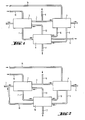
- the coke oven gas which has been cooled to a temperature of 20-30.degree. C. and has largely been freed of tar, naphthalene, benzene and ammonia in the upstream gas treatment, is introduced into the potash wash 2 via line 1.
- the gas is desulfurized to a sulfur content of 0.2 to 0.5 g H2S / mn3 gas.
- This partially desulfurized gas is then fed via line 3 to the Stretford scrubber 4, in which the fine desulfurization of the gas takes place to a residual sulfur content of 2 to 5 mg H 2 S / MI gas.
- This desulfurized gas is then fed via line 5 to its further use.
- a partial stream of the partially desulfurized gas can of course also be withdrawn from line 3 via line 6 and fed to its further use, for example as heating gas for the underfiring of the coke ovens.
- the H 2 S-rich sour gas obtained in the potash washing 2 is introduced via line 7 into the sulfuric acid plant 8.
- the elemental sulfur obtained in the Stretford wash 4 is also introduced into this system via the line 9 and the exhaust air from the oxidizers of the Stretford wash 4 via the line 10.
- the sulfuric acid produced is drawn off via line 11 and used for further use, for example in the production of ammonium sulfate.
- the resulting exhaust gas leaves the sulfuric acid plant 8 via the line 12.
- the waste heat generated in the sulfuric acid plant 8 can be returned via line 13 to the potash laundry 2 and used there for the regeneration of the loaded potash solution.
- a partial stream of the circulating washing solution is discharged and fed via line 14 to the gas condensation, not shown in the flow diagram, where this partial stream is added to the rinsing water, which is used to separate the tar-containing and other condensates from the raw coke oven gas.
- the sensible heat of the flushing water circuit of the gas condensation can be used at the same time for the regeneration of the loaded potash solution.
- the gas condensation is therefore connected via line 15 to the potash wash 2.
- Another possibility for eliminating the diverted partial flow of the washing solution from the Stretford laundry 4 is to add this partial flow to the charge coal before entering the coke oven.
- FIG. 2 shows the flow diagram for the other variant of the method according to the invention, in which the H 2 S-rich sour gas from the potash washing 2 as well as the elemental sulfur and the exhaust air from the Stretford washing 4 are further processed in a Claus system 16.
- the sulfur obtained in the Claus plant 16 is drawn off via line 17, while the residual Claus gas is discharged via line 18 and added to the coke oven gas in line 1 before it enters the potash wash 2 or in the gas condensation.
- coke oven gas 45,000 m3 / h of coke oven gas are to be desulphurized by the process according to the invention, the acid gas obtained from the potash washing and the sulfur from the Stretford washing to be worked up in a sulfuric acid plant to give 95% H 2 SO 4 .
- the coke oven gas to be desulfurized is introduced into the process via line 1 at a temperature of 23 to 25 ° C. and a pressure of + 65 mbar.
- the gas has the following composition:
- this gas is desulfurized by the potash washing and the Stretford washing, so that it can subsequently be fed to the gasometer at a temperature of 23 to 25 ° C. and a pressure of + 40 mbar via line 5 .
- the composition of the desulfurized gas is as follows:
- the rejected washing solution has the following composition:
- the rejected washing solution is replaced by fresh washing solution.
- an undesired accumulation of waste water is avoided, so that only sulfuric acid or elemental sulfur are obtained as by-products in the process according to the invention.
Landscapes
- Chemical & Material Sciences (AREA)
- Engineering & Computer Science (AREA)
- Combustion & Propulsion (AREA)
- Chemical Kinetics & Catalysis (AREA)
- General Chemical & Material Sciences (AREA)
- Oil, Petroleum & Natural Gas (AREA)
- Organic Chemistry (AREA)
- Inorganic Chemistry (AREA)
- Analytical Chemistry (AREA)
- Industrial Gases (AREA)
- Treating Waste Gases (AREA)
Abstract

Description
- Die Erfindung betrifft ein Verfahren zur Entschwefelung von Koksofengas unter Niederdruck, bei dem vor der Entschwefelung das Ammoniak sowie die organischen Begleitstoffe (Teer, Naphthalin und Benzol) weitgehend aus dem Gas entfernt werden.
- Bei der Entschwefelung von Koksofengas werden in der Praxis im wesentlichen zwei unterschiedliche Verfahrensgruppen eingesetzt. Bei der ersten Verfahrensgruppe handelt es sich um die sogenannten nassen Neutralisations-Verfahren. Zu dieser Verfahrensgruppe gehören beispielsweise die ammoniakalische Kreislaufwäsche und die Alkalicarbonatwäschen, insbesondere die Pottaschewäsche. Die zweite Verfahrensgruppe umfaßt die nassen Oxidationsverfahren, bei denen der im Gas enthaltene Schwefelwasserstoff unter Anwendung organischer Sauerstoffüberträger zu Elementarschwefel oxidiert wird. Zu dieser Verfahrensgruppe gehören das Perox-Verfahren und das Stretford-Verfahren.
- Bezüglich des Entschwefelungsgrades von Koksofengas sind die Anforderungen in den letzten Jahren laufend erhöht worden, so daß heute zum Teil bereits ein Restschwefelgehalt im niederdruckgereinigten Gas verlangt wird, der den Wert von 2 mg H2S/

- Der Erfindung liegt deshalb die Aufgabe zugrunde, ein verbessertes Verfahren zur Entschwefelung von Koksofengas unter Niederdruck zu schaffen, mit dem einerseits eine Entschwefelung des Gases bis auf einen Restschwefelgehalt von 2 mg H2S/m3 Gas gelingt und bei dem andererseits möglichst wenig umweltschädigende Abfallstoffe anfallen.
- Diese Aufgabe wird gelöst durch ein Verfahren der eingangs genannten Art, das erfindungsgemäß dadurch gekennzeichnet ist, daß das Gas durch eine Pottaschewäsche bis auf 0,2 bis 0,5 g H2S/


- Das heißt, bei der erfindungsgemäßen Arbeitsweise wird ein nasses Neutralisationsverfahren mit einem nassen Oxidationsverfahren kombiniert. Dabei hat die erfindungsgemäß vorgeschlagene Kombination von Pottaschewäsche mit der Stretfordwäsche Vorteile gegenüber anderen möglichen Kombinationen, da durch die Pottaschewäsche eine fast totale Blausäureentfernung aus dem Gas erreicht wird. Deshalb fällt in der nachgeschalteten Stretford-Wäsche kaum Abwasser an.
- Sowohl die Pottaschewäsche als auch die Stretford-Wäsche sind an sich bekannte Entschwefelungsverfahren. In der Pottaschewäsche wird der Schwefelwasserstoff mit einer wässerigen Pottaschelösung aus dem Koksofengas ausgewaschen. Der ausgewaschene Schwefelwasserstoff wird in der Pottascheregenerierung unter Vakuum als Sauergas gewonnen.
- Bei diesem Prozeß treten folgende wesentliche Reaktionen auf:
- Pottaschewascher: K2CO3 + H2S = KHS + KHC03
- Pottascheregenerierung: KHS + KHC03 = H2S + K2C03
- Zusätzlich laufen noch Nebenreaktionen mit Kohlendioxid und Blausäure ab.
- Das Koksofengas durchströmt den H2S-Wascher von unten nach oben und wird durch Berieselung mit regenerierter Pottaschelösung entschwefelt. Gleichzeitig erfolgt eine Teilentfernung des COzund eine nahezu vollständige Entfernung des HCN. Die beladene Pottaschelösung aus dem H2S-Wascher wird anschließend unter Vakuum im.H2S-Abtreiber vom H2S befreit. Der ausgetriebene Schwefelwasserstoff wird als sogenanntes Sauergas gewonnen, das zuvor in der Vakuumpumpe verdichtet wurde. Die Wärme für die Regenerierung der Pottaschelösung wird indirekt zugeführt, wobei der größte Teil durch die fühlbare Wärme des Spülwasserkreislaufs der Gaskondensation gedeckt wird.
- In der anschließenden Stretford-Wäsche wird als Waschflüssigkeit eine Natriumkarbonatlösung mit Zusätzen von Anthrachinondisulfonsäure (ADS), Kalium-Natriumtartrat und Natriumvanadat verwendet.
- In der Anlage treten folgende Hauptreaktionen auf:
- Stretford-Wascher:

- Das gebildete Hydrogensulfid wird durch Vanadat zu Elementarschwefel oxidiert.

- Durch Reaktionen mit oxidierter ADS wird das gebildete vierwertige Vanadium wieder zu fünfwertigem oxidiert.

- Die reduzierte ADS wird in einem sogenannten Oxideur wieder durch Luft oxidiert.

- Das gebildete Natriumhydroxid reagiert mit Hydrogenkarbonat zu Natriumkarbonat.

- Die Summierung der Gleichungen ergibt

- Im Oxideur flotiert der anfallende elementare Schwefel nach oben und fließt als Schwefelschaum ab. Die regenerierte Waschlösung wird zum Wascher zurückgeführt. In Dekantierzentrifugen wird der Elementarschwefel von der restlichen Waschlösung des Schwefelschaums getrennt und in einem Autoklaven aufgeschmolzen. Er wird als flüssiger Schwefel der Schwefelsäureanlage oder der Clausanlage zugeführt.
- Bei allen Entschwefelungsverfahren, die elementaren Schwefel durch Oxidation des H2S erzeugen, sind Nebenreaktionen unvermeidbar. Primär entsteht Thiosulfat, daneben auch Sulfat. Bei Anwesenheit von Cyanwasserstoff im Gas bildet sich zusätzlich Thiocyanat. Um diese Salze, die sich im Laufe der Zeit in der Waschlösung anreichern, nicht über ein bestimmtes zulässiges Maß ansteigen zu lassen, wird jeweils ein bestimmter Teilstrom aus der Waschlösung ausgeschleust und erfindungsgemäß der Gaskondensation zugeführt oder der Einsatzkohle zugesetzt.
- Sofern gemäß der ersten Variante des erfindungsgemäßen Verfahrens das H2S-reiche Sauergas zusammen mit dem Schwefel aus der Stretford-Wäsche zu Schwefelsäure weiterverarbeitet werden soll, werden die wesentlichen Komponenten in einer Brennkammer mit Luftüberschuß gemäß folgender Reaktionsgleichungen verbrannt:


- Vorhandene Kohlenwasserstoffe werden im wesentlichen zu C02 und Wasserdampf umgesetzt. Die erforderliche Verbrennungsluft wird über ein Brennluftgebläse dem Brenner zugeführt. Dafür wird auch die Abluft aus den Oxideuren der Stretford-Wäsche mitverwendet. Im Verbrennungsofen wird durch geregelte Zugabe von Sekundärluft der Sauerstoffgehalt des Prozeßgases eingestellt.
- Anschließend wird das Prozeßgas, das im Verbrennungsofen gebildet wurde, in einem Abhitzekessel gekühlt und danach das in ihm enthaltene S02 in einen sogenannten S02-Konverter gemäß der Reaktionsgleichung

- Hinter dem SO2-Konverter wird das SOa-reiche Prozeßgas zunächst in einem Gaskühler gekühlt, ehe es in den Heiß kondensator gelangt. Im Gaskühler und dem Heißkondensator reagiert das S03 mit H20 zu Schwefelsäure gemäß der Reaktionsformel

- Die gebildete Schwefelsäure kann aus dem Sumpf des Heißkondensators zwecks Weiterverwendung, z.B. zur Ammonsulfatgewinnung, abgezogen werden. Der bei der Kühlung anfallende Abhitzedampf kann in die vorgeschalteten Verfahrensstufen zurückgeführt und dort verwendet werden.
- Bei der zweiten Variante des erfindungsgemäßen Verfahrens werden das H2S-reiche Sauergas aus der Pottaschewäsche und der Elementarschwefel aus der Stretford-Wäsche in einer Clausanlage aufgearbeitet. Hierbei wird der Schwefelwasserstoff des Sauergases in einer Brennkammer zum Teil zu S02 verbrannt, während die anderen Komponenten des Sauergases,wie weiter oben im Zusammenhang mit der Schwefelsäureherstellung beschrieben, umgesetzt werden.
- Gleichzeitig wird der Elementarschwefel aus der Stretford-Wäsche in die Brennkammer eingeleitet, so daß er an den Reaktionen teilnimmt. Das gebildete SO2reagiert mit dem nicht umgesetzten Schwefelwasserstoff unter Bildung von Elementarschwefel gemäß folgender Gleichung:

- Die Umsetzung erfolgt dabei in Gegenwart von hierfür geeigneten handelsüblichen Katalysatoren, z.B. Bauxit-Katalysatoren. Zur Deckung des Sauerstoffbedarfs der Ver brennung kann auch in diesem Falle die Abluft aus den Oxideuren der Stretford-Wäsche mitverwendet werden. Der bei der Kühlung des aus der Clausanlage austretenden heißen Prozeßgases anfallende Abhitzedampf kann in die vorgeschalteten Verfahrensstufen zurückgeführt und dort mitverwendet werden. Durch die Kühlung, bei der das Prozeßgas bis fast auf die Temperatur des Schwefelerstarrungspunktes abgekühlt wird, erfolgt die Abscheidung des Schwefels aus dem Gas durch Kondensation. Der abgeschiedene Schwefel, dessen Qualität wesentlich besser ist als die des nach dem Stretford-Verfahren gewonnenen Schwefels, wird von dort seiner weiteren Verwendung zugeführt. Das vom Schwefel befreite Claus-Restgas enthält noch Schwefelwasserstoff und kann daher nicht ohne weiteres in die Atmosphäre abgelassen werden. Erfindungsgemäß ist deshalb vorgesehen, daß dieses Restgas dem Koksofengas vor dem Eintritt in die Pottaschewäsche zugesetzt wird.
- Der gesamte Ablauf des erfindungsgemäßen Verfahrens soll nachfolgend noch durch die in den Abbildungen dargestellten Fließschemata verdeutlicht werden, wobei auf die vorstehende Beschreibung der einzelnen Verfahrensschritte Bezug genommen wird. Hierbei zeigen:
- Fig. 1 den Verfahrensablauf bei Einsatz einer Schwefelsäureanlage zur Aufarbeitung des Sauergases und des Elementarschwefels sowie
- Fig. 2 den Verfahrensablauf bei Einsatz einer Claus-Anlage zur Aufarbeitung des Sauergases und des Elementarschwefels.
- Bei dem in Fig. 1 dargestellten Fließschema wird das bis auf eine Temperatur von 20 - 30 C gekühlte Koksofengas, das in der vorgeschalteten Gasbehandlung von Teer, Naphthalin, Benzol und Ammoniak weitgehend befreit worden ist, über die Leitung 1 in die Pottaschewäsche 2 eingeleitet. In dieser erfolgt eine Entschwefelung des Gases bis auf einen Schwefelgehalt von 0,2 bis 0,5 g H2S/mn3 Gas. Anschließend wird dieses teilentschwefelte Gas über die Leitung 3 der Stretford-Wäsche 4 zugeführt, in der die Feinentschwefelung des Gases bis auf einen Restschwefelgehalt von 2 bis 5 mg H2S/MI Gas erfolgt. Dieses feinentschwefelte Gas wird dann über die Leitung 5 seiner weiteren Verwendung zugeführt. Bei Bedarf kann selbstverständlich auch ein Teilstrom des teilentschwefelten Gases aus der Leitung 3 über die Leitung 6 abgezogen und seiner weiteren Verwendung, z.B. als Heizgas für die Unterfeuerung der Koksöfen, zugeführt werden. Das bei der Pottaschewäsche 2 anfallende H2S-reiche Sauergas wird in diesem Falle über die Leitung 7 in die Schwefelsäureanlage 8 eingeleitet. In diese Anlage werden auch der bei der Stretford-Wäsche 4 anfallende Elementarschwefel über die Leitung 9 sowie die Abluft aus den Oxideuren der Stretford-Wäsche 4 über die Leitung 10 eingeleitet. Die erzeugte Schwefelsäure wird über die Leitung 11 abgezogen und ihrer weiteren Verwendung, z.B. bei der Ammoniumsulfat-Herstellung, zugeführt. Das anfallende Abgas verläßt die Schwefelsäureanlage 8 über die Leitung 12. Der in der Schwefelsäureanlage 8 anfallende Abhitzedampf kann über die Leitung 13 in die Pottaschewäsche 2 zurückgeführt und dort zur Regenerierung der beladenen Pottaschelösung mitverwendet werden. Aus der Stretford-Wäsche 4 wird jeweils ein Teilstrom der umlaufenden Waschlösung ausgeschleust und über die Leitung 14 der im Fließschema nicht dargestellten Gaskondensation zugeführt, wo dieser Teilstrom dem Spülwasser zugesetzt wird, das der Abscheidung der teerhaltigen und sonstigen Kondensate aus dem Koksofenrohgas dient. Die fühlbare Wärme des Spülwasserkreislaufes der Gaskondensation kann dabei gleichzeitig für die Regenerierung der beladenen Pottaschelösung genutzt werden. Die Gaskondensation steht daher über die Leitung 15 mit der Pottaschewäsche 2 in Verbindung. Eine andere Möglichkeit zur Beseitigung des ausgeschleusten Teilstromes der Waschlösung aus der Stretford-Wäsche 4 besteht darin, diesen Teilstrom der Einsatzkohle vor dem Eintritt in den Koksofen zuzusetzen.
- Die Fig. 2 zeigt das Fließschema für die andere Variante des erfindungsgemäßen Verfahrens, bei der das H2S-reiche Sauergas aus der Pottaschewäsche 2 sowie der Elementarschwefel und die Abluft aus der Stretford-Wäsche 4 in einer Claus-Anlage 16 weiterverarbeitet werden. Hierbei wird der in der Claus-Anlage 16 gewonnene Schwefel über die Leitung 17 abgezogen, während das anfallende Claus-Restgas über die Leitung 18 abgeführt und dem Koksofengas in der Leitung 1 vor dessen Eintritt in die Pottaschewäsche 2 oder in der Gaskondensation zugesetzt wird. Im übrigen haben wir mit Fig. 1 übereinstimmenden Bezugszeichen die gleiche Bedeutung wie dort und brauchen deshalb nicht noc einmal näher erläutert zu werden.
- Abschließend soll die Wirkungsweise des erfindungsgemäßen Verfahrens an Hand eines Ausführungsbeispieles erläutert werden. Hierbei sollen 45 000 m3, /h Koksofengas nach dem erfindungsgemäßen Verfahren entschwefelt werden, wobei das anfallende Sauergas aus der Pottaschewäsche und der Schwefel aus der Stretfordwäsche in einer Schwefelsäureanlage zu 95 %-iger H2S04 aufgearbeitet werden sollen. Das zu entschwefelnde Koksofengas wird hierbei mit einer Temperatur von 23 bis 25 C und einem Druck von + 65 mbar über die Leitung 1 in das Verfahren eingeführt. Das Gas weist folgende Zusammensetzung auf:


- Dieses Gas wird, wie weiter oben beschrieben wurde, durch die Pottaschewäsche und die Stretford- Wäsche entschwefelt, so daß es im Anschluß daran mit einer Temperatur von 23 bis 25 C und einem Druck von + 40 mbar über die Leitung 5 dem Gasometer zugeführt werden kann. Die Zusammensetzung des feinentschwefelten Gases ist dabei folgende:


- Bei Verarbeitung der weiter oben genannten Gasmenge werden gleichzeitig in der Schwefelsäureanlage pro Tag ca. 22 Tonnen 95 %-ige H2S04 erzeugt, und aus der Stretford-Wäsche werden pro Tag ca. 1,6 m3 ausgebrauchte Waschlösung abgestoßen und zur Gaskondensation zurückgeführt. Die abgestoßene Waschlösung hat folgende Zusammensetzung:

- Selbstverständlich wird dabei die abgestoßene Waschlösung durch frische Waschlösung ersetzt. Durch die Rückführung der abgestoßenen Waschlösung in die Gaskondensation wird ein unerwünschter Abwasseranfall vermieden, so daß beim erfindungsgemäßen Verfahren als Nebenprodukte lediglich Schwefelsäure oder Elementarschwefel anfallen.
Claims (5)
Applications Claiming Priority (2)
| Application Number | Priority Date | Filing Date | Title |
|---|---|---|---|
| DE3834847A DE3834847A1 (de) | 1988-10-13 | 1988-10-13 | Verfahren zur entschwefelung von koksofengas |
| DE3834847 | 1988-10-13 |
Publications (3)
| Publication Number | Publication Date |
|---|---|
| EP0363664A2 true EP0363664A2 (de) | 1990-04-18 |
| EP0363664A3 EP0363664A3 (de) | 1991-04-24 |
| EP0363664B1 EP0363664B1 (de) | 1994-06-29 |
Family
ID=6365009
Family Applications (1)
| Application Number | Title | Priority Date | Filing Date |
|---|---|---|---|
| EP89116932A Expired - Lifetime EP0363664B1 (de) | 1988-10-13 | 1989-09-13 | Verfahren zur Entschwefelung von Koksofengas |
Country Status (5)
| Country | Link |
|---|---|
| EP (1) | EP0363664B1 (de) |
| CN (1) | CN1019950C (de) |
| DD (1) | DD285610A5 (de) |
| DE (2) | DE3834847A1 (de) |
| ES (1) | ES2057037T3 (de) |
Cited By (1)
| Publication number | Priority date | Publication date | Assignee | Title |
|---|---|---|---|---|
| EP0547400A1 (de) * | 1991-12-19 | 1993-06-23 | Krupp Koppers GmbH | Verfahren zur Entfernung von H2S aus Gasen |
Families Citing this family (3)
| Publication number | Priority date | Publication date | Assignee | Title |
|---|---|---|---|---|
| DE4333039C2 (de) * | 1993-09-03 | 1997-03-13 | Fpr Holding Ag | Verfahren zum Reinigen eines im wesentlichen sauerstofffreien, brennbaren Gases |
| CN101274750B (zh) * | 2007-12-29 | 2010-06-30 | 江苏晟宜环保科技有限公司 | 尾气循环硫回收方法 |
| PL237732B1 (pl) * | 2017-10-19 | 2021-05-17 | Biuro Projektow Koksoprojekt Spolka Z Ograniczona Odpowiedzialnoscia | Sposób oczyszczania gazu koksowniczego z naftalenu, amoniaku i siarkowodoru |
Family Cites Families (3)
| Publication number | Priority date | Publication date | Assignee | Title |
|---|---|---|---|---|
| GB1467083A (en) * | 1974-03-13 | 1977-03-16 | Hoelter H | Process and apparatus for the purification of coke oven gas |
| US4125597A (en) * | 1976-02-04 | 1978-11-14 | Union Oil Company Of California | Method of removing hydrogen sulfide from gas |
| DE2659015A1 (de) * | 1976-12-27 | 1978-07-06 | Metallgesellschaft Ag | Verfahren zum regenerieren von aus der entschwefelung heisser gase erhaltenen alkalicarbonatloesungen |
-
1988
- 1988-10-13 DE DE3834847A patent/DE3834847A1/de not_active Withdrawn
-
1989
- 1989-09-13 EP EP89116932A patent/EP0363664B1/de not_active Expired - Lifetime
- 1989-09-13 ES ES89116932T patent/ES2057037T3/es not_active Expired - Lifetime
- 1989-09-13 DE DE58907981T patent/DE58907981D1/de not_active Expired - Fee Related
- 1989-10-10 CN CN89107772A patent/CN1019950C/zh not_active Expired - Fee Related
- 1989-10-11 DD DD89333510A patent/DD285610A5/de not_active IP Right Cessation
Cited By (1)
| Publication number | Priority date | Publication date | Assignee | Title |
|---|---|---|---|---|
| EP0547400A1 (de) * | 1991-12-19 | 1993-06-23 | Krupp Koppers GmbH | Verfahren zur Entfernung von H2S aus Gasen |
Also Published As
| Publication number | Publication date |
|---|---|
| CN1019950C (zh) | 1993-03-03 |
| ES2057037T3 (es) | 1994-10-16 |
| DE3834847A1 (de) | 1990-04-19 |
| DE58907981D1 (de) | 1994-08-04 |
| EP0363664B1 (de) | 1994-06-29 |
| DD285610A5 (de) | 1990-12-19 |
| CN1041704A (zh) | 1990-05-02 |
| EP0363664A3 (de) | 1991-04-24 |
Similar Documents
| Publication | Publication Date | Title |
|---|---|---|
| EP2552570B1 (de) | Verfahren und vorrichtung zur verarbeitung eines kohlendioxidreichen sauergases in einem claus-prozess | |
| DE2554699C3 (de) | Verfahren zur rauchfreien Rückgewinnung von Chemikalien | |
| EP0363664B1 (de) | Verfahren zur Entschwefelung von Koksofengas | |
| DE2912115B2 (de) | Verfahren zur selektiven Entschwefelung von Gasen | |
| DE3209858A1 (de) | Verfahren zur gewinnung von schwefel aus dem schwefelwasserstoff des kokereigases | |
| DE2110036B2 (de) | Verfahren zur Herstellung von Ammoniumsultat | |
| EP0546527B1 (de) | Verfahren zur Reinigung eines H2S- und Stickstoff-haltigen Rohgases | |
| DE2157365C3 (de) | Verfahren zur Vermeidung der Bildung von Abwasser mit schädlichen Stoffen bei der Entschwefelung von Koksofengas | |
| DE2425393C3 (de) | Verfahren zur Entsäuerung von Koksofengas | |
| EP0560039B1 (de) | Verfahren zur Reinigung eines durch Vergasung von kohlenstoffhaltigem Material gewonnenen Gases | |
| DD210066A5 (de) | Selbstregulierendes verfahren zur entfernung von hydrogensulfid aus gasen | |
| DE2823749C3 (de) | Verfahren zur Rückgewinnung des Magnesiumbisulfits | |
| DE2337364C3 (de) | Verfahren zum Reinigen eines Schwefelwasserstoff und Ammoniak enthaltenden Koksofengases | |
| DE3247583A1 (de) | Verfahren zur reduktion von schwefeldioxid | |
| DE2361910C3 (de) | Verfahren zur Beseitigung von Abwässern, die bei der Entschwefelung von Koksofengas mit einer organische Sauerstofffiberträger enthaltenden Waschlösung anfallen | |
| DE2734497A1 (de) | Verfahren zum entfernen von schwefelwasserstoff aus gasen, insbesondere kohlendestillationsgasen | |
| DE1196489B (de) | Verfahren zur Rueckgewinnung von Chemikalien aus einer Lauge, die Alkali-, besondersNatriumsalze der schwefeligen Saeure enthaelt | |
| EP0628519A1 (de) | Verfahren und Anlage zur Reinigung von Abwasser, insbesondere von alkalischem Prozesskondensat-Abwasser | |
| AT334404B (de) | Verfahren zur reinigung von kokereigasen | |
| DE1212052B (de) | Verfahren zur Verbrennung des in Koksofengasen enthaltenen Ammoniaks unter gleichzeitiger Verbrennung des Schwefelwasserstoffs | |
| DE2736488B2 (de) | Verfahren zum Entfernen von Schwefeloxiden aus Rauchgasen | |
| DE2505959A1 (de) | Verfahren und vorrichtung zur reinigung von koksofengas | |
| DE3837429C2 (de) | Verfahren zur Behandlung von schwefelwasserstoffhaltigen Restgasen | |
| DE1184895B (de) | Verfahren zur Entfernung von Schwefelverbindungen aus heissen Spaltgasen | |
| DE1806003A1 (de) | Verfahren zum Entfernen von Ammoniak und Schwefelwasserstoff aus Gasen,insbesondere Koksofengas |
Legal Events
| Date | Code | Title | Description |
|---|---|---|---|
| PUAI | Public reference made under article 153(3) epc to a published international application that has entered the european phase |
Free format text: ORIGINAL CODE: 0009012 |
|
| AK | Designated contracting states |
Kind code of ref document: A2 Designated state(s): BE DE ES FR IT NL |
|
| PUAL | Search report despatched |
Free format text: ORIGINAL CODE: 0009013 |
|
| AK | Designated contracting states |
Kind code of ref document: A3 Designated state(s): BE DE ES FR IT NL |
|
| 17P | Request for examination filed |
Effective date: 19910318 |
|
| 17Q | First examination report despatched |
Effective date: 19920713 |
|
| GRAA | (expected) grant |
Free format text: ORIGINAL CODE: 0009210 |
|
| AK | Designated contracting states |
Kind code of ref document: B1 Designated state(s): BE DE ES FR IT NL |
|
| ITF | It: translation for a ep patent filed | ||
| REF | Corresponds to: |
Ref document number: 58907981 Country of ref document: DE Date of ref document: 19940804 |
|
| ET | Fr: translation filed | ||
| REG | Reference to a national code |
Ref country code: ES Ref legal event code: FG2A Ref document number: 2057037 Country of ref document: ES Kind code of ref document: T3 |
|
| PLBE | No opposition filed within time limit |
Free format text: ORIGINAL CODE: 0009261 |
|
| STAA | Information on the status of an ep patent application or granted ep patent |
Free format text: STATUS: NO OPPOSITION FILED WITHIN TIME LIMIT |
|
| 26N | No opposition filed | ||
| PGFP | Annual fee paid to national office [announced via postgrant information from national office to epo] |
Ref country code: FR Payment date: 19970820 Year of fee payment: 9 |
|
| PGFP | Annual fee paid to national office [announced via postgrant information from national office to epo] |
Ref country code: NL Payment date: 19970821 Year of fee payment: 9 Ref country code: DE Payment date: 19970821 Year of fee payment: 9 |
|
| PGFP | Annual fee paid to national office [announced via postgrant information from national office to epo] |
Ref country code: BE Payment date: 19970828 Year of fee payment: 9 |
|
| PGFP | Annual fee paid to national office [announced via postgrant information from national office to epo] |
Ref country code: ES Payment date: 19970926 Year of fee payment: 9 |
|
| PG25 | Lapsed in a contracting state [announced via postgrant information from national office to epo] |
Ref country code: ES Free format text: LAPSE BECAUSE OF EXPIRATION OF PROTECTION Effective date: 19980914 |
|
| PG25 | Lapsed in a contracting state [announced via postgrant information from national office to epo] |
Ref country code: BE Free format text: LAPSE BECAUSE OF NON-PAYMENT OF DUE FEES Effective date: 19980930 |
|
| BERE | Be: lapsed |
Owner name: KRUPP KOPPERS G.M.B.H. Effective date: 19980930 |
|
| PG25 | Lapsed in a contracting state [announced via postgrant information from national office to epo] |
Ref country code: NL Free format text: LAPSE BECAUSE OF NON-PAYMENT OF DUE FEES Effective date: 19990401 |
|
| PG25 | Lapsed in a contracting state [announced via postgrant information from national office to epo] |
Ref country code: FR Free format text: LAPSE BECAUSE OF NON-PAYMENT OF DUE FEES Effective date: 19990531 |
|
| NLV4 | Nl: lapsed or anulled due to non-payment of the annual fee |
Effective date: 19990401 |
|
| PG25 | Lapsed in a contracting state [announced via postgrant information from national office to epo] |
Ref country code: DE Free format text: LAPSE BECAUSE OF NON-PAYMENT OF DUE FEES Effective date: 19990701 |
|
| REG | Reference to a national code |
Ref country code: FR Ref legal event code: ST |
|
| REG | Reference to a national code |
Ref country code: ES Ref legal event code: FD2A Effective date: 20010201 |
|
| PG25 | Lapsed in a contracting state [announced via postgrant information from national office to epo] |
Ref country code: IT Free format text: LAPSE BECAUSE OF NON-PAYMENT OF DUE FEES Effective date: 20050913 |