EP0363683A1 - Verfahren zur Gewinnung höherkonzentrierter Schwefelsäurelösungen durch Aufbereitung verdünnter sulfathaltiger Schwefelsäurelösungen - Google Patents
Verfahren zur Gewinnung höherkonzentrierter Schwefelsäurelösungen durch Aufbereitung verdünnter sulfathaltiger Schwefelsäurelösungen Download PDFInfo
- Publication number
- EP0363683A1 EP0363683A1 EP89117224A EP89117224A EP0363683A1 EP 0363683 A1 EP0363683 A1 EP 0363683A1 EP 89117224 A EP89117224 A EP 89117224A EP 89117224 A EP89117224 A EP 89117224A EP 0363683 A1 EP0363683 A1 EP 0363683A1
- Authority
- EP
- European Patent Office
- Prior art keywords
- sulfuric acid
- concentration
- concentrated
- weight
- concentrated sulfuric
- Prior art date
- Legal status (The legal status is an assumption and is not a legal conclusion. Google has not performed a legal analysis and makes no representation as to the accuracy of the status listed.)
- Granted
Links
- QAOWNCQODCNURD-UHFFFAOYSA-N sulfuric acid Substances OS(O)(=O)=O QAOWNCQODCNURD-UHFFFAOYSA-N 0.000 title claims abstract description 130
- 238000000034 method Methods 0.000 title claims abstract description 37
- QAOWNCQODCNURD-UHFFFAOYSA-L Sulfate Chemical compound [O-]S([O-])(=O)=O QAOWNCQODCNURD-UHFFFAOYSA-L 0.000 title claims abstract 3
- 238000011084 recovery Methods 0.000 title 1
- 229940032330 sulfuric acid Drugs 0.000 title 1
- 150000003839 salts Chemical class 0.000 claims abstract description 28
- 229910052751 metal Inorganic materials 0.000 claims abstract description 27
- 239000002184 metal Substances 0.000 claims abstract description 27
- BAUYGSIQEAFULO-UHFFFAOYSA-L iron(2+) sulfate (anhydrous) Chemical compound [Fe+2].[O-]S([O-])(=O)=O BAUYGSIQEAFULO-UHFFFAOYSA-L 0.000 claims abstract description 10
- RTAQQCXQSZGOHL-UHFFFAOYSA-N Titanium Chemical compound [Ti] RTAQQCXQSZGOHL-UHFFFAOYSA-N 0.000 claims abstract description 8
- 238000004519 manufacturing process Methods 0.000 claims abstract description 8
- 239000010936 titanium Substances 0.000 claims abstract description 8
- 229910052719 titanium Inorganic materials 0.000 claims abstract description 8
- 230000029087 digestion Effects 0.000 claims abstract description 6
- 238000004094 preconcentration Methods 0.000 claims description 18
- 239000002244 precipitate Substances 0.000 claims description 5
- 238000000926 separation method Methods 0.000 claims description 5
- 239000002994 raw material Substances 0.000 claims description 3
- 239000012141 concentrate Substances 0.000 claims description 2
- XLYOFNOQVPJJNP-UHFFFAOYSA-N water Chemical compound O XLYOFNOQVPJJNP-UHFFFAOYSA-N 0.000 claims description 2
- 239000002253 acid Substances 0.000 abstract description 13
- GWEVSGVZZGPLCZ-UHFFFAOYSA-N Titan oxide Chemical compound O=[Ti]=O GWEVSGVZZGPLCZ-UHFFFAOYSA-N 0.000 abstract description 12
- 239000004408 titanium dioxide Substances 0.000 abstract description 3
- 235000011149 sulphuric acid Nutrition 0.000 abstract 4
- 239000001117 sulphuric acid Substances 0.000 abstract 4
- 239000000203 mixture Substances 0.000 abstract 1
- 229910021653 sulphate ion Inorganic materials 0.000 abstract 1
- 229910000358 iron sulfate Inorganic materials 0.000 description 5
- 150000003467 sulfuric acid derivatives Chemical class 0.000 description 4
- 238000005265 energy consumption Methods 0.000 description 3
- 230000002349 favourable effect Effects 0.000 description 3
- 238000001914 filtration Methods 0.000 description 3
- CSNNHWWHGAXBCP-UHFFFAOYSA-L Magnesium sulfate Chemical compound [Mg+2].[O-][S+2]([O-])([O-])[O-] CSNNHWWHGAXBCP-UHFFFAOYSA-L 0.000 description 2
- 238000001704 evaporation Methods 0.000 description 2
- 230000008020 evaporation Effects 0.000 description 2
- 229910000359 iron(II) sulfate Inorganic materials 0.000 description 2
- 238000001556 precipitation Methods 0.000 description 2
- 238000002360 preparation method Methods 0.000 description 2
- 239000000725 suspension Substances 0.000 description 2
- 239000002699 waste material Substances 0.000 description 2
- VYZAMTAEIAYCRO-UHFFFAOYSA-N Chromium Chemical compound [Cr] VYZAMTAEIAYCRO-UHFFFAOYSA-N 0.000 description 1
- 229910052804 chromium Inorganic materials 0.000 description 1
- 239000011651 chromium Substances 0.000 description 1
- 230000000052 comparative effect Effects 0.000 description 1
- 238000010924 continuous production Methods 0.000 description 1
- 238000001816 cooling Methods 0.000 description 1
- 230000008021 deposition Effects 0.000 description 1
- 238000010586 diagram Methods 0.000 description 1
- 238000005516 engineering process Methods 0.000 description 1
- 230000007613 environmental effect Effects 0.000 description 1
- 239000000706 filtrate Substances 0.000 description 1
- 239000007789 gas Substances 0.000 description 1
- 238000010438 heat treatment Methods 0.000 description 1
- 230000007062 hydrolysis Effects 0.000 description 1
- 238000006460 hydrolysis reaction Methods 0.000 description 1
- XBDUTCVQJHJTQZ-UHFFFAOYSA-L iron(2+) sulfate monohydrate Chemical compound O.[Fe+2].[O-]S([O-])(=O)=O XBDUTCVQJHJTQZ-UHFFFAOYSA-L 0.000 description 1
- 229910052943 magnesium sulfate Inorganic materials 0.000 description 1
- 235000019341 magnesium sulphate Nutrition 0.000 description 1
- 238000002156 mixing Methods 0.000 description 1
- IYVLHQRADFNKAU-UHFFFAOYSA-N oxygen(2-);titanium(4+);hydrate Chemical compound O.[O-2].[O-2].[Ti+4] IYVLHQRADFNKAU-UHFFFAOYSA-N 0.000 description 1
- DCKVFVYPWDKYDN-UHFFFAOYSA-L oxygen(2-);titanium(4+);sulfate Chemical compound [O-2].[Ti+4].[O-]S([O-])(=O)=O DCKVFVYPWDKYDN-UHFFFAOYSA-L 0.000 description 1
- 239000002893 slag Substances 0.000 description 1
- 239000001038 titanium pigment Substances 0.000 description 1
- 229910000348 titanium sulfate Inorganic materials 0.000 description 1
- 150000003681 vanadium Chemical class 0.000 description 1
- 239000002918 waste heat Substances 0.000 description 1
- 238000010626 work up procedure Methods 0.000 description 1
Images
Classifications
-
- C—CHEMISTRY; METALLURGY
- C22—METALLURGY; FERROUS OR NON-FERROUS ALLOYS; TREATMENT OF ALLOYS OR NON-FERROUS METALS
- C22B—PRODUCTION AND REFINING OF METALS; PRETREATMENT OF RAW MATERIALS
- C22B34/00—Obtaining refractory metals
- C22B34/10—Obtaining titanium, zirconium or hafnium
- C22B34/12—Obtaining titanium or titanium compounds from ores or scrap by metallurgical processing; preparation of titanium compounds from other titanium compounds see C01G23/00 - C01G23/08
- C22B34/1236—Obtaining titanium or titanium compounds from ores or scrap by metallurgical processing; preparation of titanium compounds from other titanium compounds see C01G23/00 - C01G23/08 obtaining titanium or titanium compounds from ores or scrap by wet processes, e.g. by leaching
- C22B34/124—Obtaining titanium or titanium compounds from ores or scrap by metallurgical processing; preparation of titanium compounds from other titanium compounds see C01G23/00 - C01G23/08 obtaining titanium or titanium compounds from ores or scrap by wet processes, e.g. by leaching using acidic solutions or liquors
- C22B34/125—Obtaining titanium or titanium compounds from ores or scrap by metallurgical processing; preparation of titanium compounds from other titanium compounds see C01G23/00 - C01G23/08 obtaining titanium or titanium compounds from ores or scrap by wet processes, e.g. by leaching using acidic solutions or liquors containing a sulfur ion as active agent
-
- C—CHEMISTRY; METALLURGY
- C01—INORGANIC CHEMISTRY
- C01B—NON-METALLIC ELEMENTS; COMPOUNDS THEREOF; METALLOIDS OR COMPOUNDS THEREOF NOT COVERED BY SUBCLASS C01C
- C01B17/00—Sulfur; Compounds thereof
- C01B17/69—Sulfur trioxide; Sulfuric acid
- C01B17/88—Concentration of sulfuric acid
-
- C—CHEMISTRY; METALLURGY
- C01—INORGANIC CHEMISTRY
- C01B—NON-METALLIC ELEMENTS; COMPOUNDS THEREOF; METALLOIDS OR COMPOUNDS THEREOF NOT COVERED BY SUBCLASS C01C
- C01B17/00—Sulfur; Compounds thereof
- C01B17/69—Sulfur trioxide; Sulfuric acid
- C01B17/90—Separation; Purification
- C01B17/901—Recovery from spent acids containing metallic ions, e.g. hydrolysis acids, pickling acids
-
- C—CHEMISTRY; METALLURGY
- C22—METALLURGY; FERROUS OR NON-FERROUS ALLOYS; TREATMENT OF ALLOYS OR NON-FERROUS METALS
- C22B—PRODUCTION AND REFINING OF METALS; PRETREATMENT OF RAW MATERIALS
- C22B34/00—Obtaining refractory metals
- C22B34/10—Obtaining titanium, zirconium or hafnium
- C22B34/12—Obtaining titanium or titanium compounds from ores or scrap by metallurgical processing; preparation of titanium compounds from other titanium compounds see C01G23/00 - C01G23/08
- C22B34/1236—Obtaining titanium or titanium compounds from ores or scrap by metallurgical processing; preparation of titanium compounds from other titanium compounds see C01G23/00 - C01G23/08 obtaining titanium or titanium compounds from ores or scrap by wet processes, e.g. by leaching
- C22B34/1259—Obtaining titanium or titanium compounds from ores or scrap by metallurgical processing; preparation of titanium compounds from other titanium compounds see C01G23/00 - C01G23/08 obtaining titanium or titanium compounds from ores or scrap by wet processes, e.g. by leaching treatment or purification of titanium containing solutions or liquors or slurries
Definitions
- the invention relates to a process for the production of highly concentrated sulfuric acid solutions with a lower metal salt content by processing dilute iron (II) sulphate-containing sulfuric acid solutions, the dilute sulfuric acid solution having an initial sulfuric acid concentration of at most 28% by weight being preconcentrated in at least one preconcentration stage and the preconcentration stage obtained in at least one preconcentration stage is further concentrated, the preconcentrate being mixed with a sulfuric acid solution having a higher sulfuric acid concentration than that of the preconcentrated sulfuric acid, and the metal salts precipitated after the mixing being separated from the concentrated sulfuric acid.
- dilute iron (II) sulphate-containing sulfuric acid solutions the dilute sulfuric acid solution having an initial sulfuric acid concentration of at most 28% by weight being preconcentrated in at least one preconcentration stage and the preconcentration stage obtained in at least one preconcentration stage is further concentrated, the preconcentrate being mixed with a sulfuric acid solution having a higher sulfuric acid concentration than that of the preconcentrated sulfuric acid, and the metal
- Such a process is known, for example, from DE-A-2 618 122 and is preferably used to work up the dilute sulfuric acid solution obtained in large quantities in the hydrolysis of titanium sulfate solutions after removal of the titanium oxide hydrate, which, in addition to a sulfuric acid content of 10-30% by weight, usually 20 - 23 wt .-%, contains large amounts of iron (II) sulfate and other metal salts.
- a sulfuric acid component of this so-called thin acid in particular to be able to return it to the titanium dioxide production.
- this thin acid must be highly concentrated to the concentration required for the titanium ore digestion and the metal salts contained in it must be separated as much as possible.
- the process described in DE-A-2 618 122 in which the preconcentration of the thin acid is carried out only up to a concentration of 25-32% by weight and the preconcentrate is concentrated to 60-70% with 90-96% sulfuric acid , has proven to be suitable for processing the thin acid produced in the production of titanium dioxide in such a way that it can be recycled at low energy costs and reused in the process, ie in the titanium raw material digestion.
- the known method does not yet represent the optimum of the preparation with regard to the metal salts remaining in the concentrated sulfuric acid solution and with regard to the energy consumption, ie the process economy.
- DE-B-1 129 140 also discloses a process for working up waste sulfuric acids for reuse in titanium pigment production, in which the waste acid solution is preconcentrated by evaporation in two stages, to 40-45% or 65-70% , and the pre-concentrated sulfuric acid is strengthened with 96 or 98.6% concentrated sulfuric acid to over 80%, preferably over 85%. This method also does not work with optimally favorable energy consumption.
- the invention seeks to remedy this and relates to the task of creating a process for the preparation of dilute sulfuric acid solutions, in which as little residual content of metal salts as possible remains in the prepared and concentrated sulfuric acid solution and the energy requirement is significantly reduced.
- this object is achieved in that the dilute sulfuric acid solution is preconcentrated up to a sulfuric acid concentration of 40-65% by weight, in that the preconcentrated sulfuric acid solution up to a sulfuric acid concentration of 70-88% by weight with the supply of energy and with the separation of the precipitated metal salts is further concentrated, and that part of the sulfuric acid further concentrated to 70-88% by weight after the metal salts have been separated off is mixed directly with the preconcentrated sulfuric acid and circulated.
- the multi-stage preconcentration of the thin acid proves to be the most energy-efficient form of processing.
- a sulfuric acid solution with a concentration of only 70-88% by weight is separated off and admixed with the pre-concentrated sulfuric acid. While in the known method the concentration is essentially by admixture Highly concentrated, over 90% sulfuric acid takes place, the high concentration taking place in a further step downstream of the concentration with high energy consumption, according to the inventive method, a portion of the concentrated sulfuric acid solution is returned and mixed with the pre-concentrated sulfuric acid solution. In order to achieve a sufficient concentration of the concentrated sulfuric acid of 70-88% by weight, the concentration stage is supplied with the energy necessary for the concentration after the metal salts have been separated off. According to the method according to the invention, a substantial part of the high concentration of the total concentrated sulfuric acid is thus eliminated to over 90% by weight.
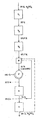
- the figure shows a diagram of an example of the method according to the invention.
- thin acid with a sulfuric acid content of 21 wt .-% and a metal salt content of 12 wt .-%, preferably consisting of iron (II) sulfate, magnesium sulfate and admixtures of other metal sulfates in a first preconcentration stage V 1, for example a vacuum evaporator on a Sulfuric acid concentration of e.g. 25% by weight, at most 28% by weight, e.g. using waste heat, such as pre-concentrated from the TiO2 manufacturing process, and then in a second pre-concentration stage V2, e.g. a second vacuum evaporator to a concentration of approx. 33.5, at most 50% by weight.
- a first preconcentration stage V 1 for example a vacuum evaporator on a Sulfuric acid concentration of e.g. 25% by weight, at most 28% by weight, e.g. using waste heat, such as pre-concentrated from the TiO2 manufacturing process, and then in a
- a subsequent third preconcentration stage V3 e.g. In a third vacuum evaporator, the sulfuric acid solution is further evaporated to 60.7% by weight.
- the sulfuric acid preconcentrated to 60.7% by weight is then introduced into a mixer M, where it is mixed with recycled 76% sulfuric acid in such a proportion that a sulfuric acid concentration of approximately 70% by weight is established.
- the major part of the metal salts remaining in solution precipitates here, in particular also disruptive chromium and vanadium salts.
- the precipitated metal salts are then separated off in a rotary filter F or a suitable press filter, if necessary after cooling the suspension, so that the 76% sulfuric acid emerging as filtrate and concentrated in a concentration stage A with the supply of energy is relatively low in salt.
- a little more than half of this 76% sulfuric acid is returned to the mixer M and mixed into the pre-concentrate.
- the rest of the 76% sulfuric acid is brought up to a sulfuric acid concentration of 85-88% by weight, e.g. 86 wt .-% highly concentrated, which is reused for the digestion of titanium ore.
- a further part of the acid can, if necessary, be removed for other use immediately after the filtration at 70% by weight or after the concentration to 76% by weight.
- V1, V2, V3, A and H which can be designed as a vacuum evaporator or in another suitable manner, water vapor as a heating medium in one of the preceding concentrations or evaporator stages so that only a small amount of live steam is required.
- the mixer M can be supplied with 86% highly concentrated sulfuric acid in a ratio such that a sulfuric acid concentration of 70% by weight is also established.
- the energy costs in this example were DM 71.35 / t TiO2 (in energy prices from August 1988). Investments decrease by about half, and the filter can be designed about 70% smaller.
- the pre-concentration stage is heated by vapors from the high concentration, while the high concentration is carried out with thermal oil or gas.
Landscapes
- Chemical & Material Sciences (AREA)
- Organic Chemistry (AREA)
- Geology (AREA)
- Life Sciences & Earth Sciences (AREA)
- Engineering & Computer Science (AREA)
- General Life Sciences & Earth Sciences (AREA)
- Environmental & Geological Engineering (AREA)
- Manufacturing & Machinery (AREA)
- Materials Engineering (AREA)
- Mechanical Engineering (AREA)
- Metallurgy (AREA)
- Inorganic Chemistry (AREA)
- Manufacture And Refinement Of Metals (AREA)
- Inorganic Compounds Of Heavy Metals (AREA)
Abstract
Description
- Die Erfindung betrifft ein Verfahren zur Gewinnung von höherkonzentrierten Schwefelsäurelösungen mit geringerem Metallsalzgehalt durch Aufbereitung verdünnter eisen(II)sulfathaltiger Schwefelsäurelösungen, wobei die verdünnte Schwefelsäurelösung mit einer Ausgangsschwefelsäurekonzentration von höchstens 28 Gew.-% in wenigstens einer Vorkonzentrationsstufe vorkonzentriert und das erhaltene Vorkonzentrat in wenigstens einer Weiterkonzentrationsstufe weiterkonzentriert wird, wobei das Vorkonzentrat mit einer Schwefelsäurelösung mit einer höheren Schwefelsäurekonzentration als die der vorkonzentrierten Schwefelsäure gemischt wird, und die nach dem Mischen ausgefällten Metallsalze von der aufkonzentrierten Schwefelsäure abgetrennt werden.
- Ein solches Verfahren ist beispielsweise aus der DE-A-2 618 122 bekannt und dient vorzugsweise zur Aufarbeitung der bei der Hydrolyse von Titansulfatlösungen nach Abtrennung des Titanoxidhydrates in grossen Mengen anfallenden verdünnten Schwefelsäurelösung, die neben einem Schwefelsäuregehalt von 10 - 30 Gew.-%, in der Regel von 20 - 23 Gew.-%, grosse Mengen an Eisen(II)sulfat und andere Metallsalze enthält. Aus Gründen des Umweltschutzes und der Verfahrensökonomie ist es wünschenswert, den Schwefelsäureanteil dieser sogenannten Dünnsäure wiederverwenden zu können, insbesondere wieder in die Titandioxidfabrikation zurückführen zu können. Dazu muss diese Dünnsäure auf die für den Titanerzaufschluss erforderliche Konzentration hochkonzentriert und die in ihr enthaltenen Metallsalze möglichst weitgehend abgetrennt werden. Das in DE-A-2 618 122 beschriebene Verfahren, bei dem die Vorkonzentration der Dünnsäure nur bis zu einer Konzentration von 25 - 32 Gew.-% vorgenommen wird und das Vorkonzentrat mit 90 - 96%iger Schwefelsäure auf 60 - 70% aufkonzentriert wird, hat sich als geeignet erwiesen, die bei der Titandioxidproduktion anfallende Dünnsäure so aufzuarbeiten, dass sie energetisch günstig recykliert und im Prozess, d.h. beim Titanrohstoff- aufschluss wiederverwendet werden kann. Das bekannte Verfahren stellt jedoch noch nicht das Optimum der Aufbereitung bezüglich der in der konzentrierten Schwefelsäurelösung verbliebenen Metallsalze und bezüglich des Energieverbrauchs, d.h. der Verfahrensökonomie, dar.
- Aus der DE-B-1 129 140 ist weiterhin ein Verfahren zur Aufarbeitung von Abfallschwefelsäuren zur Wiederverwendung bei der Titanpigmentherstellung bekannt, bei dem die Abfallsäurelösung durch Eindampfen in zwei Stufen vorkonzentriert wird, und zwar auf 40 - 45%, bzw. 65 - 70%, und die vorkonzentrierte Schwefelsäure mit 96 bzw. 98,6%iger konzentrierter Schwefelsäure auf über 80%, vorzugsweise über 85%, aufgestärkt wird. Auch dieses Verfahren arbeitet nicht mit optimal günstigem Energieverbrauch.
- Die Erfindung will hier Abhilfe schaffen und bezieht sich auf die Aufgabe, ein Verfahren zur Aufbereitung verdünnter Schwefelsäurelösungen zu schaffen, bei welchem in der aufbereiteten und konzentrierten Schwefelsäurelösung ein möglichst geringer Restgehalt an Metallsalzen verbleibt und wobei der Energiebedarf wesentlich vermindert ist.
- Erfindungsgemäss wird diese Aufgabe dadurch gelöst, dass die verdünnte Schwefelsäurelösung bis zu einer Schwefelsäurekonzentration von 40 - 65 Gew.-% vorkonzentriert wird, dass die vorkonzentrierte Schwefelsäurelösung bis zu einer Schwefelsäurekonzentration von 70 - 88 Gew.-% unter Energiezufuhr und unter Abtrennung der ausgefällten Metallsalze weiterkonzentriert wird, und dass ein Teil der auf 70 - 88 Gew.-% weiterkonzentrierten Schwefelsäure nach Abtrennung der Metallsalze direkt mit der vorkonzentrierten Schwefelsäure gemischt und im Kreislauf geführt wird.
- Im Gegensatz zu dem aus DE-A-2 618 122 bekannten Verfahren, bei dem die Vorkonzentration bis zu einem Schwefelsäuregehalt von 25 - 32 Gew.-% vorgenommen wird, wobei angestrebt wird, die Vorkonzentration nur soweit vorzunehmen, dass kein Eisensulfat ausfällt, wird nach dem erfindungsgemässen Verfahren eine Ausfällung einer bestimmten Eisensulfatmenge von höchstens 25 Gew.-%, bezogen auf Salz und Schwefelsäure, in Kauf genommen. Während bisher davon ausgegangen wurde, dass suspendiertes Eisensulfat einen kontinuierlichen Prozess stören könnte, geht die Erfindung von der überraschenden Erkenntnis aus, dass eine gewisse Menge ausgefällten Eisensulfates und anderer Salze von höchstens 25 Gew.-% den Prozess bei laufendem Betrieb noch nicht stört, was eine Vorkonzentration bis über 60% erlaubt.
- Die in der DE-B-1 129 140 vorgesehene Vorkonzentration auf 65 - 70% führt dagegen zu einer deutlich störenden Ausfällung von Eisensulfat von mehr als 25 Gew.-%.
- Die mehrstufige Vorkonzentration der Dünnsäure erweist sich dabei als die energetisch günstigste Form der Aufbereitung.
- Ein weiterer Unterschied zum Stand der Technik ist der, dass anstelle einer auf 90 - 96 Gew.-% hochkonzentrierten Schwefelsäure eine Schwefelsäurelösung mit einer Konzentration von nur 70 - 88 Gew.-% abgetrennt und der vorkonzentrierten Schwefelsäure beigemischt wird. Während bei dem bekannten Verfahren die Aufkonzentration im wesentlichen durch Beimischung hochkonzentrierter, über 90%iger Schwefelsäure erfolgt, wobei die Hochkonzentration in einer weiteren, der Aufkonzentration nachgeschalteten Stufe mit hohem Energieverbrauch erfolgt, wird gemäss dem erfindungsgemässen Verfahren ein Teil der aufkonzentrierten Schwefelsäurelösung zurückgeführt und der vorkonzentrierten Schwefelsäurelösung zugemischt. Um dabei eine hinreichende Konzentration der aufkonzentrierten Schwefelsäure von 70 - 88 Gew.-% zu erreichen, wird der Aufkonzentrationsstufe nach der Abtrennung der Metallsalze die zur Aufkonzentration notwendige Energie zugeführt. Nach dem erfindungsgemässen Verfahren entfällt also ein wesentlicher Teil der Hochkonzentration der gesamten aufkonzentrierten Schwefelsäure auf über 90 Gew.-%.
- Dabei ist es jedoch vorteilhaft, wenigstens einen Teil der nicht für die Rückführung und Zumischung zum Vorkonzentrat erforderlichen aufkonzentrierten Schwefelsäure in einer kleiner dimensionierten Hochkonzentrationsstufe auf die für die Verwendung im Titanerzaufschluss erforderliche Konzentration zu bringen. Dabei wird die inzwischen gewonnene Erkenntnis berücksichtigt, dass zum Aufschluss bestimmter Titanrohstoffe, z.B. Titanschlacke, anstelle der früher verwendeten 96%-igen Schwefelsäure oder gar von Oleum auch im Konzentrationsbereich unter 90%, beispielsweise mit 86%-iger Schwefelsäure erfolgreich und ökonomisch gearbeitet werden kann. Nach dem erfindungsgemässen Verfahren wird also der Energiebedarf deutlich vermindert.
- In der Figur ist ein Schema eines Beispieles des erfindungsgemässes Verfahrens dargestellt.
- Bei diesem Beispiel wird Dünnsäure mit einem Schwefelsäuregehalt von 21 Gew.-% und einem Metallsalzgehalt von 12 Gew.-%, vorzugsweise bestehend aus Eisen(II)sulfat, Magnesiumsulfat und Beimengungen anderer Metallsulfate, in einer ersten Vorkonzentrationsstufe V₁, beispielsweise einem Vakuumverdampfer auf eine Schwefelsäurekonzentration von z.B. 25 Gew.-%, höchstens 28 Gew.-%, z.B. unter Verwendung von Abfallwärme, etwa aus dem TiO₂-Herstellungsprozess vorkonzentriert, und anschliessend in einer zweiten Vorkonzentrationsstufe V₂, z.B. einem zweiten Vakuumverdampfer auf eine Konzentration von ca, 33,5, höchstens 50 Gew.-%. In einer anschliessenden dritten Vorkonzentrationsstufe V₃, z.B. einem dritten Vakuumverdampfer wird die Schwefelsäurelösung weiter auf 60,7 Gew.-% eingedampft. Hierbei fallen ein Teil der Metallsulfate, vorzugsweise Eisen(II)sulfatmonohydrat aus und verbleiben in der Suspension. Die Konzentration dieser Metallsulfate überschreitet 25 Gew.-% nicht, und es zeigt sich, dass bei kontinuierlichem Betrieb hierbei noch keine Störungen durch Abscheidungen von Metallsulfaten eintreten.
- Anschliessend wird die auf 60,7 Gew.-% vorkonzentrierte Schwefelsäure in einen Mischer M eingebracht, wo sie mit rückgeführter 76%iger Schwefelsäure in einem solchen Anteil gemischt wird, dass sich eine Schwefelsäurekonzentration von ca. 70 Gew.-% einstellt.
- Hierbei fällt der wesentliche Teil in Lösung verbliebener Metallsalze aus, insbesondere auch störende Chrom- und Vanadiumsalze. Anschliessend werden die gefällten Metallsalze in einem Drehfilter F oder einem geeigneten Pressfilter abgetrennt, nötigenfalls nach Kühlung der Suspension, so dass die als Filtrat austretende und in einer Aufkonzentrationsstufe A unter Energiezufuhr aufkonzentrierte 76%-ige Schwefelsäure relativ salzarm ist. Etwas mehr als die Hälfte dieser 76%-igen Schwefelsäure wird in den Mischer M zurückgeführt und dem Vorkonzentrat zugemischt. Der Rest der 76%-igen Schwefelsäure wird in einer Hochkonzentrationsstufe H auf eine Schwefelsäurekonzentration von 85 - 88 Gew.-%, z.B. 86 Gew.-% hochkonzentriert, welche zum Aufschluss von Titanerz wiederverwendet wird. Ein weiterer Teil der Säure kann bei Bedarf sofort nach der Filtration bei 70 Gew.% oder auch nach der Aufkonzentration auf 76 Gew.-% zu anderweitiger Verwendung abgeführt werden.
- Da aus filtrationstechnischen Gründen ein Konzentrationsbereich von 70 - 72 Gew.-% für die Abtrennung der Filtersalze günstig ist, empfiehlt sich die Zugabe aufkonzentrierter Säure in einer solchen Menge und Konzentration, in Anpassung an die Herkunft der Dünnsäure, dass die Filtration in den günstigsten Bereich gelegt wird.
- Zur Verbessung der Energiebilanz dient der in den einzelnen Konzentrationsstufen V₁, V₂, V₃, A und H, die als Vakuumverdampfer oder in anderer geeigneter Art ausgeführt sein können, anfallende Wasserdampf als Heizmittel in einer der vorangehenden Konzentrations bzw. Verdampferstufen, so dass nur eine geringe Menge Frischdampf erforderlich ist.
- Bei einer Variante dieses Beispieles eines erfindungsgemässen Verfahrens kann dem Mischer M statt oder zusätzlich zu aufkonzentrierter Schwefelsäure 86%ige hochkonzentrierte Schwefelsäure in einen solchen Verhältnis zugeführt werden, dass sich ebenfalls eine Schwefelsäurekonzentration von 70 Gew.-% einstellt.
- Die Energiekosten lagen bei diesem Beispiel bei DM 71,35/t TiO₂ (in Energiepreisen vom August 1988). Die Investitionen sinken etwa um die Hälfte, und das Filter kann um ca 70% kleiner ausgelegt sein.
- Bei einem Beispiel des in der DE-A-2 618 122 beschriebenen Verfahrens wird in einer Vorkonzentrationsstufe 21%ige Dünnschwefelsäure mit 12 Gew.-% Salzgehalt auf 29 Gew.-% konzentriert. Im Mischer wird 92%ige Schwefelsäure zugesetzt, so dass eine Konzentration von 70 Gew.-% erreicht wird. Die ausgefallenen Salze werden mit einem Pressfilter abgetrennt. In einer zweistufigen Hochkonzentrationseinheit wird die Schwefelsäure auf 92 Gew.-% eingedampft. Ein Teilstrom davon geht zum Mischer zurück, der Rest wird in die Produktion zurückgeführt.
- Bei diesem Verfahren fallen in der Vorkonzentrationsstufe noch keine Metallsalze aus. Der Haupteindampfprozess wird in die Hochkonzentrierung verlegt, nachdem die meisten Metallsalze entfernt wurden.
- Die Vorkonzentrationsstufe wird durch Brüden aus der Hochkonzentration beheizt, während die Hochkonzentration mit Thermoöl oder Gas durchgeführt wird.
- Die Energiekosten betragen bei diesem vorbekannten Verfahren DM 125.-/t TiO₂, also 75% mehr als bei dem vorgängig beschriebenen Beispiel des erfindungsgemässen Verfahrens.
Claims (10)
Applications Claiming Priority (2)
| Application Number | Priority Date | Filing Date | Title |
|---|---|---|---|
| CH356788A CH677921A5 (de) | 1988-09-26 | 1988-09-26 | |
| CH3567/88 | 1988-09-26 |
Publications (2)
| Publication Number | Publication Date |
|---|---|
| EP0363683A1 true EP0363683A1 (de) | 1990-04-18 |
| EP0363683B1 EP0363683B1 (de) | 1994-11-17 |
Family
ID=4258787
Family Applications (1)
| Application Number | Title | Priority Date | Filing Date |
|---|---|---|---|
| EP89117224A Expired - Lifetime EP0363683B1 (de) | 1988-09-26 | 1989-09-18 | Verfahren zur Gewinnung höherkonzentrierter Schwefelsäurelösungen durch Aufbereitung verdünnter sulfathaltiger Schwefelsäurelösungen |
Country Status (4)
| Country | Link |
|---|---|
| EP (1) | EP0363683B1 (de) |
| CH (1) | CH677921A5 (de) |
| DE (2) | DE3918794C2 (de) |
| ES (1) | ES2064409T3 (de) |
Cited By (2)
| Publication number | Priority date | Publication date | Assignee | Title |
|---|---|---|---|---|
| CN104876194A (zh) * | 2015-06-02 | 2015-09-02 | 南京鹳山化工科技有限公司 | 利用含硫酸盐稀硫酸回收硫酸和硫酸盐的方法 |
| CN109231399A (zh) * | 2018-08-28 | 2019-01-18 | 杭州轩辉环境设备有限公司 | 一种提取硫酸盐的工艺方法 |
Families Citing this family (1)
| Publication number | Priority date | Publication date | Assignee | Title |
|---|---|---|---|---|
| DE10024457A1 (de) * | 2000-05-18 | 2001-11-29 | Sachtleben Chemie Gmbh | Verfahren zur Konzentration des Schwefelsäure-Gehalts von bei der Produktion von Titandioxid anfallender Dünnsäure |
Citations (4)
| Publication number | Priority date | Publication date | Assignee | Title |
|---|---|---|---|---|
| DE1129140B (de) * | 1960-08-04 | 1962-05-10 | Metallgesellschaft Ag | Verfahren zum Aufarbeiten von Abfallschwefelsaeure der Titanpigmentherstellung |
| DE1173074B (de) * | 1961-01-26 | 1964-07-02 | Bayer Ag | Verfahren zum Aufarbeiten der bei der Titandioxyd-Herstellung nach dem Schwefel-saeureaufschluss-Verfahren anfallenden Hydrolysesaeuren |
| DE2618122A1 (de) * | 1976-04-26 | 1977-11-10 | Kronos Titan Gmbh | Verfahren zur aufarbeitung verduennter eisen(ii)-sulfathaltiger schwefelsaeureloesungen |
| EP0133505A2 (de) * | 1983-08-02 | 1985-02-27 | Bayer Ag | Verfahren zur Aufarbeitung von Dünnsäuren |
Family Cites Families (2)
| Publication number | Priority date | Publication date | Assignee | Title |
|---|---|---|---|---|
| DE2630196A1 (de) * | 1976-07-05 | 1978-01-19 | Bayer Ag | Verfahren zur herstellung von schwefelsaeure aus abfallsaeure und eisensulfat |
| DE3537941A1 (de) * | 1985-10-25 | 1987-04-30 | Bayer Ag | Aus duennsaeure gewonnene metallsulfatsuspension, verfahren zu ihrer herstellung sowie deren verwendung |
-
1988
- 1988-09-26 CH CH356788A patent/CH677921A5/de not_active IP Right Cessation
-
1989
- 1989-06-08 DE DE19893918794 patent/DE3918794C2/de not_active Expired - Fee Related
- 1989-09-18 DE DE58908649T patent/DE58908649D1/de not_active Expired - Fee Related
- 1989-09-18 EP EP89117224A patent/EP0363683B1/de not_active Expired - Lifetime
- 1989-09-18 ES ES89117224T patent/ES2064409T3/es not_active Expired - Lifetime
Patent Citations (4)
| Publication number | Priority date | Publication date | Assignee | Title |
|---|---|---|---|---|
| DE1129140B (de) * | 1960-08-04 | 1962-05-10 | Metallgesellschaft Ag | Verfahren zum Aufarbeiten von Abfallschwefelsaeure der Titanpigmentherstellung |
| DE1173074B (de) * | 1961-01-26 | 1964-07-02 | Bayer Ag | Verfahren zum Aufarbeiten der bei der Titandioxyd-Herstellung nach dem Schwefel-saeureaufschluss-Verfahren anfallenden Hydrolysesaeuren |
| DE2618122A1 (de) * | 1976-04-26 | 1977-11-10 | Kronos Titan Gmbh | Verfahren zur aufarbeitung verduennter eisen(ii)-sulfathaltiger schwefelsaeureloesungen |
| EP0133505A2 (de) * | 1983-08-02 | 1985-02-27 | Bayer Ag | Verfahren zur Aufarbeitung von Dünnsäuren |
Cited By (2)
| Publication number | Priority date | Publication date | Assignee | Title |
|---|---|---|---|---|
| CN104876194A (zh) * | 2015-06-02 | 2015-09-02 | 南京鹳山化工科技有限公司 | 利用含硫酸盐稀硫酸回收硫酸和硫酸盐的方法 |
| CN109231399A (zh) * | 2018-08-28 | 2019-01-18 | 杭州轩辉环境设备有限公司 | 一种提取硫酸盐的工艺方法 |
Also Published As
| Publication number | Publication date |
|---|---|
| DE3918794C2 (de) | 1994-01-20 |
| DE58908649D1 (de) | 1994-12-22 |
| EP0363683B1 (de) | 1994-11-17 |
| CH677921A5 (de) | 1991-07-15 |
| ES2064409T3 (es) | 1995-02-01 |
| DE3918794A1 (de) | 1990-03-29 |
Similar Documents
| Publication | Publication Date | Title |
|---|---|---|
| EP0147608B2 (de) | Verfahren zur Herstellung von Titandioxid | |
| DE2618122C2 (de) | Verfahren zur Aufarbeitung verdünnter eisen(II)-sulfathaltiger Schwefelsäurelösungen | |
| EP0393430B1 (de) | Verfahren zur Herstellung von Titandioxid | |
| EP0363683B1 (de) | Verfahren zur Gewinnung höherkonzentrierter Schwefelsäurelösungen durch Aufbereitung verdünnter sulfathaltiger Schwefelsäurelösungen | |
| DE2732854C3 (de) | Verfahren zum Aufarbeiten chromhaltiger Vanadinschlacken | |
| DE2735406C2 (de) | Verfahren zur Gewinnung von Aluminiumoxid aus aluminiumoxidhaltigen Erzen | |
| DE2729755C2 (de) | Verfahren zur Herstellung von Titandioxid durch diskontinuierliches Aufschließen von Ilmeniterzen mit Schwefelsäure | |
| EP0475104A1 (de) | Verfahren zur Aufarbeitung von Aufschlussrückständen aus der Titandioxidproduktion | |
| DE2112271C3 (de) | Verfahren zur Aufarbeitung verbrauchter Beizflüssigkeit | |
| DE3744575C1 (de) | Verfahren zur Herstellung von Titandioxid | |
| DE2210637A1 (de) | Verfahren zur herstellung eines schwefeldioxid enthaltenden gases aus einer eisen(ii)sulfat-haltigen schwefelsaeure | |
| DE2357172A1 (de) | Verfahren zur herstellung von hexagonalen plattenfoermigen kristallen aus extrem chemisch reinem aluminiumsulfat | |
| EP0197507B1 (de) | Verfahren zur Herstellung von Titandioxid | |
| DE69901036T2 (de) | Verfahren zur aufkonzentrierung von verdünnten schwefelsäurelösungen | |
| EP0392211B1 (de) | Verfahren zur Wiederverwendung von Abfallschwefelsäure | |
| CH638465A5 (de) | Verfahren zum konzentrieren von waessrigen schwefelsaeureloesungen. | |
| DE3780960T2 (de) | Verfahren zur herstellung einer eisen-iii-sulfatloesung. | |
| DE3938915C1 (de) | ||
| DE2647084C2 (de) | Verfahren zur Reinigung einer verdünnten Schwefelsäurelösung | |
| DE3022874A1 (de) | Verfahren zur herstellung von tantal-konzentraten | |
| DE489651C (de) | Verfahren zur Herstellung von hochprozentigem Dicalciumphosphat | |
| DE3876999T2 (de) | Verfahren zur wiedergewinnung von chromanhydrid aus erschoepften waessrigen chromplattierungsbaedern unter verwendung des gewonnenen chroms. | |
| DE2933430C2 (de) | ||
| EP0145984A1 (de) | Verfahren zur Herstellung von Titandioxid | |
| DE3206355C2 (de) |
Legal Events
| Date | Code | Title | Description |
|---|---|---|---|
| PUAI | Public reference made under article 153(3) epc to a published international application that has entered the european phase |
Free format text: ORIGINAL CODE: 0009012 |
|
| 17P | Request for examination filed |
Effective date: 19890918 |
|
| AK | Designated contracting states |
Kind code of ref document: A1 Designated state(s): BE DE ES FR GB IT |
|
| 17Q | First examination report despatched |
Effective date: 19920319 |
|
| RAP1 | Party data changed (applicant data changed or rights of an application transferred) |
Owner name: SULZER CHEMTECH AG |
|
| GRAA | (expected) grant |
Free format text: ORIGINAL CODE: 0009210 |
|
| AK | Designated contracting states |
Kind code of ref document: B1 Designated state(s): BE DE ES FR GB IT |
|
| GBT | Gb: translation of ep patent filed (gb section 77(6)(a)/1977) |
Effective date: 19941121 |
|
| REF | Corresponds to: |
Ref document number: 58908649 Country of ref document: DE Date of ref document: 19941222 |
|
| ITF | It: translation for a ep patent filed | ||
| REG | Reference to a national code |
Ref country code: ES Ref legal event code: FG2A Ref document number: 2064409 Country of ref document: ES Kind code of ref document: T3 |
|
| ET | Fr: translation filed | ||
| PLBE | No opposition filed within time limit |
Free format text: ORIGINAL CODE: 0009261 |
|
| STAA | Information on the status of an ep patent application or granted ep patent |
Free format text: STATUS: NO OPPOSITION FILED WITHIN TIME LIMIT |
|
| 26N | No opposition filed | ||
| PGFP | Annual fee paid to national office [announced via postgrant information from national office to epo] |
Ref country code: GB Payment date: 20000814 Year of fee payment: 12 |
|
| PGFP | Annual fee paid to national office [announced via postgrant information from national office to epo] |
Ref country code: DE Payment date: 20000830 Year of fee payment: 12 |
|
| PGFP | Annual fee paid to national office [announced via postgrant information from national office to epo] |
Ref country code: FR Payment date: 20000831 Year of fee payment: 12 |
|
| PGFP | Annual fee paid to national office [announced via postgrant information from national office to epo] |
Ref country code: BE Payment date: 20000911 Year of fee payment: 12 |
|
| PGFP | Annual fee paid to national office [announced via postgrant information from national office to epo] |
Ref country code: ES Payment date: 20000922 Year of fee payment: 12 |
|
| PG25 | Lapsed in a contracting state [announced via postgrant information from national office to epo] |
Ref country code: GB Free format text: LAPSE BECAUSE OF NON-PAYMENT OF DUE FEES Effective date: 20010918 |
|
| PG25 | Lapsed in a contracting state [announced via postgrant information from national office to epo] |
Ref country code: ES Free format text: LAPSE BECAUSE OF NON-PAYMENT OF DUE FEES Effective date: 20010919 |
|
| PG25 | Lapsed in a contracting state [announced via postgrant information from national office to epo] |
Ref country code: BE Free format text: LAPSE BECAUSE OF NON-PAYMENT OF DUE FEES Effective date: 20010930 |
|
| REG | Reference to a national code |
Ref country code: GB Ref legal event code: IF02 |
|
| BERE | Be: lapsed |
Owner name: SULZER CHEMTECH A.G. Effective date: 20010930 |
|
| PG25 | Lapsed in a contracting state [announced via postgrant information from national office to epo] |
Ref country code: DE Free format text: LAPSE BECAUSE OF NON-PAYMENT OF DUE FEES Effective date: 20020501 |
|
| GBPC | Gb: european patent ceased through non-payment of renewal fee |
Effective date: 20010918 |
|
| PG25 | Lapsed in a contracting state [announced via postgrant information from national office to epo] |
Ref country code: FR Free format text: LAPSE BECAUSE OF NON-PAYMENT OF DUE FEES Effective date: 20020531 |
|
| REG | Reference to a national code |
Ref country code: FR Ref legal event code: ST |
|
| REG | Reference to a national code |
Ref country code: ES Ref legal event code: FD2A Effective date: 20021011 |
|
| PG25 | Lapsed in a contracting state [announced via postgrant information from national office to epo] |
Ref country code: IT Free format text: LAPSE BECAUSE OF NON-PAYMENT OF DUE FEES Effective date: 20050918 |