EP0363818B1 - Oximether-Derivate, Verfahren zu ihrer Herstellung und diese enthaltende Fungizide - Google Patents
Oximether-Derivate, Verfahren zu ihrer Herstellung und diese enthaltende Fungizide Download PDFInfo
- Publication number
- EP0363818B1 EP0363818B1 EP89118472A EP89118472A EP0363818B1 EP 0363818 B1 EP0363818 B1 EP 0363818B1 EP 89118472 A EP89118472 A EP 89118472A EP 89118472 A EP89118472 A EP 89118472A EP 0363818 B1 EP0363818 B1 EP 0363818B1
- Authority
- EP
- European Patent Office
- Prior art keywords
- het
- alkyl
- formula
- compound
- pyridyl
- Prior art date
- Legal status (The legal status is an assumption and is not a legal conclusion. Google has not performed a legal analysis and makes no representation as to the accuracy of the status listed.)
- Expired - Lifetime
Links
- 0 *Cc(cccc1)c1I* Chemical compound *Cc(cccc1)c1I* 0.000 description 2
Classifications
-
- C—CHEMISTRY; METALLURGY
- C07—ORGANIC CHEMISTRY
- C07D—HETEROCYCLIC COMPOUNDS
- C07D213/00—Heterocyclic compounds containing six-membered rings, not condensed with other rings, with one nitrogen atom as the only ring hetero atom and three or more double bonds between ring members or between ring members and non-ring members
- C07D213/02—Heterocyclic compounds containing six-membered rings, not condensed with other rings, with one nitrogen atom as the only ring hetero atom and three or more double bonds between ring members or between ring members and non-ring members having three double bonds between ring members or between ring members and non-ring members
- C07D213/04—Heterocyclic compounds containing six-membered rings, not condensed with other rings, with one nitrogen atom as the only ring hetero atom and three or more double bonds between ring members or between ring members and non-ring members having three double bonds between ring members or between ring members and non-ring members having no bond between the ring nitrogen atom and a non-ring member or having only hydrogen or carbon atoms directly attached to the ring nitrogen atom
- C07D213/60—Heterocyclic compounds containing six-membered rings, not condensed with other rings, with one nitrogen atom as the only ring hetero atom and three or more double bonds between ring members or between ring members and non-ring members having three double bonds between ring members or between ring members and non-ring members having no bond between the ring nitrogen atom and a non-ring member or having only hydrogen or carbon atoms directly attached to the ring nitrogen atom with hetero atoms or with carbon atoms having three bonds to hetero atoms with at the most one bond to halogen, e.g. ester or nitrile radicals, directly attached to ring carbon atoms
- C07D213/62—Oxygen or sulfur atoms
- C07D213/63—One oxygen atom
- C07D213/64—One oxygen atom attached in position 2 or 6
-
- A—HUMAN NECESSITIES
- A01—AGRICULTURE; FORESTRY; ANIMAL HUSBANDRY; HUNTING; TRAPPING; FISHING
- A01N—PRESERVATION OF BODIES OF HUMANS OR ANIMALS OR PLANTS OR PARTS THEREOF; BIOCIDES, e.g. AS DISINFECTANTS, AS PESTICIDES OR AS HERBICIDES; PEST REPELLANTS OR ATTRACTANTS; PLANT GROWTH REGULATORS
- A01N43/00—Biocides, pest repellants or attractants, or plant growth regulators containing heterocyclic compounds
- A01N43/34—Biocides, pest repellants or attractants, or plant growth regulators containing heterocyclic compounds having rings with one nitrogen atom as the only ring hetero atom
- A01N43/40—Biocides, pest repellants or attractants, or plant growth regulators containing heterocyclic compounds having rings with one nitrogen atom as the only ring hetero atom six-membered rings
-
- A—HUMAN NECESSITIES
- A01—AGRICULTURE; FORESTRY; ANIMAL HUSBANDRY; HUNTING; TRAPPING; FISHING
- A01N—PRESERVATION OF BODIES OF HUMANS OR ANIMALS OR PLANTS OR PARTS THEREOF; BIOCIDES, e.g. AS DISINFECTANTS, AS PESTICIDES OR AS HERBICIDES; PEST REPELLANTS OR ATTRACTANTS; PLANT GROWTH REGULATORS
- A01N43/00—Biocides, pest repellants or attractants, or plant growth regulators containing heterocyclic compounds
- A01N43/34—Biocides, pest repellants or attractants, or plant growth regulators containing heterocyclic compounds having rings with one nitrogen atom as the only ring hetero atom
- A01N43/40—Biocides, pest repellants or attractants, or plant growth regulators containing heterocyclic compounds having rings with one nitrogen atom as the only ring hetero atom six-membered rings
- A01N43/42—Biocides, pest repellants or attractants, or plant growth regulators containing heterocyclic compounds having rings with one nitrogen atom as the only ring hetero atom six-membered rings condensed with carbocyclic rings
-
- A—HUMAN NECESSITIES
- A01—AGRICULTURE; FORESTRY; ANIMAL HUSBANDRY; HUNTING; TRAPPING; FISHING
- A01N—PRESERVATION OF BODIES OF HUMANS OR ANIMALS OR PLANTS OR PARTS THEREOF; BIOCIDES, e.g. AS DISINFECTANTS, AS PESTICIDES OR AS HERBICIDES; PEST REPELLANTS OR ATTRACTANTS; PLANT GROWTH REGULATORS
- A01N43/00—Biocides, pest repellants or attractants, or plant growth regulators containing heterocyclic compounds
- A01N43/48—Biocides, pest repellants or attractants, or plant growth regulators containing heterocyclic compounds having rings with two nitrogen atoms as the only ring hetero atoms
- A01N43/54—1,3-Diazines; Hydrogenated 1,3-diazines
-
- A—HUMAN NECESSITIES
- A01—AGRICULTURE; FORESTRY; ANIMAL HUSBANDRY; HUNTING; TRAPPING; FISHING
- A01N—PRESERVATION OF BODIES OF HUMANS OR ANIMALS OR PLANTS OR PARTS THEREOF; BIOCIDES, e.g. AS DISINFECTANTS, AS PESTICIDES OR AS HERBICIDES; PEST REPELLANTS OR ATTRACTANTS; PLANT GROWTH REGULATORS
- A01N43/00—Biocides, pest repellants or attractants, or plant growth regulators containing heterocyclic compounds
- A01N43/72—Biocides, pest repellants or attractants, or plant growth regulators containing heterocyclic compounds having rings with nitrogen atoms and oxygen or sulfur atoms as ring hetero atoms
- A01N43/74—Biocides, pest repellants or attractants, or plant growth regulators containing heterocyclic compounds having rings with nitrogen atoms and oxygen or sulfur atoms as ring hetero atoms five-membered rings with one nitrogen atom and either one oxygen atom or one sulfur atom in positions 1,3
-
- C—CHEMISTRY; METALLURGY
- C07—ORGANIC CHEMISTRY
- C07D—HETEROCYCLIC COMPOUNDS
- C07D213/00—Heterocyclic compounds containing six-membered rings, not condensed with other rings, with one nitrogen atom as the only ring hetero atom and three or more double bonds between ring members or between ring members and non-ring members
- C07D213/02—Heterocyclic compounds containing six-membered rings, not condensed with other rings, with one nitrogen atom as the only ring hetero atom and three or more double bonds between ring members or between ring members and non-ring members having three double bonds between ring members or between ring members and non-ring members
- C07D213/04—Heterocyclic compounds containing six-membered rings, not condensed with other rings, with one nitrogen atom as the only ring hetero atom and three or more double bonds between ring members or between ring members and non-ring members having three double bonds between ring members or between ring members and non-ring members having no bond between the ring nitrogen atom and a non-ring member or having only hydrogen or carbon atoms directly attached to the ring nitrogen atom
- C07D213/60—Heterocyclic compounds containing six-membered rings, not condensed with other rings, with one nitrogen atom as the only ring hetero atom and three or more double bonds between ring members or between ring members and non-ring members having three double bonds between ring members or between ring members and non-ring members having no bond between the ring nitrogen atom and a non-ring member or having only hydrogen or carbon atoms directly attached to the ring nitrogen atom with hetero atoms or with carbon atoms having three bonds to hetero atoms with at the most one bond to halogen, e.g. ester or nitrile radicals, directly attached to ring carbon atoms
- C07D213/62—Oxygen or sulfur atoms
- C07D213/70—Sulfur atoms
-
- C—CHEMISTRY; METALLURGY
- C07—ORGANIC CHEMISTRY
- C07D—HETEROCYCLIC COMPOUNDS
- C07D213/00—Heterocyclic compounds containing six-membered rings, not condensed with other rings, with one nitrogen atom as the only ring hetero atom and three or more double bonds between ring members or between ring members and non-ring members
- C07D213/02—Heterocyclic compounds containing six-membered rings, not condensed with other rings, with one nitrogen atom as the only ring hetero atom and three or more double bonds between ring members or between ring members and non-ring members having three double bonds between ring members or between ring members and non-ring members
- C07D213/04—Heterocyclic compounds containing six-membered rings, not condensed with other rings, with one nitrogen atom as the only ring hetero atom and three or more double bonds between ring members or between ring members and non-ring members having three double bonds between ring members or between ring members and non-ring members having no bond between the ring nitrogen atom and a non-ring member or having only hydrogen or carbon atoms directly attached to the ring nitrogen atom
- C07D213/60—Heterocyclic compounds containing six-membered rings, not condensed with other rings, with one nitrogen atom as the only ring hetero atom and three or more double bonds between ring members or between ring members and non-ring members having three double bonds between ring members or between ring members and non-ring members having no bond between the ring nitrogen atom and a non-ring member or having only hydrogen or carbon atoms directly attached to the ring nitrogen atom with hetero atoms or with carbon atoms having three bonds to hetero atoms with at the most one bond to halogen, e.g. ester or nitrile radicals, directly attached to ring carbon atoms
- C07D213/78—Carbon atoms having three bonds to hetero atoms, with at the most one bond to halogen, e.g. ester or nitrile radicals
- C07D213/79—Acids; Esters
- C07D213/80—Acids; Esters in position 3
-
- C—CHEMISTRY; METALLURGY
- C07—ORGANIC CHEMISTRY
- C07D—HETEROCYCLIC COMPOUNDS
- C07D213/00—Heterocyclic compounds containing six-membered rings, not condensed with other rings, with one nitrogen atom as the only ring hetero atom and three or more double bonds between ring members or between ring members and non-ring members
- C07D213/02—Heterocyclic compounds containing six-membered rings, not condensed with other rings, with one nitrogen atom as the only ring hetero atom and three or more double bonds between ring members or between ring members and non-ring members having three double bonds between ring members or between ring members and non-ring members
- C07D213/04—Heterocyclic compounds containing six-membered rings, not condensed with other rings, with one nitrogen atom as the only ring hetero atom and three or more double bonds between ring members or between ring members and non-ring members having three double bonds between ring members or between ring members and non-ring members having no bond between the ring nitrogen atom and a non-ring member or having only hydrogen or carbon atoms directly attached to the ring nitrogen atom
- C07D213/60—Heterocyclic compounds containing six-membered rings, not condensed with other rings, with one nitrogen atom as the only ring hetero atom and three or more double bonds between ring members or between ring members and non-ring members having three double bonds between ring members or between ring members and non-ring members having no bond between the ring nitrogen atom and a non-ring member or having only hydrogen or carbon atoms directly attached to the ring nitrogen atom with hetero atoms or with carbon atoms having three bonds to hetero atoms with at the most one bond to halogen, e.g. ester or nitrile radicals, directly attached to ring carbon atoms
- C07D213/78—Carbon atoms having three bonds to hetero atoms, with at the most one bond to halogen, e.g. ester or nitrile radicals
- C07D213/84—Nitriles
- C07D213/85—Nitriles in position 3
-
- C—CHEMISTRY; METALLURGY
- C07—ORGANIC CHEMISTRY
- C07D—HETEROCYCLIC COMPOUNDS
- C07D215/00—Heterocyclic compounds containing quinoline or hydrogenated quinoline ring systems
- C07D215/02—Heterocyclic compounds containing quinoline or hydrogenated quinoline ring systems having no bond between the ring nitrogen atom and a non-ring member or having only hydrogen atoms or carbon atoms directly attached to the ring nitrogen atom
- C07D215/16—Heterocyclic compounds containing quinoline or hydrogenated quinoline ring systems having no bond between the ring nitrogen atom and a non-ring member or having only hydrogen atoms or carbon atoms directly attached to the ring nitrogen atom with hetero atoms or with carbon atoms having three bonds to hetero atoms with at the most one bond to halogen, e.g. ester or nitrile radicals, directly attached to ring carbon atoms
- C07D215/20—Oxygen atoms
- C07D215/22—Oxygen atoms attached in position 2 or 4
- C07D215/227—Oxygen atoms attached in position 2 or 4 only one oxygen atom which is attached in position 2
-
- C—CHEMISTRY; METALLURGY
- C07—ORGANIC CHEMISTRY
- C07D—HETEROCYCLIC COMPOUNDS
- C07D215/00—Heterocyclic compounds containing quinoline or hydrogenated quinoline ring systems
- C07D215/02—Heterocyclic compounds containing quinoline or hydrogenated quinoline ring systems having no bond between the ring nitrogen atom and a non-ring member or having only hydrogen atoms or carbon atoms directly attached to the ring nitrogen atom
- C07D215/16—Heterocyclic compounds containing quinoline or hydrogenated quinoline ring systems having no bond between the ring nitrogen atom and a non-ring member or having only hydrogen atoms or carbon atoms directly attached to the ring nitrogen atom with hetero atoms or with carbon atoms having three bonds to hetero atoms with at the most one bond to halogen, e.g. ester or nitrile radicals, directly attached to ring carbon atoms
- C07D215/20—Oxygen atoms
- C07D215/22—Oxygen atoms attached in position 2 or 4
- C07D215/233—Oxygen atoms attached in position 2 or 4 only one oxygen atom which is attached in position 4
-
- C—CHEMISTRY; METALLURGY
- C07—ORGANIC CHEMISTRY
- C07D—HETEROCYCLIC COMPOUNDS
- C07D215/00—Heterocyclic compounds containing quinoline or hydrogenated quinoline ring systems
- C07D215/02—Heterocyclic compounds containing quinoline or hydrogenated quinoline ring systems having no bond between the ring nitrogen atom and a non-ring member or having only hydrogen atoms or carbon atoms directly attached to the ring nitrogen atom
- C07D215/16—Heterocyclic compounds containing quinoline or hydrogenated quinoline ring systems having no bond between the ring nitrogen atom and a non-ring member or having only hydrogen atoms or carbon atoms directly attached to the ring nitrogen atom with hetero atoms or with carbon atoms having three bonds to hetero atoms with at the most one bond to halogen, e.g. ester or nitrile radicals, directly attached to ring carbon atoms
- C07D215/20—Oxygen atoms
- C07D215/24—Oxygen atoms attached in position 8
- C07D215/26—Alcohols; Ethers thereof
-
- C—CHEMISTRY; METALLURGY
- C07—ORGANIC CHEMISTRY
- C07D—HETEROCYCLIC COMPOUNDS
- C07D215/00—Heterocyclic compounds containing quinoline or hydrogenated quinoline ring systems
- C07D215/02—Heterocyclic compounds containing quinoline or hydrogenated quinoline ring systems having no bond between the ring nitrogen atom and a non-ring member or having only hydrogen atoms or carbon atoms directly attached to the ring nitrogen atom
- C07D215/16—Heterocyclic compounds containing quinoline or hydrogenated quinoline ring systems having no bond between the ring nitrogen atom and a non-ring member or having only hydrogen atoms or carbon atoms directly attached to the ring nitrogen atom with hetero atoms or with carbon atoms having three bonds to hetero atoms with at the most one bond to halogen, e.g. ester or nitrile radicals, directly attached to ring carbon atoms
- C07D215/20—Oxygen atoms
- C07D215/24—Oxygen atoms attached in position 8
- C07D215/26—Alcohols; Ethers thereof
- C07D215/28—Alcohols; Ethers thereof with halogen atoms or nitro radicals in positions 5, 6 or 7
-
- C—CHEMISTRY; METALLURGY
- C07—ORGANIC CHEMISTRY
- C07D—HETEROCYCLIC COMPOUNDS
- C07D215/00—Heterocyclic compounds containing quinoline or hydrogenated quinoline ring systems
- C07D215/02—Heterocyclic compounds containing quinoline or hydrogenated quinoline ring systems having no bond between the ring nitrogen atom and a non-ring member or having only hydrogen atoms or carbon atoms directly attached to the ring nitrogen atom
- C07D215/16—Heterocyclic compounds containing quinoline or hydrogenated quinoline ring systems having no bond between the ring nitrogen atom and a non-ring member or having only hydrogen atoms or carbon atoms directly attached to the ring nitrogen atom with hetero atoms or with carbon atoms having three bonds to hetero atoms with at the most one bond to halogen, e.g. ester or nitrile radicals, directly attached to ring carbon atoms
- C07D215/36—Sulfur atoms
-
- C—CHEMISTRY; METALLURGY
- C07—ORGANIC CHEMISTRY
- C07D—HETEROCYCLIC COMPOUNDS
- C07D237/00—Heterocyclic compounds containing 1,2-diazine or hydrogenated 1,2-diazine rings
- C07D237/02—Heterocyclic compounds containing 1,2-diazine or hydrogenated 1,2-diazine rings not condensed with other rings
- C07D237/06—Heterocyclic compounds containing 1,2-diazine or hydrogenated 1,2-diazine rings not condensed with other rings having three double bonds between ring members or between ring members and non-ring members
- C07D237/10—Heterocyclic compounds containing 1,2-diazine or hydrogenated 1,2-diazine rings not condensed with other rings having three double bonds between ring members or between ring members and non-ring members with hetero atoms or with carbon atoms having three bonds to hetero atoms with at the most one bond to halogen, e.g. ester or nitrile radicals, directly attached to ring carbon atoms
- C07D237/14—Oxygen atoms
-
- C—CHEMISTRY; METALLURGY
- C07—ORGANIC CHEMISTRY
- C07D—HETEROCYCLIC COMPOUNDS
- C07D237/00—Heterocyclic compounds containing 1,2-diazine or hydrogenated 1,2-diazine rings
- C07D237/02—Heterocyclic compounds containing 1,2-diazine or hydrogenated 1,2-diazine rings not condensed with other rings
- C07D237/06—Heterocyclic compounds containing 1,2-diazine or hydrogenated 1,2-diazine rings not condensed with other rings having three double bonds between ring members or between ring members and non-ring members
- C07D237/10—Heterocyclic compounds containing 1,2-diazine or hydrogenated 1,2-diazine rings not condensed with other rings having three double bonds between ring members or between ring members and non-ring members with hetero atoms or with carbon atoms having three bonds to hetero atoms with at the most one bond to halogen, e.g. ester or nitrile radicals, directly attached to ring carbon atoms
- C07D237/18—Sulfur atoms
-
- C—CHEMISTRY; METALLURGY
- C07—ORGANIC CHEMISTRY
- C07D—HETEROCYCLIC COMPOUNDS
- C07D239/00—Heterocyclic compounds containing 1,3-diazine or hydrogenated 1,3-diazine rings
- C07D239/02—Heterocyclic compounds containing 1,3-diazine or hydrogenated 1,3-diazine rings not condensed with other rings
- C07D239/24—Heterocyclic compounds containing 1,3-diazine or hydrogenated 1,3-diazine rings not condensed with other rings having three or more double bonds between ring members or between ring members and non-ring members
- C07D239/28—Heterocyclic compounds containing 1,3-diazine or hydrogenated 1,3-diazine rings not condensed with other rings having three or more double bonds between ring members or between ring members and non-ring members with hetero atoms or with carbon atoms having three bonds to hetero atoms with at the most one bond to halogen, directly attached to ring carbon atoms
- C07D239/32—One oxygen, sulfur or nitrogen atom
- C07D239/34—One oxygen atom
-
- C—CHEMISTRY; METALLURGY
- C07—ORGANIC CHEMISTRY
- C07D—HETEROCYCLIC COMPOUNDS
- C07D239/00—Heterocyclic compounds containing 1,3-diazine or hydrogenated 1,3-diazine rings
- C07D239/02—Heterocyclic compounds containing 1,3-diazine or hydrogenated 1,3-diazine rings not condensed with other rings
- C07D239/24—Heterocyclic compounds containing 1,3-diazine or hydrogenated 1,3-diazine rings not condensed with other rings having three or more double bonds between ring members or between ring members and non-ring members
- C07D239/28—Heterocyclic compounds containing 1,3-diazine or hydrogenated 1,3-diazine rings not condensed with other rings having three or more double bonds between ring members or between ring members and non-ring members with hetero atoms or with carbon atoms having three bonds to hetero atoms with at the most one bond to halogen, directly attached to ring carbon atoms
- C07D239/32—One oxygen, sulfur or nitrogen atom
- C07D239/38—One sulfur atom
-
- C—CHEMISTRY; METALLURGY
- C07—ORGANIC CHEMISTRY
- C07D—HETEROCYCLIC COMPOUNDS
- C07D241/00—Heterocyclic compounds containing 1,4-diazine or hydrogenated 1,4-diazine rings
- C07D241/02—Heterocyclic compounds containing 1,4-diazine or hydrogenated 1,4-diazine rings not condensed with other rings
- C07D241/10—Heterocyclic compounds containing 1,4-diazine or hydrogenated 1,4-diazine rings not condensed with other rings having three double bonds between ring members or between ring members and non-ring members
- C07D241/14—Heterocyclic compounds containing 1,4-diazine or hydrogenated 1,4-diazine rings not condensed with other rings having three double bonds between ring members or between ring members and non-ring members with hetero atoms or with carbon atoms having three bonds to hetero atoms with at the most one bond to halogen, e.g. ester or nitrile radicals, directly attached to ring carbon atoms
- C07D241/18—Oxygen or sulfur atoms
-
- C—CHEMISTRY; METALLURGY
- C07—ORGANIC CHEMISTRY
- C07D—HETEROCYCLIC COMPOUNDS
- C07D261/00—Heterocyclic compounds containing 1,2-oxazole or hydrogenated 1,2-oxazole rings
- C07D261/02—Heterocyclic compounds containing 1,2-oxazole or hydrogenated 1,2-oxazole rings not condensed with other rings
- C07D261/06—Heterocyclic compounds containing 1,2-oxazole or hydrogenated 1,2-oxazole rings not condensed with other rings having two or more double bonds between ring members or between ring members and non-ring members
- C07D261/10—Heterocyclic compounds containing 1,2-oxazole or hydrogenated 1,2-oxazole rings not condensed with other rings having two or more double bonds between ring members or between ring members and non-ring members with hetero atoms or with carbon atoms having three bonds to hetero atoms with at the most one bond to halogen, e.g. ester or nitrile radicals, directly attached to ring carbon atoms
-
- C—CHEMISTRY; METALLURGY
- C07—ORGANIC CHEMISTRY
- C07D—HETEROCYCLIC COMPOUNDS
- C07D261/00—Heterocyclic compounds containing 1,2-oxazole or hydrogenated 1,2-oxazole rings
- C07D261/02—Heterocyclic compounds containing 1,2-oxazole or hydrogenated 1,2-oxazole rings not condensed with other rings
- C07D261/06—Heterocyclic compounds containing 1,2-oxazole or hydrogenated 1,2-oxazole rings not condensed with other rings having two or more double bonds between ring members or between ring members and non-ring members
- C07D261/10—Heterocyclic compounds containing 1,2-oxazole or hydrogenated 1,2-oxazole rings not condensed with other rings having two or more double bonds between ring members or between ring members and non-ring members with hetero atoms or with carbon atoms having three bonds to hetero atoms with at the most one bond to halogen, e.g. ester or nitrile radicals, directly attached to ring carbon atoms
- C07D261/12—Oxygen atoms
-
- C—CHEMISTRY; METALLURGY
- C07—ORGANIC CHEMISTRY
- C07D—HETEROCYCLIC COMPOUNDS
- C07D263/00—Heterocyclic compounds containing 1,3-oxazole or hydrogenated 1,3-oxazole rings
- C07D263/52—Heterocyclic compounds containing 1,3-oxazole or hydrogenated 1,3-oxazole rings condensed with carbocyclic rings or ring systems
- C07D263/54—Benzoxazoles; Hydrogenated benzoxazoles
- C07D263/58—Benzoxazoles; Hydrogenated benzoxazoles with hetero atoms or with carbon atoms having three bonds to hetero atoms with at the most one bond to halogen, e.g. ester or nitrile radicals, directly attached in position 2
-
- C—CHEMISTRY; METALLURGY
- C07—ORGANIC CHEMISTRY
- C07D—HETEROCYCLIC COMPOUNDS
- C07D277/00—Heterocyclic compounds containing 1,3-thiazole or hydrogenated 1,3-thiazole rings
- C07D277/60—Heterocyclic compounds containing 1,3-thiazole or hydrogenated 1,3-thiazole rings condensed with carbocyclic rings or ring systems
- C07D277/62—Benzothiazoles
- C07D277/68—Benzothiazoles with hetero atoms or with carbon atoms having three bonds to hetero atoms with at the most one bond to halogen, e.g. ester or nitrile radicals, directly attached in position 2
-
- C—CHEMISTRY; METALLURGY
- C07—ORGANIC CHEMISTRY
- C07D—HETEROCYCLIC COMPOUNDS
- C07D277/00—Heterocyclic compounds containing 1,3-thiazole or hydrogenated 1,3-thiazole rings
- C07D277/60—Heterocyclic compounds containing 1,3-thiazole or hydrogenated 1,3-thiazole rings condensed with carbocyclic rings or ring systems
- C07D277/62—Benzothiazoles
- C07D277/68—Benzothiazoles with hetero atoms or with carbon atoms having three bonds to hetero atoms with at the most one bond to halogen, e.g. ester or nitrile radicals, directly attached in position 2
- C07D277/70—Sulfur atoms
- C07D277/74—Sulfur atoms substituted by carbon atoms
-
- C—CHEMISTRY; METALLURGY
- C07—ORGANIC CHEMISTRY
- C07D—HETEROCYCLIC COMPOUNDS
- C07D333/00—Heterocyclic compounds containing five-membered rings having one sulfur atom as the only ring hetero atom
- C07D333/02—Heterocyclic compounds containing five-membered rings having one sulfur atom as the only ring hetero atom not condensed with other rings
- C07D333/04—Heterocyclic compounds containing five-membered rings having one sulfur atom as the only ring hetero atom not condensed with other rings not substituted on the ring sulphur atom
- C07D333/26—Heterocyclic compounds containing five-membered rings having one sulfur atom as the only ring hetero atom not condensed with other rings not substituted on the ring sulphur atom with hetero atoms or with carbon atoms having three bonds to hetero atoms with at the most one bond to halogen, e.g. ester or nitrile radicals, directly attached to ring carbon atoms
- C07D333/30—Hetero atoms other than halogen
- C07D333/32—Oxygen atoms
-
- C—CHEMISTRY; METALLURGY
- C07—ORGANIC CHEMISTRY
- C07D—HETEROCYCLIC COMPOUNDS
- C07D333/00—Heterocyclic compounds containing five-membered rings having one sulfur atom as the only ring hetero atom
- C07D333/02—Heterocyclic compounds containing five-membered rings having one sulfur atom as the only ring hetero atom not condensed with other rings
- C07D333/04—Heterocyclic compounds containing five-membered rings having one sulfur atom as the only ring hetero atom not condensed with other rings not substituted on the ring sulphur atom
- C07D333/26—Heterocyclic compounds containing five-membered rings having one sulfur atom as the only ring hetero atom not condensed with other rings not substituted on the ring sulphur atom with hetero atoms or with carbon atoms having three bonds to hetero atoms with at the most one bond to halogen, e.g. ester or nitrile radicals, directly attached to ring carbon atoms
- C07D333/30—Hetero atoms other than halogen
- C07D333/34—Sulfur atoms
Definitions
- the present invention relates to new oxime ether derivatives, their preparation, fungicides containing them and their use as fungicides.
- oxime ethers such as, for example, methyl 2- (phenyloxy- (or benzoxazolylthio) methyl) phenylglyoxylate-O-methyloxime as fungicides (EP-A-253 213, EP-A-254 426, EP-A-299 694). It is also known to use the a- (2-pyridin-2-yloxymethyl) phenyl- ⁇ -methoxyacrylic acid methyl ester as a fungicide (EP-A-278 595).
- Het 1 can e.g. B. 2-pyridyl, 3-pyridyl, 4-pyridyl, 2-quinolyl, 3-quinolyl, 4-quinolyl, 8-quinolyl, 2-pyrimidinyl, 4-pyrimidinyl, 5-pyrimidinyl, 2-pyrazinyl, 3-pyridazinyl, 2-thienyl, 3-thienyl, 2-quinoxalinyl, 5-isoxazolyl, 2-benzoxazolyl or 2-benzothiazolyl.
- the new compounds can also be converted by reaction with acids into acid addition salts of inorganic or organic acids which are compatible with plants, such as, for example, salts of hydrochloric acid, hydrobromic acid, nitric acid, oxalic acid, acetic acid, sulfuric acid, phosphoric acid or dodecylbenzenesulfonic acid.
- acids such as, for example, salts of hydrochloric acid, hydrobromic acid, nitric acid, oxalic acid, acetic acid, sulfuric acid, phosphoric acid or dodecylbenzenesulfonic acid.
- the effectiveness of the salts is due to the cation, so that the choice of the anion is generally arbitrary.
- the new compounds can be converted into metal complexes using known methods. This can be done by reacting these compounds with metal salts, e.g. B. the metals copper, zinc, iron, manganese or nickel, for example copper (II) chloride, zinc (II) chloride, iron (III) chloride, copper (II) nitrate, manganese (II) chloride or Nickel (II) bromide take place.
- metal salts e.g. B. the metals copper, zinc, iron, manganese or nickel, for example copper (II) chloride, zinc (II) chloride, iron (III) chloride, copper (II) nitrate, manganese (II) chloride or Nickel (II) bromide take place.
- the reactions to the compounds of formula la and b can, for. B. in an inert solvent or diluent (e.g. acetone, acetonitrile, dimethyl sulfoxide, dioxane, dimethylformamide, N-methylpyrrolidone, N, N'-dimethylpropyleneurea or pyridine) using a base (e.g.
- the procedure can also be followed in which the compounds of the general formula Ila or Ilb are first converted into the corresponding sodium or potassium salts using a base (e.g. sodium hydroxide or potassium hydroxide) and these are then converted into an inert solvent or diluent e.g. dimethylformamide) with the benzyl halides of the formula III to give the corresponding compounds of the general formula I.
- a base e.g. sodium hydroxide or potassium hydroxide
- an inert solvent or diluent e.g. dimethylformamide
- heterocyclic starting compounds of the general formulas Ila and Ilb are either known or can be prepared by processes analogous to known processes. Corresponding manufacturing processes are e.g. B. described in EP-A-224 217; DE-A-25 31 035; J. Heterocyclic Chem. 20 (1983) 219; J. Heterocyclic Chem. 24 (1987) 709.
- the ortho-substituted benzyl halides of the formula III can be prepared by halogenating the methyl group on ⁇ -ketocarboxylic acid esters of the formula IV (cf., for example, BJH Photis, Tetrahedron Lett. 1980, 3539) using methods known from the literature.
- a solvent such as carbon tetrachloride
- a light source for example mercury vapor lamp, 300 W
- N-chloro- or N-bromosuccinimide Horner, Winkelmann, Angew. Chem. 71 , 349 (1959)
- the halides of the formula III can be prepared by reacting an a-ketocarboxylic acid ester of the formula V, for example a) with O-substituted hydroxylamines of the formula H 2 N-OR 2 , in which R 2 has the abovementioned meanings, or b) with hydroxylamine converted to the corresponding oxime and then with an alkyl halide of the formula R 2- Hal in which R 2 has the meanings given above and Hal represents a halogen atom (F, Cl, Br, J), or is reacted with a dialkyl sulfate.
- an a-ketocarboxylic acid ester of the formula V for example a) with O-substituted hydroxylamines of the formula H 2 N-OR 2 , in which R 2 has the abovementioned meanings, or b) with hydroxylamine converted to the corresponding oxime and then with an alkyl halide of the formula R 2- Hal in which R 2 has
- the halides of the formula III can also be prepared by reacting an a-ketocarboxylic acid ester of the formula IV, for example a) with O-substituted hydroxylamines of the formula H 2 N-OR 2 , in which R 2 has the meanings given above, or b) with Hydroxylamine converts to the corresponding oxime and thereafter with an alkyl halide of the formula R 2- Hal in which R 2 has the abovementioned meanings and Hal denotes a halogen atom (F, Cl, Br, J), or with a dialkyl sulfate to give oxime ether derivatives of the general formula VI, where R 1 and R 2 have the meanings given above.
- an a-ketocarboxylic acid ester of the formula IV for example a) with O-substituted hydroxylamines of the formula H 2 N-OR 2 , in which R 2 has the meanings given above, or b) with Hydroxylamine converts to the
- the compounds of the formula VI can then be converted into the halides of the formula III by halogenation on the methyl group using methods known from the literature. This can be achieved, for example, with bromine or chlorine in a solvent such as carbon tetrachloride, optionally with exposure to a light source (for example mercury vapor lamp, 300 W), with N-chloro- or N-bromosuccinimide (Horner, Winkelmann, Angew. Chem. 71, 349 (1959)).
- a light source for example mercury vapor lamp, 300 W
- N-chloro- or N-bromosuccinimide Heorner, Winkelmann, Angew. Chem. 71, 349 (1959)
- they can be prepared by reacting the above compound of formula V with the heterocyclic compounds of formula 11.
- the reactions to the compounds of formula VII can, for. B. in an inert solvent or diluent (e.g. acetone, acetonitrile, dimethyl sulfoxide, dioxane, dimethylformamide, N-methylpyrrolidone, N, N'-dimethylpropyleneurea or pyridine) using a base (e.g. sodium carbonate, potassium carbonate) be performed.
- a catalyst such as e.g. B. Add tris (3,6-dioxoheptyl) amine (J. Org. Chem. 50 (1985) 3717).
- the procedure can also be followed in that the compounds of the general formula 11 are first converted into the corresponding sodium or potassium salts using a base (for example sodium hydroxide or potassium hydroxide) and these are then converted into an inert solvent or diluent (for example Dimethylfor mamide) with the benzyl halides of the formula V to give the new a-ketocarboxylic esters of the general formula VII.
- a base for example sodium hydroxide or potassium hydroxide
- an inert solvent or diluent for example Dimethylfor mamide
- the new compounds are distinguished by excellent activity against a broad spectrum of phytopathogenic fungi, in particular from the classes of the Ascomycetes and Basidiomycetes. Some of them are systemically effective and can be used as foliar and soil fungicides.
- the fungicidal compounds are particularly interesting for controlling a large number of fungi on various crop plants or their seeds, in particular wheat, rye, barley, oats, rice, Corn, lawn, cotton, soybeans, coffee, sugar cane, fruit and ornamental plants in horticulture, viticulture and vegetables - such as cucumbers, beans and pumpkin plants -.
- the compounds are applied by spraying or dusting the plants with the active compounds or by treating the seeds of the plants with the active compounds. It is used before or after the plants or seeds are infected by the fungi.
- the new substances can be converted into the usual formulations, such as solutions, emulsions, suspensions, dusts, powders, pastes and granules.
- the application forms depend entirely on the purposes; in any case, they should ensure a fine and uniform distribution of the active substance.
- the formulations are prepared in a known manner, e.g. by stretching the active ingredient with solvents and / or carriers, if appropriate using emulsifiers and dispersants, and if water is used as the diluent, other organic solvents can also be used as auxiliary solvents.
- solvents such as aromatics (e.g. xylene), chlorinated aromatics (e.g. chlorobenzenes), paraffins (e.g.
- Carriers such as natural stone powder (e.g. kaolins, clays, talc, chalk) and synthetic stone powder (e.g. highly disperse silica, silicates); Emulsifiers such as non-ionic and anionic emulsifiers (e.g. polyoxyethylene fatty alcohol ether, alkyl sulfonates and aryl sulfonates) and dispersants such as lignin, sulfite liquors and methyl cellulose.
- Carriers such as natural stone powder (e.g. kaolins, clays, talc, chalk) and synthetic stone powder (e.g. highly disperse silica, silicates)
- Emulsifiers such as non-ionic and anionic emulsifiers (e.g. polyoxyethylene fatty alcohol ether, alkyl sulfonates and aryl sulfonates) and dispersants such as lignin, sulfite liquors and methyl cellulose.
- the fungicidal compositions generally contain between 0.1 and 95, preferably between 0.5 and 90% by weight of active ingredient.
- the application rates are between 0.02 and 3 kg of active ingredient or more per hectare.
- the new compounds can also be used in material protection, e.g. against Paecilomyces variotii.
- agents or the ready-to-use preparations produced therefrom such as solutions, emulsions, suspensions, powders, dusts, pastes or granules, are used in a known manner, for example by spraying, atomizing, dusting, scattering, pickling or pouring.
- the agents according to the invention can also be present together with other active ingredients, such as e.g. Herbicides, insecticides, growth regulators and fungicides, or also mixed with fertilizers and applied. When mixed with fungicides, the fungicidal activity spectrum is enlarged in many cases.
- Leaves of potted vines of the "Müller Thurgau” variety were sprayed with an aqueous spray liquor which contained 80% active ingredient and 20% emulsifier in the dry matter.
- the plants were placed in the greenhouse for 8 days after the spray coating had dried on. Only then were the leaves infected with a zoospore suspension of Plasmopara viticola (vine peronospora).
- the vines were then placed for 48 hours in a steam-saturated chamber at 24 ° C and then for 5 days in a greenhouse with temperatures between 20 and 30 ° C. After this time, the plants were again placed in the moist chamber for 16 hours in order to accelerate the sporangium carrier outbreak. Then the extent of the fungal outbreak on the undersides of the leaves was assessed.
- Leaves of potted plants of the "large meat tomato” variety were sprayed with an aqueous spray liquor which contained 80% active ingredient and 20% emulsifier in the dry matter. After 24 hours, the leaves were infected with a zoospore suspension of the Phytophthora infestans fungus. The plants were then placed in a steam-saturated chamber at temperatures between 16 and 18 ° C. After 6 days, the disease was like this on the untreated but infected control plants strongly developed that the fungicidal effectiveness of the substances could be assessed.
- Barley seedlings of the "Igri" variety were sprayed to runoff point in the two-leaf stage with aqueous suspensions containing 80% active ingredient and 20% emulsifier in the dry matter. After 24 hours, the plants were inoculated with a spore suspension of the fungus Pyrenophora teres and placed in a climatic chamber with high atmospheric humidity at 18 ° C. for 48 hours. The plants were then cultivated in a greenhouse at 20-22 ° C. and 70% relative atmospheric humidity for a further 5 days. The extent of leaf infestation was then determined.
Landscapes
- Chemical & Material Sciences (AREA)
- Organic Chemistry (AREA)
- Life Sciences & Earth Sciences (AREA)
- Wood Science & Technology (AREA)
- Environmental Sciences (AREA)
- Plant Pathology (AREA)
- Health & Medical Sciences (AREA)
- Engineering & Computer Science (AREA)
- Dentistry (AREA)
- General Health & Medical Sciences (AREA)
- Agronomy & Crop Science (AREA)
- Zoology (AREA)
- Pest Control & Pesticides (AREA)
- Agricultural Chemicals And Associated Chemicals (AREA)
- Plural Heterocyclic Compounds (AREA)
- Pyridine Compounds (AREA)
- Organic Low-Molecular-Weight Compounds And Preparation Thereof (AREA)
- Quinoline Compounds (AREA)
- Thiazole And Isothizaole Compounds (AREA)
- Heterocyclic Carbon Compounds Containing A Hetero Ring Having Nitrogen And Oxygen As The Only Ring Hetero Atoms (AREA)
- Heterocyclic Compounds Containing Sulfur Atoms (AREA)
- Pharmaceuticals Containing Other Organic And Inorganic Compounds (AREA)
Description
- Die vorliegende Erfindung betrifft neue Oximether-Derivate, ihre Herstellung, diese enthaltende Fungizide und ihre Verwendung als Fungizide.
- Es ist bekannt, Oximether wie zum Beispiel das 2-(Phenyloxy- (oder Benzoxazolylthio)methyl)-phenylglyoxylsäuremethylester-O-methyloxim als Fungizide zu verwenden (EP-A-253 213, EP-A-254 426, EP-A-299 694). Es ist ferner bekannt, den a-(2-Pyridin-2-yloxymethyl)phenyl-ß-methoxyacrylsäuremethyle- ster als Fungizid zu verwenden (EP-A-278 595).
- Es wurde nun gefunden, daß substituierte Oximether-Derivate der Formeln la und Ib
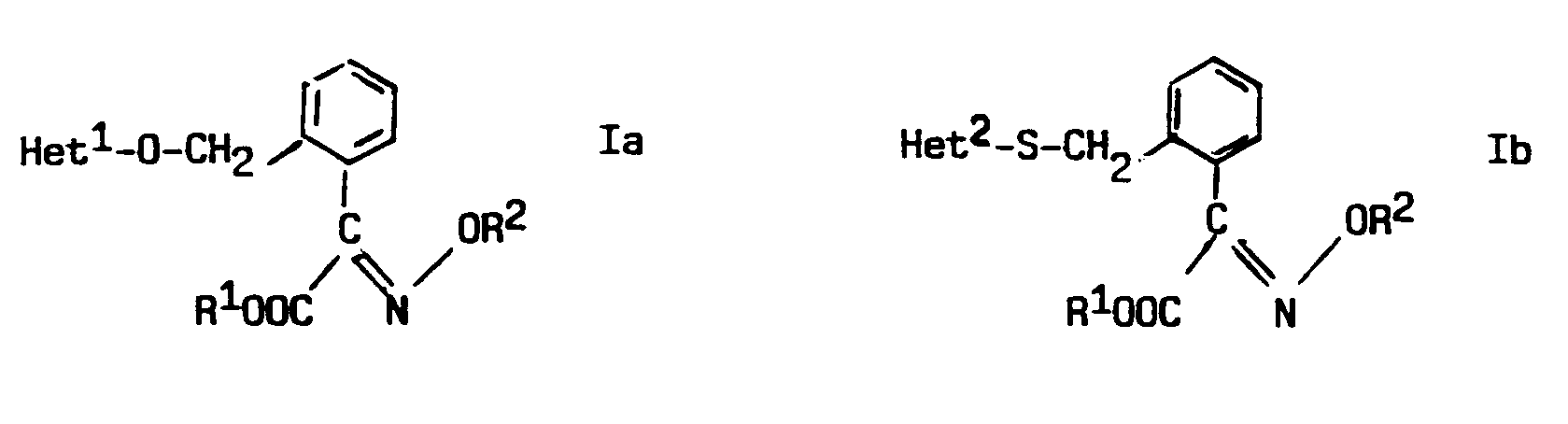
- R1 und R2 Wasserstoff oder C1-C5-Alkyl,
- Het1 Pyridyl, Chinolyl, Pyrimidinyl, Pyrazinyl, Pyridazinyl, Thienyl, Chinoxalinyl, Isoxazolyl, Benzoxazolyl oder Benzthiazolyl bedeutet, wobei das heterocyclische Ringsystem gegebenenfalls substituiert ist durch Halogen, C1-C8-Alkyl, C3-C6-Cycloalkyl, C1-C2-Halogenalkyl, C1-C4-Alkoxy, C1-C4-Alkoxy-C1-C4-alkyl, Phenyl, Phenyl-Ci-C4-alkyl, C1-C4-Alkylcarbonyl, C1-C4-Alkoxycarbonyl, Cyano,
- Het2 2-Pyridyl, 2-Chinolyl, 2-Pyrimidinyl bedeutet, wobei das heterocyclische Ringsystem gegebenenfalls substituiert ist durch Halogen, C1-C8-Alkyl, C3-C6-Cycloalkyl, C1-C2-Halogenalkyl, C1-C4-Alkoxy, C1-C4-Alkoxy-C1-C4-alkyl, Phenyl, Phenyl-C1-C4-alkyl, C1-C4-Alkylcarbonyl, C1-4-Alkoxycarbonyl, Cyano,
- Die in der allgemeinen Formel la und Ib aufgeführten Reste können beispielsweise folgende Bedeutung haben:
- R1 und R2 sind gleich oder verschieden und stehen z. B. für Wasserstoff, C1-C5-Alkyl, Methyl, Ethyl, Propyl, i-Propyl, Butyl, Pentyl.
- Het1 kann z. B. 2-Pyridyl, 3-Pyridyl, 4-Pyridyl, 2-Chinolyl, 3-Chinolyl, 4-Chinolyl, 8-Chinolyl, 2-Pyrimidinyl, 4-Pyrimidinyl, 5-Pyrimidinyl, 2-Pyrazinyl, 3-Pyridazinyl, 2-Thienyl, 3-Thienyl, 2-Chinoxalinyl, 5-lsoxazolyl, 2-Benzoxazolyl oder 2-Benzthiazolyl sein.
- Das heterocyclische Ringsystem Het1 und Het2 kann gegebenenfalls durch einen bis zu drei der folgenden Reste substituiert sein kann:
- Halogen (z. B. Fluor, Chlor, Brom), C1-C8-Alkyl (z. B. Methyl, Ethyl, n- oder iso-Propyl, n-, iso-, sec- oder tert.-Butyl, n-, iso-, sec.-, tert.- oder neo-Pentyl, Hexyl, Heptyl, Octyl), C3-C6-Cycloalkyl (z. B. Cyclopropyl, Cyclobutyl, Cyclopentyl, Cyclohexyl), C1-C2-Halogenalkyl (z. B. Difluormethyl, Trifluormethyl, Chlormethyl, Dichlormethyl, Trichlormethyl, Pentafluorethyl), C1-C4-Alkoxy (z. B. Methoxy, Ethoxy, n-oder iso-Propoxy, n-, iso-, sec.- oder tert.-Butoxy), C1-C4-Alkoxy-C1-C4-alkyl (z. B. Methoxymethyl, Ethoxymethyl, Methoxyethyl, Propoxymethyl), Phenyl, Phenyl-Ci-C4-alkyl (z. B. Benzyl, 2-Phenylethyl, 3-Phenylpropyl, 4-Phenylbutyl), C1-C4-Alkylcarbonyl (z. B. Acetyl, Ethylcarbonyl, Propylcarbonyl, Butylcarbonyl), C1-C4-Alkoxycarbonyl (z. B. Methoxycarbonyl, Ethoxycarbonyl, Propoxycarbonyl, Butoxycarbonyl), Cyano.
- Die neuen Verbindungen können durch Umsetzung mit Säuren auch in pflanzenverträgliche Säureadditionssalze der anorganischen oder organischen Säuren überführt werden, wie beispielsweise in Salze der Salzsäure, Bromwasserstoffsäure, Salpetersäure, Oxalsäure, Essigsäure, Schwefelsäure, Phosphorsäure oder Dodecylbenzolsulfonsäure. Die Wirksamkeit der Salze geht auf das Kation zurück, so daß die Wahl des Anions im allgemeinen beliebig ist.
- Ferner lassen sich die neuen Verbindungen nach bekannten Methoden in Metallkomplexe überführen. Das kann durch Umsetzung dieser Verbindungen mit Metallsalzen, z. B. der Metalle Kupfer, Zink, Eisen, Mangan oder Nickel, beispielsweise Kupfer(II)-chlorid, Zink(II)-chlorid, Eisen(III)-chlorid, Kupfer(II)-nitrat, Mangan(II)-chlorid oder Nickel(II)-bromid erfolgen.
- Durch Umsetzung der neuen Verbindungen mit Oxidationsmitteln z. B. mit m-Chlorperbenzosäure erhält man die N-Oxide der heterocyclischen Verbindungen.
- Die neuen Verbindungen der Formel la und Ib können bei ihrer Herstellung aufgrund der C = N-Doppelbindung als E/Z-Isomerengemische anfallen, die in üblicher Weise, z. B. durch Kristallisation oder Chromatographie, in die einzelnen Komponenten getrennt werden können. Sowohl die einzelnen isomeren Verbindungen als auch ihre Gemische werden von der Erfindung umfaßt und sind als Fungizide brauchbar.
- Die neuen Verbindungen der allgemeinen Formel la und Ib lassen sich beispielsweise herstellen, indem man die heterocyclischen Verbindungen der Formeln Het'-O-H (Ila) oder Het2-S-H (Ilb) mit einem Benzylhalogenid der allgemeinen Formel 111 umsetzt (Hal = Cl, Br, J). z.B.

- Alternativ kann auch so vorgegangen werden, daß man die Verbindungen der allgemeinen Formel Ila bzw. Ilb zunächst mit einer Base (z. B. Natriumhydroxid oder Kaliumhydroxid) in die entsprechenden Natrium-oder Kaliumsalze überführt und diese dann in einem inerten Lösungs-oder Verdünnungsmittel (z. B. Dimethylformamid) mit den Benzylhalogeniden der Formel III zu den entsprechenden Verbindungen der allgemeinen Formel I umsetzt.
- Die heterocyclischen Ausgangsverbindungen der allgemeinen Formel Ila und Ilb sind entweder bekannt oder können durch Verfahren analog zu bekannten Verfahren hergestellt werden. Entsprechende Herstellverfahren sind z. B. beschrieben in EP-A-224 217; DE-A-25 31 035; J. Heterocyclic Chem. 20 (1983) 219; J. Heterocyclic Chem. 24 (1987) 709.
- Die ortho-substituierten Benzylhalogenide der Formel III lassen sich herstellen, indem man literaturbekannte a-Ketocarbonsäureester der Formel IV (vgl. z. B. J. H. Photis, Tetrahedron Lett. 1980, 3539) nach literaturbekannten Methoden an der Methylgruppe halogeniert.

- Die Halogenide der Formel III lassen sich herstellen, indem man einen a-Ketocarbonsäureester der Formel V z.B. a) mit O-substituierten Hydroxylaminen der Formel H2N-OR2 umsetzt, in der R2 die obengenannten Bedeutungen hat, oder b) mit Hydroxylamin zum entsprechenden Oxim umsetzt und danach mit einem Alkylhalogenid der Formel R2-Hal in der R2 die obengenannten Bedeutungen hat und Hal ein Halogenatom (F, Cl, Br, J) bedeutet, oder mit einem Dialkylsulfat umsetzt.
- Die Halogenide der Formel III lassen sich auch herstellen, indem man einen a-Ketocarbonsäureester der Formel IV z.B. a) mit O-substituierten Hydroxylaminen der Formel H2N-OR2 umsetzt, in der R2 die obengenannten Bedeutungen hat, oder b) mit Hydroxylamin zum entsprechenden Oxim umsetzt und danach mit einem Alkylhalogenid der Formel R2-Hal in der R2 die obengenannten Bedeutungen hat und Hal ein Halogenatom (F, Cl, Br, J) bedeutet, oder mit einem Dialkylsulfat zu Oximether-Derivaten der allgemeinen Formel VI umsetzt, wobei R1 und R2 die jeweils oben genannten Bedeutungen haben.

- Die neuen Verbindungen der Formel I können zum Beispiel auch in der Weise hergestellt werden, daß man die neuen a-Ketocarbonsäureester der der Formel VII, worin Het-X = Het1-O oder Het2-S

- a) mit O-substituierten Hydroxylaminen der Formel H2 NOR2 umsetzt, in der R2 die obengenannten Bedeutungen hat, oder
- b) mit Hydroxylamin zum entsprechenden Oxim und danach mit einem Alkylhalogenid der Formel R2- Hal, in der R2 die obengenannten Bedeutungen hat und Hal ein Halogenatom (F, Cl, Br, J) bedeutet, oder mit einem Dialkylsulfat umsetzt.
- Die neuen a-Ketocarbonsäureester der allgemeinen Formel VII, worin Het-X = Het1-O oder Het2-O, sind wertvolle Zwischenprodukte. Sie können zum Beispiel hergestellt werden, indem man die obengenannte Verbindung der Formel V mit den heterocyclischen Verbindungen der Formel 11 umsetzt.

- Alternativ kann auch so vorgegangen werden, daß man die Verbindungen der allgemeinen Formel 11 zunächst mit einer Base (z. B. Natriumhydroxid oder Kaliumhydroxid) in die entsprechenden Natrium-oder Kaliumsalze überführt und diese dann in einem inerten Lösungs-oder Verdünnungsmittel (z. B. Dimethylformamid) mit den Benzylhalogeniden der Formel V zu den neuen a-Ketocarbonsäureestern der allgemeinen Formel VII umsetzt.
- Die folgenden Beispiele sollen die Herstellung der neuen Wirkstoffe der allgemeinen Formel I erläutern.
- 5,34 g (30 mmol) 2-Methylphenylglyoxylsäuremethylester und 5,34 g (30 mmol) N-Bromsuccinimid werden in 1000 I Tetrachlormethan für eine Stunde mit einer 300 W-Hg-Dampf-Lampe bestrahlt. Dann wird die organische Phase 1x mit Wasser und 3x mit Natriumhydrogencarbonat-Lösung gewaschen und über Natriumsulfat/Natriumcarbonat getrocknet. Nach dem Einengen wird das Rohprodukt an Kieselgel mit Methyl-t.-Butylether/n-Hexan (1/9) chromatographiert. Man erhält 3,8 g (49 %) der obengenannten Verbindungen als gelbes öl.
- 1H-NMR (CDCl3):
- 5 = 3,97 (s, 3H), 4,90 (s, 2H), 7,4-7,8 (m, 4H).
- IR (Film):
- 2955, 1740, 1689, 1435, 1318, 1207, 999 cm-1
- 100 g (0,56 mol) 2-Methylphenylglyoxylsäuremethylester werden in 600 ml Tetrachlormethan vorgelegt. Dann wird unter Bestrahlung mit einer 300 W-Hg-Dampf-Lampe auf Rückfluß erhitzt und dabei 28 g (0,39 mol) Chlorgas eingeleitet. Nach ca. 50 % Umsatz (DC-Kontrolle) wird die Reaktion abgebrochen und es wird eingeengt. Anschließend wird fraktioniert destilliert. Man erhält 29 g als öl.
- 1H-NMR (CDCl3):
- 5 = 3,97 (s, 3H), 5,0 (s, 2H), 7,4-7,8 (m, 4H).
- 27,5 g (0,133 mol) 2-Methyl-phenylglyoxylsäuremethylester-O-methyloxim gelöst in 400 ml Tetrachlormethan werden unter Rühren mit 21,4 g (0,133 mol) Brom versetzt. Dann wird unter Bestrahlung mit einer 300 W-Hg-Dampf-Lampe vier Stunden auf Rückflußtemperatur erhitzt. Danach wird eingeengt, in Essigester/Wasser aufgenommen, mit H20 gewaschen, mit Natriumsulfat getrocknet und eingeengt. Das Rohprodukt wird mit Cyclohexan/Essigester (9/1) an Kieselgel chromatographisch gereinigt. Es werden 17,4 g (46 %) der oben genannten Verbindung als öl erhalten.
- 1H (CDCl3):
- 5 = 3,88 /s, 3H), 4,08 (s, 3H), 4,33 (s, 2H), 6,12-7,52 (m, 4H).
- 4,85 g (37 mmol) 2-Hydroxy-6-methylpyridin-Natriumsalz werden zusammen mit 0,1 g Kaliumjodid in 100 ml absolutem N,N-Dimethylformamid vorgelegt. Dann werden unter Rühren bei Raumtemperatur (20 °C) 5,3 g (18,5 mmol) 2-(Brommethyl)-phenylglyoxylsäuremethylester-O-methyloxim, gelöst in 50 ml absolutem N,N-Dimethylformamid, zugetropft. Nachdem 5 Stunden bei 100 ° C gerührt worden ist, wird eingeengt und der Rückstand in Essigester aufgenommen. Es wird mit H20 gewaschen, über Natriumsulfat getrocknet und eingeengt. Das Rohprodukt wird durch Verreiben mit n-Pentan zur Kristallisation gebracht. Die Kristalle werden isoliert und getrocknet. Man erhält 1,2 g (21 % Ausbeute) der oben genannten Verbindung (Fp = 67-72 ° C).
- 1H-NMR (CDCl3):
- δ = 2,41 (s, 3H), 3,83 (s, 3H), 4,02 (s, 3H), 5,22 (s, 2H), 6,47 (d, 1 H), 6,67 (d, 1 H), 7,18-7,60 (m, 5H).
- In entsprechender Weise können die in der folgenden Tabelle aufgeführten Verbindungen hergestellt werden.


- Die neuen Verbindungen zeichnen sich, allgemein ausgedrückt, durch eine hervorragende Wirksamkeit gegen ein breites Spektrum von pflanzenpathogenen Pilzen, insbesondere aus der Klasse der Ascomyceten und Basidiomyceten, aus. Sie sind zum Teil systemisch wirksam und können als Blatt- und Bodenfungizide eingesetzt werden.
- Besonders interessant sind die fungiziden Verbindungen für die Bekämpfung einer Vielzahl von Pilzen an verschiedenen Kulturpflanzen oder ihren Samen, insbesondere Weizen, Roggen, Gerste, Hafer, Reis, Mais, Rasen, Baumwolle, Soja, Kaffee, Zuckerrohr, Obst und Zierpflanzen im Gartenbau, Weinbau sowie Gemüse - wie Gurken, Bohnen und Kürbisgewächse -.
- Die neuen Verbindungen sind insbesondere geeignet zur Bekämpfung folgender Pflanzenkrankheiten:
- Erysiphe graminis (echter Mehltau) in Getreide,
- Erysiphe cichoracearum und Sphaerotheca fuliginea an Kürbisgewächsen,
- Podosphaera leucotricha an Äpfeln,
- Uncinula necator an Reben,
- Puccinia-Arten an Getreide,
- Rhizoctonia-Arten an Baumwolle und Rasen,
- Ustilago-Arten an Getreide und Zuckerrohr,
- Venturia inaequalis (Schorf) an Äpfeln,
- Helminthosporium-Arten an Getreide,
- Septoria nodorum an Weizen,
- Botrytis cinerea (Grauschimmel) an Erdbeeren, Reben,
- Cercospora arachidicola an Erdnüssen,
- Pseudocercosporella herpotrichoides an Weizen, Gerste,
- Pyricularia oryzae an Reis,
- Phytophthora infestans an Kartoffeln und Tomaten,
- Fusarium- und Verticillium-Arten an verschiedenen Pflanzen,
- Plasmopara viticola an Reben,
- Alternaria-Arten an Gemüse und Obst.
- Die Verbindungen werden angewendet, indem man die Pflanzen mit den Wirkstoffen besprüht oder bestäubt oder die Samen der Pflanzen mit den Wirkstoffen behandelt. Die Anwendung erfolgt vor oder nach der Infektion der Pflanzen oder Samen durch die Pilze.
- Die neuen Substanzen können in die üblichen Formulierungen übergeführt werden, wie Lösungen, Emulsionen, Suspensionen, Stäube, Pulver, Pasten und Granulate. Die Anwendungsformen richten sich ganz nach den Verwendungszwecken; sie sollen in jedem Fall eine feine und gleichmäßige Verteilung der wirksamen Substanz gewährleisten. Die Formulierungen werden in bekannter Weise hergestellt, z.B. durch Verstrecken des Wirkstoffs mit Lösungsmitteln und/oder Trägerstoffen, gegebenenfalls unter Verwendung von Emulgiermitteln und Dispergiermitteln, wobei im Falle der Benutzung von Wasser als Verdünnungsmittel auch andere organische Lösungsmittel als Hilfslösungsmittel verwendet werden können. Als Hilfsstoffe kommen dafür im wesentlichen in Frage: Lösungsmittel wie Aromaten (z.B. Xylol), chlorierte Aromaten (z.B. Chlorbenzole), Paraffine (z.B. Erdölfraktionen), Alkohole (z.B. Methanol, Butanol), Ketone (z.B. Cyclohexanon), Amine (z.B. Ethanolamin, Dimethylformamid) und Wasser; Trägerstoffe wie natürliche Gesteinsmehle (z.B. Kaoline, Tonerden, Talkum, Kreide) und synthetische Gesteinsmehle (z.B. hochdisperse Kieselsäure, Silikate) ; Emulgiermittel, wie nichtionogene und anionische Emulgatoren (z.B. Polyoxyethylen-FettalkoholEther, Alkylsulfonate und Arylsulfonate) und Dispergiermittel, wie Lignin, Sulfitablaugen und Methylcellulose.
- Die fungiziden Mittel enthalten im allgemeinen zwischen 0,1 und 95, vorzugsweise zwischen 0,5 und 90 Gew.% Wirkstoff.
- Die Aufwandmengen liegen je nach Art des gewünschten Effektes zwischen 0,02 und 3 kg Wirkstoff oder mehr je ha. Die neuen Verbindungen können auch im Materialschutz eingesetzt werden, z.B. gegen Paecilomyces variotii.
- Die Mittel bzw. die daraus hergestellten gebrauchsfertigen Zubereitungen, wie Lösungen, Emulsionen, Suspensionen, Pulver, Stäube, Pasten oder Granulate werden in bekannter Weise angewendet, beispielsweiise durch Versprühen, Vernebeln, Verstäuben, Verstreuen, Beizen oder Gießen.
- Beispiele für solche Zubereitungen sind:
- I. Man vermischt 90 Gew.-Teile der Verbindung Nr. 2 mit 10 Gew.-Teilen N-Methyl-a-pyrrolidon und erhält eine Lösung, die zur Anwendung in Form kleinster Tropfen geeignet ist.
- 11. 20 Gew.-Teile der Verbindung Nr. 5 werden in einer Mischung gelöst, die aus 80 Gew.-Teilen Xylol, 10 Gew.-Teilen des Anlagerungsproduktes von 8 bis 10 Mol Ethylenoxid an 1 Mol ölsäure-N-monoethanolamid, 5 Gew.-Teilen Calciumsalz der Dodecylbenzolsulfonsäure und 5 Gew.-Teilen des Anlagerungsproduktes und 40 Mol Ethylenoxid an 1 Mol Ricinusöl besteht. Durch Ausgießen und feines Verteilen der Lösung in Wasser erhält man eine wäßrige Dispersion.
- 111. 20 Gew.-Teile der Verbindung Nr. 8 werden in einer Mischung gelöst, die aus 40 Gew.-Teilen Cyclohexanon, 30 Gew.-Teilen Isobutanol, 20 Gew.-Teilen des Anlagerungsproduktes von 40 Mol Ethylenoxid an 1 Mol Ricinusöl besteht. Durch Eingießen und feines Verteilen der Lösung in Wasser erhält man eine wäßrige Dispersion.
- IV. 20 Gew.-Teile der Verbindung Nr. 12 werden in einer Mischung gelöst, die aus 25 Gew.-Teilen Cyclohexanol, 65 Gew.-Teilen einer Mineralölfraktion vom Siedepunkt 210 bis 280 °C und 10 Gew.-Teilen des Anlagerungsproduktes von 40 Mol Ethylenoxid an 1 Mol Ricinusöl besteht. Durch Eingießen und feines Verteilen der Lösung in Wasser erhält man eine wäßrige Dispersion.
- V. 80 Gew.-Teile der Verbindung Nr. 2 werden mit 3 Gew.-Teilen des Natriumsalzes der Diisobutylnaphthalin-a-sulfonsäure, 10 Gew.-Teilen des Natriumsalzes einer Ligninsulfonsäure aus einer Sulfitablauge und 7 Gew.-Teilen pulverförmigem Kieselsäuregel gut vermischt und in einer Hammermühle vermahlen. Durch feines Verteilen der Mischung in Wasser erhält man eine Spritzbrühe.
- Vl. 3 Gew.-Teile der Verbindung Nr. 5 werden mit 97 Gew.-Teilen feinteiligem Kaolin innig vermischt. Man erhält auf diese Weise ein Stäubemittel, das 3 Gew.% des Wirkstoffs enthält.
- VII. 30 Gew.-Teile der Verbindung Nr. 8 werden mit einer Mischung aus 92 Gew.-Teilen pulverförmigem Kieselsäuregel und 8 Gew.-Teilen Paraffinöl, das auf die Oberfläche dieses Kieselsäuregels gesprüht wurde, innig vermischt. Man erhält auf diese Weise eine Aufbereitung des Wirkstoffs mit guter Haftfähigkeit.
- VIII. 40 Gew.-Teile der Verbindung Nr. 12 werden mit 10 Gew.-Teilen Natriumsalz eines Phenolsulfonsäure-harnstoff-formaldehyd-KondenX sates, 2 Gew.-Teilen Kieselgel und 48 Gew.-Teilen Wasser innig vermischt. Man erhält eine stabile wäßrige Dispersion. Durch Verdünnen mit Wasser erhält man eine wäßrige Dispersion.
- IX. 20 Gew.-Teile der Verbindung Nr. 2 werden mit 2 Gew.-Teilen Calciumsalz der Dodecylbenzolsulfonsäure, 8 Gew.-Teilen Fettalkoholpolyglykolether, 2 Gew.-Teilen Natriumsalz eines Phenolsulfonsäureharnstoff-formaldehyd-Kondensats und 68 Gew.-Teilen eines paraffinischen Mineralöls innig vermischt. Man erhält eine stabile ölige Dispersion.
- Die erfindungsgemäßen Mittel können in diesen Anwendungsformen auch zusammen mit anderen Wirkstoffen vorliegen, wie z.B. Herbiziden, Insektiziden, Wachstumsregulatoren und Fungiziden, oder auch mit Düngemitteln vermischt und ausgebracht werden. Beim Vermischen mit Fungiziden erhält man dabei in vielen Fällen eine Vergrößerung des fungiziden Wirkungsspektrums.
- Als Vergleichswirkstoff wurde 2-(Phenyloxymethyl)-phenylglyoxylsäuremethylester-O-methyloXim (A) - bekannt aus EP-A-253 213 - benutzt.
- Blätter von Topfreben der Sorte "Müller Thurgau" wurden mit wäßriger Spritzbrühe, die 80 % Wirkstoff und 20 % Emulgiermittel in der Trockensubstanz enthielt, besprüht. Um die Wirkungsdauer der Wirkstoffe beurteilen zu können, wurden die Pflanzen nach dem Antrocknen des Spritzbelages 8 Tage im Gewächshaus aufgestellt. Erst dann wurden die Blätter mit einer Zoosporenaufschwemmung von Plasmopara viticola (Rebenperonospora) infiziert. Danach wurden die Reben zunächst für 48 Stunden in einer wasserdampfgesättigten Kammer bei 24 °C und anschließend für 5 Tage in einem Gewächshaus mit Temperaturen zwischen 20 und 30 °C aufgestellt. Nach dieser Zeit wurden die Pflanzen zur Beschleunigung des sporangienträgerausbruches abermals für 16 Stunden in der feuchten Kammer aufgestellt. Dann erfolgte die Beurteilung des Ausmaßes des Pilzausbruches auf den Blattunterseiten.
- Das Ergebnis zeigt, daß die Wirkstoffe Nr. 2, 3, 5, 8, 9, 12, 27, 50, und 189 bei der Anwendung als 0,05; 0,025 und 0,0125 %ige (Gew.-%) Spritzbrühen eine bessere fungizide Wirkung zeigen (100 %) als der bekannte Vergleichswirkstoff A (90 %).
- Blätter von Topfpflanzen der Sorte "Große Fleischtomate" wurden mit wäßriger Spritzbrühe, die 80 % Wirkstoff und 20 % Emulgiermittel in der Trockensubstanz enthielt, besprüht. Nach 24 Stunden wurden die Blätter mit einer Zoosporenaufschwemmung des Pilzes Phytophthora infestans infiziert. Die Pflanzen wurden dann in einer wasserdampfgesättigten Kammer bei Temperaturen zwischen 16 und 18 ° C aufgestellt. Nach 6 Tagen hatte sich die Krankheit auf den unbehandelten, jedoch infizierten Kontrollpflanzen so stark entwickelt, daß die fungizide Wirksamkeit der Substanzen beurteilt werden konnte.
- Das Ergebnis zeigt, daß der Wirkstoff Nr. 2 bei der Anwendung als 0,025 %ige Spritzbrühe eine bessere fungizide Wirkung zeigt (90 %) als der bekannte Vergleichswirkstoff A (55 %).
- Gerstenkeimlinge der Sorte "Igri" wurden im Zweiblattstadium mit wäßrigen Suspensionen, die 80 % Wirkstoff und 20 % Emulgator in der Trockensubstanz enthielten, tropfnaß gespritzt. Nach 24 Stunden wurden die Pflanzen mit einer Sporensuspension des Pilzes Pyrenophora teres inokuliert und für 48 Stunden in eine Klimakammer mit hoher Luftfeuchtigkeit bei 18 ° C gestellt. Anschließend wurden die Pflanzen im Gewächshaus bei 20 - 22 ° C und 70 % relativer Luftfeuchtigkeit für weitere 5 Tage kultiviert. Dann wurde das Ausmaß des Befalls der Blätter ermittelt.
- Das Ergebnis zeigt, daß die Wirkstofe Nr. 5, 8, 12, 13, 50 bei der Anwendung als 0,05 %ige Spritzbrühe eine bessere fungizide Wirkung zeigen (97 %) als der bekannte Vergleichswirkstoff A (55 %).
sowie ihre pflanzenverträglichen Säureadditionssalze, Metallkomplexverbindungen und ihre N-Oxide eine ausgezeichnete fungizide Wirkung besitzen.
Claims (9)

sowie ihre pflanzenverträglichen Säureadditionssalze, Metallkomplexverbindungen und ihre N-Oxide.


Priority Applications (1)
| Application Number | Priority Date | Filing Date | Title |
|---|---|---|---|
| AT89118472T ATE103900T1 (de) | 1988-10-14 | 1989-10-05 | Oximether-derivate, verfahren zu ihrer herstellung und diese enthaltende fungizide. |
Applications Claiming Priority (2)
| Application Number | Priority Date | Filing Date | Title |
|---|---|---|---|
| DE3835028 | 1988-10-14 | ||
| DE3835028A DE3835028A1 (de) | 1988-10-14 | 1988-10-14 | Oximether-derivate, verfahren zu ihrer herstellung und diese enthaltende fungizide |
Publications (2)
| Publication Number | Publication Date |
|---|---|
| EP0363818A1 EP0363818A1 (de) | 1990-04-18 |
| EP0363818B1 true EP0363818B1 (de) | 1994-04-06 |
Family
ID=6365127
Family Applications (1)
| Application Number | Title | Priority Date | Filing Date |
|---|---|---|---|
| EP89118472A Expired - Lifetime EP0363818B1 (de) | 1988-10-14 | 1989-10-05 | Oximether-Derivate, Verfahren zu ihrer Herstellung und diese enthaltende Fungizide |
Country Status (13)
| Country | Link |
|---|---|
| US (3) | US5334577A (de) |
| EP (1) | EP0363818B1 (de) |
| JP (1) | JP2888882B2 (de) |
| KR (1) | KR0138107B1 (de) |
| AT (1) | ATE103900T1 (de) |
| AU (1) | AU626327B2 (de) |
| CA (1) | CA1341163C (de) |
| DE (2) | DE3835028A1 (de) |
| ES (1) | ES2063094T3 (de) |
| HU (1) | HU202838B (de) |
| IL (1) | IL91783A (de) |
| NZ (1) | NZ230994A (de) |
| ZA (1) | ZA897760B (de) |
Cited By (1)
| Publication number | Priority date | Publication date | Assignee | Title |
|---|---|---|---|---|
| CN102964309A (zh) * | 2012-09-07 | 2013-03-13 | 开封田威生物化学有限公司 | 一种异恶唑基取代的甲氧丙烯酸酯类化合物及其制备方法 |
Families Citing this family (39)
| Publication number | Priority date | Publication date | Assignee | Title |
|---|---|---|---|---|
| JPH076057B2 (ja) * | 1988-06-07 | 1995-01-25 | 株式会社村田製作所 | マスキング用ホルダー |
| US4919076A (en) * | 1988-10-03 | 1990-04-24 | International Business Machines Corporation | Reusable evaporation fixture |
| DE3835028A1 (de) * | 1988-10-14 | 1990-04-19 | Basf Ag | Oximether-derivate, verfahren zu ihrer herstellung und diese enthaltende fungizide |
| DE3923068A1 (de) * | 1989-07-13 | 1991-01-24 | Basf Ag | Verfahren zur bekaempfung von schaedlingen mittels substituierter pyrimidine |
| DE4037003A1 (de) * | 1990-05-30 | 1991-12-05 | Bayer Ag | Substituierte azine |
| PH11991042549B1 (de) * | 1990-06-05 | 2000-12-04 | ||
| MX26077A (es) | 1990-06-05 | 1993-10-01 | Ciba Geigy Ag | Esteres de oxima y procedimiento para su preparacion |
| DE4103695A1 (de) * | 1991-02-07 | 1992-08-13 | Basf Ag | Oximether und diese enthaltende fungizide |
| GB9122098D0 (en) * | 1991-10-17 | 1991-11-27 | Ici Plc | Fungicides |
| US5281713A (en) * | 1991-12-20 | 1994-01-25 | American Cyanamid Company | Process for the manufacture of 2-alkoxymethylacrolein |
| TW224042B (de) | 1992-04-04 | 1994-05-21 | Basf Ag | |
| DE4305502A1 (de) * | 1993-02-23 | 1994-08-25 | Basf Ag | Ortho-substituierte 2-Methoxyiminophenylessigsäuremethylamide |
| DE4313267A1 (de) * | 1993-04-23 | 1994-10-27 | Basf Ag | Diarylderivate und deren Verwendung als Pflanzenschutzmittel |
| DE4405428A1 (de) * | 1993-07-05 | 1995-03-30 | Bayer Ag | 2-Oximino-2-thienyl-essigsäurederivate |
| CN1100764C (zh) * | 1994-11-17 | 2003-02-05 | 巴斯福股份公司 | 2-[(2-烷氧基-6-三氟甲基嘧啶-4-基)氧亚甲基]苯基乙酸衍生物、其制备和中间体以及应用 |
| CN1182423A (zh) * | 1995-02-24 | 1998-05-20 | 纳幕尔杜邦公司 | 杀菌环酰胺 |
| KR100418807B1 (ko) * | 1995-06-28 | 2004-06-12 | 신젠타 리미티드 | 2-(6-치환된-피리드-2-일옥시메틸)페닐아세테이트의제조방법 |
| GB9521343D0 (en) * | 1995-10-18 | 1995-12-20 | Zeneca Ltd | Fungicides |
| EP0873316B1 (de) * | 1995-12-14 | 2002-05-29 | Basf Aktiengesellschaft | 2-(o- pyrimidin-4-yl]methylenoxy)phenylessigsäure-derivate und ihre verwendung zur bekämpfung von schadpilzen und tierischen schädlingen |
| DE59605241D1 (de) * | 1996-01-03 | 2000-06-21 | Novartis Ag | Verfahren zur Herstellung o-Chlor-Methyl-Phenylglyoxylsäure-Derivaten |
| GB9602623D0 (en) * | 1996-02-09 | 1996-04-10 | Zeneca Ltd | Fungicides |
| DE19605903A1 (de) * | 1996-02-17 | 1997-08-21 | Basf Ag | Pyridyl-phenyl- und -benzylether, Verfahren und Zwischenprodukte zu ihrer Herstellung und ihre Verwendung |
| DE19609618A1 (de) * | 1996-03-12 | 1997-09-18 | Basf Ag | Pyrimidylphenyl- und -benzylether, Verfahren und Zwischenprodukte zu ihrer Herstellung und ihre Verwendung |
| US5968875A (en) * | 1997-02-03 | 1999-10-19 | Dow Agrosciences Llc | 2-methoxyimino-2-(pyridinyloxymethyl)phenyl acetamides with carboxylic acid derivatives on the pyridine ring |
| AU1459999A (en) | 1997-11-14 | 1999-06-07 | Dow Agrosciences Llc | 2-methoxyimino-2-phenyl acetamides containing a ketal- or dialkoxy substituted pyridine moiety, their preparation and their use as fungicides |
| KR20010079852A (ko) * | 1998-09-16 | 2001-08-22 | 케네쓰 엘. 로에르트셔 | 살진균제로서 피리딘 환 상에 5원 헤테로사이클릭 환을갖는 2-메톡시이미노-2-(피리디닐옥시메틸)페닐아세트아미드 |
| WO2000015616A1 (en) | 1998-09-16 | 2000-03-23 | Dow Agrosciences Llc | 2-methoxyimino-2-(pyridinyloxymethyl)phenyl acetamides with (derivatised) hydroxyalkyl derivatives on the pyridine ring |
| US6369083B1 (en) | 1998-09-16 | 2002-04-09 | Dow Agrosciences Llc | 2-methoxyimino-2 (pyrinyloxymethyl) phenyl acetamides with polyether derivatives on the pyridine ring |
| CN1409705A (zh) | 1999-12-15 | 2003-04-09 | 美国陶氏益农公司 | 具有杀真菌活性的吡啶衍生物和其制备方法及使用方法 |
| KR100427262B1 (ko) * | 2001-07-16 | 2004-04-14 | 한국화학연구원 | 살균활성을 가지는 유황함유 메톡시 아크릴레이트 유도체 |
| CA2479744A1 (en) | 2002-03-28 | 2003-10-09 | Paul E. Finke | Substituted 2,3-diphenyl pyridines |
| US6846561B1 (en) * | 2003-08-06 | 2005-01-25 | Fina Technology, Inc. | Bicomponent fibers of isotactic and syndiotactic polypropylene |
| CN1310899C (zh) * | 2003-11-11 | 2007-04-18 | 沈阳化工研究院 | 具有杀虫、杀菌活性的苯并吡喃酮类化合物及制备与应用 |
| CN100427481C (zh) | 2005-05-26 | 2008-10-22 | 沈阳化工研究院 | 一种芳基醚类化合物及其制备与应用 |
| CN101311170B (zh) | 2007-05-25 | 2010-09-15 | 中国中化股份有限公司 | 取代嘧啶醚类化合物及其应用 |
| CN101941921B (zh) * | 2010-09-03 | 2013-10-02 | 岳阳迪普化工技术有限公司 | 一种肟菌酯的制备方法 |
| WO2013144924A1 (en) | 2012-03-29 | 2013-10-03 | Rallis India Ltd. | An improved process for the synthesis of strobilurin fungicides viz trifloxystrobin and kresoxim-methyl |
| CN108314656B (zh) | 2018-02-27 | 2020-10-27 | 浙江工业大学 | 不饱和烃嘧啶硫醚类化合物及其制备方法与应用 |
| CN111807990B (zh) * | 2020-07-24 | 2021-03-02 | 阜新孚隆宝医药科技有限公司 | 一种用于制备肟菌酯的中间体及其合成方法 |
Family Cites Families (9)
| Publication number | Priority date | Publication date | Assignee | Title |
|---|---|---|---|---|
| US4347372A (en) * | 1978-09-01 | 1982-08-31 | Ciba-Geigy Corporation | Benzoxazolyl-glyoxylonitrile-2-oxime ether derivatives |
| GB2046255B (en) * | 1979-03-13 | 1983-05-11 | Sumitomo Chemical Co | Urea derivatives |
| US4322241A (en) * | 1979-08-07 | 1982-03-30 | Ciba-Geigy Corporation | Pyridyl-2-oxyphenyloxime derivatives, and their use as herbicides |
| DE2951362A1 (de) * | 1979-12-20 | 1981-07-02 | Erno Raumfahrttechnik Gmbh, 2800 Bremen | Plattenfoermiger sonnenkollektor |
| DE3623921A1 (de) * | 1986-07-16 | 1988-01-21 | Basf Ag | Oximether und diese enthaltende fungizide |
| GB8617648D0 (en) * | 1986-07-18 | 1986-08-28 | Ici Plc | Fungicides |
| EP0278595B2 (de) * | 1987-02-09 | 2000-01-12 | Zeneca Limited | Fungizide |
| IL87020A (en) * | 1987-07-11 | 1996-09-12 | Schering Agrochemicals Ltd | Acrylic acid derivatives and their use as pesticides |
| DE3835028A1 (de) * | 1988-10-14 | 1990-04-19 | Basf Ag | Oximether-derivate, verfahren zu ihrer herstellung und diese enthaltende fungizide |
-
1988
- 1988-10-14 DE DE3835028A patent/DE3835028A1/de not_active Withdrawn
-
1989
- 1989-09-26 CA CA000613193A patent/CA1341163C/en not_active Expired - Fee Related
- 1989-09-26 IL IL91783A patent/IL91783A/xx not_active IP Right Cessation
- 1989-10-05 DE DE89118472T patent/DE58907393D1/de not_active Expired - Fee Related
- 1989-10-05 AT AT89118472T patent/ATE103900T1/de not_active IP Right Cessation
- 1989-10-05 ES ES89118472T patent/ES2063094T3/es not_active Expired - Lifetime
- 1989-10-05 EP EP89118472A patent/EP0363818B1/de not_active Expired - Lifetime
- 1989-10-12 NZ NZ230994A patent/NZ230994A/en unknown
- 1989-10-13 JP JP1265337A patent/JP2888882B2/ja not_active Expired - Fee Related
- 1989-10-13 ZA ZA897760A patent/ZA897760B/xx unknown
- 1989-10-13 AU AU42820/89A patent/AU626327B2/en not_active Ceased
- 1989-10-13 HU HU895313A patent/HU202838B/hu not_active IP Right Cessation
- 1989-10-14 KR KR1019890014748A patent/KR0138107B1/ko not_active Expired - Fee Related
-
1990
- 1990-12-04 US US07/620,456 patent/US5334577A/en not_active Expired - Fee Related
-
1994
- 1994-05-04 US US08/237,841 patent/US5468717A/en not_active Expired - Fee Related
-
1995
- 1995-08-08 US US08/512,487 patent/US5554578A/en not_active Expired - Fee Related
Cited By (1)
| Publication number | Priority date | Publication date | Assignee | Title |
|---|---|---|---|---|
| CN102964309A (zh) * | 2012-09-07 | 2013-03-13 | 开封田威生物化学有限公司 | 一种异恶唑基取代的甲氧丙烯酸酯类化合物及其制备方法 |
Also Published As
| Publication number | Publication date |
|---|---|
| CA1341163C (en) | 2001-01-02 |
| JPH02164866A (ja) | 1990-06-25 |
| US5468717A (en) | 1995-11-21 |
| EP0363818A1 (de) | 1990-04-18 |
| AU4282089A (en) | 1990-04-26 |
| US5554578A (en) | 1996-09-10 |
| ATE103900T1 (de) | 1994-04-15 |
| KR900006286A (ko) | 1990-05-07 |
| DE58907393D1 (de) | 1994-05-11 |
| DE3835028A1 (de) | 1990-04-19 |
| HU202838B (en) | 1991-04-29 |
| NZ230994A (en) | 1992-02-25 |
| HUT52758A (en) | 1990-08-28 |
| IL91783A0 (en) | 1990-06-10 |
| HU895313D0 (en) | 1990-01-28 |
| US5334577A (en) | 1994-08-02 |
| IL91783A (en) | 1993-07-08 |
| ES2063094T3 (es) | 1995-01-01 |
| AU626327B2 (en) | 1992-07-30 |
| ZA897760B (en) | 1991-06-26 |
| JP2888882B2 (ja) | 1999-05-10 |
| KR0138107B1 (ko) | 1998-05-15 |
Similar Documents
| Publication | Publication Date | Title |
|---|---|---|
| EP0350691B2 (de) | Heterocyclisch substituierte alfa-Aryl-acrylsäureester und Fungizide, die diese Verbindungen enthalten | |
| EP0363818A1 (de) | Oximether-Derivate, Verfahren zu ihrer Herstellung und diese enthaltende Fungizide | |
| EP0383117B1 (de) | Pyridyl-substituierte Acrylsäureester | |
| EP0280185B1 (de) | Substituierte Crotonsäureester und diese enthalende Fungizide | |
| EP0400417A1 (de) | Neue Oximether und diese enthaltende Fungizide | |
| EP0386561B1 (de) | Substituierte Oximether und Fungizide, die diese Verbindungen enthalten | |
| DE4019307A1 (de) | 2-methoximinocarbonsaeureester | |
| EP0384211B1 (de) | Substituierte Acrylsäureester | |
| EP0432503B1 (de) | Thiolcarbonsäureester und diese enthaltende Fungizide | |
| EP0374811B1 (de) | Schwefelhaltige Oximether und diese enthaltende Fungizide | |
| DD283909A5 (de) | Fungizide mittel | |
| EP0407891A1 (de) | Neue 3-Methoximinopropionsäureester und diese enthaltende Fungizide | |
| EP0385224B1 (de) | Substituierte N-Hydroxypyrazole und Fungizide, die diese Verbindungen enthalten | |
| EP0331966A1 (de) | Substituierte Acrylsäureester | |
| EP0379098B1 (de) | Schwefelhaltige Acrylsäureester und diese enthaltende Fungizide | |
| EP0420091B1 (de) | Neue Anilinderivate und diese enthaltende Fungizide | |
| EP0400344B1 (de) | Pyridinderivate und ihre Verwendung als Fungizide | |
| EP0438726B1 (de) | Ungesättigte Cyclohexylessigsäurederivate und diese enthaltende Pflanzenschutzmittel | |
| EP0385357B1 (de) | Ortho-substituierte 1-Naphthylether und diese enthaltende Fungizide | |
| EP0463513B1 (de) | Benzylketone und diese enthaltende Fungizide | |
| EP0557860B1 (de) | Substituierte Pyridylpyrimidine und ihre Verwendung als Schädlingsbekämpfungsmittel | |
| EP0311907B1 (de) | 3-substituierte Pyridine und diese enthaltende Fungizide | |
| DE3724554A1 (de) | Substituierte 3-arylpyrrole | |
| EP0461487A2 (de) | Derivate des beta-Picolins und diese enthaltende Pflanzenschutzmittel | |
| DE4227073A1 (de) | Pyridylsubstituierte 1,3-Oxazolidin-Derivate |
Legal Events
| Date | Code | Title | Description |
|---|---|---|---|
| PUAI | Public reference made under article 153(3) epc to a published international application that has entered the european phase |
Free format text: ORIGINAL CODE: 0009012 |
|
| AK | Designated contracting states |
Kind code of ref document: A1 Designated state(s): AT BE CH DE ES FR GB GR IT LI NL SE |
|
| 17P | Request for examination filed |
Effective date: 19900306 |
|
| 17Q | First examination report despatched |
Effective date: 19900725 |
|
| GRAA | (expected) grant |
Free format text: ORIGINAL CODE: 0009210 |
|
| AK | Designated contracting states |
Kind code of ref document: B1 Designated state(s): AT BE CH DE ES FR GB GR IT LI NL SE |
|
| REF | Corresponds to: |
Ref document number: 103900 Country of ref document: AT Date of ref document: 19940415 Kind code of ref document: T |
|
| REF | Corresponds to: |
Ref document number: 58907393 Country of ref document: DE Date of ref document: 19940511 |
|
| GBT | Gb: translation of ep patent filed (gb section 77(6)(a)/1977) |
Effective date: 19940503 |
|
| ITF | It: translation for a ep patent filed | ||
| REG | Reference to a national code |
Ref country code: GR Ref legal event code: FG4A Free format text: 3011365 |
|
| ET | Fr: translation filed | ||
| REG | Reference to a national code |
Ref country code: ES Ref legal event code: FG2A Ref document number: 2063094 Country of ref document: ES Kind code of ref document: T3 |
|
| EAL | Se: european patent in force in sweden |
Ref document number: 89118472.3 |
|
| PLBE | No opposition filed within time limit |
Free format text: ORIGINAL CODE: 0009261 |
|
| STAA | Information on the status of an ep patent application or granted ep patent |
Free format text: STATUS: NO OPPOSITION FILED WITHIN TIME LIMIT |
|
| 26N | No opposition filed | ||
| PGFP | Annual fee paid to national office [announced via postgrant information from national office to epo] |
Ref country code: SE Payment date: 19980923 Year of fee payment: 10 |
|
| PGFP | Annual fee paid to national office [announced via postgrant information from national office to epo] |
Ref country code: GR Payment date: 19980930 Year of fee payment: 10 |
|
| PGFP | Annual fee paid to national office [announced via postgrant information from national office to epo] |
Ref country code: AT Payment date: 19981001 Year of fee payment: 10 |
|
| PGFP | Annual fee paid to national office [announced via postgrant information from national office to epo] |
Ref country code: BE Payment date: 19981008 Year of fee payment: 10 |
|
| PG25 | Lapsed in a contracting state [announced via postgrant information from national office to epo] |
Ref country code: AT Free format text: LAPSE BECAUSE OF NON-PAYMENT OF DUE FEES Effective date: 19991005 |
|
| PG25 | Lapsed in a contracting state [announced via postgrant information from national office to epo] |
Ref country code: SE Free format text: THE PATENT HAS BEEN ANNULLED BY A DECISION OF A NATIONAL AUTHORITY Effective date: 19991030 |
|
| PG25 | Lapsed in a contracting state [announced via postgrant information from national office to epo] |
Ref country code: GR Free format text: LAPSE BECAUSE OF NON-PAYMENT OF DUE FEES Effective date: 19991031 Ref country code: BE Free format text: LAPSE BECAUSE OF NON-PAYMENT OF DUE FEES Effective date: 19991031 |
|
| BERE | Be: lapsed |
Owner name: BASF A.G. Effective date: 19991031 |
|
| EUG | Se: european patent has lapsed |
Ref document number: 89118472.3 |
|
| REG | Reference to a national code |
Ref country code: GB Ref legal event code: IF02 |
|
| PGFP | Annual fee paid to national office [announced via postgrant information from national office to epo] |
Ref country code: FR Payment date: 20020920 Year of fee payment: 14 |
|
| PGFP | Annual fee paid to national office [announced via postgrant information from national office to epo] |
Ref country code: CH Payment date: 20020930 Year of fee payment: 14 |
|
| PGFP | Annual fee paid to national office [announced via postgrant information from national office to epo] |
Ref country code: GB Payment date: 20021003 Year of fee payment: 14 |
|
| PGFP | Annual fee paid to national office [announced via postgrant information from national office to epo] |
Ref country code: ES Payment date: 20021009 Year of fee payment: 14 |
|
| PGFP | Annual fee paid to national office [announced via postgrant information from national office to epo] |
Ref country code: NL Payment date: 20021011 Year of fee payment: 14 |
|
| PGFP | Annual fee paid to national office [announced via postgrant information from national office to epo] |
Ref country code: DE Payment date: 20021116 Year of fee payment: 14 |
|
| PG25 | Lapsed in a contracting state [announced via postgrant information from national office to epo] |
Ref country code: GB Free format text: LAPSE BECAUSE OF NON-PAYMENT OF DUE FEES Effective date: 20031005 |
|
| PG25 | Lapsed in a contracting state [announced via postgrant information from national office to epo] |
Ref country code: ES Free format text: LAPSE BECAUSE OF NON-PAYMENT OF DUE FEES Effective date: 20031006 |
|
| PG25 | Lapsed in a contracting state [announced via postgrant information from national office to epo] |
Ref country code: LI Free format text: LAPSE BECAUSE OF NON-PAYMENT OF DUE FEES Effective date: 20031031 Ref country code: CH Free format text: LAPSE BECAUSE OF NON-PAYMENT OF DUE FEES Effective date: 20031031 |
|
| PG25 | Lapsed in a contracting state [announced via postgrant information from national office to epo] |
Ref country code: NL Free format text: LAPSE BECAUSE OF NON-PAYMENT OF DUE FEES Effective date: 20040501 Ref country code: DE Free format text: LAPSE BECAUSE OF NON-PAYMENT OF DUE FEES Effective date: 20040501 |
|
| GBPC | Gb: european patent ceased through non-payment of renewal fee |
Effective date: 20031005 |
|
| REG | Reference to a national code |
Ref country code: CH Ref legal event code: PL |
|
| PG25 | Lapsed in a contracting state [announced via postgrant information from national office to epo] |
Ref country code: FR Free format text: LAPSE BECAUSE OF NON-PAYMENT OF DUE FEES Effective date: 20040630 |
|
| NLV4 | Nl: lapsed or anulled due to non-payment of the annual fee |
Effective date: 20040501 |
|
| REG | Reference to a national code |
Ref country code: FR Ref legal event code: ST |
|
| REG | Reference to a national code |
Ref country code: ES Ref legal event code: FD2A Effective date: 20031006 |
|
| PG25 | Lapsed in a contracting state [announced via postgrant information from national office to epo] |
Ref country code: IT Free format text: LAPSE BECAUSE OF NON-PAYMENT OF DUE FEES;WARNING: LAPSES OF ITALIAN PATENTS WITH EFFECTIVE DATE BEFORE 2007 MAY HAVE OCCURRED AT ANY TIME BEFORE 2007. THE CORRECT EFFECTIVE DATE MAY BE DIFFERENT FROM THE ONE RECORDED. Effective date: 20051005 |