EP0363941A2 - Pièces en plastique à faible friction et résistant à l'usure - Google Patents
Pièces en plastique à faible friction et résistant à l'usure Download PDFInfo
- Publication number
- EP0363941A2 EP0363941A2 EP89118916A EP89118916A EP0363941A2 EP 0363941 A2 EP0363941 A2 EP 0363941A2 EP 89118916 A EP89118916 A EP 89118916A EP 89118916 A EP89118916 A EP 89118916A EP 0363941 A2 EP0363941 A2 EP 0363941A2
- Authority
- EP
- European Patent Office
- Prior art keywords
- fluoride
- piston
- plastic
- sodium
- article
- Prior art date
- Legal status (The legal status is an assumption and is not a legal conclusion. Google has not performed a legal analysis and makes no representation as to the accuracy of the status listed.)
- Withdrawn
Links
Images



Classifications
-
- C—CHEMISTRY; METALLURGY
- C08—ORGANIC MACROMOLECULAR COMPOUNDS; THEIR PREPARATION OR CHEMICAL WORKING-UP; COMPOSITIONS BASED THEREON
- C08J—WORKING-UP; GENERAL PROCESSES OF COMPOUNDING; AFTER-TREATMENT NOT COVERED BY SUBCLASSES C08B, C08C, C08F, C08G or C08H
- C08J5/00—Manufacture of articles or shaped materials containing macromolecular substances
-
- C—CHEMISTRY; METALLURGY
- C08—ORGANIC MACROMOLECULAR COMPOUNDS; THEIR PREPARATION OR CHEMICAL WORKING-UP; COMPOSITIONS BASED THEREON
- C08J—WORKING-UP; GENERAL PROCESSES OF COMPOUNDING; AFTER-TREATMENT NOT COVERED BY SUBCLASSES C08B, C08C, C08F, C08G or C08H
- C08J7/00—Chemical treatment or coating of shaped articles made of macromolecular substances
- C08J7/12—Chemical modification
-
- C—CHEMISTRY; METALLURGY
- C08—ORGANIC MACROMOLECULAR COMPOUNDS; THEIR PREPARATION OR CHEMICAL WORKING-UP; COMPOSITIONS BASED THEREON
- C08J—WORKING-UP; GENERAL PROCESSES OF COMPOUNDING; AFTER-TREATMENT NOT COVERED BY SUBCLASSES C08B, C08C, C08F, C08G or C08H
- C08J7/00—Chemical treatment or coating of shaped articles made of macromolecular substances
- C08J7/04—Coating
- C08J7/0427—Coating with only one layer of a composition containing a polymer binder
-
- C—CHEMISTRY; METALLURGY
- C08—ORGANIC MACROMOLECULAR COMPOUNDS; THEIR PREPARATION OR CHEMICAL WORKING-UP; COMPOSITIONS BASED THEREON
- C08J—WORKING-UP; GENERAL PROCESSES OF COMPOUNDING; AFTER-TREATMENT NOT COVERED BY SUBCLASSES C08B, C08C, C08F, C08G or C08H
- C08J7/00—Chemical treatment or coating of shaped articles made of macromolecular substances
- C08J7/04—Coating
- C08J7/046—Forming abrasion-resistant coatings; Forming surface-hardening coatings
-
- F—MECHANICAL ENGINEERING; LIGHTING; HEATING; WEAPONS; BLASTING
- F16—ENGINEERING ELEMENTS AND UNITS; GENERAL MEASURES FOR PRODUCING AND MAINTAINING EFFECTIVE FUNCTIONING OF MACHINES OR INSTALLATIONS; THERMAL INSULATION IN GENERAL
- F16C—SHAFTS; FLEXIBLE SHAFTS; ELEMENTS OR CRANKSHAFT MECHANISMS; ROTARY BODIES OTHER THAN GEARING ELEMENTS; BEARINGS
- F16C33/00—Parts of bearings; Special methods for making bearings or parts thereof
- F16C33/02—Parts of sliding-contact bearings
- F16C33/04—Brasses; Bushes; Linings
- F16C33/20—Sliding surface consisting mainly of plastics
- F16C33/201—Composition of the plastic
-
- F—MECHANICAL ENGINEERING; LIGHTING; HEATING; WEAPONS; BLASTING
- F16—ENGINEERING ELEMENTS AND UNITS; GENERAL MEASURES FOR PRODUCING AND MAINTAINING EFFECTIVE FUNCTIONING OF MACHINES OR INSTALLATIONS; THERMAL INSULATION IN GENERAL
- F16D—COUPLINGS FOR TRANSMITTING ROTATION; CLUTCHES; BRAKES
- F16D13/00—Friction clutches
- F16D13/58—Details
-
- F—MECHANICAL ENGINEERING; LIGHTING; HEATING; WEAPONS; BLASTING
- F16—ENGINEERING ELEMENTS AND UNITS; GENERAL MEASURES FOR PRODUCING AND MAINTAINING EFFECTIVE FUNCTIONING OF MACHINES OR INSTALLATIONS; THERMAL INSULATION IN GENERAL
- F16D—COUPLINGS FOR TRANSMITTING ROTATION; CLUTCHES; BRAKES
- F16D65/00—Parts or details
- F16D65/14—Actuating mechanisms for brakes; Means for initiating operation at a predetermined position
-
- C—CHEMISTRY; METALLURGY
- C08—ORGANIC MACROMOLECULAR COMPOUNDS; THEIR PREPARATION OR CHEMICAL WORKING-UP; COMPOSITIONS BASED THEREON
- C08J—WORKING-UP; GENERAL PROCESSES OF COMPOUNDING; AFTER-TREATMENT NOT COVERED BY SUBCLASSES C08B, C08C, C08F, C08G or C08H
- C08J2383/00—Characterised by the use of macromolecular compounds obtained by reactions forming in the main chain of the macromolecule a linkage containing silicon with or without sulfur, nitrogen, oxygen, or carbon only; Derivatives of such polymers
- C08J2383/04—Polysiloxanes
-
- C—CHEMISTRY; METALLURGY
- C08—ORGANIC MACROMOLECULAR COMPOUNDS; THEIR PREPARATION OR CHEMICAL WORKING-UP; COMPOSITIONS BASED THEREON
- C08J—WORKING-UP; GENERAL PROCESSES OF COMPOUNDING; AFTER-TREATMENT NOT COVERED BY SUBCLASSES C08B, C08C, C08F, C08G or C08H
- C08J2427/00—Characterised by the use of homopolymers or copolymers of compounds having one or more unsaturated aliphatic radicals, each having only one carbon-to-carbon double bond, and at least one being terminated by a halogen; Derivatives of such polymers
- C08J2427/02—Characterised by the use of homopolymers or copolymers of compounds having one or more unsaturated aliphatic radicals, each having only one carbon-to-carbon double bond, and at least one being terminated by a halogen; Derivatives of such polymers not modified by chemical after-treatment
- C08J2427/12—Characterised by the use of homopolymers or copolymers of compounds having one or more unsaturated aliphatic radicals, each having only one carbon-to-carbon double bond, and at least one being terminated by a halogen; Derivatives of such polymers not modified by chemical after-treatment containing fluorine atoms
-
- F—MECHANICAL ENGINEERING; LIGHTING; HEATING; WEAPONS; BLASTING
- F05—INDEXING SCHEMES RELATING TO ENGINES OR PUMPS IN VARIOUS SUBCLASSES OF CLASSES F01-F04
- F05C—INDEXING SCHEME RELATING TO MATERIALS, MATERIAL PROPERTIES OR MATERIAL CHARACTERISTICS FOR MACHINES, ENGINES OR PUMPS OTHER THAN NON-POSITIVE-DISPLACEMENT MACHINES OR ENGINES
- F05C2251/00—Material properties
- F05C2251/04—Thermal properties
- F05C2251/042—Expansivity
-
- F—MECHANICAL ENGINEERING; LIGHTING; HEATING; WEAPONS; BLASTING
- F16—ENGINEERING ELEMENTS AND UNITS; GENERAL MEASURES FOR PRODUCING AND MAINTAINING EFFECTIVE FUNCTIONING OF MACHINES OR INSTALLATIONS; THERMAL INSULATION IN GENERAL
- F16D—COUPLINGS FOR TRANSMITTING ROTATION; CLUTCHES; BRAKES
- F16D2125/00—Components of actuators
- F16D2125/02—Fluid-pressure mechanisms
- F16D2125/06—Pistons
-
- Y—GENERAL TAGGING OF NEW TECHNOLOGICAL DEVELOPMENTS; GENERAL TAGGING OF CROSS-SECTIONAL TECHNOLOGIES SPANNING OVER SEVERAL SECTIONS OF THE IPC; TECHNICAL SUBJECTS COVERED BY FORMER USPC CROSS-REFERENCE ART COLLECTIONS [XRACs] AND DIGESTS
- Y10—TECHNICAL SUBJECTS COVERED BY FORMER USPC
- Y10T—TECHNICAL SUBJECTS COVERED BY FORMER US CLASSIFICATION
- Y10T428/00—Stock material or miscellaneous articles
- Y10T428/13—Hollow or container type article [e.g., tube, vase, etc.]
- Y10T428/131—Glass, ceramic, or sintered, fused, fired, or calcined metal oxide or metal carbide containing [e.g., porcelain, brick, cement, etc.]
- Y10T428/1314—Contains fabric, fiber particle, or filament made of glass, ceramic, or sintered, fused, fired, or calcined metal oxide, or metal carbide or other inorganic compound [e.g., fiber glass, mineral fiber, sand, etc.]
-
- Y—GENERAL TAGGING OF NEW TECHNOLOGICAL DEVELOPMENTS; GENERAL TAGGING OF CROSS-SECTIONAL TECHNOLOGIES SPANNING OVER SEVERAL SECTIONS OF THE IPC; TECHNICAL SUBJECTS COVERED BY FORMER USPC CROSS-REFERENCE ART COLLECTIONS [XRACs] AND DIGESTS
- Y10—TECHNICAL SUBJECTS COVERED BY FORMER USPC
- Y10T—TECHNICAL SUBJECTS COVERED BY FORMER US CLASSIFICATION
- Y10T428/00—Stock material or miscellaneous articles
- Y10T428/13—Hollow or container type article [e.g., tube, vase, etc.]
- Y10T428/1352—Polymer or resin containing [i.e., natural or synthetic]
-
- Y—GENERAL TAGGING OF NEW TECHNOLOGICAL DEVELOPMENTS; GENERAL TAGGING OF CROSS-SECTIONAL TECHNOLOGIES SPANNING OVER SEVERAL SECTIONS OF THE IPC; TECHNICAL SUBJECTS COVERED BY FORMER USPC CROSS-REFERENCE ART COLLECTIONS [XRACs] AND DIGESTS
- Y10—TECHNICAL SUBJECTS COVERED BY FORMER USPC
- Y10T—TECHNICAL SUBJECTS COVERED BY FORMER US CLASSIFICATION
- Y10T428/00—Stock material or miscellaneous articles
- Y10T428/13—Hollow or container type article [e.g., tube, vase, etc.]
- Y10T428/1352—Polymer or resin containing [i.e., natural or synthetic]
- Y10T428/1372—Randomly noninterengaged or randomly contacting fibers, filaments, particles, or flakes
-
- Y—GENERAL TAGGING OF NEW TECHNOLOGICAL DEVELOPMENTS; GENERAL TAGGING OF CROSS-SECTIONAL TECHNOLOGIES SPANNING OVER SEVERAL SECTIONS OF THE IPC; TECHNICAL SUBJECTS COVERED BY FORMER USPC CROSS-REFERENCE ART COLLECTIONS [XRACs] AND DIGESTS
- Y10—TECHNICAL SUBJECTS COVERED BY FORMER USPC
- Y10T—TECHNICAL SUBJECTS COVERED BY FORMER US CLASSIFICATION
- Y10T428/00—Stock material or miscellaneous articles
- Y10T428/31504—Composite [nonstructural laminate]
- Y10T428/31942—Of aldehyde or ketone condensation product
Definitions
- the invention relates to plastic articles or parts that exhibit low friction and good wear resistance.
- the invention more particularly relates to an improved piston for disc brakes, such as vehicular disc brakes, particularly automotive disc brakes.
- the present invention relates to an improved plastic brake piston for use in anti-skid or anti-lock vehicular brake systems, now commonly known as the "ABS" system.
- One type of brake assembly presently in use in motor vehicle disc brakes is the opposed piston type.
- a piston is positioned adjacent each opposite side of a brake disc and forces its respective brake shoe or lining against the disc to impart a braking action.
- Other types of brake assemblies in which the present invention is equally useful are those in which a single piston is utilized to move the brake shoe or lining into contact with both sides of the brake disc by utilizing a caliper slide to impart a braking action.
- pistons used were metallic, usually fabricated of chrome plated iron or steel, and required several time consuming and costly machining operations.
- pistons for disc brakes have been fabricated of a plastic material, usually a phenolic resin molding compound. Such pistons may be produced by molding techniques known in the art. The molded plastic pistons are generally machined to achieve close dimensional tolerance.
- Plastic pistons are described in U.S. Patent No. 4,170,926, the disclosure of which is incorporated herein by reference.
- U.S. Patent No. 3,992,221 discloses treating the surface of an extensible hydrocarbon article, such as a rubber glove, by positioning the article in a chamber from which extraneous oxidizing agents are excluded, extending the article, and treating the extended surface with a fluorinating gas which may contain elemental fluorine.
- a fluorinating gas which may contain elemental fluorine.
- the purposes of the invention are achieved by a process of modifying the surface profile of a filled plastic article resulting in improved friction and wear properties of the plastic article.
- the surface modification can involve chemical modification.
- the purposes of the invention are achieved by providing a plastic molded article containing a filler wherein the surface of the article has been treated with an aqueous solution of an inorganic fluoride.
- the purposes of the invention are achieved by providing a plastic vehicular brake piston wherein the surfaces of said piston have been treated with an inorganic fluoride such as hydrogen fluoride.
- the plastic pistons of the invention generally comprise a cylindrical resin body having an open end and a closed end.
- the resin is preferably a phenol-aldehyde molding compound.
- the molded plastic pistons are usually machined to achieve close dimensional tolerances.
- the improved plastic pistons of the invention are obtained by treating the surfaces of the plastic piston with an inorganic fluoride which removes and/or modifies filler material protruding from the machined surface of the molded plastic piston.
- the improved plastic pistons of the invention do not show wear when used in commercial braking systems.
- the preferred plastic for use in making the articles, such as pistons, of the invention is a thermosetting resin molding compound such as a phenol-aldehyde resin filled with one or more filler materials.
- a thermosetting resin molding compound such as a phenol-aldehyde resin filled with one or more filler materials.
- Other mineral-filled thermosetting plastics can also be used, such as polyesters, melamines, epoxy resins, and urea resins.
- Suitable filler materials are glass fibers of various lengths and diameters, and inorganic fillers such as metal silicates such as calcium silicates. Various silicon bearing fillers can be employed.
- a typical plastic piston is comprised of a cylindrical plastic body having an open end and a closed end.
- the "closed end” can be cored out for structural and other purposes and is deemed to be within the foregoing description.
- the outer walls of molded plastic pistons are usually machined to achieve close dimensional tolerances.
- the improved disc brake plastic piston of the present invention can have a metallic cap or face which provides a heat shield, provides a means of attaching a brake shoe or a brake shoe assembly, or provides a dust boot groove.
- the metallic cap component provides both a brake shoe retaining means, such as a brake shoe clip, and a dust boot groove.
- the molded and machined plastic articles are treated in an aqueous solution of an inorganic fluoride.
- an inorganic fluoride Preferred is hydrogen fluoride.
- fluoride aqueous solution
- other fluorides can be used such as sodium fluoride, potassium fluoride, sodium fluoborate, sodium fluorosilicate, sodium bifluoride, and the like.
- the fluoride concentration in the aqueous solution is about 5 to 80 weight percent of fluoride compound, preferably about 30 to 70 weight percent, and usually about 50 weight percent of the weight of solution.
- the machined and molded plastic pistons are dipped in the aqueous fluoride solution for a period of time from about 1 second to 10 minutes, preferably about 3 to about 60 seconds.
- Ambient temperatures are usually employed, but temperatures in the range of about 5 to 50°C can be used, preferably about 15 to about 35°C.
- the principal reaction of the treatment process (4HF + SiO2 ⁇ SiF4 + 2H20) does not significantly decrease the effectiveness of the acid compound in the treatment solution, since the moles of acid by far exceed the moles of silicon compound being attacked.
- the other by-product, SiF4 gaseous silicon tetrafluoride
- SiF4 gaseous silicon tetrafluoride
- the acid solution that adheres to the treated plastic pistons is neutralized to remove residual acid.
- the neutralization bath used for this purpose should contain a cation that will react with a fluoride ion to form an insoluble fluoride salt, and an anion that will maintain a basic pH in the neutralization bath.
- Suitable cations that form insoluble salts are calcium and magnesium.
- Suitable anions that maintain a basic pH include hydroxide, oxide, carbonate and bicarbonate.
- the foregoing cations and anions can be provided by a single compound such as calcium or magnesium hydroxides, oxides, carbonates and bicarbonates.
- the desired cation and anion can also be provided by using two or more compounds.
- Other compounds of calcium and magnesium that form insoluble salts with fluoride ions include calcium chloride, magnesium chloride, calcium sulfate, magnesium sulfate, calcium acetate, magnesium acetate, calcium citrate, magnesium citrate, calcium gluconate, magnesium gluconate, and the like.
- Other basic compounds that provide the necessary ptt but which do not form insoluble salts with fluoride ions include ammonia, and hydroxides of Group I metals such as sodium hydroxide, potassium hydroxide, hydroxides of Group II metals such as zinc hydroxide and barium hydroxide and the corresponding oxides, carbonates and bicarbonates of sodium, potassium, zinc and barium.
- the neutralization bath should be monitored both by pH and by fluoride ion concentration (fluoride electrodes are commercially available). There is acid carry-over into the bath from the treatment step. If the bath is not refreshed, the bath will become useless at some point.
- the starting pH of the saturated basic solution is 14. When the pH goes down to about 11 the solution should be refreshed by adding the above disclosed compounds so that it remains an effective neutralizer of acidity and reactant for free fluoride ions.
- the treated and neutralized plastic pistons are washed one or more times with water and dried.
- the outer surface of a piston molded from Durez 29502 phenol-formaldehyde molding compound was machined to tolerance.
- the machined surface was photomicrographed at 870 magnification.
- the photomicrograph is shown in Figure 1A.
- the surface was rough with exposed filler material protruding from the surface of the piston.
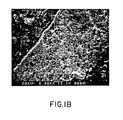
- the outer surface of a piston molded from Durez 29502 phenol-formaldehyde molding compound was machined to tolerance.
- the machined pistons were treated with aqueous hydrogen fluoride solution in accordance with the invention.
- the machined and treated surface of the piston was photomicrographed at 900 magnification.
- the photomicrograph is shown in Figure 1B.
- the figure shows the filler material to be smooth by comparison with Figure 1A.
- the outer surface of a piston molded from Durez 32450 phenol-formaldehyde molding compound was ground to tolerance.
- the ground surface was photomicrographed at 522 magnification.
- the photomicrograph is shown in Figure 2A.
- the surface was rough with exposed filler material protruding from the surface of the piston.
- the outer surface of pistons molded from Durez 32450 phenol-formaldehyde molding compound were ground to tolerance.
- the ground pistons were treated with aqueous hydrogen fluoride solution in accordance with the invention.
- the treated surface of the piston was photomicrographed at 518 magnification.
- the photomicrograph is shown in Figure 2B.
- the figure shows the filler material points to be smooth by comparison with Figure 2A.
Landscapes
- Chemical & Material Sciences (AREA)
- Engineering & Computer Science (AREA)
- General Engineering & Computer Science (AREA)
- Medicinal Chemistry (AREA)
- Chemical Kinetics & Catalysis (AREA)
- Polymers & Plastics (AREA)
- Organic Chemistry (AREA)
- Health & Medical Sciences (AREA)
- Mechanical Engineering (AREA)
- General Chemical & Material Sciences (AREA)
- Manufacturing & Machinery (AREA)
- Materials Engineering (AREA)
- Manufacture Of Macromolecular Shaped Articles (AREA)
- Treatments Of Macromolecular Shaped Articles (AREA)
- Pistons, Piston Rings, And Cylinders (AREA)
- Sliding-Contact Bearings (AREA)
- Connection Of Motors, Electrical Generators, Mechanical Devices, And The Like (AREA)
- Braking Arrangements (AREA)
Applications Claiming Priority (2)
| Application Number | Priority Date | Filing Date | Title |
|---|---|---|---|
| US07/256,422 US4921736A (en) | 1988-10-12 | 1988-10-12 | Low friction, wear resistant plastic parts |
| US256422 | 1988-10-12 |
Publications (2)
| Publication Number | Publication Date |
|---|---|
| EP0363941A2 true EP0363941A2 (fr) | 1990-04-18 |
| EP0363941A3 EP0363941A3 (fr) | 1991-06-12 |
Family
ID=22972171
Family Applications (1)
| Application Number | Title | Priority Date | Filing Date |
|---|---|---|---|
| EP19890118916 Withdrawn EP0363941A3 (fr) | 1988-10-12 | 1989-10-11 | Pièces en plastique à faible friction et résistant à l'usure |
Country Status (6)
| Country | Link |
|---|---|
| US (1) | US4921736A (fr) |
| EP (1) | EP0363941A3 (fr) |
| JP (1) | JPH02166130A (fr) |
| KR (1) | KR900006415A (fr) |
| BR (1) | BR8905147A (fr) |
| DK (1) | DK504189A (fr) |
Families Citing this family (3)
| Publication number | Priority date | Publication date | Assignee | Title |
|---|---|---|---|---|
| US6637957B2 (en) * | 2000-09-29 | 2003-10-28 | Zih Corp. | Printer with ribbon fold out mechanism and plastic ribbon clutch |
| US20040112089A1 (en) * | 2002-12-16 | 2004-06-17 | Digiovanni David J. | Manufacture of optical fibers using enhanced doping |
| US9587741B2 (en) * | 2014-11-21 | 2017-03-07 | Akebono Brake Industry Co., Ltd. | Piston with out of phase mode |
Family Cites Families (10)
| Publication number | Priority date | Publication date | Assignee | Title |
|---|---|---|---|---|
| US3276927A (en) * | 1963-07-01 | 1966-10-04 | North American Aviation Inc | Smoothing of mechanically drilled holes |
| US3266963A (en) * | 1965-07-22 | 1966-08-16 | Chemical And Aerospace Product | Method and means for etching glass and glass reinforced plastics |
| US3997935A (en) * | 1975-05-29 | 1976-12-21 | Acushnet Company | Windshield wiper blade treatment |
| US3992221A (en) * | 1975-10-23 | 1976-11-16 | Vitek, Inc. | Method of treating extensible hydrocarbon articles |
| US4170926A (en) * | 1976-03-17 | 1979-10-16 | Hooker Chemicals & Plastics Corp. | Fluted core disc brake piston |
| US4298424A (en) * | 1980-06-19 | 1981-11-03 | Vbe Industries, Ltd. | Method for etching polyamide shaped articles |
| US4401012A (en) * | 1980-10-31 | 1983-08-30 | Occidental Chemical Corporation | Piston for disc brakes |
| US4376087A (en) * | 1981-05-26 | 1983-03-08 | Rca Corporation | Processing of video discs |
| JPS6166727A (ja) * | 1984-09-10 | 1986-04-05 | Nippon Valqua Ind Ltd | 充てん材入りふつ素樹脂成形体の表面処理方法 |
| US4775557A (en) * | 1987-11-09 | 1988-10-04 | Enthone, Incorporated | Composition and process for conditioning the surface of polycarbonate resins prior to metal plating |
-
1988
- 1988-10-12 US US07/256,422 patent/US4921736A/en not_active Expired - Fee Related
-
1989
- 1989-10-11 DK DK504189A patent/DK504189A/da not_active Application Discontinuation
- 1989-10-11 KR KR1019890014538A patent/KR900006415A/ko not_active Withdrawn
- 1989-10-11 EP EP19890118916 patent/EP0363941A3/fr not_active Withdrawn
- 1989-10-11 BR BR898905147A patent/BR8905147A/pt unknown
- 1989-10-12 JP JP1266097A patent/JPH02166130A/ja active Pending
Also Published As
| Publication number | Publication date |
|---|---|
| KR900006415A (ko) | 1990-05-08 |
| BR8905147A (pt) | 1990-05-15 |
| DK504189D0 (da) | 1989-10-11 |
| JPH02166130A (ja) | 1990-06-26 |
| US4921736A (en) | 1990-05-01 |
| DK504189A (da) | 1990-04-13 |
| EP0363941A3 (fr) | 1991-06-12 |
Similar Documents
| Publication | Publication Date | Title |
|---|---|---|
| EP1559541B1 (fr) | Article composite en alliage d'aluminium comprenant une resine et procede de production de celui-ci | |
| EP0077627B1 (fr) | Pièces en acier résistant à la corrosion et procédé de fabrication | |
| US6612415B2 (en) | Friction member and method of manufacture | |
| JP5581680B2 (ja) | 耐候性に優れたアルミ・樹脂複合品及びその製造方法 | |
| Chen et al. | The difference in running-in period and friction coefficient between self-mated Si3N4 and SiC under water lubrication | |
| EP3088764A1 (fr) | Matériau de friction | |
| US4921736A (en) | Low friction, wear resistant plastic parts | |
| US5053106A (en) | Low friction, wear resistant plastic parts | |
| EP1227262A1 (fr) | Materiau de friction exempt d'amiante | |
| KR0144646B1 (ko) | 금속냉간가공용 복합피막형성을 위한 금속표면처리화학조성물 및 복합피막의 형성방법 | |
| Hong et al. | The modification of epoxy/metal interphases by adsorbed contaminants | |
| KR100613157B1 (ko) | 마그네슘 또는 마그네슘 합금 하우징 및 그 제조 방법 | |
| Hillis | Surface engineering of magnesium alloys | |
| JP2005015576A (ja) | 摩擦材 | |
| EP0229325B1 (fr) | Procédé de fabrication de pièces d'acier résistant à la corrosion | |
| EP4194405A1 (fr) | Matériau de régulation de friction, composition de matériau de friction, matériau de friction, et élément de friction | |
| JPH07109362A (ja) | 摩擦部材 | |
| US20040255818A1 (en) | Lubricating chemical coating for metalworking | |
| KR19990030459A (ko) | 자동차용 미끄럼작동부재의 표면처리방법 | |
| WO1999023149A1 (fr) | Article resistant grincement | |
| EP4450584A1 (fr) | Modificateur de friction, composition de matériau de friction, matériau de friction et élément de friction | |
| DE19848590A1 (de) | Verfahren zum Beschichten einer metallischen Gleitoberfläche, insbesondere einer Motor-Zylinderlauffläche aus einer Aluminiumlegierung | |
| GB2068019A (en) | Ion Implanting Forming Tools | |
| JP2000046061A (ja) | バーフィールド型等速ジョイントとその製造方法 | |
| Perks | Ion implanting forming tools |
Legal Events
| Date | Code | Title | Description |
|---|---|---|---|
| PUAI | Public reference made under article 153(3) epc to a published international application that has entered the european phase |
Free format text: ORIGINAL CODE: 0009012 |
|
| AK | Designated contracting states |
Kind code of ref document: A2 Designated state(s): BE DE FR GB IT NL SE |
|
| PUAL | Search report despatched |
Free format text: ORIGINAL CODE: 0009013 |
|
| AK | Designated contracting states |
Kind code of ref document: A3 Designated state(s): BE DE FR GB IT NL SE |
|
| STAA | Information on the status of an ep patent application or granted ep patent |
Free format text: STATUS: THE APPLICATION IS DEEMED TO BE WITHDRAWN |
|
| 18D | Application deemed to be withdrawn |
Effective date: 19911213 |