EP0364086A2 - Guidage d'un engin tactique par la déviation du jet de poussée et par des ailettes mobiles - Google Patents
Guidage d'un engin tactique par la déviation du jet de poussée et par des ailettes mobiles Download PDFInfo
- Publication number
- EP0364086A2 EP0364086A2 EP89308314A EP89308314A EP0364086A2 EP 0364086 A2 EP0364086 A2 EP 0364086A2 EP 89308314 A EP89308314 A EP 89308314A EP 89308314 A EP89308314 A EP 89308314A EP 0364086 A2 EP0364086 A2 EP 0364086A2
- Authority
- EP
- European Patent Office
- Prior art keywords
- nozzle
- missile
- housing
- movable
- case
- Prior art date
- Legal status (The legal status is an assumption and is not a legal conclusion. Google has not performed a legal analysis and makes no representation as to the accuracy of the status listed.)
- Granted
Links
Images




Classifications
-
- F—MECHANICAL ENGINEERING; LIGHTING; HEATING; WEAPONS; BLASTING
- F42—AMMUNITION; BLASTING
- F42B—EXPLOSIVE CHARGES, e.g. FOR BLASTING, FIREWORKS, AMMUNITION
- F42B10/00—Means for influencing, e.g. improving, the aerodynamic properties of projectiles or missiles; Arrangements on projectiles or missiles for stabilising, steering, range-reducing, range-increasing or fall-retarding
- F42B10/60—Steering arrangements
Definitions
- the present invention relates generally to guided missiles.
- Tactical missiles have commonly been provided with aerodynamic surfaces in the form of fixed strakes and movable fins for lift, stability, and guidance.
- the steerage capability of the movable fins or aerofins is dependent upon the dynamic pressure, i.e., the atmospheric density times the velocity squared.
- a movable thrust nozzle for thrust vector control on such missiles for effective steerage at low dynamic pressures.
- movable thrust nozzles have been provided commonly on strategic missiles, weight and space limitations have curtailed their use on tactical missiles.
- a tactical missile may be differentiated from a strategic missile in that a tactical missile is capable of being carried in a payload bay of an airplane or on a ship and generally has a diameter of up to about 15 inches.
- a tactical missile is defined as one which has a case diameter of less than about 20 inches.
- actuators for the movable nozzle have been considered too bulky and heavy.
- Thrust vector control can be used to augment lift and provide stable flight at high angles-of-attack without large aerodynamic control surfaces.
- TVC is inefficient from an energy point of view, and the gimballed nozzle and complex autopilot design requirements inexorably lead to increased weight and cost.
- the movable aerofins are effective for steering when the dynamic pressure is sufficient
- the movable thrust nozzle is effective for steering only when solid propellant therein is being fired to produce thrust.
- the combustion process will proceed without the ability to stop it until the entire mass of ignited propellant has been consumed after which the movable nozzle will no longer be effective for steerage.
- pulsed rocket motors In order to allow management of the expenditure of the propulsive energy over the duration of a flight for enhanced performance and flexibility, pulsed rocket motors have been provided wherein within the same case two or more solid propellant units such as a boost grain and a sustain grain separated by a membrane seal structure enable the ignition of the propellant units to be independent of each other whereby discrete impulses are available upon command.
- a pulsed rocket motor is disclosed in U.S. patent application 813,819, which is to issue on August 30, 1988, as U.S. patent 4,766,726 to Tackett et al , which is assigned to the assignee of the present invention and which is hereby incorporated herein by reference.
- Pulsed rocket motors are also disclosed in U.S.
- FIG 1 Another problem faced by tactical defense planners has been that of increasing weapons loadout on an airplane.
- FIG 1 there is illustrated this problem wherein the payload bay illustrated at A of an aircraft B is shown to contain only one tactical missile C. It is considered desirable to increase the weapons loadout for more effective use of the aircraft B as shown in Figure 2 wherein a greater number such as perhaps nine missiles D, each having the same case diameter as the case diameter of missile C, can be loaded in the payload bay A. Thus, it is considered desirable to be able to package several missiles of the same case diameter into an area formerly occupied by only one missile.
- a missile which includes an elongate generally cylindrical case 14 which is open at its aft end 16, and its forward end 18 tapers slightly to a closed end.
- the case may be composed of any suitable material such as stainless steel or a composite of a resin impregnated fibrous material such as carbon, fiberglass, or aramid fibers.
- the missile 10, which is a tactical missile, has a case diameter illustrated at 12 of less than about 20 inches.
- each pulse has a separate igniter illustrated at 30 for igniting the propellant 20 therein. Only the igniter 30 for the third or forward most pulse 26 is illustrated which is mounted in the domed closed forward end thereof, each of the other pulses 22 and 24 being provided with a similar igniter mounted in the respective membrane seal assembly 28.
- Each igniter 30 is connected through leads 32 to a source of electrical or laser power (not shown), the ignition times being controlled by a guidance and control system in accordance with principles commonly known to those of ordinary skill in the art to which this invention pertains.
- Each pulse is, as previously stated, separated from each subsequent pulse by a membrane seal assembly 28 or other suitable means to enable the ignition of the solid propellant grains to be independent of each other whereby discrete impulses are available upon command.
- the membrane seal assembly 28 extends over the inner diameter of the rocket motor case 14 and is suitably attached thereto.
- Each of the membrane seal assemblies may, for example, be similar to those which are shown and described in greater detail in the aforesaid U.S. patent application which is to issue as U.S. patent 4,766,726 or the aforesaid U.S. patent 3,888,079.
- the membrane seal assembly 28 may include a bulkhead which includes a plurality of apertures for flow of combustion gases therethrough and may also include a thin imperforate metallic membrane or cover of high strength but ductile material which covers the aft side of the bulkhead to seal the forward chamber or pulse from flow of gases thereinto upon ignition of the solid propellant grain in the aft chamber or pulse and which, after the solid propellant grain in the aft chamber or pulse has been expended, pressure resulting from combustion of the solid propellant grain in the forward chamber or pulse upon ignition thereof at a selected time will cause the thin membrane to rupture and thus allow the escape of gases from the forward chamber or pulse through the apertures in the bulkhead to the aft chamber or pulse and then out the nozzle to produce thrust.
- the payload, avionics and cooling apparatus, seekers, and any other apparatus which it is desired that the missile 10 carry In the space 34 forward of the forward pulse 26 are loaded the payload, avionics and cooling apparatus, seekers, and any other apparatus which it is
- a thrust nozzle 36 Attached to the aft end 16 of the case 14, in flow communication with the grain 20 of the aft or first pulse 22 and also in flow communication with gases generated by each subsequent pulse 24 and 26 when the membranes of the membrane seal assemblies 28 are respectively ruptured, is a thrust nozzle 36 to which is attached an exit cone 194.
- a plurality such as four aerodynamic surfaces illustrated at 38 spaced circumferentially about the aft end 16 of the case 14 approximately 90° apart extend radially outwardly from the case 14 and are integrally or otherwise suitably attached thereto.
- the aerodynamic surfaces 38 include non-movable strakes 40 for providing lift and stability and, aft thereof, aerofins 42 which are movable about a radial axis illustrated at 44 for providing steerage or trim attitude control, that is, pitch (up and down movement), yaw (movement about a vertical axis), and roll.
- the nozzle 36 may be pivoted about a point, i.e., the center of a bearing interface, as hereinafter described, at the throat 39, so that its center line is positioned omniaxially with respect to the missile 10, that is, the nozzle 36 may be positioned so that its axis is at a small angle in any direction relative to the longitudinal axis 46 of the missile 10 to direct gas flow outwardly at different angles in all directions to cause a reaction force and large turning moment, for high maneuverability, for turning the missile.
- the nozzle 36 is positioned in Figure 3 so that its axis is the same as the missile axis 46, it may be positioned such that its axis illustrated at 48 is at an angle 50 up to perhaps 15° in any direction relative thereto for purposes of steerage of the missile 10 during a time when one of the pulses is being fired.
- the thrust nozzle 36 does not provide any steerage capacity during times when none of the pulses are being fired.
- the movable aerofins 42 are provided to provide steerage. Thrust vector control provided by the movable nozzle 36 is thus needed most at high altitudes and/or low speeds where the dynamic pressure is lower than perhaps about 100 lbs. per square foot.
- the nozzle bearing interface with the case 14 may be, as best shown in Figure 12, a bonded elastomeric material known as a flexible bearing or flexbearing 37 to allow its pivoting about its pivot point for positioning it omniaxially.
- the flexbearing 37 comprises a reinforcing laminate 41 of shim stock of steel or other suitable material sandwiched between and suitably bonded to a pair of elastomeric pads 43 and 45 composed of natural rubber, polyisoprene, polyurethane, silicone, or other suitable elastomeric material.
- the other surface of one pad 43 is suitably bonded to fixed housing 47 which is fixedly attached to aft closure member 49 which is fixedly attached to rocket motor case 14.
- the other surface of the other pad 45 is suitably bonded to a movable housing or carrier element 51 which is composed of a solid insulator ablative structural material such as a combination of steel and carbon phenolic which is suitably inlaid in the nozzle 36 for support of the flexbearing 37.
- a solid insulator ablative structural material such as a combination of steel and carbon phenolic which is suitably inlaid in the nozzle 36 for support of the flexbearing 37.
- a soft elastomeric material 53 having a large deflection and ablative capability such as, for example, a phenol based silicone foam, is bonded to the fixed housing 47 and to the nozzle 36 including the inlaid structural member 51 whereby the elastomeric material 53, which may be called a split line protector, may suitably stretch and contract as the nozzle is slewed.
- a liquid silicone or other suitable liquid may be encapsulated in the elastomeric material 53 to allow motion thereof without high compression thereof.
- the flexbearing may be composed of only a single elastomeric pad.
- the flexbearing 37 have minimum size while having the capacity to handle the applied conditions, for example, compressive stresses over 5000 psi and shear strains over 400 percent simultaneously, it is desired that the elastomer/metal interfaces be maintained parallel so that, during nozzle deflection, there is not a large tensile load at one edge of the elastomer and a large compressive load at the other edge.
- the flexbearing may be built with fewer elastomeric elements for reduced size, weight, and cost to safely provide greater deflection, i.e., about 15 degrees.
- a ball and socket arrangement instead of a flexbearing for the bearing interface with the nozzle.
- a trapped ball bearing such as described in U.S. patent 4,157,788 to Canfield et al and assigned to the assignee of the present invention which patent is hereby incorporated herein by reference, may be used.
- the aerofins 42 are preferably symmetric about the radial axis 44 so that the amount of power required to move them may be minimized.
- the strakes 40 are sized to have a sufficient amount of surface area in accordance with principles commonly known to those of ordinary skill in the art to which this invention pertains for the required lift and stability.
- the missile 10 is multi-pulsed in order that it may have an ability to fire more than once so that the expenditure of propulsive energy over the duration of the flight may be managed for enhanced performance and, with the use of the movable nozzle for thrust vector control, enhanced maneuvering flexibility.
- the first pulse 22 is fired to launch the missile 10, and the ignition times of the other pulses 24 and 26 are controlled by the guidance and control system (not shown) to optimize performance criteria such as maximum terminal velocity or maximum f-pole.
- the f-pole may be defined as the distance between the launch aircraft and the target at the time of target intercept. It is usually desired that the f-pole not be within range of the target since the target may be able to counter-attack if the f-pole is within its range. If high acceleration maneuvers are not required in the intercept phase, then all of the remaining pulses 24 and 26 may be fired during mid-course for maximum range, or the final pulse 26 can be saved until terminal homing to increase maneuverability during that phase.
- the nozzle 36 and aerofins 42 are positioned by an integral aerofin/thrust vector control actuation system, generally illustrated at 52 and which will be described in greater detail hereinafter, which receives position command signals from the guidance and control system (not shown) and uses battery powered electric motors to move the nozzle and aerofins.
- Feedback sensors and electronic logic measure actual position, compare actual to commanded position, and send appropriate error signals to the actuators to adjust position, as will be discussed more fully hereinafter.
- Tactical missiles typically have an aerodynamic surface span, the distance illustrated at 54 which a fin 42 and strake 40 extends radially outwardly from the missile case 14, which is about eight inches or greater.
- the aerodynamic surface span 54 may be referred to hereinafter as fin span.
- fin span is meant to also include the strake span.
- the term "aerodynamic surface” is meant to include both the movable fin 42 and the strake 40.
- the range of the missile 10 may be reduced due to greater drag as the fin span 54 is increased.
- the greater the fin span 54 the lesser number of missiles 10 which can be provided in a payload bay of a given size, as illustrated in Figures 1 and 2.
- the fin span 54 is reduced so that the missile 10 has a fin span 54 of less than about four inches.
- a greater number of missiles of the same case diameter 12 can be packaged in a payload bay, as illustrated in Figure 2.
- the missile 10 of Figures 3 and 4 may have a case diameter 12 of eight inches and a fin span 54 of two inches.
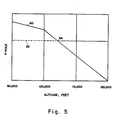
- Figure 5 illustrates the advantage and additional capability of using a pulsed missile with thrust vector control.
- the f-pole is affected by a decision to either fire all remaining pulses during the mid-course phase of flight or to save the final pulse until the terminal phase. Saving the final pulse until the terminal phase would normally only be desirable if the missile had thrust vector control for increased maneuverability during that phase.
- Line 60 illustrates the f-pole at various target altitudes for a missile with no thrust vector control wherein the remaining pulses are optimally fired in mid-course.
- Line 60 illustrates that a larger f-pole is obtained at a lower target altitude of perhaps 90,000 feet or less, and then decreases as the altitude increases.
- Line 62 illustrates the f-pole at various target altitudes for a missile with thrust vector control wherein the final pulse is fired during the terminal phase.
- Line 62 illustrates that the f-pole remains almost constant as the target altitude increases.
- a certain target altitude illustrated at point 64 such as perhaps 105,000 feet
- the maximum f-pole is obtained by firing the remaining pulses in mid-course.
- the f-pole may be increased by saving the last pulse until the terminal phase and using it in conjunction with thrust vector control.
- a missile with thrust vector control may be utilized to fire the remaining pulses in mid-course if the target altitude is low, i.e., below the target altitude at point 64, and to use the last pulse in the terminal phase at target altitudes above that altitude for enhanced missile flexibility and increased effective service ceiling of the missile.
- a movable nozzle for thrust vector control and movable aerofins on a tactical missile in accordance with the present invention is also provided to enhance the flexibility by enabling rear-hemisphere defense.
- the dimensions of the strakes 40 and aerofins 42 determine the location of the center of pressure (CP) on the missile.
- the mass distribution in the missile determines the location of the center of gravity (CG).
- the magnitude of the turning moment due to the relative wind is proportional to the distance between the CP and CG while the moment direction is determined by the CP being forward or aft of the CG.
- the steering system (movable nozzle 36 and aerofins 42) must be capable of providing enough turning moment to overcome the moment due to the wind.
- it is considered desirable to size the aerodynamic surfaces 38 so that the CP and the CG nearly coincide to thus minimize the steering effort required. hs the propellant 20 is consumed, the CG shifts.
- line 70 illustrates the amount of side force required at launch to hold the desired missile attitude with various fin spans 54
- line 72 representing zero side force
- Line 74 represents the required side force to hold the desired missile attitude with various fin spans 54 at burnout.
- Figure 6 illustrates an example in which the CG at launch and at burnout are symmetric about the CP for a fin span of about 1.6 inches whereby the magnitude of the required side force may be the same for launch and burnout, while having an opposite force vector direction.
- missile 10 may have a diameter of eight inches, a length of 144 inches, a weight of 400 pounds, a moment arm (distance between the CG and the pivot point of the nozzle 36) of approximately 60 inches, have a strake chord, illustrated at 56, which is the combined length axially of the missile of the strake 40 and fin 42, of about 33 inches, and have a fin span 54 of about 1.6 inch for use optimally at a speed and altitude of mach 4 and 70,000 feet.
- the stability decreases, this decrease in stability may be compensated for and the missile maintained stable by movements of the movable aerofins 42 and the movable nozzle 36 whereby greater flexibility is provided for maintaining stability.
- each of the aerodynamic surfaces 38 have a fin span 54 such that the required side force vector on the missile at burnout is the same magnitude and of opposite direction as the required side force vector on the missile at launch.
- the actuation system is reduced in size as hereinafter described to also allow a larger volume of propellant and thus a higher total impulse.
- the blast tube may be reduced in size or eliminated to allow a significant increase in the amount of propellant that can be loaded into a given overall motor length.
- each of the aerofins 42 is controlled by a separate motor which is preferably installed closely adjacent thereto, and a separate motor is provided for movement of the nozzle 36 in each of the pitch and yaw directions 186 and 182 respectively which motor is preferivelyably closely adjacent a respective yoke 175 and 174 respectively for movement of the nozzle 36.
- Each of the motors must be capable of putting out a high power of perhaps 1 horsepower during its duty cycle in order to effectively operate its corresponding aerofin or nozzle.
- a high voltage of perhaps 150 volts or more is required.
- the motor in order to prevent such a motor from overheating from the resulting high wattage when such a voltage is applied, the motor must conventionally undesirably be made too large to effectively save any space in the missile.
- a tactical missile which is built to be destroyed usually within about five minutes after launch, it is only necessary to prevent the motor from overheating so that it is operable during the duration of the missile flight.
- a power source preferably a single battery, is provided for supplying high voltage electrical power to all of the nozzle and fin motors.
- high voltage is defined to mean that voltage which would cause the motor to which it is supplied to provide the desired power output for at least about five minutes but would cause the motor to which it is supplied to overheat and become inoperative after about ten minutes or less of continuous operation.
- the motors may be sized smaller than would be desired in conventional applications to provide a compact nozzle and aerofin actuation system 52.
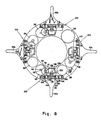
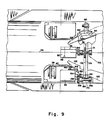
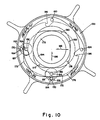
- FIG. 7 to 10 there are shown detailed views of the actuation system 52, the portion thereof for actuating the aerofins 42 being shown most clearly in Figures 7 and 8 and the portion thereof for actuating the nozzle 36 being shown most clearly in Figures 9 and 10.
- the actuation system 52 comprises six direct current motors two of which are illustrated at 80 and 82 for movement of the nozzle 36 omniaxially and four of which are illustrated at 84, 86, 88, and 90 for movement respectively of the four aerofins 42.
- Each of the aerofin motors is closely adjacent its respective aerofin, as shown in Figure 8, in order to eliminate a large amount of space taking linkage which would otherwise be required if a single motor were provided for all the aerofins or if the motors were positioned further from their corresponding aerofins.
- motor 84 is provided for aerofin 42a
- motor 86 is provided for aerofin 42b
- motor 88 is provided for aerofin 42c
- motor 90 is provided for aerofin 42d.
- Motor 80 is the pitch direction servo motor for movement of yoke 175, and motor 82 is the yaw direction servo motor for movement of yoke 174, the pitch and yaw directions 186 and 182 respectively being perpendicular to each other.
- motors 80 and 82 are closely adjacent the corresponding yokes 175 and 174 respectively (hereinafter described) which they operate. In order to further save space and provide an even more compact size to the actuation system 52, all of the motors are powered by a single battery illustrated at 92.
- Each of the motors 80, 82, 84, 86, 88, and 90 which may have a length illustrated at 94 in Figure 9 of perhaps 2.3 inches and a diameter illustrated at 96 in Figure 9 of perhaps 1.5 inches, is preferably a three phase Y-connected neodymium-iron-boron permanent magnet brushless motor.
- the motors for both the nozzle 36 and aerofins 42 are similar because the load conditions are similar to thereby result in cost savings.
- the brushless construction is inside-out when compared to conventional brush type motors.
- the windings are in a fixed stator housing while the rotor is composed of permanent magnet pole pieces.
- Commutation is achieved electronically instead of mechanically using a sensor on the rotor to monitor position, logic circuits in the electronic control unit, illustrated at 98 in Figures 7 and 9, to decode the position, and transistors to switch the three coils on and off at the right times to set up the desired relationship between current flow in the wires and the magnetic field of rotating magnet poles.
- the brushless construction is provided so that each motor may have no brush wear for high reliability, low maintenance, no arcing, no contamination problems, higher possible speeds, and consequently a higher horsepower to weight ratio.
- a brushless motor may be packaged smaller.
- the windings are located in the stator to give better thermal dissipation because the stator, being an integral part of the frame and mounting brackets, acts as a heat sink.
- the permanent magnet rotor is smaller and lighter than its wound counterparts, and the lower inertia contributes to fast dynamic response.
- the use of neodymium-iron-boron material in the magnets is provided to result in higher power density than samarium cobalt as well as lower cost due to the greater availability.
- Each motor is constructed to put out an instantaneous peak power of over one horsepower during its short duty cycle when supplied with high voltage of perhaps 150 volts.
- the battery 92 comprises a molten lithium anode, an iron disulfide cathode, and an inorganic salt electrolyte of lithium and potassium chlorides, with thermal energy provided by mixture of iron powder and potassium perchlorate.
- the electrolyte remains non-conductive until a squib ignites the heat source which then instantly melts the electrolyte and makes it conductive.
- Such a battery which may have an energy density greater than that of stored gas in a fluid power blow down system, may supply a peak current of about 50 amps at a minimum loaded voltage (peak power) of perhaps 90 volts.
- Nominal battery voltage may be perhaps 175 volts at a load of about 1.1 amps.
- the battery 92 is capable of supplying high voltage to the motors so that each of the motors has an output of over 1 horsepower.
- 80 cells in series, each perhaps 1.6 inches in diameter and 0.055 inch in length, may make up the battery to result in a high power, lightweight (perhaps 0.1 pounds per cubic inch) battery with high reliability and a storage life of greater than perhaps ten years.
- the battery 92 may be located between the nozzle and fin actuator motors as the interface permits. If necessary and suitable, it can alternately be located between the cylindrical motor case 14 and the air frame.
- the battery 92 may thus be compact to have a length perhaps between about 5.46 and 6.73 inches and a diameter of perhaps about 1.86 inches.
- FIG. 7 and 8 there are shown the portions of the actuation system 52 which comprise the actuators, illustrated generally at 100, for each of the aerofins 42.
- the aerofin actuator 100 for aerofin 42d will be discussed hereinafter, each of the other aerofin actuators 100 being similar thereto.
- the aerofin 42d is suspended from and fixedly attached to platform bevel gear 102 by suitable means such as screws 103 for movement about radial axis 44.
- the bevel gear 102 is mounted for rotation within ball bearing 104 which is itself mounted within the motor mount 106 in which the motor 90 is suitably mounted.
- the motor mount or housing 106 is suitably attached to the case 14 by suitably means such as screws 108.
- the mating faces of the aerofin 42d and platform gear 102 are splined as illustrated at 140, that is, they are each provided with meshing teeth, to thereby allow the teeth to take the load to provide a firm fin mount to prevent undesirable flutter of the fin 42d.
- a suitable thin film thermal insulator may be provided between the teeth of the splined faces 140 to prevent overheating of the actuator apparatus 100.
- the motor 90 is operatively connected to the bevel platform gear 102 by a triple-reduction gear train as follows.
- a spur gear 110 on the motor shaft 116 is caused to suitably mesh with reduction spur gear 112 for rotation thereof.
- Gear 112 is mounted on shaft 114 which is suitably mounted by any conventional means for rotation.
- Mounted on shaft 114 is gear 118 which is structurally integral with gear 112 and which is caused to suitably mesh with spur reduction gear 120 for rotation thereof.
- Gear 120 is mounted on shaft 126 which is mounted in roller or needle bearings 122 and 124 for rotation therein.
- bevel tapered gear 128 which is structurally integral with gear 120 and positioned to suitably mesh with the bevel platform gear 102 for rotation thereof for rotating the aerofin 42d about the radial axis 44.
- the individual compact motor 90 is connected to the fin 42d through a triple-reduction gear for operation thereof without the requirement of weight and space consuming linkages.
- a circular slot 130 which is generally coaxial with gear 102.
- An aperture 132 which is coaxial with gear 102, extends through the platform gear 102 in communication with the slot 130.
- a shaft 134 Disposed in the aperture 132 is a shaft 134 which is fixedly mounted to the platform gear 102 for rotation coaxially therewith by a flange 136 which is received within the slot 130 and is fixedly held in the slot 130 for rotation with the platform gear 102 by retainer 135 and screws 137.
- the shaft 134 is suitably connected to and in communication with the potentiometer or feedback transducer 138 for providing feedback information thereto as to the position of the aerofin 42d as will be described in greater detail hereinafter.
- a rubber insert or soft stop 144 may be provided in the surface of the nozzle 36 at a point where it may touch other hardware in order to absorb shock when in the deflected position illustrated by dashed line 146.
- FIG. 9 there are shown the portions of the actuation system 52 which comprise the thrust vector actuation system generally illustrated at 150 for omniaxially moving the nozzle 36.
- Mounted on the shaft 152 of the yaw servo motor 82 is a gear 154 which is positioned to suitably mesh with spur reduction gear 156 for rotation thereof.
- the motor 82 is suitably mounted in motor mount 158 which is suitably attached to the nozzle housing 47 by suitable means such as screws 160, as more clearly shown in Figure 12.
- the end of the shaft 152 for motor 82 is suitably received in roller bearing 162 for rotation thereof.
- Spur reduction gear 156 is mounted on shaft 164 which is suitably received, for rotation thereof, in a pair of roller bearings 166 and 168 which are suitably mounted in housing 158.
- shaft 164 Mounted on shaft 164 is a pinion gear 170 to which is suitably connected a feedback transducer (not shown) in accordance with principles commonly known to those of ordinary skill in the art to which this invention pertains.
- the gear 170 is suitably positioned to mesh with teeth (not shown) which are machined in the radially outer surface of a circular portion 172 of yaw yoke or driving plate 174 and which are similar to teeth 171 machined in a circular portion 173 of similar pitch yoke or driving plate 175 for the pitch servo motor 80.
- the pitch servo motor 80 is geared to pitch yoke or driving plate 175 similarly as yaw servo motor 82 is geared to yaw yoke or driving plate 174.
- the driving plates 174 and 175 may be characterized as large sector gears with elongated holes in the middle provided by elongated inner surfaces 176 and 177 respectively.
- the driving plates or yokes 174 and 175 are arranged so that the inner surfaces 176 and 177 are elongated to have flat portions or flats 188 and 190 respectively in directions which are perpendicular to each other as best shown in Figure 10.
- the exit cone 194 which is threadedly attached as illustrated at 192 to the nozzle 36, has a generally spherical cam surface illustrated at 178 which is received within and engaged by the elongated portions or flats 188 and 190 respectively of the inner surfaces 176 and 177.
- Each of the yokes 174 and 175 is suitably pivotable about pivot pins 180 and 184 respectively, each pivot pin positioned circumferentially 180° from the circular teeth portion 172 and 173 respectively of its respective yoke 174 and 175 to cause movement of the yaw yoke 174 in the yaw direction 182 to cause the flat 188 to force the nozzle 36 to rotate in the yaw direction 182 about its pivot point when the yaw yoke 174 is moved about pivot 180 by gear 170 when initiated by motor 82 and to cause the pitch yoke 175 to pivot about its pin 184 for movement of the flat 190 in the pitch direction 186, which is perpendicular to the yaw direction 182, to force the nozzle 36 to rotate in the pitch direction 186 about its pivot point when initiated by motor 80.
- the exit cone spherical seat 178 is pivotable about the central point, the center as previously discussed of a trapped ball (not shown) at the throat, whereby a combination of movements of the yaw and pitch yokes 174 and 175 respectively in the yaw and pitch directions 182 and 186 respectively will cause pivotal movement of the nozzle 36 omniaxially by perhaps as much as 15° from its centered position illustrated at 148.
- Notches illustrated at 196 may be formed in the outer surfaces of the yokes 174 and 175 to avoid interference thereof with the pins 180 and 184 respectively.
- Actuation system 150 may, for example, allow a high gear reduction of about 120 to 1 between the motor shaft and exit cone center line. If desired, additional gear reductions may be provided to increase the gear reduction ratio to perhaps 500 to 1.
- each thrust vector actuation system 150 with the nozzle and exit cone may be accomplished using the threaded coupling illustrated at 192 in Figure 9 (not illustrated in Figure 12).
- the actuators and drive plate mechanism 150 as well as aerofin actuators 100 are first installed over the nozzle assembly 36 after which the exit cone 194 is screwed in.
- the yokes advantageously do not apply any significant axial force to the nozzle.
- An antirotation device is advantageously not required to constrain the nozzle from rotating about the center line.
- the thrust vector actuation system 150 may for example have a mechanical efficiency of about 90 percent compared to typically 70 percent for other means such as ball screws.
- the use of individual small motors powered by high voltage, as discussed hereinbefore, which are closely adjacent their respective driven mechanisms may, for example, reduce the weight and volume over conventional actuation devices by as much as perhaps 50 percent. By the time such small motors have been overheated by the high power density due to the high voltage, they will have completed their task.
- a housing 200 for the single electronics control unit 98 Extending annularly around the radially inner surface of the case 14 just forward of the motors is a housing 200 for the single electronics control unit 98.
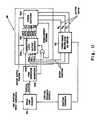
- the electronics control unit 98 comprises a commutation logic section 204, power switches 206, pulse with modulation (PWM) logic section 208, and a servo loop closure section 210. While only one motor 80 is shown in the diagram, it is to be understood that the single electronics control unit 98 is meant to serve all of the motors 80, 82, 84, 86, 88, and 90.
- bipolar latched Hall-effect sensors which magnetically detect position, are used to monitor rotor position.
- Discrete logic gates 212 then decode the position and send switching signals to the power stage 206.
- the power transistor switches 206 use conventional metal oxide semiconductor field effect transistor (MOSFET) technology to lend thermal stability for immunity to thermal runaway.
- MOSFET metal oxide semiconductor field effect transistor
- PWM logic which provides high frequency pulses of current to power switches and also to the motor so that it may run cooler and more efficiently and also results in a slight back and forth movement to maintain lubrication to keep undesirable microwelds from occurring in parts, is used in the forward loop, i.e., the signal which is a summation of the command signal and actual position signal which represents error which is modulated and then sent to the motor to correct the error, to achieve better thermal efficiency.
- Analog components such as potentiometers or variable differential transformers 138 for position feedback and amplifiers for summing and compensation, may be used for the loop closure 210.
- the electronics control unit 98 may be provided in accordance with the above discussion using principles commonly known to those of ordinary skill in the art to which this invention pertains.
- small individual motors for separately operating aerofins and nozzle yokes may be provided with high voltage power supply in accordance with the present invention for reduced space and weight so that both movable aerofins and a movable nozzle for thrust vector control may be provided in pulsed tactical missile where space and weight are at a premium. Further reduction in space and weight may be achieved by providing a common electronic control unit for the individual motors.
- the actuation system 52 may, for example, have a weight of perhaps less than about 17 pounds. With a smaller fin span, a greater number of such tactical missiles may be packaged in a payload bay of an airplane.
Landscapes
- Physics & Mathematics (AREA)
- Fluid Mechanics (AREA)
- Engineering & Computer Science (AREA)
- General Engineering & Computer Science (AREA)
- Aiming, Guidance, Guns With A Light Source, Armor, Camouflage, And Targets (AREA)
- Toys (AREA)
Applications Claiming Priority (2)
| Application Number | Priority Date | Filing Date | Title |
|---|---|---|---|
| US07/233,069 US4867393A (en) | 1988-08-17 | 1988-08-17 | Reduced fin span thrust vector controlled pulsed tactical missile |
| US233069 | 1988-08-17 |
Publications (3)
| Publication Number | Publication Date |
|---|---|
| EP0364086A2 true EP0364086A2 (fr) | 1990-04-18 |
| EP0364086A3 EP0364086A3 (fr) | 1991-11-21 |
| EP0364086B1 EP0364086B1 (fr) | 1995-05-31 |
Family
ID=22875761
Family Applications (1)
| Application Number | Title | Priority Date | Filing Date |
|---|---|---|---|
| EP89308314A Expired - Lifetime EP0364086B1 (fr) | 1988-08-17 | 1989-08-16 | Guidage d'un engin tactique par la déviation du jet de poussée et par des ailettes mobiles |
Country Status (4)
| Country | Link |
|---|---|
| US (1) | US4867393A (fr) |
| EP (1) | EP0364086B1 (fr) |
| JP (1) | JPH02170000A (fr) |
| DE (1) | DE68922890T2 (fr) |
Cited By (2)
| Publication number | Priority date | Publication date | Assignee | Title |
|---|---|---|---|---|
| FR2785381A1 (fr) * | 1998-10-30 | 2000-05-05 | Lockheed Corp | Procede et dispositif pour permettre l'execution, par un vehicule, d'un virage rapide dans un milieu fluide |
| WO2004038208A3 (fr) * | 2002-06-19 | 2004-10-28 | Lockheed Corp | Orientation de la poussee d'un vehicule volant pendant le ralliement au moyen d'un moteur multi-impulsions |
Families Citing this family (19)
| Publication number | Priority date | Publication date | Assignee | Title |
|---|---|---|---|---|
| US5125596A (en) * | 1989-05-23 | 1992-06-30 | Cavalleri Robert J | Fluid shielded movable strut for missile and rocket thrust vector control |
| US5072891A (en) * | 1989-11-22 | 1991-12-17 | Applied Technology Associates | Combination actuator and coolant supply for missile and rocket vector control |
| US6231002B1 (en) * | 1990-03-12 | 2001-05-15 | The Boeing Company | System and method for defending a vehicle |
| US5235128A (en) * | 1991-04-18 | 1993-08-10 | Loral Corporation | Separable missile nosecap |
| US5398887A (en) * | 1993-10-12 | 1995-03-21 | Thiokol Corporation | Finless aerodynamic control system |
| US5452864A (en) * | 1994-03-31 | 1995-09-26 | Alliant Techsystems Inc. | Electro-mechanical roll control apparatus and method |
| US5579635A (en) * | 1994-11-18 | 1996-12-03 | Thiokol Corporation | Distributed erosion region rocket motor nozzle |
| US5511745A (en) * | 1994-12-30 | 1996-04-30 | Thiokol Corporation | Vectorable nozzle having jet vanes |
| US5631830A (en) * | 1995-02-03 | 1997-05-20 | Loral Vought Systems Corporation | Dual-control scheme for improved missle maneuverability |
| US5806791A (en) * | 1995-05-26 | 1998-09-15 | Raytheon Company | Missile jet vane control system and method |
| USD377326S (en) * | 1995-08-31 | 1997-01-14 | Northrop Grumman Corporation | Tactical aircraft decoy (TAD) |
| US20040084566A1 (en) * | 2002-11-06 | 2004-05-06 | Daniel Chasman | Multi-nozzle grid missile propulsion system |
| US7108223B2 (en) | 2002-11-07 | 2006-09-19 | Raytheon Company | Missile control system and method |
| US7287725B2 (en) * | 2005-04-25 | 2007-10-30 | Raytheon Company | Missile control system and method |
| US7856806B1 (en) * | 2006-11-06 | 2010-12-28 | Raytheon Company | Propulsion system with canted multinozzle grid |
| US8117847B2 (en) | 2008-03-07 | 2012-02-21 | Raytheon Company | Hybrid missile propulsion system with reconfigurable multinozzle grid |
| US8729443B2 (en) * | 2010-09-13 | 2014-05-20 | Raytheon Company | Projectile and method that include speed adjusting guidance and propulsion systems |
| JP6253871B2 (ja) * | 2012-01-17 | 2017-12-27 | 三菱重工業株式会社 | 断熱材及びそれを備えた宇宙機、並びに断熱材の製造方法 |
| US9019161B1 (en) * | 2012-03-21 | 2015-04-28 | Rockwell Collins, Inc. | Tri-fin TCAS antenna |
Family Cites Families (12)
| Publication number | Priority date | Publication date | Assignee | Title |
|---|---|---|---|---|
| US2996267A (en) * | 1954-12-06 | 1961-08-15 | James R Warren | Vibration damping mechanism |
| GB857540A (en) * | 1956-05-10 | 1960-12-29 | Pye Ltd | Arrangement for the guidance control of jet-propelled missiles and aircraft |
| US3090198A (en) * | 1960-11-17 | 1963-05-21 | Gen Motors Corp | Swivel nozzle control |
| US3913951A (en) * | 1970-06-22 | 1975-10-21 | United Technologies Corp | Universal joint employing a fluid bearing |
| DE2141744C3 (de) * | 1971-08-20 | 1978-09-14 | Messerschmitt-Boelkow-Blohm Gmbh, 8000 Muenchen | Flugkörper mit Schubvektor- und aerodynamischer Steuerung |
| US4327886A (en) * | 1972-11-30 | 1982-05-04 | The United States Of America As Represented By The Secretary Of The Navy | Integral rocket ramjet missile |
| US4044970A (en) * | 1975-08-08 | 1977-08-30 | General Dynamics Corporation | Integrated thrust vector aerodynamic control surface |
| DE2721656A1 (de) * | 1977-05-13 | 1978-11-16 | Ver Flugtechnische Werke | Stellanordnung zur steuerung von flugkoerpern |
| US4648567A (en) * | 1983-04-28 | 1987-03-10 | General Dynamics, Pomona Division | Directional control of rockets using elastic deformation of structural members |
| US4560121A (en) * | 1983-05-17 | 1985-12-24 | The Garrett Corporation | Stabilization of automotive vehicle |
| US4549695A (en) * | 1983-07-29 | 1985-10-29 | Ball Corporation | Thrust vector control actuator |
| GB2150092B (en) * | 1983-11-25 | 1987-07-22 | British Aerospace | Deployment and actuation mechanisms |
-
1988
- 1988-08-17 US US07/233,069 patent/US4867393A/en not_active Expired - Fee Related
-
1989
- 1989-08-16 DE DE68922890T patent/DE68922890T2/de not_active Expired - Fee Related
- 1989-08-16 JP JP1210216A patent/JPH02170000A/ja active Pending
- 1989-08-16 EP EP89308314A patent/EP0364086B1/fr not_active Expired - Lifetime
Cited By (3)
| Publication number | Priority date | Publication date | Assignee | Title |
|---|---|---|---|---|
| FR2785381A1 (fr) * | 1998-10-30 | 2000-05-05 | Lockheed Corp | Procede et dispositif pour permettre l'execution, par un vehicule, d'un virage rapide dans un milieu fluide |
| WO2004038208A3 (fr) * | 2002-06-19 | 2004-10-28 | Lockheed Corp | Orientation de la poussee d'un vehicule volant pendant le ralliement au moyen d'un moteur multi-impulsions |
| US7012233B2 (en) | 2002-06-19 | 2006-03-14 | Lockheed Martin Corporation | Thrust vectoring a flight vehicle during homing using a multi-pulse motor |
Also Published As
| Publication number | Publication date |
|---|---|
| EP0364086A3 (fr) | 1991-11-21 |
| US4867393A (en) | 1989-09-19 |
| DE68922890T2 (de) | 1996-02-15 |
| DE68922890D1 (de) | 1995-07-06 |
| JPH02170000A (ja) | 1990-06-29 |
| EP0364086B1 (fr) | 1995-05-31 |
Similar Documents
| Publication | Publication Date | Title |
|---|---|---|
| EP0364086B1 (fr) | Guidage d'un engin tactique par la déviation du jet de poussée et par des ailettes mobiles | |
| US5452864A (en) | Electro-mechanical roll control apparatus and method | |
| US7857254B2 (en) | System and method for utilizing stored electrical energy for VTOL aircraft thrust enhancement and attitude control | |
| US4364530A (en) | Propulsion/control modular booster | |
| EP0878688B1 (fr) | Méthode et système pour contrôler les aubes d'un missile | |
| US4844380A (en) | Detachable thrust vector mechanism for an aeronautical vehicle | |
| US9919792B2 (en) | Vehicle attitude control using jet paddles and/or movable mass | |
| WO1998030449A1 (fr) | Vehicules de lancement spatial configures comme des planeurs et remorques jusqu'a une altitude de lancement par un aeronef classique | |
| Napior et al. | Controllable solid propulsion for launch vehicle and spacecraft application | |
| US8800913B2 (en) | Methods and apparatus for a tandem divert and attitude control system | |
| US20060284002A1 (en) | Unmanned Urban Aerial Vehicle | |
| US7703273B2 (en) | Dual-mode chemical-electric thrusters for spacecraft | |
| US4113204A (en) | Auxiliary control of vehicle direction | |
| US20180273193A1 (en) | Electrically operated propellant thrust assist for supplementing airplane takeoff, landing or in-flight maneuverability | |
| US5158246A (en) | Radial bleed total thrust control apparatus and method for a rocket propelled missile | |
| US5028014A (en) | Radial bleed total thrust control apparatus and method for a rocket propelled missile | |
| US5082202A (en) | Droppable jet vane TVC | |
| EP0768509B1 (fr) | Missile avec partie propulsion non-cylindrique | |
| EP0227211B1 (fr) | Propulseur largable pour un véhicule aéronautique | |
| US4415130A (en) | Missile system with acceleration induced operational energy | |
| Lloyd et al. | A review of thrust vector control systems for tactical missiles | |
| US9926886B2 (en) | Magneto-rheologic damper for electromechanical actuator | |
| US20050217237A1 (en) | Thrust, with or without the ejection of propellant | |
| JP3252360B2 (ja) | 飛翔体の姿勢制御装置 | |
| Brevig et al. | Underwater test qualification of the Tomahawk booster and jet tab TVC system< 149> Thrust Vector Control |
Legal Events
| Date | Code | Title | Description |
|---|---|---|---|
| PUAI | Public reference made under article 153(3) epc to a published international application that has entered the european phase |
Free format text: ORIGINAL CODE: 0009012 |
|
| AK | Designated contracting states |
Kind code of ref document: A2 Designated state(s): DE FR GB IT |
|
| RAP1 | Party data changed (applicant data changed or rights of an application transferred) |
Owner name: THIOKOL CORPORATION (A DELWARE CORP. FORMERLY CALL |
|
| PUAL | Search report despatched |
Free format text: ORIGINAL CODE: 0009013 |
|
| AK | Designated contracting states |
Kind code of ref document: A3 Designated state(s): DE FR GB IT |
|
| 17P | Request for examination filed |
Effective date: 19920216 |
|
| 17Q | First examination report despatched |
Effective date: 19931013 |
|
| GRAA | (expected) grant |
Free format text: ORIGINAL CODE: 0009210 |
|
| AK | Designated contracting states |
Kind code of ref document: B1 Designated state(s): DE FR GB IT |
|
| ET | Fr: translation filed | ||
| REF | Corresponds to: |
Ref document number: 68922890 Country of ref document: DE Date of ref document: 19950706 |
|
| PGFP | Annual fee paid to national office [announced via postgrant information from national office to epo] |
Ref country code: FR Payment date: 19950710 Year of fee payment: 7 |
|
| PGFP | Annual fee paid to national office [announced via postgrant information from national office to epo] |
Ref country code: GB Payment date: 19950718 Year of fee payment: 7 |
|
| PGFP | Annual fee paid to national office [announced via postgrant information from national office to epo] |
Ref country code: DE Payment date: 19950721 Year of fee payment: 7 |
|
| ITF | It: translation for a ep patent filed | ||
| PLBE | No opposition filed within time limit |
Free format text: ORIGINAL CODE: 0009261 |
|
| STAA | Information on the status of an ep patent application or granted ep patent |
Free format text: STATUS: NO OPPOSITION FILED WITHIN TIME LIMIT |
|
| 26N | No opposition filed | ||
| PG25 | Lapsed in a contracting state [announced via postgrant information from national office to epo] |
Ref country code: GB Effective date: 19960816 |
|
| GBPC | Gb: european patent ceased through non-payment of renewal fee |
Effective date: 19960816 |
|
| PG25 | Lapsed in a contracting state [announced via postgrant information from national office to epo] |
Ref country code: FR Effective date: 19970430 |
|
| PG25 | Lapsed in a contracting state [announced via postgrant information from national office to epo] |
Ref country code: DE Effective date: 19970501 |
|
| REG | Reference to a national code |
Ref country code: FR Ref legal event code: ST |
|
| PG25 | Lapsed in a contracting state [announced via postgrant information from national office to epo] |
Ref country code: IT Free format text: LAPSE BECAUSE OF NON-PAYMENT OF DUE FEES;WARNING: LAPSES OF ITALIAN PATENTS WITH EFFECTIVE DATE BEFORE 2007 MAY HAVE OCCURRED AT ANY TIME BEFORE 2007. THE CORRECT EFFECTIVE DATE MAY BE DIFFERENT FROM THE ONE RECORDED. Effective date: 20050816 |