EP0364874A2 - Procédé de fabrication d'un fil assemblé - Google Patents
Procédé de fabrication d'un fil assemblé Download PDFInfo
- Publication number
- EP0364874A2 EP0364874A2 EP89118903A EP89118903A EP0364874A2 EP 0364874 A2 EP0364874 A2 EP 0364874A2 EP 89118903 A EP89118903 A EP 89118903A EP 89118903 A EP89118903 A EP 89118903A EP 0364874 A2 EP0364874 A2 EP 0364874A2
- Authority
- EP
- European Patent Office
- Prior art keywords
- thread
- treatment
- low
- elastane
- stretch
- Prior art date
- Legal status (The legal status is an assumption and is not a legal conclusion. Google has not performed a legal analysis and makes no representation as to the accuracy of the status listed.)
- Granted
Links
- 239000002131 composite material Substances 0.000 title claims abstract description 15
- 238000000034 method Methods 0.000 title claims description 36
- 238000011282 treatment Methods 0.000 claims abstract description 45
- 230000007480 spreading Effects 0.000 claims abstract description 30
- 238000003892 spreading Methods 0.000 claims abstract description 30
- 229920002334 Spandex Polymers 0.000 claims abstract description 29
- 230000007246 mechanism Effects 0.000 claims description 35
- 230000002093 peripheral effect Effects 0.000 claims description 6
- 238000004804 winding Methods 0.000 claims description 6
- 238000007664 blowing Methods 0.000 claims description 5
- 238000004519 manufacturing process Methods 0.000 claims description 5
- 239000012530 fluid Substances 0.000 claims description 4
- 241001589086 Bellapiscis medius Species 0.000 claims description 3
- 238000005520 cutting process Methods 0.000 claims 1
- 238000011144 upstream manufacturing Methods 0.000 claims 1
- 229920001169 thermoplastic Polymers 0.000 abstract description 24
- 239000004416 thermosoftening plastic Substances 0.000 abstract description 24
- 238000004090 dissolution Methods 0.000 abstract description 3
- 229920002635 polyurethane Polymers 0.000 abstract 1
- 239000004814 polyurethane Substances 0.000 abstract 1
- 230000008569 process Effects 0.000 description 9
- 239000004677 Nylon Substances 0.000 description 2
- 229920002292 Nylon 6 Polymers 0.000 description 2
- 230000009471 action Effects 0.000 description 2
- 238000001816 cooling Methods 0.000 description 2
- 230000000694 effects Effects 0.000 description 2
- 238000000605 extraction Methods 0.000 description 2
- 230000002349 favourable effect Effects 0.000 description 2
- 238000010438 heat treatment Methods 0.000 description 2
- 230000010354 integration Effects 0.000 description 2
- 229920001778 nylon Polymers 0.000 description 2
- 229920000728 polyester Polymers 0.000 description 2
- 239000004759 spandex Substances 0.000 description 2
- 239000000853 adhesive Substances 0.000 description 1
- 230000001070 adhesive effect Effects 0.000 description 1
- 230000008901 benefit Effects 0.000 description 1
- 238000005265 energy consumption Methods 0.000 description 1
- 239000000835 fiber Substances 0.000 description 1
- 230000001771 impaired effect Effects 0.000 description 1
- 238000000926 separation method Methods 0.000 description 1
- 239000004753 textile Substances 0.000 description 1
Images


Classifications
-
- D—TEXTILES; PAPER
- D02—YARNS; MECHANICAL FINISHING OF YARNS OR ROPES; WARPING OR BEAMING
- D02G—CRIMPING OR CURLING FIBRES, FILAMENTS, THREADS, OR YARNS; YARNS OR THREADS
- D02G1/00—Producing crimped or curled fibres, filaments, yarns, or threads, giving them latent characteristics
- D02G1/20—Combinations of two or more of the above-mentioned operations or devices; After-treatments for fixing crimp or curl
-
- D—TEXTILES; PAPER
- D02—YARNS; MECHANICAL FINISHING OF YARNS OR ROPES; WARPING OR BEAMING
- D02G—CRIMPING OR CURLING FIBRES, FILAMENTS, THREADS, OR YARNS; YARNS OR THREADS
- D02G1/00—Producing crimped or curled fibres, filaments, yarns, or threads, giving them latent characteristics
- D02G1/02—Producing crimped or curled fibres, filaments, yarns, or threads, giving them latent characteristics by twisting, fixing the twist and backtwisting, i.e. by imparting false twist
- D02G1/0206—Producing crimped or curled fibres, filaments, yarns, or threads, giving them latent characteristics by twisting, fixing the twist and backtwisting, i.e. by imparting false twist by false-twisting
- D02G1/0266—Producing crimped or curled fibres, filaments, yarns, or threads, giving them latent characteristics by twisting, fixing the twist and backtwisting, i.e. by imparting false twist by false-twisting false-twisting machines
-
- D—TEXTILES; PAPER
- D02—YARNS; MECHANICAL FINISHING OF YARNS OR ROPES; WARPING OR BEAMING
- D02G—CRIMPING OR CURLING FIBRES, FILAMENTS, THREADS, OR YARNS; YARNS OR THREADS
- D02G3/00—Yarns or threads, e.g. fancy yarns; Processes or apparatus for the production thereof, not otherwise provided for
- D02G3/22—Yarns or threads characterised by constructional features, e.g. blending, filament/fibre
- D02G3/32—Elastic yarns or threads ; Production of plied or cored yarns, one of which is elastic
- D02G3/328—Elastic yarns or threads ; Production of plied or cored yarns, one of which is elastic containing elastane
-
- D—TEXTILES; PAPER
- D02—YARNS; MECHANICAL FINISHING OF YARNS OR ROPES; WARPING OR BEAMING
- D02J—FINISHING OR DRESSING OF FILAMENTS, YARNS, THREADS, CORDS, ROPES OR THE LIKE
- D02J1/00—Modifying the structure or properties resulting from a particular structure; Modifying, retaining, or restoring the physical form or cross-sectional shape, e.g. by use of dies or squeeze rollers
- D02J1/08—Interlacing constituent filaments without breakage thereof, e.g. by use of turbulent air streams
Definitions
- thermoplastic i.e. a relatively low-stretch thread together with an elastane thread that has a comparatively high, e.g. has more than ten times its extensibility
- This method has the disadvantage that the air jet treatment can only result in an intensive and even connection of the two threads if the interconnected threads are passed through the air jet treatment at low speed or if a particularly intensive air jet treatment is carried out at high air pressure and air throughput.
- the object of the invention is to design the known method so that a high-quality composite yarn with intensive interweaving of the individual components is produced in an industrial process at high yarn speeds and low energy consumption for air jet treatment.
- the spreading treatment proposed thereafter relates in particular to the thermoplastic, ie low-stretch thread.
- the spreading treatment can also relate to both threads, in particular if the spreading treatment only takes place after the two threads have been brought together (connected) (claim 2).
- the spreading treatment means that the air can attack better in the air jet treatment, so that there is more intensive interweaving. Contrary to expectations, however, the mean distance between the interweaving zone is also shortened and evened out, so that even at high yarn speeds there is no danger that inadmissibly long pieces of yarn without interweaving zones will occur.
- the thread in particular the thermoplastic thread
- a false twist treatment before being connected to the elastane thread, the connection with the elastane thread then taking place during or immediately after the false twist has been dissolved.
- the dissolution of the false twist leads, in particular when the false twist is also associated with a conveyance of the thread, to the fact that the individual filaments separate from one another, the thread becomes more voluminous and therefore a spreading of the individual filaments in the sense of this application is brought about (claim 4).
- thermoplastic thread is drawn from the false twist zone with a thread tension between 0.2 and 0.6 cN / dtex from the false twist unit.
- a suitable fluid nozzle is e.g. in the unpublished German patent application P 38 35 169.2 (Z-1661) shown.
- other fluid nozzles in particular air nozzles, lead to sufficient separation of the individual filaments and spreading in the sense of the application.
- the nozzle mentioned above has the advantage that the spreading takes place essentially in one plane and that the effort in terms of pressure and air volume is low.
- the spreading treatment can be carried out either only on the thermoplastic thread or after the connection with the elastane thread (claim 7).
- the elastane thread is combined with the low-stretch thread in the tensioned state (claim).
- the thread tension is preferably applied by a defined supply (claim 13).
- the composite thread is supplied with the air jet treatment (claim 9), and that the thread tension during the air jet treatment is kept constant by the measure according to claim 10.
- the relaxation in the air treatment zone gives the composite thread high elasticity and high bulk (crimp) with good coverage and great comfort, but above all an intensive mixing and knotting (tangling) of the previously spread filaments.
- the measure according to claim 12 also contributes to this.
- the bobbin can be produced with the desired hardness without the thread properties to be achieved by the air jet treatment being impaired thereby.
- thread tension fluctuations caused by the winding cannot have a disturbing effect in the air jet treatment.
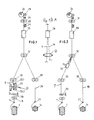
- the elastane thread is drawn off from the supply spool 14 overhead.
- the head package is preceded coaxially by a head thread guide 27.
- the elastane thread is drawn off by the delivery mechanism 28 and then guided to the withdrawal mechanism 12.
- the thermoplastic thread is drawn off from the supply spool 1 by the thread guide 4 by means of a take-off mechanism 5.
- the thread is then passed over a drawing pin 29 with a 360 ° loop and drawn out of the drawing zone by drawing device 30 and then also led to take-off device 12.
- the threads are drawn off together by the take-off mechanism 12.
- the threads are preferably guided separately, as shown in FIG. 1 / 2A.
- the threads are guided through a tangel nozzle 19 and drawn off from it by the take-off unit 31.
- the threads are then wound on the take-up spool 24, for which purpose the take-up spool 24 is driven by the drive roller 25 on its circumference.
- the position of a traversing device is indicated schematically at 32.
- the procedure in the three cases shown is as follows:
- the thermoplastic thread is drawn between the take-off unit 5 and the drafting unit 3.
- the stretching point or the stretching zone is formed on or behind the stretching pin 29.
- the peripheral speed of the drawing-off mechanism 28 for the elastane thread is set to the peripheral speed of the drawing-off mechanism 12 such that both the thermoplastic thread and the elastane thread run towards the withdrawal mechanism in the tensioned state.
- the thread tension of the elastane thread is preferably between 0.1 and 0.3 cN / dtex, while the thread tension of the low-stretch, thermoplastic thread is between 0.2 and 0.8 cN / dtex.
- the peripheral speed of the extraction mechanism 31 is at least 2% lower, preferably 6 to 9% lower than the peripheral speed of the extraction mechanism 12.
- the spreading treatment serves to loosen the fiber composite of the individual filaments of the low-stretch thread 1 held together by adhesive and cohesive forces.
- an expansion treatment is carried out in the stretching zone.
- the combination of a thread guide 33 with two overflow edges 33.1 and 33.2 and a knife 34 which projects between the overflow edges 33.1 and 33.2 serves as the spreading device 32. The thread is passed between the overflow edges 33.1, 33.2 and the knife and is thereby tensioned and spread along the knife edge.
- the spreading device consists of a spreading nozzle, as shown in detail in the aforementioned patent application P 38 35 169.2 (Z-1661) and in FIG. 5.
- a spreading nozzle is also provided as the spreading device 32, but in this case is provided directly in front of the air jet treatment nozzle (tangle nozzle) 19.
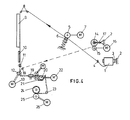
- the supply spool 1 with a thermoplastic thread 1, for example nylon, perlon, polyester, is plugged onto a drain mandrel 3 on the gate 2, which is only partially shown.
- the thread is guided through the centrally arranged top thread guide 4 and drawn off by a feed mechanism 5.
- the Delivery unit 5 is driven by motor 7.
- the thread is pressed against the surface of the delivery mechanism 5 by pressure roller 6, which is under spring force.
- the thread is passed over a heating plate 9 and a subsequent cooling plate 10 before it runs into the false twister 11 - indicated here as a friction false twister with a plurality of disks which are attached to three rotating axes.
- the thread is withdrawn from the false twist zone by delivery mechanism 12.
- the delivery mechanism 12 is driven by motor 13.
- the thread is pressed against the surface of the delivery mechanism 12 by a strap looped over two freely rotating rollers.
- elastane thread on the supply spool 14. It is a highly elastic, rubber-like, elastomeric continuous thread.
- the coil 14 is mounted in a rocker 17 on the gate 2 and lies with its circumference on a drive roller 15.
- the drive roller 15 is driven by the motor 16 such that the elastane thread is unwound.
- the elastane thread is guided separately from and parallel to the thermoplastic thread into the feed mechanism 12 via deflection roller 18.
- This blowing nozzle 19 is a tangel nozzle.
- the function of the Tangel nozzle is to form knots between the individual filaments of the two threads, which are repeated in a more or less regular sequence.
- Behind the tangel nozzle 19 the now combined thread is passed over an oil roller which is driven by motor 22 at low speed.
- the thread is then fed to the take-up spool 24 via deflection 23 and a traversing device, not shown.
- the take-up reel 24 lies on the drive roller 25 and is driven by motor 26 at a defined speed.
- the drawing mechanism 31 shown in dashed lines is provided between the tang nozzle and the take-up.
- the speed of the draw-off mechanism 31 can be set independently of the speed of the other yarn feed mechanisms and the drive rollers 15 and 25.
- thermoplastic thread is only pre-oriented. It is stretched between the delivery plants 5 and 12.
- the delivery mechanism 12 is therefore driven in relation to the delivery mechanism 5 at a speed ratio of 1.1: 1 to 2: 1.
- a thread tension of 0.3 to 0.8 cN / dtex is established in front of the delivery mechanism 12.
- the drive roller 15 of the supply spool for the elastane thread is driven at a significantly lower peripheral speed than the feed mechanism 12.
- the speed ratio is between 1: 2 to 1: 4.
- the thread tension of the elastane thread is therefore between 0.1 and 0.4 cN / dtex before the delivery mechanism 12.
- the speed of the drive roller 25 for the take-up reel 24 is lower than the speed of the supply mechanism 12, preferably between 4 and 10% lower. If the withdrawal mechanism 31 is provided, these speed ratios apply to the delivery mechanism 12 and the withdrawal mechanism 31.
- the relative thread tension during winding is very low, since the tensile forces are only absorbed by the elastane thread portion of the combination thread, but the titer is essentially equal to the sum of the individual titer.
- the drop in the relative thread tension results from the fact that the absolute thread tension of the elastane thread in front of the supplying plant was 7 cN in one example, while the absolute thread tension of the combination thread behind the tangle nozzle is 5 cN.
- the thread can be passed through a heating device in front of the blowing nozzle or preferably after the blowing nozzle, preferably before the take-off mechanism 31, in order to calm the tendency to torsion of the previously twisted thermoplastic thread.
- Polyester, nylon or perlon are particularly suitable as thermoplastic threads.
- the special feature of the method according to the invention is that the threads are brought together only in or shortly before the tangle nozzle. Otherwise there is a connection of the two threads, which is caused by the tendency of the previously false-twisted thread to curl and which interferes with the image of the overall thread.
- the union of the elastane thread and the thermoplastic thread can only be effected as late as possible, preferably only after the delivery unit closing the false twist zone, if one wants to prevent the two threads from being connected by the tendency of the thermoplastic thread to curl.
- thermoplastic thread has to be fed to the tangle nozzle at a speed which leads to extensive relaxation of the thermoplastic thread in the connection zone. If this does not happen, the low-stretch thermoplastic thread does not take part in the twisting and knotting by the air jet treatment, and the mixing and knotting of the threads becomes less intensive. On the other hand, the relaxation of the composite thread must remain limited so that the process is not disturbed. In contrast, the winding speed must be chosen so high that neither very soft, unstable, unusable bobbins nor unbearably hard bobbins with thread damage arise.
- FIG. 5 shows a suitable expansion nozzle in longitudinal section, which can be used in the process sequence according to FIG. 2 or 3.
- a thread tube 43 is fastened with its lower end in a mounting block 39.
- the compressed air connection 38 opens into a collecting space 51, which continues in two compressed air channels 49.
- the two compressed air channels 49 nestle against the outer circumference of the thread tube. Their diameter is smaller than that of the thread tube.
- the inner boundary of the compressed air channels is formed by the outer wall of the thread tube.
- the compressed air channels are diametrically opposite with respect to the thread tube.
- the outer walls of the compressed air channels are convergent with respect to the axial direction of the thread tube and form a cross section with a minimal width 46.
- the channels 49 emerge into the free environment.
- the channels and the thread tube 43 are directed to a constriction 44.
- the thread tube 43 and the two compressed air channels 49 are arranged together with the center points M of the two balls 42 and the constriction 44 in the plane in which the continuous thread is guided and spread out into its individual filaments 9.
Landscapes
- Engineering & Computer Science (AREA)
- Textile Engineering (AREA)
- Mechanical Engineering (AREA)
- Physics & Mathematics (AREA)
- Fluid Mechanics (AREA)
- Yarns And Mechanical Finishing Of Yarns Or Ropes (AREA)
Applications Claiming Priority (4)
| Application Number | Priority Date | Filing Date | Title |
|---|---|---|---|
| DE3835138 | 1988-10-15 | ||
| DE3835138 | 1988-10-15 | ||
| DE3841740 | 1988-12-10 | ||
| DE3841740 | 1988-12-10 |
Publications (3)
| Publication Number | Publication Date |
|---|---|
| EP0364874A2 true EP0364874A2 (fr) | 1990-04-25 |
| EP0364874A3 EP0364874A3 (en) | 1990-12-12 |
| EP0364874B1 EP0364874B1 (fr) | 1993-09-29 |
Family
ID=25873268
Family Applications (1)
| Application Number | Title | Priority Date | Filing Date |
|---|---|---|---|
| EP89118903A Expired - Lifetime EP0364874B1 (fr) | 1988-10-15 | 1989-10-11 | Procédé de fabrication d'un fil assemblé |
Country Status (3)
| Country | Link |
|---|---|
| US (1) | US5008992A (fr) |
| EP (1) | EP0364874B1 (fr) |
| DE (1) | DE58905762D1 (fr) |
Cited By (5)
| Publication number | Priority date | Publication date | Assignee | Title |
|---|---|---|---|---|
| FR2749859A1 (fr) * | 1996-06-18 | 1997-12-19 | Icbt Valence | Procede de realisation d'un fil mixte extensible et machine pour sa mise en oeuvre |
| US6840032B2 (en) | 2001-10-10 | 2005-01-11 | Saurer Gmbh & Co. Kg | Yarn texturing machine for producing a composite yarn |
| WO2007054334A1 (fr) * | 2005-11-12 | 2007-05-18 | Oerlikon Textile Gmbh & Co. Kg | Dispositif de deviation d'un fil a haute elasticite |
| DE19746878B4 (de) * | 1996-11-21 | 2008-01-24 | Oerlikon Textile Gmbh & Co. Kg | Verfahren zur Herstellung eines Mehrkomponentenfadens |
| KR101185206B1 (ko) | 2009-06-29 | 2012-09-21 | 코오롱인더스트리 주식회사 | 아라미드 공기교락사 및 그 제조방법 |
Families Citing this family (17)
| Publication number | Priority date | Publication date | Assignee | Title |
|---|---|---|---|---|
| FR2735501A1 (fr) * | 1995-06-15 | 1996-12-20 | Payen & Cie L | Procede pour la fabrication d'un fil guipe elastique et nouveau type de fil ainsi obtenu |
| US6105224A (en) | 1998-09-28 | 2000-08-22 | O'mara Incorporated | Bulk yarns having improved elasticity and recovery, and processes for making same |
| IT1302607B1 (it) * | 1998-10-06 | 2000-09-29 | Fadis Spa | Procedimento e relativa macchina per l'accoppiamento di un filoelastomerico ad un filo inestensibile. |
| US6543106B1 (en) * | 1999-10-25 | 2003-04-08 | Celanese Acetate, Llc | Apparatus, method and system for air opening of textile tow and opened textile tow web produced thereby |
| ITMI20010600U1 (it) * | 2001-11-14 | 2003-05-14 | Giudici Davide E Figli S N C D | Macchina testurizzatrice |
| JP2003201637A (ja) * | 2001-12-27 | 2003-07-18 | Nisshinbo Ind Inc | 複合弾性糸及びその製造方法及びストレッチ性織物及びストレッチ性編物 |
| EP1411014A1 (fr) * | 2002-10-17 | 2004-04-21 | Giudici S.p.a. | Procédé et dispositif pour la production d'un fil élastique et pour remplacer automatiquement les bobines d'alimentation |
| US6848151B2 (en) * | 2003-03-31 | 2005-02-01 | Invista Norh America S.à.r.l | Air-jet method for producing composite elastic yarns |
| TW200523410A (en) * | 2003-12-02 | 2005-07-16 | Giudici S P A | Method and device for the production of a covered elastic yarn and for automatic replacement of feed spools |
| CN100472004C (zh) * | 2004-08-17 | 2009-03-25 | 江苏宏源纺机股份有限公司 | 利用高速弹力丝机制造花色丝的方法 |
| EP2844789A1 (fr) | 2012-05-03 | 2015-03-11 | Nytex S.r.l. | Fil composite entrelacé |
| US9080265B2 (en) * | 2012-11-19 | 2015-07-14 | New Horizon Elastic Fabric Co., Ltd | Fabric strap with soft side edges |
| JP6234866B2 (ja) * | 2014-03-31 | 2017-11-22 | ユニチカトレーディング株式会社 | ポリエステル複合仮撚糸の製造方法 |
| CN103938331B (zh) * | 2014-04-30 | 2016-03-02 | 福建万家丽科技实业有限公司 | 网络纱成型装置 |
| US9758908B2 (en) * | 2014-11-03 | 2017-09-12 | Goodrich Corporation | System and method for preparing textiles with volumized tows for facilitating densification |
| US12129577B2 (en) * | 2019-04-17 | 2024-10-29 | Snako Tekstil Isletmeleri San. Ve Tic A.S. | Composite yarn comprising at least two bundles of coalesced elastic filaments and a plurality of inelastic elements |
| CN113062022A (zh) * | 2021-03-17 | 2021-07-02 | 绍兴市柯桥区东纺纺织产业创新研究院 | 一种高弹纱的生产方法 |
Family Cites Families (7)
| Publication number | Priority date | Publication date | Assignee | Title |
|---|---|---|---|---|
| US3952496A (en) * | 1969-02-19 | 1976-04-27 | Akzona Incorporated | Composite thread |
| GB1453979A (en) * | 1973-03-16 | 1976-10-27 | Du Pont Canada | Composite yarns |
| US3940917A (en) * | 1974-09-05 | 1976-03-02 | E. I. Du Pont De Nemours And Company | Composite elastic yarns and process for producing them |
| DE7520319U (de) * | 1975-06-26 | 1976-04-01 | Barmag Barmer Maschinenfabrik Ag, 5600 Wuppertal | Stauchkraeuselvorrichtung fuer thermoplastische faeden |
| JPS5249367A (en) * | 1975-10-15 | 1977-04-20 | Mitsubishi Rayon Co | Method of suedeelike knitted woven goods |
| US4341063A (en) * | 1980-08-26 | 1982-07-27 | Milliken Research Corporation | Air textured yarns |
| DE3789006T2 (de) * | 1986-11-26 | 1994-09-01 | Fadis Spa | Maschine für das Zusammenfügen verschiedener Garne mittels Luftblasens. |
-
1989
- 1989-10-11 EP EP89118903A patent/EP0364874B1/fr not_active Expired - Lifetime
- 1989-10-11 DE DE89118903T patent/DE58905762D1/de not_active Expired - Fee Related
- 1989-10-12 US US07/420,571 patent/US5008992A/en not_active Expired - Fee Related
Cited By (6)
| Publication number | Priority date | Publication date | Assignee | Title |
|---|---|---|---|---|
| FR2749859A1 (fr) * | 1996-06-18 | 1997-12-19 | Icbt Valence | Procede de realisation d'un fil mixte extensible et machine pour sa mise en oeuvre |
| WO1997048843A1 (fr) * | 1996-06-18 | 1997-12-24 | Icbt Valence | Procede de realisation d'un fil mixte extensible et machine pour sa mise en oeuvre |
| DE19746878B4 (de) * | 1996-11-21 | 2008-01-24 | Oerlikon Textile Gmbh & Co. Kg | Verfahren zur Herstellung eines Mehrkomponentenfadens |
| US6840032B2 (en) | 2001-10-10 | 2005-01-11 | Saurer Gmbh & Co. Kg | Yarn texturing machine for producing a composite yarn |
| WO2007054334A1 (fr) * | 2005-11-12 | 2007-05-18 | Oerlikon Textile Gmbh & Co. Kg | Dispositif de deviation d'un fil a haute elasticite |
| KR101185206B1 (ko) | 2009-06-29 | 2012-09-21 | 코오롱인더스트리 주식회사 | 아라미드 공기교락사 및 그 제조방법 |
Also Published As
| Publication number | Publication date |
|---|---|
| US5008992A (en) | 1991-04-23 |
| DE58905762D1 (de) | 1993-11-04 |
| EP0364874B1 (fr) | 1993-09-29 |
| EP0364874A3 (en) | 1990-12-12 |
Similar Documents
| Publication | Publication Date | Title |
|---|---|---|
| EP0364874B1 (fr) | Procédé de fabrication d'un fil assemblé | |
| DE69308994T2 (de) | Verfahren und Vorrichtung zur Herstellung eines Verbundgarn | |
| EP1594785B1 (fr) | Dispositif pour fabriquer et enrouler des fils synthetiques | |
| DE10235936A1 (de) | Vorrichtung zum Spinnen und Aufwickeln | |
| DE69319642T2 (de) | Glasgarn, Verfahren und Vorrichtung zu dessen Herstellung | |
| DE69406001T2 (de) | Verbundfaden und methode zum herstellen eines verbundfadens der einen spandex-kern und eine texturierte thermoplastische ummantelung aufweist | |
| DE3125962A1 (de) | Verfahren und vorrichtung zum zufuehren von spannungsfreiem garn zu einer garnverbrauchseinrichtung | |
| DE3926227C2 (fr) | ||
| EP0718424B1 (fr) | Machine d'étirage-texturation pour fils synthétiques | |
| DE2837613A1 (de) | Verfahren zum herstellen eines effektstellen aufweisenden texturierten garnes und vorrichtung zur durchfuehrung des verfahrens | |
| DE102010051434B4 (de) | Vorrichtung und Verfahren zur Herstellung eines Umwindegarns | |
| DE2025109A1 (de) | Sohmelzspinnverfahren | |
| DE3437343A1 (de) | Verfahren und vorrichtung zur herstellung eines gesponnenen fadens | |
| EP1453996B1 (fr) | Procede et dispositif pour produire un fil combine | |
| DE2526107A1 (de) | Verfahren und vorrichtung zur herstellung gezwirnten garns sowie nach dem verfahren hergestelltes garn | |
| DE4424547C2 (de) | Verfahren zur Herstellung eines Nähfadens und Nähfaden | |
| AT414236B (de) | Verfahren und vorrichtung zur herstellung von folienbändchen | |
| EP0761855A1 (fr) | Procédé et dispositif pour le frisage à boîte de bourrage | |
| DE4032117A1 (de) | Spinnmaschine zum pneumatischen falschdrallspinnen | |
| EP1328671A2 (fr) | Machine de fausse torsion | |
| DE4129028A1 (de) | Falschzwirnkraeuselmaschine | |
| EP2673406A1 (fr) | Procédé et dispositif de texturation d'un fil synthétique | |
| DE19626031A1 (de) | Verfahren und Vorrichtung zum Herstellen von Dick/Dünneffekten in einem nicht voll orientierten Filament-Vorlagegarn | |
| DE19847744B4 (de) | Verfahren zur Herstellung von Coregarnen und/oder Fäden aus derartigen Garnen sowie Vorrichtung zur Durchführung des Verfahrens | |
| DE2527511B2 (de) | Maschine zum lufttexturieren von synthetischen endlosfaeden |
Legal Events
| Date | Code | Title | Description |
|---|---|---|---|
| PUAI | Public reference made under article 153(3) epc to a published international application that has entered the european phase |
Free format text: ORIGINAL CODE: 0009012 |
|
| AK | Designated contracting states |
Kind code of ref document: A2 Designated state(s): CH DE FR GB IT LI |
|
| PUAL | Search report despatched |
Free format text: ORIGINAL CODE: 0009013 |
|
| AK | Designated contracting states |
Kind code of ref document: A3 Designated state(s): CH DE FR GB IT LI |
|
| 17P | Request for examination filed |
Effective date: 19901206 |
|
| 17Q | First examination report despatched |
Effective date: 19920804 |
|
| ITF | It: translation for a ep patent filed | ||
| GRAA | (expected) grant |
Free format text: ORIGINAL CODE: 0009210 |
|
| AK | Designated contracting states |
Kind code of ref document: B1 Designated state(s): CH DE FR GB IT LI |
|
| PGFP | Annual fee paid to national office [announced via postgrant information from national office to epo] |
Ref country code: GB Payment date: 19931001 Year of fee payment: 5 |
|
| PGFP | Annual fee paid to national office [announced via postgrant information from national office to epo] |
Ref country code: FR Payment date: 19931021 Year of fee payment: 5 |
|
| PGFP | Annual fee paid to national office [announced via postgrant information from national office to epo] |
Ref country code: CH Payment date: 19931027 Year of fee payment: 5 |
|
| REF | Corresponds to: |
Ref document number: 58905762 Country of ref document: DE Date of ref document: 19931104 |
|
| PGFP | Annual fee paid to national office [announced via postgrant information from national office to epo] |
Ref country code: DE Payment date: 19931106 Year of fee payment: 5 |
|
| ET | Fr: translation filed | ||
| GBT | Gb: translation of ep patent filed (gb section 77(6)(a)/1977) |
Effective date: 19931027 |
|
| PLBE | No opposition filed within time limit |
Free format text: ORIGINAL CODE: 0009261 |
|
| STAA | Information on the status of an ep patent application or granted ep patent |
Free format text: STATUS: NO OPPOSITION FILED WITHIN TIME LIMIT |
|
| 26N | No opposition filed | ||
| PG25 | Lapsed in a contracting state [announced via postgrant information from national office to epo] |
Ref country code: GB Effective date: 19941011 |
|
| PG25 | Lapsed in a contracting state [announced via postgrant information from national office to epo] |
Ref country code: LI Effective date: 19941031 Ref country code: CH Effective date: 19941031 |
|
| GBPC | Gb: european patent ceased through non-payment of renewal fee |
Effective date: 19941011 |
|
| PG25 | Lapsed in a contracting state [announced via postgrant information from national office to epo] |
Ref country code: FR Effective date: 19950630 |
|
| REG | Reference to a national code |
Ref country code: CH Ref legal event code: PL |
|
| PG25 | Lapsed in a contracting state [announced via postgrant information from national office to epo] |
Ref country code: DE Effective date: 19950701 |
|
| REG | Reference to a national code |
Ref country code: FR Ref legal event code: ST |
|
| PG25 | Lapsed in a contracting state [announced via postgrant information from national office to epo] |
Ref country code: IT Free format text: LAPSE BECAUSE OF NON-PAYMENT OF DUE FEES;WARNING: LAPSES OF ITALIAN PATENTS WITH EFFECTIVE DATE BEFORE 2007 MAY HAVE OCCURRED AT ANY TIME BEFORE 2007. THE CORRECT EFFECTIVE DATE MAY BE DIFFERENT FROM THE ONE RECORDED. Effective date: 20051011 |