EP0364975A1 - Outil de taillage pour finissage d'engrenages - Google Patents
Outil de taillage pour finissage d'engrenages Download PDFInfo
- Publication number
- EP0364975A1 EP0364975A1 EP89119298A EP89119298A EP0364975A1 EP 0364975 A1 EP0364975 A1 EP 0364975A1 EP 89119298 A EP89119298 A EP 89119298A EP 89119298 A EP89119298 A EP 89119298A EP 0364975 A1 EP0364975 A1 EP 0364975A1
- Authority
- EP
- European Patent Office
- Prior art keywords
- cermet
- hob
- atoms
- cutting
- titanium
- Prior art date
- Legal status (The legal status is an assumption and is not a legal conclusion. Google has not performed a legal analysis and makes no representation as to the accuracy of the status listed.)
- Granted
Links
- 239000011195 cermet Substances 0.000 claims abstract description 40
- 239000010936 titanium Substances 0.000 claims abstract description 30
- 229910052721 tungsten Inorganic materials 0.000 claims abstract description 12
- RTAQQCXQSZGOHL-UHFFFAOYSA-N Titanium Chemical compound [Ti] RTAQQCXQSZGOHL-UHFFFAOYSA-N 0.000 claims abstract description 11
- PXHVJJICTQNCMI-UHFFFAOYSA-N Nickel Chemical compound [Ni] PXHVJJICTQNCMI-UHFFFAOYSA-N 0.000 claims abstract description 9
- 239000011230 binding agent Substances 0.000 claims abstract description 8
- 229910052719 titanium Inorganic materials 0.000 claims abstract description 7
- 229910052723 transition metal Inorganic materials 0.000 claims abstract description 7
- 150000003624 transition metals Chemical class 0.000 claims abstract description 7
- 125000004429 atom Chemical group 0.000 claims abstract description 5
- 125000004432 carbon atom Chemical group C* 0.000 claims abstract description 4
- 239000010941 cobalt Substances 0.000 claims abstract description 4
- 229910017052 cobalt Inorganic materials 0.000 claims abstract description 4
- GUTLYIVDDKVIGB-UHFFFAOYSA-N cobalt atom Chemical compound [Co] GUTLYIVDDKVIGB-UHFFFAOYSA-N 0.000 claims abstract description 4
- 229910052759 nickel Inorganic materials 0.000 claims abstract description 4
- 239000002131 composite material Substances 0.000 claims abstract description 3
- 239000012535 impurity Substances 0.000 claims abstract description 3
- WFKWXMTUELFFGS-UHFFFAOYSA-N tungsten Chemical compound [W] WFKWXMTUELFFGS-UHFFFAOYSA-N 0.000 claims abstract description 3
- 239000010937 tungsten Substances 0.000 claims abstract description 3
- 238000005520 cutting process Methods 0.000 claims description 41
- 229910052715 tantalum Inorganic materials 0.000 claims description 11
- 229910052750 molybdenum Inorganic materials 0.000 claims description 6
- 229910052758 niobium Inorganic materials 0.000 claims description 5
- 239000010955 niobium Substances 0.000 claims description 5
- 229910052726 zirconium Inorganic materials 0.000 claims description 4
- VYZAMTAEIAYCRO-UHFFFAOYSA-N Chromium Chemical compound [Cr] VYZAMTAEIAYCRO-UHFFFAOYSA-N 0.000 claims description 2
- ZOKXTWBITQBERF-UHFFFAOYSA-N Molybdenum Chemical compound [Mo] ZOKXTWBITQBERF-UHFFFAOYSA-N 0.000 claims description 2
- QCWXUUIWCKQGHC-UHFFFAOYSA-N Zirconium Chemical compound [Zr] QCWXUUIWCKQGHC-UHFFFAOYSA-N 0.000 claims description 2
- 229910052804 chromium Inorganic materials 0.000 claims description 2
- 239000011651 chromium Substances 0.000 claims description 2
- 229910052735 hafnium Inorganic materials 0.000 claims description 2
- VBJZVLUMGGDVMO-UHFFFAOYSA-N hafnium atom Chemical compound [Hf] VBJZVLUMGGDVMO-UHFFFAOYSA-N 0.000 claims description 2
- 239000011733 molybdenum Substances 0.000 claims description 2
- GUCVJGMIXFAOAE-UHFFFAOYSA-N niobium atom Chemical compound [Nb] GUCVJGMIXFAOAE-UHFFFAOYSA-N 0.000 claims description 2
- GUVRBAGPIYLISA-UHFFFAOYSA-N tantalum atom Chemical compound [Ta] GUVRBAGPIYLISA-UHFFFAOYSA-N 0.000 claims description 2
- 229910052720 vanadium Inorganic materials 0.000 claims description 2
- LEONUFNNVUYDNQ-UHFFFAOYSA-N vanadium atom Chemical compound [V] LEONUFNNVUYDNQ-UHFFFAOYSA-N 0.000 claims description 2
- 239000000203 mixture Substances 0.000 abstract description 11
- 150000004767 nitrides Chemical group 0.000 abstract description 2
- 238000003754 machining Methods 0.000 description 18
- 238000000034 method Methods 0.000 description 14
- 229910000997 High-speed steel Inorganic materials 0.000 description 12
- 230000003746 surface roughness Effects 0.000 description 12
- 238000002474 experimental method Methods 0.000 description 11
- 239000000463 material Substances 0.000 description 9
- 238000005259 measurement Methods 0.000 description 7
- 230000000694 effects Effects 0.000 description 4
- 229910000851 Alloy steel Inorganic materials 0.000 description 2
- XEEYBQQBJWHFJM-UHFFFAOYSA-N Iron Chemical compound [Fe] XEEYBQQBJWHFJM-UHFFFAOYSA-N 0.000 description 2
- 239000010730 cutting oil Substances 0.000 description 2
- 229910052751 metal Inorganic materials 0.000 description 2
- 239000002184 metal Substances 0.000 description 2
- 125000004433 nitrogen atom Chemical group N* 0.000 description 2
- 238000012360 testing method Methods 0.000 description 2
- 238000003466 welding Methods 0.000 description 2
- 229910000831 Steel Inorganic materials 0.000 description 1
- -1 TiN Chemical class 0.000 description 1
- ATJFFYVFTNAWJD-UHFFFAOYSA-N Tin Chemical compound [Sn] ATJFFYVFTNAWJD-UHFFFAOYSA-N 0.000 description 1
- 230000002349 favourable effect Effects 0.000 description 1
- 239000004615 ingredient Substances 0.000 description 1
- 229910052742 iron Inorganic materials 0.000 description 1
- 238000004519 manufacturing process Methods 0.000 description 1
- 150000001247 metal acetylides Chemical class 0.000 description 1
- 239000012255 powdered metal Substances 0.000 description 1
- 238000005245 sintering Methods 0.000 description 1
- 239000007779 soft material Substances 0.000 description 1
- 239000006104 solid solution Substances 0.000 description 1
- 239000000243 solution Substances 0.000 description 1
- 239000007858 starting material Substances 0.000 description 1
- 239000010959 steel Substances 0.000 description 1
- 230000036346 tooth eruption Effects 0.000 description 1
Images

Classifications
-
- B—PERFORMING OPERATIONS; TRANSPORTING
- B23—MACHINE TOOLS; METAL-WORKING NOT OTHERWISE PROVIDED FOR
- B23F—MAKING GEARS OR TOOTHED RACKS
- B23F21/00—Tools specially adapted for use in machines for manufacturing gear teeth
- B23F21/12—Milling tools
- B23F21/16—Hobs
-
- B—PERFORMING OPERATIONS; TRANSPORTING
- B23—MACHINE TOOLS; METAL-WORKING NOT OTHERWISE PROVIDED FOR
- B23F—MAKING GEARS OR TOOTHED RACKS
- B23F21/00—Tools specially adapted for use in machines for manufacturing gear teeth
- B23F21/12—Milling tools
- B23F21/16—Hobs
- B23F21/163—Hobs with inserted cutting elements
-
- C—CHEMISTRY; METALLURGY
- C22—METALLURGY; FERROUS OR NON-FERROUS ALLOYS; TREATMENT OF ALLOYS OR NON-FERROUS METALS
- C22C—ALLOYS
- C22C29/00—Alloys based on carbides, oxides, nitrides, borides, or silicides, e.g. cermets, or other metal compounds, e.g. oxynitrides, sulfides
- C22C29/02—Alloys based on carbides, oxides, nitrides, borides, or silicides, e.g. cermets, or other metal compounds, e.g. oxynitrides, sulfides based on carbides or carbonitrides
- C22C29/04—Alloys based on carbides, oxides, nitrides, borides, or silicides, e.g. cermets, or other metal compounds, e.g. oxynitrides, sulfides based on carbides or carbonitrides based on carbonitrides
-
- Y—GENERAL TAGGING OF NEW TECHNOLOGICAL DEVELOPMENTS; GENERAL TAGGING OF CROSS-SECTIONAL TECHNOLOGIES SPANNING OVER SEVERAL SECTIONS OF THE IPC; TECHNICAL SUBJECTS COVERED BY FORMER USPC CROSS-REFERENCE ART COLLECTIONS [XRACs] AND DIGESTS
- Y10—TECHNICAL SUBJECTS COVERED BY FORMER USPC
- Y10T—TECHNICAL SUBJECTS COVERED BY FORMER US CLASSIFICATION
- Y10T407/00—Cutters, for shaping
- Y10T407/17—Gear cutting tool
- Y10T407/1715—Hob
- Y10T407/173—Hob for cutting involute gear tooth
-
- Y—GENERAL TAGGING OF NEW TECHNOLOGICAL DEVELOPMENTS; GENERAL TAGGING OF CROSS-SECTIONAL TECHNOLOGIES SPANNING OVER SEVERAL SECTIONS OF THE IPC; TECHNICAL SUBJECTS COVERED BY FORMER USPC CROSS-REFERENCE ART COLLECTIONS [XRACs] AND DIGESTS
- Y10—TECHNICAL SUBJECTS COVERED BY FORMER USPC
- Y10T—TECHNICAL SUBJECTS COVERED BY FORMER US CLASSIFICATION
- Y10T407/00—Cutters, for shaping
- Y10T407/27—Cutters, for shaping comprising tool of specific chemical composition
-
- Y—GENERAL TAGGING OF NEW TECHNOLOGICAL DEVELOPMENTS; GENERAL TAGGING OF CROSS-SECTIONAL TECHNOLOGIES SPANNING OVER SEVERAL SECTIONS OF THE IPC; TECHNICAL SUBJECTS COVERED BY FORMER USPC CROSS-REFERENCE ART COLLECTIONS [XRACs] AND DIGESTS
- Y10—TECHNICAL SUBJECTS COVERED BY FORMER USPC
- Y10T—TECHNICAL SUBJECTS COVERED BY FORMER US CLASSIFICATION
- Y10T428/00—Stock material or miscellaneous articles
- Y10T428/12—All metal or with adjacent metals
- Y10T428/12014—All metal or with adjacent metals having metal particles
- Y10T428/12028—Composite; i.e., plural, adjacent, spatially distinct metal components [e.g., layers, etc.]
- Y10T428/12049—Nonmetal component
- Y10T428/12056—Entirely inorganic
Definitions
- the present invention relates to a hobbing tool for finishing the tooth bottom and the tooth surface of a gear produced by generate gear cutting, to a highly smooth finish.
- a prior art hob for finishing a generated gear is usually made of high-speed steel. But, because of insufficient resistance to wear and to weld, its use has been limited to the machining of a relatively soft material having an HB (Brinell hardness number) of no more than 200. Further, this type of prior art hob cannot finish up the surface of even such a low-hardness material but can machine it only to such an extent as to require further finishing work by another tool.
- HB Batteryll hardness number
- a hob made of cemented carbide is coming into wide use because it is superior to high-speed steel in the resistance to wear and resistance to weld.
- the surface roughness obtainable with a cutting edge made of cemented carbide is about 6 microns, which is a little better than the surface roughness obtainable with a cutting edge made of high-speed steel i.e. about 10 to 20 microns, but is not sufficient to achieve a surface roughness at which no further finishing is necessary, about 2 to 3 microns.
- a hobbing tool for finishing gears which has a cutting edge made of a cermet comprising 70 to 97 per cent by weight of a hard phase, the balance being a binder phase.
- the hard phase comprises a composite carbonitride including titanium and tungsten and at least one transition metal selected from the group consisting of zirconium, hafnium, vanadium, niobium, tantalum, chromium and molybdenum.
- the binder phase comprises nickel and/or cobalt and inevitable impurities.
- the ratio between nitrogen atoms and carbon atoms, that is, N/(C + N), and the ratio between titanium atoms and atoms of a transition metal other than titanium in the hard phase, that is, M/(Ti + M), should meet one of the following conditions;
- the cermet according to the present invention may be made from carbides such as TiC, TaC, NbC and WC, nitrides such as TiN, carbonitrides such as TiCN, and cobalt and nickel by powdered metal technique, or may be made from a solid solution made from some or all of such starting materials by solution treatment. With either methods, similar effects can be achieved.
- the work can be machined at a speed 3 to 5 times higher than with a prior art hob made of high-speed steel. Also its service life is about ten times longer than that of the prior art hob.
- the efficiency of generate gear cutting improves dramatically because no additional finishing is necessary and the work can be machined at an increased speed.
- the high machining efficiency as well as longer service life will make it possible to sharply cut down the machining cost and the production cost.
- a cutting edge made of cermet which has an excellent antiweld property against iron, can produce a finer finished surface than the one produced by a cutting edge made of high-speed steel or cemented carbide.
- Cermet has a fine grain size, an increased hardness and a high heat resistance, which are highly desirable characteristics as the material for a cutting edge. In spite of its favorable characteristics, cermet has never been used as the material for a hobbing tool. This is because any prior art cermet provided for ordinary light machining was extremely poor in strength as well as toughness. In fact, it was observed that a hob made of such a proir art cermet broke too early to exhibit its excellent characteristics as described above.
- a hob made of the cermet according to the present invention having the above-described composition was found out to withstand a practical use.
- the surface of a work can be finished to such an extent as to require no further grinding (roughness of 2 - 3 microns) with such a hob by virtue of the abovementioned characteristics of cermet.
- the hobbing tool formed with a flat land on the relief surface of each cutting edge is less liable to have bad effects on the gear being machined and the flat lands serve to increase the rigidity of the cutting edges, thus preventing them form chipping. This will lead to an extention of the service life of the machine tool.
- the provision of the flat land on each relief surface will not lead to the blunting of the edges or promote welding, because the edges are made of the cermet having an increased rigidity and an excellent antiweld property.
- the cermet according to the present invention should have the abovesaid limitations in the contents of its ingredients.
- the content of the hard phase in the cermet should be 70 to 97 per cent by weight. If it is less than 70 per cent by weight, the heat resistance, antiwear property and antiweld property of the cermet will be insufficient, whereas if it is more than 97 per cent by weight, the cermet will be short of toughness.
- the ratio between the nitrogen atoms and the carbon atoms, N/(C + N), and the ratio between the titanium atoms and the atoms of transition metals M other than the titanium contained in the hard phase, i.e. M/(Ti + M) should be, either:
- N/(C + N) is less than 0.2, while M/(Ti + M) is within the range of 0.05 - 0. 4 (the prior art cermet has such a composition), the toughness will be insufficient. A hob made of such a cermet tends to suffer chipping of its cutting edges. On the other hand, any cermet having the N/(C + N) ratio of more than 0.6 would be very difficult to work.
- the cermet will exhibit a sufficient toughness for actual use even if N/(C + N) is 0.05 - 0.25. But, if M/(Ti + M) is higher than 0.6, the antiweld property will worsen.
- cermet hob which can generate a fine surface equivalent in roughness to a ground surface not by grinding but simply by cutting. But such a demand has not been satisfied because cermet has some unfavorable characteristics.
- the cermet according to the present invention has a novel composition which is entirely different from any conventional cermet and is free of such unfavorable characteristics.
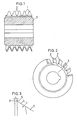
- Figs. 1 to 3 show the embodiment of the present invention which comprises a cutting insert 1 having cutting edges 2 and a hob body 3.
- the insert 1 is made of the cermet having the above-described composition and brazed to the body 3. As shown in Fig. 3, the insert 1 has a relief surface 4 formed with a narrow flat land 5.
- the dimension t of the flat land 5 in the direction of threads should be as large as possible to increase the rigidity of the edge and to allow repeated regrinding. But it should not be so large that the rear end of the land 5 with respect to the direction of rotation of the hob would interfere with the material being machined. It should be from 0.2 to 1.0 mm.
- An alloy steel SCM435 (having an HB of 340) was machined by use of the cermet hob according to the present invention, a hob made of cermet having a conventional composition, a hob made of cemented carbide JIS P25 and a hob made of high-speed steel JIS SKH 5.
- Table 1 shows the measurements of the hobs used in this experiment and the cutting conditions.
- Table 2 shows the measurements of the gear machined.
- Table 3 shows the composition of the cermets used in this experiment.
- the cermet hob according to the present invention has the same measurements as the prior art cermet hob.
- Fig. 4 shows the measurements of the surface roughness of the works machined by the respective hobs versus the cutting length.
- Fig. 5 shows the degree of wear of the hobs versus the cutting length.
- Fig. 4 shows that the cermet hob according to the present invention can produce the smoothest finished surface of all the hobs, namely the surface roughness of about 2 microns, whereas the surface roughness values attained by the hobs made of cemented carbide and high-speed steel were 6 - 7 microns and 16 - 17 microns, respectively.
- the cermet hob of the present invention suffered the smallest degree of wear and thus showed the longest service life.
- the hobs made of cermet having the dimensions shown in Table 4 and having the compositions shown in Table 5 were used to machine an alloy steel SCM415 (having an HB of 160) under different cutting conditions as shown in Table 6. The roughness of the finished surface on the material was checked. The measurements of the gear machined are shown in Table 7.
- the sample No. 9 showed too high a welding tendency to be acceptable as the material for a hob. Since the samples Nos. 7 and 8 were substantially the same in performance, only the results of the sample No. 7 are shown in Fig. 6, which reveal that the surface finished by the cermet hob according to the present invention had a surface roughness of about 2 microns under any of the three different cutting conditions A to C, that is, the roughness which is so smooth as to require no additional grinding which was necessary with prior art hobs.
- the roughhness of the relief surface on each cutting edge is supposed to be transferred precisely onto each tooth of the work.
- the surface finished by the cermet hob according to the present invention had a roughness of about 2 microns. This is because the relief surface on its cutting edges had a roughness of about 2 microns. This means that the surface roughness of the work is proportional to the surface roughness of the relief surface. But, forming an extremely fine relief surface on each cutting edge will only result in complicating the working of the tool.
- the lower limit of the roughness of the relief surface should be about 0.5 micron and its upper limit should be about 3 microns, because if the roughness is more than 3 microns, additional grinding will become necessary.
- a hob made of high-speed steel was used for both rough machining and finish machining of a gear.
- Another gear was machined roughly by use of a hob made of cemented carbide and then finished by use of the hob made of cermet having the same composition as the one used in Experiment I.
- the machining time, the service life, the surface roughness, etc. were measured for both gears machined.
- the gears made of an SCM420 steel (HB 270) were used for testing.
- Table 8 shows the measurements of the gears.
- Table 9 shows the results of the experiment and the cutting conditions.
- the machining speed had to be limited to 20 to 30 m/min. in view of the wear of the tools used.
- the roughness of the finished surface was 12S, which is too rough to be acceptable.
- the machining speed could be increased up to about 100 m/min., thereby greatly improving the machining efficiency.
- the tools used in the improved process exhibited a service life over ten times longer than those of the tools used in the prior art process.
Landscapes
- Engineering & Computer Science (AREA)
- Mechanical Engineering (AREA)
- Chemical & Material Sciences (AREA)
- Materials Engineering (AREA)
- Metallurgy (AREA)
- Organic Chemistry (AREA)
- Cutting Tools, Boring Holders, And Turrets (AREA)
- Gear Processing (AREA)
Applications Claiming Priority (2)
| Application Number | Priority Date | Filing Date | Title |
|---|---|---|---|
| JP26208288 | 1988-10-17 | ||
| JP262082/88 | 1988-10-17 |
Publications (2)
| Publication Number | Publication Date |
|---|---|
| EP0364975A1 true EP0364975A1 (fr) | 1990-04-25 |
| EP0364975B1 EP0364975B1 (fr) | 1994-05-25 |
Family
ID=17370776
Family Applications (1)
| Application Number | Title | Priority Date | Filing Date |
|---|---|---|---|
| EP89119298A Expired - Lifetime EP0364975B1 (fr) | 1988-10-17 | 1989-10-17 | Outil de taillage pour finissage d'engrenages |
Country Status (4)
| Country | Link |
|---|---|
| US (1) | US5030038A (fr) |
| EP (1) | EP0364975B1 (fr) |
| KR (1) | KR930001091B1 (fr) |
| DE (1) | DE68915507T2 (fr) |
Cited By (1)
| Publication number | Priority date | Publication date | Assignee | Title |
|---|---|---|---|---|
| EP0739697A4 (fr) * | 1993-09-21 | 1998-01-28 | Kanefusa Knife & Saw | Outil de coupe rotatif pour le travail du bois ou d'un materiau composite a base de bois |
Families Citing this family (9)
| Publication number | Priority date | Publication date | Assignee | Title |
|---|---|---|---|---|
| US5552108A (en) * | 1990-12-21 | 1996-09-03 | Sandvik Ab | Method of producing a sintered carbonitride alloy for extremely fine machining when turning with high cutting rates |
| JP3198680B2 (ja) * | 1992-11-16 | 2001-08-13 | 三菱マテリアル株式会社 | 耐摩耗性のすぐれたTi系炭窒化物基サーメット製切削工具 |
| JP3165658B2 (ja) * | 1997-04-10 | 2001-05-14 | 三菱重工業株式会社 | 歯車加工方法 |
| TW582317U (en) * | 1997-07-07 | 2004-04-01 | Mitsubishi Heavy Ind Ltd | Gear shaper cutting apparatus |
| AU2002221127A1 (en) * | 2000-12-19 | 2002-07-01 | Honda Giken Kogyo Kabushiki Kaisha | Composite material |
| CN100422362C (zh) * | 2001-07-03 | 2008-10-01 | 本田技研工业株式会社 | 多元系陶瓷粉末及其制造方法、和烧结体及其制造方法 |
| US7645727B2 (en) * | 2004-05-03 | 2010-01-12 | Gm Global Technology Operations, Inc. | Gear cutting oil |
| CN101108432B (zh) * | 2006-07-19 | 2010-06-02 | 陆联精密股份有限公司 | 滚齿刀及其成型方法 |
| CN116422832B (zh) * | 2023-04-27 | 2023-10-13 | 西安理工大学 | 耐磨盾构机滚刀刀具及其制备方法 |
Citations (4)
| Publication number | Priority date | Publication date | Assignee | Title |
|---|---|---|---|---|
| US2498721A (en) * | 1945-06-07 | 1950-02-28 | Stephen M Stafford | Hob |
| US3971656A (en) * | 1973-06-18 | 1976-07-27 | Erwin Rudy | Spinodal carbonitride alloys for tool and wear applications |
| US4049876A (en) * | 1974-10-18 | 1977-09-20 | Sumitomo Electric Industries, Ltd. | Cemented carbonitride alloys |
| EP0259192A2 (fr) * | 1986-09-05 | 1988-03-09 | Sumitomo Electric Industries, Limited | Cermet à résilience élevée et son procédé de fabrication |
Family Cites Families (8)
| Publication number | Priority date | Publication date | Assignee | Title |
|---|---|---|---|---|
| US4022584A (en) * | 1976-05-11 | 1977-05-10 | Erwin Rudy | Sintered cermets for tool and wear applications |
| JPS5918349B2 (ja) * | 1982-07-12 | 1984-04-26 | 工業技術院長 | 炭窒化チタン−ホウ化金属系セラミツクス材料 |
| US4587174A (en) * | 1982-12-24 | 1986-05-06 | Mitsubishi Kinzoku Kabushiki Kaisha | Tungsten cermet |
| KR890004539B1 (ko) * | 1983-01-13 | 1989-11-13 | 미쯔비시긴조구 가부시기가이샤 | 초내열 소결합금 및 그 제조방법 |
| JPS59144535A (ja) * | 1983-02-03 | 1984-08-18 | Kyocera Corp | 缶蓋巻締用工具 |
| US4647546A (en) * | 1984-10-30 | 1987-03-03 | Megadiamond Industries, Inc. | Polycrystalline cubic boron nitride compact |
| JPH0617531B2 (ja) * | 1986-02-20 | 1994-03-09 | 日立金属株式会社 | 強靭性サ−メツト |
| US4942097A (en) * | 1987-10-14 | 1990-07-17 | Kennametal Inc. | Cermet cutting tool |
-
1989
- 1989-10-16 US US07/421,236 patent/US5030038A/en not_active Expired - Lifetime
- 1989-10-17 EP EP89119298A patent/EP0364975B1/fr not_active Expired - Lifetime
- 1989-10-17 KR KR1019890014925A patent/KR930001091B1/ko not_active Expired - Lifetime
- 1989-10-17 DE DE68915507T patent/DE68915507T2/de not_active Expired - Lifetime
Patent Citations (4)
| Publication number | Priority date | Publication date | Assignee | Title |
|---|---|---|---|---|
| US2498721A (en) * | 1945-06-07 | 1950-02-28 | Stephen M Stafford | Hob |
| US3971656A (en) * | 1973-06-18 | 1976-07-27 | Erwin Rudy | Spinodal carbonitride alloys for tool and wear applications |
| US4049876A (en) * | 1974-10-18 | 1977-09-20 | Sumitomo Electric Industries, Ltd. | Cemented carbonitride alloys |
| EP0259192A2 (fr) * | 1986-09-05 | 1988-03-09 | Sumitomo Electric Industries, Limited | Cermet à résilience élevée et son procédé de fabrication |
Cited By (1)
| Publication number | Priority date | Publication date | Assignee | Title |
|---|---|---|---|---|
| EP0739697A4 (fr) * | 1993-09-21 | 1998-01-28 | Kanefusa Knife & Saw | Outil de coupe rotatif pour le travail du bois ou d'un materiau composite a base de bois |
Also Published As
| Publication number | Publication date |
|---|---|
| US5030038A (en) | 1991-07-09 |
| DE68915507D1 (de) | 1994-06-30 |
| KR900006054A (ko) | 1990-05-07 |
| EP0364975B1 (fr) | 1994-05-25 |
| DE68915507T2 (de) | 1994-09-08 |
| KR930001091B1 (ko) | 1993-02-15 |
Similar Documents
| Publication | Publication Date | Title |
|---|---|---|
| EP0380096B1 (fr) | Foret en métal dur | |
| AU2008229200B2 (en) | Composite articles | |
| US7648736B2 (en) | Coated cutting tool for turning of steel | |
| US4769070A (en) | High toughness cermet and a process for the production of the same | |
| EP0364975B1 (fr) | Outil de taillage pour finissage d'engrenages | |
| US4514224A (en) | Tough carbide base cermet | |
| JP6956260B2 (ja) | 超硬合金、被覆工具及び切削工具 | |
| US3840367A (en) | Tool alloy compositions and methods of fabrication | |
| US4619698A (en) | Cubic boron nitride-based very high pressure-sintered material for cutting tools | |
| EP0591121B1 (fr) | Alliage de carbonitrure à base de titanium ayant une structure commandée | |
| JP2724485B2 (ja) | ニューセラミックスソリッドエンドミル | |
| US11618936B2 (en) | Cemented carbide, coated tool using same, and cutting tool | |
| US20010006594A1 (en) | Cutting member | |
| JPS633017B2 (fr) | ||
| JPH08502213A (ja) | エンドミル工具 | |
| WO2023188875A1 (fr) | Corps fritté et outil de coupe | |
| CN119794442A (zh) | 一种带有副容屑槽的整体硬质合金成形铣刀 | |
| US20090169315A1 (en) | CVD Coated Cutting Tool Insert for Milling | |
| JP3123067B2 (ja) | 靭性に優れたwc基超硬合金および硬質層被覆超硬合金 | |
| JP2815533B2 (ja) | フライス加工用切削装置 | |
| JP2005052957A (ja) | ボールエンドミル | |
| JPS6141980B2 (fr) | ||
| JPH08176719A (ja) | 窒素含有焼結硬質合金 | |
| JPH02212022A (ja) | 歯車加工用ホブ工具 | |
| JPS6141979B2 (fr) |
Legal Events
| Date | Code | Title | Description |
|---|---|---|---|
| PUAI | Public reference made under article 153(3) epc to a published international application that has entered the european phase |
Free format text: ORIGINAL CODE: 0009012 |
|
| AK | Designated contracting states |
Kind code of ref document: A1 Designated state(s): DE GB IT |
|
| 17P | Request for examination filed |
Effective date: 19900730 |
|
| 17Q | First examination report despatched |
Effective date: 19920212 |
|
| GRAA | (expected) grant |
Free format text: ORIGINAL CODE: 0009210 |
|
| AK | Designated contracting states |
Kind code of ref document: B1 Designated state(s): DE GB IT |
|
| REF | Corresponds to: |
Ref document number: 68915507 Country of ref document: DE Date of ref document: 19940630 |
|
| ITF | It: translation for a ep patent filed | ||
| PLBE | No opposition filed within time limit |
Free format text: ORIGINAL CODE: 0009261 |
|
| STAA | Information on the status of an ep patent application or granted ep patent |
Free format text: STATUS: NO OPPOSITION FILED WITHIN TIME LIMIT |
|
| 26N | No opposition filed | ||
| PGFP | Annual fee paid to national office [announced via postgrant information from national office to epo] |
Ref country code: GB Payment date: 20011017 Year of fee payment: 13 |
|
| REG | Reference to a national code |
Ref country code: GB Ref legal event code: IF02 |
|
| PG25 | Lapsed in a contracting state [announced via postgrant information from national office to epo] |
Ref country code: GB Free format text: LAPSE BECAUSE OF NON-PAYMENT OF DUE FEES Effective date: 20021017 |
|
| GBPC | Gb: european patent ceased through non-payment of renewal fee |
Effective date: 20021017 |
|
| PG25 | Lapsed in a contracting state [announced via postgrant information from national office to epo] |
Ref country code: IT Free format text: LAPSE BECAUSE OF NON-PAYMENT OF DUE FEES;WARNING: LAPSES OF ITALIAN PATENTS WITH EFFECTIVE DATE BEFORE 2007 MAY HAVE OCCURRED AT ANY TIME BEFORE 2007. THE CORRECT EFFECTIVE DATE MAY BE DIFFERENT FROM THE ONE RECORDED. Effective date: 20051017 |
|
| PGFP | Annual fee paid to national office [announced via postgrant information from national office to epo] |
Ref country code: DE Payment date: 20081014 Year of fee payment: 20 |