EP0365014A1 - Méthode et appareil pour cuire les aliments pour chauffage - Google Patents
Méthode et appareil pour cuire les aliments pour chauffage Download PDFInfo
- Publication number
- EP0365014A1 EP0365014A1 EP89119436A EP89119436A EP0365014A1 EP 0365014 A1 EP0365014 A1 EP 0365014A1 EP 89119436 A EP89119436 A EP 89119436A EP 89119436 A EP89119436 A EP 89119436A EP 0365014 A1 EP0365014 A1 EP 0365014A1
- Authority
- EP
- European Patent Office
- Prior art keywords
- closed
- container
- chamber
- inner container
- boiling
- Prior art date
- Legal status (The legal status is an assumption and is not a legal conclusion. Google has not performed a legal analysis and makes no representation as to the accuracy of the status listed.)
- Ceased
Links
Images
Classifications
-
- A—HUMAN NECESSITIES
- A47—FURNITURE; DOMESTIC ARTICLES OR APPLIANCES; COFFEE MILLS; SPICE MILLS; SUCTION CLEANERS IN GENERAL
- A47J—KITCHEN EQUIPMENT; COFFEE MILLS; SPICE MILLS; APPARATUS FOR MAKING BEVERAGES
- A47J27/00—Cooking-vessels
- A47J27/04—Cooking-vessels for cooking food in steam; Devices for extracting fruit juice by means of steam ; Vacuum cooking vessels
Definitions
- the present invention relates to a method of cooking foods in which foods that may be packaged or unpackaged are subjected to the application of heat for a very short period of time, e.g., to steaming or to warming or heating, so as to prepare them to be served.
- the present invention also relates to an apparatus for carrying out the method.
- Japanese Patent Laid-Open No. 63-240753 discloses a method of and an apparatus for preparing and processing foods by utilizing electric heating.
- a food material which may be any food material desired, such as polished rice or wheat, is received within a closed-end insulating container while submerged in water.
- the food material is then subjected to treatment with heat for a short period of time by heated water and bubble vapor resulting from the action of a pair of electrodes provided in the bottom portion of the container and supplied with electricity.
- this method makes it possible for flavorful and tasty foods to be served.
- the present invention has been accomplished in view of the drawback of the prior art.
- the present invention is directed to the provision of a method of and an apparatus for cooking foods by subjecting the foods to warming or heating, in which a closed-end insulating container having a steaming chamber defined therein and a pair of electrodes provided in the bottom portion thereof is specially provided with a boiling chamber receiving a relatively small mount of a solution of an electrolyte, the relatively small amount of solution of the electrolyte is caused to boil within a short period of time by the action of the pair of electrodes between which the flow of current occurs, and a food material received in the steaming chamber is quickly warmed or heated by the heat of steam generated by the boiling, the method and apparatus of the present invention thus being capable of cooking a food material quickly.
- a method of cooking foods by subjecting the foods to warming or heating comprises the steps of: preparing a closed-end insulating container having a steaming chamber defined therein, a pair of electrodes provided in the bottom portion of the container, and a boiling chamber receiving therein a solution of electrolyte, the steaming chamber being positioned above the boiling chamber; placing a food material to be cooked within the steaming chamber; causing the solution of the electrolyte to boil quickly by the action of the pair of electrodes between which the flow of current occurs; and warming or heating the food material by the heat of steam generated by the boiling so as to cook the food material.
- An apparatus for cooking foods by subjecting the foods to warming or heating comprises: a closed-end insulating container: and a removable cover at the upper portion thereof, the container having a steaming chamber defined therein, a boiling chamber which is provided on that side of the container that is close to the bottom of the inside thereof and which is capable of receiving therein a solution of electrolyte, and a pair of electrodes provided in the boiling chamber and capable of causing the boiling of the solution of the electrolyte received in the boiling chamber.
- Advantageous effects are provided if a food material is received within the steaming chamber while being received in a net or basket allowing the heat of steam to pass therethrough.
- the container prepared may further has a closed-end inner container which is provided within the steaming chamber above the boiling chamber and which is capable of receiving a food material therein, so that the food material may be cooked by being warmed or heated by the heating action of the heat of steam generated by boiling.
- the above-specified apparatus of the present invention may further comprise a closed-end inner container which is provided within the steaming chamber and which is capable of receiving a food material therein.
- the closed-end inner container may preferably be provided with a removable cover at the upper portion thereof.
- the closed-end inner container provided within the steaming chamber may preferably have an annular opening, or a plurality of openings formed around the upper portion thereof that is on the side where the inner container opens, the openings allowing steam to pass therethrough.
- the closed-end inner container may preferably have a vertically extending cylindrical passage provided at a substantially central location thereof, the passage allowing steam to ascend therethrough and communicating with the steaming chamber.
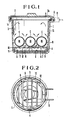
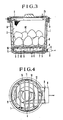
- Figs. 1 and 2 are views showing an embodiment of the apparatus for cooking foods by subjecting the foods to warming or heating, according to the present invention.
- the apparatus includes a closed-end insulating container 1 which opens at the upper end thereof and defines a steaming chamber 3 therein.
- a flange 1a is provided around the open end of the closed-end insulating container 1.
- the entire structure of the closed-end insulating container 1 should be formed of a heat-resisting resin material.
- the container 1 may be alternatively formed of an inexpensive material such as heat-resisting insulating water-proof paper or a molded foaming synthetic resin material.
- the material used to form the container 1 as well as the cross-sectional configuration of the same (e.g., a circular configuration), and other factors concerning the container 1 can be arbitrarily selected.
- a cover 2 is provided to cover the opening at the upper end of the closed-end insulating container 1, and is removable therefrom.
- a steam escape hole 2a opens through a suitable portion of the cover 2.
- the steaming chamber 3 occupies the majority of the inside of the closed-end insulating container 1, while a bottom portion of the inside of the container 1 is formed as a boiling chamber 4.
- a pair of annular electrodes 5 and 6, which are in the form of thin plates, are concentrically provided, with an electrode space 7 provided therebetween.
- the pair of electrodes 5 and 6 are formed of a electrically conducting material. If a metallic material is to be used, it may be selected from among such materials as thin plates, bar materials and sheets of titanium, aluminum or the like, and such sheets having their surfaces laminated with synthetic resin films. Other materials which may be used include carbon materials and resins containing carbon. The material and the configuration of the electrodes 5 and 6 can be arbitrarily selected.
- a plug 8 is provided to supply electricity to the electrodes 5 and 6 within the closed-end insulating container 1 via a lead 13.
- a plug receiving portion 9 is provided on the edge around the opening at the upper end of the closed-end insulating container 1, as shown in Figs. 1 and 2. If the plug 8 and the plug receiving portion 9 are members of, for instance, magnet type commonly employed in various equipment, they can be engaged with or disengaged from each other easily.
- a suitable amount of a solution A of an electrolyte is received within the boiling chamber 4.
- a preferred example of the electrolyte solution A is dilute salt water which is received in the boiling chamber 4 in such an amount that the electrodes 5 and 6 are adequately submerged in the solution A.
- a support 10 is disposed in the boiling chamber 4.
- the support 10 is formed by molding, e.g., a heat-resisting insulating synthetic resin.
- the support 10 has a large number of windows 12 opening through the surfaces thereof so that the support 10 is roaster-shaped.
- the support 10 also has a suitable number of vertically extending legs 11.
- B1 is a food material placed upon the support 10 within the steaming chamber 3.
- the embodiment shown in Fig. 1 illustrate the case where the food material B1 is a fish or meat paste product packaged in a packaging material C such as a plastic film.
- the height of the support 10 is determined in such a manner that a food material placed upon the support 10 will not be directly submerged in the electrolyte solution A.
- Denoted at symbol D is particles of steam generated by boiling.
- An apparatus such as that shown in Figs. 1 and 2 is used in the following manner to cook, by warming or heating for a short period of time, a food material which may be either packaged in a suitable packaging body and with any desired configuration, or unpackaged.
- a closed-end insulating container 1 is prepared, which container has a steaming chamber 3 defined therein, a pair of electrodes 5 and 6 provided in the bottom portion of the container 1, and a boiling chamber 4 receiving therein a solution A of an electrolyte, as shown in Figs. 1 and 2.
- a food material B1, packaged or unpackaged is placed within the steaming chamber 3 above the boiling chamber 4 in such a manner that the food material B1 is not submerged in the electrolyte solution A.
- the upper end at which the closed-end insulating container 1 opens is covered with a cover 2 and closed thereby.
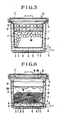
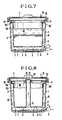
- FIGs. 3 and 4 show an apparatus for cooking foods by subjecting the foods to warming or heating, according to another embodiment of the present invention.
- This apparatus is exactly the same as the apparatus of the previous embodiment shown in Figs. 1 and 2, except that an unpackaged food material B2 is received in a net 14 which allows free passage therethrough of the heat of steam generated by boiling, and that the plug receiving portion 9 capable of engaging with a plug 8 is provided on the lower portion of the closed-end insulating container 1.
- the net 14 is formed of a piece of woven fabric or a formed synthetic resin. The edge portion of the net 14 around its opening projects outwardly from the flange 1a of the closed-end insulating container 1.
- the net 14 is formed with a flexible net-shaped configuration so that the food material B2 will be exposed to the heat of steam generated by boiling within the boiling chamber 4 and then freely passing through the net 14.
- the net 14 is also arranged in such a manner that, when the cooking of the food material B2 by the application of heat thereto is completed, the net 14 is taken out from the closed-end insulating container 1 while the net 14 still receives the food material B2.
- Fig. 3 illustrates the case where the unpackaged food material B2 is, e.g., vegetables, beans, or peas
- the food material B2 may alternatively be a different food material, packaged or unpackaged.
- the food material B2 may be a mixture of instant noodles and a soup, a mixture of a rice-cooking material such as rice or processed rice and water, or food which may often be served with the principal food, such as curry sauce.
- Examples of the food material B2 also include cooked foods and steamed cakes.
- Fig. 5 shows an apparatus for cooking foods by subjecting the foods to warming or heating, according to a still another embodiment of the present invention.
- This apparatus is exactly the same as the apparatus of the previous embodiment shown in Figs. 3 and 4, except that the net 14 is substituted with a basket 15 having a large number of windows 15′ formed through the peripheral surfaces thereof, the basket 15 being received in the steaming chamber 3 while in the state of being suspended.
- the basket 15 has its entire structure formed using, e.g., a synthetic resin, and is capable of being received while being suspended with its edge portion around its upper opening being disposed on the flange 1a of the closed-end insulating container 1.
- the boiling chamber 4 is positioned below the basket 15, thereby making it possible to omit the support 10 shown in Figs. 1 and 3.
- the use of the basket 15 allows the heat of steam generated by boiling to pass through the large number of windows 15′ and then be introduced into the basket 15, and also allows a food material B3 to be taken out from the casing 1 with ease.
- a food material B2 or B3, packaged or unpackaged is received in a net 14 or basket 15 which allows free passage therethrough of the heat of steam, and the net 14 or basket 15 receiving therein the food material B2 or B3 is in turn received in the steaming chamber 3, steam particles D of steam generated by boiling caused within the boiling chamber 4 by the action of the pair of electrodes 5 and 6 supplied with electricity are quickly introduced into the net 14 or basket 15, so that the heat of the steam generated by the boiling acts to warm or heat the food material B1 or B2 so as to cook it within a short period of time.
- Figs. 6 to 8 show apparatuses for cooking foods by subjecting the foods to warming or heating, according to further embodiments of the present invention.
- Each of the apparatuses includes a closed-end insulating container 1 and a removable cover 2 provided to cover and close the upper open portion of the container 1.
- the container 1 has a steaming chamber 3 defined therein, a pair of electrodes 5 and 6 provided in the bottom portion of the container 1, and a boiling chamber 4 receiving an electrolyte solution A.
- a support 10 is provided in the boiling chamber 4, with its legs 11 vertically extending.
- a closed-end inner container 16A opening at its upper end is disposed upon the support 10 in such a manner as to be received within the steaming chamber 3.
- the closed-end inner container 16A is capable of receiving therein a food material B4 comprising, in the illustrated example, instant noodles and a soup.
- a plurality of supporting projections 17 are provided at upper portions of the inner wall of the steaming chamber 3, so that the closed-end inner container 16A received in the steaming chamber 3 is accurately received and supported.
- a steam-ascending passage 18 is formed in the gap between the inner wall of the closed-end insulating container 1 and the outer wall of the closed-end inner container 16A.
- the steam-ascending passage 18 communicates, at its lower end, with the boiling chamber 4 and, at its upper end, with the steaming chamber 3, and allows steam to ascend therethrough.
- the closed-end inner container 16A shown in Fig. 6 may be provided with a cover 19 when required, the cover 19 being provided on the upper open side of the inner container 16A in such a manner as to be removable.
- a steam escape hole 19a of a suitable size is formed through the cover 19.
- a flange 20 for suspending a closed-end inner container 16B is provided around the upper opening of the container 16B.
- a food material B5 comprising, e.g., a rice-cooking material such as rice or processed rice and water
- the flange 20 is disposed upon the flange 1a of the closed-end insulating container 1, whereby the inner container 16B with the food material B5 is received in the steaming chamber 3 while in the condition of being suspended.
- a plurality of steam escape openings 18a′ open through the surfaces of the flange 20 of the closed-end inner container 16B, and a steam-ascending passage 18 is formed in the gap between the closed-end insulating container 1 and the closed-end inner container 16B, so that steam generated by boiling within the boiling chamber 4 will ascend through the steam-ascending passage 18, passes through the steam escape openings 18a′, and then flows into the closed-end inner container 16B.
- the embodiment shown in Fig. 8 is distinguished from the embodiment shown in Fig. 7 in that a closed-end inner container 16C is used.
- This container 16C is the same as the container 16B used in the embodiment shown in Fig. 7 except that the container 16C also has a cylindrical steam-ascending passage 21 vertically extending through the container 16C and communicating with the steaming chamber 3, the passage 21 being provided at a substantially central location of the closed-end inner container 16C.
- the lower end of the steam-ascending passage 21 communicates with the boiling chamber 4.
- a suitable number of steam escape holes 22 open through upper portions of the steam-ascending passage 21 in such a manner that the holes 22 communicate with the inside of the closed-end inner container 16C.
- steam generated by boiling ascends and flows not only over the outer peripheral wall of the closed-end inner container 16C but also through a central location of the container 16C.
- a food material B6 e.g., food such as curry sauce
- An apparatus for cooking foods by subjecting the foods to warming or heating such as that shown in any of Figs. 6 to 8, is used in the following manner to cook, by warming or heating for a short period of time, a food material B4, B5, or B6, packaged or unpackaged.
- a closed-end insulating container 1 is prepared, which container has a steaming chamber 3 defined therein, a pair of electrodes 5 and 6 provided in the bottom portion of the container 1, and a boiling chamber 4 receiving therein a solution A of an electrolyte A.
- the above-described operation is the same as the corresponding operation in the case where the apparatus of the embodiment shown in any of Figs. 1 to 5 is used.
- a closed-end inner container 16 receiving therein a food material B4, B5 or B6 is placed within the steaming chamber 3 above the boiling chamber 4 in such a manner that, in the case of the apparatus shown in Fig. 6, an inner container 16A is received through the intermediary of the support 10, whereas in the case of the apparatus shown in Fig. 7 or 8, an inner container 16B or 16C is disposed while being suspended.
- the amount of the electrolyte solution A is adjusted to such an amount that the bottom of the closed-end inner container 16A, 16B or 16C is not submerged in the electrolyte solution A.
- the upper end at which the closed-end insulating container 1 opens is covered with and closed by a cover 2.
- the upper open end of the inner container 16A is closed by the cover 19, as in the case of the apparatus shown in Fig. 6. If an annular steam escape opening 18a is formed around the upper open end of the closed-end inner container 16A, or a plurality of steam escape openings 18a′ are formed around the upper open end of the closed-end inner container 16B or 16C received within the steaming chamber 3, as in the case of the apparatus shown in Fig.
- part of steam generated by boiling is introduced into the closed-end inner container 16A, 16B or 16C through the opening 18a or openings 18a′ on the upper open side of the inner container 16.
- the food material is heated by both indirect and direct heating actions, thereby making it possible to cook, by warming or heating, the food material within a curtailed period of time.
- the closed-end inner container 16C has, at a substantially central location thereof, a cylindrical steam-ascending passage 21 vertically extending and communicating, at the upper end thereof, with the steaming chamber 3 and communicating, at the lower end thereof, with the boiling chamber 4, the food material received B6 can be cooked within a further curtailed time by warming or heating the food material by the heat of steam generated by boiling.
- the electrolyte solution A used in the apparatus for cooking foods by subjecting the foods to warming or heating, according to any of the above-described embodiments is such that, if substantially all the electrolyte solution A evaporates as time passes, the flow of current between the pair of electrodes is automatically interrupted.
- the amount of the received electrolyte solution A is adjusted, it is possible to set the electricity supply period to various values. It is also possible to vary the demand. That is, if the electrolyte solution A has a high electrolyte concentration, a correspondingly large amount of electricity is supplied, whereas if that concentration is low, a correspondingly small amount of electricity is supplied. Therefore, if that concentration is set at a predetermined value beforehand, it is possible to set the electricity supply amount at any desired value, thereby eliminating the need for any controller to be provided.
- the present invention providing the above-described method and apparatus, enables the achievement of the following advantageous effects.
- the space defined by substantially all the inside of the closed-end insulating container forms a steaming chamber
- a relatively small space on the side close to the bottom of the closed-end insulating container is formed as a boiling chamber
- a solution of an electrolyte is received within the boiling chamber that a pair of electrodes are submerged in the electrolyte solution
- the electrolyte solution can be brought to the boil within a short period of time at a speed which is considerably greater than that conventionally possible, while a relatively larger volume of a food material can be received, thereby enhancing the efficiency of one cooking (warming or heating) operation.
- this arrangement is advantageous in that, in contrast with conventional methods and apparatuses, it is possible to cook the food material by warming or heating the same indirectly by the heat of steam generated by boiling through the intermediary of the closed-end inner container, while the food material is kept from coming into direct contact with the electrolyte solution. Consequently, liquid-form food materials, such as soups, broths, milk, which have hitherto been warmed or heated only with difficulty, as well as steamed or processed food materials and foods often served together with the principal food can be processed with ease.
- food materials can be cooked by being warmed or heated, regardless of their contents, and whether they are packaged or unpackaged, within a very short period of time and with a small demand. If the materials for forming such members as the closed-end insulating container, the pair of electrodes, and the closed-end inner container are suitably selected and used, it is possible to use the method and the apparatus of the present invention to cook instant foods.
- the transportation of the food into and out of the closed-end insulating container can be easily performed, while the cooking can be performed quickly by directly warming or heating the food material by the heat of steam generated by boiling.
- the closed-end inner container is provided with a removable cover at the upper portion of the container, it is possible to cook a food material received in the closed-end inner container by warming or heating the food material in either of two ways, i.e., indirectly or directly, in accordance with the condition, i.e., applied or not applied, of the cover.
- an annular steam-escaping opening or a plurality of steam escape openings are formed around the upper opening of the closed-end inner container received in the steaming chamber, or if a cylindrical steam ascending passage which vertically extends and communicates with the steaming chamber is formed at a substantially central location of the closed-end inner container, a food material received in the closed-end inner container can be cooked within a short period of time by both the indirect warming or heating action and the direct warming or heating action of the heat of steam generated by boiling.
Landscapes
- Engineering & Computer Science (AREA)
- Food Science & Technology (AREA)
- Cookers (AREA)
- General Preparation And Processing Of Foods (AREA)
- Commercial Cooking Devices (AREA)
Applications Claiming Priority (2)
| Application Number | Priority Date | Filing Date | Title |
|---|---|---|---|
| JP63264006A JPH02111316A (ja) | 1988-10-21 | 1988-10-21 | 食品の加温加熱調理方法およびその装置 |
| JP264006/88 | 1988-10-21 |
Publications (1)
| Publication Number | Publication Date |
|---|---|
| EP0365014A1 true EP0365014A1 (fr) | 1990-04-25 |
Family
ID=17397239
Family Applications (1)
| Application Number | Title | Priority Date | Filing Date |
|---|---|---|---|
| EP89119436A Ceased EP0365014A1 (fr) | 1988-10-21 | 1989-10-19 | Méthode et appareil pour cuire les aliments pour chauffage |
Country Status (5)
| Country | Link |
|---|---|
| EP (1) | EP0365014A1 (fr) |
| JP (1) | JPH02111316A (fr) |
| KR (1) | KR900005926A (fr) |
| AU (1) | AU614672B2 (fr) |
| CA (1) | CA2000935A1 (fr) |
Cited By (1)
| Publication number | Priority date | Publication date | Assignee | Title |
|---|---|---|---|---|
| CN113273883A (zh) * | 2021-07-12 | 2021-08-20 | 廉江市壹米飘香电器有限公司 | 一种新型米汤阀的沥米电饭煲 |
Families Citing this family (5)
| Publication number | Priority date | Publication date | Assignee | Title |
|---|---|---|---|---|
| EP0392940B1 (fr) * | 1989-04-11 | 1994-06-22 | Nippon Sanso Kabushiki Kaisha | Récipient de cuisson isolé thermiquement |
| JP5759694B2 (ja) * | 2010-09-21 | 2015-08-05 | 株式会社群商 | 店頭での実演販売用食品調理装置 |
| JP6175802B2 (ja) * | 2013-02-27 | 2017-08-09 | タイガー魔法瓶株式会社 | 調理鍋用蒸し具、及び、蒸し具を用いる炊飯器 |
| JP2017189628A (ja) * | 2017-06-02 | 2017-10-19 | タイガー魔法瓶株式会社 | 調理鍋用蒸し具、及び、蒸し具を用いる炊飯器 |
| CN114831494A (zh) * | 2021-01-31 | 2022-08-02 | 云米互联科技(广东)有限公司 | 一种基于食物食用值的智能保食方法及其智能保食烹饪器材 |
Citations (6)
| Publication number | Priority date | Publication date | Assignee | Title |
|---|---|---|---|---|
| CH358211A (de) * | 1957-12-16 | 1961-11-15 | Fritsch & Co Ohg | Turmkocheinrichtung |
| US3902044A (en) * | 1972-11-20 | 1975-08-26 | Schick Inc | Electrically heated towel steaming appliance |
| US4164174A (en) * | 1975-09-30 | 1979-08-14 | Wallsten Hans Ivar | Method of preparing foodstuffs by means of boiling or steaming and means for performing the method |
| US4574776A (en) * | 1984-06-05 | 1986-03-11 | Panhandle Industries, Inc. | Cooking utensil |
| GB2198631A (en) * | 1986-12-15 | 1988-06-22 | Kenwood Ltd | A device for heating liquid |
| WO1989009010A1 (fr) * | 1988-03-31 | 1989-10-05 | Societe Nouvelle Vivalp | Appareil domestique de cuisson a la vapeur |
Family Cites Families (2)
| Publication number | Priority date | Publication date | Assignee | Title |
|---|---|---|---|---|
| US4650968A (en) * | 1984-10-03 | 1987-03-17 | Williams James T | Steamer cooking device |
| JPH056967U (ja) * | 1991-07-03 | 1993-01-29 | スタンレー電気株式会社 | 画像読取り装置 |
-
1988
- 1988-10-21 JP JP63264006A patent/JPH02111316A/ja active Pending
-
1989
- 1989-10-17 KR KR1019890014885A patent/KR900005926A/ko not_active Ceased
- 1989-10-17 AU AU42963/89A patent/AU614672B2/en not_active Ceased
- 1989-10-18 CA CA002000935A patent/CA2000935A1/fr not_active Abandoned
- 1989-10-19 EP EP89119436A patent/EP0365014A1/fr not_active Ceased
Patent Citations (6)
| Publication number | Priority date | Publication date | Assignee | Title |
|---|---|---|---|---|
| CH358211A (de) * | 1957-12-16 | 1961-11-15 | Fritsch & Co Ohg | Turmkocheinrichtung |
| US3902044A (en) * | 1972-11-20 | 1975-08-26 | Schick Inc | Electrically heated towel steaming appliance |
| US4164174A (en) * | 1975-09-30 | 1979-08-14 | Wallsten Hans Ivar | Method of preparing foodstuffs by means of boiling or steaming and means for performing the method |
| US4574776A (en) * | 1984-06-05 | 1986-03-11 | Panhandle Industries, Inc. | Cooking utensil |
| GB2198631A (en) * | 1986-12-15 | 1988-06-22 | Kenwood Ltd | A device for heating liquid |
| WO1989009010A1 (fr) * | 1988-03-31 | 1989-10-05 | Societe Nouvelle Vivalp | Appareil domestique de cuisson a la vapeur |
Cited By (1)
| Publication number | Priority date | Publication date | Assignee | Title |
|---|---|---|---|---|
| CN113273883A (zh) * | 2021-07-12 | 2021-08-20 | 廉江市壹米飘香电器有限公司 | 一种新型米汤阀的沥米电饭煲 |
Also Published As
| Publication number | Publication date |
|---|---|
| AU614672B2 (en) | 1991-09-05 |
| CA2000935A1 (fr) | 1990-04-21 |
| JPH02111316A (ja) | 1990-04-24 |
| KR900005926A (ko) | 1990-05-07 |
| AU4296389A (en) | 1990-04-26 |
Similar Documents
| Publication | Publication Date | Title |
|---|---|---|
| US4477705A (en) | Microwave oven popcorn popper, steamer and roaster | |
| US3808963A (en) | Steam cooker | |
| US4971819A (en) | Method of preparing foods by utilizing electric heating | |
| JP2015027562A (ja) | 炊飯器 | |
| EP0300809B1 (fr) | Emballage | |
| US2984171A (en) | Pressure cooker and smoker | |
| JP5884883B2 (ja) | 炊飯器 | |
| CN113576233A (zh) | 一种烹饪设备及方法、装置、存储介质 | |
| CA2000935A1 (fr) | Methode de cuisson a feu doux ou fort et appareil correspondant | |
| JP5724467B2 (ja) | 炊飯器 | |
| EP0486548A1 (fr) | Chariot de distribution de repas avec elements chauffants a activation individuelle | |
| JP5888389B2 (ja) | 炊飯器 | |
| KR20170056733A (ko) | 이동형 복합 가열방식 즉석식품 조리장치 | |
| KR100473282B1 (ko) | 자동압력 중탕기 | |
| JP5854109B2 (ja) | 炊飯器 | |
| JPH0986571A (ja) | カップ麺用容器およびカップ麺 | |
| KR20170056732A (ko) | 복합 가열방식 즉석식품 조리장치 | |
| KR102795698B1 (ko) | 누룽지 저당밥 자동 취사도구 | |
| KR101241184B1 (ko) | 저온 가열 조리기 | |
| CN111195068A (zh) | 烹饪器具和烹饪方法 | |
| JPH0779636B2 (ja) | 電子レンジ用煮物調理容器 | |
| JPH0429744Y2 (fr) | ||
| JP5884881B2 (ja) | 炊飯器 | |
| RU2058084C1 (ru) | Электроконтактный способ приготовления пищевых продуктов | |
| CN209315535U (zh) | 一种养生壶组件 |
Legal Events
| Date | Code | Title | Description |
|---|---|---|---|
| PUAI | Public reference made under article 153(3) epc to a published international application that has entered the european phase |
Free format text: ORIGINAL CODE: 0009012 |
|
| AK | Designated contracting states |
Kind code of ref document: A1 Designated state(s): DE FR GB |
|
| 17P | Request for examination filed |
Effective date: 19900626 |
|
| 17Q | First examination report despatched |
Effective date: 19911118 |
|
| STAA | Information on the status of an ep patent application or granted ep patent |
Free format text: STATUS: THE APPLICATION HAS BEEN REFUSED |
|
| 18R | Application refused |
Effective date: 19930726 |