EP0365187A2 - Vorrichtung zur selektiven Ausführung von einem Verzweigungsbefehl folgenden Befehlen - Google Patents
Vorrichtung zur selektiven Ausführung von einem Verzweigungsbefehl folgenden Befehlen Download PDFInfo
- Publication number
- EP0365187A2 EP0365187A2 EP89310270A EP89310270A EP0365187A2 EP 0365187 A2 EP0365187 A2 EP 0365187A2 EP 89310270 A EP89310270 A EP 89310270A EP 89310270 A EP89310270 A EP 89310270A EP 0365187 A2 EP0365187 A2 EP 0365187A2
- Authority
- EP
- European Patent Office
- Prior art keywords
- instruction
- branch
- executing
- condition code
- providing
- Prior art date
- Legal status (The legal status is an assumption and is not a legal conclusion. Google has not performed a legal analysis and makes no representation as to the accuracy of the status listed.)
- Withdrawn
Links
Images
Classifications
-
- G—PHYSICS
- G06—COMPUTING OR CALCULATING; COUNTING
- G06F—ELECTRIC DIGITAL DATA PROCESSING
- G06F9/00—Arrangements for program control, e.g. control units
- G06F9/06—Arrangements for program control, e.g. control units using stored programs, i.e. using an internal store of processing equipment to receive or retain programs
- G06F9/30—Arrangements for executing machine instructions, e.g. instruction decode
- G06F9/38—Concurrent instruction execution, e.g. pipeline or look ahead
- G06F9/3836—Instruction issuing, e.g. dynamic instruction scheduling or out of order instruction execution
- G06F9/3842—Speculative instruction execution
-
- G—PHYSICS
- G06—COMPUTING OR CALCULATING; COUNTING
- G06F—ELECTRIC DIGITAL DATA PROCESSING
- G06F9/00—Arrangements for program control, e.g. control units
- G06F9/06—Arrangements for program control, e.g. control units using stored programs, i.e. using an internal store of processing equipment to receive or retain programs
- G06F9/30—Arrangements for executing machine instructions, e.g. instruction decode
- G06F9/30003—Arrangements for executing specific machine instructions
- G06F9/30072—Arrangements for executing specific machine instructions to perform conditional operations, e.g. using predicates or guards
Definitions
- the present invention relates to pipeline computer apparatus, in particular, pipeline computer apparatus incorporating delayed branching instructions.
- the apparatus includes a CPU and program compiler which executes the branch shadow instructions without imposing restrictions on the execution of either the stream of instructions if the branch is taken or the instructions executed as a result of an untaken branch.
- the apparatus and methods according to the present invention provide for a class of branch shadow instructions which are selectively responsive to the condition code on which the branch itself was determined. The selection is made according to the branch instruction. It is further contemplated in the present invention that such branch instructions may be selectively executed without regard to the condition code or if the branch is taken.
- the resulting hardware and compiled program instruction sequence provides a computing system with enhanced performance and increased flexibility of system programming.
- the present invention further provides the conditional execution of any instruction within the instruction set by means of a one instruction preface.
- conditional trap instructions from instruction primitives may be composed.
- a branch operation tests the condition codes set by a previous operation. If the condition tested by the branch operation is met, the program transfers control to the address formed by the branch operation.
- a CALL operation performs the same function as a branch operation but it stores the return program center (PC) in a register. If the condition tested by the branch operation is met, the program transfers control to the address of the destination operand of the branch operation.
- a branch operation consists of the following three parts:
- the branch predicates state the condition to be met before a branch is taken.
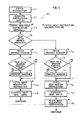
- a flow chart 50 according to the process of the present invention is shown in Fig. 1, wherein the next instruction is fetched at 52 and executed at 54, wherein the condition codes (cc) are set in response to the result of the instruction execution.
- integer processor requires a subsequent instruction to intervene in the flow chart 50 of Fig. 1.
- the condition code is tested relative to the branch predicate, illustrated below in tables 1-3 at step 58.
- the next three steps of either branch from the test 58 relates to the execution of the branch shadow, and are substantially similar regardless of the result of the test at 58.
- the branch shadow instruction is fetched and tested at step 62 according to the shadow control modifier bits included in the branch instruction.
- the shadow instruction is executed at step 64.
- the next sequential instruction is fetched at step 66 and executed at step 68.
- the subsequent program instructions continue to be fetched and executed thereafter.
- the branch shadow instruction is fetched at step 70, and a test of the condition code relative to the shadow control modifier of table 4 is made at step 72.
- the shadow is executed at step 74.
- the destination instruction is then fetched at step 76 whether or not the shadow is executed, at step 74.
- the destination instruction is executed at step 78 and the next sequential instruction is fetched at step 80.
- the program continues to execute in sequence, thereafter.
- the preferred embodiment of the present invention envisions the process of Fig. 1 implemented in a pipeline processor.
- new instructions are continually loaded in the pipeline to be fetched and executed in sequence, in particular, according to the flow chart 50 of Fig. 1.
- the steps of the present invention where the next instruction is preferably loaded into the pipeline is indicated by an asterisk (') adjacent to the steps of the flow chart 50.
- asterisk e.g., asterisk
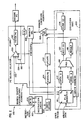
- instruction cache 102 being loaded by a memory management unit 104 from instruction memory (not shown), is operable according to techniques known in the art.
- the instruction cache 102 fetches an instruction on lead 104 according to an instruction address provided by the program counter source bus (PCSRC).
- PCSRC program counter source bus
- the signal is stored in register 106 where it is decoded by the branch select logic 108 and the operand fetch logic of the filed register 110 part of the execution unit 150.
- the file register 110 provides an A and B operand in registers 112 and 114, wherein the signals stored therein are received by an arithmetic logic unit (ALU 116).
- ALU 116 arithmetic logic unit
- the ALU provides a result, stored in result register 118 and the above discussed condition code signals (cc) which is stored in register 120.
- the result called write data, is stored in the file register 110 according to a write address signal provided by the update register 122. Since the instruction may specify the location in which the result is to be written, and in view of the pipeline structure of the embodiment of the present invention shown, the instruction is propagated through the pipeline synchronously with the generation and flow of signals within the execution unit by sequential storage of the instruction from the instruction decode register 106, the execute register 124 (corresponding with the generation of the operand and ALU signals) and the update register 122.
- condition code is also propagated in a pipeline comprising next condition code register 120 and current condition code register 126, wherein the condition code signal is selectively provided by multiplexer 128 according to a signal provided in the instruction word.
- the selection of a condition code is further discussed in copending patent application APOLL-107XX, entitled CENTRAL PROCESSOR CONDITION CODE METHOD AND APPARATUS, filed concurrently herewith and incorporated by reference.
- the resulting selected condition code is received by the branch select logic 108, which is compared to the branch predicate signals, as illustrated in step 58 of Fig. 1.
- the value of the program counter is provided according to a selection of a particular signal by the PC source multiplexer 130, wherein such program counter values include the previous counter program value as may be provided on lead 132, the next sequential instruction (PC+8) provided on lead 134 and the branch destination address signal on lead 136 as may be selected according to the result of the branch select logic 108.
- Other PC signal sources include trap and PC + Displacement, not shown.
- the signal provided by the PC source selector 130 is stored in the fetch PC register 140, to provide the PC SRC signal to the instruction cache 102.
- the branch shadow instruction is loaded into the instruction decode register 106 while the instruction cache 102 is providing the next instruction.
- the shadow control modifier included in the instruction now stored in the instruction decode register 106 is received by the file register 110 of the execution unit, together with a signal from the branch select logic 108, wherein the test indicated in steps 62 and 72 of Fig. 1 is performed to determine whether or not to execute the shadow.
- the taken branch will be subsequently received by the file register 110, wherein the execution of the instructions follows accordingly.
- Tables 1, and 3 below lists all the branch predicates that you can use to test the integer and floating-point condition codes.
- the instruction that follows the branch is the branch shadow operation and is always fetched before the destination instruction is fetched. Whether or not the branch shadow instruction executes. depends on a shadow control modifier.
- the shadow control modifier is a suffix appended to the branch predicate that tells the hardware when it should execute the branch shadow instruction.
- the Modifier .sf corresponds to conventional (that is, 68000) branch behavior.
- the trace of instruction execution for this program segment depends on two variables: the shadow control modifier, and whether or not the branch condition is met.
- Table 5 traces the execution of the code segment depending on these two variables.
- the hyphen ("-") that appears in the table indicates a single- cycle stall between the execution of the instructions listed. For example, A-D does not mean execute instructions A through D. Rather, it means instruction A executed followed by a stall, then instruction D executes.
- the destination of a branch operation can be either an address contained in an integer register or a PC relative expression.
- a CALL operation loads a target address into the program counter (PC), so that the next instruction executed is the one at the target address rather than the one that is physically next in memory.
- PC program counter
- a CALL operation performs the same function as a branch operation but it additionally stores the return PC in a register.
- the shadow control modifier determines whether this shadow instruction is executed.
- the shadow control modifier for a CALL operation can be .sa and .sn, as listed in Table 4, above.
- the destination of the CALL operatidn can be an address contained in an integer register or a PC-relative expression. An example of a CALL operation is shown in List 3.
- the present invention is operable with concurrently dispatched instruction processors as discussed in copending patent application APOLL-105XX, entitled METHOD AND APPARATUS FOR CONCURRENT DISPATCH OF INSTRUCTIONS TO MULTIPLE FUNCTIONAL UNITS, filed October 7, 1988, incorporated by reference.
- IP Integer Processor
- IP_NOP when asserted informs the FPU to dispatch a nop for the instruction resident in its IR'S.
- all fetch related exceptions/stalls regarding the shadow are taken prior to attempting to dispatch the shadow.
- a Memory Management Unit (MMU) fetch exception on the branch shadow will be serviced even through the shadow is not to be executed.
- MMU Memory Management Unit
- the present invention provides privileged branch operations that are used to effect trap returns and to enable or disable traps. These operations are normal BRANCH operations with trap control since effects.
- the privileged BRANCH operation can use any of the BRANCH predicates listed in Tables 2 and 3.
- the shadow control modifier is always .sa. This means that the BRANCH shadow instruction always executed.
- the available variations of the privileged BRANCH operation are: Disable sets the integer processor status word's (IPSW) in trap bit at the end of the decode phase of the operation. While "in trap” is set, interrupts are inhibited. Enable clears the integer processor status word's (IPSW) in trap bit at the end of the decode phase of the operation. No trap inhibits an asynchronous fetch trap from occurring in the decode phase of the operation.
- Reissue uses the contents of RB as an address and issues a memory request. The attributes of the memory request are derived from the trap stat queue.
Landscapes
- Engineering & Computer Science (AREA)
- Software Systems (AREA)
- Theoretical Computer Science (AREA)
- Physics & Mathematics (AREA)
- General Engineering & Computer Science (AREA)
- General Physics & Mathematics (AREA)
- Advance Control (AREA)
Applications Claiming Priority (2)
| Application Number | Priority Date | Filing Date | Title |
|---|---|---|---|
| US25913088A | 1988-10-18 | 1988-10-18 | |
| US259130 | 1988-10-18 |
Publications (2)
| Publication Number | Publication Date |
|---|---|
| EP0365187A2 true EP0365187A2 (de) | 1990-04-25 |
| EP0365187A3 EP0365187A3 (de) | 1992-04-29 |
Family
ID=22983656
Family Applications (1)
| Application Number | Title | Priority Date | Filing Date |
|---|---|---|---|
| EP19890310270 Withdrawn EP0365187A3 (de) | 1988-10-18 | 1989-10-06 | Vorrichtung zur selektiven Ausführung von einem Verzweigungsbefehl folgenden Befehlen |
Country Status (2)
| Country | Link |
|---|---|
| EP (1) | EP0365187A3 (de) |
| JP (1) | JPH02211533A (de) |
Cited By (1)
| Publication number | Priority date | Publication date | Assignee | Title |
|---|---|---|---|---|
| EP0365188A3 (de) * | 1988-10-18 | 1992-04-29 | Hewlett-Packard Company | Verfahren und Vorrichtung für Zustandskode in einem Zentralprozessor |
Family Cites Families (1)
| Publication number | Priority date | Publication date | Assignee | Title |
|---|---|---|---|---|
| US4755966A (en) * | 1985-06-28 | 1988-07-05 | Hewlett-Packard Company | Bidirectional branch prediction and optimization |
-
1989
- 1989-10-06 EP EP19890310270 patent/EP0365187A3/de not_active Withdrawn
- 1989-10-17 JP JP1270137A patent/JPH02211533A/ja active Pending
Cited By (2)
| Publication number | Priority date | Publication date | Assignee | Title |
|---|---|---|---|---|
| EP0365188A3 (de) * | 1988-10-18 | 1992-04-29 | Hewlett-Packard Company | Verfahren und Vorrichtung für Zustandskode in einem Zentralprozessor |
| US5193157A (en) * | 1988-10-18 | 1993-03-09 | Hewlett-Packard Company | Piplined system includes a selector for loading condition code either from first or second condition code registers to program counter |
Also Published As
| Publication number | Publication date |
|---|---|
| EP0365187A3 (de) | 1992-04-29 |
| JPH02211533A (ja) | 1990-08-22 |
Similar Documents
| Publication | Publication Date | Title |
|---|---|---|
| JP2550213B2 (ja) | 並列処理装置および並列処理方法 | |
| US6295600B1 (en) | Thread switch on blocked load or store using instruction thread field | |
| US5826089A (en) | Instruction translation unit configured to translate from a first instruction set to a second instruction set | |
| Ditzel et al. | Branch folding in the CRISP microprocessor: Reducing branch delay to zero | |
| US6721874B1 (en) | Method and system for dynamically shared completion table supporting multiple threads in a processing system | |
| US7020871B2 (en) | Breakpoint method for parallel hardware threads in multithreaded processor | |
| US5404552A (en) | Pipeline risc processing unit with improved efficiency when handling data dependency | |
| US6279105B1 (en) | Pipelined two-cycle branch target address cache | |
| US5167026A (en) | Simultaneously or sequentially decoding multiple specifiers of a variable length pipeline instruction based on detection of modified value of specifier registers | |
| US5142633A (en) | Preprocessing implied specifiers in a pipelined processor | |
| US5148528A (en) | Method and apparatus for simultaneously decoding three operands in a variable length instruction when one of the operands is also of variable length | |
| US6725354B1 (en) | Shared execution unit in a dual core processor | |
| US6728872B1 (en) | Method and apparatus for verifying that instructions are pipelined in correct architectural sequence | |
| US6219778B1 (en) | Apparatus for generating out-of-order results and out-of-order condition codes in a processor | |
| US5898864A (en) | Method and system for executing a context-altering instruction without performing a context-synchronization operation within high-performance processors | |
| US12223327B2 (en) | CPUs with capture queues to save and restore intermediate results and out-of-order results | |
| US20040064684A1 (en) | System and method for selectively updating pointers used in conditionally executed load/store with update instructions | |
| WO2021061626A1 (en) | Instruction executing method and apparatus | |
| US6735687B1 (en) | Multithreaded microprocessor with asymmetrical central processing units | |
| JPH07120284B2 (ja) | データ処理装置 | |
| US7831979B2 (en) | Processor with instruction-based interrupt handling | |
| US5737562A (en) | CPU pipeline having queuing stage to facilitate branch instructions | |
| JP2710994B2 (ja) | データ処理装置 | |
| JP3182591B2 (ja) | マイクロプロセッサ | |
| US6988121B1 (en) | Efficient implementation of multiprecision arithmetic |
Legal Events
| Date | Code | Title | Description |
|---|---|---|---|
| PUAI | Public reference made under article 153(3) epc to a published international application that has entered the european phase |
Free format text: ORIGINAL CODE: 0009012 |
|
| AK | Designated contracting states |
Kind code of ref document: A2 Designated state(s): AT BE CH DE ES FR GB GR IT LI LU NL SE |
|
| RBV | Designated contracting states (corrected) |
Designated state(s): DE FR GB |
|
| PUAL | Search report despatched |
Free format text: ORIGINAL CODE: 0009013 |
|
| AK | Designated contracting states |
Kind code of ref document: A3 Designated state(s): AT BE CH DE ES FR GB GR IT LI LU NL SE |
|
| STAA | Information on the status of an ep patent application or granted ep patent |
Free format text: STATUS: THE APPLICATION IS DEEMED TO BE WITHDRAWN |
|
| 18D | Application deemed to be withdrawn |
Effective date: 19921030 |