EP0365209A2 - Aminosäuresequenz des Anti-leu 3a - Google Patents
Aminosäuresequenz des Anti-leu 3a Download PDFInfo
- Publication number
- EP0365209A2 EP0365209A2 EP89310415A EP89310415A EP0365209A2 EP 0365209 A2 EP0365209 A2 EP 0365209A2 EP 89310415 A EP89310415 A EP 89310415A EP 89310415 A EP89310415 A EP 89310415A EP 0365209 A2 EP0365209 A2 EP 0365209A2
- Authority
- EP
- European Patent Office
- Prior art keywords
- amino acid
- acid sequence
- mouse
- variable region
- antibody
- Prior art date
- Legal status (The legal status is an assumption and is not a legal conclusion. Google has not performed a legal analysis and makes no representation as to the accuracy of the status listed.)
- Ceased
Links
Images


Classifications
-
- C—CHEMISTRY; METALLURGY
- C07—ORGANIC CHEMISTRY
- C07K—PEPTIDES
- C07K16/00—Immunoglobulins [IG], e.g. monoclonal or polyclonal antibodies
- C07K16/18—Immunoglobulins [IG], e.g. monoclonal or polyclonal antibodies against material from animals or humans
- C07K16/28—Immunoglobulins [IG], e.g. monoclonal or polyclonal antibodies against material from animals or humans against receptors, cell surface antigens or cell surface determinants
- C07K16/2803—Immunoglobulins [IG], e.g. monoclonal or polyclonal antibodies against material from animals or humans against receptors, cell surface antigens or cell surface determinants against the immunoglobulin superfamily
- C07K16/2812—Immunoglobulins [IG], e.g. monoclonal or polyclonal antibodies against material from animals or humans against receptors, cell surface antigens or cell surface determinants against the immunoglobulin superfamily against CD4
-
- A—HUMAN NECESSITIES
- A61—MEDICAL OR VETERINARY SCIENCE; HYGIENE
- A61P—SPECIFIC THERAPEUTIC ACTIVITY OF CHEMICAL COMPOUNDS OR MEDICINAL PREPARATIONS
- A61P37/00—Drugs for immunological or allergic disorders
-
- C—CHEMISTRY; METALLURGY
- C07—ORGANIC CHEMISTRY
- C07K—PEPTIDES
- C07K2317/00—Immunoglobulins specific features
- C07K2317/20—Immunoglobulins specific features characterized by taxonomic origin
- C07K2317/24—Immunoglobulins specific features characterized by taxonomic origin containing regions, domains or residues from different species, e.g. chimeric, humanized or veneered
-
- C—CHEMISTRY; METALLURGY
- C07—ORGANIC CHEMISTRY
- C07K—PEPTIDES
- C07K2319/00—Fusion polypeptide
-
- C—CHEMISTRY; METALLURGY
- C07—ORGANIC CHEMISTRY
- C07K—PEPTIDES
- C07K2319/00—Fusion polypeptide
- C07K2319/01—Fusion polypeptide containing a localisation/targetting motif
- C07K2319/02—Fusion polypeptide containing a localisation/targetting motif containing a signal sequence
Definitions
- This invention relates to an amino acid sequence for an anti-CD4 antibody and more particularly relates to an amino acid sequence for the anti-CD4 antibody, Anti-Leu 3a, and a chimeric variant thereof.
- CD4 is an antigen on certain T lymphocytes (i.e. , the helper subset) that has a molecular weight of approximately 55 Kd. It is thought to consist of four domains (V1 - V4) that extend from the cell membrane outward in serial fashion.
- CD4 antigen or CD4+ cells have been implicated in certain immune system diseases ranging from autoimmune diseases, such as rheumatoid arthritis and multiple sclerosis, to AIDS.
- autoimmune diseases such as rheumatoid arthritis and multiple sclerosis
- anti-CD4 agents i.e. , chemical or biological materials that bind to or block the function of the CD4 antigen
- Anti-Leu 3a has been attributed to its structure being the same or nearly the same as a portion of the gp120 region of the HIV virus.
- the gp120 region of the virus has been shown to bind to CD4.
- Anti-Leu 3a has a structure that looks like the HIV binding region on gp120 but lacks the disease carrying properties of the virus itself.
- the use of Anti-Leu 3a as a vaccine is being attempted. See Matthews et al ., Sci. Amer., 259:120 (1988).
- Anti-Leu 3a is a mouse monoclonal antibody derived from clone SK3 which was originally described by Evans et al ., PNAS, 78:544 (1981).
- SK3 was derived from hybridization of mouse NS-1 myeloma cells with spleens from BALB/c mice immunized with sheep red blood cell rosettes of human peripheral blood. It is a IgG1 type antibody having a kappa light chain. Because Anti-Leu 3a is a mouse monoclonal antibody, however, its use a therapeutic agent, such as an AIDS vaccine, raises certain problems.
- Mouse monoclonal antibodies or in fact any other non-human antibodies will be immunogenic when used as a human therapeutic agent.
- the mouse monoclonal antibody will be recognized as being "non-self" by the recipient's immune system.
- anti-mouse antibodies will be formed in the host which then will limit the subsequent effectiveness of the agent in the course of further or subsequent treatment. Accordingly, it would be preferable to use human monoclonal antibody.
- the preparation of a human antibody raises a number of serious practical and ethical questions.
- the mouse variable region of the antibody is coupled to the constant region of the same type antibody but from another species or another strain of the same species.
- the other species is human.
- the species to be treated will comprise the other species.
- the gene for the mouse variable region is isolated and spliced by appropriate genetic engineering techniques, such as those described in chapters 5 and 6 of Recombinant DNA: A Short Course (Watson et al ., eds., 1983), to the gene for the human constant region.
- the resulting gene then will code for an immunoglobulin having the mouse variable region and human constant region.
- a vector carrying this new gene then may be placed in a prokaryotic or eukaryotic organism for expression of the immunoglobulin.
- a specific embodiment for this type of chimeric antibody for expression in eukaryotic organisms is set forth in USSN 644,473 filed August 27, 1984, and for expression in prokaryotic organisms is set forth in USSN 483,457 filed April 8, 1983.
- the application USSN 644,473 corresponds with published European Patent Specification 173494.
- the application USSN 483,457 corresponds with published US Patent 4816567.
- variable region of both mouse and human immunoglobulins is comprised of four framework residues (FRs) which are interspersed with three complementarity determining residues (CDRs).
- FRs framework residues
- CDRs complementarity determining residues
- the CDRs mediate antigen binding.
- the mouse variable region genes coding for one or more of the CDRs are spliced into the human framework variable region and the resulting "mosaic" variable region may be spliced onto the human constant region forming a different type of chimeric antibody.
- Vectors containing these constructs may be transferred in to expressions systems as described above.
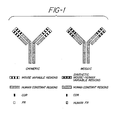
- FIG. 1 A schematic for the traditional and mosaic forms of chimeric antibodies is shown in FIG. 1.
- This ability will effect not only the therapeutic format of the antibody but also will enable one to improve the diagnostic characteristics of the antibody.
- This invention comprises the amino acid sequence for the monoclonal antibody Anti-Leu 3a variable region. It further comprises the amino acid sequence for each of the CDR portions of the Anti-Leu 3a variable region.
- a chimeric antibody having the amino acid sequence for the variable region and a mosaic antibody having one or more of the amino acid sequences for the CDR portion of the variable region also are claimed.
- the deduced amino acid sequence is shown below the nucleotide sequence in three letter code.
- the sequence of the mature protein is capitalized while the leader peptide is in lower case letters.
- CDRs are boxed.
- DNA regulatory elements e.g. , Parslow box and TATA box
- Donor and acceptor splice sites are underlined and splice junctions are indicated be an up arrow.
- the immunoglobulin gene system comprises three separate loci of L ⁇ , L ⁇ and H (light and heavy) chain genes, each chain containing the variable (V) and constant (C) genes.
- the L ⁇ , L ⁇ and H chain genes are located on mouse chromosomes 6, 16 an 12 respectively and on are located on human chromosomes 2, 22 and 14 respectively.
- a variety of introns and exons may exist within each of the genes.
- variable region sequence for the kappa light chain of Anti-Leu 3a was determined as follows.
- DNA containing the mouse variable region light chain gene was isolated from clone SK3 by screening a genomic library using hybridization probes.
- Genomic DNA was partially digested with MboI, ligated into the lambda replacement vectors EMBL3 or EMBL4, packaged, and amplified on an appropriate E. coli host.
- the libraries were screened using a ⁇ 0.85 Kb SacI HindIII probe from the mouse J ⁇ -C ⁇ intron, or a ⁇ 0.70 Kb XbaI EcoRI enhancer probe from the mouse heavy chain intron.. Positive clones were characterized by Southern blotting, then were subcloned into the cloning vector pUC13.
- the nucleotide sequence from positions 538 through 882 comprises the coding region for the Anti-Leu 3a V ⁇ chain.
- the amino acid sequence corresponding to the nucleotide sequence from positions 549 through 881 further comprises the structure of the variable region of the Anti-Leu 3a kappa light chain.
- variable region sequence for the heavy chain of Anti-Leu 3a was determined as described above for the light chain except that appropriate restriction fragments were subcloned into the sequencing vectors M13mp18 and M13mp19 (Pharmacia), and the cloning vectors pUC12 and pUC13.
- the nucleotide sequence from positions 373 through 738 comprises the coding region for the Anti-Leu 3a V H chain.
- the amino acid sequence corresponding to the nucleotide sequence from positions 384 through 737 further comprises the structure of the variable region of the Anti-Leu 3a heavy chain.
- nucleotide sequences for each or either of the variable region chains may be combined with nucleotide sequences for the human constant region.
- the vector into which they are combined may be placed in an expression system for production of the chimeric antibody.
- the method of Morrison and Oi as set forth in USSN 644,473 is used to construct the chimeric antibody; however, the methods set forth in USSN 483,457 may be used to construct the chimeric antibody in a prokaryotic system, such as E. coli .
- the 206-V ⁇ and 316-V H variable region genes were spliced to human kappa and human gamma 1 constant region genes and were inserted into the vectors pSV184 neo and PSV2 ⁇ H gpt respectively.
- the 206-V ⁇ gene was spliced to the human ⁇ gene at a unique HindIII site located in the large intron between the J ⁇ and C ⁇ exons.
- the 316-V H gene was spliced to the human gamma 1 gene at a unique EcoRI site located in the large intron between the J H and C H exons.
- V23 One Chimeric cell line that resulted from this transfection was named V23.
- This cell line produces a a chimeric mouse:human gamma 1 immunoglobulin that binds to the CD4 antigen on CD4+ cells as confirmed by flow cytometric analyses and as confirmed by SDS-polyacrylamide gel electrophoresis of antigen antibody complexes from labelled cells.
- the mosaic light chain variable region was synthesized from two 200 base-pair restriction fragments, each consisting of six oligonucleotides.
- the mosaic heavy chain variable region was synthesized from two 100 base-pair restriction fragments consisting of four oligonucleotides each and a 200 base-pair restriction fragment consisting of eight oligonucleotides. See FIG. 6.
- the nucleotide sequence from positions 43 through 387 comprise the mosaic V ⁇ chain.
- the sequences from positions 120-164, 210-230 and 327-353 comprise the CDR1, CDR2 and CDR3 regions respectively.
- the amino acid sequence for each CDR then was deduced from the nucleotide sequence.
- the nucleotide sequence from positions 20 through 385 comprise the mosaic V H chain.
- the sequences from positions 121-136, 178-228 and 325-351 comprise the CDR1, CDR2 and CDR3 regions respectively.
- the amino acid sequence for each CDR then was deduced from the nucleotide sequence.
- expression vectors then were made to splice the mosaic constructs to the respective constant region genes.
- the vectors pSV184 ⁇ H neo and PSV2 ⁇ H gpt were used with the V ⁇ and V H mosaics respectively.
- Constant regions from KOL also were used as previously described.
- Each vector was modified by site-directed mutagenesis to permit insertion of the variable region mosaics. See FIG. 7.
- This cell line produces a mosaic mouse:human gamma 1 immunoglobulin that binds to the CD4 antigen on CD4+ cells as confirmed by flow cytometric analyses and as confirmed by SDS-polyacrylamide gel electrophoresis of antigen-antibody complexes from labelled cells.
Landscapes
- Health & Medical Sciences (AREA)
- Immunology (AREA)
- Chemical & Material Sciences (AREA)
- Organic Chemistry (AREA)
- Medicinal Chemistry (AREA)
- General Health & Medical Sciences (AREA)
- Life Sciences & Earth Sciences (AREA)
- Animal Behavior & Ethology (AREA)
- Biochemistry (AREA)
- General Chemical & Material Sciences (AREA)
- Pharmacology & Pharmacy (AREA)
- Chemical Kinetics & Catalysis (AREA)
- Bioinformatics & Cheminformatics (AREA)
- Engineering & Computer Science (AREA)
- Public Health (AREA)
- Veterinary Medicine (AREA)
- Nuclear Medicine, Radiotherapy & Molecular Imaging (AREA)
- Biophysics (AREA)
- Genetics & Genomics (AREA)
- Molecular Biology (AREA)
- Proteomics, Peptides & Aminoacids (AREA)
- Peptides Or Proteins (AREA)
- Preparation Of Compounds By Using Micro-Organisms (AREA)
- Medicines Containing Antibodies Or Antigens For Use As Internal Diagnostic Agents (AREA)
- Saccharide Compounds (AREA)
Applications Claiming Priority (2)
| Application Number | Priority Date | Filing Date | Title |
|---|---|---|---|
| US26055888A | 1988-10-17 | 1988-10-17 | |
| US260558 | 1988-10-17 |
Publications (2)
| Publication Number | Publication Date |
|---|---|
| EP0365209A2 true EP0365209A2 (de) | 1990-04-25 |
| EP0365209A3 EP0365209A3 (de) | 1990-07-25 |
Family
ID=22989651
Family Applications (1)
| Application Number | Title | Priority Date | Filing Date |
|---|---|---|---|
| EP89310415A Ceased EP0365209A3 (de) | 1988-10-17 | 1989-10-11 | Aminosäuresequenz des Anti-leu 3a |
Country Status (2)
| Country | Link |
|---|---|
| EP (1) | EP0365209A3 (de) |
| JP (1) | JPH02238883A (de) |
Cited By (17)
| Publication number | Priority date | Publication date | Assignee | Title |
|---|---|---|---|---|
| WO1991009966A1 (en) * | 1989-12-21 | 1991-07-11 | Ortho Pharmaceutical Corporation | Cd4 specific recombinant antibody |
| WO1992005274A1 (en) * | 1990-09-17 | 1992-04-02 | Scott David Gorman | Framework mutated antibodies and their preparation |
| US5171838A (en) * | 1990-03-23 | 1992-12-15 | Kureha Kagaku Kogyo Kabushiki Kaisha | Leu3a binding peptides |
| EP0481790A3 (en) * | 1990-10-17 | 1993-04-14 | The Wellcome Foundation Limited | Antibody production |
| EP0727435A1 (de) * | 1989-03-24 | 1996-08-21 | BEHRINGWERKE Aktiengesellschaft | Monoklonale Antikörper (MAK) gegen tumorassoziierte Antigene, ihre Herstellung und Verwendung |
| US5693761A (en) * | 1988-12-28 | 1997-12-02 | Protein Design Labs, Inc. | Polynucleotides encoding improved humanized immunoglobulins |
| US5821337A (en) * | 1991-06-14 | 1998-10-13 | Genentech, Inc. | Immunoglobulin variants |
| US5859205A (en) * | 1989-12-21 | 1999-01-12 | Celltech Limited | Humanised antibodies |
| US5994510A (en) * | 1990-12-21 | 1999-11-30 | Celltech Therapeutics Limited | Recombinant antibodies specific for TNFα |
| US6054297A (en) * | 1991-06-14 | 2000-04-25 | Genentech, Inc. | Humanized antibodies and methods for making them |
| EP0730609A4 (de) * | 1993-09-07 | 2000-05-10 | Smithkline Beecham Corp | In der behandlung von il4 auslösenden krankheiten nützliche rekombinante il4 antikörper |
| US6750325B1 (en) | 1989-12-21 | 2004-06-15 | Celltech R&D Limited | CD3 specific recombinant antibody |
| US6800738B1 (en) | 1991-06-14 | 2004-10-05 | Genentech, Inc. | Method for making humanized antibodies |
| WO2006030200A1 (en) * | 2004-09-14 | 2006-03-23 | National Institute For Biological Standards And Control | Vaccine |
| US7037496B2 (en) | 1989-12-27 | 2006-05-02 | Centocor, Inc. | Chimeric immunoglobulin for CD4 receptors |
| US11180555B2 (en) | 2014-09-16 | 2021-11-23 | Ubi Us Holdings, Llc. | Antibodies directed against CD4 for the treatment and functional cure of HIV |
| US11292839B2 (en) | 2016-08-13 | 2022-04-05 | Ubi Us Holdings, Llc | Treatment and sustained virologic remission of HIV infection by antibodies to CD4 in HAART stabilized patients |
Families Citing this family (2)
| Publication number | Priority date | Publication date | Assignee | Title |
|---|---|---|---|---|
| EP1083226A4 (de) * | 1998-05-25 | 2001-12-19 | Asahi Chemical Ind | Vorrichtung zum separieren von zellen und separationsverfahren. |
| US7501494B2 (en) | 2003-01-15 | 2009-03-10 | United Biomedical, Inc. | Designed deimmunized monoclonal antibodies for protection against HIV exposure and treatment of HIV infection |
Family Cites Families (4)
| Publication number | Priority date | Publication date | Assignee | Title |
|---|---|---|---|---|
| JPS6147500A (ja) * | 1984-08-15 | 1986-03-07 | Res Dev Corp Of Japan | キメラモノクロ−ナル抗体及びその製造法 |
| GB8607679D0 (en) * | 1986-03-27 | 1986-04-30 | Winter G P | Recombinant dna product |
| DE3853779T2 (de) * | 1987-05-29 | 1995-09-07 | Baylor College Medicine | Hiv-1 neutralisierende monoklonale antikörper. |
| JP2646007B2 (ja) * | 1988-01-30 | 1997-08-25 | 財団法人 化学及血清療法研究所 | 抗hiv抗体可変領域をコードする遺伝子断片およびこれらを用いて発現された抗hivキメラ抗体ならびにその製法 |
-
1989
- 1989-10-11 EP EP89310415A patent/EP0365209A3/de not_active Ceased
- 1989-10-17 JP JP1270152A patent/JPH02238883A/ja active Pending
Cited By (39)
| Publication number | Priority date | Publication date | Assignee | Title |
|---|---|---|---|---|
| US5693762A (en) * | 1988-12-28 | 1997-12-02 | Protein Design Labs, Inc. | Humanized immunoglobulins |
| US6180370B1 (en) | 1988-12-28 | 2001-01-30 | Protein Design Labs, Inc. | Humanized immunoglobulins and methods of making the same |
| US5693761A (en) * | 1988-12-28 | 1997-12-02 | Protein Design Labs, Inc. | Polynucleotides encoding improved humanized immunoglobulins |
| US7662383B2 (en) | 1989-03-24 | 2010-02-16 | Aventis Pharma Deutschland Gmbh | Chimeric antibody against tumor associated antigens and its use in diagnosing tumors |
| US6926896B2 (en) | 1989-03-24 | 2005-08-09 | Aventis Pharma Deutschland Gmbh | Monoclonal antibodies (MAbs) against tumor-associated antigens, the preparation and use thereof |
| EP0727435A1 (de) * | 1989-03-24 | 1996-08-21 | BEHRINGWERKE Aktiengesellschaft | Monoklonale Antikörper (MAK) gegen tumorassoziierte Antigene, ihre Herstellung und Verwendung |
| US7244832B2 (en) | 1989-12-21 | 2007-07-17 | Celltech R&D Limited | Humanised antibodies |
| US6750325B1 (en) | 1989-12-21 | 2004-06-15 | Celltech R&D Limited | CD3 specific recombinant antibody |
| US5859205A (en) * | 1989-12-21 | 1999-01-12 | Celltech Limited | Humanised antibodies |
| US5929212A (en) * | 1989-12-21 | 1999-07-27 | Celltech Therapeutics Limited | CD3 specific recombinant antibody |
| WO1991009966A1 (en) * | 1989-12-21 | 1991-07-11 | Ortho Pharmaceutical Corporation | Cd4 specific recombinant antibody |
| US7241877B2 (en) | 1989-12-21 | 2007-07-10 | Celltech R&D Limited | Humanised antibodies |
| USRE50178E1 (en) | 1989-12-21 | 2024-10-22 | UCB Biopharma SRL | Humanised antibodies |
| USRE48787E1 (en) | 1989-12-21 | 2021-10-26 | UCB Biopharma SRL | Humanised antibodies |
| US7262050B2 (en) | 1989-12-21 | 2007-08-28 | Celltech R&D Limited | Humanised antibodies |
| US6632927B2 (en) | 1989-12-21 | 2003-10-14 | Celltech Therapeutics Limited | Humanized antibodies |
| US7244615B2 (en) | 1989-12-21 | 2007-07-17 | Celltech R&D Limited | Humanized antibodies |
| US7566771B1 (en) | 1989-12-21 | 2009-07-28 | Celltech R&D Limited | Humanised antibodies |
| US7037496B2 (en) | 1989-12-27 | 2006-05-02 | Centocor, Inc. | Chimeric immunoglobulin for CD4 receptors |
| US5171838A (en) * | 1990-03-23 | 1992-12-15 | Kureha Kagaku Kogyo Kabushiki Kaisha | Leu3a binding peptides |
| US6767996B1 (en) | 1990-09-17 | 2004-07-27 | Glaxo Wellcome Inc. | Altered antibodies and their preparation |
| WO1992005274A1 (en) * | 1990-09-17 | 1992-04-02 | Scott David Gorman | Framework mutated antibodies and their preparation |
| USRE43898E1 (en) | 1990-09-17 | 2013-01-01 | Glaxo Wellcome Inc. Research | Altered antibodies and their preparation |
| USRE46877E1 (en) | 1990-09-17 | 2018-05-29 | Btg International Limited | Altered antibodies and their preparation |
| US7098006B1 (en) | 1990-09-17 | 2006-08-29 | Burroughs Wellcome Co. | Chimeric antibody, pharmaceutical composition and process of its production |
| EP0481790A3 (en) * | 1990-10-17 | 1993-04-14 | The Wellcome Foundation Limited | Antibody production |
| EP0822255A3 (de) * | 1990-10-17 | 1999-10-27 | The Wellcome Foundation Limited | Von CHO (Chinese Hamster Ovary) glykosylierte Antikörper und ihre therapeutische Verwendung |
| US5994510A (en) * | 1990-12-21 | 1999-11-30 | Celltech Therapeutics Limited | Recombinant antibodies specific for TNFα |
| US6407213B1 (en) | 1991-06-14 | 2002-06-18 | Genentech, Inc. | Method for making humanized antibodies |
| US6800738B1 (en) | 1991-06-14 | 2004-10-05 | Genentech, Inc. | Method for making humanized antibodies |
| US6719971B1 (en) | 1991-06-14 | 2004-04-13 | Genentech, Inc. | Method for making humanized antibodies |
| US8075890B2 (en) | 1991-06-14 | 2011-12-13 | Genentech, Inc. | Method for making humanized antibodies |
| US6639055B1 (en) | 1991-06-14 | 2003-10-28 | Genentech, Inc. | Method for making humanized antibodies |
| US5821337A (en) * | 1991-06-14 | 1998-10-13 | Genentech, Inc. | Immunoglobulin variants |
| US6054297A (en) * | 1991-06-14 | 2000-04-25 | Genentech, Inc. | Humanized antibodies and methods for making them |
| EP0730609A4 (de) * | 1993-09-07 | 2000-05-10 | Smithkline Beecham Corp | In der behandlung von il4 auslösenden krankheiten nützliche rekombinante il4 antikörper |
| WO2006030200A1 (en) * | 2004-09-14 | 2006-03-23 | National Institute For Biological Standards And Control | Vaccine |
| US11180555B2 (en) | 2014-09-16 | 2021-11-23 | Ubi Us Holdings, Llc. | Antibodies directed against CD4 for the treatment and functional cure of HIV |
| US11292839B2 (en) | 2016-08-13 | 2022-04-05 | Ubi Us Holdings, Llc | Treatment and sustained virologic remission of HIV infection by antibodies to CD4 in HAART stabilized patients |
Also Published As
| Publication number | Publication date |
|---|---|
| EP0365209A3 (de) | 1990-07-25 |
| JPH02238883A (ja) | 1990-09-21 |
Similar Documents
| Publication | Publication Date | Title |
|---|---|---|
| EP0365209A2 (de) | Aminosäuresequenz des Anti-leu 3a | |
| Adderson et al. | Restricted immunoglobulin VH usage and VDJ combinations in the human response to Haemophilus influenzae type b capsular polysaccharide. Nucleotide sequences of monospecific anti-Haemophilus antibodies and polyspecific antibodies cross-reacting with self antigens. | |
| Cazenave et al. | Vβ17 gene polymorphism in wild-derived mouse strains: two amino acid substitutions in the Vβ17 region greatly alter T cell receptor specificity | |
| Schilling et al. | Amino acid sequence of homogeneous antibodies to dextran and DNA rearrangments in heavy chain V-region gene segments | |
| JP5099405B2 (ja) | 異種抗体を産生することができるトランスジェニック非ヒト動物 | |
| Silberstein et al. | Variable region gene analysis of pathologic human autoantibodies to the related i and I red blood cell antigens | |
| EP0368684B2 (de) | Klonierung von Immunglobulin sequenzen aus den variabelen Domänen. | |
| JP3919830B2 (ja) | 抗ネコヘルペスウイルス−1組換え抗体および該抗体をコードする遺伝子断片 | |
| Trepicchio Jr et al. | The heavy chain genes of a lupus anti-DNA autoantibody are encoded in the germ line of a nonautoimmune strain of mouse and conserved in strains of mice polymorphic for this gene locus. | |
| Sasano et al. | Molecular selection of human antibodies with an unconventional bacterial B cell antigen. | |
| Morahan et al. | An idiotypic determinant formed by both immunoglobulin constant and variable regions | |
| Bloom et al. | V region gene analysis of anti-Sm hybridomas from MRL/Mp-lpr/lpr mice | |
| Lueders et al. | Association between a transposed α-globin pseudogene and retrovirus-like elements in the BALB/c mouse genome | |
| Clarke et al. | The BALB/c secondary response to the Sb site of influenza virus hemagglutinin. Nonrandom silent mutation and unequal numbers of VH and Vk mutations. | |
| Youngblood et al. | Rheumatoid factors from the peripheral blood of two patients with rheumatoid arthritis are genetically heterogeneous and somatically mutated. | |
| Spatz et al. | Cloning and sequence analysis of the VH and VL regions of an anti-myelin/DNA antibody from a patient with peripheral neuropathy and chronic lymphocytic leukemia. | |
| McKean et al. | Mechanisms of antibody diversity: multiple genes encode structurally related mouse κ variable regions | |
| Goshorn et al. | Common structural features among monoclonal antibodies binding the same antigenic region of cytochrome c | |
| Ehrlich et al. | Potential of primate monoclonal antibodies to substitute for human antibodies: nucleotide sequence of chimpanzee Fab fragments | |
| Boucher et al. | Restricted use of cationic germline VH gene segments in human Rh (D) red cell antibodies | |
| Pratt et al. | Molecular characterization of a supratypic cross-reactive idiotype associated with IgM autoantibodies | |
| Helmuth et al. | Germline repertoire of the immunoglobulin VH 3 family in rhesus monkeys | |
| Deev et al. | Reciprocal recombination products of V K-J K joining reactions in human lymphoid cell lines | |
| Boyd et al. | Structural differences in a single gene encoding the V kappa Ser group of light chains explain the existence of two mouse light-chain genetic markers. | |
| Dildrop et al. | AV region determinant (idiotope) expressed at high frequency in B lymphocytes is encoded by a large set of antibody structural genes. |
Legal Events
| Date | Code | Title | Description |
|---|---|---|---|
| PUAI | Public reference made under article 153(3) epc to a published international application that has entered the european phase |
Free format text: ORIGINAL CODE: 0009012 |
|
| AK | Designated contracting states |
Kind code of ref document: A2 Designated state(s): AT BE CH DE ES FR GB GR IT LI LU NL SE |
|
| PUAL | Search report despatched |
Free format text: ORIGINAL CODE: 0009013 |
|
| AK | Designated contracting states |
Kind code of ref document: A3 Designated state(s): AT BE CH DE ES FR GB GR IT LI LU NL SE |
|
| 17P | Request for examination filed |
Effective date: 19900903 |
|
| 17Q | First examination report despatched |
Effective date: 19930311 |
|
| STAA | Information on the status of an ep patent application or granted ep patent |
Free format text: STATUS: THE APPLICATION HAS BEEN REFUSED |
|
| 18R | Application refused |
Effective date: 19940717 |