EP0365321A2 - Elektrophoresegerät - Google Patents
Elektrophoresegerät Download PDFInfo
- Publication number
- EP0365321A2 EP0365321A2 EP89310750A EP89310750A EP0365321A2 EP 0365321 A2 EP0365321 A2 EP 0365321A2 EP 89310750 A EP89310750 A EP 89310750A EP 89310750 A EP89310750 A EP 89310750A EP 0365321 A2 EP0365321 A2 EP 0365321A2
- Authority
- EP
- European Patent Office
- Prior art keywords
- sensing
- electrodes
- electrode
- driving electrodes
- driving
- Prior art date
- Legal status (The legal status is an assumption and is not a legal conclusion. Google has not performed a legal analysis and makes no representation as to the accuracy of the status listed.)
- Withdrawn
Links
Images

Classifications
-
- G—PHYSICS
- G01—MEASURING; TESTING
- G01N—INVESTIGATING OR ANALYSING MATERIALS BY DETERMINING THEIR CHEMICAL OR PHYSICAL PROPERTIES
- G01N27/00—Investigating or analysing materials by the use of electric, electrochemical, or magnetic means
- G01N27/26—Investigating or analysing materials by the use of electric, electrochemical, or magnetic means by investigating electrochemical variables; by using electrolysis or electrophoresis
- G01N27/416—Systems
- G01N27/447—Systems using electrophoresis
- G01N27/44756—Apparatus specially adapted therefor
- G01N27/44773—Multi-stage electrophoresis, e.g. two-dimensional electrophoresis
-
- G—PHYSICS
- G01—MEASURING; TESTING
- G01N—INVESTIGATING OR ANALYSING MATERIALS BY DETERMINING THEIR CHEMICAL OR PHYSICAL PROPERTIES
- G01N27/00—Investigating or analysing materials by the use of electric, electrochemical, or magnetic means
- G01N27/26—Investigating or analysing materials by the use of electric, electrochemical, or magnetic means by investigating electrochemical variables; by using electrolysis or electrophoresis
- G01N27/416—Systems
- G01N27/447—Systems using electrophoresis
- G01N27/44704—Details; Accessories
- G01N27/44713—Particularly adapted electric power supply
Definitions
- This invention pertains to electrophoresis. More specifically, this invention pertains to improvements in electrophoresis apparatus whereby an electric field can be directionally modulated, so as to tend to cause a molecule being electrophoresed to migrate in any desired direction.
- Pulsed modulation refers to modulation at timed intervals, between which the electric field may be substantially uniform across the flat surface of the gel.
- apparatus for gel electrophoresis have advanced from apparatus employing two parallel driving electrodes, or two parallel arrays of driving electrodes, which apply electric fields tending to cause molecules to migrate along straight lines between such electrodes, to apparatus employing polygonal arrays of driving electrodes, which apply electric fields that can be directionally modulated so as to tend to cause molecules to migrate along non-straight paths, e.g., paths having corners or zig-zag paths.
- a square array of driving electrodes which enables electric fields to be alternatively applied in transverse directions so as to tend to cause samples being electrophoresed to migrate in paths that change direction at 90° angles.
- each electrode can be selectively maintained at any positive or negative electrical potential within a selected range.
- a hexagonal array of driving electrodes which enables homogenous electrical fields to be alternatingly applied at timed intervals so as to cause molecules being electrophoreses to migrate in zig-zag paths.
- electrophoresis in such apparatus as contour-clamped homogeneous electric field (CHEF) electrophoresis, and which compares CHEF electrophoresis to other heretofore known techniques including pulsed-field gel electrophoresis (PFGE) and field-inversion electrophoresis.
- CHEF homogeneous electric field
- apparatus for electrophoresis which comprises a support containing a medium including a buffer solution; a plurality of driving electrodes in contact with the medium and arrayed in spaced relation to one another; and supply means for supplying electrical potentials to the driving electrodes, characterized in that the apparatus further includes a plurality of sensing electrodes in contact with the medium and arrayed in spaced relation to one another and to the driving electrodes; sensing means for sensing electrical potentials at the sensing electrodes, and adjusting means for adjusting the potentials applied to the driving electrodes to maintain the potentials sensed by the sensing electrodes at selected values.
- each driving electrode may be independently controlled and the apparatus may be programmably controllable, as for example by means of a microprocessor, to enable an electric field to be directionally modulated, in any direction, e.g., as a function of time.
- an apparatus for electrophoresis employing a gel matrix G , in a buffer solution constitutes a preferred embodiment of this invention.
- the gel matrix G may be an aqueous gel of 1% agarose occupying a square area, which measures about 20cm x 20cm. Any conventional buffer solution compatible with the gel matrix G may be used.
- the buffer solution must have sufficient resistivity to avoid short-circuits between driving electrodes described below.
- Two preferred formulations for buffer solutions are set forth below in Tables A and B respectively. Preferably these are used in 0.5X strengths.
- the apparatus 10 comprises an electrophoresis chamber of a conventional type including a rectangular, horizontal support 20 for the gel matrix G and the buffer solution and including outer walls 22, 24, 26, 28, which contain the buffer solution.
- the horizontal support 20 and the outer walls are made of a non-electrically conducting material, e.g., glass or plexiglass.
- the depth and temperature uniformity of the buffer solution should be controlled, and the gel matrix G should be immersed entirely within a uniform layer of the buffer solution, not recessed into a well.
- the buffer solution should be cooled, in order to maintain a uniform temperature, by recirculating through cooling means (not shown) conventional in electrophoresis. Precise temperature control is important because the conductivity of a buffer solution can vary by as much as 3% per degree C variation.
- the support 20 is levelled, and the buffer solution covers the gel matrix G at a depth of about 1cm and is maintained at a uniform temperature between 5 and 15°C. Maintaining the buffer solution at such a temperature also suppresses denaturing of the gel matrix G and of the sample.
- the apparatus 10 comprises twenty-four driving electrodes D n (wherein n represents integers from 1 to 24 inclusive) in a circular array having a radius R D and twenty-four sensing electrodes S n (wherein n again represents integers from 1 to 24 inclusive) in a circular array having a radius R s and being disposed fixedly and concentrically within the circular array of driving electrodes.
- the circular arrays of the driving electrodes D n and sensing electrodes S n preferably form closed paths, and in the described embodiment these closed paths are closed circles.
- Each of the driving and sensing electrodes is preferably mounted to make optimal electrical contact with the liquid buffer in the electrophoresis chamber of the apparatus 10, by penetrating the buffer solution vertically over its full depth.
- Each of the driving electrodes may be advantageously made of a platinum foil covering a cylindrical core, or of coiled or folded lengths of platinum wire longer than the depth of the buffer solution, or of a porous conductive ceramic, e.g., a porous titanium suboxide available commercially from Ebonex Technologies, Inc. under the "Ebonex" trademark.
- Each of the sensing electrodes may be advantageously made of a platinum wire or other conducting media.
- the circular array of the sensing electrodes has a radius R s of about 16.5cm
- the circular array of driving electrodes has a radius R D of about 18cm
- the geometric center of the 20cm x 20cm square occupied by the gel matrix G coincides with the common center of the circular arrays.
- a reference radius R R is indicated on FIGURE 1 for a purpose to be later mentioned.
- the driving electrodes are arrayed in equally spaced relation to one another, i.e., at 15° intervals.
- the sensing electrodes are arrayed similarly, at like intervals, so that each of the sensing electrodes is positioned radially inward of one of the driving electrodes.
- the driving electrode D1 and the sensing electrode S1 are located on a common radius, i.e., the reference radius R R the driving electrode D2 and the sensing electrode S2 are located on a common radius, and so on.
- the driving and sensing electrodes are arrayed, on the common radii, in electrode pairs.
- the driving electrode D1 and the sensing electrode S1 constitute a first electrode pair
- the driving electrode D2 and the sensing electrode S2 constitute a second electrode pair, and so on.
- the electrophoresis chamber of the apparatus 10 contains a bounded, uniformly electrically conducting layer of the buffer solution, the potential distribution necessary for a homogeneous field within the boundary of such layer is the same as would exist if such layer were embedded in a much larger region exhibiting a homogeneous field. Field conditions within a region isolated as if removed from a larger whole can be maintained if boundary conditions of the region can be matched.
- the apparatus 10 enables the boundary conditions of the circular array of sensing electrodes to be matched as if the circular array of sensing electrodes were within a much larger region exhibiting a uniform field.
- an electrical potential is applied directly to the driving electrode, e.g., between the driving electrode and a point of common potential usually referred to as ground, of a suitable magnitude to cause an electrical potential of a desired magnitude to occur at the sensing electrode of such electrode pair.
- the electrical potential is sensed at the sensing electrode of such pair.
- the potential required at each sensing electrode varies depending on the desired field.
- the potential at the corresponding driving electrode differs from that of its sensing electrode by varying amounts, as determined by parameters such as buffer solution formulation, electrical current, electrode polarity, and spacing.
- V s E R s cos ⁇
- E the desired electric field intensity
- R S the radius of the circular array of sensing electrodes
- ⁇ the angle between a radius through the given one of the sensing electrodes and a radius coinciding with the vector arrow, as shown in FIGURE 1.
- the electrical potential at a central region C of the gel matrix G may be arbitrarily held at zero potential, and, therefore, the central region C of the gel matrix G may be said to be grounded.
- potentials or voltages of up to ⁇ 165V are sensed at the sensing electrodes.
- the electrical potentials applied at the driving electrodes are up to 25V greater, more commonly up to 15V greater, than the electrical potentials sensed at the sensing electrodes. Since the direction of the electric field can be quite arbitrary, it is not necessary to align the direction of the electric field with the angular position of any electrode or electrode pair of the circular arrays.
- a constant positive or negative potential or voltage may be arbitrarily added to all potentials or voltages given in Table C above.
- the corresponding absolute values of the electrical potentials applied to the driving electrodes exceed the absolute values of the electrical potentials sensed at the sensing electrodes in the respective electrode pairs, typically by up to 25V, more commonly up to 15V, but depend in complex ways on such factors as the composition of the buffer solution, the polarities, currents drawn by the respective electrodes, and surface areas of the respective electrodes.
- the feedback approach taken by this invention allows such factors as are mentioned in the preceding paragraph to be largely ignored. Prudence still dictates, however, that driving electrodes having larger surface areas are preferred over thin wires. Larger surface areas diminish the potential drops in the immediate vicinity of the driving electrodes and lessen the density of gas bubbles formed by electrolysis, thus reducing excess power dissipation outside the electrophoresis region. Reduced power loss minimizes the cooling requirements. For example, driving electrodes with an exposed surface area of about 0.25cm2 are preferred.
- a driving electrode all references to a driving electrode are intended to refer to an electrode which, at a given potential applied thereto, provides or receives an electromotive force tending to cause molecules to migrate toward or away from an electrode of a different potential, e.g., zero potential or a potential of an opposite polarity.
- a different potential e.g., zero potential or a potential of an opposite polarity.
- the center C of the gel matrix G would define a ground potential of zero value vis-a-vis each of the driving electrodes to which electrical potentials are applied. Irrespective of whether the center C of the gel matrix G is at ground potential, electrical potentials can be thus applied to a selected two or more, and as many as all of the driving electrodes, to establish an electric field in an arbitrary direction.
- references to selected ones of the driving electrodes are intended to refer to as few as two of the driving electrodes, and to as many as all of the driving electrodes.
- references to selected ones of the sensing electrodes are intended to refer to as few as two of the sensing electrodes and as many as all of the sensing electrodes.
- a high gain, error-sensing, differential amplifier arranged for negative feedback is provided for each of the twenty-four electrodes pairs.
- such an amplifier 40 is shown, as provided for the electrode pair constituted by the driving electrode D23 and the sensing electrode S23, and another such amplifier 40′ is shown, as provided for the electrode pair constituted by the driving electrode D19 and the sensing electrode S19.
- Each amplifier comprises a high gain, integrated circuit operational amplifier with a discrete component output stage employing conventional high voltage MOS transistors, to deliver output voltages of up to ⁇ 250V, and capable of switching speeds on the order of 100 ⁇ s.
- the output stage of each amplifier is connected directly to the driving electrode of the electrode pair for which such amplifier is provided.
- the output stage of the amplifier 40 is connected directly to the driving electrode D23.
- Each amplifier compares an electrical potential corresponding to the electrical potential sensed at the sensing electrode of the electrode pair for which such amplifier is provided, to a program voltage supplied to such amplifier for such electrode pair in a manner to be later described.
- the electrical potential sensed at the sensing electrode of such electrode pair may be and, as shown, is scaled down by a factor of 100, before being fed back to such amplifier, by a voltage divider comprising a resistor connected to the sensing electrode of such electrode pair and a resistor connected between the resistor and ground.
- a voltage divider scaling down the electrical potential sensed at the sensing electrode S23 comprises a resistor 42 having a resistance of 1M ⁇ connected to the sensing electrode S23 and a resistor 44 having a resistance of 10k ⁇ connected between the resistor 42 and ground.
- resistor values produce negligible current flow through the sensing electrodes and allow them to sense the buffer solution potential at their locations without errors due to electrochemical electrode activity.
- a voltage divider scaling down the electrical potential sensed at the sensing electrode S19 comprises a resistor 42′ connected to the sensing electrode S19 and a resistor 44′.
- Each amplifier applies an electrical potential having a value equal to a program voltage plus or minus a feedback voltage to the driving electrode of the electrode pair for which such amplifier is provided.
- the feedback voltage is determined by the electrical potential or voltage sensed at the associated sensing electrode of the electrode pair, and scaled down by the associated voltage divider so as to be in the same range of magnitude as the program voltage. Consequently, an electrical potential of the desired magnitude tends to occur at the sensing electrode of such electrode pair.
- the program voltage for each electrode pair is provided, as a digital signal, from a data source 50, which generates or retrieves such program voltage.
- the data source 50 supplies the digital signal through a digital-to-analog converter 52, which converts the digital signal to an analog voltage, through a buffer 54, which buffers the analog voltage, and through a multiplexer 60, to the amplifier provided for such electrode pair.
- the multiplexer 60 which has a timed cycle that may be controlled by the data source 50 through a lead 62, or independently, has one input stage, which is connected to the digital-to-analog converter 52 through the buffer 54, and twenty-four output stages, one for each electrode pair.
- the output stage of the multiplexer 60 for each electrode pair includes an output terminal, which is connected to the amplifier for such electrode pair, and a capacitor for storing a voltage, i.e., the program voltage supplied by the multiplexer 60 to the amplifier for such electrode pair.
- the multiplexer 60 has an output stage including such an output terminal V1 and such a capacitor C1 for the electrode pair constituted by the driving electrode D1 and the sensing electrode S1 and such an output terminal V2 and such a capacitor C2 for the electrode pair constituted by the driving electrode D2 and the sensing electrode S2.
- the multiplexer 60 has such an output terminal V23 and such a capacitor C23 for the electrode pair constituted by the driving electrode D23 and the sensing electrode S23 and such an output terminal V24 and such a capacitor C24 for the electrode pair constituted by the driving electrode D24 and the sensing electrode S24.
- the output terminal V23 is shown also in FIGURE 1.
- a plural number of multiplexers may be used, each addressing a different group of the electrode pairs, e.g., six muitiplexers, each addressing a different group of four electrode pairs, whereupon, in place of the digital-to-analog converter 52 and the buffer 54, as a subcombination, a like number of subcombinations of digital-to-analog converters and buffers may be used, each subcombination comprising a digital-to-analog converter supplying an analog signal through a buffer, and each subcombination addressing a different one of the multiplexers.
- the multiplexer 60 preferably is electronic.
- the data source 50 may be any suitable source of digital signals representing the program voltages for the driving electrodes.
- the data source 50 may comprise a computer, microprocessor, or programmable controller, which generates such signals pursuant to a stored program.
- the stored program may reside in an erasable, programmable, read-only memory (EPROM) which is used as a "look up" table, and from which data are retrieved, as digital signals, pursuant to external control through external leads 56, 58, shown in FIGURE 2. External control of such a memory may be provided by an array of switches.
- the data source 50 may comprise a resistor-divider string, which is adapted to be selectively switched. Details of the data source 50 are outside the scope of this invention.
- the amplifiers noted above and the voltage dividers associated therewith apply electrical potentials, as provided by the digital-to-analog converter 52 through the buffer 54 and the multiplexer 60, to selected ones of the driving electrodes.
- the amplifiers adjust the applied potentials so as to tend to maintain the sensed potentials at selected values.
- the driving electrodes to which electrical potentials are applied and the sensing electrodes at which electrical potentials are sensed are selected from the same electrode pairs.
- the capacitors noted above store the program voltages, and the multiplexer restores the program voltages periodically, e.g., every 200 to 600 ⁇ s, to the potentials stored by such capacitors.
- the apparatus 10 may be readily adapted to practice a wide range of different techniques of gel electrophoresis, as exemplified by but not limited to such techniques as are discussed in the Cantor et al. and Carle et al. patents noted above and in the Biotechnology and Science references noted above.
- a uniform field that is constant as a function of time can be thus used to separate smaller molecules of a sample. Forcing the molecules of a sample to change direction of movement at an angle, however, causes the smaller molecules to proceed faster than the larger molecules.
- the electric field discussed in the above example as having an intensity of 5Vcm ⁇ 1 and as being directed at an angle of 25° (clockwise as shown) from the reference radius R R can be initially applied for a specified period of time, e.g., from 1s to 120s, or more, whereupon the electric field can be angularly rotated 90° (i.e., new electrical potentials are applied to the driving electrodes so that the potential or voltage sensed initially at the sensing electrode S1 is sensed at the sensing electrode S7, so that the potential or voltage sensed initially at the sensing electrode S2 is sensed at the sensing electrode S8, and so on) and then applied for the same period of time, or for a different period of time, whereupon the electric field can be similarly rotated back (to where the electric field was applied initially) and then applied for the same period of time, or for a different period of time, and so on for
- the electric field discussed above as having an intensity of 5Vcm ⁇ 1 and as being directed at an angle of 25° (clockwise as shown) from the reference radius R R can be initially applied for a specified period of time, e.g., about 120s, whereupon the electric field can be angularly rotated 180° (i.e., new electrical potentials are applied so that the potential or voltage sensed initially at the sensing electrode S1, is sensed at the sensing electrode S13, so that the potential or voltage sensed initially at the sensing voltage S2 is sensed at the sensing electrode S14 and so on) and then applied at a selected, lower intensity, e.g., 5/3Vcm ⁇ 1 , for the same period of time, or 5Vcm ⁇ 1 for a shorter (e.g., 40s) period of time, whereupon the electric field can be similarly rotated back (to where the electric field was applied initially)
- a specified period of time e.g., about 120s
- an electric field can be analogously switched back and forth 120°, at timed intervals.
- the electric field also may be so controlled as to undergo many small step changes in intensity and/or direction in a rapid sequence, so as to approximate a smooth evolution of angle and intensity, over time.
- any angle of electric field can be programmed, and within the ⁇ 250V constraints of amplifier 40, any intensity between 0 and 10 Vcm ⁇ 1 can be programmed.
- the field can also be controlled to cause a funneling effect tending to narrow a band of molecules of a sample being electrophoresed as the band progresses along the gel matrix G .
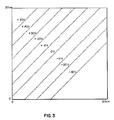
- FIGURE 3 illustrates the kind of uniform field that can be generated in matrix G , as actually measured as isopotentials using the arrangement of Figure 1.
- electric vector E was directed towards electrodes D22 and S22.
- the buffer was 1 cm deep (0.5X TBE formulation), at about 28°C, with a voltage gradient of about 5Vcm ⁇ 1 and power dissipation in the buffer of about 60W.
Landscapes
- Health & Medical Sciences (AREA)
- Life Sciences & Earth Sciences (AREA)
- Molecular Biology (AREA)
- Chemical & Material Sciences (AREA)
- Chemical Kinetics & Catalysis (AREA)
- Electrochemistry (AREA)
- Physics & Mathematics (AREA)
- Analytical Chemistry (AREA)
- Biochemistry (AREA)
- General Health & Medical Sciences (AREA)
- General Physics & Mathematics (AREA)
- Immunology (AREA)
- Pathology (AREA)
- Engineering & Computer Science (AREA)
- Power Engineering (AREA)
- Peptides Or Proteins (AREA)
- Investigating Or Analysing Biological Materials (AREA)
- Investigating Or Analyzing Materials By The Use Of Electric Means (AREA)
Applications Claiming Priority (2)
| Application Number | Priority Date | Filing Date | Title |
|---|---|---|---|
| US07/260,150 US4911817A (en) | 1988-10-20 | 1988-10-20 | Electrophoresis apparatus |
| US260150 | 1994-06-15 |
Publications (2)
| Publication Number | Publication Date |
|---|---|
| EP0365321A2 true EP0365321A2 (de) | 1990-04-25 |
| EP0365321A3 EP0365321A3 (de) | 1991-12-18 |
Family
ID=22987973
Family Applications (1)
| Application Number | Title | Priority Date | Filing Date |
|---|---|---|---|
| EP19890310750 Withdrawn EP0365321A3 (de) | 1988-10-20 | 1989-10-19 | Elektrophoresegerät |
Country Status (3)
| Country | Link |
|---|---|
| US (1) | US4911817A (de) |
| EP (1) | EP0365321A3 (de) |
| JP (1) | JPH02165047A (de) |
Cited By (3)
| Publication number | Priority date | Publication date | Assignee | Title |
|---|---|---|---|---|
| EP0816837A1 (de) * | 1996-07-03 | 1998-01-07 | Caliper Technologies Corporation | Variable Überwachung von elektroosmotischen und/oder elektroforetischen Kräften in einer in einem Fluidum enthaltenen Anordnung durch elektrische Kräfte |
| US6176990B1 (en) * | 1995-06-08 | 2001-01-23 | Visible Genetics Inc. | Micro-electrophoresis chip for moving and separating nucleic acids and other charged molecules |
| WO2009127911A1 (en) * | 2008-04-14 | 2009-10-22 | Hafid Mezdour | Apparatus and method for non immersed gel electrophoresis |
Families Citing this family (25)
| Publication number | Priority date | Publication date | Assignee | Title |
|---|---|---|---|---|
| US5549796A (en) * | 1986-08-14 | 1996-08-27 | The Board Of Trustees Of The Leland Stanford Junior University | Electrophoresis using contour-clamped electric fields |
| US5750015A (en) | 1990-02-28 | 1998-05-12 | Soane Biosciences | Method and device for moving molecules by the application of a plurality of electrical fields |
| US5126022A (en) * | 1990-02-28 | 1992-06-30 | Soane Tecnologies, Inc. | Method and device for moving molecules by the application of a plurality of electrical fields |
| US5185071A (en) * | 1990-10-30 | 1993-02-09 | Board Of Regents, The University Of Texas System | Programmable electrophoresis with integrated and multiplexed control |
| US5167784A (en) * | 1991-09-04 | 1992-12-01 | Xerox Corporation | Sequencing large nucleic acid fragments |
| US5645702A (en) * | 1995-06-07 | 1997-07-08 | Hewlett-Packard Company | Low voltage miniaturized column analytical apparatus and method |
| US5671086A (en) * | 1995-04-18 | 1997-09-23 | The Regents, University Of California | Method and apparatus for accurately manipulating an object during microelectrophoresis |
| US6902313B2 (en) * | 2000-08-10 | 2005-06-07 | University Of California | Micro chaotic mixer |
| US20050040042A1 (en) * | 2001-06-14 | 2005-02-24 | Yun Jae-Young | Method and device for electronic control of the spatial location of charged molecules |
| EP1720636A4 (de) | 2004-02-02 | 2012-06-20 | Univ British Columbia | Scodaphorese und verfahren und vorrichtungen zum bewegen und aufkonzentrieren von teilchen |
| US9186685B2 (en) | 2012-01-13 | 2015-11-17 | The University Of British Columbia | Multiple arm apparatus and methods for separation of particles |
| US10337054B2 (en) | 2004-02-02 | 2019-07-02 | Quantum-Si Incorporated | Enrichment of nucleic acid targets |
| US8529744B2 (en) | 2004-02-02 | 2013-09-10 | Boreal Genomics Corp. | Enrichment of nucleic acid targets |
| US8518228B2 (en) | 2011-05-20 | 2013-08-27 | The University Of British Columbia | Systems and methods for enhanced SCODA |
| CA2496294A1 (en) * | 2005-02-07 | 2006-08-07 | The University Of British Columbia | Apparatus and methods for concentrating and separating particles such as molecules |
| CA2713313A1 (en) | 2008-02-01 | 2009-08-06 | The University Of British Columbia | Methods and apparatus for particle introduction and recovery |
| US8877028B2 (en) | 2009-04-21 | 2014-11-04 | The University Of British Columbia | System and methods for detection of particles |
| GB201102385D0 (en) * | 2011-02-10 | 2011-03-30 | Biocule Scotland Ltd | Two-dimensional gel electrophoresis apparatus and method |
| GB2490665B (en) * | 2011-05-06 | 2017-01-04 | Genetic Microdevices Ltd | Device and method for applying an electric field |
| WO2013166444A2 (en) | 2012-05-04 | 2013-11-07 | Boreal Genomics Corp. | Biomarker analysis using scodaphoresis |
| US9340835B2 (en) | 2013-03-15 | 2016-05-17 | Boreal Genomics Corp. | Method for separating homoduplexed and heteroduplexed nucleic acids |
| US11130986B2 (en) | 2015-05-20 | 2021-09-28 | Quantum-Si Incorporated | Method for isolating target nucleic acid using heteroduplex binding proteins |
| KR101996722B1 (ko) * | 2017-07-07 | 2019-07-04 | 재단법인대구경북과학기술원 | 다채널 박막전극을 이용한 전기적 생체분자 이동방법 |
| WO2021086985A1 (en) | 2019-10-29 | 2021-05-06 | Quantum-Si Incorporated | Peristaltic pumping of fluids and associated methods, systems, and devices |
| CN111007134B (zh) * | 2019-12-17 | 2022-11-18 | 京东方科技集团股份有限公司 | 生物电泳装置、设备及控制方法 |
Family Cites Families (10)
| Publication number | Priority date | Publication date | Assignee | Title |
|---|---|---|---|---|
| US3630882A (en) * | 1968-06-13 | 1971-12-28 | Ortec Inc | Apparatus for particle separation |
| US3563872A (en) * | 1968-08-28 | 1971-02-16 | Beckman Instruments Inc | Voltage gradient control system for electrophoresis apparatus |
| US4433299A (en) * | 1980-03-07 | 1984-02-21 | Kureha Kagaku Kogyo Kabushiki Kaisha | Method and apparatus for measuring interfacial electrokinetic phenomena |
| US4473452A (en) * | 1982-11-18 | 1984-09-25 | The Trustees Of Columbia University In The City Of New York | Electrophoresis using alternating transverse electric fields |
| US4569741A (en) * | 1983-09-28 | 1986-02-11 | Pohl Herbert A | Cellular spin resonance spectrometer |
| US4661451A (en) * | 1984-02-06 | 1987-04-28 | Ortho Diagnostic Systems, Inc. | Methods for immobilizing and translocating biological cells |
| US4737251A (en) * | 1985-09-27 | 1988-04-12 | Washington University | Field-inversion gel electrophoresis |
| US4740283A (en) * | 1986-02-27 | 1988-04-26 | University Patents, Inc. | Pulsed-field gradient gel electrophoretic apparatus |
| ATE87365T1 (de) * | 1986-08-13 | 1993-04-15 | Univ Leland Stanford Junior | Elektrophorese, welche homogene oder inhomogene elektrische felder mit bestimmtem umkreis benutzt. |
| FR2620230B1 (fr) * | 1987-09-07 | 1990-02-23 | Ari Sa | Procede et dispositif pour l'electrophorese des macromolecules de grandes dimensions |
-
1988
- 1988-10-20 US US07/260,150 patent/US4911817A/en not_active Expired - Fee Related
-
1989
- 1989-10-19 JP JP1270503A patent/JPH02165047A/ja active Pending
- 1989-10-19 EP EP19890310750 patent/EP0365321A3/de not_active Withdrawn
Cited By (8)
| Publication number | Priority date | Publication date | Assignee | Title |
|---|---|---|---|---|
| US6176990B1 (en) * | 1995-06-08 | 2001-01-23 | Visible Genetics Inc. | Micro-electrophoresis chip for moving and separating nucleic acids and other charged molecules |
| US6261430B1 (en) | 1995-06-08 | 2001-07-17 | Visible Genetics Inc. | Micro-electrophoresis chip for moving and separating nucleic acids and other charged molecules |
| EP0816837A1 (de) * | 1996-07-03 | 1998-01-07 | Caliper Technologies Corporation | Variable Überwachung von elektroosmotischen und/oder elektroforetischen Kräften in einer in einem Fluidum enthaltenen Anordnung durch elektrische Kräfte |
| US5800690A (en) * | 1996-07-03 | 1998-09-01 | Caliper Technologies Corporation | Variable control of electroosmotic and/or electrophoretic forces within a fluid-containing structure via electrical forces |
| US5965001A (en) * | 1996-07-03 | 1999-10-12 | Caliper Technologies Corporation | Variable control of electroosmotic and/or electrophoretic forces within a fluid-containing structure via electrical forces |
| US6413401B1 (en) | 1996-07-03 | 2002-07-02 | Caliper Technologies Corp. | Variable control of electroosmotic and/or electrophoretic forces within a fluid-containing structure via electrical forces |
| EP0909386A4 (de) * | 1996-07-03 | 2005-01-19 | Caliper Life Sciences Inc | Verstellbare steuerung durch elektrische kräfte von elektroosmotischen und/oder elektroforetischen kräften in einer eine flüssigkeit enthaltenden struktur |
| WO2009127911A1 (en) * | 2008-04-14 | 2009-10-22 | Hafid Mezdour | Apparatus and method for non immersed gel electrophoresis |
Also Published As
| Publication number | Publication date |
|---|---|
| JPH02165047A (ja) | 1990-06-26 |
| US4911817A (en) | 1990-03-27 |
| EP0365321A3 (de) | 1991-12-18 |
Similar Documents
| Publication | Publication Date | Title |
|---|---|---|
| US4911817A (en) | Electrophoresis apparatus | |
| Chu et al. | Separation of large DNA molecules by contour-clamped homogeneous electric fields | |
| US5084157A (en) | Gel electrophoresis using time dependent contour controlled electric fields | |
| Clark et al. | A novel instrument for separating large DNA molecules with pulsed homogeneous electric fields | |
| EP0361046B1 (de) | Gelelektrophorese mit erzwungenem gleichmässigem Feld | |
| US4737251A (en) | Field-inversion gel electrophoresis | |
| US5165898A (en) | Electrophoresis using contour-clamped electric fields | |
| Robertson et al. | Rapid isoelectric focusing in a vertical polyacrylamide minigel system | |
| US5405519A (en) | Pulsed oriented electrophoresis | |
| CA2012379C (en) | Processes for the preparation and separation of macromolecules | |
| ZA200308254B (en) | Circuit arrangement for injecting nucleic acids and other biologically active molecules into the nucleus of higher educaryontic cells using electrical currents. | |
| US6558522B1 (en) | Apparatus for electrophoresis | |
| Birren et al. | Pulsed field gel electrophoresis techniques for separating 1-to 50-kilobase DNA fragments | |
| US4830726A (en) | Separation of large DNA molecules in alternating asymmetric electric fields | |
| WO1987000635A1 (en) | Method for electrophoretic separator | |
| US4702814A (en) | Non-mechanical buffer circulation apparatus for electrophoresis | |
| JPS63113351A (ja) | 電気泳動装置 | |
| EP0644420A2 (de) | Verfahren und Vorrichtung für Gelelektrophorese | |
| Gardiner et al. | Transverse alternating field electrophoresis and applications to mammalian genome mapping | |
| US5445723A (en) | Blotting apparatus | |
| KR900701376A (ko) | 직사각형 겔 플레이트를 통하여 거대분자의 이동을 조절하기 위한 다중 전기영동법 및 장치 | |
| WO2002044706A1 (en) | Methods and apparatus for nonlinear mobility electrophoresis separation | |
| US5028308A (en) | Apparatus for the electrophoretic separation of high-molecular DNA in gel | |
| AU617898B2 (en) | Electrophoresis method and apparatus | |
| WO1994011730A1 (en) | Two-dimensional electrophoresis apparatus and an electrophoresis unit therefor |
Legal Events
| Date | Code | Title | Description |
|---|---|---|---|
| PUAI | Public reference made under article 153(3) epc to a published international application that has entered the european phase |
Free format text: ORIGINAL CODE: 0009012 |
|
| AK | Designated contracting states |
Kind code of ref document: A2 Designated state(s): CH DE FR GB IT LI SE |
|
| PUAL | Search report despatched |
Free format text: ORIGINAL CODE: 0009013 |
|
| AK | Designated contracting states |
Kind code of ref document: A3 Designated state(s): CH DE FR GB IT LI SE |
|
| 17P | Request for examination filed |
Effective date: 19920504 |
|
| 17Q | First examination report despatched |
Effective date: 19920803 |
|
| STAA | Information on the status of an ep patent application or granted ep patent |
Free format text: STATUS: THE APPLICATION IS DEEMED TO BE WITHDRAWN |
|
| 18D | Application deemed to be withdrawn |
Effective date: 19930215 |