EP0365414A2 - Formteil für Fahrzeugkarosserien und Verfahren zu dessen Herstellung - Google Patents
Formteil für Fahrzeugkarosserien und Verfahren zu dessen Herstellung Download PDFInfo
- Publication number
- EP0365414A2 EP0365414A2 EP89402852A EP89402852A EP0365414A2 EP 0365414 A2 EP0365414 A2 EP 0365414A2 EP 89402852 A EP89402852 A EP 89402852A EP 89402852 A EP89402852 A EP 89402852A EP 0365414 A2 EP0365414 A2 EP 0365414A2
- Authority
- EP
- European Patent Office
- Prior art keywords
- layer
- synthetic material
- product
- reinforcing element
- paint
- Prior art date
- Legal status (The legal status is an assumption and is not a legal conclusion. Google has not performed a legal analysis and makes no representation as to the accuracy of the status listed.)
- Granted
Links
- 238000004519 manufacturing process Methods 0.000 title claims abstract description 6
- 239000010410 layer Substances 0.000 claims abstract description 40
- 239000003973 paint Substances 0.000 claims abstract description 25
- 230000003014 reinforcing effect Effects 0.000 claims abstract description 24
- 239000002344 surface layer Substances 0.000 claims abstract description 12
- 238000000151 deposition Methods 0.000 claims abstract description 8
- 239000011521 glass Substances 0.000 claims abstract description 8
- 239000012530 fluid Substances 0.000 claims abstract description 5
- 229920002994 synthetic fiber Polymers 0.000 claims description 38
- 239000000463 material Substances 0.000 claims description 23
- 238000000034 method Methods 0.000 claims description 22
- 238000000465 moulding Methods 0.000 claims description 16
- 229920000582 polyisocyanurate Polymers 0.000 claims description 8
- 239000011495 polyisocyanurate Substances 0.000 claims description 8
- 238000006116 polymerization reaction Methods 0.000 claims description 6
- 229920002396 Polyurea Polymers 0.000 claims description 4
- 239000000945 filler Substances 0.000 claims description 4
- 229920000515 polycarbonate Polymers 0.000 claims description 4
- 239000004417 polycarbonate Substances 0.000 claims description 4
- 229920000728 polyester Polymers 0.000 claims description 4
- 229910052500 inorganic mineral Inorganic materials 0.000 claims description 2
- 239000011707 mineral Substances 0.000 claims description 2
- 230000008021 deposition Effects 0.000 claims 1
- 239000000126 substance Substances 0.000 abstract 1
- 239000002184 metal Substances 0.000 description 8
- 238000001962 electrophoresis Methods 0.000 description 7
- 239000002991 molded plastic Substances 0.000 description 6
- 238000011282 treatment Methods 0.000 description 6
- 238000010107 reaction injection moulding Methods 0.000 description 5
- 239000011248 coating agent Substances 0.000 description 4
- 238000000576 coating method Methods 0.000 description 4
- 239000004033 plastic Substances 0.000 description 4
- 229920003023 plastic Polymers 0.000 description 4
- 238000006243 chemical reaction Methods 0.000 description 3
- 238000010276 construction Methods 0.000 description 3
- 238000002347 injection Methods 0.000 description 3
- 239000007924 injection Substances 0.000 description 3
- 238000010422 painting Methods 0.000 description 3
- 230000002787 reinforcement Effects 0.000 description 3
- 230000015572 biosynthetic process Effects 0.000 description 1
- 239000000470 constituent Substances 0.000 description 1
- 229920001577 copolymer Polymers 0.000 description 1
- 238000005260 corrosion Methods 0.000 description 1
- 230000000694 effects Effects 0.000 description 1
- 239000012764 mineral filler Substances 0.000 description 1
- 239000000203 mixture Substances 0.000 description 1
- -1 polyacrylamate Polymers 0.000 description 1
- 229920002635 polyurethane Polymers 0.000 description 1
- 239000004814 polyurethane Substances 0.000 description 1
- 230000037452 priming Effects 0.000 description 1
- 230000001681 protective effect Effects 0.000 description 1
- 239000011241 protective layer Substances 0.000 description 1
- 239000000243 solution Substances 0.000 description 1
- 239000002904 solvent Substances 0.000 description 1
- 238000005507 spraying Methods 0.000 description 1
- 239000002345 surface coating layer Substances 0.000 description 1
- 238000011144 upstream manufacturing Methods 0.000 description 1
Images
Classifications
-
- B—PERFORMING OPERATIONS; TRANSPORTING
- B29—WORKING OF PLASTICS; WORKING OF SUBSTANCES IN A PLASTIC STATE IN GENERAL
- B29C—SHAPING OR JOINING OF PLASTICS; SHAPING OF MATERIAL IN A PLASTIC STATE, NOT OTHERWISE PROVIDED FOR; AFTER-TREATMENT OF THE SHAPED PRODUCTS, e.g. REPAIRING
- B29C37/00—Component parts, details, accessories or auxiliary operations, not covered by group B29C33/00 or B29C35/00
- B29C37/0025—Applying surface layers, e.g. coatings, decorative layers, printed layers, to articles during shaping, e.g. in-mould printing
- B29C37/0028—In-mould coating, e.g. by introducing the coating material into the mould after forming the article
- B29C37/0032—In-mould coating, e.g. by introducing the coating material into the mould after forming the article the coating being applied upon the mould surface before introducing the moulding compound, e.g. applying a gelcoat
-
- B—PERFORMING OPERATIONS; TRANSPORTING
- B29—WORKING OF PLASTICS; WORKING OF SUBSTANCES IN A PLASTIC STATE IN GENERAL
- B29C—SHAPING OR JOINING OF PLASTICS; SHAPING OF MATERIAL IN A PLASTIC STATE, NOT OTHERWISE PROVIDED FOR; AFTER-TREATMENT OF THE SHAPED PRODUCTS, e.g. REPAIRING
- B29C37/00—Component parts, details, accessories or auxiliary operations, not covered by group B29C33/00 or B29C35/00
- B29C37/0078—Measures or configurations for obtaining anchoring effects in the contact areas between layers
-
- B—PERFORMING OPERATIONS; TRANSPORTING
- B29—WORKING OF PLASTICS; WORKING OF SUBSTANCES IN A PLASTIC STATE IN GENERAL
- B29C—SHAPING OR JOINING OF PLASTICS; SHAPING OF MATERIAL IN A PLASTIC STATE, NOT OTHERWISE PROVIDED FOR; AFTER-TREATMENT OF THE SHAPED PRODUCTS, e.g. REPAIRING
- B29C67/00—Shaping techniques not covered by groups B29C39/00 - B29C65/00, B29C70/00 or B29C73/00
- B29C67/24—Shaping techniques not covered by groups B29C39/00 - B29C65/00, B29C70/00 or B29C73/00 characterised by the choice of material
- B29C67/246—Moulding high reactive monomers or prepolymers, e.g. by reaction injection moulding [RIM], liquid injection moulding [LIM]
-
- B—PERFORMING OPERATIONS; TRANSPORTING
- B29—WORKING OF PLASTICS; WORKING OF SUBSTANCES IN A PLASTIC STATE IN GENERAL
- B29L—INDEXING SCHEME ASSOCIATED WITH SUBCLASS B29C, RELATING TO PARTICULAR ARTICLES
- B29L2031/00—Other particular articles
- B29L2031/30—Vehicles, e.g. ships or aircraft, or body parts thereof
- B29L2031/3055—Cars
Definitions
- the invention relates to a molded bodywork part for a vehicle, and its manufacturing method.
- these molded parts are generally made of materials which cannot withstand high temperatures, of the order of 180-200 ° C for example, baths in which the body parts necessarily pass after assembly on the chains. paint manufacturers.
- the body parts are first subjected to an anti-corrosion treatment by cataphoresis, then receive successive layers of priming and finishing paints.
- the protective treatment by cataphoresis has no effect on molded plastic parts, which are not electrically conductive.
- the protective layer, deposited on metallic parts by cataphoresis, will therefore be lacking on molded plastic parts which, however, should be subjected to a treatment identical to that of metallic parts, to avoid any difference in appearance at the end of chain.
- the molded plastic parts must have very good surface qualities.
- they include fillers, for example mineral fillers, and / or reinforcing elements, such as a glass mat, the structure of which appears more or less on their outer surface when these parts are not molded according to special processes. , relatively expensive.
- plastic body parts are generally treated independently of metal parts and are painted before being fitted to bodywork, which results in higher cost and the risk of color differences between parts. molded plastic and metal parts of bodywork.
- Document GB-A-2 079 667 discloses a process for molding plastic body parts according to which a surface coating layer is deposited on a mold base, a reinforcement is placed in the mold, and finally injects a polymerizable material into the mold.
- the coating material contains a reaction promoter which promotes polymerization of the material injected subsequently, and which is also intended to "transfer the coating from the mold base to the molded part” and "bind the coating to the molded part".
- this reaction promoter has no action on the coating material which is chemically different from the plastic of the part and which is not compatible with it, the results obtained are very disappointing, and this process does not has never been exploited.
- the object of the invention is in particular to provide a simple, effective and inexpensive solution to these problems of the prior art.
- body parts for vehicles made of synthetic material, which are rigid and self-supporting, capable of withstanding the high temperatures of the paint chains of automobile construction factories, and which have plus the surface aspects required for body parts.
- the invention therefore proposes a molded bodywork part for a vehicle, made of a polymerized synthetic material and comprising a filler and / or a reinforcing element such as a glass mat for example, optionally fixing inserts and, at the less on its visible outer surface, a surface layer of a smooth product, characterized in that it is made of material resistant to high temperatures, of the order of 180 ° - 200 ° C for example, and in that said polymerized synthetic material and the product of said surface layer are chemically compatible and have polymerization reactions of the same type, allowing the bonding of said material and of said product to each other.
- Such a bodywork part can pass without disadvantages, with the metal parts, over a paint line of an automobile construction factory. It also has a good surface appearance and can therefore be used as an external bodywork part, without affecting the aesthetics of the vehicle, since the reinforcing element is covered by the surface layer of smooth product.
- the product used to cover or hide the reinforcing element is a self-release paint.
- a pri layer is thus formed during molding. mayor on whom the other coats of primer and finish paints will be deposited.
- the paint used to form the surface layer is electrically conductive.
- molded plastic parts will behave in cataphoresis like metal parts and may be subjected to the same treatments on the paint chains.
- the molded part comprises an intermediate layer of another synthetic material, between the reinforcing element and the surface layer of smooth product, the material of this intermediate layer being chemically compatible with the product and the synthetic material. mentioned above, to ensure good liaison with them.
- This intermediate layer of synthetic material makes it possible to completely hide the structure of the reinforcing element and make it invisible from the outside, thereby giving a perfectly smooth appearance to the molded part.
- the aforementioned synthetic material (s) are of the type which can be used in the R.I.M. process, such as a polyisocyanurate, a polycarbonate, a polyacrylamate, a polyester or a polyurea, respectively.
- the invention also provides a method of manufacturing molded bodywork parts for vehicles, comprising depositing on the walls of a mold cavity a layer of a fluid product such as a paint, then placing in the mold cavity a reinforcing element, such as for example a glass mat, and / or inserts intended to allow the subsequent fixing of the part, then to inject into the mold cavity a polymerizable synthetic material, characterized in that it consists mold the part in a synthetic material resistant to high temperatures, of the order of 180 ° - 200 ° C for example, the injected material being chemically compatible with said fluid product, and having the same type of polymerization reaction as this to ensure good adhesion of the product layer on the injected synthetic material.
- a polymerizable synthetic material characterized in that it consists mold the part in a synthetic material resistant to high temperatures, of the order of 180 ° - 200 ° C for example, the injected material being chemically compatible with said fluid product, and having the same type of polymerization reaction as this to ensure good adhesion of
- the method after depositing a layer of said product on the walls of the molding cavity and before placing a reinforcing element and any inserts in this cavity, the method also consists in depositing on this product layer a layer of another polymerizable synthetic material chemically compatible with said product and the injected synthetic material.
- This other synthetic material, as well as the first synthetic material mentioned, are advantageously of the type which can be used in the R.I.M.
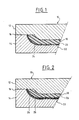
- FIG. 1 therefore shows a partial cross section of a mold 10, comprising an upper part 12 and a lower part 14 applied one on the other along a joint plane 16 and delimiting between them a molding cavity 18 to the shape of the part to be produced.
- This part is a bodywork element, for example a bumper, a door, a wing, a hood, etc. of a motor vehicle. It is produced by injection, into the molding cavity 18, of a polymerizable synthetic material, preferably a material usable in RIM (Reaction-Injection-Molding), process according to which the various constituents of a polymerizable synthetic material are mixed between them immé diatly upstream of the molding cavity in an injection head.
- a polymerizable synthetic material preferably a material usable in RIM (Reaction-Injection-Molding), process according to which the various constituents of a polymerizable synthetic material are mixed between them immé diatly upstream of the molding cavity in an injection head.
- RIM Reaction-Injection-Molding
- the molded part may include a filler, for example mineral, and a reinforcing element, such as a glass mat 20 which is in generally placed on the bottom of the mold, that is to say on the wall 22 of the mold cavity 18 defined by the lower part 14 of the mold 10.
- a filler for example mineral
- a reinforcing element such as a glass mat 20 which is in generally placed on the bottom of the mold, that is to say on the wall 22 of the mold cavity 18 defined by the lower part 14 of the mold 10.
- the invention provides for depositing, on the wall 22, a layer 24 of a product such as a primary paint, then to position in the molding cavity 18, on this layer of product 24, the reinforcing element 20 and possibly inserts, for example metallic, which will be used to fix the molded part.
- the paint of layer 24 must be chemically compatible with the synthetic material of the part, that is to say must polymerize according to the same type of reaction, to cling to this material, for example by formation of a copolymer. at the interface between the paint and the synthetic material of the part.
- the paint used for layer 24 is advantageously electrically conductive and self-demolding.
- the process for manufacturing the molded part according to the invention is as follows: the mold 10 being open, a layer 24 of paint is deposited on the wall 22 of the lower part 14 of the mold, for example by spraying, and the solvent of this paint is allowed to evaporate. Then we place the reinforcing element 20 and any inserts in the bottom of the mold, on the layer 24, then the mold is closed and the polymerizable synthetic material intended to form the molded part is injected into the molding cavity 18.
- the RIM process is preferably used, according to which the different components of this synthetic material are mixed immediately before being injected into the molding cavity.
- the mold 10 is opened, for demolding the bodywork part. This release is facilitated when the paint used to form the surface layer 24 is self-release.
- the molded part thus obtained has a good surface appearance, because the reinforcing element 20 is covered by the layer 24 of paint.
- This process makes it possible in particular to obtain bodywork parts having a grainy exterior appearance, making it possible to hide the texture of the reinforcing element 20 covered by the layer of paint 24.
- the body part thus obtained can be assembled with other body parts, for example metallic, on a construction line, then passed without drawbacks in the cataphoresis and painting baths at relatively high temperature.
- the method according to the invention firstly consists in: deposit a layer 24 of fluid, such as a paint, on the wall 22 of the lower part 14 of the mold, then deposit on this layer 24 a layer 26 of a polymerizable synthetic material, having a thickness of the order from 1 to 2 mm, and to place on this layer 26 the reinforcing element 20 and any inserts, before injecting into the molding cavity 18 a polymerizable synthetic material which is identical or similar to that of the process of the figure 1.
- the materials of layers 24 and 26 are chemically compatible with each other and with the injected plastic, to ensure a good bond between them.
- the layer 26 of synthetic material completely masks the reinforcing element 20 and is itself covered by the layer 24 of paint, so that this molded part has a very high quality surface appearance ( class A according to the American names).
- the synthetic material used to form layer 26 is a polymerizable material, usable in RIM, of the polyisocyanurate or polyurea type, which will form a thin and smooth skin on the reinforcing element 20. In practice, this skin completely covers the element. reinforcement, which lines the mold cavity. As the polymerizable material used to form this skin will come into contact with the internal surface of the upper part 12 of the mold, it is possible to choose a self-releasing material.
- a molded part according to the invention can have, for example, the following composition: - injectable polymerizable synthetic material: polyisocyanurate - reinforcement element 20: glass mat - layer 24: two-component polyurethane, conductive and self-release - layer 26: polyisocyanurate. -
- the temperature and the injection pressure in the mold can vary between 50 and 150 ° C, and 3 and 40 bars respectively, depending on the material used.
- the method according to the invention makes it possible to obtain body parts molded in synthetic material, having at will a class A appearance or a grained appearance, which can be assembled with metal body parts and then undergo the treatments. usual cataphoresis and painting of these metal parts.
Landscapes
- Injection Moulding Of Plastics Or The Like (AREA)
- Laminated Bodies (AREA)
- Casting Or Compression Moulding Of Plastics Or The Like (AREA)
Applications Claiming Priority (2)
| Application Number | Priority Date | Filing Date | Title |
|---|---|---|---|
| FR8813634A FR2637836B1 (fr) | 1988-10-17 | 1988-10-17 | Piece moulee de carrosserie pour vehicules, et son procede de fabrication |
| FR8813634 | 1988-10-17 |
Publications (3)
| Publication Number | Publication Date |
|---|---|
| EP0365414A2 true EP0365414A2 (de) | 1990-04-25 |
| EP0365414A3 EP0365414A3 (de) | 1991-05-15 |
| EP0365414B1 EP0365414B1 (de) | 1994-03-09 |
Family
ID=9371086
Family Applications (1)
| Application Number | Title | Priority Date | Filing Date |
|---|---|---|---|
| EP19890402852 Expired - Lifetime EP0365414B1 (de) | 1988-10-17 | 1989-10-16 | Formteil für Fahrzeugkarosserien und Verfahren zu dessen Herstellung |
Country Status (4)
| Country | Link |
|---|---|
| EP (1) | EP0365414B1 (de) |
| DE (2) | DE365414T1 (de) |
| ES (1) | ES2025031A4 (de) |
| FR (1) | FR2637836B1 (de) |
Cited By (4)
| Publication number | Priority date | Publication date | Assignee | Title |
|---|---|---|---|---|
| FR2670708A1 (fr) * | 1990-12-21 | 1992-06-26 | Panico Yvo | Procede de fabrication d'un article composite a base de resine armee. |
| EP0534512A1 (de) * | 1991-09-03 | 1993-03-31 | General Motors Corporation | Verfahren zur Elektrostatischbeschichtung von isolierenden Substraten |
| WO2004056561A1 (de) * | 2002-12-19 | 2004-07-08 | Daimlerchrysler Ag | Verfahren zur beschichtung zu lackierender bauteile aus faserverstärktem kunststoff |
| US9925727B2 (en) | 2012-03-09 | 2018-03-27 | Mubea Carbo Tech Gmbh | Method for producing components from fiber-reinforced composite material |
Families Citing this family (1)
| Publication number | Priority date | Publication date | Assignee | Title |
|---|---|---|---|---|
| CN104369855B (zh) * | 2014-10-21 | 2016-09-21 | 成都巨峰玻璃有限公司 | Mdyb-3航空有机玻璃复杂曲面制品的生产工艺 |
Family Cites Families (8)
| Publication number | Priority date | Publication date | Assignee | Title |
|---|---|---|---|---|
| SE405823B (sv) * | 1973-10-10 | 1979-01-08 | Messerschmitt Boelkow Blohm | Forfarande for att forbettra ytkvaliteten i av herdbar plast bestaende foremal |
| FR2272142A1 (en) * | 1974-05-24 | 1975-12-19 | Ziegler Hubert | Decorative cladding involving flexible polyester resins - for application to non planar surfaces |
| US4349643A (en) * | 1980-05-15 | 1982-09-14 | International Telephone And Telegraph Corporation | Coating composition adapted for transfer coating during reaction injection molding containing a polyurethane catalyst |
| US4356230A (en) * | 1980-07-10 | 1982-10-26 | International Telephone And Telegraph Corporation | Molded plastic product having a plastic substrate containing a filler and an in-mold plastic coating firmly bonded thereon and a process for its manufacture |
| DE3140316C2 (de) * | 1981-10-10 | 1983-10-13 | Basf Farben + Fasern Ag, 2000 Hamburg | Verfahren zur Herstellung von Kunststoff-Verbundwerkstoffteilen |
| FR2538303B1 (fr) * | 1982-12-27 | 1989-01-13 | Gigon Michel | Procede pour la realisation d'un produit composite pourvu d'une couche de surface en resine polyester et produit ainsi obtenu |
| US4587160A (en) * | 1983-06-13 | 1986-05-06 | Ferro Corporation | Electrostatically conductive premold coating |
| JPS61111335A (ja) * | 1984-11-05 | 1986-05-29 | Dainippon Toryo Co Ltd | プラスチツク成形方法 |
-
1988
- 1988-10-17 FR FR8813634A patent/FR2637836B1/fr not_active Expired - Fee Related
-
1989
- 1989-10-16 DE DE1989402852 patent/DE365414T1/de active Pending
- 1989-10-16 ES ES89402852T patent/ES2025031A4/es active Pending
- 1989-10-16 EP EP19890402852 patent/EP0365414B1/de not_active Expired - Lifetime
- 1989-10-16 DE DE1989613649 patent/DE68913649T2/de not_active Expired - Fee Related
Cited By (6)
| Publication number | Priority date | Publication date | Assignee | Title |
|---|---|---|---|---|
| FR2670708A1 (fr) * | 1990-12-21 | 1992-06-26 | Panico Yvo | Procede de fabrication d'un article composite a base de resine armee. |
| WO1992011127A1 (fr) * | 1990-12-21 | 1992-07-09 | Yvo Panico | Procede de fabrication d'articles en resine, notamment en polyurethanne armee |
| EP0534512A1 (de) * | 1991-09-03 | 1993-03-31 | General Motors Corporation | Verfahren zur Elektrostatischbeschichtung von isolierenden Substraten |
| US5262207A (en) * | 1991-09-03 | 1993-11-16 | General Motors Corporation | Method of electrostatically coating nonconductive panels |
| WO2004056561A1 (de) * | 2002-12-19 | 2004-07-08 | Daimlerchrysler Ag | Verfahren zur beschichtung zu lackierender bauteile aus faserverstärktem kunststoff |
| US9925727B2 (en) | 2012-03-09 | 2018-03-27 | Mubea Carbo Tech Gmbh | Method for producing components from fiber-reinforced composite material |
Also Published As
| Publication number | Publication date |
|---|---|
| DE68913649T2 (de) | 1994-10-06 |
| ES2025031A4 (es) | 1992-03-16 |
| EP0365414A3 (de) | 1991-05-15 |
| EP0365414B1 (de) | 1994-03-09 |
| FR2637836B1 (fr) | 1991-03-08 |
| FR2637836A1 (fr) | 1990-04-20 |
| DE365414T1 (de) | 1992-02-27 |
| DE68913649D1 (de) | 1994-04-14 |
Similar Documents
| Publication | Publication Date | Title |
|---|---|---|
| EP0524060B1 (de) | Verfahren und Vorrichtung zum Herstellen einer Glasscheibe mit einem Umfangsrahmen auf Polymerbasis | |
| EP0121481B1 (de) | Einfassen einer Scheibe in eine Öffnung eines Kraftfahrzeuges durch Klebeverbindung | |
| CA2113386A1 (fr) | Vitrage automobile preequipe pour le collage dans une baie et procede de fabrication | |
| EP1478538A1 (de) | Glasscheibe mit einem starren element möglicherweise eingebaut in einem durch umspritzen eingesetzten kunststoffteil | |
| EP0365414B1 (de) | Formteil für Fahrzeugkarosserien und Verfahren zu dessen Herstellung | |
| WO2016087806A1 (fr) | Procede de fabrication d'une piece de vehicule automobile en matiere thermoplastique renforcee | |
| FR2662091A1 (fr) | Ski et procede de fabrication d'un ski. | |
| FR2541959A1 (fr) | Aile d'automobile moulee en resine synthetique ou similaire et son procede de fabrication | |
| EP3706973A1 (de) | Verfahren zur herstellung eines kunststoffformteils mit einer körnigen aussenfläche mit höherer qualität | |
| FR2494185A3 (fr) | Element moule en matiere plastique, a deux composants, notamment pare-chocs et pieces de carrosserie pour vehicules automobiles | |
| EP0382602B1 (de) | Einbaufertige Verglasung und dessen Herstellungsverfahren | |
| EP0782501B1 (de) | Verfahren zum herstellen einer platte beschichtet mit einer verblendungsfläche, insbesondere textil | |
| EP1718515B1 (de) | Verfahren zur herstellung eines eine synthetische materialschicht umfassenden fahrzeugbodens | |
| EP3870419B1 (de) | Karosserieteil mit einem dekorativen element | |
| EP3230045B1 (de) | Verfahren zur herstellung eines teils durch generative fertigung | |
| EP3651961B1 (de) | Verfahren zur herstellung eines luftreifens mit verbesserter lauffläche | |
| US5932357A (en) | Painted plastics articles | |
| FR2845399A1 (fr) | Zone d'affichage et procede permettant sa fabrication. | |
| FR2683763A1 (fr) | Procede d'obtention par moulage de pieces, pretes a l'emploi, en materiaux composites. | |
| EP3018042B1 (de) | Thermoplastisches kraftfahrzeugteil, das mit einem durchbrochenen, lokal aufgeformten metallverstärkungselement ausgestattet ist | |
| FR2897564A1 (fr) | Garnitures d'etancheite souples et moulees pour vitrages et leur procede de fabrication | |
| FR2787742A1 (fr) | Materiau plastique non metallisable lors de la realisation d'objets composites a revetement metallique selectif, les objets composites ainsi obtenus et leur procede de preparation | |
| EP3921208A1 (de) | Schallschutzplatte für einen kraftfahrzeugmotorraum | |
| WO2016156750A1 (fr) | Procédé de fabrication d'un insert d'un ouvrant de véhicule automobile | |
| EP4338923A1 (de) | Verfahren zum formen einer karosserieplatte |
Legal Events
| Date | Code | Title | Description |
|---|---|---|---|
| PUAI | Public reference made under article 153(3) epc to a published international application that has entered the european phase |
Free format text: ORIGINAL CODE: 0009012 |
|
| AK | Designated contracting states |
Kind code of ref document: A2 Designated state(s): BE DE ES FR GB IT SE |
|
| PUAL | Search report despatched |
Free format text: ORIGINAL CODE: 0009013 |
|
| AK | Designated contracting states |
Kind code of ref document: A3 Designated state(s): BE DE ES FR GB IT SE |
|
| GBC | Gb: translation of claims filed (gb section 78(7)/1977) | ||
| 17P | Request for examination filed |
Effective date: 19911002 |
|
| DET | De: translation of patent claims | ||
| REG | Reference to a national code |
Ref country code: ES Ref legal event code: BA2A Ref document number: 2025031 Country of ref document: ES Kind code of ref document: A4 |
|
| 17Q | First examination report despatched |
Effective date: 19930224 |
|
| GRAA | (expected) grant |
Free format text: ORIGINAL CODE: 0009210 |
|
| AK | Designated contracting states |
Kind code of ref document: B1 Designated state(s): BE DE ES FR GB IT SE |
|
| PG25 | Lapsed in a contracting state [announced via postgrant information from national office to epo] |
Ref country code: SE Free format text: THE PATENT HAS BEEN ANNULLED BY A DECISION OF A NATIONAL AUTHORITY Effective date: 19940309 |
|
| REF | Corresponds to: |
Ref document number: 68913649 Country of ref document: DE Date of ref document: 19940414 |
|
| ITF | It: translation for a ep patent filed | ||
| PG25 | Lapsed in a contracting state [announced via postgrant information from national office to epo] |
Ref country code: ES Free format text: LAPSE BECAUSE OF FAILURE TO SUBMIT A TRANSLATION OF THE DESCRIPTION OR TO PAY THE FEE WITHIN THE PRESCRIBED TIME-LIMIT Effective date: 19940620 |
|
| GBT | Gb: translation of ep patent filed (gb section 77(6)(a)/1977) |
Effective date: 19940525 |
|
| PG25 | Lapsed in a contracting state [announced via postgrant information from national office to epo] |
Ref country code: BE Effective date: 19941031 |
|
| PLBE | No opposition filed within time limit |
Free format text: ORIGINAL CODE: 0009261 |
|
| STAA | Information on the status of an ep patent application or granted ep patent |
Free format text: STATUS: NO OPPOSITION FILED WITHIN TIME LIMIT |
|
| 26N | No opposition filed | ||
| BERE | Be: lapsed |
Owner name: HUTCHINSON Effective date: 19941031 |
|
| REG | Reference to a national code |
Ref country code: GB Ref legal event code: IF02 |
|
| PGFP | Annual fee paid to national office [announced via postgrant information from national office to epo] |
Ref country code: FR Payment date: 20020323 Year of fee payment: 14 |
|
| PGFP | Annual fee paid to national office [announced via postgrant information from national office to epo] |
Ref country code: GB Payment date: 20021002 Year of fee payment: 14 |
|
| PGFP | Annual fee paid to national office [announced via postgrant information from national office to epo] |
Ref country code: DE Payment date: 20021223 Year of fee payment: 14 |
|
| PG25 | Lapsed in a contracting state [announced via postgrant information from national office to epo] |
Ref country code: GB Free format text: LAPSE BECAUSE OF NON-PAYMENT OF DUE FEES Effective date: 20031016 |
|
| PG25 | Lapsed in a contracting state [announced via postgrant information from national office to epo] |
Ref country code: DE Free format text: LAPSE BECAUSE OF NON-PAYMENT OF DUE FEES Effective date: 20040501 |
|
| GBPC | Gb: european patent ceased through non-payment of renewal fee |
Effective date: 20031016 |
|
| PG25 | Lapsed in a contracting state [announced via postgrant information from national office to epo] |
Ref country code: FR Free format text: LAPSE BECAUSE OF NON-PAYMENT OF DUE FEES Effective date: 20040630 |
|
| REG | Reference to a national code |
Ref country code: FR Ref legal event code: ST |
|
| PG25 | Lapsed in a contracting state [announced via postgrant information from national office to epo] |
Ref country code: IT Free format text: LAPSE BECAUSE OF NON-PAYMENT OF DUE FEES;WARNING: LAPSES OF ITALIAN PATENTS WITH EFFECTIVE DATE BEFORE 2007 MAY HAVE OCCURRED AT ANY TIME BEFORE 2007. THE CORRECT EFFECTIVE DATE MAY BE DIFFERENT FROM THE ONE RECORDED. Effective date: 20051016 |