EP0365729A2 - Feuilles stratifiées chauffables par micro-ondes - Google Patents
Feuilles stratifiées chauffables par micro-ondes Download PDFInfo
- Publication number
- EP0365729A2 EP0365729A2 EP88312408A EP88312408A EP0365729A2 EP 0365729 A2 EP0365729 A2 EP 0365729A2 EP 88312408 A EP88312408 A EP 88312408A EP 88312408 A EP88312408 A EP 88312408A EP 0365729 A2 EP0365729 A2 EP 0365729A2
- Authority
- EP
- European Patent Office
- Prior art keywords
- susceptor
- printed
- laminate
- particles
- ink
- Prior art date
- Legal status (The legal status is an assumption and is not a legal conclusion. Google has not performed a legal analysis and makes no representation as to the accuracy of the status listed.)
- Granted
Links
Images
Classifications
-
- B—PERFORMING OPERATIONS; TRANSPORTING
- B32—LAYERED PRODUCTS
- B32B—LAYERED PRODUCTS, i.e. PRODUCTS BUILT-UP OF STRATA OF FLAT OR NON-FLAT, e.g. CELLULAR OR HONEYCOMB, FORM
- B32B27/00—Layered products comprising a layer of synthetic resin
- B32B27/18—Layered products comprising a layer of synthetic resin characterised by the use of special additives
-
- B—PERFORMING OPERATIONS; TRANSPORTING
- B32—LAYERED PRODUCTS
- B32B—LAYERED PRODUCTS, i.e. PRODUCTS BUILT-UP OF STRATA OF FLAT OR NON-FLAT, e.g. CELLULAR OR HONEYCOMB, FORM
- B32B7/00—Layered products characterised by the relation between layers; Layered products characterised by the relative orientation of features between layers, or by the relative values of a measurable parameter between layers, i.e. products comprising layers having different physical, chemical or physicochemical properties; Layered products characterised by the interconnection of layers
- B32B7/04—Interconnection of layers
- B32B7/12—Interconnection of layers using interposed adhesives or interposed materials with bonding properties
-
- B—PERFORMING OPERATIONS; TRANSPORTING
- B32—LAYERED PRODUCTS
- B32B—LAYERED PRODUCTS, i.e. PRODUCTS BUILT-UP OF STRATA OF FLAT OR NON-FLAT, e.g. CELLULAR OR HONEYCOMB, FORM
- B32B15/00—Layered products comprising a layer of metal
- B32B15/04—Layered products comprising a layer of metal comprising metal as the main or only constituent of a layer, which is next to another layer of the same or of a different material
- B32B15/12—Layered products comprising a layer of metal comprising metal as the main or only constituent of a layer, which is next to another layer of the same or of a different material of paper or cardboard
-
- B—PERFORMING OPERATIONS; TRANSPORTING
- B32—LAYERED PRODUCTS
- B32B—LAYERED PRODUCTS, i.e. PRODUCTS BUILT-UP OF STRATA OF FLAT OR NON-FLAT, e.g. CELLULAR OR HONEYCOMB, FORM
- B32B5/00—Layered products characterised by the non- homogeneity or physical structure, i.e. comprising a fibrous, filamentary, particulate or foam layer; Layered products characterised by having a layer differing constitutionally or physically in different parts
- B32B5/16—Layered products characterised by the non- homogeneity or physical structure, i.e. comprising a fibrous, filamentary, particulate or foam layer; Layered products characterised by having a layer differing constitutionally or physically in different parts characterised by features of a layer formed of particles, e.g. chips, powder or granules
-
- B—PERFORMING OPERATIONS; TRANSPORTING
- B65—CONVEYING; PACKING; STORING; HANDLING THIN OR FILAMENTARY MATERIAL
- B65D—CONTAINERS FOR STORAGE OR TRANSPORT OF ARTICLES OR MATERIALS, e.g. BAGS, BARRELS, BOTTLES, BOXES, CANS, CARTONS, CRATES, DRUMS, JARS, TANKS, HOPPERS, FORWARDING CONTAINERS; ACCESSORIES, CLOSURES, OR FITTINGS THEREFOR; PACKAGING ELEMENTS; PACKAGES
- B65D81/00—Containers, packaging elements, or packages, for contents presenting particular transport or storage problems, or adapted to be used for non-packaging purposes after removal of contents
- B65D81/34—Containers, packaging elements, or packages, for contents presenting particular transport or storage problems, or adapted to be used for non-packaging purposes after removal of contents for packaging foodstuffs or other articles intended to be cooked or heated within the package
- B65D81/3446—Containers, packaging elements, or packages, for contents presenting particular transport or storage problems, or adapted to be used for non-packaging purposes after removal of contents for packaging foodstuffs or other articles intended to be cooked or heated within the package specially adapted to be heated by microwaves
-
- B—PERFORMING OPERATIONS; TRANSPORTING
- B32—LAYERED PRODUCTS
- B32B—LAYERED PRODUCTS, i.e. PRODUCTS BUILT-UP OF STRATA OF FLAT OR NON-FLAT, e.g. CELLULAR OR HONEYCOMB, FORM
- B32B2264/00—Composition or properties of particles which form a particulate layer or are present as additives
- B32B2264/10—Inorganic particles
- B32B2264/105—Metal
-
- B—PERFORMING OPERATIONS; TRANSPORTING
- B32—LAYERED PRODUCTS
- B32B—LAYERED PRODUCTS, i.e. PRODUCTS BUILT-UP OF STRATA OF FLAT OR NON-FLAT, e.g. CELLULAR OR HONEYCOMB, FORM
- B32B2553/00—Packaging equipment or accessories not otherwise provided for
-
- B—PERFORMING OPERATIONS; TRANSPORTING
- B65—CONVEYING; PACKING; STORING; HANDLING THIN OR FILAMENTARY MATERIAL
- B65D—CONTAINERS FOR STORAGE OR TRANSPORT OF ARTICLES OR MATERIALS, e.g. BAGS, BARRELS, BOTTLES, BOXES, CANS, CARTONS, CRATES, DRUMS, JARS, TANKS, HOPPERS, FORWARDING CONTAINERS; ACCESSORIES, CLOSURES, OR FITTINGS THEREFOR; PACKAGING ELEMENTS; PACKAGES
- B65D2581/00—Containers, packaging elements, or packages, for contents presenting particular transport or storage problems, or adapted to be used for non-packaging purposes after removal of contents
- B65D2581/34—Containers, packaging elements, or packages, for contents presenting particular transport or storage problems, or adapted to be used for non-packaging purposes after removal of contents for packaging foodstuffs or other articles intended to be cooked or heated within
- B65D2581/3437—Containers, packaging elements, or packages, for contents presenting particular transport or storage problems, or adapted to be used for non-packaging purposes after removal of contents for packaging foodstuffs or other articles intended to be cooked or heated within specially adapted to be heated by microwaves
- B65D2581/3439—Means for affecting the heating or cooking properties
- B65D2581/344—Geometry or shape factors influencing the microwave heating properties
-
- B—PERFORMING OPERATIONS; TRANSPORTING
- B65—CONVEYING; PACKING; STORING; HANDLING THIN OR FILAMENTARY MATERIAL
- B65D—CONTAINERS FOR STORAGE OR TRANSPORT OF ARTICLES OR MATERIALS, e.g. BAGS, BARRELS, BOTTLES, BOXES, CANS, CARTONS, CRATES, DRUMS, JARS, TANKS, HOPPERS, FORWARDING CONTAINERS; ACCESSORIES, CLOSURES, OR FITTINGS THEREFOR; PACKAGING ELEMENTS; PACKAGES
- B65D2581/00—Containers, packaging elements, or packages, for contents presenting particular transport or storage problems, or adapted to be used for non-packaging purposes after removal of contents
- B65D2581/34—Containers, packaging elements, or packages, for contents presenting particular transport or storage problems, or adapted to be used for non-packaging purposes after removal of contents for packaging foodstuffs or other articles intended to be cooked or heated within
- B65D2581/3437—Containers, packaging elements, or packages, for contents presenting particular transport or storage problems, or adapted to be used for non-packaging purposes after removal of contents for packaging foodstuffs or other articles intended to be cooked or heated within specially adapted to be heated by microwaves
- B65D2581/3439—Means for affecting the heating or cooking properties
- B65D2581/3447—Heat attenuators, blocking agents or heat insulators for temperature control
-
- B—PERFORMING OPERATIONS; TRANSPORTING
- B65—CONVEYING; PACKING; STORING; HANDLING THIN OR FILAMENTARY MATERIAL
- B65D—CONTAINERS FOR STORAGE OR TRANSPORT OF ARTICLES OR MATERIALS, e.g. BAGS, BARRELS, BOTTLES, BOXES, CANS, CARTONS, CRATES, DRUMS, JARS, TANKS, HOPPERS, FORWARDING CONTAINERS; ACCESSORIES, CLOSURES, OR FITTINGS THEREFOR; PACKAGING ELEMENTS; PACKAGES
- B65D2581/00—Containers, packaging elements, or packages, for contents presenting particular transport or storage problems, or adapted to be used for non-packaging purposes after removal of contents
- B65D2581/34—Containers, packaging elements, or packages, for contents presenting particular transport or storage problems, or adapted to be used for non-packaging purposes after removal of contents for packaging foodstuffs or other articles intended to be cooked or heated within
- B65D2581/3437—Containers, packaging elements, or packages, for contents presenting particular transport or storage problems, or adapted to be used for non-packaging purposes after removal of contents for packaging foodstuffs or other articles intended to be cooked or heated within specially adapted to be heated by microwaves
- B65D2581/3439—Means for affecting the heating or cooking properties
- B65D2581/3448—Binders for microwave reactive materials, e.g. for inks or coatings
-
- B—PERFORMING OPERATIONS; TRANSPORTING
- B65—CONVEYING; PACKING; STORING; HANDLING THIN OR FILAMENTARY MATERIAL
- B65D—CONTAINERS FOR STORAGE OR TRANSPORT OF ARTICLES OR MATERIALS, e.g. BAGS, BARRELS, BOTTLES, BOXES, CANS, CARTONS, CRATES, DRUMS, JARS, TANKS, HOPPERS, FORWARDING CONTAINERS; ACCESSORIES, CLOSURES, OR FITTINGS THEREFOR; PACKAGING ELEMENTS; PACKAGES
- B65D2581/00—Containers, packaging elements, or packages, for contents presenting particular transport or storage problems, or adapted to be used for non-packaging purposes after removal of contents
- B65D2581/34—Containers, packaging elements, or packages, for contents presenting particular transport or storage problems, or adapted to be used for non-packaging purposes after removal of contents for packaging foodstuffs or other articles intended to be cooked or heated within
- B65D2581/3437—Containers, packaging elements, or packages, for contents presenting particular transport or storage problems, or adapted to be used for non-packaging purposes after removal of contents for packaging foodstuffs or other articles intended to be cooked or heated within specially adapted to be heated by microwaves
- B65D2581/3439—Means for affecting the heating or cooking properties
- B65D2581/3452—Packages having a plurality of microwave reactive layers, i.e. multiple or overlapping microwave reactive layers
-
- B—PERFORMING OPERATIONS; TRANSPORTING
- B65—CONVEYING; PACKING; STORING; HANDLING THIN OR FILAMENTARY MATERIAL
- B65D—CONTAINERS FOR STORAGE OR TRANSPORT OF ARTICLES OR MATERIALS, e.g. BAGS, BARRELS, BOTTLES, BOXES, CANS, CARTONS, CRATES, DRUMS, JARS, TANKS, HOPPERS, FORWARDING CONTAINERS; ACCESSORIES, CLOSURES, OR FITTINGS THEREFOR; PACKAGING ELEMENTS; PACKAGES
- B65D2581/00—Containers, packaging elements, or packages, for contents presenting particular transport or storage problems, or adapted to be used for non-packaging purposes after removal of contents
- B65D2581/34—Containers, packaging elements, or packages, for contents presenting particular transport or storage problems, or adapted to be used for non-packaging purposes after removal of contents for packaging foodstuffs or other articles intended to be cooked or heated within
- B65D2581/3437—Containers, packaging elements, or packages, for contents presenting particular transport or storage problems, or adapted to be used for non-packaging purposes after removal of contents for packaging foodstuffs or other articles intended to be cooked or heated within specially adapted to be heated by microwaves
- B65D2581/3463—Means for applying microwave reactive material to the package
- B65D2581/3464—Microwave reactive material applied by ink printing
-
- B—PERFORMING OPERATIONS; TRANSPORTING
- B65—CONVEYING; PACKING; STORING; HANDLING THIN OR FILAMENTARY MATERIAL
- B65D—CONTAINERS FOR STORAGE OR TRANSPORT OF ARTICLES OR MATERIALS, e.g. BAGS, BARRELS, BOTTLES, BOXES, CANS, CARTONS, CRATES, DRUMS, JARS, TANKS, HOPPERS, FORWARDING CONTAINERS; ACCESSORIES, CLOSURES, OR FITTINGS THEREFOR; PACKAGING ELEMENTS; PACKAGES
- B65D2581/00—Containers, packaging elements, or packages, for contents presenting particular transport or storage problems, or adapted to be used for non-packaging purposes after removal of contents
- B65D2581/34—Containers, packaging elements, or packages, for contents presenting particular transport or storage problems, or adapted to be used for non-packaging purposes after removal of contents for packaging foodstuffs or other articles intended to be cooked or heated within
- B65D2581/3437—Containers, packaging elements, or packages, for contents presenting particular transport or storage problems, or adapted to be used for non-packaging purposes after removal of contents for packaging foodstuffs or other articles intended to be cooked or heated within specially adapted to be heated by microwaves
- B65D2581/3471—Microwave reactive substances present in the packaging material
- B65D2581/3472—Aluminium or compounds thereof
-
- B—PERFORMING OPERATIONS; TRANSPORTING
- B65—CONVEYING; PACKING; STORING; HANDLING THIN OR FILAMENTARY MATERIAL
- B65D—CONTAINERS FOR STORAGE OR TRANSPORT OF ARTICLES OR MATERIALS, e.g. BAGS, BARRELS, BOTTLES, BOXES, CANS, CARTONS, CRATES, DRUMS, JARS, TANKS, HOPPERS, FORWARDING CONTAINERS; ACCESSORIES, CLOSURES, OR FITTINGS THEREFOR; PACKAGING ELEMENTS; PACKAGES
- B65D2581/00—Containers, packaging elements, or packages, for contents presenting particular transport or storage problems, or adapted to be used for non-packaging purposes after removal of contents
- B65D2581/34—Containers, packaging elements, or packages, for contents presenting particular transport or storage problems, or adapted to be used for non-packaging purposes after removal of contents for packaging foodstuffs or other articles intended to be cooked or heated within
- B65D2581/3437—Containers, packaging elements, or packages, for contents presenting particular transport or storage problems, or adapted to be used for non-packaging purposes after removal of contents for packaging foodstuffs or other articles intended to be cooked or heated within specially adapted to be heated by microwaves
- B65D2581/3471—Microwave reactive substances present in the packaging material
- B65D2581/3479—Other metallic compounds, e.g. silver, gold, copper, nickel
-
- B—PERFORMING OPERATIONS; TRANSPORTING
- B65—CONVEYING; PACKING; STORING; HANDLING THIN OR FILAMENTARY MATERIAL
- B65D—CONTAINERS FOR STORAGE OR TRANSPORT OF ARTICLES OR MATERIALS, e.g. BAGS, BARRELS, BOTTLES, BOXES, CANS, CARTONS, CRATES, DRUMS, JARS, TANKS, HOPPERS, FORWARDING CONTAINERS; ACCESSORIES, CLOSURES, OR FITTINGS THEREFOR; PACKAGING ELEMENTS; PACKAGES
- B65D2581/00—Containers, packaging elements, or packages, for contents presenting particular transport or storage problems, or adapted to be used for non-packaging purposes after removal of contents
- B65D2581/34—Containers, packaging elements, or packages, for contents presenting particular transport or storage problems, or adapted to be used for non-packaging purposes after removal of contents for packaging foodstuffs or other articles intended to be cooked or heated within
- B65D2581/3437—Containers, packaging elements, or packages, for contents presenting particular transport or storage problems, or adapted to be used for non-packaging purposes after removal of contents for packaging foodstuffs or other articles intended to be cooked or heated within specially adapted to be heated by microwaves
- B65D2581/3471—Microwave reactive substances present in the packaging material
- B65D2581/3483—Carbon, carbon black, or graphite
-
- B—PERFORMING OPERATIONS; TRANSPORTING
- B65—CONVEYING; PACKING; STORING; HANDLING THIN OR FILAMENTARY MATERIAL
- B65D—CONTAINERS FOR STORAGE OR TRANSPORT OF ARTICLES OR MATERIALS, e.g. BAGS, BARRELS, BOTTLES, BOXES, CANS, CARTONS, CRATES, DRUMS, JARS, TANKS, HOPPERS, FORWARDING CONTAINERS; ACCESSORIES, CLOSURES, OR FITTINGS THEREFOR; PACKAGING ELEMENTS; PACKAGES
- B65D2581/00—Containers, packaging elements, or packages, for contents presenting particular transport or storage problems, or adapted to be used for non-packaging purposes after removal of contents
- B65D2581/34—Containers, packaging elements, or packages, for contents presenting particular transport or storage problems, or adapted to be used for non-packaging purposes after removal of contents for packaging foodstuffs or other articles intended to be cooked or heated within
- B65D2581/3437—Containers, packaging elements, or packages, for contents presenting particular transport or storage problems, or adapted to be used for non-packaging purposes after removal of contents for packaging foodstuffs or other articles intended to be cooked or heated within specially adapted to be heated by microwaves
- B65D2581/3486—Dielectric characteristics of microwave reactive packaging
- B65D2581/3494—Microwave susceptor
Definitions
- the present invention relates to laminated sheets, especially paper and paperboard sheets which convert microwave energy to heat for warming products in a microwave oven.
- Foods such as popcorn, pizza that can be heated and, in the case of popcorn, popped quickly in the microwave oven have achieved an astonishing degree of popularity in recent months. It is only necessary to place the package in the microwave oven for three or four minutes to obtain a piping hot bag of freshly popped popcorn or a serving of pizza.
- heating packages contain a heater or susceptor formed from a thin sheet of a plastic resin such as a polyester film vapor-coated with a semiconductive layer, e.g. aluminum.
- the coated film is usually bonded to a support such as paper or paperboard.
- These susceptors require several components and extra processing steps which adds to the complexity and cost or production. Vapor coating and laminating the plastic sheet to the paper or paperboard backing makes the composite structure relatively expensive and requires a substantial investment in processing equipment.
- patent 4,518,651 describes the coating of 18-point board with carbon black suspended in a matrix of a polyester copolymer dissolved in an organic solvent to which is pressed a polyester film under a pressure of 1,250 psi for three minutes. All samples required the application of a substantial amount of pressure in order to be an effective heater.
- Patent 4,264,668 describes the use of a carbon strip for sealing bags. Carbon particles in the form of powdered coal or carbon black are mixed with a binder such as an acrylate-type binder. Several layers are printed one on top of the other in order to obtain an appropriate resistivity of approximately 6,000 ohms.
- the carbon black layer is used to seal polyethylene plastic to form two narrow sealed bands when held against a sealing device, e.g. a high frequency transformer that produces a high frequency electric field.
- a sealing device e.g. a high frequency transformer that produces a high frequency electric field.
- the coated sheets are not used for heating in a microwave oven. Once the finished package is formed, no further heating occurs. Moreover, the carbon strips on the edge of the bag are not located appropriately to heat the contents of the package.
- An important objective of the invention to provide a microwave susceptor coating applied at normal pressure as an ink which, upon exposure to microwave heating, will produce a uniform heat without unacceptable arcing, popping, sparking or burning. It is another objective to obtain uniformity of heating in different portions of the package and also from one sample to another.
- the heating composition must be able to be coated, preferably by means of a conventional printing press directly onto a backing such as paper, paperboard or the like without the requirement for multiple superimposed printed coatings, plastic sheets or high pressure which increase production costs and capital requirements.
- the susceptor composition must have all the qualities of a good printing ink including the proper rheological properties: viscosity, dilatency and thixotropy to avoid problems such as misting, splattering or dripping from freshly printed surface moving at high speed and must also transfer easily from the supply roll to the printing roll.
- the compositions suited for the present invention can be printed by means of a variety of printing processes such as offset, intaglio, letterpress and the like, it is particularly desirable for the composition to be applied by flexography or gravure printing.
- the microwave interactive heating composition which for convenience will hereinafter sometimes be referred to as ink, must also have other desirable ink qualities such as good film strength, rub resistance, flexibility, the ability to dry quickly, and should be nontoxic both in the pressroom and as a finished coating. It should also have good covering characteristics and be sufficiently stable to resist settling or other degradation during use. It should produce coatings of uniform thicknesses and be able to form a continuous or interrupted coating, e.g. a coating with a multiplicity of openings or uncoated spots within a coated area.
- a laminate for microwave heating of packaged products that are to be heated in a microwave oven which preferably includes at least two supporting sheets of dielectric material.
- the dielectric material is typically paper, paperboard or plastic film.
- One of the dielectric sheets serves as a susceptor substrate.
- a microwave susceptor composed of an ink layer containing a microwave inductive substance is printed onto one of the sheets over a selected portion of its surface in alignment with the packaged product to be heated.
- the sheets are joined together in face-to-face relationship with the ink layer located between the sheets to thereby provide a bilayer laminate of dielectric material as a support structure for the ink layer which has insufficient strength to be self-supporting.
- heat is transferred to the product, e.g. a food product being heated, usually by conduction through one of the sheets which serves as a structural support for the layer of ink.
- the invention is also useful as a single sheet to which the ink layer has been applied.
- the present invention also provides a coated and/or laminated sheet material such as paper or paperboard that is transparent to microwave energy and has a printed susceptor layer or coating thereon.
- the susceptor coating comprises a dispersion of a fluid organic printing ink vehicle base in which is uniformly and homogenously suspended two kinds of dispersed particles, one of which is electrically conductive microwave interactive carbon particles and the other of which is electrically nonconductive non-microwave interactive mineral attenuator particles for dissipating, spreading and/or modulating the energy absorbed and converted to heat by the conductive particles.
- the dispersed phase comprises two kinds of uniformly intermixed suspended particles of different compositions. Only the carbon interacts with microwave energy directly.
- Both suspended materials are composed of microscopic size particles that remain dispersed or in suspension in the ink vehicle until used. It is important that both kinds of particles are dispersed in the same vehicle rather than, for example, layered one on top of the other to achieve the desired results. While the precise method of interaction not know with certainty it is speculated that the suspended attenuation particles prevent localized energy buildup and consequent runaway heating. They may also prevent agglutination of the carbon particles to thereby provide a more uniform dispersion and more uniform heating characteristics.
- a printed or coated sheet which consists of a sheet of paper, paperboard, plastic film or other flexible microwave transparent sheet material in which the sheet is printed with a special printing ink adapted to produce heat when exposed to microwave energy in a microwave oven.
- the substrate or backing sheet material can, for example, be 15 to 50-pound kraft paper or paperboard such as 18 or 20 point paperboard, plastic film such as 3 mil polyester, nylon, cellophane or the like.
- the special printed coating comprises a microwave susceptor composed of a fluid organic and resinous printing ink vehicle or film former that serves as a base or matrix to hold the ink together and to the underlying substrate.
- the vehicle can comprise any suitable ink vehicle such as an acrylic or maleic resin, e.g.
- the solvent can be water with or without an amine such as ammonia.
- amine such as ammonia
- a variety of other spirit based ink vehicles known to the art can also be used; however, water based inks are preferred.
- Suitable water based inks can be alkaline solutions of acidic resins. Upon drying the resins become water insoluble by evaporation of ammonia or other volatile amines. The properties depend upon the type of acidic resin used. Many suitable carboxylated or acid-containing resins can be used.
- ammonia soluble resins can be employed including acrylic, protein, shellac and maleic resins. The best heat resistance is provided by acrylic and protein resins, and the best printability and drying is provided by acrylic resins. The shelf life and dispersion ability are also better with acrylic resins and accordingly, an acrylic resins vehicle is preferred but is not essential.
- the acrylic particles present in the emulsion coagulate or flow together to form a film.
- the ink vehicle typically contains about 30% resin solids and about 70% water.
- the ink vehicle when it consists of an acrylic resin can be present in the amount of about 50% to 80% by weight, typically about 65% to 70% by weight.
- Uniformly and homogenously suspended in the vehicle which serves as a matrix or binder are at least two kinds of dispersed particles.
- the first is an electrically conductive particle comprising carbon optionally together with suspended metal particles such as aluminum flakes in a minor amount, say 0% to 20% of the electrically conductive particles.
- the conductive carbon particles dispersed in the vehicle should be of a suitable ink-grade carbon black such as channel black, furnace black or lamp black. While various suitable carbon blacks can be used, one suitable carbon black is 90F Black (Inmont Printing Inks Division of BASF Corporation, Chicago, Illinois [I.P.I.]). Approximately one part of carbon black is present for each four or five parts of film former (wet basis).
- a suitable ink-grade carbon black such as channel black, furnace black or lamp black. While various suitable carbon blacks can be used, one suitable carbon black is 90F Black (Inmont Printing Inks Division of BASF Corporation, Chicago, Illinois [I.P.I.]). Approximately one part of carbon black is present for each four or five parts of film former (wet basis).
- the attenuator particles can comprise any of a variety of nonconductive mineral powders of fine particle size suited for dispersion in an ink vehicle.
- attenuators are powdered titanium dioxide, clay, zinc oxide, calcium carbonate, sodium silicate, barium sulfate, aluminum oxide or aluminum sulfate, and for nonfood items, antimony oxide, white lead or the like.
- Attenuators can be used in an amount preferably from about two-thirds to about six times the amount of carbon black present.
- the attenuator is present in a sufficient amount to prevent localized overheating, sparking and burning. It appears to modulate the action of the carbon black and is thought to render the dispersion of the carbon black more uniform and to provide less opportunity for carbon particles agglutination.
- the presence of the attenuator between the carbon black particles will tend to produce electron tunneling as a result of the fluctuating electrical field produced by the microwave energy and will reduce the bulk resistivity.
- Both kinds of suspended particles are preferably dispersed in the fluid ink vehicle conventionally as by means of a ball mill, rod mill or roller mill until uniform dispersion is obtained as will be understood by those skilled in the printing art. Only enough of the attenuator needs to be provided to reduce the tendency for hot spots to occur in the finished susceptor target. If too much is present the heating effect will be reduced, but it too little is present, sparking or hot spots may appear. While the particle size is not considered critical, carbon particles and attenuator particles having a particle size on the order of about 10 to about 1,000 nanometers is typical. Other electrically conductive particles such as metal particles, e.g. flakes of aluminum, bronze or nickel, can also be used in a minor amount with the carbon particles.
- Minor amounts of known ink additives can be provided for improving flow and drying properties as well as the properties of the finished ink film.
- An amine such as ammonia or an organic amine of any suitable known composition useful in printing inks can be employed to form a stable vehicle suspension.
- Suitable amines include any of a variety of organic amine compounds characterized by reacting with the acid group of the resin present. The organic amines are slower evaporating than the ammonia sometimes used; consequently, their presence retards the drying time to some degree.
- One suitable amine is morphaline (I.P.I) in the amount of about 0% to 3% by weight.
- a plasticizer and emulsifier propylene glycol can also be used in an amount from about 0% to 5%.
- a small amount of wax such as polyethylene wax or other suitable known composition can also be employed as an agent for promoting transfer and to give the finished ink film desired characteristics. Polyethylene wax can be used in an amount of from about 0% to 10%.
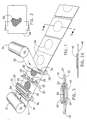
- a web 10 is unwound from supply roll 12, from left to right in the drawings, between a printing roll 14 and backing roll 16.
- Ink present in supply pan 18 is fed from pickup roll 20 to transfer roll 22 and then to printing roll 14.
- the printing rolls 14-22 merely illustrate diagrammatically the printing process since any of a variety of methods can be used including letterpress, gravure, flexographic, planographic, intaglio and others. Of these methods, flexographic and gravure printing are preferred.
- the ink carried in the supply pan 18 is transferred at 24 as a circular area in this case on the printing roll 14 and from there is transferred to the paper to provide a circular or target-shaped printed susceptor 26.
- the ink film 26 is then dried conventionally as by means of infrared and/or hot air dryers (not shown) or other suitable drying methods known to the art, and adhesive such as a polyvinyl acetate adhesive is applied in any suitable way as by means of glue application rollers or by means of a sprayer, shown diagrammatically in this case as four spray heads 28 to which glue is supplied under pressure through a supply line 30.
- the glue can comprise any of a variety of suitable adhesives known to the art. Typical adhesives include polyvinyl acetate emulsion and polyvinyl acetate copolymer emulsion adhesives such as Duracet and Elektromek adhesives by Franklin International and Elektromek Company, respectively.
- this composite sheet includes a paper sheet 10 in contact with an article to be heated such as a food article 40, the printed susceptor lamina 26, adhesive layer 29 and a second nonconductive sheet 32. If desired, there is also printed onto the sheet 32 in vertical alignment with the printed susceptor 26 an optional layer of heat insulating coating 42.
- the coating 42 can be a relatively thick clay coating layer which furnishes heat insulating properties for reducing the transmission of heat developed by the susceptor 26 away from the food product 40, thereby rendering the susceptor 26 more efficient in operation so that more of the heat produced is transferred to the food from the susceptor during the heating operation.
- the clay coating 42 can comprise any suitable commercially available clay coating for paper or a white printing ink with a relatively high load of clay and a compatible white pigment.
- the printed susceptor 26 can be a solidly printed disc about 41 ⁇ 4 inches in diameter is printed at a weight of about 1-8 and more typically 4-6 pounds per ream (3,000 square feet).
- the conductivity is usually between about 2500 and 10,000 ohms per square and most preferably between about 3000 and 5000 ohms per square. It is preferred to apply the ink film as a relatively thin layer by thinning the fluid ink to a fairly fluid consistency, e.g. between about 18 and 22 seconds in a #2 Zahn cup.
- the engraved roll 24 will apply a certain volume of ink per square inch, by providing smaller openings on the surface of the roll a relatively thin ink film can be applied with a carbon content in the dried ink film on the order of 40% to 45%.
- the viscosity of the fluid ink controls the basis weight of the ink film applied to the paper sheet 10. More or less water or other solven can be used to control the viscosity. Thus, by adding more water the basis weight can be reduced.
- FIG. 2 illustrates another form of the invention.
- a substrate or backing sheet 48 which is a 20-point food grade paperboard on which is printed a susceptor 50 having an irregular outline shaped to conform exactly to the outline of the food to be placed against it, in this case the shape of a beefsteak.
- the laminate in this embodiment consists solely of the printed susceptor lamina 50 and the microwave transparent backing sheet 48 that provides integrity and support for the printed susceptor which by itself is not self-supporting.
- the beefsteak (not shown) is placed on the paperboard sheet 48 adjacent the printed susceptor 50 and in alignment with the edges thereof.
- the steak can be placed on the opposite side of the board 48 or the printed side, and in that case it is preferably prewrapped in a thin, moisture impervious plastic or paper envelope (not shown).
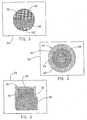
- FIG. 3 illustrates another form of susceptor 52 printed onto a paper support sheet 54.
- the susceptor 52 in this case comprises a circular disc of about 41 ⁇ 4 inches in diameter composed of solidly printed bar portion 56 and two half-printed grid patterned portions 58 and 60 which comprise approximately 50% open unprinted areas in the form of small unprinted circles or squares surrounded by grid lines.
- a greater amount of each can be provided by the printed bar 56 precisely where the food is located with reduced amounts being provided at 58 and 60 on either side of the mass of food to supply additional heat but to prevent runaway or excessive heating at the periphery or in areas where the food is likely to come out of contact with the susceptor 52.
- FIG. 4 illustrates a further modifies form of the invention which in this case comprises a circular or target-shaped printed susceptor 62 having a solidly printed center section 64, a circular printed grid 66 that is 80% printed and 20% open area. Surrounding that is an additional circular printed area 68 which is approximately 50% printed dots of about 1/32 inch in diameter and 50% open area.
- a greater amount of heat can be provided at the center with reduced amounts provided in successive areas proceeding outwardly toward the periphery by virtue of a reduction in the amount of susceptor material printed onto the substrate.
- the highest temperatures can be achieved at the center of the product being heated where it is most needed by applying a greater amount, with reduced amounts being provided proceeding outwardly toward the periphery of the susceptor 62. This reduces the likelihood of overheating, particularly where the sheet 70 happens to come out of contact with the product at its edge, such as a food product 40 that is being heated.
- FIG. 6 illustrates still another form of the invention.
- a paper sheet such as 50 pound kraft paper sheet 72 is printed with a susceptor 74 having a square center section 76 that is solidly printed surrounded by a square grid area that is 80% printed and 20% open and an additional peripheral border 80 that is 50% printed and about 50% open.
- the lower half of susceptor 74 is over-printed with an additional layer of a solidly printed susceptor ink at 82.
- a greater amount of heating will be provided by the double layer at the bottom with successively reduced amounts of heating provided by the areas 76, 78 and 80. In this way, the amount of heat provided can be tailored to the precise amount of heat required by each portion of the product so that the likelihood of uncontrolled heating is reduced around the periphery of the food product.
Landscapes
- Engineering & Computer Science (AREA)
- Life Sciences & Earth Sciences (AREA)
- Wood Science & Technology (AREA)
- Food Science & Technology (AREA)
- Mechanical Engineering (AREA)
- Laminated Bodies (AREA)
- Inks, Pencil-Leads, Or Crayons (AREA)
- Package Specialized In Special Use (AREA)
- Cookers (AREA)
Applications Claiming Priority (2)
| Application Number | Priority Date | Filing Date | Title |
|---|---|---|---|
| US26138088A | 1988-10-24 | 1988-10-24 | |
| US261380 | 1988-10-24 |
Publications (3)
| Publication Number | Publication Date |
|---|---|
| EP0365729A2 true EP0365729A2 (fr) | 1990-05-02 |
| EP0365729A3 EP0365729A3 (fr) | 1991-04-03 |
| EP0365729B1 EP0365729B1 (fr) | 1995-12-13 |
Family
ID=22993048
Family Applications (1)
| Application Number | Title | Priority Date | Filing Date |
|---|---|---|---|
| EP88312408A Expired - Lifetime EP0365729B1 (fr) | 1988-10-24 | 1988-12-29 | Feuilles stratifiées chauffables par micro-ondes |
Country Status (9)
| Country | Link |
|---|---|
| EP (1) | EP0365729B1 (fr) |
| JP (1) | JP2555439B2 (fr) |
| KR (1) | KR930009283B1 (fr) |
| AU (2) | AU611755B2 (fr) |
| BR (1) | BR8907737A (fr) |
| CA (1) | CA1314592C (fr) |
| DE (1) | DE3854788T2 (fr) |
| NZ (1) | NZ231124A (fr) |
| WO (1) | WO1990004516A1 (fr) |
Cited By (9)
| Publication number | Priority date | Publication date | Assignee | Title |
|---|---|---|---|---|
| EP0466361A1 (fr) * | 1990-06-27 | 1992-01-15 | Zeneca Inc. | Emballage pour four à micro-ondes ayant une couche d'encre sensible aux micro-ondes |
| EP0451530A3 (en) * | 1990-04-11 | 1992-05-06 | Societe Des Produits Nestle S.A. | Microwave susceptor sheet stock with heat control |
| EP0429604A4 (en) * | 1989-06-20 | 1993-05-12 | James River Corporation Of Virginia | Microwavable double-bag food container |
| EP0506670A4 (en) * | 1989-12-22 | 1993-11-10 | Golden Valley Microwave Foods Inc. | Microwave susceptor with attenuator for heat control |
| EP0544914A4 (en) * | 1991-06-05 | 1995-11-29 | Koransha Kk | Heat generation body for absorbing microwave and method for forming heat generation layer used therein |
| US6188055B1 (en) | 1996-12-03 | 2001-02-13 | Advanced Deposition Technologies, Inc. | Micromesh heating material and food packages made therefrom |
| WO2005068322A1 (fr) * | 2003-12-31 | 2005-07-28 | E.I. Du Pont De Nemours And Company | Structure de suscepteur de micro-ondes hautes temperatures |
| WO2005068567A1 (fr) * | 2003-12-31 | 2005-07-28 | E.I. Du Pont De Nemours And Company | Procédé pour chauffer un aliment |
| EP1452071A4 (fr) * | 2001-11-07 | 2009-06-24 | Graphic Packaging Int Inc | Emballage special micro-ondes pourvu d'empreintes |
Families Citing this family (10)
| Publication number | Priority date | Publication date | Assignee | Title |
|---|---|---|---|---|
| US5410135A (en) * | 1988-09-01 | 1995-04-25 | James River Paper Company, Inc. | Self limiting microwave heaters |
| DE3854788T2 (de) * | 1988-10-24 | 1996-05-02 | Golden Valley Microwave Foods | Durch Mikrowellen erhitzbare Verbundfolien |
| US5132144A (en) * | 1990-08-30 | 1992-07-21 | Westvaco Corporation | Microwave oven susceptor |
| ATE127762T1 (de) * | 1990-12-21 | 1995-09-15 | Procter & Gamble | Mikrowellensuszeptor mit einer beschichtung aus silikatbindemittel und aktiven bestandteilen. |
| ATE141231T1 (de) * | 1991-07-16 | 1996-08-15 | Unilever Nv | Suszeptor und keksteig |
| US5231268A (en) * | 1992-03-04 | 1993-07-27 | Westvaco Corporation | Printed microwave susceptor |
| AU650735B2 (en) * | 1992-04-16 | 1994-06-30 | Westvaco Corporation | Microwave oven susceptor |
| DK200700924A (da) * | 2007-06-27 | 2008-12-28 | Innovic Holding Aps | Höjeffektive IR absorberende overflader på alufolie baseret på matchende emitterende bölgelængder |
| JP6550588B1 (ja) * | 2017-12-28 | 2019-07-31 | 株式会社熊谷 | 導電性発熱層を備えた電子レンジ加熱用包装体 |
| CN117697052A (zh) * | 2023-12-26 | 2024-03-15 | 北京科技大学 | 一种用于加工硬脆绝缘材料的方法及设备 |
Family Cites Families (9)
| Publication number | Priority date | Publication date | Assignee | Title |
|---|---|---|---|---|
| US4190757A (en) * | 1976-10-08 | 1980-02-26 | The Pillsbury Company | Microwave heating package and method |
| US4518651A (en) * | 1983-02-16 | 1985-05-21 | E. I. Du Pont De Nemours And Company | Microwave absorber |
| US4713510A (en) * | 1986-06-25 | 1987-12-15 | International Paper Co. | Package for microwave cooking with controlled thermal effects |
| US4738882A (en) * | 1986-09-08 | 1988-04-19 | Bemis Company, Inc. | Static shielding sheet materials and bags formed therefrom |
| GB8700966D0 (en) * | 1987-01-17 | 1987-02-18 | Waddingtons Cartons Ltd | Receptor films |
| AU609187B2 (en) * | 1987-10-15 | 1991-04-26 | Minnesota Mining And Manufacturing Company | Microwave absorbing composite |
| US4866232A (en) * | 1988-04-06 | 1989-09-12 | Packaging Corporation Of America | Food package for use in a microwave oven |
| US5002826A (en) * | 1988-09-01 | 1991-03-26 | James River Corporation Of Virginia | Heaters for use in microwave ovens |
| DE3854788T2 (de) * | 1988-10-24 | 1996-05-02 | Golden Valley Microwave Foods | Durch Mikrowellen erhitzbare Verbundfolien |
-
1988
- 1988-12-29 DE DE3854788T patent/DE3854788T2/de not_active Expired - Fee Related
- 1988-12-29 EP EP88312408A patent/EP0365729B1/fr not_active Expired - Lifetime
-
1989
- 1989-01-18 CA CA000588512A patent/CA1314592C/fr not_active Expired - Fee Related
- 1989-01-19 AU AU28606/89A patent/AU611755B2/en not_active Ceased
- 1989-01-27 JP JP1016489A patent/JP2555439B2/ja not_active Expired - Fee Related
- 1989-10-19 WO PCT/US1989/004699 patent/WO1990004516A1/fr not_active Ceased
- 1989-10-19 BR BR898907737A patent/BR8907737A/pt not_active Application Discontinuation
- 1989-10-19 KR KR1019900701250A patent/KR930009283B1/ko not_active Expired - Lifetime
- 1989-10-19 AU AU44991/89A patent/AU4499189A/en not_active Abandoned
- 1989-10-24 NZ NZ231124A patent/NZ231124A/xx unknown
Cited By (10)
| Publication number | Priority date | Publication date | Assignee | Title |
|---|---|---|---|---|
| EP0429604A4 (en) * | 1989-06-20 | 1993-05-12 | James River Corporation Of Virginia | Microwavable double-bag food container |
| EP0506670A4 (en) * | 1989-12-22 | 1993-11-10 | Golden Valley Microwave Foods Inc. | Microwave susceptor with attenuator for heat control |
| EP0451530A3 (en) * | 1990-04-11 | 1992-05-06 | Societe Des Produits Nestle S.A. | Microwave susceptor sheet stock with heat control |
| AU636465B2 (en) * | 1990-04-11 | 1993-04-29 | Societe Des Produits Nestle S.A. | Microwave susceptor sheet stock with heat control |
| EP0466361A1 (fr) * | 1990-06-27 | 1992-01-15 | Zeneca Inc. | Emballage pour four à micro-ondes ayant une couche d'encre sensible aux micro-ondes |
| EP0544914A4 (en) * | 1991-06-05 | 1995-11-29 | Koransha Kk | Heat generation body for absorbing microwave and method for forming heat generation layer used therein |
| US6188055B1 (en) | 1996-12-03 | 2001-02-13 | Advanced Deposition Technologies, Inc. | Micromesh heating material and food packages made therefrom |
| EP1452071A4 (fr) * | 2001-11-07 | 2009-06-24 | Graphic Packaging Int Inc | Emballage special micro-ondes pourvu d'empreintes |
| WO2005068322A1 (fr) * | 2003-12-31 | 2005-07-28 | E.I. Du Pont De Nemours And Company | Structure de suscepteur de micro-ondes hautes temperatures |
| WO2005068567A1 (fr) * | 2003-12-31 | 2005-07-28 | E.I. Du Pont De Nemours And Company | Procédé pour chauffer un aliment |
Also Published As
| Publication number | Publication date |
|---|---|
| AU611755B2 (en) | 1991-06-20 |
| BR8907737A (pt) | 1991-08-27 |
| CA1314592C (fr) | 1993-03-16 |
| NZ231124A (en) | 1992-11-25 |
| DE3854788T2 (de) | 1996-05-02 |
| WO1990004516A1 (fr) | 1990-05-03 |
| AU4499189A (en) | 1990-05-14 |
| EP0365729B1 (fr) | 1995-12-13 |
| DE3854788D1 (de) | 1996-01-25 |
| AU2860689A (en) | 1990-04-26 |
| KR900701523A (ko) | 1990-12-03 |
| KR930009283B1 (ko) | 1993-09-25 |
| EP0365729A3 (fr) | 1991-04-03 |
| JPH02151439A (ja) | 1990-06-11 |
| JP2555439B2 (ja) | 1996-11-20 |
Similar Documents
| Publication | Publication Date | Title |
|---|---|---|
| US5175031A (en) | Laminated sheets for microwave heating | |
| EP0365729B1 (fr) | Feuilles stratifiées chauffables par micro-ondes | |
| US5038009A (en) | Printed microwave susceptor and packaging containing the susceptor | |
| US5285040A (en) | Microwave susceptor with separate attenuator for heat control | |
| US4943456A (en) | Microwave reactive heater | |
| US4982064A (en) | Microwave double-bag food container | |
| US5171594A (en) | Microwave food package with printed-on susceptor | |
| US5006405A (en) | Coated microwave heating sheet for packaging | |
| US5132144A (en) | Microwave oven susceptor | |
| US5118747A (en) | Microwave heater compositions for use in microwave ovens | |
| US5002826A (en) | Heaters for use in microwave ovens | |
| US5231268A (en) | Printed microwave susceptor | |
| EP2883924B1 (fr) | Étiquette adhésive à revêtement de libération à base d'eau | |
| US5217765A (en) | Microwave oven susceptor | |
| US5079083A (en) | Coated microwave heating sheet | |
| CN102216086B (zh) | 粘合剂分散体的柔性版印刷应用 | |
| CA2621723A1 (fr) | Structure isolante interactive d'energie de micro-onde | |
| WO1990016138A1 (fr) | Double sac-conteneur a aliments pour four a micro-ondes | |
| US20060000828A1 (en) | Microwave susceptor for food packaging | |
| AU650735B2 (en) | Microwave oven susceptor | |
| JPS6147584B2 (fr) |
Legal Events
| Date | Code | Title | Description |
|---|---|---|---|
| PUAI | Public reference made under article 153(3) epc to a published international application that has entered the european phase |
Free format text: ORIGINAL CODE: 0009012 |
|
| AK | Designated contracting states |
Kind code of ref document: A2 Designated state(s): DE ES FR GB IT SE |
|
| PUAL | Search report despatched |
Free format text: ORIGINAL CODE: 0009013 |
|
| AK | Designated contracting states |
Kind code of ref document: A3 Designated state(s): DE ES FR GB IT SE |
|
| 17P | Request for examination filed |
Effective date: 19911003 |
|
| 17Q | First examination report despatched |
Effective date: 19920916 |
|
| GRAA | (expected) grant |
Free format text: ORIGINAL CODE: 0009210 |
|
| AK | Designated contracting states |
Kind code of ref document: B1 Designated state(s): DE ES FR GB IT SE |
|
| PG25 | Lapsed in a contracting state [announced via postgrant information from national office to epo] |
Ref country code: IT Free format text: LAPSE BECAUSE OF FAILURE TO SUBMIT A TRANSLATION OF THE DESCRIPTION OR TO PAY THE FEE WITHIN THE PRE;WARNING: LAPSES OF ITALIAN PATENTS WITH EFFECTIVE DATE BEFORE 2007 MAY HAVE OCCURRED AT ANY TIME BEFORE 2007. THE CORRECT EFFECTIVE DATE MAY BE DIFFERENT FROM THE ONE RECORDED.SCRIBED TIME-LIMIT Effective date: 19951213 Ref country code: ES Free format text: THE PATENT HAS BEEN ANNULLED BY A DECISION OF A NATIONAL AUTHORITY Effective date: 19951213 |
|
| REF | Corresponds to: |
Ref document number: 3854788 Country of ref document: DE Date of ref document: 19960125 |
|
| ET | Fr: translation filed | ||
| PG25 | Lapsed in a contracting state [announced via postgrant information from national office to epo] |
Ref country code: SE Effective date: 19960313 |
|
| PLBE | No opposition filed within time limit |
Free format text: ORIGINAL CODE: 0009261 |
|
| STAA | Information on the status of an ep patent application or granted ep patent |
Free format text: STATUS: NO OPPOSITION FILED WITHIN TIME LIMIT |
|
| 26N | No opposition filed | ||
| REG | Reference to a national code |
Ref country code: GB Ref legal event code: IF02 |
|
| PGFP | Annual fee paid to national office [announced via postgrant information from national office to epo] |
Ref country code: GB Payment date: 20041104 Year of fee payment: 17 |
|
| PGFP | Annual fee paid to national office [announced via postgrant information from national office to epo] |
Ref country code: FR Payment date: 20041201 Year of fee payment: 17 |
|
| PGFP | Annual fee paid to national office [announced via postgrant information from national office to epo] |
Ref country code: DE Payment date: 20041230 Year of fee payment: 17 |
|
| PG25 | Lapsed in a contracting state [announced via postgrant information from national office to epo] |
Ref country code: GB Free format text: LAPSE BECAUSE OF NON-PAYMENT OF DUE FEES Effective date: 20051229 |
|
| PG25 | Lapsed in a contracting state [announced via postgrant information from national office to epo] |
Ref country code: DE Free format text: LAPSE BECAUSE OF NON-PAYMENT OF DUE FEES Effective date: 20060701 |
|
| GBPC | Gb: european patent ceased through non-payment of renewal fee |
Effective date: 20051229 |
|
| PG25 | Lapsed in a contracting state [announced via postgrant information from national office to epo] |
Ref country code: FR Free format text: LAPSE BECAUSE OF NON-PAYMENT OF DUE FEES Effective date: 20060831 |
|
| REG | Reference to a national code |
Ref country code: FR Ref legal event code: ST Effective date: 20060831 |