EP0365898B1 - Procédé et dispositif pour l'assainissement d'un sol contaminé - Google Patents
Procédé et dispositif pour l'assainissement d'un sol contaminé Download PDFInfo
- Publication number
- EP0365898B1 EP0365898B1 EP89118672A EP89118672A EP0365898B1 EP 0365898 B1 EP0365898 B1 EP 0365898B1 EP 89118672 A EP89118672 A EP 89118672A EP 89118672 A EP89118672 A EP 89118672A EP 0365898 B1 EP0365898 B1 EP 0365898B1
- Authority
- EP
- European Patent Office
- Prior art keywords
- container
- carbon dioxide
- pressure
- pollutants
- phase
- Prior art date
- Legal status (The legal status is an assumption and is not a legal conclusion. Google has not performed a legal analysis and makes no representation as to the accuracy of the status listed.)
- Expired - Lifetime
Links
Images


Classifications
-
- B—PERFORMING OPERATIONS; TRANSPORTING
- B09—DISPOSAL OF SOLID WASTE; RECLAMATION OF CONTAMINATED SOIL
- B09C—RECLAMATION OF CONTAMINATED SOIL
- B09C1/00—Reclamation of contaminated soil
-
- B—PERFORMING OPERATIONS; TRANSPORTING
- B01—PHYSICAL OR CHEMICAL PROCESSES OR APPARATUS IN GENERAL
- B01D—SEPARATION
- B01D11/00—Solvent extraction
- B01D11/02—Solvent extraction of solids
- B01D11/0203—Solvent extraction of solids with a supercritical fluid
Definitions
- the invention relates to a method for the remediation of soil material contaminated with pollutants by washing the pollutants out of the soil material by means of a washing liquid and then separating the pollutants from the washing liquid.
- a known method for the remediation of contaminated soil material consists of two steps. First, the pollutants are washed out of the soil material with a washing liquid, for example water or a solvent consisting of special chemicals. Then the pollutants are separated from the washing liquid, for example by sedimentation, flotation, extraction, etc. Usually, large amounts of washing liquid are required to wash out the pollutants, so that the separation of the pollutants from the washing liquid requires large-sized separation devices. Soils contaminated with hydrocarbon compounds, for example, require immense amounts of water that have to be cleaned in sewage treatment plants. These wastewater treatment plants are area-intensive on the one hand, and immobile for other remediation sites on the other. If chemicals are used as washing liquid, an undesirable residual load of pollutants remains in the soil material. Basically, only the hydrocarbon compounds are basically exchanged.
- the present invention has for its object to design a method of the type mentioned so that an effective and economical remediation of the floor material is achieved.
- the invention is based on the knowledge that carbon dioxide in liquid form can be mixed with many pollutants, in particular with hydrocarbons and chlorinated hydrocarbons, and can be easily separated off again.
- Liquid carbon dioxide is an effective solvent and allows the pollutants to be concentrated. Only small amounts of washing liquid have to be treated in a separating device in order to separate the pollutants.
- the separation device can therefore be dimensioned relatively small.
- the following process steps are carried out: First, the soil material contaminated with pollutants is poured into at least one pressure-resistant container. Then, in a first pressure build-up phase, gaseous carbon dioxide is introduced into the container and a pressure of approx. 50 to approx. 55 bar is built up. In a subsequent second pressure build-up phase, liquid carbon dioxide is introduced into the container and a pressure of approx. 60 to approx. 65 bar is built up. In a subsequent washing phase, the container is rinsed with liquid carbon dioxide while maintaining the pressure of approx. 60 to approx. 65 bar. For this purpose, the pressurized carbon dioxide is expediently passed through the container from bottom to top. The pollutants are largely washed out of the soil material and dissolve in the liquid carbon dioxide.
- a first pressure reduction phase then follows, in which the liquid carbon dioxide is drawn off from the container and expanded to about 50 to about 55 bar.
- the liquid carbon dioxide is converted into the gaseous state by further expanding to about 1.2 bar.
- Pollutants separated from the gaseous carbon dioxide The cleaned soil material is removed from the container and new contaminated soil material is poured into the container. The gaseous carbon dioxide freed from the pollutants is compressed and returned to the tank in the circuit.
- the first pressure build-up phase is started again.
- two containers which have a common carbon dioxide cycle.
- the two containers are operated in the manner described above, but out of phase with one another. While the pressure is reduced in one container, the pressure is built up in the other container.
- the pressure reduction in one container during the first pressure reduction phase is advantageously used to build up pressure in the other container during the second pressure build-up phase.
- the cyclical operation of the two containers enables particularly effective and economical cleaning of even large quantities of contaminated soil.
- the method according to the invention is suitable, for example, for the remediation of contaminated soils on factory premises, hazardous waste landfills, etc.
- the method is particularly suitable for remediating contaminated sites of hydrocarbons and their derivatives, since liquid carbon dioxide is particularly readily miscible with hydrocarbons and their compounds.
- the invention offers an effective and economical method for the remediation of particularly hydrocarbon-containing contaminated sites with the possibility of concentrating the pollutants.
- the device according to the invention is compact and light and can be quickly brought to different locations.
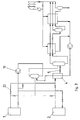
- a process stage is shown in which the container 1 is in the pressure build-up, while pressure is reduced in the container 2.
- the container 2 is filled with liquid carbon dioxide which is at a pressure of about 60 to about 65 bar and is loaded with hydrocarbons.
- the liquid carbon dioxide is drawn off from the container 2 via line 3, passed through a heat exchanger 4 and via the expansion valve 5 relaxed to a pressure of approx. 15 to approx. 21 bar.
- a first separation of the carbon dioxide into a gaseous and a liquid fraction takes place in a separator 6.
- the gaseous fraction is drawn off at the top of the separator 6 via line 7 and fed to a heat exchanger 8.
- the liquid portion is discharged at the foot of the separator 6 via line 9 and also fed to the heat exchanger 8.
- the carbon dioxide is further expanded to a pressure of less than 3 bar, for example approximately 1.2 bar, via expansion valves 10 and 11.
- the liquid fraction is fed to a further separator 12, while the gaseous fraction is fed directly to a compressor 14 via a heat exchanger 13.
- the separator 12 there is a further separation into a gaseous and a liquid portion of the carbon dioxide, the gaseous portion being drawn off at the top of the separator 12 and fed to the compressor 14 via the heat exchanger 13, while the liquid portion is drawn off at the base of the separator 12 and is fed to a further separator 15 via the heat exchanger 13.
- the hydrocarbons and their derivatives are drawn off from the base of the separator 15, while the gaseous carbon dioxide is likewise fed to the compressor 14.
- the gaseous carbon dioxide is brought to a pressure of approximately 25 to approximately 35 bar, for example 26 bar.
- the carbon dioxide thus compressed is passed through the heat exchangers 8 and 13, condensed and fed via line 16 to a pump 17.
- the pump 17 further compresses the carbon dioxide to a pressure of approximately 57 bar.
- the carbon dioxide compressed further in this way is fed via the heat exchanger 4 to a pump receiver 18 and a further pump 19 connected downstream.
- the pump 19 further compresses the carbon dioxide to a pressure of approximately 65 bar and introduces it into the container 1.
- a pressure of approx. 65 bar is built up in container 1.
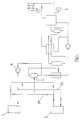
- the washing phase is initiated in container 1.
- This stage of the process is shown in FIG. 2.
- the liquid carbon dioxide compressed to about 65 bar is passed several times in a circuit via lines 20 and 21 and the pump 19 from bottom to top through container 1.
- the hydrocarbons are washed out of the soil material and dissolved in the liquid carbon dioxide.
- the container 2 is emptied, loaded with new contaminated soil material and sealed pressure-tight.
- the washing phase is initiated in container 2.
- This stage of the process is shown in FIG. 4.
- the liquid carbon dioxide compressed to about 65 bar is passed several times in the circuit via lines 24 and 23 and the pump 19 from bottom to top through container 2.
- the hydrocarbons are washed out of the soil material and dissolved in the liquid carbon dioxide.
- the container 1 is emptied, with new contaminated soil material loaded and sealed pressure-tight. If the soil material in container 2 is largely cleaned of the hydrocarbons, the pressure in container 2 is reduced again according to FIG. 1.
- the two containers 1 and 2 are thus operated intermittently and out of phase with one another. In this way, economic utilization of the plant is achieved.
Landscapes
- Chemical & Material Sciences (AREA)
- Chemical Kinetics & Catalysis (AREA)
- Life Sciences & Earth Sciences (AREA)
- Soil Sciences (AREA)
- Engineering & Computer Science (AREA)
- Environmental & Geological Engineering (AREA)
- Processing Of Solid Wastes (AREA)
- Extraction Or Liquid Replacement (AREA)
- Automobile Manufacture Line, Endless Track Vehicle, Trailer (AREA)
Claims (3)
- Procédé d'assainissement de prélèvement de sol pollué par des substances nocives par extraction des substances nocives par lavage du prélèvement de sol à l'aide d'un liquide de lavage et séparation subséquente hors du liquide de lavage des substances nocives, caractérisé en ce que:a) le sol pollué par des substances nocives est déversé dans au moins un récipient (1) résistant à la pression;b) au cours d'une première phase de montée en pression, du dioxyde de carbone gazeux est introduit dans le récipient (1) et on fait monter la pression jusqu'à environ 50 à 55 bar;c) au cours d'une deuxième phase de montée en pression, on introduit du dioxyde de carbone liquide dans le récipient (1) et on fait monter la pression jusqu'à environ 60 à 65 bar;d) au cours d'une phase de lavage, le récipient (1) est rincé au dioxyde de carbone liquide;e) au cours d'une première phase de diminution de la pression, le dioxyde de carbone liquide est retiré du récipient (1) et détendu à environ 50 à 55 bars;f) au cours d'une deuxième phase de diminution de pression, le dioxyde de carbone liquide est ramené à l'état gazeux par détente à environ 1,2 bar;g) les substances nocives sont séparées du dioxyde de carbone gazeux;h) le prélèvement de sol épuré est évacué du récipient (1) qui est ensuite rempli de prélèvement de sol non épuré; eti) on recommence la première phase de montée en pression est reprise.
- Procédé selon la revendication 1, caractérisé en ce qu'on met en oeuvre un deuxième récipient (2) qui comporte un circuit de dioxyde de carbone commun avec celui du premier récipient (1) mais décalé en phase par rapport au premier récipient (1), de manière que la pression augmente dans l'un des récipients, tandis qu'elle diminue dans le deuxième récipient.
- Procédé selon la revendication 1 ou 2, caractérisé en ce que l'on assainit du prélèvement de sol pollué par des composés d'hydrocarbures.
Priority Applications (1)
| Application Number | Priority Date | Filing Date | Title |
|---|---|---|---|
| AT89118672T ATE89769T1 (de) | 1988-10-22 | 1989-10-07 | Verfahren und vorrichtung zu sanierung von kontaminiertem bodenmaterial. |
Applications Claiming Priority (2)
| Application Number | Priority Date | Filing Date | Title |
|---|---|---|---|
| DE3836130A DE3836130A1 (de) | 1988-10-22 | 1988-10-22 | Verfahren und vorrichtung zur sanierung von kontaminiertem bodenmaterial |
| DE3836130 | 1988-10-22 |
Publications (2)
| Publication Number | Publication Date |
|---|---|
| EP0365898A1 EP0365898A1 (fr) | 1990-05-02 |
| EP0365898B1 true EP0365898B1 (fr) | 1993-05-26 |
Family
ID=6365762
Family Applications (1)
| Application Number | Title | Priority Date | Filing Date |
|---|---|---|---|
| EP89118672A Expired - Lifetime EP0365898B1 (fr) | 1988-10-22 | 1989-10-07 | Procédé et dispositif pour l'assainissement d'un sol contaminé |
Country Status (3)
| Country | Link |
|---|---|
| EP (1) | EP0365898B1 (fr) |
| AT (1) | ATE89769T1 (fr) |
| DE (2) | DE3836130A1 (fr) |
Families Citing this family (5)
| Publication number | Priority date | Publication date | Assignee | Title |
|---|---|---|---|---|
| DE4111868A1 (de) * | 1991-04-11 | 1992-10-15 | Siemens Ag | Verfahren und einrichtung zur sanierung eines oelkontaminierten bodens |
| DE4208280A1 (de) * | 1992-03-13 | 1993-09-16 | Preussag Anlagenbau | Bodenwaschverfahren |
| WO1994023855A1 (fr) * | 1993-04-19 | 1994-10-27 | Robertson, Struan, Glen | Recuperation et destruction de substances toxiques contenues dans un sol contamine |
| DE19515029A1 (de) * | 1995-04-24 | 1996-10-31 | Robert Mittelmeier | Vorrichtung und Verfahren zur Reinigung von kontaminierten Materialien, insbesondere Erdreich |
| FR3100142B1 (fr) | 2019-08-28 | 2021-11-05 | Rmv Equipement | Dispositif d’extraction et de décontamination de substances organiques et/ou inorganiques à partir de matières solides ou semi-solides sous le contrôle de plusieurs paramètres |
Family Cites Families (4)
| Publication number | Priority date | Publication date | Assignee | Title |
|---|---|---|---|---|
| US3966981A (en) * | 1974-11-26 | 1976-06-29 | The United States Of America As Represented By The Secretary Of Agriculture | Process for removing residual solvents |
| DE3610199A1 (de) * | 1986-03-26 | 1987-10-01 | Wessling Erwin Chem Lab | Verfahren zur reinigung von mit schadstoffen verunreinigten boeden |
| DE3633699A1 (de) * | 1986-10-03 | 1988-04-14 | Still Carl Gmbh Co Kg | Verfahren zur aufbereitung von kontaminierter erde |
| DE3803634A1 (de) * | 1988-02-06 | 1988-07-21 | Weiss Gmbh & Co Leonhard | Verfahren zur reinigung von erd-boeden oder dergleichen, die mit extrahierbaren organischen schadstoffen belastet sind |
-
1988
- 1988-10-22 DE DE3836130A patent/DE3836130A1/de not_active Withdrawn
-
1989
- 1989-10-07 EP EP89118672A patent/EP0365898B1/fr not_active Expired - Lifetime
- 1989-10-07 AT AT89118672T patent/ATE89769T1/de not_active IP Right Cessation
- 1989-10-07 DE DE8989118672T patent/DE58904484D1/de not_active Expired - Fee Related
Also Published As
| Publication number | Publication date |
|---|---|
| DE3836130A1 (de) | 1990-04-26 |
| EP0365898A1 (fr) | 1990-05-02 |
| ATE89769T1 (de) | 1993-06-15 |
| DE58904484D1 (de) | 1993-07-01 |
Similar Documents
| Publication | Publication Date | Title |
|---|---|---|
| DE69015610T2 (de) | Verfahren zur Reinigung von verunreinigtem Wasser und Vorrichtung zu dessen Durchführung. | |
| US4783263A (en) | Detoxification process | |
| WO2005068905A1 (fr) | Procede et dispositif de deflegmation dans un groupe-vapeur | |
| EP0928228B1 (fr) | Procede de nettoyage de sols contamines | |
| EP0365898B1 (fr) | Procédé et dispositif pour l'assainissement d'un sol contaminé | |
| DE2837491A1 (de) | Kompakte vorrichtung zur kontinuierlichen behandlung eines emulgierte kohlenwasserstoffe enthaltenden abwassers | |
| AT398540B (de) | Verfahren und vorrichtung zum kontinuierlichen waschen von körnigen substraten | |
| DE3326822C2 (fr) | ||
| EP0403669A1 (fr) | Procédé et dispositif d'élution de matières granuleuses | |
| EP0354239B1 (fr) | Installation et procede de nettoyage de sols contamines | |
| DE19937989B4 (de) | Mobile Entsorgungsanlage | |
| DE4112867A1 (de) | Verfahren zum dekontaminieren von mit schadstoffen verunreinigten boeden | |
| DE69002348T2 (de) | Vorrichtung und verfahren fuer eine kombinierte luft- und wasserreinigung. | |
| EP0796822B1 (fr) | Procédé pour la purification des eaux contenant des composés organiques | |
| DE4304193C1 (de) | Verfahren zum Auswaschen der sauren Gaskomponenten aus Rauchgasen durch Absorption | |
| DE4040735C2 (de) | Vorrichtung und Verfahren zum Reinigen einer mit einem Schadstoff verunreinigten Flüssigkeit | |
| DE4315550A1 (de) | Verfahren und Vorrichtung zum Dekontaminieren von mit Kohlenwasserstoffen verunreinigten Bodenmassen | |
| DE4121181A1 (de) | Verfahren zur reinigung von mit schadstoffen kontaminierten substraten | |
| DE4323146C1 (de) | Verfahren zur Dekontaminierung von Feststoffen mittels Lösungsmittelextraktion | |
| DE3802369A1 (de) | Anlage zur reinigung kontaminierter boeden | |
| DE4125471A1 (de) | Verfahren zur reinigung von abluft | |
| DE3921924A1 (de) | Verfahren zur entfernung von halogenierten organischen verbindungen aus abwasser | |
| AT405299B (de) | Entkonservierungssystem zur permanenten vollautomatischen aufbereitung der abwässer beim entfernen der oberflächenschutzschicht fabriksneuer fahrzeuge oder dergleichen | |
| DE4320711A1 (de) | Verfahren zum Reinigen von Transformatoren | |
| DE19614674A1 (de) | Verfahren zur Minimierung des Wasserbedarfs |
Legal Events
| Date | Code | Title | Description |
|---|---|---|---|
| PUAI | Public reference made under article 153(3) epc to a published international application that has entered the european phase |
Free format text: ORIGINAL CODE: 0009012 |
|
| AK | Designated contracting states |
Kind code of ref document: A1 Designated state(s): AT BE CH DE ES FR IT LI NL |
|
| 17P | Request for examination filed |
Effective date: 19900601 |
|
| 17Q | First examination report despatched |
Effective date: 19911104 |
|
| GRAA | (expected) grant |
Free format text: ORIGINAL CODE: 0009210 |
|
| AK | Designated contracting states |
Kind code of ref document: B1 Designated state(s): AT BE CH DE ES FR IT LI NL |
|
| PG25 | Lapsed in a contracting state [announced via postgrant information from national office to epo] |
Ref country code: IT Free format text: LAPSE BECAUSE OF FAILURE TO SUBMIT A TRANSLATION OF THE DESCRIPTION OR TO PAY THE FEE WITHIN THE PRESCRIBED TIME-LIMIT;WARNING: LAPSES OF ITALIAN PATENTS WITH EFFECTIVE DATE BEFORE 2007 MAY HAVE OCCURRED AT ANY TIME BEFORE 2007. THE CORRECT EFFECTIVE DATE MAY BE DIFFERENT FROM THE ONE RECORDED. Effective date: 19930526 Ref country code: FR Effective date: 19930526 Ref country code: ES Free format text: THE PATENT HAS BEEN ANNULLED BY A DECISION OF A NATIONAL AUTHORITY Effective date: 19930526 |
|
| REF | Corresponds to: |
Ref document number: 89769 Country of ref document: AT Date of ref document: 19930615 Kind code of ref document: T |
|
| REF | Corresponds to: |
Ref document number: 58904484 Country of ref document: DE Date of ref document: 19930701 |
|
| EN | Fr: translation not filed | ||
| PLBE | No opposition filed within time limit |
Free format text: ORIGINAL CODE: 0009261 |
|
| STAA | Information on the status of an ep patent application or granted ep patent |
Free format text: STATUS: NO OPPOSITION FILED WITHIN TIME LIMIT |
|
| 26N | No opposition filed | ||
| PGFP | Annual fee paid to national office [announced via postgrant information from national office to epo] |
Ref country code: AT Payment date: 19941012 Year of fee payment: 6 |
|
| PGFP | Annual fee paid to national office [announced via postgrant information from national office to epo] |
Ref country code: CH Payment date: 19941014 Year of fee payment: 6 |
|
| PGFP | Annual fee paid to national office [announced via postgrant information from national office to epo] |
Ref country code: NL Payment date: 19941031 Year of fee payment: 6 |
|
| PGFP | Annual fee paid to national office [announced via postgrant information from national office to epo] |
Ref country code: BE Payment date: 19941208 Year of fee payment: 6 |
|
| PG25 | Lapsed in a contracting state [announced via postgrant information from national office to epo] |
Ref country code: AT Effective date: 19951007 |
|
| PG25 | Lapsed in a contracting state [announced via postgrant information from national office to epo] |
Ref country code: CH Effective date: 19951031 Ref country code: LI Effective date: 19951031 Ref country code: BE Effective date: 19951031 |
|
| BERE | Be: lapsed |
Owner name: LINDE A.G. Effective date: 19951031 |
|
| PG25 | Lapsed in a contracting state [announced via postgrant information from national office to epo] |
Ref country code: NL Effective date: 19960501 |
|
| REG | Reference to a national code |
Ref country code: CH Ref legal event code: PL |
|
| NLV4 | Nl: lapsed or anulled due to non-payment of the annual fee |
Effective date: 19960501 |
|
| PGFP | Annual fee paid to national office [announced via postgrant information from national office to epo] |
Ref country code: DE Payment date: 19961223 Year of fee payment: 8 |
|
| PG25 | Lapsed in a contracting state [announced via postgrant information from national office to epo] |
Ref country code: DE Free format text: LAPSE BECAUSE OF NON-PAYMENT OF DUE FEES Effective date: 19980701 |