EP0365903B1 - Olefinisch ungesättigte Verbindungen, ein Verfahren zur Herstellung von Isocyanatgruppen aufweisenden Copolymerisaten, die so erhaltenen Copolymerisate und die Copolymerisate enthaltende Beschichtungsmittel bzw. Dichtmassen - Google Patents
Olefinisch ungesättigte Verbindungen, ein Verfahren zur Herstellung von Isocyanatgruppen aufweisenden Copolymerisaten, die so erhaltenen Copolymerisate und die Copolymerisate enthaltende Beschichtungsmittel bzw. Dichtmassen Download PDFInfo
- Publication number
- EP0365903B1 EP0365903B1 EP89118694A EP89118694A EP0365903B1 EP 0365903 B1 EP0365903 B1 EP 0365903B1 EP 89118694 A EP89118694 A EP 89118694A EP 89118694 A EP89118694 A EP 89118694A EP 0365903 B1 EP0365903 B1 EP 0365903B1
- Authority
- EP
- European Patent Office
- Prior art keywords
- copolymers
- groups
- isocyanate groups
- compounds
- methyl
- Prior art date
- Legal status (The legal status is an assumption and is not a legal conclusion. Google has not performed a legal analysis and makes no representation as to the accuracy of the status listed.)
- Expired - Lifetime
Links
Classifications
-
- C—CHEMISTRY; METALLURGY
- C07—ORGANIC CHEMISTRY
- C07C—ACYCLIC OR CARBOCYCLIC COMPOUNDS
- C07C271/00—Derivatives of carbamic acids, i.e. compounds containing any of the groups, the nitrogen atom not being part of nitro or nitroso groups
- C07C271/06—Esters of carbamic acids
- C07C271/08—Esters of carbamic acids having oxygen atoms of carbamate groups bound to acyclic carbon atoms
- C07C271/10—Esters of carbamic acids having oxygen atoms of carbamate groups bound to acyclic carbon atoms with the nitrogen atoms of the carbamate groups bound to hydrogen atoms or to acyclic carbon atoms
- C07C271/20—Esters of carbamic acids having oxygen atoms of carbamate groups bound to acyclic carbon atoms with the nitrogen atoms of the carbamate groups bound to hydrogen atoms or to acyclic carbon atoms to carbon atoms of hydrocarbon radicals substituted by nitrogen atoms not being part of nitro or nitroso groups
-
- C—CHEMISTRY; METALLURGY
- C08—ORGANIC MACROMOLECULAR COMPOUNDS; THEIR PREPARATION OR CHEMICAL WORKING-UP; COMPOSITIONS BASED THEREON
- C08F—MACROMOLECULAR COMPOUNDS OBTAINED BY REACTIONS ONLY INVOLVING CARBON-TO-CARBON UNSATURATED BONDS
- C08F246/00—Copolymers in which the nature of only the monomers in minority is defined
-
- C—CHEMISTRY; METALLURGY
- C08—ORGANIC MACROMOLECULAR COMPOUNDS; THEIR PREPARATION OR CHEMICAL WORKING-UP; COMPOSITIONS BASED THEREON
- C08G—MACROMOLECULAR COMPOUNDS OBTAINED OTHERWISE THAN BY REACTIONS ONLY INVOLVING UNSATURATED CARBON-TO-CARBON BONDS
- C08G18/00—Polymeric products of isocyanates or isothiocyanates
- C08G18/06—Polymeric products of isocyanates or isothiocyanates with compounds having active hydrogen
- C08G18/28—Polymeric products of isocyanates or isothiocyanates with compounds having active hydrogen characterised by the compounds used containing active hydrogen
- C08G18/30—Low-molecular-weight compounds
- C08G18/32—Polyhydroxy compounds; Polyamines; Hydroxyamines
- C08G18/3225—Polyamines
- C08G18/3253—Polyamines being in latent form
- C08G18/3256—Reaction products of polyamines with aldehydes or ketones
-
- C—CHEMISTRY; METALLURGY
- C08—ORGANIC MACROMOLECULAR COMPOUNDS; THEIR PREPARATION OR CHEMICAL WORKING-UP; COMPOSITIONS BASED THEREON
- C08G—MACROMOLECULAR COMPOUNDS OBTAINED OTHERWISE THAN BY REACTIONS ONLY INVOLVING UNSATURATED CARBON-TO-CARBON BONDS
- C08G18/00—Polymeric products of isocyanates or isothiocyanates
- C08G18/06—Polymeric products of isocyanates or isothiocyanates with compounds having active hydrogen
- C08G18/28—Polymeric products of isocyanates or isothiocyanates with compounds having active hydrogen characterised by the compounds used containing active hydrogen
- C08G18/30—Low-molecular-weight compounds
- C08G18/32—Polyhydroxy compounds; Polyamines; Hydroxyamines
- C08G18/3271—Hydroxyamines
- C08G18/3296—Hydroxyamines being in latent form
-
- C—CHEMISTRY; METALLURGY
- C08—ORGANIC MACROMOLECULAR COMPOUNDS; THEIR PREPARATION OR CHEMICAL WORKING-UP; COMPOSITIONS BASED THEREON
- C08G—MACROMOLECULAR COMPOUNDS OBTAINED OTHERWISE THAN BY REACTIONS ONLY INVOLVING UNSATURATED CARBON-TO-CARBON BONDS
- C08G18/00—Polymeric products of isocyanates or isothiocyanates
- C08G18/06—Polymeric products of isocyanates or isothiocyanates with compounds having active hydrogen
- C08G18/70—Polymeric products of isocyanates or isothiocyanates with compounds having active hydrogen characterised by the isocyanates or isothiocyanates used
- C08G18/72—Polyisocyanates or polyisothiocyanates
- C08G18/728—Polymerisation products of compounds having carbon-to-carbon unsaturated bonds and having isocyanate or isothiocyanate groups or groups forming isocyanate or isothiocyanate groups
Definitions
- the present invention relates to olefinically unsaturated compounds having isocyanate groups bonded to tertiary carbon atoms, a process for the preparation of copolymers using these compounds, the corresponding copolymers and coating compositions or sealing compounds which contain such copolymers as the binder component.
- Copolymers with free isocyanate groups and their use as binder components in two-component coating compositions are known.
- DE-OS 3 245 294, 3 245 295 and 3 245 298 describe isocyanate-functional copolymers which are prepared by using vinyl isocyanate as an unsaturated NCO-functional monomer were described in US Pat. Nos. 3,004,527, 4,219,632, 4,401,794 and 4,510,298 isocyanate-functional copolymers which were prepared by using isocyanatoethyl methacrylate as the NCO-functional monomer.
- copolymers are obtained which have primary isocyanate groups.
- these primary isocyanate groups are too reactive with frequently used nitrogen-containing crosslinking substances, such as, for example, polyketimines or polyoxazolanes, so that when used as two-component coating systems, sufficiently long pot lives are not achieved.
- Aliphatic isocyanate groups are described, for example, in EP-A-0 130 322, EP-A-0 130 323, J 61 120-667-A (CA 105 192 987), J 61 120-862-A (CA 105 192 967), J. 61 126-177-A (CA 105 192 991) or J 61 126-178-A (CA 105 192 992).
- the introduction of the isocyanate group takes place through the use of m-isopropenyl- ⁇ , ⁇ -dimethylbenzyl isocyanate as an isocyanate-functional copolymerizable monomer.
- Japanese patent application 54 419 dated March 31, 1982 (CA 100 , 211 268 (1984)) describes copolymers containing isocyanate groups which have been prepared using reaction products of hydroxyethyl acrylate with diisocyanatotoluene or with diisocyanatohexane. These copolymers are to be used for the production of adhesives.
- the invention also relates to a process for the preparation of copolymers containing isocyanate groups and having a weight average molecular weight of from 1000 to 100,000 by radical-initiated copolymerization of isocyanate group-free, olefinically unsaturated monomers with olefinically unsaturated monoisocyanates in such an amount that 0.1 in the resulting copolymers up to 13% by weight of chemically incorporated isocyanate groups with an average NCO functionality of the copolymers of at least 2, characterized in that unsaturated compounds of the type according to the invention are used as olefinically unsaturated monoisocyanates.
- the invention finally also relates to coating or sealing compounds which contain, as binders, a two-component system consisting of a polyisocyanate component and a polyamine component with blocked amino groups, characterized in that the polyisocyanate component consists of copolymers prepared by this process.
- the olefinically unsaturated compounds according to the invention are simply olefinically unsaturated monoisocyanates, which preferably have a molecular weight of approx. 252 to 800, i.e. have an NCO content of 5 to 17% by weight and a urethane group content of 7 to 24% by weight.
- the isocyanate group is bonded to a tertiary carbon atom, which in turn is part of a cycloaliphatic ring.
- the olefinically unsaturated compounds according to the invention are prepared by reacting special starting diisocyanates which have an aliphatically bound primary isocyanate group and a cycloaliphatically bound tertiary isocyanate group with hydroxyl-functional olefinically unsaturated compounds in such a way that one molecule of hydroxyl compound is used per molecule of diisocyanate. If necessary, polymerization inhibitors such as 2,6-di-tert-butyl-4-methylphenol or hydroquinone monomethyl ether can be added.
- the starting diisocyanates are aliphatic-cycloaliphatic diisocyanates with an NCO content of 20 to 50, preferably 30 to 48% by weight, which, in addition to a sterically unhindered, aliphatically bound isocyanate group, have a sterically hindered isocyanate group attached to a tertiary carbon atom is bound, which in turn is part of a cycloaliphatic ring.
- Suitable starting diisocyanates are those of the formula (I) or any mixtures of those of the formula (I) for which R1 represents an alkyl radical with 1 to 4 carbon atoms, preferably a methyl radical, R2 and R3 represent the same or different radicals and each represent a divalent linear or branched saturated hydrocarbon radical having 1 to 4, preferably 1 to 3 carbon atoms, the sum of the carbon atoms of these radicals preferably being 3 to 6, in particular 4 or 5, R4 represents hydrogen or an alkyl radical having 1 to 4 carbon atoms, preferably hydrogen or a methyl radical, R5 represents a divalent, linear or branched, saturated aliphatic hydrocarbon radical having 1 to 4, in particular 1 to 3, carbon atoms and n stands for 0 or 1.
- Particularly preferred diisocyanates are, for example, 1-isocyanato-1-methyl-4 (3) -isocyanatomethylcyclohexane, which is generally present as a mixture of the 4- and 3-isocyanatomethyl isomers, 1-isocyanato-1-methyl-4- (4-isocyanatobut -2-yl) cyclohexane or 1-isocyanato-1,2,2-trimethyl-3- (2-isocyanatoethyl) cyclopentane.
- Any organic compounds which have an alcoholic hydroxyl group and an olefinic double bond can be considered as the hydroxy-functional olefinically unsaturated compound.
- These compounds preferably have a molecular weight of 58 to 600.
- the reaction can be carried out either in the presence or in the absence of a solvent which is inert to isocyanate and hydroxyl groups.
- the reaction temperature is between 0 and 100 ° C, preferably between 20 and 80 ° C.
- catalysts such as e.g. tertiary amines, organic zinc or tin compounds or other compounds which catalyze a urethane formation reaction can be added in small amounts.
- the reaction products obtained are generally monoadducts of the special starting diisocyanates and the hydroxyl-functional olefinically unsaturated compound used, which can be used without additional work-up or cleaning processes for their use in the preparation of the isocyanate-functional copolymers according to the invention.
- the isocyanate group-free monomers which are copolymerized with the olefinically unsaturated monoisocyanates according to the invention in the process according to the invention are the customary, preferably mono-olefinically unsaturated monomers, as have also been used as monomers in the process of the prior art mentioned above are.
- esters of acrylic and methacrylic acid such as methyl acrylate, ethyl acrylate, n-butyl acrylate, isobutyl acrylate, tert-butyl acrylate, 2-ethylhexyl acrylate, cyclohexyl methacrylate, methyl methacrylate, n-butyl methacrylate, isobutyl methacrylate or 2-ethylhexyl methacrylate;
- Vinylaromatics such as, for example, styrene, vinyltoluene, ⁇ -methylstyrene, ⁇ -ethylstyrene, nucleus-substituted diethylstyrenes which may represent isomer mixtures, isopropylstyrenes, butylstyrenes and methoxystyrenes, vinyl ethers such as, for example, ethyl vinyl ether, n-
- the copolymers are prepared, ie the process according to the invention is carried out by copolymerizing the monomers mentioned by way of example, the olefinically unsaturated monoisocyanates which are essential to the invention being used in such an amount that from 0.1 to 13% by weight, preferably 1 to 1%, is obtained in the resulting copolymers 10% by weight of free isocyanate groups are present.
- the copolymerization is carried out using conventional radical polymerization processes, such as bulk or solution polymerization.
- the monomers are copolymerized at temperatures from 60 to 200.degree. C., preferably 80 to 160.degree. C. in the presence of radical formers and, if appropriate, molecular weight regulators.
- the copolymerization is preferably carried out in inert solvents at solids contents of 30 to 95% by weight.
- suitable solvents are, for example, aromatics such as benzene, toluene, xylene, esters such as ethyl acetate, butyl acetate, methyl glycol acetate, ethyl glycol acetate, methoxypropyl acetate, ethers such as tetrahydrofuran, dioxane, diethylene glycol dimethyl ether, ketones such as acetone, methyl ethyl ketone and methyl isobutyl ketone.
- the copolymerization can be carried out continuously or batchwise.
- the monomer mixture and the initiator are usually metered into a polymerization reactor uniformly and continuously, and at the same time the corresponding amount of polymer is continuously removed.
- Chemically almost uniform copolymers can preferably be produced in this way.
- Copolymers which are almost chemically uniform can also be prepared by allowing the reaction mixture to run into a stirred kettle at a constant rate without removing the polymer.
- a part of the monomers can also be initially introduced, for example, in solvents of the type mentioned, and the remaining monomers and auxiliaries can be introduced separately or together into this original at the reaction temperature.
- the polymerization takes place at an overpressure of 0 to 20 bar.
- the initiators are used in amounts of 0.05 to 15% by weight, based on the total amount of the monomers.
- Suitable initiators are conventional radical initiators such as e.g. aliphatic azo compounds such as azodiisobutyronitrile, azo-bis-2-methylvaleronitrile, 1,1′-azo-bis-1-cyclohexanenitrile and 2,2′-azo-bis-isobutyric acid alkyl ester; symmetrical diacyl peroxides, e.g. Acetyl, propionyl or butyryl peroxide, benzoyl peroxides substituted with bromine, nitro, methyl or methoxy groups, lauryl peroxides; symmetrical peroxidicarbonates, e.g.
- aliphatic azo compounds such as azodiisobutyronitrile, azo-bis-2-methylvaleronitrile, 1,1′-azo-bis-1-cyclohexanenitrile and 2,2′-azo-bis-isobutyric acid alkyl ester
- symmetrical diacyl peroxides
- customary regulators can be used in the production. Examples include tert-dodecyl mercaptan, n-dodecyl mercaptan or diisopropylxanthogen disulfide.
- the regulators can be added in amounts of 0.1 to 10% by weight, based on the total amount of the monomers.
- the copolymers moreover, have a molecular weight (weight average), which can be determined by the gel permeation chromatography method, of 1000 to 100,000, preferably 1500 to 75,000 and particularly preferably 2000 to 50,000.
- the solutions of the copolymers obtained in the copolymerization reaction can be fed to the use according to the invention without further working up. However, it is of course also possible to free the copolymers from any residual amounts of unreacted monomers and solvents that may still be present and to send the copolymers present as distillation residues to the use according to the invention.
- two-component systems consisting of a polyisocyanate component A) and a hardener B) are present as binders.
- the polyisocyanate component A) is the isocyanate-functional copolymers according to the invention.
- Hardener component B) is an organic polyamine with blocked amino groups. "Blocked amino groups" are understood to mean those groups which react with water to release primary and / or secondary amino groups. Particularly preferred blocked polyamines B) are compounds containing aldimine, ketimine, oxazolane, hexahydropyrimidine and / or tetrahydroimidazole groups, which may also contain several of these groups at the same time.
- the blocked polyamines B) have a weight average molecular weight of 86 to 10,000, preferably 250 to 4000, and contain on average 1 to 50, preferably 2 to 10, and in particular 2 to 4, structural units of the general formula in which R6 and R7 represent the same or different radicals and are hydrogen, aliphatic hydrocarbon radicals having 1 to 18 carbon atoms, cycloaliphatic hydrocarbon radicals having 5 to 10 carbon atoms, aliphatic hydrocarbon radicals having 7 to 18 carbon atoms or phenyl radicals, the two radicals R6 and R7 together with the adjacent one Carbon atoms can also form a 5- or 6-membered cycloaliphatic ring, and preferably at most one of the radicals is hydrogen, and R8 for a divalent aliphatic hydrocarbon radical with 2 to 6 carbon atoms stands, with the proviso that 2 or 3 carbons are arranged between the two nitrogen atoms.
- the molecular weights mentioned can be determined by the gel permeation chromatography method (molecular weights above 1000) or from the stoichiometry of the starting materials used to prepare the compounds (molecular weights up to 1000).
- Preferred components B) are e.g. those which contain hexahydropyrimidine or tetrahydroimidazole structures of the general formula (II), for which R6 and R7 represent the same or different aliphatic hydrocarbon radicals having 2 to 10 carbon atoms, where one of the radicals can also be hydrogen and R7 represents an optionally alkyl-substituted ethylene - or trimethylene residue.
- R6 and R7 represent the same or different aliphatic hydrocarbon radicals having 2 to 10 carbon atoms, where one of the radicals can also be hydrogen and R7 represents an optionally alkyl-substituted ethylene - or trimethylene residue.
- Blocked polyamines of the type mentioned can be produced in a manner known per se by reacting corresponding aldehydes or ketones with the corresponding polyamines.
- Aldehydes or ketones suitable for the preparation of the compounds B) having hexahydropyrimidine or tetrahydroimidazole groups are, for example, those of the general formula which preferably have a molecular weight of 72 to 200 (ketones) or 58 to 250 (aldehydes).
- acetone methyl ethyl ketone, methyl propyl ketone, methyl isopropyl ketone, methyl n-butyl ketone, methyl isobutyl ketone, methyl n-amyl ketone, methyl isoamyl ketone, methyl heptyl ketone, diethyl ketone, ethyl butyl ketone, ethyl amyl ketone, diisopropyl ketone, isotyl butyl ketone, diisoputyl ketone, diisobutyl ketone, diisobutyl ketone 5-methyl-3-heptanone, 4-heptyl ketone, 1-phenyl-2-propanone, acetophenone, methyl nonyl ketone, 3,3,5-trimethylcyclohexanone, formaldehyde, acetaldehyde, propionaldehyde
- Preferred aldehydes and ketones for the preparation of the compounds containing hexahydropyrimidine or tetrahydroimidazole groups are butyraldehyde, isobutyraldehyde, trimethylacetaldehyde, 2,2-dimethylpropanol, 2-ethylhexanal, hexanal, 3-cyclohexane-1-carboxaldehyde, heptanal, methylpentane, hexanal, hexahydroanal, hexahydro , Cyclohexanone, cyclopentanone, methyl isopropyl ketone, acetone, 3,3,5-trimethylcyclohexanone and methylcyclohexanone.
- the polyamines used for the preparation of the compounds containing hexahydropyrimidine or tetrahydroimidazole groups are, in particular, organic compounds which have at least two primary and / or secondary amino groups.
- Suitable polyamines are, for example, those of the general formula R9-NH-R8-NH-R10, in which R8 has the meaning given above and R9 and R10 represent the same or different radicals and are hydrogen, aliphatic hydrocarbon radicals having 1 to 10, preferably 1 to 4 carbon atoms, cycloaliphatic hydrocarbon radicals having 5 to 10, preferably 6 hydrocarbon atoms or aromatic hydrocarbon radicals having 7 to 15, preferably 7 hydrocarbon atoms, where the hydrocarbon radicals mentioned, in particular the aliphatic hydrocarbon radicals mentioned, optionally heteroatoms such as oxygen, nitrogen or sulfur in the form of ether, ester, amide, urethane, oxirane, ketone, lactam, urea, thioether, thioester or lactone groups, or the radicals can also contain reactive hydroxyl or can have amino groups.
- Particularly preferred polyamines are those in which R9 and R10 represent the same or different radicals and hydrogen and / or C1-C6-alkyl radicals such as methyl, ethyl, n-propyl, iso-propyl, n-butyl, iso -Butyl, tert-butyl, n-pentyl or n-hexyl radicals, or at least one of the radicals R8 or R9 represents a radical such as is obtained by addition of an amine hydrogen atom onto an olefinically unsaturated compound.
- Suitable olefinically unsaturated compounds suitable for producing such modified polyamines are, for example, derivatives of (meth) acrylic acid such as esters, amides, nitriles or e.g. Vinyl aromatics such as styrene, ⁇ -methylstyrene, vinyltoluene or e.g. Vinyl esters such as vinyl acetate, vinyl propionate, vinyl butyrate or e.g. Vinyl ethers such as ethyl vinyl ether, polyvinyl ether, butyl vinyl ether or mono- and diesters of fumaric acid, maleic acid or tetrahydrophthalic acid.
- (meth) acrylic acid such as esters, amides, nitriles or e.g. Vinyl aromatics such as styrene, ⁇ -methylstyrene, vinyltoluene or e.g. Vinyl esters such as vinyl acetate, vinyl propionate, vinyl butyrate or e.g
- R9 and / or R10 can also represent an aminoalkyl or hydroxyalkyl radical having, for example, 2 to 4 carbon atoms.
- Very particularly preferred polyamines are ethylenediamine, 1,2-propylenediamine, 1,3-propylenediamine, 1,2- and 1,3-butylenediamine, Diethylenetriamine and derivatives of these polyamines.
- Compounds containing oxazolane groups of the general formula (III) which are suitable as component B) are preferably those for which R6 and R7 represent identical or different radicals and are hydrogen or aliphatic hydrocarbon radicals having 1 to 18 and in particular 1 to 8 carbon atoms, or where the R6 and R7 together with the carbon atom of the heterocyclic ring form a cycloaliphatic ring with a total of 4 to 9 carbon atoms, in particular a cyclohexane ring, with the proviso that at most one of the radicals R6 and R7 is hydrogen, and where R monyi is an alkylene radical with 2 to 4, preferably 2 to 3 carbon atoms, with the proviso that at least 2 carbon atoms are arranged between the oxygen and nitrogen atoms.
- Component B) containing oxazolane can be prepared in a manner known per se by reacting corresponding aldehydes or ketones of the formula with suitable hydroxyamines of the type specified below.
- Aldehydes or ketones are in principle those of the type already mentioned above as examples.
- Preferred aldehydes or ketones here are butyraldehyde, isobutyraldehyde, trimethylacetaldehyde, 2,2-dimethylpropanal, 2-ethylhexanal, 3-cyclohexene-1-carboxaldehyde, hexahydrobenzaldehyde, cyclopentanone, cyclohexanone, methylcyclopentanone, methylcyclohexanone, 3,3,5-trimethylcyclohexanone , Methylcyclobutanone, acetone, methyl ethyl ketone and methyl isobutyl ketone.
- Hydroxyamines are, in particular, organic compounds which have at least one aliphatic amino group and at least one aliphatic hydroxyl group.
- the hydroxyamines generally have a molecular weight between 61 and 500, preferably between 61 and 300.
- Suitable hydroxyamines can be, for example: bis (2-hydroxyethyl) amine, bis (2-hydroxypropyl) amine, bis (2-hydroxybutyl) amine, bis (3-hydroxypropyl) amine, bis (3 -hydroxyhexyl) amine, N- (2-hydroxypropyl) -N- (2-hydroxyethyl) amine, 2- (methylamino) ethanol, 2- (ethylamino) ethanol, 2- (propylamino) ethanol, 2- (Butylamino) ethanol, 2-amino-2-methyl-1-propanol, 2-amino-2-ethyl-1-propanol, 2-amino-2-propyl-1-propanol, 2-amino-2-methyl-1,3-propanediol, 2-amino-3-methyl-3-hydroxybutane, propanolamine, ethanolamine.
- bis (2-hydroxyethyl) amine bis (2-hydroxypropyl) amine, bis (2-hydroxybutyl) amine, bis (3-hydroxyhexyl) amine, 2- (methylamino) -ethanol, 2- (ethylamino) -ethanol, 2-amino-2-methyl-1-propanol, 2-amino-2-ethyl-1-propanol, propanolamine and ethanolamine.
- the preferred compounds containing aldimine or ketimine groups include those which have structural units of the general formula (IV) included, where R6 and R7 represent the same or different radicals and represent hydrogen or aliphatic hydrocarbon radicals having 1 to 8 carbon atoms, which can also be linked together with the carbon atom to form a cycloaliphatic ring, in particular a cyclohexane ring.
- aldehydes or ketones already exemplified above are used to prepare these compounds suitable.
- Preferred aldehydes or ketones here are butyraldehyde, isobutyraldehyde, trimetylacetaldehyde, 2,2-dimethylpropanal, 2-ethylhexanal, 3-cyclohexene-1-carboxaldehyde, hexahydrobenzaldehyde and in particular those ketones which have a boiling point below 170 ° C.
- methyl isobutyl ketone methyl isopropyl ketone, diethyl ketone, diisobutyl ketone, methyl tert-butyl ketone.
- the polyamines used for the production of component B) containing ketimine or aldimine groups are, in particular, organic compounds which have at least two aliphatically and / or cycloaliphatically bound primary amino groups.
- the use of such polyamines which have aromatic amino groups is also possible, but less preferred.
- the polyamines generally have a molecular weight from 60 to 500, preferably from 88 to 400, but higher molecular weight prepolymers having terminal amino groups can also be used as the polyamine component in the preparation of component B).
- Particularly preferred polyamines are diprimary aliphatic or cycloaliphatic diamines such as, for example Tetramethylene diamine, hexamethylene diamine, isophorone diamine, bis (4-aminocyclohexyl) methane, bis-aminomethyl hexahydro-4,7-methanoindane, 1,4-cyclohexane diamine, 1,3-cyclohexane diamine, 2-methylcyclohexane diamine, 4-methylcyclohexane diamine, 2,2, 5-trimethylhexanediamine, 2,2,4-trimethylhexanediamine, 1,4-butanediol bis (3-aminopropyl) ether, 2,5-diamino-2,5-dimethylhexane, bis-aminomethylcyclohexane, bis- (4th -amino-3,5-dimethylcyclohexyl) methane or mixtures thereof.
- Tetramethylenediamine, hexamethylenediamine, isophoronediamine, bis-aminomethylcyclohexane, 1,4-cyclohexanediamine, bis-aminomethylhexahydro-4,7-methanoindane and bis- (4-aminocyclohexyl) methane are very particularly preferred.
- prepolymers containing terminal primary amino groups can also be used to prepare the aldimines or ketimines, ie compounds which have at least two terminal amino groups and a molecular weight of 500 to 5000, preferably 500 to 2000.
- These compounds include, for example, the aminopolyethers known per se from polyurethane chemistry, as are described, for example, in EP-A 0 081 701, or, for example, reaction products containing amide, urea, urethane or secondary amino groups of at least difunctional carboxylic acids, isocyanates or Epoxides with diamines of the type exemplified above, these reaction products also having at least two primary amino groups. Mixtures of such higher molecular weight polyamines with the examples mentioned low molecular weight polyamines can be used.
- aromatic polyamines which in principle are also suitable for the preparation of the aldimines or ketimines, but are less preferred, include, for example, 2,4- and 2,6-diaminotoluene, 1,4-diaminobenzene or 4,4'-diaminodiphenylmethane.
- Component B which may contain aldimine, ketimine, oxazolane, hexahydropyrimidine or tetrahydroimidazole groups, is carried out by reacting the starting components, the proportions of the reactants generally being chosen such that the amino compounds are based on the particular desired reaction , in 1- to 1.5-fold molar excess, based on the carbonyl groups. If necessary, catalytic amounts of acidic substances such as e.g. p-toluenesulfonic acid, hydrochloric acid, sulfuric acid, aluminum III chloride, tin compounds can be used.
- acidic substances such as e.g. p-toluenesulfonic acid, hydrochloric acid, sulfuric acid, aluminum III chloride, tin compounds can be used.
- the reaction generally takes place within the temperature range from 60 to 180 ° C., the reaction being carried out in the presence of an entrainer to remove the water of reaction until the calculated amount of water has been split off or until no more water is split off.
- entrainer and any unreacted starting materials present are separated off by distillation.
- Suitable entraining agents are e.g. Toluene, xylene, cyclohexane, octane.
- the crude products thus obtained can be used as component B) for the preparation of the binder combinations without further purification steps. If particularly high requirements are placed on the purity of component B), it is also possible, e.g. by distillation to obtain components B) in pure form.
- the preferred blocked polyamines of component B) also include those which contain 2 to 10 structural units of the general formulas (II), (III), (IV) and which are formed by linking different compounds having such structural units with formation from e.g. Ester, ether, amide, urea and / or urethane bonds can be obtained.
- the compounds containing structural units of the formulas mentioned which are to be linked to one another in this way must contain at least one primary or secondary amino group or at least one hydroxyl group in unblocked form.
- Suitable modifiers which are suitable for linking the compounds mentioned are, for example, polyisocyanates, polyepoxides, polycarboxylic acids and polyacryloyl compounds.
- Polyisocyanates suitable for this modification reaction are, for example, aliphatic, cycloaliphatic, aliphatic, aromatic and heterocyclic polyisocyanates, as are e.g. by W. Siefken in Justus Liebigs Annalen der Chemie, 562, pages 75 to 1346, for example 1,4-tetramethylene diisocyanate, 1,6-hexamethylene diisocyanate, 1,12-dodecane diisocyanate, cyclobutane-1,3-diisocyanate, cyclohexane 1,3-diisocyanate, cyclohexane-1,4-diisocyanate, 1-isocyanato-3,3,5-trimethyl-5-isocyanatomethyl-cyclohexane, 2,4- and 2,6-hexahydrotoluenediisocyanate, hexahydro-1,3- and -1,4-phenylene diisocyanate, perhydro-2,
- polyisocyanates with allophanate groups e.g. GB -PS 944 890
- polyisocyanates containing isocyanurate groups e.g. DE-PS 10 22 789, DE-PS 12 22 067
- polyisocyanates containing urethane groups e.g. US-PS 33 94 164
- Polyepoxides suitable for the modification reaction mentioned are, for example, aliphatic, cycloaliphatic, aliphatic, aromatic and heterocyclic substances containing at least two epoxy groups, such as e.g. epoxidized esters of aliphatic polybasic acids with unsaturated monohydric alcohols, glycidyl ethers of polyhydroxy compounds, glycidyl esters of polycarboxylic acids, copolymers containing epoxy groups.
- Polycarboxylic acids suitable for the modification reaction are, for example, aliphatic, cycloaliphatic, aliphatic, aromatic and heterocyclic substances containing at least two carboxyl groups, e.g. Adipic acid, dimer fatty acid, phthalic acid, terephthalic acid, isophthalic acid, fumaric acid, maleic acid, succinic acid, trimellitic acid, pyromellitic acid, (meth) acrylic acid-containing copolymers, acidic polyesters or acidic polyamides.
- Adipic acid dimer fatty acid
- phthalic acid terephthalic acid
- isophthalic acid fumaric acid
- maleic acid succinic acid
- trimellitic acid trimellitic acid
- pyromellitic acid pyromellitic acid
- acrylic acid-containing copolymers acidic polyesters or acidic polyamides.
- the corresponding acid anhydrides (if the acids are intramolecular acid anhydrides) can also be used. or the corresponding simple alkyl esters, in particular methyl esters, can be used for the modification reaction.
- Compounds with at least two olefinic double bonds of the type mentioned which are suitable for the modification reaction are, in particular, derivatives of acrylic acid or methacrylic acid, such as, for example, hexanediol-bis- (meth) acrylic acid ester, trimethylolpropane-tris (meth) acrylic acid ester, pentaerythritol tetra (meth) acrylic acid ester, OH-functional ones Polyesters or polyacrylates esterified with acrylic acid, diethylene glycol dimethacrylic acid esters, reaction products of polyisocyanates with hydroxyalkyl (meth) acrylate.
- derivatives of acrylic acid or methacrylic acid such as, for example, hexanediol-bis- (meth) acrylic acid ester, trimethylolpropane-tris (meth) acrylic acid ester, pentaerythritol tetra (meth) acrylic acid ester, OH-functional ones Polyesters or polyacryl
- Polyamines containing ketimine or aldimine groups and which still contain at least one free primary or secondary amino group or one free hydroxyl group are obtained, for example, by reacting at least difunctional amines with ketones and / or aldehydes in equivalent ratios such that at least one amino group remains free .
- aldimines or ketimines which have at least one free secondary amino group are formed in the reaction with aldehydes or ketones (if an equivalent ratio of primary amino groups to carbonyl groups is maintained) of 1: 1), or which contain free primary amino groups in addition to at least one secondary amino group (if the carbonyl compounds, based on the primary amino groups, have been used in deficit).
- Such primary-secondary polyamines are, for example, diethylenetriamine, triethylenetetramine, tetraethylenepentamine, dipropylenetriamine, tripropylenetetramine.
- Compounds containing oxazole groups which still have at least one reactive primary or secondary amino group or a hydroxy group are obtained, for example, by reacting hydroxyamines which, in addition to a hydroxy group and a secondary amino group, also have at least one further hydroxy group and / or primary or secondary amino group, or by reacting suitable hydroxyamines with a hydroxyl group and a primary amino group in suitable equivalent ratios with ketones and / or aldehydes, as described, for example, above.
- Suitable hydroxyamines can be, for example: bis (2-hydroxyethyl) amine, bis (2-hydroxypropyl) amine, bis (2-hydroxybutyl) amine, bis (3-hydroxypropyl) amine, bis (3 -hydroxyhexyl) amine, N- (2-hydropropyl) -N- (6-hydroxyhexyl) amine, 2-amino-2-methyl-1-propanol, 2-amino-2-methyl-1,3-propanediol, 2-amino-3-methyl-3-hydroxybutane, aminoethanol.
- the hydroxyamines containing oxazolane groups which still have at least one free primary or secondary amino group or a hydroxy group, are prepared by reacting the starting components mentioned, while maintaining an equivalent ratio of amino or hydroxy groups to aldehyde or ketone groups that at least one primary or secondary amino group or a hydroxy group is not blocked and is available for the subsequent reaction with the reactant used as modifier.
- the compounds containing hexahydropyrimidine or tetrahydroimidazole groups which still have at least one free primary or secondary amino group or a hydroxyl group, are prepared by reacting the starting compounds mentioned while maintaining such an equivalent ratio of amino or. Hydroxy groups to form aldehyde or keto groups such that at least one primary or secondary amino group or one hydroxyl group is not blocked and is available for the subsequent reaction with the reactant used as modifier.
- crosslinking components B) are formed in which hexahydropyrimidines, tetrahydroimidazoles, ketimines, aldimines and / or oxazolanes are chemically linked to one another.
- the modification reaction is usually carried out in a solvent of the type mentioned above by way of example at reaction temperatures of 30 to 180 ° C., if appropriate on a water separator.
- an equivalent ratio of reactive groups of the blocked polyamines to the reactive groups of the "modifier” is selected.
- the binders according to the invention can optionally contain auxiliaries and additives of the most varied types as further components C). These include, for example, solvents or diluents, leveling agents, antioxidants, fillers, pigments and UV absorbers.
- the binders or binder combinations according to the invention are prepared by mixing the starting components A) and B) and, if appropriate, the auxiliaries and additives C) with one another. If solvents or diluents are also used as component C), these can already be added to one or more of the individual components or only to the mixture of components A) and B). In particular, an embodiment is conceivable, according to which the solvents or diluents already are present during the production of one or more starting components, as has been described above, for example, in the production of the copolymers. The solvents or diluents should be largely anhydrous to ensure sufficient processing time for the mixtures.
- Solvents or diluents are generally used in such amounts that are necessary to set suitable processing viscosities of the combinations according to the invention.
- the solvent content of the binders according to the invention to be used according to the invention is generally from 10 to 80% by weight.
- the only blocked polyamines used are compounds B) which have no groups which are reactive towards isocyanate groups in the absence of moisture, and whose blocked amino groups consist exclusively of hexahydropyrimidine, tetrahydroimidazole, aldimine, ketimine and / or oxazolane groups of the type mentioned .
- the preferred combinations according to the invention produced in this way contain 40 to 90 parts by weight of copolymers A) and 10 to 60 parts by weight of hexahydropyrimidine, tetrahydroimidazole, ketimine, aldimine or oxazolane-containing compounds B).
- the proportions of the individual components A) and B) are generally chosen so that a total of 0.2 to 8, preferably 0.5 to 4, isocyanate groups of component A) are accounted for each blocked amino group of component B).
- a higher excess of the latter groups within the ranges mentioned will be selected if the other components have reactive groups which react with isocyanate groups in the absence of moisture.
- reactive groups which react with isocyanate groups in the absence of moisture.
- These include in particular primary or secondary amino groups, which may be present, for example, in addition to the blocked amino groups in component B), and also alcoholic hydroxyl groups, which may be present in component B) in addition to the blocked amino groups.
- alcoholic hydroxyl groups are largely inert towards tertiary isocyanate groups under the prevailing conditions (room temperature), so that the hydroxyl groups need only be considered if they are used in the form of non-volatile alcohols which are not used when using the combinations according to the invention evaporate and come into consideration, for example at higher temperatures during the curing of coatings, as reactants for component A).
- binder therefore not only includes, as stated above, pure mixtures of the individual components A) and B), but rather also systems in which such reaction products are present in addition to the individual components, or which consist essentially exclusively of such reaction products consist.
- the type and proportions of these individual components are preferably chosen such that the molar ratio of tertiary isocyanate groups to blocked amino groups after the end of the reaction which may occur spontaneously between isocyanate groups on the one hand and primary or secondary amino groups on the other hand at 0 , 2: 1 to 8: 1 and in particular 0.5: 1 to 4: 1, an excess of isocyanate groups should also be taken into account here if individual components are also used which have alcoholic hydroxyl groups, but which are used when used according to the invention in addition to the blocked amino groups are suitable as reactants for the isocyanate groups.
- blocked polyamines B which have reactive hydrogen atoms with tertiary isocyanate groups
- the reaction which may optionally occur spontaneously between the copolymers A) and the groups which are reactive towards tertiary isocyanate groups has already been completed. If desired, however, it is possible to bring this reaction to a conclusion by briefly heating to 40 to 100 ° C. before use in accordance with the invention. Otherwise, the binders according to the invention are preferably produced at room temperature.
- the binders according to the invention are generally liquid (often because of the presence of solvents) at room temperature, are sufficiently stable in the absence of water and generally harden quickly after application to a substrate in the presence of atmospheric moisture.
- crosslinked films are obtained even at room temperature.
- the very rapid curing itself can be further accelerated by drying at higher temperatures. Temperatures of 80 to 130 ° C and drying times of 10 to 30 minutes are advantageous.
- the coating compositions and sealants containing the binders according to the invention can contain the auxiliaries and additives customary in coating technology, such as, for example, pigments, fillers, flow control agents, antioxidants or UV absorbers.
- auxiliaries and additives should be as anhydrous as possible and are preferably incorporated into the starting components, generally component A), before the binders are prepared.
- the lacquers and coating compositions containing the products according to the invention as binders generally have a pot life of 3 to 48 hours in the absence of moisture. By choosing suitable reactants, the pot life can be corrected up or down as desired.
- the coating compositions (lacquers) and sealing compounds can be applied to any, possibly already pretreated, substrates such as e.g. by spraying, brushing, dipping, flooding, pouring, rolling, filling. Metal, wood, glass, ceramics, stone, concrete, plastics, textiles, leather, cardboard or paper can be applied.
- the starting components are placed in a 2 l reaction vessel with stirring, cooling and heating devices under a nitrogen atmosphere and stirred at 40 ° C. until the isocyanate content to be calculated theoretically is reached.
- compositions of the starting components are listed in Table 1 together with the isocyanate content of the isocyanate-functional monomers obtained.
- Part I is placed in a 3 l reaction vessel with stirring, cooling and heating devices and heated to the reaction temperature. Then part II (addition over a total of 2 hours) and part III (addition over a total of 2.5 hours) are metered in parallel under a nitrogen atmosphere. The mixture is then stirred at the reaction temperature for 2 hours.
- cooling and heating devices are 200.6 g of an isocyanurate group-containing polyisocyanate based on hexamethylene diisocyanate, which consists essentially of N, N ', N ⁇ -tris (6-isocyanatohexyl) isocyanurate under an N2 atmosphere exists and 207 g of butyl acetate and heated to 60 ° C. After the dropwise addition of 286.7 g of the oxazolane precursor B3a) is kept at 70 ° C for 10 hours. A 70% solution of the crosslinking agent B3 containing 3 oxazolane groups on average is obtained.
- the components A) containing tertiary isocyanate groups and the polyamine components B) are mixed with one another at room temperature and, if appropriate, adjusted to a processable viscosity by adding further auxiliaries C).
- the films are drawn onto test sheets using a film puller, the wet film thickness being 180 ⁇ m.
- the films drawn up and stored at room temperature had all dried thoroughly after at least 60 minutes. After aging, i.e. 24 hours at room temperature you get clear, cross-linked, solvent-resistant films with excellent film mechanics and very good film optics.
- the paint mixtures used all had a service life of several hours.
- Table 3 below shows the compositions of the binder combinations and the solvent strengths as the degree of crosslinking.
- the solvent resistance is checked by a wipe test with a cotton ball soaked in methyl isobutyl ketone (MIBK). The number of double strokes after which the film remains without any visible change is indicated. No more than 200 double strokes per film were carried out.
- MIBK methyl isobutyl ketone
Landscapes
- Chemical & Material Sciences (AREA)
- Organic Chemistry (AREA)
- Chemical Kinetics & Catalysis (AREA)
- Medicinal Chemistry (AREA)
- Polymers & Plastics (AREA)
- Health & Medical Sciences (AREA)
- Polyurethanes Or Polyureas (AREA)
- Paints Or Removers (AREA)
- Addition Polymer Or Copolymer, Post-Treatments, Or Chemical Modifications (AREA)
- Organic Low-Molecular-Weight Compounds And Preparation Thereof (AREA)
- Sealing Material Composition (AREA)
- Heterocyclic Carbon Compounds Containing A Hetero Ring Having Nitrogen And Oxygen As The Only Ring Hetero Atoms (AREA)
- Plural Heterocyclic Compounds (AREA)
Description
- Die vorliegende Erfindung betrifft olefinisch ungesättigte Verbindungen mit an tertiäre Kohlenstoffatome gebundenen Isocyanatgruppen, ein Verfahren zur Herstellung von Copolymerisaten unter Verwendung dieser Verbindungen, die entsprechenden Copolymerisate und Beschichtungsmittel bzw. Dichtmassen, die als Bindemittelkomponente derartige Copolymerisate enthalten.
- Copolymerisate mit freien Isocyanatgruppen und deren Verwendung als Bindemittelkomponente in Zweikomponenten-Beschichtungsmassen sind bekannt.
- So werden beispielsweise in DE-OS 3 245 294, 3 245 295 und 3 245 298 isocyanatfunktionelle Copolymerisate beschrieben, die durch Verwendung von Vinylisocyanat als ungesättigtes NCO-funktionelles Monomer hergestellt wurden, während in den US-PS 3 004 527, 4 219 632, 4 401 794 und 4 510 298 isocyanatfunktionelle Copolymerisate beschrieben werden, die durch Verwendung von Isocyanatoethylmethacrylat als NCO-funktionelles Monomer hergestellt wurden. Bei Verwendung dieser beiden NCO-funktionellen Monomeren zur Herstellung von Copolymerisaten werden Copolymerisate erhalten, die primäre Isocyanatgruppen aufweisen. Diese primären Isocyanatgruppen sind jedoch gegenüber häufig verwendeten stickstoffhaltigen Vernetzersubstanzen wie z.B. Polyketimine oder Polyoxazolane zu reaktionsfähig, so daß bei der Anwendung als Zweikomponentenbeschichtungssysteme keine ausreichend lange Topfzeiten erzielt werden.
- Copolymerisate mit chemisch eingebauten tert. aliphatischen Isocyanatgruppen werden beispielsweise in EP-A-0 130 322, EP-A-0 130 323, J 61 120-667-A (C.A. 105 192 987), J 61 120-862-A (C.A. 105 192 967), J 61 126-177-A (C.A. 105 192 991) oder J 61 126-178-A (C.A. 105 192 992) beschrieben. Hierbei erfolgt die Einführung der Isocyanatgruppe durch die Verwendung vom m-Isopropenyl-α,α-dimethylbenzylisocyanat als isocyanatfunktionelles copolymerisierbares Monomer. Bei Verwendung dieses Monomers zur radikalischen Copolymerisation mit anderen ungesättigten Monomeren wie z.B. Estern der (Meth)acrylsäure oder Styrol findet man jedoch immer größere Mengen an Restmonomeren, weil die quasi α-Methylstyrolstruktur des m-Isopropenyl-α,α-dimethylbenzylisocyanats aufgrund ungünstiger Copolymerisationsparameter nur ungenügend mit den obengenannten anderen Monomeren copolymerisiert. Auch durch entsprechendes Nachaktivieren mit zusätzlichen Mengen an Radikalinitiatoren läßt sich der Monomerenumsatz kaum erhöhen bzw. der Restmonomerengehalt nur unwesentlich absenken. Hohe Anteile an Restmonomeren in Bindemitteln für Beschichtungszwecke sind naturgemäß gesundheitsschädlich, so daß die Bindemittel für diesen Anwendungszweck ungeeignet sind.
- Die japanische Patentanmeldung 54 419 vom 31.03.1982 (C.A. 100, 211 268 (1984)) beschreibt Isocyanatgruppen aufweisendeCopolymerisate, die unter Mitverwendung von Umsetzungsprodukten von Hydroxyethylacrylat mit Diisocyanatotoluol bzw. mit Diisocyanatohexan hergestellt worden sind. Diese Copolymerisate sollen zur Herstellung von Klebstoffen verwendet werden. Ganz abgesehen von der Problematik der Herstellbarkeit von olefinisch ungesättigten Monomeren aus Hydroxyethylacrylat und Diisocyanaten mit Isocyanatgruppen gleicher oder annähernd gleicher Reaktivität (die Umsetzung der genannten Ausgangsmaterialien führt im allgemeinen stets zu großen Mengen an unerwünschten 2:1-Addukten), handelt es sich bei den in den Copolymerisaten dieser Vorveröffentlichung vorliegenden Isocyanatgruppen um solche einer vergleichsweise hohen Reaktivität, die zur Herstellung von Zweikomponenten-Lacken in Kombination mit stickstoffhaltigen Vernetzern wegen der unzureichenden Topfzeiten ungeeignet sind.
- Grundsätzlich die gleichen Feststellungen rechtfertigen sich im Hinblick auf die Copolymerisate der japanischen Patentanmeldung 267 523 vom 20.12.1984 (C.A. 106, 157 585 (1987)), die ebenfalls zur Herstellung von Klebstoffen verwendet werden sollen, und bei deren Herstellung als Isocyanatgruppen aufweisende Monomere Umsetzungsprodukte von Isophorondiisocyanat mit Hydroxyethylacrylat verwendet werden.
- Es war daher die der Erfindung zugrundeliegende Aufgabe, neue, olefinisch ungesättigte, als isocyanatfunktionelle Monomere geeignete Isocyanate, sowie diese als Bausteine enthaltende Copolymerisate zur Verfügung zu stellen, die nicht mit den Nachteilen des Standes der Technik behaftet sind.
- Diese Aufgabe konnte durch die Bereitstellung der nachstehend näher beschriebenen olefinisch ungesättigten Monoisocyanate und der mit ihnen hergestellten Copolymerisate gelöst werden.
- Gegenstand der Erfindung sind olefinisch ungesättigte Verbindungen des Molekulargewichtsbereichs 252 bis 800, gekennzeichnet durch
- (i) einen Gehalt an Urethangruppen von 7 bis 24 Gew.-% und
- (ii) einen Gehalt an Isocyanatgruppen von 5 bis 17 Gew.-% , die an tertiäre Kohlenstoffatome gebunden sind, die ihrerseits Teil eines cycloaliphatischen Rings sind.
wobei 1-Isocyanato-1-methyl-3-(2-allyloxy-ethoxycarbonylamino)-cyclohexan und 1-Isocyanato-1-methyl-3-(2-acryloxyethoxycarbonylamino)-cyclohexan, ausgenommen sind. - Gegenstand der erfindung ist auch ein Verfahren zur Herstellung von Isocyanatgruppen aufweisenden Copolymerisaten eines als Gewichtsmittel bestimmten Molekulargewichts von 1000 bis 100 000 durch radikalisch initiierte Copolymerisation von isocyanatgruppenfreien, olefinisch ungesättigten Monomeren mit olefinisch ungesättigten Monoisocyanaten in einer solchen Menge, daß in den resultierenden Copolymerisaten 0,1 bis 13 Gew.-% an chemisch eingebauten Isocyanatgruppen bei einer mittleren NCO-Funktionalität der Copolymerisate von mindestens 2 vorliegen, dadurch gekennzeichnet, daß man als olefinisch ungesättigte Monoisocyanate ungesättigten Verbindungen der erfindungsgemäßen Art verwendet.
- Gegenstand der erfindung sind schließlich auch Beschichtungs- oder Dichtmassen, die als Bindemittel ein Zweikomponenten-System aus einer Polyisocyanatkomponente und einer Polyaminkomponente mit blockierten Aminogruppen enthalten, dadurch gekennzeichnet, daß die Polyisocyanatkomponente aus nach diesem Verfahren hergestellten Copolymerisaten besteht.
- Bei den erfindungsgemäßen, olefinisch ungesättigten Verbindungen handelt es sich um einfach olefinisch ungesättigte Monoisocyanate, die vorzugsweise ein Molekulargewicht von ca. 252 bis 800, d.h. einen NCO-Gehalt von 5 bis 17 Gew.-% und einen Gehalt an Urethangruppen von 7 bis 24 Gew.-%, aufweisen. Die Isocyanatgruppe ist in den erfindungsgemäßen Verbindungen an ein tertiäres Kohlenstoffatom gebunden, welches seinerseits Teil eines cycloaliphatischen Rings ist.
- Die US-PS 2 958 704 beschreibt eine Reihe von olefinisch ungesättigten, Urethangruppen aufweisenden Isocyanaten, jedoch handelt es sich bei den Isocyanaten der Vorveröffentlichung mit einer Ausnahme um solche, deren Isocyanatgruppen nicht an ein tertiäres Kohlenstoffatom gebunden sind, welches Teil eines cycloaliphatischen Rings ist. Die Ausnahme bezieht sich auf eine Verbindung unklarer Konstitution. Aus der übrigen Offenbarung kann hergeleitet werden, daß die Autoren der Vorveröffentlichung eine der oben genannten Verbindungen gemeint haben könnten. Diese Verbindungen wurden jedoch per Disclaimer vom Patentschutz ausgenommen und sind nicht Gegenstand der vorliegenden Erfindung.
- Die erfindungsgemäßen, olefinisch ungesättigten Verbindungen werden hergestellt durch Umsetzung von speziellen Ausgangsdiisocyanaten, welche eine aliphatisch gebundene primäre Isocyanatgruppe und eine cycloaliphatisch gebundene tertiäre Isocyanatgruppe aufweisen, mit hydroxylfunktionellen olefinisch ungesättigten Verbindungen in der Weise, daß pro Molekül Diisocyanat ein Molekül Hydroxylverbindung zum Einsatz kommt. Dabei können gegebenenfalls Polymerisationsinhibitoren wie z.B. 2,6-Di-tert.-butyl-4-methylphenol oder Hydrochinonmonomethylether zugesetzt werden.
- Es handelt sich bei den Ausgangsdiisocyanaten um aliphatisch-cycloaliphatische Diisocyanate mit einem NCO-Gehalt von 20 bis 50, vorzugsweise 30 bis 48 Gew.-%, die neben einer sterisch ungehinderten, aliphatisch gebundenen Isocyanatgruppe eine sterisch gehinderte Isocyanatgruppe aufweisen, die an ein tertiäres Kohlenstoffatom gebunden ist, welches seinerseits Teil eines cycloaliphatischen Rings ist. Gut geeignete Ausgangsdiisocyanate sind solche der Formel (I) oder beliebige Gemische von solchen der Formel (I)

für welche
R₁ für einen Alkylrest mit 1 bis 4 Kohlenstoffatomen, vorzugsweise einen Methylrest steht,
R₂ und R₃ für gleiche oder verschiedene Reste stehen und jeweils einen zweiwertigen linearen oder verzweigten gesättigten Kohlenwasserstoffrest mit 1 bis 4, vorzugsweise 1 bis 3 Kohlenstoffatomen bedeuten, wobei die Summe der Kohlenstoffatome dieser Reste vorzugsweise 3 bis 6, insbesondere 4 oder 5 beträgt,
R₄ für Wasserstoff oder einen Alkylrest mit 1 bis 4 Kohlenstoffatomen, vorzugsweise für Wasserstoff oder einen Methylrest steht,
R₅ für einen zweiwertigen, linearen oder verzweigten, gesättigten aliphatischen Kohlenwasserstoffrest mit 1 bis 4, insbesondere 1 bis 3 Kohlenstoffatomen steht und
n für 0 oder 1 steht. - Besonders bevorzugte Diisocyanate sind z.B. 1-Isocyanato-1-methyl-4(3)-isocyanatomethylcyclohexan, welches im allgemeinen als Gemisch der 4- und 3-Isocyanatomethyl-Isomeren vorliegt, 1-Isocyanato-1-methyl-4-(4-isocyanatobut-2-yl)-cyclohexan oder 1-Isocyanato-1,2,2-trimethyl-3-(2-isocyanatoethyl)-cyclopentan. Geeignet sind jedoch auch z.B. 1-Isocyanato-1-n-butyl-3-(4-isocyanatobut-1-yl)-cyclopentan, 1-Isocyanato-1-ethyl-4-n-butyl-4-(4-isocyanatobut-1-yl)-cyclohexan oder 1-Isocyanato-1,2-dimethyl-3-ethyl-3-isocyanatomethylcyclopentan.
- Die entsprechenden Diisocyanate sind in der EP-A-0 153 561 ausführlich beschrieben und können nach den dort angegebenen Verfahren hergestellt werden.
- Als hydroxyfunktionelle olefinisch ungesättigte Verbindung kommen beliebige organische Verbindungen in Betracht, die eine alkoholische Hydroxylgruppe und eine olefinische Doppelbindung aufweisen. Vorzugsweise weisen diese Verbindungen ein Molekulargewicht von 58 bis 600 auf. Geeignet sind beispielsweise Hydroxyethylacrylat, 2- und 3-Hydroxypropylacrylat, 2-, 3- und 4-Hydroxybutylacrylat, Hydroxyethylmethacrylat, 2- und 3-Hydroxypropylmethacrylat, Hydroxyethylvinylether, 2-, 3- und 4-Hydroxybutylvinylether, Allylalkohol, Umsetzungsprodukte von ungesättigten Carbonsäuren wie z.B. Acrylsäure mit Epoxiden, Umsetzungsprodukte der zuvor beispielhaft genannten hydroxyfunktionellen olefinisch ungesättigten Monomeren mit ε-Caprolacton, Butyrolacton, Ethylenoxid oder Propylenoxid.
- Die Umsetzung der speziellen Diisocyanate mit den zuvor beispielhaft genannten hydroxylfunktionellen olefinisch ungesättigten Monomeren erfolgt zweckmäßigerweise so, daß je Mol Diisocyanat ein Mol Hydroxylverbindung zum Einsatz kommt.
- Die Reaktion kann sowohl in An- als auch in Abwesenheit eines gegenüber Isocyanat- und Hydroxylgruppen inerten Lösungsmittels durchgeführt werden. Die Reaktionstemperatur liegt zwischen 0 und 100°C, vorzugsweise zwischen 20 und 80°C. Weiterhin können auch Katalysatoren wie z.B. tertiäre Amine, organische Zink- oder Zinnverbindungen oder andere, eine Urethanbildungsreaktion katalysierende Verbindungen in kleinen Mengen zugesetzt werden. Als Reaktionsprodukte werden in der Regel Monoaddukte aus den speziellen Ausgangsdiisocyanaten und den jeweils eingesetzten hydroxylfunktionellen olefinisch ungesättigten Verbindung erhalten, welche ohne zusätzliche Aufarbeitungs- oder Reinigungsprozesse ihrer Verwendung zur Herstellung der erfindungsgemäßen, isocyanatfunktionellen Copolymerisate zugeführt werden können.
- Bei den Isocyanatgruppen-freien Monomeren, die mit den erfindungsgemäßen, olefinisch ungesättigten Monoisocyanaten beim erfindungsgemäßen Verfahren copolymerisiert werden, handelt es sich um die üblichen, vorzugsweise einfach olefinisch ungesättigten Monomeren, wie sie auch bereits bei dem Verfahren des obengenannten Standes der Technik als Monomere eingesetzt worden sind. Typische Beispiele sind Ester der Acryl- und Methacrylsäure wie beispielsweise Methylacrylat, Ethylacrylat, n-Butylacrylat, Isobutylacrylat, tert.-Butylacrylat, 2-Ethylhexylacrylat, Cyclohexylmethacrylat, Methylmethacrylat, n-Butylmethacrylat, Isobutylmethacrylat oder 2-Ethylhexylmethacrylat; Vinylaromaten wie beispielsweise Styrol, Vinyltoluol, α-Methylstyrol, α-Ethylstyrol, kernsubstituierte, gegebenenfalls Isomerengemische darstellende Diethylstyrole, Isopropylstyrole, Butylstyrole und Methoxystyrole, Vinylether wie beispielsweise Ethylvinylether, n-Propylvinylether, Isopropylvinylether, n-Butylvinylether und Isobutylvinylether; Vinylester wie beispielsweise Vinylacetat, Vinylpropionat und Vinylbutyrat.
- Bei der Durchführung der Copolymerisation können selbstverständlich jeweils beliebige Gemische der beispielhaft genannten Monomeren verwendet werden.
- Die Herstellung der Copolymerisate, d.h. die Durchführung des erfindungsgemäßen Verfahrens erfolgt durch Copolymerisation der beispielhaft genannten Monomeren, wobei die erfindungswesentlichen olefinisch ungesättigten Monoisocyanate in einer solchen Menge mitverwendet werden, daß in den resultierenden Copolymerisaten 0,1 bis 13 Gew.-%, vorzugsweise 1 bis 10 Gew.-% an freien Isocyanatgruppen vorliegen. In der Praxis bedeutet dies, daß im allgemeinen das Gewichtsverhältnis von Isocyanatgruppen aufweisenden Monomeren zu Isocyanatgruppen-freien Monomeren der beispielhaft genannten Art bei 0,01:1 bis 24:1 liegt. Die Copolymerisation erfolgt nach üblichen radikalischen Polymerisationsverfahren wie beispielsweise Masse- oder Lösungspolymerisation.
- Dabei werden die Monomeren bei Temperaturen von 60 bis 200°C, vorzugsweise 80 bis 160°C in Gegenwart von Radikalbildnern und gegebenenfalls Molekulargewichtsreglern copolymerisiert.
- Die Copolymerisation wird vorzugsweise in inerten Lösungsmitteln bei Feststoffgehalten von 30 bis 95 Gew.-% durchgeführt. Geeignete Lösungsmittel sind beispielsweise Aromaten wie Benzol, Toluol, Xylol, Ester wie Ethylacetat, Butylacetat, Methylglykolacetat, Ethylglykolacetat, Methoxypropylacetat, Ether wie Tetrahydrofuran, Dioxan, Diethylenglykoldimethylether, Ketone wie Aceton, Methylethylketon, Methylisobutylketon.
- Die Copolymerisation kann kontinuierlich oder diskontinuierlich erfolgen. Üblicherweise wird in einen Polymerisationsreaktor gleichmäßig und kontinuierlich die Monomermischung und der Initiator eindosiert und gleichzeitig die entsprechende Menge Polymerisat kontinuierlich abgeführt. Vorzugsweise können so chemisch nahezu einheitliche Copolymere hergestellt werden. Chemisch nahezu einheitliche Copolymere können auch hergestellt werden, indem man die Reaktionsmischung mit konstanter Geschwindigkeit in einen Rührkessel einlaufen läßt, ohne das Polymerisat abzuführen.
- Man kann auch einen Teil der Monomeren beispielsweise in Lösungsmitteln der genannten Art vorlegen und die restlichen Monomeren und Hilfsmittel getrennt oder gemeinsam in diese Vorlage bei der Reaktionstemperatur eintragen.
- Im allgemeinen erfolgt die Polymerisation bei einem Überdruck von 0 bis 20 bar. Die Initiatoren werden in Mengen von 0,05 bis 15 Gew.-%, bezogen auf die Gesamtmenge der Monomeren, eingesetzt.
- Geeignete Initiatoren sind übliche Radikalstarter wie z.B. aliphatische Azoverbindungen wie Azodiisobuttersäurenitril, Azo-bis-2-methylvaleronitril, 1,1′-Azo-bis-1-cyclohexannitril und 2,2′-Azo-bis-isobuttersäurealkylester; symmetrische Diacylperoxide, z.B. Acetyl-, Propionyl- oder Butyrylperoxid, mit Brom-, Nitro-, Methyl- oder Methoxygruppen substituierte Benzoylperoxide, Laurylperoxide; symmetrische Peroxidicarbonate, z.B. Diethyl-, Diisopropyl-, Dicyclohexyl- sowie Dibenzoylperoxidicarbonat; tert.-Butylperoctoat, tert.-Butylperbenzoat oder tert.-Butylphenylperacetat sowie Peroxycarbonate wie z.B. tert.-Butyl-N-(phenylperoxy)-carbonat oder tert.-Butyl-N-(2-, 3- oder 4-chlorphenylperoxy)-carbonat; Hydroperoxide wie beispielsweise tert.-Butylhydroperoxid, Cumolhydroperoxid; Dialkylperoxide wie Di-cumylperoxid; tert.-Butyl-cumylperoxid oder Di-tert.-butylperoxid.
- Zur Regelung des Molekulargewichtes der Copolymerisate können übliche Regler bei der Herstellung eingesetzt werden. Beispielhaft genannt seien tert.-Dodecylmercaptan, n-Dodecylmercaptan oder Diisopropylxanthogendisulfid. Die Regler können in Mengen von 0,1 bis 10 Gew.-%, bezogen auf die Gesamtmenge der Monomeren, zugegeben werden.
- Die Copolymerisate weisen im übrigen ein, nach der Methode der Gelpermeationschromatographie bestimmbares, Molekulargewicht (Gewichtsmittel) von 1000 bis 100 000, vorzugsweise 1500 bis 75 000 und besonders bevorzugt 2000 bis 50 000 auf.
- Die bei der Copolymerisationsreaktion anfallenden Lösungen der Copolymerisate können ohne weitere Aufarbeitung der erfindungsgemäßen Verwendung zugeführt werden. Selbstverständlich ist es jedoch auch möglich, die Copolymerisate destillativ von gegebenenfalls noch vorliegenden Restmengen an nicht umgesetzten Monomeren und Lösungsmittel zu befreien und die als Destillationsrückstand vorliegenden Copolymerisate der erfindungsgemäßen Verwendung zuzuführen.
- In den erfindungsgemäßen Beschichtungs- oder Dichtmassen liegen als Bindemittel Zweikomponenten-Systeme aus einer Polyisocyanatkomponente A) und einem Härter B) vor. Bei der Polyisocyanatkomponente A) handelt es sich um die erfindungsgemäßen isocyanatfunktionellen Copolymerisate. Bei der Härterkomponente B) handelt es sich um organische Polyamine mit blockierten Aminogruppen. Unter "blockierten Aminogruppen" sind dabei solche Gruppen zu verstehen, die mit Wasser unter Freisetzung von primären und/oder sekundären Aminogruppen reagieren. Besonders bevorzugte blockierte Polyamine B) sind Aldimin-, Ketimin-, Oxazolan-, Hexahydropyrimidin- und/oder Tetrahydroimidazolgruppen aufweisende Verbindungen, die gleichzeitig auch mehrere dieser Gruppierungen enthalten können.
- Die blockierten Polyamine B) weisen ein als Gewichtsmittel bestimmtes Molekulargewicht von 86 bis 10 000, bevorzugt von 250 bis 4000, auf und enthalten im statistischen Mittel 1 bis 50, bevorzugt 2 bis 10, und insbesondere 2 bis 4, Struktureinheiten der allgemeinen Formel

R₆ und R₇ für gleiche oder verschiedene Reste stehen und Wasserstoff, aliphatische Kohlenwasserstoffreste mit 1 bis 18 Kohlenstoffatomen, cycloaliphatische Kohlenwasserstoffreste mit 5 bis 10 Kohlenstoffatomen, aliphatische Kohlenwasserstoffreste mit 7 bis 18 Kohlenstoffatomen oder Phenylreste bedeuten, wobei die beiden Reste R₆ und R₇ zusammen mit dem benachbarten Kohlenstoffatomen auch einen 5- oder 6-gliedrigen cycloaliphatischen Ring bilden können, und wobei vorzugsweise höchstens einer der Reste für Wasserstoff steht, und
R₈ für einen zweiwertigen aliphatischen Kohlenwasserstoffrest mit 2 bis 6 Kohlenstoffatomen steht, mit der Maßgabe, daß zwischen den beiden Stickstoffatomen 2 oder 3 Kohlenstoffe angeordnet sind. - Die genannten Molekulargewichte können nach der Methode der Gelpermeationschromatographie (Molekulargewichte von oberhalb 1000) bzw. aus der Stöchiometrie der zur Herstellung der Verbindungen eingesetzten Ausgangsmaterialien (Molekulargewichte bis 1000) ermittelt werden.
- Bevorzugt eingesetzte Komponenten B) sind z.B. solche, die Hexahydropyrimidin- bzw. Tetrahydroimidazolstrukturen der allgemeinen Formel (II) enthalten, für welche R₆ und R₇ für gleiche oder verschiedene aliphatische Kohlenwasserstoffreste mit 2 bis 10 Kohlenstoffatomen stehen, wobei einer der Reste auch für Wasserstoff stehen kann und R₇ für einen gegebenenfalls alkylsubstituierten Ethylen- oder Trimethylenrest steht.
- Die Herstellung von blockierten Polyaminen der genannten Art gelingen in an sich bekannter Weise durch Umsetzung von entsprechenden Aldehyden bzw. Ketonen mit den entsprechenden Polyaminen.
- Zur Herstellung der Hexahydropyrimidin- bzw. Tetrahydroimidazolgruppen aufweisenden Verbindungen B) geeignete Aldehyde bzw. Ketone sind beispielsweise solche der allgemeinen Formel

die vorzugsweise ein Molekulargewicht von 72 bis 200 (Ketone) bzw. von 58 bis 250 (Aldehyde) aufweisen. - Beispiele hierfür sind Aceton, Methylethylketon, Methylpropylketon, Methylisopropylketon, Methyl-n-butylketon, Methylisobutylketon, Methyl-n-amylketon, Methylisoamylketon, Methylheptylketon, Diethylketon, Ethylbutylketon, Ethylamylketon, Diisopropylketon, Diisobutylketon, Cyclohexanon, Isophoron, Methyl-tert.-butylketon, 5-Methyl-3-heptanon, 4-Heptylketon, 1-Phenyl-2-propanon, Acetophenon, Methylnonylketon, 3,3,5-Trimethylcyclohexanon, Formaldehyd, Acetaldehyd, Propionaldehyd, Butyraldehyd, Isobutyraldehyd, Trimethylacetaldehyd, 2,2-Dimethylpropanol, 2-Ethylhexanol, 3-Cyclohexen-1-carboxaldehyd, Hexanal, Heptanal, Octanal, Valeraldehyd, Benzaldehyd, Tetrahydrobenzaldehyd, Hexahydrobenzaldehyd, Acrolein, Crotonaldehyd, Propargylaldehyd, p-Toluylaldehyd, 2-Methylpentanal, 3-Methylpentanal, Phenylethanal, 4-Methylpentanal.
- Zur Herstellung der Hexahydropyrimidin- bzw. Tetrahydroimidazolgruppen aufweisenden Verbindungen bevorzugte Aldehyde und Ketone sind Butyraldehyd, Isobutyraldehyd, Trimethylacetaldehyd, 2,2-Dimethylpropanol, 2-Ethylhexanal, Hexanal, 3-Cyclohexan-1-carboxaldehyd, Heptanal, Octanal, Hexahydrobenzaldehyd, 2-Methylpentanal, Cyclohexanon, Cyclopentanon, Methylisopropylketon, Aceton, 3,3,5-Trimethylcyclohexanon und Methylcyclohexanon.
- Es können selbstverständlich auch Mischungen verschiedener Ketone bzw. Aldehyde und auch Mischungen von Ketonen mit Aldehyden eingesetzt werden, um spezielle Eigenschaften zu erzielen.
- Bei den zur Herstellung der Hexahydropyrimidin- bzw. Tetrahydroimidazolgruppen aufweisenden Verbindungen zum Einsatz gelangenden Polyaminen handelt es sich insbesondere um organische Verbindungen, die mindestens zwei primäre und/oder sekundäre Aminogruppe aufweisen.
- Geeignete Polyamine sind beispielsweise solche der allgemeinen Formel
R₉-NH-R₈-NH-R₁₀,
in welcher
R₈ die obengenannte Bedeutung hat und
R₉ und R₁₀ für gleiche oder verschiedene Reste stehen und Wasserstoff, aliphatische Kohlenwasserstoffreste mit 1 bis 10, bevorzugt 1 bis 4 Kohlenstoffatomen, cycloaliphatische Kohlenwasserstoffreste mit 5 bis 10, vorzugsweise 6 Kohlenwasserstoffatomen oder aromatische Kohlenwasserstoffreste mit 7 bis 15, vorzugsweise 7 Kohlenwasserstoffatomen, stehen, wobei die genannten Kohlenwasserstoffreste, insbesondere die genannten aliphatischen Kohlenwasserstoffreste, gegebenenfalls Heteroatome wie Sauerstoff, Stickstoff oder Schwefel in Form von Ether-, Ester-, Amid-, Urethan-, Oxiran-, Keton-, Lactam-, Harnstoff-, Thioether-, Thioester-oder Lactongruppen aufweisen können, oder wobei die Reste auch reaktionsfähige Hydroxyl-oder Aminogruppen aufweisen können. - Besonders bevorzugte Polyamine sind solche, bei denen R₉ und R₁₀ für gleiche oder verschiedene Reste stehen und Wasserstoff und/oder C₁-C₆-Alkylreste wie Methyl-, Ethyl-, n-Propyl-, iso-Propyl-, n-Butyl-, iso-Butyl-, tert.-Butyl-, n-Pentyl- oder n-Hexylreste bedeuten, oder wobei zumindest einer der Reste R₈ bzw. R₉ für einen Rest steht, wie er durch Anlagerung eines Aminwasserstoffatoms an eine olefinisch ungesättigte Verbindung erhalten wird. Zur Herstellung derartiger, modifizierter Polyamine geeignete, olefinisch ungesättigte Verbindungen sind beispielsweise Derivate der (Meth)Acrylsäure wie Ester, Amide, Nitrile oder z.B. Vinylaromaten wie Styrol, α-Methylstyrol, Vinyltoluol oder z.B. Vinylester wie Vinylacetat, Vinylpropionat, Vinylbutyrat oder z.B. Vinylether wie Ethylvinylether, Polyvinylether, Butylvinylether oder Mono- und Diester der Fumarsäure, Maleinsäure oder Tetrahydrophthalsäure.
- R₉ und/oder R₁₀ können auch für einen Aminoalkyl- oder Hydroxyalkylrest mit beispielsweise 2 bis 4 Kohlenstoffatomen stehen.
- Ganz besonders bevorzugte Polyamine sind Ethylendiamin, 1,2-Propylendiamin, 1,3-Propylendiamin, 1,2- und 1,3-Butylendiamin, Diethylentriamin sowie Derivate dieser Polyamine.
- Als Komponente B) geeignete, Oxazolangruppen der allgemeinen Formel (III) aufweisende Verbindungen sind vorzugsweise solche, für welche R₆ und R₇ für gleiche oder verschiedene Reste stehen und Wasserstoff oder aliphatische Kohlenwasserstoffreste mit 1 bis 18 und insbesondere 1 bis 8 Kohlenstoffatomen stehen, oder wobei die Reste R₆ und R₇ zusammen mit dem Kohlenstoffatom des heterocyclischen Rings einen cycloaliphatischen Ring mit insgesamt 4 bis 9 Kohlenstoffatomen, insbesondere einen Cyclohexanring bilden, mit der Maßgabe, daß höchstens einer der Reste R₆ und R₇ für Wasserstoff steht, und wobei R₈ für einen Alkylenrest mit 2 bis 4, vorzugsweise 2 bis 3 Kohlenstoffatomen steht, mit der Maßgabe, daß zwischen dem Sauerstoff- und dem Stickstoffatom mindestens 2 Kohlenstoffatome angeordnet sind.
- Die Herstellung der oxazolanhaltigen Komponente B) gelingt in an sich bekannter Weise durch Umsetzung von entsprechenden Aldehyden bzw. Ketonen der Formel

mit geeigneten Hydroxyaminen der nachstehend näher genannten Art. - Als Aldehyde bzw. Ketone kommen grundsätzlich solche der oben bereits beispielhaft genannten Art in Betracht. Bevorzugte Aldehyde bzw. Ketone sind hier Butyraldehyd, Isobutyraldehyd, Trimethylacetaldehyd, 2,2-Dimethylpropanal, 2-Ethylhexanal, 3-Cyclohexen-1-carboxaldehyd, Hexahydrobenzaldehyd, Cyclopentanon, Cyclohexanon, Methylcyclopentanon, Methylcyclohexanon, 3,3,5-Trimethylcyclohexanon, Cyclobutanon, Methylcyclobutanon, Aceton, Methylethylketon und Methylisobutylketon.
- Es können selbstverständlich auch Mischungen verschiedener Ketone bzw. Aldehyde und auch Mischungen von Ketonen mit Aldehyden eingesetzt werden, um spezielle Eigenschaften zu erzielen.
- Bei Hydroxyaminen handelt es sich insbesondere um organische Verbindungen, die mindestens eine aliphatische Aminogruppe und mindestens eine aliphatisch gebundene Hydroxylgruppe aufweisen. Die Hydroxyamine weisen im allgemeinen ein zwischen 61 und 500, vorzugsweise zwischen 61 und 300 liegendes Molekulargewicht auf.
- Geeignete Hydroxyamine können z.B. sein: Bis-(2-hydroxyethyl)-amin, Bis-(2-hydroxypropyl)-amin, Bis-(2-hydroxybutyl)-amin, Bis-(3-hydroxypropyl)-amin, Bis-(3-hydroxyhexyl)-amin, N-(2-hydroxypropyl)-N-(2-hydroxyethyl)-amin, 2-(Methylamino)-ethanol, 2-(Ethylamino)-ethanol, 2-(Propylamino)-ethanol, 2-(Butylamino)-ethanol, 2-Amino-2-methyl-1-propanol, 2-Amino-2-ethyl-1-propanol, 2-Amino-2-propyl-1-propanol, 2-Amino-2-methyl-1,3-propandiol, 2-Amino-3-methyl-3-hydroxybutan, Propanolamin, Ethanolamin.
- Ganz besonders bevorzugt sind: Bis-(2-hydroxyethyl)-amin, Bis-(2-hydroxypropyl)-amin, Bis-(2-hydroxybutyl)-amin, Bis-(3-hydroxyhexyl)-amin, 2-(Methylamino)-ethanol, 2-(Ethylamino)-ethanol, 2-Amino-2-methyl-1-propanol, 2-Amino-2-ethyl-1-propanol, Propanolamin und Ethanolamin.
- Zu den bevorzugten Aldimin- bzw. Ketimingruppen aufweisenden Verbindungen gehören solche, die Struktureinheiten der allgemeinen Formel (IV)

enthalten, wobei
R₆ und R₇ für gleiche oder verschiedene Reste stehen und Wasserstoff oder aliphatische Kohlenwasserstoffreste mit 1 bis 8 Kohlenstoffatomen darstellen, die auch zusammen mit dem Kohlenstoffatom zu einem cycloaliphatischen Ring, insbesondere einem Cyclohexanring verknüpft sein können. - Zur Herstellung dieser Verbindungen sind im Prinzip die bereits oben beispielhaft genannten Aldehyde bzw. Ketone geeignet. Bevorzugte Aldehyde bzw. Ketone sind hier Butyraldehyd, Isobutyraldehyd, Trimetylacetaldehyd, 2,2-Dimethylpropanal, 2-Ethylhexanal, 3-Cyclohexen-1-carboxaldehyd, Hexahydrobenzaldehyd und insbesondere solche Ketone, die einen Siedepunkt von unter 170°C aufweisen und bei Raumtemperatur eine gute Flüchtigkeit zeigen, wie z.B. Methylisobutylketon, Methylisopropylketon, Diethylketon, Diisobutylketon, Methyl-tert.-butylketon.
- Es können selbstverständlich auch Mischungen verschiedener Ketone bzw. Aldehyde und auch Mischungen von Ketonen mit Aldehyden eingesetzt werden, um spezielle Eigenschaften zu erzielen.
- Bei den zur Herstellung von Ketimin- bzw. Aldimingruppen enthaltenden Komponente B) zum Einsatz gelangenden Polyaminen handelt es sich insbesondere um organische Verbindungen, die mindestens zwei aliphatisch und/oder cycloaliphatisch gebundene primäre Aminogruppen aufweisen. Die Verwendung von solchen Polyaminen, die aromatische Aminogruppen aufweisen, ist zwar ebenfalls möglich, jedoch weniger bevorzugt. Die Polyamine weisen im allgemeinen ein von 60 bis 500, vorzugsweise von 88 bis 400 liegendes Molekulargewicht auf, jedoch können auch höhermolekulare, endständige Aminogruppen aufweisende Prepolymere als Polyaminkomponente bei der Herstellung der Komponente B) eingesetzt werden.
- Besonders bevorzugte Polyamine sind diprimäre aliphatische bzw. cycloaliphatische Diamine wie beispielsweise Tetramethylendiamin, Hexamethylendiamin, Isophorondiamin, Bis-(4-aminocyclohexyl)-methan, Bis-aminomethylhexahydro-4,7-methanoindan, 1,4-Cyclohexandiamin, 1,3-Cyclohexandiamin, 2-Methylcyclohexandiamin, 4-Methylcyclohexandiamin, 2,2,5-Trimethylhexandiamin, 2,2,4-Trimethylhexandiamin, 1,4-Butandiol-bis-(3-aminopropyl)-ether, 2,5-Diamino-2,5-dimethylhexan, Bis-amino-methylcyclohexan, Bis-(4-amino-3,5-dimethylcyclohexyl)-methan oder deren Gemische.
- Ganz besonders bevorzugt sind Tetramethylendiamin, Hexamethylendiamin, Isophorondiamin, Bis-aminomethylcyclohexan, 1,4-Cyclohexandiamin, Bis-aminomethylhexahydro-4,7-methanoindan und Bis-(4-aminocyclohexyl)-methan.
- Neben diesen bevorzugten Diaminen können zur Herstellung der Aldimine bzw. Ketimine auch endständige primäre Aminogruppen aufweisende Prepolymere eingesetzt werden, d.h. Verbindungen, die mindestens zwei endständige Aminogruppen und ein Molekulargewicht von 500 bis 5000, vorzugsweise 500 bis 2000, aufweisen. Zu diesen Verbindungen gehören beispielsweise die aus der Polyurethanchemie an sich bekannten Aminopolyether, wie sie beispielsweise in der EP-A 0 081 701 beschrieben werden, oder z.B. Amid-, Harnstoff-, Urethan- oder sekundäre Aminogruppen aufweisende Umsetzungsprodukte von mindestens difunktionellen Carbonsäuren, Isocyanaten oder Epoxiden mit Diaminen der oben beispielhaft genannten Art, wobei diese Umsetzungsprodukte noch mindestens zwei primäre Aminogruppen aufweisen. Auch Gemische von derartigen höhermolekularen Polyaminen mit den beispielhaft genannten niedermolekularen Polyaminen können zum Einsatz gelangen.
- Zu den aromatischen Polyaminen, die im Prinzip auch zur Herstellung der Aldimine bzw. Ketimine geeignet, jedoch weniger bevorzugt sind, gehören beispielsweise 2,4- und 2,6-Diaminotoluol, 1,4-Diaminobenzol oder 4,4′-Diaminodiphenylmethan.
- Die Herstellung der Komponente B), welche Aldimin, Ketimin-, Oxazolan-, Hexahydropyrimidin- oder Tetrahydroimidazolgruppen enthalten kann, erfolgt durch Umsetzung der Ausgangskomponenten, wobei im allgemeinen die Mengenverhältnisse der Reaktionspartner so gewählt werden, daß die Aminoverbindungen, bezogen auf die jeweilig angestrebte Reaktion, in 1- bis 1,5-fachem molarem Überschuß, bezogen auf die Carbonylgruppen, vorliegen. Gegebenenfalls können zur Reaktionsbeschleunigung katalytische Mengen von sauren Substanzen wie z.B. p-Toluolsulfonsäure, Salzsäure, Schwefelsäure, Aluminium-III-chlorid, Zinnverbindungen eingesetzt werden.
- Die Umsetzung erfolgt im allgemeinen innerhalb des Temperaturbereichs von 60 bis 180°C, wobei die Reaktion in Gegenwart eines Schleppmittels zur Entfernung des Reaktionswassers so lange durchgeführt wird, bis die berechnete Menge an Wasser abgespalten ist bzw. bis kein Wasser mehr abgespalten wird.
- Anschließend werden Schleppmittel und gegebenenfalls vorliegende, nicht umgesetzte Ausgangsmaterialien destillativ abgetrennt. Geeignete Schleppmittel sind z.B. Toluol, Xylol, Cyclohexan, Octan. Die so erhaltenen Rohprodukte können ohne weitere Reinigungsschritte als Komponente B) zur Herstellung der Bindemittelkombinationen verwendet werden. Werden besonders hohe Anforderungen an die Reinheit der Komponente B) gestellt, so ist es auch möglich, z.B. durch eine Destillation, die Komponenten B) in reiner Form zu erhalten.
- Zu den bevorzugten, blockierten Polyaminen der Komponente B) gehören auch solche, in denen 2 bis 10 Struktureinheiten der allgemeinen Formel (II), (III), (IV) enthalten sind, und die durch Verknüpfung von unterschiedlichen, derartige Struktureinheiten aufweisenden Verbindungen unter Ausbildung von z.B. Ester-, Ether-, Amid-, Harnstoff- und/oder Urethanbindungen erhalten werden.
- Die auf diese Weise miteinander zu verknüpfenden, Struktureinheiten der genannten Formeln enthaltenden Verbindungen müssen mindestens eine primäre bzw. sekundäre Aminogruppe oder mindestens eine Hydroxylgruppe in nicht blockierter Form enthalten. Geeignete Modifizierungsmittel, die zur Verknüpfung der genannten Verbindungen geeignet sind, sind z.B. Polyisocyanate, Polyepoxide, Polycarbonsäuren und Polyacryloylverbindungen.
- Für diese Modifizierungsreaktion geeignete Polyisocyanate sind beispielseise aliphatische, cycloaliphatische, aliphatische, aromatische und heterocyclische Polyisocyanate, wie sie z.B. von W.Siefken in Justus Liebigs Annalen der Chemie, 562, Seite 75 bis 1346, beschrieben werden, beispielsweise 1,4-Tetramethylendiisocyanat, 1,6-Hexamethylendiisocyanat, 1,12-Dodecandiisocyanat, Cyclobutan-1,3-diisocyanat, Cyclohexan-1,3-diisocyanat, Cyclohexan-1,4-diisocyanat, 1-Isocyanato-3,3,5-trimethyl-5-isocyanatomethyl-cyclohexan, 2,4- und 2,6-Hexahydrotoluylendiisocyanat, Hexahydro-1,3- und -1,4-phenylendiisocyanat, Perhydro-2,4′-und/oder -4,4′-diphenylmethandiisocyanat, 1,3-Phenylendiisocyanat, 1,4-Phenylendiisocyanat, 2,4-Toluylendiisocyanat, 2,6-Toluylendiisocyanat, Diphenylmethan-2,4′-und/oder -4,4′-diisocyanat, Naphthylen-1,5-diisocyanat, Gemische dieser und anderer Polyisocyanate, Polyisocyanate mit Carbodiimidgruppen (z.B. DE-OS 10 92 007), Polyisocyanate mit Allophanatgruppen (z.B. GB-PS 944 890), Isocyanuratgruppen aufweisende Polyisocyanate (z.B. DE-PS 10 22 789, DE-PS 12 22 067), Urethangruppen aufweisende Polyisocyanate (z.B. US-PS 33 94 164) oder durch Umsetzung von mindestens difunktionellen Hydroxyverbindungen mit überschüssigen, mindestens difunktionellen Isocyanaten hergestellte Polyisocyanate, Biuretgruppen aufweisende Polyisocyanate (z.B. DE-PS 11 01 394) und präpolymere bzw. polymere Substanzen mit mindestens zwei Isocyanatgruppen.
- Vertreter dieser erfindungsgemäß zu verwendenden Verbindungen sind z.B. in High Polymers, Vol. XVI, "Polyurethans, Chemistry and Technology" Interscience Publishers, New York, London, Band I, 1962, S. 32 bis 42 bzw. 45 bis 54 und Band II, 1964, S. 5 bis 6 und 198 bis 199, sowie im Kunststoffhandbuch, Band VII, Vieweg-Höchtlen, Carl-Hanser-Verlag, München, 1966, S. 45 bis 72, beschrieben.
- Für die genannte Modifizierungsreaktion geeignete Polyepoxide sind beispielsweise aliphatische, cycloaliphatische, aliphatische, aromatische und heterocyclische, mindestens zwei Epoxidgruppen enthaltende Substanzen, wie z.B. epoxidierte Ester aliphatischer polybasischer Säuren mit ungesättigten einwertigen Alkoholen, Glycidylether von Polyhydroxyverbindungen, Glycidylester von Polycarbonsäuren, epoxidgruppenhaltige Copolymerisate.
- Für die Modifizierungseaktion geeignete Polycarbonsäuren sind beispielsweise aliphatische, cycloaliphatische, aliphatische, aromatische und heterocyclische, mindestens zwei Carboxylgruppen enthaltende Substanzen, wie z.B. Adipinsäure, Dimerfettsäure, Phthalsäure, Terephthalsäure, Isophthalsäure, Fumarsäure, Maleinsäure, Bernsteinsäure, Trimellithsäure, Pyromellithsäure, (Meth)acrylsäure-haltige Copolymerisate, saure Polyester oder saure Polyamide.
- Anstelle der beispielhaft genannten Säuren können auch die entsprechenden Säureanhydride (sofern es sich um intramolekulare Säureanhydride bildende Säuren handelt) oder die entsprechenden einfachen Alkylester, insbesondere Methylester für Modifizierungsreaktion eingesetzt werden.
- Für die Modifizierungsreaktion geeignete Verbindungen mit mindestens zwei olefinischen Doppelbindungen der genannten Art sind insbesondere Derivate der Acrylsäure bzw. Methacrylsäure wie beispielsweise Hexandiol-bis-(meth)acrylsäureester, Trimethylolpropan-tris-(meth)acrylsäureester, Pentaerythrittetra(meth)acrylsäureester, OH-funktionelle Polyester bzw. Polyacrylate, die mit Acrylsäure verestert sind, Diethylenglykoldimethacrylsäureester, Umsetzungsprodukte von Polyisocyanaten mit Hydroxyalkyl(meth)acrylat.
- Bei der Modifizierungsreaktion zur Herstellung von höherfunktionellen Komponenten B) ist es auch möglich, Gemische verschiedener blockierter Amine einzusetzen, die jeweils mindestens eine freie, mit dem Modifizierungsmittel reaktionsfähige Hydroxyl- oder Aminogruppe aufweisen.
- Ketimin- bzw. Aldimingruppen-haltige Polyamine, die noch mindestens eine freie primäre bzw. sekundäre Aminogruppe oder eine freie Hydroxylgruppe enthalten, erhält man z.B. durch Umsetzung von mindestens difunktionellen Aminen mit Ketonen und/oder Aldehyden in solchen Äquivalentverhältnissen, daß mindestens eine Aminogruppe frei bleibt.
- Auch bei der Verwendung von beispielsweise solchen Polyaminen, die neben primären Aminogruppen mindestens eine sekundäre Aminogruppe aufweisen, entstehen bei der Umsetzung mit Aldehyden oder Ketonen Aldimine bzw. Ketimine, die mindestens eine freie sekundäre Aminogruppe aufweisen (falls unter Einhaltung eines Äquivalentverhältnisses von primären Aminogruppen zu Carbonylgruppen von 1:1 gearbeitet worden ist), bzw. die neben mindestens einer sekundären Aminogruppe noch freie primäre Aminogruppen enthalten (falls die Carbonylverbindungen, bezogen auf die primäre Aminogruppen, im Unterschuß verwendet worden sind). Derartige primär-sekundäre Polyamine sind beispielsweise Diethylentriamin, Triethylentetramin, Tetraethylenpentamin, Dipropylentriamin, Tripropylentetramin.
- Oxazolangruppen enthaltende Verbindungen, die noch mindestens eine reaktive primäre bzw. sekundäre Aminogruppe oder eine Hydroxygruppe aufweisen, erhält man z.B. durch Umsetzung von Hydroxyaminen, die neben einer Hydroxygruppe und einer sekundären Aminogruppe noch mindestens eine weitere Hydroxygruppe und/oder primäre bzw. sekundäre Aminogruppe aufweisen, oder durch Umsetzung von geeigneten Hydroxyaminen mit einer Hydroxygruppe und einer primären Aminogruppe in geeigneten Äquivalentverhältnissen mit Ketonen und/oder Aldehyden, wie sie z.B. weiter oben beschrieben worden sind. Geeignete Hydroxyamine können z.B. sein: Bis-(2-hydroxyethyl)-amin, Bis-(2-hydroxypropyl)-amin, Bis-(2-hydroxybutyl)-amin, Bis-(3-hydroxypropyl)-amin, Bis-(3-hydroxyhexyl)-amin, N-(2-hydropropyl)-N-(6-hydroxyhexyl)-amin, 2-Amino-2-methyl-1-propanol, 2-Amino-2-methyl-1,3-propandiol, 2-Amino-3-methyl-3-hydroxybutan, Aminoethanol.
- Die Herstellung der Oxazolangruppen enthaltenden Hydroxyamine, die noch mindestens eine freie primäre bzw. sekundäre Aminogruppe bzw. eine Hydroxygruppe aufweisen, erfolgt durch Umsetzung der genannten Ausgangskomponenten unter Einhaltung eines solchen Äquivalentverhältnisses von Amino- bzw. Hydroxygruppen zu Aldehyd- bzw. Ketongruppen, daß mindestens eine primäre bzw. sekundäre Aminogruppe bzw. eine Hydroxygruppe nicht blockiert wird und für die anschließende Umsetzung mit dem als Modifizierungsmittel verwendeten Reaktionspartner zur Verfügung steht.
- Hexahydropyrimidin- bzw. Tetrahydroimidazolgruppen enthaltende Verbindungen, die noch mindestens eine reaktive primäre bzw. sekundäre Aminogruppe oder eine Hydroxygruppe aufweisen, erhält man z.B. durch Umsetzung von Hydroxyaminen, die neben mindestens einer Hydroxygruppe noch zwei sekundäre Aminogruppen enthalten, wie z.B. N-Methyl-N′-4-hydroxytetramethylendiamin, oder durch Umsetzung von Polyaminen, die neben mindestens einer sekundären Aminogruppe mindestens eine primäre Aminogruppe oder mindestens zwei weitere sekundäre Aminogruppen enthalten, wie z.B. N-Methyl-1,3-diaminoethan, N-Methyl-1,3-diaminopropan, N-Methyl-1,3-diaminobutan, Diethylentriamin, N-Methyldiethylentriamin, N,N-Bis-(3-aminopropyl)-amin, N,N′-Dimethyl-diethylentriamin.
- Die Herstellung der Hexahydropyrimidin- bzw. Tetrahydroimidazolgruppen enthaltenden Verbindungen, welche noch mindestens eine freie primäre bzw. sekundäre Aminogruppe bzw. eine Hydroxylgruppe aufweisen, erfolgt durch Umsetzung der genannten Ausgangsverbindungen unter Einhaltung eines solchen Äquivalentverhältnisses von Amino-bzw. Hydroxygruppen zu Aldehyd- bzw. Ketogruppen, daß mindestens eine primäre bzw. sekundäre Aminogruppe bzw. eine Hydroxylgruppe nicht blockiert wird und für die anschließende Umsetzung mit dem als Modifizierungsmittel verwendeten Reaktionspartner zur Verfügung steht.
- Zur näheren Erläuterung seien folgende Struktureinheiten, welche zum Aufbau solcher höhermolekularer, Ester-, Ether-, Amid-, Harnstoff-, Urethanbindungen enthaltender Komponenten B) geeignet sind, beispielhaft genannt:
- Bisketimin aus Diethylentriamin und Aceton

- Aldimin aus Isophorondiamin und Isobutyraldehyd

- Oxazolan aus Diethanolamin und Isobutyraldehyd

- Hexahydropyrimidin aus N-Methyl-1,3-diaminopropan und Cyclohexanon

- Falls die oben beispielhaft genannten Modifizierungsmittel mit freien primären bzw. sekundären Amino- bzw. Hydroxylgruppen aufweisenden Hexahydropyrimidinen bzw. Tetrahydroimidazolen umgesetzt werden, entstehen höherfunktionelle Hexahydropyrimidine bzw. Tetrahydroimidazole. Entsprechendes gilt für die Modifizierung von Aldiminen bzw. Ketiminen und für die Modifizierung von Oxazolanen.
- Falls die Modifizierungsmittel jedoch mit Gemischen aus Hexahydropyrimidinen, Tetrahydroimidazolen, Aldiminen, Ketiminen und/oder Oxazolanen, welche freie primäre bzw. sekundäre Amino- bzw. Hydroxylgruppen aufweisen, umgesetzt werden, entstehen Vernetzungskomponenten B), in denen Hexahydropyrimidine, Tetrahydroimidazole, Ketimine, Aldimine und/oder Oxazolane chemisch miteinander verknüpft sind.
- Durch diese Modifizierungs- bzw. Verknüpfungsreaktionen sind somit die unterschiedlichsten, als Komponente B) geeigneten Verbindungen zugänglich.
- Die Modifizierungsreaktion wird üblicherweise in einem Lösungsmittel der oben beispielhaft genannten Art bei Reaktionstemperaturen von 30 bis 180°C, gegebenenfalls am Wasserabscheider, durchgeführt.
- Dabei wird in der Regel ein äquivalentes Verhältnis von reaktionsfähigen Gruppen der blockierten Polyamine zu den reaktionsfähigen Gruppen des "Modifizierungsmittels" gewählt. Es ist jedoch auch möglich, die "Modifizierungsmittel" im Unterschuß, etwa unter Verwendung von 0,75 bis 0,99-fach äquivalenten Mengen, einzusetzen.
- Durch die genannten Modifizierungsreaktionen zugängliche, als Komponente B) geeignete Polyamine sind beispielsweise Verbindungen der Formeln:


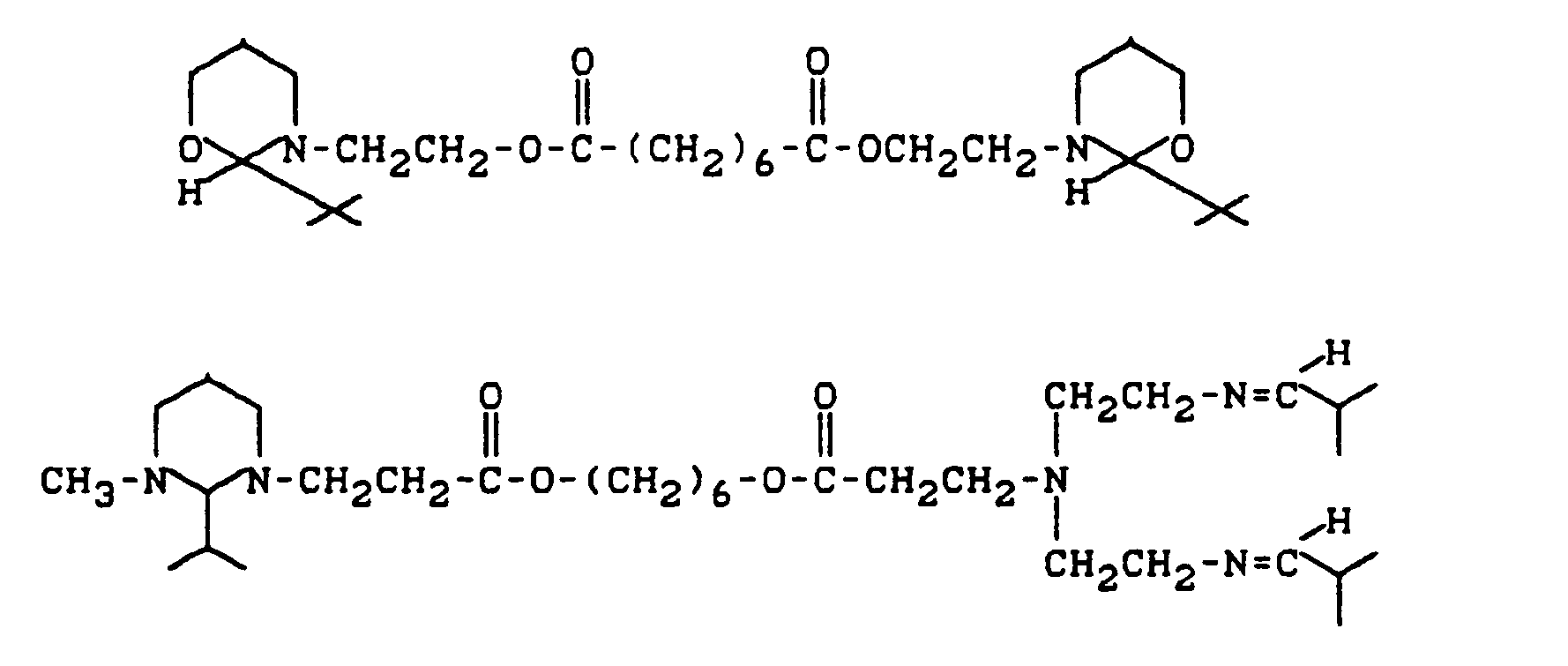
- Die erfindungsgemäßen Bindemittel können neben den wesentlichen Komponenten A) und B) gegebenenfalls als weitere Komponenten C) Hilfs- und Zusatzmittel der unterschiedlichsten Art enthalten. Zu diesen gehören beispielsweise Lösungs- bzw. Verdünnungsmittel, Verlaufshilfsmittel, Antioxidantien, Füllstoffe, Pigmente und UV-Absorber.
- Die Herstellung der erfindungsgemäßen Bindemittel bzw. Bindemittelkombinationen erfolgt dergestalt, daß man die Ausgangskomponenten A) und B), sowie gegebenenfalls die Hilfs- und Zusatzmittel C) miteinander vermischt. Im Falle der Mitverwendung von Lösungs- bzw. Verdünnungsmitteln als Komponente C) können diese bereits einer oder mehreren der Einzelkomponenten oder aber erst dem Gemisch aus den Komponenten A) und B) zugemischt werden. Insbesondere ist eine Ausführungsform denkbar, derzufolge die Lösungs- bzw. Verdünnungsmittel auch schon während der Herstellung einer oder mehrerer Ausgangskomponenten zugegen sind, wie dies z.B. vorstehend bei der Herstellung der Copolymerisate beschrieben worden ist. Die Lösungs- bzw. Verdünnungsmittel sollten weitgehend wasserfrei sein, um eine ausreichende Verarbeitungszeit der Gemische sicherzustellen. Lösungs- bzw. Verdünnungsmittel werden im allgemeinen in solchen Mengen mitverwendet, die zur Einstellung von geeigneten Verarbeitungsviskositäten der erfindungsgemäßen Kombinationen erforderlich sind. Der Lösungsmittelgehalt der der erfindungsgemäßen Verwendung zuzuführenden erfindungsgemäßen Bindemittel liegt im allgemeinen bei 10 bis 80 Gew.-%.
- Durch Verwendung geeigneter, vergleichsweise niedermolekularer, Copolymerisate A) ist es jedoch auch prinzipiell möglich, den Lösungs- bzw. Verdünnungsmittelgehalt noch weiter zu reduzieren, bzw. auf die Mitverwendung dieser Hilfsmittel völlig zu verzichten.
- Gemäß einer bevorzugten Ausführungsform werden als alleinige blockierte Polyamine Verbindungen B) eingesetzt, die keine in Abwesenheit von Feuchtigkeit gegenüber Isocyanatgruppen reaktionsfähige Gruppen aufweisen, und deren blockierte Aminogruppen ausschließlich aus Hexahydropyrimidin-, Tetrahydroimidazol-, Aldimin, Ketimin- und/oder Oxazolangruppen der genannten Art bestehen. Die bevorzugten, so hergestellten erfindungsgemäßen Kombinationen enthalten 40 bis 90 Gew.-Teile an Copolymerisaten A) und 10 bis 60 Gew.-Teile an Hexahydropyrimidin-, Tetrahydroimidazol, Ketimin-, Aldimin- bzw. Oxazolangruppen aufweisende Verbindungen B).
- Die Mengenverhältnisse der Einzelkomponenten A) und B) werden im allgemeinen so gewählt, daß auf jede blockierte Aminogruppe der Komponente B) insgesamt 0,2 bis 8, vorzugsweise 0,5 bis 4 Isocyanatgruppen der Komponente A) entfallen. Im allgemeinen wird man einen höheren Überschuß an den letztgenannten Gruppen innerhalb der genannten Bereiche dann wählen, wenn die übrigen Komponenten reaktive Gruppen aufweisen, die in Abwesenheit von Feuchtigkeit mit Isocyanatgruppen reagieren. Hierzu gehören insbesondere primäre oder sekundäre Aminogruppen, die beispielsweise neben den blockierten Aminogruppen in der Komponente B) vorliegen können und auch alkoholische Hydroxylgruppen, die in der Komponente B) neben den blockierten Aminogruppen vorhanden sein können. Im allgemeinen sind jedoch alkoholische Hydroxylgruppen unter den vorherrschenden Bedingungen (Raumtemperatur) gegenüber tertiären Isocyanatgruppen weitgehend inert, so daß die Hydroxylgruppen nur dann in Betracht gezogen werden müssen, wenn sie in Form von schwerflüchtigen Alkoholen zum Einsatz gelangen, die bei der Verwendung der erfindungsgemäßen Kombinationen nicht verdunsten und, beispielsweise bei höheren Temperaturen während des Aushärtens von Beschichtungen als Reaktionspartner für die Komponente A) in Betracht kommen.
- Insbesondere, wenn als Komponente B) solche Verbindungen eingesetzt werden, die neben den blockierten Aminogruppen freie primäre oder sekundäre Aminogruppen aufweisen, entstehen bei der Herstellung der erfindungsgemäßen Bindemittel durch Abmischen der Einzelkomponenten komplexe Gemische, in denen Harnstoffgruppen (durch Reaktion der Isocyanatgruppen mit Aminogruppen) vorliegen. Der Begriff "Bindemittel" umfaßt daher im Rahmen der Erfindung nicht nur, wie oben ausgeführt reine Gemische aus den Einzelkomponenten A) und B) sondern vielmehr auch Systeme, in denen neben den Einzelkomponenten derartige Umsetzungsprodukte vorliegen, bzw. die im wesentlichen ausschließlich aus derartigen Umsetzungsprodukten bestehen. Bei allen Varianten der Herstellung der erfindungsgemäßen Bindemittel durch Abmischen der Einzelkomponenten werden Art und Mengenverhältnisse dieser Einzelkomponenten vorzugsweise so gewählt, daß das Molverhältnis von tertiären Isocyanatgruppen zu blockierten Aminogruppen nach Beendigung der gegebenenfalls spontan ablaufenden Reaktion zwischen Isocyanatgruppen einerseits und primären bzw. sekundären Aminogruppen andererseits bei 0,2:1 bis 8:1 und insbesondere 0,5:1 bis 4:1 liegt, wobei auch hier ein Überschuß an Isocyanatgruppen in Betracht gezogen werden sollte, falls Einzelkomponenten mitverwendet werden, die alkoholische Hydroxylgruppen aufweisen, die bei der erfindungsgemäßen Verwendung jedoch neben den blockierten Aminogruppen als Reaktionspartner für die Isocyanatgruppen in Betracht kommen.
- Unter "gegenüber tertiären Isocyanatgruppen reaktionsfähige Wasserstoffatome aufweisenden, blockierten Polyamine B)" sind im Rahmen der Erfindung im übrigen nicht nur solche blockierte Polyamine der genannten Art zu verstehen, die reaktionsfähige Wasserstoffatome in chemisch gebundener Form enthalten, sondern vielmehr auch solche, die im Gemisch mit überschüssigem, zu ihrer Herstellung eingesetztem Polyamin bzw. Hydroxylamin vorliegen.
- Bezüglich der Verwendbarkeit der erfindungsgemäßen Bindemittelkombinationen ist es weitgehend ohne Bedeutung, ob die gegebenenfalls spontan ablaufende Reaktion zwischen den Copolymerisaten A) und den gegenüber tertiären Isocyanatgruppen reaktionsfähigen Gruppen bereits vollständig zum Abschluß gekommen ist. Gewünschtenfalls ist es jedoch möglich, diese Reaktion vor der erfindungsgemäßen Verwendung durch kurzzeitiges Erhitzen auf 40 bis 100°C zum Abschluß zu bringen. Im übrigen erfolgt die Herstellung der erfindungsgemäßen Bindemittel vorzugsweise bei Raumtemperatur.
- Die erfindungsgemäßen Bindemittel sind im allgemeinen (oftmals wegen des vorliegens von Lösungsmitteln) bei Raumtemperatur flüssig, sie sind in Abwesenheit von Wasser ausreichend lagerstabil und härten nach Applikation auf ein Substrat in Gegenwart von Luftfeuchtigkeit im allgemeinen rasch aus.
- In der Regel werden bereits bei Raumtemperatur vernetzte Filme erhalten. Die an sich schon sehr rasche Aushärtung kann durch Trocknung bei höheren Temperaturen noch weiter beschleunigt werden. Dabei sind Temperaturen von 80 bis 130°C und Trocknungszeiten von 10 bis 30 Minuten vorteilhaft.
- Bei Verwendung von besonders hydrolysestabilen blockierten Aminogruppen kann diese forcierte Trocknung bei höheren Temperaturen erforderlich sein, um das optimale Eigenschaftsbild zu erhalten.
- Die die erfindungsgemäßen Bindemittel enthaltenden Beschichtungsmittel und Dichtmassen können die in der Lacktechnologie üblichen Hilfs- und Zusatzstoffe wie beispielsweise Pigmente, Füllstoffe, Verlaufshilfsmittel, Antioxidantien oder UV-Absorber enthalten.
- Diese Hilfs- und Zusatzstoffe sollten möglichst wasserfrei sein und werden vorzugsweise bereits vor der Herstellung der Bindemittel den Ausgangskomponenten, im allgemeinen der Komponente A), einverleibt.
- Die die erfindungsgemäßen Produkte als Bindemittel enthaltenden Lacke und Beschichtungsmassen weisen in Abwesenheit von Feuchtigkeit im allgemeinen eine Topfzeit von 3 bis 48 Stunden auf. Durch Auswahl geeigneter Reaktionspartner kann die Topfzeit jedoch beliebig nach oben oder unten korrigiert werden. Die Beschichtungsmittel (Lacke) und Dichtmassen können nach den üblichen Methoden, beispielsweise durch Spritzen, Streichen, Tauchen, Fluten, Gießen, Walzen, Spachteln auf beliebige, gegebenenfalls bereits vorbehandelte Untergründe wie z.B. Metall, Holz, Glas, Keramik, Stein, Beton, Kunststoffe, Textilien, Leder, Pappe oder Papier aufgetragen werden.
- In den nachfolgenden Beispielen beziehen sich alle Prozentzahlen und -teile, falls nicht anders vermerkt, auf das Gewicht.
- In einem 2-l-Reaktionsgefäß mit Rühr-, Kühl- und Heizvorrichtungen werden unter Stickstoffatmosphäre die Ausgangskomponenten vorgelegt und so lange bei 40°C gerührt, bis der theoretisch zu berechnende Isocyanatgehalt erreicht ist.
- Die Zusammensetzungen der Ausgangskomponenten sind zusammen mit dem Isocyanatgehalt der erhaltenen isocyanatfunktionellen Monomeren in Tabelle 1 aufgeführt.

- In einem 3-l-Reaktionsgefäß mit Rühr-, Kühl- und Heizvorrichtungen wird Teil I vorgelegt und auf Reaktionstemaperatur aufgeheizt. Dann werden parallel Teil II (Zugabe über einen Zeitraum von insgesamt 2 Stunden) und Teil III (Zugabe über einen Zeitraum von insgesamt 2,5 Stunden) unter Stickstoffatmosphäre zudosiert. Anschließend wird 2 Stunden bei der Reaktionstemperatur nachgerührt.
- Die Reaktionstemperaturen und die Zusammensetzungen der Teile I bis III sind in Tabelle 2, zusammen mit den Kenndaten der erhaltenen Copolymerisate aufgeführt.

- In einem 2-l-Reaktionsgefäß mit Rühr-, Kühl- und Heizvorrichtung werden unter N₂-Atmosphäre 513 g Cyclohexan und 456 g Isobutyraldehyd vorgelegt. Bei 10°C (Eisbadkühlung) werden 529,8 g 1-Amino-3-methyl-aminopropan zugetropft, 1 Stunde bei 10°C gerührt und so lange auf Rückflußtemperatur erhitzt, bis kein Wasser mehr abgespalten wird. Anschließend werden Cyclohexan und überschüssiger Isobutyraldehyd abdestilliert und der Hexahydropyrimidinvernetzer B₁ erhalten.
- In einem 3-l-Reaktionsgefäß mit Rühr-, Kühl- und Heizvorrichtung werden unter N₂-Atmosphäre 680 g Isophorondiamin, 1000 g Methylisobutylketon und 560 g Toluol so lange am Wasserabscheider unter Rückfluß erhitzt, bis die theoretische Wassermenge abgetrennt ist (144 g) bzw. bis sich kein Wasser mehr abscheidet. Anschließend werden Toluol und überschüssiges Methylisobutylketon abdestilliert und der Bisketiminvernetzer B₂ erhalten.
-
- a) In einem 4-l-Reaktionsgefäß mit Rühr-, Kühl- und Heizvorrichtung werden unter N₂-Atmosphäre 1050 g Di-ethanolamin und 615 g Cyclohexan vorgelegt. Bei Raumtemperatur werden dann 1408 g 2-Ethylhexanal zugetropft, wobei die Temperatur langsam ansteigt. Es wird so lange bei Rückflußtemperatur gehalten, bis die Wasserabscheidung beendet ist. Anschließend werden Cyclohexan und überschüssiges 2-Ethylhexanal abdestilliert. Man erhält ein Oxazolan, die Vorstufe B₃a).
- b) Herstellung von B₃
- In einem Reaktionsgefäß mit Rühr-, Kühl- und Heizvorrichtungen werden unter N₂-Atmosphäre 200,6 g eines Isocyanuratgruppen aufweisenden Polyisocyanats auf Basis von Hexamethylendiisocyanat, welches im wesentlichen aus N,N′,N˝-Tris-(6-isocyanatohexyl)-isocyanurat besteht und 207 g Butylacetat vorgelegt und auf 60°C erwärmt. Nach dem Zutropfen von 286,7 g der Oxazolanvorstufe B₃a) wird noch 10 Stunden bei 70°C gehalten. Man erhält eine 70 %ige Lösung des im statistischen Mittel 3 Oxazolangruppen enthaltenden Vernetzers B₃.
- Die tertiäre Isocyanatgruppen enthaltenden Komponenten A) und die Polyaminkomponenten B) werden bei Raumtemperatur miteinander vermischt und gegebenenfalls durch Zugabe von weiteren Hilfsmitteln C) auf eine verarbeitungsfähige Viskosität eingestellt.
- Die Filme werden mit einem Filmzieher auf Prüfbleche aufgezogen, wobei die Naßfilmstärke 180 µm beträgt. Die bei Raumtemperatur aufgezogenen und gelagerten Filme waren alle nach spätestens 60 Minuten klebfrei durchgetrocknet. Nach Alterung, d.h. 24 Stunden Raumtemperatur erhält man klare, vernetzte, lösungsmittelbeständige Filme mit hervorragender Filmmechanik und sehr guter Filmoptik.
- Die angesetzten Lackmischungen wiesen durchweg eine Standzeit von mehreren Stunden auf.
- In der folgenden Tabelle 3 werden die Zusammensetzungen der Bindemittelkombinationen und die Lösungsmittelfestigkeiten als Grad der Vernetzung aufgeführt.
- Die Lösungsmittelfestigkeit wird durch einen Wischtest mit einem Methylisobutylketon (MIBK)-getränkten Wattebausch geprüft. Angegeben wird die Zahl der Doppelhübe, nach denen der Film ohne sichtbare Veränderung bleibt. Mehr als 200 Doppelhübe pro Film wurden nicht durchgeführt.


Claims (3)
- Verfahren zur Herstellung von Isocyanatgruppen aufweisenden Copolymerisaten eines als Gewichtsmittel bestimmten Molekulargewichts von 1000 bis 100 000 durch radikalisch initiierte Copolymerisation von isocyanatgruppenfreien, olefinisch ungesättigten Monomeren mit olefinisch ungesättigten Monoisocyanaten in einer solchen Menge, daß in den resultierenden Copolymerisaten 0,1 bis 13 Gew.-% an chemisch eingebauten Isocyanatgruppen bei einer mittleren NCO-Funktionalität der Copolymerisate von mindestens 2 vorliegen, dadurch gekennzeichnet, daß man als olefinisch ungesättigte Monoisocyanate olefinisch ungesättigte Verbindungen des Molekulargewichtsbereichs 252 bis 800 verwendet, die(i) einen Gehalt an Urethangruppen von 7 bis 24 Gew.-% und(ii) einen Gehalt an Isocyanatgruppen von 5 bis 17 Gew.-%, die an tertiäre Kohlenstoffatome gebunden sind, die ihrerseits Teil eines cycloaliphatischen Rings sind,
aufweisen, wobei 1-Isocyanato- 1-methyl-3-(2-allyloxy-ethoxycarbonylamino)-cyclohexan und 1-Isocyanato-1-methyl-3-(2-acryloxyethoxycarbonylamino)-cyclohexan ausgenommen sind. - Unter dem Einfluß von Feuchtigkeit aushärtbare Beschichtungsmittel oder Dichtmassen, die als Bindemittel ein Zweikomponenten-System aus einer Polyisocyanatkomponente und einer Polyaminkomponente mit blockierten Aminogruppen enthalten, dadurch gekennzeichnet, daß die Polyisocyanatkomponente aus gemäß Anspruch 1 erhaltenen Copolymerisaten besteht.
Priority Applications (1)
| Application Number | Priority Date | Filing Date | Title |
|---|---|---|---|
| AT89118694T ATE82957T1 (de) | 1988-10-21 | 1989-10-07 | Olefinisch ungesaettigte verbindungen, ein verfahren zur herstellung von isocyanatgruppen aufweisenden copolymerisaten, die so erhaltenen copolymerisate und die copolymerisate enthaltende beschichtungsmittel bzw. dichtmassen. |
Applications Claiming Priority (2)
| Application Number | Priority Date | Filing Date | Title |
|---|---|---|---|
| DE3835935A DE3835935A1 (de) | 1988-10-21 | 1988-10-21 | Olefinisch ungesaettigte verbindungen, ein verfahren zur herstellung von isocyanatgruppen aufweisenden copolymerisaten, die so erhaltenen copolymerisate und die copolymerisate enthaltende beschichtungsmittel bzw. dichtmassen |
| DE3835935 | 1988-10-21 |
Publications (2)
| Publication Number | Publication Date |
|---|---|
| EP0365903A1 EP0365903A1 (de) | 1990-05-02 |
| EP0365903B1 true EP0365903B1 (de) | 1992-12-02 |
Family
ID=6365649
Family Applications (1)
| Application Number | Title | Priority Date | Filing Date |
|---|---|---|---|
| EP89118694A Expired - Lifetime EP0365903B1 (de) | 1988-10-21 | 1989-10-07 | Olefinisch ungesättigte Verbindungen, ein Verfahren zur Herstellung von Isocyanatgruppen aufweisenden Copolymerisaten, die so erhaltenen Copolymerisate und die Copolymerisate enthaltende Beschichtungsmittel bzw. Dichtmassen |
Country Status (6)
| Country | Link |
|---|---|
| EP (1) | EP0365903B1 (de) |
| JP (2) | JP2916176B2 (de) |
| AT (1) | ATE82957T1 (de) |
| CA (1) | CA2001003C (de) |
| DE (2) | DE3835935A1 (de) |
| ES (1) | ES2053904T3 (de) |
Families Citing this family (1)
| Publication number | Priority date | Publication date | Assignee | Title |
|---|---|---|---|---|
| EP1602479B1 (de) * | 2003-02-17 | 2019-04-10 | Tokuyama Corporation | Beschichtetes produkt, optischer teil, herstellungsverfahren und überzugsflüssigkeit |
Family Cites Families (7)
| Publication number | Priority date | Publication date | Assignee | Title |
|---|---|---|---|---|
| US2958704A (en) * | 1958-09-02 | 1960-11-01 | Goodrich Co B F | Alkenyl isocyanate-substituted carbamates |
| US3789965A (en) * | 1972-06-21 | 1974-02-05 | Gen Motors Corp | Vacuum clutch actuator |
| US4219632A (en) * | 1979-03-02 | 1980-08-26 | E. I. Du Pont De Nemours And Company | Low molecular weight isocyanato-acrylate copolymers |
| DE3613082A1 (de) * | 1985-05-07 | 1986-11-13 | Hüls AG, 45772 Marl | Haftklebstoffe auf der basis von strahlenhaertbaren, (meth-)acrylgruppenhaltigen polyestern |
| DE3522978A1 (de) * | 1985-06-27 | 1987-01-15 | Bayer Ag | Verfahren zur herstellung von lichtechten, loesungsmittelbestaendigen polyurethanharnstoffelastomerbeschichtungen im reaktiv-beschichtungsverfahren |
| DE3703973A1 (de) * | 1987-02-10 | 1988-08-18 | Bayer Ag | Verfahren zur herstellung von isocyanatgruppen aufweisenden praepolymeren, die so hergestellten praepolymeren und ihre verwendung |
| DE3743996A1 (de) * | 1987-12-23 | 1989-07-13 | Siemens Ag | Fluessiges, strahlenhaertbares harz zur isolierung duenner leitungen |
-
1988
- 1988-10-21 DE DE3835935A patent/DE3835935A1/de not_active Withdrawn
-
1989
- 1989-10-07 ES ES89118694T patent/ES2053904T3/es not_active Expired - Lifetime
- 1989-10-07 DE DE8989118694T patent/DE58902893D1/de not_active Expired - Fee Related
- 1989-10-07 EP EP89118694A patent/EP0365903B1/de not_active Expired - Lifetime
- 1989-10-07 AT AT89118694T patent/ATE82957T1/de not_active IP Right Cessation
- 1989-10-19 CA CA002001003A patent/CA2001003C/en not_active Expired - Fee Related
- 1989-10-20 JP JP1271908A patent/JP2916176B2/ja not_active Expired - Lifetime
-
1998
- 1998-11-09 JP JP10331903A patent/JP3040385B2/ja not_active Expired - Lifetime
Also Published As
| Publication number | Publication date |
|---|---|
| ATE82957T1 (de) | 1992-12-15 |
| JP2916176B2 (ja) | 1999-07-05 |
| CA2001003A1 (en) | 1990-04-21 |
| DE58902893D1 (de) | 1993-01-14 |
| JPH02169559A (ja) | 1990-06-29 |
| JP3040385B2 (ja) | 2000-05-15 |
| EP0365903A1 (de) | 1990-05-02 |
| DE3835935A1 (de) | 1990-05-03 |
| CA2001003C (en) | 2000-03-28 |
| ES2053904T3 (es) | 1994-08-01 |
| JPH11246817A (ja) | 1999-09-14 |
Similar Documents
| Publication | Publication Date | Title |
|---|---|---|
| EP0639628B1 (de) | Verfahren zur Herstellung von Überzügen | |
| EP0403921B1 (de) | Verfahren zur Herstellung von Überzügen | |
| EP0470461A2 (de) | Verwendung von Zweikomponenten-Bindemittelkombinationen in Autoreparaturlacken | |
| EP0284953B1 (de) | Unter dem Einfluss von Feuchtigkeit härtbare Bindemittelkombinationen, ein Verfahren zu ihrer Herstellung und ihre Verwendung | |
| EP0346669B1 (de) | Verfahren zur Herstellung von härtbaren Bindemittelkombinationen, die nach diesem Verfahren erhältlichen Kombinationen und ihre Verwendung | |
| EP0319864B1 (de) | Bindemittelkombinationen, ein Verfahren zu ihrer Herstellung und ihre Verwendung | |
| EP0528304B1 (de) | Bindemittelgemische und ihre Verwendung | |
| EP0394786B1 (de) | Bindemittelkombinationen, ein Verfahren zu ihrer Herstellung und ihre Verwendung | |
| EP0532899B1 (de) | Verfahren zum Verlängern der Topfzeit von Polyol-Polyisocyanat-Mischungen | |
| DE2900592A1 (de) | Hydroxyl- und tertiaere aminogruppen enthaltende niedermolekulare acrylatharze | |
| EP0279311B1 (de) | Die Verwendung von Bindemittelkombinationen in lösungsmittelhaltigen Beschichtungsmitteln für Kraftfahrzeugteile | |
| EP0328962B1 (de) | Isocyanat- und Säureanhydridgruppen enthaltende Copolymerisate, ein Verfahren zu ihrer Herstellung und ihre Verwendung als Bindemittelkomponente | |
| EP0302373B1 (de) | Verfahren zur Herstellung von feuchtigkeitshärtenden Bindemittelkompositionen und ihre Verwendung | |
| EP0350664B1 (de) | Modifizierte Copolymerisate enthaltende Bindemittel und ihre Verwendung in Beschichtungsmitteln und Dichtmassen | |
| EP0075206A1 (de) | Verfahren zur Herstellung von Überzügen | |
| EP0365903A1 (de) | Olefinisch ungesättigte Verbindungen, ein Verfahren zur Herstellung von Isocyanatgruppen aufweisenden Copolymerisaten, die so erhaltenen Copolymerisate und die Copolymerisate enthaltende Beschichtungsmittel bzw. Dichtmassen | |
| EP0307701B1 (de) | Verfahren zur Herstellung von feuchtigkeitshärtenden Bindemittelkombinationen, die nach diesem Verfahren erhältlichen Kombinationen und ihre Verwendung | |
| EP0372295B1 (de) | Wässrige Lösungen oder Dispersionen von selbstvernetzenden Bindemitteln, ein Verfahren zu ihrer Herstellung und ihre Verwendung | |
| EP0473999B1 (de) | Bindemittelkombinationen und ihre Verwendung in Beschichtungsmitteln und Dichtmassen | |
| DE4344515C2 (de) | Bindemittel auf der Basis cycloolefinischer Copolymerer, deren Herstellung und deren Verwendung | |
| US5135987A (en) | Modified copolymers, a process for their production, binders containing the modified copolymers and their use in coating compositions and sealing compounds |
Legal Events
| Date | Code | Title | Description |
|---|---|---|---|
| PUAI | Public reference made under article 153(3) epc to a published international application that has entered the european phase |
Free format text: ORIGINAL CODE: 0009012 |
|
| 17P | Request for examination filed |
Effective date: 19891007 |
|
| AK | Designated contracting states |
Kind code of ref document: A1 Designated state(s): AT BE CH DE ES FR GB IT LI NL SE |
|
| 17Q | First examination report despatched |
Effective date: 19911023 |
|
| GRAA | (expected) grant |
Free format text: ORIGINAL CODE: 0009210 |
|
| AK | Designated contracting states |
Kind code of ref document: B1 Designated state(s): AT BE CH DE ES FR GB IT LI NL SE |
|
| REF | Corresponds to: |
Ref document number: 82957 Country of ref document: AT Date of ref document: 19921215 Kind code of ref document: T |
|
| REF | Corresponds to: |
Ref document number: 58902893 Country of ref document: DE Date of ref document: 19930114 |
|
| ITF | It: translation for a ep patent filed | ||
| ET | Fr: translation filed | ||
| GBT | Gb: translation of ep patent filed (gb section 77(6)(a)/1977) |
Effective date: 19930305 |
|
| PLBE | No opposition filed within time limit |
Free format text: ORIGINAL CODE: 0009261 |
|
| STAA | Information on the status of an ep patent application or granted ep patent |
Free format text: STATUS: NO OPPOSITION FILED WITHIN TIME LIMIT |
|
| 26N | No opposition filed | ||
| REG | Reference to a national code |
Ref country code: ES Ref legal event code: FG2A Ref document number: 2053904 Country of ref document: ES Kind code of ref document: T3 |
|
| EAL | Se: european patent in force in sweden |
Ref document number: 89118694.2 |
|
| PGFP | Annual fee paid to national office [announced via postgrant information from national office to epo] |
Ref country code: DE Payment date: 19990915 Year of fee payment: 11 |
|
| PGFP | Annual fee paid to national office [announced via postgrant information from national office to epo] |
Ref country code: SE Payment date: 19990920 Year of fee payment: 11 |
|
| PGFP | Annual fee paid to national office [announced via postgrant information from national office to epo] |
Ref country code: CH Payment date: 19990924 Year of fee payment: 11 |
|
| PGFP | Annual fee paid to national office [announced via postgrant information from national office to epo] |
Ref country code: ES Payment date: 19991004 Year of fee payment: 11 |
|
| PGFP | Annual fee paid to national office [announced via postgrant information from national office to epo] |
Ref country code: GB Payment date: 19991006 Year of fee payment: 11 |
|
| PGFP | Annual fee paid to national office [announced via postgrant information from national office to epo] |
Ref country code: FR Payment date: 19991021 Year of fee payment: 11 |
|
| PGFP | Annual fee paid to national office [announced via postgrant information from national office to epo] |
Ref country code: BE Payment date: 19991027 Year of fee payment: 11 Ref country code: AT Payment date: 19991027 Year of fee payment: 11 |
|
| PGFP | Annual fee paid to national office [announced via postgrant information from national office to epo] |
Ref country code: NL Payment date: 19991029 Year of fee payment: 11 |
|
| PG25 | Lapsed in a contracting state [announced via postgrant information from national office to epo] |
Ref country code: GB Free format text: LAPSE BECAUSE OF NON-PAYMENT OF DUE FEES Effective date: 20001007 Ref country code: AT Free format text: LAPSE BECAUSE OF NON-PAYMENT OF DUE FEES Effective date: 20001007 |
|
| PG25 | Lapsed in a contracting state [announced via postgrant information from national office to epo] |
Ref country code: ES Free format text: LAPSE BECAUSE OF NON-PAYMENT OF DUE FEES Effective date: 20001008 |
|
| PG25 | Lapsed in a contracting state [announced via postgrant information from national office to epo] |
Ref country code: SE Free format text: THE PATENT HAS BEEN ANNULLED BY A DECISION OF A NATIONAL AUTHORITY Effective date: 20001030 |
|
| PG25 | Lapsed in a contracting state [announced via postgrant information from national office to epo] |
Ref country code: LI Free format text: LAPSE BECAUSE OF NON-PAYMENT OF DUE FEES Effective date: 20001031 Ref country code: CH Free format text: LAPSE BECAUSE OF NON-PAYMENT OF DUE FEES Effective date: 20001031 Ref country code: BE Free format text: LAPSE BECAUSE OF NON-PAYMENT OF DUE FEES Effective date: 20001031 |
|
| BERE | Be: lapsed |
Owner name: BAYER A.G. Effective date: 20001031 |
|
| PG25 | Lapsed in a contracting state [announced via postgrant information from national office to epo] |
Ref country code: NL Free format text: LAPSE BECAUSE OF NON-PAYMENT OF DUE FEES Effective date: 20010501 |
|
| GBPC | Gb: european patent ceased through non-payment of renewal fee |
Effective date: 20001007 |
|
| REG | Reference to a national code |
Ref country code: CH Ref legal event code: PL |
|
| EUG | Se: european patent has lapsed |
Ref document number: 89118694.2 |
|
| PG25 | Lapsed in a contracting state [announced via postgrant information from national office to epo] |
Ref country code: FR Free format text: LAPSE BECAUSE OF NON-PAYMENT OF DUE FEES Effective date: 20010629 |
|
| NLV4 | Nl: lapsed or anulled due to non-payment of the annual fee |
Effective date: 20010501 |
|
| PG25 | Lapsed in a contracting state [announced via postgrant information from national office to epo] |
Ref country code: DE Free format text: LAPSE BECAUSE OF NON-PAYMENT OF DUE FEES Effective date: 20010703 |
|
| REG | Reference to a national code |
Ref country code: FR Ref legal event code: ST |
|
| REG | Reference to a national code |
Ref country code: ES Ref legal event code: FD2A Effective date: 20011113 |
|
| PG25 | Lapsed in a contracting state [announced via postgrant information from national office to epo] |
Ref country code: IT Free format text: LAPSE BECAUSE OF NON-PAYMENT OF DUE FEES Effective date: 20051007 |