EP0365916A1 - Polymermischungen - Google Patents
Polymermischungen Download PDFInfo
- Publication number
- EP0365916A1 EP0365916A1 EP89118840A EP89118840A EP0365916A1 EP 0365916 A1 EP0365916 A1 EP 0365916A1 EP 89118840 A EP89118840 A EP 89118840A EP 89118840 A EP89118840 A EP 89118840A EP 0365916 A1 EP0365916 A1 EP 0365916A1
- Authority
- EP
- European Patent Office
- Prior art keywords
- acid
- alkyl
- bis
- mixtures
- mol
- Prior art date
- Legal status (The legal status is an assumption and is not a legal conclusion. Google has not performed a legal analysis and makes no representation as to the accuracy of the status listed.)
- Granted
Links
- 229920002959 polymer blend Polymers 0.000 title abstract description 6
- 239000000203 mixture Substances 0.000 claims abstract description 53
- 125000003118 aryl group Chemical group 0.000 claims abstract description 17
- 125000000217 alkyl group Chemical group 0.000 claims abstract description 12
- 239000001257 hydrogen Substances 0.000 claims abstract description 10
- 229910052739 hydrogen Inorganic materials 0.000 claims abstract description 10
- 125000004429 atom Chemical group 0.000 claims abstract description 8
- 229910052799 carbon Inorganic materials 0.000 claims abstract description 8
- 125000004169 (C1-C6) alkyl group Chemical group 0.000 claims abstract description 7
- 229910052736 halogen Inorganic materials 0.000 claims abstract description 7
- 150000002367 halogens Chemical class 0.000 claims abstract description 7
- 150000002431 hydrogen Chemical class 0.000 claims abstract description 7
- 229920000620 organic polymer Polymers 0.000 claims abstract description 7
- 125000004209 (C1-C8) alkyl group Chemical group 0.000 claims abstract description 5
- 125000000041 C6-C10 aryl group Chemical group 0.000 claims abstract description 5
- OKTJSMMVPCPJKN-UHFFFAOYSA-N Carbon Chemical group [C] OKTJSMMVPCPJKN-UHFFFAOYSA-N 0.000 claims abstract description 5
- UFHFLCQGNIYNRP-UHFFFAOYSA-N Hydrogen Chemical compound [H][H] UFHFLCQGNIYNRP-UHFFFAOYSA-N 0.000 claims abstract description 5
- IISBACLAFKSPIT-UHFFFAOYSA-N bisphenol A Chemical compound C=1C=C(O)C=CC=1C(C)(C)C1=CC=C(O)C=C1 IISBACLAFKSPIT-UHFFFAOYSA-N 0.000 claims description 37
- 229920006393 polyether sulfone Polymers 0.000 claims description 26
- 229920000515 polycarbonate Polymers 0.000 claims description 21
- 239000004417 polycarbonate Substances 0.000 claims description 18
- 229920000728 polyester Polymers 0.000 claims description 18
- BVKZGUZCCUSVTD-UHFFFAOYSA-L Carbonate Chemical compound [O-]C([O-])=O BVKZGUZCCUSVTD-UHFFFAOYSA-L 0.000 claims description 4
- 230000003287 optical effect Effects 0.000 claims description 3
- 229920000570 polyether Polymers 0.000 abstract description 11
- 239000004721 Polyphenylene oxide Substances 0.000 abstract description 8
- 125000001174 sulfone group Chemical group 0.000 abstract 1
- 229920001169 thermoplastic Polymers 0.000 description 30
- 239000004416 thermosoftening plastic Substances 0.000 description 30
- YMWUJEATGCHHMB-UHFFFAOYSA-N Dichloromethane Chemical compound ClCCl YMWUJEATGCHHMB-UHFFFAOYSA-N 0.000 description 27
- -1 alkyl radical Chemical class 0.000 description 26
- 229920000642 polymer Polymers 0.000 description 22
- 229920001971 elastomer Polymers 0.000 description 19
- 238000000034 method Methods 0.000 description 19
- YXFVVABEGXRONW-UHFFFAOYSA-N Toluene Chemical compound CC1=CC=CC=C1 YXFVVABEGXRONW-UHFFFAOYSA-N 0.000 description 18
- 239000000243 solution Substances 0.000 description 18
- LYCAIKOWRPUZTN-UHFFFAOYSA-N Ethylene glycol Chemical compound OCCO LYCAIKOWRPUZTN-UHFFFAOYSA-N 0.000 description 17
- OKKJLVBELUTLKV-UHFFFAOYSA-N Methanol Chemical compound OC OKKJLVBELUTLKV-UHFFFAOYSA-N 0.000 description 15
- 239000005060 rubber Substances 0.000 description 15
- WNLRTRBMVRJNCN-UHFFFAOYSA-N adipic acid Chemical compound OC(=O)CCCCC(O)=O WNLRTRBMVRJNCN-UHFFFAOYSA-N 0.000 description 14
- QQVIHTHCMHWDBS-UHFFFAOYSA-N isophthalic acid Chemical compound OC(=O)C1=CC=CC(C(O)=O)=C1 QQVIHTHCMHWDBS-UHFFFAOYSA-N 0.000 description 14
- 229920002554 vinyl polymer Polymers 0.000 description 13
- PPBRXRYQALVLMV-UHFFFAOYSA-N Styrene Chemical compound C=CC1=CC=CC=C1 PPBRXRYQALVLMV-UHFFFAOYSA-N 0.000 description 12
- 229920000578 graft copolymer Polymers 0.000 description 11
- 125000000391 vinyl group Chemical group [H]C([*])=C([H])[H] 0.000 description 11
- 229930185605 Bisphenol Natural products 0.000 description 10
- 239000004695 Polyether sulfone Substances 0.000 description 10
- 150000003457 sulfones Chemical class 0.000 description 10
- XLYOFNOQVPJJNP-UHFFFAOYSA-N water Substances O XLYOFNOQVPJJNP-UHFFFAOYSA-N 0.000 description 10
- 239000004970 Chain extender Substances 0.000 description 9
- 229920000412 polyarylene Polymers 0.000 description 9
- QTBSBXVTEAMEQO-UHFFFAOYSA-N Acetic acid Chemical compound CC(O)=O QTBSBXVTEAMEQO-UHFFFAOYSA-N 0.000 description 8
- VEXZGXHMUGYJMC-UHFFFAOYSA-N Hydrochloric acid Chemical compound Cl VEXZGXHMUGYJMC-UHFFFAOYSA-N 0.000 description 8
- KKEYFWRCBNTPAC-UHFFFAOYSA-N Terephthalic acid Chemical compound OC(=O)C1=CC=C(C(O)=O)C=C1 KKEYFWRCBNTPAC-UHFFFAOYSA-N 0.000 description 8
- 239000004433 Thermoplastic polyurethane Substances 0.000 description 8
- 229920001577 copolymer Polymers 0.000 description 8
- 150000002576 ketones Chemical class 0.000 description 8
- 239000002798 polar solvent Substances 0.000 description 8
- 238000002360 preparation method Methods 0.000 description 8
- 229920002803 thermoplastic polyurethane Polymers 0.000 description 8
- ZAMOUSCENKQFHK-UHFFFAOYSA-N Chlorine atom Chemical compound [Cl] ZAMOUSCENKQFHK-UHFFFAOYSA-N 0.000 description 7
- WFDIJRYMOXRFFG-UHFFFAOYSA-N acetic acid anhydride Natural products CC(=O)OC(C)=O WFDIJRYMOXRFFG-UHFFFAOYSA-N 0.000 description 7
- 239000002253 acid Substances 0.000 description 7
- 239000001361 adipic acid Substances 0.000 description 7
- 235000011037 adipic acid Nutrition 0.000 description 7
- 150000004985 diamines Chemical class 0.000 description 7
- 125000005442 diisocyanate group Chemical group 0.000 description 7
- 230000009477 glass transition Effects 0.000 description 7
- 238000004519 manufacturing process Methods 0.000 description 7
- 239000000178 monomer Substances 0.000 description 7
- 229920002635 polyurethane Polymers 0.000 description 7
- 239000004814 polyurethane Substances 0.000 description 7
- 239000000126 substance Substances 0.000 description 7
- CNPURSDMOWDNOQ-UHFFFAOYSA-N 4-methoxy-7h-pyrrolo[2,3-d]pyrimidin-2-amine Chemical compound COC1=NC(N)=NC2=C1C=CN2 CNPURSDMOWDNOQ-UHFFFAOYSA-N 0.000 description 6
- KAKZBPTYRLMSJV-UHFFFAOYSA-N Butadiene Chemical compound C=CC=C KAKZBPTYRLMSJV-UHFFFAOYSA-N 0.000 description 6
- PEDCQBHIVMGVHV-UHFFFAOYSA-N Glycerine Chemical compound OCC(O)CO PEDCQBHIVMGVHV-UHFFFAOYSA-N 0.000 description 6
- ZMXDDKWLCZADIW-UHFFFAOYSA-N N,N-Dimethylformamide Chemical compound CN(C)C=O ZMXDDKWLCZADIW-UHFFFAOYSA-N 0.000 description 6
- MUBZPKHOEPUJKR-UHFFFAOYSA-N Oxalic acid Chemical compound OC(=O)C(O)=O MUBZPKHOEPUJKR-UHFFFAOYSA-N 0.000 description 6
- ISWSIDIOOBJBQZ-UHFFFAOYSA-N Phenol Chemical compound OC1=CC=CC=C1 ISWSIDIOOBJBQZ-UHFFFAOYSA-N 0.000 description 6
- WERYXYBDKMZEQL-UHFFFAOYSA-N butane-1,4-diol Chemical compound OCCCCO WERYXYBDKMZEQL-UHFFFAOYSA-N 0.000 description 6
- 238000006243 chemical reaction Methods 0.000 description 6
- 239000000460 chlorine Substances 0.000 description 6
- 229910052801 chlorine Inorganic materials 0.000 description 6
- KRKNYBCHXYNGOX-UHFFFAOYSA-N citric acid Chemical compound OC(=O)CC(O)(C(O)=O)CC(O)=O KRKNYBCHXYNGOX-UHFFFAOYSA-N 0.000 description 6
- 239000007789 gas Substances 0.000 description 6
- 229920001519 homopolymer Polymers 0.000 description 6
- IXCSERBJSXMMFS-UHFFFAOYSA-N hydrogen chloride Substances Cl.Cl IXCSERBJSXMMFS-UHFFFAOYSA-N 0.000 description 6
- 229910000041 hydrogen chloride Inorganic materials 0.000 description 6
- 238000002156 mixing Methods 0.000 description 6
- BDJRBEYXGGNYIS-UHFFFAOYSA-N nonanedioic acid Chemical compound OC(=O)CCCCCCCC(O)=O BDJRBEYXGGNYIS-UHFFFAOYSA-N 0.000 description 6
- BWHMMNNQKKPAPP-UHFFFAOYSA-L potassium carbonate Chemical compound [K+].[K+].[O-]C([O-])=O BWHMMNNQKKPAPP-UHFFFAOYSA-L 0.000 description 6
- 229920006114 semi-crystalline semi-aromatic polyamide Polymers 0.000 description 6
- GPAPPPVRLPGFEQ-UHFFFAOYSA-N 4,4'-dichlorodiphenyl sulfone Chemical compound C1=CC(Cl)=CC=C1S(=O)(=O)C1=CC=C(Cl)C=C1 GPAPPPVRLPGFEQ-UHFFFAOYSA-N 0.000 description 5
- NLHHRLWOUZZQLW-UHFFFAOYSA-N Acrylonitrile Chemical compound C=CC#N NLHHRLWOUZZQLW-UHFFFAOYSA-N 0.000 description 5
- WKBOTKDWSSQWDR-UHFFFAOYSA-N Bromine atom Chemical compound [Br] WKBOTKDWSSQWDR-UHFFFAOYSA-N 0.000 description 5
- CERQOIWHTDAKMF-UHFFFAOYSA-N Methacrylic acid Chemical class CC(=C)C(O)=O CERQOIWHTDAKMF-UHFFFAOYSA-N 0.000 description 5
- SECXISVLQFMRJM-UHFFFAOYSA-N N-Methylpyrrolidone Chemical compound CN1CCCC1=O SECXISVLQFMRJM-UHFFFAOYSA-N 0.000 description 5
- 229940106691 bisphenol a Drugs 0.000 description 5
- 125000004432 carbon atom Chemical class C* 0.000 description 5
- 239000003054 catalyst Substances 0.000 description 5
- 238000009833 condensation Methods 0.000 description 5
- 230000005494 condensation Effects 0.000 description 5
- 239000000839 emulsion Substances 0.000 description 5
- 150000002148 esters Chemical class 0.000 description 5
- 239000011521 glass Substances 0.000 description 5
- 229920002601 oligoester Polymers 0.000 description 5
- 150000003254 radicals Chemical class 0.000 description 5
- CXMXRPHRNRROMY-UHFFFAOYSA-N sebacic acid Chemical compound OC(=O)CCCCCCCCC(O)=O CXMXRPHRNRROMY-UHFFFAOYSA-N 0.000 description 5
- 239000002904 solvent Substances 0.000 description 5
- 150000003568 thioethers Chemical class 0.000 description 5
- NIXOWILDQLNWCW-UHFFFAOYSA-M Acrylate Chemical compound [O-]C(=O)C=C NIXOWILDQLNWCW-UHFFFAOYSA-M 0.000 description 4
- HEDRZPFGACZZDS-UHFFFAOYSA-N Chloroform Chemical compound ClC(Cl)Cl HEDRZPFGACZZDS-UHFFFAOYSA-N 0.000 description 4
- QIGBRXMKCJKVMJ-UHFFFAOYSA-N Hydroquinone Chemical compound OC1=CC=C(O)C=C1 QIGBRXMKCJKVMJ-UHFFFAOYSA-N 0.000 description 4
- NBIIXXVUZAFLBC-UHFFFAOYSA-N Phosphoric acid Chemical compound OP(O)(O)=O NBIIXXVUZAFLBC-UHFFFAOYSA-N 0.000 description 4
- WYURNTSHIVDZCO-UHFFFAOYSA-N Tetrahydrofuran Chemical compound C1CCOC1 WYURNTSHIVDZCO-UHFFFAOYSA-N 0.000 description 4
- 239000003513 alkali Substances 0.000 description 4
- 229920006020 amorphous polyamide Polymers 0.000 description 4
- GDTBXPJZTBHREO-UHFFFAOYSA-N bromine Substances BrBr GDTBXPJZTBHREO-UHFFFAOYSA-N 0.000 description 4
- 229910052794 bromium Inorganic materials 0.000 description 4
- 150000001991 dicarboxylic acids Chemical class 0.000 description 4
- 239000000806 elastomer Substances 0.000 description 4
- JBKVHLHDHHXQEQ-UHFFFAOYSA-N epsilon-caprolactam Chemical class O=C1CCCCCN1 JBKVHLHDHHXQEQ-UHFFFAOYSA-N 0.000 description 4
- 238000001125 extrusion Methods 0.000 description 4
- 238000010438 heat treatment Methods 0.000 description 4
- NAQMVNRVTILPCV-UHFFFAOYSA-N hexane-1,6-diamine Chemical compound NCCCCCCN NAQMVNRVTILPCV-UHFFFAOYSA-N 0.000 description 4
- 230000035699 permeability Effects 0.000 description 4
- 230000002688 persistence Effects 0.000 description 4
- 125000001997 phenyl group Chemical group [H]C1=C([H])C([H])=C(*)C([H])=C1[H] 0.000 description 4
- DNIAPMSPPWPWGF-UHFFFAOYSA-N propylene glycol Substances CC(O)CO DNIAPMSPPWPWGF-UHFFFAOYSA-N 0.000 description 4
- YPFDHNVEDLHUCE-UHFFFAOYSA-N 1,3-propanediol Substances OCCCO YPFDHNVEDLHUCE-UHFFFAOYSA-N 0.000 description 3
- DPQHRXRAZHNGRU-UHFFFAOYSA-N 2,4,4-trimethylhexane-1,6-diamine Chemical compound NCC(C)CC(C)(C)CCN DPQHRXRAZHNGRU-UHFFFAOYSA-N 0.000 description 3
- FZZMTSNZRBFGGU-UHFFFAOYSA-N 2-chloro-7-fluoroquinazolin-4-amine Chemical compound FC1=CC=C2C(N)=NC(Cl)=NC2=C1 FZZMTSNZRBFGGU-UHFFFAOYSA-N 0.000 description 3
- POSWICCRDBKBMH-UHFFFAOYSA-N 3,3,5-trimethylcyclohexan-1-one Chemical compound CC1CC(=O)CC(C)(C)C1 POSWICCRDBKBMH-UHFFFAOYSA-N 0.000 description 3
- DZIHTWJGPDVSGE-UHFFFAOYSA-N 4-[(4-aminocyclohexyl)methyl]cyclohexan-1-amine Chemical compound C1CC(N)CCC1CC1CCC(N)CC1 DZIHTWJGPDVSGE-UHFFFAOYSA-N 0.000 description 3
- 229940090248 4-hydroxybenzoic acid Drugs 0.000 description 3
- 150000005168 4-hydroxybenzoic acids Chemical class 0.000 description 3
- XWUCFAJNVTZRLE-UHFFFAOYSA-N 7-thiabicyclo[2.2.1]hepta-1,3,5-triene Chemical compound C1=C(S2)C=CC2=C1 XWUCFAJNVTZRLE-UHFFFAOYSA-N 0.000 description 3
- VEXZGXHMUGYJMC-UHFFFAOYSA-M Chloride anion Chemical compound [Cl-] VEXZGXHMUGYJMC-UHFFFAOYSA-M 0.000 description 3
- PXGOKWXKJXAPGV-UHFFFAOYSA-N Fluorine Chemical compound FF PXGOKWXKJXAPGV-UHFFFAOYSA-N 0.000 description 3
- VVQNEPGJFQJSBK-UHFFFAOYSA-N Methyl methacrylate Chemical compound COC(=O)C(C)=C VVQNEPGJFQJSBK-UHFFFAOYSA-N 0.000 description 3
- ZWXPDGCFMMFNRW-UHFFFAOYSA-N N-methylcaprolactam Chemical compound CN1CCCCCC1=O ZWXPDGCFMMFNRW-UHFFFAOYSA-N 0.000 description 3
- 229920001283 Polyalkylene terephthalate Polymers 0.000 description 3
- 238000000149 argon plasma sintering Methods 0.000 description 3
- 125000001797 benzyl group Chemical group [H]C1=C([H])C([H])=C(C([H])=C1[H])C([H])([H])* 0.000 description 3
- VCCBEIPGXKNHFW-UHFFFAOYSA-N biphenyl-4,4'-diol Chemical group C1=CC(O)=CC=C1C1=CC=C(O)C=C1 VCCBEIPGXKNHFW-UHFFFAOYSA-N 0.000 description 3
- 229920001400 block copolymer Polymers 0.000 description 3
- CDQSJQSWAWPGKG-UHFFFAOYSA-N butane-1,1-diol Chemical compound CCCC(O)O CDQSJQSWAWPGKG-UHFFFAOYSA-N 0.000 description 3
- 150000001875 compounds Chemical class 0.000 description 3
- 229920003244 diene elastomer Polymers 0.000 description 3
- MTHSVFCYNBDYFN-UHFFFAOYSA-N diethylene glycol Chemical compound OCCOCCO MTHSVFCYNBDYFN-UHFFFAOYSA-N 0.000 description 3
- RTZKZFJDLAIYFH-UHFFFAOYSA-N ether Substances CCOCC RTZKZFJDLAIYFH-UHFFFAOYSA-N 0.000 description 3
- 229910052731 fluorine Inorganic materials 0.000 description 3
- 239000011737 fluorine Substances 0.000 description 3
- 238000010559 graft polymerization reaction Methods 0.000 description 3
- 125000002887 hydroxy group Chemical group [H]O* 0.000 description 3
- WGCNASOHLSPBMP-UHFFFAOYSA-N hydroxyacetaldehyde Natural products OCC=O WGCNASOHLSPBMP-UHFFFAOYSA-N 0.000 description 3
- 229920000126 latex Polymers 0.000 description 3
- 239000000155 melt Substances 0.000 description 3
- 125000002496 methyl group Chemical group [H]C([H])([H])* 0.000 description 3
- 239000001301 oxygen Substances 0.000 description 3
- 229910052760 oxygen Inorganic materials 0.000 description 3
- FJKROLUGYXJWQN-UHFFFAOYSA-N papa-hydroxy-benzoic acid Natural products OC(=O)C1=CC=C(O)C=C1 FJKROLUGYXJWQN-UHFFFAOYSA-N 0.000 description 3
- 150000002989 phenols Chemical class 0.000 description 3
- 229920006380 polyphenylene oxide Polymers 0.000 description 3
- 229910000027 potassium carbonate Inorganic materials 0.000 description 3
- 150000004040 pyrrolidinones Chemical class 0.000 description 3
- 239000007858 starting material Substances 0.000 description 3
- 229920006345 thermoplastic polyamide Polymers 0.000 description 3
- MYRTYDVEIRVNKP-UHFFFAOYSA-N 1,2-Divinylbenzene Chemical compound C=CC1=CC=CC=C1C=C MYRTYDVEIRVNKP-UHFFFAOYSA-N 0.000 description 2
- OXTQEWUBDTVSFB-UHFFFAOYSA-N 2,4,4-Trimethylcyclopentanone Chemical compound CC1CC(C)(C)CC1=O OXTQEWUBDTVSFB-UHFFFAOYSA-N 0.000 description 2
- JEANOXXXGPLTOI-UHFFFAOYSA-N 2,4,4-trimethylcyclohexan-1-one Chemical compound CC1CC(C)(C)CCC1=O JEANOXXXGPLTOI-UHFFFAOYSA-N 0.000 description 2
- NXXYKOUNUYWIHA-UHFFFAOYSA-N 2,6-Dimethylphenol Chemical compound CC1=CC=CC(C)=C1O NXXYKOUNUYWIHA-UHFFFAOYSA-N 0.000 description 2
- SMZOUWXMTYCWNB-UHFFFAOYSA-N 2-(2-methoxy-5-methylphenyl)ethanamine Chemical compound COC1=CC=C(C)C=C1CCN SMZOUWXMTYCWNB-UHFFFAOYSA-N 0.000 description 2
- HZAXFHJVJLSVMW-UHFFFAOYSA-N 2-Aminoethan-1-ol Chemical compound NCCO HZAXFHJVJLSVMW-UHFFFAOYSA-N 0.000 description 2
- NIXOWILDQLNWCW-UHFFFAOYSA-N 2-Propenoic acid Natural products OC(=O)C=C NIXOWILDQLNWCW-UHFFFAOYSA-N 0.000 description 2
- VEORPZCZECFIRK-UHFFFAOYSA-N 3,3',5,5'-tetrabromobisphenol A Chemical compound C=1C(Br)=C(O)C(Br)=CC=1C(C)(C)C1=CC(Br)=C(O)C(Br)=C1 VEORPZCZECFIRK-UHFFFAOYSA-N 0.000 description 2
- RNLHGQLZWXBQNY-UHFFFAOYSA-N 3-(aminomethyl)-3,5,5-trimethylcyclohexan-1-amine Chemical compound CC1(C)CC(N)CC(C)(CN)C1 RNLHGQLZWXBQNY-UHFFFAOYSA-N 0.000 description 2
- QGNLHMKIGMZKJX-UHFFFAOYSA-N 3-chloro-4-hydroxybenzoic acid Chemical class OC(=O)C1=CC=C(O)C(Cl)=C1 QGNLHMKIGMZKJX-UHFFFAOYSA-N 0.000 description 2
- UPMLOUAZCHDJJD-UHFFFAOYSA-N 4,4'-Diphenylmethane Diisocyanate Chemical compound C1=CC(N=C=O)=CC=C1CC1=CC=C(N=C=O)C=C1 UPMLOUAZCHDJJD-UHFFFAOYSA-N 0.000 description 2
- VPWNQTHUCYMVMZ-UHFFFAOYSA-N 4,4'-sulfonyldiphenol Chemical compound C1=CC(O)=CC=C1S(=O)(=O)C1=CC=C(O)C=C1 VPWNQTHUCYMVMZ-UHFFFAOYSA-N 0.000 description 2
- ODJUOZPKKHIEOZ-UHFFFAOYSA-N 4-[2-(4-hydroxy-3,5-dimethylphenyl)propan-2-yl]-2,6-dimethylphenol Chemical compound CC1=C(O)C(C)=CC(C(C)(C)C=2C=C(C)C(O)=C(C)C=2)=C1 ODJUOZPKKHIEOZ-UHFFFAOYSA-N 0.000 description 2
- IJGRMHOSHXDMSA-UHFFFAOYSA-N Atomic nitrogen Chemical compound N#N IJGRMHOSHXDMSA-UHFFFAOYSA-N 0.000 description 2
- SDDLEVPIDBLVHC-UHFFFAOYSA-N Bisphenol Z Chemical compound C1=CC(O)=CC=C1C1(C=2C=CC(O)=CC=2)CCCCC1 SDDLEVPIDBLVHC-UHFFFAOYSA-N 0.000 description 2
- CURLTUGMZLYLDI-UHFFFAOYSA-N Carbon dioxide Chemical compound O=C=O CURLTUGMZLYLDI-UHFFFAOYSA-N 0.000 description 2
- IAZDPXIOMUYVGZ-UHFFFAOYSA-N Dimethylsulphoxide Chemical compound CS(C)=O IAZDPXIOMUYVGZ-UHFFFAOYSA-N 0.000 description 2
- CPELXLSAUQHCOX-UHFFFAOYSA-N Hydrogen bromide Chemical compound Br CPELXLSAUQHCOX-UHFFFAOYSA-N 0.000 description 2
- KFZMGEQAYNKOFK-UHFFFAOYSA-N Isopropanol Chemical compound CC(C)O KFZMGEQAYNKOFK-UHFFFAOYSA-N 0.000 description 2
- LRHPLDYGYMQRHN-UHFFFAOYSA-N N-Butanol Chemical compound CCCCO LRHPLDYGYMQRHN-UHFFFAOYSA-N 0.000 description 2
- 229920002292 Nylon 6 Polymers 0.000 description 2
- 229920002302 Nylon 6,6 Polymers 0.000 description 2
- CTQNGGLPUBDAKN-UHFFFAOYSA-N O-Xylene Chemical compound CC1=CC=CC=C1C CTQNGGLPUBDAKN-UHFFFAOYSA-N 0.000 description 2
- 239000004952 Polyamide Substances 0.000 description 2
- QAOWNCQODCNURD-UHFFFAOYSA-N Sulfuric acid Chemical compound OS(O)(=O)=O QAOWNCQODCNURD-UHFFFAOYSA-N 0.000 description 2
- KYPYTERUKNKOLP-UHFFFAOYSA-N Tetrachlorobisphenol A Chemical compound C=1C(Cl)=C(O)C(Cl)=CC=1C(C)(C)C1=CC(Cl)=C(O)C(Cl)=C1 KYPYTERUKNKOLP-UHFFFAOYSA-N 0.000 description 2
- ZJCCRDAZUWHFQH-UHFFFAOYSA-N Trimethylolpropane Chemical compound CCC(CO)(CO)CO ZJCCRDAZUWHFQH-UHFFFAOYSA-N 0.000 description 2
- XTXRWKRVRITETP-UHFFFAOYSA-N Vinyl acetate Chemical compound CC(=O)OC=C XTXRWKRVRITETP-UHFFFAOYSA-N 0.000 description 2
- OTKFKCIRTBTDKK-UHFFFAOYSA-N [3-(aminomethyl)-5-bicyclo[2.2.1]heptanyl]methanamine Chemical compound C1C(CN)C2C(CN)CC1C2 OTKFKCIRTBTDKK-UHFFFAOYSA-N 0.000 description 2
- FDLQZKYLHJJBHD-UHFFFAOYSA-N [3-(aminomethyl)phenyl]methanamine Chemical compound NCC1=CC=CC(CN)=C1 FDLQZKYLHJJBHD-UHFFFAOYSA-N 0.000 description 2
- ISKQADXMHQSTHK-UHFFFAOYSA-N [4-(aminomethyl)phenyl]methanamine Chemical compound NCC1=CC=C(CN)C=C1 ISKQADXMHQSTHK-UHFFFAOYSA-N 0.000 description 2
- 230000002378 acidificating effect Effects 0.000 description 2
- 150000001298 alcohols Chemical class 0.000 description 2
- 125000001931 aliphatic group Chemical group 0.000 description 2
- 150000001338 aliphatic hydrocarbons Chemical class 0.000 description 2
- XYLMUPLGERFSHI-UHFFFAOYSA-N alpha-Methylstyrene Chemical compound CC(=C)C1=CC=CC=C1 XYLMUPLGERFSHI-UHFFFAOYSA-N 0.000 description 2
- 229910000147 aluminium phosphate Inorganic materials 0.000 description 2
- 238000004458 analytical method Methods 0.000 description 2
- 150000004945 aromatic hydrocarbons Chemical class 0.000 description 2
- QVGXLLKOCUKJST-UHFFFAOYSA-N atomic oxygen Chemical compound [O] QVGXLLKOCUKJST-UHFFFAOYSA-N 0.000 description 2
- 230000001588 bifunctional effect Effects 0.000 description 2
- LLEMOWNGBBNAJR-UHFFFAOYSA-N biphenyl-2-ol Chemical compound OC1=CC=CC=C1C1=CC=CC=C1 LLEMOWNGBBNAJR-UHFFFAOYSA-N 0.000 description 2
- WTEOIRVLGSZEPR-UHFFFAOYSA-N boron trifluoride Chemical compound FB(F)F WTEOIRVLGSZEPR-UHFFFAOYSA-N 0.000 description 2
- BVKZGUZCCUSVTD-UHFFFAOYSA-N carbonic acid Chemical class OC(O)=O BVKZGUZCCUSVTD-UHFFFAOYSA-N 0.000 description 2
- 239000003795 chemical substances by application Substances 0.000 description 2
- MVPPADPHJFYWMZ-UHFFFAOYSA-N chlorobenzene Chemical compound ClC1=CC=CC=C1 MVPPADPHJFYWMZ-UHFFFAOYSA-N 0.000 description 2
- 150000001993 dienes Chemical class 0.000 description 2
- 150000002009 diols Chemical class 0.000 description 2
- KZTYYGOKRVBIMI-UHFFFAOYSA-N diphenyl sulfone Chemical compound C=1C=CC=CC=1S(=O)(=O)C1=CC=CC=C1 KZTYYGOKRVBIMI-UHFFFAOYSA-N 0.000 description 2
- YWEUIGNSBFLMFL-UHFFFAOYSA-N diphosphonate Chemical compound O=P(=O)OP(=O)=O YWEUIGNSBFLMFL-UHFFFAOYSA-N 0.000 description 2
- 238000001704 evaporation Methods 0.000 description 2
- 239000000706 filtrate Substances 0.000 description 2
- 239000011888 foil Substances 0.000 description 2
- 150000002334 glycols Chemical class 0.000 description 2
- TZMQHOJDDMFGQX-UHFFFAOYSA-N hexane-1,1,1-triol Chemical compound CCCCCC(O)(O)O TZMQHOJDDMFGQX-UHFFFAOYSA-N 0.000 description 2
- ACCCMOQWYVYDOT-UHFFFAOYSA-N hexane-1,1-diol Chemical compound CCCCCC(O)O ACCCMOQWYVYDOT-UHFFFAOYSA-N 0.000 description 2
- 125000004464 hydroxyphenyl group Chemical group 0.000 description 2
- 150000002500 ions Chemical class 0.000 description 2
- 239000012948 isocyanate Substances 0.000 description 2
- 150000002513 isocyanates Chemical class 0.000 description 2
- 150000003951 lactams Chemical class 0.000 description 2
- 239000007788 liquid Substances 0.000 description 2
- RLSSMJSEOOYNOY-UHFFFAOYSA-N m-cresol Chemical compound CC1=CC=CC(O)=C1 RLSSMJSEOOYNOY-UHFFFAOYSA-N 0.000 description 2
- 238000002844 melting Methods 0.000 description 2
- 230000008018 melting Effects 0.000 description 2
- 229910052757 nitrogen Inorganic materials 0.000 description 2
- QWVGKYWNOKOFNN-UHFFFAOYSA-N o-cresol Chemical compound CC1=CC=CC=C1O QWVGKYWNOKOFNN-UHFFFAOYSA-N 0.000 description 2
- 235000006408 oxalic acid Nutrition 0.000 description 2
- 239000002245 particle Substances 0.000 description 2
- 230000035515 penetration Effects 0.000 description 2
- DLYUQMMRRRQYAE-UHFFFAOYSA-N phosphorus pentoxide Inorganic materials O1P(O2)(=O)OP3(=O)OP1(=O)OP2(=O)O3 DLYUQMMRRRQYAE-UHFFFAOYSA-N 0.000 description 2
- XNGIFLGASWRNHJ-UHFFFAOYSA-N phthalic acid Chemical compound OC(=O)C1=CC=CC=C1C(O)=O XNGIFLGASWRNHJ-UHFFFAOYSA-N 0.000 description 2
- WLJVNTCWHIRURA-UHFFFAOYSA-N pimelic acid Chemical compound OC(=O)CCCCCC(O)=O WLJVNTCWHIRURA-UHFFFAOYSA-N 0.000 description 2
- 229920002492 poly(sulfone) Polymers 0.000 description 2
- 229920002647 polyamide Polymers 0.000 description 2
- 238000006068 polycondensation reaction Methods 0.000 description 2
- 229920001195 polyisoprene Polymers 0.000 description 2
- 238000001556 precipitation Methods 0.000 description 2
- 238000003825 pressing Methods 0.000 description 2
- 239000011541 reaction mixture Substances 0.000 description 2
- GHMLBKRAJCXXBS-UHFFFAOYSA-N resorcinol Chemical compound OC1=CC=CC(O)=C1 GHMLBKRAJCXXBS-UHFFFAOYSA-N 0.000 description 2
- 150000003839 salts Chemical class 0.000 description 2
- SQGYOTSLMSWVJD-UHFFFAOYSA-N silver(1+) nitrate Chemical compound [Ag+].[O-]N(=O)=O SQGYOTSLMSWVJD-UHFFFAOYSA-N 0.000 description 2
- 150000003440 styrenes Chemical class 0.000 description 2
- TYFQFVWCELRYAO-UHFFFAOYSA-N suberic acid Chemical compound OC(=O)CCCCCCC(O)=O TYFQFVWCELRYAO-UHFFFAOYSA-N 0.000 description 2
- 150000003512 tertiary amines Chemical class 0.000 description 2
- YLQBMQCUIZJEEH-UHFFFAOYSA-N tetrahydrofuran Natural products C=1C=COC=1 YLQBMQCUIZJEEH-UHFFFAOYSA-N 0.000 description 2
- 239000008096 xylene Substances 0.000 description 2
- JIAARYAFYJHUJI-UHFFFAOYSA-L zinc dichloride Chemical compound [Cl-].[Cl-].[Zn+2] JIAARYAFYJHUJI-UHFFFAOYSA-L 0.000 description 2
- DNIAPMSPPWPWGF-VKHMYHEASA-N (+)-propylene glycol Chemical compound C[C@H](O)CO DNIAPMSPPWPWGF-VKHMYHEASA-N 0.000 description 1
- PUPZLCDOIYMWBV-UHFFFAOYSA-N (+/-)-1,3-Butanediol Chemical compound CC(O)CCO PUPZLCDOIYMWBV-UHFFFAOYSA-N 0.000 description 1
- MRERMGPPCLQIPD-NBVRZTHBSA-N (3beta,5alpha,9alpha,22E,24R)-3,5,9-Trihydroxy-23-methylergosta-7,22-dien-6-one Chemical compound C1C(O)CCC2(C)C(CCC3(C(C(C)/C=C(\C)C(C)C(C)C)CCC33)C)(O)C3=CC(=O)C21O MRERMGPPCLQIPD-NBVRZTHBSA-N 0.000 description 1
- AXKGIPZJYUNAIW-UHFFFAOYSA-N (4-aminophenyl)methanol Chemical compound NC1=CC=C(CO)C=C1 AXKGIPZJYUNAIW-UHFFFAOYSA-N 0.000 description 1
- 125000004178 (C1-C4) alkyl group Chemical group 0.000 description 1
- 125000006528 (C2-C6) alkyl group Chemical group 0.000 description 1
- 0 **(CCC1)CCC[N+]1[O-] Chemical compound **(CCC1)CCC[N+]1[O-] 0.000 description 1
- AVQQQNCBBIEMEU-UHFFFAOYSA-N 1,1,3,3-tetramethylurea Chemical compound CN(C)C(=O)N(C)C AVQQQNCBBIEMEU-UHFFFAOYSA-N 0.000 description 1
- XXMCAWSEVMOGLO-UHFFFAOYSA-N 1,1-dichloro-1,6-diisocyanatohexane Chemical compound O=C=NC(Cl)(Cl)CCCCCN=C=O XXMCAWSEVMOGLO-UHFFFAOYSA-N 0.000 description 1
- KOMNUTZXSVSERR-UHFFFAOYSA-N 1,3,5-tris(prop-2-enyl)-1,3,5-triazinane-2,4,6-trione Chemical compound C=CCN1C(=O)N(CC=C)C(=O)N(CC=C)C1=O KOMNUTZXSVSERR-UHFFFAOYSA-N 0.000 description 1
- WNXJIVFYUVYPPR-UHFFFAOYSA-N 1,3-dioxolane Chemical compound C1COCO1 WNXJIVFYUVYPPR-UHFFFAOYSA-N 0.000 description 1
- RYHBNJHYFVUHQT-UHFFFAOYSA-N 1,4-Dioxane Chemical compound C1COCCO1 RYHBNJHYFVUHQT-UHFFFAOYSA-N 0.000 description 1
- 125000004958 1,4-naphthylene group Chemical group 0.000 description 1
- DFPJRUKWEPYFJT-UHFFFAOYSA-N 1,5-diisocyanatopentane Chemical compound O=C=NCCCCCN=C=O DFPJRUKWEPYFJT-UHFFFAOYSA-N 0.000 description 1
- URPIOHXFOXUKJB-UHFFFAOYSA-N 1-(4-chlorophenyl)sulfonyl-4-fluorobenzene Chemical compound C1=CC(F)=CC=C1S(=O)(=O)C1=CC=C(Cl)C=C1 URPIOHXFOXUKJB-UHFFFAOYSA-N 0.000 description 1
- QBNABJXQGRVIRA-UHFFFAOYSA-N 1-bromo-4-(4-bromophenyl)sulfonylbenzene Chemical compound C1=CC(Br)=CC=C1S(=O)(=O)C1=CC=C(Br)C=C1 QBNABJXQGRVIRA-UHFFFAOYSA-N 0.000 description 1
- YSEMNCKHWQEMTC-UHFFFAOYSA-N 1-chloro-4-(4-chloro-3-nitrophenyl)sulfonyl-2-nitrobenzene Chemical compound C1=C(Cl)C([N+](=O)[O-])=CC(S(=O)(=O)C=2C=C(C(Cl)=CC=2)[N+]([O-])=O)=C1 YSEMNCKHWQEMTC-UHFFFAOYSA-N 0.000 description 1
- GWCFTYITFDWLAY-UHFFFAOYSA-N 1-ethylazepan-2-one Chemical compound CCN1CCCCCC1=O GWCFTYITFDWLAY-UHFFFAOYSA-N 0.000 description 1
- KHAWDEWNXJIVCJ-UHFFFAOYSA-N 1-fluoro-4-(4-fluoro-3-nitrophenyl)sulfonyl-2-nitrobenzene Chemical compound C1=C(F)C([N+](=O)[O-])=CC(S(=O)(=O)C=2C=C(C(F)=CC=2)[N+]([O-])=O)=C1 KHAWDEWNXJIVCJ-UHFFFAOYSA-N 0.000 description 1
- PLVUIVUKKJTSDM-UHFFFAOYSA-N 1-fluoro-4-(4-fluorophenyl)sulfonylbenzene Chemical compound C1=CC(F)=CC=C1S(=O)(=O)C1=CC=C(F)C=C1 PLVUIVUKKJTSDM-UHFFFAOYSA-N 0.000 description 1
- KYZJYDSSXRSBDB-UHFFFAOYSA-N 1-isocyanato-2-(2-isocyanatophenoxy)benzene Chemical compound O=C=NC1=CC=CC=C1OC1=CC=CC=C1N=C=O KYZJYDSSXRSBDB-UHFFFAOYSA-N 0.000 description 1
- LFSYUSUFCBOHGU-UHFFFAOYSA-N 1-isocyanato-2-[(4-isocyanatophenyl)methyl]benzene Chemical compound C1=CC(N=C=O)=CC=C1CC1=CC=CC=C1N=C=O LFSYUSUFCBOHGU-UHFFFAOYSA-N 0.000 description 1
- DWFQYSNYIDKLCP-UHFFFAOYSA-N 1-methylcyclohexane-1,4-diamine Chemical compound CC1(N)CCC(N)CC1 DWFQYSNYIDKLCP-UHFFFAOYSA-N 0.000 description 1
- RTBFRGCFXZNCOE-UHFFFAOYSA-N 1-methylsulfonylpiperidin-4-one Chemical compound CS(=O)(=O)N1CCC(=O)CC1 RTBFRGCFXZNCOE-UHFFFAOYSA-N 0.000 description 1
- PBLZLIFKVPJDCO-UHFFFAOYSA-N 12-aminododecanoic acid Chemical compound NCCCCCCCCCCCC(O)=O PBLZLIFKVPJDCO-UHFFFAOYSA-N 0.000 description 1
- YIYBRXKMQFDHSM-UHFFFAOYSA-N 2,2'-Dihydroxybenzophenone Chemical class OC1=CC=CC=C1C(=O)C1=CC=CC=C1O YIYBRXKMQFDHSM-UHFFFAOYSA-N 0.000 description 1
- DWFUTNJGNBYHNN-UHFFFAOYSA-N 2,2,4-trimethylhexanedioic acid Chemical compound OC(=O)CC(C)CC(C)(C)C(O)=O DWFUTNJGNBYHNN-UHFFFAOYSA-N 0.000 description 1
- IKWBIQNMUMKUPM-UHFFFAOYSA-N 2,2,5-trimethylcycloheptan-1-one Chemical compound CC1CCC(=O)C(C)(C)CC1 IKWBIQNMUMKUPM-UHFFFAOYSA-N 0.000 description 1
- FRKBGJCJGLELLI-UHFFFAOYSA-N 2,2,6-trimethylcycloheptan-1-one Chemical compound CC1CCCC(C)(C)C(=O)C1 FRKBGJCJGLELLI-UHFFFAOYSA-N 0.000 description 1
- KNSPBSQWRKKAPI-UHFFFAOYSA-N 2,2-dimethylcyclohexan-1-one Chemical compound CC1(C)CCCCC1=O KNSPBSQWRKKAPI-UHFFFAOYSA-N 0.000 description 1
- MNKAMLMLSBHWMW-UHFFFAOYSA-N 2,2-dimethylcyclooctan-1-one Chemical compound CC1(C)CCCCCCC1=O MNKAMLMLSBHWMW-UHFFFAOYSA-N 0.000 description 1
- 125000004825 2,2-dimethylpropylene group Chemical group [H]C([H])([H])C(C([H])([H])[H])(C([H])([H])[*:1])C([H])([H])[*:2] 0.000 description 1
- WFQIZSACCHAGQV-UHFFFAOYSA-N 2,3,3,4-tetramethylcyclopentan-1-one Chemical compound CC1CC(=O)C(C)C1(C)C WFQIZSACCHAGQV-UHFFFAOYSA-N 0.000 description 1
- BIQQEOKHAUBBGB-UHFFFAOYSA-N 2,3,3,5-tetramethylcycloheptan-1-one Chemical compound CC1CCC(=O)C(C)C(C)(C)C1 BIQQEOKHAUBBGB-UHFFFAOYSA-N 0.000 description 1
- IWOORFWEZGNMPW-UHFFFAOYSA-N 2,3,3-trimethylcyclohexan-1-one Chemical compound CC1C(=O)CCCC1(C)C IWOORFWEZGNMPW-UHFFFAOYSA-N 0.000 description 1
- RZQRIBYBTHKBPK-UHFFFAOYSA-N 2,3,3-trimethylcyclopentan-1-one Chemical compound CC1C(=O)CCC1(C)C RZQRIBYBTHKBPK-UHFFFAOYSA-N 0.000 description 1
- UPHBNTWDWKUFAT-UHFFFAOYSA-N 2,3,4,4-tetramethylcyclopentan-1-one Chemical compound CC1C(C)C(C)(C)CC1=O UPHBNTWDWKUFAT-UHFFFAOYSA-N 0.000 description 1
- DSBUDTYUVWSSPD-UHFFFAOYSA-N 2,3,5,5-tetramethylcycloheptan-1-one Chemical compound CC1CC(C)(C)CCC(=O)C1C DSBUDTYUVWSSPD-UHFFFAOYSA-N 0.000 description 1
- RLEQVGMLDNITBW-UHFFFAOYSA-N 2,4,4-trimethylhexanedioic acid Chemical compound OC(=O)C(C)CC(C)(C)CC(O)=O RLEQVGMLDNITBW-UHFFFAOYSA-N 0.000 description 1
- NPFPKRBGZLWCPL-UHFFFAOYSA-N 2,4-dimethyl-4-propan-2-ylcyclopentan-1-one Chemical compound CC(C)C1(C)CC(C)C(=O)C1 NPFPKRBGZLWCPL-UHFFFAOYSA-N 0.000 description 1
- OITMBHSFQBJCFN-UHFFFAOYSA-N 2,5,5-trimethylcyclohexan-1-one Chemical compound CC1CCC(C)(C)CC1=O OITMBHSFQBJCFN-UHFFFAOYSA-N 0.000 description 1
- ZACLMVYBDSHRDN-UHFFFAOYSA-N 2,6,6-trimethylcycloheptan-1-one Chemical compound CC1CCCC(C)(C)CC1=O ZACLMVYBDSHRDN-UHFFFAOYSA-N 0.000 description 1
- HOLHYSJJBXSLMV-UHFFFAOYSA-N 2,6-dichlorophenol Chemical compound OC1=C(Cl)C=CC=C1Cl HOLHYSJJBXSLMV-UHFFFAOYSA-N 0.000 description 1
- MWXYTNVRKXXINS-UHFFFAOYSA-N 2,7,7-trimethylcyclooctan-1-one Chemical compound CC1CCCCC(C)(C)CC1=O MWXYTNVRKXXINS-UHFFFAOYSA-N 0.000 description 1
- VXHYVVAUHMGCEX-UHFFFAOYSA-N 2-(2-hydroxyphenoxy)phenol Chemical compound OC1=CC=CC=C1OC1=CC=CC=C1O VXHYVVAUHMGCEX-UHFFFAOYSA-N 0.000 description 1
- BLDLRWQLBOJPEB-UHFFFAOYSA-N 2-(2-hydroxyphenyl)sulfanylphenol Chemical class OC1=CC=CC=C1SC1=CC=CC=C1O BLDLRWQLBOJPEB-UHFFFAOYSA-N 0.000 description 1
- XSVZEASGNTZBRQ-UHFFFAOYSA-N 2-(2-hydroxyphenyl)sulfinylphenol Chemical class OC1=CC=CC=C1S(=O)C1=CC=CC=C1O XSVZEASGNTZBRQ-UHFFFAOYSA-N 0.000 description 1
- QUWAJPZDCZDTJS-UHFFFAOYSA-N 2-(2-hydroxyphenyl)sulfonylphenol Chemical class OC1=CC=CC=C1S(=O)(=O)C1=CC=CC=C1O QUWAJPZDCZDTJS-UHFFFAOYSA-N 0.000 description 1
- KYGLCUAXJICESS-UHFFFAOYSA-N 2-[2,3-di(propan-2-yl)phenyl]phenol Chemical class CC(C)C1=CC=CC(C=2C(=CC=CC=2)O)=C1C(C)C KYGLCUAXJICESS-UHFFFAOYSA-N 0.000 description 1
- CDMGNVWZXRKJNS-UHFFFAOYSA-N 2-benzylphenol Chemical compound OC1=CC=CC=C1CC1=CC=CC=C1 CDMGNVWZXRKJNS-UHFFFAOYSA-N 0.000 description 1
- NZHZXZREENEERJ-UHFFFAOYSA-N 2-butyl-3,3,4-trimethylcyclohexan-1-one Chemical compound CCCCC1C(=O)CCC(C)C1(C)C NZHZXZREENEERJ-UHFFFAOYSA-N 0.000 description 1
- XWYVLTRWDRKVHU-UHFFFAOYSA-N 2-butyl-3,3,4-trimethylcyclopentan-1-one Chemical compound CCCCC1C(=O)CC(C)C1(C)C XWYVLTRWDRKVHU-UHFFFAOYSA-N 0.000 description 1
- KBISFCUIEKTJEW-UHFFFAOYSA-N 2-butyl-3,3-dimethylcyclopentan-1-one Chemical compound CCCCC1C(=O)CCC1(C)C KBISFCUIEKTJEW-UHFFFAOYSA-N 0.000 description 1
- XBQRPFBBTWXIFI-UHFFFAOYSA-N 2-chloro-4-[2-(3-chloro-4-hydroxyphenyl)propan-2-yl]phenol Chemical compound C=1C=C(O)C(Cl)=CC=1C(C)(C)C1=CC=C(O)C(Cl)=C1 XBQRPFBBTWXIFI-UHFFFAOYSA-N 0.000 description 1
- ISPYQTSUDJAMAB-UHFFFAOYSA-N 2-chlorophenol Chemical compound OC1=CC=CC=C1Cl ISPYQTSUDJAMAB-UHFFFAOYSA-N 0.000 description 1
- MVRPPTGLVPEMPI-UHFFFAOYSA-N 2-cyclohexylphenol Chemical compound OC1=CC=CC=C1C1CCCCC1 MVRPPTGLVPEMPI-UHFFFAOYSA-N 0.000 description 1
- DOKDNTOHNOOUAQ-UHFFFAOYSA-N 2-ethyl-3,5,5-trimethylcyclohexan-1-one Chemical compound CCC1C(C)CC(C)(C)CC1=O DOKDNTOHNOOUAQ-UHFFFAOYSA-N 0.000 description 1
- MVDKKZZVTWHVMC-UHFFFAOYSA-N 2-hexadecylpropanedioic acid Chemical compound CCCCCCCCCCCCCCCCC(C(O)=O)C(O)=O MVDKKZZVTWHVMC-UHFFFAOYSA-N 0.000 description 1
- MWCBGWLCXSUTHK-UHFFFAOYSA-N 2-methylbutane-1,4-diol Chemical compound OCC(C)CCO MWCBGWLCXSUTHK-UHFFFAOYSA-N 0.000 description 1
- FYZUENZXIZCLAZ-UHFFFAOYSA-N 2-methylhept-2-enoic acid Chemical compound CCCCC=C(C)C(O)=O FYZUENZXIZCLAZ-UHFFFAOYSA-N 0.000 description 1
- JJYWRQLLQAKNAD-UHFFFAOYSA-N 2-methylpent-2-enoic acid Chemical compound CCC=C(C)C(O)=O JJYWRQLLQAKNAD-UHFFFAOYSA-N 0.000 description 1
- MILSYCKGLDDVLM-UHFFFAOYSA-N 2-phenylpropan-2-ylbenzene Chemical compound C=1C=CC=CC=1C(C)(C)C1=CC=CC=C1 MILSYCKGLDDVLM-UHFFFAOYSA-N 0.000 description 1
- 125000003903 2-propenyl group Chemical group [H]C([*])([H])C([H])=C([H])[H] 0.000 description 1
- WMRCTEPOPAZMMN-UHFFFAOYSA-N 2-undecylpropanedioic acid Chemical compound CCCCCCCCCCCC(C(O)=O)C(O)=O WMRCTEPOPAZMMN-UHFFFAOYSA-N 0.000 description 1
- YMTYZTXUZLQUSF-UHFFFAOYSA-N 3,3'-Dimethylbisphenol A Chemical compound C1=C(O)C(C)=CC(C(C)(C)C=2C=C(C)C(O)=CC=2)=C1 YMTYZTXUZLQUSF-UHFFFAOYSA-N 0.000 description 1
- DEMDAOTZMLQKIF-UHFFFAOYSA-N 3,3,4,4-tetramethylcyclopentan-1-one Chemical compound CC1(C)CC(=O)CC1(C)C DEMDAOTZMLQKIF-UHFFFAOYSA-N 0.000 description 1
- UTULSHMCEREFCR-UHFFFAOYSA-N 3,3,4-trimethyl-2-propan-2-ylcyclopentan-1-one Chemical compound CC(C)C1C(=O)CC(C)C1(C)C UTULSHMCEREFCR-UHFFFAOYSA-N 0.000 description 1
- JKONWEHOIIXXRN-UHFFFAOYSA-N 3,3,4-trimethylcyclohexan-1-one Chemical compound CC1CCC(=O)CC1(C)C JKONWEHOIIXXRN-UHFFFAOYSA-N 0.000 description 1
- ANEGGVOMHWVLTN-UHFFFAOYSA-N 3,3,4-trimethylcyclopentan-1-one Chemical compound CC1CC(=O)CC1(C)C ANEGGVOMHWVLTN-UHFFFAOYSA-N 0.000 description 1
- MWGDYVWTNUHIQB-UHFFFAOYSA-N 3,3,5,5-tetramethylcycloheptan-1-one Chemical compound CC1(C)CCC(=O)CC(C)(C)C1 MWGDYVWTNUHIQB-UHFFFAOYSA-N 0.000 description 1
- YDDIDKITLCIFAE-UHFFFAOYSA-N 3,3,5-trimethyl-4-propan-2-ylcyclohexan-1-one Chemical compound CC(C)C1C(C)CC(=O)CC1(C)C YDDIDKITLCIFAE-UHFFFAOYSA-N 0.000 description 1
- ZTCPLLGFBZYAKW-UHFFFAOYSA-N 3,3,5-trimethyl-5-propan-2-ylcyclohexan-1-one Chemical compound CC(C)C1(C)CC(=O)CC(C)(C)C1 ZTCPLLGFBZYAKW-UHFFFAOYSA-N 0.000 description 1
- YJYAWHZIAIPEFU-UHFFFAOYSA-N 3,3,5-trimethyl-5-propylcyclohexan-1-one Chemical compound CCCC1(C)CC(=O)CC(C)(C)C1 YJYAWHZIAIPEFU-UHFFFAOYSA-N 0.000 description 1
- HNZBTZAZHHJOBM-UHFFFAOYSA-N 3,3,5-trimethylcycloheptan-1-one Chemical compound CC1CCC(=O)CC(C)(C)C1 HNZBTZAZHHJOBM-UHFFFAOYSA-N 0.000 description 1
- RQSOYFCJVXBPSR-UHFFFAOYSA-N 3,3-dimethylcycloheptan-1-one Chemical compound CC1(C)CCCCC(=O)C1 RQSOYFCJVXBPSR-UHFFFAOYSA-N 0.000 description 1
- ZVJQBBYAVPAFLX-UHFFFAOYSA-N 3,3-dimethylcyclohexan-1-one Chemical compound CC1(C)CCCC(=O)C1 ZVJQBBYAVPAFLX-UHFFFAOYSA-N 0.000 description 1
- JSYAQLZSGHPSJD-UHFFFAOYSA-N 3,3-dimethylcyclopentan-1-one Chemical compound CC1(C)CCC(=O)C1 JSYAQLZSGHPSJD-UHFFFAOYSA-N 0.000 description 1
- FPNZOUJIEOSYEB-UHFFFAOYSA-N 3,4,4-trimethylcyclohexan-1-one Chemical compound CC1CC(=O)CCC1(C)C FPNZOUJIEOSYEB-UHFFFAOYSA-N 0.000 description 1
- DIXFJWMIUSSKNT-UHFFFAOYSA-N 3,5,5-trimethylcycloheptan-1-one Chemical compound CC1CC(=O)CCC(C)(C)C1 DIXFJWMIUSSKNT-UHFFFAOYSA-N 0.000 description 1
- CNKKFFNIHJXBFX-UHFFFAOYSA-N 3-(2-aminoethyl)-3,5,5-trimethylcyclohexan-1-amine Chemical compound CC1(C)CC(N)CC(C)(CCN)C1 CNKKFFNIHJXBFX-UHFFFAOYSA-N 0.000 description 1
- WDBZEBXYXWWDPJ-UHFFFAOYSA-N 3-(2-methylphenoxy)propanoic acid Chemical compound CC1=CC=CC=C1OCCC(O)=O WDBZEBXYXWWDPJ-UHFFFAOYSA-N 0.000 description 1
- HORNXRXVQWOLPJ-UHFFFAOYSA-N 3-chlorophenol Chemical compound OC1=CC=CC(Cl)=C1 HORNXRXVQWOLPJ-UHFFFAOYSA-N 0.000 description 1
- FQCSWWXRWLUNLH-UHFFFAOYSA-N 3-ethyl-3,5,5-trimethylcyclohexan-1-one Chemical compound CCC1(C)CC(=O)CC(C)(C)C1 FQCSWWXRWLUNLH-UHFFFAOYSA-N 0.000 description 1
- SINCOHHNSCMYME-UHFFFAOYSA-N 3-ethyl-3-methyl-4-propan-2-ylcyclohexan-1-one Chemical compound CCC1(C)CC(=O)CCC1C(C)C SINCOHHNSCMYME-UHFFFAOYSA-N 0.000 description 1
- CULUYVDAKOQDJQ-UHFFFAOYSA-N 3-ethyl-3-methyl-4-propan-2-ylcyclopentan-1-one Chemical compound CCC1(C)CC(=O)CC1C(C)C CULUYVDAKOQDJQ-UHFFFAOYSA-N 0.000 description 1
- HPFWICIZVJFFNM-UHFFFAOYSA-N 3-ethyl-3-methylcyclohexan-1-one Chemical compound CCC1(C)CCCC(=O)C1 HPFWICIZVJFFNM-UHFFFAOYSA-N 0.000 description 1
- IUZULRVGAITOOO-UHFFFAOYSA-N 3-ethyl-3-methylcyclopentan-1-one Chemical compound CCC1(C)CCC(=O)C1 IUZULRVGAITOOO-UHFFFAOYSA-N 0.000 description 1
- LOMDULYNXSSXAM-UHFFFAOYSA-N 3-methyl-3-(4-methylpentyl)cyclohexan-1-one Chemical compound CC(C)CCCC1(C)CCCC(=O)C1 LOMDULYNXSSXAM-UHFFFAOYSA-N 0.000 description 1
- OKISUZLXOYGIFP-UHFFFAOYSA-N 4,4'-dichlorobenzophenone Chemical group C1=CC(Cl)=CC=C1C(=O)C1=CC=C(Cl)C=C1 OKISUZLXOYGIFP-UHFFFAOYSA-N 0.000 description 1
- VWGKEVWFBOUAND-UHFFFAOYSA-N 4,4'-thiodiphenol Chemical compound C1=CC(O)=CC=C1SC1=CC=C(O)C=C1 VWGKEVWFBOUAND-UHFFFAOYSA-N 0.000 description 1
- VGAKELRUPBNCST-UHFFFAOYSA-N 4,4-dimethyl-2-propan-2-ylcyclopentan-1-one Chemical compound CC(C)C1CC(C)(C)CC1=O VGAKELRUPBNCST-UHFFFAOYSA-N 0.000 description 1
- BYMMLKKZWRAKQV-UHFFFAOYSA-N 4,4-dimethylcycloheptan-1-one Chemical compound CC1(C)CCCC(=O)CC1 BYMMLKKZWRAKQV-UHFFFAOYSA-N 0.000 description 1
- PXQMSTLNSHMSJB-UHFFFAOYSA-N 4,4-dimethylcyclohexan-1-one Chemical compound CC1(C)CCC(=O)CC1 PXQMSTLNSHMSJB-UHFFFAOYSA-N 0.000 description 1
- OCEINMLGYDSKFW-UHFFFAOYSA-N 4-(4-amino-3-nitrophenyl)-2-nitroaniline Chemical compound C1=C([N+]([O-])=O)C(N)=CC=C1C1=CC=C(N)C([N+]([O-])=O)=C1 OCEINMLGYDSKFW-UHFFFAOYSA-N 0.000 description 1
- SUCTVKDVODFXFX-UHFFFAOYSA-N 4-(4-hydroxy-3,5-dimethylphenyl)sulfonyl-2,6-dimethylphenol Chemical compound CC1=C(O)C(C)=CC(S(=O)(=O)C=2C=C(C)C(O)=C(C)C=2)=C1 SUCTVKDVODFXFX-UHFFFAOYSA-N 0.000 description 1
- NZGQHKSLKRFZFL-UHFFFAOYSA-N 4-(4-hydroxyphenoxy)phenol Chemical compound C1=CC(O)=CC=C1OC1=CC=C(O)C=C1 NZGQHKSLKRFZFL-UHFFFAOYSA-N 0.000 description 1
- IGSBHTZEJMPDSZ-UHFFFAOYSA-N 4-[(4-amino-3-methylcyclohexyl)methyl]-2-methylcyclohexan-1-amine Chemical compound C1CC(N)C(C)CC1CC1CC(C)C(N)CC1 IGSBHTZEJMPDSZ-UHFFFAOYSA-N 0.000 description 1
- AZZWZMUXHALBCQ-UHFFFAOYSA-N 4-[(4-hydroxy-3,5-dimethylphenyl)methyl]-2,6-dimethylphenol Chemical compound CC1=C(O)C(C)=CC(CC=2C=C(C)C(O)=C(C)C=2)=C1 AZZWZMUXHALBCQ-UHFFFAOYSA-N 0.000 description 1
- BWCAVNWKMVHLFW-UHFFFAOYSA-N 4-[1-(4-hydroxy-3,5-dimethylphenyl)cyclohexyl]-2,6-dimethylphenol Chemical compound CC1=C(O)C(C)=CC(C2(CCCCC2)C=2C=C(C)C(O)=C(C)C=2)=C1 BWCAVNWKMVHLFW-UHFFFAOYSA-N 0.000 description 1
- UMPGNGRIGSEMTC-UHFFFAOYSA-N 4-[1-(4-hydroxyphenyl)-3,3,5-trimethylcyclohexyl]phenol Chemical compound C1C(C)CC(C)(C)CC1(C=1C=CC(O)=CC=1)C1=CC=C(O)C=C1 UMPGNGRIGSEMTC-UHFFFAOYSA-N 0.000 description 1
- BDBZTOMUANOKRT-UHFFFAOYSA-N 4-[2-(4-aminocyclohexyl)propan-2-yl]cyclohexan-1-amine Chemical compound C1CC(N)CCC1C(C)(C)C1CCC(N)CC1 BDBZTOMUANOKRT-UHFFFAOYSA-N 0.000 description 1
- OBZFGWBLZXIBII-UHFFFAOYSA-N 4-[3-(4-hydroxy-3,5-dimethylphenyl)-3-methylbutyl]-2,6-dimethylphenol Chemical compound CC1=C(O)C(C)=CC(CCC(C)(C)C=2C=C(C)C(O)=C(C)C=2)=C1 OBZFGWBLZXIBII-UHFFFAOYSA-N 0.000 description 1
- NIRYBKWMEWFDPM-UHFFFAOYSA-N 4-[3-(4-hydroxyphenyl)-3-methylbutyl]phenol Chemical compound C=1C=C(O)C=CC=1C(C)(C)CCC1=CC=C(O)C=C1 NIRYBKWMEWFDPM-UHFFFAOYSA-N 0.000 description 1
- HJSPWKGEPDZNLK-UHFFFAOYSA-N 4-benzylphenol Chemical compound C1=CC(O)=CC=C1CC1=CC=CC=C1 HJSPWKGEPDZNLK-UHFFFAOYSA-N 0.000 description 1
- WDDUKJWHQDQCLJ-UHFFFAOYSA-N 4-butyl-3,3,5-trimethylcyclohexan-1-one Chemical compound CCCCC1C(C)CC(=O)CC1(C)C WDDUKJWHQDQCLJ-UHFFFAOYSA-N 0.000 description 1
- BEISIWACDYSFJD-UHFFFAOYSA-N 4-ethyl-2,3,4-trimethylcyclopentan-1-one Chemical compound CCC1(C)CC(=O)C(C)C1C BEISIWACDYSFJD-UHFFFAOYSA-N 0.000 description 1
- LOKSUEDSRBXVJV-UHFFFAOYSA-N 4-ethyl-4-methyl-3-propan-2-ylcyclohexan-1-one Chemical compound CCC1(C)CCC(=O)CC1C(C)C LOKSUEDSRBXVJV-UHFFFAOYSA-N 0.000 description 1
- MABKONZEVCZGAJ-UHFFFAOYSA-N 4-ethyl-4-methylcyclohexan-1-one Chemical compound CCC1(C)CCC(=O)CC1 MABKONZEVCZGAJ-UHFFFAOYSA-N 0.000 description 1
- SZUWRIBQCMULKV-UHFFFAOYSA-N 5-ethyl-2,5-dimethylcycloheptan-1-one Chemical compound CCC1(C)CCC(C)C(=O)CC1 SZUWRIBQCMULKV-UHFFFAOYSA-N 0.000 description 1
- XWAGBXRBHWUJMU-UHFFFAOYSA-N 5-ethyl-5-methyl-2,4-di(propan-2-yl)cyclohexan-1-one Chemical compound CCC1(C)CC(=O)C(C(C)C)CC1C(C)C XWAGBXRBHWUJMU-UHFFFAOYSA-N 0.000 description 1
- SLXKOJJOQWFEFD-UHFFFAOYSA-N 6-aminohexanoic acid Chemical compound NCCCCCC(O)=O SLXKOJJOQWFEFD-UHFFFAOYSA-N 0.000 description 1
- 229910015900 BF3 Inorganic materials 0.000 description 1
- GIXXQTYGFOHYPT-UHFFFAOYSA-N Bisphenol P Chemical compound C=1C=C(C(C)(C)C=2C=CC(O)=CC=2)C=CC=1C(C)(C)C1=CC=C(O)C=C1 GIXXQTYGFOHYPT-UHFFFAOYSA-N 0.000 description 1
- RVZAWHJGDXIFBF-UHFFFAOYSA-N ClNC1=CC=C(C2=CC=C(NCl)C=C2)C=C1.O=C1C=C(CC(C)(C)C1)C Chemical compound ClNC1=CC=C(C2=CC=C(NCl)C=C2)C=C1.O=C1C=C(CC(C)(C)C1)C RVZAWHJGDXIFBF-UHFFFAOYSA-N 0.000 description 1
- XDTMQSROBMDMFD-UHFFFAOYSA-N Cyclohexane Chemical compound C1CCCCC1 XDTMQSROBMDMFD-UHFFFAOYSA-N 0.000 description 1
- RWSOTUBLDIXVET-UHFFFAOYSA-N Dihydrogen sulfide Chemical compound S RWSOTUBLDIXVET-UHFFFAOYSA-N 0.000 description 1
- MYMOFIZGZYHOMD-UHFFFAOYSA-N Dioxygen Chemical compound O=O MYMOFIZGZYHOMD-UHFFFAOYSA-N 0.000 description 1
- 239000004908 Emulsion polymer Substances 0.000 description 1
- JOYRKODLDBILNP-UHFFFAOYSA-N Ethyl urethane Chemical compound CCOC(N)=O JOYRKODLDBILNP-UHFFFAOYSA-N 0.000 description 1
- 229920000181 Ethylene propylene rubber Polymers 0.000 description 1
- PIICEJLVQHRZGT-UHFFFAOYSA-N Ethylenediamine Chemical compound NCCN PIICEJLVQHRZGT-UHFFFAOYSA-N 0.000 description 1
- KRHYYFGTRYWZRS-UHFFFAOYSA-N Fluorane Chemical compound F KRHYYFGTRYWZRS-UHFFFAOYSA-N 0.000 description 1
- 244000043261 Hevea brasiliensis Species 0.000 description 1
- 239000005057 Hexamethylene diisocyanate Substances 0.000 description 1
- DGAQECJNVWCQMB-PUAWFVPOSA-M Ilexoside XXIX Chemical compound C[C@@H]1CC[C@@]2(CC[C@@]3(C(=CC[C@H]4[C@]3(CC[C@@H]5[C@@]4(CC[C@@H](C5(C)C)OS(=O)(=O)[O-])C)C)[C@@H]2[C@]1(C)O)C)C(=O)O[C@H]6[C@@H]([C@H]([C@@H]([C@H](O6)CO)O)O)O.[Na+] DGAQECJNVWCQMB-PUAWFVPOSA-M 0.000 description 1
- 239000005058 Isophorone diisocyanate Substances 0.000 description 1
- 229920002633 Kraton (polymer) Polymers 0.000 description 1
- JHWNWJKBPDFINM-UHFFFAOYSA-N Laurolactam Chemical compound O=C1CCCCCCCCCCCN1 JHWNWJKBPDFINM-UHFFFAOYSA-N 0.000 description 1
- 229920000106 Liquid crystal polymer Polymers 0.000 description 1
- GYCMBHHDWRMZGG-UHFFFAOYSA-N Methylacrylonitrile Chemical compound CC(=C)C#N GYCMBHHDWRMZGG-UHFFFAOYSA-N 0.000 description 1
- FXHOOIRPVKKKFG-UHFFFAOYSA-N N,N-Dimethylacetamide Chemical compound CN(C)C(C)=O FXHOOIRPVKKKFG-UHFFFAOYSA-N 0.000 description 1
- WHNWPMSKXPGLAX-UHFFFAOYSA-N N-Vinyl-2-pyrrolidone Chemical compound C=CN1CCCC1=O WHNWPMSKXPGLAX-UHFFFAOYSA-N 0.000 description 1
- ADYVCZCQSVYNPQ-UHFFFAOYSA-N N=C=O.N=C=O.C=1C=CC=CC=1C(C)C1=CC=CC=C1 Chemical compound N=C=O.N=C=O.C=1C=CC=CC=1C(C)C1=CC=CC=C1 ADYVCZCQSVYNPQ-UHFFFAOYSA-N 0.000 description 1
- 239000005062 Polybutadiene Substances 0.000 description 1
- 239000004743 Polypropylene Substances 0.000 description 1
- ZLMJMSJWJFRBEC-UHFFFAOYSA-N Potassium Chemical compound [K] ZLMJMSJWJFRBEC-UHFFFAOYSA-N 0.000 description 1
- KDYFGRWQOYBRFD-UHFFFAOYSA-N Succinic acid Natural products OC(=O)CCC(O)=O KDYFGRWQOYBRFD-UHFFFAOYSA-N 0.000 description 1
- 229910021627 Tin(IV) chloride Inorganic materials 0.000 description 1
- GSEJCLTVZPLZKY-UHFFFAOYSA-N Triethanolamine Chemical compound OCCN(CCO)CCO GSEJCLTVZPLZKY-UHFFFAOYSA-N 0.000 description 1
- YMOONIIMQBGTDU-VOTSOKGWSA-N [(e)-2-bromoethenyl]benzene Chemical compound Br\C=C\C1=CC=CC=C1 YMOONIIMQBGTDU-VOTSOKGWSA-N 0.000 description 1
- KEUCYUPOICDBOG-UHFFFAOYSA-N [2-(aminomethyl)-5-bicyclo[2.2.1]heptanyl]methanamine Chemical compound C1C2C(CN)CC1C(CN)C2 KEUCYUPOICDBOG-UHFFFAOYSA-N 0.000 description 1
- XMUZQOKACOLCSS-UHFFFAOYSA-N [2-(hydroxymethyl)phenyl]methanol Chemical compound OCC1=CC=CC=C1CO XMUZQOKACOLCSS-UHFFFAOYSA-N 0.000 description 1
- YIMQCDZDWXUDCA-UHFFFAOYSA-N [4-(hydroxymethyl)cyclohexyl]methanol Chemical compound OCC1CCC(CO)CC1 YIMQCDZDWXUDCA-UHFFFAOYSA-N 0.000 description 1
- KXBFLNPZHXDQLV-UHFFFAOYSA-N [cyclohexyl(diisocyanato)methyl]cyclohexane Chemical compound C1CCCCC1C(N=C=O)(N=C=O)C1CCCCC1 KXBFLNPZHXDQLV-UHFFFAOYSA-N 0.000 description 1
- 150000007513 acids Chemical class 0.000 description 1
- 239000000654 additive Substances 0.000 description 1
- 150000001335 aliphatic alkanes Chemical class 0.000 description 1
- 229910052783 alkali metal Inorganic materials 0.000 description 1
- 150000001336 alkenes Chemical class 0.000 description 1
- 125000005250 alkyl acrylate group Chemical group 0.000 description 1
- VSCWAEJMTAWNJL-UHFFFAOYSA-K aluminium trichloride Chemical compound Cl[Al](Cl)Cl VSCWAEJMTAWNJL-UHFFFAOYSA-K 0.000 description 1
- 229920006125 amorphous polymer Polymers 0.000 description 1
- JFCQEDHGNNZCLN-UHFFFAOYSA-N anhydrous glutaric acid Natural products OC(=O)CCCC(O)=O JFCQEDHGNNZCLN-UHFFFAOYSA-N 0.000 description 1
- 238000010533 azeotropic distillation Methods 0.000 description 1
- YDLSUFFXJYEVHW-UHFFFAOYSA-N azonan-2-one Chemical compound O=C1CCCCCCCN1 YDLSUFFXJYEVHW-UHFFFAOYSA-N 0.000 description 1
- 230000015572 biosynthetic process Effects 0.000 description 1
- 125000006267 biphenyl group Chemical group 0.000 description 1
- KDYFGRWQOYBRFD-NUQCWPJISA-N butanedioic acid Chemical compound O[14C](=O)CC[14C](O)=O KDYFGRWQOYBRFD-NUQCWPJISA-N 0.000 description 1
- CQEYYJKEWSMYFG-UHFFFAOYSA-N butyl acrylate Chemical compound CCCCOC(=O)C=C CQEYYJKEWSMYFG-UHFFFAOYSA-N 0.000 description 1
- 239000003990 capacitor Substances 0.000 description 1
- 239000001569 carbon dioxide Substances 0.000 description 1
- 229910002092 carbon dioxide Inorganic materials 0.000 description 1
- 150000004649 carbonic acid derivatives Chemical class 0.000 description 1
- 238000005266 casting Methods 0.000 description 1
- 239000007795 chemical reaction product Substances 0.000 description 1
- 239000007810 chemical reaction solvent Substances 0.000 description 1
- 150000008280 chlorinated hydrocarbons Chemical class 0.000 description 1
- 239000003426 co-catalyst Substances 0.000 description 1
- 238000000975 co-precipitation Methods 0.000 description 1
- 230000000052 comparative effect Effects 0.000 description 1
- 238000013329 compounding Methods 0.000 description 1
- 238000001816 cooling Methods 0.000 description 1
- 150000001879 copper Chemical class 0.000 description 1
- 239000011258 core-shell material Substances 0.000 description 1
- 238000004132 cross linking Methods 0.000 description 1
- 239000003431 cross linking reagent Substances 0.000 description 1
- 150000001924 cycloalkanes Chemical class 0.000 description 1
- QYQADNCHXSEGJT-UHFFFAOYSA-N cyclohexane-1,1-dicarboxylate;hydron Chemical compound OC(=O)C1(C(O)=O)CCCCC1 QYQADNCHXSEGJT-UHFFFAOYSA-N 0.000 description 1
- 125000004956 cyclohexylene group Chemical group 0.000 description 1
- VSSAZBXXNIABDN-UHFFFAOYSA-N cyclohexylmethanol Chemical compound OCC1CCCCC1 VSSAZBXXNIABDN-UHFFFAOYSA-N 0.000 description 1
- YQLZOAVZWJBZSY-UHFFFAOYSA-N decane-1,10-diamine Chemical compound NCCCCCCCCCCN YQLZOAVZWJBZSY-UHFFFAOYSA-N 0.000 description 1
- 239000012024 dehydrating agents Substances 0.000 description 1
- KEIQPMUPONZJJH-UHFFFAOYSA-N dicyclohexylmethanediamine Chemical class C1CCCCC1C(N)(N)C1CCCCC1 KEIQPMUPONZJJH-UHFFFAOYSA-N 0.000 description 1
- 239000000539 dimer Substances 0.000 description 1
- ZZTCPWRAHWXWCH-UHFFFAOYSA-N diphenylmethanediamine Chemical compound C=1C=CC=CC=1C(N)(N)C1=CC=CC=C1 ZZTCPWRAHWXWCH-UHFFFAOYSA-N 0.000 description 1
- 239000006185 dispersion Substances 0.000 description 1
- WNAHIZMDSQCWRP-UHFFFAOYSA-N dodecane-1-thiol Chemical compound CCCCCCCCCCCCS WNAHIZMDSQCWRP-UHFFFAOYSA-N 0.000 description 1
- 239000000975 dye Substances 0.000 description 1
- 238000007720 emulsion polymerization reaction Methods 0.000 description 1
- 238000005516 engineering process Methods 0.000 description 1
- 150000002170 ethers Chemical class 0.000 description 1
- 125000001495 ethyl group Chemical group [H]C([H])([H])C([H])([H])* 0.000 description 1
- 229920001038 ethylene copolymer Polymers 0.000 description 1
- 230000008020 evaporation Effects 0.000 description 1
- 238000002474 experimental method Methods 0.000 description 1
- 239000000945 filler Substances 0.000 description 1
- 238000005227 gel permeation chromatography Methods 0.000 description 1
- 125000003106 haloaryl group Chemical group 0.000 description 1
- RRAMGCGOFNQTLD-UHFFFAOYSA-N hexamethylene diisocyanate Chemical compound O=C=NCCCCCCN=C=O RRAMGCGOFNQTLD-UHFFFAOYSA-N 0.000 description 1
- XXMIOPMDWAUFGU-UHFFFAOYSA-N hexane-1,6-diol Chemical compound OCCCCCCO XXMIOPMDWAUFGU-UHFFFAOYSA-N 0.000 description 1
- 125000004435 hydrogen atom Chemical group [H]* 0.000 description 1
- 229910000042 hydrogen bromide Inorganic materials 0.000 description 1
- 229910000040 hydrogen fluoride Inorganic materials 0.000 description 1
- 229910000037 hydrogen sulfide Inorganic materials 0.000 description 1
- 230000007062 hydrolysis Effects 0.000 description 1
- 238000006460 hydrolysis reaction Methods 0.000 description 1
- 238000011065 in-situ storage Methods 0.000 description 1
- 239000012442 inert solvent Substances 0.000 description 1
- 239000003999 initiator Substances 0.000 description 1
- 238000001746 injection moulding Methods 0.000 description 1
- ZFSLODLOARCGLH-UHFFFAOYSA-N isocyanuric acid Chemical compound OC1=NC(O)=NC(O)=N1 ZFSLODLOARCGLH-UHFFFAOYSA-N 0.000 description 1
- NIMLQBUJDJZYEJ-UHFFFAOYSA-N isophorone diisocyanate Chemical compound CC1(C)CC(N=C=O)CC(C)(CN=C=O)C1 NIMLQBUJDJZYEJ-UHFFFAOYSA-N 0.000 description 1
- 150000002531 isophthalic acids Chemical class 0.000 description 1
- 150000002596 lactones Chemical class 0.000 description 1
- 239000004816 latex Substances 0.000 description 1
- 229920002521 macromolecule Polymers 0.000 description 1
- 239000000463 material Substances 0.000 description 1
- 238000005259 measurement Methods 0.000 description 1
- AUHZEENZYGFFBQ-UHFFFAOYSA-N mesitylene Substances CC1=CC(C)=CC(C)=C1 AUHZEENZYGFFBQ-UHFFFAOYSA-N 0.000 description 1
- 125000001827 mesitylenyl group Chemical group [H]C1=C(C(*)=C(C([H])=C1C([H])([H])[H])C([H])([H])[H])C([H])([H])[H] 0.000 description 1
- 125000005397 methacrylic acid ester group Chemical group 0.000 description 1
- XJRBAMWJDBPFIM-UHFFFAOYSA-N methyl vinyl ether Chemical compound COC=C XJRBAMWJDBPFIM-UHFFFAOYSA-N 0.000 description 1
- DFQICHCWIIJABH-UHFFFAOYSA-N naphthalene-2,7-diol Chemical compound C1=CC(O)=CC2=CC(O)=CC=C21 DFQICHCWIIJABH-UHFFFAOYSA-N 0.000 description 1
- 229920003052 natural elastomer Polymers 0.000 description 1
- 229920001194 natural rubber Polymers 0.000 description 1
- 230000003472 neutralizing effect Effects 0.000 description 1
- 125000000449 nitro group Chemical group [O-][N+](*)=O 0.000 description 1
- JRZJOMJEPLMPRA-UHFFFAOYSA-N olefin Natural products CCCCCCCC=C JRZJOMJEPLMPRA-UHFFFAOYSA-N 0.000 description 1
- 235000010292 orthophenyl phenol Nutrition 0.000 description 1
- 230000001590 oxidative effect Effects 0.000 description 1
- WXZMFSXDPGVJKK-UHFFFAOYSA-N pentaerythritol Chemical compound OCC(CO)(CO)CO WXZMFSXDPGVJKK-UHFFFAOYSA-N 0.000 description 1
- 125000005385 peroxodisulfate group Chemical group 0.000 description 1
- 239000003208 petroleum Substances 0.000 description 1
- 229910052698 phosphorus Inorganic materials 0.000 description 1
- 239000011574 phosphorus Substances 0.000 description 1
- 229920003023 plastic Polymers 0.000 description 1
- 239000004033 plastic Substances 0.000 description 1
- 229920002852 poly(2,6-dimethyl-1,4-phenylene oxide) polymer Polymers 0.000 description 1
- 229920001084 poly(chloroprene) Polymers 0.000 description 1
- 229920001643 poly(ether ketone) Polymers 0.000 description 1
- 229920002857 polybutadiene Polymers 0.000 description 1
- 239000004632 polycaprolactone Substances 0.000 description 1
- 229920006289 polycarbonate film Polymers 0.000 description 1
- 229920001470 polyketone Polymers 0.000 description 1
- 230000000379 polymerizing effect Effects 0.000 description 1
- 229920000098 polyolefin Polymers 0.000 description 1
- 229920006324 polyoxymethylene Polymers 0.000 description 1
- 229920000137 polyphosphoric acid Polymers 0.000 description 1
- 229920001155 polypropylene Polymers 0.000 description 1
- 229920001296 polysiloxane Polymers 0.000 description 1
- 229920000166 polytrimethylene carbonate Polymers 0.000 description 1
- 229910052700 potassium Inorganic materials 0.000 description 1
- 239000011591 potassium Substances 0.000 description 1
- 239000000843 powder Substances 0.000 description 1
- 239000000047 product Substances 0.000 description 1
- 125000001436 propyl group Chemical group [H]C([*])([H])C([H])([H])C([H])([H])[H] 0.000 description 1
- 108090000623 proteins and genes Proteins 0.000 description 1
- 238000000746 purification Methods 0.000 description 1
- 238000010526 radical polymerization reaction Methods 0.000 description 1
- 230000035484 reaction time Effects 0.000 description 1
- 239000012966 redox initiator Substances 0.000 description 1
- 238000010992 reflux Methods 0.000 description 1
- 238000005096 rolling process Methods 0.000 description 1
- 229920006395 saturated elastomer Polymers 0.000 description 1
- 229910001961 silver nitrate Inorganic materials 0.000 description 1
- 238000005245 sintering Methods 0.000 description 1
- 229910052708 sodium Inorganic materials 0.000 description 1
- 239000011734 sodium Substances 0.000 description 1
- 239000007787 solid Substances 0.000 description 1
- 238000003892 spreading Methods 0.000 description 1
- 239000003381 stabilizer Substances 0.000 description 1
- 238000001256 steam distillation Methods 0.000 description 1
- 238000003756 stirring Methods 0.000 description 1
- 229920003048 styrene butadiene rubber Polymers 0.000 description 1
- HXJUTPCZVOIRIF-UHFFFAOYSA-N sulfolane Chemical compound O=S1(=O)CCCC1 HXJUTPCZVOIRIF-UHFFFAOYSA-N 0.000 description 1
- 239000000725 suspension Substances 0.000 description 1
- KKEYFWRCBNTPAC-UHFFFAOYSA-L terephthalate(2-) Chemical compound [O-]C(=O)C1=CC=C(C([O-])=O)C=C1 KKEYFWRCBNTPAC-UHFFFAOYSA-L 0.000 description 1
- 150000003504 terephthalic acids Chemical class 0.000 description 1
- 230000000930 thermomechanical effect Effects 0.000 description 1
- 238000009757 thermoplastic moulding Methods 0.000 description 1
- YODZTKMDCQEPHD-UHFFFAOYSA-N thiodiglycol Chemical compound OCCSCCO YODZTKMDCQEPHD-UHFFFAOYSA-N 0.000 description 1
- 229950006389 thiodiglycol Drugs 0.000 description 1
- HPGGPRDJHPYFRM-UHFFFAOYSA-J tin(iv) chloride Chemical compound Cl[Sn](Cl)(Cl)Cl HPGGPRDJHPYFRM-UHFFFAOYSA-J 0.000 description 1
- XJDNKRIXUMDJCW-UHFFFAOYSA-J titanium tetrachloride Chemical compound Cl[Ti](Cl)(Cl)Cl XJDNKRIXUMDJCW-UHFFFAOYSA-J 0.000 description 1
- 238000005809 transesterification reaction Methods 0.000 description 1
- 229920006163 vinyl copolymer Polymers 0.000 description 1
- 229920001567 vinyl ester resin Polymers 0.000 description 1
- 239000010457 zeolite Substances 0.000 description 1
- 239000011592 zinc chloride Substances 0.000 description 1
- 235000005074 zinc chloride Nutrition 0.000 description 1
Classifications
-
- C—CHEMISTRY; METALLURGY
- C08—ORGANIC MACROMOLECULAR COMPOUNDS; THEIR PREPARATION OR CHEMICAL WORKING-UP; COMPOSITIONS BASED THEREON
- C08G—MACROMOLECULAR COMPOUNDS OBTAINED OTHERWISE THAN BY REACTIONS ONLY INVOLVING UNSATURATED CARBON-TO-CARBON BONDS
- C08G75/00—Macromolecular compounds obtained by reactions forming a linkage containing sulfur with or without nitrogen, oxygen, or carbon in the main chain of the macromolecule
- C08G75/20—Polysulfones
- C08G75/23—Polyethersulfones
-
- C—CHEMISTRY; METALLURGY
- C08—ORGANIC MACROMOLECULAR COMPOUNDS; THEIR PREPARATION OR CHEMICAL WORKING-UP; COMPOSITIONS BASED THEREON
- C08L—COMPOSITIONS OF MACROMOLECULAR COMPOUNDS
- C08L81/00—Compositions of macromolecular compounds obtained by reactions forming in the main chain of the macromolecule a linkage containing sulfur with or without nitrogen, oxygen or carbon only; Compositions of polysulfones; Compositions of derivatives of such polymers
- C08L81/06—Polysulfones; Polyethersulfones
Definitions
- the invention relates to mixtures containing aromatic polyether sulfones based on dihydroxydiphenylcycloalkanes of the formula (I) wherein R1 and R2 independently of one another are hydrogen, halogen, preferably chlorine or bromine, C1-C8-alkyl, C5-C6-cycloalkyl, C6-C10-aryl, preferably phenyl and C7-C12-aralkyl, preferably phenyl-C1-C4-alkyl, especially benzyl and cumyl, m is an integer from 4 to 7, preferably 4 or 5 R3 and R4 individually selectable for each X, independently of one another hydrogen, or C1-C6-alkyl and alkyl and X is carbon, with the proviso that at least one atom X R3 and R4 are alkyl at the same time, with other organic polymers, as well as foils with a thickness of 1 - 3000 ⁇ m from these mixtures.
- Diphenols of formula (I) are the subject of the older patent application P 3 832 396.6, the special aromatic polyether sulfones are the subject of the older patent application P 3 833 385.6.
- Preferred in formula (I) are 1-2 atoms X, in particular only one atom X, R3 and R4 simultaneously alkyl.
- the preferred alkyl radical is methyl; the X atoms in the ⁇ -position to the di-phenyl-substituted C atom (C-1) are preferably not dialkyl-substituted, but the alkyl disubstitution in the ⁇ -position to C-1 is preferred.
- the alkyl disubstitution in the ⁇ -position and the other ⁇ -position is particularly preferably mono-alkyl-substituted.
- Dihydroxydiphenylcycloalkanes of the formula (I) can be prepared in a manner known per se by condensation of phenols of the formula (V) and ketones of the formula (VI) are prepared, wherein in the formulas (V) and (VI) X, R1, R2, R3, R4 and m have the meaning given for formula (I).
- the phenols of the formula (V) are either known from the literature or can be obtained by processes known from the literature. (See e.g. Ullmann, Encyklopadie der Technische Chemie, 4th edition, volume 15, pp. 61-77.)
- Suitable phenols of the formula (V) are: phenol, o-cresol, m-cresol, 2,6-dimethylphenol, 2-chlorophenol, 3-chlorophenol, 2,6-dichlorophenol, 2-cyclohexylphenol, o-phenylphenol and o - or p-benzylphenol.
- ketones of the formula (VI) are known from the literature (see, for example, Beilsteins Handbuch der organic Chemie, 4th edition, volume 7) -Deutscher Verlag derticianen, Berlin p. 698.
- ketones of the formula (VI) are: 3,3-dimethylcyclopentanone, 2,2-dimethylcyclohexanone, 3,3-dimethylcyclohexanone, 4,4-dimethylcyclohexanone, 3-ethyl-3-methylcyclopentanone, 2,3,3-trimethylcyclopentanone, 2,4,4-trimethylcyclopentanone, 3,3,4-trimethylcyclopentanone, 3,3-dimethylcycloheptanone, 4,4-dimethylcycloheptanone, 3-ethyl-3-methylcyclohexanone, 4-ethyl-4-methylcyclohexanone, 2,3,3- Trimethylcyclohexanone, 2,4,4-trimethylcyclohexanone, 3,3,4-trimethylcyclohexanone, 2,5,5-trimethylcyclohexanone, 3,3,5-trimethylcyclohexa non, 3,4,4-trimethylcyclohexanone, 2,3,3,4-tetramethyl
- Bisphenol preparation generally uses 2 to 10 mol, preferably 2.5 to 6 mol, of phenol (V) per mol of ketone (VI). Preferred reaction times are 1 to 100 hours. In general, temperatures from -30 ° C to 300 ° C, preferably from -15 ° C to 150 ° C and at pressures from 1 to 20 bar, preferably from 1 to 10 bar.
- the condensation is generally carried out in the presence of acidic catalysts.
- acidic catalysts examples are hydrogen chloride, hydrogen bromide, hydrogen fluoride, boron trifluoride, aluminum trichloride, zinc dichloride, titanium tetrachloride, tin tetrachloride, phosphorus halides, phosphorus pentoxide, phosphoric acid, concentrated hydrochloric acid or sulfuric acid and mixtures of acetic acid and acetic anhydride.
- acidic ion exchangers is also possible.
- reaction can be accelerated by adding co-catalysts such as C1-C18 alkyl mercaptans, hydrogen sulfide, thiophenols, thioacids and dialkyl sulfides.
- co-catalysts such as C1-C18 alkyl mercaptans, hydrogen sulfide, thiophenols, thioacids and dialkyl sulfides.
- the condensation can be carried out without a solvent or in the presence of an inert solvent (e.g. aliphatic and aromatic hydrocarbon, chlorinated hydrocarbon).
- an inert solvent e.g. aliphatic and aromatic hydrocarbon, chlorinated hydrocarbon.
- the catalyst also acts as a dehydrating agent, it is not necessary to use additional dehydrating agents, but the latter is in any case advantageous for achieving good sales if the catalyst used does not bind the water of reaction.
- Suitable dehydrating agents are for example: Acetic anhydride, zeolites, polyphosphoric acid and phosphorus pentoxide.
- the aromatic polyether sulfones of the invention preferably have average molecular weights M w (weight average) from 758 to 500,000, in particular from 3,000 to 200,000 and especially from 5,000 to 100,000 g / mol.
- Aromatic polyether sulfones are known (see for example GB-PS 1 078 234, US-PS 4 010 147 and EP-OS 0 135 938). They can be prepared, for example, by reacting dialkali salts of diphenols with dihalodiarylsulfones in a polar solvent (see, for example, GB-PS 1 078 234), the dialkali salts of the diphenols also being able to be produced in situ.
- the polyether sulfones to be used in the mixtures according to the invention can also be prepared by this method, the preferred polar solvent being C1-C5-alkyl-substituted caprolactam, such as N-methyl-caprolactam, N-ethyl-caprolactam, Nn-propyl-caprolactam, N, as the polar solvent -Isopropyl-caprolactam, preferably N-methyl-caprolactam, and preferably nitrogen-substituted C1-C5-alkyl-substituted pyrrolidones, such as N-methylpyrrolidone) N, N-dimethylformamide, N, N-dimethylacetamide, dimethyl sulfoxide, diphenyl sulfone, sulfolane or tetramethyl urea .
- the preferred polar solvent being C1-C5-alkyl-substituted caprolactam, such as N-methyl
- Proportionally e.g. 0.1 to 200% by weight, based on the weight of the polar solvent, of other, less polar solvents, e.g. aromatic hydrocarbons such as toluene, xylene, mesitylene, chlorobenzene, or aliphatic hydrocarbons such as gasoline, cyclohexane.
- aromatic hydrocarbons such as toluene, xylene, mesitylene, chlorobenzene, or aliphatic hydrocarbons such as gasoline, cyclohexane.
- Suitable diphenols of the formula (IX) are, for example Hydroquinone, Resorcinol, Dihydroxydiphenyls, Bis (hydroxyphenyl) alkanes, Bis (hydroxyphenyl) cycloalkanes, Bis (hydroxyphenyl) sulfides, Bis (hydroxyphenyl) ether, Bis (hydroxyphenyl) ketones, Bis (hydroxyphenyl) sulfones, Bis (hydroxyphenyl) sulfoxides, ⁇ , ⁇ ′-bis (hydroxyphenyl) diisopropylbenzenes and their nuclear alkylated and nuclear halogenated compounds.
- Preferred other diphenols (IX) are, for example: 4,4'-dihydroxydiphenyl, 2,2-bis (4-hydroxyphenyl) propane, 2,4-bis (4-hydroxyphenyl) -2-methylbutane, 1,1-bis (4-hydroxyphenyl) cyclohexane, ⁇ , ⁇ ′-bis (4-hydroxyphenyl) -p-diisopropylbenzene, 2,2-bis (3-methyl-4-hydroxyphenyl) propane, 2,2-bis (3-chloro-4-hydroxyphenyl) propane, Bis (3,5-dimethyl-4-hydroxyphenyl) methane, 2,2-bis (3,5-dimethyl-4-hydroxyphenyl) propane, Bis (3,5-dimethyl-4-hydroxyphenyl) sulfone, 2,4-bis (3,5-dimethyl-4-hydroxyphenyl) -2-methylbutane, 1,1-bis (3,5-dimethyl-4-hydroxyphenyl) cyclohexane, ⁇ ,
- diphenols are, for example: 2,2-bis (4-hydroxyphenyl) propane, 2,2-bis (3,5-dimethyl-4-hydroxyphenyl) propane, 2,2-bis (3,5-dichloro-4-hydroxyphenyl) propane, 2,2-bis (3,5-dibromo-4-hydroxyphenyl) propane and 1,1-bis (4-hydroxyphenyl) cyclohexane and 4,4'-dihydroxydiphenyl sulfone.
- Suitable dihalodiarylsulfones are, for example 4,4′-dichlorodiphenyl sulfone, 4,4′-difluorodiphenyl sulfone, 4-chloro-4′-fluorodiphenyl sulfone, 3,3′-dinitro-4,4′-dichlorodiphenyl sulfone, 3,3'-dinitro-4,4'-difluorodiphenyl sulfone, 4,4′-dibromodiphenyl sulfone,
- Sodium and potassium are preferably used as the alkali in the dialkaliphenolates (Ib) and (IXb).
- Chlorine and fluorine, in particular chlorine, are preferably used as the halogen in the dihalodiaryl sulfones (III).
- Preferred polyether sulfones to be used in the mixtures according to the invention are those which contain at least 10 mol% of the repeating unit contain, and have a molecular weight (weight average) of over 3000 g / mol.
- aromatic polyether sulfones can be produced at temperatures from 130 ° C. to 320 ° C., preferably 145 ° C. to 280 ° C. and at pressures from 0.8 to 10 bar, preferably 1 to 3 bar, in particular at atmospheric ambient pressure.
- the molar ratio of the alkali diphenolates (Ib) and (IXb) to the dihalodaryl sulfones (VIII) is between 0.5 and 2, preferably 0.8 and 1.2, particularly preferably 0.95 and 1.05 , a ratio of 1 or close to 1 must be selected for high molecular weights.
- the amount of polar solvents is 0.5 to 50, preferably 2 to 20 parts by weight, based on the total weight of the polyether sulfone formation components.
- the polyether sulfones which can be used for the mixtures according to the invention can be obtained as follows from the reaction mixtures obtained.
- the reaction mixture is diluted, especially if very highly viscous solutions are present, e.g. with the polar reaction solvent or another solvent for the polyether sulfone, and filtered.
- a suitable acid e.g. Acetic acid
- the polyethersulfone is poured into a suitable precipitation medium, e.g. Water, alcohols (such as methanol, isopropanol) or water-alcohol mixtures, e.g. H2O / methanol 1: 1, precipitated, isolated and then dried.
- a suitable precipitation medium e.g. Water, alcohols (such as methanol, isopropanol) or water-alcohol mixtures, e.g. H2O / methanol 1: 1, precipitated, isolated and then dried.
- the polyether sulfones that can be used for the mixtures according to the invention are thermoplastics with high heat resistance.
- They can be processed, for example, by extrusion, injection molding, sintering or pressing.
- the mixtures generally contain 0.1 to 99.9% by weight of the aromatic polyether sulfone (a), preferably 1 to 98% by weight and in particular 2.5 to 90% by weight and correspondingly 99.9 to 0.1% by weight of the other organic polymers, preferably 99 to 2% by weight, particularly preferably 97.5 to 10% by weight.
- aromatic polyether sulfone (a) preferably 1 to 98% by weight and in particular 2.5 to 90% by weight and correspondingly 99.9 to 0.1% by weight of the other organic polymers, preferably 99 to 2% by weight, particularly preferably 97.5 to 10% by weight.
- mixtures can contain conventional additives such as stabilizers, fillers, dyes.
- the mixtures can be made by the usual methods of mixing plastics, e.g. by melt compounding, mixing powders, joint extrusion, mixing solutions and evaporation, mixing latices (or other dispersions) and co-precipitation. In individual cases, the selected method depends on the type and physical state of the mixing partner.
- thermoplastics b1) examples include amorphous polymers from the class of the polycarbonates, polyamides, polyolefins, polysulfones, polyketones, thermoplastic vinyl polymers such as polymethylacrylic acid esters or homopolymers of vinyl aromatics, copolymers of vinyl aromatics or graft polymers of vinyl monomers on rubbers, polyurethanes, polyethers, polyethers, polyether aromatic polyesters (carbonates) and liquid crystalline polymers.
- thermoplastics b2) are aliphatic-aromatic polyesters, polyarylene sulfides and the partially crystalline representatives of the thermoplastics subsumed under b1) above.
- elastomers b3) are a wide variety of rubbers such as ethylene-propylene rubber, polyisoprene, polychloroprene, polysiloxanes, atactic polypropylene, diene, olefin and acrylate rubbers and natural rubbers, styrene-butadiene block copolymers, ethylene copolymers with vinyl acetate or with (meth ) acrylic acid esters, elastic polyurethanes, unless subsumed under thermoplastics under b1) or b2), and elastic polycarbonate-polyether block copolymers.
- rubbers such as ethylene-propylene rubber, polyisoprene, polychloroprene, polysiloxanes, atactic polypropylene, diene, olefin and acrylate rubbers and natural rubbers, styrene-butadiene block copolymers, ethylene copolymers with vinyl acetate or with (meth )
- thermoplastics b1) are in particular known polycarbonates, including those described in German patent application P 3 832 396.6.
- Polycarbonates can be both homopolycarbonates and copolycarbonates, they can be both linear and branched.
- Bisphenol-A 2,2-bis- (4-hydroxyphenyl) propane] is a particularly preferred bisphenol for the thermoplastic polycarbonates (b).
- Thermoplastic polycarbonates are known.
- the molecular weights M w (weight average molecular weight, determined by gel permeation chromatography in tetrahydrofuran) of the thermoplastic polycarbonates are between 10,000 and 300,000, preferably between 12,000 and 150,000 g / mol.
- thermoplastic polycarbonates can be used both alone and in a mixture as component (b) of the mixtures according to the invention.
- Mixtures of the aromatic polyether sulfones based on the diphenols of the formula (I) and aromatic polycarbonates based on bisphenol A (and optionally up to 10% by weight of another bisphenol) with molecular weights of 8000 to 150,000 g / mol are particularly preferred, preferably 10,000 to 120,000 g / mol and particularly preferably 15,000 to 80,000 g / mol.
- the mixtures generally contain 99.5 to 50% by weight of polycarbonate and 0.1 to 50% by weight of aromatic polyether sulfone. It is important that in the total bisphenol residues contained in the mixture 1 to 30 mol%.
- thermoplastics (b) for producing the mixtures according to the invention are also aliphatic-aromatic thermoplastic polyesters, particularly preferably polyalkylene terephthalates, that is to say, for example, those based on ethylene glycol, 1,3-propanediol, 1,4-butanediol, 1,6-hexanediol and 1 , 4-bis-hydroxymethylcyclohexane.
- the molecular weights ( M w) these polyalkylene terephthalates are between 10,000 and 80,000.
- the polyalkylene terephthalates can be obtained by known processes, for example from dialkyl terephthalate and the corresponding diol, by transesterification (see, for example, US Patents 2,647,885, 2,643,989, 2,534,028, 2,578,660, 2,742,494, 2,901,466).
- polyesters are known.
- Other preferred thermoplastics are thermoplastic polyamides.
- All semi-crystalline polyamides are suitable, in particular polyamide-6, polyamide-6,6 and semi-crystalline copolyamides based on these two components.
- Semi-crystalline polyamides are also suitable, the acid component of which is wholly or partly composed Adipic acid or caprolactam, consists of terephthalic acid and / or isophthalic acid and / or suberic acid and / or sebacic acid and / or azelaic acid and / or dodecanedicarboxylic acid and / or adipic acid and / or a cyclohexanedicarboxylic acid, and the diamine component thereof, in whole or in part, consists of m and / or p-xylylenediamine and / or hexamethylenediamine and / or 2,2,4- and / or 2,4,4-trimethylhexamethyldiamin and / or isophoronediamine exist and the compositions of which are known in principle from the prior art (see
- partially crystalline polyamides which are wholly or partly prepared from lactams with 6 to 12 carbon atoms, optionally with the use of one or more of the above-mentioned starting components.
- Particularly preferred partially crystalline polyamides are polyamide-6 and polyamide-6,6 or copolyamides with a small proportion, up to about 10 percent by weight of other co-components.
- Suitable polyamides are also amorphous polyamides obtained, for example, by polycondensation of diamines, such as, for example, hexamethylene diamines, decamethylene diamine, 2,2,4- or 2,4,4-trimethylhexamethylene diamine, m- or p-xylylenediamine, bis- (4-aminocyclohexyl) -methane, mixtures of 4,4'- and 2,2'-diaminodicyclohexylmethanes, 2,2-bis (4-aminocyclohexyl) propane, 3,3'-dimethyl-4,4'-diamino-dicyclohexylmethane, 3-aminoethyl-3,5,5-trimethyl-cyclohexylamine , 2,5-bis (aminomethyl) norbornane, 2,6-bis (aminomethyl) norbornane, 1,4-diamino-methylcyclohexane and any mixture of
- Amorphous copolyamides obtained by polycondensation of several of the diamines and / or dicarboxylic acids mentioned above are thus also included. Also included are amorphous copolyamides which are produced using ⁇ -aminocarboxylic acids such as ⁇ -aminocaproic acid, ⁇ -aminoundecanoic acid or ⁇ -aminolauric acid or of their lactams.
- thermoplastic polyamides are those composed of isophthalic acid, hexamethylene diamine and other diamines such as 4,4'-diaminodicyclohexyl methane, isophorone diamine, 2,2,4- or 2,4,4-trimethylhexamethylene diamine, 2,5- and / or 2,6-bis (aminomethyl) norbornane are available, those which are obtainable from isophthalic acid, 4,4'-diamino-di-cyclohexylmethane and ⁇ -caprolactam, those which are obtained from isophthalic acid, 3,3-dimethyl-4 , 4'-diamino-dicyclohexylmethane and ⁇ -laurolactam are available, and those which are available from terephthalic acid and the isomer mixture of 2,2,4- and 2,4,4-trimethylhexamethylene diamine.
- diamines such as 4,4'-diaminodicyclohexyl methan
- mixtures of the positionally isomeric diaminodicyclohexylmethanes can also be used, which are composed of 70 to 99 mol% of the 4,4'-diamino isomer 1 to 30 mol% of the 2,4'-diamino isomer 0 to 2 mol% of the 2,2'-diamino isomer and, if appropriate, correspondingly more highly condensed diamines obtained by hydrogenating technical-grade diaminodiphenylmethane.
- Suitable thermoplastic polyamides can also consist of mixtures of partially crystalline and amorphous polyamides, the proportion of amorphous polyamide preferably being below the proportion of partially crystalline polyamide.
- the amorphous polyamides and their preparation are also known from the prior art (see, for example, Ullmann, Encyclopedia of Technical Chemistry, volume 19, p. 50).
- thermoplastics b) are also thermoplastic linear or branched polyarylene sulfides. They have structural units of the general formula where R1 to R4 can be independent or the same and are C1-C6 alkyl, phenyl or hydrogen. The polyarylene sulfides may also contain diphenyl units.
- thermoplastic polyarylene sulfones which have not been produced on the basis of diphenols of the formula (I).
- Suitable polyarylene sulfones have average weight-average molecular weights M w (measured by the light scattering method in CHCl3) between 1,000 and 200,000, preferably between 20,000 and 60,000.
- M w average weight-average molecular weights
- Examples of these are the polyarylene sulfones obtainable by known processes from 4,4′-dichlorodiphenyl sulfone and a bisphenol, in particular 2,2-bis (4-hydroxyphenyl) propane, with average weight-average molecular weights M w from 2,000 to 200,000.
- polyarylene sulfones are known (see for example US Pat. No. 3,264,536, DE-AS 1,794,171, GB Pat. No. 1,264,900, US Pat. No. 3,641,207, EP-A-00 38 028, DE-OS 3 601 419 and DE-OS 3 601 420).
- the suitable polyarylene sulfones can also be branched in a known manner (see for example DE-OS 2 305 413).
- thermoplastics b) are also thermoplastic polyphenylene oxides, preferably poly (2,6-dialkyl-1,4-phenylene oxides).
- Polyphenylene oxides suitable according to the invention have weight average molecular weights M w (measured by the light scattering method in chloroform) between 2,000 and 100,000, preferably between 20,000 and 60,000. These polyphenylene oxides are known.
- the preferred poly- (2,6-dialkyl-1,4-phenylene oxides) can be obtained by known processes by oxidizing condensation of 2,6-dialkylphenols with oxygen in the presence of catalyst combinations of copper salts and tertiary amines (see for example DE-OS 2 126,434 and U.S. Patent 3,306,875).
- Suitable poly- (2,6-dialkyl-1,4-phenylene oxides are in particular the poly- [2,6-di (C1-C4-alkyl) -1,4-phenylene oxides] such as poly- (2,6- dimethyl-1,4-phenylene oxide).
- thermoplastics b) are also aromatic polyether ketones (see for example GB-PS 1 078 234, US-PS 4 010 147 and EP-OS 0 135 938).
- a suitable dialkalidiphenolate is e.g. B. that of 2,2-bis (4-hydroxyphenyl) propane, a suitable bis (haloaryl) ketone is 4,4'-dichlorobenzophenone.
- thermoplastics b) are also thermoplastic vinyl polymers.
- vinyl polymers are homopolymers of vinyl compounds, copolymers of vinyl compounds and graft polymers of vinyl compounds on rubbers.
- Suitable homopolymers and copolymers according to the invention are those of styrene, ⁇ -methylstyrene, acrylonitrile, methacrylonitrile, C1-C12- (cyclo) -alkyl esters of (meth) acrylic acid, C1-C4-carboxylic acid vinyl esters, the copolymers of mixtures of these vinyl -Connections are available by known methods.
- the homopolymers or copolymers should have intrinsic viscosities (Staudinger indices) between 0.3 and 1.5 dl / g (measured at 23 ° C. in toluene in a known manner).
- Suitable vinyl polymers are, for example, thermoplastic poly-C1-C4-alkyl methacrylates, for example those of the methyl, ethyl, propyl or butyl methacrylic acid ester, preferably the methyl or ethyl methacrylic acid ester. It includes both homopolymers and copolymers of these methacrylic acid esters.
- ethylenically unsaturated copolymerizable monomers such as (meth) acrylonitrile, ( ⁇ -methyl) styrene, bromostyrene, vinyl acetate, C1-C8 alkyl acrylate, (meth) acrylic acid, ethylene, propylene and N-vinylpyrrolidone in subordinate Amounts polymerized.
- thermoplastic poly-C1-C4-alkyl methacrylates suitable according to the invention are known from the literature or can be obtained by processes known from the literature.
- Suitable vinyl polymers are also copolymers of styrene or ⁇ -methylstyrene and acrylonitrile, which may contain up to 40% by weight of esters of acrylic acid or methacrylic acid, in particular methyl methacrylate or n-butyl acrylate.
- styrene derivatives must be present as monomers.
- the styrene derivatives are contained here in proportions between 100 and 10% by weight, preferably between 90 to 20% by weight, particularly preferably between 80 to 30% by weight, which by conventional processes such as free-radical polymerization in bulk, solution, Suspension or emulsion, but preferably be obtained by radical emulsion polymerization in water.
- Suitable graft polymers are obtained by polymerizing the above-mentioned vinyl monomers or vinyl monomer mixtures in the presence of rubbers with glass transition temperatures ⁇ 0 ° C., preferably ⁇ -20 ° C.
- the graft polymers generally contain 1 to 85% by weight, preferably 10 to 80% by weight, of rubber.
- the graft polymers can be prepared by customary processes in solution, mass or emulsion, preferably in emulsion, it being possible for graft polymerizations to be polymerized simultaneously or successively.
- Suitable rubbers are preferably diene rubbers and acrylate rubbers.
- Diene rubbers are, for example, polybutadiene, polyisoprene and copolymers of butadiene with up to 35% by weight of comonomers such as styrene, acrylonitrile, methyl methacrylate and C1-C6 alkyl acrylates.
- Acrylate rubbers are, for example, crosslinked, particulate emulsion polymers of C1-C6-alkyl acrylates, in particular C2-C6-alkyl acrylates, optionally in a mixture with up to 15% by weight.
- other unsaturated monomers such as styrene, methyl methacrylate, butadiene, vinyl methyl ether, acrylonitrile, and from at least one polyfunctional crosslinking agent such as, for example, divinylbenzene, glycol bis-acrylates, bisacrylamides, phosphoric acid triallyl esters, citric acid triallyl esters, allyl esters of acrylic acid and methacrylic acid, and triallyl isocyanurate, and bisallyl isocyanurate May contain 4 wt .-% of the crosslinking comonomers.
- Mixtures of diene rubbers with acrylate rubbers and rubbers with a core-shell structure are also suitable for producing the graft polymers.
- the gums must be in the form of discrete parts for graft polymerization, e.g. B. as latex. These particles generally have average diameter from 10 nm to 2,000 nm.
- the graft polymers can be produced by known processes, for example by radical emulsion graft polymerization of the vinyl monomers in the presence of rubber latices at temperatures from 50 to 90 ° C. using water-soluble initiators such as peroxodisulfate or with the aid of redox initiators.
- thermoplastics b) are also thermoplastic polyurethanes. These are reaction products Diisocyanates, completely or predominantly aliphatic oligo- and / or polyesters and / or ethers and one or more chain extenders. These thermoplastic polyurethanes are essentially linear and have thermoplastic processing characteristics.
- thermoplastic polyurethanes are known or can be prepared by known methods (see, for example, US Pat. No. 3,214,411, JH Saunders and KC Frisch, "Polyurethanes, Chemistry and Technology", Vol II, pages 299 to 451, Interscience Publishers, New York, 1964 and Mobay Chemical Coporation, "A Processing Handbook for Texin Urethane Elastoplastic Materials", Pittsburgh, PA).
- Starting materials for the production of the oligoesters and polyesters are, for example, adipic acid, succinic acid, subecic acid, sebacic acid, oxalic acid, methyladipic acid, glutaric acid, pimelic acid, azelaic acid, phthalic acid, terephthalic acid and isophthalic acid.
- Adipic acid is preferred here.
- glycols for the production of the oligoesters and polyesters are, for example, ethylene glycol, 1,2- and 1,3-propylene glycol, 1,2-, 1,3-, 1,4-, 2,3-, 2,4-butanediol, hexanediol , Bishydroxymethylcyclohexan, diethylene glycol and 2,2-dimethyl-propylene glycol into consideration.
- small amounts, up to 1 mol%, of tri- or higher functional alcohols For example, trimethylolpropane, glycerol, hexanetriol, etc. can be used.
- the resulting hydroxyl oligo or polyesters have a molecular weight of at least 600, a hydroxyl number of approximately 25 to 190, preferably approximately 40 to 150, an acid number of approximately 0.5 to 2 and a water content of approximately 0.01 up to 0.2%.
- Oligoesters or polyesters are also oligomeric or polymeric lactones, such as, for example, oligo-caprolactone or poly-caprolactone, and aliphatic polycarbonates, such as, for example, poly-butanediol (1,4) carbonate or polyhexanediol (1,6) carbonate.
- lactones such as, for example, oligo-caprolactone or poly-caprolactone
- aliphatic polycarbonates such as, for example, poly-butanediol (1,4) carbonate or polyhexanediol (1,6) carbonate.
- a particularly suitable oligo residue which can be used as a starting material for the thermoplastic polyurethanes is produced from adipic acid and a glycol which has at least one primary hydroxyl group.
- the condensation is ended when an acid number of 10, preferably about 0.5 to 2, has been reached.
- the water formed during the reaction is thus separated off at the same time or afterwards, so that the water content in the end is in the range from approximately 0.01 to 0.05%, preferably 0.01 to 0.02.
- Oligo- or polyethers for producing the thermoplastic polyurethanes are, for example, those based on tetramethylene glycol, propylene glycol and ethylene glycol.
- Polyacetals are also to be understood and used as polyethers.
- the oligoethers or polyethers should have average molecular weights M n (number average, determined via the OH number of the products) from 600 to 2000, preferably from 1000 to 2000.
- 4,4'-Diphenylmethane diisocyanate is preferably used as the organic diisocyanate for the production of the polyurethanes. It should contain less than 5% 2,4'-diphenylmethane diisocyanate and less than 2% of the dimer of diphenylmethane diisocyanate. It is also desirable that the acidity, calculated as HCl, be in the range of c. 0.005 to 0.2%.
- the acidity calculated as% HCl, is determined by extracting the chloride from the isocyanate in hot, aqueous methanol solution or by releasing the chloride upon hydrolysis with water and titrating the extract with standard silver nitrate solution in order to determine the chloride To get ion concentration.
- diisocyanates can also be used to produce the thermoplastic polyurethanes, for example the diisocyanate of ethylene, ethylidene, propylene, butylene, cyclopentylene-1,3, cyclohexylene-1,4, cyclohexylene-1,2, 2,4-tolylene, of 2,6-tolylene, p-phenylene, n-phenylene, xylene, 1,4-naphthylene, 1,5-naphthylene, 4,4'-diphenylene, 2,2-diphenyl-propane -4,4'-diisocyanate Azobenzene-4,4'-diisocyanate, the diphenylsulfone-4,4'-diisocyanate, the dichlorohexamethylene diisocyanate, the pentamethylene diisocyanate, the hexamethylene diisocyanate, the 1-chlorobenzene-2,4-diiso
- Organic difunctional compounds containing active, isocyanate-reactive hydrogen e.g. Diols, hydroxycarboxylic acids, dicarboxylic acids, diamines and alkanolamines and water.
- Examples include ethylene, propylene, butylene glycol, 1,4-butanediol, butanediol, butynediol, xylylene glycol, amylene glycol, 1,4-phenylene-bis- ⁇ -hydroxyethyl ether, 1,3-phenylene-bis- ⁇ - hydroxyethyl ether, bis (hydroxymethyl-cyclohexane), hexanediol, adipic acid, ⁇ -hydroxycaproic acid, thiodiglycol, ethylenediamine, propylene, butylene, hexamethylene, cyclohexylene, phenylene, tolylene, xylylenediamine, diaminodicyclohexylme
- Such trifunctional or more than trifunctional chain extenders are, for example, glycerol, trimethylolpropane, hexanetriol, pentaerythritol and triethanolamine.
- thermoplastic polyurethanes can also be used to produce the thermoplastic polyurethanes.
- thermoplastic polyurethanes The diisocyanates, oligoesters, polyesters, polyether chain extenders and monofunctional components mentioned as building blocks for the thermoplastic polyurethanes are either known from the literature or can be obtained by processes known from the literature.
- the known production of the polyurethanes can be carried out, for example, as follows:
- the oligo- or polyesters, the organic diisocyanates and the chain extenders can preferably be heated to a temperature of approximately 50 to 220 ° C. per se and then mixed.
- the oligomers or polyesters are preferably first heated individually, then mixed with the chain extenders and the mixture obtained is mixed with the preheated isocyanate.
- the starting components for the production of the polyurethanes can be mixed using any mechanical stirrer which allows intensive mixing within a short time. If the viscosity of the mixture rises too quickly prematurely during stirring, the temperature can either be reduced or a small amount (0.001 to 0.05% by weight, based on ester) of citric acid or the like can be added to increase the rate of the reaction reduce.
- Suitable catalysts such as e.g. tertiary amines mentioned in U.S. Patent 2,729,618 are used.
- thermoplastics are also so-called "LC polymers”.
- LC polymers are polymers that can form liquid-crystalline melts. Such polymers, which are also referred to as “thermotropic", are sufficiently known (see, for example, EP-OS 0 131 846, EP-OS 0 132 637 and EP-OS 0 134 959). Further literature is referred to in the cited references and the determination of the liquid-crystalline state of polymer melts is also described.
- LC polymers are, for example, aromatic polyesters based on optionally substituted p-hydroxybenzoic acid, optionally substituted iso- and / or terephthalic acids, 2,7-dihydroxynaphthalene and other diphenols (EP-OS 0 131 846), aromatic polyesters based on optionally Substituted p-hydroxybenzoic acid, diphenols, carbonic acid and optionally aromatic dicarboxylic acids (EP-OS 0 132 637) and aroma table polyester based on optionally substituted p-hydroxybenzoic acid, 3-chloro-4-hydroxybenzoic acid, isophthalic acid, hydroquinone and 3,4'- and / or 4,4'-dihydroxydiphenyl, 3,4'- and / or 4,4 ' -Dihydroxydiphenyl, 3,4'- and / or 4,4'-dihydroxydiphenyl ether and / or 3,4'- and / or 4,4'-dihydroxydiphenyl s
- the LC polymers have a persistence length at room temperature between 18 and 1300 ⁇ , preferably between 25 and 300 ⁇ , in particular between 25 and 150 ⁇ .
- the persistence length of a polymer at room temperature characterizes the mean entanglement of a molecular chain in a dilute solution under theta conditions (see, for example, PJ Flory "Principles of Polymer Chemistry"), Cornell Univ. Press, Ithaca, New York) and half the Kuhn stride.
- the persistence length can be determined using various methods in dilute solutions, for example by light scattering and small-angle X-ray measurements. After a suitable preparation, the persistence lengths can also be determined with the help of neutron small-angle scattering in the solid. Further theoretical and experimental methods are, for example, in JH Wendorff in "Liquid Crystalline Order in Polymers", ed. A. Blumstein, Academic Press 1978, p. F16 ff and in "SM Aharoni Macromolecules 19, (1986), p. 429 ff "described references.
- Preferred elastomers b3) for component b) for the preparation of the mixtures according to the invention are the above-mentioned polyurethanes, insofar as they are elastic in nature, styrene, butadiene block copolymers, which can be partially hydrogenated (for example Kraton G® from Shell), which are used above for the Graft polymers mentioned rubbers, the graft polymers themselves, insofar as they are elastic, and elastic polycarbonate-polyether block copolymers.
- the polymer mixtures according to the invention can be used as thermally stable thermoplastic molding compositions. They are preferably used to produce films by generally known processes. Insofar as the molded parts produced from the mixtures are transparent, they can be used in particular for optical applications.
- the films according to the invention have thicknesses of 1-3000 ⁇ m, preferably 1.2 to 1500 ⁇ m. They can be stretched and / or stretched mono- or biaxially, preferably in a ratio of 1: 1.5 to 1: 5.0. These films are particularly suitable as heat-resistant films.
- Films can be produced from the polymer mixtures according to the invention by extrusion, deep-drawing or by casting solutions in customary solvents (methylene chloride, dimethylformamide, N-methylpyrrolidone, tetrahydrofuran, dioxane, dioxolane). Films produced by extrusion - generally at 80 to 450 ° C - are often biaxially stretched after cooling by at least 50 ° C (but not below room temperature). Films suitable for deep drawing can also be obtained by rolling blocks out of the polymer mixtures at temperatures up to 350 Get ° C,
- Cast films are obtained by pouring concentrated solutions of the polymer mixtures onto flat surfaces and evaporating the solvent at 30 to 270 ° C.
- the surface of a liquid which has a higher density than the polymer solution and which does not dissolve the polymers or their solvents can also be used as a flat surface.
- the films according to the invention can be used alone or in combination with films made from other polymers.
- thermo-mechanical analysis TMA the softening behavior of the sample at a heating rate of 1 K / min was determined by the penetration behavior of a circular stamp (diameter 1 mm) and an overlying load of 50 pond. The stamp only penetrated the sample significantly above 241 ° C.
Landscapes
- Chemical & Material Sciences (AREA)
- Health & Medical Sciences (AREA)
- Chemical Kinetics & Catalysis (AREA)
- Medicinal Chemistry (AREA)
- Polymers & Plastics (AREA)
- Organic Chemistry (AREA)
- Compositions Of Macromolecular Compounds (AREA)
- Polymers With Sulfur, Phosphorus Or Metals In The Main Chain (AREA)
- Polyethers (AREA)
- Manufacture Of Macromolecular Shaped Articles (AREA)
Abstract
Description
- Gegenstand der Erfindung sind Mischungen, enthaltend aromatische Polyethersulfone auf Basis von Dihydroxydiphenylcycloalkanen der Formel (I)

R¹ und R² unabhängig voneinander Wasserstoff, Halogen, bevorzugt Chlor oder Brom, C₁-C₈-Alkyl, C₅-C₆-Cycloalkyl, C₆-C₁₀-Aryl, bevorzugt Phenyl und C₇-C₁₂-Aralkyl, bevorzugt Phenyl-C₁-C₄-Alkyl, insbesondere Benzyl und Cumyl,
m eine ganze Zahl von 4 bis 7, bevorzugt 4 oder 5
R³ und R⁴ für jedes X individuell wählbar, unabhängig voneinander Wasserstoff, oder C₁-C₆-Alkyl und Alkyl und
X Kohlenstoff bedeuten,
mit der Maßgabe, daß an mindestens einem Atom X R³ und R⁴ gleichzeitig Alkyl sind,
mit anderen organischen Polymeren, sowie Folien einer Dicke von 1 - 3000 µm aus diesen Mischungen. - Diphenole der Formel (I) sind Gegenstand der älteren Patentanmeldung P 3 832 396.6, die speziellen aromatischen Polyethersulfone sind Gegenstand der alteren Patentanmeldung P 3 833 385.6.
- Bevorzugt sind in Formel (I) an 1 - 2 Atomen X, insbesondere nur an einem Atom X, R³ und R⁴ gleichzeitig Alkyl. Bevorzugter Alkylrest ist Methyl; die X-Atome in α-Stellung zu dem di-phenyl-substituierten C-Atom (C-1) sind bevorzugt nicht dialkyl-substituiert, dagegen ist die Alkyl-disubstitution in ß-Stellung zu C-1 bevorzugt.
- Besonders bevorzugt ist die Alkyldisubstitution in ß-Stellung und die andere ß-Stellung mono-alkylsubstituiert.
- Besonders bevorzugt als Ausgangsmaterial sind Dihydroxydiphenylcycloalkane mit 5 und 6 Ring-C-Atomen im cycloaliphatischen Rest (m = 4 oder 5 in Formel (I)) wie beispielsweise die Diphenole der Formeln

- Dihydroxydiphenylcycloalkane der Formel (I) können in an sich bekannter Weise durch Kondensation von Phenolen der Formel (V)

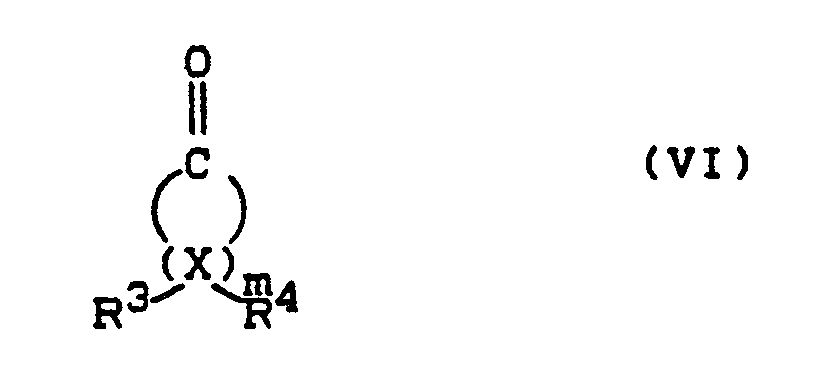
- Die Phenole der Formel (V) sind entweder literaturbekannt oder nach literaturbekannten Verfahren erhältlich. (Vgl. z.B. Ullmann, Encyklopädie der technischen Chemie, 4. Auflage, Band 15, S. 61-77.)
- Beispiele für geeignete Phenole der Formel (V) sind: Phenol, o-Kresol, m-Kresol, 2,6-Dimethylphenol, 2-Chlorphenol, 3-Chlorphenol, 2,6-Dichlorphenol, 2-Cyclohexylphenol, o-Phenylphenol und o- oder p-Benzylphenol.
- Die Ketone der Formel (VI) sind literaturbekannt (siehe beispielsweise Beilsteins Handbuch der organischen Chemie, 4. Auflage, Band 7.) Ein allgemeines Verfahren zur Herstellung von Ketonen der Formel (VI) ist beispielsweise in "Organikum" 15. Auflage 1977, VEB-Deutscher Verlag der Wissenschaften, Berlin S. 698 beschrieben.
- Beispiele für Ketone der Formel (VI) sind: 3,3-Dimethylcyclopentanon, 2,2-Dimethylcyclohexanon, 3,3-Dimethylcyclohexanon, 4,4-Dimethylcyclohexanon, 3-Ethyl-3-Methylcyclopentanon, 2,3,3-Trimethylcyclopentanon, 2,4,4-Trimethylcyclopentanon, 3,3,4-Trimethylcyclopentanon, 3,3-Dimethylcycloheptanon, 4,4-Dimethylcycloheptanon, 3-Ethyl-3-methylcyclohexanon, 4-Ethyl-4-methylcyclohexanon, 2,3,3-Trimethylcyclohexanon, 2,4,4-Trimethylcyclohexanon, 3,3,4-Trimethylcyclohexanon, 2,5,5-Trimethylcyclohexanon, 3,3,5-Trimethylcyclohexa non, 3,4,4-Trimethylcyclohexanon, 2,3,3,4-Tetramethylcyclopentanon, 2,3,4,4-Tetramethylcyclopentanon, 3,3,4,4-Tetramethylcyclopentanon, 2,2,5-Trimethylcycloheptanon, 2,2,6-Trimethylcycloheptanon, 2,6,6-Trimethylcycloheptanon, 3,3,5-Trimethylcycloheptanon, 3,5,5-Trimethylcycloheptanon, 5-Ethyl-2,5-dimethylcycloheptanon, 2,3,3,5-Tetramethylcycloheptanon, 2,3,5,5-Tetramethylcycloheptanon, 3,3,5,5-Tetramethylcycloheptanon, 4-Ethyl-2,3,4-trimethylcyclopentanon, 2-Isopropyl-4,4-dimethylcyclopentanon, 4-Isopropyl-2,4-dimethylcyclopentanon, 2-Ethyl-3,5,5-trimethylcyclohexanon, 3-Ethyl-3,5,5-trimethylcyclohexanon, 3-Ethyl-4-isopropyl-3-methyl-cyclopentanon, 4-sec. Butyl-3,3-dimethylcyclopentanon, 2-Isopropyl-3,3,4-trimethylcyclopentanon, 3-Ethyl-4-isopropyl-3-methyl-cyclohexanon, 4-Ethyl-3-isopropyl-4-methyl-cyclohexanon, 3-sec.Butyl-4,4-dimethylcyclohexanon, 3-Isopropyl-3,5,5-trimethylcyclohexanon, 4-Isopropyl-3,5,5-trimethylcyclohexanon, 3,3,5-Trimethyl-5-propylcyclohexanon, 3,5,5-Trimethyl-5-propylcyclohexanon, 2-Butyl-3,3,4-trimethylcyclopentanon, 2-Butyl-3,3,4-trimethylcyclohexanon, 4-Butyl-3,3,5-trimethylcyclohexanon, 3-Isohexyl-3-methylcyclohexanon, 5-Ethyl-2,4-diisopropyl-5-methylcyclohexanon, 2,2-Dimethylcyclooctanon, und 3,3,8-Trimethylcyclooctanon.
- Beispiele für bevorzugte Ketone sind

- Zur Bisphenolherstellung werden im allgemeinen 2 bis 10 Mol, vorzugsweise 2,5 bis 6 Mol Phenol (V) pro Mol Keton (VI), verwendet. Bevorzugte Reaktionszeiten betragen 1 bis 100 Stunden. Im allgemeinen arbeitet man bei Temperaturen von -30°C bis 300°C, vorzugsweise von -15°C bis 150°C und bei Drücken von 1 bis 20 bar, vorzugsweise von 1 bis 10 bar.
- Die Kondensation wird im allgemeinen in Gegenwart saurer Katalysatoren durchgeführt. Beispiele sind Chlorwasserstoff, Bromwasserstoff, Fluorwasserstoff, Bortrifluorid, Aluminiumtrichlorid, Zinkdichlorid, Titantetrachlorid, Zinntetrachlorid, Phosphorhalogenide, Phosphorpentoxid, Phosphorsäure, konzentrierte Salzsäure oder Schwefelsäure sowie Mischungen aus Essigsäure und Acetanhydrid. Die Verwendung saurer Ionenaustauscher ist ebenfalls möglich.
- Weiterhin kann die Umsetzung durch Zugabe von Co-Katalysatoren wie C₁-C₁₈-Alkyl-Mercaptanen, Schwefelwasserstoff, Thiophenolen, Thiosäuren und Dialkylsulfiden beschleunigt werden.
- Die Kondensation kann ohne Lösungsmittel oder in Gegenwart eines inerten Lösungsmittels (z.B. aliphatischer und aromatischer Kohlenwasserstoff, Chlorkohlenwasserstoff) durchgeführt werden.
- In den Fällen, in denen der Katalysator gleichzeitig als wasserentziehendes Mittel fungiert, ist es nicht erforderlich, zusätzlich wasserentziehende Mittel einzusetzen, letzteres ist jedoch zur Erzielung guter Umsätze in jedem Fall dann vorteilhaft, wenn der eingesetzte Katalysator das Reaktionswasser nicht bindet.
- Geeignete wasserentziehende Mittel sind beispielsweise:
Acetanhydrid, Zeolithe, Polyphosphorsäure und Phosphorpentoxid. - Erfindungsgemäß in den Mischungen verwendet werden aromatische Polyethersulfone mit der wiederkehrenden Struktureinheit
-O-E-O-E′- (VII)
worin -E- ein zweibindiger Rest eines aromatischen Sulfons der Formel (VIIIa)
-O-E-O- (IX a)
ein zweibindiger Diphenolat-Rest ist, die dadurch gekennzeichnet sind, daß von 0,1 Mol% bis 100 Mol%, vorzugsweise von 3 Mol% bis 100 Mol% und insbesondere von 10 Mol% bis 100 Mol% der Diphenolat-Reste (IX a) solche der Formel (Ia)
- Die aromatischen Polyethersulfone der Erfindung haben bevorzugt mittlere Molekulargewichte
M w (Gewichtsmittel) von 758 bis 500 000, insbesondere von 3 000 bis 200 000 und speziell von 5 000 bis 100 000 g/mol. - Aromatische Polyethersulfone sind bekannt (siehe beispielsweise GB-PS 1 078 234, US-PS 4 010 147 und EP-OS 0 135 938). Sie können beispielsweise durch Umsetzung von Dialkalisalzen von Diphenolen mit Dihalogen-diarylsulfonen in einem polaren Lösungsmittel hergestellt werden, (siehe beispielsweise GB-PS 1 078 234), wobei die Dialkalisalze der Diphenole auch in situ erzeugt werden können.
- Die in den erfindungsgemäßen Mischungen zu verwendenden Polyethersulfone können ebenfalls nach dieser Methode hergestellt werden, wobei als polares Lösungsmittel bevorzugt am Stickstoff C₁-C₅-alkylsubstituiertes Caprolactam, wie N-Methyl-caprolactam, N-Ethyl-caprolactam, N-n-Propyl-caprolactam, N-Isopropyl-caprolactam, vorzugsweise N-Methyl-caprolactam, und vorzugsweise am Stickstoff C₁-C₅-alkylsubstituierte Pyrrolidone, wie N-Methylpyrrolidon) N,N-Dimethylformamid, N,N-Dimethylacetamid, Dimethylsulfoxid, Diphenylsulfon, Sulfolan oder Tetramethylharnstoff, eingesetzt werden. Es können anteilig z.B. 0,1 bis 200 Gew.-%, bezogen auf das Gewicht des polaren Lösungsmittels, andere, weniger polare Lösungsmittel mitverwendet werden, z.B. aromatische Kohlenwasserstoffe wie Toluol, Xylol, Mesitylen, Chlorbenzol, oder aliphatische Kohlenwasserstoffe wie Benzin, Cyclohexan.
- Es wurden also zur Herstellung der erfindungsgemäß zu verwendenden Polyethersulfone mit der Struktureinheit (VII) Dialkalidiphenolate (IXb)
Alkali-O-E-O-Alkali (IX b)
mit Dihalogen-diaryl-sulfonen

worin X, R¹, R²,R³, R⁴ und m wie in Formel (I) definiert sind, und worin polare Lösungsmittel wie N-alkylierten Caprolactamen oder N-alkylierten Pyrrolidonen, vorzugsweise N-alkylierte Pyrrolidonen verwendet werden. - Geeignete Diphenole der Formel (IX) sind z.B.
Hydrochinon,
Resorcin,
Dihydroxydiphenyle,
Bis-(hydroxyphenyl)-alkane,
Bis-(hydroxyphenyl)-cycloalkane,
Bis-(hydroxyphenyl)-sulfide,
Bis-(hydroxyphenyl)-ether,
Bis-(hydroxyphenyl)-ketone,
Bis-(hydroxyphenyl)-sulfone,
Bis-(hydroxyphenyl)-sulfoxide,
α,α′-Bis(hydroxyphenyl)-diisopropylbenzole
sowie deren kernalkylierte und kernhalogenierte Verbindungen. - Diese und weitere geeignete andere Diphenole (IX) sind z.B. in den US-PS 3 028 365, 2 999 835, 3 148 172, 3 275 601, 2 991 273, 3 271 367, 3 062 781, 2 970 131 und 2 999 846, in den deutschen Offenlegungsschriften 1 570 703, 2 063 050, 2 063 052, 2 211 0956, der französischen Patentschrift 1 561 518 und in der Monographie "H. Schnell, Chemistry and Physics of Polycarbonates, Interscience Publishers, New York 1964", beschrieben.
- Bevorzugte andere Diphenole (IX) sind beispielsweise:
4,4′-Dihydroxydiphenyl,
2,2-Bis-(4-hydroxyphenyl)-propan,
2,4-Bis-(4-hydroxyphenyl)-2-methylbutan,
1,1-Bis-(4-hydroxyphenyl)-cyclohexan,
α,α′-Bis-(4-hydroxyphenyl)-p-diisopropylbenzol,
2,2-Bis-(3-methyl-4-hydroxyphenyl)-propan,
2,2-Bis-(3-chlor-4-hydroxyphenyl)-propan,
Bis-(3,5-dimethyl-4-hydroxyphenyl)-methan,
2,2-Bis-(3,5-dimethyl-4-hydroxyphenyl)-propan,
Bis-(3,5-dimethyl-4-hydroxyphenyl)-sulfon,
2,4-Bis-(3,5-dimethyl-4-hydroxyphenyl)-2-methylbutan,
1,1-Bis-(3,5-dimethyl-4-hydroxyphenyl)-cyclohexan,
α,α′-Bis-(3,5-dimethyl-4-hydroxyphenyl)-p-diisopropylbenzol,
2,2-Bis-(3,5-dichlor-4-hydroxyphenyl)-propan,
2,2-Bis-(3,5-dibrom-4-hydroxyphenyl)-propan und
4,4′-Dihydroxydiphenylsulfon. - Besonders bevorzugte andere Diphenole sind beispielsweise:
2,2-Bis-(4-hydroxyphenyl)-propan,
2,2-Bis-(3,5-dimethyl-4-hydroxyphenyl)-propan,
2,2-Bis-(3,5-dichlor-4-hydroxyphenyl)-propan,
2,2-Bis-(3,5-dibrom-4-hydroxyphenyl)-propan und
1,1-Bis-(4-hydroxyphenyl)-cyclohexan und
4,4′-Dihydroxydiphenylsulfon. - Sie können einzeln oder im Gemisch eingesetzt werden.
- Die Formel (IXa) und (IXb) stellen in durch Entfernen von 2 H-Atomen gebildeten Reste dieser Diphenole beziehungsweise die Alkalisalze dieser Verbindungen dar.
- Geeignete Dihalogendiarylsulfone (VIII) sind z.B.
4,4′-Dichlordiphenylsulfon,
4,4′-Difluordiphenylsulfon,
4-Chlor-4′-fluordiphenylsulfon,
3,3′-Dinitro-4,4′-dichlordiphenylsulfon,
3,3′-Dinitro-4,4′-difluordiphenylsulfon,
4,4′-Dibromdiphenylsulfon,
- Bevorzugt sind demnach in Formel (VIII)
Ar und Ar′ p-Phenylenreste oder mit Alkyl oder Nitrogruppen substituierte p-Phenylenreste oder Reste der Formel
und Hal = Fluor, Chlor oder Brom. - Als Alkali in den Dialkaliphenolaten (I b) und (IX b) dient vorzugsweise Natrium und Kalium.
- Als Halogen in den Dihalogendiarylsulfonen (III) dient vorzugsweise Chlor und Fluor, insbesondere Chlor.
- Bevorzugte, in den erfindungsgemäßen Mischungen zu verwendende Polyethersulfone sind solche, die mindestens 10 Mol-% der wiederkehrenden Einheit

- Diese aromatischen Polyethersulfone können bei Temperaturen von 130°C bis 320°C, bevorzugt 145°C bis 280°C und bei Drucken von 0,8 bis 10 bar, vorzugsweise 1 bis 3 bar, insbesondere bei atmosphärischem Umgebungsdruck, hergestellt werden.
- Das molare Mengenverhältnis der Alkalidiphenolate (I b) und (IX b) zu den Dihalogen-diaryl-sulfonen (VIII) liegt zwischen 0,5 und 2, bevorzugt 0,8 und 1,2, besonders bevorzugt 0,95 und 1,05, wobei für hohe Molekulargewichte ein Verhältnis von 1 oder nahe bei 1 gewählt werden muß.
- Die Menge an polaren Lösungsmitteln beträgt 0,5 bis 50, bevorzugt 2 bis 20 Gewichtsteile bezogen auf das Gesamtgewicht der Polyethersulfonbildungskomponenten.
- Die für die erfindungsgemäßen Mischungen verwendbaren Polyethersulfone können wie folgt aus den erhaltenen Reaktionsgemischen gewonnen werden.
- Man verdünnt das Reaktionsgemisch, insbesondere wenn sehr hochviskose Lösungen vorliegen, z.B. mit den polaren Reaktions-Lösemittel oder einem anderen Lösungsmittel für das Polyethersulfon, und filtriert. Nach Neutralisation des Filtrats mit einer geeigneten Säure, z.B. Essigsäure, wird das Polyethersulfon durch Eingießen in ein geeignetes Fällungsmedium, z.B. Wasser, Alkohole (wie z.B. Methanol, Isopropanol) oder Wasser-Alkohol-Gemische, z.B. H₂O/Methanol 1:1, ausgefällt, isoliert und anschließend getrocknet.
- Die für die erfindungsgemäßen Mischungen verwendbaren Polyethersulfone sind thermoplastische Kunststoffe mit hoher Wärmeformbeständigkeit.
- Sie können beispielsweise verarbeitet werden durch Extrusion, Spritzgießen, Sintern oder Verpressen.
- Gegenstand dieser Erfindung sind Mischungen enthaltend
- (a) aromatische Polyethersulfone auf Basis von Dihydroxydiphenylcycloalkanen der Formel (I)

R¹ und R² unabhängig voneinander Wasserstoff, Halogen, bevorzugt Chlor oder Brom, C₁-C₈-Alkyl, C₅-C₆-Cycloalkyl, C₆-C₁₀-Aryl, bevorzugt Phenyl und C₇-C₁₂-Aralkyl, bevorzugt Phenyl-C₁-C₄-Alkyl, insbesondere Benzyl und Cumyl,
m eine ganze Zahl von 4 bis 7, bevorzugt 4 oder 5
R³ und R⁴ für jedes X individuell wählbar, unabhängig voneinander Wasserstoff, oder C₁-C₆-Alkyl und Alkyl und
X Kohlenstoff bedeuten,
mit der Maßgabe, daß an mindestens einem Atom X R³ und R⁴ gleichzeitig Alkyl sind,
und - (b) andere organische Polymere.
- Die Mischungen enthalten im allgemeinen 0,1 bis 99,9 Gew.-% des aromatischen Polyethersulfons (a), bevorzugt 1 bis 98 Gew.-% und insbesondere 2,5 bis 90 Gew.-% und entsprechend 99,9 bis 0,1 Gew.-% der anderen organischen Polymeren, bevorzugt 99 bis 2 Gew.-%, besonders bevorzugt 97,5 bis 10 Gew.-%.
- Daneben können die Mischungen übliche Additive wie Stabilisatoren, Füllstoffe, Farbstoffe enthalten.
- Die Mischungen können mit den üblichen Methoden der Vermischung von Kunststoffen hergestellt werden, z.B. durch Schmelzkompoundieren, Mischen von Pulvern, gemeinsame Extrusion, Vermischen von Lösungen und Eindampfen, Vermischen von Latices (oder anderen Dispersionen) und gemeinsames Fällen. Im Einzelfall richtet sich die gewählte Methode nach Art und Aggregatzustand des Mischungspartners.
- Andere organische Polymere (b) im Sinne der Erfindung sind beispielsweise
- b1) amorphe Thermoplaste, vorzugsweise solche mit einer Glastemperatur von mehr als 40°C, insbesondere von 60°C bis 220°C, als auch
- b2) teilkristalline Thermoplaste, vorzugsweise solche mit einer Schmelztemperatur von mehr als 60°C, insbesondere von 80°C bis 400°C.
- Elastomere für die Komponenten (b) der erfindungsgemäßen Mischungen sind
- b3) solche Polymere, die eine Glastemperatur von unter 0°C, vorzugsweise von unter -10°C und insbesondere von -15°C bis -140°C, haben.
- Beispiele für andere amorphe Thermoplasten b1) sind amorphe Polymere aus der Klasse der Polycarbonate, Polyamide, Polyolefine, Polysulfone, Polyketone, thermoplastische Vinylpolymerisate wie Polymethylacrylsäureester oder Homopolymerisate von Vinylaromaten, Copolymerisate von Vinylaromaten oder Pfropfpolymerisate von Vinylmonomeren auf Kautschuke, Polyether, Polyimide und thermoplastische Polyurethane, aromatische Polyester (Carbonate) und flüssig-kristalline Polymere.
- Beispiele für kristalline Thermoplasten b2) sind aliphatisch-aromatische Polyester, Polyarylensulfide sowie die teilkristallinen Vertreter der vorstehend unter b1) subsummierten Thermoplasten.
- Beispiele für Elastomere b3) sind die verschiedensten Kautschuke wie Ethylen-Propylen-Kautschuk, Polyisopren, Polychloropren, Polysiloxane, ataktisches Polypropylen, Dien-, Olefin- und Acrylatkautschuke und Naturkautschuke, Styrol-Butadien-Blockcopolymere, Ethylen-Copolymerisate mit Vinylacetat oder mit (Meth)acrylsäureestern, elastische Polyurethane, soweit nicht als Thermoplasten unter b1) oder b2) subsumiert, und elastische Polycarbonat-Polyether-Blockcopolymere.
- Amorphe Thermoplasten b1) sind insbesondere bekannte Polycarbonate einschließlich der in der deutschen Patentanmeldung P 3 832 396.6 beschriebenen. Polycarbonate können sowohl Homopolycarbonate als auch Copolycarbonate sein, sie können sowohl linear als auch verzweigt sein. Besonders bevorzugtes Bisphenol für die thermoplastischen Polycarbonate (b) ist Bisphenol-A [= 2,2-Bis-(4-hydroxyphenyl)-propan].
- Thermoplastische Polycarbonate sind bekannt.
- Die Molekulargewichte
M w (Gewichtsmittelmolekulargewicht, ermittelt nach der Gelpermeationschromatographie in Tetrahydrofuran) der thermoplastischen Polycarbonate liegen zwischen 10.000 und 300.000, vorzugsweise zwischen 12.000 und 150.000 g/mol. - Die thermoplastischen Polycarbonate sind sowohl allein als auch im Gemisch als Komponente (b) der erfindungsgemäßen Mischungen verwendbar.
- Besonders bevorzugt sind Mischungen aus den aromatischen Polyethersulfonen auf Basis der Diphenole gemäß Formel (I) und aromatischen Polycarbonaten auf Basis von Bisphenol A (und gegebenenfalls bis zu 10 Gew.-% eines anderen Bisphenols) mit Molekulargewichten von 8000 bis 150 000 g/mol, bevorzugt 10 000 bis 120 000 g/mol und besonders bevorzugt 15 000 bis 80 000 g/mol. Die Mischungen enthalten im allgemeinen 99,5 bis 50 Gew.-% Polycarbonat und 0,1 bis 50 Gew.-% aromatisches Polyethersulfon. Es ist wichtig, daß in den gesamten, in der Mischung enthaltenen Bisphenolresten 1 bis 30 Mol-%. Bisphenol A-Reste und 99 bis 70 Gew.-% Reste des Bisphenols der Formel (I) oder 99 bis 70 Mol % Bisphenol A-Reste und 1 bis 30 Mol %. Reste des Bisphenols der Formel (I) sind. Diese Mischungen haben hohe Wärmeformbeständigkeit und sind transparent. Daher kommen sie für optische Anwendungen in Frage.
- Bevorzugte andere Thermoplasten (b) zur Herstellung der erfindungsgemäßen Mischungen sind auch aliphatisch-aromatische thermoplastische Polyester, besonders bevorzugt Polyalkylenterephthalate, also beispielsweise solche auf Basis von Ethylenglykol, Propandiol-1,3, Butandiol-1,4, Hexandiol-1,6 und 1,4-Bis-hydroxymethylcyclohexan.
- Die Molekulargewichte (
M w) dieser Polyalkylenterephthalate liegen zwischen 10.000 und 80.000. Die Polyalkylenterephthalate können nach bekannten Verfahren beispielsweise aus Terephthalsäuredialkylester und dem entsprechenden Diol durch Umesterung erhalten werden (s. z. B. US-Patente 2 647 885, 2 643 989, 2 534 028, 2 578 660, 2 742 494, 2 901 466). - Diese Polyester sind bekannt. Weiterhin bevorzugte andere Thermoplasten sind thermoplastische Polyamide.
- Es eignen sich alle teilkristallinen Polyamide, insbesondere Polyamid-6, Polyamid-6,6 und teilkristalline Copolyamide auf Basis dieser beiden Komponenten. Weiterhin kommen teilkristalline Polyamide in Betracht, deren Säurekomponente insbesondere ganz oder teilweise aus Adipinsäure beziehungsweise Caprolactam, aus Terephthalsäure und/oder Isophthalsäure und/oder Korksäure und/oder Sebacinsäure und/oder Azelainsäure und/oder Dodecandicarbonsäure und/oder Adipinsäure und/oder einer Cyclohexandicarbonsäure besteht, und deren Diaminkomponente ganz oder teilweise insbesondere aus m- und/oder p-Xylylendiamin und/oder Hexamethylendiamin und/oder 2,2,4- und/oder 2,4,4-Trimethylhexamethyldiamin und/oder Isophorondiamin bestehen und deren Zusammensetzungen im Prinzip aus dem Stand der Technik bekannt sind (siehe beispielsweise Encyclopedie of Polymers, Vol. 11, S. 315 ff).
- Außerdem sind geeignet, teilkristalline Polyamide, die ganz oder teilweise aus Lactamen mit 6 bis 12 C-Atomen, gegebenenfalls unter Mitverwendung einer oder mehrerer der obengenannten Ausgangskomponenten, hergestellt werden.
- Besonders bevorzugte teilkristalline Polyamide sind Polyamid-6 und Polyamid-6,6 oder Copolyamide mit geringem Anteil, bis etwa 10 Gewichtsprozent an anderen Co-Komponenten.
- Geeignete Polyamide sind auch amorphe Polyamide, erhalten beispielsweise durch Polykondensation von Diaminen, wie beispielsweise von Hexamethylendiaminen, Decamethylendiamin, 2,2,4- beziehungsweise 2,4,4-Trimethylhexamethylendiamin, m- beziehungsweise p-Xylylendiamin, Bis-(4-aminocyclohexyl)-methan, Gemischen aus 4,4′- und 2,2′-Diaminodicyclohexylmethanen, 2,2-Bis-(4-aminocyclohexyl)-propan, 3,3′-Dimethyl-4,4′-diamino-dicyclohexylmethan, 3-Aminoethyl-3,5,5-trimethyl-cyclohexylamin, 2,5-Bis-(aminomethyl)-norbornan, 2,6-Bis-(aminomethyl)-norbornan, 1,4-Diamino-methylcyclohexan und von beliebigen Gemischen dieser Diamine, mit Dicarbonsäuren wie beispielsweise mit Oxalsäure, Adipinsäure, Azelainsäure, Decandicarbonsäure, Heptadecandicarbonsäure, 2,2,4-Trimethyladipinsäure, 2,4,4-Trimethyladipinsäure, Isophthalsäure und Terephthalsäure und mit beliebigen Gemischen dieser Dicarbonsäuren. Es sind somit auch amorphe Copolyamide einbezogen, die durch Polykondensation mehrerer der vorstehend genannten Diamine und/oder Dicarbonsäuren erhalten werden. Ferner sind amorphe Copolyamide einbezogen, die unter Mitverwendung von ω-Aminocarbonsäuren wie ω-Aminocapronsäure, ω-Aminoundecansäure oder ω-Aminolaurinsäure oder von deren Lactamen hergestellt sind.
- Besonders geeignete, amorphe, thermoplastische Polyamide sind solche, die aus Isophthalsäure, Hexamethylendiamin und weiteren Diaminen wie 4,4′-Diaminodicyclohexylmethan, Isophorondiamin, 2,2,4- beziehungsweise 2,4,4-Trimethylhexamethylendiamin, 2,5- und/oder 2,6-Bis-(aminomethyl)-norbornan erhältlich sind, solche, die aus Isophthalsäure, 4,4′-Diamino-di-cyclohexylmethan und ω-Caprolactam erhältlich sind, solche, die aus Isophthalsäure, 3,3-Dimethyl-4,4′-diamino-dicyclohexylmethan und ω-Laurinlactam erhältlich sind, und solche, die aus Terephthalsäure und dem Isomerengemisch aus 2,2,4- und 2,4,4-Trimethylhexamethylendiamin erhältlich sind.
- Anstelle des reinen 4,4′-Diaminodicyclohexylmethans können auch Gemische der stellungsisomeren Diaminodicyclohexylmethane eingesetzt werden, die sich zusammensetzen aus
70 bis 99 Mol-% des 4,4′-Diaminoisomeren
1 bis 30 Mol-% des 2,4′-Diaminoisomeren
0 bis 2 Mol-% des 2,2′-Diaminoisomeren
und gegebenenfalls entsprechend höherkondensierten Diaminen, die durch Hydrierung von Diaminodiphenylmethan technischer Qualität erhalten werden. - Geeignete thermoplastische Polyamide können auch aus Mischungen von teilkristallinen und amorphen Polyamiden bestehen, wobei vorzugsweise der Anteil an amorphem Polyamid unter dem Anteil an teilkristallinem Polyamid liegt. Auch die amorphen Polyamide und deren Herstellung sind aus dem Stand der Technik bekannt (siehe beispielsweise Ullmann, Enzyklopädie d. technischen Chemie, Band 19, S. 50).
- Bevorzugte andere Thermoplasten b) sind auch thermoplastische lineare oder verzweigte Polyarylensulfide. Sie haben Struktureinheiten der allgemeinen Formel

- Polyarylensulfide und ihre Herstellung sind bekannt (siehe beispielsweise US-PS 33 54 129 und EP-OS 0 171 021).
- Geeignet als andere Thermoplasten b) sind auch thermoplastische Polyarylensulfone, die nicht auf der Basis von Diphenolen der Formel (I) hergestellt worden sind.
- Geeignete Polyarylensulfone haben mittlere Gewichtsmittelmolekulargewichte
M w (gemessen nach der Lichtstreumethode in CHCl₃) zwischen 1.000 und 200.000, vorzugsweise zwischen 20.000 und 60.000. Beispiele dafür sind die nach bekannten Verfahren erhältlichen Polyarylensulfone aus 4,4′-Dichlordiphenylsulfon und einem Bisphenol, insbesondere 2,2-Bis-(4-hydroxyphenyl)-propan, mit mittleren GewichtsmittelmolekulargewichtenM w von 2.000 bis 200.000. - Diese Polyarylensulfone sind bekannt (siehe beispielsweise US-PS 3 264 536, DE-AS 1 794 171, GB-PS 1 264 900, US-PS 3 641 207, EP-A-00 38 028, DE-OS 3 601 419 und DE-OS 3 601 420). Die geeigneten Polyarylensulfone können auch in bekannter Weise verzweigt sein (siehe beispielsweise DE-OS 2 305 413).
- Bevorzugte andere Thermoplasten b) sind auch thermoplastische Polyphenylenoxide, vorzugsweise Poly-(2,6-dialkyl-1,4-phenylenoxide). Erfindungsgemäß geeignete Polyphenylenoxide haben Gewichtsmittelmolekulargewichte
M w (gemessen nach der Lichtstreumethode in Chloroform) zwischen 2.000 und 100.000, vorzugsweise zwischen 20.000 und 60.000. Diese Polyphenylenoxide sind bekannt. - Die bevorzugten Poly-(2,6-dialkyl-1,4-phenylenoxide) können nach bekannten Verfahren durch oxidierende Kondensation von 2,6-Dialkylphenolen mit Sauerstoff in Anwesenheit von Katalysatorkombinationen aus Kupfersalzen und tertiären Aminen erhalten werden (siehe beispielsweise DE-OS 2 126 434 und US-PS 3 306 875).
- Geeignete Poly-(2,6-dialkyl-1,4-phenylenoxide) sind insbesondere die Poly-[2,6-di(C₁-C₄-alkyl)-1,4-phenylenoxide] wie beispielsweise Poly-(2,6-dimethyl-1,4-phenylenoxid).
- Bevorzugte andere Thermoplasten b) sind auch aromatische Polyetherketone (siehe beispielsweise GB-PS 1 078 234, US-PS 4 010 147 und EP-OS 0 135 938).
- Sie enthalten das wiederkehrende Strukturelement
-O-E-O-E′- ,
worin -E′- der zweibindige Rest eines Bisarylketons und -O-E-O- ein zweibindiger Diphenolat-Rest ist. - Sie können beispielsweise gemäß GB-PS 1 078 234 aus Dialkalidiphenolaten der Formel Alkali-O-E-O-Alkali und Bis-(halogenaryl)-ketonen der Formel Hal-E′-Hal (mit Hal = Halogen) hergestellt werden. Ein geeignetes Dialkalidiphenolat ist z. B. das des 2,2-Bis-(4-hydroxyphenyl)-propans, ein geeignetes Bis-(halogenaryl)-keton ist das 4,4′-Dichlorbenzophenon.
- Bevorzugte andere Thermoplasten b) sind auch thermoplastische Vinyl-Polymerisate.
- Vinyl-Polymerisate im Sinne dieser Erfindung sind Homopolymerisate von Vinylverbindungen, Copolymerisate von Vinylverbindungen und Pfropfpolymerisate von Vinylverbindungen auf Kautschuke.
- Erfindungsgemäß geeignete Homopolymerisate und Copolymerisate sind solche von Styrol, α-Methylstyrol, Acrylnitril, Methacrylnitril, C₁-C₁₂-(Cyclo)-Alkyl-Estern der (Meth)Acrylsäure, C₁-C₄-Carbonsäure-Vinylester, wobei die Copolymerisate aus Mischungen dieser Vinyl-Verbindungen nach bekannten Methoden erhältlich sind.
- Die Homo- beziehungsweise Copolymerisate sollen Grenzviskositäten (Staudinger-Indices) zwischen 0,3 und 1,5 dl/g (gemessen bei 23°C in Toluol in bekannter Weise) haben.
- Geeignete Vinylpolymerisate sind beispielsweise thermoplastische Poly-C₁-C₄-alkylmethacrylate, beispielsweise solche des Methyl-, Ethyl-, Propyl- oder Butylmethacrylsäureesters, vorzugsweise des Methyl- oder Ethyl-methacrylsäureesters. Es sind sowohl Homopolymerisate als auch Copolymerisate dieser Methacrylsäureester darunter zu verstehen. Darüber hinaus können andere, ethylenisch ungesättigte copolymerisierbare Monomere wie beispielsweise (Meth)Acrylnitril, (α-Methyl)-Styrol, Bromstyrol, Vinylacetat, Acrylsäure- C₁-C₈-alkylester, (Meth)Acrylsäure, Ethylen, Propylen und N-Vinylpyrrolidon in untergeordneten Mengen einpolymerisiert sein.
- Die erfindungsgemäß geeigneten thermoplastischen Poly-C₁-C₄-alkyl-methacrylate sind literaturbekannt oder nach literaturbekannten Verfahren erhältlich.
- Geeignete Vinylpolymerisate sind auch Copolymerisate aus Styrol oder α-Methylstyrol und Acrylnitril, die gegebenenfalls bis zu 40 Gew.-% Ester der Acrylsäure oder Methacrylsäure, insbesondere Methylmethacrylat oder n-Butylacrylat enthalten. Styrolderivate müssen auf jeden Fall als Monomere enthalten sein. Die Styrolderivate sind dabei in Anteilen zwischen 100 und 10 Gew.-%, bevorzugt zwischen 90 bis 20 Gew.-%, besonders bevorzugt zwischen 80 bis 30 Gew.-%, enthalten, die nach üblichen Verfahren wie radikalische Polymerisation in Masse, Lösung, Suspension oder Emulsion, bevorzugt aber durch radikalische Emulsionspolymerisation in Wasser erhalten werden.
- Geeignete Pfropfpolymerisate entstehen durch Polymerisation der oben genannten Vinylmonomeren oder Vinylmonomerengemische in Gegenwart von Kautschuken mit Glastemperaturen <0°C, vorzugsweise <-20°C. Die Pfropfpolymerisate enthalten in der Regel 1 bis 85 Gew.-%, bevorzugt 10 bis 80 Gew.-%, Kautschuk. Die Pfropfpolymerisate lassen sich durch übliche Verfahren in Lösung, Masse oder Emulsion, bevorzugt in Emulsion, herstellen, wobei Vinylmonomerengemische simultan oder sukzessive pfropfpolymerisiert werden können.
- Geeignete Kautschuke sind vorzugsweise Dienkautschuke und Acrylatkautschuke.
- Dienkautschuke sind beispielsweise Polybutadien, Polyisopren und Copolymerisate von Butadien mit bis zu 35 Gew.-% Comonomeren wie Styrol, Acrylnitril, Methylmethacrylat und C₁-C₆-Alkylacrylaten.
- Acrylatkautschuke sind beispielsweise vernetzte, teilchenförmige Emulsionspolymerisate aus C₁-C₆-Alkylacrylaten, insbesondere C₂-C₆-Alkylacrylaten, gegebenenfalls im Gemisch mit bis zu 15 Gew.-%. anderen, ungesättigten Monomeren wie Styrol, Methylmethacrylat, Butadien, Vinylmethylether, Acrylnitril, und aus wenigstens einem polyfunktionellem Vernetzer wie beispielsweise Divinylbenzol, Glykol-bis-acrylate, Bisacrylamide, Phosphorsäuretriallylester, Zitronensäuretriallylester, Allylester von Acrylsäure und Methacrylsäure, Triallylisocyanurat, wobei die Acrylatkautschuke bis zu 4 Gew.-% der vernetzenden Comonomere enthalten können.
- Zur Herstellung der Pfropfpolymerisate sind auch Gemische von Dien- mit Acrylatkautschuken sowie Kautschuke mit einer Kern-Mantel-Struktur geeignet.
- Die Kautschuke müssen zur Pfropfpolymerisation in Form diskreter Teile vorliegen, z. B. als Latex. Diese Teilchen haben i.a. mittlere Durchmesser von 10 nm bis 2.000 nm.
- Die Pfropfpolymerisate können nach bekannten Verfahren, beispielsweise durch radikalische Emulsionspfropfpolymerisation der Vinylmonomeren in Gegenwart von Kautschuklatices bei Temperaturen von 50 bis 90°C unter Verwendung wasserlöslicher Initiatoren wie Peroxodisulfat oder mit Hilfe von Redoxinitiatoren, erzeugt werden.
- Bevorzugt sind radikalisch hergestellte Emulsionspfropfpolymerisate auf teilchenförmige, hochvernetzte Kautschuke (Dien- oder Alkylacrylatkautschuke) mit Gelgehalten > 80 Gew.-% und mittleren Teilchendurchmessern (d50) von 80 bis 800 nm.
- Besonders geeignet sind technisch gebräuchliche ABS-Polymerisate.
- Mischungen von Vinyl-Homopolymerisaten und/oder Vinyl-Copolymerisaten mit Pfropfpolymerisaten sind ebenfalls geeignet.
- Bevorzugte andere Thermoplasten b) sind auch thermoplastische Polyurethane. Dies sind Reaktionsprodukte aus Diisocyanaten, ganz oder überwiegend aliphatischen Oligo- und/oder Polyestern und/oder -ethern sowie einem oder mehreren Kettenverlängerern. Diese thermoplastischen Polyurethane sind im wesentlichen linear und besitzen thermoplastische Verarbeitungscharakteristiken.
- Die thermoplastischen Polyurethane sind bekannt oder können nach bekannten Verfahren (siehe beispielsweise US-PS 3 214 411, J.H. Saunders und K.C. Frisch, "Polyurethanes, Chemistry and Technology", Vol II, Seiten 299 bis 451, Interscience Publishers, New York, 1964 und Mobay Chemical Coporation, "A Processing Handbook for Texin Urethane Elastoplastic Materials", Pittsburgh, PA) hergestellt werden.
- Ausgangsmaterialien zur Herstellung der Oligoester und Polyester sind beispielsweise Adipinsäure, Bernsteinsäure, Subecinsäure, Sebacinsure, Oxalsäure, Methyladipinsäure, Glutarsäure, Pimelinsäure, Azelainsäure, Phthalsäure, Terephthalsäure und Isophthalsäure.
- Adipinsäure ist hierbei bevorzugt.
- Als Glykole zur Herstellung der Oligoester und Polyester kommen beispielsweise Ethylenglykol, 1,2- und 1,3-Propylenglykol, 1,2-, 1,3-, 1,4-, 2,3-, 2,4-Butandiol, Hexandiol, Bishydroxymethylcyclohexan, Diethylenglykol und 2,2-Diemthyl-propylenglykol in Betracht. Darüberhinaus können gemeinsam mit den Glykolen kleine Mengen, bis zu 1 Mol-%, tri- oder höher funktionelle Alkohole, z.B. Trimethylolpropan, Glycerin, Hexantriol usw. eingesetzt werden.
- Die resultierenden Hydroxyl-oligo oder -polyester haben ein Molekulargewicht von wenigstens 600, eine Hydroxylzahl von ca. 25 bis 190, vorzugsweise ca. 40 bis 150, eine Säurezahl von ca. 0,5 bis 2 und einen Wassergehalt vo ca. 0,01 bis 0,2 %.
- Oligoester bzw. Polyester sind auch oligomere oder polymere Lactone, wie beispielsweise Oligo-caprolacton oder Poly-caprolacton, und aliphatische Polycarbonate, wie beispielsweise Poly-butandiol-(1,4)-carbonat oder Polyhexandiol-(1,6)-carbonat.
- Ein besonders geeigneter Oligorest, der als Ausgangsmaterial für die thermoplastischen Polyurethane verwendet werden kann, wird aus Adipinsäure und einem Glykol hergestellt, das wenigstens eine primäre Hydroxylgruppe besitzt. Die Kondensation wird beendet, wenn eine Säurezahl von 10, vorzugsweise ca. 0,5 bis 2 erreicht ist. Das während der Reaktion entstehende Wasser wird damit gleichzeitig oder hinterher abgetrennt, so daß der Wassergehalt am Ende im Bereich von ungefähr 0,01 bis 0,05 %, vorzugsweise 0,01 bis 0,02 liegt.
- Oligo- bzw. Polyether zur Herstellung der thermoplastischen Polyurethane sind beispielsweise solche auf Basis von Tetramethylenglykol, Propylenglykol und Ethylenglkyol.
- Polyacetale sind ebenfalls als Polyether zu verstehen und einsetzbar.
- Die Oligoether bzw. Polyether sollen mittlere Molekulargewichte
M n (Zahlenmittel, ermittelt über die OH-Zahl der Produkte) von 600 bis 2000 vorzugsweise von 1000 bis 2000 haben. - Als organisches Diisocyanat wird zur Herstellung der Polyurethane vorzugsweise 4,4′-Diphenylmethan-diisocyanat verwendet. Es sollte weniger als 5 % 2,4′-Diphenylmethan-diisocyanat und weniger als 2 % des Dimeren von Diphenylmethan-diisocyanat enthalten. Es ist weiterhin wünschenswert, daß die Acidität, gerechnet als HCl im Bereich von c. 0,005 bis 0,2 % liegt. Die Acidität, gerechnet als % HCl, wird durch Extraktion des Chlorids aus dem Isocyanat in heißer, wäßriger Methanol-Lösung oder durch Freisetzung des Chlorides bei Hydrolyse mit Wasser und Titration des Extraktes mit Standard-Silbernitrat-Lösung bestimmt, um die darin vorhandene Chlorid-Ionen-Konzentration zu erhalten.
- Es können auch andere Diisocyanate zur Herstellung der thermoplastischen Polyurethane verwendet werden, beispielsweise die Diisocyante des Ethylens, Ethylidens, Propylens, Butylens, Cyclopentylens-1,3, Cyclohexylens-1,4, Cyclohexylens-1,2, des 2,4-Tolylens, des 2,6-Tolylens, des p-Phenylens, des n-Phenylens, des Xylens, des 1,4-Naphthylens, des 1,5-Naphthylens, des 4,4′-Diphenylens, das 2,2-Diphenyl-propan-4,4′-diisocyanat, das Azobenzol-4,4′-diisocyanat, des Diphenylsulfon-4,4′-diisocyanat, das Dichlorhexamethylen-diisocyanat, das Pentamethylen-diisocyanat, das Hexamethylen-diisocyanat, das 1-Chlorbenzol-2,4-diisocyanat, das Furfuryldiisocyanat, das Dicyclohexylmethan-diisocyanat, das Isophorondiisocyanat, das Diphenylethan-diisocyanat und Bis(-isocyanatophenyl)-ether von Ethylenglykol, Butandiol etc.
- Als Kettenverlängerer können organische difunktionelle Verbindungen verwendet werden, die aktiven, mit Isocyanaten reaktiven, Wasserstoff enthalten, z.B. Diole, Hydroxycarbonsäuren, Dicarbonsäuren, Diamine und Alkanolamine und Wasser. Als solche sind beispielsweise Ethylen-, Propylen-, Butylenglykol, 1,4-Butandiol, Butandiol, Butindiol, Xylylenglykol, Amylenglykol, 1,4-Phenylen-bis-ß-hydroxy-ethylether, 1,3-Phenylen-bis-ß-hydroxyethylether, Bis-(hydroxymethyl-cyclohexan), Hexandiol, Adipinsäure, ω-Hydroxycapronsäure, Thiodiglykol, Ethylendiamin-, Propylen, Butylen-, Hexamethylen-, Cyclohexylen-, Phenylen-, Toluylen-, Xylylendiamin, Diaminodicyclohexylmethan, Isophorondiamin, 3,3′-Dichlorbenzidin, 3,3′-Dinitrobenzidin, Ethanolamin, Aminopropylalkohol, 2,2-Dimethyl-propanolamin, 3-Aminocyclohexylalkohol und p-Aminobenzylalkohol zu nennen. Das Molverhältnis Oligo- bzw. Polyester zu bifunktionellem Kettenverlängerer bewegt sich im Bereich 1:1 bis 1:50, vorzugsweise 1:2 bis 1:30.
- Außer difunktionellen Kettenverlängerern können auch in untergeordneten Mengen bis zu etwa 5 Mol-%, bezogen auf Mole eingesetzten bifunktionellen Kettenverlängerer, trifunktionelle oder mehr als trifunktionelle Kettenverlängerer eingesetzt werden.
- Derartige trifunktionelle oder mehr als trifunktionelle Kettenverlängerer sind beispielsweise Glycerin, Trimethylolpropan, Hexantriol, Pentaerythrit und Triethanolamin.
- Monofunktionelle Komponenten, beispielsweise Butanol, können auch zur Herstellung der thermoplastischen Polyurethane eingesetzt werden.
- Die als Bausteine für die thermoplastischen Polyurethane genannten Diisocyanate, Oligoester, Polyester, Polyether Kettenverlängerer und monofunktionellen Komponenten sind entweder literaturbekannt oder nach literaturbekannten Verfahren erhältlich.
- Die bekannte Herstellung der Polyurethane kann beispielsweise wie folgt durchgeführt werden:
- So können die Oligo- bzw. Polyester, die organischen Diisocyanate und die Kettenverlängerer für sich vorzugsweise auf eine Temperatur von ca. 50 bis 220°C erhitzt und dann vermischt werden. Vorzugsweise werden die Oligo- bzw. Polyester zunächst einzeln erhitzt, dann mit den Kettenverlängerern gemischt und die erhaltene Mischung mit dem vorerhitzten Isocyanat vermischt.
- Das Mischen der Ausgangskomponenten zur Herstellung der Polyurethane kann mit irgendeinem mechanischen Rührer erfolgen, der intensive Mischung innerhalb kurzer Zeit erlaubt. Falls die Viskosität der Mischung während des Rührens vorzeitig zu schnell steigen sollte, kann entweder die Temperatur gesenkt oder eine kleine Menge (0,001 bis 0,05 Gew.-%, bezogen auf Ester) Zitronensäure oder ähnliches zugegeben werden, um die Geschwindigkeit der Reaktion zu verringern. Zur Erhöhung der Reaktionsgeschwindigkeit können geeignete Katalysatoren, wie z.B. tertiäre Amine, die in dem US-Patent 2 729 618 genannt werden, zur Anwendung kommen.
- Bevorzugte andere Thermoplasten sind auch sogenannte "LC-Polymere". Als LC-Polymere werden Polymere bezeichnet, die flüssigkristalline Schmelzen bilden können. Derartige Polymere, die auch als "thermotrop" bezeichnet werden, sind hinreichend bekannt (siehe beispielsweise EP-OS 0 131 846, EP-OS 0 132 637 und EP-OS 0 134 959). In den genannten Literaturstellen ist weitere Literatur angezogen und darüber hinaus die Ermittlung des flüssigkristallinen Zustands von Polymerschmelzen beschrieben.
- "LC-Polymere" sind beispielsweise aromatische Polyester auf Basis von gegebenenfalls substituierter p-Hydroxybenzoesäure, gegebenenfalls substituierten Iso- und/oder Terephthalsäuren, 2,7-Dihydroxynaphthalin und anderen Diphenolen (EP-OS 0 131 846), aromatische Polyester auf Basis von gegebenenfalls substituierter p-Hydroxybenzoesäure, Diphenolen, Kohlensäure und gegebenenfalls aromatischen Dicarbonsäuren (EP-OS 0 132 637) und aroma tischer Polyester auf Basis von gegebenenfalls substituierter p-Hydroxybenzoesäure, 3-Chlor-4-hydroxybenzoesäure, Isophthalsäure, Hydrochinon und 3,4′-und/oder 4,4′-Dihydroxydiphenyl, 3,4′- und/oder 4,4′-Dihydroxydiphenyl, 3,4′- und/oder 4,4′-Dihydroxydiphenylether und/oder 3,4′- und/oder 4,4′-Dihydroxydiphenylsulfid (EP-OS 0 134 959).
- Die LC-Polymere haben eine Persistenzlänge bei Zimmertemperatur zwischen 18 und 1300 Å, bevorzugt zwischen 25 und 300 Å, insbesondere zwischen 25 und 150 Å.
- Die Persistenzlänge eines Polymeren bei Zimmertemperatur charakterisiert die mittlere Verknäuelung einer Molekülkette in einer verdünnten Lösung unter Theta-Bedingungen (vgl. z.B. P.J. Flory "Principles of Polymer Chemistry"), Cornell Univ. Press, Ithaca, New York) und die Hälfte der Kuhnschen Schrittlänge. Die Persistenzlänge kann mit verschiedenen Methoden in verdünnten Lösungen bestimmt werden, z.B. durch Lichtstreuung und Röntgenkleinwinkel-Messungen. Man kann nach geeigneter Präparation die Persistenzlängen auch mit Hilfe der Neutronenkleinwinkelstreuung im Festkörper bestimmen. Weitere theroretische und experimentelle Methoden sind z.B. in J.H. Wendorff in "Liquid Crystalline Order in Polymers", ed. A. Blumstein, Academic Press 1978, S. f16 ff sowie in den in "S.M. Aharoni Macromolecules 19, (1986), S. 429 ff" angegebenen Referenzen beschrieben.
- Bevorzugte Elastomere b3) für die Komponente b) zur Herstellung der erfindungsgemäßen Mischungen sind die vorstehend erwähnten Polyurethane, soweit sie elastischer Natur sind, Styrol, Butadien-Blockcopolymere, die teilweise hydriert sein können (beispielsweise Kraton G® der Shell), die vorstehend für die Pfropfpolymerisate erwähnten Kautschuke, die Pfropfpolymerisate selbst, soweit sie elastisch sind sowie elastische Polycarbonat-Polyether-Blockcopolymere.
- Diese Elastomeren sind bekannt.
- Die erfindungsgemäßen Polymermischungen können als wärmeformbeständige thermoplastische Formmassen verwendet werden, Bevorzugt dienen sie der Herstellung von Folien nach allgemein bekannten Verfahren. Soweit die aus den Mischungen hergestellten Formteile transparent sind, sind sie insbesondere für optische Anwendungen verwendbar.
- Die Herstellung der Folien ist im folgenden kurz beschrieben:
- Die erfindungsgemäßen Folien haben Dicken von 1-3000 µm, bevorzugt 1,2 bis 1500 µm. Sie können mono- oder biaxial verstreckt und/oder gereckt werden, bevorzugt im Verhältnis 1:1,5 bis 1:5,0. Diese Folien sind besonders geeignet als wärmeformbeständige Folien.
- Aus den erfindungsgemäßen Polymermischungen können Folien durch Extrusion, Tiefziehen oder durch Gießen von Lösungen in üblichen Lösungsmitteln (Methylenchlorid, Dimethylformamid, N-Methylpyrrolidon, Tetrahydrofuran, Dioxan, Dioxolan) hergestellt werden. Durch Extrusion - im allgemeinen bei 80 bis 450°C - hergestellte Folien werden häufig nach Abkühlen um mindestens 50°C (aber nicht unterhalb Zimmertemperatur) biaxial verstreckt, Zum Tiefziehen geeignete Folien kann man auch durch Auswalzen von Blöcken aus den Polymermischungen bei Temperaturen bis 350°C erhalten,
- Gießfolien erhält man durch Ausgießen von konzentrierten Lösungen der Polymermischungen auf ebene Oberflächen und Verdampfen des Lösungsmittels bei 30 bis 270°C. Als ebene Fläche kann man auch die Oberfläche einer Flüssigkeit verwenden, die eine höhere Dichte als die Polymerlösung hat und weder die Polymeren noch deren Lösungsmittel auflöst.
- Die erfindungsgemäßen Folien können allein oder im Verbund mit Folien aus anderen Polymeren verwendet werden.
-
- 1. Herstellung eines Bisphenols der Formel (A)

- 2. Herstellung der für die erfindungsgemäßen Mischungen verwendbaren Polyethersulfone
- In einer mit Stickstoff gespülten Rührapparatur, die mit einem Wasserabscheider versehen ist, werden 31,04 g (0,1 Mol) des Bisphenols der Formel (A), 28,72 g 4,4′-Dichlordiphenylsulfon, 200 ml N-Methylpyrrolidon, 100 ml Toluol und 18 g Kaliumcarbonat vorgelegt. Es wird destillativ azeotrop entwässert, bis der Ansatz wasserfrei ist. Durch Abdestillieren von Toluol wird die Sumpftemperatur innerhalb einer Stunde auf 180°C erhöht. Der Ansatz wird 4 h bei 180°C gerührt und anschließend für 1 h auf 190-195°C aufgeheizt. Danach wird mit 200 ml N-Methylpyrrolidon verdünnt und heiß abgesaugt. Das Filtrat wird mit Essigsäure neutralisiert und das Polymer durch Fällung in einer Methanol-Wasser-Mischung (1:1) daraus isoliert. Zur weiteren Reinigung wird das Polymer in Methylenchlorid gelöst und anschließend in Methanol gefällt. Abschließend wird 14 h bei 120°C im Vakuum getrocknet. Ausbeute: 35,8 g; relative Viskosität gemessen in Methylenchlorid bei 25°C und einer Polymerkonzentration von 5 g pro Liter: 1,19, Glastemperatur, bestimmt mit Hilfe der DSC-Methode bei einer Aufheizgeschwindigkeit von 20 K/min.: 236°C.
- Mit Hilfe der sogenannten Thermopmechanischen Analyse TMA wurde das Erweichungsverhalten der Probe bei einer Aufheizrate von 1 K/min durch das Eindringverhalten eines kreisrunden Stempels (Durchmesser 1 mm) und einer aufliegenden Last von 50 Pond bestimmt. Erst oberhalb 241°C drang der Stempel signifikant in die Probe ein.
- In einer Rührapparatur entsprechend Beispiel 2a werden nach dem gleichen Verfahren wie in Beispiel 2a 15,52 g (0,05 Mol) des Bisphenols der Formel (A), 11,4 g Bisphenol A (2,2-Bis-(4-hydroxyphenyl)-propan; 0,05 Mol), 28,72 g 4,4′-Dichlordiphenylsulfon, 200 ml N-Methylpyrrolidon, 100 ml Toluol und 18 g Kaliumcarbonat miteinander umgesetzt. Nach Aufarbeitung wie in Beispiel 2a wurde ein Polysulfon mit einer relativen Lösungsviskosität, gemessen wie in Beispiel 2a, von 1.160 isoliert. Glastemperatur nach DSC: 213°C, TMA-Analyse: Eindringpunkt etwa 218°C.
- Entsprechend Beispiel 2 a wurden 31,04 g des Bisphenols der Formel (A), 28,72 g 4,4′-Dichlordiphenylsulfon, 200 ml N-Methylcaprolactam, 100 ml Toluol und 18 g Kaliumcarbonat miteinander umgesetzt. Anschließend wurde eine weitere Stunde bei 210°C, danach noch eine Stunde bei 230°C gerührt. Nach Aufarbeitung entsprechend Beispiel 2a wurden 39,4 g Polyethersulfon isoliert; relative Lösungsviskosität 1,131, gemessen wie in Beispiel 2a), Glastemperatur nach DSC: 228°C, TMA-Erweichungspunkt, bestimmt analog Beispiel 2a: 230°C.
- 3. Für die nachfolgenden Beispiele verwendete Polymere b):
- a) Poly-para-phenylensulfid - hergestellt nach EP-PS 142 024, Beispiel 2, mit einer Schmelzviskosität von 120 Pa.s, gemessen bei 306°C und einer Scherrate von 1000/sec.
- b) Polycarbonat aus dem Bisphenol-A mit einer in Methylenchlorid bei 25°C und einer Konzentration von c=0,5 g/dl Polymer gemessenen relativen Viskosität von 1.28 und einem
M w (gewichtsgemitteltes Molekulargewicht) von 28.500 g/mol. Glastemperatur - gemessen mit der DSC bei einer Aufheizgeschwindigkeit von 20 K/min - ca. 146°C.
- 4. Herstellung der Mischungen
- a) 15 g des Poly-para-phenylensulfid 3 a) wurde bei 310°C mit 15 g des Polyethersulfons 2) in einem Kleinkneter innig vermischt. Anschließend wurde aus der vermischten Menge bei 280°C unter Anwendung eines Druckes von 200 bar nach 5 minütigem Pressen ein Formteil einer Dicke von etwa 1 mm gepreßt. Die Wärmformbeständigkeit der Mischung kann z.B. durch den Schubmodul, gemessen mit einem Torsionspendel der Firma Brabender bei einer Zugbelastung von 10 pond und einer Aufheizgeschwindigkeit von 1 K/min, charakterisiert werden. Die unten stehende Tabelle I zeigt den deutlich höheren Modul der erfindungsge mäßen Mischung im Vergleich zu dem nicht erfindungsgemäßen Poly-para-phenylensulfid
- b) 10 g des Poly-ethersulfons 2) wurden mit 1 g Polycarbonat 3 b) in 100 ml Methylenchlorid gelöst, die Lösungen zusammengemischt und eingedickt. Anschließend wurde eine Folie durch Spreiten auf einer Glasplatte hergestellt. Die Folie hatte eine Dicke von 150 µm. Die Folie war tranparent und hatte eine Glastemperatur von 214°C.
- c) 2 g Polyethersulfon 2) wurde wie unter 4 b) - jedoch mit 8 g Polycarbonat 3 b) vermischt. Die hergestellte Folie hatte eine Dicke von 154 µm. An dieser Folie wurde die Glastemperatur gemessen. Ergebnis (nach DSC): 168°C. Im Vergleich zu einer Folie aus Polycarbonat 3 b) (Dicke: 140 µm) wurde die Permeabilität bezüglich der Gase Sauerstoff und Kohlendioxid gemessen, wobei zum Vergleich auch die Polycarbonatfolie aus einer eingedickten Lösung von Methylenchlorid gewonnen wurde. Beide Folien, die Vergleichsfolie aus Polycarbonat 3 b) und die erfindungsgemäße Folie, wurden bei 100°C 2 h unter Vakkum getrocknet, anschließend wurde mit Druckmeßkondensatoren für eine Folie mit einer Querschnittfläche von etwa 4 cm² die Permeabilität für einige Gase gemessen. Die Tabelle III vergleicht Permeabilität und Wärmeformbeständigkeit. Sie zeigt, daß die erfindungsgemäße Folie bei mindestens gleicher Permeabilität eine verbesserte Wärmeformbeständigkeit hat.
- Analog Beispiel 4a wurden 10 g Substanz 3a) und 30 g Substanz 2b) bei 335°C innig vermischt und im Torsionspendel charakterisiert. Ergebnisse siehe Tabelle I.
- Analog Beispiel 4a wurden 20 g Substanz 3a) und 30 g Substanz 2c) bei 330°C innig vermischt und im Tosionspendel charakterisiert. Ergebnisse siehe Tabelle I.
Tabelle I: Vergleich des Schubmoduls Substanz Schubmodul in MPa bei T = 110°C T = 140°C T = 200°C PPS 3 a) (Vergleich) 150 110 98 Erf. gem. Beispiel 4 a) 750 500 450 Beispiel 4 d) 800 610 420 Beispiel 4 e) 790 615 460 Tabelle II: Vergleich der Glastemperatur und Transparenz Substanz Glastemperatur Aussehen Polycarbonat 3 b) (Vergleich) 146°C transparent Erf. gem. Beispiel 4 b) 214°C transparent Erf. gem. Beispiel 4 c) 168°C transparent 
Claims (4)

R¹ und R² unabhängig voneinander Wasserstoff, Halogen, C₁-C₈-Alkyl, C₅-C₆-Cycloalkyl, C₆-C₁₀-Aryl und C₇-C₁₅-Aralkyl,
m eine ganze Zahl von 4 bis 7,
R³ und R⁴ für jedes X individuell wählbar, unabhängig voneinander Wasserstoff oder C₁-C₆-Alkyl und
X Kohlenstoff bedeuten,
mit der Maßgabe, daß an mindestens einem Atom X R³ und R⁴ gleichzeitig Alkyl ist,
und andere organische Polymere.
Applications Claiming Priority (2)
| Application Number | Priority Date | Filing Date | Title |
|---|---|---|---|
| DE3836176A DE3836176A1 (de) | 1988-10-24 | 1988-10-24 | Polymermischungen |
| DE3836176 | 1988-10-24 |
Publications (2)
| Publication Number | Publication Date |
|---|---|
| EP0365916A1 true EP0365916A1 (de) | 1990-05-02 |
| EP0365916B1 EP0365916B1 (de) | 1993-12-08 |
Family
ID=6365794
Family Applications (1)
| Application Number | Title | Priority Date | Filing Date |
|---|---|---|---|
| EP89118840A Expired - Lifetime EP0365916B1 (de) | 1988-10-24 | 1989-10-11 | Polymermischungen |
Country Status (4)
| Country | Link |
|---|---|
| EP (1) | EP0365916B1 (de) |
| JP (1) | JP3174304B2 (de) |
| DE (2) | DE3836176A1 (de) |
| ES (1) | ES2059668T3 (de) |
Cited By (44)
| Publication number | Priority date | Publication date | Assignee | Title |
|---|---|---|---|---|
| EP0413222A3 (en) * | 1989-08-17 | 1991-09-18 | Bayer Ag | Polyarylene sulfide resin composition |
| EP0735079A1 (de) * | 1995-03-31 | 1996-10-02 | Teijin Limited | Folie aus einem aromatischen Polyäthersulfon, Verfahren zu ihrer Herstellung und Lösungszusammensetzung zu ihrer Herstellung |
| EP0744433A1 (de) * | 1995-05-23 | 1996-11-27 | Sekisui Chemical Co., Ltd. | Verfahren zur Herstellung von einem Film aus Polysulfonharz und Verzögerungsschicht |
| US5645766A (en) * | 1995-03-30 | 1997-07-08 | Teijin Limited | Film of aromatic polyethersulfone process for the production thereof and solution composition for the production thereof |
| DE102007003648A1 (de) | 2007-01-18 | 2008-07-24 | Rebac Gmbh | Kupferenthaltende Formmasse aus Polyester, ihre Herstellung und Verwendung |
| DE102007003662A1 (de) | 2007-01-18 | 2008-07-24 | Rebac Gmbh | Kupfer(I)enthaltende Formmasse aus Polyester, ihre Herstellung und Verwendung |
| DE102007003649A1 (de) | 2007-01-18 | 2008-07-24 | Rebac Gmbh | Kupfer(II)enthaltende Formmasse aus Polyester, ihre Herstellung und Verwendung |
| DE102008038410A1 (de) | 2007-09-11 | 2009-03-12 | Basf Se | Flammgeschützte Polyester |
| DE202008012066U1 (de) | 2008-08-26 | 2010-01-28 | Lanxess Deutschland Gmbh | Querträgermodul für ein Kraftfahrzeug |
| DE102008042325A1 (de) | 2008-09-24 | 2010-04-01 | Isringhausen Gmbh & Co. Kg | Gurtholm für Integralsitze |
| WO2010089241A1 (de) | 2009-02-04 | 2010-08-12 | Basf Se | Schwarze, uv-stabile thermoplastische formmassen |
| DE102009034767A1 (de) | 2009-07-25 | 2011-01-27 | Lanxess Deutschland Gmbh & Co. Kg | Organoblechstrukturbauteil |
| DE102009052110A1 (de) | 2009-11-05 | 2011-05-12 | Faurecia Innenraum Systeme Gmbh | Kraftfahrzeug-Frontend |
| EP2377703A1 (de) | 2010-04-15 | 2011-10-19 | LANXESS Deutschland GmbH | Türstrukturmodul |
| EP2377747A1 (de) | 2010-04-15 | 2011-10-19 | LANXESS Deutschland GmbH | Querträgermodul für ein Kraftfahrzeug |
| WO2011138384A1 (de) | 2010-05-05 | 2011-11-10 | Basf Se | Bauteil umfassend ein einlegeteil und eine kunststoffummantelung sowie verfahren zu seiner herstellung |
| WO2011144502A1 (de) | 2010-05-18 | 2011-11-24 | Basf Se | Lasertransparente polyester |
| WO2011154518A1 (de) | 2010-06-11 | 2011-12-15 | Basf Se | Lasertransparentes pbt mit organischen additiven |
| WO2012013564A1 (de) | 2010-07-30 | 2012-02-02 | Basf Se | Flammgeschützte formmassen |
| WO2012020112A1 (de) | 2010-08-13 | 2012-02-16 | Basf Se | Expandierbare granulate auf polyesterbasis |
| WO2012022669A2 (de) | 2010-08-19 | 2012-02-23 | Basf Se | Nanocompositblends mit polyestern |
| DE102011087869A1 (de) | 2010-12-08 | 2012-09-06 | Basf Se | Lasermarkierbare flammgeschützte Formkörper |
| WO2012119966A1 (de) | 2011-03-07 | 2012-09-13 | Basf Se | Lasertransparente polyester |
| WO2012119996A1 (de) | 2011-03-08 | 2012-09-13 | Basf Se | Lasertransparente polyester mit carbonsäuresalzen |
| WO2012119967A1 (de) | 2011-03-08 | 2012-09-13 | Basf Se | Lasertransparente polyester mit anorganischen salzen |
| WO2012143314A1 (de) | 2011-04-20 | 2012-10-26 | Basf Se | Lasertransparente polyester mit alkalinitriten |
| US8318843B2 (en) | 2010-05-18 | 2012-11-27 | Basf Se | Laser-transparent polyesters |
| WO2012163822A1 (de) | 2011-06-01 | 2012-12-06 | Basf Se | Polyester mit styrolcopolymeren |
| WO2013189779A1 (de) | 2012-06-18 | 2013-12-27 | Basf Se | Flammgeschützte polyester mit polyacrylnitrilhomopolymerisaten |
| WO2014029641A1 (de) | 2012-08-20 | 2014-02-27 | Basf Se | Langfaserverstärkte flammgeschützte polyester |
| US8791179B2 (en) | 2011-03-07 | 2014-07-29 | Basf Se | Laser-transparent polyesters |
| WO2014146912A1 (de) | 2013-03-18 | 2014-09-25 | Basf Se | Polyester für profilextrusion und/oder rohrextrusion |
| US8859664B2 (en) | 2011-04-20 | 2014-10-14 | Basf Se | Laser-transparent polyesters with alkali metal nitrites |
| US8889768B2 (en) | 2010-06-11 | 2014-11-18 | Basf Se | Laser-transparent PBT with organic additives |
| EP2816081A1 (de) | 2013-06-17 | 2014-12-24 | Basf Se | Polyesterformmassen mit geringer TOC Emission |
| US8962717B2 (en) | 2012-08-20 | 2015-02-24 | Basf Se | Long-fiber-reinforced flame-retardant polyesters |
| US9249270B2 (en) | 2010-08-13 | 2016-02-02 | Basf Se | Expandable pelletized materials based on polyester |
| WO2017063841A1 (de) | 2015-10-14 | 2017-04-20 | Basf Se | Polyesterblend mit halogenfreiem flammschutz |
| WO2018050426A1 (de) | 2016-09-14 | 2018-03-22 | Basf Se | Polyester für profilextrusion und/oder rohrextrusion |
| WO2021191178A1 (en) | 2020-03-23 | 2021-09-30 | Basf Se | Container for ingredients for making beverages |
| WO2021224136A1 (en) | 2020-05-06 | 2021-11-11 | Basf Se | Flame retarded polyester blend |
| WO2022029260A1 (de) | 2020-08-07 | 2022-02-10 | Basf Se | Thermoplastische mischungen |
| WO2023088806A1 (de) | 2021-11-22 | 2023-05-25 | Basf Se | Thermoplastische mischungen |
| WO2025252781A1 (en) | 2024-06-05 | 2025-12-11 | Basf Se | Flame retardant polyamides for improved lsr compression set |
Families Citing this family (5)
| Publication number | Priority date | Publication date | Assignee | Title |
|---|---|---|---|---|
| US20060069236A1 (en) * | 2004-09-27 | 2006-03-30 | General Electric Company | Polyethersulfone compositions with high heat and good impact resistance |
| US20100249311A1 (en) | 2007-11-20 | 2010-09-30 | Basf Se | Use of thermoplastic molding materials for gid/wit |
| US20120009427A1 (en) * | 2010-07-08 | 2012-01-12 | Christopher Hable | Solvent cast flame retardant polycarbonate coatings, films and laminates |
| US8618201B2 (en) | 2011-03-08 | 2013-12-31 | Basf Se | Laser-transparent polyesters with inorganic salts |
| JP7415427B2 (ja) * | 2019-10-16 | 2024-01-17 | 王子ホールディングス株式会社 | 樹脂フィルム、コンデンサ用金属化フィルム、及びコンデンサ |
Citations (3)
| Publication number | Priority date | Publication date | Assignee | Title |
|---|---|---|---|---|
| EP0000732A1 (de) * | 1977-08-04 | 1979-02-21 | Bayer Ag | Abmischungen von verzweigtem Polyarylsulfon-Polycarbonat sowie ihre Verwendung zur Herstellung von Extrusionsfolien |
| EP0000733B1 (de) * | 1977-08-04 | 1980-08-20 | Bayer Ag | Polyarylsulfon-Polycarbonat-Abmischungen und ihre Verwendung zur Herstellung von Extrusionsfolien |
| EP0133907A1 (de) * | 1983-06-30 | 1985-03-13 | Amoco Corporation | Polyarylethersulfon enthaltende Mischungen |
-
1988
- 1988-10-24 DE DE3836176A patent/DE3836176A1/de not_active Withdrawn
-
1989
- 1989-10-11 DE DE89118840T patent/DE58906372D1/de not_active Expired - Fee Related
- 1989-10-11 EP EP89118840A patent/EP0365916B1/de not_active Expired - Lifetime
- 1989-10-11 ES ES89118840T patent/ES2059668T3/es not_active Expired - Lifetime
- 1989-10-23 JP JP27393489A patent/JP3174304B2/ja not_active Expired - Fee Related
Patent Citations (3)
| Publication number | Priority date | Publication date | Assignee | Title |
|---|---|---|---|---|
| EP0000732A1 (de) * | 1977-08-04 | 1979-02-21 | Bayer Ag | Abmischungen von verzweigtem Polyarylsulfon-Polycarbonat sowie ihre Verwendung zur Herstellung von Extrusionsfolien |
| EP0000733B1 (de) * | 1977-08-04 | 1980-08-20 | Bayer Ag | Polyarylsulfon-Polycarbonat-Abmischungen und ihre Verwendung zur Herstellung von Extrusionsfolien |
| EP0133907A1 (de) * | 1983-06-30 | 1985-03-13 | Amoco Corporation | Polyarylethersulfon enthaltende Mischungen |
Cited By (55)
| Publication number | Priority date | Publication date | Assignee | Title |
|---|---|---|---|---|
| EP0413222A3 (en) * | 1989-08-17 | 1991-09-18 | Bayer Ag | Polyarylene sulfide resin composition |
| US5759449A (en) * | 1995-03-30 | 1998-06-02 | Teijin Limited | Film of aromatic polyethersulfone, process for the production thereof, and solution composition for the production thereof |
| US5958305A (en) * | 1995-03-30 | 1999-09-28 | Teijin Limited | Film of aromatic polyethersulfone, process for the production thereof, and solution composition for the production thereof |
| US5645766A (en) * | 1995-03-30 | 1997-07-08 | Teijin Limited | Film of aromatic polyethersulfone process for the production thereof and solution composition for the production thereof |
| EP0735079A1 (de) * | 1995-03-31 | 1996-10-02 | Teijin Limited | Folie aus einem aromatischen Polyäthersulfon, Verfahren zu ihrer Herstellung und Lösungszusammensetzung zu ihrer Herstellung |
| US5611985A (en) * | 1995-05-23 | 1997-03-18 | Sekisui Chemical Co., Ltd. | Method of manufacturing a polysulfone resin film and a retardation film |
| EP0744433A1 (de) * | 1995-05-23 | 1996-11-27 | Sekisui Chemical Co., Ltd. | Verfahren zur Herstellung von einem Film aus Polysulfonharz und Verzögerungsschicht |
| DE102007003648A1 (de) | 2007-01-18 | 2008-07-24 | Rebac Gmbh | Kupferenthaltende Formmasse aus Polyester, ihre Herstellung und Verwendung |
| DE102007003662A1 (de) | 2007-01-18 | 2008-07-24 | Rebac Gmbh | Kupfer(I)enthaltende Formmasse aus Polyester, ihre Herstellung und Verwendung |
| DE102007003649A1 (de) | 2007-01-18 | 2008-07-24 | Rebac Gmbh | Kupfer(II)enthaltende Formmasse aus Polyester, ihre Herstellung und Verwendung |
| DE102008038410A1 (de) | 2007-09-11 | 2009-03-12 | Basf Se | Flammgeschützte Polyester |
| DE202008012066U1 (de) | 2008-08-26 | 2010-01-28 | Lanxess Deutschland Gmbh | Querträgermodul für ein Kraftfahrzeug |
| DE102008039652A1 (de) | 2008-08-26 | 2010-03-11 | Lanxess Deutschland Gmbh | Querträgermodul für ein Kraftfahrzeug |
| DE202008017621U1 (de) | 2008-09-24 | 2010-08-19 | Isringhausen Gmbh & Co. Kg | Gurtholm für Integralsitze |
| DE102008042325A1 (de) | 2008-09-24 | 2010-04-01 | Isringhausen Gmbh & Co. Kg | Gurtholm für Integralsitze |
| WO2010089241A1 (de) | 2009-02-04 | 2010-08-12 | Basf Se | Schwarze, uv-stabile thermoplastische formmassen |
| DE102009034767A1 (de) | 2009-07-25 | 2011-01-27 | Lanxess Deutschland Gmbh & Co. Kg | Organoblechstrukturbauteil |
| DE202010001918U1 (de) | 2009-07-25 | 2011-06-27 | LANXESS Deutschland GmbH, 51373 | Organoblechstrukturbauteil |
| DE102009052110A1 (de) | 2009-11-05 | 2011-05-12 | Faurecia Innenraum Systeme Gmbh | Kraftfahrzeug-Frontend |
| WO2011054754A1 (de) | 2009-11-05 | 2011-05-12 | Faurecia Kunststoff Automobilsysteme Gmbh | Kraftfahrzeug-frontend |
| EP2377703A1 (de) | 2010-04-15 | 2011-10-19 | LANXESS Deutschland GmbH | Türstrukturmodul |
| EP2377704A1 (de) | 2010-04-15 | 2011-10-19 | LANXESS Deutschland GmbH | Türstrukturmodul |
| EP2377747A1 (de) | 2010-04-15 | 2011-10-19 | LANXESS Deutschland GmbH | Querträgermodul für ein Kraftfahrzeug |
| EP2377746A1 (de) | 2010-04-15 | 2011-10-19 | LANXESS Deutschland GmbH | Querträgermodul für ein Kraftfahrzeug |
| US8474902B2 (en) | 2010-04-15 | 2013-07-02 | Lanxess Deutschland Gmbh | Transverse-member module for a motor-vehicle |
| WO2011138384A1 (de) | 2010-05-05 | 2011-11-10 | Basf Se | Bauteil umfassend ein einlegeteil und eine kunststoffummantelung sowie verfahren zu seiner herstellung |
| WO2011144502A1 (de) | 2010-05-18 | 2011-11-24 | Basf Se | Lasertransparente polyester |
| US8318843B2 (en) | 2010-05-18 | 2012-11-27 | Basf Se | Laser-transparent polyesters |
| WO2011154518A1 (de) | 2010-06-11 | 2011-12-15 | Basf Se | Lasertransparentes pbt mit organischen additiven |
| US8889768B2 (en) | 2010-06-11 | 2014-11-18 | Basf Se | Laser-transparent PBT with organic additives |
| WO2012013564A1 (de) | 2010-07-30 | 2012-02-02 | Basf Se | Flammgeschützte formmassen |
| WO2012020112A1 (de) | 2010-08-13 | 2012-02-16 | Basf Se | Expandierbare granulate auf polyesterbasis |
| US9249270B2 (en) | 2010-08-13 | 2016-02-02 | Basf Se | Expandable pelletized materials based on polyester |
| WO2012022669A2 (de) | 2010-08-19 | 2012-02-23 | Basf Se | Nanocompositblends mit polyestern |
| DE102011087869A1 (de) | 2010-12-08 | 2012-09-06 | Basf Se | Lasermarkierbare flammgeschützte Formkörper |
| US8791179B2 (en) | 2011-03-07 | 2014-07-29 | Basf Se | Laser-transparent polyesters |
| WO2012119966A1 (de) | 2011-03-07 | 2012-09-13 | Basf Se | Lasertransparente polyester |
| WO2012119967A1 (de) | 2011-03-08 | 2012-09-13 | Basf Se | Lasertransparente polyester mit anorganischen salzen |
| WO2012119996A1 (de) | 2011-03-08 | 2012-09-13 | Basf Se | Lasertransparente polyester mit carbonsäuresalzen |
| WO2012143314A1 (de) | 2011-04-20 | 2012-10-26 | Basf Se | Lasertransparente polyester mit alkalinitriten |
| US8859664B2 (en) | 2011-04-20 | 2014-10-14 | Basf Se | Laser-transparent polyesters with alkali metal nitrites |
| WO2012163822A1 (de) | 2011-06-01 | 2012-12-06 | Basf Se | Polyester mit styrolcopolymeren |
| WO2013189779A1 (de) | 2012-06-18 | 2013-12-27 | Basf Se | Flammgeschützte polyester mit polyacrylnitrilhomopolymerisaten |
| WO2014029641A1 (de) | 2012-08-20 | 2014-02-27 | Basf Se | Langfaserverstärkte flammgeschützte polyester |
| US8962717B2 (en) | 2012-08-20 | 2015-02-24 | Basf Se | Long-fiber-reinforced flame-retardant polyesters |
| WO2014146912A1 (de) | 2013-03-18 | 2014-09-25 | Basf Se | Polyester für profilextrusion und/oder rohrextrusion |
| EP2816081A1 (de) | 2013-06-17 | 2014-12-24 | Basf Se | Polyesterformmassen mit geringer TOC Emission |
| WO2017063841A1 (de) | 2015-10-14 | 2017-04-20 | Basf Se | Polyesterblend mit halogenfreiem flammschutz |
| WO2018050426A1 (de) | 2016-09-14 | 2018-03-22 | Basf Se | Polyester für profilextrusion und/oder rohrextrusion |
| US11401412B2 (en) | 2016-09-14 | 2022-08-02 | Basf Se | Polyester for profile extrusion and/or pipe extrusion |
| WO2021191178A1 (en) | 2020-03-23 | 2021-09-30 | Basf Se | Container for ingredients for making beverages |
| WO2021224136A1 (en) | 2020-05-06 | 2021-11-11 | Basf Se | Flame retarded polyester blend |
| WO2022029260A1 (de) | 2020-08-07 | 2022-02-10 | Basf Se | Thermoplastische mischungen |
| WO2023088806A1 (de) | 2021-11-22 | 2023-05-25 | Basf Se | Thermoplastische mischungen |
| WO2025252781A1 (en) | 2024-06-05 | 2025-12-11 | Basf Se | Flame retardant polyamides for improved lsr compression set |
Also Published As
| Publication number | Publication date |
|---|---|
| EP0365916B1 (de) | 1993-12-08 |
| JP3174304B2 (ja) | 2001-06-11 |
| DE58906372D1 (de) | 1994-01-20 |
| JPH02166162A (ja) | 1990-06-26 |
| DE3836176A1 (de) | 1990-05-03 |
| ES2059668T3 (es) | 1994-11-16 |
Similar Documents
| Publication | Publication Date | Title |
|---|---|---|
| EP0365916B1 (de) | Polymermischungen | |
| EP0362603B1 (de) | Aromatische Polyethersulfone | |
| EP0364741B1 (de) | Aromatische Polyetherketone | |
| EP0362646B1 (de) | Mischungen von speziellen, neuen Polycarbonaten mit anderen Thermoplasten oder mit Elastomeren | |
| EP0365917B1 (de) | Polymermischungen | |
| EP0359953B1 (de) | Dihydroxydiphenylcycloalkane, ihre Herstellung und ihre Verwendung zur Herstellung von hochmolekularen Polycarbonaten | |
| EP0402678A2 (de) | Verwendung von Polycarbonatmischungen in der Optik | |
| US5227458A (en) | Polycarbonate from dihydroxydiphenyl cycloalkane | |
| DE3833953A1 (de) | Mischungen von speziellen, neuen polycarbonaten mit anderen thermoplasten oder mit elastomeren | |
| EP0415066A2 (de) | Ternäre, thermoplastische Mischungen | |
| EP0422441A2 (de) | Thermoplastische Mischungen | |
| DD297605A5 (de) | Verbundfolien mit polycarbonaten | |
| DE3836169A1 (de) | Folien aus aromatischen polyetherketonen | |
| DE3836162A1 (de) | Folien aus aromatischen polyethersulfonen | |
| DE3840166A1 (de) | Folien aus mischungen von speziellen, neuen polycarbonaten mit anderen thermoplasten oder mit elastomeren | |
| DE3837090A1 (de) | Folien aus aromatischen polycarbonaten | |
| EP0417462A1 (de) | Folien aus Polyarylensulfid-Mischungen und ihre Verwendung zur Gastrennung | |
| DE3927137A1 (de) | Polyarylensulfid-mischungen |
Legal Events
| Date | Code | Title | Description |
|---|---|---|---|
| PUAI | Public reference made under article 153(3) epc to a published international application that has entered the european phase |
Free format text: ORIGINAL CODE: 0009012 |
|
| 17P | Request for examination filed |
Effective date: 19891011 |
|
| AK | Designated contracting states |
Kind code of ref document: A1 Designated state(s): BE DE ES FR GB IT NL |
|
| 17Q | First examination report despatched |
Effective date: 19920814 |
|
| GRAA | (expected) grant |
Free format text: ORIGINAL CODE: 0009210 |
|
| AK | Designated contracting states |
Kind code of ref document: B1 Designated state(s): BE DE ES FR GB IT NL |
|
| REF | Corresponds to: |
Ref document number: 58906372 Country of ref document: DE Date of ref document: 19940120 |
|
| GBT | Gb: translation of ep patent filed (gb section 77(6)(a)/1977) |
Effective date: 19940124 |
|
| ITF | It: translation for a ep patent filed | ||
| ET | Fr: translation filed | ||
| PLBE | No opposition filed within time limit |
Free format text: ORIGINAL CODE: 0009261 |
|
| STAA | Information on the status of an ep patent application or granted ep patent |
Free format text: STATUS: NO OPPOSITION FILED WITHIN TIME LIMIT |
|
| ITTA | It: last paid annual fee | ||
| REG | Reference to a national code |
Ref country code: ES Ref legal event code: FG2A Ref document number: 2059668 Country of ref document: ES Kind code of ref document: T3 |
|
| 26N | No opposition filed | ||
| PGFP | Annual fee paid to national office [announced via postgrant information from national office to epo] |
Ref country code: GB Payment date: 19971002 Year of fee payment: 9 |
|
| PGFP | Annual fee paid to national office [announced via postgrant information from national office to epo] |
Ref country code: ES Payment date: 19971008 Year of fee payment: 9 |
|
| PG25 | Lapsed in a contracting state [announced via postgrant information from national office to epo] |
Ref country code: GB Free format text: LAPSE BECAUSE OF NON-PAYMENT OF DUE FEES Effective date: 19981011 |
|
| PG25 | Lapsed in a contracting state [announced via postgrant information from national office to epo] |
Ref country code: ES Free format text: LAPSE BECAUSE OF THE APPLICANT RENOUNCES Effective date: 19981013 |
|
| GBPC | Gb: european patent ceased through non-payment of renewal fee |
Effective date: 19981011 |
|
| REG | Reference to a national code |
Ref country code: ES Ref legal event code: FD2A Effective date: 20001009 |
|
| PGFP | Annual fee paid to national office [announced via postgrant information from national office to epo] |
Ref country code: DE Payment date: 20040910 Year of fee payment: 16 |
|
| PGFP | Annual fee paid to national office [announced via postgrant information from national office to epo] |
Ref country code: FR Payment date: 20041013 Year of fee payment: 16 |
|
| PGFP | Annual fee paid to national office [announced via postgrant information from national office to epo] |
Ref country code: BE Payment date: 20041027 Year of fee payment: 16 |
|
| PGFP | Annual fee paid to national office [announced via postgrant information from national office to epo] |
Ref country code: NL Payment date: 20041029 Year of fee payment: 16 |
|
| PG25 | Lapsed in a contracting state [announced via postgrant information from national office to epo] |
Ref country code: IT Free format text: LAPSE BECAUSE OF NON-PAYMENT OF DUE FEES;WARNING: LAPSES OF ITALIAN PATENTS WITH EFFECTIVE DATE BEFORE 2007 MAY HAVE OCCURRED AT ANY TIME BEFORE 2007. THE CORRECT EFFECTIVE DATE MAY BE DIFFERENT FROM THE ONE RECORDED. Effective date: 20051011 |
|
| PG25 | Lapsed in a contracting state [announced via postgrant information from national office to epo] |
Ref country code: BE Free format text: LAPSE BECAUSE OF NON-PAYMENT OF DUE FEES Effective date: 20051031 |
|
| PG25 | Lapsed in a contracting state [announced via postgrant information from national office to epo] |
Ref country code: NL Free format text: LAPSE BECAUSE OF NON-PAYMENT OF DUE FEES Effective date: 20060501 |
|
| PG25 | Lapsed in a contracting state [announced via postgrant information from national office to epo] |
Ref country code: DE Free format text: LAPSE BECAUSE OF NON-PAYMENT OF DUE FEES Effective date: 20060503 |
|
| PG25 | Lapsed in a contracting state [announced via postgrant information from national office to epo] |
Ref country code: FR Free format text: LAPSE BECAUSE OF NON-PAYMENT OF DUE FEES Effective date: 20060630 |
|
| NLV4 | Nl: lapsed or anulled due to non-payment of the annual fee |
Effective date: 20060501 |
|
| REG | Reference to a national code |
Ref country code: FR Ref legal event code: ST Effective date: 20060630 |
|
| BERE | Be: lapsed |
Owner name: *BAYER A.G. Effective date: 20051031 |