EP0366042A2 - Adsorbant pour résolution optique et méthode de résolution l'employant - Google Patents
Adsorbant pour résolution optique et méthode de résolution l'employant Download PDFInfo
- Publication number
- EP0366042A2 EP0366042A2 EP89119647A EP89119647A EP0366042A2 EP 0366042 A2 EP0366042 A2 EP 0366042A2 EP 89119647 A EP89119647 A EP 89119647A EP 89119647 A EP89119647 A EP 89119647A EP 0366042 A2 EP0366042 A2 EP 0366042A2
- Authority
- EP
- European Patent Office
- Prior art keywords
- adsorbent
- group
- optical resolution
- polymer
- optically active
- Prior art date
- Legal status (The legal status is an assumption and is not a legal conclusion. Google has not performed a legal analysis and makes no representation as to the accuracy of the status listed.)
- Ceased
Links
- 239000003463 adsorbent Substances 0.000 title claims abstract description 55
- 230000003287 optical effect Effects 0.000 title claims abstract description 43
- 238000000034 method Methods 0.000 title claims description 42
- 239000000178 monomer Substances 0.000 claims abstract description 43
- 229920006037 cross link polymer Polymers 0.000 claims abstract description 23
- 125000000391 vinyl group Chemical group [H]C([*])=C([H])[H] 0.000 claims abstract description 22
- 229920002554 vinyl polymer Polymers 0.000 claims abstract description 21
- 125000004435 hydrogen atom Chemical group [H]* 0.000 claims abstract description 8
- 125000004453 alkoxycarbonyl group Chemical group 0.000 claims abstract description 6
- 125000002496 methyl group Chemical group [H]C([H])([H])* 0.000 claims abstract description 5
- 230000000379 polymerizing effect Effects 0.000 claims abstract description 4
- 125000001183 hydrocarbyl group Chemical group 0.000 claims abstract 2
- 229920000642 polymer Polymers 0.000 claims description 39
- 239000000203 mixture Substances 0.000 claims description 25
- 239000002245 particle Substances 0.000 claims description 13
- 238000004587 chromatography analysis Methods 0.000 claims description 11
- -1 5-methyl-2-(1-methylethyl)-cyclohexyl Chemical class 0.000 claims description 6
- 150000002009 diols Chemical group 0.000 claims description 5
- 125000003396 thiol group Chemical group [H]S* 0.000 claims description 4
- 125000000217 alkyl group Chemical group 0.000 claims description 3
- 125000005843 halogen group Chemical group 0.000 claims description 3
- 125000003710 aryl alkyl group Chemical group 0.000 claims description 2
- 125000003118 aryl group Chemical group 0.000 claims description 2
- 125000000113 cyclohexyl group Chemical group [H]C1([H])C([H])([H])C([H])([H])C([H])(*)C([H])([H])C1([H])[H] 0.000 claims description 2
- 150000001924 cycloalkanes Chemical class 0.000 claims 1
- YXFVVABEGXRONW-UHFFFAOYSA-N Toluene Chemical compound CC1=CC=CC=C1 YXFVVABEGXRONW-UHFFFAOYSA-N 0.000 description 27
- IJGRMHOSHXDMSA-UHFFFAOYSA-N Atomic nitrogen Chemical compound N#N IJGRMHOSHXDMSA-UHFFFAOYSA-N 0.000 description 20
- 229920000578 graft copolymer Polymers 0.000 description 14
- 229920001577 copolymer Polymers 0.000 description 13
- 239000000243 solution Substances 0.000 description 13
- OKKJLVBELUTLKV-UHFFFAOYSA-N Methanol Chemical compound OC OKKJLVBELUTLKV-UHFFFAOYSA-N 0.000 description 12
- 238000010521 absorption reaction Methods 0.000 description 11
- 238000000862 absorption spectrum Methods 0.000 description 11
- 238000004132 cross linking Methods 0.000 description 11
- 229910052757 nitrogen Inorganic materials 0.000 description 10
- DVWQNBIUTWDZMW-UHFFFAOYSA-N 1-naphthalen-1-ylnaphthalen-2-ol Chemical compound C1=CC=C2C(C3=C4C=CC=CC4=CC=C3O)=CC=CC2=C1 DVWQNBIUTWDZMW-UHFFFAOYSA-N 0.000 description 9
- CSCPPACGZOOCGX-UHFFFAOYSA-N Acetone Chemical compound CC(C)=O CSCPPACGZOOCGX-UHFFFAOYSA-N 0.000 description 9
- 238000012856 packing Methods 0.000 description 8
- STVZJERGLQHEKB-UHFFFAOYSA-N ethylene glycol dimethacrylate Substances CC(=C)C(=O)OCCOC(=O)C(C)=C STVZJERGLQHEKB-UHFFFAOYSA-N 0.000 description 7
- XLYOFNOQVPJJNP-UHFFFAOYSA-N water Substances O XLYOFNOQVPJJNP-UHFFFAOYSA-N 0.000 description 7
- RYHBNJHYFVUHQT-UHFFFAOYSA-N 1,4-Dioxane Chemical compound C1COCCO1 RYHBNJHYFVUHQT-UHFFFAOYSA-N 0.000 description 6
- JFLWLYFJFFNEMV-JTQLQIEISA-N 2-methyl-n-[(1s)-1-phenylethyl]prop-2-enamide Chemical compound CC(=C)C(=O)N[C@@H](C)C1=CC=CC=C1 JFLWLYFJFFNEMV-JTQLQIEISA-N 0.000 description 6
- LYCAIKOWRPUZTN-UHFFFAOYSA-N Ethylene glycol Chemical compound OCCO LYCAIKOWRPUZTN-UHFFFAOYSA-N 0.000 description 6
- 238000004440 column chromatography Methods 0.000 description 6
- 238000000280 densification Methods 0.000 description 6
- 238000000921 elemental analysis Methods 0.000 description 6
- 239000003999 initiator Substances 0.000 description 6
- 239000007788 liquid Substances 0.000 description 6
- 239000002904 solvent Substances 0.000 description 6
- DBCAQXHNJOFNGC-UHFFFAOYSA-N 4-bromo-1,1,1-trifluorobutane Chemical compound FC(F)(F)CCCBr DBCAQXHNJOFNGC-UHFFFAOYSA-N 0.000 description 5
- 230000000052 comparative effect Effects 0.000 description 5
- 150000001875 compounds Chemical class 0.000 description 5
- 125000003700 epoxy group Chemical group 0.000 description 5
- 150000002148 esters Chemical class 0.000 description 5
- 238000001914 filtration Methods 0.000 description 5
- 238000006116 polymerization reaction Methods 0.000 description 5
- 229910001220 stainless steel Inorganic materials 0.000 description 5
- 239000010935 stainless steel Substances 0.000 description 5
- MYRTYDVEIRVNKP-UHFFFAOYSA-N 1,2-Divinylbenzene Chemical compound C=CC1=CC=CC=C1C=C MYRTYDVEIRVNKP-UHFFFAOYSA-N 0.000 description 4
- QRIMLDXJAPZHJE-UHFFFAOYSA-N 2,3-dihydroxypropyl 2-methylprop-2-enoate Chemical compound CC(=C)C(=O)OCC(O)CO QRIMLDXJAPZHJE-UHFFFAOYSA-N 0.000 description 4
- SMZOUWXMTYCWNB-UHFFFAOYSA-N 2-(2-methoxy-5-methylphenyl)ethanamine Chemical compound COC1=CC=C(C)C=C1CCN SMZOUWXMTYCWNB-UHFFFAOYSA-N 0.000 description 4
- NIXOWILDQLNWCW-UHFFFAOYSA-N 2-Propenoic acid Natural products OC(=O)C=C NIXOWILDQLNWCW-UHFFFAOYSA-N 0.000 description 4
- CERQOIWHTDAKMF-UHFFFAOYSA-N Methacrylic acid Chemical compound CC(=C)C(O)=O CERQOIWHTDAKMF-UHFFFAOYSA-N 0.000 description 4
- QAOWNCQODCNURD-UHFFFAOYSA-N Sulfuric acid Chemical compound OS(O)(=O)=O QAOWNCQODCNURD-UHFFFAOYSA-N 0.000 description 4
- 239000007864 aqueous solution Substances 0.000 description 4
- 238000010559 graft polymerization reaction Methods 0.000 description 4
- 238000005406 washing Methods 0.000 description 4
- XFHQGYBXSCRMNT-JTQLQIEISA-N (2s)-3-phenyl-2-(prop-2-enoylamino)propanoic acid Chemical compound C=CC(=O)N[C@H](C(=O)O)CC1=CC=CC=C1 XFHQGYBXSCRMNT-JTQLQIEISA-N 0.000 description 3
- RTZKZFJDLAIYFH-UHFFFAOYSA-N Diethyl ether Chemical compound CCOCC RTZKZFJDLAIYFH-UHFFFAOYSA-N 0.000 description 3
- LFQSCWFLJHTTHZ-UHFFFAOYSA-N Ethanol Chemical compound CCO LFQSCWFLJHTTHZ-UHFFFAOYSA-N 0.000 description 3
- KFZMGEQAYNKOFK-UHFFFAOYSA-N Isopropanol Chemical compound CC(C)O KFZMGEQAYNKOFK-UHFFFAOYSA-N 0.000 description 3
- 239000002253 acid Substances 0.000 description 3
- 150000001408 amides Chemical class 0.000 description 3
- 229940024606 amino acid Drugs 0.000 description 3
- 150000001413 amino acids Chemical class 0.000 description 3
- 238000010828 elution Methods 0.000 description 3
- 150000002430 hydrocarbons Chemical group 0.000 description 3
- FQPSGWSUVKBHSU-UHFFFAOYSA-N methacrylamide Chemical compound CC(=C)C(N)=O FQPSGWSUVKBHSU-UHFFFAOYSA-N 0.000 description 3
- 125000005397 methacrylic acid ester group Chemical group 0.000 description 3
- VLKZOEOYAKHREP-UHFFFAOYSA-N n-Hexane Chemical compound CCCCCC VLKZOEOYAKHREP-UHFFFAOYSA-N 0.000 description 3
- UTZREZGWWFSVJP-JTQLQIEISA-N n-[(1s)-1-cyclohexylethyl]-2-methylprop-2-enamide Chemical compound CC(=C)C(=O)N[C@@H](C)C1CCCCC1 UTZREZGWWFSVJP-JTQLQIEISA-N 0.000 description 3
- 238000010526 radical polymerization reaction Methods 0.000 description 3
- 150000003333 secondary alcohols Chemical class 0.000 description 3
- 238000000926 separation method Methods 0.000 description 3
- CWERGRDVMFNCDR-UHFFFAOYSA-N thioglycolic acid Chemical class OC(=O)CS CWERGRDVMFNCDR-UHFFFAOYSA-N 0.000 description 3
- 238000012546 transfer Methods 0.000 description 3
- WSLDOOZREJYCGB-UHFFFAOYSA-N 1,2-Dichloroethane Chemical compound ClCCCl WSLDOOZREJYCGB-UHFFFAOYSA-N 0.000 description 2
- GWCJNVUIVCCXER-UHFFFAOYSA-N 2-(1-phenylprop-2-enoxymethyl)oxirane Chemical compound C=1C=CC=CC=1C(C=C)OCC1CO1 GWCJNVUIVCCXER-UHFFFAOYSA-N 0.000 description 2
- OZAIFHULBGXAKX-UHFFFAOYSA-N 2-(2-cyanopropan-2-yldiazenyl)-2-methylpropanenitrile Chemical compound N#CC(C)(C)N=NC(C)(C)C#N OZAIFHULBGXAKX-UHFFFAOYSA-N 0.000 description 2
- 150000000703 Cerium Chemical class 0.000 description 2
- 230000005526 G1 to G0 transition Effects 0.000 description 2
- OFBQJSOFQDEBGM-UHFFFAOYSA-N Pentane Chemical compound CCCCC OFBQJSOFQDEBGM-UHFFFAOYSA-N 0.000 description 2
- 239000004372 Polyvinyl alcohol Substances 0.000 description 2
- WYURNTSHIVDZCO-UHFFFAOYSA-N Tetrahydrofuran Chemical compound C1CCOC1 WYURNTSHIVDZCO-UHFFFAOYSA-N 0.000 description 2
- 125000005907 alkyl ester group Chemical group 0.000 description 2
- MPMBRWOOISTHJV-UHFFFAOYSA-N but-1-enylbenzene Chemical compound CCC=CC1=CC=CC=C1 MPMBRWOOISTHJV-UHFFFAOYSA-N 0.000 description 2
- 125000004432 carbon atom Chemical group C* 0.000 description 2
- 238000006243 chemical reaction Methods 0.000 description 2
- 238000001514 detection method Methods 0.000 description 2
- VILAVOFMIJHSJA-UHFFFAOYSA-N dicarbon monoxide Chemical compound [C]=C=O VILAVOFMIJHSJA-UHFFFAOYSA-N 0.000 description 2
- 239000003085 diluting agent Substances 0.000 description 2
- 239000006185 dispersion Substances 0.000 description 2
- 238000009826 distribution Methods 0.000 description 2
- PEOHLVWFSVQRLK-UHFFFAOYSA-N ethenylcarbamic acid Chemical compound OC(=O)NC=C PEOHLVWFSVQRLK-UHFFFAOYSA-N 0.000 description 2
- 238000011156 evaluation Methods 0.000 description 2
- 239000000499 gel Substances 0.000 description 2
- VOZRXNHHFUQHIL-UHFFFAOYSA-N glycidyl methacrylate Chemical compound CC(=C)C(=O)OCC1CO1 VOZRXNHHFUQHIL-UHFFFAOYSA-N 0.000 description 2
- 230000000977 initiatory effect Effects 0.000 description 2
- 238000004519 manufacturing process Methods 0.000 description 2
- 239000003960 organic solvent Substances 0.000 description 2
- 125000001997 phenyl group Chemical group [H]C1=C([H])C([H])=C(*)C([H])=C1[H] 0.000 description 2
- 230000000704 physical effect Effects 0.000 description 2
- 229920002451 polyvinyl alcohol Polymers 0.000 description 2
- 150000003141 primary amines Chemical class 0.000 description 2
- KJQKMIVZLOMZLL-UHFFFAOYSA-N prop-1-en-2-ylcarbamic acid Chemical compound CC(=C)NC(O)=O KJQKMIVZLOMZLL-UHFFFAOYSA-N 0.000 description 2
- 230000008961 swelling Effects 0.000 description 2
- VZGDMQKNWNREIO-UHFFFAOYSA-N tetrachloromethane Chemical compound ClC(Cl)(Cl)Cl VZGDMQKNWNREIO-UHFFFAOYSA-N 0.000 description 2
- NOOLISFMXDJSKH-KXUCPTDWSA-N (-)-Menthol Chemical class CC(C)[C@@H]1CC[C@@H](C)C[C@H]1O NOOLISFMXDJSKH-KXUCPTDWSA-N 0.000 description 1
- RQEUFEKYXDPUSK-SSDOTTSWSA-N (1R)-1-phenylethanamine Chemical compound C[C@@H](N)C1=CC=CC=C1 RQEUFEKYXDPUSK-SSDOTTSWSA-N 0.000 description 1
- XBWOPGDJMAJJDG-SSDOTTSWSA-N (1r)-1-cyclohexylethanamine Chemical compound C[C@@H](N)C1CCCCC1 XBWOPGDJMAJJDG-SSDOTTSWSA-N 0.000 description 1
- JUDCRQQSAKEHCQ-MRVPVSSYSA-N (3S)-2-methylidene-3-phenylbutanoic acid Chemical compound C1(=CC=CC=C1)[C@H](C)C(C(=O)O)=C JUDCRQQSAKEHCQ-MRVPVSSYSA-N 0.000 description 1
- WAPNOHKVXSQRPX-SSDOTTSWSA-N (R)-1-phenylethanol Chemical compound C[C@@H](O)C1=CC=CC=C1 WAPNOHKVXSQRPX-SSDOTTSWSA-N 0.000 description 1
- SCYULBFZEHDVBN-UHFFFAOYSA-N 1,1-Dichloroethane Chemical compound CC(Cl)Cl SCYULBFZEHDVBN-UHFFFAOYSA-N 0.000 description 1
- WYGWHHGCAGTUCH-UHFFFAOYSA-N 2-[(2-cyano-4-methylpentan-2-yl)diazenyl]-2,4-dimethylpentanenitrile Chemical compound CC(C)CC(C)(C#N)N=NC(C)(C#N)CC(C)C WYGWHHGCAGTUCH-UHFFFAOYSA-N 0.000 description 1
- HRPVXLWXLXDGHG-UHFFFAOYSA-N Acrylamide Chemical compound NC(=O)C=C HRPVXLWXLXDGHG-UHFFFAOYSA-N 0.000 description 1
- 239000004342 Benzoyl peroxide Substances 0.000 description 1
- OMPJBNCRMGITSC-UHFFFAOYSA-N Benzoylperoxide Chemical compound C=1C=CC=CC=1C(=O)OOC(=O)C1=CC=CC=C1 OMPJBNCRMGITSC-UHFFFAOYSA-N 0.000 description 1
- CKTWBJXOYMYIHO-VIFPVBQESA-N C1(=CC=CC=C1)[C@@H](C)C=C(C(=O)O)C Chemical compound C1(=CC=CC=C1)[C@@H](C)C=C(C(=O)O)C CKTWBJXOYMYIHO-VIFPVBQESA-N 0.000 description 1
- 239000004215 Carbon black (E152) Substances 0.000 description 1
- 229920002284 Cellulose triacetate Polymers 0.000 description 1
- HEDRZPFGACZZDS-UHFFFAOYSA-N Chloroform Chemical compound ClC(Cl)Cl HEDRZPFGACZZDS-UHFFFAOYSA-N 0.000 description 1
- NOOLISFMXDJSKH-UHFFFAOYSA-N DL-menthol Natural products CC(C)C1CCC(C)CC1O NOOLISFMXDJSKH-UHFFFAOYSA-N 0.000 description 1
- COLNVLDHVKWLRT-QMMMGPOBSA-N L-phenylalanine Chemical compound OC(=O)[C@@H](N)CC1=CC=CC=C1 COLNVLDHVKWLRT-QMMMGPOBSA-N 0.000 description 1
- CERQOIWHTDAKMF-UHFFFAOYSA-M Methacrylate Chemical compound CC(=C)C([O-])=O CERQOIWHTDAKMF-UHFFFAOYSA-M 0.000 description 1
- VVQNEPGJFQJSBK-UHFFFAOYSA-N Methyl methacrylate Chemical compound COC(=O)C(C)=C VVQNEPGJFQJSBK-UHFFFAOYSA-N 0.000 description 1
- 238000005481 NMR spectroscopy Methods 0.000 description 1
- GRYLNZFGIOXLOG-UHFFFAOYSA-N Nitric acid Chemical compound O[N+]([O-])=O GRYLNZFGIOXLOG-UHFFFAOYSA-N 0.000 description 1
- CTQNGGLPUBDAKN-UHFFFAOYSA-N O-Xylene Chemical compound CC1=CC=CC=C1C CTQNGGLPUBDAKN-UHFFFAOYSA-N 0.000 description 1
- 229920002319 Poly(methyl acrylate) Polymers 0.000 description 1
- 239000004793 Polystyrene Substances 0.000 description 1
- VYPSYNLAJGMNEJ-UHFFFAOYSA-N Silicium dioxide Chemical compound O=[Si]=O VYPSYNLAJGMNEJ-UHFFFAOYSA-N 0.000 description 1
- PPBRXRYQALVLMV-UHFFFAOYSA-N Styrene Chemical compound C=CC1=CC=CC=C1 PPBRXRYQALVLMV-UHFFFAOYSA-N 0.000 description 1
- NNLVGZFZQQXQNW-ADJNRHBOSA-N [(2r,3r,4s,5r,6s)-4,5-diacetyloxy-3-[(2s,3r,4s,5r,6r)-3,4,5-triacetyloxy-6-(acetyloxymethyl)oxan-2-yl]oxy-6-[(2r,3r,4s,5r,6s)-4,5,6-triacetyloxy-2-(acetyloxymethyl)oxan-3-yl]oxyoxan-2-yl]methyl acetate Chemical compound O([C@@H]1O[C@@H]([C@H]([C@H](OC(C)=O)[C@H]1OC(C)=O)O[C@H]1[C@@H]([C@@H](OC(C)=O)[C@H](OC(C)=O)[C@@H](COC(C)=O)O1)OC(C)=O)COC(=O)C)[C@@H]1[C@@H](COC(C)=O)O[C@@H](OC(C)=O)[C@H](OC(C)=O)[C@H]1OC(C)=O NNLVGZFZQQXQNW-ADJNRHBOSA-N 0.000 description 1
- 150000004945 aromatic hydrocarbons Chemical class 0.000 description 1
- 235000019400 benzoyl peroxide Nutrition 0.000 description 1
- 125000001797 benzyl group Chemical group [H]C1=C([H])C([H])=C(C([H])=C1[H])C([H])([H])* 0.000 description 1
- 125000000484 butyl group Chemical group [H]C([*])([H])C([H])([H])C([H])([H])C([H])([H])[H] 0.000 description 1
- 125000004744 butyloxycarbonyl group Chemical group 0.000 description 1
- BVKZGUZCCUSVTD-UHFFFAOYSA-N carbonic acid Chemical compound OC(O)=O BVKZGUZCCUSVTD-UHFFFAOYSA-N 0.000 description 1
- 239000001913 cellulose Substances 0.000 description 1
- 229920002678 cellulose Polymers 0.000 description 1
- 239000003153 chemical reaction reagent Substances 0.000 description 1
- 239000003638 chemical reducing agent Substances 0.000 description 1
- 229960001701 chloroform Drugs 0.000 description 1
- 238000007796 conventional method Methods 0.000 description 1
- 125000000753 cycloalkyl group Chemical group 0.000 description 1
- 125000000664 diazo group Chemical group [N-]=[N+]=[*] 0.000 description 1
- 238000009792 diffusion process Methods 0.000 description 1
- GYZLOYUZLJXAJU-UHFFFAOYSA-N diglycidyl ether Chemical compound C1OC1COCC1CO1 GYZLOYUZLJXAJU-UHFFFAOYSA-N 0.000 description 1
- 150000002170 ethers Chemical class 0.000 description 1
- 125000003754 ethoxycarbonyl group Chemical group C(=O)(OCC)* 0.000 description 1
- CJGXMNONHNZEQQ-SNVBAGLBSA-N ethyl (2r)-2-amino-3-phenylpropanoate Chemical compound CCOC(=O)[C@H](N)CC1=CC=CC=C1 CJGXMNONHNZEQQ-SNVBAGLBSA-N 0.000 description 1
- 125000001495 ethyl group Chemical group [H]C([H])([H])C([H])([H])* 0.000 description 1
- 125000000524 functional group Chemical group 0.000 description 1
- 229940052308 general anesthetics halogenated hydrocarbons Drugs 0.000 description 1
- 150000008282 halocarbons Chemical class 0.000 description 1
- 125000004051 hexyl group Chemical group [H]C([H])([H])C([H])([H])C([H])([H])C([H])([H])C([H])([H])C([H])([H])* 0.000 description 1
- 238000004128 high performance liquid chromatography Methods 0.000 description 1
- 150000001469 hydantoins Chemical class 0.000 description 1
- 229930195733 hydrocarbon Natural products 0.000 description 1
- 238000004811 liquid chromatography Methods 0.000 description 1
- 125000001160 methoxycarbonyl group Chemical group [H]C([H])([H])OC(*)=O 0.000 description 1
- 238000012986 modification Methods 0.000 description 1
- 230000004048 modification Effects 0.000 description 1
- RBVOJZBQNQTPRA-SECBINFHSA-N n-[(1r)-1-phenylethyl]prop-2-enamide Chemical compound C=CC(=O)N[C@H](C)C1=CC=CC=C1 RBVOJZBQNQTPRA-SECBINFHSA-N 0.000 description 1
- QYZRGBXUPPZFKT-VIFPVBQESA-N n-[(1s)-1-cyclohexylethyl]prop-2-enamide Chemical compound C=CC(=O)N[C@@H](C)C1CCCCC1 QYZRGBXUPPZFKT-VIFPVBQESA-N 0.000 description 1
- RBVOJZBQNQTPRA-VIFPVBQESA-N n-[(1s)-1-phenylethyl]prop-2-enamide Chemical compound C=CC(=O)N[C@@H](C)C1=CC=CC=C1 RBVOJZBQNQTPRA-VIFPVBQESA-N 0.000 description 1
- 125000001624 naphthyl group Chemical group 0.000 description 1
- 229910017604 nitric acid Inorganic materials 0.000 description 1
- YCIMNLLNPGFGHC-UHFFFAOYSA-N o-dihydroxy-benzene Natural products OC1=CC=CC=C1O YCIMNLLNPGFGHC-UHFFFAOYSA-N 0.000 description 1
- 125000002347 octyl group Chemical group [H]C([*])([H])C([H])([H])C([H])([H])C([H])([H])C([H])([H])C([H])([H])C([H])([H])C([H])([H])[H] 0.000 description 1
- 150000002976 peresters Chemical group 0.000 description 1
- 150000002978 peroxides Chemical class 0.000 description 1
- JRKICGRDRMAZLK-UHFFFAOYSA-L peroxydisulfate Chemical compound [O-]S(=O)(=O)OOS([O-])(=O)=O JRKICGRDRMAZLK-UHFFFAOYSA-L 0.000 description 1
- 238000005191 phase separation Methods 0.000 description 1
- 229960005190 phenylalanine Drugs 0.000 description 1
- COLNVLDHVKWLRT-UHFFFAOYSA-N phenylalanine Natural products OC(=O)C(N)CC1=CC=CC=C1 COLNVLDHVKWLRT-UHFFFAOYSA-N 0.000 description 1
- 229920002223 polystyrene Polymers 0.000 description 1
- ULWHHBHJGPPBCO-UHFFFAOYSA-N propane-1,1-diol Chemical compound CCC(O)O ULWHHBHJGPPBCO-UHFFFAOYSA-N 0.000 description 1
- 125000001436 propyl group Chemical group [H]C([*])([H])C([H])([H])C([H])([H])[H] 0.000 description 1
- 230000005855 radiation Effects 0.000 description 1
- 239000011541 reaction mixture Substances 0.000 description 1
- 239000012966 redox initiator Substances 0.000 description 1
- 230000000630 rising effect Effects 0.000 description 1
- 239000000741 silica gel Substances 0.000 description 1
- 229910002027 silica gel Inorganic materials 0.000 description 1
- 239000007787 solid Substances 0.000 description 1
- 125000001424 substituent group Chemical group 0.000 description 1
- 239000000725 suspension Substances 0.000 description 1
- YLQBMQCUIZJEEH-UHFFFAOYSA-N tetrahydrofuran Natural products C=1C=COC=1 YLQBMQCUIZJEEH-UHFFFAOYSA-N 0.000 description 1
- 239000008096 xylene Substances 0.000 description 1
Images
Classifications
-
- C—CHEMISTRY; METALLURGY
- C08—ORGANIC MACROMOLECULAR COMPOUNDS; THEIR PREPARATION OR CHEMICAL WORKING-UP; COMPOSITIONS BASED THEREON
- C08F—MACROMOLECULAR COMPOUNDS OBTAINED BY REACTIONS ONLY INVOLVING CARBON-TO-CARBON UNSATURATED BONDS
- C08F291/00—Macromolecular compounds obtained by polymerising monomers on to macromolecular compounds according to more than one of the groups C08F251/00 - C08F289/00
-
- B—PERFORMING OPERATIONS; TRANSPORTING
- B01—PHYSICAL OR CHEMICAL PROCESSES OR APPARATUS IN GENERAL
- B01J—CHEMICAL OR PHYSICAL PROCESSES, e.g. CATALYSIS OR COLLOID CHEMISTRY; THEIR RELEVANT APPARATUS
- B01J20/00—Solid sorbent compositions or filter aid compositions; Sorbents for chromatography; Processes for preparing, regenerating or reactivating thereof
- B01J20/22—Solid sorbent compositions or filter aid compositions; Sorbents for chromatography; Processes for preparing, regenerating or reactivating thereof comprising organic material
- B01J20/26—Synthetic macromolecular compounds
- B01J20/261—Synthetic macromolecular compounds obtained by reactions only involving carbon to carbon unsaturated bonds
-
- B—PERFORMING OPERATIONS; TRANSPORTING
- B01—PHYSICAL OR CHEMICAL PROCESSES OR APPARATUS IN GENERAL
- B01J—CHEMICAL OR PHYSICAL PROCESSES, e.g. CATALYSIS OR COLLOID CHEMISTRY; THEIR RELEVANT APPARATUS
- B01J20/00—Solid sorbent compositions or filter aid compositions; Sorbents for chromatography; Processes for preparing, regenerating or reactivating thereof
- B01J20/22—Solid sorbent compositions or filter aid compositions; Sorbents for chromatography; Processes for preparing, regenerating or reactivating thereof comprising organic material
- B01J20/26—Synthetic macromolecular compounds
- B01J20/264—Synthetic macromolecular compounds derived from different types of monomers, e.g. linear or branched copolymers, block copolymers, graft copolymers
-
- B—PERFORMING OPERATIONS; TRANSPORTING
- B01—PHYSICAL OR CHEMICAL PROCESSES OR APPARATUS IN GENERAL
- B01J—CHEMICAL OR PHYSICAL PROCESSES, e.g. CATALYSIS OR COLLOID CHEMISTRY; THEIR RELEVANT APPARATUS
- B01J20/00—Solid sorbent compositions or filter aid compositions; Sorbents for chromatography; Processes for preparing, regenerating or reactivating thereof
- B01J20/22—Solid sorbent compositions or filter aid compositions; Sorbents for chromatography; Processes for preparing, regenerating or reactivating thereof comprising organic material
- B01J20/26—Synthetic macromolecular compounds
- B01J20/265—Synthetic macromolecular compounds modified or post-treated polymers
- B01J20/267—Cross-linked polymers
-
- B—PERFORMING OPERATIONS; TRANSPORTING
- B01—PHYSICAL OR CHEMICAL PROCESSES OR APPARATUS IN GENERAL
- B01J—CHEMICAL OR PHYSICAL PROCESSES, e.g. CATALYSIS OR COLLOID CHEMISTRY; THEIR RELEVANT APPARATUS
- B01J20/00—Solid sorbent compositions or filter aid compositions; Sorbents for chromatography; Processes for preparing, regenerating or reactivating thereof
- B01J20/28—Solid sorbent compositions or filter aid compositions; Sorbents for chromatography; Processes for preparing, regenerating or reactivating thereof characterised by their form or physical properties
- B01J20/28002—Solid sorbent compositions or filter aid compositions; Sorbents for chromatography; Processes for preparing, regenerating or reactivating thereof characterised by their form or physical properties characterised by their physical properties
- B01J20/28004—Sorbent size or size distribution, e.g. particle size
-
- B—PERFORMING OPERATIONS; TRANSPORTING
- B01—PHYSICAL OR CHEMICAL PROCESSES OR APPARATUS IN GENERAL
- B01J—CHEMICAL OR PHYSICAL PROCESSES, e.g. CATALYSIS OR COLLOID CHEMISTRY; THEIR RELEVANT APPARATUS
- B01J20/00—Solid sorbent compositions or filter aid compositions; Sorbents for chromatography; Processes for preparing, regenerating or reactivating thereof
- B01J20/28—Solid sorbent compositions or filter aid compositions; Sorbents for chromatography; Processes for preparing, regenerating or reactivating thereof characterised by their form or physical properties
- B01J20/28054—Solid sorbent compositions or filter aid compositions; Sorbents for chromatography; Processes for preparing, regenerating or reactivating thereof characterised by their form or physical properties characterised by their surface properties or porosity
- B01J20/28057—Surface area, e.g. B.E.T specific surface area
-
- B—PERFORMING OPERATIONS; TRANSPORTING
- B01—PHYSICAL OR CHEMICAL PROCESSES OR APPARATUS IN GENERAL
- B01J—CHEMICAL OR PHYSICAL PROCESSES, e.g. CATALYSIS OR COLLOID CHEMISTRY; THEIR RELEVANT APPARATUS
- B01J20/00—Solid sorbent compositions or filter aid compositions; Sorbents for chromatography; Processes for preparing, regenerating or reactivating thereof
- B01J20/281—Sorbents specially adapted for preparative, analytical or investigative chromatography
- B01J20/29—Chiral phases
-
- B—PERFORMING OPERATIONS; TRANSPORTING
- B01—PHYSICAL OR CHEMICAL PROCESSES OR APPARATUS IN GENERAL
- B01J—CHEMICAL OR PHYSICAL PROCESSES, e.g. CATALYSIS OR COLLOID CHEMISTRY; THEIR RELEVANT APPARATUS
- B01J20/00—Solid sorbent compositions or filter aid compositions; Sorbents for chromatography; Processes for preparing, regenerating or reactivating thereof
- B01J20/30—Processes for preparing, regenerating, or reactivating
- B01J20/3092—Packing of a container, e.g. packing a cartridge or column
-
- B—PERFORMING OPERATIONS; TRANSPORTING
- B01—PHYSICAL OR CHEMICAL PROCESSES OR APPARATUS IN GENERAL
- B01J—CHEMICAL OR PHYSICAL PROCESSES, e.g. CATALYSIS OR COLLOID CHEMISTRY; THEIR RELEVANT APPARATUS
- B01J20/00—Solid sorbent compositions or filter aid compositions; Sorbents for chromatography; Processes for preparing, regenerating or reactivating thereof
- B01J20/30—Processes for preparing, regenerating, or reactivating
- B01J20/32—Impregnating or coating ; Solid sorbent compositions obtained from processes involving impregnating or coating
- B01J20/3202—Impregnating or coating ; Solid sorbent compositions obtained from processes involving impregnating or coating characterised by the carrier, support or substrate used for impregnation or coating
- B01J20/3206—Organic carriers, supports or substrates
- B01J20/3208—Polymeric carriers, supports or substrates
- B01J20/321—Polymeric carriers, supports or substrates consisting of a polymer obtained by reactions involving only carbon to carbon unsaturated bonds
-
- B—PERFORMING OPERATIONS; TRANSPORTING
- B01—PHYSICAL OR CHEMICAL PROCESSES OR APPARATUS IN GENERAL
- B01J—CHEMICAL OR PHYSICAL PROCESSES, e.g. CATALYSIS OR COLLOID CHEMISTRY; THEIR RELEVANT APPARATUS
- B01J20/00—Solid sorbent compositions or filter aid compositions; Sorbents for chromatography; Processes for preparing, regenerating or reactivating thereof
- B01J20/30—Processes for preparing, regenerating, or reactivating
- B01J20/32—Impregnating or coating ; Solid sorbent compositions obtained from processes involving impregnating or coating
- B01J20/3231—Impregnating or coating ; Solid sorbent compositions obtained from processes involving impregnating or coating characterised by the coating or impregnating layer
- B01J20/3242—Layers with a functional group, e.g. an affinity material, a ligand, a reactant or a complexing group
- B01J20/3268—Macromolecular compounds
- B01J20/3278—Polymers being grafted on the carrier
-
- C—CHEMISTRY; METALLURGY
- C08—ORGANIC MACROMOLECULAR COMPOUNDS; THEIR PREPARATION OR CHEMICAL WORKING-UP; COMPOSITIONS BASED THEREON
- C08F—MACROMOLECULAR COMPOUNDS OBTAINED BY REACTIONS ONLY INVOLVING CARBON-TO-CARBON UNSATURATED BONDS
- C08F257/00—Macromolecular compounds obtained by polymerising monomers on to polymers of aromatic monomers as defined in group C08F12/00
- C08F257/02—Macromolecular compounds obtained by polymerising monomers on to polymers of aromatic monomers as defined in group C08F12/00 on to polymers of styrene or alkyl-substituted styrenes
-
- C—CHEMISTRY; METALLURGY
- C08—ORGANIC MACROMOLECULAR COMPOUNDS; THEIR PREPARATION OR CHEMICAL WORKING-UP; COMPOSITIONS BASED THEREON
- C08F—MACROMOLECULAR COMPOUNDS OBTAINED BY REACTIONS ONLY INVOLVING CARBON-TO-CARBON UNSATURATED BONDS
- C08F265/00—Macromolecular compounds obtained by polymerising monomers on to polymers of unsaturated monocarboxylic acids or derivatives thereof as defined in group C08F20/00
- C08F265/04—Macromolecular compounds obtained by polymerising monomers on to polymers of unsaturated monocarboxylic acids or derivatives thereof as defined in group C08F20/00 on to polymers of esters
-
- B—PERFORMING OPERATIONS; TRANSPORTING
- B01—PHYSICAL OR CHEMICAL PROCESSES OR APPARATUS IN GENERAL
- B01J—CHEMICAL OR PHYSICAL PROCESSES, e.g. CATALYSIS OR COLLOID CHEMISTRY; THEIR RELEVANT APPARATUS
- B01J2220/00—Aspects relating to sorbent materials
- B01J2220/50—Aspects relating to the use of sorbent or filter aid materials
- B01J2220/54—Sorbents specially adapted for analytical or investigative chromatography
-
- B—PERFORMING OPERATIONS; TRANSPORTING
- B01—PHYSICAL OR CHEMICAL PROCESSES OR APPARATUS IN GENERAL
- B01J—CHEMICAL OR PHYSICAL PROCESSES, e.g. CATALYSIS OR COLLOID CHEMISTRY; THEIR RELEVANT APPARATUS
- B01J2220/00—Aspects relating to sorbent materials
- B01J2220/50—Aspects relating to the use of sorbent or filter aid materials
- B01J2220/58—Use in a single column
Definitions
- the present invention relates to a novel adsorbent for optical resolution having a high level of optical resolution ability and being free from densification even under the pressure of a liquid passed therethrough at a high flow velocity, and a resolution method employing it.
- Optical resolution i.e. a method for resolving a racemic mixture which is a mixture of optical antipodes, to the respective optical antipodes, is used in the medical, agricultural and food industries.
- a common industrial resolution method comprises converting a racemic mixture to a mixture of diastereomers and resolving the mixture of diastereomers based on the difference in their physical properties.
- a method of resolving a racemic mixture by means of chromatography has been actively studied in recent years.
- an optically active adsorbent such as a porous silica gel coated with a cellulose derivative such as cellulose triacetate or with optically active poly(triphenylmethyl) methacrylate, as a stationary phase, or to use a copolymer of an optically active vinyl monomer with a small amount of crosslinkable monomer, as an adsorbent (e.g. Japanese Examined Patent Publication No. 7503/1984 and Japanese Unexamined Patent Publication No. 67056/1987).
- an optically active adsorbent such as a porous silica gel coated with a cellulose derivative such as cellulose triacetate or with optically active poly(triphenylmethyl) methacrylate
- racemic mixtures which can be resolved by the method of converting a racemic mixture to a mixture of diastereomers, followed by resolution based on the difference of their physical properties, are rather limited.
- the optically active adsorbent used as the stationary phase is limited in its application to analytical means, and for its industrial application, it has problems with respect to the durability and efficiency in its production.
- the adsorbent obtained by copolymerizing an optically active vinyl monomer with a small amount of a crosslinkable monomer has a drawback that the crosslinking degree is so low that it tends to be densified, and it tends to be difficult to pass a liquid therethrough under a high pressure at a high flow velocity.
- Another object of the present invention is to provide a resolution method wherein the adsorbent having such an excellent optical resolution ability is used.
- the present invention provides an adsorbent for optical resolution obtained by graft polymerizing an optically active vinyl monomer of the formula: wherein X is -CONH-, -COO- or -NHCOO-, R1 is a hydrogen atom or a methyl group, and each of R2 to R4 which are different from one another, is a hydrogen atom, a hydrocarbon group or an alkoxycarbonyl group, or R2 and R3 together form a ring, to a crosslinked polymer carrier having groups to which said monomer is graft polymerizable.
- the present invention also provides a method for resolving a racemic mixture to its optical antipodes, which comprises contacting the racemic mixture to the above adsorbent for optical resolution.
- the optically active vinyl monomer graft-polymerized to the crosslinked polymer carrier is represented by the above-mentioned formula I.
- the hydrocarbon group for each of R2 to R4 may be an alkyl group having from 1 to 12 carbon atoms such as a methyl group, an ethyl group, a propyl group, a butyl group, a hexyl group or an octyl group, preferably a lower alkyl group having from 1 to 4 carbon atoms, an aryl group such as a phenyl group or a naphthyl group, an aralkyl group such as a benzyl group, or a cycloalkyl group such as a cyclohexyl group or a menthyl group.
- the alkoxycarbonyl group may be a lower alkoxycarbonyl group such as a methoxycarbonyl group, an ethoxycarbonyl group or a butoxycarbonyl group.
- an optically active vinyl monomer having such substituents an acid amide of an optically active primary amine or an alkyl ester of an optically active amino acid with acrylic acid or with methacrylic acid; an ester of an optically active secondary alcohol with acrylic acid or with methacrylic acid; or an ester of an optically active secondary alcohol with vinyl carbamic acid or with isopropenyl carbamic acid, may be employed.
- it may be an acid amide obtained from (R)-1-phenylethylamine, (R)-1-naphthylethylamine, (R)-1-cyclohexylethylamine, as the primary amine, or (R)-phenylalanine ethyl ester, as the alkylester of an amino acid, or an antipode thereof, and acrylic acid or methacrylic acid, or an ester of (R)-1-phenylethyl alcohol, (R)-1-naphthylethyl alcohol, (R)-1-cyclohexylethyl alcohol, or an antipode thereof, or one of eight possible optical isomers of 5-methyl-2-(1-methylethyl)-cyclohexanol, as the secondary alcohol and acrylic acid, methacrylic acid, vinylcarbamic acid or isopropenylcarbamic acid.
- the crosslinked polymer carrier to which the optically active vinyl monomer is graft polymerized is suitably selected depending upon the type of the vinyl monomer and the type of the graft polymerization method employed among those having functional groups constituting initiation sites for graft polymerization.
- graft polymerization various methods may be employed. For example, there may be mentioned a method wherein a cerium salt is used as an initiator, a method wherein radical polymerization is applied to a polymer having double bonds, a method wherein chain transfer is applied to a polymer having mercapto groups or halogen groups, a method wherein chain transfer is conducted by using a peroxide initiator such as benzoyl peroxide and an azo type initiator such as azobisisobutyronitrile, a method wherein a redox initiator such as a combination of a persulfate and a reducing agent, is employed, a method wherein a polymer having perester groups, diazo groups and azonitrile groups, is used as an initiator, and a method wherein radical polymerization initiating sites are generated by irradiation of radiation.
- a peroxide initiator such as benzoyl peroxide and an azo type initiator such as azobisisobut
- the crosslinked polymer carrier is a copolymer having diol groups such as a copolymer of glycerol monomethacrylate with ethylene glycol dimethacrylate or a polymer obtained by converting epoxy groups of an epoxy group-containing polymer to diol groups by e.g. an acid, such as a copolymer of glycidyl monomethacrylate with ethylene glycol dimethacrylate, or a copolymer of vinylbenzylglycidyl ether with divinyl benzene, a method wherein a cerium salt is used as an initiator, is employed.
- diol groups such as a copolymer of glycerol monomethacrylate with ethylene glycol dimethacrylate or a polymer obtained by converting epoxy groups of an epoxy group-containing polymer to diol groups by e.g. an acid, such as a copolymer of glycidyl monomethacrylate with ethylene glycol dime
- a radical polymerizable double bonds such as copolymer of methyl methacrylate with ethylene glycol dimethacrylate having a crosslinking degree of 99%
- a radical polymerization method to the remaining unpolymerized double bonds is employed.
- a chain transfer method is employed, wherein as the polymer, a polymer obtained by converting epoxy groups of a polymer such as a copolymer of glycidyl monomethacrylate with ethylene glycol dimethacrylate to thioglycolic acid esters by a thioglycolic acid to introduce mercapto groups, is employed.
- the crosslinking degree of the crosslinked polymer carrier is usually at least 15%, preferably from 15 to 99.5%, most preferably from 20 to 99%. In the case of a polymer carrier having radical polymerizable double bonds, a crosslinking degree within a range of from 99 to 100% is also suitable.
- the crosslinking degree is represented by the weight ratio of the crosslinkable monomer to the total amount of polymerizable monomers.
- the crosslinkable monomer to be used is a compound containing at least two polymerizable vinyl groups. If the crosslinking degree is too low, the densification is likely to result when packed into a column, whereby it becomes difficult to pass a liquid therethrough at a high flow velocity.
- the physical structure of the crosslinked polymer carrier used here may be of a gel type or of a porous type.
- Preferred is a porous type.
- Particularly preferred is a porous type carrier having a surface area of from 1 to 2,000 m2/g.
- a usual method for producing such a porous carrier may be, for example, a method wherein a suitable diluent is added to the monomer phase so that a porous polymer is obtained by the phase separation between the diluent and the polymer formed during the progress of polymerization, or a method wherein polymerization is conducted in the presence of a linear polymer such as polystyrene, polymethylstyrene or polymethyl acrylate in the monomer phase, and then the linear polymer is extracted and removed from the formed spherical gel to obtain a porous carrier.
- a suitable diluent is added to the monomer phase so that a porous polymer is obtained by the phase separation between the diluent and the
- the crosslinked polymer carrier used in the present invention is usually spherical. However, it is possible to use a product finely pulverized and classified, as the case requires. Further, when a crosslinked polymer having a narrow particle size distribution is employed as the crosslinked polymer carrier, it is possible to obtain a graft polymer having a narrow particle size distribution, which is advantageous particularly when it is used for column chromatography, since it is thereby possible to obtain a high plate numbers.
- the size of the crosslinked polymer particles varies depending upon the particular purpose, but is usually selected within a range of from 1 to 1,000 ⁇ m.
- the reaction conditions and the type of the initiator vary depending upon the graft method employed, but they may be suitably determined from the known methods. (See e.g. Kogyo Kagaku Zasshi Vol. 64, No. 9, p. 162 (1961), Japanese Examined Patent Publication No. 54126/1987, and Journal of Polymer Science Vol. XXXVII, p. 411 (1959).)
- the polymer obtained by graft polymerizing the optically active monomer to the crosslinked polymer carrier is separated from the reaction mixture and purified by thoroughly washing off the reaction reagents, etc.
- the graft degree of the optically active monomer to the crosslinked polymer carrier is preferably from 5 to 60% by weight, more preferably from 10 to 50% by weight, most preferably from 10 to 40% by weight, in the resulting polymer.
- the graft degree is the weight ratio of the units derived from the optically active monomer in the resulting adsorbent for optical resolution.
- the polymer produced by the above method is used as the adsorbent.
- a method for evaluating the adsorptivity prior to use a batch method or a column chromatography method is usually employed. When highly difficult separation such as resolution of optical antipodes is to be conducted, it is preferred to conduct the evaluation by a column chromatography method.
- the column chromatography method is usually conducted in the following manner. Firstly, the adsorbent is suspended in a solvent which is used for elution, and the suspension is transferred to a column. The object to be separated is dissolved in a small amount of the solvent, and the resulting solution is injected to the top of the column. Then, an eluting solution is passed through this column, and the eluate from the column is fractionally recovered by a usual method. Then, the angle of rotation of each fraction is measured to ascertain the degree of resolution of the racemic modification.
- the adsorbent for optical resolution according to the present invention is capable of efficiently resolving many differend kinds of racemic mixtures. It is particularly useful under a high flow velocity condition. Specifically, it is very useful as an adsorbent for optical resolution of a racemic mixture of e.g. a hydroxycarboxylic acid, an amino acid and a derivative of such compound, an N-benzoyl derivative such as phenylalanine, hydantoin derivative, binaphtol or propanediol.
- a racemic mixture e.g. a hydroxycarboxylic acid, an amino acid and a derivative of such compound, an N-benzoyl derivative such as phenylalanine, hydantoin derivative, binaphtol or propanediol.
- racemic mixture is to be resolved to optically active antipodes by means of the adsorbent of the present invention, it is usually advantageous to employ a column chromatography method.
- the solvent to be used for elution and packing the column varies depending upon the type of the compound to be separated and the type of the adsorbent. However, it is usually selected from organic solvents capable of adequately dissolving the compound to be separated and capable of swelling the adsorbent. Specific examples of such a solvent include aromatic hydrocarbons such as toluene and xylene, ethers such as diethyl ether, dioxane and tetrahydrofuran and halogenated hydrocarbons such as dichloroethane, trichloromethane and carbon tetrachloride.
- solvents may be used alone or in combination as a mixture.
- a solvent which does not swell the adsorbent such as a hydrocarbon such as pentane or hexane, an alcohol such as ethanol or 2-propanol, or water, may also be used in combination with the organic solvent capable of swelling the adsorbent.
- the graft polymerization of the optically active monomer to the crosslinked polymer carrier it has been made possible to produce an adsorbent free from a problem of densification under a high flow velocity condition or under a high packing layer condition without impairing the optical resolution ability of the graft polymer portion composed of the optically active monomer.
- the graft polymer portion does not contain any optically inactive comonomer which may impair the optical resolution ability and since there is no crosslinking which impairs freeness of the polymer chain, the obtained graft polymer shows a high level of separating ability when used for chromatography.
- it since it is a polymer grafted to the carrier surface, a sharp separation pattern with excellent diffusion is obtainable.
- the adsorbent for optical resolution of the present invention has excellent properties for practical application.
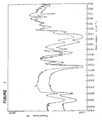
- Figure 1 is a graph showing the infrared absorption spectra of the adsorbent prepared in Example 1 (broken line) and the glycerol monomethacrylate/ethylene glycol dimethacrylate copolymer used as the porous carrier (solid line).
- the graft degree was 31.2% by weight as calculated from the nitrogen content. From the above results, it is evident that the optically active methacrylamide monomer was graft polymerized.
- An adsorbent was prepared in the same manner as in Example 1 by using the same (S)-N-(1-phenylethyl)methacrylamide as used in Example 1 as the optically active vinyl monomer and porous polymer particles obtained by converting epoxy groups of the vinylbenzene glycidyl ether/ethylvinylbenzene/divinylbenzene copolymer having a particle size of from 5 to 15 ⁇ m and a crosslinking degree of 64%, to diol groups by a dioxane aqueous solution containing 10% by weight of sulfuric acid, as the crosslinked polymer carrier.
- the graft degree was 9.9% by weight as calculated from the nitrogen content.
- An adsorbent was prepared in the same manner as in Example 1 except that (S)-N-(1-naphthylethyl)-methacrylamide was used as the optically active vinyl monomer.
- the infrared absorption spectrum of this adsorbent was measured, whereby the absorption attributable to the graft polymer was observed in the vicinity of 1650 cm ⁇ 1 and in the vicinity of 800 cm ⁇ 1 as in Example 1.
- the graft degree was 31.1% by weight as calculated from the nitrogen content.
- the graft degree was 31.7% by weight as calculated from the nitrogen content.
- the graft degree was 32.0% by weight as calculated from the nitrogen content.
- An adsorbent was prepared in the same manner as in Example 1 by using (1R,2S,5R)-menthyl methacrylic acid ester as the optically active vinyl monomer and porous polymer particles prepared by converting epoxy groups of a vinylbenzyl glycidyl ether/ethylvinylbenzene/divinylbenzene copolymer having a particle size of from 5 to 15 ⁇ m and a crosslinking degree of 48%, to diol groups by a dioxane aqueous solution containing 10% by weight of sulfuric acid, as the crosslinked polymer carrier.
- the infrared absorption spectrum of this adsorbent was measured, whereby the absorption attributable to the graft polymer was observed in the vicinity of 1700 cm ⁇ 1. Further, when subjected to C13 solid NMR analysis, an absorption attributable to the carbonyl carbon of the ester bond of the graft polymer was observed. The graft degree was 27% by weight as calculated from the proportion of the carbonyl carbon.
- the adsorbent was prepared in the same manner as in Example 5 except that (1R,2S,5R)-menthyl-N-vinylcarbamic acid ester was used as the optically active vinyl monomer.
- the infrared absorption spectrum of this adsorbent was measured, whereby an absorption attributable to the urethane bond of the graft polymer was observed in the vicinity of 1500 cm ⁇ 1.
- the graft degree was 26.5% by weight as calculated from the nitrogen content.
- the adsorbent prepared in Example 1 was packed in a stainless steel column under the following condition.
- As the packing pump a high performance liquid chromatography apparatus manufactured by Shimadzu Corporation was used, and as the packing device, a large size packer manufactured by Gasukuro Kogyo K.K. was used. Further, the liquid was supplied by a constant flow method.
- the adsorbent was packed without any trouble under the above packing condition, whereby there was no problem of densification at all. Then, resolution of racemic 1,1′-binaphthol was conducted by a chromatography method by using this packed column.
- the optical yield in the Table was obtained by the following method. Namely, at the time of resolution of the racemate by chromatography, the sample concentration and the degree of rotation were simultaneously measured by means of a differential refractive index detector for measuring the sample concentration in the eluate and a degree of rotation detector for measuring the degree of rotation of the eluate. By comparing the areas of the chromatograms drawn by the two detectors, the optical yield was calculated from the following equation.
- optical yield 0% means that there is no optical resolution ability, and the optical yield being 100% means the racemate was resolved completely to the respective antipodes.
- Example 7 The adsorbent prepared in Example 7 was packed into a stainless steel column and the resolution was conducted under the same conditions as in Application Example 1.
- the results of resolution of racemic 1,1′-binaphthol are shown in Table 1. Table 1 Example No.
- a solution mixture comprising 4.5 g of (S)-N-(1-phenylethyl)methacrylamide, 0.5 g of ethylene glycol dimethacrylate, 0.075 g of 2,2′-azobis(2,4-dimethylvaleronitrile) and 5.0 g of toluene, was added to a solution comprising 0.3 g of polyvinyl alcohol and 29.7 g of water. This mixture was stirred under nitrogen at a rotational speed of about 650 rpm and reacted at 50°C for 10 hours. The obtained polymer was separated by filtration and purified by washing sequentially with water, methanol, acetone and toluene.
Landscapes
- Chemical & Material Sciences (AREA)
- Organic Chemistry (AREA)
- Chemical Kinetics & Catalysis (AREA)
- Analytical Chemistry (AREA)
- Health & Medical Sciences (AREA)
- Medicinal Chemistry (AREA)
- Polymers & Plastics (AREA)
- Solid-Sorbent Or Filter-Aiding Compositions (AREA)
- Organic Low-Molecular-Weight Compounds And Preparation Thereof (AREA)
Applications Claiming Priority (2)
| Application Number | Priority Date | Filing Date | Title |
|---|---|---|---|
| JP267599/88 | 1988-10-24 | ||
| JP26759988 | 1988-10-24 |
Publications (2)
| Publication Number | Publication Date |
|---|---|
| EP0366042A2 true EP0366042A2 (fr) | 1990-05-02 |
| EP0366042A3 EP0366042A3 (fr) | 1991-08-21 |
Family
ID=17446973
Family Applications (1)
| Application Number | Title | Priority Date | Filing Date |
|---|---|---|---|
| EP19890119647 Ceased EP0366042A3 (fr) | 1988-10-24 | 1989-10-23 | Adsorbant pour résolution optique et méthode de résolution l'employant |
Country Status (2)
| Country | Link |
|---|---|
| US (1) | US5096971A (fr) |
| EP (1) | EP0366042A3 (fr) |
Cited By (5)
| Publication number | Priority date | Publication date | Assignee | Title |
|---|---|---|---|---|
| WO1992000805A1 (fr) * | 1990-07-10 | 1992-01-23 | Sartorius Ag | Matrice poreuse non particulaire permeable a la convexion |
| FR2682609A1 (fr) * | 1991-10-18 | 1993-04-23 | Centre Nat Rech Scient | Support pour la preparation de colonnes chromatographiques et procede pour sa preparation. |
| WO1993017055A1 (fr) * | 1992-02-20 | 1993-09-02 | Cornell Research Foundation, Inc. | Preparation de particules polymeres a fonctions de surface |
| WO1994026379A1 (fr) * | 1993-05-13 | 1994-11-24 | Merck Patent Gmbh | Procede et entraineurs pour la chromatographie par permeation de gel |
| WO1995010354A1 (fr) * | 1993-10-08 | 1995-04-20 | Merck Patent Gmbh | Derives epoxy d'amides polyacryliques |
Families Citing this family (4)
| Publication number | Priority date | Publication date | Assignee | Title |
|---|---|---|---|---|
| USRE34799E (en) * | 1988-05-02 | 1994-11-22 | General Electric Company | Reactive graft polymers |
| SE500248C2 (sv) * | 1992-12-03 | 1994-05-24 | Eka Nobel Ab | Kirala adsorbenter och framställning av dessa samt föreningar på vilka adsorbenterna är baserade och framställning av dessa föreningar |
| DE69522483T2 (de) * | 1994-03-01 | 2002-04-25 | Mitsubishi Chemical Corp., Tokio/Tokyo | Methode zur Demineralisierung von Wasser oder einer wässerigen Flüssigkeit |
| GB2350802A (en) * | 1999-06-08 | 2000-12-13 | Anglia Polytechnic University | Sample pre-treatment |
Family Cites Families (4)
| Publication number | Priority date | Publication date | Assignee | Title |
|---|---|---|---|---|
| DE2758036A1 (de) * | 1977-12-24 | 1979-07-05 | Boehringer Mannheim Gmbh | Adsorbens fuer die affinitaetsspezifische trennung von makromolekularen stoffen, verfahren zu seiner herstellung und seine verwendung |
| JPS591509A (ja) * | 1982-05-21 | 1984-01-06 | Daicel Chem Ind Ltd | 重合性高分子の製造方法 |
| US4694044A (en) * | 1984-03-09 | 1987-09-15 | Research Development Corp. Of Japan | Adsorbent |
| JPS6238238A (ja) * | 1985-08-14 | 1987-02-19 | Res Dev Corp Of Japan | 光学分割方法 |
-
1989
- 1989-10-20 US US07/424,693 patent/US5096971A/en not_active Expired - Fee Related
- 1989-10-23 EP EP19890119647 patent/EP0366042A3/fr not_active Ceased
Cited By (5)
| Publication number | Priority date | Publication date | Assignee | Title |
|---|---|---|---|---|
| WO1992000805A1 (fr) * | 1990-07-10 | 1992-01-23 | Sartorius Ag | Matrice poreuse non particulaire permeable a la convexion |
| FR2682609A1 (fr) * | 1991-10-18 | 1993-04-23 | Centre Nat Rech Scient | Support pour la preparation de colonnes chromatographiques et procede pour sa preparation. |
| WO1993017055A1 (fr) * | 1992-02-20 | 1993-09-02 | Cornell Research Foundation, Inc. | Preparation de particules polymeres a fonctions de surface |
| WO1994026379A1 (fr) * | 1993-05-13 | 1994-11-24 | Merck Patent Gmbh | Procede et entraineurs pour la chromatographie par permeation de gel |
| WO1995010354A1 (fr) * | 1993-10-08 | 1995-04-20 | Merck Patent Gmbh | Derives epoxy d'amides polyacryliques |
Also Published As
| Publication number | Publication date |
|---|---|
| EP0366042A3 (fr) | 1991-08-21 |
| US5096971A (en) | 1992-03-17 |
Similar Documents
| Publication | Publication Date | Title |
|---|---|---|
| US4694044A (en) | Adsorbent | |
| US4882048A (en) | Optically active adsorbents | |
| US4140653A (en) | Solid support for liquid chromatography | |
| US5403902A (en) | Polymeric supports | |
| US5306561A (en) | Preparation of surface-functional polymer particles | |
| EP0534016A1 (fr) | Matrices pour la chromatographie en phase liquide | |
| CA1116584A (fr) | Separateur hydrophile et sa preparation | |
| US5096971A (en) | Adsorbent for optical resolution and resolution method employing it | |
| JP2896571B2 (ja) | 複合化分離剤及びその製造法 | |
| CA1294970C (fr) | (meth) acrylamides optiquement actifs, polymeres de ceux-ci, procede pour leur preparation et leur utilisation pour une solution de racemates | |
| JP2005510609A5 (fr) | ||
| JP5280604B2 (ja) | 多孔性支持体の後修飾 | |
| EP0198395A2 (fr) | Agent de séparation pour solutions mixtes | |
| JP2005510593A5 (fr) | ||
| US3896092A (en) | Material for gel permeation chromatography | |
| CA2045972C (fr) | Derives d'acide n-.alpha.-fluoroacryloylamine optiquement actifs et polymeres optiquement actifs de ceux-ci pour la resolution des racemates | |
| US5302633A (en) | Optical resolution agent and process for the preparation of the same | |
| US6689889B2 (en) | Chromatographic separation of enantiomers of lactones | |
| Chen et al. | One‐pot synthesis of polysaccharide 3, 5‐dimethylphenylcarbamates having a random vinyl group for immobilization on silica gel as chiral stationary phases | |
| JP3029640B2 (ja) | 吸着剤 | |
| JPH02211242A (ja) | 光学分割用吸着剤及びそれを用いる分割方法 | |
| JPH01199643A (ja) | 光学分割用吸着剤 | |
| US4135892A (en) | Macroporous polymeric sorbents for chromatography, especially gas chromatography of organic compounds | |
| USRE35186E (en) | Separation media containing acyl diazepines | |
| Kolarz et al. | Pentaerythritol triacrylate-homopolymer and its copolymers with butyl acrylate |
Legal Events
| Date | Code | Title | Description |
|---|---|---|---|
| PUAI | Public reference made under article 153(3) epc to a published international application that has entered the european phase |
Free format text: ORIGINAL CODE: 0009012 |
|
| AK | Designated contracting states |
Kind code of ref document: A2 Designated state(s): CH DE FR GB LI |
|
| 17P | Request for examination filed |
Effective date: 19901205 |
|
| PUAL | Search report despatched |
Free format text: ORIGINAL CODE: 0009013 |
|
| AK | Designated contracting states |
Kind code of ref document: A3 Designated state(s): CH DE FR GB LI |
|
| 17Q | First examination report despatched |
Effective date: 19930503 |
|
| STAA | Information on the status of an ep patent application or granted ep patent |
Free format text: STATUS: THE APPLICATION HAS BEEN REFUSED |
|
| 18R | Application refused |
Effective date: 19940710 |