EP0366265B1 - Détecteur de phase pour signaux en radiofréquence modulés en amplitude et contenant une forme d'onde basse fréquence - Google Patents
Détecteur de phase pour signaux en radiofréquence modulés en amplitude et contenant une forme d'onde basse fréquence Download PDFInfo
- Publication number
- EP0366265B1 EP0366265B1 EP89309687A EP89309687A EP0366265B1 EP 0366265 B1 EP0366265 B1 EP 0366265B1 EP 89309687 A EP89309687 A EP 89309687A EP 89309687 A EP89309687 A EP 89309687A EP 0366265 B1 EP0366265 B1 EP 0366265B1
- Authority
- EP
- European Patent Office
- Prior art keywords
- signal
- radio frequency
- amplitude
- detector
- output
- Prior art date
- Legal status (The legal status is an assumption and is not a legal conclusion. Google has not performed a legal analysis and makes no representation as to the accuracy of the status listed.)
- Expired - Lifetime
Links
- 239000003990 capacitor Substances 0.000 claims description 28
- 239000004020 conductor Substances 0.000 claims description 14
- 230000005540 biological transmission Effects 0.000 claims description 12
- 239000004065 semiconductor Substances 0.000 claims description 5
- 230000000694 effects Effects 0.000 claims description 4
- 230000008878 coupling Effects 0.000 claims description 2
- 238000010168 coupling process Methods 0.000 claims description 2
- 238000005859 coupling reaction Methods 0.000 claims description 2
- 230000001939 inductive effect Effects 0.000 claims 1
- 238000006243 chemical reaction Methods 0.000 description 24
- 230000006870 function Effects 0.000 description 14
- 238000010586 diagram Methods 0.000 description 8
- 238000004804 winding Methods 0.000 description 6
- 238000013461 design Methods 0.000 description 4
- 238000001914 filtration Methods 0.000 description 3
- 238000007667 floating Methods 0.000 description 3
- 238000010276 construction Methods 0.000 description 2
- 230000006872 improvement Effects 0.000 description 2
- 238000013459 approach Methods 0.000 description 1
- 230000008901 benefit Effects 0.000 description 1
- 230000008859 change Effects 0.000 description 1
- 238000012937 correction Methods 0.000 description 1
- 238000001514 detection method Methods 0.000 description 1
- 238000005259 measurement Methods 0.000 description 1
- 238000000034 method Methods 0.000 description 1
- 238000012986 modification Methods 0.000 description 1
- 230000004048 modification Effects 0.000 description 1
- 238000010587 phase diagram Methods 0.000 description 1
- 230000010363 phase shift Effects 0.000 description 1
- 230000001131 transforming effect Effects 0.000 description 1
Images




Classifications
-
- H—ELECTRICITY
- H03—ELECTRONIC CIRCUITRY
- H03D—DEMODULATION OR TRANSFERENCE OF MODULATION FROM ONE CARRIER TO ANOTHER
- H03D13/00—Circuits for comparing the phase or frequency of two mutually-independent oscillations
Definitions
- This disclosure relates to phase detectors for radio frequency circuit measurements.
- the most common radio frequency (RF) phase detector is a double balanced mixer.
- a double balanced mixer has a radio frequency (RF) port, a local oscillator (LO) port and an intermediate frequency (IF) port. The impedance of these three ports is 50 ohms.
- the mixer produces both a sum and a difference product. The sum product is removed by filtering so that only the difference product remains.
- the difference product for an ideal mixer is a cosine of the phase difference of the LO and RF frequencies.
- the phase slope of the mixer is a function of the IF power output. Because the derivative of a cosine wave is a sine wave, the peak voltage of the sinusoid is equal to the phase slope (volts/radian) when the output is at zero volts. For example, zero dBm at the IF output of the mixer is equal to a .316 volt peak sinewave into 50 ohms, and the phase slope is .316 volts per radian at zero volts output.
- the IF power at the output is a function of the RF and LO power at the input and the conversion loss of the mixer.
- Conversion loss is the difference between the RF power and the IF power.
- the LO power is much greater than the RF power, which gives the minimum conversion loss.
- the typical conversion loss of a mixer will vary between 6 and 9 dB. 3dB of the conversion loss is due to the lost power in the sum product that is filtered.
- the extra conversion loss is due to losses in the mixer and efficiency of the switching diodes. Increasing the RF power until it is equal to the LO power will increase the IF power and phase slope but at a lower conversion loss.
- phase slope K ⁇
- IF source resistance R i
- RF peak voltage V r
- RF source resistance R r
- the conversion loss is: (10)Log(V r 2/R r ) - (10)Log(K ⁇ 2 /R i ) Because K ⁇ equals the peak IF voltage for a cosine IF output, this definition is consistent with the case where the RF power is much less than the LO power.
- the conversion loss for mixers where the RF and the LO power levels are equal is typically 12 to 15 dB.
- a typical high level mixer with +20 dBm power into the RF and LO ports would have a peak RF voltage of 3.16 volts and a phase slope of .56 to .8 volts per radian.
- the noise floor of the phase detector can be determined.
- the source voltage is double the voltage measured when terminated into a 50 ohm load resistor because of the divide ratio of the source resistance and the load resistance.
- the single sideband phase noise of the phase detector referred back to the RF and LO source is equal to: (10)Log(.5(E n /K ⁇ )2), where E n is the IF source resistance noise.
- a typical mixer with a K ⁇ of .5 volts per radian terminated in 50 ohms would have a source voltage of 1 volt per radian and a source noise of .89 nanovolts, giving a single sideband phase noise floor of -184 dBc in a 1 Hz bandwidth.
- the noise figure of the phase detector is 3 dB less than the conversion loss of the phase detector as defined above.
- a conversion loss of 14 dB and a RF power of 18 dBm would give the .5 volts per radian discussed.
- the reason that the noise figure of the phase detector is 3 dB better than the conversion loss is that the double sideband noise at the RF port is converted to single sideband noise at the IF port. When relating single sideband noise at the IF port back to single sideband noise at the RF port, there is a 3 dB correction factor.
- the amplifier that follows the phase detector will also contribute to the noise floor of the phase detector. Its contribution can be accounted for in terms of noise figure.
- the noise figure of a typical differential pair amplifier is about 3 dB for a 50 ohm source impedance.
- the total noise floor of the phase detector and amplifier following the phase detector will be -181 dBc in a 1 Hz bandwidth giving a total noise figure of 14 dB.
- phase detector can be described as a sum-difference peak detector. This detector adds the RF to the LO at one output port and subtracts the RF from the LO at the other output port. By peak detecting the signals at the sum port and difference port and subtracting the outputs of the peak detectors, a very high phase slope for relatively low RF and LO powers is achieved.
- the source impedance of a peak detector can be very high. Given the definition of the conversion loss of the phase detector, a very high phase slope could have a very poor conversion loss if the IF source impedance is very high. For example, using a peak detector on the sum and difference ports would give an IF voltage output of equal to twice the RF voltage input. With a source impedance of about 10000 ohms, the conversion loss would be 17 dB. This high a conversion loss makes the phase detector undesirable for low noise applications.
- phase comparator adapted to provide so called ambiguous and non-ambiguous phase comparison of two inputs and to make the results of the comparisons available each at one or other of the two output terminals comprising four four-port quarter wave directional coupling devices, two being termed input devices and two being termed output devices, and each device having two diagonally opposite input ports and two diagonally opposite output ports; interconnections connecting the four devices in a ring sequence such that the output ports of the said input devices are connected in ring sequence to the input ports of the said output devices; a 90° phase shifter included in one of said connections; means for applying one input to one of the remaining input ports of one of said input devices; means for applying the other input to one of the remaining input ports of the second input device which is separated from said one input device in the ring sequence by the two output devices; means for rectifying the vector sum of two signals appearing at a remaining output port of one of the said two output devices to produce a non
- the invention provides a low noise floor phase detector for radio frequency signals, comprising radio frequency signal combining means having two signal inputs for respectively receiving incoming signals from two radio frequency sources and having two signal outputs, the amplitudes of the radio frequency signals at each signal output being summations of the two incoming signals and the phase angle of at least one of the incoming signals being shifted by a constant angular amount between the two signal outputs; a pair of amplitude detectors respectively connected to the signal outputs of the combining means, each amplitude detector comprising:
- the invention provides a low noise floor phase detector for radio frequency signals, comprising radio frequency signal combining means having two signal inputs for respectively receiving incoming signals from two radio frequency sources and having two signal outputs, the amplitudes of the radio frequency signals at each signal output being summations of the two incoming signals and the phase angle of at least one of the incoming signals being shifted by a constant angular amount between the two signal outputs; a pair of amplitude detectors respectively connected to the signal outputs of the combining means, each amplitude detector comprising:
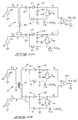
- This invention is a low noise phase detector as illustrated generally in Figs. 1A and 1B.
- the phase detector consists of a means 10 for combining two radio frequency (RF) signals, and a high signal to noise ratio (SNR) means 11 for detecting the amplitudes of the combined RF signals.
- the means 10 for combining the two RF signals consists of two RF inputs (ports A and B) and two RF outputs (ports C and D) such that the signals at the outputs are equal linear summations of the inputs. For example, an RF signal applied at A by a radio frequency (RF) source 12 will result in equal signal levels at C and D. Also an RF signal applied at B by a reference local oscillator source 13 will result in equal signal levels at C and D.
- RF radio frequency
- phase relationship at the outputs should be such that when the two RF signals from A and B arrive in phase at port C they are 180 degrees out of phase at port D - when the phase is +90 degrees at port C it is -90 degrees at port D, when the phase is 180 degrees at port C it is zero degrees at port D.
- the amplitude at port C will increase as the relative phase between the signals from port A and port B changes from 180 degrees to zero degrees. The same is true for port D.
- the phase difference at C is 90 degrees (plus or minus) and 90 degrees (plus or minus) at port D
- the amplitude at port C and D will be the same.
- the high SNR amplitude detectors at ports C and D measure the amplitude of the combined RF signals from ports A and B. Subtracting the outputs of the two amplitude detectors gives a phase detector output which varies with the relative phase of the RF signal at port A and the RF signal at port B.
- the phase slope of this phase detector is a function of the amplitude detector constant and the loss of the device that combines the RF signals.
- the source impedance is twice the source impedance of one of the amplitude detectors, since they are used in series.
- a combining means 10 would be a 3 dB transmission line coupler (Fig. 1A).
- the phase relationship between the signal output at the coupled port and the thru port is always 90 degrees for any transmission line coupler. This meets the necessary conditions as stated above.
- the RF source impedance at the outputs C and D is 50 ohms for a 50 ohm coupler.
- the detector source impedance for each of the low noise AM detectors can be designed to be approximately 300 ohms. The total source impedance is therefore 600 ohms.
- the phaselope for this detector is 2.2 times the peak RF source voltage when the LO power level is much larger than the RF power level. This gives a conversion loss of 4 dB.
- the conversion loss is only 3 dB higher, bringing the conversion loss to 7 dB.
- the typical loss of a transmission line coupler is less than 1 dB, giving a worst case conversion loss of 8 dB.
- the conversion loss is about 4 to 7 dB better than the example of the mixer as a phase detector discussed in the background information of this disclosure.
- the same low noise amplifier would have a .4 db noise figure compared to a 3 db noise figure in a 50 ohm system. This gives a total improvement of 6 to 9 dB over the mixer method.
- Figs. 1A and 1B illustrate the general circuitry of the phase detector.
- the combining means 10 for the two incoming RF signals in Fig. 1A is a transmission line coupler 50. This might be a pair of parallel traces on a circuitboard or a pair of conductive wires.
- the transmission line coupler is a 3 dB coupler of known construction, comprising a length of coaxial cable having a pair of twisted interior conductors insulated from one another and located within a surrounding shield.
- the combining means is shown as a conventional 2:1 transformer 51.
- the combining means 10 has two signal inputs designated by the letters A and B, and two signal outputs, designated by letters C and D.
- the signal outputs C and D serve as both through ports and coupled ports for the incoming radio frequency signals from signal inputs A and B. More specifically, in Fig. 1A the signal output C is a through port for the RF signal from signal input B and a coupled port for the RF signal at signal input A. Signal output D is operatively connected to the signal inputs A and B in an opposite manner. In Fig. 1B, signal outputs C and D are through ports for the RF signal at signal input B and coupled ports for the RF signal at signal input A.
- the amplitudes of the radio RF at each signal outputs C and D are summations of the two incoming RF signals at signal inputs A and B.
- the phase angle of at least one of the incoming signals at signal inputs A or B must be shifted by a constant angular amount between the two signal outputs C and D.
- the phase of each signal input is shifted 90 degrees between the two signal outputs C and D.
- the transformer 51 shown in Fig. 1B the phase of the incoming signal from signal input A is shifted 180 degrees between signal outputs C and D, and no phase shift occurs with respect to the incoming signal from signal input B.
- the signal outputs C and D are connected to separate upper and lower amplitude detectors 11A and 11B, respectively, each including a pair of diodes 21, 31 and signal terminating means 26, illustrated in Figs. 1A and 1B as a constant current source 26.
- Fig. 1A for example, in amplitude detector 11A one side of diode 21 is connected to ground through a capacitor 22, and the corresponding side of diode 31 is connected to ground through capacitor 24 and the LO signal source 13.
- the lower amplitude detector 11B the same circuitry is used, with the one side of its diode 31 being connected to ground through an identical capacitor 24 and the RF signal source 12.
- the signal sources 12 and 13 can be separate sources, but will typically be a single source of RF signals having the signal divided through a delay line or a circuit loop that will effect a constant phase relationship between the two signals directed to the phase detector.
- the demodulated output signals from the amplitude detectors are directed to summation means shown in Figs. 1A and 1B as amplifier 54.
- the output of amplifier 54 is a function of the differences between the demodulated output voltages of the two amplitude detectors.
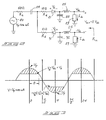
- Fig. 2 generally illustrates the components and circuit equivalents included within the amplitude detector.
- a pair of semi-conductor diodes 21, 31 are oriented oppositely to one another within parallel circuits adapted to be operatively connected to a radio frequency (RF) signal source 20.
- RF radio frequency
- a first capacitor 22 is operatively connected between one side of the first diode 21 and ground.
- a second capacitor 32 is operatively connected between one side of the second diode 31 and ground.
- the amplitude detector is completed by terminating means 23 connected across the parallel circuits for properly biasing each diode to cause it to conduct current from the signal source 20 at a conduction angle ⁇ , which is graphically illustrated in Fig. 3.
- the conduction angle is selected to minimize the Signal to Noise Ratio (SNR) of the amplitude detector. It also matches the radio frequency load impedance of the amplitude detector to the radio frequency impedance of the signal source 20.
- the signal terminating means 23 has an output at which a demodulated signal is produced having an amplitude proportional to the amplitude of any low frequency signal present in a radio frequency signal directed to the amplitude detector from the signal source 20.
- the waveform of a typical RF signal having a sinusoidal shape can be expressed by the formula V p Cos ⁇ t, where V p is the peak voltage amplitude of the incoming RF signal.
- R s denotes the RF impedance of signal source 20, which is conventionally 50 ohms.
- the inclusion of capacitor 24 in conjunction with capacitors 22 and 32 is a circuit design alternative that is described below.
- R d is a circuit equivalent for the typical dynamic on resistance of each diode 21, 31. For illustration, R d is quantified as 10 ohms.
- the inductor 25 provides RF filtering of the low frequency signal prior to the signal terminating means 23.
- Signal terminating means 23 is illustrated as two separate devices leading from each parallel circuit to ground. The current flowing through each device is designated as I dc .
- the voltage level at the connection between the signal terminating means 23 and each parallel circuit is designated as V dc .
- the output voltage across the terminal ends of the parallel circuits is designated as V out and is equal to 2V dc .
- Fig. 3 graphically illustrates the angular relationships between voltage and current (indicated by the shaded lines within the sinusoidal curve) for a selected diode conduction angle ⁇ .
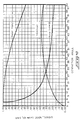
- the calculation of ⁇ and the radio frequency load impedance of the amplitude detector (R in ) is presented in Fig. 6. It can be seen that when these mathematical relationships are solved to determine the maximum Signal to Noise Ratio, ⁇ equals 1.165 radians or approximately 67°. This means that each diode 21, 22 conducts over a total angle of 134° during each half cycle of the incoming radio frequency waves or during 37% of each full cycle. Once the optimum conduction angle for lowest noise operation is determined, one can calculate the low frequency source impedance of the amplitude detector required to achieve optimal operation.
- the amplitude detector source impedance is 2.695 times the impedance of the RF source impedance, which in turn is the sum of the impedance of source 20 plus the impedance of each diode 21, 31 (R s plus R d ).
- the average RF load impedance that the amplitude detector presents to the RF source 20 is approximately equal to the source impedance of the RF source. This properly matches the radio frequency load impedance of the detector to the radio frequency impedance of the signal source for efficient termination of the RF signal.
- Figs. 4 and 5 are plots of theoretically derived data relating to the Signal to Noise Ratio as a function of diode conduction angle (Fig. 4) and the conduction angle as a function of the dynamic source impedance of the detector, as well as a passive resistor load utilized as the signal terminating means 23. They graphically illustrate the optimum Signal to Noise Ratio and load matching that occur at a conduction angle of 67°.
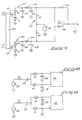
- Figs. 8 - 10 schematically illustrate variations in circuit design that incorporate the operational features described above.
- three capacitors are used, the third capacitor 24 providing a "floating" RF signal input to the parallel circuits that include diodes 21, 31.
- Fig. 9 only two capacitors are used.
- One diode 31 has one side shorted directly to ground and its remaining side is connected to ground through the floating connection provided by capacitor 24 and the signal source 20. It is to be understood that either diode 21 or 31 can have one side directly shorted to ground in this manner.
- Fig. 10 shows the use of both capacitors 22, 32 as previously described, with one side of diode 31 shunted to ground directly through the RF signal source 20.
- Figs. 11 through 14 schematically illustrate the various types of devices that can be used as the terminating means 23 in the amplitude detector.
- Figs. 11 and 12 numerically indicate the low frequency impedance value of the terminating means 23 required to achieve the selected diode conduction angle of 67°. It is stated as a function of the signal source impedance R s .
- the terminating means is shown as a constant current source 26, the output, (V out ), being the voltage across the current source 26.
- the output voltage may be measured by a conventional voltage meter 14 connected across the current source 26.
- the signal terminating means is a constant voltage source 27 and the output of the amplitude detector (I out ) is readable as the current flowing through voltage source 27.
- the output current signal may be measured by a conventional current meter 15 in series with the voltage source 27.
- the signal terminating means is a passive resistive load or resistor 28 and the output (V out ) is readable as the voltage across resistor 28.
- the signal terminating means is a active resistive load comprising amplifier 29 and feedback resistor 30 where the value of resistor 30 is given by the equation shown and provides an equivalent impedance equal to that shown in Fig. 13.
- the output is readable as changes in the voltage output (V out ) at the output terminals of amplifier 29.
- FIG. 7 A simplified circuit diagram of the current phase detector circuitry is shown in Fig. 7.
- two incoming radio frequency signals are fed to the radio frequency (RF) and local oscillator (LO) signal inputs of a combining means 40 having separate signal outputs 41 and 42.
- Signal outputs 41 and 42 serve as both through ports and coupled ports for the incoming radio frequency signals at the signal inputs.
- the phase angle of at least one of the incoming signals is shifted by a constant angular amount between the two signal outputs 41 and 42.
- the combining means 40 might be a transformer, it is preferably a transmission line coupler, such as a length of coaxial cable having a pair of twisted interior conductors insulated from one another and surrounded by a cylindrical shield.
- Each signal output 41, 42 is fed to an amplitude detector 43 of the type described above.
- the two diodes 21, 31, which are included within parallel circuits from the signal outputs 41, 42, are connected with one side of diode 21 shunted to ground through capacitor 22 and one side of diode 31 shunted to ground. Filtering of RF wave forms is assured through provision of a filter comprised of an inductor 44 and capacitor 45.
- the signal terminating means 23 is shown in Fig. 7 as passive resistors 47.
- a constant voltage source 46 in series with each resistor 47 provides the turn on voltage for the diodes of the amplitude detectors.
- the output signals from the two amplitude detectors are directed to a summation means that produces a signal that is a function of any difference in the amplitudes of the demodulated signals produced by the amplitude detectors 43.
- the illustrated summation means is an operational amplifier 48 and a resistor 49 that provides negative feedback. Any differences in the output voltage amplitudes at the amplitude detectors 43 will be reflected as a change in voltage (V a ) at the output of operational amplifier 48.
- Fig. 15 relates the RF signal at the signal outputs C and D of a transmission line coupler 50 to the respective phase characteristics of the incoming LO and RF signals. These phase relationships at signal outputs C and D are illustrated by vector diagrams 16A and 16B. It is assumed for purposes of Figs. 16A and 16B, that the signals at signal outputs C and D have equal amplitudes and that the phase angles of the LO and RF incoming signals are identical. It can be seen that as the phase of the LO signal increases relative to that of the RF signal, the amplitude of the signal at C will increase and the amplitude of the signal at D will decrease until the phase angle between the signals at A and B is 90 degrees relative to each other. Similarly, Figs.
- the noise improvement of this invention is about 6 to 9 dB when compared to the mixer used as a phase detector.
- This invention has the effect of transforming the 50 ohm source impedance up to a 600 ohm source impedance with a corresponding increase in phase slope. This makes the design of the phase detector amplifier much easier because less gain is required and low noise figure is easy to achieve.
- phase slope will increase linearly with increasing power, limited only by the power dissipation of the diodes.
- higher phase slope is achieved by placing diodes in series for higher LO drive levels, causing higher conversion loss.
- phase detector at very low RF power levels into both ports. By biasing the amplitude detector diodes at their turn on voltage, they are able to amplitude detect low power levels.
Landscapes
- Engineering & Computer Science (AREA)
- Power Engineering (AREA)
- Measurement Of Resistance Or Impedance (AREA)
- Transmitters (AREA)
- Radar Systems Or Details Thereof (AREA)
- Monitoring And Testing Of Transmission In General (AREA)
Claims (12)
- Détecteur de phase plancher à faible bruit pour signaux haute fréquence, comprenant
un moyen (40) de combinaison des signaux haute fréquence qui comprend deux entrées de signaux destinées à recevoir respectivement les signaux entrants provenant de deux sources haute fréquence (RF, LO) et qui comprend deux sorties de signaux (41, 42), les amplitudes des signaux haute fréquence présents à chaque sortie de signaux (41, 42) étant les sommes de deux signaux d'entrée et l'angle de phase d'au moins l'un des signaux d'entrée étant décalé d'une valeur angulaire constante entre les deux sorties de signaux (41, 42) ;
deux détecteurs d'amplitude (43) connectés respectivement aux sorties de signaux (41, 42) du moyen de combinaison, chaque détecteur d'amplitude (43) comprenant :1) deux diodes semi-conductrices (21, 31) orientées en opposition l'une par rapport à l'autre dans des circuits montés en parallèle sur une sortie de signaux (41, 42) du moyen de combinaison ;2) un premier condensateur (22) monté entre un côté d'une diode (21) et la masse ;3) un second condensateur (32) monté entre un côté de l'autre diode (31) et la masse ; et4) un moyen de terminaison (23) monté entre les circuits en parallèle pour polariser chaque diode (21, 31) suivant un angle prédéterminé de conduction en rendant les diodes individuelles (21, 31) conductrices séquentiellement pendant un pourcentage prédéterminé de chaque cycle de signal haute fréquence pour produire un rapport optimal signal-bruit du détecteur d'amplitude tout en faisant correspondre l'impédance de charge haute fréquence du détecteur d'amplitude (43) avec l'impédance haute fréquence de ladite une sortie de signaux (41, 42), le moyen de terminaison des signaux (23) produisant un signal de sortie qui est un signal démodulé ayant une amplitude proportionnelle à l'amplitude de tout signal basse fréquence présent dans le signal haute fréquence à ladite une sortie de signaux du moyen de combinaison ;et le détecteur comprenant par ailleurs un moyen de sommation (48, 49) connecté aux sorties du moyen de terminaison (23) associé à chaque détecteur d'amplitude pour produire un signal qui est une fonction de toute différence des amplitudes des signaux démodulés qui sont produits par les deux détecteurs d'amplitude (43). - Détecteur de phase plancher à faible bruit pour signaux haute fréquence, comprenant
un moyen (40) de combinaison des signaux haute fréquence qui comprend deux entrées de signaux destinés à recevoir respectivement des signaux entrants provenant de deux sources (RF, LO) à haute fréquence et qui comprend deux sorties de signaux (41, 42), les amplitudes des signaux haute fréquence présents à chaque sortie de signaux (41), (42) étant les sommes de deux signaux entrants et l'angle de phase d'au moins l'un des signaux entrants étant décalé d'une valeur angulaire constante entre les deux sorties de signaux (41, 42) ;
deux détecteurs d'amplitude (43) connectés respectivement aux sorties de signaux (41, 42) du moyen de combinaison, chaque détecteur d'amplitude (43) comprenant :1) deux diodes semi-conductrices (21, 31) orientées en opposition l'une par rapport à l'autre dans des circuits montés en parallèle sur une sortie de signaux (41, 42) du moyen de combinaison ;2) un premier condensateur (22) monté entre un côté d'une diode (21) et la masse ;3) un second condensateur (24) monté entre la connexion en parallèle des diodes et ladite une sortie de signaux (41, 42) du moyen de combinaison ;4) un moyen de terminaison (23) monté entre les circuits en parallèle pour polariser chaque diode (21, 31) suivant un angle prédéterminé de conduction qui rend les diodes individuelles (21, 31) conductrices séquentiellement pendant un pourcentage prédéterminé de chaque cycle de signal haute fréquence pour obtenir un rapport optimal signal-bruit du détecteur d'amplitude tout en faisant correspondre l'impédance de charge haute fréquence du détecteur d'amplitude (43) à l'impédance haute fréquence de ladite une sortie de signaux (41, 42), le moyen de terminaison des signaux (23) produisant un signal de sortie qui est un signal démodulé ayant une amplitude proportionnelle à l'amplitude de tout signal basse fréquence présent dans le signal haute fréquence à ladite une sortie de signaux du moyen de combinaison ;et le détecteur comprenant par ailleurs un moyen de sommation (48, 49) connecté aux sorties du moyen de terminaison (23) associé à chaque détecteur d'amplitude pour produire un signal qui est une fonction de toute différence des amplitudes des signaux démodulés qui sont produits par les deux détecteurs d'amplitude (43). - Détecteur selon la revendication 1 ou 2, caractérisé en ce que ledit angle prédéterminé de conduction est sensiblement égal à 67 degrés et ledit pourcentage prédéterminé est sensiblement égal à 37 pour cent de chaque cycle de signal haute fréquence.
- Détecteur selon la revendication 1, 2 ou 3, caractérisé en ce que ledit moyen de terminaison (23) est une charge passive de résistance, le signal démodulé de chaque détecteur d'amplitude (43) étant la tension aux bornes de la charge passive de résistance (28).
- Détecteur selon la revendication 1, 2 ou 3, caractérisé en ce que ledit moyen de terminaison (23) est une charge de résistance active (29, 30), le signal démodulé de chaque détecteur d'amplitude (43) étant la tension aux bornes de la charge active de résistance (29, 30).
- Détecteur selon la revendication 1, 2 ou 3, caractérisé en ce que ledit moyen de terminaison (23) est une source de courant (26), le signal démodulé de chaque détecteur d'amplitude (43) étant la chute de tension aux bornes de la source de courant (26).
- Détecteur selon la revendication 1, 2 ou 3, caractérisé en ce que ledit moyen de terminaison (23) est une source de tension (27), le signal démodulé de chaque détecteur d'amplitude (43) étant le courant circulant dans la source de tension (27).
- Détecteur selon la revendication 1, 2 ou 3, caractérisé en ce que ledit moyen de terminaison (23) est une résistance passive fixe (47) connectée fonctionnellement à chaque détecteur d'amplitude (43) en série avec une source de tension constante (46) qui produit les inversions de tension pour les diodes (31, 41).
- Détecteur selon l'une quelconque des revendications précédentes, dans lequel le moyen de combinaison haute fréquence consiste en un coupleur (50) par ligne de transmission.
- Détecteur selon la revendication 9, dans lequel le coupleur (50) par ligne de transmission comprend deux pistes étroitement rapprochées sur un panneau de circuit imprimé, les tronçons de pistes se chevauchant au moins partiellement l'un l'autre afin de produire un couplage par induction entre eux.
- Détecteur selon la revendication 9, dans lequel le coupleur (50) par ligne de transmission comprend un tronçon de câble coaxial comprenant deux conducteurs torsadés, isolés électriquement l'un de l'autre à l'intérieur d'un blindage qui les entoure.
- Détecteur selon l'une quelconque des revendications précédentes, caractérisé en ce que ledit moyen de sommation (48, 49) comprend un amplificateur opérationnel à réaction négative ayant deux entrées connectées fonctionnellement aux sorties respectives du moyen de terminaison (23) des deux détecteurs d'amplitude (43).
Applications Claiming Priority (2)
| Application Number | Priority Date | Filing Date | Title |
|---|---|---|---|
| US07/263,107 US4888558A (en) | 1988-10-26 | 1988-10-26 | Phase detector for amplitude modulated radio frequency signals containing a low frequency waveform |
| US263107 | 1988-10-26 |
Publications (3)
| Publication Number | Publication Date |
|---|---|
| EP0366265A2 EP0366265A2 (fr) | 1990-05-02 |
| EP0366265A3 EP0366265A3 (en) | 1990-11-28 |
| EP0366265B1 true EP0366265B1 (fr) | 1995-06-28 |
Family
ID=23000395
Family Applications (1)
| Application Number | Title | Priority Date | Filing Date |
|---|---|---|---|
| EP89309687A Expired - Lifetime EP0366265B1 (fr) | 1988-10-26 | 1989-09-22 | Détecteur de phase pour signaux en radiofréquence modulés en amplitude et contenant une forme d'onde basse fréquence |
Country Status (5)
| Country | Link |
|---|---|
| US (1) | US4888558A (fr) |
| EP (1) | EP0366265B1 (fr) |
| JP (1) | JP3062206B2 (fr) |
| CA (1) | CA1287124C (fr) |
| DE (1) | DE68923245T2 (fr) |
Cited By (1)
| Publication number | Priority date | Publication date | Assignee | Title |
|---|---|---|---|---|
| WO2025122484A1 (fr) * | 2023-12-04 | 2025-06-12 | Quantinuum Llc | Détecteur d'amplitude radiofréquence (rf) stable |
Families Citing this family (18)
| Publication number | Priority date | Publication date | Assignee | Title |
|---|---|---|---|---|
| JP2897795B2 (ja) * | 1991-10-31 | 1999-05-31 | 日本電気株式会社 | サンプルホールド型位相比較回路 |
| GB2356756B (en) | 1999-11-25 | 2004-08-11 | Ericsson Telefon Ab L M | Power amplifiers |
| US7006562B2 (en) * | 2000-03-17 | 2006-02-28 | Chien Chou | Phase demodulator, phase difference detector, and interferometric system using the phase difference detector |
| RU2231915C2 (ru) * | 2002-04-16 | 2004-06-27 | Федеральное государственное унитарное предприятие "Конструкторское бюро "Луч" | Дифференциальный фазовый дискриминатор символьной синхронизации (его варианты) |
| US8414498B2 (en) * | 2003-05-12 | 2013-04-09 | Cheetah Medical, Inc. | System, method and apparatus for measuring blood flow and blood volume |
| ATE363150T1 (de) * | 2003-05-27 | 2007-06-15 | Koninkl Philips Electronics Nv | Phasendetektor und dazugehöriges verfahren |
| AU2006215274B2 (en) * | 2005-02-15 | 2011-12-22 | Cheetah Medical, Inc. | System, method and apparatus for measuring blood flow and blood volume |
| US9095271B2 (en) * | 2007-08-13 | 2015-08-04 | Cheetah Medical, Inc. | Dynamically variable filter |
| US8876725B2 (en) * | 2007-02-23 | 2014-11-04 | Cheetah Medical, Inc. | Method and system for estimating exercise capacity |
| US8764667B2 (en) * | 2007-03-07 | 2014-07-01 | Cheetah Medical, Inc. | Method and system for monitoring sleep |
| WO2008129535A1 (fr) * | 2007-04-19 | 2008-10-30 | Cheetah Medical Ltd. | Procédé, appareil et système destinés à prévoir une dissociation électrochimique |
| US7849752B2 (en) * | 2007-10-24 | 2010-12-14 | Argon St, Inc. | Method and system for passive wireless strain gauge |
| WO2011116822A1 (fr) * | 2010-03-25 | 2011-09-29 | Telefonaktiebolaget Lm Ericsson (Publ) | Détecteur de phase |
| US9250276B2 (en) * | 2013-09-30 | 2016-02-02 | Analog Devices, Inc. | Microwave voltmeter using fully-linearized diode detector |
| RU2582552C1 (ru) * | 2014-12-08 | 2016-04-27 | Федеральное государственное казенное военное образовательное учреждение высшего профессионального образования "Военный учебно-научный центр Военно-воздушных сил "Военно-воздушная академия имени профессора Н.Е. Жуковского и Ю.А. Гагарина" (г. Воронеж) Министерства обороны Российской Федерации | Частотный детектор |
| CN106775142B (zh) | 2015-12-31 | 2019-10-01 | 深圳市汇顶科技股份有限公司 | 电容感测电路 |
| EP3945325B1 (fr) * | 2020-07-28 | 2024-03-27 | Rohde & Schwarz GmbH & Co. KG | Sonde de champ et procédé permettant d'effectuer des mesures d'antenne |
| US20250180616A1 (en) * | 2023-12-04 | 2025-06-05 | Quantinuum Llc | Stable radio frequency (rf) amplitude detector |
Family Cites Families (6)
| Publication number | Priority date | Publication date | Assignee | Title |
|---|---|---|---|---|
| US2919404A (en) * | 1954-06-15 | 1959-12-29 | Honeywell Regulator Co | Bridge demodulator phase detecting circuit |
| FR1286549A (fr) * | 1960-04-21 | 1962-03-02 | Siemens Ag | Installation pour la mise en circuit commun d'antennes, d'amplificateurs d'antennes et de transformateurs du domaine de fréquences de la télévision |
| DE1200941B (de) * | 1964-04-25 | 1965-09-16 | Rohde & Schwarz | Phasendiskriminatorschaltung |
| US3493871A (en) * | 1967-03-13 | 1970-02-03 | Gen Motors Corp | Balanced limiter-detector circuit for radio receiver |
| GB1236829A (en) * | 1968-09-30 | 1971-06-23 | Marconi Co Ltd | Improvements in or relating to phase comparators |
| FR29377E (fr) * | 1970-03-12 | 1925-07-25 | Système de loqueteau sans ressort pour châssis, impostes, vasistas et autres |
-
1988
- 1988-10-26 US US07/263,107 patent/US4888558A/en not_active Expired - Lifetime
-
1989
- 1989-09-07 CA CA000610607A patent/CA1287124C/fr not_active Expired - Lifetime
- 1989-09-22 EP EP89309687A patent/EP0366265B1/fr not_active Expired - Lifetime
- 1989-09-22 DE DE68923245T patent/DE68923245T2/de not_active Expired - Fee Related
- 1989-10-26 JP JP1279592A patent/JP3062206B2/ja not_active Expired - Fee Related
Cited By (1)
| Publication number | Priority date | Publication date | Assignee | Title |
|---|---|---|---|---|
| WO2025122484A1 (fr) * | 2023-12-04 | 2025-06-12 | Quantinuum Llc | Détecteur d'amplitude radiofréquence (rf) stable |
Also Published As
| Publication number | Publication date |
|---|---|
| CA1287124C (fr) | 1991-07-30 |
| EP0366265A3 (en) | 1990-11-28 |
| DE68923245T2 (de) | 1995-10-26 |
| EP0366265A2 (fr) | 1990-05-02 |
| DE68923245D1 (de) | 1995-08-03 |
| US4888558A (en) | 1989-12-19 |
| JPH02170705A (ja) | 1990-07-02 |
| JP3062206B2 (ja) | 2000-07-10 |
Similar Documents
| Publication | Publication Date | Title |
|---|---|---|
| US4888558A (en) | Phase detector for amplitude modulated radio frequency signals containing a low frequency waveform | |
| US20090230980A1 (en) | Method for measuring d-q impedance of polyphase power grid components | |
| US4691165A (en) | Method and apparatus including spaced antennas for determining the trace and depth of underground metallic conductors | |
| US3870960A (en) | Mixer carrier null adjustment | |
| JP2758402B2 (ja) | 連続波周波数変換器用の逆相分検出装置 | |
| US3634767A (en) | Radiometer detector circuit | |
| EP0366264B1 (fr) | Détecteur d'amplitude à rapport signal/bruit élevé | |
| CN118276631B (zh) | 相位差确定电路以及射频电源设备 | |
| CA1126340A (fr) | Mesure de l'impedance rf | |
| JPS63158903A (ja) | 変調器 | |
| US4399547A (en) | Receiver of pulsed phase modulated signals | |
| JP2960074B2 (ja) | 適応形ハーフ・ブリッジ及びインピーダンス・メータ | |
| EP0501241B1 (fr) | Dispositif détecteur de champ magnétique à haute sensibilité | |
| JPH027543B2 (fr) | ||
| US3659116A (en) | Power insensitive frequency detector | |
| EP0346435B1 (fr) | Multiplicateur analogique a haute vitesse; detecteur de valeur absolue | |
| US3987367A (en) | Surface wave discriminator system | |
| US20020145415A1 (en) | Method and apparatus for determining the instantaneous power of a sinusoidal signal | |
| US4119906A (en) | Constant high voltage generating circuit | |
| US20040077328A1 (en) | Frequency modulating device of an integrated circuit and a method of measuring modulated frequency | |
| US3417338A (en) | Phase-sensitive gated switching means | |
| US2963660A (en) | Signal frequency converter | |
| JPS622704A (ja) | 検波回路 | |
| US5459417A (en) | Apparatus for detecting DC content of an AC waveform | |
| SU1465812A1 (ru) | Устройство дл измерени фазового сдвига четырехполюсника |
Legal Events
| Date | Code | Title | Description |
|---|---|---|---|
| PUAI | Public reference made under article 153(3) epc to a published international application that has entered the european phase |
Free format text: ORIGINAL CODE: 0009012 |
|
| AK | Designated contracting states |
Kind code of ref document: A2 Designated state(s): DE FR GB IT |
|
| PUAL | Search report despatched |
Free format text: ORIGINAL CODE: 0009013 |
|
| AK | Designated contracting states |
Kind code of ref document: A3 Designated state(s): DE FR GB IT |
|
| 17P | Request for examination filed |
Effective date: 19901228 |
|
| 17Q | First examination report despatched |
Effective date: 19930603 |
|
| GRAA | (expected) grant |
Free format text: ORIGINAL CODE: 0009210 |
|
| AK | Designated contracting states |
Kind code of ref document: B1 Designated state(s): DE FR GB IT |
|
| PG25 | Lapsed in a contracting state [announced via postgrant information from national office to epo] |
Ref country code: IT Free format text: LAPSE BECAUSE OF FAILURE TO SUBMIT A TRANSLATION OF THE DESCRIPTION OR TO PAY THE FEE WITHIN THE PRESCRIBED TIME-LIMIT;WARNING: LAPSES OF ITALIAN PATENTS WITH EFFECTIVE DATE BEFORE 2007 MAY HAVE OCCURRED AT ANY TIME BEFORE 2007. THE CORRECT EFFECTIVE DATE MAY BE DIFFERENT FROM THE ONE RECORDED. Effective date: 19950628 Ref country code: FR Effective date: 19950628 |
|
| REF | Corresponds to: |
Ref document number: 68923245 Country of ref document: DE Date of ref document: 19950803 |
|
| PGFP | Annual fee paid to national office [announced via postgrant information from national office to epo] |
Ref country code: FR Payment date: 19950811 Year of fee payment: 7 |
|
| EN | Fr: translation not filed | ||
| PLBE | No opposition filed within time limit |
Free format text: ORIGINAL CODE: 0009261 |
|
| STAA | Information on the status of an ep patent application or granted ep patent |
Free format text: STATUS: NO OPPOSITION FILED WITHIN TIME LIMIT |
|
| 26N | No opposition filed | ||
| REG | Reference to a national code |
Ref country code: GB Ref legal event code: 732E |
|
| REG | Reference to a national code |
Ref country code: GB Ref legal event code: 732E |
|
| REG | Reference to a national code |
Ref country code: GB Ref legal event code: IF02 |
|
| PGFP | Annual fee paid to national office [announced via postgrant information from national office to epo] |
Ref country code: GB Payment date: 20060925 Year of fee payment: 18 |
|
| PGFP | Annual fee paid to national office [announced via postgrant information from national office to epo] |
Ref country code: DE Payment date: 20061031 Year of fee payment: 18 |
|
| GBPC | Gb: european patent ceased through non-payment of renewal fee |
Effective date: 20070922 |
|
| PG25 | Lapsed in a contracting state [announced via postgrant information from national office to epo] |
Ref country code: DE Free format text: LAPSE BECAUSE OF NON-PAYMENT OF DUE FEES Effective date: 20080401 |
|
| PG25 | Lapsed in a contracting state [announced via postgrant information from national office to epo] |
Ref country code: GB Free format text: LAPSE BECAUSE OF NON-PAYMENT OF DUE FEES Effective date: 20070922 |