EP0366360B1 - Appareil et méthode pour éprouver des détecteurs de haute tension - Google Patents
Appareil et méthode pour éprouver des détecteurs de haute tension Download PDFInfo
- Publication number
- EP0366360B1 EP0366360B1 EP19890310767 EP89310767A EP0366360B1 EP 0366360 B1 EP0366360 B1 EP 0366360B1 EP 19890310767 EP19890310767 EP 19890310767 EP 89310767 A EP89310767 A EP 89310767A EP 0366360 B1 EP0366360 B1 EP 0366360B1
- Authority
- EP
- European Patent Office
- Prior art keywords
- detector
- voltage
- screen member
- conductive element
- capacitance
- Prior art date
- Legal status (The legal status is an assumption and is not a legal conclusion. Google has not performed a legal analysis and makes no representation as to the accuracy of the status listed.)
- Expired - Lifetime
Links
- 238000000034 method Methods 0.000 title claims description 10
- 239000000523 sample Substances 0.000 claims description 15
- 239000003990 capacitor Substances 0.000 claims description 9
- 239000004020 conductor Substances 0.000 claims description 9
- 230000000694 effects Effects 0.000 claims description 9
- 238000005259 measurement Methods 0.000 claims 3
- 238000012360 testing method Methods 0.000 description 6
- 230000001960 triggered effect Effects 0.000 description 3
- 239000002184 metal Substances 0.000 description 2
- 230000000007 visual effect Effects 0.000 description 2
- 238000010586 diagram Methods 0.000 description 1
- 238000011156 evaluation Methods 0.000 description 1
- 239000006260 foam Substances 0.000 description 1
- 231100000518 lethal Toxicity 0.000 description 1
- 230000001665 lethal effect Effects 0.000 description 1
- 238000012423 maintenance Methods 0.000 description 1
- 239000000463 material Substances 0.000 description 1
- 238000012986 modification Methods 0.000 description 1
- 230000004048 modification Effects 0.000 description 1
- 229920003023 plastic Polymers 0.000 description 1
- 239000004033 plastic Substances 0.000 description 1
Images
Classifications
-
- G—PHYSICS
- G01—MEASURING; TESTING
- G01R—MEASURING ELECTRIC VARIABLES; MEASURING MAGNETIC VARIABLES
- G01R15/00—Details of measuring arrangements of the types provided for in groups G01R17/00 - G01R29/00, G01R33/00 - G01R33/26 or G01R35/00
- G01R15/04—Voltage dividers
- G01R15/06—Voltage dividers having reactive components, e.g. capacitive transformer
-
- G—PHYSICS
- G01—MEASURING; TESTING
- G01R—MEASURING ELECTRIC VARIABLES; MEASURING MAGNETIC VARIABLES
- G01R35/00—Testing or calibrating of apparatus covered by the other groups of this subclass
- G01R35/005—Calibrating; Standards or reference devices, e.g. voltage or resistance standards, "golden" references
Definitions
- This invention relates to apparatus for and a method of proving capacitive-type high voltage detectors.
- capacitive-type high voltage detectors utilises the capacitance to earth of a screen associated with electronic evaluation circuitry in the detector.
- the screen is connected to a contact probe and when the screen is at the voltage potential of a high voltage conductor against which the probe has been touched, a capacitive current flows which is proportional to the voltage potential. This current is detected by the electronic circuitry which then measures from it the voltage on the conductor and can actuate visual and audible indicators associated with the circuitry.
- Another capacitive-type high voltage detector is known from US-A-3 701 944.
- Capacitive-type detectors are used by maintenance personnel in the electrical supply industry to check that high voltage circuits are de-energised before they work on these circuits.
- the detectors are therefore safety instruments and, due to the lethal nature of high voltage circuits, it is of prime importance to be able to test or prove the integrity of these instruments before they are used.
- a proving apparatus in combination with a capacitive-type high voltage detector to be proved, the detector comprising a body carrying a contact probe connected by a capacitor to a screen member in the body, said screen member being arranged to produce, in use of the detector, a capacitive effect in relation to earth, and the proving apparatus comprising a receiver in or against which the detector is placed, said receiver having a conductive element forming a capacitance with said screen member in the detector, the proving apparatus further comprising a contact element engaged with the contact probe of the detector and means for applying a varying voltage across said conductive element and said contact element, the conductive element being arranged to form a substantially greater capacitive effect with the screen member of the detector than said screen member forms with earth in operative use of the detector.
- the receiver may be in the form of a hollow container forming a receptacle for the detector and preferably conforming generally to the external shape of the detector.
- the container can be given an inner substantially frusto-conical internal surface and preferably a substantially cylindrical internal surface continuing from the larger end of said frusto-conical surface.
- the element is preferably disposed on or close to the internal surface or surfaces of the hollow container and extends over a major part of the area thereof.
- a method of proving a capacitive-type high voltage detector comprising a body carrying a contact probe connected by a capacitor to a screen member in the body, said screen member being arranged to produce in use of the detector, a capacitive effect in relation to earth, the method comprising the steps of engaging the detector body with a conductive element to form a capacitance with said screen member in the detector, which capacitance is substantially greater than the capacitance between the screen member and earth in operative use of the detector, engaging a contact element with the contact probe of the detector, and applying a varying voltage across said conductive element and said contact element so as to actuate the detector.
- the varying voltage for the proving method can be produced as an AC voltage. Alternatively it is possible to employ a chopped DC signal.
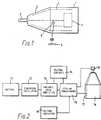
- a typical capacitive-type high voltage detector such as is shown there normally has a body 1 with a frusto-conical nose 2, made from a plastics material with good insulating properties. At the tip of the nose there is a metal probe 3 which is touched against the high voltage conductor to be tested. Inside the body of the cone there is a metallic screen 4 connected to the probe 3 via an internal capacitor 6. The screen 4 provides a capacitive path to earth 5 with a capacitance value that can be taken as being relatively constant in use. When the probe 3 is touched onto a conductor (not shown) at high voltage, a capacitive current will flow through the internal capacitor and through the capacitance from the screen 4 to earth 5.
- the capacitance of the screen to earth has a very low value, generally about 3 to 5 pico-farads, and the internal capacitor 6 is chosen to be normally very large in comparison with the capacitance of the screen to earth, the current through the capacitance 6 is therefore proportional to the voltage on the conductor and the capacitance from the screen to earth.
- the voltage across the capacitor 6 is fed into an electronic evaluating section 7 of the detector where it is able to actuate visual and/or audible indicators (not shown).
- the value of the capacitor 6 is generally chosen so that there is a voltage of 1 volt across it at the threshold, or switching, voltage of the electronic section 7.
- Fig. 2 illustrates a proving apparatus for the high voltage detector of Fig. 1.
- the apparatus includes a circuit which comprises a power source 11, for example, a 9 volt battery, which operates a sinusoidal oscillator 12 which produces a stable sinusoidal waveform having, for example, an amplitude of 1 volt RMS.
- the oscillator can have fixed or adjustable frequency, for example at some 50 to 60Hz.
- the oscillator 12 outputs to a variable gain amplifier 13 which allows the waveform to be amplified by means of a voltage control 14 mounted on a front panel (not shown) of the apparatus.
- the output of the amplifier 13 is a differential power stage providing an output voltage which is variable from 0 to about 7 volts RMS.
- the differential output is connected across the primary of step-up transformer 15, and the secondary of the transformer provides a step-up ratio, for example between about 50 to 200, which can be selected by the voltage control.
- the voltage on the transformer secondary circuit can therefore be varied from 0 up to between 350 and 1400 volts RMS.
- the transformer secondary is connected to a proving fixture 16 in the apparatus.
- the fixture 16 is formed as a hollow body designed to receive the detector under test fitting closely within it and the inner surfaces of the body are preferably substantially conformal with the adjoining surfaces of the detector.
- One secondary terminal is connected to an internal metal screen 17 in the fixture body or close to its inner surface, and the other terminal is connected to a conductor 18 projecting concentrically into the tapered inner end of the body.
- the capacitance between the screens 4 and 17 is much larger than the capacitance to earth of the internal screen 4 of the detector. Accordingly, the detector will be triggered at much lower voltages than its normal threshold voltage. It is therefore possible to check the threshold voltage of the detector using a voltage value which is only a fraction of the appropriate voltage for the screen-earth capacitance effect.
- the capacitance to earth of the metallic screen 4 within the detector is relatively constant, and that the capacitance between the screen 4 and the screen 17 of the fixture is also relatively constant.
- the voltage supplied by the step-up transformer 15 is monitored, eg. on a voltage indicator 19, by scaling the reading it is possible to determine the equivalent voltage for the detector when it is in normal use. This allows the threshold voltage of the detector to be accurately determined using a voltage very considerably less than the normal operational voltage, by increasing the transformer step-up ratio until the detector is triggered.
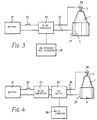
- Fig. 3 illustrates an alternative proving apparatus for the high voltage detector of Fig. 1.
- the apparatus includes electronic circuit powered by a power source 21, for example, a 9 volt battery, which is connected to the electronic circuit by an on-off switch 22. When the switch 22 is closed a DC/DC converter 23 of the circuit produces a high DC voltage, typically 1000 volts, across the output terminals 24 of the proving apparatus. Means may be provided to vary the output voltage, as in the first example described.
- the circuit also incorporates a low frequency multivibrator 25 with a frequency of typically 10HZ which switches the DC/DC converter on and off. Therefore, the signal across the output terminals 24 of the proving apparatus is a square wave with a frequency of 10HZ and a peak to peak voltage of 1000 volts.
- One terminal of the proving apparatus is connected via a lead with a crocodile-type clip 26 to the probe 3 of the high voltage detector to be proved.
- the other terminal of the proving apparatus is connected via a lead to a flexible, conductive strip 27 which is wrapped round the body 1 of the high voltage detector.
- This flexible strip could be made of robust, conductive foam, and it may be held in position by either stud fasteners or so-called touch-and-close fastening strips (not shown).
- the conductive strip 27 is so configured that the capacitance between the internal screen 4 of the detector and the strip is much larger than the capacitance to earth of the screen 4. Accordingly, the detector will be triggered at much lower voltages than its normal threshold voltage. It is, therefore, possible to check this operation of the detector using a voltage value which is only a fraction of the appropriate voltage for the screen-earth capacitance effect.
- This illustrated apparatus and its method of operation are not intended to determine the threshold voltage of a detector. Its purpose rather is to provide in a simple and economical way a go/no-go tester which checks that the high voltage detector is operating correctly, without measuring its switching threshold voltage.
- Fig. 4 illustrates a further alternative proving apparatus for the high voltage detector.
- the low frequency test signal available from the apparatus in Fig. 3 has too low a frequency to activate certain high voltage detectors.
- the apparatus illustrated in Fig. 4 can circumvent such problems. It takes a similar form to the apparatus of Fig. 3 and components already described in the previous example are indicated by the same reference numbers. It differs in that it employs a multivibrator 28 having a frequency, typically 50Hz, higher than that of the multivibrator 25, which switches a high voltage switch 29 so that the signal across the output terminals 24 of the proving apparatus is a square wave at the multivibrator frequency and with a peak to peak voltage of typically 10000 volts.
- the high voltage switch 29 would conveniently be a high-voltage power MOS-FET.
- a receiver for the detector can be provided by a flexible sleeve that can be wrapped around the detector body, the sleeve consisting of or containing conductive material so as to be able to provide a suitably high capacitive effect with the detector screen member.
Landscapes
- Physics & Mathematics (AREA)
- General Physics & Mathematics (AREA)
- Engineering & Computer Science (AREA)
- Power Engineering (AREA)
- Measuring Instrument Details And Bridges, And Automatic Balancing Devices (AREA)
- Measurement Of Current Or Voltage (AREA)
Claims (10)
- Un appareil pour éprouver un détecteur de haute tension de type capacitif, le détecteur comprenant un corps (1) portant un capteur de contact (3) connecté par une capacité (6) à un élément écran (4) placé dans le corps (1), ledit élément écran (4) étant prévu pour produire, lorsque le détecteur est en fonctionnement, un effet capacitif avec la terre (5), et l'appareil comprenant un récepteur (16) dans ou contre lequel ledit détecteur est placé, ledit récepteur (16) ayant un élément conducteur (17 ou 27) formant une capacité avec ledit élément écran (4) dans le détecteur, l'appareil comprenant de plus un élément de contact (18 ou 26) engagé dans le capteur de contact (3) du détecteur et des moyens (11 à 15) d'application d'une tension variable entre ledit élément conducteur (17 ou 27) et ledit élément de contact (18 ou 26), l'élément conducteur (17 ou 27) étant prévu pour produire un effet capacitif avec l'élément écran (4) du détecteur sensiblement plus grand que celui produit par ledit élément écran (4) avec la terre (5) lorsque le détecteur est en fonctionnement.
- Appareil selon la revendication 1 caractérisé par des moyens (14) d'ajustement de la tension appliquée entre ledit élément conducteur (17) et ledit élément de contact (18).
- Appareil selon la revendication 2 caractérisé en ce que lesdits moyens d'ajustement de la tension appliquée comprend des moyens (14) de contrôle de la tension contrôlant un amplificateur à gain variable (13) et/ou un transformateur élévateur (15) dans lesdits moyens d'application d'une tension variable.
- Appareil selon la revendication 2 ou 3, caractérisé par des moyens (19) de mesure de la tension entre lesdits éléments et de production d'un relevé agrandi à l'échelle de la mesure.
- Appareil selon la revendication 1 ou 2 caractérisé par un convertisseur continu-continu (23) prévu pour produire une tension augmentée et des moyens (28, 29) de hachage pour interrompre cycliquement la sortie dudit convertisseur pour délivrer ladite tension variable entre ledit élément conducteur (27) et ledit élément de contact (26).
- Appareil selon la revendication 5 caractérisé en ce que lesdits moyens de hachage comprennent un commutateur (29) sur la sortie du convertisseur continu-continu (23) et un multivibrateur (28) contrôlant ledit commutateur (29).
- Appareil selon l'une quelconque des revendications précédentes, caractérisé en ce que ledit récepteur (16) comprend un conteneur évidé formant un réceptacle pour ledit détecteur.
- Appareil selon l'une quelconque des revendication 1 à 6, caractérisé en ce que ledit récepteur (16) est formé par un manchon flexible réalisé en ou contenant un matériau conducteur formant ledit élément conducteur (27).
- Une méthode pour éprouver un détecteur de haute tension de type capacitif, le détecteur comprenant un corps (1) portant un capteur de contact (3) connecté par une capacité (6) à un élément écran (4) placé dans le corps (1), ledit élément écran (4) étant prévu pour produire un effet capacitif avec la terre (5); la méthode comprenant les étapes d'engagement dans le corps (1) du détecteur d'un élément conducteur (17 ou 27) pour former une capacité entre ledit élément écran (4) dans le détecteur, ladite capacité étant sensiblement supérieure à la capacité entre l'élément écran (4) et la terre (5) lorsque le détecteur est en fonctionnement, d'engagement d'un élément de contact (18 ou 26) dans le capteur de contact (3) du détecteur, et d'application d'une tension variable entre ledit élément conducteur (17 ou 27) et ledit élément de contact (18 ou 26) de façon à actionner le détecteur.
- Une méthode selon la revendication 9, caractérisée par l'étape de mesure de la tension appliquée et d'augmentation de l'échelle de la mesure pour indiquer la tension d'actionnement du détecteur en fonctionnement normal.
Applications Claiming Priority (4)
| Application Number | Priority Date | Filing Date | Title |
|---|---|---|---|
| GB888824844A GB8824844D0 (en) | 1988-10-24 | 1988-10-24 | Proving apparatus & method for high voltage detectors |
| GB8824844 | 1988-10-24 | ||
| GB898901415A GB8901415D0 (en) | 1989-01-23 | 1989-01-23 | Proving apparatus & method for high voltage detectors |
| GB8901415 | 1989-01-23 |
Publications (2)
| Publication Number | Publication Date |
|---|---|
| EP0366360A1 EP0366360A1 (fr) | 1990-05-02 |
| EP0366360B1 true EP0366360B1 (fr) | 1993-12-15 |
Family
ID=26294545
Family Applications (1)
| Application Number | Title | Priority Date | Filing Date |
|---|---|---|---|
| EP19890310767 Expired - Lifetime EP0366360B1 (fr) | 1988-10-24 | 1989-10-19 | Appareil et méthode pour éprouver des détecteurs de haute tension |
Country Status (2)
| Country | Link |
|---|---|
| EP (1) | EP0366360B1 (fr) |
| DE (1) | DE68911474T2 (fr) |
Families Citing this family (3)
| Publication number | Priority date | Publication date | Assignee | Title |
|---|---|---|---|---|
| JP5727074B1 (ja) * | 2014-06-04 | 2015-06-03 | 長谷川電機工業株式会社 | 直流電圧検出器 |
| US10539643B2 (en) * | 2017-09-01 | 2020-01-21 | Fluke Corporation | Proving unit for use with electrical test tools |
| GB2576369B (en) * | 2018-08-17 | 2020-10-28 | Powerpoint Eng | Testing apparatus for a voltage detector |
Family Cites Families (2)
| Publication number | Priority date | Publication date | Assignee | Title |
|---|---|---|---|---|
| FR2102531A5 (fr) * | 1970-08-06 | 1972-04-07 | Merlin Gerin | |
| DE3712783A1 (de) * | 1987-04-15 | 1988-11-03 | Wickmann Werke Gmbh | Verfahren zur ueberpruefung der funktionsfaehigkeit einer pruefvorrichtung fuer hochspannungsleiter sowie pruefvorrichtung |
-
1989
- 1989-10-19 EP EP19890310767 patent/EP0366360B1/fr not_active Expired - Lifetime
- 1989-10-19 DE DE1989611474 patent/DE68911474T2/de not_active Expired - Fee Related
Also Published As
| Publication number | Publication date |
|---|---|
| EP0366360A1 (fr) | 1990-05-02 |
| DE68911474T2 (de) | 1994-04-14 |
| DE68911474D1 (de) | 1994-01-27 |
Similar Documents
| Publication | Publication Date | Title |
|---|---|---|
| US6876203B2 (en) | Parallel insulation fault detection system | |
| US3774110A (en) | Static electric field detector | |
| US6812685B2 (en) | Auto-selecting, auto-ranging contact/noncontact voltage and continuity tester | |
| EP0878717A2 (fr) | Circuit de mesure en circuit de la résistance et du courant | |
| US4488118A (en) | Halogen gas leak detector | |
| US7292048B2 (en) | Method and apparatus for measuring a dielectric response of an electrical insulating system | |
| USRE32552E (en) | Gaseous impurity detector employing corona discharge phenomenon | |
| MX166719B (es) | Dispositivo detector portatil para detectar la descarga electrica parcial en equipo y/o cables de distribucion de voltaje | |
| US5365177A (en) | Apparatus for measurement of high frequency corona discharges in electrical components | |
| ZA855518B (en) | Digital display ohmmeter | |
| EP0366360A1 (fr) | Appareil et méthode pour éprouver des détecteurs de haute tension | |
| US5600255A (en) | Live circuit resistance measurement system and method | |
| US3863149A (en) | Rf hazard detector | |
| US4392106A (en) | Non-contact device for monitoring electrical pulse signals | |
| US6313635B1 (en) | High voltage sensor assembly | |
| WO2015184491A1 (fr) | Détecteur de tension | |
| ATE272847T1 (de) | Ein gerät zur überwachung teilweiser entladungen in einem gerät mit elektrischer hochspannung oder in einer hochspannungsanlage | |
| US5471134A (en) | Measuring apparatus with adjustable indicator for measuring the real load factor on an electricity source | |
| US3546581A (en) | Insulation continuity tester including a grounded detector resistance and grounded voltage source | |
| JPS5717870A (en) | Coil turn short circuit detection method of electromagnetic induction device | |
| KR101721366B1 (ko) | 휴대용 전기울타리 전압측정기 | |
| KR970706488A (ko) | 비전도성 물질에서 전하 운반능력을 측정하는 방법 및 장치(device and method for measuring charge carrying activity in generally nonconductive materials) | |
| JPH11354252A (ja) | 放電電流モニタ及び高圧電源装置及び放電装置 | |
| EP0551199A2 (fr) | Instrument d'essai d'isolement et de la continuité électrique | |
| US5016136A (en) | Charge build-up and decay monitor |
Legal Events
| Date | Code | Title | Description |
|---|---|---|---|
| PUAI | Public reference made under article 153(3) epc to a published international application that has entered the european phase |
Free format text: ORIGINAL CODE: 0009012 |
|
| AK | Designated contracting states |
Kind code of ref document: A1 Designated state(s): DE FR GB |
|
| 17P | Request for examination filed |
Effective date: 19900915 |
|
| RAP1 | Party data changed (applicant data changed or rights of an application transferred) |
Owner name: EDGCUMBE INSTRUMENTS LIMITED |
|
| 17Q | First examination report despatched |
Effective date: 19920811 |
|
| GRAA | (expected) grant |
Free format text: ORIGINAL CODE: 0009210 |
|
| AK | Designated contracting states |
Kind code of ref document: B1 Designated state(s): DE FR GB |
|
| REF | Corresponds to: |
Ref document number: 68911474 Country of ref document: DE Date of ref document: 19940127 |
|
| ET | Fr: translation filed | ||
| PLBE | No opposition filed within time limit |
Free format text: ORIGINAL CODE: 0009261 |
|
| STAA | Information on the status of an ep patent application or granted ep patent |
Free format text: STATUS: NO OPPOSITION FILED WITHIN TIME LIMIT |
|
| 26N | No opposition filed | ||
| PGFP | Annual fee paid to national office [announced via postgrant information from national office to epo] |
Ref country code: GB Payment date: 19991020 Year of fee payment: 11 |
|
| PGFP | Annual fee paid to national office [announced via postgrant information from national office to epo] |
Ref country code: DE Payment date: 19991022 Year of fee payment: 11 |
|
| PGFP | Annual fee paid to national office [announced via postgrant information from national office to epo] |
Ref country code: FR Payment date: 19991026 Year of fee payment: 11 |
|
| PG25 | Lapsed in a contracting state [announced via postgrant information from national office to epo] |
Ref country code: GB Free format text: LAPSE BECAUSE OF NON-PAYMENT OF DUE FEES Effective date: 20001019 |
|
| GBPC | Gb: european patent ceased through non-payment of renewal fee |
Effective date: 20001019 |
|
| PG25 | Lapsed in a contracting state [announced via postgrant information from national office to epo] |
Ref country code: FR Free format text: LAPSE BECAUSE OF NON-PAYMENT OF DUE FEES Effective date: 20010629 |
|
| PG25 | Lapsed in a contracting state [announced via postgrant information from national office to epo] |
Ref country code: DE Free format text: LAPSE BECAUSE OF NON-PAYMENT OF DUE FEES Effective date: 20010703 |
|
| REG | Reference to a national code |
Ref country code: FR Ref legal event code: ST |