EP0366591B1 - Triboelektrischer Generator mit Rollen - Google Patents
Triboelektrischer Generator mit Rollen Download PDFInfo
- Publication number
- EP0366591B1 EP0366591B1 EP89500108A EP89500108A EP0366591B1 EP 0366591 B1 EP0366591 B1 EP 0366591B1 EP 89500108 A EP89500108 A EP 89500108A EP 89500108 A EP89500108 A EP 89500108A EP 0366591 B1 EP0366591 B1 EP 0366591B1
- Authority
- EP
- European Patent Office
- Prior art keywords
- collecting
- components
- active
- triboelectric generator
- active components
- Prior art date
- Legal status (The legal status is an assumption and is not a legal conclusion. Google has not performed a legal analysis and makes no representation as to the accuracy of the status listed.)
- Expired - Lifetime
Links
- 238000005096 rolling process Methods 0.000 title claims description 43
- 239000000463 material Substances 0.000 claims description 19
- 239000007787 solid Substances 0.000 claims description 5
- 239000004020 conductor Substances 0.000 claims description 2
- 238000005421 electrostatic potential Methods 0.000 claims 2
- 230000035508 accumulation Effects 0.000 description 5
- 238000009825 accumulation Methods 0.000 description 5
- 238000013461 design Methods 0.000 description 5
- 230000005611 electricity Effects 0.000 description 4
- 238000000034 method Methods 0.000 description 4
- 239000003795 chemical substances by application Substances 0.000 description 3
- 230000008569 process Effects 0.000 description 3
- 229920006362 Teflon® Polymers 0.000 description 2
- 230000009471 action Effects 0.000 description 2
- 230000015572 biosynthetic process Effects 0.000 description 2
- 238000010276 construction Methods 0.000 description 2
- 238000013519 translation Methods 0.000 description 2
- 230000014616 translation Effects 0.000 description 2
- 229920002972 Acrylic fiber Polymers 0.000 description 1
- 229920004934 Dacron® Polymers 0.000 description 1
- 239000004677 Nylon Substances 0.000 description 1
- 230000005540 biological transmission Effects 0.000 description 1
- 230000015556 catabolic process Effects 0.000 description 1
- 229920002678 cellulose Polymers 0.000 description 1
- 239000001913 cellulose Substances 0.000 description 1
- 230000000295 complement effect Effects 0.000 description 1
- 239000003989 dielectric material Substances 0.000 description 1
- 230000005684 electric field Effects 0.000 description 1
- 230000002708 enhancing effect Effects 0.000 description 1
- 230000007613 environmental effect Effects 0.000 description 1
- 239000011521 glass Substances 0.000 description 1
- 230000009931 harmful effect Effects 0.000 description 1
- 230000006698 induction Effects 0.000 description 1
- 239000010985 leather Substances 0.000 description 1
- 230000007246 mechanism Effects 0.000 description 1
- 229920001778 nylon Polymers 0.000 description 1
- 239000002245 particle Substances 0.000 description 1
- 239000005020 polyethylene terephthalate Substances 0.000 description 1
- 239000012716 precipitator Substances 0.000 description 1
- 238000011160 research Methods 0.000 description 1
- 230000003068 static effect Effects 0.000 description 1
- MJZUVFQGQRWMQE-UHFFFAOYSA-J sulfanide;tin(4+) Chemical compound [SH-].[SH-].[SH-].[SH-].[Sn+4] MJZUVFQGQRWMQE-UHFFFAOYSA-J 0.000 description 1
- 238000012546 transfer Methods 0.000 description 1
- 229920002554 vinyl polymer Polymers 0.000 description 1
Images

Classifications
-
- H—ELECTRICITY
- H02—GENERATION; CONVERSION OR DISTRIBUTION OF ELECTRIC POWER
- H02N—ELECTRIC MACHINES NOT OTHERWISE PROVIDED FOR
- H02N1/00—Electrostatic generators or motors using a solid moving electrostatic charge carrier
- H02N1/04—Friction generators
Definitions
- Electrostatic machines played an important role in early discoveries in the field of electricity: nowadays, they have been relegated to specific research or industrial uses, such as, for example, the supply of high voltages for particle accelerators and for separators or precipitators.
- Van der Graaf who designed the generator which bears his name and which is currently the one in most use, both in small and in large sizes.
- the "peletron” is a modified Van der Graaf generator using a system which is similar to an endless belt. In the Oak Ridge (USA) laboratory there is a peletron coupled to a 25 MV accelerator.
- Modern generators are usually accommodated in hermetic chambers which are filled at high pressures with some suitable gas, such as F6S, which prevents dielectric breakdown and the harmful effects of environmental humidity.
- the generator which is proposed here can also operate in a hermetic enclosure and any chosen atmosphere and at the appropriate pressure. If the "coaxial" arrangement is adopted, which is one of those proposed, the external cylinder can act simultaneously as the container to be filled by the gas.
- the cylinders of Ballentine's device are loaded with electrical charges of the same sign and, on the other hand, the charges created by the triboelectrization in the surface of the rollers can only issue through the fixed electrodes which do not contact with the external surface of the rotor.
- Ballentine's device there is no electrode or charge collecting means or way of escape for the charges generated by the triboelectrization on the external surface of the contactors and on the inside surface of the rotor.
- the coaxial design ( Figure 6) also offers the particular feature that the entire electric field generated by the device is confined within the physical limits of the device, avoiding losses and interferences.
- the electrostatic generator proposed in the present specification has, among other features, the novelty of its design, the originality of its operation, the simplicity of its basic construction, the possibility of grouping its basic elements together in a modular fashion and its adaptability to different performance requirements or demands.
- triboelectric because it is based on the so-called “triboelectric” properties of some materials and “rolling” because it benefits from the electrification produced by rolling in triboelectric materials.
- Ticlearification is the process by means of which, by placing two specific materials in surface contact, accumulations of electrical charges of respectively opposite signs are produced on said surfaces.
- the phenomenon originates in the transfer of electrons close to the surface from one material to the other. In order for triboelectrification to take place, it is not essential for one surface to cause friction on the other. If the triboelectrified media are insulating, the accumulations of charges will persist when there is no longer any contact between the surfaces of the media.
- the rolling triboelectric generator which is the subject of the invention is intended to obtain electromotive forces and comprises active components or parts which, by means of triboelectrification, generate electrical charges; positive and negative respectively, in equal quantity; and at least two parts or components collecting said charges and intended for the transmission of said charges to terminals outside the generator.
- the active parts or elements of the generator comprises one or more pairs of solid bodies of materials which are suitable and distinguished from one another (for example, nylon and teflon®) which occupy separate positions in the so-called “triboelectric series” and which are intended to roll on one another, generating electrical charges of opposite signs which appear separately in the bodies of different materials and situated at unequal electrical potentials.
- the parts or components which form the active pairs possess external surfaces which permit rolling of one on another, wherein one of them is plane and the other cylindrical, or wherein the two surfaces are cylindrical.
- the mutual rolling surfaces between the active parts have a finish which is smooth or grooved in the manner of a gear or rack, the latter in the case of parts with a plane surface.
- the collecting parts or components of the triboelectric generator are solid bodies, at least at the surface, which conduct electricity and are suitable for transferring the electrical charges to the terminals outside the generator.
- the collecting elements possess plane or curved surfaces by means of which they are in rolling contact with the respective active parts, the rolling surfaces having a finish which is smooth or grooved in the manner of a gear or rack.
- the active parts and collecting parts have the form of a cylinder or roller with smooth or grooved surfaces.
- the collecting parts or components comprise two cylindrical parts which are coaxial and concentric, the outermost of which is hollow and is provided with a certain number of pairs of active parts which are dimensioned and positioned in such a way that they can perform rolling movements relative, respectively, to the inner face of the external collecting part and to another active component which, in turn, will roll on the outer face of the inner collecting cylinder, all the surfaces of the components mentioned being smooth or grooved.
- the active parts have the form of a roller and the collecting parts are of plane form.
- Another aspect of the generator which is the subject of the invention resides in that the individual active components, in whatever form, are grouped together in series or in parallel or alternatively in mixed form, it being possible, in the first case, to adapt two intermediate collecting parts into a single part common to the two modules thereby grouped together.
- Rolling is a form of contact between two surfaces which is produced in successive form and which is possible only when at least one of the two surfaces is curved.
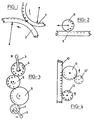
- Figure 2 illustrates the formation of surface charges as a result of rolling between triboelectric media, one of which has a plane surface (9) and the other has the form of a cylinder or roller (8).
- the arrow indicates the direction of advance of the center of the roller (8).
- the signs of the charges depend on the respective nature of the materials.
- the electrical charges generated by rolling on a surface may be removed therefrom by another rolling involving a third surface (plane or curved, as appropriate) of material which conducts electricity and which acts as a collecting device.
- Figure 3 illustrates this process: the cylinders (5) and (6), shown in section, are made of materials which are suitable for the rolling between them to cause triboelectrification; the cylinders (4) and (7) are made of conducting material and, in rolling thereof with the above, act as collectors collecting the electrical charges.
- triboelectrification is due to rolling between a plane (10) and a cylinder or roller (11) and the charges are collected by means of the conducting cylinders (12) and (12').
- the collecting parts are the plane parts (13) and (14) and in the configuration of Figure 6 the conducting and collecting elements are concentric tubes (17) and (18) shown in section.
- the cylinders or rollers which collect the charges are drawn by means of circles of small diameter, the circles of large diameter corresponding to cylinders or rollers of triboelectrifiable materials.
- the device operates when there is rolling between the active components and between the active components and the collectors, all driven by an external mechanical agent. This movement gives rise to accumulations of charges in the active components, which charges are transferred to the collectors and (via external terminals) to the external devices receiving electrical charges and currents. An electromotive force arises between said terminals during operation of the device.
- the electrical energy involved during operation of this device originates from the mechanical energy supplied by the external mechanical agent which determines the rolling process.
- the nature, characteristics and form of application of this mechanical action lie outside the subject of this patent.
- This mechanical action may be applied in several ways and may directly affect one or more of the essential elements of the device which were mentioned above.
- the plane parts which can, alternatively, form the active elements and the collectors permit, in relation to a rolling, mutual movements which are basically those of translation. When the form thereof is cylindrical, they permit rotations and translations.
- the rolling results, in each case, from relative combinations of these types of movements.
- Figure 3 illustrates a proposal or construction which may be considered basic or fundamental.
- the active parts are two cylinders (5 and 6) of arbitrary and not necessarily equal radius, suitable for rolling on one another. Each one of them is in permanent rolling contact with a collecting cylinder (4) and (7) which, in turn, are each provided with respective terminals (3).
- the radii of the different cylinders or rollers do not necessarily have to be equal: their values are arbitrary, although they may also be equal.
- the axes of the different cylinders or rollers have to be parallel, but not necessarily all coplanar.
- the surface of the rollers may be smooth. It may also be provided with teeth so that it has the form of a straight or helical gear.
- the cylinders having surfaces in the form of gears increase the contact surface, enhancing the generation of surface charges, and facilite the entrainment of all of them, thereby enabling applying the external mechanical agent to only one or all of them.
- the active elements are the plane part (10) and the cylinder (11).
- the collecting elements are the rollers, smooth or provided with teeth, which are identified by the numbers (12) and (12').
- the cylinders in this arrangement, are provided with teeth, the plane part has to be made in the form of a rack. In this case, electromotive forces are generated by virtue of the relative movement of the parts which remain in contact.
- the active elements forming pairs, are organized in series, being held in suitable relative positions by means of a retaining structure.
- the existence of three pairs of active elements (15,16) has been assumed.
- Their form is cylindrical.
- the collecting parts are plane in character (13) and (14). Both the plane elements and the cylindrical elements may be smooth on the surface or may be provided with grooves or teeth which couple or mesh together. Electromotive forces are generated when the "series" of active elements is displaced relative to the plane parts, causing rolling which determines both the generation and accumulations of charges and collection thereof by the plane collectors.
- the active elements (21 and 22) have the form of pairs of cylinders or rollers (smooth or toothed) in permanent contact with one another and with two coaxial cylinders (17 and 18) which act as collectors, the larger (17) of which is hollow.
- the active pairs (at least one) are accommodated in the space between the two collecting cylinders whose surfaces intended for rolling are smooth or toothed according to the nature of the surface of the active rollers.
- a generator is shown as a non-limiting example, with three pairs of active elements.
- the choice of the radii of the respective parts is such that permanent contact is ensured during rolling between the inner face of the outer collector cylinder (17) and the outer surface of the active element or elements of one sign and also that permanent contact is ensured between the outer face of the inner collector cylinder (18) and the active roller or rollers of the other sign. Permanent contact during rolling must also be ensured in respect of each active cylinder and its companion or complementary component. In this case, electromotive forces are generated by any of the relative movements of the parts or elements, by means of which relative movements rolling is produced between the rollers and cylinders involved.
- Figure 7 shows the grouping together of various individual modules.
- the grouping together of various modules with the characteristics of that described in Figure 3 has been taken as a non-limiting example.
- the left-hand branch and the right-hand branch each include various modules (to be exact, two) grouped together in series.
- the two collecting elements by means of which the series connection is established, (19) and (20), may be adapted into a single element.
- the grouping together of modules in series increases the voltage between external terminals.
- the two branches (each comprising two series-connected groups) are connected in parallel, which increases the current supply.
- the larger circles show, in section, the active rollers
- the smaller circles show, in section, the collecting cylinders
Landscapes
- Elimination Of Static Electricity (AREA)
- Spark Plugs (AREA)
- Rolls And Other Rotary Bodies (AREA)
- Non-Mechanical Conveyors (AREA)
Claims (20)
- Triboelektrischer Generator vom Rollentyp zum Erzeugen elektromotorischer Kraft, ohne äußere Ladungsquellen zu verwenden, mit:
einer Vielzahl aktiver Bauteile (1, 2, 5, 6, 8-11, 13-18), von denen jedes eine äußere Oberfläche hat, wobei wenigstens eines der aktiven Bauteile (1, 2, 5, 6, 8-11, 13-18) eine äußere Oberfläche aufweist, die an der äußeren Oberfläche eines der anderen aktiven Bauteile (1, 2, 5, 6, 8-11, 13-18) gegenläufig rollbar ist;
einer Vielzahl elektrische Ladung sammelnder Bauteile (4, 7, 12, 12', 19, 20), von denen jedes eine elektrisch leitende Oberfläche aufweist, wobei jede elektrisch leitende Oberfläche der Ladung sammelnden Bauteile (4, 7, 12, 12', 19, 20) zum gegenläufigen Rollen an der äußeren Oberfläche eines entsprechenden aktiven Bauteils (1, 2, 5, 6, 8-11, 13-18) angeordnet ist;
dadurch gekennzeichnet, daß
die aktiven Bauteile (1, 2, 5, 6, 8-11, 13-18) jeweils Materialien aufweisen, die unterschiedliche Positionen in den triboelektrischen Reihen einnehmen und als triboelektrifizierende Generatoren positiver und negativer elektrischer Ladungen in gleicher Menge dienen, die getrennt durch die aktiven Bauteile mit ihren unterschiedlichen Materialien und mit ihren ungleichen elektrostatischen Potentialen erzeugt werden; und
die sammelnden Bauteile (4, 7, 12, 12', 19, 20) wenigstens zwei Sammelkörper aufweisen, die zumindest an ihren Oberflächen zu dem gegenläufigen Rollen an den jeweiligen aktiven Bauteilen eingerichtet sind; und
mit den sammelnden Bauteilen (4, 7, 12, 12', 19, 20) elektrische Ladungen, die durch das gegenläufige Rollen erzeugt worden sind, von elektrisch leitenden Bereichen an den Oberflächen der wenigstens zwei sammelnden Körper auf äußere Anschlüsse (3) zu übertragen. - Triboelektrischer Generator nach Anspruch 1, bei dem wenigstens eine der äußeren Oberflächen der aktiven Bauteile (1, 2, 5, 6, 8-11, 13-18) und die elektrisch leitenden Oberflächen der sammelnden Bauteile (4, 7, 12, 12', 19, 20) eine im wesentlichen ebene Oberfläche (9, 10, 13, 14) ist.
- Triboelektrischer Generator nach Anspruch 2, bei dem wenigstens eine der äußeren Oberflächen der aktiven Bauteile (1, 2, 5, 6, 8-11, 13-18) und der elektrisch leitenden Oberflächen der sammelnden Bauteile (4, 7, 12, 12', 19, 20) eine im wesentlichen gekrümmte Oberfläche ist.
- Triboelektrischer Generator nach Anspruch 1, bei dem wenigstens eine der äußeren Oberflächen der aktiven Bauteile (1, 2, 5, 6, 8-11, 13-18) und der elektrisch leitenden Oberflächen der sammelnden Bauteile (4, 7, 12, 12', 19, 20) eine im wesentlichen gekrümmte Oberfläche ist.
- Triboelektrischer Generator nach Anspruch 1, bei dem die aktiven Bauteile (1, 2, 5, 6, 8-11, 13-18) wenigstens ein Paar gegenseitig unterteilter Festkörper aufweisen.
- Triboelektrischer Generator nach Anspruch 2, bei dem gegenläufig rollbare Oberflächen zwischen ebenen aktiven Bauteilen (9, 10) glatt sind.
- Triboelektrischer Generator nach Anspruch 2, bei dem gegenläufig rollbare Oberflächen zwischen einem ebenen aktiven Bauteil (9, 10) und einem ebenen sammelnden Bauteil (13, 14) gezahnt sind.
- Triboelektrischer Generator nach Anspruch 7, bei dem die ebenen gezahnten gegenläufig rollbaren Oberflächen eine Zahnstangen-Getriebeanordnung aufweisen.
- Triboelektrischer Generator nach Anspruch 1, bei dem die aktiven Bauteile (1, 2, 5, 6, 8-11, 13-18) und die sammelnden Bauteile (4, 7, 12, 12', 19, 20) zylindrische oder Rollengestalten aufweisen.
- Triboelektrischer Generator nach Anspruch 9, bei dem die äußeren Oberflächen wenigstens eines Paares der aktiven (1, 5, 6, 8-11, 13-18) und sammelnden (4, 7, 12, 12', 19, 20) Bauteile glatt sind.
- Triboelektrischer Generator nach Anspruch 9, bei dem die äußeren Oberflächen wenigstens eines Paares der aktiven (1, 5, 6, 8-11, 13-18) und sammelnden (4, 7, 12, 12', 19, 20) Bauteile genutet sind.
- Triboelektrischer Generator nach Anspruch 1, bei dem wenigstens eines der aktiven (1, 5, 6, 8-11, 13-18) und sammelnden (4, 7, 12, 12', 19, 20) Bauteile eine zylindrische oder Rollengestalt aufweist.
- Triboelektrischer Generator nach Anspruch 1, bei dem wenigstens eines der aktiven Bauteile (1, 5, 6, 8-11, 13-18) und wenigstens eines der sammelnden Bauteile (4, 7, 12, 12', 19, 20) jeweils zylindrische oder Rollengestalten aufweisen.
- Triboelektrischer Generator vom Rollentyp nach Anspruch 1, bei dem die sammelnden Bauteile (4, 7, 12, 12', 19, 20) ein Paar voneinander beabstandeter einander zugewandter ebener Bauteile (13, 14) aus elektrisch leitendem Material aufweisen, und die aktiven Bauteile (15, 16) zwischen den voneinander beabstandeten sammelnden Bauteilen angeordnet sind, wobei die aktiven Bauteile (15, 16) in Paaren vorgesehen sind, die gegenläufig aneinander rollbar sind und die auf jeweiligen Ebenen sammelnden Bauteile (13, 14) rollbar sind.
- Triboelektrischer Generator nach Anspruch 14, bei dem die Paare aktiver Bauteile (15, 16) miteinander parallel verbunden sind, um die Stromkapazität zu erhöhen.
- Triboelektrischer Generator nach Anspruch 14, bei dem die Paare aktiver Bauteile (15, 16) miteinander in Reihe verbunden sind, um die Spannungskapazität zu erhöhen.
- Triboelektrischer Generator vom Rollentyp zum Erzeugen elektromotorischer Kräfte, ohne externe Ladungsquellen zu verwenden, mit:
einer Vielzahl aktiver Bauteile (1, 2, 5, 6, 8-11, 13-18), von denen jedes eine äußere Oberfläche hat, wobei wenigstens eines der aktiven Bauteile (1, 2, 5, 6, 8-11, 13-18) eine äußere Oberfläche hat, die an der äußeren Oberfläche eines anderen der aktiven Bauteile (1, 2, 5, 6, 8-11, 13-18) gegenläufig rollbar ist;
einer Vielzahl elektrische Ladung sammelnder Bauteile (4, 7, 12, 12', 19, 20), von denen jedes eine elektrisch leitende Oberfläche aufweist, wobei jede elektrisch leitende Oberfläche der Ladung sammelnden Bauteile (4, 7, 12, 12', 19, 20) zum gegenläufigen Rollen an der äußeren Oberfläche eines jeweiligen aktiven Bauteils (1, 2, 5, 6, 8-11, 13-18) angeordnet ist;
dadurch gekennzeichnet, daß
die aktiven Bauteile (1, 2, 5, 6, 8-11, 13-18) jeweils Materialien aufweisen, die unterschiedliche Positionen in den triboelektrischen Reihen einnehmen und als triboelektrische Generatoren positiver und negativer elektrischer Ladungen in gleicher Menge dienen, die getrennt durch die aktiven Bauteile mit ihren unterschiedlichen Materialien und mit ungleichen elektrostatischen Potentialen erzeugt werden;
die sammelnden Bauteile (4, 7, 12, 12', 19, 20) wenigstens zwei koaxiale und zylindrische sammelnde Bauteile aufweisen, von denen wenigstens ein äußerster hohl ist; die aktiven Bauteile (1, 2, 5, 6, 8-11, 13-18) zwischen koaxialen sammelnden Teilen angeordnet sind und rollende Berührungsbewegungen jeweils bezüglich einer inneren Oberfläche des äußersten sammelnden Teiles und eines anderen aktiven Bauteiles ausführen, wobei das andere aktive Bauteil seinerseits eine rollende Berührungsbewegung an einer äußeren Oberfläche eines am weitestens innen liegenden sammelnden Teiles ausführt; und
Einrichtungen mit den sammelnden Bauteilen (4, 7, 12, 12', 19, 20) gekoppelt sind, um durch das gegenläufige Rollen erzeugte elektrische Ladungen von elektrisch leitenden Bereichen an den Oberflächen der wenigstens zwei sammelnden Teile zu externen Anschlüssen (3) zu übertragen. - Triboelektrischer Generator nach Anspruch 17, bei dem die gegenläufig rollenden Oberflächen (1, 2, 4-8, 11, 12, 12', 15, 16) glatt sind.
- Triboelektrischer Generator nach Anspruch 17, bei dem wenigstens zwei der gegenläufig rollenden Oberflächen (1, 2, 4, 8-11, 12, 15, 16) genutet sind.
- Triboelektrischer Generator nach Anspruch 19, bei dem die aktiven Bauteile und die sammelnden Bauteile in Reihe zusammengruppiert sind, und die sammelnden Bauteile ein zwischenliegendes sammelndes Element (19, 20) einer Reihengruppierung aufweisen, das wenigstens zwei der aktiven Bauteile einer Reihengruppierung gemeinsam ist.
Priority Applications (2)
| Application Number | Priority Date | Filing Date | Title |
|---|---|---|---|
| AT89500108T ATE99846T1 (de) | 1989-10-27 | 1989-10-27 | Triboelektrischer generator mit rollen. |
| DE1989612072 DE68912072T2 (de) | 1989-10-27 | 1989-10-27 | Triboelektrischer Generator mit Rollen. |
Applications Claiming Priority (1)
| Application Number | Priority Date | Filing Date | Title |
|---|---|---|---|
| ES888803198A ES2020013A6 (es) | 1988-10-20 | 1988-10-20 | Generador triboelectrico de rodadura. |
Publications (2)
| Publication Number | Publication Date |
|---|---|
| EP0366591A1 EP0366591A1 (de) | 1990-05-02 |
| EP0366591B1 true EP0366591B1 (de) | 1994-01-05 |
Family
ID=8258588
Family Applications (1)
| Application Number | Title | Priority Date | Filing Date |
|---|---|---|---|
| EP89500108A Expired - Lifetime EP0366591B1 (de) | 1988-10-20 | 1989-10-27 | Triboelektrischer Generator mit Rollen |
Country Status (3)
| Country | Link |
|---|---|
| US (1) | US4990813A (de) |
| EP (1) | EP0366591B1 (de) |
| ES (1) | ES2020013A6 (de) |
Families Citing this family (51)
| Publication number | Priority date | Publication date | Assignee | Title |
|---|---|---|---|---|
| DE4429029A1 (de) * | 1994-08-16 | 1996-02-29 | Gore & Ass | Generator für die Erzeugung elektrischer Energie |
| US5744236A (en) * | 1996-11-27 | 1998-04-28 | Alliedsignal Inc. | Hollow fibers impregnated with solid particles |
| ES2128247B1 (es) * | 1996-12-11 | 1999-12-01 | David Systems S A | Conversor de energia electrostatica en energia electrica aprovechable. |
| RU2150170C1 (ru) * | 1997-10-30 | 2000-05-27 | Нунупаров Мартын Сергеевич | Способ питания электронной системы и устройство для его осуществления |
| DE19848852A1 (de) | 1998-10-22 | 1999-07-29 | Alexander Dr Ing Luchinskiy | Verfahren zur Erzeugung elektrischer Energie |
| GB2377191B (en) * | 2001-07-06 | 2003-09-10 | Reckitt Benckiser | Spraying device |
| US20040232801A1 (en) * | 2003-05-23 | 2004-11-25 | Jerale Lance F. | Electrostatic high voltage generator |
| FR2888419B1 (fr) * | 2005-07-08 | 2010-12-03 | Commissariat Energie Atomique | Dispositif generateur de capacite variable pour la generation d'energie electrique et dispositif d'assistance au mouvement du type roulement a billes, l'incluant |
| US20080296906A1 (en) * | 2006-06-12 | 2008-12-04 | Daw Shien Scientific Research And Development, Inc. | Power generation system using wind turbines |
| RU2414393C2 (ru) * | 2008-11-24 | 2011-03-20 | Владимир Константинович Клюев | Энергообеспечение марсохода |
| US20120056505A1 (en) * | 2010-09-07 | 2012-03-08 | Victor Mayorkis | Electrostatic generating apparatus for generating an electrostatic charge |
| CA2834592C (en) * | 2011-05-03 | 2019-09-24 | Carlos Camara | Apparatus and method to generate x-rays by contact electrification |
| US9178446B2 (en) | 2011-08-30 | 2015-11-03 | Georgia Tech Research Corporation | Triboelectric generator |
| WO2013126896A1 (en) * | 2012-02-24 | 2013-08-29 | The Regents Of The University Of California | Charged particle acceleration device |
| FR2987708B1 (fr) * | 2012-03-05 | 2023-11-24 | Commissariat Energie Atomique | Dispositif electrostatique de recuperation d'energie mecanique par effet triboelectrique |
| US8938048B2 (en) | 2012-03-27 | 2015-01-20 | Tribogenics, Inc. | X-ray generator device |
| US9208985B2 (en) * | 2012-06-14 | 2015-12-08 | Tribogenics, Inc. | Friction driven x-ray source |
| US9812993B2 (en) | 2012-09-21 | 2017-11-07 | Georgia Tech Research Corporation | Single electrode triboelectric generator |
| US9985554B2 (en) | 2013-03-01 | 2018-05-29 | Georgia Tech Research Corporation | Triboelectric nanogenerator |
| US9595894B2 (en) | 2012-09-21 | 2017-03-14 | Georgia Tech Research Corporation | Triboelectric nanogenerator for powering portable electronics |
| US9790928B2 (en) | 2012-09-21 | 2017-10-17 | Georgia Tech Research Corporation | Triboelectric generators and sensors |
| US9244028B2 (en) | 2012-11-07 | 2016-01-26 | Tribogenics, Inc. | Electron excited x-ray fluorescence device |
| US8536760B1 (en) * | 2013-01-23 | 2013-09-17 | K-Technology Usa, Inc. | Ball-electric power generator |
| US9543860B2 (en) * | 2013-03-01 | 2017-01-10 | Georgia Tech Research Corporation | Triboelectric nanogenerator |
| US9571009B2 (en) * | 2013-03-01 | 2017-02-14 | Georgia Tech Research Corporation | Rotating cylindrical and spherical triboelectric generators |
| US9484842B2 (en) * | 2013-03-01 | 2016-11-01 | Georgia Tech Research Corporation | Segmentally structured disk triboelectric nanogenerator |
| US9173279B2 (en) | 2013-03-15 | 2015-10-27 | Tribogenics, Inc. | Compact X-ray generation device |
| US9412553B2 (en) | 2013-03-15 | 2016-08-09 | Tribogenics, Inc. | Transmission X-ray generator |
| US9008277B2 (en) * | 2013-03-15 | 2015-04-14 | Tribogenics, Inc. | Continuous contact X-ray source |
| CN103780126B (zh) * | 2013-03-29 | 2017-02-08 | 北京纳米能源与系统研究所 | 摩擦纳米发电机和陀螺仪 |
| KR101498595B1 (ko) * | 2013-05-31 | 2015-03-04 | 전자부품연구원 | 마찰전기 발생장치 |
| US9887644B2 (en) * | 2014-07-30 | 2018-02-06 | Seoul National University R&Db Foundation | Stretchable triboelectric generator, stretchable electricity storage device, and wearable electronic device |
| US9921678B2 (en) | 2014-08-05 | 2018-03-20 | Georgia Tech Research Corporation | Self-powered, ultra-sensitive, flexible tactile sensors based on contact electrification |
| CN104811086B (zh) * | 2014-10-11 | 2017-07-25 | 纳米新能源(唐山)有限责任公司 | 一种转动摩擦发电机及摩擦发电单元 |
| US10333430B2 (en) * | 2014-11-25 | 2019-06-25 | Georgia Tech Research Corporation | Robust triboelectric nanogenerator based on rolling electrification |
| CN105790631B (zh) * | 2014-12-24 | 2018-10-30 | 北京纳米能源与系统研究所 | 一种滚动式摩擦纳米发电机 |
| TR201900402T4 (tr) | 2015-03-31 | 2019-02-21 | Koninklijke Philips Nv | Enerji üretim sistemi ve yöntemi. |
| CN106208801B (zh) * | 2015-05-08 | 2019-04-30 | 北京纳米能源与系统研究所 | 一种旋转式摩擦纳米发电机 |
| US10425018B2 (en) * | 2015-05-19 | 2019-09-24 | Georgia Tech Research Corporation | Triboelectric nanogenerator for harvesting broadband kinetic impact energy |
| US20170008010A1 (en) * | 2015-07-08 | 2017-01-12 | Isadora Josefina Vizcaino Hernandez | Method and System of Sorting Municipal Solid Waste |
| KR101728472B1 (ko) * | 2015-10-27 | 2017-04-20 | 중앙대학교 산학협력단 | 마찰 대전을 이용한 에너지 수확장치 |
| PT3430697T (pt) * | 2016-03-14 | 2020-11-25 | Univ Do Porto | Turbina triboelétrica para geração de eletricidade a partir do movimento de fluidos |
| US10277147B2 (en) * | 2016-06-09 | 2019-04-30 | Wisconsin Alumni Research Foundation | Triboelectric nanogenerators based on chemically treated cellulose |
| US10622918B2 (en) | 2016-07-07 | 2020-04-14 | Wisconsin Alumni Research Foundation | Cellulose composite-structured triboelectric generator and method |
| US10808504B2 (en) | 2018-10-25 | 2020-10-20 | Saudi Arabian Oil Company | Self-winding power generating systems and methods for downhole environments |
| CN110011562B (zh) * | 2019-04-29 | 2020-03-24 | 安徽大学 | 一种摆动式摩擦纳米发电机 |
| US12091313B2 (en) | 2019-08-26 | 2024-09-17 | The Research Foundation For The State University Of New York | Electrodynamically levitated actuator |
| US11545915B2 (en) | 2020-01-08 | 2023-01-03 | Board Of Trustees Of Michigan State University | Power generator, wave energy converter or sensor apparatus for water wave energy harvesting |
| US12304063B2 (en) | 2020-11-02 | 2025-05-20 | Board Of Trustees Of Michigan State University | Soft gripper apparatus |
| US12241445B2 (en) | 2021-04-05 | 2025-03-04 | Board Of Trustees Of Michigan State University | Hybrid triboelectric and electromagnetic generator |
| CN114257119A (zh) * | 2021-11-17 | 2022-03-29 | 煤炭科学研究总院 | 皮带运输机能量收集装置 |
Family Cites Families (7)
| Publication number | Priority date | Publication date | Assignee | Title |
|---|---|---|---|---|
| DE58777C (de) * | V. HlRBEC in Paris, 48 Rue de Malta | Elektrisirmaschine | ||
| US3086131A (en) * | 1961-09-05 | 1963-04-16 | Earle W Ballentine | Triboelectric generator |
| US3364423A (en) * | 1964-07-20 | 1968-01-16 | Swift & Co | Apparatus for measuring electrostatic build-up on static producing web material brought into rolling contact with a standard web |
| NL6605612A (de) * | 1966-04-27 | 1967-10-30 | ||
| FR2563063B1 (fr) * | 1984-04-12 | 1986-06-20 | Bech Jean | Coupleur-reducteur epicycloidal a induction pour machines a tres grande vitesse de rotation |
| JPS627378A (ja) * | 1985-06-11 | 1987-01-14 | Nippon Fuijitetsuku Kiki Kk | 静電高電圧発生装置 |
| US4789802A (en) * | 1987-01-24 | 1988-12-06 | Japan Physitec Co., Ltd. | High voltage, multi-stage electrostatic generator |
-
1988
- 1988-10-20 ES ES888803198A patent/ES2020013A6/es not_active Expired - Lifetime
-
1989
- 1989-10-26 US US07/427,875 patent/US4990813A/en not_active Expired - Lifetime
- 1989-10-27 EP EP89500108A patent/EP0366591B1/de not_active Expired - Lifetime
Also Published As
| Publication number | Publication date |
|---|---|
| EP0366591A1 (de) | 1990-05-02 |
| US4990813A (en) | 1991-02-05 |
| ES2020013A6 (es) | 1991-07-16 |
Similar Documents
| Publication | Publication Date | Title |
|---|---|---|
| EP0366591B1 (de) | Triboelektrischer Generator mit Rollen | |
| US4595852A (en) | Electrostatic generator | |
| US6771002B2 (en) | High voltage electrostatic generator | |
| US4760303A (en) | Electrostatic high-voltage generator | |
| EP0271108B1 (de) | Elektrostatischer Motor | |
| JPH1198868A (ja) | 静電型発電装置 | |
| US20220109384A1 (en) | Hybrid type energy harvester | |
| KR20190108453A (ko) | 캡슐 구조의 마찰 전기 나노발전기 및 그 제조 방법 | |
| WO2021095947A1 (ko) | 마찰대전 발전소자 | |
| CN113241966A (zh) | 一种基于尖端放电的旋转式摩擦纳米发电装置及方法 | |
| PL296676A1 (en) | Arrangement of contacts in an accumulator and accumulator charging device | |
| Mognaschi et al. | Asynchronous dielectric induction motor | |
| JPH03145973A (ja) | 回転式摩擦電気発電機 | |
| CA2206089A1 (en) | The method of obtaining the adjustable capacitor | |
| DE68912072T2 (de) | Triboelektrischer Generator mit Rollen. | |
| US2701844A (en) | Method and apparatus for electrostatic generation of electricity | |
| SU1403310A1 (ru) | Емкостный двигатель посто нного напр жени | |
| US3039011A (en) | Electrostatic generator | |
| JPH03159584A (ja) | 静電気力を利用した動力発生装置 | |
| Achillides | An Energy Paradox | |
| KR102925312B1 (ko) | 마찰 대전 발전기 | |
| CN110061651A (zh) | 电容感应发电机 | |
| Mende | Electric Generators of Mende | |
| Müller et al. | 12. Capacitance of and energy stored in capacitors. Parallel and series connections | |
| CN109272837A (zh) | 一种静电炮教学演示仪器及使用方法 |
Legal Events
| Date | Code | Title | Description |
|---|---|---|---|
| PUAI | Public reference made under article 153(3) epc to a published international application that has entered the european phase |
Free format text: ORIGINAL CODE: 0009012 |
|
| AK | Designated contracting states |
Kind code of ref document: A1 Designated state(s): AT BE CH DE FR GB GR IT LI LU NL SE |
|
| 17P | Request for examination filed |
Effective date: 19901022 |
|
| 17Q | First examination report despatched |
Effective date: 19920513 |
|
| GRAA | (expected) grant |
Free format text: ORIGINAL CODE: 0009210 |
|
| AK | Designated contracting states |
Kind code of ref document: B1 Designated state(s): AT BE CH DE FR GB GR IT LI LU NL SE |
|
| REF | Corresponds to: |
Ref document number: 99846 Country of ref document: AT Date of ref document: 19940115 Kind code of ref document: T |
|
| REF | Corresponds to: |
Ref document number: 68912072 Country of ref document: DE Date of ref document: 19940217 |
|
| ET | Fr: translation filed | ||
| ITF | It: translation for a ep patent filed | ||
| REG | Reference to a national code |
Ref country code: GR Ref legal event code: FG4A Free format text: 3011343 |
|
| PLBE | No opposition filed within time limit |
Free format text: ORIGINAL CODE: 0009261 |
|
| STAA | Information on the status of an ep patent application or granted ep patent |
Free format text: STATUS: NO OPPOSITION FILED WITHIN TIME LIMIT |
|
| 26N | No opposition filed | ||
| EAL | Se: european patent in force in sweden |
Ref document number: 89500108.9 |
|
| REG | Reference to a national code |
Ref country code: GB Ref legal event code: IF02 |
|
| PGFP | Annual fee paid to national office [announced via postgrant information from national office to epo] |
Ref country code: LU Payment date: 20050929 Year of fee payment: 17 |
|
| PGFP | Annual fee paid to national office [announced via postgrant information from national office to epo] |
Ref country code: FR Payment date: 20050930 Year of fee payment: 17 Ref country code: GR Payment date: 20050930 Year of fee payment: 17 |
|
| PGFP | Annual fee paid to national office [announced via postgrant information from national office to epo] |
Ref country code: AT Payment date: 20051011 Year of fee payment: 17 |
|
| PGFP | Annual fee paid to national office [announced via postgrant information from national office to epo] |
Ref country code: GB Payment date: 20051017 Year of fee payment: 17 Ref country code: SE Payment date: 20051017 Year of fee payment: 17 |
|
| PGFP | Annual fee paid to national office [announced via postgrant information from national office to epo] |
Ref country code: NL Payment date: 20051018 Year of fee payment: 17 |
|
| PGFP | Annual fee paid to national office [announced via postgrant information from national office to epo] |
Ref country code: BE Payment date: 20051019 Year of fee payment: 17 |
|
| PGFP | Annual fee paid to national office [announced via postgrant information from national office to epo] |
Ref country code: CH Payment date: 20051021 Year of fee payment: 17 |
|
| PGFP | Annual fee paid to national office [announced via postgrant information from national office to epo] |
Ref country code: DE Payment date: 20051026 Year of fee payment: 17 |
|
| PG25 | Lapsed in a contracting state [announced via postgrant information from national office to epo] |
Ref country code: AT Free format text: LAPSE BECAUSE OF NON-PAYMENT OF DUE FEES Effective date: 20061027 |
|
| PG25 | Lapsed in a contracting state [announced via postgrant information from national office to epo] |
Ref country code: SE Free format text: LAPSE BECAUSE OF NON-PAYMENT OF DUE FEES Effective date: 20061028 |
|
| PG25 | Lapsed in a contracting state [announced via postgrant information from national office to epo] |
Ref country code: CH Free format text: LAPSE BECAUSE OF NON-PAYMENT OF DUE FEES Effective date: 20061031 Ref country code: LI Free format text: LAPSE BECAUSE OF NON-PAYMENT OF DUE FEES Effective date: 20061031 |
|
| PGFP | Annual fee paid to national office [announced via postgrant information from national office to epo] |
Ref country code: IT Payment date: 20061031 Year of fee payment: 18 |
|
| PG25 | Lapsed in a contracting state [announced via postgrant information from national office to epo] |
Ref country code: NL Free format text: LAPSE BECAUSE OF NON-PAYMENT OF DUE FEES Effective date: 20070501 Ref country code: DE Free format text: LAPSE BECAUSE OF NON-PAYMENT OF DUE FEES Effective date: 20070501 |
|
| REG | Reference to a national code |
Ref country code: CH Ref legal event code: PL |
|
| EUG | Se: european patent has lapsed | ||
| GBPC | Gb: european patent ceased through non-payment of renewal fee |
Effective date: 20061027 |
|
| NLV4 | Nl: lapsed or anulled due to non-payment of the annual fee |
Effective date: 20070501 |
|
| REG | Reference to a national code |
Ref country code: FR Ref legal event code: ST Effective date: 20070629 |
|
| PG25 | Lapsed in a contracting state [announced via postgrant information from national office to epo] |
Ref country code: GB Free format text: LAPSE BECAUSE OF NON-PAYMENT OF DUE FEES Effective date: 20061027 |
|
| BERE | Be: lapsed |
Owner name: *UNIVERSIDAD NACIONAL DE EDUCACION A DISTANCIA Effective date: 20061031 |
|
| PG25 | Lapsed in a contracting state [announced via postgrant information from national office to epo] |
Ref country code: FR Free format text: LAPSE BECAUSE OF NON-PAYMENT OF DUE FEES Effective date: 20061031 |
|
| PG25 | Lapsed in a contracting state [announced via postgrant information from national office to epo] |
Ref country code: LU Free format text: LAPSE BECAUSE OF NON-PAYMENT OF DUE FEES Effective date: 20061027 |
|
| PG25 | Lapsed in a contracting state [announced via postgrant information from national office to epo] |
Ref country code: GR Free format text: LAPSE BECAUSE OF NON-PAYMENT OF DUE FEES Effective date: 20070503 |
|
| PG25 | Lapsed in a contracting state [announced via postgrant information from national office to epo] |
Ref country code: IT Free format text: LAPSE BECAUSE OF NON-PAYMENT OF DUE FEES Effective date: 20071027 Ref country code: BE Free format text: LAPSE BECAUSE OF FAILURE TO SUBMIT A TRANSLATION OF THE DESCRIPTION OR TO PAY THE FEE WITHIN THE PRESCRIBED TIME-LIMIT Effective date: 20061031 |