EP0366610B1 - Uhr, insbesondere Armbanduhr, mit mehrfacher Zeigeranzeige - Google Patents
Uhr, insbesondere Armbanduhr, mit mehrfacher Zeigeranzeige Download PDFInfo
- Publication number
- EP0366610B1 EP0366610B1 EP19890810788 EP89810788A EP0366610B1 EP 0366610 B1 EP0366610 B1 EP 0366610B1 EP 19890810788 EP19890810788 EP 19890810788 EP 89810788 A EP89810788 A EP 89810788A EP 0366610 B1 EP0366610 B1 EP 0366610B1
- Authority
- EP
- European Patent Office
- Prior art keywords
- wheel
- display
- week
- watch
- hand
- Prior art date
- Legal status (The legal status is an assumption and is not a legal conclusion. Google has not performed a legal analysis and makes no representation as to the accuracy of the status listed.)
- Expired - Lifetime
Links
- 210000004247 hand Anatomy 0.000 title claims 2
- 210000000707 wrist Anatomy 0.000 title claims 2
- 125000004122 cyclic group Chemical group 0.000 claims description 11
- 239000003086 colorant Substances 0.000 claims description 4
- 238000004519 manufacturing process Methods 0.000 claims description 2
- 241000669069 Chrysomphalus aonidum Species 0.000 claims 1
- 238000012937 correction Methods 0.000 description 9
- PEDCQBHIVMGVHV-UHFFFAOYSA-N Glycerine Chemical compound OCC(O)CO PEDCQBHIVMGVHV-UHFFFAOYSA-N 0.000 description 8
- 238000010276 construction Methods 0.000 description 5
- 230000008901 benefit Effects 0.000 description 3
- 230000006872 improvement Effects 0.000 description 2
- 241001057674 Phoenicococcidae Species 0.000 description 1
- 240000008042 Zea mays Species 0.000 description 1
- 230000009471 action Effects 0.000 description 1
- 230000001419 dependent effect Effects 0.000 description 1
- 230000002452 interceptive effect Effects 0.000 description 1
- 230000004048 modification Effects 0.000 description 1
- 238000012986 modification Methods 0.000 description 1
- 230000000007 visual effect Effects 0.000 description 1
- 238000012800 visualization Methods 0.000 description 1
Images



Classifications
-
- G—PHYSICS
- G04—HOROLOGY
- G04B—MECHANICALLY-DRIVEN CLOCKS OR WATCHES; MECHANICAL PARTS OF CLOCKS OR WATCHES IN GENERAL; TIME PIECES USING THE POSITION OF THE SUN, MOON OR STARS
- G04B19/00—Indicating the time by visual means
- G04B19/24—Clocks or watches with date or week-day indicators, i.e. calendar clocks or watches; Clockwork calendars
-
- G—PHYSICS
- G04—HOROLOGY
- G04B—MECHANICALLY-DRIVEN CLOCKS OR WATCHES; MECHANICAL PARTS OF CLOCKS OR WATCHES IN GENERAL; TIME PIECES USING THE POSITION OF THE SUN, MOON OR STARS
- G04B19/00—Indicating the time by visual means
- G04B19/26—Clocks or watches with indicators for tides, for the phases of the moon, or the like
- G04B19/264—Clocks or watches with indicators for tides, for the phases of the moon, or the like with indicators for biological cycles
-
- G—PHYSICS
- G04—HOROLOGY
- G04B—MECHANICALLY-DRIVEN CLOCKS OR WATCHES; MECHANICAL PARTS OF CLOCKS OR WATCHES IN GENERAL; TIME PIECES USING THE POSITION OF THE SUN, MOON OR STARS
- G04B19/00—Indicating the time by visual means
- G04B19/26—Clocks or watches with indicators for tides, for the phases of the moon, or the like
- G04B19/268—Clocks or watches with indicators for tides, for the phases of the moon, or the like with indicators for the phases of the moon
Definitions
- the invention relates to a particular arrangement to give mechanical display multiple functions, it is not important to know what kind of movement is the watch itself, the main thing being that this movement has, approximately in the middle of a face, an axis and an output cannon for a minute hand and an hour hand.
- the invention typically applies to the case of electronic watches with stepping motor, but also to mechanical watches.
- the invention essentially relates to a watch fitted with a display device with hands of the week row in the year, no publication not proposing this character, could not be relevant.
- Gale offers a display of the week rank whose scale, with 52 positions, is located just inside a date scale going from 7 to 7 in correspondence with the weeks (but January 1 is not always the first day of the week, unless a specific agreement is inadmissible because it is outside the ISO R 2015 standard accepted by most countries).
- Gale also plans a month scale, while on the outside, that is to say everything outside the watch, it provides a scale (or graduation) calendar, 31 positions.
- Delaporte provides, with the same hand (f), the display of the day rank in the year and the week rank in the year.
- An external rotary crown allows the relative adjustment of the days divided into dates and the days divided into weeks, in a way that hardly makes reading easy.
- the week rank display is relegated inside a crown of thirteen Roman numerals corresponding to thirteen intervals of four weeks each. Delaporte's layout can only escape some confusion by the fact that it is a large watch. In any case, neither Gale nor Delaporte provide a display of the week rank which, in the wristwatch format, is clearly visible and visually comprehensible at first glance.
- the object of the invention is to obtain, in the generically defined watch, a display of the week rank more interesting than what the prior art has been able to propose.
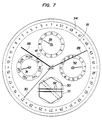
- Fig. 1 represents an embodiment of the watch seen from above; it is a watch with a display "all by hands" although, for other embodiments, one could have one or more displays with windows and not hands.
- On a dial 13 move an hour hand 28 and a minute hand 29. In this case, no second hand has been provided, but it would be easy to provide one.
- a date hand 32 moves opposite a graduation going from 1 to 31 to mark the dates.
- a "time zone hours” hand 33 moves opposite a 24-hour graduation and makes one revolution in 24 hours.
- a pusher not shown in FIG. 1, but which we will consider with the following figures, allows this hand 33 to make a jump just one hour, so that one can make time zone corrections without wasting time in minutes and seconds.
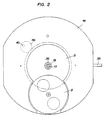
- the dial 13 has been removed and we now see a plate cover 14 which includes just a notch for the passage of the lunar disc 8.
- This plate cover 14 maintains by its periphery a wheel of week 5 row that we will explain in more detail.
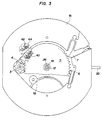
- the center of the watch as seen in Figs. 2, 3, 4 and 5, there are the two mobiles, pavement 17 and cannon 18, respectively carrying the minute hand and the hour hand.
- the movement can therefore be of any type, provided that it presents, around its center, a barrel of hour output and minute output tube. Typically, this will be, so to speak always, an electronic watch of the stepping motor type.
- the hour canon 18 carries a central drive gear 1.
- This central drive gear in turn drives two drive wheels one revolution per day, namely the first drive wheel 2 and the second drive wheel 12.
- the first wheel coach 2 does not permanently mesh with the star of the days of week 3, but it meshes only once a day by means of a longer tooth 27 which it understands (fig. 4), so that the day of the week star does not move until about midnight.
- the day of the week star 3 itself carries an integral drive finger 4 which, as best understood in FIG. 3, advances wheel 5 of the week row in the year by one step each time the display of the days of the week changes from Sunday to Monday.
- the first drive wheel at one revolution per day 2 also comprises a lug 24 which comes into gear once a day with the lunar toothed wheel 19 (with 59 teeth as is known).
- the week row wheel 5 is of course provided with a stop pawl 6 and a correction push button 7 which makes it possible to advance or reverse this wheel by one step (the respective shapes and positions of the pawl 6 and pusher 7 will define whether this correction is made forwards or backwards).
- the second driving wheel 12 one revolution per day, is permanently in engagement with the time zone gear 21 which also performs one revolution per day.
- the second driving wheel 12 has also been provided with a longer tooth than the others 27 ′, but this only serves to have two times the same toothing profile; in reality, this additional projection 27 ′ is superfluous, if not for the sake of manufacturing convenience.
- This same second driving wheel 12 drives the date wheel 9 via a lug 25, in known manner.
- the wheel 11, or hour wheel for time zone normally rotates integrally with the time zone gear wheel 21. However, there is an axial clutch device between these two wheels. This device consists of two blades 22 which are cut and slightly bent in the wheel 21 and twenty-four holes 23 which are drilled at regular intervals in the hour wheel "time zone" 11.
- a push finger for time zone 37 (fig .8) allows corrections to be made when necessary, that is to say when the wearer wants to know the time it is in a time zone different from that of which his watch gives the time.
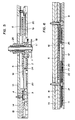
- the construction of the watch, or rather of the multiple display device which is added to the watch, is easily understood starting from FIG. 5 and considering the other figures relating thereto.
- the plate 20 which is crossed only by the two cannons 17 and 18 of the hours and minutes.
- the central return 1 Around the barrel 18 is fixed, integrally, the central return 1.
- the two drive wheels 2 and 12 are put in place to be each in engagement with the central return 1.
- These two drive wheels 2 and 12 do not are fixed only on one side, that is to say in a hole or on a pivot of the plate, and their upward flap is, if necessary, limited by the cover 16 which comes just above this level.
- the lunar disc 8 is put in place and it passes over the week row wheel 5. It is noted that, in this construction, the lunar gear and the lunar disc 8 are not applied one against the other, but are linked by an axis, so that the week 5 row wheel pass between them.
- the wheel 5 of weeks rows has, along its surface, a coloration alternately of four colors, for example green-blue-red-yellow. As seen in fig. 3, these colors are arranged sufficiently inside so as not to be masked by the plate 15. On the other hand, the plate cover 14 and the dial 13 are pierced with a small viewing window which will allow the color to be seen without difficulty which is behind this kind of counter.
- the cover will have an opening at about 46 as large as the largest dimension of the star 43, so that the cover just comes to hold the edge of the star 43 so that the one -this stays in place, but without preventing the visualization of the color.
- the dial will have an opening at a determined location of the eight possible positions, for example at 45, as seen in FIG. 2. With these solutions, there is no possibility of correction of the four-color display. A variant would however allow such a correction and we will explain it simply on the basis of FIG. 2. Instead of having a large opening 46 in the cover plate and only a small opening 45 in the dial, there would be in both of them a large opening 46, which openings would come exactly opposite one the other.
- the moon phase device has a cutout of the dial quite different from those which we are used to. It is simply an open hexagon, while the lunar disc has (but this can give rise to any fanciful choice) horizontal lines which rotate making a U-turn per moon phase.
- this embodiment is advantageously accompanied by the modification which can be seen in FIG. 8.
- This fig. 8 is also similar to FIG. 4, but it can be seen there that the push-button 10 for resetting the day of the week has been replaced by a push-button 53, of a shape symmetrical to that of the push-button 37, to advance step by step the esoteric display.
Landscapes
- Physics & Mathematics (AREA)
- General Physics & Mathematics (AREA)
- Astronomy & Astrophysics (AREA)
- Health & Medical Sciences (AREA)
- Life Sciences & Earth Sciences (AREA)
- Engineering & Computer Science (AREA)
- Biomedical Technology (AREA)
- General Health & Medical Sciences (AREA)
- Molecular Biology (AREA)
- Electromechanical Clocks (AREA)
Claims (12)
- Uhr, insbesondere Armbanduhr mit einer mehrfachen mechanischen Anzeige, welche in herkömmlicher Art mit einer Hauptanzeige mit auf einem Zifferblatt zentrierten Zeigern versehen ist um die laufende Zeit auf dem Zifferblatt anzuzeigen, umfasst:- eine mechanische Hilfsanzeige zum Anzeigen der Woche innerhalb des Jahres,- mindestens eine andere mechanische Hilfsanzeige mit einem Zeiger, der längs einer mit einer regelmässigen Gradeinteilung versehenen Skala positionierbar ist, um wenigstens eine Angabe über eine Zeitberechnung, über eine unterschiedliche Zeit oder über eine Zählung zu liefern,- die mechanische Hilfsanzeige zum Anzeigen der Woche ist eine Zeigeranzeige, deren Zeiger auf dem Zifferblatt zentriert angeordnet und ebenfalls längs einer mit einer regelmässigen Gradeinteilung versehenen Skala positionierbar ist, dadurch gekennzeichnet, dass:- die letztgenannte mit der regelmässigen Gradeinteilung versehene Skala ganz aussen am Zifferblatt angeordnet ist, wobei die unmittelbare Nachbarschaft der Skala freigehalten und ohne jegliche konzentrische Gradeinteilungen von anderen Hilfsanzeigen ist, und wobei die mit der regelmässigen Gradeinteilung versehene Skala zum Anzeigen der Woche, visuell auffallend, die Grösste von allen mit Gradeinteilungen versehenen Skalen auf dem Zifferblatt ist.
- Uhr nach Anspruch 1, dadurch gekennzeichnet, dass die genannten mit regelmässigen Gradeinteilungen versehenen Skalen kreisförmig sind, wobei die mindestens eine andere mechanische Zeigerhilfsanzeige zum Anzeigen des Datums bestimmt ist und in bezug auf die Achse der Hauptanzeige dezentral angeordnet ist.
- Uhr nach Anspruch 1, dadurch gekennzeichnet, dass die genannten mit regelmässigen Gradeinteilungen versehenen Skalen kreisförmig sind, wobei die mindestens eine andere mechanische Zeigerhilfsanzeige zum Anzeigen der Zeit einer anderen Zeitzone bestimmt ist und wobei die kreisförmige Skala zum Anzeigen der Zeit der anderen Zeitzone in bezug auf die Achse der Hauptanzeige dezentral angeordnet ist.
- Uhr nach Anspruch 1, dadurch gekennzeichnet, dass die genannten mit regelmässigen Gradeinteilungen versehenen Skalen kreisförmig sind, wobei die mindestens eine andere mechanische Zeigerhilfsanzeige zum Anzeigen des Wochentages bestimmt ist und wobei die kreisförmige Skala zum Anzeigen des Wochentages in bezug auf die Achse der Hauptanzeige dezentral angeordnet ist.
- Uhr nach Anspruch 1, dadurch gekennzeichnet, dass die genannten mit regelmässigen Gradeinteilungen versehenen Skalen kreisförmig sind, wobei drei andere mechanische Zeigerhilfsanzeigen vorhanden und zum Anzeigen des Datums, des Wochentages und der Zeit einer anderen Zeitzone bestimmt sind, und wobei die kreisförmigen Skalen für die obgenannten Anzeigen in bezug auf die Achse der Hauptanzeige dezentral angeordnet sind.
- Uhr nach Anspruch 4, mit einem Uhrwerk mit einer Platine, auf der ein Stundenzeigerrohr vorsteht, welches einen Minutenzeigerzapfen umgibt, wobei das Zifferblatt an der genannten Platine befestigt und ein Antriebsmechanismus für die Hilfsanzeigen zwischen der Platine und dem Zifferblatt angeordnet ist, dadurch gekennzeichnet, dass der Antriebsmechanismus umfasst:- ein 24-Stunden-Zeigerstellrad, welches vom Stundenzeigerrohr angetrieben ist und eine Verzahnung aufweist, bei der ein Zahn länger ist als die anderen,- eine Wochentagssternscheibe, welche auf einem Zapfen montiert ist, der das Zifferblatt durchquert und einen Zeiger trägt, wobei die genannte Sternscheibe vom genannten längeren Zahn des Zeigerstellrades angetrieben ist,- ein Antriebsfinger für die Anzeige der Woche, welcher zusammen mit der Wochentagssternscheibe auf dem gleichem Zapfen wie die letztere montiert ist,- ein Wochenrad mit einer Buchse, das auf dem Stundenzeigerrohr drehbar gelagert ist, wobei der genannte Finger das Wochenrad immer dann einen Schritt vorwärts bewegt, wenn die Wochentagssternscheibe vom Sonntag auf den Montag vorrückt.
- Uhr nach Anspruch 6, mit zusätzlich einer Mondphasenhilfsanzeige, dadurch gekennzeichnet, dass der genannte Mechanismus umfasst:- einen Antriebsdorn, der auf dem 24-Stunden-Zeigerstellrad montiert ist,- einen Mondphasendrehteil, welcher ein Rad mit 59 Zähnen umfasst, welche gerade bis zum genannten Zeigerstellrad reichen, derart, dass das Rad jeden Tag vom genannten Dorn um einen Zahn vorgerückt wird, sowie ein plattenförmiges Mondphasenrad aufweist, welches zusammen mit dem Rad mit den 59 Zähnen auf einem gleichen Zapfen montiert und knapp unterhalb dem Zifferblatt geführt ist, wobei das Wochenrad zwischen dem Rad mit den 59 Zähnen und dem plattenförmigen Mondphasenrad durchgeführt ist.
- Uhr nach Anspruch 6, mit zusätzlich einer Datumshilfsanzeige, dadurch gekennzeichnet, dass der genannte Mechanismus umfasst:- ein zweites 24-Stunden-Zeigerstellrad, welches mit einem Dorn versehen ist,- einen Datumsdrehteil, welcher ein Rad mit 31 Zähnen umfasst, das durch den genannten Dorn des zweiten Zeigerstellrades angetrieben ist und einen Zapfen aufweist, der zum Tragen eines Zeigers das Zifferblatt durchquert.
- Uhr nach Anspruch 8, mit zusätzlich einer Hilfsanzeige einer anderen Zeitzone, dadurch gekennzeichnet, dass der genannte Mechanismus umfasst:- einen Drehteil mit zwei koaxial zueinander angeordneten Rädern, die durch Kerben in 24 verschiedenen relativen Stellungen zueinander gegenseitig arretierbar'sind, wobei das eine der koaxialen Räder mit seinen Zähnen in einem dauernden Eingriff mit dem zweiten 24-Stunden-Zeigerstellrad, welches die gleiche Anzahl Zähne aufweist und das andere der Räder mittels einem Zapfen einen Zeiger zum Anzeigen der Zeit der anderen Zeitzone trägt und wobei ein manuell betätigbares Korrekturglied zum Vorrücken des Zeigerrades mit dem Zeiger um 1/24 einer Umdrehung gegenüber dem mit dem zweiten 24-Stunden-Zeigerstellrad in Eingriff stehenden Rad vorhanden ist.
- Uhr nach Anspruch 9, dadurch gekennzeichnet, dass die zwei 24-Stunden-Zeigerstellräder beide je einen längeren Zahn haben, dass das genannte Rad des Drehteiles zum Anzeigen der Zeit der anderen Zeitzone, welches dauernd mit dem zweiten 24-Stunden-Zeigerstellrad in Eingriff ist, ein Profil aufweist, das den Durchgang des längeren Zahnes unterstützt, und dass die beien Zeigerstellräder zum Vereinfachen ihrer Herstellung zueinander identisch sind.
- Uhr nach Anspruch 6, dadurch gekennzeichnet, dass das Wochenrad 52 Zähne aufweist, wobei die Buchse den genannten Zeiger trägt, der die Woche auf der genannten Skala mit der Gradeinteilung, welche ganz aussen am Zifferblatt angeordnet ist, anzeigt.
- Uhr nach Anspruch 11, dadurch gekennzeichnet, dass das genannte Wochenrad hinter einer Oeffnung im Zifferblatt eine vierwöchentliche Anzeige durch vier Farben oder Ansichten liefert, welche in einem Viererzyklus mit dem Ablauf der Wochen des Jahres hinter dem Fenster wechselt.
Applications Claiming Priority (2)
| Application Number | Priority Date | Filing Date | Title |
|---|---|---|---|
| CH3991/88 | 1988-10-26 | ||
| CH399188 | 1988-10-26 |
Publications (2)
| Publication Number | Publication Date |
|---|---|
| EP0366610A1 EP0366610A1 (de) | 1990-05-02 |
| EP0366610B1 true EP0366610B1 (de) | 1992-08-26 |
Family
ID=4267765
Family Applications (1)
| Application Number | Title | Priority Date | Filing Date |
|---|---|---|---|
| EP19890810788 Expired - Lifetime EP0366610B1 (de) | 1988-10-26 | 1989-10-18 | Uhr, insbesondere Armbanduhr, mit mehrfacher Zeigeranzeige |
Country Status (2)
| Country | Link |
|---|---|
| EP (1) | EP0366610B1 (de) |
| DE (1) | DE68902623T2 (de) |
Families Citing this family (10)
| Publication number | Priority date | Publication date | Assignee | Title |
|---|---|---|---|---|
| GB2253285A (en) * | 1991-02-26 | 1992-09-02 | Simon Joseph Greenock | Timepiece |
| EP0652496B1 (de) * | 1993-05-21 | 1999-07-21 | Seiko Epson Corporation | Uhrenzifferblatt und uhr |
| DE69315065T2 (de) * | 1993-06-16 | 1998-05-07 | Sonceboz Ebauches Fab | Uhr mit mindestens einer durch die Datumsanzeige getriebenen drehbaren Anzeigevorrichtung |
| CH688362B5 (fr) * | 1995-03-28 | 1998-02-27 | Ebauchesfabrik Eta Ag | Pièce d'horlogerie électronique analogique à disque de quantième multifonctionnel. |
| EP1729185B1 (de) | 2005-06-02 | 2012-08-15 | Blancpain SA. | Uhr mit einer Vorrichtung zur Anzeige des Wochenranges im aktuellen Jahr |
| EP1813998A1 (de) | 2006-01-27 | 2007-08-01 | Meier Willy Bureau Technique | Vorrichtung zur Anzeige der Woche |
| EP1813997A1 (de) | 2006-01-27 | 2007-08-01 | Meier Willy Bureau Technique | Vorrichtung zur Anzeige der Woche |
| DE602006012857D1 (de) | 2006-12-13 | 2010-04-22 | Longines Montres Comp D | Mechanismus für die Zeigerstellung eines Stundenanzeigers |
| ITUB20159707A1 (it) * | 2015-12-15 | 2017-06-15 | Hi Tek Office S R L | Cronometro |
| EP3705951A1 (de) * | 2019-03-07 | 2020-09-09 | Patek Philippe SA Genève | Mechanismus zur anzeige der wochennummer fur einen uhrzeug |
Family Cites Families (6)
| Publication number | Priority date | Publication date | Assignee | Title |
|---|---|---|---|---|
| US96792A (en) * | 1869-11-16 | Improvement in calendar-clocks | ||
| CH6203A (fr) * | 1893-02-02 | 1893-08-15 | Montandon Simmen Paul | Nouvelle disposition de mécanisme pour montre à quantième |
| FR510450A (fr) * | 1919-04-26 | 1920-12-04 | Paul Delaporte | Disposition de cadrans permettant de chronométrer, indépendamment des heures et des minutes, l'année, les mois et les jours, ainsi que d'établir la relation entre deux systèmes annuaires ou horaires différents |
| US1996701A (en) * | 1931-12-22 | 1935-04-02 | Sparuret Ab | Mechanical calendar |
| JPS51135571A (en) * | 1975-05-20 | 1976-11-24 | Citizen Watch Co Ltd | Calendar watch |
| DE3316185A1 (de) * | 1983-05-04 | 1984-11-08 | Telefonbau Und Normalzeit Gmbh, 6000 Frankfurt | Weltzeituhr |
-
1989
- 1989-10-18 DE DE1989602623 patent/DE68902623T2/de not_active Expired - Fee Related
- 1989-10-18 EP EP19890810788 patent/EP0366610B1/de not_active Expired - Lifetime
Also Published As
| Publication number | Publication date |
|---|---|
| DE68902623D1 (de) | 1992-10-01 |
| EP0366610A1 (de) | 1990-05-02 |
| DE68902623T2 (de) | 1993-04-15 |
Similar Documents
| Publication | Publication Date | Title |
|---|---|---|
| EP0940833B1 (de) | Kalendermechanismus für Uhrwerk | |
| EP1989597B1 (de) | Uhr mit mindestens einem dreidimensionalen anzeiger, der zeitinformation ergänzt | |
| EP2392976B1 (de) | Mondphasenanzeigemechanismus | |
| CH686808B5 (fr) | Piece d'horlogerie avec indication de la partie de la terre visible depuis la lune. | |
| EP2080067A2 (de) | Zeiger für eine uhr, uhrwerk zum antrieb des zeigers und entsprechende uhr | |
| EP0366610B1 (de) | Uhr, insbesondere Armbanduhr, mit mehrfacher Zeigeranzeige | |
| EP1349020A1 (de) | Uhr mit Kalender | |
| EP0619035A1 (de) | Kalenderuhr. | |
| EP3667434B1 (de) | Grossanzeigemechanismus für datum, und mit einem solchen mechanismus ausgestattete uhr | |
| WO2002075461A8 (fr) | Mouvement de montre | |
| WO2002010864A1 (fr) | Piece d'horlogerie | |
| EP1792236B1 (de) | Uhr mit anzeige des monatstages mit einer vorrichtung für eine fortlaufende zeitgleichung | |
| EP1792235B1 (de) | Kalenderuhr mit zeitgleichungsvorrichtung | |
| EP4113218B1 (de) | Anzeigemechanismus kombiniert mit einer monddatums- und mondphasenanzeige für uhrwerk | |
| CH703258A2 (fr) | Montre à heures universelles. | |
| CH702718A2 (fr) | Fuseau horaire à la demande sur l'aiguillage principal d'une pièce d'horlogerie. | |
| CH716556B1 (fr) | Pièce d'horlogerie à mécanisme d'affichage de l'âge de la lune. | |
| CH704342B1 (fr) | Dispositif d'affichage. | |
| WO2006050750A1 (fr) | Piece d'horlogerie, notamment montre bracelet comprenant un affichage principal et un mecanisme actionnant au moins un affichage secondaire | |
| CH720240A2 (fr) | Mécanisme d'affichage des périodes d'un cycle annuel pour pièce d'horlogerie animé par un mobile à 31 positions. | |
| CH721374A2 (fr) | Mouvement d'horlogerie comportant un mécanisme d'affichage des périodes d'un cycle annuel animé par un anneau de quantième | |
| CH703821A2 (fr) | Mécanisme d'affichage sectoriel multiple et pièce d'horlogerie comportant un tel mécanisme. | |
| EP3731027A1 (de) | Anzeigevorrichtung des kalenders, der uhrzeit des sonnenaufgangs und/oder des sonnenuntergangs | |
| CH686019B5 (fr) | Mécanisme de quantieme perpétuel de piéce d'horlogerie. | |
| CH688069B5 (fr) | Pièce d'horlogerie comportant un quantième perpétuel. |
Legal Events
| Date | Code | Title | Description |
|---|---|---|---|
| PUAI | Public reference made under article 153(3) epc to a published international application that has entered the european phase |
Free format text: ORIGINAL CODE: 0009012 |
|
| AK | Designated contracting states |
Kind code of ref document: A1 Designated state(s): CH DE FR GB IT LI |
|
| 17P | Request for examination filed |
Effective date: 19901020 |
|
| 17Q | First examination report despatched |
Effective date: 19910416 |
|
| GRAA | (expected) grant |
Free format text: ORIGINAL CODE: 0009210 |
|
| AK | Designated contracting states |
Kind code of ref document: B1 Designated state(s): CH DE FR GB IT LI |
|
| REF | Corresponds to: |
Ref document number: 68902623 Country of ref document: DE Date of ref document: 19921001 |
|
| ITF | It: translation for a ep patent filed | ||
| GBT | Gb: translation of ep patent filed (gb section 77(6)(a)/1977) |
Effective date: 19921208 |
|
| PLBE | No opposition filed within time limit |
Free format text: ORIGINAL CODE: 0009261 |
|
| STAA | Information on the status of an ep patent application or granted ep patent |
Free format text: STATUS: NO OPPOSITION FILED WITHIN TIME LIMIT |
|
| 26N | No opposition filed | ||
| PGFP | Annual fee paid to national office [announced via postgrant information from national office to epo] |
Ref country code: FR Payment date: 19950913 Year of fee payment: 7 |
|
| PGFP | Annual fee paid to national office [announced via postgrant information from national office to epo] |
Ref country code: GB Payment date: 19950914 Year of fee payment: 7 |
|
| PGFP | Annual fee paid to national office [announced via postgrant information from national office to epo] |
Ref country code: DE Payment date: 19950920 Year of fee payment: 7 |
|
| PG25 | Lapsed in a contracting state [announced via postgrant information from national office to epo] |
Ref country code: GB Effective date: 19961018 |
|
| GBPC | Gb: european patent ceased through non-payment of renewal fee |
Effective date: 19961018 |
|
| PG25 | Lapsed in a contracting state [announced via postgrant information from national office to epo] |
Ref country code: FR Effective date: 19970630 |
|
| PG25 | Lapsed in a contracting state [announced via postgrant information from national office to epo] |
Ref country code: DE Effective date: 19970701 |
|
| REG | Reference to a national code |
Ref country code: FR Ref legal event code: ST |
|
| REG | Reference to a national code |
Ref country code: CH Ref legal event code: NV Representative=s name: PATENTS & TECHNOLOGY SURVEYS, FORNEROD & SAAM |
|
| REG | Reference to a national code |
Ref country code: CH Ref legal event code: PCAR Representative=s name: PATENTS & TECHNOLOGY SURVEYS SA, CH |
|
| PG25 | Lapsed in a contracting state [announced via postgrant information from national office to epo] |
Ref country code: IT Free format text: LAPSE BECAUSE OF NON-PAYMENT OF DUE FEES Effective date: 20051018 |
|
| PGFP | Annual fee paid to national office [announced via postgrant information from national office to epo] |
Ref country code: CH Payment date: 20081015 Year of fee payment: 20 |
|
| REG | Reference to a national code |
Ref country code: CH Ref legal event code: PL |