EP0366726B1 - Sack aus verrottbarem material und einlage - Google Patents
Sack aus verrottbarem material und einlage Download PDFInfo
- Publication number
- EP0366726B1 EP0366726B1 EP88907073A EP88907073A EP0366726B1 EP 0366726 B1 EP0366726 B1 EP 0366726B1 EP 88907073 A EP88907073 A EP 88907073A EP 88907073 A EP88907073 A EP 88907073A EP 0366726 B1 EP0366726 B1 EP 0366726B1
- Authority
- EP
- European Patent Office
- Prior art keywords
- adsorbent
- anyone
- sack
- moisture
- sack according
- Prior art date
- Legal status (The legal status is an assumption and is not a legal conclusion. Google has not performed a legal analysis and makes no representation as to the accuracy of the status listed.)
- Expired - Lifetime
Links
- 239000000463 material Substances 0.000 title claims abstract description 19
- 239000010815 organic waste Substances 0.000 claims abstract description 10
- 239000003463 adsorbent Substances 0.000 claims description 39
- 239000000440 bentonite Substances 0.000 claims description 12
- 229910000278 bentonite Inorganic materials 0.000 claims description 12
- SVPXDRXYRYOSEX-UHFFFAOYSA-N bentoquatam Chemical group O.O=[Si]=O.O=[Al]O[Al]=O SVPXDRXYRYOSEX-UHFFFAOYSA-N 0.000 claims description 12
- 235000019402 calcium peroxide Nutrition 0.000 claims description 6
- 238000009264 composting Methods 0.000 claims description 6
- 239000004927 clay Substances 0.000 claims description 5
- 239000004343 Calcium peroxide Substances 0.000 claims description 4
- LHJQIRIGXXHNLA-UHFFFAOYSA-N calcium peroxide Chemical compound [Ca+2].[O-][O-] LHJQIRIGXXHNLA-UHFFFAOYSA-N 0.000 claims description 4
- 239000004020 conductor Substances 0.000 claims description 3
- 239000007800 oxidant agent Substances 0.000 claims description 3
- 239000002689 soil Substances 0.000 claims description 3
- 229940036811 bone meal Drugs 0.000 claims description 2
- 239000002374 bone meal Substances 0.000 claims description 2
- 239000004576 sand Substances 0.000 claims description 2
- 239000004753 textile Substances 0.000 claims description 2
- 239000001913 cellulose Substances 0.000 claims 1
- 229920002678 cellulose Polymers 0.000 claims 1
- 235000012054 meals Nutrition 0.000 claims 1
- -1 sawdust Substances 0.000 claims 1
- 239000004575 stone Substances 0.000 claims 1
- 239000000126 substance Substances 0.000 claims 1
- 239000002023 wood Substances 0.000 claims 1
- 239000002699 waste material Substances 0.000 description 15
- 239000000123 paper Substances 0.000 description 12
- XLYOFNOQVPJJNP-UHFFFAOYSA-N water Chemical compound O XLYOFNOQVPJJNP-UHFFFAOYSA-N 0.000 description 6
- 230000000694 effects Effects 0.000 description 5
- 235000013311 vegetables Nutrition 0.000 description 5
- 230000008961 swelling Effects 0.000 description 4
- 238000010521 absorption reaction Methods 0.000 description 3
- 239000003205 fragrance Substances 0.000 description 3
- 241000196324 Embryophyta Species 0.000 description 2
- 239000003094 microcapsule Substances 0.000 description 2
- 239000010813 municipal solid waste Substances 0.000 description 2
- 239000004745 nonwoven fabric Substances 0.000 description 2
- 230000035699 permeability Effects 0.000 description 2
- 239000004033 plastic Substances 0.000 description 2
- 229920003023 plastic Polymers 0.000 description 2
- 229920006254 polymer film Polymers 0.000 description 2
- 241000894006 Bacteria Species 0.000 description 1
- 241000219310 Beta vulgaris subsp. vulgaris Species 0.000 description 1
- 244000025254 Cannabis sativa Species 0.000 description 1
- 235000008733 Citrus aurantifolia Nutrition 0.000 description 1
- 229920002785 Croscarmellose sodium Polymers 0.000 description 1
- 241001465754 Metazoa Species 0.000 description 1
- 241000237536 Mytilus edulis Species 0.000 description 1
- 239000004372 Polyvinyl alcohol Substances 0.000 description 1
- 235000021536 Sugar beet Nutrition 0.000 description 1
- 235000011941 Tilia x europaea Nutrition 0.000 description 1
- 230000002745 absorbent Effects 0.000 description 1
- 239000002250 absorbent Substances 0.000 description 1
- 239000000853 adhesive Substances 0.000 description 1
- 238000004026 adhesive bonding Methods 0.000 description 1
- 230000001070 adhesive effect Effects 0.000 description 1
- 239000007864 aqueous solution Substances 0.000 description 1
- QVGXLLKOCUKJST-UHFFFAOYSA-N atomic oxygen Chemical compound [O] QVGXLLKOCUKJST-UHFFFAOYSA-N 0.000 description 1
- 230000003139 buffering effect Effects 0.000 description 1
- 230000015556 catabolic process Effects 0.000 description 1
- 235000013339 cereals Nutrition 0.000 description 1
- 238000004140 cleaning Methods 0.000 description 1
- 239000002361 compost Substances 0.000 description 1
- 238000006731 degradation reaction Methods 0.000 description 1
- 239000010791 domestic waste Substances 0.000 description 1
- 235000013399 edible fruits Nutrition 0.000 description 1
- 238000002474 experimental method Methods 0.000 description 1
- 239000004744 fabric Substances 0.000 description 1
- 210000003608 fece Anatomy 0.000 description 1
- 239000000835 fiber Substances 0.000 description 1
- 235000013312 flour Nutrition 0.000 description 1
- 235000013305 food Nutrition 0.000 description 1
- 239000010794 food waste Substances 0.000 description 1
- 238000005342 ion exchange Methods 0.000 description 1
- 239000004571 lime Substances 0.000 description 1
- 230000014759 maintenance of location Effects 0.000 description 1
- 238000004519 manufacturing process Methods 0.000 description 1
- 229910052751 metal Inorganic materials 0.000 description 1
- 239000002184 metal Substances 0.000 description 1
- 238000000034 method Methods 0.000 description 1
- 239000011707 mineral Substances 0.000 description 1
- 235000010755 mineral Nutrition 0.000 description 1
- 235000020638 mussel Nutrition 0.000 description 1
- 238000006386 neutralization reaction Methods 0.000 description 1
- 230000009965 odorless effect Effects 0.000 description 1
- 239000001301 oxygen Substances 0.000 description 1
- 229910052760 oxygen Inorganic materials 0.000 description 1
- 229920006255 plastic film Polymers 0.000 description 1
- 239000002985 plastic film Substances 0.000 description 1
- 229920002451 polyvinyl alcohol Polymers 0.000 description 1
- 239000000843 powder Substances 0.000 description 1
- 230000002787 reinforcement Effects 0.000 description 1
- 239000011435 rock Substances 0.000 description 1
- 238000009958 sewing Methods 0.000 description 1
- 239000010822 slaughterhouse waste Substances 0.000 description 1
- 230000035943 smell Effects 0.000 description 1
- 238000001179 sorption measurement Methods 0.000 description 1
- 238000009827 uniform distribution Methods 0.000 description 1
Images

Classifications
-
- B—PERFORMING OPERATIONS; TRANSPORTING
- B65—CONVEYING; PACKING; STORING; HANDLING THIN OR FILAMENTARY MATERIAL
- B65F—GATHERING OR REMOVAL OF DOMESTIC OR LIKE REFUSE
- B65F1/00—Refuse receptacles; Accessories therefor
- B65F1/0006—Flexible refuse receptables, e.g. bags, sacks
-
- B—PERFORMING OPERATIONS; TRANSPORTING
- B65—CONVEYING; PACKING; STORING; HANDLING THIN OR FILAMENTARY MATERIAL
- B65D—CONTAINERS FOR STORAGE OR TRANSPORT OF ARTICLES OR MATERIALS, e.g. BAGS, BARRELS, BOTTLES, BOXES, CANS, CARTONS, CRATES, DRUMS, JARS, TANKS, HOPPERS, FORWARDING CONTAINERS; ACCESSORIES, CLOSURES, OR FITTINGS THEREFOR; PACKAGING ELEMENTS; PACKAGES
- B65D81/00—Containers, packaging elements, or packages, for contents presenting particular transport or storage problems, or adapted to be used for non-packaging purposes after removal of contents
- B65D81/24—Adaptations for preventing deterioration or decay of contents; Applications to the container or packaging material of food preservatives, fungicides, pesticides or animal repellants
- B65D81/26—Adaptations for preventing deterioration or decay of contents; Applications to the container or packaging material of food preservatives, fungicides, pesticides or animal repellants with provision for draining away, or absorbing, or removing by ventilation, fluids, e.g. exuded by contents; Applications of corrosion inhibitors or desiccators
- B65D81/264—Adaptations for preventing deterioration or decay of contents; Applications to the container or packaging material of food preservatives, fungicides, pesticides or animal repellants with provision for draining away, or absorbing, or removing by ventilation, fluids, e.g. exuded by contents; Applications of corrosion inhibitors or desiccators for absorbing liquids
-
- B—PERFORMING OPERATIONS; TRANSPORTING
- B65—CONVEYING; PACKING; STORING; HANDLING THIN OR FILAMENTARY MATERIAL
- B65F—GATHERING OR REMOVAL OF DOMESTIC OR LIKE REFUSE
- B65F1/00—Refuse receptacles; Accessories therefor
- B65F1/14—Other constructional features; Accessories
- B65F2001/1489—Refuse receptacles adapted or modified for gathering compostable domestic refuse
-
- B—PERFORMING OPERATIONS; TRANSPORTING
- B65—CONVEYING; PACKING; STORING; HANDLING THIN OR FILAMENTARY MATERIAL
- B65F—GATHERING OR REMOVAL OF DOMESTIC OR LIKE REFUSE
- B65F2210/00—Equipment of refuse receptacles
- B65F2210/102—Absorbing means
-
- B—PERFORMING OPERATIONS; TRANSPORTING
- B65—CONVEYING; PACKING; STORING; HANDLING THIN OR FILAMENTARY MATERIAL
- B65F—GATHERING OR REMOVAL OF DOMESTIC OR LIKE REFUSE
- B65F2250/00—Materials of refuse receptacles
- B65F2250/105—Biodegradable
Definitions
- the invention relates to a sack made of rotten material for collecting moisture-releasing goods, in particular organic waste, and an insert for this sack.
- moisture-releasing goods e.g. of organic waste in household waste, e.g. Food waste of all kinds, vegetable and fruit bowls, flower remnants, grass clippings, etc.
- household waste e.g. Food waste of all kinds, vegetable and fruit bowls, flower remnants, grass clippings, etc.
- wet waste e.g. Grains, leached sugar beet pulp, animal droppings and slaughterhouse waste.
- wet waste these moisture-releasing goods are hereinafter referred to as "wet waste”.
- wet waste should not normally be incinerated or landfilled, but should be sent to a composting plant, it is advisable to use sacks made of easily decomposable material that can also be composted.
- Such bags are preferably made of water vapor permeable materials, such as paper, nonwovens, fabrics or paper-like nonwovens. Have the bags in question however, the disadvantage that they easily soak through, making it difficult to transport the bags.
- a garbage container in the form of sacks or bags is known, the walls of which consist of a plastic film (e.g. of polyvinyl alcohol) which dissolves in the presence of water at a temperature of at least about 37 ° C.
- a plastic film e.g. of polyvinyl alcohol
- microcapsules in the container wall e.g. May contain water or aqueous solutions of bacteria that degrade the polymer film. The microcapsules are destroyed, which accelerates the degradation of the polymer film.
- the known container does not contain an adsorbent layer with a swellable clay.
- a carrier bag for moisture-releasing foods such as mussels, is known, the walls of which are made of plastic and on the bottom of which a separate compartment with an adsorbent is arranged, which essentially consists of a powder of crosslinked carboxymethyl cellulose.
- the walls of the carrier bag are made of a non-rotting material.
- the invention is therefore based on the object to develop a bag that is able to remove moisture from the Vacuum wet waste without losing any noticeable strength, while preventing unpleasant smells from escaping.
- the sack should also be compostable.
- One of the sub-tasks underlying the invention is the development of an absorbent insert.
- the object to be achieved is achieved with the aid of a sack of the type defined at the outset, which is characterized in that it contains an adsorbent layer at least in the base region, the adsorbent being a swellable clay.
- the adsorbent layer is designed as an insert, in which the adsorbent is enclosed between two walls made of decomposable material, at least the upper one of which is permeable to moisture.
- the insert is placed loosely on the sack bottom and its cross-sectional dimensions correspond approximately to the area of the sack bottom.
- the invention further relates to the insert itself, which is preferably in the sack, but also in any other container, e.g. can be placed on the floor of a household rubbish bin or a dumpster.
- the sack according to the invention is designed in the bottom region as a double-wall sack, the adsorbent layer being arranged between the outer wall and the inner wall.
- the outer and inner walls can be made of the same rotting material or a combination of two rotting materials. So it is e.g. possible to use a paper bag lined with gauze on the inside.
- the moisture permeability of the outer wall can be higher than that of the inner wall, so that the sack still has a certain strength, even if the capacity of the adsorbent is exhausted.
- the intermediate layer containing the adsorbent is only present in the bottom area, since the bottom area is exposed to the greatest loads.
- the intermediate layer containing the adsorbent can, however, also be provided in the side parts of the bag, the intermediate layer preferably being divided into separate individual chambers.
- the individual chambers can be obtained by gluing or sewing the inner and outer walls together and filled with adsorbent. This enables a uniform distribution of the adsorbent.
- the layer thickness of the adsorbent can vary within wide limits.
- the adsorbent layer is preferably about 1 to 2 cm thick.
- the swellable clay used according to the invention as an adsorbent also represents a material which accelerates the composting of organic waste and improves the soil. Bentonite can be used. Due to their high swelling capacity, the clays are characterized by a high water retention capacity and thus ensure a reliable binding of moisture from wet waste. The clays are also characterized by a high adsorption capacity, so that the odor is completely absorbed.
- Bentonite and other swellable clays also accelerate the composting of organic waste and also have a soil-improving effect in that, in addition to water due to their ion exchange capacity, they bind mineral nutrients and only gradually release them again to the plants, which means that these swellable clays can be used as adsorbents in the intermediate layer In addition to the safe and odorless collection and transport of organic waste, the composting process is accelerated at the same time.
- Bentonite and other swellable clays also have the property of buffering the pH of the leachate that may escape from the waste.
- the adsorbent is therefore preferably mixed with a moisture-conducting material which, due to its wicking effect, facilitates the transport of moisture from the surface into the interior of the adsorbent.
- moisture-containing Material can be used, for example, shredded paper, such as newspaper shredder, sawdust, woodchips, textile fibers (eg from rags), sand, rock flour or bone meal.
- the adsorbent can also be mixed with an oxidizing agent such as calcium peroxide.
- an oxidizing agent such as calcium peroxide.
- the use of calcium peroxide has an advantageous effect on accelerated, aerobic composting of vegetable waste, namely through a slow release of oxygen, combined with simultaneous neutralization of the compost by the lime formed. Calcium peroxide also has a strong decomposing effect on odorants.
- fragrances can also be added to cover the odor.
- FIG. 1 there is a loose insert in a sack made of decomposable material, the outer wall of which is designated 1 in both the bottom region and the side wall region, in which the adsorbent 3 is enclosed between two walls 1a and 2a made of decomposable material .
- At least the upper wall 2a is permeable to moisture, while the lower wall 1a is not permeable to moisture needs or may have a lower moisture permeability than the top wall 2a.
- the insert can also be placed on the bottom of any other waste container, e.g. on the bottom of a metal or plastic container, but then the side walls of the container come into contact with the waste, so that the cleaning effort is higher.
- the outer wall is denoted by 1 both in the bottom area and in the side wall area.
- the intermediate layer 3 containing an adsorbent in the bottom region.
- the intermediate layer 3 can also be divided into individual chambers in the embodiment of FIG. 2, but this is generally not necessary here (in particular in the case of smaller bags). , because the adsorbent layer is arranged horizontally.
- FIG. 3 corresponds to the embodiment of FIG. 2 in the bottom area. However, it is not single-walled in the side wall area, but also double-walled.
- the outer wall 1 and the inner wall 2 are connected to one another at the adhesive or seam locations 4, as a result of which the individual chambers 5 are formed for receiving the adsorbent, which cannot slide downward.
- This embodiment is particularly suitable for absorbing goods that are highly moisture-containing and / or have a strong odor.
- the sacks of the invention were tested for the effect of the adsorbent on moisture retention, sack strength and odor levels.
- the onset of putrefaction of the waste can be postponed by 2 to 3 days due to the bentonite insert, so that the organic waste can be collected for up to 5 days without noticeable odor pollution.
- the paper bags with bentonite inlay have not lost their strength even after 5 days, so that they can be easily transported.
Landscapes
- Engineering & Computer Science (AREA)
- Mechanical Engineering (AREA)
- Food Science & Technology (AREA)
- Processing Of Solid Wastes (AREA)
- Fertilizers (AREA)
Description
- Die Erfindung betrifft einen Sack aus verrottbarem Material zum Sammeln von Feuchtigkeit abgebenden Gütern, insbesondere von organischen Abfällen sowie eine Einlage für diesen Sack.
- Zur sinnvollen Verwertung von Feuchtigkeit abgebenden Gütern, z.B. von organischen Abfällen im Hausmüll, wie z.B. Speiseresten aller Art, Gemüse- und Obstschalen, Blumenresten, Grasschnitt usw., ist es notwendig, diese Güter bereits dort wo sie anfallen, z.B. in den Haushalten, in Säcken vorzusortieren.
- Entsprechendes gilt auch für industrielle oder landwirtschaftliche organische Abfälle, z.B. Treber, ausgelaugte Zuckerrübenschnitzel, Tierkot und Schlachthausabfälle. Aus Gründen der Einfachheit werden diese Feuchtigkeit abgebenden Güter nachstehend als "Naßmüll" bezeichnet.
- Da Naßmüll üblicherweise nicht verbrannt oder deponiert, sondern einer Kompostieranlage zugeführt werden sollte, ist es zweckmäßig, Säcke aus leicht verrottbarem Mateerial zu verwenden, die sich ebenfalls kompostieren lasasen. Derartige Säcke werden vorzugsweise aus wasserdampfdurchlässigen Werkstoffen, wie Papier, Vliesstoffen, Gewebe oder papierartigen Faservliesen hergestellt. Die in Frage kommenden Säcke haben jedoch den Nachteil, daß sie leicht durchweichen und dadurch ein Transport der Säcke erschwert ist.
- Es wurde bereits versucht (DE-Gbm 87 09 242), diese Nachteile dadurch zu beheben, daß man sack- oder tütenförmige Behältnisse aus verrottbarem Material, wie Alt- oder Recyclingpapier, mit einem verstärkten Boden versah und verschließbar ausbildete. Hierbei wurde der Boden aus mehreren Schichten Papier oder aus extra starkem Papier verstärkt.
- Diese Art der Verstärkung ist jedoch häufig unzureichend. Ferner konnte insbesondere bei stark geruchsintensiven Abfällen ein geruchsdichter Abschluß nicht erreicht werden.
- Aus der US-A-37 62 454 ist ein Müllbehälter in Sack- oder Beutelform bekannt, dessen Wände aus einem Kunststoffilm (z.B. aus Polyvinylalkohol) bestehen, der sich in Gegenwart von Wasser mit einer Temperatur von mindestens etwa 37°C auflöst. In der Behälterwand befinden sich Mikrokapseln, die z.B. Wasser oder wäßrige Lösungen von Bakterien, die den Polymerfilm abbauen, enthalten können. Die Mikrokapseln werden zerstört, wodurch der Abbau des Polymerfilms beschleunigt wird. Abgesehen davon, daß seine Herstellung aufwendig ist, enthält der bekannte Behälter keine Adsorptionsmittelschicht mit einem quellfähigen Ton.
- Aus der EP-A-0 068 530 ist eine Tragetasche für feuchtigkeitsabgebende Lebensmittel, wie Muscheln bekannt, deren Wände aus Kunststoff bestehen und auf deren Boden ein getrenntes Abteil mit einem Adsorptionsmittel angeordnet ist, das im wesentlichen aus einem Pulver aus vernetzter Carboxymethylcellulose besteht. Die Wände der Tragetasche bestehen also aus einem nicht verrottbaren Material.
- Der Erfindung liegt somit die Aufgabe zugrunde, einen Sack zu entwickeln, der in der Lage ist, die Feuchtigkeit aus dem Naßmüll aufzusaugen, ohne dabei merklich an Festigkeit zu verlieren, und der gleichzeitig ein Entweichen von unangenehmen Gerüchen verhindert. Ferner soll der Sack kompostierbar sein.
- Eine der Erfindung zugrundeliegende Teilaufgabe besteht in der Entwicklung einer saugfähigen Einlage.
- Die zu lösende Aufgabe wird mit Hilfe eines Sackes der eingangs definierten Gattung gelöst, der dadurch gekennzeichnet ist, daß er zumindest im Bodenbereich eine Adsorptionsmittelschicht enthält, wobei das Adsorptionsmittel einen quellfähigen Ton darstellt.
- Nach einer Ausführungsform der Erfindung ist die Adsorptionsmittelschicht als Einlage ausgebildet, bei der das Adsorptionsmittel zwischen zwei Wänden aus verrottbarem Material eingeschlossen ist, von denen zumindest die obere feuchtigkeitsdurchlässig ist. Die Einlage ist hierbei lose auf den Sackboden gelegt und entspricht in ihren Querschnittsabmessungen etwa der Fläche des Sackbodens.
- Gegenstand der Erfindung ist ferner die Einlage selbst, die vorzugsweise in den Sack, aber auch in jeden beliebigen anderen Behälter, z.B. auf den Boden eines Hausmülleimers oder eines Müllcontainers gelegt werden kann.
- Nach einer weiteren Ausführungsform ist der erfindungsgemäße Sack im Bodenbereich als Doppelwandsack ausgebildet, wobei die Adsorptionsmittelschicht zwischen der Außenwand und der Innenwand angeordnet ist.
- Die Außen- und Innenwand können aus demselben verrottbaren Material oder aus einer Kombination zweier verrottbarer Materialien bestehen. So ist es z.B. möglich, einen Papiersack zu verwenden, der innen mit einer Gaze ausgekleidet ist.
- Ferner kann die Feuchtigkeitsdurchlässigkeit der Außenwand höher sein als die der Innenwand, so daß der Sack noch eine gewisse Festigkeit hat, auch wenn die Kapazität des Adsorptionsmittels erschöpft ist.
- Im allgemeinen reicht es bei der zweiten Ausführungsform aus, wenn die das Adsorptionsmittel enthaltende Zwischenschicht nur im Bodenbereich vorhanden ist, da der Bodenbereich den stärksten Belastungen ausgesetzt ist. Die das Adsorptionsmittel enthaltende Zwischenschicht kann aber auch in den Seitenteilen des Sackes vorgesehen sein, wobei die Zwischenschicht vorzugsweise in voneinander getrennte Einzelkammern unterteilt ist. Die Einzelkammern können durch Zusammenkleben bzw. Zusammennähen von Innen- und Außenwand erhalten und mit Adsorptionsmittel aufgefüllt werden. Dadurch ist eine gleichmäßige Verteilung des Adsorptionsmittels möglich.
- Die Schichtstärke des Adsorptionsmittels kann innerhalb weiter Grenzen variieren. Vorzugsweise ist die Adsorptionsmittelschicht etwa 1 bis 2 cm dick.
- Der erfindungsgemäß als Adsorptionsmittel verwendete quellfähige Ton stellt auch ein die Kompostierung von organischen Abfällen beschleunigendes und bodenverbesserndes Material dar. Als quellfähiger Ton kann z.B. Bentonit verwendet werden. Die Tone zeichnen sich aufgrund ihres hohen Quellvermögens durch ein hohes Wasserrückhaltevermögen aus und gewährleisten dadurch eine zuverlässige Bindung der Feuchtigkeit aus dem Naßmüll. Die Tone zeichnen sich ferner durch ein hohes Adsorptionsvermögen aus, so daß eine vollständige Geruchsbindung erfolgt.
- Bentonit und andere quellfähige Tone beschleunigen ferner die Kompostierung von organischen Abfällen und haben auch eine bodenverbessernde Wirkung, indem sie neben Wasser aufgrund ihres Ionenaustauschvermögens mineralische Nährstoffe binden und nur allmählich wieder an die Pflanzen abgeben.Der Einsatz dieser quellfähigen Tone als Adsorptionsmittel in der Zwischenlage ermöglicht somit neben dem sicheren und geruchlosen Sammeln und Transportieren von organischen Abfällen eine gleichzeitige Beschleunigung des Kompostiervorganges.
- Bentonit und andere quellfähige Tone haben ferner die Eigenschaft, daß sie den pH-Wert der gegebenenfalls aus den Abfällen austretenden Sickerwässer abpuffern.
- Bei stark quellendem Bentonit und anderen stark quellenden Adsorptionsmitteln wurde in einigen Fällen festgestellt, daß sich aufgrund der starken oberflächlichen Quellung die Feuchtigkeitsaufnahme nach einiger Zeit verlangsamte, obwohl die Aufnahmekapazität des Adsorptionsmittels noch nicht erschöpft war. Zur Erhöhung der Feuchtigkeitsaufnahmegeschwindigkeit wird deshalb das Adsorptionsmittel vorzugsweise mit einem feuchtigkeitsleitenden Material vermischt, das aufgrund seiner Dochtwirkung den Feuchtigkeitstransport von der Oberfläche in das Innere des Adsorptionsmittels erleichtert. Als feuchtigkeitshaltiges Material können z.B. Papierschnitzel, wie Zeitungspapierschnitzel, Sägemehl, Holzschnitzel, Textilfasern (z.B. aus Lumpen),Sand, Gesteinsmehl oder Knochenmehl verwendet werden.
- Man kann das Adsorptionsmittel auch mit einem Oxidationsmittel, wie Calciumperoxid, vermischen. Der Einsatz von Calciumperoxid wirkt sich vorteilhaft auf eine beschleunigte, aerobe Kompostierung von pflanzlichen Abfällen aus, und zwar durch eine langsame Freisetzung von Sauerstoff, verbunden mit gleichzeitiger Neutralisation des Komposts durch den entstandenen Kalk. Ebenso wirkt Calciumperoxid auf Geruchtsstoffe stark zersetzend.
- Anstelle eines Oxidationsmittels zur Zersetzung der Geruchsstoffe können auch Duftstoffe zur Überdeckung des Geruches zugesetzt werden.
- Die Erfindung ist durch die Zeichnung erläutert. Es zeigen:
- Fig. 1 einen Schnitt durch einen erfindungsgemäßen Sack, der im Bodenbereich eine lose Einlage enthält;
- Fig. 2 einen Schnitt durch einen erfindungsgemäßen Sack, der nur im Bodenbereich als Doppelwandsack ausgebildet ist;
- Fig. 3 einen Schnitt durch einen erfindungsgemäßen Sack, der sowohl im Bodenbereich als auch im Seitenwandbereich als Doppelwandsack ausgebildet ist.
- Bei der Ausführungsform nach Fig. 1 befindet sich in einem Sack aus verrottbarem Material, dessen Außenwand sowohl im Bodenbereich als auch im Seitenwandbereich mit 1 bezeichnet ist, eine lose Einlage, bei der das Adsorptionsmittel 3 zwischen zwei Wänden 1a und 2a aus verrottbarem Material eingeschlossen ist. Zumindest die obere Wand 2a ist feuchtigkeitsdurchlässig, während die untere Wand 1a nicht feuchtigkeitsdurchlässig zu sein braucht oder eine geringere Feuchtigkeitsdurchlässigkeit als die obere Wand 2a haben kann.
- Der Einsatz kann auch auf den Boden eines beliebigen anderen Abfallbehälters, z.B. auf den Boden eines Metall- oder Kunststoffbehälters, gelegt werden, wobei dann allerdings die Seitenwände des Behälters mit dem Abfall in Berührung kommen, so daß der Reinigungsaufwand höher ist.
- Bei der Ausführungsform nach Fig. 1 ist die Außenwand sowohl im Bodenbereich als auch im Seitenwandbereich mit 1 bezeichnet. Zwischen der Außenwand 1 und der Innenwand 2 befindet sich im Bodenbereich die ein Adsorptionsmittel enthaltende Zwischenschicht 3. Die Zwischenschicht 3 kann auch bei der Ausführungsform von Fig. 2 in Einzelkammern unterteilt sein, doch ist dies hier im allgemeinen nicht notwendig (insbesondere bei kleineren Säcken), da die Adsorptionsmittelschicht horizontal angeordnet ist.
- Die Ausführungsform von Fig. 3 entspricht im Bodenbereich der Ausführungsform von Fig. 2. Sie ist aber im Seitenwandbereich nicht einwandig, sondern ebenfalls doppelwandig ausgebildet. Die Außenwand 1 und die Innenwand 2 sind an den Klebe- oder Nahtstellen 4 miteinander verbunden, wodurch die Einzelkammern 5 zur Aufnahme des Adsorptionsmittels gebildet werden, das nicht nach unten verrutschen kann. Diese Ausführungsform eignet sich insbesondere zur Aufnahme von stark feuchtigkeitshaltigen und/oder stark geruchsintensiven Gütern.
- Die erfindungsgemäßßen Säcke wurden auf die Wirkung des Adsorptionsmittels im Hinblick auf Feuchtigkeitsrückhaltevermögen, Festigkeit des Sackes und Geruchsbelastung untersucht.
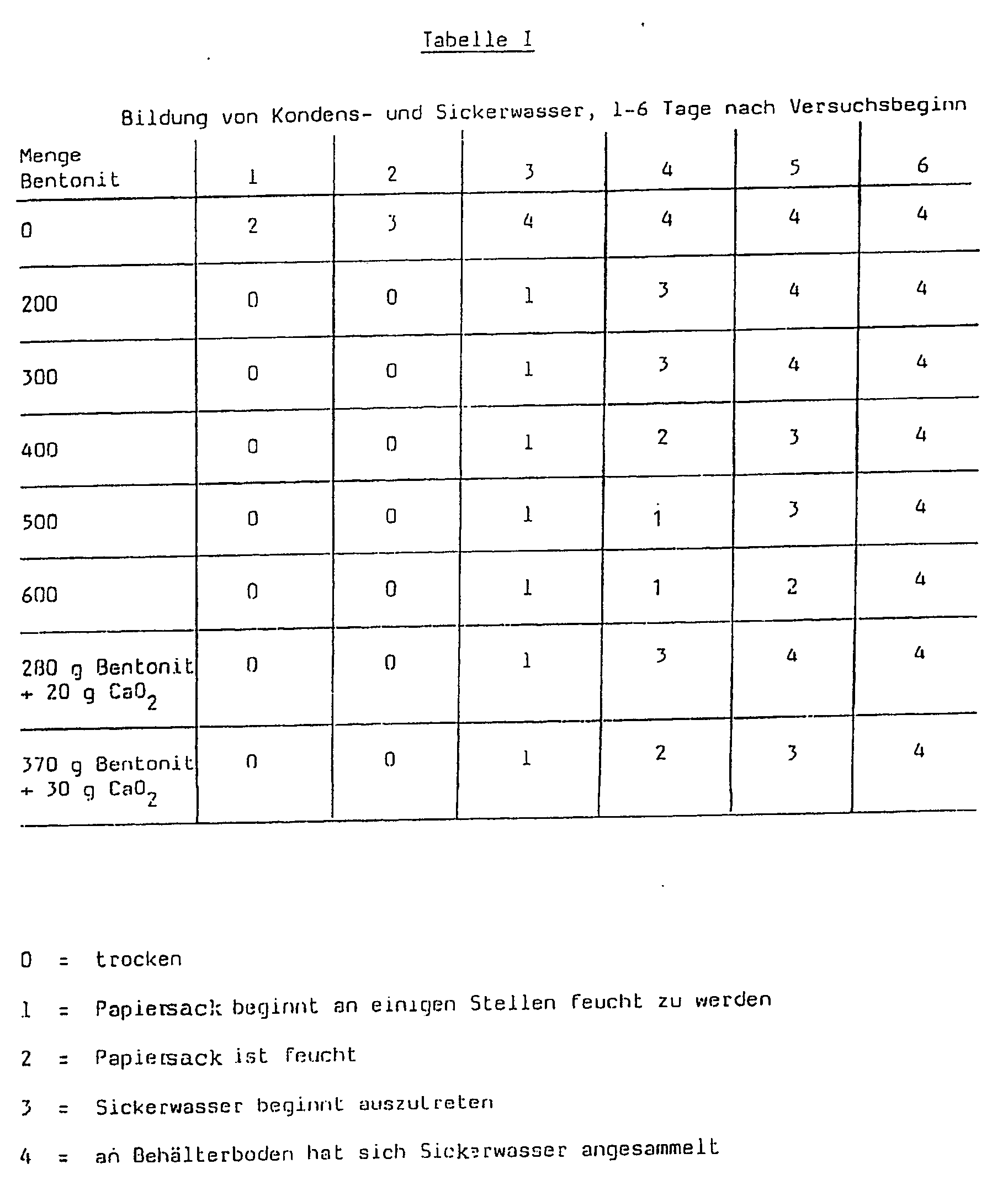
- Das folgende Beispiel zeigt, das bei Verwendung eines Papiersackes ohne Bentoniteinlage schon am zweiten Tag eine deutliche Fäulnis des Abfallmaterials zu beobachten ist, verbunden mit einem Austritt von Sickerwasser.
- Durch die Bentoniteinlage läßt sich die einsetzende Fäulnis des Abfalls um 2 bis 3 Tage verschieben, so daß die organischen Abfälle bis zu 5 Tage ohne merkliche Geruchsbelastung gesammelt werden können. Die Papiersäcke mit Bentoniteinlage haben auch nach 5 Tagen nicht an Festigkeit verloren, so daß sie sich gut transportieren lassen.
- Etwa 6 Liter pflanzliches Abfallmaterial (1 kg) wurden in Papiersäcke gefüllt, auf deren Boden Bentoniteinlagen (200 bis 600 g) als Rundkissen gelegt waren. Die Papiersäcke wurden dann in PVC-Gefäße gegeben. Nach einem Tag wurde ein weiteres Kilogramm pflanzlicher Abfall zugefügt. Zum Vergleich wurde ein Papiersack, der keinen Bentoniteinsatz enthielt, in der gleichen Weise mit pflanzlichem Abfall gefüllt. Einige Papiersäcke erhielten als Einlage 200 g Bentonit + 20 g CaO₂ bzw. 370 g Bentonit + 30 g CaO₂.
- Im Zeitraum von 1 bis 6 Tagen nach Versuchbeginn wurde die Menge an zwischenzeitlich gebildetem Bodenwasser (Kondenswasser und Sickerwasser) bestimmt.
- Die Versuchsergebnisse sind in den Tabellen I und II angegeben.

Claims (12)
Priority Applications (1)
| Application Number | Priority Date | Filing Date | Title |
|---|---|---|---|
| AT88907073T ATE62881T1 (de) | 1988-04-19 | 1988-07-22 | Sack aus verrottbarem material und einlage. |
Applications Claiming Priority (2)
| Application Number | Priority Date | Filing Date | Title |
|---|---|---|---|
| DE8805816U DE8805816U1 (de) | 1988-04-19 | 1988-04-19 | Sack aus verrottbarem Material |
| DE8805816U | 1988-04-19 |
Publications (2)
| Publication Number | Publication Date |
|---|---|
| EP0366726A1 EP0366726A1 (de) | 1990-05-09 |
| EP0366726B1 true EP0366726B1 (de) | 1991-04-24 |
Family
ID=6823620
Family Applications (1)
| Application Number | Title | Priority Date | Filing Date |
|---|---|---|---|
| EP88907073A Expired - Lifetime EP0366726B1 (de) | 1988-04-19 | 1988-07-22 | Sack aus verrottbarem material und einlage |
Country Status (4)
| Country | Link |
|---|---|
| EP (1) | EP0366726B1 (de) |
| DE (2) | DE8805816U1 (de) |
| DK (1) | DK433989A (de) |
| WO (1) | WO1989010311A1 (de) |
Families Citing this family (11)
| Publication number | Priority date | Publication date | Assignee | Title |
|---|---|---|---|---|
| DE4241480C2 (de) * | 1992-12-09 | 1997-02-13 | Hubert Heubl | Verwertungsanlage für mit Speisemüll gefüllte Müllbehälter |
| NL9401832A (nl) * | 1994-11-03 | 1996-06-03 | Krijn Verwijs B V | Lekvrije verpakking voor natte, althans vochtige, verswaar alsmede een verpakking voor mosselen en andere schelpdieren. |
| FI103274B1 (fi) * | 1995-08-18 | 1999-05-31 | Matti Jyllinmaa | Menetelmä biojätteen keräämiseksi kotitalouksista |
| EP1131259B1 (de) * | 1998-11-16 | 2003-05-28 | The Procter & Gamble Company | Geruchsneutralisierende und flüssigkeitsabsorbierende müllbeutel |
| DE19920623A1 (de) * | 1999-05-05 | 2000-11-23 | Ahe Avu & Heintke Entsorgung G | Einlage für einen Behälter zur Aufnahme von Feuchtigkeit enthaltenden Abfällen |
| US20030078552A1 (en) | 2001-06-01 | 2003-04-24 | The Procter & Gamble Company | Odor-controlling disposal container |
| DE202004015728U1 (de) * | 2004-10-12 | 2004-12-09 | Melitta Haushaltsprodukte Gmbh & Co. Kg | Müllbeutel zur Entsorgung von feuchtem Müll |
| WO2007029272A1 (en) | 2005-09-07 | 2007-03-15 | Aspic S.R.L. | Bag for collecting organic waste or foodstuffs |
| DE102005061233A1 (de) * | 2005-12-20 | 2007-06-21 | Sbm Maschinen Gmbh | Verfahren zur Beseitigung von Biomasse |
| WO2014018682A1 (en) * | 2012-07-24 | 2014-01-30 | B3 Plastics, Llc | Dripless trash bag |
| IT201800007736A1 (it) * | 2018-08-01 | 2020-02-01 | Ecofil Societa' A Responsabilita' Limitata | Sacchetto contenitore per la frazione organica/umida |
Family Cites Families (4)
| Publication number | Priority date | Publication date | Assignee | Title |
|---|---|---|---|---|
| US3556186A (en) * | 1968-10-18 | 1971-01-19 | Gerard Besthorne | Inflatable bag |
| US3762454A (en) * | 1971-11-15 | 1973-10-02 | R Wilkins | Disposable garbage container |
| US4410578A (en) * | 1981-04-29 | 1983-10-18 | Miller Alan H | Receptacle for moisture exuding food products |
| EP0068530A1 (de) * | 1981-06-01 | 1983-01-05 | Akzo N.V. | Verpackung für Lebensmittel, z.B. Schaltiere, die in der Verpackung Wasser abgeben, und Verpackungsverfahren |
-
1988
- 1988-04-19 DE DE8805816U patent/DE8805816U1/de not_active Expired
- 1988-07-22 DE DE8888907073T patent/DE3862583D1/de not_active Expired - Fee Related
- 1988-07-22 WO PCT/EP1988/000661 patent/WO1989010311A1/de not_active Ceased
- 1988-07-22 EP EP88907073A patent/EP0366726B1/de not_active Expired - Lifetime
-
1989
- 1989-09-01 DK DK433989A patent/DK433989A/da not_active Application Discontinuation
Also Published As
| Publication number | Publication date |
|---|---|
| DE8805816U1 (de) | 1988-06-16 |
| WO1989010311A1 (en) | 1989-11-02 |
| DE3862583D1 (de) | 1991-05-29 |
| DK433989D0 (da) | 1989-09-01 |
| EP0366726A1 (de) | 1990-05-09 |
| DK433989A (da) | 1989-09-01 |
Similar Documents
| Publication | Publication Date | Title |
|---|---|---|
| DE68926681T2 (de) | Behälter zur beseitigung von abfall | |
| EP0597282B1 (de) | Sammelbehälter für organische Abfälle | |
| WO1989010311A1 (en) | Bag made from putrescible material and lining therefor | |
| DE3938738A1 (de) | Wegwerftopf zur aufzucht von pflanzen | |
| DE3725988C2 (de) | Verfahren zum Humifizieren von Klärschlämmen | |
| DE102015014823A1 (de) | Kompostierbare Papiere und papierähnliche Materialien und ihre Verwendung | |
| DE4304715A1 (de) | Müllbeutel | |
| DE3736889A1 (de) | Verfahren zum aufbereiten von organischen abfaellen durch verrottung | |
| DE4019771A1 (de) | Muellbehaelter | |
| DE3727408C2 (de) | ||
| DE3812766C2 (de) | ||
| DE202020105814U1 (de) | Kompostierbare, Feuchtigkeit bindende und geruchshemmende Vorrichtung | |
| EP0524908B1 (de) | Herstelling von Kompost | |
| DE4128399A1 (de) | Verfahren und behaelter zur naturgemaessen verwertung biologischen und anderen zellulosehaltigen abfalls | |
| DE69517986T2 (de) | Papier-oder kartonbehälter welcher teilweise mit einer sperrschicht versehen ist | |
| EP3981711A1 (de) | Kompostierbare, feuchtigkeit bindende und geruchshemmende vorrichtung | |
| EP4186817B1 (de) | Beutelvorrichtung | |
| DE2309457A1 (de) | Verfahren zum kompostieren von zerkleinerten haus- und sperrmuell | |
| EP0673902B1 (de) | Mittel zur Behandlung von Bioabfällen | |
| DE2628772A1 (de) | Verfahren zum kompostieren von abfallstoffen | |
| DE102004052726B3 (de) | Verfahren zur Herstellung eines organischen N/P/K-Düngers | |
| DE4323211C1 (de) | Komposter aus verrottbarem Material | |
| DE9416183U1 (de) | Sammelbehälter für organische Abfälle | |
| EP0581992A1 (de) | Verfahren zum Humifizieren von strukturierten und unstrukturierten organischen Materialien | |
| DE202021102676U1 (de) | Kompostierbare, Feuchtigkeit bindende und geruchshemmende Vorrichtung |
Legal Events
| Date | Code | Title | Description |
|---|---|---|---|
| PUAI | Public reference made under article 153(3) epc to a published international application that has entered the european phase |
Free format text: ORIGINAL CODE: 0009012 |
|
| 17P | Request for examination filed |
Effective date: 19891111 |
|
| AK | Designated contracting states |
Kind code of ref document: A1 Designated state(s): AT BE CH DE FR LI NL SE |
|
| 17Q | First examination report despatched |
Effective date: 19900619 |
|
| GRAA | (expected) grant |
Free format text: ORIGINAL CODE: 0009210 |
|
| AK | Designated contracting states |
Kind code of ref document: B1 Designated state(s): AT BE CH DE FR LI NL SE |
|
| PG25 | Lapsed in a contracting state [announced via postgrant information from national office to epo] |
Ref country code: SE Effective date: 19910424 Ref country code: NL Effective date: 19910424 Ref country code: FR Effective date: 19910424 Ref country code: BE Effective date: 19910424 |
|
| REF | Corresponds to: |
Ref document number: 62881 Country of ref document: AT Date of ref document: 19910515 Kind code of ref document: T |
|
| PGFP | Annual fee paid to national office [announced via postgrant information from national office to epo] |
Ref country code: AT Payment date: 19910508 Year of fee payment: 4 |
|
| REF | Corresponds to: |
Ref document number: 3862583 Country of ref document: DE Date of ref document: 19910529 |
|
| PGFP | Annual fee paid to national office [announced via postgrant information from national office to epo] |
Ref country code: DE Payment date: 19910605 Year of fee payment: 4 |
|
| PGFP | Annual fee paid to national office [announced via postgrant information from national office to epo] |
Ref country code: CH Payment date: 19910722 Year of fee payment: 4 |
|
| NLV1 | Nl: lapsed or annulled due to failure to fulfill the requirements of art. 29p and 29m of the patents act | ||
| EN | Fr: translation not filed | ||
| PLBE | No opposition filed within time limit |
Free format text: ORIGINAL CODE: 0009261 |
|
| STAA | Information on the status of an ep patent application or granted ep patent |
Free format text: STATUS: NO OPPOSITION FILED WITHIN TIME LIMIT |
|
| 26N | No opposition filed | ||
| PG25 | Lapsed in a contracting state [announced via postgrant information from national office to epo] |
Ref country code: AT Effective date: 19920722 |
|
| PG25 | Lapsed in a contracting state [announced via postgrant information from national office to epo] |
Ref country code: LI Effective date: 19920731 Ref country code: CH Effective date: 19920731 |
|
| REG | Reference to a national code |
Ref country code: CH Ref legal event code: PL |
|
| PG25 | Lapsed in a contracting state [announced via postgrant information from national office to epo] |
Ref country code: DE Effective date: 19930401 |