EP0366811A1 - Verfahren und vorrichtung zur wiedergewinnung von draht - Google Patents
Verfahren und vorrichtung zur wiedergewinnung von draht Download PDFInfo
- Publication number
- EP0366811A1 EP0366811A1 EP89904243A EP89904243A EP0366811A1 EP 0366811 A1 EP0366811 A1 EP 0366811A1 EP 89904243 A EP89904243 A EP 89904243A EP 89904243 A EP89904243 A EP 89904243A EP 0366811 A1 EP0366811 A1 EP 0366811A1
- Authority
- EP
- European Patent Office
- Prior art keywords
- wire
- drum
- speed
- angular velocity
- radius
- Prior art date
- Legal status (The legal status is an assumption and is not a legal conclusion. Google has not performed a legal analysis and makes no representation as to the accuracy of the status listed.)
- Granted
Links
- 238000011084 recovery Methods 0.000 title claims abstract description 64
- 238000000034 method Methods 0.000 title claims abstract description 17
- 238000004804 winding Methods 0.000 abstract 2
- 230000002093 peripheral effect Effects 0.000 description 6
- 238000010586 diagram Methods 0.000 description 3
- 230000007774 longterm Effects 0.000 description 3
- 238000003754 machining Methods 0.000 description 2
- 238000002360 preparation method Methods 0.000 description 2
- 230000006870 function Effects 0.000 description 1
- 238000007781 pre-processing Methods 0.000 description 1
Images


Classifications
-
- B—PERFORMING OPERATIONS; TRANSPORTING
- B23—MACHINE TOOLS; METAL-WORKING NOT OTHERWISE PROVIDED FOR
- B23H—WORKING OF METAL BY THE ACTION OF A HIGH CONCENTRATION OF ELECTRIC CURRENT ON A WORKPIECE USING AN ELECTRODE WHICH TAKES THE PLACE OF A TOOL; SUCH WORKING COMBINED WITH OTHER FORMS OF WORKING OF METAL
- B23H7/00—Processes or apparatus applicable to both electrical discharge machining and electrochemical machining
- B23H7/02—Wire-cutting
- B23H7/08—Wire electrodes
- B23H7/10—Supporting, winding or electrical connection of wire-electrode
Definitions
- the present invention relates to a wire recovery method and an apparatus therefor for use in a wire-cut electric discharge machine.
- a used wire is usually retrieved by using a wire recovery drum.
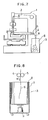
- a wire recovery apparatus 3 is arranged at the lowest-course side of a wire path 2 of a wire-cut electric discharge machine 1, and a used wire 6 held between a feed roller 4 and a pinch roller 5 and drawn out therefrom is simply let fall into a wire recovery drum 8 of the recovery apparatus 3.
- the wire recovery apparatus 3 of this type is easy to use and has a large capacity, and accordingly it is widely used.
- the wire 6 sometimes retains the liability to coil up after use and is twisted while it goes through the wire path 2, it is laid randomly and bulkily within the recovery drum 8 if simply let fall into the drum 8, thus extremely reducing the effective wire receiving capacity of the drum 8.
- An object of the present invention is to provide a wire recovery method and an apparatus therefor, which are capable of receiving a used wire neatly and in quantity, thus permitting a long-term unmanned operation of a wire-cut electric discharge machine.
- a method of recovering a used wire in a wire recovery drum while rotating the drum which comprises the steps of (a) determining a desired wire coiling radius, (b) calculating a desired angular velocity of the wire recovery drum that provides a wire coiling speed at the desired wire coiling radius coinciding with a wire feed speed, and (c) controlling an actual angular velocity of the wire recovery drum to the desired angular velocity.
- an apparatus for recovering a used wire in a wire recovery drum while rotating the drum which comprises a wire recovery drum supported rotatably, a rotating mechanism for rotating the wire recovery drum, setting means for setting a desired wire coiling radius, calculating means for calculating a desired angular velocity of the wire recovery drum that provides a wire coiling speed at the desired wire coiling radius coinciding with a wire feed speed, and driving means for driving the rotating mechanism such that an actual angular velocity of the wire recovery drum coincides with the desired angular velocity.
- the actual angular velocity of the wire recovery drum is controlled to a desired angular velocity that provides a wire coiling speed coinciding with the wire feed speed at the desired wire coiling radius. Accordingly, the used wire can be stably retrieved at the predetermined radial position in the drum, whereby the wire recovery capacity of the drum can be effectively utilized and unmanned operation of the wire-cut electric discharge machine can be continued for a long term.
- the present invention is therefore intended to control the wire coiling speed to be coincident with the wire feed speed, thereby to neatly receive a used wire in the wire recovery drum.
- the principle of recovering a wire employed in this invention will be described with reference to Fig. 4.
- a represents the wire coiling position at which a portion of the wire 6 being newly retrieved in the wire recovery drum 8 contacts the upper surface of a wire portion already contained in the drum (or the bottom surface of the drum 8 at the start), and R represents the inner diameter of the drum 8.
- v2 (m/s) of the drum 8 is given by the following equation (1):
- the actual angular velocity of the drum is controlled to the desired angular velocity w calculated by equation (2).
- the used wire 6 can be neatly coiled along and near the inner peripheral surface of the wire recovery drum 8, thus effectively using the receiving capacity of the drum 8.
- a wire recovery apparatus 3 is provided with a wire recovery drum 8 which is contained in a cylindrical outer casing 7 having an upper open end and serving as a base.
- the drum 8 includes a cylindrical peripheral wall, and a bottom wall 12 having a reinforced shaft fitting hole 13 bored through the central portion thereof.
- a plurality of rubber rollers, e.g., four rubber rollers 14, are disposed at equal angular intervals at a peripheral portion of the bottom surface of the drum 8 coaxially with the same drum, and each have a roller shaft rotatably supported by the bottom wall of the drum.
- An annular rail 16 (Fig. 5), having wedge-shaped protuberances 15 and aligned with the rollers 14, is secured to the outer casing 7 through a stay 17.
- the wire recovery drum 8 is placed on this rail 16 through the rollers 14 for rotation relative to the outer casing 7, so that the drum 8 is shaken vertically when the drum runs over the protuberances 15 during rotation.
- a rotating mechanism 10, including a motor 9, for rotating the wire recovery drum 8 is so arranged that a driving pulley 18, secured to the output shaft of the motor 9, is operatively coupled through a belt 21 to a driven pulley 20 which is secured to a drive shaft 10 spline-fitted to the shaft fitting hole 13 bored through the drum 8, so as to rotate the wire recovery drum 8 counterclockwise as viewed from above the wire recovery apparatus 3.
- a speed controller 22 for speed control of the rotating mechanism 10 which is arranged to control the motor 9 such that the actual speed of the motor coincides with a command from a setting unit 11.
- the setting unit 11 comprises a variable resistor, a transformer with a siftable tap, or the like.
- the wire recovery apparatus 3 has casters 23, whereby it can be easily moved away from the position for use of the electric discharge machine 1, shown in Fig. 7, to facilitate discarding of the wire.
- an operator determines a desired wire coiling radius r1 which corresponds to the radial distance r in Fig. 4. If the used wire 6 retrieved in the wire recovery drum 8 interferes with the inner peripheral surface of the drum, the wire is received randomly. Accordingly, the desired radius rl is set to such a value that no interference occurs between the drum 8 and the wire 6, taking account of the liability to coil up, diameter, rigidity, etc. of the wire 6, and is usually set to about 80% of the drum radius R.
- the operator After manually adjusting the setting unit 1 such that a command representing the calculated value ⁇ 1 is delivered therefrom, the operator starts the operation of the electric discharge machine 1 at the reference wire feed speed v11.
- the speed controller 22 drives the motor 9 such that the actual rotational speed of the motor 9 coincides with the command from the setting unit 11, whereby the drum 8 is rotated at the desired reference angular velocity Ml by the motor 9.
- the wire is let fall into the drum 8 in alignment with the axis of rotation of the same (shaft 19), and when it contacts the inner bottom surface of the drum, a centrifugal force acts on the wire due to the rotating drum 8, whereby the wire is coiled at the radial distance rl corresponding to the angular velocity ⁇ 1 (Fig. 4).
- the wire coiling speed v21 coincides with the reference wire feed speed v11
- the wire 6 is regularly coiled along a circle with a radius equal to the desired radius rl, as shown in Fig. 4.
- the wire is stacked on the wire already coiled up, and thus the _ wire receiving capacity of the drum 8 can be effectively achieved.
- the drum 8 placed on the rail 16 through the rollers 14 is smoothly rotated within the outer casing 7 and is vertically shaken as it passes the protuberances 15 of the rail 16. Accordingly, the wire 6 can be easily shaken down if it touches the inner peripheral surface of the drum 8 due to its liability to coil up, for example, and therefore, disorderly wire recovering as shown in Figs. 2 and 3 can be avoided.
- the operator starts the operation of the electric discharge machine 1 at the wire feed speed vllx.
- the wire 6 is recovered while it is regularly coiled in a circle with a radius equal to the desired radius rl.
- the drum 8 When the drum 8 is filled with the retrieved wire, it is detached from the electric discharge machine 1 and extracted from the outer casing 7, and the retrieved wire 6 is discarded.
- a wire recovery apparatus for carrying out the method of this embodiment is constructed similar to that shown in Fig. 1 but includes a numerical control apparatus instead of the setting unit 11 in Fig. 1.
- the numerical control apparatus (hereinafter designated with numeral 11 for the sake of convenience) has an arrangement fundamentally similar to a conventional one.
- the numerical control apparatus 11 comprises, though not shown, a central processing unit (hereinafter referred to as CPU) including various registers as described later, and a manual data input device, and is so arranged as to periodically carry out, as a task process, a pulse distribution conventionally known and an execute form data preparation as a pre-processing for the pulse distribution, to control the operation of various operating parts of the electric discharge machine 1, e.g., a wire conveying mechanism.
- CPU central processing unit
- the numerical control apparatus 11 comprises, though not shown, a central processing unit (hereinafter referred to as CPU) including various registers as described later, and a manual data input device, and is so arranged as to periodically carry out, as a task process
- NC command data is converted into machine language data that is easy to be processed in the numerical control apparatus 11. Further, the numerical control apparatus 11 has an override function so that the wire feed speed specified in a machining program may be changed by an operation of an override switch by the operator.
- the operator To recover a wire, the operator first operates the manual data input device to input the desired wire coiling radius r, etc. to the numerical control apparatus 11. Upon input of the data, the CPU of the apparatus 11 stores the input data in corresponding registers.
- the CPU reads out the NC command data of the first one block from the machining program and the command wire feed speed (hereinafter referred to as wire speed) vlx and stores the value v1x in a register R(vlx) (Step Sl), and then determines whether the NC command data indicates the end of the program (Step S2).
- the command data of the first block does not indicate the program end, and accordingly, the result of the determination in Step S2 is negative.
- the CPU determines whether the wire speed has been changed, by a comparison between a previous wire speed vlx' (initial value: "0") and a current wire speed vlx respectively stored in registers R(vlx') and R(vlx) (Step S3).
- the previous wire speed vlx' is "0"
- the current wire speed vlx is not "0.” Accordingly, it is determined that the wire speed has been changed, and Step S4 is entered.
- the CPU creates execute form data on the basis of the NC command data read in Step S1 (Step S7). Further, the CPU carries out pulse distribution for the individual axes of the electric discharge machine in accordance with the execute form data, and drives the wire recovery apparatus 3. Accordingly, the electric discharge machine 1 starts electric discharge machining, and, as in the case of the first embodiment, the drum 8 is rotated at the desired angular velocity ⁇ x by the motor 9 which is driven by the controller 22 such that the actual rotational speed thereof coincides with the command from the numerical control apparatus 11, thereby starting coiling of the wire in a circle with a radius equal to the desired radius rl.
- Step S1 the process beginning from Step S1 is periodically repeated. While the command wire feed speed remains unchanged, Steps S1, S2, S3 and S7 are executed, whereby the wire 6 is received in such a manner that it is stacked on the wire having received in the drum 8.
- Step S4 a desired angular velocity (ox of the drum is calculated in Step S4 in accordance with the aforesaid equation and on the basis of the changed wire speed vlx stored in the register R(vlx) in Step S1 and the desired wire coiling radius rl set in the register R(r). Then, as mentioned above, the process of Fig. 6 is repeatedly executed. Consequently, the wire is coiled in a circle with the same radius as before even if the wire speed is changed, and no irregularity occurs in the coiling of the wire.
- the angular velocity of the drum is so changed as to continue the coiling operation in the same manner as before, whereby unmanned operation of the electric discharge machine 1 can be continued for a long term . without a hitch.
- the command wire feed speed can be manually changed by the override switch.
- Step S2 when it is determined in Step S2 that the NC command data read in Step Sl indicates the end of the machining program, the CPU sends a stop command to the speed controller 22 to stop the rotation of the motor 9 and thus end the wire recovery operation (Step S8).
- the speed controller 22 which responds to a command from the setting unit or the numerical control apparatus is used to electrically control the angular velocity of the drum, but an infinitely variable gear, for example, may alternatively be provided in the rotating mechanism 10 to mechanically control the angular velocity of the drum.
Landscapes
- Chemical & Material Sciences (AREA)
- Chemical Kinetics & Catalysis (AREA)
- Electrochemistry (AREA)
- Engineering & Computer Science (AREA)
- Mechanical Engineering (AREA)
- Electrical Discharge Machining, Electrochemical Machining, And Combined Machining (AREA)
Applications Claiming Priority (2)
| Application Number | Priority Date | Filing Date | Title |
|---|---|---|---|
| JP63100085A JPH01271123A (ja) | 1988-04-25 | 1988-04-25 | ワイヤ回収方法及びその装置 |
| JP100085/88 | 1988-04-25 |
Publications (3)
| Publication Number | Publication Date |
|---|---|
| EP0366811A1 true EP0366811A1 (de) | 1990-05-09 |
| EP0366811A4 EP0366811A4 (en) | 1990-09-26 |
| EP0366811B1 EP0366811B1 (de) | 1993-01-07 |
Family
ID=14264596
Family Applications (1)
| Application Number | Title | Priority Date | Filing Date |
|---|---|---|---|
| EP89904243A Expired - Lifetime EP0366811B1 (de) | 1988-04-25 | 1989-04-11 | Verfahren und vorrichtung zur wiedergewinnung von draht |
Country Status (4)
| Country | Link |
|---|---|
| EP (1) | EP0366811B1 (de) |
| JP (1) | JPH01271123A (de) |
| KR (1) | KR900700227A (de) |
| WO (1) | WO1989010229A1 (de) |
Cited By (1)
| Publication number | Priority date | Publication date | Assignee | Title |
|---|---|---|---|---|
| EP3838464A4 (de) * | 2018-09-19 | 2022-06-15 | Ki Chul Seong | Abfalldrahtrückgewinnungsvorrichtung |
Families Citing this family (2)
| Publication number | Priority date | Publication date | Assignee | Title |
|---|---|---|---|---|
| KR100879351B1 (ko) * | 2002-09-27 | 2009-01-19 | 주식회사 포스코 | 스트립 통판용 로프의 회수장치 |
| JP5538351B2 (ja) * | 2011-12-06 | 2014-07-02 | 三菱電機株式会社 | ワイヤ放電加工装置 |
Family Cites Families (4)
| Publication number | Priority date | Publication date | Assignee | Title |
|---|---|---|---|---|
| JPS4947666A (de) * | 1972-09-08 | 1974-05-08 | ||
| JPS5844588B2 (ja) * | 1978-08-29 | 1983-10-04 | 住友金属工業株式会社 | 棒材の巻取方法 |
| JPS57116316U (de) * | 1981-01-12 | 1982-07-19 | ||
| JPS59196125A (ja) * | 1983-04-19 | 1984-11-07 | Fanuc Ltd | ワイヤカツト放電加工機における使用済み電極ワイヤ処理装置 |
-
1988
- 1988-04-25 JP JP63100085A patent/JPH01271123A/ja active Pending
-
1989
- 1989-04-11 WO PCT/JP1989/000392 patent/WO1989010229A1/ja not_active Ceased
- 1989-04-11 EP EP89904243A patent/EP0366811B1/de not_active Expired - Lifetime
- 1989-12-16 KR KR1019890702370A patent/KR900700227A/ko not_active Withdrawn
Non-Patent Citations (1)
| Title |
|---|
| See references of WO8910229A1 * |
Cited By (1)
| Publication number | Priority date | Publication date | Assignee | Title |
|---|---|---|---|---|
| EP3838464A4 (de) * | 2018-09-19 | 2022-06-15 | Ki Chul Seong | Abfalldrahtrückgewinnungsvorrichtung |
Also Published As
| Publication number | Publication date |
|---|---|
| JPH01271123A (ja) | 1989-10-30 |
| KR900700227A (ko) | 1990-08-11 |
| EP0366811B1 (de) | 1993-01-07 |
| EP0366811A4 (en) | 1990-09-26 |
| WO1989010229A1 (fr) | 1989-11-02 |
Similar Documents
| Publication | Publication Date | Title |
|---|---|---|
| US5209414A (en) | Apparatus for precisely winding a coil of wire | |
| JPH08267163A (ja) | 線材矯正計尺切断装置 | |
| EP0023824A1 (de) | Verfahren für die Wiederherstellung einer gebrochenen Drahtelektrode | |
| US4669289A (en) | Coil spring manufacturing apparatus | |
| EP0366811A1 (de) | Verfahren und vorrichtung zur wiedergewinnung von draht | |
| EP0197160B1 (de) | Verfahren zur bearbeitung mittels elektroerosivem drahtschneiden | |
| EP0915405A2 (de) | Verfahren zur Beschleunigungs-/Verzögerungssteuerung für numerische Steuerung und numerische Steuerungsvorrichtung | |
| US3337154A (en) | Motor control system for coiling apparatus | |
| EP0370112B1 (de) | Drahtwiedergewinnungsverfahren | |
| EP0031581A2 (de) | Vorrichtung zur Herstellung von Wendeln | |
| JP2002200535A (ja) | 工具マガジンの制御方法及び制御装置 | |
| JPH03293916A (ja) | 被覆剥取装置におけるカッターの切込位置調整方法 | |
| JP3262907B2 (ja) | 巻取り制御方法 | |
| JPH0788576A (ja) | 薄板の送り装置 | |
| JPH0220541B2 (de) | ||
| KR200273390Y1 (ko) | 자기감응센서용 코일 권선기 | |
| JPH03159541A (ja) | 回転電機の巻線装置 | |
| JPS6141698B2 (de) | ||
| JP3029744B2 (ja) | コイル製造装置 | |
| JPH04106063A (ja) | 尾端定位置停止制御装置 | |
| JPH0764471B2 (ja) | 線材巻取装置 | |
| JP2695538B2 (ja) | 数値制御装置における走行材料切断方法 | |
| JP2664294B2 (ja) | 数値制御装置における走行材料切断方法 | |
| JPH0215924A (ja) | ワイヤ放電加工装置 | |
| SU1310056A1 (ru) | Многократный волочильный стан барабанного типа |
Legal Events
| Date | Code | Title | Description |
|---|---|---|---|
| PUAI | Public reference made under article 153(3) epc to a published international application that has entered the european phase |
Free format text: ORIGINAL CODE: 0009012 |
|
| 17P | Request for examination filed |
Effective date: 19891218 |
|
| AK | Designated contracting states |
Kind code of ref document: A1 Designated state(s): CH DE FR GB IT LI |
|
| A4 | Supplementary search report drawn up and despatched |
Effective date: 19900808 |
|
| AK | Designated contracting states |
Kind code of ref document: A4 Designated state(s): CH DE FR GB IT LI |
|
| 17Q | First examination report despatched |
Effective date: 19910712 |
|
| GRAA | (expected) grant |
Free format text: ORIGINAL CODE: 0009210 |
|
| AK | Designated contracting states |
Kind code of ref document: B1 Designated state(s): CH DE FR GB IT LI |
|
| PG25 | Lapsed in a contracting state [announced via postgrant information from national office to epo] |
Ref country code: IT Free format text: LAPSE BECAUSE OF FAILURE TO SUBMIT A TRANSLATION OF THE DESCRIPTION OR TO PAY THE FEE WITHIN THE PRESCRIBED TIME-LIMIT;WARNING: LAPSES OF ITALIAN PATENTS WITH EFFECTIVE DATE BEFORE 2007 MAY HAVE OCCURRED AT ANY TIME BEFORE 2007. THE CORRECT EFFECTIVE DATE MAY BE DIFFERENT FROM THE ONE RECORDED. Effective date: 19930107 Ref country code: FR Effective date: 19930107 |
|
| REF | Corresponds to: |
Ref document number: 68904290 Country of ref document: DE Date of ref document: 19930218 |
|
| PG25 | Lapsed in a contracting state [announced via postgrant information from national office to epo] |
Ref country code: GB Effective date: 19930411 |
|
| EN | Fr: translation not filed | ||
| PLBE | No opposition filed within time limit |
Free format text: ORIGINAL CODE: 0009261 |
|
| STAA | Information on the status of an ep patent application or granted ep patent |
Free format text: STATUS: NO OPPOSITION FILED WITHIN TIME LIMIT |
|
| GBPC | Gb: european patent ceased through non-payment of renewal fee |
Effective date: 19930411 |
|
| 26N | No opposition filed | ||
| PGFP | Annual fee paid to national office [announced via postgrant information from national office to epo] |
Ref country code: CH Payment date: 19990413 Year of fee payment: 11 |
|
| PGFP | Annual fee paid to national office [announced via postgrant information from national office to epo] |
Ref country code: DE Payment date: 19990419 Year of fee payment: 11 |
|
| PG25 | Lapsed in a contracting state [announced via postgrant information from national office to epo] |
Ref country code: CH Free format text: LAPSE BECAUSE OF NON-PAYMENT OF DUE FEES Effective date: 20000430 Ref country code: LI Free format text: LAPSE BECAUSE OF NON-PAYMENT OF DUE FEES Effective date: 20000430 |
|
| REG | Reference to a national code |
Ref country code: CH Ref legal event code: PL |
|
| PG25 | Lapsed in a contracting state [announced via postgrant information from national office to epo] |
Ref country code: DE Free format text: LAPSE BECAUSE OF NON-PAYMENT OF DUE FEES Effective date: 20010201 |