EP0366823B1 - Procédé pour réduire la formation de feuilles pendant la polymérisation d'alpha-oléfines - Google Patents
Procédé pour réduire la formation de feuilles pendant la polymérisation d'alpha-oléfines Download PDFInfo
- Publication number
- EP0366823B1 EP0366823B1 EP88118338A EP88118338A EP0366823B1 EP 0366823 B1 EP0366823 B1 EP 0366823B1 EP 88118338 A EP88118338 A EP 88118338A EP 88118338 A EP88118338 A EP 88118338A EP 0366823 B1 EP0366823 B1 EP 0366823B1
- Authority
- EP
- European Patent Office
- Prior art keywords
- reactor
- alpha
- ethylene
- water
- temperature
- Prior art date
- Legal status (The legal status is an assumption and is not a legal conclusion. Google has not performed a legal analysis and makes no representation as to the accuracy of the status listed.)
- Expired - Lifetime
Links
- 238000000034 method Methods 0.000 title claims description 28
- 238000006116 polymerization reaction Methods 0.000 title claims description 23
- 239000004711 α-olefin Substances 0.000 title claims description 21
- 239000003054 catalyst Substances 0.000 claims description 79
- 239000007789 gas Substances 0.000 claims description 62
- IJGRMHOSHXDMSA-UHFFFAOYSA-N Atomic nitrogen Chemical compound N#N IJGRMHOSHXDMSA-UHFFFAOYSA-N 0.000 claims description 52
- XLYOFNOQVPJJNP-UHFFFAOYSA-N water Substances O XLYOFNOQVPJJNP-UHFFFAOYSA-N 0.000 claims description 45
- 230000003068 static effect Effects 0.000 claims description 39
- VGGSQFUCUMXWEO-UHFFFAOYSA-N Ethene Chemical compound C=C VGGSQFUCUMXWEO-UHFFFAOYSA-N 0.000 claims description 37
- 239000005977 Ethylene Substances 0.000 claims description 35
- 229910052757 nitrogen Inorganic materials 0.000 claims description 26
- 230000015572 biosynthetic process Effects 0.000 claims description 23
- 239000010936 titanium Substances 0.000 claims description 20
- 150000001875 compounds Chemical class 0.000 claims description 19
- 229920000642 polymer Polymers 0.000 claims description 19
- 229910052720 vanadium Inorganic materials 0.000 claims description 19
- LEONUFNNVUYDNQ-UHFFFAOYSA-N vanadium atom Chemical compound [V] LEONUFNNVUYDNQ-UHFFFAOYSA-N 0.000 claims description 19
- RTAQQCXQSZGOHL-UHFFFAOYSA-N Titanium Chemical compound [Ti] RTAQQCXQSZGOHL-UHFFFAOYSA-N 0.000 claims description 14
- 229910052719 titanium Inorganic materials 0.000 claims description 14
- VXNZUUAINFGPBY-UHFFFAOYSA-N 1-Butene Chemical compound CCC=C VXNZUUAINFGPBY-UHFFFAOYSA-N 0.000 claims description 10
- 229920001577 copolymer Polymers 0.000 claims description 10
- 125000005234 alkyl aluminium group Chemical group 0.000 claims description 9
- 238000005245 sintering Methods 0.000 claims description 9
- 229920001519 homopolymer Polymers 0.000 claims description 7
- LIKMAJRDDDTEIG-UHFFFAOYSA-N 1-hexene Chemical compound CCCCC=C LIKMAJRDDDTEIG-UHFFFAOYSA-N 0.000 claims description 6
- 239000011261 inert gas Substances 0.000 claims description 6
- 229920001038 ethylene copolymer Polymers 0.000 claims description 5
- 229920000098 polyolefin Polymers 0.000 claims description 5
- WSSSPWUEQFSQQG-UHFFFAOYSA-N 4-methyl-1-pentene Chemical compound CC(C)CC=C WSSSPWUEQFSQQG-UHFFFAOYSA-N 0.000 claims description 3
- YWAKXRMUMFPDSH-UHFFFAOYSA-N pentene Chemical compound CCCC=C YWAKXRMUMFPDSH-UHFFFAOYSA-N 0.000 claims description 3
- QQONPFPTGQHPMA-UHFFFAOYSA-N propylene Natural products CC=C QQONPFPTGQHPMA-UHFFFAOYSA-N 0.000 claims description 3
- 125000004805 propylene group Chemical group [H]C([H])([H])C([H])([*:1])C([H])([H])[*:2] 0.000 claims description 3
- 229920005684 linear copolymer Polymers 0.000 claims description 2
- 229920005989 resin Polymers 0.000 description 48
- 239000011347 resin Substances 0.000 description 48
- 239000002245 particle Substances 0.000 description 42
- -1 polyethylene Polymers 0.000 description 30
- 239000000047 product Substances 0.000 description 26
- 238000006243 chemical reaction Methods 0.000 description 23
- VYPSYNLAJGMNEJ-UHFFFAOYSA-N Silicium dioxide Chemical compound O=[Si]=O VYPSYNLAJGMNEJ-UHFFFAOYSA-N 0.000 description 21
- 239000000203 mixture Substances 0.000 description 17
- 238000009826 distribution Methods 0.000 description 15
- 239000012530 fluid Substances 0.000 description 11
- 238000004519 manufacturing process Methods 0.000 description 11
- 239000001257 hydrogen Substances 0.000 description 10
- 229910052739 hydrogen Inorganic materials 0.000 description 10
- 239000000377 silicon dioxide Substances 0.000 description 10
- 239000002243 precursor Substances 0.000 description 9
- UFHFLCQGNIYNRP-UHFFFAOYSA-N Hydrogen Chemical compound [H][H] UFHFLCQGNIYNRP-UHFFFAOYSA-N 0.000 description 8
- TWRXJAOTZQYOKJ-UHFFFAOYSA-L Magnesium chloride Chemical compound [Mg+2].[Cl-].[Cl-] TWRXJAOTZQYOKJ-UHFFFAOYSA-L 0.000 description 8
- 230000008569 process Effects 0.000 description 8
- 239000011651 chromium Substances 0.000 description 7
- 238000005243 fluidization Methods 0.000 description 7
- 239000000463 material Substances 0.000 description 7
- 239000000178 monomer Substances 0.000 description 7
- 229920000573 polyethylene Polymers 0.000 description 7
- VYZAMTAEIAYCRO-UHFFFAOYSA-N Chromium Chemical compound [Cr] VYZAMTAEIAYCRO-UHFFFAOYSA-N 0.000 description 6
- 239000004698 Polyethylene Substances 0.000 description 6
- WGLPBDUCMAPZCE-UHFFFAOYSA-N Trioxochromium Chemical compound O=[Cr](=O)=O WGLPBDUCMAPZCE-UHFFFAOYSA-N 0.000 description 6
- MCMNRKCIXSYSNV-UHFFFAOYSA-N Zirconium dioxide Chemical compound O=[Zr]=O MCMNRKCIXSYSNV-UHFFFAOYSA-N 0.000 description 6
- 229910052782 aluminium Inorganic materials 0.000 description 6
- 239000002585 base Substances 0.000 description 6
- 239000000460 chlorine Substances 0.000 description 6
- 229910052804 chromium Inorganic materials 0.000 description 6
- QWTDNUCVQCZILF-UHFFFAOYSA-N isopentane Chemical compound CCC(C)C QWTDNUCVQCZILF-UHFFFAOYSA-N 0.000 description 6
- 229920001684 low density polyethylene Polymers 0.000 description 6
- 150000002681 magnesium compounds Chemical class 0.000 description 6
- 239000000155 melt Substances 0.000 description 6
- 239000003607 modifier Substances 0.000 description 6
- 150000003609 titanium compounds Chemical class 0.000 description 6
- VOITXYVAKOUIBA-UHFFFAOYSA-N triethylaluminium Chemical compound CC[Al](CC)CC VOITXYVAKOUIBA-UHFFFAOYSA-N 0.000 description 6
- 150000001338 aliphatic hydrocarbons Chemical class 0.000 description 5
- 229910052794 bromium Inorganic materials 0.000 description 5
- 125000004432 carbon atom Chemical group C* 0.000 description 5
- 229910052801 chlorine Inorganic materials 0.000 description 5
- 230000000694 effects Effects 0.000 description 5
- 239000004702 low-density polyethylene Substances 0.000 description 5
- 230000009467 reduction Effects 0.000 description 5
- XKRFYHLGVUSROY-UHFFFAOYSA-N Argon Chemical compound [Ar] XKRFYHLGVUSROY-UHFFFAOYSA-N 0.000 description 4
- PXGOKWXKJXAPGV-UHFFFAOYSA-N Fluorine Chemical compound FF PXGOKWXKJXAPGV-UHFFFAOYSA-N 0.000 description 4
- WYURNTSHIVDZCO-UHFFFAOYSA-N Tetrahydrofuran Chemical compound C1CCOC1 WYURNTSHIVDZCO-UHFFFAOYSA-N 0.000 description 4
- 125000001931 aliphatic group Chemical group 0.000 description 4
- 125000000217 alkyl group Chemical group 0.000 description 4
- 229910052796 boron Inorganic materials 0.000 description 4
- 238000007599 discharging Methods 0.000 description 4
- 229910052731 fluorine Inorganic materials 0.000 description 4
- 239000011737 fluorine Substances 0.000 description 4
- 238000002347 injection Methods 0.000 description 4
- 239000007924 injection Substances 0.000 description 4
- 150000002500 ions Chemical class 0.000 description 4
- 239000007788 liquid Substances 0.000 description 4
- 229910001629 magnesium chloride Inorganic materials 0.000 description 4
- VNWKTOKETHGBQD-UHFFFAOYSA-N methane Chemical compound C VNWKTOKETHGBQD-UHFFFAOYSA-N 0.000 description 4
- 150000003682 vanadium compounds Chemical class 0.000 description 4
- 239000004215 Carbon black (E152) Substances 0.000 description 3
- IMNFDUFMRHMDMM-UHFFFAOYSA-N N-Heptane Chemical compound CCCCCCC IMNFDUFMRHMDMM-UHFFFAOYSA-N 0.000 description 3
- CQBWEBXPMRPCSI-UHFFFAOYSA-M O[Cr](O[SiH3])(=O)=O Chemical compound O[Cr](O[SiH3])(=O)=O CQBWEBXPMRPCSI-UHFFFAOYSA-M 0.000 description 3
- 230000004913 activation Effects 0.000 description 3
- 239000012190 activator Substances 0.000 description 3
- 239000000654 additive Substances 0.000 description 3
- 230000000996 additive effect Effects 0.000 description 3
- XAGFODPZIPBFFR-UHFFFAOYSA-N aluminium Chemical compound [Al] XAGFODPZIPBFFR-UHFFFAOYSA-N 0.000 description 3
- PNEYBMLMFCGWSK-UHFFFAOYSA-N aluminium oxide Inorganic materials [O-2].[O-2].[O-2].[Al+3].[Al+3] PNEYBMLMFCGWSK-UHFFFAOYSA-N 0.000 description 3
- YNLAOSYQHBDIKW-UHFFFAOYSA-M diethylaluminium chloride Chemical group CC[Al](Cl)CC YNLAOSYQHBDIKW-UHFFFAOYSA-M 0.000 description 3
- AFABGHUZZDYHJO-UHFFFAOYSA-N dimethyl butane Natural products CCCC(C)C AFABGHUZZDYHJO-UHFFFAOYSA-N 0.000 description 3
- 239000012153 distilled water Substances 0.000 description 3
- 229910052736 halogen Inorganic materials 0.000 description 3
- 150000002367 halogens Chemical class 0.000 description 3
- 229920001903 high density polyethylene Polymers 0.000 description 3
- 229930195733 hydrocarbon Natural products 0.000 description 3
- 239000012442 inert solvent Substances 0.000 description 3
- 229910052809 inorganic oxide Inorganic materials 0.000 description 3
- 238000002156 mixing Methods 0.000 description 3
- 238000012986 modification Methods 0.000 description 3
- 230000004048 modification Effects 0.000 description 3
- 239000002574 poison Substances 0.000 description 3
- 231100000614 poison Toxicity 0.000 description 3
- 229920013716 polyethylene resin Polymers 0.000 description 3
- 239000011148 porous material Substances 0.000 description 3
- 229920006395 saturated elastomer Polymers 0.000 description 3
- 239000007787 solid Substances 0.000 description 3
- ZCUFMDLYAMJYST-UHFFFAOYSA-N thorium dioxide Chemical compound O=[Th]=O ZCUFMDLYAMJYST-UHFFFAOYSA-N 0.000 description 3
- FAQYAMRNWDIXMY-UHFFFAOYSA-N trichloroborane Chemical compound ClB(Cl)Cl FAQYAMRNWDIXMY-UHFFFAOYSA-N 0.000 description 3
- ORYGRKHDLWYTKX-UHFFFAOYSA-N trihexylalumane Chemical compound CCCCCC[Al](CCCCCC)CCCCCC ORYGRKHDLWYTKX-UHFFFAOYSA-N 0.000 description 3
- ZOXJGFHDIHLPTG-UHFFFAOYSA-N Boron Chemical compound [B] ZOXJGFHDIHLPTG-UHFFFAOYSA-N 0.000 description 2
- WKBOTKDWSSQWDR-UHFFFAOYSA-N Bromine atom Chemical compound [Br] WKBOTKDWSSQWDR-UHFFFAOYSA-N 0.000 description 2
- 239000002879 Lewis base Substances 0.000 description 2
- GWEVSGVZZGPLCZ-UHFFFAOYSA-N Titan oxide Chemical compound O=[Ti]=O GWEVSGVZZGPLCZ-UHFFFAOYSA-N 0.000 description 2
- 229910021551 Vanadium(III) chloride Inorganic materials 0.000 description 2
- 125000005907 alkyl ester group Chemical group 0.000 description 2
- 239000002216 antistatic agent Substances 0.000 description 2
- 229910052786 argon Inorganic materials 0.000 description 2
- ILAHWRKJUDSMFH-UHFFFAOYSA-N boron tribromide Chemical compound BrB(Br)Br ILAHWRKJUDSMFH-UHFFFAOYSA-N 0.000 description 2
- GDTBXPJZTBHREO-UHFFFAOYSA-N bromine Substances BrBr GDTBXPJZTBHREO-UHFFFAOYSA-N 0.000 description 2
- IAQRGUVFOMOMEM-UHFFFAOYSA-N butene Natural products CC=CC IAQRGUVFOMOMEM-UHFFFAOYSA-N 0.000 description 2
- 229910052799 carbon Inorganic materials 0.000 description 2
- 239000012876 carrier material Substances 0.000 description 2
- 239000012986 chain transfer agent Substances 0.000 description 2
- 239000007795 chemical reaction product Substances 0.000 description 2
- 125000001309 chloro group Chemical group Cl* 0.000 description 2
- 230000003247 decreasing effect Effects 0.000 description 2
- 230000001419 dependent effect Effects 0.000 description 2
- 230000008021 deposition Effects 0.000 description 2
- 238000001035 drying Methods 0.000 description 2
- 230000005611 electricity Effects 0.000 description 2
- 238000001125 extrusion Methods 0.000 description 2
- 150000002222 fluorine compounds Chemical class 0.000 description 2
- 125000004051 hexyl group Chemical group [H]C([H])([H])C([H])([H])C([H])([H])C([H])([H])C([H])([H])C([H])([H])* 0.000 description 2
- 239000004700 high-density polyethylene Substances 0.000 description 2
- 150000002431 hydrogen Chemical class 0.000 description 2
- 239000012535 impurity Substances 0.000 description 2
- 238000009434 installation Methods 0.000 description 2
- 229910052740 iodine Inorganic materials 0.000 description 2
- 150000007527 lewis bases Chemical class 0.000 description 2
- 238000005259 measurement Methods 0.000 description 2
- 230000007246 mechanism Effects 0.000 description 2
- 238000006386 neutralization reaction Methods 0.000 description 2
- 150000002829 nitrogen Chemical class 0.000 description 2
- 230000000379 polymerizing effect Effects 0.000 description 2
- 239000000843 powder Substances 0.000 description 2
- 238000002360 preparation method Methods 0.000 description 2
- 238000001175 rotational moulding Methods 0.000 description 2
- 238000005204 segregation Methods 0.000 description 2
- 229910052710 silicon Inorganic materials 0.000 description 2
- 239000010703 silicon Substances 0.000 description 2
- YLQBMQCUIZJEEH-UHFFFAOYSA-N tetrahydrofuran Natural products C=1C=COC=1 YLQBMQCUIZJEEH-UHFFFAOYSA-N 0.000 description 2
- XJDNKRIXUMDJCW-UHFFFAOYSA-J titanium tetrachloride Chemical compound Cl[Ti](Cl)(Cl)Cl XJDNKRIXUMDJCW-UHFFFAOYSA-J 0.000 description 2
- HQYCOEXWFMFWLR-UHFFFAOYSA-K vanadium(iii) chloride Chemical group [Cl-].[Cl-].[Cl-].[V+3] HQYCOEXWFMFWLR-UHFFFAOYSA-K 0.000 description 2
- 238000013022 venting Methods 0.000 description 2
- POILWHVDKZOXJZ-ARJAWSKDSA-M (z)-4-oxopent-2-en-2-olate Chemical compound C\C([O-])=C\C(C)=O POILWHVDKZOXJZ-ARJAWSKDSA-M 0.000 description 1
- 125000003903 2-propenyl group Chemical group [H]C([*])([H])C([H])=C([H])[H] 0.000 description 1
- FQHYQCXMFZHLAE-UHFFFAOYSA-N 25405-85-0 Chemical compound CC1(C)C2(OC(=O)C=3C=CC=CC=3)C1C1C=C(CO)CC(C(C(C)=C3)=O)(O)C3C1(O)C(C)C2OC(=O)C1=CC=CC=C1 FQHYQCXMFZHLAE-UHFFFAOYSA-N 0.000 description 1
- PMJNEQWWZRSFCE-UHFFFAOYSA-N 3-ethoxy-3-oxo-2-(thiophen-2-ylmethyl)propanoic acid Chemical compound CCOC(=O)C(C(O)=O)CC1=CC=CS1 PMJNEQWWZRSFCE-UHFFFAOYSA-N 0.000 description 1
- ZCYVEMRRCGMTRW-UHFFFAOYSA-N 7553-56-2 Chemical group [I] ZCYVEMRRCGMTRW-UHFFFAOYSA-N 0.000 description 1
- 101100058670 Aeromonas hydrophila subsp. hydrophila (strain ATCC 7966 / DSM 30187 / BCRC 13018 / CCUG 14551 / JCM 1027 / KCTC 2358 / NCIMB 9240 / NCTC 8049) bsr gene Proteins 0.000 description 1
- 229910015845 BBr3 Inorganic materials 0.000 description 1
- 229910015844 BCl3 Inorganic materials 0.000 description 1
- AQLZCGLPNYEIDH-UHFFFAOYSA-N C=1C=CC=CC=1[Si](C=1C=CC=CC=1)(C=1C=CC=CC=1)O[Cr](=O)(=O)O[Si](C=1C=CC=CC=1)(C=1C=CC=CC=1)C1=CC=CC=C1 Chemical compound C=1C=CC=CC=1[Si](C=1C=CC=CC=1)(C=1C=CC=CC=1)O[Cr](=O)(=O)O[Si](C=1C=CC=CC=1)(C=1C=CC=CC=1)C1=CC=CC=C1 AQLZCGLPNYEIDH-UHFFFAOYSA-N 0.000 description 1
- UGFAIRIUMAVXCW-UHFFFAOYSA-N Carbon monoxide Chemical compound [O+]#[C-] UGFAIRIUMAVXCW-UHFFFAOYSA-N 0.000 description 1
- 229910000975 Carbon steel Inorganic materials 0.000 description 1
- OTMSDBZUPAUEDD-UHFFFAOYSA-N Ethane Chemical compound CC OTMSDBZUPAUEDD-UHFFFAOYSA-N 0.000 description 1
- XUIMIQQOPSSXEZ-UHFFFAOYSA-N Silicon Chemical compound [Si] XUIMIQQOPSSXEZ-UHFFFAOYSA-N 0.000 description 1
- 229910010062 TiCl3 Inorganic materials 0.000 description 1
- 229910003074 TiCl4 Inorganic materials 0.000 description 1
- 238000009825 accumulation Methods 0.000 description 1
- 239000004480 active ingredient Substances 0.000 description 1
- 239000000853 adhesive Substances 0.000 description 1
- 230000001070 adhesive effect Effects 0.000 description 1
- 230000002411 adverse Effects 0.000 description 1
- 238000005054 agglomeration Methods 0.000 description 1
- 230000002776 aggregation Effects 0.000 description 1
- 125000002723 alicyclic group Chemical group 0.000 description 1
- 150000001336 alkenes Chemical class 0.000 description 1
- 238000013459 approach Methods 0.000 description 1
- 150000004945 aromatic hydrocarbons Chemical group 0.000 description 1
- 238000009835 boiling Methods 0.000 description 1
- 150000001639 boron compounds Chemical class 0.000 description 1
- WXCZUWHSJWOTRV-UHFFFAOYSA-N but-1-ene;ethene Chemical compound C=C.CCC=C WXCZUWHSJWOTRV-UHFFFAOYSA-N 0.000 description 1
- 125000000484 butyl group Chemical group [H]C([*])([H])C([H])([H])C([H])([H])C([H])([H])[H] 0.000 description 1
- 150000001721 carbon Chemical group 0.000 description 1
- 239000006229 carbon black Substances 0.000 description 1
- 229910002091 carbon monoxide Inorganic materials 0.000 description 1
- 239000010962 carbon steel Substances 0.000 description 1
- 238000003889 chemical engineering Methods 0.000 description 1
- 239000003795 chemical substances by application Substances 0.000 description 1
- ZCDOYSPFYFSLEW-UHFFFAOYSA-N chromate(2-) Chemical class [O-][Cr]([O-])(=O)=O ZCDOYSPFYFSLEW-UHFFFAOYSA-N 0.000 description 1
- 229960000359 chromic chloride Drugs 0.000 description 1
- 229940055042 chromic sulfate Drugs 0.000 description 1
- 150000001845 chromium compounds Chemical class 0.000 description 1
- PHFQLYPOURZARY-UHFFFAOYSA-N chromium trinitrate Chemical compound [Cr+3].[O-][N+]([O-])=O.[O-][N+]([O-])=O.[O-][N+]([O-])=O PHFQLYPOURZARY-UHFFFAOYSA-N 0.000 description 1
- LJAOOBNHPFKCDR-UHFFFAOYSA-K chromium(3+) trichloride hexahydrate Chemical compound O.O.O.O.O.O.[Cl-].[Cl-].[Cl-].[Cr+3] LJAOOBNHPFKCDR-UHFFFAOYSA-K 0.000 description 1
- 235000007831 chromium(III) chloride Nutrition 0.000 description 1
- 239000011636 chromium(III) chloride Substances 0.000 description 1
- GRWVQDDAKZFPFI-UHFFFAOYSA-H chromium(III) sulfate Chemical compound [Cr+3].[Cr+3].[O-]S([O-])(=O)=O.[O-]S([O-])(=O)=O.[O-]S([O-])(=O)=O GRWVQDDAKZFPFI-UHFFFAOYSA-H 0.000 description 1
- 229910000356 chromium(III) sulfate Inorganic materials 0.000 description 1
- 235000015217 chromium(III) sulphate Nutrition 0.000 description 1
- 239000011696 chromium(III) sulphate Substances 0.000 description 1
- 229920006026 co-polymeric resin Polymers 0.000 description 1
- 239000004020 conductor Substances 0.000 description 1
- 238000012790 confirmation Methods 0.000 description 1
- 230000001276 controlling effect Effects 0.000 description 1
- 239000013078 crystal Substances 0.000 description 1
- 150000004292 cyclic ethers Chemical class 0.000 description 1
- 125000000113 cyclohexyl group Chemical group [H]C1([H])C([H])([H])C([H])([H])C([H])(*)C([H])([H])C1([H])[H] 0.000 description 1
- 125000001511 cyclopentyl group Chemical group [H]C1([H])C([H])([H])C([H])([H])C([H])(*)C1([H])[H] 0.000 description 1
- 230000001627 detrimental effect Effects 0.000 description 1
- 238000004090 dissolution Methods 0.000 description 1
- 238000005516 engineering process Methods 0.000 description 1
- 125000001495 ethyl group Chemical group [H]C([H])([H])C([H])([H])* 0.000 description 1
- 230000004927 fusion Effects 0.000 description 1
- 230000020169 heat generation Effects 0.000 description 1
- 238000010438 heat treatment Methods 0.000 description 1
- 150000002430 hydrocarbons Chemical class 0.000 description 1
- 125000001183 hydrocarbyl group Chemical group 0.000 description 1
- 125000004435 hydrogen atom Chemical group [H]* 0.000 description 1
- 238000005470 impregnation Methods 0.000 description 1
- 238000001746 injection moulding Methods 0.000 description 1
- 229910010272 inorganic material Inorganic materials 0.000 description 1
- 239000011147 inorganic material Substances 0.000 description 1
- 238000011835 investigation Methods 0.000 description 1
- PNDPGZBMCMUPRI-UHFFFAOYSA-N iodine Chemical compound II PNDPGZBMCMUPRI-UHFFFAOYSA-N 0.000 description 1
- 239000011630 iodine Chemical group 0.000 description 1
- 239000003456 ion exchange resin Substances 0.000 description 1
- 229920003303 ion-exchange polymer Polymers 0.000 description 1
- 238000011068 loading method Methods 0.000 description 1
- OTCKOJUMXQWKQG-UHFFFAOYSA-L magnesium bromide Chemical compound [Mg+2].[Br-].[Br-] OTCKOJUMXQWKQG-UHFFFAOYSA-L 0.000 description 1
- 229910001623 magnesium bromide Inorganic materials 0.000 description 1
- BLQJIBCZHWBKSL-UHFFFAOYSA-L magnesium iodide Chemical compound [Mg+2].[I-].[I-] BLQJIBCZHWBKSL-UHFFFAOYSA-L 0.000 description 1
- 229910001641 magnesium iodide Inorganic materials 0.000 description 1
- 125000002496 methyl group Chemical group [H]C([H])([H])* 0.000 description 1
- 235000019813 microcrystalline cellulose Nutrition 0.000 description 1
- 239000008108 microcrystalline cellulose Substances 0.000 description 1
- 229940016286 microcrystalline cellulose Drugs 0.000 description 1
- 239000002808 molecular sieve Substances 0.000 description 1
- 230000007935 neutral effect Effects 0.000 description 1
- JRZJOMJEPLMPRA-UHFFFAOYSA-N olefin Natural products CCCCCCCC=C JRZJOMJEPLMPRA-UHFFFAOYSA-N 0.000 description 1
- 150000002894 organic compounds Chemical class 0.000 description 1
- 239000011368 organic material Substances 0.000 description 1
- 239000012188 paraffin wax Substances 0.000 description 1
- 239000011236 particulate material Substances 0.000 description 1
- 125000001147 pentyl group Chemical group C(CCCC)* 0.000 description 1
- 238000005325 percolation Methods 0.000 description 1
- 125000001997 phenyl group Chemical group [H]C1=C([H])C([H])=C(*)C([H])=C1[H] 0.000 description 1
- 239000002685 polymerization catalyst Substances 0.000 description 1
- 229920005672 polyolefin resin Polymers 0.000 description 1
- 230000002265 prevention Effects 0.000 description 1
- 238000011027 product recovery Methods 0.000 description 1
- 230000000750 progressive effect Effects 0.000 description 1
- 230000001737 promoting effect Effects 0.000 description 1
- 125000001436 propyl group Chemical group [H]C([*])([H])C([H])([H])C([H])([H])[H] 0.000 description 1
- 230000005855 radiation Effects 0.000 description 1
- 230000002285 radioactive effect Effects 0.000 description 1
- 239000000376 reactant Substances 0.000 description 1
- 238000011084 recovery Methods 0.000 description 1
- 230000001105 regulatory effect Effects 0.000 description 1
- 238000000518 rheometry Methods 0.000 description 1
- 239000000523 sample Substances 0.000 description 1
- 229930195734 saturated hydrocarbon Natural products 0.000 description 1
- 238000007790 scraping Methods 0.000 description 1
- 238000000926 separation method Methods 0.000 description 1
- 239000002002 slurry Substances 0.000 description 1
- URGAHOPLAPQHLN-UHFFFAOYSA-N sodium aluminosilicate Chemical compound [Na+].[Al+3].[O-][Si]([O-])=O.[O-][Si]([O-])=O URGAHOPLAPQHLN-UHFFFAOYSA-N 0.000 description 1
- 239000000243 solution Substances 0.000 description 1
- 238000001228 spectrum Methods 0.000 description 1
- 239000010935 stainless steel Substances 0.000 description 1
- 229910001220 stainless steel Inorganic materials 0.000 description 1
- 238000003756 stirring Methods 0.000 description 1
- 239000000126 substance Substances 0.000 description 1
- 239000000758 substrate Substances 0.000 description 1
- 230000002459 sustained effect Effects 0.000 description 1
- 208000024891 symptom Diseases 0.000 description 1
- YONPGGFAJWQGJC-UHFFFAOYSA-K titanium(iii) chloride Chemical compound Cl[Ti](Cl)Cl YONPGGFAJWQGJC-UHFFFAOYSA-K 0.000 description 1
- 238000012546 transfer Methods 0.000 description 1
- 125000005106 triarylsilyl group Chemical group 0.000 description 1
- MCULRUJILOGHCJ-UHFFFAOYSA-N triisobutylaluminium Chemical group CC(C)C[Al](CC(C)C)CC(C)C MCULRUJILOGHCJ-UHFFFAOYSA-N 0.000 description 1
- 238000011144 upstream manufacturing Methods 0.000 description 1
Images
Classifications
-
- C—CHEMISTRY; METALLURGY
- C08—ORGANIC MACROMOLECULAR COMPOUNDS; THEIR PREPARATION OR CHEMICAL WORKING-UP; COMPOSITIONS BASED THEREON
- C08F—MACROMOLECULAR COMPOUNDS OBTAINED BY REACTIONS ONLY INVOLVING CARBON-TO-CARBON UNSATURATED BONDS
- C08F10/00—Homopolymers and copolymers of unsaturated aliphatic hydrocarbons having only one carbon-to-carbon double bond
-
- C—CHEMISTRY; METALLURGY
- C08—ORGANIC MACROMOLECULAR COMPOUNDS; THEIR PREPARATION OR CHEMICAL WORKING-UP; COMPOSITIONS BASED THEREON
- C08F—MACROMOLECULAR COMPOUNDS OBTAINED BY REACTIONS ONLY INVOLVING CARBON-TO-CARBON UNSATURATED BONDS
- C08F110/00—Homopolymers of unsaturated aliphatic hydrocarbons having only one carbon-to-carbon double bond
- C08F110/02—Ethene
-
- C—CHEMISTRY; METALLURGY
- C08—ORGANIC MACROMOLECULAR COMPOUNDS; THEIR PREPARATION OR CHEMICAL WORKING-UP; COMPOSITIONS BASED THEREON
- C08F—MACROMOLECULAR COMPOUNDS OBTAINED BY REACTIONS ONLY INVOLVING CARBON-TO-CARBON UNSATURATED BONDS
- C08F210/00—Copolymers of unsaturated aliphatic hydrocarbons having only one carbon-to-carbon double bond
- C08F210/16—Copolymers of ethene with alpha-alkenes, e.g. EP rubbers
-
- Y—GENERAL TAGGING OF NEW TECHNOLOGICAL DEVELOPMENTS; GENERAL TAGGING OF CROSS-SECTIONAL TECHNOLOGIES SPANNING OVER SEVERAL SECTIONS OF THE IPC; TECHNICAL SUBJECTS COVERED BY FORMER USPC CROSS-REFERENCE ART COLLECTIONS [XRACs] AND DIGESTS
- Y10—TECHNICAL SUBJECTS COVERED BY FORMER USPC
- Y10S—TECHNICAL SUBJECTS COVERED BY FORMER USPC CROSS-REFERENCE ART COLLECTIONS [XRACs] AND DIGESTS
- Y10S526/00—Synthetic resins or natural rubbers -- part of the class 520 series
- Y10S526/901—Monomer polymerized in vapor state in presence of transition metal containing catalyst
Definitions
- This invention relates to a method for reducing sheeting during production of polyolefins by polymerization of alpha-olefins and more particularly to a method for reducing sheeting during polymerization of polyethylene utilizing titanium based catalysts or vanadium based catalysts with alkyl aluminum cocatalysts.
- HP-LDPE high pressure, low density polyethylene
- HP-LDPE's are characterized by an intricate long chain branched molecular architecture. These long chain branches have a dramatic effect on the melt rheology of these resins.
- HP-LDPE's also possess a spectrum of short chain branches, generally 1 to 6 carbon atoms in length. These short chain branches disrupt crystal formation and depress resin density.
- low density polyethylene can be produced by fluidized bed techniques at low pressures and temperatures by copolymerizing ethylene with various alpha-olefins.
- LP-LDPE low pressure LDPE
- linear LDPE resins are sometimes referred to as linear LDPE resins. They are short chain branched with branch length and frequency controlled by the type and amount of comonomer used during polymerization.
- low pressure, high or low density polyethylenes can now be conventionally provided by a fluidized bed process utilizing several families of catalysts to produce a full range of low density and high density products.
- the appropriate selection of catalysts to be utilized depends in part upon the type of end product desired, i.e., high density, low density, extrusion grade, film grade resins and other criteria.
- the various types of catalysts which may be used to produce polyethylenes in fluid bed reactors can generally be typed as follows: Type I .
- the silyl chromate catalysts are characterized by the presence therein of a group of the formula: wherein R is a hydrocarbyl group having from 1 to 14 carbon atoms.
- the preferred silyl chromate catalysts are the bis(triarylsilyl) chromates and more preferably bis(triphenylsilyl) chromate.
- This catalyst is used on a support such as silica, alumina, thoria and zirconia; other supports such as carbon black, micro-crystalline cellulose, and the non-sulfonated ion exchange resins may be used.
- Type II The bis(cyclopentadienyl) chromium (II) compounds disclosed in U.S. Patent No. 3,879,368. These bis(cyclopentadienyl) chromium (II) compounds have the following formula: wherein R′ and R ⁇ may be the same or different C1 to C20, inclusive, hydrocarbon radicals, and n′ and n ⁇ may be the same or different integers of 0 to 5, inclusive.
- the R′ and R ⁇ hydrocarbon radicals may be saturated or unsaturated, and can include aliphatic, alicyclic and aromatic radicals such as methyl, ethyl, propyl, butyl, pentyl, cyclopentyl, cyclohexyl, allyl, phenyl and naphthyl radicals.
- catalysts are used on a support as heretofore described.
- Type III The catalysts as described in U.S. Patent No. 4,011,382. These catalysts contain chromium and titanium in the form of oxides and, optionally, fluorine and a support.
- the catalysts contain, based on the combined weight of the support and the chromium, titanium and fluorine, 0.05 to 3.0, and preferably 0.2 to 1.0, weight percent of chromium (calculated as Cr), 1.5 to 9.0, and preferably 4.0 to 7.0, weight percent of titanium (calculated as Ti), and 0.0 to 2.5, and preferably 0.1 to 1.0 weight percent of fluorine (calculated as F).
- the chronium compounds which may be used for the Type III catalysts include CrO3, or any compound of chromium which is oxidizable to CrO3 under the activation conditions employed. At least a portion of the chromium in the supported, activated catalyst must be in the hexavalent state.
- Chromium compound other than CrO3 which may be used are disclosed in U.S. Patent No. 2,825,721 and U.S. Patent No. 3,622,521 and include chromic acetyl acetonate, chromic nitrate, chromic acetate, chromic chloride, chromic sulfate, and ammonium chromate.
- the titanium compounds which may be used include all those which are oxidizable to TiO2 under the activation conditions employed, and include those disclosed in U.S. Patent No. 3,622,521 and Netherlands Patent Application 72-10881.
- the fluorine compounds which may be used include HF, or any compound of fluorine which will yield HF under the activation conditions employed. Fluorine compounds other than HF which may be used are disclosed in Netherlands Patent Application No. 72-10881.
- the inorganic oxide materials which may be used as a support in the catalyst compositions are porous materials having a high surface area, that is, a surface area in the range of 50 to 1000 square meters per gram, and an average particle size of 20 to 200 microns ( ⁇ m).
- the inorganic oxides which may be used include silica, alumina, thoria, zirconia and other comparable inorganic oxides, as well as mixtures of such oxides.
- Type IV The catalysts as described in U.S. Patent No. 4,302,566 in the names of F.J. Karol et al, and entitled, "Preparation of Ethylene Copolymers in Fluid Bed Reactor" and assigned to the same assignee as the present application. These catalysts comprise at least one titanium compound, at least one magnesium compound, at least one electron donor compound, at least one activator compound and at least one inert carrier material.
- the titanium compounds can be used individually or in combination thereof, and would include TiCl3, TiCl4, Ti(OCH3)Cl3, Ti(OC6H5)Cl3, Ti(OCOCH3)Cl3 and Ti(OCOC6H5)Cl3.
- the magnesium compound has the structure: MgX2 wherein X is Cl, Br or I.
- Such magnesium compounds can be used individually or in combinations thereof and would include MgCl2, MgBr2 and MgI2.
- Anhydrous MgCl2 is the preferred magnesium compound.
- the titanium compound and the magnesium compound are generally used in a form which will facilitate their dissolution in the electron donor compound.
- the electron donor compound is an organic compound which is liquid at 25°C and in which the titanium compound and the magnesium compound are partially or completely soluble.
- the electron donor compounds are known as such or as Lewis bases.
- the electron donor compounds would include such compounds as alkyl esters of aliphatic and aromatic carboxylic acids, aliphatic ethers, cyclic ethers and aliphatic ketones.
- the catalyst may be modified with a boron halide compound having the structure: BR c X' 3-c wherein R is an aliphatic or aromatic hydrocarbon radical containing from 1 to 14 carbon atoms or OR′, wherein R′ is also an aliphatic or aromatic hydrocarbon radical containing from 1 to 14 carbon atoms; X′ is selected from the group consisting of Cl and Br, or mixtures thereof, and; c is 0 or 1 when R is an aliphatic or aromatic hydrocarbon and 0, 1 or 2 when R is OR′.
- R is an aliphatic or aromatic hydrocarbon radical containing from 1 to 14 carbon atoms or OR′
- R′ is also an aliphatic or aromatic hydrocarbon radical containing from 1 to 14 carbon atoms
- X′ is selected from the group consisting of Cl and Br, or mixtures thereof, and
- c is 0 or 1 when R is an aliphatic or aromatic hydrocarbon and 0, 1 or 2 when R is OR′.
- the boron halide compounds can be used individually or in combination thereof, and would include BCl3, BBr3, B(C2H5)Cl2, B(OC2H5)Cl2, B(OC2H5)2Cl, B(C6H5)Cl2, B(OC6H5)Cl2, B(C6H13)Cl2, B()C6H13)Cl2, and B(OC6H5)2Cl.
- Boron trichloride is the particularly preferred boron compound.
- Such activator compound can be used individually or in combinations thereof.
- the carrier materials are solid, particulate materials and would include inorganic materials such as oxides of silicon and aluminum and molecular sieves, and organic materials such as olefin polymers, e.g., polyethylene.
- Type V Vanadium based catalysts. These type catalysts generally include vanadium as the active ingredient, one such type catalyst generally comprises a supported precursor, a cocatalyst and a promoter.
- the supported precursor consists essentially of a vanadium compound and modifier impregnated on a solid, inert carrier.
- the vanadium compound in the precursor is the reaction product of a vanadium trihalide and an electron donor.
- the halogen in the vanadium trihalide is chlorine, bromine or iodine, or mixtures thereof.
- a particularly preferred vanadium trihalide is vanadium trichloride, VCl3.
- the electron donor is a liquid, organic Lewis base in which the vanadium trihalide is soluble.
- the electron donor is selected from the group consisting of alkyl esters of aliphatic and aromatic carboxylic acids, aliphatic esters, aliphatic ketones, aliphatic amines, aliphatic alcohols, alkyl and cycloalkyl ethers, and mixtures thereof.
- Preferred electron donors are alkyl and cycloalkyl ethers, including particularly tetrahydrofuran. Between 1 to 20, preferably between 1 to 10, and most preferably about 3 moles of the electron donor are complexed with each mole of vanadium used.
- the modifier used in the precursor has the formula: MX a wherein:
- Preferred modifiers include C1 to C6 alkyl aluminum mono- and di- chlorides and boron trichloride.
- a particularly preferred modifier is diethyl aluminum chloride. 0.1 to 10, and preferably 0.2 to 2.5, moles of modifier are used per mole of electron donor.
- the carrier is a solid, particulate porous material inert to the polymerization.
- the carrier consists essentially of silica or alumina, i.e., oxides of silicon or aluminum or mixtures thereof.
- the carrier may contain additional materials such as zirconia, thoria or other compounds chemically inert to the polymerization or mixtures thereof.
- the carrier is used as a dry powder having an average particle size of between 10 to 250, preferably 20 to 200, and most preferably 30 to 100, microns ( ⁇ m).
- the porous carrier has a surface area of greater than or equal to 3, and preferably greater than or equal to 50, m2/g.
- a preferred carrier is silica having pore sizes of greater than or equal to 80 angstroms (8.10 ⁇ 9 m), and preferably greater than or equal to 100, angstroms (10 ⁇ 8 m).
- the carrier is predried by heating to remove water, preferably at a temperature of greater than or equal to 600°C.
- the amount of carrier used is that which will provide a vanadium content of between 0.05 to 0.5 mmoles of vanadium per gram (mmole V/g), and preferably between 0.2 to 0.35 mmole V/g, and most preferably 0.29 mmole V/g.
- the carrier is ordinarily free of preparative chemical treatment by reaction with an alkylaluminum compound prior to the formation of the supported precursor. Such treatment results in the formation of aluminum alkoxides chemically bonded to the carrier molecules. It has been discovered that the use of such a treated carrier in the catalyst composition and process is not only nonessential, but instead results in undesirable agglomeration when used in the preparation of high density polyethylene (>0.94 g/cm3), resulting in a chunk-like, non-freely flowing product.
- the cocatalyst which can be employed for the Type IV and Type V catalysts has the formula: AlR3 wherein R is as previously defined in the definition of M.
- Preferred cocatalysts include C2 to C8 trialkylaluminum compounds.
- a particularly preferred cocatalyst is triisobutyl aluminum. Between 5 to 500, and preferably between 10 to 50, moles of cocatalyst are used per mole of vanadium.
- the promoter has the formula: R' b CX' (4-b) wherein:
- the catalyst is produced by first preparing the supported precursor.
- the vanadium compound is prepared by dissolving the vanadium trihalide in the electron donor at a temperature between 20°C up to the boiling point of the electron donor for a few hours. Preferably, mixing occurs at about 65°C for 3 hours or more.
- the vanadium compound so produced is then impregnated onto the carrier. Impregnation may be effected by adding the carrier as a dry powder or as a slurry in the electron donor or other inert solvent. The liquid is removed by drying at less than 100°C for a few hours, preferably between 45°C to 90°C for 3 to 6 hours.
- the modifier dissolved in an inert solvent, such as a hydrocarbon, is then mixed with the vanadium impregnated carrier.
- the liquid is removed by drying at temperatures of less than 70°C for a few hours, preferably between 45° to 65°C for about 3 hours.
- the cocatalyst and promoter are added to the supported precursor either before and/or during the polymerization reaction.
- the cocatalyst and promoter are added either together or separately, and either simultaneously or sequentially during polymerization.
- the cocatalyst and promoter are preferably added separately as solutions in inert solvent, such as isopentane, during polymerization.
- the above catalysts are introduced together with the polymerizable materials, into a reactor having an expanded section above a straight-sided section.
- Cycle gas enters the bottom of the reactor and passes upward through a gas distributor plate into a fluidized bed located in the straight-sided section of the vessel.
- the gas distributor plate serves to ensure proper gas distribution and to support the resin bed when gas flow is stopped.
- Gas leaving the fluidized bed entrains resin particles. Most of these particles are disengaged as the gas passes through the expanded section where its velocity is reduced.
- the sheets vary widely in size, but are similar in most respects. They are usually 1/4 to 1/2 inch (0.64 to 1.27 cm) thick and are from 0.3 to 1.5 m (one to five feet) long, with a few specimens even longer. They have a width of 3 inches (7.62 cm) to more than 18 inches (45.72 cm).
- the sheets have a core composed of fused polymer which is oriented in the long direction of the sheets and their surfaces are covered with granular resin which has fused to the core. The edges of the sheets can have a hairy appearance from strands of fused polymer.
- the critical static voltage level for sheet formation is a complex function of resin sintering temperature, operating temperature, drag forces in the fluid bed, resin particle size distribution and recycle gas composition.
- the static voltage can be reduced by a variety of techniques such as by treating the reactor surface to reduce static electric generation by injection of an antistatic agent to increase particle surface electrical conductivity thus promoting particle discharging; by installation of appropriate devices connected to the reactor walls which are designed to promote electrical discharging by creating areas of high localized field strength, and by neutralization of charges by the injection or creation of ion pairs, ions or charged particles of the opposite polarity from the resin bed.
- US-P 3440237 describes the modification of some Ziegler catalysts which have been modified by small amounts of water. These catalysts which are often considerably deactivated have been used to produce high-density polyethylene having a narrow molecular weight distribution.
- Object of the present invention was to provide a method for substantially reducing or eliminating the amount of sheeting which occurs during the low pressure fluidized bed polymerization of alpha-olefins utilizing titanium based compounds or vanadium based compounds as catalyst with alkyl aluminum as cocatalysts.
- Another object is to provide a process for reducing sheeting in fluidized bed reactors utilized for the production of polyolefin resins wherein titanium or vanadium based catalysts with alkyl aluminum cocatalysts are employed.
- the present invention provides a method for reducing sheeting during polymerization of alpha-olefins in a fluidized bed reactor utilizing titanium or vanadium based compounds as catalysts together with alkyl aluminum cocatalysts which comprises introducing water into said reactor in an amount sufficient to maintain the electrostatic levels at the site of possible sheet formation at levels which avoid sheeting without substantially altering the effectiveness of said catalysts.
- the use of water add back to the gas phased low pressure polyethylene process will assist in the reduction of agglomerate formation in the fluidized bed. This is accomplished by a reduction in the levels of positive static voltage which lowers particle adhesive forces in the reaction system.
- the amount of water which is fed to the reactor depends on the static voltage within the reactor and is in an amount of 0.1 to 2 ppm based on ethylene feed.
- the nitrogen flow control is such as to permit a nitrogen flow of 0 to 11 lbs/hr (0 to 5 kg/h) for an ethylene feed range of 0 to 50,000 lb/hr (0 to 22680 kg/h).
- the water cylinder temperature in the O'Brien box can generally be in a range of 10°C to about 40°C.
- Nitrogen pressures can generally range from 200 to 400 psig (1432 to 2767 kPa) preferably 320 to 370 psig (2233 to 2566 kPa).
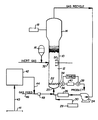
- a conventional fluidized bed reaction system for polymerizing alpha-olefins slightly modified to provide for water add back includes a reactor 10 which consists of a reaction zone 12 and a velocity reduction zone 14.
- the reaction zone 12 includes a bed of growing polymer particles, formed polymer particles and a minor amount of catalyst particles fluidized by the continuous flow of polymerizable and modifying gaseous components in the form of make-up feed and recycle gas through the reaction zone.
- the mass gas flow rate through the bed is normally maintained above the minimum flow required for fluidization, and preferably from 1.5 to 10 times G mf and more preferably from about 3 to about 6 times G mf .
- G mf is used in the accepted form as the abbreviation for the minimum gas flow required to achieve fluidization, C.Y. Wen and Y.H. Yu, "Mechanics of Fluidization", Chemical Engineering Progress Symposium Series, Vol. 62, pg. 100-111 (1966).
- the bed always contains particles to prevent the formation of localized "hot spots" and to entrap and distribute the particulate catalyst throughout the reaction zone.
- the reactor On start up, the reactor is usually charged with a base of particulate polymer particles before gas flow is initiated. Such particles may be identical in nature to the polymer to be formed or different therefrom. When different, they are withdrawn with the desired formed polymer particles as the first product. Eventually, a fluidized bed of the desired polymer particles supplants the start-up bed.
- the appropriate catalyst used in the fluidized bed is preferably stored for service in a reservoir 16 under a blanket of a gas which is inert to the stored material, such as nitrogen or argon.
- Fluidization is achieved by a high rate of gas recycle to and through the bed, typically in the order of about 50 times the rate of feed of make-up gas.
- the fluidized bed has the general appearance of a dense mass of viable particles in possible free-vortex flow as created by the percolation of gas through the bed.
- the pressure drop through the bed is equal to or slightly greater than the mass of the bed divided by the cross-sectional area. It is thus dependent on the geometry of the reactor.
- Make-up gas is fed to the bed at a rate equal to the rate at which particulate polymer product is withdrawn.
- the composition of the make-up gas is determined by a gas analyzer 18 positioned above the bed. The gas analyzer determines the composition of the gas being recycled and the composition of the make-up gas is adjusted accordingly to maintain an essentially steady state gaseous composition within the reaction zone.
- the recycle gas and, where desired, part or all of the make-up gas are returned to the reactor at base 20 below the bed.
- Gas distribution plate 22 positioned above the point of return ensures proper gas distribution and also supports the resin bed when gas flow is stopped.
- the portion of the gas stream which does not react in the bed constitutes the recycle gas which is removed from the polymerization zone, preferably by passing it into velocity reduction zone 14 above the bed where entrained particles are given an opportunity to drop back into the bed.
- the recycle gas is then compressed in a compressor 24 and thereafter passed through a heat exchanger 26 wherein it is stripped of heat of reaction before it is returned to the bed.
- a temperature gradient will exist in the bottom of the bed in a layer of 6 to 12 inches (15.24 to 30.48 cm), between the temperature of the inlet gas and the temperature of the remainder of the bed.
- the recycle is then returned to the reactor at its base 20 and to the fluidized bed through distribution plate 22.
- the compressor 24 can also be placed downstream of heat exchanger 26.
- Hydrogen may be used as a chain transfer agent for conventional polymerization reactions of the types contemplated herein.
- ethylene used as a monomer the ratio of hydrogen/ethylene employed will vary between 0 to 2.0 moles of hydrogen per mole of the monomer in the gas stream.
- Any gas inert to the catalyst and reactants can also be present in the gas stream.
- the cocatalyst is added to the gas recycle stream upstream of its connection with the reactor as from dispenser 28 through line 30.
- the fluid bed reactor is operated at pressures of up to 80-110 psi (551-758 kPa) for high density and 65-95 (448-655 kPa) for low and medium density.
- the catalyst is injected into the bed at a rate equal to its consumption at a point 32 which is above the distribution plate 22.
- a gas which is inert to the catalyst such as nitrogen or argon is usually used to carry the catalyst into the bed. Injecting the catalyst at a point above distribution plate 22 is an important feature. Since the catalysts normally used are highly active, injection into the area below the distribution plate may cause polymerization to begin there and eventually cause plugging of the distribution plate. Injection into the viable bed, instead, aids in distributing the catalyst throughout the bed and tends to preclude the formation of localized spots of high catalyst concentration which may result in the formation of "hot spots".
- the fluidized bed should be maintained at essentially a constant height by withdrawing a portion of the bed as product at a rate equal to the rate of formation of the particulate polymer product. Since the rate of heat generation is directly related to product formation, a measurement of the temperature rise of the gass across the reactor (the difference between inlet gas temperature and exit gas temperature) is determinative of the rate of particulate polymer formation at a constant gas velocity.
- the particulate polymer product is preferably withdrawn at a point 34 at or close to distribution plate 22.
- the particulate polymer product is conveniently and preferably withdrawn through the sequential operation of a pair of timed valves 36 and 38 defining a segregation zone 40. While valve 38 is closed, valve 36 is opened to emit a plug of gas and product to the zone 40 between it and valve 36 which is then closed. Valve 38 is then opened to deliver the product to an external recovery zone and after delivery, valve 38 is then closed to await the next product recovery operation.
- the fluidized bed reactor is equipped with an adequate venting system to allow venting the bed during the start up and shut down.
- the reactor does not require the use of stirring means and/or wall scraping means.
- the reactor vessel is normally constructed of carbon steel and is designed for the operating conditions stated above.
- the titanium based catalyst (Type IV) is introduced into the reactor 10 at point 32.
- sheets begin to form in reactor 10, at a site in the reactor proximate the wall of the reactor and located about a distance of one-half the reactor diameter up from the base of the fluid bed.
- the sheets of fused resin begin to appear in segregation zone 40, rapidly plugging the system, causing the reactor to be shut down. More characteristically the sheeting begins after production equivalent to 6 to 10 times the weight of the bed of resin in reactor 10.
- thermocouples were installed just inside the reactor walls at elevations of 1/4 to 1/2 reactor diameter above the gas distribution plate.
- skin thermocouples indicate temperatures equal to or slightly lower than the temperature of the fluidized bed. When sheeting occurs, these thermocouples may indicate temperature excursions of up to 20°C above the temperature of the fluidized bed thus providing reliable indication of the occurrence of sheeting.
- an electrostatic voltmeter was used to measure voltage on a 1/2 inch (1.27 cm) spherical electrode located in the fluid bed 1 inch (2.54 cm) radially from the reactor wall and usually 5 to 6 feet (1.5 to 1.8 m) above the gas distributor plate.
- the location was selected because sheet formation was observed to initiate in a band ranging from 1/4 to 3/4 reactor diameter in elevation above the base of the fluid bed. As is well known for deep fluidized beds, this corresponds to the region of least mixing intensity near the wall, i.e., a null zone where particle motion near the wall changes from generally upward to generally downward.
- the possible causes investigated included factors affecting mixing in the fluidized bed, reactor operating conditions, catalyst and resin particle size, particle size distribution, and others. A correlation was found between sheeting and buildup of static electric charge on the resin particles proximate the reactor walls. When the static voltage level of resin particles at particular sites proximate the reactor wall in a fluidized bed reactor is low, the reactor runs normally and no sheets are formed. When the static voltage level exceeds a critical level at those sites, uncontrolled sheeting occurs and the reactor must be shut down.
- the critical voltage level Vc for sheeting of ethylene homopolymers, ethylene-butene and ethylene-hexene copolymers is primarily a function of the resin sintering temperature, the reactor bed temperature and the concentration of hydrogen in the recycle gas.
- the sintering temperature of the resin under reactor operating conditions is the temperature at which a settled bed of resin in contact with a gas having the same composition as the reactor recycle gas used in producing the resin will sinter and form agglomerates when refluidization is attempted after allowing the bed to remain settled for fifteen minutes.
- the sintering temperature is decreased by decreasing the resin density, by increasing the melt index and by increasing the amount of dissolved monomers and monomer type.
- the art teaches various processes whereby static voltage can be reduced or eliminated. These comprise (1) reducing the rate of charge generation, (2) increasing the rate of discharge of electrical charge, and (3) neutralization of electrical charge.
- Some processes suited for use in a fluidized bed comprise (1) use of an additive to increase the conductivity of the particles thus providing a path for discharging, (2) installation of grounding devices in a fluidized bed to provide additional area for discharging electrostatic charges to ground, (3) ionization of gas or particles by electrical discharge to generate ions to neutralize electrostatic charges on the particles, and (4) the use of radioactive sources to produce radiation that will create ions to neutralize electrostatic charges on the particles.
- Any additive used must not act as a poison to the polymerization catalyst and must not adversely affect the quality of the product. It had been previously thought that water, the most widely used additive to reduce static on particles, cannot be used since it is a severe catalyst poison.
- an inert gas such as dry nitrogen from a nitrogen supply source, 41
- the O'Brien box generally contains one or more water tanks containing distilled water and is equipped with temperature and flow control means all of which are not shown.
- the nitrogen is bubbled through one of the water tanks which is a one liter stainless steel cylinder of distilled water in the temperature controlled housing.
- Water saturated nitrogen leaving the O'Brien box 42, through line 44, is then flow controlled through heat traced tubing to enter the olefin feed line such as ethylene feed line, 46, to the reaction cycle.
- Resultant water concentration in the ethylene is generally less than one part per million by volume.
- a moisture analyzer, 48, on the ethylene feed line 46 can be used for confirmation of water addition.
- a typical range for nitrogen flow control is 0 to 11 lbs/hr (0 to 5 kg/h) for an ethylene feed range of 0 to 50,000 lbs/hr (0 to 22680 kg/h).
- water cylinder temperature 20°C and 350 psig (2433 kPa
- nitrogen a range of 0 to 0.3 ppm water is realized. Adjustments in water temperature or nitrogen pressure can permit varying this range to desired levels.
- line 44 is preferably insulated and steam traced prior to entering the gas feed line 46.
- the polymers to which the present invention is primarily directed and which cause the sheeting problems above referred to in the presence of titanium catalysts are linear homopolymers of ethylene or linear copolymers of a major mol percent ( ⁇ 90%) of ethylene, and a minor mol percent ( ⁇ 10%) of one or more C3 to C8 alpha olefins.
- the C3 to C8 alpha olefins should not contain any branching on any of their carbon atoms which is closer than the fourth carbon atom.
- the preferred C3 to C8 alpha olefins are propylene, butene-1, pentene-1, hexene-1, 4-methylpentene-1, heptene-1, and octene-1. This description is not intended to exclude the use of this invention with alpha olefin homopolymer and copolymer resins in which ethylene is not a monomer.
- the homopolymers and copolymers have a density ranging from 0.97 to 0.91.
- the density of the copolymer, at a given melt index level is primarily regulated by the amount of the C3 to C8 comonomer which is copolymerized with the ethylene.
- the addition of progressively larger amounts of the comonomers to the copolymers results in a progressive lowering of the density of the copolymer.
- the amount of each of the various C3 to C8 comonomers needed to achieve the same result will vary from monomer to monomer, under the same reaction conditions. In the absence of the comonomer, the ethylene would homopolymerize.
- the melt index of a homopolymer or copolymer is a reflection of its molecular weight. Polymers having a relatively high molecular weight, have relatively high viscosities and low melt index.
- a reactor vessel such as shown in Figure 1 and which is susceptible to sheeting problems by the polymerization of the above described materials utilizing Type IV and Type V catalysts with an alkyl aluminum cocatalyst is partially filled with granular polyethylene resin which is purged with a non-reactive gas such as nitrogen and is fluidized by circulating said non-reacting gas through the reactor at a velocity above the minimum fluidizing velocity (Gmf) of the granular polyethylene and preferably at 3 to 5 Gmf.
- the reactor is brought up to operational temperatures by the gas and the reaction is started by introducing the catalyst and cocatalyst to the reactor.
- Examples 1 and 2 were conducted in a conventional bed reactor.
- the catalyst used was a Ziegler type, titanium based catalyst supported on porous silica produced as described earlier as Type IV.
- the cocatalyst used was triethyl aluminum.
- the products made in the examples were copolymers of ethylene and 1-butene. Hydrogen was used as a chain transfer agent to control the melt index of the polymer.
- a fluidized bed reactor was started up at operating conditions designed to produce a film grade low density ethylene copolymer product having a density of 0.918, a melt index of 1.0, and a sticking temperature of 104°C.
- the reaction was started by feeding catalyst to the reactor precharged with a bed of granular resin similar to the product to be made.
- the catalyst was a mixture of 5.5 parts titanium tetrachloride, 8.5 parts magnesium chloride and 14 parts tetrahydrofuran deposited on 100 parts Davison grade 955 silica which had been dehydrated at 600°C and treated with four parts triethylaluminum prior to deposition and was activated with thirty-five parts tri-n-hexyl aluminum subsequent to deposition.
- the reactor and resin bed Prior to starting catalyst feed, the reactor and resin bed were brought up to the operating temperature of 85°C, were purged of impurities by circulating nitrogen through the resin bed. Ethylene, butene and hydrogen concentrations were established at 53, 24, and 11%, respectively. Cocatalyst was fed at a rate of 0.3 parts triethylaluminum per part of catalyst.
- Reactor start-up was normal. After producing product for twenty-nine hours and equivalent to 6-1/2 times the weight of the fluidized bed, temperature excursions of 1 to 2°C above bed temperature were observed using thermocouples located just inside the reactor wall at an elevation of 1/2 reactor diameter above the gas distributor plate. Prior experience had shown that such temperature excursions are a positive indication that sheets of resin are being formed in the fluidized bed.
- bed voltage (measured using an electrostatic voltmeter connected to a 1/2 inch (1.27 cm) diameter spherical electrode located one inch (2.54 cm) from the reactor wall at an elevation of 1/2 reactor diameter above the gas distributor plate) increased from a reading of approximately +1500 to +2000 volts to a reading of over +5000 volts and then dropped back to +2000 volts over a 3 minute period.
- Temperature and voltage excursions continued for approximately 12 hours and increased in frequency and magnitude.
- sheets of fused polyethylene resin began to show up in the resin product.
- Evidence of sheeting became more severe, i.e., temperature excursions increased to as high as 20°C above bed temperature and stayed high for extended periods of time and voltage excursions also became more frequent.
- the reactor was shut down because of the extent of sheeting.
- the fluidized bed reactor used in Example 1 was started up and operated to produce a linear low density ethylene copolymer suitable for extrusion or rotational molding and having a density of 0.934, a melt index of 5 and a sticking temperature of 118°C.
- the reaction was started by feeding catalyst similar to the catalyst in Example 1 except activated with 28 parts tri-n-hexylaluminum, to the reactor precharged with a bed of granular resin similar to the product to be made. Prior to starting catalyst feed the reactor and the resin bed were brought up to the operating temperature of 85°C, and were purged of impurities with nitrogen. The concentration of ethylene (52%), butene (14%), hydrogen (21%) were introduced into the reactor.
- Example illustrates the prevention of sheeting by adding water to the gas feed during periods of high voltage in the reactor.
- the reactor of Examples 1 and 2 were modified as shown in Figure 1 and a high density film grade polyethylene resin of 0.946 density, 7.5 flow index, and sticking temperature of 124°C was continuously produced.
- the product was an ethylene-hexene copolymer utilizing a vanadium based catalyst with an aluminum alkyl cocatalyst and halogen promoter for polymerization.
- the catalyst contained 0.29 millimoles vanadium per gram of precursor and 1.2% aluminum added in the form of diethylaluminum chloride on a Davison silica support of 30-130 micron ( ⁇ m) size.
- Reaction proceeded with a bed temperature of 98°C, 76% ethylene, 1.6% hydrogen, 1.2% hexene, and the remaining concentration inert gases of nitrogen, methane, isopentane, etc. under a reactor pressure of 315 psia (2170 kPa).
- Cocatalyst was controlled by feeding triethylaluminum to maintain 200 ppmv in the resin produced.
- Freon was fed as a promoter to maintain a ratio of 0.7 moles freon to each mole of teal. Production rate was sustained at approximately 20,000 pph or a space time yield of 5 mlbs/hr/ft3 of bed volume.
- the static level was brought to control near zero and sheet formation was avoided and stable reactor operation was maintained without unwanted shutdowns from sheeting incidents.
- the modified reactor of Example 3 was utilized to produce a linear low density film resin.
- the resin produced was a 0.917 density, 2.7 melt index ethylene-hexene copolymer with a sticking temperature of 102°C.
- the catalyst used was a titanium based on a silica support. Loading of titanium was 0.25 millimoles per gram of precursor. Magnesium chloride, diethylaluminum chloride, and tri-normal hexylaluminum were added in molar ratios of 3, .02, .02 respectively to the titanium content.
- Silica support was Davison 955 with a micron size range of 10-80.
- Reaction is proceeded with a bed temperature of 76°C, 29% ethylene, 11% hydrogen, 5% 1-hexene, and the remaining concentrations inert nitrogen, ethane, methane, and isopentane.
- Cocatalyst was fed to control 300 ppmw triethylaluminum in the resin.
- Catalyst productivity under these conditions was 2200 pounds (998 kg) of polyethylene produced per pound of catalyst. Production rates were 18,000 pounds (8165 kg) per hour or 4.5 space time yield.
Landscapes
- Chemical & Material Sciences (AREA)
- Health & Medical Sciences (AREA)
- Chemical Kinetics & Catalysis (AREA)
- Medicinal Chemistry (AREA)
- Polymers & Plastics (AREA)
- Organic Chemistry (AREA)
- Polymerisation Methods In General (AREA)
- Addition Polymer Or Copolymer, Post-Treatments, Or Chemical Modifications (AREA)
- Transition And Organic Metals Composition Catalysts For Addition Polymerization (AREA)
Claims (10)
- Procédé pour réduire la formation de feuilles au cours de la polymérisation d'alpha-oléfines à des températures inférieures à la température de frittage du polymère dans un réacteur à lit fluidisé utilisant des composés à base de titane ou de vanadium comme catalyseurs conjointement avec des cocatalyseurs du type alkylaluminium, qui comprend l'introduction d'eau dans ledit réacteur en une quantité de 0,1 à 2 ppm sur la base de la charge d'alpha-oléfines afin de maintenir les quantités de charges électrostatiques au niveau du site de formation éventuelle de feuilles à des valeurs qui évitent la formation de feuilles sans modifier notablement l'efficacité desdits catalyseurs.
- Procédé suivant la revendication 1, dans lequel l'une des alpha-oléfines est l'éthylène.
- Procédé suivant l'une des, ou les deux, revendications 1 et 2, dans lequel l'eau est introduite dans le réacteur en faisant passer un gaz inerte sous pression, par exemple l'azote, à un débit ajusté à travers un récipient à température régulée contenant de l'eau pour ajouter de l'eau audit gaz inerte, en dirigeant ledit gaz inerte contenant de l'eau dudit récipient à température régulée dans un mélange avec ladite alpha-oléfine, par exemple l'éthylène, puis en introduisant ledit mélange dans ledit réacteur.
- Procédé suivant la revendication 3, dans lequel le débit du gaz, par exemple l'azote, le débit de l'apha-oléfine, par exemple l'éthylène, et la température de l'eau dans le récipient sont ajustés et sont déterminés en réponse aux quantités de charges statiques dans le réacteur.
- Procédé suivant une ou plusieurs des revendications 3 et 4, dans lequel la teneur en eau du mélange de charge d'alpha-oléfines, de gaz inerte et d'eau pénétrant dans le réacteur est inférieure à une partie par million, par exemple comprise dans l'intervalle de 0 à 0,3 ppm, sur la base de ladite charge d'alpha-oléfines, par exemple d'éthylène.
- Procédé suivant une ou plusieurs des revendications 3 à 5, dans lequel on fait varier le débit du gaz, par exemple l'azote, entre 0 et 11 lb/h (0 à 5 kg/h) pour une charge d'alpha-oléfine, par exemple d'éthylène, allant de 0 à 50 000 lb/h (0 à 22 680 kg/h).
- Procédé suivant une ou plusieurs des revendications 3 à 6, dans lequel la température de l'eau dans le récipient est régulée dans l'intervalle de 10°C à 40°C.
- Procédé suivant une ou plusieurs des revendications 1 à 7, dans lequel les polyoléfines sont des homopolymères linéaires d'éthylène ou des copolymères linéaires d'un pourcentage molaire dominant (≧90 %) d'éthylène et d'un pourcentage molaire secondaire (≦10 %) d'une ou plusieurs alpha-oléfines en C₃ à C₈.
- Procédé suivant la revendication 8, dans lequel les alpha-oléfines en C₃ à C₈ sont choisies entre le propylène, le butène-1, le pentène-1, l'hexène-1, le 4-méthylpentène-1, l'heptène-1 et l'octène-1.
- Procédé suivant une ou plusieurs des revendications 1 à 7, dans lequel les polyoléfines sont des homopolymères ou copolymères d'alpha-oléfines en C₃ à C₈, de préférence le propylène, le butène-1, le pentène-1, l'hexène-1, le 4-méthylpentène-1, l'heptène-1 et l'octène-1.
Priority Applications (3)
| Application Number | Priority Date | Filing Date | Title |
|---|---|---|---|
| AT88118338T ATE94564T1 (de) | 1988-11-03 | 1988-11-03 | Verfahren zum vermindern des zusammenbackens waehrend einer alpha-olefinpolymerisation. |
| DE19883884203 DE3884203T2 (de) | 1988-11-03 | 1988-11-03 | Verfahren zum Vermindern des Zusammenbackens während einer Alpha-Olefinpolymerisation. |
| SG133694A SG133694G (en) | 1988-11-03 | 1994-09-21 | Method for reducing sheeting during polymerization of alpha-olefins |
Applications Claiming Priority (1)
| Application Number | Priority Date | Filing Date | Title |
|---|---|---|---|
| US06/914,443 US4855370A (en) | 1986-10-01 | 1986-10-01 | Method for reducing sheeting during polymerization of alpha-olefins |
Publications (2)
| Publication Number | Publication Date |
|---|---|
| EP0366823A1 EP0366823A1 (fr) | 1990-05-09 |
| EP0366823B1 true EP0366823B1 (fr) | 1993-09-15 |
Family
ID=25434379
Family Applications (1)
| Application Number | Title | Priority Date | Filing Date |
|---|---|---|---|
| EP88118338A Expired - Lifetime EP0366823B1 (fr) | 1986-10-01 | 1988-11-03 | Procédé pour réduire la formation de feuilles pendant la polymérisation d'alpha-oléfines |
Country Status (7)
| Country | Link |
|---|---|
| US (1) | US4855370A (fr) |
| EP (1) | EP0366823B1 (fr) |
| CN (1) | CN1035384C (fr) |
| AU (1) | AU620051B2 (fr) |
| ES (1) | ES2058214T3 (fr) |
| MY (1) | MY104346A (fr) |
| OA (1) | OA09225A (fr) |
Cited By (1)
| Publication number | Priority date | Publication date | Assignee | Title |
|---|---|---|---|---|
| US7122607B2 (en) | 2004-05-20 | 2006-10-17 | Univation Technologies, Llc | Polymerization process |
Families Citing this family (152)
| Publication number | Priority date | Publication date | Assignee | Title |
|---|---|---|---|---|
| US5034479A (en) * | 1987-10-22 | 1991-07-23 | Union Carbide Chemicals And Plastics Technology Corporation | Process for reducing sheeting during polymerization of alpha-olefins |
| US5244987A (en) * | 1988-12-22 | 1993-09-14 | Bf Chemicals Limited | Process for alpha-olefin gas-phase polymerization controlled by the simultaneous addition of an activator and an activity retarder to the polymerization medium |
| US5385991A (en) * | 1990-07-27 | 1995-01-31 | Nippon Petrochemicals Company, Limited | Method for producing polyolefin |
| US5688865A (en) * | 1991-03-06 | 1997-11-18 | Mobil Oil Corporation | Process and system for preventing pressure tap fouling in tandem polymerization reactors |
| US5543478A (en) * | 1992-12-29 | 1996-08-06 | Nippon Petrochemicals Company, Limited | Method for operating reactor for polymerizing olefins |
| JP3216928B2 (ja) * | 1992-12-29 | 2001-10-09 | 日本石油化学株式会社 | 気相重合反応系の乾燥方法 |
| EP0604990B1 (fr) * | 1992-12-29 | 1997-06-11 | Nippon Petrochemicals Co., Ltd. | Procédé de polymérisation d'alpha-oléfine en phase vapeur |
| DE69329142T2 (de) * | 1992-12-30 | 2001-01-11 | Nippon Petrochemicals Co., Ltd. | Verfahren zur Olefinpolymerisation in der Dampfphase |
| CA2127822A1 (fr) | 1993-07-13 | 1995-01-14 | Yoshinori Morita | Procede de polymerisation en phase gazeuse d'olefine |
| US5391657A (en) * | 1993-09-27 | 1995-02-21 | Union Carbide Chemicals & Plastics Technology Corporaton | Method for reducing sheeting and static charges during polymerization of ethylene polymers |
| US5416175A (en) * | 1993-12-17 | 1995-05-16 | Union Carbide Chemicals & Plastics Technology Corporation | Method for reducing sheeting during polymerization of α-olefins |
| US5733988A (en) * | 1994-06-29 | 1998-03-31 | Union Carbide Chemicals & Plastics Technology Corporation | Process for reducing polymer build-up in recycle lines and heat exchangers during polymerizations employing butadiene, isoprene, and/or styrene |
| US6140432A (en) * | 1995-07-13 | 2000-10-31 | Exxon Chemical Patents Inc. | Polymerization catalyst systems, their production and use |
| US6124230A (en) * | 1995-07-13 | 2000-09-26 | Exxon Chemical Patents, Inc. | Polymerization catalyst systems, their production and use |
| US6008662A (en) * | 1996-10-31 | 1999-12-28 | Oxford Instruments America, Inc. | Apparatus and method for measuring conditions in fluidized beds |
| WO1999002573A1 (fr) * | 1997-07-08 | 1999-01-21 | Union Carbide Chemicals & Plastics Technology Cor Poration | Procede de reduction de la formation de feuilles pendant la polymerisation d'olefines |
| EP0959081A1 (fr) | 1998-05-19 | 1999-11-24 | Bp Chemicals S.N.C. | Procédé de polymérisation en phase gazeuse |
| TW475934B (en) | 1998-06-27 | 2002-02-11 | Basell Technology Co Bv | Process for the production of Α-olefin polymer |
| US7354880B2 (en) * | 1998-07-10 | 2008-04-08 | Univation Technologies, Llc | Catalyst composition and methods for its preparation and use in a polymerization process |
| DE19835467A1 (de) | 1998-08-06 | 2000-02-17 | Elenac Gmbh | Feststoffreaktor mit antistatischer Beschichtung zur Durchführung von Reaktionen in der Gasphase |
| US6111034A (en) * | 1998-12-31 | 2000-08-29 | Union Carbide Chemicals & Plastics Technology Corporation | Static control in olefin polymerization |
| US6300429B1 (en) * | 1998-12-31 | 2001-10-09 | Union Carbide Chemicals & Plastics Technology Corporation | Method of modifying near-wall temperature in a gas phase polymerization reactor |
| US6313236B1 (en) | 1999-03-30 | 2001-11-06 | Eastman Chemical Company | Process for producing polyolefins |
| DE69919408T2 (de) | 1999-03-30 | 2005-11-17 | Eastman Chemical Co., Kingsport | Verfahren zur herstellung von polyolefine |
| US6300432B1 (en) | 1999-03-30 | 2001-10-09 | Eastman Chemical Company | Process for producing polyolefins |
| US6288181B1 (en) | 1999-03-30 | 2001-09-11 | Eastman Chemical Company | Process for producing polyolefins |
| US6201076B1 (en) | 1999-04-29 | 2001-03-13 | Equistar Chemicals, L.P. | Olefin polymerization process with fatty amine additives for improved activity and reduced fouling |
| US6187879B1 (en) | 1999-08-31 | 2001-02-13 | Eastman Chemical Company | Process for producing polyolefins |
| US6191238B1 (en) | 1999-08-31 | 2001-02-20 | Eastman Chemical Company | Process for producing polyolefins |
| WO2001016189A1 (fr) | 1999-08-31 | 2001-03-08 | Eastman Chemical Company | Procede de production de polyolefines |
| US6359083B1 (en) | 2000-05-02 | 2002-03-19 | Eastman Chemical Company | Olefin polymerization process |
| US6905654B2 (en) | 2000-10-06 | 2005-06-14 | Univation Technologies, Llc | Method and apparatus for reducing static charges during polymerization of olefin polymers |
| US6548610B2 (en) * | 2000-10-06 | 2003-04-15 | Univation Technologies, Llc | Method and apparatus for reducing static charges during polymerization of olefin polymers |
| US6593267B2 (en) | 2000-12-18 | 2003-07-15 | Univation Technologies, Llc | Method for preparing a supported catalyst system and its use in a polymerization process |
| US6933258B2 (en) | 2000-12-19 | 2005-08-23 | Univation Technologies, L.L.C. | Catalyst composition and methods for its preparation and use in a polymerization process |
| EP1308464A1 (fr) * | 2001-10-19 | 2003-05-07 | BP Chemicals S.N.C. | Procédé de polymérisation d'oléfines en phase gazeuse dans un réacteur à lit fluidisé |
| US20050232995A1 (en) | 2002-07-29 | 2005-10-20 | Yam Nyomi V | Methods and dosage forms for controlled delivery of paliperidone and risperidone |
| US20050208132A1 (en) * | 2002-07-29 | 2005-09-22 | Gayatri Sathyan | Methods and dosage forms for reducing side effects of benzisozazole derivatives |
| US6884749B2 (en) | 2002-10-17 | 2005-04-26 | Equistar Chemicals L.P. | Supported catalysts which reduce sheeting in olefin polymerization, process for the preparation and the use thereof |
| US6630548B1 (en) | 2002-11-01 | 2003-10-07 | Equistar Chemicals, Lp | Static reduction |
| US6831140B2 (en) * | 2002-12-26 | 2004-12-14 | Univation Technologies, Llc | Static measurement and detection in a gas phase polyethylene reactor |
| WO2004094487A1 (fr) * | 2003-03-21 | 2004-11-04 | Dow Global Technologies, Inc. | Procede de polymerisation d'olefines avec controle de la morphologie |
| BRPI0413962B1 (pt) | 2003-09-23 | 2021-02-02 | Dow Global Technologies Inc | processo para a polimerização de etileno em fase gasosa |
| US7238756B2 (en) * | 2003-10-15 | 2007-07-03 | Univation Technologies, Llc | Polymerization process and control of polymer composition properties |
| US6828395B1 (en) | 2003-10-15 | 2004-12-07 | Univation Technologies, Llc | Polymerization process and control of polymer composition properties |
| US6878454B1 (en) | 2003-12-05 | 2005-04-12 | Univation Technologies, Llc | Polyethylene films |
| US20050148742A1 (en) * | 2004-01-02 | 2005-07-07 | Hagerty Robert O. | Method for controlling sheeting in gas phase reactors |
| US20070073012A1 (en) * | 2005-09-28 | 2007-03-29 | Pannell Richard B | Method for seed bed treatment before a polymerization reaction |
| US7985811B2 (en) * | 2004-01-02 | 2011-07-26 | Univation Technologies, Llc | Method for controlling sheeting in gas phase reactors |
| US7683140B2 (en) | 2004-05-20 | 2010-03-23 | Univation Technologies, Llc | Method for determining temperature value indicative of resin stickiness from data generated by polymerization reaction monitoring |
| US7754830B2 (en) | 2004-05-20 | 2010-07-13 | Univation Technologies, Llc | Polymerization reaction monitoring with determination of induced condensing agent concentration for preventing discontinuity events |
| WO2008008169A2 (fr) * | 2006-07-07 | 2008-01-17 | Univation Technologies, Llc | SystÈmes et mÉthodes de dÉtection des impuretÉs dans les systÈmes de rÉacteurs |
| EP2084194B1 (fr) * | 2006-07-31 | 2011-05-18 | Univation Technologies, LLC | Procédé et appareil de contrôle de la charge statique dans des réacteurs de polyoléfines |
| KR20090063245A (ko) * | 2006-09-07 | 2009-06-17 | 유니베이션 테크놀로지즈, 엘엘씨 | 용융개시온도 저하 모델을 사용하여 수지 점착도를 온-라인으로 결정하는 방법 |
| JP2010502813A (ja) * | 2006-09-07 | 2010-01-28 | ユニベーション・テクノロジーズ・エルエルシー | 重合反応監視によって生成したデータから樹脂粘着性を示す温度値を決定するための方法 |
| EP2089223A4 (fr) * | 2006-12-04 | 2010-04-14 | Univation Tech Llc | Revêtements semi-conducteurs pour un système de réaction de polyoléfines |
| TW200902558A (en) * | 2007-02-16 | 2009-01-16 | Univation Tech Llc | Method for on-line monitoring and control of polymerization processes and reactors to prevent discontinuity events |
| EP2082797A1 (fr) | 2007-12-24 | 2009-07-29 | Borealis Technology OY | Système réacteur pour la polymérisation catalytique d'oléfines comprenant un moyen de blindage et un procédé et utilisation correspondante |
| EP2090356A1 (fr) * | 2007-12-24 | 2009-08-19 | Borealis Technology OY | Systèmes réacteurs et procédé pour la polymérisation catalytique d'oléfines et l'utilisation d'un tel système réacteur dans la polymérisation catalytique d'oléfines |
| EP2090357B1 (fr) | 2007-12-24 | 2018-04-04 | Borealis Technology OY | Système réacteur et procédé pour la polymérisation catalytique d'oléfines et l'utilisation d'un tel système réacteur dans la polymérisation catalytique d'oléfines |
| EP2130862A1 (fr) | 2008-06-02 | 2009-12-09 | Borealis AG | Compositions polymères et tuyaux résistant à la pression fabriqués à partir de ces compositions |
| EP2130863A1 (fr) | 2008-06-02 | 2009-12-09 | Borealis AG | Compositions polymères haute densité, leur procédé de préparation et tuyaux résistants à la pression fabriqués à partir de ces compositions |
| EP2130859A1 (fr) | 2008-06-02 | 2009-12-09 | Borealis AG | Compositions polymères disposant d'une homogénéité et odeur améliorées, leur procédé de fabrication et tuyaux fabriqués à partir de ces compositions |
| EP2182524A1 (fr) | 2008-10-31 | 2010-05-05 | Borealis AG | Câble et composition de copolymère éthylénique multimodal |
| EP2182525A1 (fr) | 2008-10-31 | 2010-05-05 | Borealis AG | Câble et composition de copolymère éthylénique multimodal |
| EP2182526A1 (fr) | 2008-10-31 | 2010-05-05 | Borealis AG | Câble et composition de copolymère éthylénique multimodal |
| ES2381849T3 (es) | 2008-11-17 | 2012-06-01 | Borealis Ag | Procedimiento multietapa para producir polietileno con formación de gel reducida |
| US8124696B2 (en) | 2009-11-20 | 2012-02-28 | Univation Technologies, Llc | Method of using an upper discharge in a fluidized bed reactor and system thereof |
| RU2527945C2 (ru) | 2009-01-08 | 2014-09-10 | Юнивейшн Текнолоджиз, Ллк | Добавка для процессов полимеризации полиолефинов |
| WO2010080871A1 (fr) | 2009-01-08 | 2010-07-15 | Univation Technologies, Llc | Additif pour procédés de polymérisation en phase gazeuse |
| ATE529450T1 (de) | 2009-02-25 | 2011-11-15 | Borealis Ag | Multimodales polymer aus propylen, zusammensetzung damit und verfahren zur herstellung davon |
| EP2223944A1 (fr) | 2009-02-26 | 2010-09-01 | Borealis AG | Procédé de fabrication de polymères de propylène semicristallin |
| EP2322568B1 (fr) | 2009-11-13 | 2013-05-15 | Borealis AG | Procédé pour la production d'un catalyseur de polymérisation d'oléfine |
| ES2424958T3 (es) | 2009-11-13 | 2013-10-10 | Borealis Ag | Proceso para polimerización de olefinas |
| CN102686613B (zh) | 2009-11-13 | 2014-08-13 | 博瑞立斯有限公司 | 用于回收过渡金属化合物的方法 |
| WO2011058089A1 (fr) | 2009-11-13 | 2011-05-19 | Borealis Ag | Procédé de production d'un catalyseur de polymérisation |
| KR101959473B1 (ko) | 2010-03-17 | 2019-03-18 | 보레알리스 아게 | 유리한 전기적 특성을 갖는 와이어 및 케이블 용도의 중합체 조성물 |
| KR20130016285A (ko) | 2010-03-17 | 2013-02-14 | 보레알리스 아게 | 유리한 전기적 특성을 갖는 와이어 및 케이블 용도의 중합체 조성물 |
| CA2793693A1 (fr) | 2010-04-05 | 2011-10-13 | Dow Global Technologies Llc | Procede de polymerisation de polymeres a base d'olefines contenant des fractions de masse moleculaire elevee en mode condense et super-condense |
| EP2397221B1 (fr) | 2010-06-17 | 2017-04-12 | Borealis AG | Système de contrôle pour réacteur à phase gazeuse, réacteur à phase gazeuse pour la production catalytique de polyoléfines, procédé de production catalytique de polyoléfines et utilisation du système de contrôle |
| EP2452976A1 (fr) | 2010-11-12 | 2012-05-16 | Borealis AG | Copolymères de propylène hétérophasique dotés d'un équilibre amélioré entre rigidité, impact et fluidité |
| EP2452960B1 (fr) | 2010-11-12 | 2015-01-07 | Borealis AG | Procédé pour la préparation de polymères de propylène avec un taux de fluidité ultra élevé |
| EP2452957A1 (fr) | 2010-11-12 | 2012-05-16 | Borealis AG | Procédé amélioré pour la production de copolymères de propylène hétérophasiques |
| EP2452959B1 (fr) | 2010-11-12 | 2015-01-21 | Borealis AG | Procédé pour la production de copolymères aléatoires de propylène et leurs utilisations |
| US8703884B2 (en) | 2010-12-22 | 2014-04-22 | Univation Technologies, Llc | Additive for polyolefin polymerization processes |
| US8198384B1 (en) * | 2011-01-10 | 2012-06-12 | Westlake Longview Corporation | Method for preventing or reducing clogging of a fines ejector |
| EP2535372B1 (fr) | 2011-06-15 | 2016-09-14 | Borealis AG | Mélange en réacteur in situ d'un polypropylène nucléé catalysé par Ziegler-Natta et d'un polypropylène catalysé par métallocène |
| EP2570455A1 (fr) | 2011-09-16 | 2013-03-20 | Borealis AG | Composition de polyéthylène avec large distribution de poids moléculaire et homogénéité améliorée |
| EP2583998B1 (fr) | 2011-10-21 | 2018-02-28 | Borealis AG | Composition de polyéthylène avec résistance de propagation de fissures très rapides et résistance à la pression |
| EP2594333B1 (fr) | 2011-11-21 | 2014-07-30 | Borealis AG | Procédé de récupération de polymère et appareil associé |
| EP2599828A1 (fr) | 2011-12-01 | 2013-06-05 | Borealis AG | Composition de polyéthylène multimodale pour la production des tuyaux avec une résistance améliorée de croissance lente des fissures |
| US9376517B2 (en) | 2011-12-28 | 2016-06-28 | Ineos Europe Ag | Polymerisation process |
| US9533276B2 (en) | 2011-12-28 | 2017-01-03 | Ineos Europe Ag | Polymerization process in which inert gas supply is controlled according to ranking |
| EP2617741B1 (fr) | 2012-01-18 | 2016-01-13 | Borealis AG | Procédé de polymérisation de polymères d'oléfine en présence d'un système de catalyseur et procédé de contrôle du procédé |
| EP2620472B1 (fr) | 2012-01-24 | 2018-05-30 | Borealis AG | Composition de polyéthylène dotée d'une résistance améliorée à la pression à basse température |
| WO2014071119A1 (fr) | 2012-11-01 | 2014-05-08 | Univation Technologies, Llc | Catalyseurs mixtes ziegler-natta/chrome pour produits polymères améliorés |
| EP2730612B1 (fr) | 2012-11-09 | 2016-09-14 | Abu Dhabi Polymers Company Limited (Borouge) | Composition polymère comprenant un mélange de polyéthylène multimodal et polymère d'éthylène encore plus appropriée à la production d'un tuyau d'irrigation au goutte-à-goutte |
| EP2730611B1 (fr) | 2012-11-09 | 2017-01-04 | Abu Dhabi Polymers Company Limited (Borouge) | Tuyau d'irrigation au goutte-à-goutte comprenant une composition polymère avec une résine à base de polyéthylène multimodal |
| EP2740761B1 (fr) | 2012-12-05 | 2016-10-19 | Borealis AG | Composition de polyéthylène présentant un équilibre amélioré de résistance à la propagation des fissures lentes, la résistance aux chocs et une résistance à la pression des tuyaux pour des applications de tuyaux |
| EP2749580B1 (fr) | 2012-12-28 | 2016-09-14 | Borealis AG | Procédé de production de copolymères de propylène |
| EP2796473B1 (fr) | 2013-04-22 | 2017-05-31 | Borealis AG | Procédé en plusieurs étapes de production de compositions de polypropylène résistant à basse température |
| EP3235832B1 (fr) | 2013-04-22 | 2018-06-20 | Borealis AG | Compositions de polypropylène |
| EP2796472B1 (fr) | 2013-04-22 | 2017-06-28 | Borealis AG | Procédé en deux étapes pour la fabrication de compositions de polypropylène |
| PL2796498T3 (pl) | 2013-04-22 | 2019-03-29 | Abu Dhabi Polymers Company Limited (Borouge) | Multimodalna kompozycja polipropylenowa do zastosowania w rurach |
| TR201808436T4 (tr) | 2013-04-22 | 2018-07-23 | Abu Dhabi Polymers Co Ltd Borouge | Boru uygulamaları için geliştirilmiş darbe dayanımına sahip polipropilen kompozisyonu. |
| EP2796500B1 (fr) | 2013-04-22 | 2018-04-18 | Abu Dhabi Polymers Company Limited (Borouge) | Composition de copolymère aléatoire de propylène pour applications de tuyau |
| PL2796501T3 (pl) | 2013-04-22 | 2017-01-31 | Abu Dhabi Polymers Company Limited (Borouge) | Wielomodalna polipropylenowa kompozycja do zastosowań do rur |
| EP2813520A1 (fr) * | 2013-06-11 | 2014-12-17 | Basell Polyolefine GmbH | Procédé de polymérisation en présence d'une composition agissant de façon antistatique |
| CZ305857B6 (cs) | 2013-08-12 | 2016-04-13 | Polymer Institute Brno, Spol. S R.O. | Použití činidla pro nukleaci polyolefinů pro eliminaci tvorby úsad polyolefinového prášku v plynofázních polymeračních reaktorech |
| EP2853562A1 (fr) | 2013-09-27 | 2015-04-01 | Borealis AG | Procédé en deux étapes pour la fabrication de compositions de polypropylène |
| EP2860201A1 (fr) | 2013-10-10 | 2015-04-15 | Borealis AG | Polyéthylène résistant aux températures élevées et son procédé de production |
| EP2860200B1 (fr) | 2013-10-10 | 2017-08-02 | Borealis AG | Composition de polyéthylène pour tuyau et applications de revêtement de tuyau |
| EP2860204B1 (fr) | 2013-10-10 | 2018-08-01 | Borealis AG | Composition de polyéthylène pour applications de tuyau |
| EP2860203B1 (fr) | 2013-10-10 | 2016-12-14 | Borealis AG | Procédé en plusieurs étapes de production de compositions de polyéthylène |
| PL2860202T3 (pl) | 2013-10-10 | 2018-11-30 | Borealis Ag | Polietylen odporny na wysoką temperaturę i sposób jego wytwarzania |
| WO2015061922A1 (fr) | 2013-10-30 | 2015-05-07 | Abu Dhabi Polymers Co. Ltd (Borouge) L.L.C. | Composition de polyéthylène appropriée pour des applications de moulage par injection |
| EP2883887A1 (fr) | 2013-12-13 | 2015-06-17 | Borealis AG | Procédé en plusieurs étapes de production de compositions de polyéthylène |
| EP2883885A1 (fr) | 2013-12-13 | 2015-06-17 | Borealis AG | Procédé en plusieurs étapes de production de compositions de polyéthylène |
| EP2894174B1 (fr) | 2013-12-20 | 2018-02-07 | Borealis AG | Composition de polyéthylène avec une grande flexibilité et une résistance à haute température convenant à des applications de tuyau |
| EP2894195B1 (fr) | 2013-12-23 | 2016-09-14 | Abu Dhabi Polymers Company Limited (Borouge) | Composition de polyéthylène pour applications de tuyau présentant de meilleures propriétés d'affaissement |
| WO2016091803A1 (fr) | 2014-12-08 | 2016-06-16 | Borealis Ag | Procédé de production de granulés de copolymères de propylène |
| CN112979842B (zh) | 2015-02-05 | 2022-11-11 | 博里利斯股份公司 | 用于生产聚乙烯的方法 |
| WO2016131907A1 (fr) | 2015-02-20 | 2016-08-25 | Borealis Ag | Procédé de production de copolymères de propylène hétérophasiques |
| EP3088458B2 (fr) | 2015-04-27 | 2022-10-05 | Abu Dhabi Polymers Company Limited (Borouge) L.L.C. | Composition de polyéthylène adaptée à des applications de tuyau |
| EP3109275B1 (fr) | 2015-06-22 | 2017-08-09 | Abu Dhabi Polymers Company Limited (Borouge) L.L.C. | Composition de polyethylene pour applications de canalisations presentant des proprietes d'affaissement et d'extrusion ameliorees |
| EP3109261B1 (fr) | 2015-06-23 | 2018-12-26 | Borealis AG | Procede de production de resines lldpe |
| EP3238938A1 (fr) | 2016-04-29 | 2017-11-01 | Borealis AG | Film orienté dans le sens machine comprenant un copolymère d'éthylène multimodal et au moins deux comonomères d'alpha-oléfines |
| PL3252085T3 (pl) | 2016-05-31 | 2023-02-13 | Borealis Ag | Pancerz o polepszonych właściwościach |
| CN109415544B (zh) | 2016-05-31 | 2022-07-05 | 博里利斯股份公司 | 聚合物组合物以及用于生产该聚合物组合物的方法 |
| CN109415448B (zh) | 2016-06-22 | 2021-04-13 | 北欧化工公司 | 聚合物组合物以及制备聚合物组合物的方法 |
| BR112019002951B1 (pt) | 2016-11-25 | 2022-12-20 | Borealis Ag | Composição de polímero, artigo, uso da composição de polietileno, e, processo para a produção de uma composição de polímero |
| EP3418330B2 (fr) | 2017-06-21 | 2023-07-19 | Borealis AG | Composition polymère et procédé de production associé |
| CN109135067A (zh) | 2017-06-27 | 2019-01-04 | 阿布扎比聚合物有限责任公司(博禄) | 用于制造高压管的聚丙烯组合物 |
| KR20210033017A (ko) | 2018-07-19 | 2021-03-25 | 보레알리스 아게 | 초고분자량 폴리에틸렌 동종중합체의 제조 방법 |
| WO2020088987A1 (fr) | 2018-10-31 | 2020-05-07 | Borealis Ag | Composition de polyéthylène pour des tuyaux résistants à une haute pression présentant une homogénéité améliorée |
| EP3647645A1 (fr) | 2018-10-31 | 2020-05-06 | Borealis AG | Composition de polyéthylène pour tuyaux résistant à une haute pression |
| SG11202102809UA (en) | 2018-11-28 | 2021-04-29 | Abu Dhabi Polymers Co Ltd Borouge | Polyethylene composition for film applications |
| US11820879B2 (en) | 2018-12-28 | 2023-11-21 | Braskem S.A. | Continuous feed of antistatic agent for gas phase polymerization process |
| US11352375B2 (en) | 2018-12-28 | 2022-06-07 | Braskem S.A. | Auxiliaries for olefin polymerization process |
| KR102670190B1 (ko) | 2019-06-24 | 2024-05-28 | 보레알리스 아게 | 회수율이 개선된 폴리프로필렌의 제조 공정 |
| JP7438324B2 (ja) | 2019-07-22 | 2024-02-26 | アブ・ダビ・ポリマーズ・カンパニー・リミテッド・(ブルージュ)・リミテッド・ライアビリティ・カンパニー | シングルサイト触媒によるマルチモーダルポリエチレン組成物 |
| EP4025614A1 (fr) | 2019-09-05 | 2022-07-13 | ExxonMobil Chemical Patents Inc. | Procédés de production de polyoléfines et de copolymères résistant aux chocs ayant une large distribution de poids moléculaire et une rigidité élevée |
| EP3835327B1 (fr) | 2019-12-09 | 2024-07-31 | Borealis AG | Système de production de polyoléfine et procédé de récupération de produit de polymérisation à partir d'un réacteur en phase gazeuse |
| CN115210267A (zh) | 2020-01-24 | 2022-10-18 | 埃克森美孚化学专利公司 | 生产双峰聚烯烃和抗冲共聚物的方法 |
| US20230077569A1 (en) | 2020-02-17 | 2023-03-16 | Exxonmobil Chemical Patents Inc. | Propylene-based polymer compositions having a high molecular weight tail |
| KR102513518B1 (ko) | 2020-12-23 | 2023-03-22 | 디엘케미칼 주식회사 | 메탈로센 올레핀 중합 공정용 대전방지제를 이용한 올레핀 중합 방법 |
| EP4019583B1 (fr) | 2020-12-28 | 2024-04-10 | ABU DHABI POLYMERS CO. LTD (BOROUGE) - Sole Proprietorship L.L.C. | Composition de polyéthylène pour des applications de films à résistance et rigidité améliorées |
| EP4389820A1 (fr) | 2022-12-21 | 2024-06-26 | Borealis AG | Compositions de copolymère statistique de polypropylène présentant une résistance aux chocs améliorée pour des applications de tuyau |
| EP4389777A1 (fr) | 2022-12-22 | 2024-06-26 | Borealis AG | Polyéthylène haute densité pour applications de tuyau présentant des performances de pression et des propriétés mécaniques améliorées |
| EP4393967A1 (fr) | 2022-12-27 | 2024-07-03 | Borealis AG | Pe100-rc avec butène comme comonomère |
| EP4570856A1 (fr) | 2023-12-14 | 2025-06-18 | Borealis AG | Compositions de copolymère statistique de polypropylène présentant une résistance aux chocs améliorée pour des applications de tuyau |
| EP4574894A1 (fr) | 2023-12-22 | 2025-06-25 | Abu Dhabi Polymers Co. Ltd (Borouge) - Sole Proprietorship L.L.C. | Tuyau en polyéthylène avec performance de pression hydrostatique à haute température améliorée |
Family Cites Families (13)
| Publication number | Priority date | Publication date | Assignee | Title |
|---|---|---|---|---|
| GB856815A (en) * | 1956-04-12 | 1960-12-21 | Hoechst Ag | Process for preparing polyolefines |
| US3440237A (en) * | 1958-05-22 | 1969-04-22 | Monsanto Co | Production of polyethylene with water-modified ziegler catalyst |
| US3177184A (en) * | 1961-02-16 | 1965-04-06 | Phillips Petroleum Co | Method for controlling the polymer production rate of copolymers of ethylene with higher olefins |
| DE2001183C3 (de) * | 1970-01-13 | 1980-01-31 | Chemische Werke Huels Ag, 4370 Marl | Verfahren zur Unterbrechung und Wiederingangsetzung von Olefinpolymerisationen |
| US4130699A (en) * | 1977-11-25 | 1978-12-19 | Standard Oil Company (Indiana) | Vapor phase polymerization with temporarily inactive titanium catalyst |
| US4182810A (en) * | 1978-04-21 | 1980-01-08 | Phillips Petroleum Company | Prevention of fouling in polymerization reactors |
| AU526104B2 (en) * | 1978-09-08 | 1982-12-16 | Geon Company, The | Polymerization of vinyl chloride |
| JPS564608A (en) * | 1979-06-26 | 1981-01-19 | Mitsubishi Petrochem Co Ltd | Vapor-phase polymerization of olefin |
| US4532311A (en) * | 1981-03-26 | 1985-07-30 | Union Carbide Corporation | Process for reducing sheeting during polymerization of alpha-olefins |
| DZ520A1 (fr) * | 1982-03-24 | 2004-09-13 | Union Carbide Corp | Procédé perfectionné pour accroitre le rendement espace temps d'une réaction de polymérisation exothermique en lit fluidisé. |
| EP0136029A3 (fr) * | 1983-09-01 | 1986-08-20 | Mobil Oil Corporation | Procédé et système d'injection d'un gaz d'arrêt dans la phase gazeuse d'un réacteur de polymérisation catalytique |
| DE3600611A1 (de) * | 1986-01-11 | 1987-07-16 | Basf Ag | Einsatz von antistatika zur vermeidung von belagbildung bei der herstellung von ultrahochmolekularem polyethylen in gasphasenreaktoren |
| US4803251A (en) * | 1987-11-04 | 1989-02-07 | Union Carbide Corporation | Method for reducing sheeting during polymerization of alpha-olefins |
-
1986
- 1986-10-01 US US06/914,443 patent/US4855370A/en not_active Expired - Lifetime
-
1988
- 1988-11-03 ES ES88118338T patent/ES2058214T3/es not_active Expired - Lifetime
- 1988-11-03 MY MYPI88001260A patent/MY104346A/en unknown
- 1988-11-03 CN CN88108823A patent/CN1035384C/zh not_active Expired - Fee Related
- 1988-11-03 EP EP88118338A patent/EP0366823B1/fr not_active Expired - Lifetime
- 1988-11-03 AU AU24641/88A patent/AU620051B2/en not_active Ceased
- 1988-12-23 OA OA59500A patent/OA09225A/fr unknown
Cited By (1)
| Publication number | Priority date | Publication date | Assignee | Title |
|---|---|---|---|---|
| US7122607B2 (en) | 2004-05-20 | 2006-10-17 | Univation Technologies, Llc | Polymerization process |
Also Published As
| Publication number | Publication date |
|---|---|
| CN1035384C (zh) | 1997-07-09 |
| US4855370A (en) | 1989-08-08 |
| AU2464188A (en) | 1990-05-17 |
| OA09225A (fr) | 1992-06-30 |
| CN1042365A (zh) | 1990-05-23 |
| AU620051B2 (en) | 1992-02-13 |
| EP0366823A1 (fr) | 1990-05-09 |
| ES2058214T3 (es) | 1994-11-01 |
| MY104346A (en) | 1994-03-31 |
Similar Documents
| Publication | Publication Date | Title |
|---|---|---|
| US4855370A (en) | Method for reducing sheeting during polymerization of alpha-olefins | |
| EP0315192B1 (fr) | Procédé pour réduire la formation de feuilles pendant la polymérisation d'alpha-oléfines | |
| US4532311A (en) | Process for reducing sheeting during polymerization of alpha-olefins | |
| US4876320A (en) | Process for reducing sheeting during polymerization of alpha-olefins | |
| US4792592A (en) | Process for reducing sheeting during polymerization of alpha-olefins | |
| CN114656584B (zh) | 使用用于茂金属烯烃聚合过程的抗静电剂的烯烃聚合方法 | |
| US5034479A (en) | Process for reducing sheeting during polymerization of alpha-olefins | |
| EP0313087B1 (fr) | Procédé pour réduire la formation de feuilles pendant la polymérisation d'alpha-oléfines | |
| WO1999002573A1 (fr) | Procede de reduction de la formation de feuilles pendant la polymerisation d'olefines | |
| AU590720B2 (en) | Process for reducing sheeting in polymerization of alpha-olefins | |
| CA1312172C (fr) | METHODE POUR REDUIRE LA FORMATION DE FEUILLES AU COURS DE LA POLYMERISATION D'.alpha.-OLEFINES | |
| KR930007502B1 (ko) | 알파-올레핀의 중합반응시 쉬트화를 감소시키는 방법 | |
| JPH02145608A (ja) | α−オレフィンの重合間におけるシーチングの減少法 | |
| NZ226828A (en) | Method for preventing polyolefin deposition on reactor walls (sheeting) during olefin polymerisation by addition of water | |
| IE61912B1 (en) | "Method for reducing sheeting during polymerization of alpha-olefins" | |
| IE58346B1 (en) | Process for reducing sheeting during polymerization of alpha-olefins | |
| FI91415B (fi) | Menetelmä levynmuodostumisen vähentämiseksi alfa-olefiineja polymeroitaessa | |
| NZ212052A (en) | Method of reducing sheeting during polymerisation of alpha-olefines in fluidised bed reactor | |
| HU206128B (en) | Process for reducing lamination in polymerization of alpha-olefins | |
| CZ281858B6 (cs) | Způsob snížení tvorby plaket v průběhu polymerace alfa-olefinů | |
| NO170980B (no) | Fremgangsmaate for aa redusere arkdannelse under fremstilling av polyolefiner | |
| PT88935B (pt) | Metodo para reduzir a formacao de folhas durante a polimerizacao de alfa- olefinas |
Legal Events
| Date | Code | Title | Description |
|---|---|---|---|
| PUAI | Public reference made under article 153(3) epc to a published international application that has entered the european phase |
Free format text: ORIGINAL CODE: 0009012 |
|
| AK | Designated contracting states |
Kind code of ref document: A1 Designated state(s): AT BE CH DE ES FR GB GR IT LI LU NL SE |
|
| 17P | Request for examination filed |
Effective date: 19900913 |
|
| 17Q | First examination report despatched |
Effective date: 19911008 |
|
| GRAA | (expected) grant |
Free format text: ORIGINAL CODE: 0009210 |
|
| AK | Designated contracting states |
Kind code of ref document: B1 Designated state(s): AT BE CH DE ES FR GB GR IT LI LU NL SE |
|
| REF | Corresponds to: |
Ref document number: 94564 Country of ref document: AT Date of ref document: 19931015 Kind code of ref document: T |
|
| REF | Corresponds to: |
Ref document number: 3884203 Country of ref document: DE Date of ref document: 19931021 |
|
| ITF | It: translation for a ep patent filed | ||
| ET | Fr: translation filed | ||
| PG25 | Lapsed in a contracting state [announced via postgrant information from national office to epo] |
Ref country code: LU Free format text: LAPSE BECAUSE OF NON-PAYMENT OF DUE FEES Effective date: 19931130 |
|
| REG | Reference to a national code |
Ref country code: GR Ref legal event code: FG4A Free format text: 3009988 |
|
| PLBE | No opposition filed within time limit |
Free format text: ORIGINAL CODE: 0009261 |
|
| STAA | Information on the status of an ep patent application or granted ep patent |
Free format text: STATUS: NO OPPOSITION FILED WITHIN TIME LIMIT |
|
| 26N | No opposition filed | ||
| REG | Reference to a national code |
Ref country code: ES Ref legal event code: FG2A Ref document number: 2058214 Country of ref document: ES Kind code of ref document: T3 |
|
| EAL | Se: european patent in force in sweden |
Ref document number: 88118338.8 |
|
| PGFP | Annual fee paid to national office [announced via postgrant information from national office to epo] |
Ref country code: CH Payment date: 19950131 Year of fee payment: 7 |
|
| PG25 | Lapsed in a contracting state [announced via postgrant information from national office to epo] |
Ref country code: CH Effective date: 19951130 Ref country code: LI Effective date: 19951130 |
|
| REG | Reference to a national code |
Ref country code: CH Ref legal event code: PL |
|
| PGFP | Annual fee paid to national office [announced via postgrant information from national office to epo] |
Ref country code: GR Payment date: 19981126 Year of fee payment: 11 |
|
| PG25 | Lapsed in a contracting state [announced via postgrant information from national office to epo] |
Ref country code: GR Free format text: LAPSE BECAUSE OF NON-PAYMENT OF DUE FEES Effective date: 19991130 |
|
| REG | Reference to a national code |
Ref country code: GB Ref legal event code: IF02 |
|
| PGFP | Annual fee paid to national office [announced via postgrant information from national office to epo] |
Ref country code: AT Payment date: 20020913 Year of fee payment: 15 |
|
| PG25 | Lapsed in a contracting state [announced via postgrant information from national office to epo] |
Ref country code: AT Free format text: LAPSE BECAUSE OF NON-PAYMENT OF DUE FEES Effective date: 20031103 |
|
| PGFP | Annual fee paid to national office [announced via postgrant information from national office to epo] |
Ref country code: NL Payment date: 20041006 Year of fee payment: 17 |
|
| PGFP | Annual fee paid to national office [announced via postgrant information from national office to epo] |
Ref country code: ES Payment date: 20041116 Year of fee payment: 17 |
|
| PGFP | Annual fee paid to national office [announced via postgrant information from national office to epo] |
Ref country code: BE Payment date: 20041130 Year of fee payment: 17 |
|
| PGFP | Annual fee paid to national office [announced via postgrant information from national office to epo] |
Ref country code: GB Payment date: 20051004 Year of fee payment: 18 |
|
| PG25 | Lapsed in a contracting state [announced via postgrant information from national office to epo] |
Ref country code: IT Free format text: LAPSE BECAUSE OF NON-PAYMENT OF DUE FEES;WARNING: LAPSES OF ITALIAN PATENTS WITH EFFECTIVE DATE BEFORE 2007 MAY HAVE OCCURRED AT ANY TIME BEFORE 2007. THE CORRECT EFFECTIVE DATE MAY BE DIFFERENT FROM THE ONE RECORDED. Effective date: 20051103 |
|
| PG25 | Lapsed in a contracting state [announced via postgrant information from national office to epo] |
Ref country code: ES Free format text: LAPSE BECAUSE OF NON-PAYMENT OF DUE FEES Effective date: 20051104 |
|
| PGFP | Annual fee paid to national office [announced via postgrant information from national office to epo] |
Ref country code: FR Payment date: 20051104 Year of fee payment: 18 |
|
| PGFP | Annual fee paid to national office [announced via postgrant information from national office to epo] |
Ref country code: SE Payment date: 20051107 Year of fee payment: 18 |
|
| PG25 | Lapsed in a contracting state [announced via postgrant information from national office to epo] |
Ref country code: BE Free format text: LAPSE BECAUSE OF NON-PAYMENT OF DUE FEES Effective date: 20051130 |
|
| PGFP | Annual fee paid to national office [announced via postgrant information from national office to epo] |
Ref country code: DE Payment date: 20051130 Year of fee payment: 18 |
|
| PG25 | Lapsed in a contracting state [announced via postgrant information from national office to epo] |
Ref country code: NL Free format text: LAPSE BECAUSE OF NON-PAYMENT OF DUE FEES Effective date: 20060601 |
|
| NLV4 | Nl: lapsed or anulled due to non-payment of the annual fee |
Effective date: 20060601 |
|
| PG25 | Lapsed in a contracting state [announced via postgrant information from national office to epo] |
Ref country code: SE Free format text: LAPSE BECAUSE OF NON-PAYMENT OF DUE FEES Effective date: 20061104 |
|
| REG | Reference to a national code |
Ref country code: ES Ref legal event code: FD2A Effective date: 20051104 |
|
| PG25 | Lapsed in a contracting state [announced via postgrant information from national office to epo] |
Ref country code: DE Free format text: LAPSE BECAUSE OF NON-PAYMENT OF DUE FEES Effective date: 20070601 |
|
| EUG | Se: european patent has lapsed | ||
| GBPC | Gb: european patent ceased through non-payment of renewal fee |
Effective date: 20061103 |
|
| REG | Reference to a national code |
Ref country code: FR Ref legal event code: ST Effective date: 20070731 |
|
| PG25 | Lapsed in a contracting state [announced via postgrant information from national office to epo] |
Ref country code: GB Free format text: LAPSE BECAUSE OF NON-PAYMENT OF DUE FEES Effective date: 20061103 |
|
| BERE | Be: lapsed |
Owner name: *UNION CARBIDE CORP. Effective date: 20051130 |
|
| PG25 | Lapsed in a contracting state [announced via postgrant information from national office to epo] |
Ref country code: FR Free format text: LAPSE BECAUSE OF NON-PAYMENT OF DUE FEES Effective date: 20061130 |